In the shadow of Brexit

Back in May I wrote a post ‘It’s not about supporting Jeremy Corbyn anymore’, which stated it was about opposing Brexit, and ditching Labour’s disastrous support for it, poorly disguised in such a way as to piss off anyone with a strong view on the matter. I said after the European elections in which the Tories came fifth, with less than 10 per cent of the vote that –

“The Tories only need a new leader promising Brexit, with a bit more credibility, to have a hope of some recovery, and they’re electing one.  And if they fall short it will not be because Labour has surged forward but because Farage has managed to carry forward his success into a general election.”

But of course, Farage was pulled into line by those with the money and the only significant shift in Labour’s policy was support for a second referendum, except that I noted at the same time that “it’s not about a referendum – if Labour supported some version of Brexit to be approved by a referendum Corbyn would be politically as dead as a Monty Python parrot.”  Which he now is, because his promise to negotiate his own Brexit, and then put it to a vote without committing to supporting it, made no sense.  Then he defeated a motion to support Remain at the Labour conference while promising that a future conference would decide.

In a Facebook discussion I was admonished for not recognising that the gains of the Corbyn movement were a massively increased left membership, a sprinkling of new left MPs and an audience for anti-capitalist ideas.

That a mass membership was encouraged by Jeremy Corbyn’s leadership is clear, but it also became clear that for this leadership the role of the movement was to follow the leader, not to transform the Party into the social movement that many hoped and believed it should become.  That’s why a claim could only be made that there was a smattering of new left MPs.  This is as much the legacy of Corbyn as defeat in two elections and a divided and untransformed Party, with no clear successor never mind a good range of candidates from which the left membership could choose.

As for an audience for anti-capitalism, I believe in something which is so much more than this negative identification and that has for two hundred years gone a long way in demonstrating not only what is wrong with capitalism but also setting out the alternative.  Brexit itself is a sort of anti-capitalism, in the Lexit, reactionary, stop the development of modern capitalism sort of way that wants to go backwards to when the nation state set the framework of economic and social development.  The proclamation of anti-capitalism as a touchstone is a political retreat and confusion by the left and is consistent with such anti-capitalist phenomenon as Stalinism, and other reactionary populist politics that are inconsistent with the fullest development of capitalism but also antithetical to socialism.

While Corbyn might be leaving the stage, we continue to be under the shadow of his triangulated Brexit policy, including the narrative of a non-existent principle that we must respect a reactionary referendum result regardless of its consequences.  Also included is the idea of a Labour Brexit, one that will supposedly be progressive but bizarrely involves no commitment to supporting it, in fact a declaration of neutrality by the leader with further evasion through postponing a conference that would determine the Party’s position in any second referendum

These are only some of the contortions that have characterised Corbyn’s Brexit policy.  To declare surprise at his unpopularity in the election after such a catalogue of evasion is to audition for the role of one or all of the three wise monkeys.

The failure to openly and honestly fight for Brexit by the leadership, hiding behind six tests; the nonsense of a Labour deal with all the benefits of EU membership but none of the costs; weeks of talks with Theresa May to identify a common Brexit policy, and then claims that a deal could be agreed and voted on within six months (because the EU had agreed to Labour policy!), all this continues to confuse.

For what is most striking about Corbyn and his Brexit policy is not his opposition to Remain but his inability to argue for Brexit.  Like the small left groups who claim that explicit support for Brexit would have defeated the Tories, they fail to explain how all those who are happy to vote for the Tories and Brexit Party could be won to a Labour Brexit that would be denounced as a fraud; or explain what price would be paid in terms of the reactionary politics of nationalism and racism that would be necessary to adopt even to make the attempt.

And what would these groups expect the 68 per cent of Labour’s voters who voted Remain to do while such a policy was pursued, including those in the North of England – in the ‘traditional working class’ areas – who voted to Remain?  How could it ever become Party policy when an even greater percentage of the Labour membership support Remain?

The answer, of course, is that it couldn’t.  And because it couldn’t it wasn’t, although this did not prevent all these groups declaring the need for the impossible – open Labour support for Brexit – that they didn’t even fight for themselves. When was this openly presented as the policy to be supported, as opposed to all the duplicitous evasions listed above?

What exactly was Lexit?  What would it entail? For some it seemed not to matter after it was assumed it would happen – the detail was unimportant, only the economic policy of a future left British Government would matter.  For others it was all the benefits but none of the costs – membership of the customs union and Single Market but no free movement of people and no seat at the table that sets the rules because Britain could help set them from outside, or ignore them if it wanted.  For others it became no deal and trade on WTO terms, sometimes with the lie that these WTO rules meant no real change to the current trading arrangements for years. For others, supporting Brexit seemed only a matter of timing (it was an ok idea before but not now) and a question of who would lead the caravan across the desert and not where it was going.  No wonder there was no open fight inside the Party to win it to explicit support for Brexit.

So now we have a leadership contest where we are threatened with all this vacuous and reactionary nonsense again, with added soundbites and personality claims that only embarrass the listener.

And the obfuscation also continues.  The latest piece I’ve read is an attack on “obsessive Remainers” who have scored “a massive own goal” because they pushed for a second referendum and thereby brought about the victory of Johnson and a hard Brexit.

While it is arguable that a second referendum was not the way to stop Brexit – that was better carried out by a general election in which Labour committed to stopping it – the real claim is that a Labour Brexit was the way forward.  In other words, this is another Brexit-supporting proposition that doesn’t quite declare its love but criticises those who had the temerity to openly fight for Remain.  That this was far from a lost cause can be appreciated from the vote at the Labour conference before the election, when only some sharp practice prevented such a policy being adopted.

While the target is those who fought for Remain the argument is framed around the centrist opposition, represented by “Alastair Campbell, Peter Mandelson, and Chuka Umunna [who] knew how to play the media and get their message across”, plus the Peoples Vote campaign.

Absent from the analysis are the millions of people this campaign mobilised who were far from all being supporters of the Labour right, and who represented a movement that a Brexit-opposing Labour Party could easily have challenged for leadership of, but which Corbyn through his absence demonstrated opposition.  Along with failure to democratise the Party, this abandonment of a progressive mass campaign to a right-wing leadership is the most criminal of Corbyn’s failings.

Absent also, is any appreciation of the mass support of the voters and members of the Labour Party who also opposed Brexit and are the key constituency defining the possibilities that socialists have to make any significant step forward.  Instead we are invited by supporters of Brexit to orient to a so-called traditional working class that no longer exists in its previous form because the industrial, social and political environment that created it was destroyed.

The article states that “It would be fatuous to scold liberals for not supporting Corbynism, a project that was never their own (although some did claim to support the kind of social-democratic policies that Labour spelled out in its election manifestos). But we can certainly blame them for undermining their own self-proclaimed goal: to stop Brexit . . .”   Scolding  liberals, however, is all that the article does, so it is doubly fatuous by the fact that the author isn’t concerned that Brexit be stopped, so why would anyone with such an aim pay any heed to it?

The hypothesis is put forward that “a so-called ‘soft-Brexit’ deal would have been a perfectly acceptable framework for Labour to carry out domestic social reforms: a step sideways, not a step backward”, a claim made not in order to prevent “rewriting history and shifting the blame”, but to define the next step forward, including the identity of the new leadership of the Party.

This claim is certainly less bold than the ‘jobs Brexit’ claimed by the leadership of the Labour Party but it is still false: the exit of the UK from the EU will put up barriers to migration, trade, investment and economic growth that will very definitely not simply be “a step sideways”. Only those on the left who think that stuffing capitalism or a capitalism in crisis is the objective (i.e. ‘anti-capitalism’) could mistake this as a step forward for the working class.

The best opportunity to achieve the ‘soft’ Brexit that the author considers acceptable was when “Labour came forward with its own platform for the Brexit negotiations that set out clearly the terms of a soft-Brexit deal. It was practical and achievable — and the leading EU officials said so publicly.”

Unfortunately, this “perfectly acceptable framework for Labour to carry out domestic social reforms: a step sideways, not a step backward” turns out to be modification of Theresa May’s deal.

This proposal involved five tests which included ridiculous ideas such as leaving the EU while having a say in the EU’s trade policy, and a claim that a customs union would allow frictionless trade, which is also nonsense.  It could not therefore, as it claimed, prevent a border inside Ireland.

Calls for ‘close alignment with the single market’ does not mean membership of the single market, which anyway would be impossible if the UK left the EU, but which then raises questions of what barriers would this Brexit cause the UK to fall behind, and how much would it assume of having your cake and eating it.  The proposal was for “clear arrangements for dispute resolution” but the EU has these and they’re not going to be subject to British influence.

It is claimed that this platform was “practical and achievable” but if Brexit has taught everyone anything it is that detail is the devil that cannot be ignored and that it isn’t practical and achievable unless it is explained, and it wasn’t.

So, it is not true that the EU considered that this Labour proposal was both practical and achievable, but rather simply a step forward in the right direction, a diplomatic way of opening negotiations that would sort out the detail and remove what nonsense elements were included.  The press interpreted this as a step towards the Norway option but apart from the enormous agreements required to replicate such an option for the very different UK economy, it would involve acceptance of EU rules, which is what is claimed to be the problem, and renunciation of any say in making these rules, which is the purpose of a social democratic government.  How would this have made any sense even if it had been “practical and achievable”?

Another example of the potential for a Labour ‘soft’ Brexit is given by reference to the alternatives to Theresa May’s deal voted on in the House of Commons.  It is noted that the closest to succeeding, losing by only four votes, was Kenneth Clarke’s ‘’customs union’ proposal.  But this, like the rest, got less votes than Theresa May’s deal and only got as close as it did because of abstentions.  Given the lack of clarity in the proposal any clarification was more likely to provoke opposition.

The paucity of these so-called alternatives that might have avoided the disaster of Johnson’s victory, as the article would have it, is precisely shown by the one that came closest to succeeding.  It was so vague it didn’t actually constitute a plan.

It didn’t touch on the single market so wouldn’t have addressed the backstop for Ireland that was the centre of the controversy.  Its customs union didn’t make clear whether it would be dynamically aligned with further development of the EU customs union, or whether the European Court of Justice would have jurisdiction, or whether it was meant as an attempt to go back to arrangements created in 1973 when the UK joined the EEC.  And it didn’t say anything about what arrangements would apply to the 80 per cent of the UK economy comprised of services.  But apart from that it could have been a winner?

While it might seem very passé to go through all this again, the argument about Brexit hasn’t gone away and is very far from being done.  The time given for agreeing future arrangements after officially leaving at the end of next month is not long enough to negotiate a comprehensive trade deal.  If any deal is made, or number of sector specific side-deals agreed, it will not be enough to maintain current levels of trade.  Jobs, living standards and employment will all suffer and the identity of the cause will not be hard to find. All Tory promises about nursing and police numbers, however counted, and of new investment in infrastructure, will be unaffordable, unless borrowing increases significantly, which would only cause its own problems of increased interest rates.

If, on the other hand, the transition period is extended, Johnson’s purpose in doing so will damage his credibility and he will come under pressure from the ultra-supporting Brexiteers.

All this will raise challenges to the new leadership of the Labour Party, which will have to do a lot better than its triangulation over the last three years.  Yet, the issue that defined the election, determined the defeat and will determine and define the next period, has not so far been placed clearly at the centre of the debate over who should be the new Labour leadership.

The policy pursued by Corbyn of pretending every other issue matters more, that the question has been settled, that everyone will move on, that tail-ending the Tories by making piecemeal criticisms while having no principled or oppositionist alternative, or any combination of these disastrous approaches, will allow all the problems stored up by Johnsons to be overcome, or at the very least prevent Labour taking advantage of Tory failures.

The majority of people rejected Johnson’s reactionary policies, including Brexit.  Labour can choose to represent this majority or chase after that minority who will become increasingly disenchanted with it and who will have only three alternatives to choose from.

The first is that pursued by the majority so far – forget about the promises of market access and easy trade agreements and accept only the hardest of exits as a real Brexit.  The Labour Party cannot win by appealing to the more and more radicalised reactionaries who will follow this course.

The second is acceptance of what will become increasingly apparent – that Brexit cannot deliver on its promises and was a mistake.  A soft-Brexit approach will become less convincing to Remainers as it appears more and more pointless and may become indistinguishable from Johnson’s policy, should he so choose.  In effect the Labour Party would be hostage to the vagaries of Johnson’s opportunism and lies.  Labour will get little credit for mild criticism of a policy seen to fail so thoroughly.

The third is that a section of Brexit supporters will retreat into political inactivity and apathy as their prejudices are dashed, at which point ‘politics’ and ‘politicians’ will be blamed for the world not behaving as they think it should. Labour will not win by appealing to the prejudiced and deluded.

For all these reasons the lessons of the Brexit election need to be learned and the great schism in the left between those who have trailed behind this reactionary project and those who have opposed it will have to be settled.  Settling it will not be achieved by reconciliation of socialist internationalists to a successor Corbynista leader, who may simply follow the Brexit water down the plug-hole in ever decreasing and quickening circles.

Whoever is considered best to be the next leader and whatever their strengths and weaknesses, the left must prioritise opposition to Brexit and democratisation of the Party and judge the candidates on this basis.  This will involve examination of candidates’ platform and the forces ranged behind them.  If it is the Labour apparatus and union bureaucrats that is their base, these will determine the favoured candidates future policies.  It is not enough to seek the candidate most likely to defeat any soft left or openly centrist candidate because without opposition to Brexit and fulfilment of Party democracy the return of the right wing will only have been prepared and not prevented.


The North of Ireland’s Anti-Brexit Election

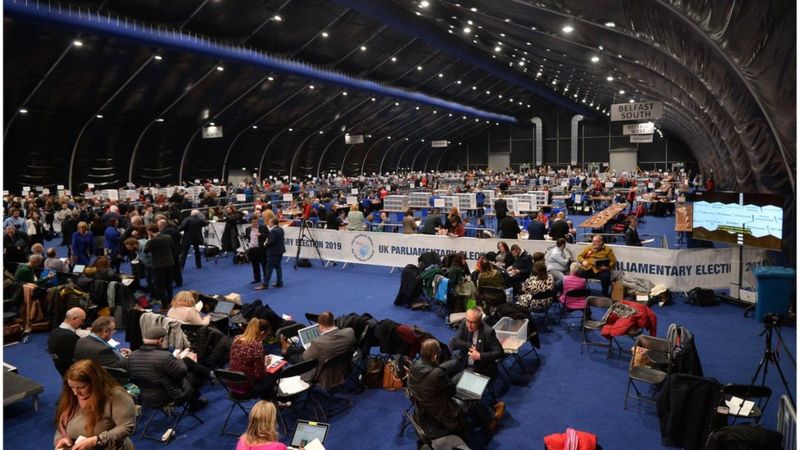
Vote count at Titanic Belfast

No sooner is the general election over but the media hails the beginning of talks to resurrect the Assembly at Stormont and the power-sharing Executive.  The election has been hailed as a dramatic change yet the same old solution that cannot find a problem it can solve is put forward again.

We are expected to forget the rampant incompetence and corruption that characterised previous Stormont attempts.  However, it’s not quite everything changes but everything remains the same, because at the same time as we wake up to groundhog devolution day we are also informed that, just perhaps, real change is on its way – ‘United Ireland’ trended on Twitter.

In part this might appear as a result of Brexit getting done under Johnson, which will hasten a Scottish referendum that will lead to Scottish independence – shattering the ‘precious’ union upon which Irish Unionism depends. In part, it is because of the results of the election in Northern Ireland, which for the first time ever has elected more nationalist MPs to Westminster than Unionist – 9 to 8.

But caveats abound.  Johnson will not get Brexit done.  The UK may leave the EU at the end of January but the transition period means nothing will change – except losing its vote in the EU – until it ends at the end of the year, which is not long enough to determine the new arrangements between the UK and the EU.  These will be contentious despite the Irish Taoiseach warmly welcoming the result of the election as removing a worrying source of instability for the Irish state and its economy.  The value of Irish shares may have soared upon the result, especially those of the banks exposed to the British economy, and one right wing politician may have welcomed the election of another, but Brexit is by no means sorted and the North of Ireland (indeed Britain itself) has just voted against it.

If the Scottish Government elected by the people demands another separation referendum then it should have it, without this the national oppression that Scotland does not currently suffer from would become real.  But Brexit will involve the same, if not even greater problems, for any separate Scottish polity that puts itself outside its main economic partner, with a hard border between it and a Brexit England and Wales.  The austerity necessary for a separate Scotland would be made worse; it is not therefore a given that the Scottish people will change its mind.

In any case socialists should oppose the erection of borders, which divide workers, and oppose nationalism that frustrates class solidarity in favour of national allegiance.  Already nationalism has many Scottish workers voting for a Party that covers its right wing politics with nationalist rhetoric.  This has unfortunately led many on the left to support its cause, perhaps not so surprising since some have also capitulated to Brexit; populist nationalism has been on the march in a muted form for longer than Boris Johnson.

So the outcome of Brexit and Scotland are not clear, but if the Withdrawal Agreement continues in some form then a real difference will be created between the North of Ireland and Britain and real harmonisation between North and South.  A loyalist campaign that attempts to stymie this is not out of the question, but it is likely to be more isolated than previous mobilisations against Sunningdale in the 1970s and the Anglo-Irish Agreement in the 1980s.  It will struggle to identify meaningful targets (which normally leads to its default disposition of attacking Catholics) and the British State lacks the incentive to indulge it.

The election results themselves have been taken to represent another step towards a United Ireland through a border poll, but again the situation is not so straightforward.  Sinn Fein, which shouts loudest for such a poll – calling for the Irish Government to create an All-Ireland Forum to advance the cause, performed badly, dropped by 6.7 percentage points.  It stood aside in a ‘Remain’ alliance in three seats, which partially explains the fall, but it also gained from the SDLP withdrawing in North Belfast, which returned a new Sinn Fein MP.  From three out of four MPs in Belfast being Unionist we now have three out of four Nationalists.

It dropped votes almost everywhere else, in West Belfast to People before Profit and spectacularly to the SDLP in Derry where its reverse was stunning.  On top of terrible results earlier this year in the local and European elections in the South, Sinn Fein has major problems.  The shine has long since come off it, it has little positive to say, and its abstentionist policy to Westminster has just cost it votes in the North.  It might have been assumed that as Irish unity appeared closer Sinn Fein would grow and benefit, but the opposite could well turn out to be the case.

It is one thing to stand out for the traditional aspiration of the majority of the Irish people when it appears you are alone in this, quite another to do anything positive to achieve it when it appears to become a realistic prospect, at least some time that isn’t the distant future.  The closer to Irish unity the less relevant appears a Party with nothing much to say about how it should be achieved or how it would actually entail a new progressive Ireland.  Previously, the SDLP suffered because it demanded the end of the IRA’s unpopular armed campaign but Sinn Fein gained from the peace process because republicans and not the SDLP could make it happen.  Sinn Fein will not make Irish unity happen, certainly not in any progressive manner.

In this election the SDLP came back from the dead to win two MPs with huge majorities in Derry and South Belfast.  Their opposition to Brexit was certainly a major factor in the latter, assisted by the fact that the sitting MP was from the DUP and Sinn Fein and the Green Party had stood aside.  Its vote however was much more than this assistance and represented more than mobilisation of a Catholic/Nationalist vote.  On the face of it this strengthens the push for restoration of Stormont since the SDLP is arguably its greatest supporter, although the sectarian carve up that is the lifeblood of Stormont faces challenges when there is competition not only between Orange and Green but also within each camp.

This is also the case in the Unionist camp where the threat to the DUP has come not from the Ulster Unionist Party, which has no real reason for existence, but from the Alliance Party – the biggest winner on the night. Like the footballer that is never off the subs bench while the team is crap, they get better the less they play, and the worse the team gets.  Alliance has benefited from appearing to stand above the sectarian incompetence and venality at Stormont but there is no indication that greater immersion into the devolution it also earnestly supports will not reveal its inadequacies as it has the others.  Its apparent opposition to the inevitable workings of Stormont will dissolve as it becomes an increasing part of it.

This however is not the major point to make about the rise of the Alliance Party.  It declares itself neither Orange nor Green although it has its origins within Unionism and has a pro-union policy.  This used to be much more obvious than it is now but has receded as the question has lost it sharpness following republican acceptance of the constitutional status-quo.  Its avowedly non-sectarian unionism has reflected its historic base inside the Protestant middle class, with an added smattering of aspiring middle class Catholics.  ‘Middle class’ here is used in the not very scientific sense to mean better paid workers and those with relatively higher standards of living.

It is now the third party in terms of votes with 17.4%, compared to the DUP with 31.6% and Sinn Fein with 23.6%, continuing its upwards trajectory following its success in getting the third MEP slot in this year’s European elections alongside one DUP and one Sinn Fein.

Much has been made of the overt sectarian arrangements at Stormont being predicated on balancing the Unionist/Protestant bloc against the Nationalist/Catholic one. This includes a veto wielding petition of concern available to each, which is blatantly undemocratic and discriminatory when a large number of representatives are defined simply as ’other’, which includes the Alliance Party.

This Alliance vote is a reflection of, but not identical to, increasing numbers of people who do not identify as unionist or nationalist, Protestant or Catholic.  The latest Northern Ireland Life and Times Survey reported that one in two identify neither as unionist or nationalist, although this seemed to me to be rather too big, confirmed by some colleagues in my office who are a generation younger than me and closer perhaps to those who might be sloughing off old identities.

This growth of ‘others’ dovetails with the growth of the Catholic population, which in the last census in 2011 reported 41% of the population as Catholic and 42% Protestant, with a Catholic majority among younger age cohorts.  Sectarian division is also influenced by the decreasing gap between Protestant and Catholic social indicators such as unemployment, and the obvious breakdown of large scale employment segregation. So society is changing in the North of Ireland, which gives credence to the idea that the union with Britain, by being less certain, is thereby closer.

Research has been done on the composition of this neither Orange nor Green population but I won’t go into it here.  Suffice to say that the majority of ‘neithers’ are in favour of the union with Britain, although one survey has reported that one third of Alliance voters have said that Brexit makes them more favourable to Irish unity.

What this shows, as if it needed pointing out, is that ‘other’ is not in itself a positive identity.  I am an ‘other’ in these terms, but I would never define myself as such because I am a socialist and do not define my views as simply other than Irish nationalism or Irish unionism.  It is pretty clear that the majority of ‘others’ do not have a coherent separate political identity beyond rejection of two major nationalisms suffused with religious identity.  And this is positive – as far as it goes.

But more importantly, this survey finding about Alliance voters shows that while ‘others’ do not define themselves as unionist or nationalist, there is no third position on the national question.  There are worlds of difference on how it might be solved, and how it might lead to more or less progressive outcomes, but increasing rejection of the old ideologies without a positive alternative leaves the old choice standing.

This does not mean that the growth of those rejecting the unionist and nationalist identities, probably because of the behaviour of the political movements that lead them, does not have an influence on the political situation or on prospective developments.  It has been remarked that these people will be pivotal in any border poll and will not be motivated by traditional war cries.  The majority are motivated by progressive impulses if only cohered in very primitive form (primitive as in undeveloped).  The struggle for a united Ireland will have to offer more than recovery of the fourth green field.

This does not mean that some economistic agenda is the way forward, for in essence this is still a political question that requires a political stand.  It is rather that what will become more and more important is what sort of transformational project will this political struggle involve – what sort of united Ireland is being fought for?

The setback for the DUP in the election is a blow to the most sectarian and reactionary Party and must be welcomed. The vote for the SDLP and Alliance is to a significant degree a vote against Brexit and again should be welcomed.  The shift of some unionists away from the parties of traditional Unionism is also a weakening of the unionist programme and acts to isolate the most extreme loyalist reactionaries, which again should be welcomed.

That Brexit has not overcome the traditional sectarian/political divide is not unexpected – in fact it is entirely to be expected that the reactionary politics of Brexit should find its natural base in unionism.  That opposition to Brexit has weakened the unionist parties and unionism is thus inevitable and once again to be welcomed.  Even the small gains by People before Profit could be welcomed were it not for the fact that it continues to fail to recognise the reactionary character of its support for Brexit and demonstrates an inability to learn from mistakes and correct them, which is more serious for it than the question itself.

What appears as significant political changes in the election are therefore, from a socialist point of view, relatively small steps forward.  They do however reflect more significant changes below the surface that socialists should be concerned to understand.

The Fall of the Red Wall

Related image

What do you do when you are leader of a Party and the vast majority of your members support a policy that you oppose?  Well, you can’t very well allow them to control the party can you?  So you can’t ensure it operates democratically.

What do you do when the majority of your voters also support that policy?  Well, you dissemble, confuse, appear to sit on the fence and declare neutrality.

In the case of the membership you first prevent them getting their way by stopping them voting on it at conference.  The next year you so manage the policy that is voted on that you can effectively continue to push your own, while of course appearing to do something different and pretending that the members got what they wanted.

But since the new policy does not make much sense the party membership are still not happy and come back to the next conference in the next year and vote again on what they want – and this time they win!  So what do you do now?  This time your friends say to the membership – ‘You Lost’ – and they start singing your name at the conference.  And it’s a victory!

For the rest?  Well, for them it’s then like being at a party where people start singing, and you don’t feel like joining in, but you’re made to feel your spoiling it for everyone, and spoiling the fun, if you don’t join in.  You really don’t want to be a party-pooper so you’re invited to suck it up.  After all, this leader has had it tough.

He’s been accused of all sorts of things that were so ridiculous that your first response might have been to ignore it. But the slander and smearing goes on and on and you want to have a square-go at the traitors inside the Party who are telling these outrageous lies, but the leader can’t trust you, so you’re not allowed.  Remember, the leader can’t very well allow you to control the party.  It’s a ‘broad church’, and just like in church it’s your job to listen to the preacher and then go out and do God’s work.

But this goes on and on, so the leader says he’ll do something about it and these terrible things will be stopped, and again and again you hear the same record.  Some people wonder why he’s saying the same thing about how bad it is, yet he’s saying it again. Why is he having to say it again?  Surely it’s been sorted?  He’s told to apologise and effectively he does, but if this happens again and again why is he apologising and nothing is changing?

Then I hear on the radio that the new manifesto is going to empower people, and I think to myself – WTF, really?  The only thing you have had the power to lead to ’empowerment’ is the membership of the Party you lead, and you’ve stood in the way of it.  Instead you’ve allowed all these reactionary shits to accuse you of nonsensical crimes.  The last time I viewed such a nightmare I was reading ‘The Trial’ by Franz Kafka, and it didn’t end well.  And this one doesn’t look like it will either.

In the election you’re facing a compulsive liar, whose own supporters don’t even trust.  They don’t believe him, but they do agree with him, and they are going to support him. But many people have gotten fed up with you.  You’re supposed to be different – he is what he is.  You are not what you have claimed to be. You’re supposed to be a conviction politician, who embodies honesty and sincerity and many people can see that you haven’t embodied either.

The dam that that held your so-called ‘red wall’ has just sprung two leaks and the first one is the enormous one. Just like a dam that you have seen in the films, your wall of support doesn’t break open only at this point, and other fractures appear in the edifice, and water spurts out of every one of them, everywhere – a hundred and one different cracks appear and it seems as if there are lots of reasons why this wall is going to fall.  When it falls it might seem difficult to say which one is responsible for the whole thing collapsing.  Lots of people look for more and more deep reasons for the collapse, the better to demonstrate their appreciation of the enormity of the collapse. But really the one big crack was vital in creating the rest.

There is a particular risk in immediately seeking the most profound reason for what has happened, although it’s not inevitably wrong and does not invalidate the attempt, but it does involve a risk.  It’s the risk that the explanation becomes so deep and meaningful that it can convey the impression that nothing could have been done about it.  We could never have won, the pressure against the wall of the dam was just too strong.

And this can lead to feeling sorry for the leader, who has been up against it all this time.  And I would feel this way too except I, like millions of others, is soaking wet and praying I’m not going to drown further down the line.  You can feel sorry for the leader if you want, my attitude involves rather more colourful expressions of emotion.

The historic defeat of the Labour Party was the result of a swing to the Tories of just 1.2 per cent and a swing away from Labour of 7.9 per cent.  The Tories won it because Labour lost it.

It lost it primarily because it lost voters loyalty on the big question that mattered – Brexit.  The machinations around it infected everything else Corbyn did, just like the real Brexit will determine so much else in the real world; limiting what good is possible and spurring on everything nasty, cruel and reactionary.

Sky called it the Brexit election, the Labour Party complained that it wasn’t, but now the Party leaders admit it was – a bit late to recognise the obvious.  The Political Studies Association reported polls asking about the issue ‘that will help you decide your vote’ and it was Health – 47% and the Economy – 35%; only 7% said Europe.

But that was in 2016.  In 2019 63% said Europe, while Health was 43% and the Economy 9%.

I could get even more annoyed now because I really dislike stupidity, especially in those who have no business being stupid.  But it wasn’t really stupidity – the reactionary position on Brexit and all its calamitous concomitants, such as suppressing Party democracy, is a sort of politics: ‘socialism from above’ is the kindest way of describing it even though there is no such sort of socialism.   It’s why it might be better to describe it as ‘state socialism’, or much more accurately, better to call it social-democracy and Stalinism.  (In this respect what was also worrying was the impression given by many socialists that the radical aspects of a social democratic programme was really socialism.). But to get back to the point.

What we saw was the nationalist politics of Brexit devour its misguided children, exemplified by Denis Skinner losing his seat to someone better able than him to embody the reactionary logic of Brexit. Unfortunately, these people brought down the rest, the majority, who have always known that Brexit had to be opposed.

If we want to look at the weaknesses of British social democracy we could do worse that start here – the narrow nationalism of the British left going back to Tony Benn or even further to Manny Shinwell and Aneurin Bevan.  Their opposition to ‘Europe’ resting on the Sterling Area and the Commonwealth, a bogus commitment to internationalism that rested entirely on the relics of Empire.

These weaknesses have been imbued by the radical left supporters of Brexit who think using one less letter and replacing one other makes a difference.  These people share the same conception of socialism – state ownership and a national state to implement and defend it from foreigners.  Entirely disappeared from consciousness is that we should be uniting with ‘foreign’ workers against our own state and theirs.  In fact, for a socialist, no worker is foreign, foreign to us is the nationalism that seeks to divide us.  Just like the Shinwell’s of old they condemn the narrowness and racism of Europe for not embracing the world while sailing on a boat that doesn’t leave the shores of Dungeness.

Labour lost 2,585,564 votes from 2017 to this election but the media narrative of the working class deserting Labour over its failure to support Brexit is a continuation of the distortions and lies that has been their staple.  Early estimates claim that over 1.1 million of this reduced vote was Labour Remainers voting for other remain Parties while perhaps 250,000 Labour Leave voters also transferred their vote to these Remain parties.

Antipathy and opposition to the figure of Jeremy Corbyn also seems to have played a major role but this is a combination of very different things that became important precisely because one person could be the focus of all of them.  For more than one reason the leadership is to blame – making Corbyn the sort of Presidential figure to the exclusion of other leaders in the campaign is probably the least important.

Anti-Corbyn hostility combined the opposition of Labour leavers; those prey to the calumny of the mass media; the failure to openly explain and discuss massive policy proposals dumped on the electorate at the last minute giving rise to some cynicism, and most of all duplicity over Brexit and apparent failure to take a position.  What price the one-day conference to discuss the Party’s Brexit policy now?

We need to stop talking about the Corbyn project in the Labour Party because clearly that project didn’t include opposing Brexit and didn’t include empowering the membership, which remain vital to any future progress.

One take on the election had a wonderful quote, ‘Disappointment is a trifle.  Disappointment is a luxury we cannot afford. The dilemma is simple but imperative. Whether to submit to mere fortune or to understand and take action.’  Perhaps not enough for the politically uninvolved but a good enough starter for the rest of us.

The struggle remains to fight Brexit, which hasn’t ceased to be the reactionary threat to the working class it has always been.  ‘Get Brexit Done’ is another lie to join everything else associated with that project.  Lies are ultimately useless because sooner or later they collide with reality.  The issue is who pays for them.  If there is one saving grace from the result it is escaping the embarrassment of an attempted Corbyn Brexit.  The Tory Brexit will fail its supporters and Labour must fight it and all of its consequences, including the disillusionment that its ‘success’ will provoke.

The second is to demand and fight for a democratic Labour Party. The mass membership has proved to be right, even if only negatively, and it must be confident in saying so.  The debate about responsibility for the defeat is not a distraction from fighting the Tories but an indispensable requirement.  Get it wrong, or lose it, and that fight will be hamstrung.  What to do depends on what is accepted as what went wrong, and there must be no truck with those who want to deal with defeat by following those who either led it or caused it.  We don’t want to tack right in pursuit of nationalists and racists and we don’t want another Corbyn who didn’t know how to fight either.


Who will I vote for?

UK general elections mean something different in the North of Ireland, and have usually revolved around the national question, whether there should be a united Ireland.  Latterly, the division has been one of squabbling over the detritus of incompetence and corruption that is the life blood of the local devolved administration.

The scandalous nepotism and waste uncovered in the Renewable Heat Incentive scheme was the trigger for Sinn Fein to eventually pull the plug on its participation in the Executive, but only after continuing to hold onto the coat tails of the DUP proved untenable.  Now the republicans have made clear that the architect of the RHI scandal, DUP leader Arlene Foster, will not have to go after all.  Sinn Fein would be happy to have this more-than-usual unpopular Unionist leader back as First Minister.

So now, with only haggling over the spoils at issue, the question of importance might appear to be whether to endorse another round of the sectarian settlement.

This time however the main issue is the same as that in Britain, albeit with very different ramifications and with many thinking it’s the old one in disguise.  It’s a Brexit election in the North. Just as it is a Brexit election in Britain; and when it comes to deciding how I am going to vote it is this that will determine whether, and who, I will be voting for on Thursday.

Brexit was supported by the majority of Protestants and opposed by the vast majority of Catholics, with the former voting Leave 60 / 40 and the latter voting Remain 85 / 15.  In terms of declared political identity the difference were even more marked, with 66% of Unionists supporting Brexit and 88% of nationalists supporting Remain.  Among those who defined themselves as neither Unionist or Nationalist – as ‘Other’ – the support for Remain was 70%.

Unionist support for Brexit is perfectly consistent with identification with an imperial nationalism and illusions in the power of Britain in the world, upon which their political position has always primarily rested.  It is not consistent with the real position of Britain in the world, which has been rammed home – to unionism’s discomfort – by Boris Johnson’s acceptance of Northern Ireland being de facto within the EU customs union and single market.  The same ideological blindness infects the same core constituency of the DUP as the Tories in Britain, while the pretence that they got Brexit right has been maintained despite the DUP having been shafted by Johnson.

If this was to be the position of the North of Ireland upon UK exit then it would mark a significant political defeat for unionism and a step towards a united Ireland.  But one, or even two steps, do not take you to your destination; although it points to one possible direction by which an objectively progressive resolution of the national question can be implemented by reactionary forces – the joint efforts of English nationalism that has no interest in Ireland and the European Union and the Irish State, which are progressive only relative to the former.

Much has been made by Sinn Fein of a border poll and increased support for a united Ireland because of Brexit but there is still no majority for a united Ireland and for that majority to arise the nationalist population has to grow significantly and/or the benefits of a united Ireland have to be demonstrated.  A border poll is not in itself an answer.

It is ironic that People before Profit (PbP) trumpet their differences with Sinn Fein but present a border poll in exactly the same way; while adding the vacuous call for a socialist Ireland, which means nothing outside of a wider programme that has to be internationalist to be socialist.

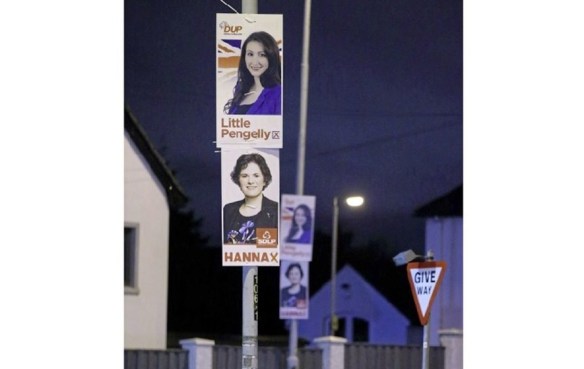
They have complained of Sinn Fein dirty tricks in putting up posters beside PbP ones stating that ‘People before Profit – Still Support Brexit’, which must be the first time a party has condemned a rival for putting up posters declaring its own policy.

Their complaint of course is that people will interpret this as support for the current Brexit, but unfortunately for them and for the rest of us a reactionary Brexit is the only one possible.  The current Tory Brexit was the only one proposed in the referendum – that they voted for – and the only one put forward now for implementation.  And it is still the case that People before Profit support leaving the EU – Brexit – and still see it as progressive.

So, if they now complain it is only because they know that the only Brexit in town is regarded by everyone as reactionary, and People before Profit condemns itself by not accepting that it is making a gross mistake by continuing to support this reactionary step backwards.

PbP complains that Sinn Fein allowed benefit cuts by agreeing that the decision on welfare should be handed back to the Tory Government in Westminster.  But this is exactly what it is doing by supporting Brexit and handing the power to inflict much greater damage on working people – throughout the UK – to an even more rapacious Tory administration that is salivating over the deregulated dystopia that is planned after Brexit.  There is no Brexit on earth that will not lead to cuts in welfare and attacks on pay that PbP claim they alone will fight.  The greater dependence on the State sector for employment in Northern Ireland will mean a greater impact from the cuts to this expenditure, which will be considered perfectly fine by a project sailing on the winds of English nationalism.

Whatever the benefits and drawbacks of the precise arrangements for the North under Brexit, it is not designed to further the interest of Irish workers: this much must be obvious even to PbP.  The same right-wing views associated with Brexit in Britain are reflected also in the North of Ireland, with those supporting Brexit more likely to have reactionary views on immigration, on the marriage rights of same-sex couples, and support for the most sectarian political parties.

A Brexit that will leave the North largely within the EU trading arrangements will be less damaging than a hard border within the island, but it is obvious that this is a more realistic way to prevent a hard border than a Brexit with PbP protests at how unfair it all is; and that no Brexit at all is the best solution of all.

Brexit has also been opposed because it is claimed that it will raise sectarian tensions, which means that it will upset many loyalists and may lead it their violent mobilisation.  To argue this however is to accept the Unionist veto on progressive change that has made the Northern State the political slum that it is and has always been.  There is no step forward that will not excite the opposition of loyalism.  The Protestant support for Remain should instead be viewed as an objective acceptance that Unionism does not represent their long-term interest; this progressive step should be supported rather than seek to pander to the most reactionary sections of the Protestant population.

So, if Brexit is the issue, who shall I vote for?

A couple of months ago I bumped into a Sinn Fein supporter I have known for years who after a couple of minutes launched into a defence of Sinn Fein’s abstentionist policy in relation to Westminster.  We hadn’t discussed politics up to then and I just listened to his poor apologetics for an obviously indefensible position. It has been widely criticised in Ireland and his defensiveness should not have been a surprise.  For a movement that was so wedded to theological shibboleths, from the IRA army council being the legitimate government of Ireland; to abstention from the Dail and Stormont; to not recognising the courts even though it meant longer sentences; to the sanctity of armed struggle; it’s as if one totem of their republican credentials must be retained to convince themselves they are still the republicans of old.

But this is a long way of saying there’s no point opposing Brexit by voting Sinn Fein because Sinn Fein will not be voting against it.  In the event of a Westminster hung parliament the SF position should be strung up with it.

Since Sinn Fein have stood down in my constituency, I don’t have to bother with considering these arguments.  Sinn Fein have withdrawn their candidate while the SDLP have withdrawn theirs from North Belfast to give Sinn Fein an uncontested Nationalist in that constituency.  The ‘Remain’ alliance that has justified these actions can be denounced as purely sectarian solidarity, except that the Green Party has also stood aside and the SDLP candidate has put opposing Brexit to the fore.

The Alliance Party has not stood aside and is also anti-Brexit, and of course also claims to be non-sectarian.  It is also however a unionist party in all but name and has rightly been described as the party of the British Government’s Northern Ireland Office.  The sitting MP is from the DUP and of course a supporter of Brexit.

So, in this election I will be voting against Brexit by voting for the Stoop Down Low Party, as it was sometimes disparagingly called (a long time ago).  And I never thought I would do that.

It is necessary to vote against Brexit and necessary to have that vote carried forward into Westminster.  It is justified also in order to weaken, however slightly, the most reactionary and sectarian major party in the North, the one that has thrown its weight behind Brexit and all the reactionary politics that that project encompasses.


‘One Man’s Terrorist. A Political History of the IRA’, reviewed – Part 3

Daniel Finn records that the British Army identified the summer of 1972 as the crucial turning point, as the moment when republican guerrillas shifted from ‘insurgency’ to ‘terrorism’.

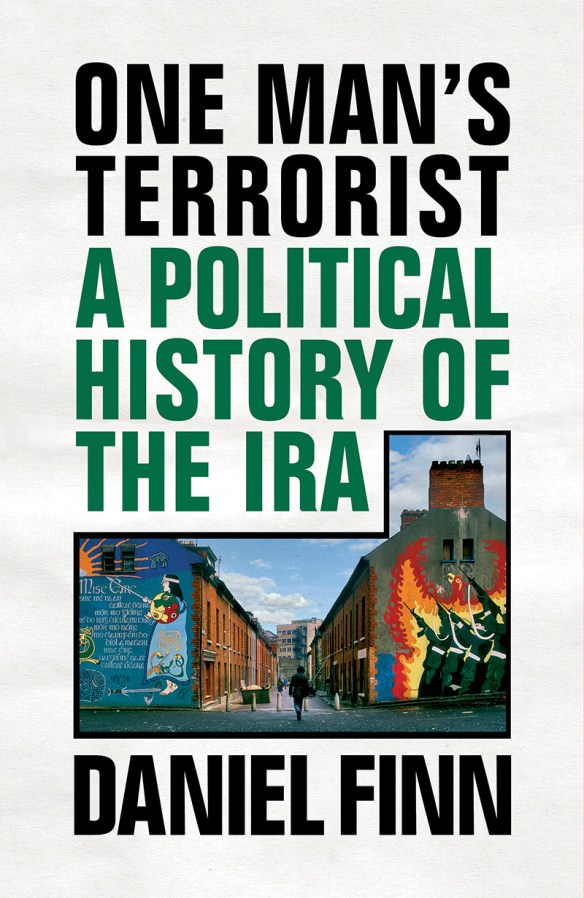
Most immediately this was the result of the removal of the no-go areas and saturation of Catholic areas by the British Army and RUC.  The number of deaths peaked in 1972, while the ability of the IRA to inflict casualties on the British declined dramatically thereafter.  The Provisional leadership however continued to declare victory – ‘we are in sight of a British declaration of intent to withdraw.’

In the following period, between 1972 and 1976, loyalist paramilitaries killed 567 people in an effort to terrorise the Catholic population, and the IRA was unable to stop them.  Its efforts at retaliation often meant killing Protestants uninvolved in loyalism and by the end of the IRA campaign loyalists had begun killing more than republicans, assisted in no small part by the British State.

This was an underappreciated aspect of the Ulsterisation process by which the British were able to distance themselves from direct responsibility for repression while seeking to de-politicise the conflict.  Facing a decline in mass political activity, the Provisional IRA continued its more isolated campaign, now carried out by a much-reduced IRA organised less openly in a cellular structure, and by this fact more separated from the population it sprung from.  The British Army took a back seat, the RUC and locally recruited Ulster Defence Regiment came to the fore, and the British embarked on a policy of refusing the political character of the conflict by treating republican prisoners as common criminals.

All this followed the downfall of the Unionist regime at Stormont and the failure of the major British political initiative of a power-sharing Executive, which was brought down by a strike of Protestant workers, the success of which relied not only on a great deal of support but also on a lot of paramilitary intimidation and British Army acceptance of it.  The latter was not about to embark on a conflict on two fronts.

The Provisionals now had enough support to maintain an armed campaign, but their periodic killing of civilians repelled many in the Catholic population ensuring they could only remain a political minority within it.  The political stalemate that resulted after 1974 and the loyalist strike that year was thus a product not just of the IRA but of loyalist intransigence.  The British were not going to challenge the latter on behalf of the former.

So, the British Army evaluation of the importance of 1972 is correct, not only in terms of how the IRA conducted itself but in terms of the overall political dynamic and the health of the movement against the Northern State.  The policy of Ulsterisation, increased role of loyalism, and decline in mass political activity among the Catholic population all reflected something more fundamental – that the struggle of the Catholic minority could not achieve an end to the Northern state and bring about a united Ireland.

This is a point I made at the Belfast launch of the book.  Once Stormont was ‘smashed’ the positive political solution favoured by the Catholic population could not be imposed, while the Provisionals believed that it could.  Since this reality impinged even on them, they shifted from predicting near-time victory to the perspective of a long war.  This became a more and more pointless campaign that degenerated into further mistakes, inclusion of more targets considered to be legitimate, and such state penetration of their organisation that one of those in charge of rooting it out was a state agent.

Finn quotes from the Peoples Democracy newspaper in October 1971, which showed that this was understood by some even before the full set of circumstances that would bring it about had come to pass.  The article suggested that “while the Provos were determined to keep fighting until Irish unity was achieved, in practice much of the Catholic support would evaporate – and probably many of the Volunteers would be satisfied – if the internees were released, Stormont smashed and the British Army removed.”  But the Provos were determined to fight for more, while declaring imminent victory for a number of years.

As the second half of the 70s wore on it became clearer to the Provisional leadership that their armed struggle would not win, or at least not by itself.  Finn recognises the speech by Jimmy Drumm in 1977, written by Gerry Adams and Danny Morrison, as the opening of a more political approach, which warned that the “isolation of socialist republicans around armed struggle was dangerous.”

It was seen at the time as signalling of a move to the left and a recognition of the importance of political struggle.  It might thus be seen as the adoption by the Provisionals of their own left, or socialist, republicanism that most republican organisations have felt compelled to adopt at some stage.

Finn sets out the experience of an experiment in this left republicanism that came to the fore two years earlier in a split within the Officials, and which gave birth to the Irish Republican Socialist Party (IRSP).

This reflected the views of many in the Official Republican Movement unhappy with the ceasefire and unhappy with its growing reformism.  The split provided a potential rallying point for the left outside the republican tradition but the determination of those leading the split that political direction would be determined by the armed wing of the movement meant that the primacy of the armed struggle would be reasserted. This necessarily entailed the irrelevance of democracy in the political wing – decisions would be taken elsewhere.

The Officials were determined to strangle the capacity of the splitters from birth and the IRSP entered the world in the midst of a bloody feud.  This, and what Finn describes as the weakness of the political leadership that survived the feud, meant that the IRSP/ Irish National Liberation Army degenerated into an aggressive militarism that robbed it of any potential it might have had.

The left republicanism developed by the Provisionals was much different but no better.  It was to be tested by the hunger strikes three years later, which pushed the Provos into a mass, open campaign and which, had the turn to the left had any depth, would have been the catalyst for the opening up of the movement and an orientation to the whole working class and its movement.

Instead a fight had to be waged even for democratic functioning and the basics of political organisation such as participation in elections.  Secret negotiations behind the backs of those engaged in the struggle continued to be a central feature of Provisional practice with a top-down view of political leadership that was never to change. The lessons learned by the leadership after the campaign were that a united front should be dismissed, elections should be the property of Sinn Fein only and (after a short period) that the strategic way forward was nationalist unity.  The armed struggle was meanwhile reinvigorated by a new cohort of recruits and supply of arms.  The failing campaign was given more time in which to fail.

By 1983 Gerry Adams was warning of ‘ultra-leftism’ and the danger of breaking up “the unity of the national independence movement by putting forward “socialist” demands that had no possibility of being achieved until real independence is won.”  The old ‘labour must wait’ cry was proclaimed by Irish republicanism once again.  Finn also notes that Adams quoted Desmond Greaves in support of this approach, the same inspiration to those who had sought to guide the Goulding Officials a couple of decades earlier.

The remaining chapters record the long political striptease of political principles that was the Irish peace process.  The Provisionals were rewarded for their abandonment of their armed struggle with majority electoral support in the Catholic population that had always opposed it.

Finn presents a well-judged summary of this process which has now gone on longer than the war the Provisionals saw as their own.  Sinn Fein then began to claim that this war had not been about ‘Brits Out’ but about equality – the goal of the original civil rights movement that the Provisionals had seen as so inadequate.

Finn quotes Adams saying that equality of treatment would erode the very reason for the existence of the state but what the limits (if any) of such equal treatment would be, what its political effects would be and how republicans would take the leadership of such dynamics were not discussed.  The Officials had seen such progress as a means to unite Catholic and Protestant workers while the Provisionals drew a rather straighter line to unity of the two Irish states.

What was eventually agreed was a political settlement that Sinn Fein saw as the embodiment of equality but was in reality a sectarian carve-up that replaced civil rights for all with rights ascribed to, and the property of, sectarian groups.   Equality was not to be the route to removing sectarian difference, but equal recognition given to the differences and their continuing protection.  This took the language of ‘parity of esteem’ and ‘equality of the two traditions.’

Finn also judges well that the ‘dissidents’ policy of a new armed campaign did not challenge the Provisionals project.  In fact, by reminding everyone of its previous policy it strengthened the new one by seeming to affirm that the only alternative to it was pointless political violence.

Finn’s history prompts the question why the left was not able to capture the leadership of the struggle for civil rights and its continued development in the period up to 1972.

Part of the reason is that it was starting from a very weak position – sectarian division really did pose an enormous obstacle to the growth of socialism and socialist consciousness in both the Catholic and Protestant working class.  This weakness also existed in the South, robbing the left of the possibility of showing the concrete benefits of working-class unity on the whole island.

Immediately this mean that the necessity for physical defence of workers from large scale physical attack could not be influenced by political considerations of mass self-activity and non-sectarianism that socialist could bring to the early defence committees.  The left did not have the weight inside the Catholic areas from which the early committees had sprung.

Republicanism also provided the means for armed defence, which was on occasion required, and the left did not have this capacity.  Had it such capacity it might have provided a model for the subordination of armed activity to the democratic political debate of a working class party and its supporters.  The absence of an armed capacity subordinated to socialist politics meant that the false promises of victory through an offensive armed campaign, which was attractive to Catholic youth, was not challenged, or at least an alternative model for the role of arms was not available.  There was, in summary, no tradition of alternative political organisation.

These weaknesses were reflected in some confusion of perspective by the left in this period and some authors today mistake the reflection for the primary cause.  It was not this confusion that was primarily responsible for the weakness of the left but the weakness of the left, or rather of the working class as a political class, that was primarily responsible for the confusion.

The Catholic working class never developed a left leadership because it never developed beyond a nationalist political identity and a political understanding of its circumstances based on it, in turn the product of forces too strong for it to defeat.  The most militant advocates of such nationalism, in the shape of republicanism, won the most ardent youth while the limits of its militancy meant republicanism never went further that nationalist ideas.

We could all have done better, which would have meant being in a stronger position today to advocate socialist politics.  It is to Finn’s credit that his book provides a valuable summary of the political struggle from which we can derive lessons for the future.  The book is to be recommended.

Concluded

Back to part 2

‘One Man’s Terrorist. A Political History of the IRA’, reviewed – Part 2

‘One Man’s Terrorist. A Political History of the IRA’, Daniel Finn, Verso 2019

Daniel Finn records that at the beginning of the ‘Troubles’ Belfast Official IRA leader, Billy McMillen expressed awareness that the use of arms might only drag the IRA into a battle it could not win against a vastly superior army.  His Chief of Staff Goulding also argued that this had been the situation in Derry when the Bogside had been attacked by the Royal Ulster Constabulary.  Gerry Adams also recalled opposing armed action later for similar reasons.

How much this last view was due to long-term strategic considerations and not simply the IRA’s lack of guns; need for a period of preparation for the offensive war the Provisionals intended; and a consideration that British repression would radicalise support for it, is probably best answered by subsequent actions.  Finn quotes Provisional leader Seán Mac Stíofáin as saying “the armed struggle comes first and then you politicise.”

A related argument has also been put that while the Officials saw a role for a primarily defensive use of arms, and the Provisionals an offensive war, there is in reality no difference – there is no such thing as a ‘defensive’ bomb.  Eamonn McCann, in his book ‘War and an Irish Town’, once argued something similar – “When it is the state itself which threatens to destroy you it is necessary to attack the state, not just to defend oneself against its attacks . . .”

It would however, overturn much military thinking to believe that there is no difference between defence and attack, and there really is no logic in believing that attacking a much better armed enemy is the only way to defend yourself.  When the Provisionals were to go on to claim that civilian casualties of their car bombs were due to the British not acting quickly enough to evacuate civilians it didn’t stop them planting more of them, even though the political as well as the human cost was obvious.  Only commitment to the idea of victory through armed struggle – an offensive war – could sustain such a view.

Finn quotes the Official’s paper the ‘United Irishman’ stating at the end of 1971 that mass participation had ‘brought the struggle of the people to a new height’, and the view of the Joint Intelligence Committee at Westminster that this was ‘perhaps the most threatening feature of the present situation in Northern Ireland.’ But while the level of mass struggle was to rise to an even greater level in 1972 it was also to fall within the year.

Bloody Friday, demonstrated the relationship between mass political action and armed struggle.  Six months after Bloody Sunday, the Provisionals set off twenty-one bombs in Belfast City centre, killing seven civilians and two British soldiers.  Television news showed body parts being shovelled off the street.  The effect of the bombing gave the political initiative to the British state to destroy the no-go areas from which the repressive arms of the state had previously been excluded.  The relationship of armed force between the IRA and British Army hadn’t changed but the political situation had, and it became apparent that it was the people who were protecting the IRA and not the other way round.  After all, what else is meant by a guerrilla movement and the people being like a fish swimming through water?

The real political tragedy of Irish republicanism in this whole period of the Troubles and ‘peace process’ was not the collapse of the Provisionals into an alliance with bourgeois nationalism and the Irish State, but the failure of the initiative within the Officials to develop a healthy socialist politics.  This was never seriously attempted by the Provisionals, whose sometime left wing rhetoric disguised a rightward trajectory.  As one of my comrades in Peoples Democracy once put it: the Provos were full of people with left wing opinions and right-wing politics.  It is possible to think of individuals for whom such a judgement would be harsh, but then, we are thinking of individuals.

Apologists for the repressive actions of the British Army during the early 1970s complain that they were ill-suited to the peace-keeping role that they were thrown into, although ‘humanitarian imperialism’ has been the rationale for such intervention ever since.  But the same could be said of the IRA, both Officials and Provisionals.

The Officials wondered what to do with their new members, as recruitment surged after internment, later noting that they “had been drawn into a war that was not of our choosing.”  They therefore withdrew, calling a ceasefire in May 1972, making it easier and more comfortable to also continue to withdraw into reformist politics that morphed into defence of the Northern State and pathological hatred of the Provisionals.

Unfortunately, for these Provisionals this only reinforced the identification of revolutionary politics with armed struggle.  The later abandonment of that struggle by the Provisionals taught the same lesson to those now dubbed republican dissidents.  To state that the failure to understand that abandonment of armed struggle was due to the prior politics developed by these movements is not enough, because for these organisations complete commitment to armed struggle guarantees their revolutionary purity.

What matters is to recognise that the republican armed struggle perpetually leads to failure, even with respect to its own limited goals.  It is not in principle incompatible with reformist political objectives, and is not compatible with the struggle for socialism.  When we say this, it does not mean rejection of physical force as such, but only that such force must be the weapon of a class not an army.  The social revolution sought by socialists requires the revolution of social relations and not transplanting one capitalist state by another.  The class that is to achieve this must defend itself, but this is a far cry from guerrilla warfare, which is in general not suited to advanced capitalist societies.  The North of Ireland is proof of this, a proof hammered home again and again over many years.

The Provisionals had the same problem as the Officials, but responded by taking a radically different direction.  They too were flooded with new recruits after internment and Bloody Sunday and were seriously misled in an abortive truce in June 1972, almost a month after the Official IRA ceasefire.  This involved meetings with the British, which like all later negotiations by the movement were held in secret – the struggle was theirs to negotiate, not the people, and not even their own members.

The Provisional leadership demanded a British commitment to withdrawal by the end of 1974, which was an objective they were never going to get, then or afterwards.  When the truce broke down Finn accurately observes that “having failed to achieve their maximum goals, the Provos had little alternative but to return to war, since the movement had no political wing that could advance their agenda in the absence of a military campaign.”

The Provisional IRA became the hammer for which every problem is a nail.   While the British Army learned lessons relatively quickly about the failure of its military solution, the Provisional IRA simply repeated the attempt. As Finn records, the British Army’s history of its operations picked out two examples of ‘poor military decision-making’ in the Troubles that had ‘serious operational and even strategic consequences’ – the Falls curfew and Bloody Sunday.  They stopped making these mistakes, even if they didn’t stop being responsible for hundreds of further killings.

Back to part 1

Forward to part 3

‘One Man’s Terrorist. A Political History of the IRA’, reviewed – Part 1

‘One Man’s Terrorist. A Political History of the IRA’, Daniel Finn, Verso 2019

There have been a number of books on the history of the IRA and as the author of this book has noted, per capita, Northern Ireland is possibly the most academically analysed society of any in the world.  At the book launch in Belfast he was asked by Matt Collins, People before Profit councillor in Belfast, why he had written another.

Finn pointed out that a number had been written some time ago, around the late 90s and early 2000’s and that distance had allowed a new evaluation of what had happened. The passage of time also allowed access to some government papers, which allow a more honest presentation of the views of the British government than its public declarations, which were mainly ritualistic denunciations of terrorism or carefully scripted statements designed to achieve particular political purposes.

The history, essentially of the modern IRA, begins in the late 1960s, which is now half a century ago, but well within the living memory of many of those involved.  Finn also has distance because he is from the South – while the main struggle reviewed was in the North – but was able to make contacts with those engaged in the political activity covered in the book.

The book is also a political history, while the others have mostly been essentially military histories with political background, and with much of their value residing in new information about what was, after all, a secret organisation.

The primary value of this book therefore that it is a political history.  Not only that, but its scope is wider than those books that have dealt solely with the Provisional IRA.  It builds its understanding of the Provisional movement not just from its own actions and statements but from within a broader canvas of the wider political struggle.  He engages not just with the Provisionals but valuably looks at the political perspectives of the Official Republican Movement and of Peoples Democracy.

As I noted in my contribution to the discussion at the Belfast launch, the history of this period is either presented as one of barely interrupted political violence by the IRA fighting the counter-insurgency of the state, or of an anti-imperialist struggle whose only real actor was the Provisionals; as if no one else ever mattered or provided a different way forward.  The book is therefore extremely useful in demonstrating that this was far from the case.

It sets the scene in an interesting introduction to the modern period with a history of republicanism and wider situation up to the explosion onto the streets of the civil rights movement in 1968.  He notes the re-evaluation of strategy by the IRA following its abysmal failure in the border campaign that spluttered out to defeat in 1962, and records it’s new leader, Cathal Goulding, describing it not so much as a guerrilla movement moving through its people like a fish in water, but more ‘like a fish through a desert.’

However, in my view, the author does not make enough of the radical change in republican objectives that occurred decades before, which moved from seeking to overthrow the Free State to de facto and then de jure acceptance.  The foundational acceptance of the legitimacy of one partitioned state was clearly a result of a purely nationalist politics that had no alternative to the separate Irish State, which over a couple of decades achieved as much political independence as could ever have been expected.

Since the republican movement, even Goulding’s IRA at this point, still saw the armed struggle as the key, this meant their opposition to the southern partitioned state could only be platonic.  This imposed a fatal weakness that led to repeated incorporation of the militant opposition of fractions of republicanism into that state; beginning with the pro-Treaty ancestors of today’s Fine Gael, then Fianna Fail, then Clann na Poblachta and later the Provisional IRA, which dropped its militant opposition to the Northern State through an alliance with the political forces of the Southern State and the fatal charms of nationalist unity.  Now assumed and taken for granted, it bears on all republicans today, pro and anti-peace process.

Finn explains the development of the thinking of the new Goulding IRA leadership with its view that political agitation must play a more prominent role in IRA activity and its belief that achievement of civil rights would assist democratisation of the Northern State.   In this scenario a second stage would facilitate class politics, which would come to the fore and would make possible dissolution of the border and establishment of an all-Ireland worker’s republic.  This strategy and that of others has been the subject of a series of posts on this blog looking at the history of the civil rights movement and beginning of the ‘Troubles’, beginning here.

For this reader the chapters dealing with the years up to the late 70s are the most interesting, since these deal with the political perspectives of the various organisations and their activities when the struggle against the Unionist regime and the British State had a mass character and wasn’t, and couldn’t be, simply dismissed as a violent conspiracy by a small number of evil men.

This period includes the growth of the civil rights movement to a mass campaign; the pitched battles between Catholic workers and the sectarian state forces; the sectarian division of much of Belfast; British repression including the Falls curfew, internment and Bloody Sunday; and the overthrow of Stormont.  This was when real advances were achieved and the mass movement won significant victories against an attempted British military solution.

These victories ultimately brought about, and included, the downfall of the Unionist Stormont regime.  As I also argued at the book launch, this then led to a struggle for an objective that the movement could not achieve – the defeat of British rule entirely and a united Ireland of some sort.  Within the potential of a struggle confined to the North it was not possible to achieve this and as we have seen, republicanism had no perspective or strategy for overthrowing the Southern partitioned state.

Before looking at the evidence that Finn provides for such a conclusion, we should recognise something else also taken for granted in most reflections on the history of republicanism.  Because of the more or less rapid demise of the Official Republican movement and its complete eclipse by the Provisionals, the importance of the split in the movement in 1969/70 is not appreciated.

Militant republicanism was a minority tendency within the Catholic population, which itself was a minority.  To think that a split in this minority could leave either side with the potential to achieve their stated goals was at best an illusion.  More objectively the split exacerbated the worst tendencies of both.  For the Provisionals, it confirmed their militarism and disregard for politics as a whole, never mind a debate on what sort of politics was needed.  For the Officials it initially created a competition with the Provisionals for armed initiatives, created a bitter and personalised division, and hardened the weakest and most rotten aspects of their increasingly Stalinist and reformist politics.  While they sought to address necessary questions that the Provisionals were simply not interested in, they came out with the wrong answers.

Forward to part 2

Saying yes to Jeremy – part 2

Brexit and any step forward by the working class in Britain are incompatible.  So what attitude do we take to a party that promises both?  Up until now the way forward was to fight for the Labour Parry to be democratised so that its Remain supporting membership, backed by the majority of Labour voters, could impose a progressive Remain policy on the leadership.  This had to be done irrespective of the Jeremey Corbyn leadership.  In other words, it was a gulp, and then ‘No, Jeremy’.

Failure to see this or to carry it to success, for whatever reason, now means that we have to face a Labour Party of MPs who don’t support Corbyn, especially any progressive policies he stands for, and are no more likely to force a radical agenda in Parliament if the Party won a majority than they were under Blair.  On the other hand, if the Party lost the election badly, Corbyn would be finished and there would be an almighty push to finish any progressive element of the Corbyn project with him.

This is one reason why socialists and working people more generally should call for a vote for Labour, because it provides better grounds on which to fight for socialism, inside the party and outwith it.

Even if the Party won, of course the fight to get the parliamentary party to take the action it needs to take to implement any sort of radical agenda would remain.  The Party would also still be run by a Brexit-supporting apparatus that would deliver up either an unsustainable Brexit or simply more years of political paralysis and crisis.  If so permitted, in either eventuality the Party would suffer, and especially the leadership that delivered either of these outcomes.  It would be better that the Tories bear responsibility for Brexit than it be implemented by Labour, although this means only that we should fight for Labour to adopt a socialist policy on Brexit, not leave it to the Tories.

A socialist policy would not simply mean opposition and support for Remain.  It would mean taking advantage of EU membership to organise on a pan-European basis, trying to win support for the social democratic policies that are currently put forward only within national limits but can only be implemented, at the very least, on a European level.  Of course, such a social democratic programme is not in itself socialist, but a fight to ensure solidarity across each member state would seek to level up labour rights, working conditions and regulations etc. in order that national differences are eroded and the nationalism that feeds off them is undermined.  In this way the grounds for the international unity of the working class can be increased.

So the socialist position is not to attempt to prevent or hold back the unity of Europe but to rapidly advance it in order that the best conditions for the organisation of workers as a class, irrespective of nationality, is created.  We don’t take the view that this cannot be done under capitalism but must somehow wait until after socialism has been created, just as we don’t wait for socialism to unite workers right now within nation states.  If capitalism breaks the restrictions of these states all the more so should the working class.

Those reactionary socialists who can conceive of socialism only as a set of sympathetic diplomatic relations between separate states have no comprehension that the real unity of workers will arise from the internationalisation of capitalism, just as the working class itself is a creation of capitalism, upon which the independent organisation of workers has been and will continue to be built.

The former can only emphasise the sovereignty and independence of separate states while the latter stands for the self-determination and independence of the working class – in opposition to these states and the institutions they create for subordinating workers at the international level, which includes the EU.  The objective is therefore a single socialist polity across the continent.

The first priority now is to campaign for all those standing in the election who at least support Remain and do so on an internationalist basis, who are seeking to advance workers’ interests in the knowledge that the principle of solidarity that ‘divided we fall and united we stand’ applies at the international level as well.

But of course, we have a problem.  Opposition to Brexit also defines the right MPs that still form a large slice of the parliamentary Labour Party, not to mention the Liberal Democrats and Scottish and Welsh nationalists.

It would not make sense to call for a vote for only left-Remain Labour candidates – there are not two Labour Parties and we have not yet democratised the one we have so that it reflects the views of the overwhelming majority of the membership.  If we could ‘solve’ this by only voting for left-Remain MPs then this task would not be necessary.

A majority Labour Party is the best position at the present time to not only defend ourselves against the Tories plans for massive attacks on the working class through Brexit, but also to move forward to opposing Brexit itself inside the Party.  Such a fight would provide a way out of the prospective dangers already mentioned, of a unjustifiable and unsustainable Brexit or continuing paralysis and crisis.  So while the resources of socialists should be concentrated on supporting left-Remain candidates and campaigning more widely for the socialist Remain argument, the overall call is for a Labour vote.  In this process the left inside the Party can demonstrate the correctness of its approach through the inevitable failure of Brexit to deliver what it claims.

Where this does not apply is to those Labour MPs who have voted for the Tory Brexit and who have employed reactionary arguments to defend it, while advancing reactionary politics that essentially blame foreign workers for the problems faced by British workers. In this they are also fundamentally no different from the Tories, which is the ultimate reason why they voted for it.

So what about the Liberals and the nationalists?  They are for Remain – so why not support tactical voting in an attempt to get a Remain majority and at least prevent the Tory’s Brexit?

At this point we have to take a step back, and remember what was said in the first post.  It was argued that Brexit would entail economic disruption that ‘means loss of markets and economies of scale in production; reduced capital accumulation leading to lower economic growth, and loss of necessary labour power both skilled and unskilled without which some current production will cease, shrink, or grow more slowly.’

This is obviously no more in the interests of the bigger capitalists who engage in foreign trade, seek economies of scale and require as wide a pool of labour to exploit as possible, as it is for workers – whose interest is not in more primitive forms of capitalism, in comparison to which the form of capitalism encapsulated in the EU is actually more progressive.  It’s why the Liberals and nationalists, not to mention the Blairites and some Tories, are also for Remain.  They do not do so because, as I said, Brexit will reduce workers’ incomes and employment and diminish the capacity of a social democratic government to provide welfare payments and to redistribute incomes.  They aren’t interested in this, except to stop it; their opposition to Brexit is not our opposition and cannot be endorsed.

So, apart from the fact that the Liberals and nationalists’ keenness for an election has revealed that their priority is not opposition to Brexit but their own party, their projects cannot be supported in any way.  Their politics are antithetical to the interests of workers in the same way that Brexit is, in so far as they seek to divide workers by nationalism, and in the case of the Liberals, in pursuing an opposition to Labour that has so exceeded their differences with the Tories.  It would not even be such a massive surprise if the Liberals did another deal with the Tories after the election, if the Tories required one; a deal for example that could be packaged as a ‘soft’ Brexit.  However, even on their own account, their reactionary politics can easily encompass support for a Tory domestic and foreign policy agenda that would be perfectly consistent with a Tory Brexit.  In short – the Liberals are a party of the class enemy.

The election may facilitate increased awareness that the choice now facing working people, at least outside Scotland, is more and more to be considered as one of Johnson and his Brexit or the social democracy of Corbyn’s Labour.  Much of this awareness will come from increased understanding that the dangers posed by the Johnson-led Tories derive particularly from their plans for Brexit.  This makes it even more inexcusable that the Corbyn leadership refuses to oppose it but has effectively come down harder in its defence. Even so, contrary to speculation that Corbyn would, as he first appeared to indicate, talk about everything but Brexit, he has said more about it than expected precisely because it has become so clear that Brexit is the sharp end of Tory plans to assault the living standards and rights of the working class.

Nevertheless, the position of Corbyn on Brexit makes it less likely that the Labour Party will appear as the alternative that strong supporters of Remain would like it to be.  And we now have numerous polls indicating that a very large number of potential Labour voters fall into this category. The call for a united party from Labour spokespeople in the election has so far effectively been used to further unity around the leadership’s Brexit agenda.

Nevertheless, opposition will not be advanced by abstaining from the election on the grounds that an election victory would see the Party likely end up in the same Brexit position as the Tories.  This is because at least in the short term, this would not be the case.  While a Corbyn proposed Brexit may be of the ‘softest’ variety, it will entail a cost, and will appear all the more pointless the softer it is.  Opposition to any Labour deal from the right and from the left would end up effectively making this same argument.

The view of the left that Brexit is not in reality compatible with any radical social democratic programme will impose itself one way or another. Labour supporters will not dismiss mounting evidence of its threats as do the demoralised, blinkered and prejudiced supporters of Brexit who in their majority now favour no deal.  They will less and less accept a policy of ‘respecting the referendum’ the more this entails they’re having to respect their rights and living standards being shredded.

So the truth that socialists must always fight beside the working class, however backward it views, will find support from the majority of Party members and supporters who are opposed to Brexit.  A Corbyn policy of getting Brexit ‘sorted’, if put to the test, would encourage further efforts to sort it by stopping it.

The longer the struggle goes on to impose this reactionary project the more likely it is that the reactionary supporters of Brexit will be demoralised.  ‘Taking back control’ will seem further away the further Britain gets into the reality of Britain on its own.  Whatever the result the reality of Brexit will impose itself with the most obvious losers its Lexit supporters, whose illusions are the most absurd.

While elections are important, socialists argue that it is not fundamentally elections that are determinate. Rather elections reflect the state of politics and the class struggle and can influence them but not decide them. What is most important therefore is that the vast majority of members of the Party are mobilised in the election in such a way as to strengthen the left in the party and its capacity to impose its views by putting a Labour Government into office.  In 2016 the referendum was to decide the question and it didn’t, and neither did the 2017 general election.  It would not be a great surprise if the current election didn’t either.  In any case the the task is to ensure an election result that puts us in as strong position as possible to resist a Brexit that still has a long way to go.

Back to part 1

Saying Yes to Jeremy?

So, as far as Jeremy Corbyn is concerned, when it comes to Brexit – ‘look, this debate is now over. We’ve done it, the party has now made its decision, and that’s it; and that’s what we’re going to campaign on.”  (As quoted in The Guardian) As for his decision to support a general election in the shadow cabinet meeting – “it was my decision. On my own. I made that decision. And they gulped, and said, Yes Jeremy.”

So how do we as socialists reconcile the Labour Party’s support for Brexit, which is reactionary, and its radical social democratic programme?

Firstly by recognising that they cannot be reconciled, that ‘friendly relations’ – employing one dictionary definition – cannot be established between the two projects: they are incompatible and one will have to give.  They are inconsistent and the contradictions between them will lead to one, or perhaps both, being ditched.  Anyone believing that a Labour Brexit is part and parcel of a radical social democratic programme is therefore mistaken.

Brexit will disrupt the insertion of the British economy into its biggest trading partner, which is its main market and theatre of operation; main supplier of additional skilled and unskilled labour power; intermediate goods that enable production to be sited in Britain; and the main route through which it inserts itself into the economies of the rest of the world – through agreements and deals which it has, as part of the EU, negotiated with the United States, Japan, South America etc. etc.

Disruption means loss of markets and economies of scale in production; reduced capital accumulation leading to lower economic growth, and loss of necessary labour power both skilled and unskilled without which some current production will cease, shrink, or grow more slowly.  The loss of these markets means that the reduction of existing and potential production will also reduce incomes and employment and the capacity of the state to syphon off revenues to finance its services.  It will reduce its capacity to provide welfare payments and to redistribute incomes, which are sold as central to Labour’s declared project of reducing inequality, insecurity and poverty.

The idea that a transformation of ownership of utilities and other companies from private capital to state ownership will compensate for these effects ignores the reality that state production will be affected just as much by the loss of skilled and unskilled labour, loss of markets and economies of scale etc. as private capital.  State ownership does not by itself create new markets that have just been shut off or reduced, or provide the labour power that is necessary for the current British economy to operate efficiently and grow.

This is all obvious from even cursory examination of media coverage of Brexit’s effects, today reporting potential damage to the tourist industry, but previously in relation to international research and university teaching, to EU staff in the NHS, the whole car industry, aircraft production, financial services and seasonal workers in agriculture, and many others. When asked this morning on Radio 4 whether any sort of Brexit could be better for the NHS, the Labour spokesman evaded the question – ‘the people had voted for it so they were going to be given the opportunity to get it’, was the gist of his reply.  As if it was not obvious what the honest answer had to be.

So, left supporters of Brexit treat it as a separate issue from every other, all of which can be made amenable to the actions of the British State.  The entirely un-socialist view, that the state should and could have such power to banish all the problems created, could only come from one that believes –

1, capitalist state ownership is somehow socialist;

2, the state can suspend or abolish capitalism through its ownership, and do so  in a relatively small country within a much larger and more powerful capitalist world;

3, the division of workers by nationalism and racism can be ended by providing answers that include shutting out foreign workers as if they were part of the problem, rather than their existence in Britain seen as an opportunity for unity that can banish nationalism and xenophobia, and

4, it is possible to ignore the failure of such experiments across the world that have distorted and tarnished the understanding and reputation of socialism.

On top of all this, it describes the socialist alternative – based on an international approach to workers solving their problems – as a question of ‘culture wars.’

Whenever Costas Lapavitsas, a left supporter of Brexit, spoke at a meeting in Belfast I told him that he had come to the wrong country if he wanted to parade the British State as the answer; and I cited internment, Bloody Sunday, murder and torture as all products of the state that we are required to believe can alone deliver progress.   Brexit threatens to further divide workers in Ireland with a harder border while its left supporters complain that the EU is responsible.

Meanwhile it threatens to divide in Britain as Britain has divided Ireland.  We can see this in many ways and not just in speculation that Scottish nationalism will be strengthened.  We see it from the speeches of Brexit supporters claiming that the only way to prevent violence is to support Brexit; that the only way to respect the memory of an MP murdered by a nationalist fanatic is to carry through the policy he killed her for; to describing opposition to the nationalist and reactionary policy of Brexit as a question of ‘culture’, just as in Ireland opposition to sectarianism is declared to be opposition to Protestant ‘culture’.  A culture composed of sectarian demonstrations and burning bonfires upon which Catholic, foreign, gay and any vaguely progressive flag or symbol is burned.

Perhaps it could be claimed that Corbyn’s Labour Party might reconcile its social democratic agenda with Brexit because it doesn’t actually support it?  Except no one believes this, and not just because of Corbyn’s own presumed Brexit views.  No one, that is, except the most ardent Brexit supporters of both right and left for whom the dangers and damage of Brexit are actually its attraction – the separation and isolation, the attempt to turn the clock back, and the illusions in the special role and place of Britain in the world.

From ‘respecting the referendum result’, to seeking how it might support a Theresa May deal, to seeking to negotiate its own deal, to refusing to accept the view of the majority of its own members, everything the Corbyn leadership has done has facilitated a policy of letting Brexit happen. All on the spurious grounds that it can be dispensed with as an issue, Labour can ‘bring people together’ around its agenda and continue with the lie that Brexit is not a part of it.

A second defence is that Labour’s Brexit is not a Tory Brexit, but one that protects jobs and living standards through a customs union and adherence to workers and environmental standards, while striking one’s own trade deals and having a say in future EU deals.  In other words, a deal that shares the illusions of the Tories, before they actually had to negotiate the first step of withdrawal.

It should not need to be said – the EU will not allow Britain the benefits of membership without being a member and paying for it as every other member of the EU does.  So yes, new customs arrangements can be agreed, as can regulatory alignment, and even alignment with future regulation; but you will have to pay for these arrangements and you will have no say in them or any other deal that the EU negotiates with other countries that you will have to accept.  If the EU is so irrevocably rotten why do you want to leave if you will have to pay for accepting its rules without having any say in their formation?

Perhaps you think you can strike your own deals and improve your own protections of workers’ rights?  But you can improve workers’ rights now, if you want.  If this creates a threat that British companies will leave to avoid these new regulations, why don’t you stay in the EU and fight for them to be adopted across the continent?  Would this not give you a strategy to unite workers across Europe and challenge the EU as it currently functions, as opposed to kidding yourself you can just walk away from it?  Perhaps you think you cannot succeed in this, because changes require unanimity within the EU?  But this means your single voice at the very least is an obstacle to a race to the bottom – Brexit on the other hand threatens an unrestricted, Trump-led sprint downwards to the bottom of the barrel.

Perhaps Labour thinks its own deals with other countries will be better.  But what sort of level of workers’ and environmental regulation does it think much bigger countries and trading blocs, such as the US, China and India, will demand for any deals?  Will the EU accept unrestricted trade with a Britain that has agreed that goods can enter Britain from these countries that do not conform with the trade deals that the EU itself has agreed with them?  A relatively small country like Britain may be forced to accept the EU’s regulations or everyone else’s.  What it won’t be able to do is enforce any of its own standards, especially if they were to be higher.

What you have left is a dystopian vision of an isolated and backward Britain dominated by the state that will be declared a socialist paradise by the enemies of socialism and by the defenders of its Stalinist inspiration so discredited in the last century.

Forward to part 2

From civil rights to ‘the Troubles’ part 8 – provocative civil rights

The December 1968 speech by Terence O’Neill was a landmark in unfolding events, but unfortunately there were many such landmarks.  Many critics of the militancy of some in the civil rights movement have since been too keen to blame the subsequent descent into the Troubles on their refusal to trust the bona fides of the Unionist regime, but without detaining themselves long to examine the paucity of the reforms on offer.

At the time the speech had a powerful impact on public opinion, and many were impressed at his sacking of the hard-line Minister of Home Affairs, Bill Craig.  The leadership of NICRA and the ‘moderate’ leaders of the Citizens’ Action Committee in Derry all accepted the request to call off their demonstrations and suspend their protests.

Peoples Democracy decided that the promises of the Unionist Government would be tested.  The speech by O’Neill had solved nothing and even the British Prime Minister Harold Wilson noted that universal franchise – ‘one man, one vote’ – had not been granted.  A march starting on 1 January 1969 from Belfast to Derry modelled on the Selma-Montgomery march in Alabama three years before, which exposed racist violence and forced reform, would test the Unionist Government’s intentions.

The intentions of unionist hard-liners became apparent very quickly.  The march was subject to repeated harassment and struggled to take its intended course with repeated blockages and police diversions that seemed intended to facilitate loyalist attacks.  On the fourth day the RUC led the demonstration into an ambush at Burntollet in which hundreds of loyalists throwing stones and bottles attacked with clubs and iron bars.  Some RUC men joined in the attack while dozens of the attackers were later exposed as off-duty members of the B Special constabulary, especially notorious for its bigotry.  No attempt was made to arrest the attackers and later both police and assailants were to be found socialising together. The march regrouped and faced further attack but eventually made its way into Derry. City

PD had organised the march to test the Unionist Government and its State but did not anticipate the level of violent reaction it suffered; encapsulating one great problem for the whole civil rights struggle.  In the words of PD leader Michael Farrell, “either the government would face up to the extreme right . . . and protect the march . . . or it would be exposed as impotent in the face of sectarian thuggery, and Westminster would be forced to intervene.”

The problem with this was that the Unionist Government was not concerned with sectarian thuggery in itself but only with its possible consequences, especially intervention by Westminster, although Westminster did not want to intervene.  The result was that sectarian thuggery took on, and had to take on, massive proportions before Westminster did eventually intervene, and then not primarily to stop the sectarian thugs.

Because this was not understood more appropriate preparations to defend against sectarian attacks were not taken and nor was the character of the later Westminster intervention understood, or the much greater level of violence it eventually entailed.

The idea of ‘provocation’ was not only the accusation of unionism but was also part of the calculation of some radical civil rights leaders. One marcher stated that “Our function in marching . . . was to break the truce, to relaunch the civil rights movement as a mass movement, and to show the people that O’Neill was, in fact, offering them nothing. We knew that we wouldn’t finish the march without getting molested, and we were accused of looking for trouble. What we really wanted to do was pull the carpet off the floor to show the dirt that was under it.”

The PD march had been opposed by the leadership of NICRA and the Derry Citizens Action Committee, while the most prominent organiser, Michael Farrell, said he knew what he was doing – “a lot of the route was through my home area of South Derry so I knew . . . the likely reaction.”

One author of the history of the civil rights movement was not so sure:

“Farrell had not, however, anticipated the full extent of the violence. He had thought that the march would force the Government either to confront the loyalists or to drop its pretensions about reform, but he had not been clear about the further consequences of forcing the Government to resist sections of its own supporters. The loyalists might back down, or the Government might fall, forcing the British government to intervene. The purpose of the march was to upset the status quo.” (Bob Purdie, ‘Politics in the Streets’)

When the Nationalist Party had tried to march in Derry city centre in 1952, for example, the march had been banned and then broken up violently by an RUC baton charge. One consequence was a great reluctance to defy these bans and the next to do so in Derry was the civil rights march in October 1968.

As Eamonn McCann said, “the strategy was to provoke the police into overreaction”, and as he also put it, “one certain way to ensure a head-on clash with the authorities was to organise a non-Unionist march through the city centre.”  “Our conscious, if unspoken, strategy was to provoke the police into over-reaction and thus spark off mass reaction against the authorities.” (War and an Irish Town p 62.)  Of October 1968 he said – “we had set out to make the police over-react.  But we hadn’t expected the animal brutality of the RUC.”

But if opponents of this approach have accused these radicals of provocation, they have been less keen to interrogate just exactly what justification had those who were provoked?

Given the moderation of the demands there is scant excuse for a violent reaction and the assumption of a strategy determinedly ‘non-provocative’ would appear to be that if you did next to nothing, next to nothing would be done to you.  But O’Neill’s promised reforms made it clear that the Unionist Government had no intention of granting equal citizenship rights to the Catholic minority without the strongest of pressure.  If only because pressure was being applied by hard-line loyalists on the other side, whose violence is so part of their nature that it is taken for granted by critics of the civil rights movement.  The imperative to non-provocation for these liberals thus always lies with the disadvantaged.

This does not imply that the moral righteousness of the oppressed means that no consideration need be given to the legitimacy or efficacy of methods of struggle employed.  It means that much more consideration needs to be given when you are in a position of weakness and you cannot simply declare a right to fight back by any means without accounting for its effects and its consequences.  There is no ‘right’ for Marxists to glorious or inglorious failure with its consequent casualties.

So, to demand civil rights meant challenging the sectarian parameters of society, which necessarily meant that the sectarian forces which defended these parameters were then ‘provoked’ into repressing demands for equality.  This, for example included demonstrating outside what was considered ‘your area’, which was then taken by the state as valid reason to enforce its sectarian rules by force.

For the defenders of sectarian supremacy any challenge to their sectarian rights was by its nature sectarian itself, simply by virtue of challenging the particular sectarian privileges of some Protestants.  In this view there was no such thing as non-sectarianism or anti-sectarianism because all attempts to redress the imbalance of rights necessarily impacted unequally on Protestants. In this view the inequality that existed was either denied or justified.  No claims to equality had any purchase on those with these views.  The alternative was to take a neutral view between these for and those opposed to sectarian practices, on the usually unspoken grounds that the latter were too powerful and capable, of violence.

The state defended itself not so much by arguing against the civil rights demands themselves as against those who were raising them, by arguing that the civil rights campaign involved republicans and was a republican front; in effect stating that even mild demands for change were subversive.

We have seen that no one outside of the Catholic population itself was able to build any substantial opposition to the State’s sectarian practices, so it had to come from within that population, not just logically but inevitably.  When the demands were raised by ‘moderate’ middle class figures they were ignored.  When they were raised by trade unions and the Northern Ireland Labour Party they were ignored.  When they were raised on the streets it was inevitable that leftists and republicans would be involved, at which point they were no longer ignored but attacked.

The involvement of the Communist Party in NICRA meant unionism also associated it and civil rights with Communism, which had a particular connotation at this time because 1968 was also the year the Soviet Union invaded Czechoslovakia.  The development of NICRA however showed that neither the Communist Party nor republicans had control of the movement.

NICRA had rejected the charge that the 5 October march in Derry was provocative and it was pointed out later that there were no clashes between demonstrators and Protestant residents but only between demonstrators and the police.  As a defence however this could not be sustained when loyalists increasingly confronted civil rights demonstrations, as they had done from the first civil rights march from Coalisland to Dungannon. This was also a consideration for those opposed to the PD march but no one in the civil rights movement could afford to allow counter-demonstrations by the most bigoted Paisley supporters or attacks by off-duty police and Special Constabulary to veto their right to protest and demand for civil rights.

Either these attacks would lead to passivity and reliance on the good grace of the Unionist Government to introduce reforms, or the campaign would continue until they had been implemented, or not.

This at least seemed the logical choice, but as has been said before in this blog, political struggle is not a question of logic.  Political struggle gives rise to (or arises from) an opposition and this changes the choices that can be made.

It is clear that the civil rights movement did not foresee the vicious loyalist reaction that dragged the opposition to the sectarianism of the state into the Troubles, but they are not to be ‘blamed’ for the Troubles on that account.  Rather, if blame is to be apportioned, it is to those who violently opposed civil rights and who escalated their violent opposition as they saw the sectarian rights they were defending threatened.

Back to part 7

Forward to part 9