In Covid’s Wake (1 of 6): the past is another country

The Irish government report on how the state handled the Covid-19 pandemic is due to report at the end of the year, seven years after it reportedly arrived in Ireland.  The delay says a lot, as was the original announcement of the review by the government – that the review was to have a “no-blame” approach and would “not be a UK-style” inquiry.  It would not have statutory powers and would be an “evaluation” on the grounds that anything greater would drag on for years.  This was not an empty threat given the many previous tribunals of inquiry held by the state, but it rather loses conviction when it took so long to establish in the first place.

Scepticism over its role was heightened by it rejecting the stronger powers of the UK inquiry, but since this failed to question the basic approach to the pandemic adopted by the British government these in themselves would not have promised a full reckoning.   A spokesperson for a patient advocate group stated that ‘the Evaluation model protects policies and decision makers from any scrutiny at all’.  We shall see.

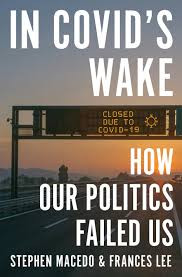
Two liberal (Democratic Party-type) US academics have published a new book that has much wider relevance than the US, including why it is important that we do not just forget about the whole thing. The book, not surprisingly, is controversial as the consensus it critiques has, also not surprisingly, not gone away.  The authors have responded to some criticism here.

It is said that the past is another country but since almost all other countries had the same experience this doesn’t displace it safely to the past, not least because its impact is still with us, never mind the possibility of any repetition.  

From the point of view of this blog the focus is on what the book implies for an evaluation of the approach taken by much of the left.  Those who have read the coverage during the pandemic will know that it was severely critical of the groupthink that overtook the left and was very much a minority, but not idiosyncratic, view.  The Left’s groupthink showed it incapable of challenging the politics of the state and mainstream bourgeois opinion across the world, putting forward a policy–‘Zero Covid’–that was actually much worse.

The suddenness and severity of actions taken by states meant that ‘just a few weeks after the lockdowns spread from China to Italy and elsewhere, 3.9 billion people–half the world’s population–were living under some form of quarantine.’ (In Covid’s Wake, p 3) What was also sudden was the adoption of the policy of lockdown that justified this approach.  Called “following the science”, it was adopted by overturning the science as it had previously been accepted and became the club to silence and stigmatise those who challenged or even questioned it.  The Left consensus simply adopted a more extreme version of this predominant approach.

Several non-pharmaceutical interventions (NPIs), including “contact tracing, quarantine of exposed individuals, entry and exit screening, [and] border closure” were “not recommended in any circumstances” in a World Health Organisation’s (WHO) assessment in November 2019 of NPI use in a respiratory pandemic.  Quarantine of individuals–never mind whole populations–was “not recommended because there is no obvious rationale for this measure in most Member States.” Contact tracing was considered some help in “isolated communities” in the “very early stages of a pandemic.” (In Covid’s Wake, p 29) Other assessments also questioned the use of NPIs, including after reviewing the experience of the 1918 Spanish flu pandemic.

This meant that when China introduced lockdown “public health experts in the United States and elsewhere responded with shock and disbelief”. (In Covid’s Wake, p 50). Dire predictions from Imperial College in London and China’s draconian embrace of lockdown were the occasion for a complete change of approach by the WHO so that now there was no alternative to unprecedented restrictions on freedom of movement backed by massive social surveillance.

Previously inconceivable restrictions became moral imperatives supported by governments, health bureaucracies, health academics and the mainstream media; plus the majority of the left for whom the unprecedented was not unprecedented enough and the draconian not sufficiently draconian.  That China’s apparent success kept on being implemented until its population started revolting was all in the future.  The WHO’s mission to China found that it provided “vital lessons for the global response” and its measures were the only “proven to interrupt or minimize transmission”, while early predictions were made that it would succeed within three months. (In Covid’s Wake, p 56 &58)

The book records how dubious this claim must have been, including the knowledge that pandemics proceed in waves; millions of people had escaped lockdown in Wuhan, and there could be no confidence in the effect lockdown would have against the progress of a novel virus. The WHO made matters worse by stating that “globally, about 3.4% of reported Covid-19 cases have died”, although it could not know how many people had been infected so could not say what percentage of them had died.  Without acting to implement stringent NPIs the modellers of Imperial College predicted “approximately 500,000 deaths” in the UK “and 2.2M million in the US”, along with the collapse of heath systems. “Suppression” of the virus was the only “viable strategy”, with China again held up as the exemplar. (In Covid’s Wake, p 63 &64)

If this didn’t scare you, or rather ‘convince’ you, this might be because you might have known of Imperial College modellers’ previous poor record.  In 2006 it had predicted “catastrophe”, ‘forecasting 150 million deaths around the world’ as a result of the outbreak of avian flu.  Nevertheless, the book’s authors note that Imperial College Covid projections ‘captured the headlines and grabbed the attention of Covid policymakers, including President Donald Trump.’ (In Covid’s Wake, p 51)

Given the forces ranged against any possible dissent it is not surprising that the ‘global suspension of basic liberties was undertaken with widespread public support.’   This was despite the book stating that ‘it is important not to ascribe to policymakers’ views more coherence than they possessed with respect to the goals of the policies they pursued.  To some extent, policymakers failed to reckon with the choices between flattening the curve, attempting to contain the disease and eliminate it entirely, or suppressing the total number of infections over the whole course pf the pandemic.’ (In Covid’s Wake, p 67)

In my own city of Belfast, the local hospital was converted into a ‘Nightingale Hospital’ for Covid-19 patients and apparently more or less closed for most of everything else. While claiming that Covid-19 would close it if it was not protected, it partially closed itself.   Cancer patients could die but no Covid-19 patient could be refused.  Yet even this stupidity did not give pause for thought that this whole policy was the latest example of the ‘madness of crowds.’  Moral panics demand that doubters are immoral and with so much mainstream opinion on-side it is easy to excuse the left who supported it, except it was a failure; they demanded even more of the same, and they ignored, when they weren’t denouncing, alternative voices.

Forward to part 2
Karl Marx’s alternative to capitalism part 79 – Universality (1)

In one of Marx’s earliest writings, the Critique of Hegel’s Philosophy of Right in 1843-4, he asks the question: ‘Where, then, is the positive possibility of a German emancipation?’

‘Answer: In the formulation of a class with radical chains, a class of civil society which is not a class of civil society, an estate which is the dissolution of all estates, a sphere which has a universal character by its universal suffering and claims no particular right because no particular wrong, but wrong generally is perpetuated against it; which can invoke no historical, but only human title; which does not stand in any one-sided antithesis to the consequences but in all-round antithesis to the premises of German statehood; a sphere, finally, which cannot emancipate itself without emancipating itself from all other spheres of society and thereby emancipating all other spheres of society, which, in a word, is the complete loss of man and hence can win itself only through the complete re-winning of man. This dissolution of society as a particular estate is the proletariat.’

The idea of universality and how it may be constituted is a central feature of Marx’s views, one that is acclaimed, as in the UN’s Universal Declaration of Human Rights, and also implicitly or explicitly rejected by supporters of identity politics, multiculturalism, postmodernism, religious fundamentalism, and nationalism etc.

The defenders of the rights of particular groups by virtue of their identity as being a member of the of that group are often in turn supported by those who would also proclaim support for human rights that are not based on these grounds.  No doubt many would argue their compatibility, but if the particular rights claimed by the former were such as to be merely expressions of human rights, then no particular rights would need to be demanded.

This is not primarily a problem of these particular rights not being wholly consistent with that of more general human rights, but of the reality of humanity being fractured and divided in reality.  The generality of human rights cannot recognise this so become an abstract moral claim that is continually eulogised and venerated but cannot be effected without particular claims being executed.

For Marx, it is the interests of the working class–the proletariat–that are compatible with and can bring about general human emancipation.  It is for this reason that Marxists do not cloak their politics in the language of human rights, because their enactment requires recognition of the grounds that would permit them and the struggle required to realise them.  Marxists are often dismissive of claims made on the grounds of human rights because they are made hypocritically by those who defend the grounds that necessarily impose oppression in the first place.  For Marx, the particular claims of the proletariat are universal ones because these include the abolition of itself, of the grounds of its particular oppression through the abolition of all classes.

The grounds for its particular claims must thus form the basis for the emancipation of all of society, and we have written about these extensively already.  In The German Ideology Marx writes:

‘This “alienation” (to use a term which will be comprehensible to the philosophers) can, of course, only be abolished given two practical premises. For it to become an “intolerable” power, i.e. a power against which men make a revolution, it must necessarily have rendered the great mass of humanity “propertyless”, and produced, at the same time, the contradiction of an existing world of wealth and culture, both of which conditions presuppose a great increase in productive power, a high degree of its development.’

‘And, on the other hand, this development of productive forces (which itself implies the actual empirical existence of men in their world-historical, instead of local, being) is an absolutely necessary practical premise because without it want is merely made general, and with destitution the struggle for necessities and all the old filthy business would necessarily be reproduced; and furthermore, because only with this universal development of productive forces is a universal intercourse between men established, which produces in all nations simultaneously the phenomenon of the “propertyless” mass (universal competition), makes each nation dependent on the revolutions of the others, and finally has put world-historical, empirically universal individuals in place of local ones.’

‘Without this, (i) communism could only exist as a local event; (2) the forces of intercourse themselves could not have developed as universal, hence intolerable powers: they would have remained home-bred conditions surrounded by superstition; and (3) each extension of intercourse would abolish local communism. Empirically, communism is only possible as the act of the dominant peoples “all at once” and simultaneously, which presupposes the universal development of productive forces and the world intercourse bound up with communism.’

Marx argues that these are the grounds for a real universality of freedom that previous ruling classes have proclaimed but could never represent:

‘For each new class which puts itself in the place of one ruling before it, is compelled, merely in order to carry through its aim, to represent its interest as the common interest of all the members of society, that is, expressed in ideal form: it has to give its ideas the form of universality, and represent them as the only rational, universally valid ones. The class making a revolution appears from the very start, if only because it is opposed to a class, not as a class but as the representative of the whole of society; it appears as the whole mass of society confronting the one ruling class.’

The character of the universality of the working class as the new ruling class lies in it being the working majority of society and the nature of the appropriation of society’s powers that it will accomplish, based on the universal development of these powers, including the power of the working class itself:

‘Thus, things have now come to such a pass that the individuals must appropriate the existing totality of productive forces, not only to achieve self-activity, but, also, merely to safeguard their very existence. This appropriation is first determined by the object to be appropriated, the productive forces, which have been developed to a totality and which only exist within a universal intercourse. From this aspect alone, therefore, this appropriation must have a universal character corresponding to the productive forces and the intercourse.’

We should not pass without noting that when Marx speaks of the working class making a revolution, and of the universal character of this revolution, his interest is not in a uniform collective, one alien to the individual and her or his freedom.  For Marx, the abolition of classes is necessary to permit the freedom of the individual that capitalism and its liberal philosophy claims but destroys in reality.  After the previous passage he therefore goes on to say:

‘The appropriation of these forces is itself nothing more than the development of the individual capacities corresponding to the material instruments of production. The appropriation of a totality of instruments of production is, for this very reason, the development of a totality of capacities in the individuals themselves.’

How this is achieved is what constitutes working class politics that is the realm of Marxism:

‘Modern universal intercourse can be controlled by individuals, therefore, only when controlled by all.  This appropriation is further determined by the manner in which it must be effected. It can only be effected through a union, which by the character of the proletariat itself can again only be a universal one, and through a revolution, in which, on the one hand, the power of the earlier mode of production and intercourse and social organisation is overthrown, and, on the other hand, there develops the universal character and the energy of the proletariat, without which the revolution cannot be accomplished; and in which, further, the proletariat rids itself of everything that still clings to it from its previous position in society.’

The concept of universality therefore has profound ramifications:

‘The individuals who rule in these conditions — leaving aside the fact that their power must assume the form of the state — have to give their will, which is determined by these definite conditions, a universal expression as the will of the state, as law, an expression whose content is always determined by the relations of this class, as the civil and criminal law demonstrates in the clearest possible way. Just as the weight of their bodies does not depend on their idealistic will or on their arbitrary decision, so also the fact that they enforce their own will in the form of law, and at the same time to make it independent of the personal arbitrariness of each individual among them, does not depend on their idealistic will.’

The state is today held up as the organ of the universal interest, as representing the interest of society as a whole.  There can be no more dreadful mistake, as not only does the state and the bureaucracy that it entails have its own interests, but these are bound tightly to those of the ruling class.  It is a mistake as common as it is egregious, proclaimed repeatedly even by those who claim to be followers of Marx.

As Marx notes: ‘actual private interests, etc., etc., are expressed as universal interests, descend to the level of mere idealising phrases, conscious illusion, deliberate hypocrisy. But the more their falsity is exposed by life, and the less meaning they have to consciousness itself, the more resolutely are they asserted, the more hypocritical, moral and holy becomes the language of this normal society.’ (All quotations from The German Ideology, Marx and Engels)

The one hundred and seventy-five years since Marx penned these words has witnessed hundreds of millions of deaths under the banner of universal interests in the guise of nationalism, the ‘national interest’ and wars for ‘human rights’.  At the same time the ideologues of capitalism have damned the explicit call for real universality as idealistic and totalitarian, if not actually impossible. Recovering the idea of universality as argued by Marx is therefore necessary but can only succeed if the politics of its creation through the working class is defended and advanced practically.

Back to part 78

Ukraine, Iran and World War III

Volodymyr Zelensky has said that World War III has already started.  If so, Ukraine is fighting it, supported by Western imperialism, which means that the ‘left’ supporters of Ukraine have already picked a side.  From the point of view of opposing the further development of this war they are worse than useless.

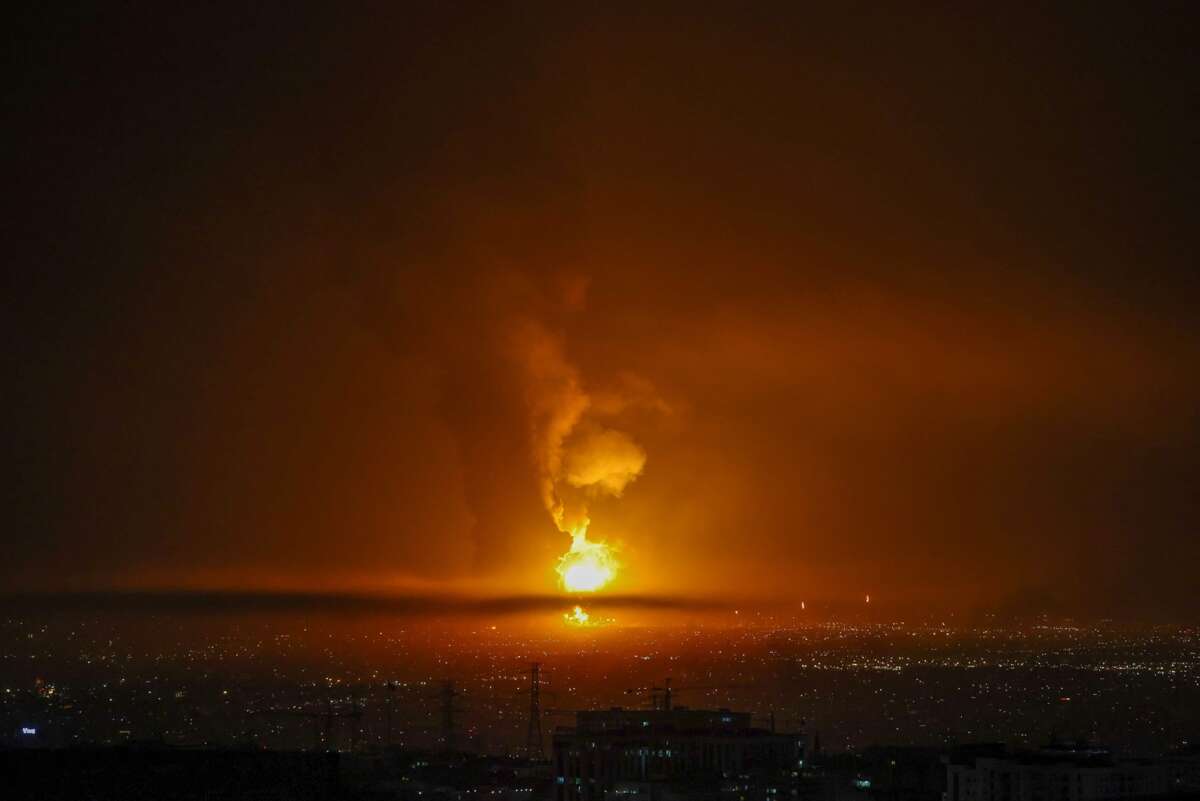
Its development includes attacks on Venezuela, and now once again on Iran.  In the first day this involved the destruction of an elementary school, killing over one hundred young girls, barely acknowledged with a shrug and a lie, plus the sinking of an unarmed Iranian ship with its sailors left to drown.  This is a war crime that even the Nazis adhered to at the start of World War II.  As one commentator noted the US had “now dropped below that level.”

This statement would be true were the word ‘now’ removed.  While each atrocity is treated as a singular act of barbarity with its own characteristics, it is unfortunately the case that this level is all too familiar. It is not only ‘now’ that US imperialism, its Zionist attack dog and the ‘civilised’ European states have involved themselves in atrocity.  What is worse than a rolling genocide in which ‘peace’ is declared as a real estate project to build a golden holiday resort over the ashes of the dead?

The working class is constantly invited to compartmentalise the world into discrete and separate events that are unrelated, so that they are unable to understand or remember them as more than individual examples of immoral turpitude. The foreign policies of states are somehow different from domestic policy, one foreign policy has nothing to do with another, and what happened in the past stayed there.  

The ‘left’ supporters of Ukraine excel in this–western imperialism is condemned in relation to Palestine and Iran while approved for support for Ukraine. It supports a Ukraine that supports the attack on Iran and states that it wants to be a “big Israel” in Europe. It now also seeks to provide help to the reactionary and authoritarian Arab states collaborating with the attack.  Yet the pro-Ukraine left justify their position by claiming a war between democracy and authoritarianism.

The authoritarian policies of Trump and Starmer demonstrate what a deception it is to provide political support to any imperialist state. Inconsistent opposition to imperialism can only be justified by claiming that imperialism itself is inconsistent: not an irradicable feature of capitalism but a choice that sometimes means imperialist war is progressive.

Authoritarian politics inside the West is directly related to its foreign wars.  This is evidenced in country after country: Starmer treats anti-genocide protesters as terrorists; the German state represses Palestine supporters, and Trump unleashes State paramilitaries on the working class while elected not to engage in foreign wars.

In Ukraine, credentials for the good fight against authoritarianism include the ban on opposition parties and media; martial law; the ‘busification’ of men into the army; the conscription of the working class and poor while the sons of the rich and connected are free, and millions seeking escape to avoid the draft.  

In Ireland, the Irish bourgeoisie trumpets its anti-colonial history while the state has become an integral part of imperialism.  Shannon airport has become an important hub for US supply of war material to Israel; the Irish Central bank has facilitated the sale of Israeli bonds that have helped finance the genocide, and booming trade with Israel has made it that state’s second biggest trading partner.

The Irish pretence at neutrality is increasingly an obstacle to the state’s international political role aligning with its economic.  This is why the ‘threat’ from Russia, like everywhere else in Europe, is paraded as justification for massive rearmament with the objective of joining NATO.  The Irish left defends ‘neutrality’ and opposes joining while much of it supports Ukraine’s war for NATO membership and the arming of it by the alliance.

Western hypocrisy in relation to the attack on Iran finds refuge in its denunciation of the repressive character of its state while the Western media fixates on questions of the purpose and endgame of Trump’s attack. The crazed and criminal intentions of the Zionist state are simply reported as a natural and accepted condition of that state, which of course is true, but without the moral approbation it would normally entail.

The dismay among media commentators that there is a complete lack of strategy in Trump’s actions, and no endgame ,fails to understand that war is itself a strategy, albeit an inadequate one, and that the inter-imperialist rivalry that lies behind it does not have an end outside of human catastrophe or an end to imperialism itself.

We have seen one attack on Iran end without resolution and there may be another.  The weakening of it can be expected to continue in any event, as one aspect of exerting US power against China and its Russian ally.  The remaining power of the US is displayed both by its attack on Iran together with the relative weakness of the Russian and Chinese responses, alongside the extreme reluctance to ‘put boots on the ground’, and the analogous but opposite situation in Ukraine.

The endless horror of war requires greater censorship and repression at home. The Russian invasion cannot be mentioned without it being called ’unprovoked’, ignoring the obvious provocations by NATO and Ukraine, while the word ‘unprovoked’ disappears from the dictionary when describing the attack by the US and Israel on Iran.

This is obvious propaganda.  It has largely succeeded in relation to the war in Ukraine but not regarding genocide in Gaza, and many can also see the hypocrisy involved in the attack on Iran.  It doesn’t translate into opposition because there is no pre-existing political opposition to imperialism that can navigate the cascading conflicts and present an alternative, although this is simply to declare the current weakness of socialism.

We have already noted the stupidity of much of the Irish left in opposing the push to Irish NATO membership but supporting the Ukraine war for it.  The rest of the Western left supporting Ukraine must explain how it can oppose imperialist rearmament while calling for more weapons to Ukraine that require it.  Why doesn’t it support Russian arms to Iran since it is the subject of an unprovoked attack by imperialism?  That way it could demonstrate its otherwise ridiculous claim not to be ‘campist’ by supporting the US against Russia in Ukraine and Russian against the US in Iran. Instead of opposing both it could achieve this feat by the truly remarkable device of supporting both!

The propaganda succeeds because the invasion should be opposed but not by supporting the Ukrainian state in its alliance with western imperialism, which began before the invasion.  In addition, the Iranian regime is brutal and reactionary, but US imperialism has paraded its callous cruelty with bombastic pride since the start of its attack.  Without a working class perspective there is no third force or policy to consistently pose a coherent response.

The petty bourgeoisie, with moralistic beliefs, is incapable of overcoming in politics the limitations of its social position that reduces social questions to good versus bad without any deeper social critique.  No understanding can arise from it of the differences between the Ukrainian state, its people or its working class and that they should be considered to have separate and opposed interests.  When the Ukrainian state unites with imperialism; its corruption involves its bourgeoisie siphoning off millions of dollars of aid; when it attacks working class people in the street to cart them off to the front; when it celebrates the fascist units in its armed forces–all this does not fit the desired narrative of a good victim, so is effectively ignored.

In Iran, the perceived need not to ‘complicate’ the narrative leads to reluctance to separate the interests of the Iranian state and its regime from that of the Iranian people and its working class. Yet the reality that they are not the same was proved by the regime killing thousands of protesters only a couple of weeks ago.  The idea that these were all Mossad agents shows only the susceptibility of many to the view that only the Iranian regime and its imperialist enemy matter.  That opposition to one means support for the other.  Yet the future of Iran and its people depend on this not being true.

For many on the left old formulas of ‘self-determination of nations’ and ‘anti-imperialism’ show only that they seek to hit a target but miss the point.  The socialist movement has witnessed many imperialist wars, and it is now some time since they held up the banner of socialism as the only way to stop them.

Karl Marx’s alternative to capitalism part 78 – the importance of labour to universal emancipation

Behind the decisive importance of the development of the productive forces and the potential abolition of classes, which provide the grounds for the end of capitalist exploitation and social oppression, lies the fundamental importance of labour in understanding human society.

In the ‘Economic and Philosophical Manuscripts’, (Marx, in Early Writings, Penguin, pp. 279–400) Marx stated that ‘The whole of what is called world history is nothing more than the creation of man through human labour’:

‘The first premise of all human existence, and therefore of all history…[is] that men must be in a position to live in order to be able to ‘make history’. But life involves before everything else eating and drinking, a habitation, clothing and many other things. The first historical act is thus the production of the means to satisfy these needs, the production of material life itself. And indeed this is an historical act, a fundamental condition of all history, which today, as thousands of years ago, must daily and hourly be fulfilled merely in order to sustain human life.’

This is just as true today, although it would be an obvious mistake to see ‘production’ and the ‘needs’ it addresses purely in terms of the creation of goods and services necessary for bare minimum existence, or even in terms of modern ‘consumer society.’

What is consumed has to be produced:

‘Through estranged labour man not only produces his relationship to the object and to the act of production as to alien and hostile powers; he also produces the relationship in which other men stand to his production and product, and the relationship in which he stands to these other men. (Marx, Economic and Philosophical Manuscripts , p 279–400.)

Production thus involves not just the bare existence of humanity but also the form that human society takes, including the relations of production that set out the pattern of exploitation and oppression.  Upon this rests the superstructure of society, conditioned by the productive forces and relations:

‘. . . the real foundation, on which arises a legal and political superstructure and to which correspond definite forms of social consciousness. The mode of production of material life conditions the general process of social, political and intellectual life. It is not the consciousness of men that determines their existence, but their social existence that determines their consciousness.’  We thus produce not just material (and immaterial) goods and services but also our social, political and ideological institutions, including philosophy, morality and religion etc.

So, when Marx talks about production and needs he is talking about the production of humanity itself, the form that it takes in various societies and the necessary interaction with the rest of nature, of which it is part:

“Labor, then, as the creator of use-values, as useful labour, is a condition of human existence which is independent of all forms of society; it is an eternal natural necessity which mediates the metabolism between man and nature, and therefore human life itself.” (Marx,, Capital, Volume I p133,). The satisfaction of human needs involves the ‘metabolic exchange with external nature’ (Grundrisse p. 528), which refers also to ‘historic needs … created by production itself, social needs’ (ibid p. 527), which are not just of a ‘physical’ nature (Capital Volume 1, pp 275, 341) but also include ‘intellectual and social requirements’ whose extent and number ‘is conditioned by the general level of civilisation’ (Capital: Volume I MECW Vol 35 p181.). 

It is in relation to this general level that individuals consider their own position, which makes inequality so corrosive of a person’s subjective and objective wellbeing: ‘our desires and pleasures spring from society; we measure them, therefore, by society and not by the objects which serve for their satisfaction. Because they are of a social nature, they are of a relative nature’ (Marx,Wage, Labour and Capital)

A number of consequences follow. The first is that the development of humanity’s productive powers create new needs, and human beings “distinguish themselves from animals as soon as they begin to produce their means of subsistence.”  “The second point is that the satisfaction of the first need . . . leads to new needs and this production of new needs is the first historical act . . . a certain mode of production . . . is always combined with a mode of cooperation” (Marx and Engels, The German Ideology, pp 42, 49, 50).

This form of cooperation can be understood in several ways. First, the organization of production is a historical process involving learning and tools that have been transmitted from one generation to another. Second, every previous historical form of production has involved some division of labour — division between mental and material labour, a gender division of labour, class divisions, racial and ethnic divisions, and a division which assigns different individuals to different tasks in the specific production process and in society as a whole.

Third, human consciousness, intrinsic to production, is itself social, as human consciousness is only possible through language, and language is inherently social. “Consciousness is, therefore, from the very beginning a social product, and remains so as long as men exist at all” (Marx and Engels, The German Ideology, p 51).

Finally, human production is fundamentally social because human beings are fundamentally social animals. As Sean Sayers puts it: “We are inherently and essentially social beings. We develop our natures . . . only by participating in society. . . . Sociality is inscribed in our very biology” . (Sayers 1998) What this means is not simply that we like to hang out with one another but that our very sense of individuality and the kind of individuality that we have depends on the form of society in which we live. “The human being,” Marx writes in the Grundrisse, “is in the most literal sense a zoon politikon [political animal], not merely a gregarious animal, but an animal which can only individuate itself in the midst of society” (Marx, Grundrisse p 84).

The Marxist understanding of humanity is thus that the ‘human essence is no abstraction inherent in each single individual. In its reality it is the ensemble of the social relations.’   These relations are conditioned by the need to produce socially: ‘In work, as we have seen, we produce not only goods but also social relations, and indeed we produce and transform human nature itself. ‘The whole of what is called world history is nothing more than the creation of man through human labour’ (Marx, Economic and philosophical manuscripts, p 400, 423).

In Engels’ ‘The Part Played by Labour in the Transition from Ape to Man’ labour is described as ‘the prime basic condition for all human existence, and this to such an extent that, in a sense, we have to say that labour created man himself.’

This creation is to be understood not just in terms of the need to produce in order to survive or to produce the culture we now currently enjoy, but also in terms of basic biological properties of humans that we take for granted and which developed from our evolution within the wider natural world.  This includes the development of cooperation and the necessity for language and the development of the specific configuration of the human brain, as the outcome of prior evolutionary changes in the corporeal configuration of hominids, eventually leading to the Homo Sapiens that includes opposable thumbs, bipedalism, binocular vision, etc. (Fracchia, The Capitalist Labour-Process and the Body in Pain, Historical Materialism 16, 2008: p 39)

This development is not, of course, the domain of Marxist theory, but of the natural biological and evolutionary sciences, but which Marxism has been able to build upon to explain the continuing development of humanity through its social organisation.  In terms of this development, Marxism perceives that humanity ‘by acting on the external world and changing it, at the same time change[s] his own nature.’ (Marx, Capital Vol. 1)

The development of the forces of production therefore can compel not only alienating labour but the source of what Marx considered real wealth: ‘when the limited bourgeois form is stripped away, what is wealth other than the universality of individual needs, capacities, pleasures, productive forces etc…. the full development of human mastery over the forces of nature, those of so-called nature as well as of humanity’s own nature? The absolute working out of his creative potentialities, with no presupposition other than the previous historic development, which makes this totality of development, i.e. the development of all human powers as such the end in itself, not as measured on a predetermined yardstick? (Marx, Grundrisse p488)

Central to this is the reduction of necessary labour time, which we explained in the previous post is: ‘that required to reproduce the working portion of society at its given, historically developed, level of subsistence, its standard of living.’  Its reduction allows in the free time made available:

‘The free development of individualities, and hence not the reduction of necessary labour time so as to posit surplus labour, but rather the general reduction of the necessary labour of society to a minimum, which then corresponds to the artistic, scientific etc. development of the individuals in the time set free, and with the means created, for all of them.’ (Marx, Grundrisse p 705–6)

While the potential exists for the time involved in surplus labour to be transformed into free time, the character of necessary labour time will also change.  The existing character of labour as mostly alienating, in which the social and cooperative nature of it is distorted and disfigured, could be transformed by conscious control of the productive forces to the objective of meeting and further developing human needs and powers.

‘I would have the immediate satisfaction and knowledge that in my labour I had gratified a human need, i.e, that I had objectified human nature and hence had procured an object corresponding to the needs of another human being’ (Marx ‘Excerpts from James Mill’s Elements of Political Economy’,Early Writings, pp. 259–78.)

‘Freedom in this field can only consist in socialised man, the associated producers, rationally regulating their interchange with Nature, bringing it under their common control, instead of being ruled by it as by the blind forces of Nature; and achieving this with the least expenditure of energy and under conditions most favourable to, and worthy of, their human nature. (Marx, Capital, Volume III p959)

The complete socialisation of the productive forces of society by the working class abolishing all classes, including itself, is a means, not of limited freedom from oppression – a purely negative objective – but ‘“the full development of human mastery over the forces of nature . . . the absolute working out of [their] creative potentialities . . . the development of all human powers as an end in itself ” (Marx, Grundrisse p488). Such is the claim of Marxism for the universal character of the working class struggle for emancipation.

Back to part 77

Forward to part 79