Socialists in Ireland opposed the Good Friday Agreement because it dictated continued imperialist rule in the North of Ireland that thus necessitated the continuation of sectarianism, enshrined in the rules governing the operation of the devolved administration at Stormont. The alternative to challenging sectarianism was to freeze it, registering the failure of republicans’ armed project to remove British rule and the inability of Unionism to reimpose the unilateral rule it had enjoyed since the creation of the state until 1972. For the British and for the Irish state freezing this volatility promised political stability, or at least the minimum of blowback from the North to either of their respective states.
The magic formula was ‘power sharing’. It hasn’t worked, and no one has claimed it has; except for widespread claims from local politicians, the two governments and the media that it is still the solution.
Widespread dismay at Stormont’s ineptitude long ago gave way to cynicism at its incompetence, dysfunction and mendacity. You can’t freeze sectarian competition, overseen by London, when the whole point of the system is to ensure the absence of power to the other side. That is the point of the arrangements – not to share power but to throttle the exercise of it by the other side. That’s why many people vote as they do – to stop ‘the other side’ as the only alternative to their own – no matter how useless etc. it may be.
It helps that neither Irish nationalism or Unionism has any social or political programme that could transcend sectarian division or promise an agenda that could win over those outside its core support. Unionism is based on sectarian division and on its continual assertion, while Irish nationalism has surrendered to the idea that it is a legitimate expression of cultural expression and political rights summed up in differing national identities. It promises to respect the Unionist tradition in its calls for an always imminent border poll for a united Ireland, while the Irish Government touts a ‘shared island’ project designed to lead to the holy grail of the reconciliation of the two traditions and ‘consensus’ on the future.
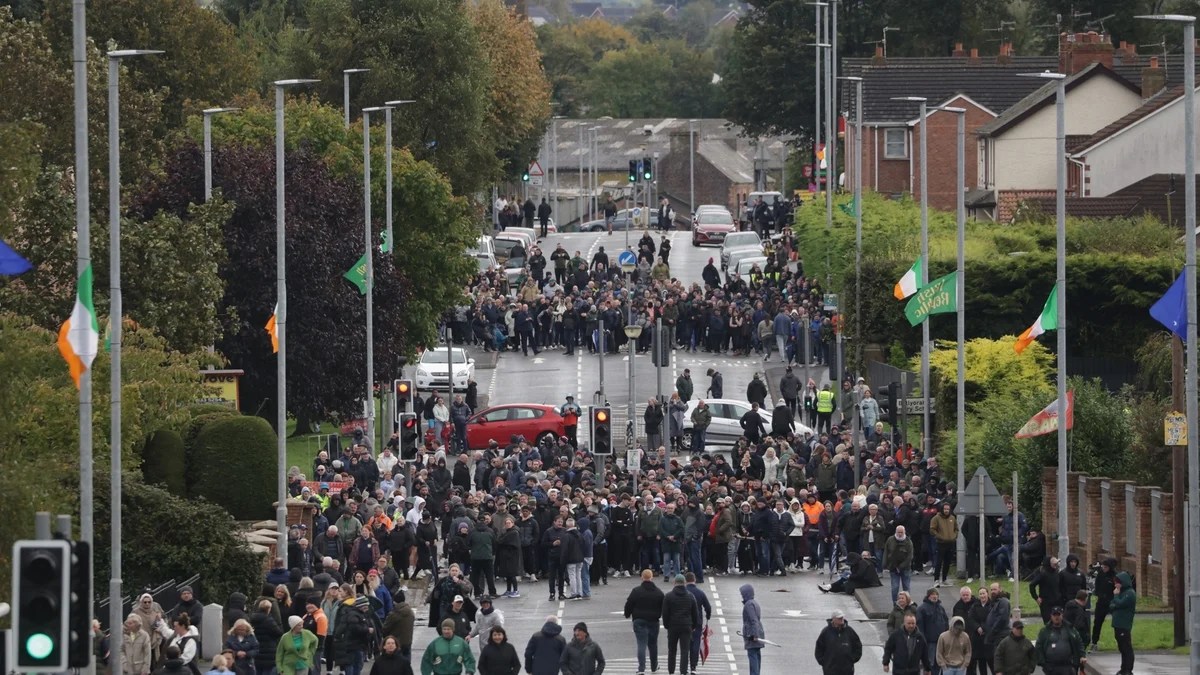
The Orangemen in Portadown have challenged Irish nationalism to put its money where its mouth is and show respect to its marching tradition, share the Garvaghy Road with its Orange parade, reconcile itself to the legitimacy of its right to so march, and thus accept a consensus that this is the future.
The residents of Garvaghy Road have said that they won’t respect anti-Catholic bigotry; won’t allow its neighbourhood to be subject to sectarian coat-trailing; won’t reconcile itself to a supremacist march that validates the supremacism of those marching and won’t accept that all this is their future.
Sinn Fein leaders turned up to the residents’ protest but they turned up politically naked. It is they who are partners in government with the Democratic Unionist Party, that just coincidentally is facing an election next year and is wracked by sex scandals. It is Sinn Fein that has presented itself as supporters of the institutional arrangements that have so obviously failed, including the Parades Commission that approved the Orange march, and the police whose evidence to the Commission ensured its approval.
The police are charged with enforcing the Commission decision but have balked at doing so because it can only succeed by beating the residents off the Road. Such an occurrence would destroy the credibility of any appeal to nationalists to support them and confirm the failure of the Sinn Fein strategy of being at Stormont. Every party supporting the current Good Friday Agreement – from the British and Irish governments, including the police, to the nationalist parties – know this. Rather than accept a forced march down the Garvaghy Road they are in the middle of kicking a can down it.
The cleanest solution for the British is to find a way to stop the Orange march – it’s what has worked for it and others for nearly thirty years. Unfortunately, the semblance of fair and objective discretion embodied in the Parades Commission has been exposed, along with the credibility of a police that advised it of no potential disorder but immediately imported police from Britain to deal with it as soon as the march had been approved.
Some other mechanism is now being called on to mediate a solution that is supposed to satisfy ‘both sides’ but which otherwise must satisfy the British who are in charge. They don’t care one way or the other whether the Orangemen march down Garvaghy Road; their objective is to stabilise their rule through Stormont by keeping both Sinn Fein and the DUP inside it.
The latter has been losing votes and is recording its lowest level of support for more than twenty years so an Orange march would boost its standing. Its long-stated opposition to the Good Friday Agreement doesn’t mean that it will walk out, as its guarded statements over the last few days have shown, but staying in while the Orange can’t march will expose weakness. On the other hand, imposing the march will damage Sinn Fein, whose support has also declined to the lowest in five years. Walking out of Stormont is not on its agenda either, at least not yet. On such shared objectives may rest a resolution although neither the Orange Order or the Garvaghy residents are puppets of either party.
Whatever ‘solution’ arises, the vulnerability and weakness of the existing governance arrangements have been exposed, and a credible socialist alternative remains to be created.
Three years ago, a joint statement by this blog and Boffy’s Blog set out the collapse of many “Marxist” organisations into social-imperialism in relation to the Ukraine-Russia War. These organisations had abandoned the independent camp of the international proletariat and instead, lined up behind one of the contending imperialist camps of NATO/Ukraine or Russia/China. Over the last three years their capitulation has hardened and deepened despite the imperialist nature of the war becoming more obvious. The arguments of each side, such as they are, can only lead them to extend this support to the various imperialist camps in the future wars that are inevitable.
The contribution below was sent by a Polish reader who explains its origin. A response by this blog will be drafted and published.
From Jan Jędrzejewski:
On May Day 2026 I published and distributed a leaflet, resulting from my first reading of Hal Draper’s The Myth of Lenin’s “Revolutionary Defeatism”, where I agreed with Draper’s conclusion to abandon the concept of revolutionary defeatism. The pdf file can be downloaded at: https://chomikuj.pl/janjedrzejewski , its name is: War-no-Socialism-yes. It would be interesting to learn the opinion of the authors of the above joint statement on my arguments against using the slogan of revolutionary defeatism. Jan Jedrzejewski, Warsaw, Poland.
Statement:
In Ukraine, Sudan, Gaza Strip, Lebanon, Iran and else-where, capitalism bleeds with war – let’s reach for socialism! Not socialism stuck halfway, like an island in the capitalist ocean, but socialism as a world system. Such socialism will permanently ensure freedom and peace for nations. A socialized, planned economy, democratically managed through a system of workers’ councils elected at workplaces, will ensure decent jobs, adequate housing, access to adequate healthcare, education, culture, and recreation for all. The great cleanup after capitalism will begin the planned process of reclamation of devastated areas and effective protection of the Earth’s natural environment, encompassing radical changes in industry, agriculture and livestock farming. Humanity will be able to minimize social losses caused by subsequent natural disasters. Socialism is the only solution to the threat of a devastating world war in which no one will emerge victorious.
I’m speaking out about the program of a prospective revolutionary party, or rather, what shouldn’t be in it: the slogan of revolutionary defeatism. I myself used to promote defeatism in the Marxist Discussion Bulletin, which had been edited with the help of a few comrades from 2019 to 2025. I’d no longer advocate it in either Russia or Ukraine. Nor would I now present revolutionary defeatism as an alternative to the postulate of Jacobin war (see MBD no. 1, December 31, 2019).
However, I uphold Karl Liebknecht’s slogan from 1915, sometimes equated with defeatism: “The main enemy of every people is in their own country”. The bourgeoisie in Poland not only exploits the labouring masses and denies fundamental rights to the masses’ majority, such as access to housing. The rulers are currently preparing the entire country to defend itself against a supposedly inevitable attack from Russia. As the bourgeoisie claims through their spokesmen, they’re ensuring Poland’s “security”. They’re doing it by participating in a proxy war of the United States and its NATO allies against Russia, waged with Ukrainian hands on their territory, and by developing an intensive arms program. However, it’s not so much Russia as the Polish bourgeoisie itself that is pushing the labouring masses towards a war catastrophe and therefore remains our main enemy. Thus, I reiterate the call from MBD of 2024: Down with NATO! Stop rearming Ukraine! Not a man and not a penny for bourgeois militarism!
What was revolutionary defeatism? For me, defeatism was always associated with a declaration of choosing the “lesser evil”. This was the case, for example, in the definition provided by Leon Trotsky, leader of the Fourth International:
“Defeatism is the class policy of the proletariat, which even during a war sees the main enemy at home, within its particular imperialist country. Patriotism, on the other hand, is a policy that locates the main enemy outside one’s own country. The idea of defeatism signifies in reality the following: conducting an irreconcilable revolutionary struggle against one’s own bourgeoisie as the main enemy, without being deterred by the fact that this struggle may result in the defeat of one’s own government; given a revolutionary movement the defeat of one’s own government is a lesser evil” (A Step Towards Social Patriotism, July 1939, marxists.org).
What’s wrong with this definition? I think it’s impossible to be sure whether a wartime defeat or a victory of one’s “own capitalist government” would create better conditions for the success of a revolutionary intervention by the proletariat during or immediately after the war. This is especially true if it were a Pyrrhic victory, exhausting all forces. So, to paraphrase this definition, defeatism is, on the one hand, the policy of a relentless revolutionary struggle in the country during a war, against the main enemy, and, on the other hand, a kind of forecast of a less burdensome outcome of that war for the proletariat (it’s always the defeat of one’s own government). Such forecasts, however, are worthless as prophecies, and I reject this part of the above-quoted description of the policy (or tactics) of defeatism.
The impetus for me to abandon defeatism came in 2025 when I read Hal Draper’s article, The Myth of Lenin’s “Revolutionary Defeatism” (New International [USA], 1953-1954). It’s available in English at marxists.org, from which the quotes were taken.
Draper belonged to a splinter group within the Ameri-can Trotskyist movement, which, following the revelation of Hitler’s 1939 pact with Stalin regarding the partition of multinational Poland, refused to recognize the USSR as a workers’ state. Those dissidents believed that the bureaucracy in the USSR was no longer a social stratum but a new class of exploiters, and they called the country’s system bureaucratic collectivism. This contradicted Trotsky’s assertion that the USSR remained a degenerate workers’ state, requiring a proletarian political revolution.
Although I’m opposed to the theory of bureaucratic collectivism, I found Draper’s arguments for abandoning defeatism compelling. To support this thesis, he points to Rosa Luxemburg’s rejection of the victory or defeat dilemma, quoting that revolutionary’s 1915 article:
“For the European proletariat as a class, victory or defeat of either of the two war groups would be equally disastrous. For war as such, whatever its military outcome may be, is the greatest conceivable defeat of the cause of the European proletariat. The overthrow of war and the speedy forcing of peace by the international revolutionary action of the proletariat alone can bring to it the only possible victory” (The Crisis of German Social Democracy, translation used by Draper).
Draper also quotes Trotsky, who at the same time rejected Lenin’s lesser-evil orientation, writing:
“…under no conditions can I agree with your opinion, which is emphasized by a resolution, that Russia’s defeat would be a »lesser evil«. This opinion represents a fundamental concession to the political methodology of social-patriotism, a concession for which there is no reason or justification, and which substitutes an orientation (extremely arbitrary under present conditions) along the lines of a »lesser evil« for the revolutionary struggle against war and the conditions which generate this war” (Nashe Slovo, June 4, 1915, translation used by Draper).
Draper writes that Trotsky pointed to the “social-patriotic potential which resides in” the defeat-slogan regarding one’s own government. I don’t intend to enquire into this methodology of social-patriotism or social-patriotic potential. As I wrote above, I reject defeatism for lack of foundation of declaring in advance which outcome of the war represents the lesser evil.
Moreover, Draper’s history of defeatism provides arguments for its rejection. First, Draper emphasizes that the tactics of defeatism, inherited by Lenin, applicable only in Russia, valid in pre-imperialist times, during the 1914 inter-imperialist war was opposed by revolutionary social democratic activists in exile (Luxemburg, Trotsky, Radek) and at home (e.g., Bukharin, Pyatakov, but not Zinoviev). Second, Draper alleges that Lenin abandoned defeatist tactics forever upon his return to the country after the February Revolution of 1917, without explaining by Lenin, why. This occurred after being confronted with the “social-patriotism of the masses” (Draper’s formulation).
According to Draper, the main reason for Lenin and the Bolshevik Party abandoning defeatism was the orientation of the masses towards defence of the country, understood by them as defence of the gains of revolution that over-threw czarism. Draper explains that Lenin abandoned defeatism when he realized “that the defeat-slogan [regarding one’s own government] broke all links between the sentiments and interests of the masses and the program of the consistent revolutionaries”.
As for the titular myth of Lenin’s “revolutionary defeatism”, it refers to the political counterrevolution in the USSR. Draper writes that after years of oblivion, “Defeatism was revived as a »principle of Leninisim« in the beginnings of the Stalinist counter-revolution, most specifically by Stalin’s partner in the »troika« which succeeded to Lenin’s leadership – Zinoviev”. It should be summoned up here that the political counterrevolution in the USSR took place after Lenin’s death in 1924, under Stalin’s slogan of building “socialism in one country”, or as Trotsky later explained, the recognition that “the revolution is wholly completed; social contradictions will steadily soften; the kulak will gradually grow into socialism; the development as a whole, regardless of events in the external world, will preserve a peaceful and planned character” (The Revolution Betrayed 1936, marxists.org).
However, the history of defeatism is even more complicated. Draper points to Trotsky’s later adoption of the slogan of defeatism, even “revolutionary defeatism”, despite his 1915 critique of defeatism, quoted above. Draper notes that Trotsky didn’t justify this decision. He writes that Trotsky “has fallen precisely into the methodological error of putting the question in the form of a choice between military outcomes on the government plane – the error which he saw so clearly in Lenin before he started to find »orthodox« formulations”. However, as Draper writes, Trotsky “never did accept it [the term defeatism] in the sense given to it by Lenin or anyone else. What happened is that he sought to reinterpret it in a peculiar fashion which not only deprived it of Lenin’s content but sometimes of any content whatsoever”. All of it together speaks for abandoning defeatism as an unjustifiably tolerated baggage from the past.
As we’ve seen, Draper believed that the slogan of defeatism had social-patriotic potential. Therefore, in his article, he argues that the Palestinian Trotskyists’ 1939 concept of advising defeatism to workers in fascist states, but not in the “democratic camp”, was “the first case we know of where serious thinking about Lenin’s concept of defeatism led a group in an objectively social-patriotic direction; where, so to speak, the social-patriotic potential in it was acted out in politics”. In turn, Trotsky, in the above-quoted (after Draper) letter from 1939 to these Palestinians, already in the title states that their concept is “A Step Towards Social Patriotism”.
In short, social-patriotic potential, which “resides” in the slogan of defeatism (Draper), emerged along with rejection of this slogan for some countries, as a step to-wards social-patriotism (Trotsky). I’d propose another explanation: this “step” of the Palestinian Trotskyists probably resulted from the mood of the masses, from the fact that the Jewish workers in Palestine saw their main enemy in European fascism, and not in the British bourgeoisie. I wouldn’t call it social-patriotism, a term I’d re-serve for the revisionist policy of “political truce” with the bourgeoisie by a workers’ party in the name of “defence of the fatherland”, such as that adopted by the German SPD and many workers’ parties in other countries after the World War One broke out.
To sum up, I advocate proletariat’s revolutionary struggle “against war and the conditions which generate this war” (Trotsky, 1915); I believe that “The overthrow of war and the speedy forcing of peace by the international revolutionary action of the proletariat alone can bring to it the only possible victory” (Luxemburg, 1915); I believe that what’s necessary is “conducting an irreconcilable revolutionary struggle against one’s own bourgeoisie as the main enemy” (Trotsky, 1939). The effects of this struggle should be assessed not in terms of drawing close to a wartime defeat of one’s own government, but in terms of drawing close to an overthrow of capitalism, as the social system that generates predatory and increasingly destructive wars. On May Day, let’s call together: War – no! Socialism – yes! Socialism – where? All over the world!
File to download: chomikuj.pl/janjedrzejewski Contactwith the author: (e-mail) mbd-warszawa@wp.pl
The self-emancipation set out in the previous post is a result of what the working is, what its essential nature is. At the same time it is the result of struggle, including its struggle to become aware of its nature and the historical tasks that result from it. It is not therefore a question of inevitability, as in a dictionary definition as ‘sure to occur, happen, or come’, or ‘unable to be avoided, evaded, or escaped.’
Inevitability here means that the essential nature of the working class, as set out in the last number of posts, entails that it will become to a greater or lesser extent aware of its interests, will struggle to defend its interests and will seek to create a society in which these become universal as society is transformed. This potential can be realised because it is part of the essential nature of the working class, but this potential can be thwarted and destroyed so that the working class is degraded along with the universal interests it represents, entailing the equal degradation of society as a whole.
This view of the working class was expressed early in Marx’s political development when he stated that “Not in vain does it [the proletariat] go through the stern but steeling school of labour. It is not a question of what this or that proletarian, or even the whole proletariat, at the moment regards as its aim. It is a question of what the proletariat is, and what, in accordance with this being, it will historically be compelled to do.’
‘Its aim and historical action is visibly and irrevocably foreshadowed in its own life situation as well as in the whole organisation of bourgeois society today. There is no need to explain here that a large part of the English and French proletariat is already conscious of its historic task and is constantly working to develop that consciousness into complete clarity.” (The Holy Family, Marx and Engels Collected Works Vol 4 p37)
This ‘life situation’ entails its lack of ownership of ‘bourgeois property’ – the means of producing what is needed to live at a certain standard of civilisation – and the results following of private appropriation of the results of its labour, appearing in the phenomena of economic and political crises, including war; also in the rampant inequality that disfigures and degrades relations between individuals and society as a whole. The socialisation of this production under capitalism provides the basis of its transformation into the property of the working class who employ the means of production, which is the essential role of the working class.
Placed in this objective situation workers become aware of their existence as a separate class, although this in itself is not class consciousness of separate political interests, or how these must be advanced. History demonstrates both this awareness, its striving for political expression, and the struggle to make it adequate to the tasks posed to it. The latter is the struggle to marry the working class to Marxism.
The working class alternative thus arises from the objective nature of the class and the subjective development that arises from this nature, from the struggle to clarify its tasks and struggle for their achievement. For Marx, socialists could assist in this task of clarification but not substitute its own clarity for it. This required that they always seek to work and unite with the working class whatever its level of development, as put forward in the section of The Communist Manifesto entitled ‘Position of the Communists in Relation to the Various Existing Opposition Parties’.
‘Both for the production on a mass scale of this communist consciousness, and for the success of the cause itself, the alteration of men on a mass scale is necessary, an alteration which can only take place in a practical movement, a revolution; the revolution is necessary, therefore, not only because the ruling class cannot be overthrown in any other way, but also because the class overthrowing it can only in a revolution succeed in ridding itself of all the muck of ages and become fitted to found society anew.’ ” (The German Ideology, Marx and Engels Collected Works Vol 5 p52-53)
The organisation for which The Communist Manifesto was written was therefore to enable the development of this consciousness, including in the organisation itself, and Engels, in his History of the Communist league recorded that ‘The organisation itself was thoroughly democratic, with elective and removable authorities. This alone barred all hankering after conspiracy, which requires dictatorship, and the League was converted—for ordinary peacetime at least—into a pure propaganda society. These new Rules were submitted to the communities for discussion—so democratic was the procedure now followed—then once again debated at the Second Congress and finally adopted . . .’ (On the History of the Communist League, Marx and Engels Collected Works Vol 26 p321-322)
This attachment to democracy was a consequence of commitment to self-emancipation and in turn an obligation to base its politics on working class independence. This became a constant political struggle for Marx and Engels that continues today. In a letter to Engels, on 18 February 1865, Marx denounced the idea that the Prussian government would help the workers set up their own cooperatives and excoriated even the idea that the working class should accept it: “the honour of the workers’ party requires that it reject such illusions, even before their hollowness is punctured by experience. The working class is revolutionary or it is nothing.’ (Marx and Engels Collected Works Vol 42 p96). Dependence on the bourgeoisie or its state would make the working class a political nullity.
In this Marx was repeating something he had written eighteen years earlier in 1847 in respect of one German government when he wrote that ‘They delude themselves that the proletariat wishes to be helped, they do not conceive that it expects help from nobody but itself.’ (The Communism of the Rheinischer Beobachter, Marx, Marx and Engels Collected Works Vol 6 p96)
The import of this for today’s political struggle is obviously unclear to many. It is why this blog consists not only of this series of posts on Marx’s alternative to capitalism but also statements on current political struggles, which so often criticise the wrong approach of others who profess to be Marxists. It is written with the view that these mistakes are partly the result of ignorance of Marx’s views, or an assumption that some programmatic statements by later notable Marxists (or others) have in some way superseded what they said. However these errors are most often the result of the import of alien ideas the force of which lie not in the ideas themselves but the social forces lying behind them, which often by their power seem to frame the political perspectives available.
Politics based on the independence of the working class does not mean subservience to illusions within the class or backward ideas that exist within it. Commitment to self-emancipation does not mean belief that the workers’ movement or its leaders will always be right and that their failures can be excused, minimised or accepted. Marx was not afraid to stand against failures, mistakes or outright treachery within the workers’ movement and its leaders but this was not in order to detach himself from it, or seek an alternative to it, but to honestly express his views so that lessons would be learnt from failures, mistakes could be corrected and treachery expunged. The workers’ movement is not short of any of these today.
From the failure of the Paris Commune in 1871 he wrote of ‘a decisive mistake in not at once marching upon Versailles’ by the Communards Central Committee; that ‘The communal constitution has been mistaken for an attempt to break up into a federation of small States’ due to ‘antagonism of the Commune against the State power . . . mistaken for an exaggerated form of the ancient struggle against over-centralization’.
Marx wrote of ‘Countless mistakes by the revolutionaries’ but he supported and defender the Commune even while he thought beforehand that ‘any attempt at upsetting the new government in the present crisis, when the enemy is almost knocking at the doors of Paris, would be a desperate folly.’ (The Civil War in France, Marx, Marx and Engels Collected Works Vol 22 p326, 333 & 509 and Second Address on the Franco-Prussian War, Vol 22 p269)
He summarised the action of the Communards by saying that the working class did not expect miracles from the Commune: ‘They have no ready-made Utopias to introduce par décret du peuple. They know that in order to work out their own emancipation, and along with it that higher form to which present society is irresistibly tending by its own economical agencies, they will have to pass through long struggles, through a series of historic processes, transforming circumstances and men.’ (The Civil War in France, Marx, Marx and Engels Collected Works Vol 22 p335)
When it came to treachery, he was also not afraid to take his stand: in one of Marx’s last political struggles against the political degeneration of the German Social Democratic Workers Party and its abandoning of independent working class politics, he and Engels stated:
‘As for ourselves, there is, considering all our antecedents, only one course open to us. For almost 40 years we have emphasised that the class struggle is the immediate motive force of history and, in particular, that the class struggle between bourgeoisie and proletariat is the great lever of modern social revolution; hence we cannot possibly co-operate with men who seek to eliminate that class struggle from the movement. At the founding of the International we expressly formulated the battle cry: The emancipation of the working class must be achieved by the working class itself.’ (Marx and Engels. Circular Letter. 17-18 Sept. 1879, Marx and Engels Collected Works Vol 45 p408)