In the previous post I noted that ‘the cleanest solution for the British is to find a way to stop the Orange march’, and so it proved; they just banned it themselves with the police playing ball by passing them their now revised view that contrary to its previous advice, the march would indeed cause considerable disorder. Unionists raged that this was riding roughshod over ‘law and order’, but as a friend, and definitely not a Marxist, said to me: everyone in Northern Ireland knows what respect for the law means, and he didn’t need to say what that was. Like Northern Ireland Water employees coming out of a blocked sewer, no party would come out clean.
Unionism is the big loser. The militant anti-Good Friday Agreement wing lost but will be strengthened in its claims that the Agreement is a nefarious assault on the Protestant people. As one man interviewed on TV put it – prevention of walking down Garvaghy Road is an attack on ‘our’ right to walk the Queen’s highway. Aside from someone having to tell him the bad news about the Queen, he should be acquainted with the fact that the British preventing Orangemen marching is as traditional as their ‘traditional’ routes, and goes back not just to the last century but to the one before that.
The march was for some just a means to destroy the Agreement and in this aspect it made some progress, although it does not involve a new presumption that the Orangemen have a right to march that can only be overturned on the strongest of grounds, as one of them claimed. Nevertheless, they will go on trying and in other contested parades. They will be strengthened if only because their rival has been weakened but overall, unionism will be more divided.
The DUP is the big loser as its inability to ensure that the parade goes through is exposed, its weakness compounded by refusing to expel Sinn Fein from office at Stormont by bringing the whole house of cards down. Its decline in electoral support is forecast to continue with speculation that it will lose members to its right – a more reactionary alternative is always available in Unionism. Being seen to back down from this challenge has been hailed by commentators in the media as making Sinn Fein the big winner, with predictions that the falling share of its vote will be reversed in the Stormont election scheduled for May next year. It responded to the outrage among nationalists (and others) by participating in the residents’ protests and demanding that the parade be stopped. It would have been a form of attempted suicide if it had not.
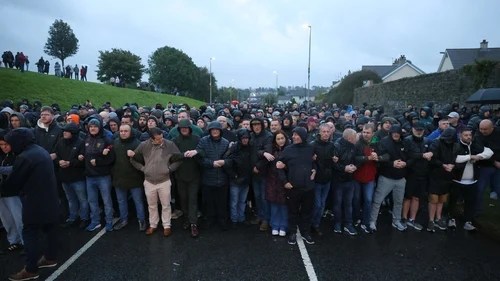
I wrote in the previous post that Sinn Fein turned up at the protests ‘politically naked’, which might seem to be at odds with their acclaimed triumph. The victory however belongs to the residents. It was their mobilisation that prevented the march. It was their opposition that galvanised the appearance of a letter by Protestants opposing the parade, and prompted the support of celebrities, who are always able to garner notice beyond either their number or influence. Their opposition also won widespread support in the rest of the country, North and South. The effect of all this, whatever its political weakness, was to support presentation of the issue not as one of mutual sectarianism by both sides but resistance of one side against it.
In addition to the reasons set out in the previous post, the political nudity of Sinn Fein is exposed by one lesson of the whole affair that more than a few have pointed out: the impasse created by the initial success of Orange demands and the deadlock at Stormont point to the need for a united Ireland to prevent this sort of thing happening again and again. Yet Sinn Fein cannot openly and forcefully put this case because it clashes both with the whole ethos of the peace process and Good Friday Agreement it purports to wholeheartedly support, and with all the flannel about reconciliation and respect for the two traditions which this entails. The residents of Garvaghy Road have just said that they are not reconciled to Orange parades and that they do not respect a tradition that is made up of sectarian bigotry and triumphalism. Most immediately, if they are right – what are Sinn Fein doing at Stormont?
Even in victory Sinn Fein is politically bereft. Media commentary has centred on whether the DUP should leave the Executive, which allows Sinn Fein to avoid the question; just as the DUP can more easily avoid it if the question is focused on Sinn Fein. Yet another example of the parties’ symbiotic relationship. Sinn Fein harps on constantly about the need for a referendum on Irish unity but cannot claim its necessity in order to deal with the demands of the Orange Order. A united Ireland is apparently to result in the same reconciliation with sectarianism that it is supposed to deny. It exposes one of the paradoxes of the claimed need for a united Ireland: aside from satisfying nationalist aspirations – that a united Ireland is a good thing by definition – why is it needed?
Without the intervention of a politically independent working class a united Ireland will involve the 26 county state becoming a 32 county one, with new deformations to accommodate unionists in the North. It’s why conversations about unity in the South centre around flags and anthems, or about special arrangements for the North that don’t involve a democratic challenge to sectarianism but some undemocratic mechanism to accommodate it.
This is illustrated by the other loser from Drumcree – the Irish government. Taoiseach Micheál Martin damned Sinn Fein because calls for the British to ban the parade down Garvaghy Road were too ‘simplistic’, while Minister for Foreign Affairs Helen McEntee said that the only solution was where the Orange Order and residents could come to an agreement. No it wasn’t and no it didn’t!
Since nearly all the calls for a united Ireland appear to involve the continuation of Orange parades, a government like the current one in Dublin would be worse than the British one in London! A united Ireland that fails to challenge and defeat sectarianism, but instead panders to it, is not one the Irish working class should support. As nationalism flaps about trying to state what its new Ireland would be like, the working class badly needs its own version and its own movement to fight for it.

