Comments on the racist riots in Belfast and response (2 of 2)

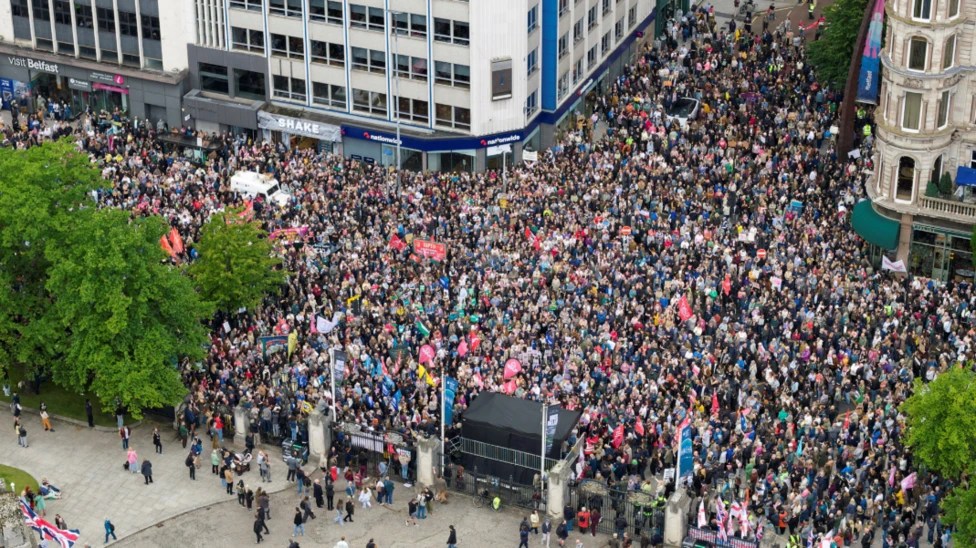
United Against Racism organised a rally in Belfast city centre to protest against the racist attacks.  It was recalled by a number of the speakers that we had been here before after previous riots, with the Green Party speaker stating that it was infuriating to be back again.  A summary of the speeches exposes the political weaknesses that help contribute to this, even while recognising the difficulty of what is required.  Not least of the problem is that there is not really an anti-racist movement and definitely not a coherent political alternative to the forces behind the racist mobilisations and the broader sympathy that lies behind them.

The range of speakers reflected the breadth of opposition to racism but at the cost of incoherence.  It’s not enough to be against racism – the racists have a policy – a political programme – no matter how primitive and inchoate, and the participants at the rally do not.

There were repeated chants of ‘Say it loud, say it clear, refugees are welcome here!’, which is a fine sentiment but not an argument or a policy.  There were frequent expressions that the rally represented the ‘real’ Belfast, repeated again by the following Monday’s editorial in the local paper ‘The Irish News’ – ‘the real face of both Belfast and modern Ireland was at show at the weekend . . .’  Unfortunately, the attacks were real, they were carried by real people, and they have a real base of support in Belfast and elsewhere in Ireland.

It might be countered that this is not what was meant by expressions of the ‘real’ Belfast but if it doesn’t mean what it says it doesn’t mean anything.  More importantly the phrase reveals a failure to recognise the real world, which is absolutely necessary to changing it and which failure to do so has all sorts of negative consequences.

Holding the rally was absolutely necessary to register the scale and scope of opposition to the attacks and in order to frame the issues raised in a more progressive way; to support those under attack and continued threat, and to give confidence to those opposed to racism and its violent expression.  The rally was correctly hailed as the largest anti-racist demonstration Belfast has seen, but it is not the sole representation of a city notorious for sectarianism and once described as ‘the race-hate capital of Europe’ in 2004, when the number of ethnic minorities was even smaller than it is now.

Organisers are claiming that 20,000 attended, when dividing by four might give a more accurate estimate, which is important only as another example of the failure to face reality.  Belfast has a history of sectarianism because there are a significant number of bigots, and religious bigotry regards racism as part of the family.  This constituency has a much longer history than any movement against racism.   It is extremely unlikely that racism will be defeated if sectarianism isn’t, which reveals the problem with a movement simply based on anti-racism.

The failure to deal with reality was expressed in the failure, so far as I noted, of any speaker to name the agents of the racist mobilisation.  Instead, the problem was an undefined ‘far-right’ and prominent individuals such as Elon Musk. The speaker from the Irish Congress of Trade Unions repeatedly employed this term, as if the trade union movement did not have a problem that a significant number of its own members in the North are loyalists.  On top of this is the acceptance that it is impossible to condemn loyalism without also demonstrating one’s own non-sectarianism by at the same time condemning republicanism.  Otherwise wider unionism might see it as evidence of a pro-nationalist bias. The result is that together they veto specific identification of the concrete and real adversary.

Ironically this means that the development of racism among nationalists cannot be separately identified as a problem should it arise; so the identity of the racist constituency is continually so abstract as to defy definition and concrete identification.  Calls for workers’ unity are all fine and good, but they remain rhetorical when the opposition within the working class isn’t recognised and challenged.

A by-product of this is the view that the trade union membership has a political unity that does not exist.  Hence the unreality of the ICTU and NIPSA speakers when the former said the trade unions would do ‘whatever it takes’ to drive out the far right and the latter that if there is another death the movement could ‘shut this place down’.  He asked for the rally to offer its support to a NIPSA motion to ICTU along these lines.  What this might mean in reality was unclear; what the possibility of it being carried was also unclear; that it would not be actioned is clear.

The trade union movement both North and South seek partnership with their respective governments and state, rather against the observations of a number of the speakers, which brings us to another illustration of the problem brought to the fore by the rally and the speeches.  Speaker after speaker criticised the Stormont Executive, the role of the police, of the state generally and the political parties.  These criticisms received widespread applause from the rally.

Unfortunately, the representative from the main party of the First Minister of the Stormont Executive, the Sinn Fein Lord Mayor of Belfast, was also applauded.  So was the Alliance Party representative, which is also part of the Executive.  The leader of the official opposition in the Stormont regime, the SDLP, was also applauded although it has been in the Executive until recently and is not at all opposed to Stormont.  All these speakers, plus the Green Party, support the police and support the state and also received the applause of the rally.

The Green Party speaker called for the Executive to develop various strategies against poverty, for equality and for refugees, while another speaker condemned the dead letter of the Executive’s existing race relations strategy.  Stormont has produced a number of strategies but this simply means that it has produced a lot of PDFs and word documents, and used up a lot of paper.  The ICTU speaker claimed that the problem was that the Executive was underfunded and that if this was rectified the money could help defeat the far right – the lack of money being the excuse of choice by the Executive as well.

It was claimed that this could get the far right out of the communities, which would equate to getting violent loyalists out of loyalist and unionist communities. This inadvertently rather encapsulates the failure to identify the problem, while raising the difficulty of doing so, and the challenge of defeating loyalism and its twin association with sectarianism and racism.

So, criticisms of the Executive were applauded while so also were the speakers representing the parties within it.  Criticisms of the police were applauded and so were the speeches of the parties supporting them.  The action of local groups and organisations in supporting and protecting those under threat were rightly applauded, yet most speeches looked to the state as the way forward (the one that was acknowledged to have failed). This was also applauded.

Behind these contradictions lays some awareness of the problems struggling to develop consciousness of what their resolution involves.*  The practical support of volunteers helping protect those threatened, and assisting their move if this was required, points to a political alternative that doesn’t rely on the forces that have failed but identifies these forces as a major part of the problem.

Why is it hard to understand that when the Stormont administration includes reactionary bigots providing political cover for the street thugs it cannot be the solution?  Whys is it not possible to follow the logic of the realisation that the sectarian structures of Stormont are not the answer to street sectarianism and its racist relative?  Of course, lack of an obvious political alternative is the most important reason, but just as the need for practical help for those under attack led to local anti-racists taking their own action, so does the creation of a political alternative require its creation by those who have felt the need to mobilise.  The question then becomes – what is the political basis for such an alternative?

If we look at the rally, there are no grounds for common political organisation based on the platform of speakers.  For example, Sinn Fein gets away with parading its anti-racist credentials in the North while the Party in the South moves to the right in an attempt to mollify racists.  There were banners from some trade unions but there was no mass mobilisation of the trade union membership just as there was no mass mobilisation of Sinn Fein members.

This is why we can say that there is no anti-racist movement.  This requires some political coherence and would have to move beyond simple anti-racism.  The size of the rally and that it took place at all are positives, as are the criticisms made of the state, but it is necessary to go way beyond this if we are not to simply repeat the rally outside Belfast City Hall next year, if not sooner.

* ‘We do not say to the world: cease your struggles, they are foolish; we will give you the true slogan of struggle. We merely show the world what it is really fighting for, and consciousness is something that it has to acquire, even if it does not want to.’ Karl Marx

Back to part 1
Comments on the racist riots in Belfast and response (1 of 2)

I was in Glasgow when the riots in Belfast broke out following the savage attack on a white man by a Sudanese migrant.  The mainstream media in Britain generally treated it as another example of the race riots carried out by the far right, most recently in Southampton, with references to the role of social media and mentions of Elon Must and Yaxley-Lennon, the guy you couldn’t even trust to tell you his real name.

Even from a distance it was clear that this wasn’t exactly the case.  Musk and the British far-right might provide inspiration, and social media provide a mechanism to inform, but the riots were an Irish phenomenon.  This is the third year in a row for such riots with social media again calling for a ‘cross-community’ racist mobilisation, including announcing meetings in nationalist areas such as Ardoyne.  Instead, the riots and the attacks on immigrants, or those considered to have the wrong skin colour, were confined to loyalist areas, and republicans in Ardoyne mobilised to reassure and protect those residents in the area who were most vulnerable to attack.

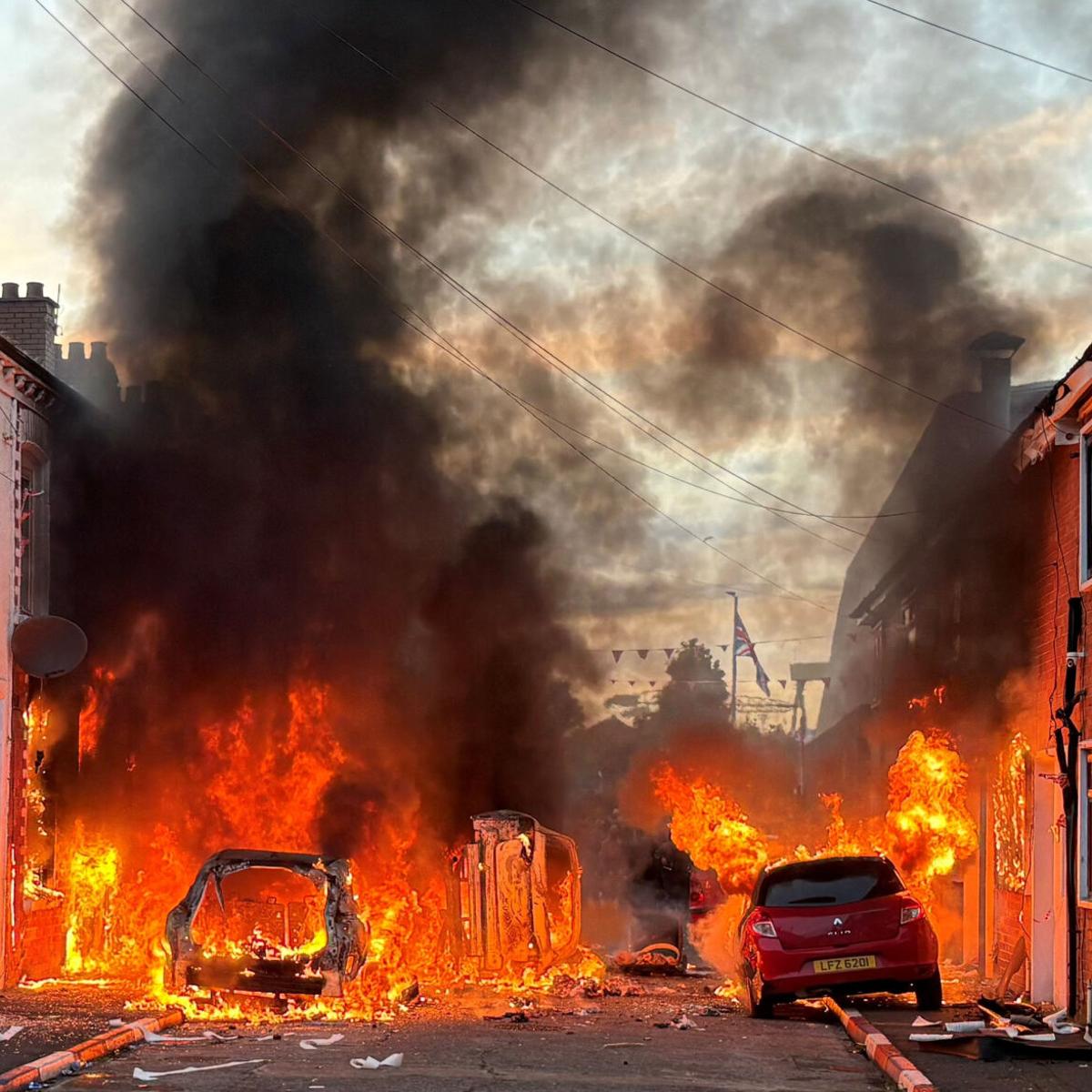
What wasn’t immediately clear from a distance was how widespread the racist mobilisation was.  Despite the drama reported on the mainstream media, reports continually showed one street in flames, the glider bus on the Newtownards Road on fire and some other localised riots.  By the historic standards of Belfast and the North of Ireland this was all relatively small, except that shops, schools and transport seemed to be closing down earlier than they had previously in worse circumstances.

When I got off the plane at Belfast there was a larger than usual number of police interviewing passengers and not necessarily checking ID.  They were more interested in where you were from and where you were going to.  I took it they were interested in identifying any loyalists of other far-right figures arriving to join the fray.

Unusually, I noticed the faces of those who weren’t white, including the black guy helping to give order to the airport taxi rank.  The taxi driver, who was an immigrant as well, and having lived in Belfast for over ten years, was very scared, particularly when it became clear that at one point taxis were being stopped in some location(s) to check whether the driver had ethnic minority passengers.

This was one of the reasons for the perceived febrile nature of the events.  The targets were immediately identifiable, unlike sectarianism where – despite the stereotypes – it is not usually obvious who is Catholic or Protestant.  Every non-white face was a reminder of who the potential targets of racist violence were.  The second startling images, perhaps especially for those not living in Belfast, was of masked men going door-to-door trying to identify and attack people of the ‘wrong’ colour.

Some commentators I saw were at pains to state that it would be wrong to paint the whole unionist ‘community’ as racist.  This is an obvious truth, just as is the other claim that there are nationalist or Catholic racists.  The point however is that it was only in loyalist areas that attacks took place. As one journalist pointed out – look down at the street and the footpaths are painted red, white and blue.

The police claimed that loyalist paramilitaries were not involved, which is nonsense.  Not all these paramilitaries were active – the riots would have been significantly bigger if they were – so the police were playing the game of not blaming them as a means of encouraging those not yet involved to stay not involved.

For the police it’s a win because it might help minimise its immediate problem while the existence of these groups is publicly treated as not their problem.  For the loyalists themselves their existence is their main objective and partial disorder both shows their capacity for violence and capacity to control it.  Yes, we can be a threat, but one you can work with.  And indeed, the British state has had no problem working with loyalist paramilitaries for decades – in the background, alongside, and fronting them up.

Lack of honesty in identifying one core issue of loyalist responsibility is one not confined to them or sections of the media, but as the next article will argue, it’s a bigger issue for those opposed to the attacks.

*              *             *

The reaction from the British government, in the shape of Keir Starmer, was the announcement that he would “crack down on anyone who is fuelling this division”, although this proved to be untrue because he continued to fuel it himself.  The British Home Office let it be known that the racists had no need to do what they were doing because the government was already cracking down on immigration. “Government sources” let it be known that it would “intensify” its actions to “track down, detain, arrest and remove illegal immigrants from Northern Ireland”.  It’s hard to see how this briefing to journalists would not validate in some way the racists and fail to reassure their victims.  

The North of Ireland has a population that is 96% white, while Belfast is home to three-quarters of asylum seekers, quoted as around the 20th highest rate of all UK council areas. Yet Belfast is quoted as having had the highest number of immigration raids in the UK between 2018 and 2024.  Whoever thinks this means that ‘cracking down’ needs intensified is living in their own world of racism, which thus includes the British government.

The Democratic Unionist Party has come under attack for playing its usual role of condemning violence while giving political cover.  There is much talk, and not only by them, about ‘legitimate concerns about immigration’ and the ‘pressures on housing, healthcare and resources’, but the claim that the rioters are concerned about resources for healthcare, for example, doesn’t withstand examination when they target nurses and other healthcare workers for intimidation.  It is a commonplace that these services rely on immigrant doctors, nurses and others.  Frequent visits to local hospitals confirm this in abundance.

Reported racist incidents exceeded sectarian ones by nearly 2 to 1 in 2025/26, affecting a very small part of the population, and it has now been argued that sectarian conflict has been displaced by racist attacks.  That these attacks are mainly by loyalists is a tacit claim that it is they who are mainly responsible for sectarianism, which is not the politically correct version of reality touted by most of the media in the North and by all of it in Britain.

It is only partially correct.  Immigrants are mainly living in loyalist areas because that is where the available housing is, thereby also making them more accessible to attack. It has also been partially displaced to the sectarian institution at Stormont, where its has stagnated.  This stagnation will not last and Stormont has already had repeated breakdowns.  A final collapse threatens to put sectarian conflict back on the streets where it will join with the current violent racism.  It is one of the ironies of the reaction to the riots that those opposed to the racist attacks look to Stormont for the answer, but we will look at this in the next post.

Forward to part 2

Ukraine and Democratic Imperialism

When the war started the supporters of Ukraine felt obliged to caveat their support.  They defended the supply of only ‘defensive’ weapons by Western powers and sanctions that would not hit ordinary Russians.  Now they complain that the weapons supplied have been insufficient, even though the amount already given has revealed serious shortages for those providing them, while the EU is on its 20th sanctions package and they still want more. Sweden has just announced the provision of fighter aircraft and new missiles but we already know from experience that none of this will deliver a victory to Ukraine.

Even though they have admitted that weapons and sanctions are critical to success and are provided by Western imperialism for its own reasons, these reasons are treated as not critical to understanding the nature of the war.  They declare that Ukraine has the right to source help from wherever it can and have simply assumed – if the thinking behind it goes that far – that whatever price is attached is hardly relevant.

Nor have they made anything of the inescapable logic that the interests of Ukraine and Western imperialism have to be aligned for this support to exist; presumably assuming it has to be some sort of happy coincidence.  The enemy of my enemy is my friend, so my enemy is Russia and Ukraine is therefore my friend, regardless of what sort of friend this could possibly be.

The supporters of Ukraine have constantly damned such logic but here they are endorsing it.  The argument that class independence requires opposition to both Russian imperialism and Western imperialism, which includes Ukraine as its proxy, is not considered with failure to support the alliance smeared as support for Russia.

All the claims about who is the aggressor or fired the first shot; support for self-determination and Ukrainian ‘agency’, are only so much confounding claims that turn opposition to capitalist war into support for it. As Trotsky said in relation to Lenin’s view of imperialism:

“The question of which group delivered the first military blow or first declare war,” wrote Lenin in March 1915, “has no importance whatever in determining the tactics of socialists. Phrases about the defence of the fatherland, repelling invasion by the enemy, conducting a defensive war, etc., are on both sides a complete deception of the people.”

Self-determination is a right to create a new state for nationalities that are annexed or are colonial possessions, a right that does not automatically impose support for the creation of a new state, and which is subordinated to the political independence of the working class.  This is erased by support for the Ukrainian capitalist state, which oppresses its working class and has allied itself with Western imperialism; the idea that support for ‘Ukraine’ somehow means something else is nonsense.

To justify support for Ukraine requires that either Western imperialism is not an enemy or its role is insignificant – which hardly tallies with demands for ever more weapons and sanctions – and that Ukraine is some sort of neutral state rising above inter-imperialist competition, which its insertion of NATO membership into its constitution reveals as impossible to believe.  It is also not enough to claim that in this case Russian imperialism is the bigger enemy.

Being bigger makes no qualitative difference for socialists, and anyway, Western imperialism is much bigger and more powerful than Russia.  For socialists in the United States the main enemy is US imperialism; in France it is French imperialism and in Britian it’s British imperialism etc.  The main enemy is always at home, which is how we do not end up following our own ruling class and its state, especially in war. Not only are the pro-war lefts supporting Ukraine and its alliance with Western imperialism – calling upon it to be made stronger – they are also supporting their own imperialism.

Being the class traitors that they are, they fail to notice that whatever about the purported right of the Ukrainian capitalist state to seek weapons and money from Western imperialism, they require that the various Western imperialist states should be supported in providing them.  Are they going to claim that imperialism has a right to do so?

As they have admitted, these states do so for their own purposes and goals, which goals and purposes are advanced by the so-called socialists in these countries supporting their interventions.  In the inter-imperialist conflict, they have lined up behind their own imperialism – finding common ground in the claim that Russia is some sort of authoritarian state that Ukraine is not and that it represents a threat that its own ruling class and its imperialist state does not.

In stark contrast to Russia’ it is claimed that Ukraine has a ‘lively civil society’, except none of the examples quoted illustrates opposition to the war or to participation in it.  This means ignoring one of the most remarkable expressions of spontaneous resistance by Ukrainian workers.  The growing movement against ‘busification’ – the forced conscription into the army by kidnapping men off the street, at their homes or their workplaces – is a startling example of ‘lively civil society’ action.  However, since this speaks of resistance to the war and the Ukrainian state, and demonstrates the brutal authoritarianism carried out by it, it is not acknowledged.

Demands to oppose Russian authoritarianism, to listen to Ukrainian voices and recognise Ukrainian ‘agency’ are all made in order to support the Ukrainian state, its propaganda and its agency. But do the supporters of the war support this resistance to authoritarianism? Are these not also Ukrainian voices we should be called upon to hear? Is this not also Ukrainian ‘agency’? Or do they – like bourgeois politicians across Europe – promote a version of the war that has no room for the real world? 

For them, Western imperialism has become the defender of democracy in Ukraine, as it has always claimed.  The Zelenskyy regime, having prevented elections and extended martial law, claims that in return it is defending the democratic West, while this democratic West supports genocide and criminalises opposition to it.  Like its imperialist allies, Ukraine also supports Israel, proclaims its desire to be a European version of it – another Sparta in Europe – and has assisted US imperialism by providing hundreds of drone operators to those wonderfully democratic states in the Gulf.

Ukraine, which previously participated in Western wars against Iraq and Afghanistan, now intervenes in Africa, including in Somalia and Mali.  In Europe it touts itself as the largest army at the disposal of NATO to guard against a supposed Russian invasion and has moved from receiving arms and training from Western militaries to providing training and drone technology to them.  Does the pro-Ukraine left support Ukraine arming and training their own imperialist armies?  Why not?  Has it not supported the professed alliance for democracy?

On the most elementary grounds this alliance doesn’t pass the sniff test for any claim to democracy.  A state at war, that millions of its citizens have fled from and in which hundreds of thousands of those remaining are afraid to leave their home.  In which opposition parties and media are banned and the far right and its history is glorified by it, including its Nazi collaborators in the Second World War.  Its far right hugely expanded in size and power within its armed forces – celebrated as its most valiant fighters. But we are supposed to be unconcerned because the erstwhile comedian who is its President is Jewish.

Defending this are such figures as Starmer, Macron and Merz, of whom it can be confidentially said it is impossible to say who is most unpopular in their respective countries.  Starmer’s support for democracy includes abolishing jury trials and the criminalisation of protest, not to mention the small matter of approving war crimes committed in the continuing destruction of an entire people.  That the left supporters of Ukraine think all this is divorced from support for Ukraine merely shows that they have lost the plot. Or more accurately never opened the book.

Do they really think Starmer cares more for Ukrainian workers than British ones?  And if the obvious answer is no – one they have already accepted – isn’t it also obvious that he wants the war to continue irrespective of how many Ukrainians have to die?  And wouldn’t ‘winning’ entail escalation that would lead Russia to do the same?  At what point do the cheerleaders think the war may not be in the interest of the working class, or do they not have an answer for this because they haven’t considered anything but victory as morally admissible?  But what do they mean by victory, and is such a victory remotely possible? Is it easier to support the war when unlike those Ukrainians in hiding from conscription they won’t be doing the fighting and dying?

Are they saying that the Ukrainian working class should fight and die for the self-determination of a state that is already independent; that has been mired in corruption since its inception and in which the wealthy and those with connections can avoid the threat of forced conscription?  

Why do they think so many Ukrainians refuse to voluntarily join the army of such a state; a state they have repeatedly in elections tried to change but failed, now led into a war that is crippling the country while relying on the same outside forces that helped provoke it in the first place; and who are happy to see continue?

Ukraine is the biggest site of the kinetic violence unleashed by inter-imperialist rivalry.  To think that some sort of bourgeois democracy is the alternative to it is to have totally failed to accept what is in front of your eyes, that ‘democratic’ imperialism is a big part of the cause of the war, is bent on ensuring its continuation regardless of the cost, and is very definitely not any part of the solution.