The fuel protests and the best of the left’s politics? (2 of 2)

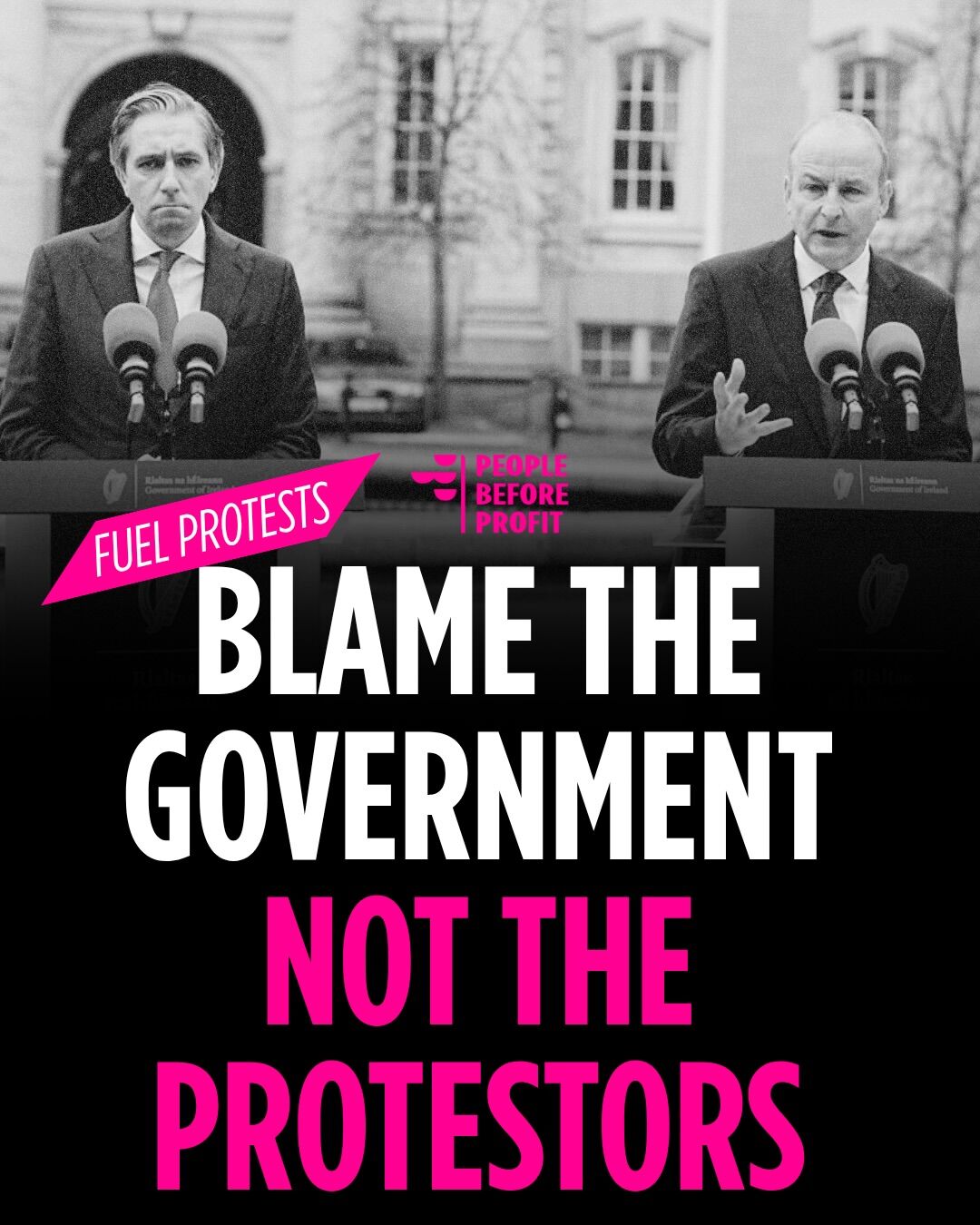
Almost as important as a correct political programme in approaching the fuel protests is an accurate analysis of them – what sort of movement was it?

People before profit were clear that it ‘supports these protests’ but wanted ‘to go further’ and to ‘deepen the movement.’  Moreover, the politics of it were basically sound – ‘The basic demand is right!’

The protests themselves and the movement that created them were to be supported, and although PbP criticised the role of the far right, it asserted ‘let’s keep coming back to the real issue of unbearable price increases and where they come from.’  The point of this article is that the question that we started with is not one that can be skirted by ‘coming back’ to what provoked it; it is the correct response to the protests which is the question posed.

People before Profit were impressed by the fact that ‘for several days Ireland has seen some of the most militant protests in years: roads blocked, fuel depots and the Whitegate refinery targeted, fuel supplies thrown into chaos.’  It justified them by saying that ‘protest to be effective must be disruptive and polarising.’

In fact, the purpose of protesting is not to polarise – that may be a consequence – the intention is to win support, not to polarise it. And the same is true of being disruptive.  Blockading Whitegate oil refinery helped create shortages of fuel supplies but it was unlikely the ultimate purpose of bringing the state to a standstill would have been widely supported. Its immediate purpose was to gain control and the question then becomes who is gaining it?  What is the character of the protest movement achieving it?  The same question arises in supporting ‘militancy’.  The north of Ireland has undergone a huge number of very militant protests over many years and quite a few of them were entirely reactionary.

People before Profit say enough about this movement to point to a problem with simply wishing for it ‘to go further’ or to ‘deepen’ it.  ‘We also have to be honest about the class character of these protests. This movement is led by people who own companies, employ workers and have access to expensive machinery.’

It was not therefore a movement led by the working class. ‘Some of the most visible leaders have made racist, misogynistic and homophobic statements publicly’ and ‘some of the loudest figures attaching themselves to these protests are cheerleaders for Trump, for racism, and in some cases for Israel.’  That is, they were supporters of those that caused the war that caused the fuel price increases.

PbP goes on to say that ‘Though workers and farmers are present in numbers, they are not dictating the pace or demands at this stage . . . many working class people [are] looking on sympathetically, in some cases inspired by the militancy of the protests. This has happened because the movement of organised workers, the trade union movement, has completely failed to give any lead on the cost-of-living crisis. In that vacuum, people will turn to whoever appears willing to fight.’

So, what we have is a movement of the petty bourgeoisie whose ‘most visible leaders’ are reactionaries but which has the working class ‘looking on sympathetically.’  This is not therefore a movement to be supported, to be deepened, or taken further.  It is one to be exposed and challenged so that workers stop being onlookers and take matters into their own hands.

PbP itself puts one thing correctly: ‘a movement dominated by small business owners and owner-drivers, with far-right figures hovering at its edges, cannot win the demands that working people actually need’ – but this conflicts with its perspective of  ‘supporting these protests’, wanting ‘to go further’, and to ‘deepen the movement.’  What was needed was an entirely different movement.

It attempted to defend its approach by stating that ‘The answer is not to sneer at that militancy. It is to deepen it, broaden it, root it in working class demands, defend it from repression, and stop reactionaries from hijacking it. We should take inspiration from the fact that the current disruption is forcing the government to act.’

The problems with this defence were that it was not working class militancy that was in evidence and what militancy there was, including in the movement that actually existed, should not have been deepened and broadened.  Its class character had to be changed, which could not be done simply by attaching oneself to it, but only by creating an entirely separate one to it.

The article we quoted in the first part of this post that approved of People before Profit’s approach points to the experience of some socialists in the protests in France by the gilets jaunes and their engagement with it in order to ‘address the proletarian elements of the movement specifically.’  Unfortunately, its author has to recognise that when PbP TD Paul Murphy visited a protest in Dublin to offer support he was harangued and sent on his way by protesters that were described as ‘political grifters trying to drag this movement in a poisonous direction.’

This article criticises Sinn Féin for one of its members being photographed with a far-right figure supporting the protests, but seeking to deepen and broaden the movement would have seen People before Profit do the same.  They would be standing beside the ‘political grifters.’  What would have prevented Paul Murphy being sent away, and framed any photograph as a right wing figure getting photographed with Paul Murphy, would have been him turning up at the protest with a couple of hundred workers with their own demands challenging the ‘poisonous direction’ being taken.  But this begs the question.

People before Profit arrived at the wrong perspective because it sought to hitch a ride on the ‘sympathy’ that many workers had for the protests.  It saw an opportunity and sought to harness it. In other words, it was an example of its opportunist politics: seeking a quick short-term gain at the expense of an immediately more difficult defence of principle that its correct characterisation of the reactionary leadership of the protests should have led it to.

It did state that ‘We must demand that our unions enter the fight. . . . . The unions have the membership, the resources and the leverage to force real change on the cost of living. It is time to use them.’  Unfortunately, the unions were too busy getting ready for a new pay agreement with the government.  PbP called on ‘every trade union branch, every shop steward, every community organisation should be discussing what action can be taken and building for it now’, but this is precisely one role that PbP itself should play, not simply demand it of others.

The electoralism of PbP and its orientation to an NGO form of campaigning meant it had helped set up an ‘Affordable Ireland Campaign’, except it proved irrelevant. Even the British socialist who hailed its intervention acknowledged that this ‘was not given serious thought before the rush to support the blockades.’

He also acknowledges the leading role of reactionaries in the protests, ‘far-right figures were providing digital signal boosting, rhetorical defiance, and organisational presence that kept the blockades in place after the initial wave of genuine industrial grievance had done its work.’  ‘This movement is led by people who own companies, employ workers and have access to expensive machinery.’  Like PbP he does not examine the importance of the movement having no coherent and democratic character while saying that workers ‘are not dictating the pace or demands at this stage.’ 

Yet, while he praises People before Profit’s political demands; notes the reactionary leadership of the protests so that workers did not ‘dictate the demands’, and that ‘the political character of the movement’s organisational core was not incidental to its demands’, he leaves aside that PbP supported them.  Even if he were right – and he’s not – about a ‘movement whose base was genuinely working-class’, it would only signal that the far-right had taken leadership of a working class struggle, a position which he appears to reject despite, and not because, of his analysis. This would have been a bigger problem than the working class simply being onlookers.

Back to part 1
The fuel protests and the best of the left’s politics? (1 of 2)

Political commentators are claiming that the much-publicised role of figurers from the far right in the recent fuel protests herald a significant development in its power and reach.  The potential for this development also resides in the continuing war and blockade against Iran.  It is forecast that if this does not stop before the end of June the run-down of existing stocks will see the price of Brent, a global oil benchmark, climbing to $150-$200 a barrel.  In any case, a more general increase in prices is in the pipeline with an even greater hit on working class living standards.

This is not a question of ‘energy poverty’ – poverty is poverty and covers multiple items of consumption, which will become increasingly apparent as a result not just of rising prices but also of the failure of incomes to keep pace.  Poverty demoralises those affected and those who might be vulnerable to falling into it, as well as the whole class that witnesses the deprivation that the state will permit.  It will not just be a crisis of poverty but of expectations of the many who won’t go into poverty but will wonder what sort of life they’re going to have if this is what they get out of a period of a much-trumpeted economic success.

The ingredients that led to the protests are not going away; hence the importance of what the socialist movement can learn from them. A review of the experience by a British socialist here is therefore a useful point to continue to do this, following up on our initial assessment.  The article reviewed compares the intervention of People before Profit with that of Sinn Fein and ends by saying that ‘the fuel protests showed PBP’s politics at their best.’  Even an initial thought can’t help but including how this could be true given its peripheral involvement and profile.

Perhaps this is justified by an examination of what the PbP political programme says, so let’s look at this.  If we do, we can’t help wondering what the condemnation of the role of Sinn Fein does for People before Profit’s strategy of a left government, which has Sinn Fein as part of it.  If SF has just failed in opposition, in what sense could it be a partner in anything pretending to be a meaningfully left alternative government?  And if it is as bad as it is claimed, the likelihood of a left government in the near term is zero; in which case it’s not the alternative that People before Profit claim it is. In programmatic and strategic terms, it is a black hole into which everything else is sucked into and out of which there is nothing to see.

The author of the article himself demolishes this perspective in his response to the following comment by one of his readers: ‘In real terms PBP are the smallest part of a rickety anti-FFG coalition, within which SF is absolutely hegemonic. PBP are dependent on their transfers, work with them on a local level and have committed to going into government with them on some sort of a united front basis. I don’t say this to be annoying but just that it’s a bigger predicament than supposedly class independent programmes can solve.’ 

The author says that ‘The commenter is right that PBP’s class independence is real at the level of programme but constrained at the level of electoral arithmetic’ and that ‘the question of whether “external support contingent on a minimum programme” in practice becomes unconditional support for an SF government that delivers none of it is not answered by the programme document alone. It is answered by what PBP does when Sinn Féin fails to implement the programme . . .’  That Sinn Fein will not join in implementing a left programme that should be supported is presented here as a given.  ‘PBP’s position is to offer external support to a Sinn Féin government that implements a minimum programme of reforms — which Sinn Féin will almost certainly not implement.’

So, the project of a Left Government as the alternative to 100 years of Fianna Fail and Fine Gael rule is not real; it’s a fraud that cannot work. So how is it an alternative?  Is PbP going to spend the next number of years pushing an expected failure?  Is it going to going to take responsibility for this failure, through its calling for transfers to Sinn Fein, or votes for it where it does not stand?  Is it going to admit that it never expected it to work?  And what does it think those persuaded to vote for it will think of this, or any further ideas it puts forward?  Why would such an experience of failure not lead to demoralisation?

If this overall issue is not satisfactorily addressed or the questions that follow from it, what are we to make of the policies put forward by People before Profit that the article praises?

The comparison with Sinn Fein is put like this: ‘People Before Profit showed up with a programme. Sinn Féin showed up with a tax cut. The difference between those two responses is not tactical. It is the difference between a politics that names the system and a politics that names the government.’  This is a strange assertion since People before Profit’s proposals consistently condemn the government and don’t mention capitalism, i.e. ‘the system’.

What it condemns instead is ‘profiteering’, which is not at all the same thing.  Reflecting its own name, profit is not to be replaced but rather something – ‘the people’ – prioritised before it.  What level of profit is ‘profiteering’ is a matter of judgment, or rather a question of ownership and control.  The main suggestion is for price caps, but it is acknowledged that previous government action to compensate for price increases was ‘wiped out almost immediately by the scale of the global commodity crisis.’

PbP wants ‘to set the maximum price for petrol, diesel, natural gas, electricity and heating oil in order to provide price stability and safeguard the people from huge price increases’ while acknowledging that ‘Ireland imports all of its oil requirements at prices determined by global markets.’  This is also almost true of gas, while around 80% of total energy is imported.  In 2025 the average Brent price was $69.14 but could hit $150-$200 according to some forecasts.

The Irish government cannot control these prices and cannot promise price stability.  In other words, it cannot control the capitalist world market.  The proposed mechanism for doing so by PbP is explained in relation to home heating oil – that PbP would ‘establish a rebate scheme to compensate retailers for price differentials with wholesale costs.’  Since it can’t control these costs, it can’t know how much tax receipts are going to be handed over to retailers.  The article by the British socialist states that PbP has a programme ‘and it was costed’, but unless it knows what the price of oil is going to be then this is complete nonsense.

PbP states that ‘Our demand is that companies are forced to open their books and fully justify any and all price increases.’  But who is going to look at the books and ensure that there are not ‘other’ books that reveal a truer position? And who is to decide what constitutes ‘justification’?  Far from naming the system, and not the government, the entirety of the measures demanded by PbP is to be carried out by the government, which raises two problems.  First the actual government that is in office that won’t do it and secondly the flaws in the idea of a ‘left’ government that we noted above.

People before Profit proposals entail taxing data centres but also want a ban on the construction of new data centres, a not entirely consistent position.  Like limits to prices, there are definite constraints to what this sort of action can achieve, which is why socialists do not believe simply reforming the current system can meet the needs of the vast majority. Nationalisation of the energy industry, as it proposes, is not socialism and is not – in the words of the British socialist – ‘democratic ownership’, which can only arise from workers’ ownership.  Large sectors of the energy industry are already owned by the state, including the largest electricity generator; the owner and operator of the transmission and distribution system, and the largest supplier of electricity to customers.

From the Marxist political point of view the most mistaken and false claim about the programme of People before Profit is that its ‘architecture deserves to be named specifically, because it is the clearest illustration of what distinguishes a transitional programme from a fiscal one.’  In fact, it is nothing of the sort: a socialist transitional programme is about what the working class must do to defend its interests and in doing so establish its own society.  The People before Profit proposals are essentially about what the government should do, knowing that it won’t, and knowing that its own alternative proposals for government won’t either.

Forward to part 2

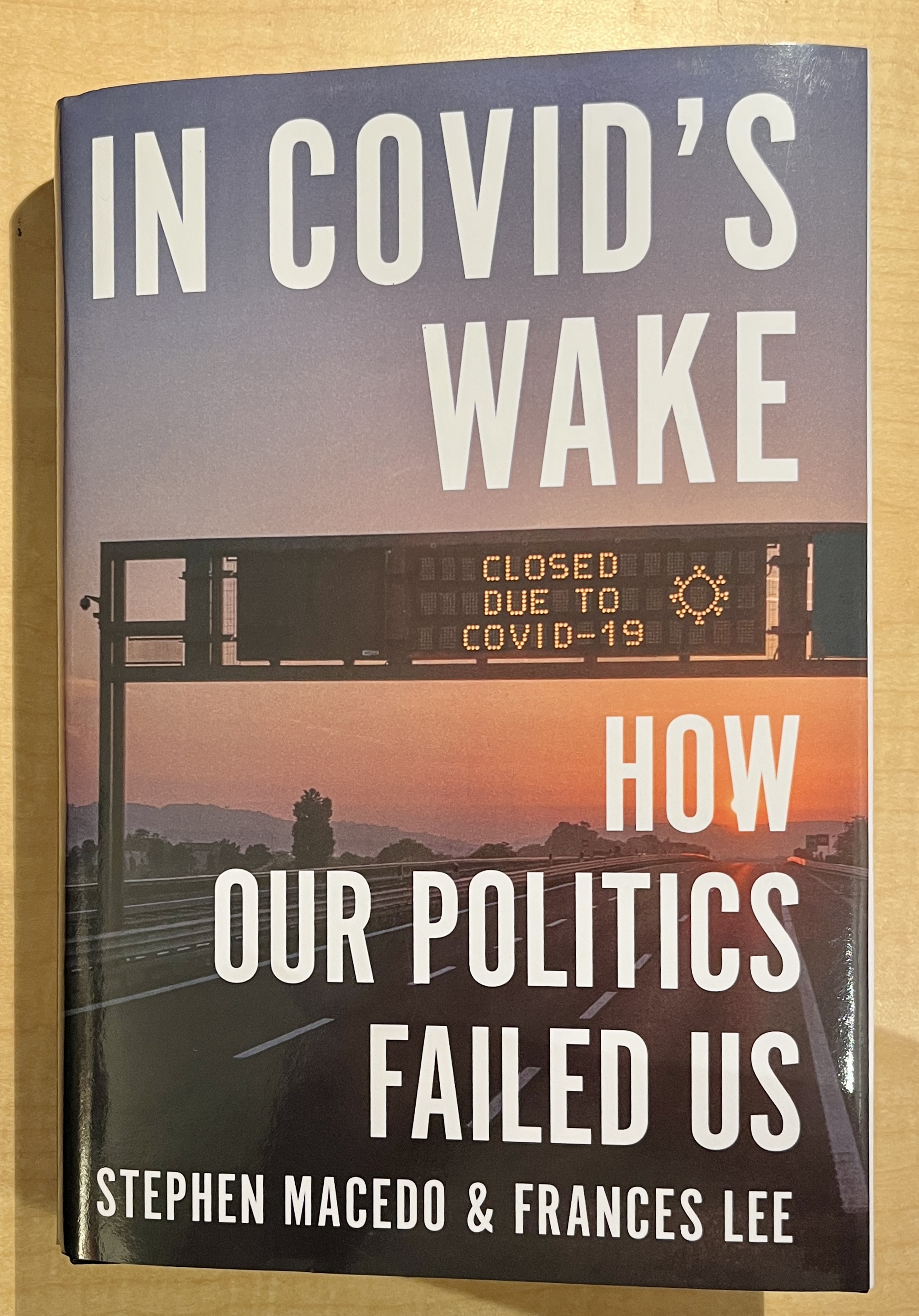
In Covid’s Wake (6 of 6): Censorship and truth

Perhaps the most shocking but not really surprising aspect of the Covid lockdown was the ‘scientific’ justification of it and its associated measures that upended previous accepted views.  It was also generally successful in imposing a silence on dissenting views, treating them as dangerous blasphemy.

For example: ‘most pre-Covid plans for addressing a respiratory pandemic were skeptical of masking . . . the U.S. surgeon general tweeted “STOP BUYING MASKS!” because they gave no protection to healthy individuals. (In Covid’s Wake p234). Yet those least at risk – those at preschool – were one of the last to require universal masking up to September 2022. (p236).  The scientific uncertainty around masking was considered an obstacle to getting the population to do as it was told.

This was just one aspect of what the authors of the book consider ‘groupthink; and ‘a sense of moral and intellectual superiority’, justified by those making the decisions because of who they were. (p254) Just as many on the left justify their demands as left wing because they are the ones making them.

This included ‘the long suppression of reasonable suspicions about a possible lab leak origin of the virus.’  This involved calling the idea a “conspiracy theory” or “racist conspiracy theory”, and smearing dissenters as “fringe epidemiologists”, indulging a form of “decidedly unscientific discourse”.  All, the authors say, ‘moralistic performances aimed at marginalising dissenters and closing down discussion.’ And all redolent of arguments employed on the left for a very long time. (p297 & 294).

This moralistic view, with its attendant features, meant that ‘Covid policies were generally unresponsive to actual pandemic conditions’, which ‘tended to a wholesale abandonment of rationality.’  ‘Even as late as summer 2021, after more than thirty million Americans had tested positive for Covid and vaccines had been made widely available, the director-general of the World Health Organization was still demanding that governments attempt to track and trace every case . . . The zero-Covid frame locked policymakers into costly, futile policies with no exit strategy.’ (p291 & 293)

However, behind every moralistic policy lies material interest.  In the case of denying the lab leak from gain-of-function research at Wuhan Institute of Virology was the funding of the research by the US National Institute of Allergy and Infectious Diseases, denied to a Senate committee hearing by the top administration health official Dr Anthony Fauci.

A number of scientists wanted an open discussion on the origin of the virus but the book records that a WHO investigation into it in 2021 was ‘compromised’ because it included someone whose organisation funded the research in the Wuhan Institute.  Top public health officials engaged in ‘oversimplifications, half-truths, and noble lies’ in order to get the population to follow its diktats. (p 263)

This was the case with the policy of lockdown itself, as we have already seen. It involved ‘White House officials and public health experts to work in secret with social media companies to amplify messages favouring government policy while censoring or muting dissenting voices and points of view.’  When it came to the weakness of the evidence for Covid boosters one paediatrician and professor of vaccinology was told that although ideally it was only high-risk groups who should be encouraged to receive them, ‘nuance garbles the message’ (p271 & 272).

‘Following the science’ became following the government and what was true was what the Government decided it was.  In the UK current and former BBC journalists stated that there was a “climate of fear” with experienced reporters “openly mocked” if they questioned the wisdom of lockdowns.  The threat posed to everyone had to be driven home even while ‘the actual risk to more than half the population was extremely low.’  In the UK ‘the BBC News backed up this misperception by regularly reporting rare tragedies involving low-risk individuals as if they were the norm.’ (p112 -113)

The authors note a paper, published after the pandemic was effectively over in August 2023, by a number of scholars associated with the US Department of Health Promotion and Policy at the University of Massachusetts Amherst.  It was published in the prestigious journal of the American Medical Association JAMA Network Open, which targeted misinformation on Covid by medical professionals on their social media platforms with a view to the government agencies and professional associations taking “actions to regulate and discipline” them. (p 276)

Among the “misinformation” was the allegation of a cover up of the possibility of a laboratory leak; the claim that the government withheld key information regarding Covid-19; that the effectiveness of masks was doubtful; that natural infection and recovery contribute effectively to herd immunity, and that “Government actors” were in contact with Twitter and other social media companies telling them what to censor. The censored included two authors of the Great Barrington Declaration, which emphasised the range of harms caused by lockdowns and proposed an alternative.

The authors of the book note that these ‘may actually be correct, or, at a minimum, within the scope of reasonable disagreement.’  They also note various sources that acknowledge the truth of this ‘misinformation.’  Perhaps the most astonishing thing about these scholars case is the lack of awareness that it was actually many of the claims made by the government and public health officials that were untrue. (p 277 & 282)

The book’s authors also say that ‘some evidence suggests that today’s scientists are more inclined than those of the past to censor research they perceive as socially harmful.’  Editors of academic journals ‘are granting themselves vast leeway to censor high-quality research that offends their own moral sensibilities.’ (p 283).  As one senior US academic put it – there is “a real peril in a public health approach steeped in moralism”. (p 122). This is, for example, a strong feature of the approach to research by those promoting ‘gender affirming’ medical and surgical intervention.

A recent article in the Financial Times reports a professor of epidemiology at Colombia University stating that the most important legacy of Covid was “a lack of trust in public health and the implications for people refusing vaccines.” 

Unless the left that demanded zero-Covid accounts for its error it must be assumed it has learned nothing. This includes regard for the truth. Once more a quote from a dead Russian is apposite – ‘We must speak the truth.

Back to part 5