Comments on the racist riots in Belfast and response (2 of 2)

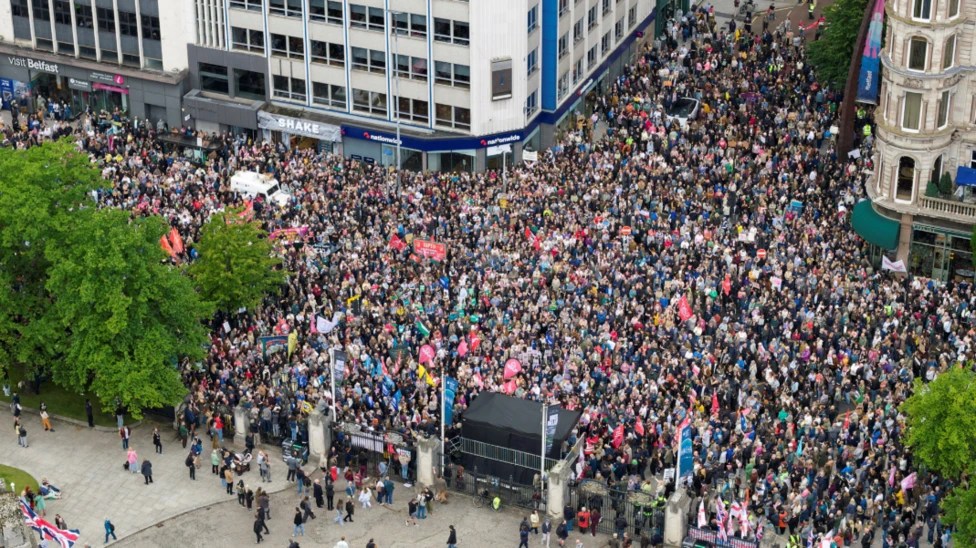
United Against Racism organised a rally in Belfast city centre to protest against the racist attacks.  It was recalled by a number of the speakers that we had been here before after previous riots, with the Green Party speaker stating that it was infuriating to be back again.  A summary of the speeches exposes the political weaknesses that help contribute to this, even while recognising the difficulty of what is required.  Not least of the problem is that there is not really an anti-racist movement and definitely not a coherent political alternative to the forces behind the racist mobilisations and the broader sympathy that lies behind them.

The range of speakers reflected the breadth of opposition to racism but at the cost of incoherence.  It’s not enough to be against racism – the racists have a policy – a political programme – no matter how primitive and inchoate, and the participants at the rally do not.

There were repeated chants of ‘Say it loud, say it clear, refugees are welcome here!’, which is a fine sentiment but not an argument or a policy.  There were frequent expressions that the rally represented the ‘real’ Belfast, repeated again by the following Monday’s editorial in the local paper ‘The Irish News’ – ‘the real face of both Belfast and modern Ireland was at show at the weekend . . .’  Unfortunately, the attacks were real, they were carried by real people, and they have a real base of support in Belfast and elsewhere in Ireland.

It might be countered that this is not what was meant by expressions of the ‘real’ Belfast but if it doesn’t mean what it says it doesn’t mean anything.  More importantly the phrase reveals a failure to recognise the real world, which is absolutely necessary to changing it and which failure to do so has all sorts of negative consequences.

Holding the rally was absolutely necessary to register the scale and scope of opposition to the attacks and in order to frame the issues raised in a more progressive way; to support those under attack and continued threat, and to give confidence to those opposed to racism and its violent expression.  The rally was correctly hailed as the largest anti-racist demonstration Belfast has seen, but it is not the sole representation of a city notorious for sectarianism and once described as ‘the race-hate capital of Europe’ in 2004, when the number of ethnic minorities was even smaller than it is now.

Organisers are claiming that 20,000 attended, when dividing by four might give a more accurate estimate, which is important only as another example of the failure to face reality.  Belfast has a history of sectarianism because there are a significant number of bigots, and religious bigotry regards racism as part of the family.  This constituency has a much longer history than any movement against racism.   It is extremely unlikely that racism will be defeated if sectarianism isn’t, which reveals the problem with a movement simply based on anti-racism.

The failure to deal with reality was expressed in the failure, so far as I noted, of any speaker to name the agents of the racist mobilisation.  Instead, the problem was an undefined ‘far-right’ and prominent individuals such as Elon Musk. The speaker from the Irish Congress of Trade Unions repeatedly employed this term, as if the trade union movement did not have a problem that a significant number of its own members in the North are loyalists.  On top of this is the acceptance that it is impossible to condemn loyalism without also demonstrating one’s own non-sectarianism by at the same time condemning republicanism.  Otherwise wider unionism might see it as evidence of a pro-nationalist bias. The result is that together they veto specific identification of the concrete and real adversary.

Ironically this means that the development of racism among nationalists cannot be separately identified as a problem should it arise; so the identity of the racist constituency is continually so abstract as to defy definition and concrete identification.  Calls for workers’ unity are all fine and good, but they remain rhetorical when the opposition within the working class isn’t recognised and challenged.

A by-product of this is the view that the trade union membership has a political unity that does not exist.  Hence the unreality of the ICTU and NIPSA speakers when the former said the trade unions would do ‘whatever it takes’ to drive out the far right and the latter that if there is another death the movement could ‘shut this place down’.  He asked for the rally to offer its support to a NIPSA motion to ICTU along these lines.  What this might mean in reality was unclear; what the possibility of it being carried was also unclear; that it would not be actioned is clear.

The trade union movement both North and South seek partnership with their respective governments and state, rather against the observations of a number of the speakers, which brings us to another illustration of the problem brought to the fore by the rally and the speeches.  Speaker after speaker criticised the Stormont Executive, the role of the police, of the state generally and the political parties.  These criticisms received widespread applause from the rally.

Unfortunately, the representative from the main party of the First Minister of the Stormont Executive, the Sinn Fein Lord Mayor of Belfast, was also applauded.  So was the Alliance Party representative, which is also part of the Executive.  The leader of the official opposition in the Stormont regime, the SDLP, was also applauded although it has been in the Executive until recently and is not at all opposed to Stormont.  All these speakers, plus the Green Party, support the police and support the state and also received the applause of the rally.

The Green Party speaker called for the Executive to develop various strategies against poverty, for equality and for refugees, while another speaker condemned the dead letter of the Executive’s existing race relations strategy.  Stormont has produced a number of strategies but this simply means that it has produced a lot of PDFs and word documents, and used up a lot of paper.  The ICTU speaker claimed that the problem was that the Executive was underfunded and that if this was rectified the money could help defeat the far right – the lack of money being the excuse of choice by the Executive as well.

It was claimed that this could get the far right out of the communities, which would equate to getting violent loyalists out of loyalist and unionist communities. This inadvertently rather encapsulates the failure to identify the problem, while raising the difficulty of doing so, and the challenge of defeating loyalism and its twin association with sectarianism and racism.

So, criticisms of the Executive were applauded while so also were the speakers representing the parties within it.  Criticisms of the police were applauded and so were the speeches of the parties supporting them.  The action of local groups and organisations in supporting and protecting those under threat were rightly applauded, yet most speeches looked to the state as the way forward (the one that was acknowledged to have failed). This was also applauded.

Behind these contradictions lays some awareness of the problems struggling to develop consciousness of what their resolution involves.*  The practical support of volunteers helping protect those threatened, and assisting their move if this was required, points to a political alternative that doesn’t rely on the forces that have failed but identifies these forces as a major part of the problem.

Why is it hard to understand that when the Stormont administration includes reactionary bigots providing political cover for the street thugs it cannot be the solution?  Whys is it not possible to follow the logic of the realisation that the sectarian structures of Stormont are not the answer to street sectarianism and its racist relative?  Of course, lack of an obvious political alternative is the most important reason, but just as the need for practical help for those under attack led to local anti-racists taking their own action, so does the creation of a political alternative require its creation by those who have felt the need to mobilise.  The question then becomes – what is the political basis for such an alternative?

If we look at the rally, there are no grounds for common political organisation based on the platform of speakers.  For example, Sinn Fein gets away with parading its anti-racist credentials in the North while the Party in the South moves to the right in an attempt to mollify racists.  There were banners from some trade unions but there was no mass mobilisation of the trade union membership just as there was no mass mobilisation of Sinn Fein members.

This is why we can say that there is no anti-racist movement.  This requires some political coherence and would have to move beyond simple anti-racism.  The size of the rally and that it took place at all are positives, as are the criticisms made of the state, but it is necessary to go way beyond this if we are not to simply repeat the rally outside Belfast City Hall next year, if not sooner.

* ‘We do not say to the world: cease your struggles, they are foolish; we will give you the true slogan of struggle. We merely show the world what it is really fighting for, and consciousness is something that it has to acquire, even if it does not want to.’ Karl Marx

Back to part 1

Comments on the racist riots in Belfast and response (1 of 2)

I was in Glasgow when the riots in Belfast broke out following the savage attack on a white man by a Sudanese migrant.  The mainstream media in Britain generally treated it as another example of the race riots carried out by the far right, most recently in Southampton, with references to the role of social media and mentions of Elon Must and Yaxley-Lennon, the guy you couldn’t even trust to tell you his real name.

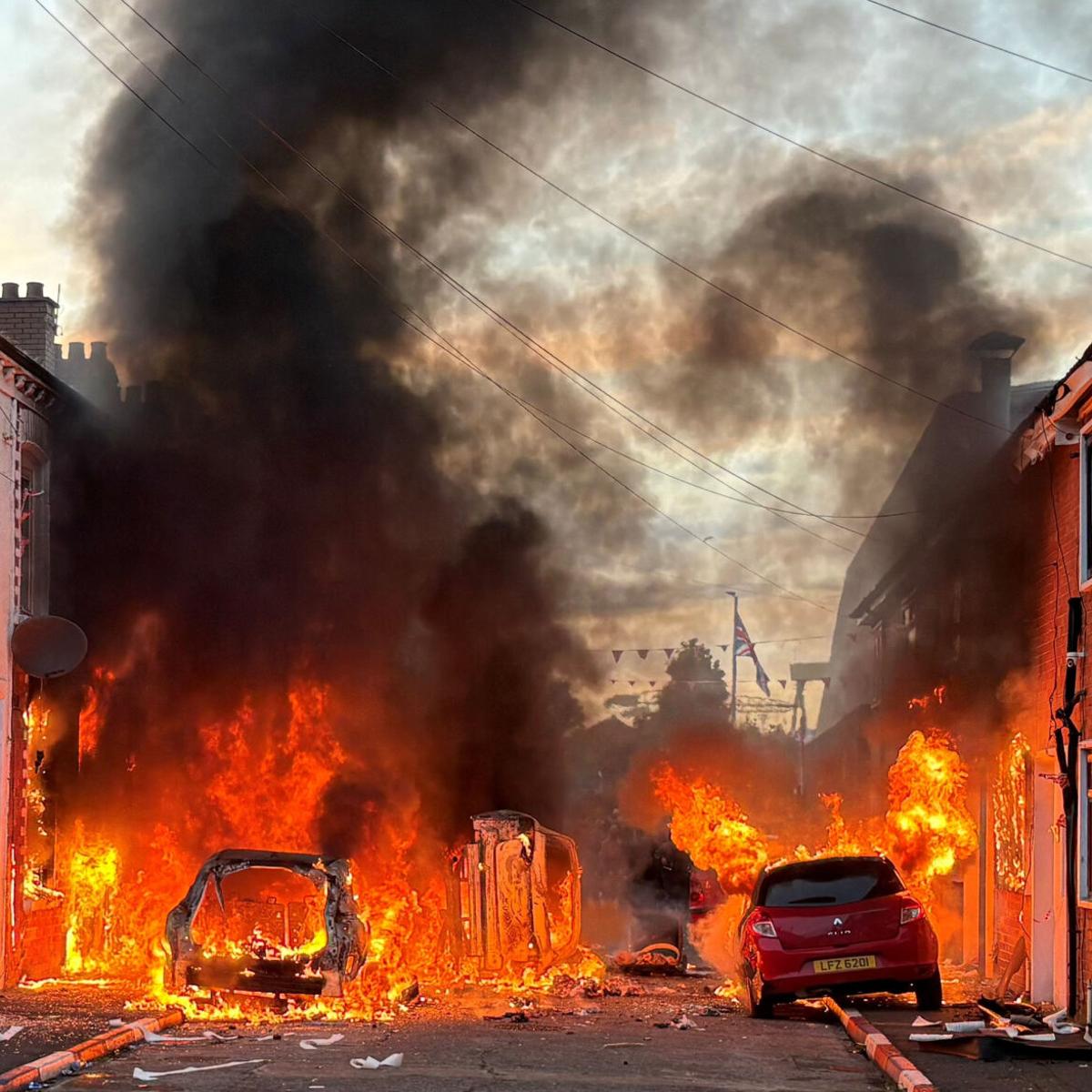
Even from a distance it was clear that this wasn’t exactly the case.  Musk and the British far-right might provide inspiration, and social media provide a mechanism to inform, but the riots were an Irish phenomenon.  This is the third year in a row for such riots with social media again calling for a ‘cross-community’ racist mobilisation, including announcing meetings in nationalist areas such as Ardoyne.  Instead, the riots and the attacks on immigrants, or those considered to have the wrong skin colour, were confined to loyalist areas, and republicans in Ardoyne mobilised to reassure and protect those residents in the area who were most vulnerable to attack.

What wasn’t immediately clear from a distance was how widespread the racist mobilisation was.  Despite the drama reported on the mainstream media, reports continually showed one street in flames, the glider bus on the Newtownards Road on fire and some other localised riots.  By the historic standards of Belfast and the North of Ireland this was all relatively small, except that shops, schools and transport seemed to be closing down earlier than they had previously in worse circumstances.

When I got off the plane at Belfast there was a larger than usual number of police interviewing passengers and not necessarily checking ID.  They were more interested in where you were from and where you were going to.  I took it they were interested in identifying any loyalists of other far-right figures arriving to join the fray.

Unusually, I noticed the faces of those who weren’t white, including the black guy helping to give order to the airport taxi rank.  The taxi driver, who was an immigrant as well, and having lived in Belfast for over ten years, was very scared, particularly when it became clear that at one point taxis were being stopped in some location(s) to check whether the driver had ethnic minority passengers.

This was one of the reasons for the perceived febrile nature of the events.  The targets were immediately identifiable, unlike sectarianism where – despite the stereotypes – it is not usually obvious who is Catholic or Protestant.  Every non-white face was a reminder of who the potential targets of racist violence were.  The second startling images, perhaps especially for those not living in Belfast, was of masked men going door-to-door trying to identify and attack people of the ‘wrong’ colour.

Some commentators I saw were at pains to state that it would be wrong to paint the whole unionist ‘community’ as racist.  This is an obvious truth, just as is the other claim that there are nationalist or Catholic racists.  The point however is that it was only in loyalist areas that attacks took place. As one journalist pointed out – look down at the street and the footpaths are painted red, white and blue.

The police claimed that loyalist paramilitaries were not involved, which is nonsense.  Not all these paramilitaries were active – the riots would have been significantly bigger if they were – so the police were playing the game of not blaming them as a means of encouraging those not yet involved to stay not involved.

For the police it’s a win because it might help minimise its immediate problem while the existence of these groups is publicly treated as not their problem.  For the loyalists themselves their existence is their main objective and partial disorder both shows their capacity for violence and capacity to control it.  Yes, we can be a threat, but one you can work with.  And indeed, the British state has had no problem working with loyalist paramilitaries for decades – in the background, alongside, and fronting them up.

Lack of honesty in identifying one core issue of loyalist responsibility is one not confined to them or sections of the media, but as the next article will argue, it’s a bigger issue for those opposed to the attacks.

*              *             *

The reaction from the British government, in the shape of Keir Starmer, was the announcement that he would “crack down on anyone who is fuelling this division”, although this proved to be untrue because he continued to fuel it himself.  The British Home Office let it be known that the racists had no need to do what they were doing because the government was already cracking down on immigration. “Government sources” let it be known that it would “intensify” its actions to “track down, detain, arrest and remove illegal immigrants from Northern Ireland”.  It’s hard to see how this briefing to journalists would not validate in some way the racists and fail to reassure their victims.  

The North of Ireland has a population that is 96% white, while Belfast is home to three-quarters of asylum seekers, quoted as around the 20th highest rate of all UK council areas. Yet Belfast is quoted as having had the highest number of immigration raids in the UK between 2018 and 2024.  Whoever thinks this means that ‘cracking down’ needs intensified is living in their own world of racism, which thus includes the British government.

The Democratic Unionist Party has come under attack for playing its usual role of condemning violence while giving political cover.  There is much talk, and not only by them, about ‘legitimate concerns about immigration’ and the ‘pressures on housing, healthcare and resources’, but the claim that the rioters are concerned about resources for healthcare, for example, doesn’t withstand examination when they target nurses and other healthcare workers for intimidation.  It is a commonplace that these services rely on immigrant doctors, nurses and others.  Frequent visits to local hospitals confirm this in abundance.

Reported racist incidents exceeded sectarian ones by nearly 2 to 1 in 2025/26, affecting a very small part of the population, and it has now been argued that sectarian conflict has been displaced by racist attacks.  That these attacks are mainly by loyalists is a tacit claim that it is they who are mainly responsible for sectarianism, which is not the politically correct version of reality touted by most of the media in the North and by all of it in Britain.

It is only partially correct.  Immigrants are mainly living in loyalist areas because that is where the available housing is, thereby also making them more accessible to attack. It has also been partially displaced to the sectarian institution at Stormont, where its has stagnated.  This stagnation will not last and Stormont has already had repeated breakdowns.  A final collapse threatens to put sectarian conflict back on the streets where it will join with the current violent racism.  It is one of the ironies of the reaction to the riots that those opposed to the racist attacks look to Stormont for the answer, but we will look at this in the next post.

Forward to part 2

Anti-racists in Belfast push back against the fascists

A week after a far right rally in the city centre led to an impromptu march to South Belfast, and attacks on ethnic minorities, the far right thought that it could cement their success with a rally in the same place the following Friday night.

Their initial Saturday rally was already small but grew when it passed through some working class loyalist areas and headed for the areas with a more prominent ethic minority presence.  They were eventually stopped, not by the police, who limited themselves to a stationary presence, mainly to defend the Islamic Centre, but by residents of the lower Ormeau Road, a mainly working class nationalist area.

The following week there were numerous attacks on ethnic minority businesses and individuals, mainly in Belfast and mainly in loyalist areas, but not exclusively so.  The far-right rally drew some attention world-wide with pictures of racists waving British Union flags and Irish tricolours, with comments about how the infamous religious division in Ireland had been overcome.  In fact, the appearance together of Irish fascists and Irish loyalists is not something to write home about, but media pundits couldn’t resist commenting and far right bloggers around the world couldn’t help claiming an historic success.

The Belfast racist’s attempt to repeat their success on Friday night was an ignominious embarrassment.  An acquaintance of mine mentioned that he had gone into Marks & Spencer for a cut-price sandwich and had gone out the back door to have a look at the racist/fascist/loyalist admixture, only to find twenty or so guys, some with Glasgow Rangers football tops, wondering why they were so few.  In the end there were less than 100 facing a counter-demonstration of around 1,000. 

The counter-demonstrators had much fun chanting:

We are Many

You are Few 

We are Belfast

Who are You?

and

There are many, many more of us than you

There are many, many more of us than you

There are many, many more

Many, many more

Many, many, more of us than you

The following day thousands of demonstrators took to the streets for a demonstration to the same site in the front of the City Hall.

The actions of the residents of the lower Ormeau Road and the mass anti-racist demonstration has gone a long way to putting the racists and fascists back in their box, but there are many reasons not to think that this particular struggle has been won.

First, the Belfast events were part of a series alongside far right attacks in Britain and follow similar attacks in Dublin and across the Irish state.  In both of these the scale of attacks were much larger and broader.  The killing of three young girls blamed by far right rumours on a Muslim immigrant was the occasion for the attacks in Britain and these in. turn were the catalyst for the Belfast attacks.

The Belfast demonstration was attended by some far right protestors from Dublin, including from the Coolock group that had rioted to prevent the creation of accommodation for asylum seekers in the area.  Dozens of arson attacks across the Irish state have been made on such prospective sites and a major riot in Dublin in November followed an attack on young children by a man originally from Algeria.

Just as the attacks in Britain and the south are not new, neither are attacks on ethnic minorities across the North of Ireland, which became more frequent recently.   Most of these are in unionist or loyalist areas because demographic decline has meant that accommodation is more available and less expensive, while property for new ethnic shops is also cheaper.

For many older people the sight of significant (but still tiny) numbers of ethnic minority people is still in some ways remarkable.  It’s a bit like seeing young people wearing GAA (Gaelic Athletic Association) tops in places where previously even someone suspected of being a Catholic would have been in mortal danger.  It is visual confirmation of the relative decline in the unionist population and increase in the nationalist one, alongside their greater political and social prominence.

These working class Protestant areas would once have been full to the brim of a monocultural population which considered itself the rightful subjects of the state who could look down on the Catholics as second class citizens.  Against this, a significant number of Protestant workers were consciously non-sectarian and anti-sectarian but they did not define the tone of the neighbourhoods, especially during the Orange marching season.

Racism therefore has two reasons to be more prevalent in loyalist areas – ethnic minorities are more prominent, and loyalism has always been based on supremacism – expressed in sectarianism – for whom racism is not exactly a distant cousin.  Nationalists have in the past looked to the black civil rights movement in the US as analogous to their own discrimination and resistance and have looked upon racism among loyalists as confirmation of their own world view.

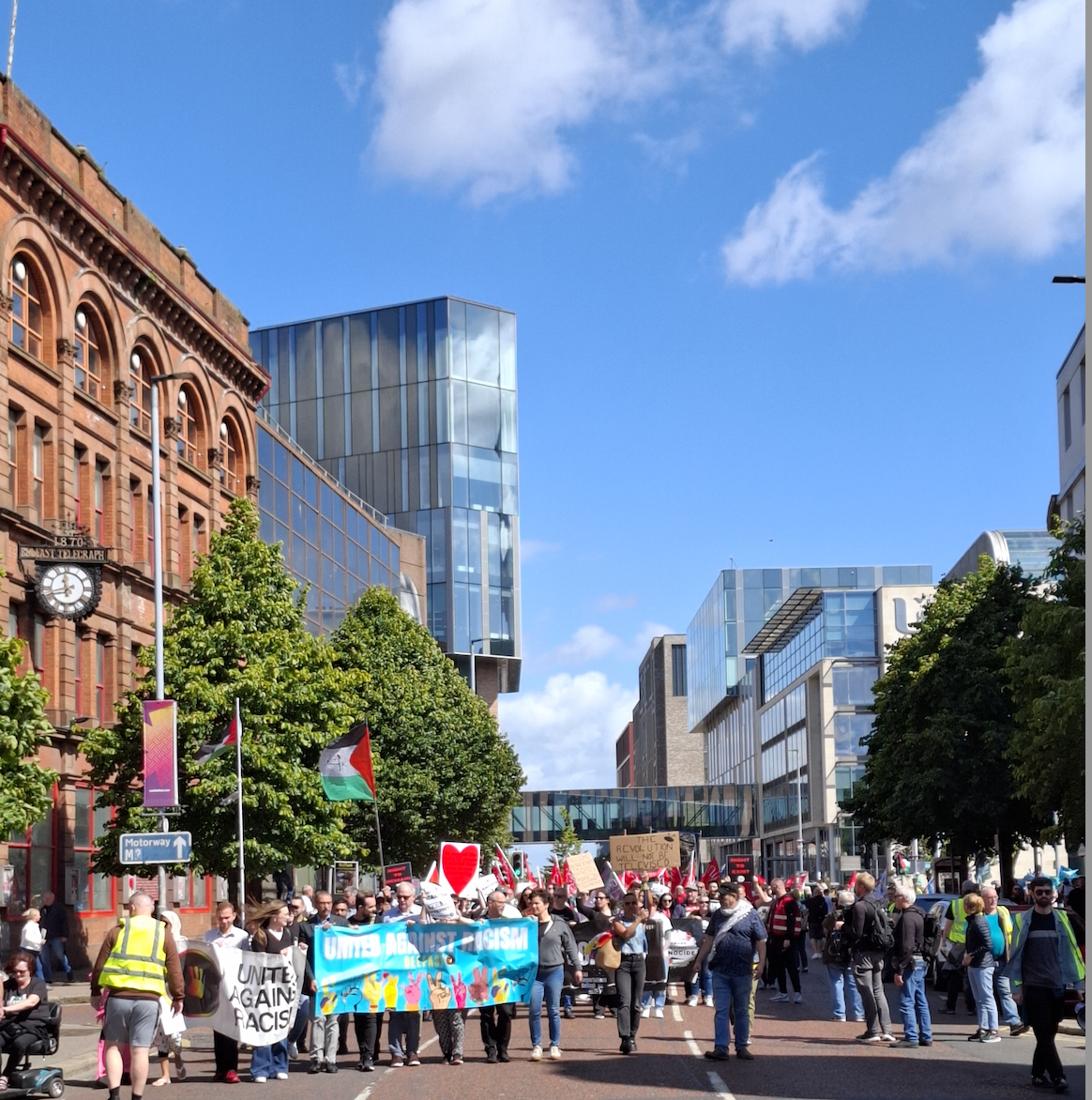
So, no one on the counter demonstration or the following day’s anti-racist march was wearing a Rangers top whereas there were many GAA tops and a few Glasgow Celtic shirts.  There were many Palestine flags and at least one Irish tricolour, while at one point a large part of the crowd was singing a song in Irish.  There was also a noteworthy republican presence on the Friday night counter demonstration.

This is not at all to suggest that the counter demonstration was a purely nationalist one or that the Saturday demonstration was either, even if the political speeches were by Sinn Fein, the SDLP and the People before Profit MLA from west Belfast.  No one on either demonstration would have considered it to be a nationalist one and it identified itself repeatedly in chanting that it was anti-racist and anti-fascist. No one, however, is blind to the obvious facts, including that the racist demonstrators waved union flags and posters and the previous Saturday’s racist march was made up of loyalists that the fascists from Dublin could ‘unite’ with.  The PSNI (Police Service of Northern Ireland) has stated that loyalist paramilitaries have been involved in the recent racist attacks.

There is thus some irony in the numerous placards and repeated declarations on the Saturday demonstration that it was in support of ‘diversity’ with one placard saying that Belfast itself was built on it. I doubt that any of the demonstrators expected their diversity to include their fellow demonstrators to be wearing Rangers or Linfield tops or waving Union and Ulster flags, or politicians from the DUP to be speaking from the back of the lorry.

Of course, when demonstrators talk about diversity they mean opposition to discrimination on grounds of race or sex or sexual orientation etc. and not politics, but this shows that politics is central and focusing on diversity erases this centrality.

One example was a young woman holding up a home-made placard telling the racist demo ‘check your privilege’.  If she had checked the racist demonstrators herself she might have noted that there wasn’t much evidence of privilege.  In general the rioters have been poor, ignorant and frequently quite stupid.  Of course they have been white, but so were the vast majority of the anti-racists.

A number of speakers pointed out that the racists are scapegoating asylum seekers and refugees for the failure of governments and their austerity policies.  They pointed to years of Tory austerity and to Starmer’s promised continuation of it, but these are not the only offenders.

These culprits are now offering their own law and order solution to racist violence and the main Muslim speaker at the Saturday rally, Raied al-Wazzan, Vice-chairman of the Northern Ireland Council for Racial Equality, called on everyone to support the police – the police that had just failed the previous week.

In Britain various police forces have been proved again and again to be racist and misogynistic while they have been embroiled in scandal after scandal including corruption and spying on left wing organisations.   In the North of Ireland they have an even worse history, including collusion with the loyalists that are now behind the racist attacks.

The call for the police to protect ethnic minorities from racism at least reveals that the immediate question is one of physical self-defence and the solution to that was demonstrated by the lower Ormeau Road residents.  Workers should organise to protect their own communities and by involving the targets of racism themselves.

This was something that wasn’t argued for at the rallies despite repeated chanting and invocations that “When migrants’ rights are under attack, what do we do? Stand up, fight back.”  Lots of slogans about fighting back but zero calls or steps at the rallies to begin organising it.  Instead, there were a number of calls for Hate Crime legislation to be introduced, which is a call for increased police powers, a step to close down free speech and a weapon that will be employed against the left and defenders of women’s rights.

While we had many pointing the finger at politicians who had sowed the seeds of racism by blaming refugees for poor public services that they had been responsible for reducing, there was not a murmur at Sinn Fein who had a speaker at the Saturday rally.  Not only has Sinn Fein imposed austerity in the North, while washing its hands of responsibility by blaming ‘London’, it has formed a partnership with the DUP that jointly dispenses little more than slush funds between republican supported and loyalist ‘community’ organisations that provide power and prestige to loyalist groups.

In the southern Irish state Sinn Fein has followed the example of the Tories and Labour in Britain, and Fine Gael and Fianna Fail in Ireland, in presenting refugees and immigrants as a problem, as something to be reduced and a population of the undeserving that must be expelled as soon as possible.

Sinn Fein’s new policy of an audit of services etc. in working class areas so that a rationale can be provided to prevent accommodating refugees within them is further pandering to racist opposition.  Applied in the North, the current areas of highest refugee populations would likely fall foul of a Sinn Fein ‘audit’.  You will not be surprised that this new great policy of Sinn Fein was not proposed at the Saturday rally.

There was only one discordant note from a speaker at the rally, when the NIPSA union leader and Socialist Party member Patrick Mulholland, noted that racists had waved both union flags and tricolours while they carried out their actions.  This resulted in a few grumbles from some in the crowd but has the unfortunate quality of being true.  Irish politicians and some left nationalists have complained that this is a misuse of the national flag and the racists and fascists have no right to it. Their problem is that the racists and fascists have as much reason to claim to be nationalists as any of the other nationalist organisations.

The strength of the anti-racist and anti-fascist movement was on display in Belfast over the weekend – its numbers, its enthusiasm and its determined opposition.  Also on display was its weakness – its reliance on the state and police, the hypocrisy of many of its adherents, the poverty of its immediate organisational objectives and weakness of overall political alternative.

The answer to racism and fascism is not ‘diversity’. Like gravity, such diversity exists anyway and will continue to exist whether celebrated or not. What matters is not that we are different in many ways but that we have cause to unite; the grounds for this unity is where our interests lie and that must be our central concern.

Thousands march in defence of refugees in Dublin

When the war in Ukraine broke out the Western powers rushed to supply weapons to the Ukrainian state, which became the purported bearer of freedom for the whole of Europe, if not the rest of the world because much of the rest of the world understood that the United States and Europe were not defenders of freedom.

In Ireland the government parties floated the idea of the state joining NATO so it too could supply weapons, but the rapid response by the Irish people showed that this idea was very unpopular and would require a lot more work to force through.  After an apparent slight from Volodymyr Zelensky about the Irish contribution to the Ukrainian cause the government parties proclaimed that their contribution would be to provide a refuge for Ukrainians fleeing the war.

Very quickly government ministers were predicting that as many as 200,000 Ukrainian refugees were to be supplied with accommodation, which on the face of it seemed incredible.  This was a government and state that had proved incapable of solving a homelessness problem of around 10,000, while massive house price increases had made buying one impossible for many, rents were astronomical, and much of the newly built housing stock was dangerous or becoming rapidly uninhabitable.

However an unprecedented propaganda campaign ensured that the cause of the Ukrainian state received much sympathy, and did so in Ireland, so much so that a state notorious for corruption and reactionary nationalism was embraced by almost everyone from right-wing governments to much of the left.  Ironically this left has just recalled thirty years since the massive anti-war demonstrations against the imminent invasion of Iraq by the US and Britain etc.  Today this left not only supports war but supports the US and Britain etc. supplying arms to ensure that the war continues to be fought, by a country that itself provided soldiers to occupy Iraq following the invasion.

Opposition to war has become support for war and opposition to western imperialism has become defence of western imperialism in its support for a state that wants to join its imperialist alliance.  From the cause of death and destruction and oppression, these powers are accepted as defenders against these calamities, and the massive drive to rearmament has left this left trailing behind, endorsing the supply of weapons to its new ally while stuck with a past politics that recognises western imperialism as a prime source of war and oppression in the world.  Of course, something will have to give here.

This is the first context to the refugee crisis in Ireland but one that was all but ignored by the demonstration in support of refugees in Dublin on Saturday, even though the massive increase in refugee numbers is mainly accounted for by Ukrainians.  Not one of the left leaflets distributed at the demonstration mentioned the war, or so much as mentioned Ukraine, and I saw only one makeshift flag in Ukrainian colours, with no identifiable Ukrainian contingent on the demonstration.

The second context is the crises in housing and health services and stress on the provision of state services more generally.  There is a valid argument that younger immigration will provide greater services than they will consume, but this will not immediately be the case and especially with so many Ukrainians being women with young children. Childcare costs can be extortionate in Ireland.  When we also consider that refugee provision has been placed in mainly working class areas or in small rural towns, but not in more affluent and middle class areas, we can see why it would cause resentment   Opinion polls have shown both support for refugees but also concern that the country has taken too many.  There are also widespread complaints of lack of consultation with local communities before placing refugees in accommodation.  Behind all this lies both valid complaints that there are inadequate services but also racism.

One reason why ‘war’ and ‘Ukraine’ was unmentioned at the demonstration is that the target of much racist invective, protest and attacks has been against non-Ukrainian asylum seekers.  This includes men from Georgia and Albania, who have been particularly targeted.  One can’t help but believe that were Georgia invaded by Russia or Albania by Serbia the Irish state would be proclaiming their needs and absolute requirement for emergency assistance.

The state and its governing parties have led the way into a crisis in which the far right and racist forces have mobilised in local areas to attack refugees and turn local people against them, with lurid stories of sexual harassment by refugees against Irish women and other racist tropes learnt from abroad.  Irish people and existing asylum seekers have seen their demand for accommodation grow, and their needs be unmet, only to witness the government parties proclaim emergency measures to accommodate Ukrainian refugees.

The prioritisation of Ukrainians and creation of double standards when it comes to treatment of those seeking refuge in Ireland has not prevented the state’s efforts to assist Ukrainians from staggering from crisis to crisis with no evidence of the ability to create the required capacity in the short term or existence of a longer-term plan.  This is not in the least surprising.  The Irish state has failed to provide adequate housing for the pre-existing population and its health services have continually been in crisis. It has been silent on complaints that large numbers of refugees will not help this situation while it has all but ignored the full needs it has created.

It has therefore opened the door to racist and xenophobic arguments and agitation and has now started to row in behind them.  It has promised to clamp down harder on asylum seekers while it proclaims the necessity to support more Ukrainian refugees, with the threat of more deportations of the former.  It makes claims of their cheating to be here in the first place as a result ”criminal gangs”’ and human “traffickers”; makes statements denying that single men are being placed in accommodation, as if they were indeed the threat proclaimed by racists, and the new Taoiseach Varadkar has now declared that immigration policy must become “firm and hard”.

The real failure of the state and government parties to provide adequate state services is being blamed on refugees by the far right, which has not targeted the largest group of arrivals–Ukrainians fleeing war–but instead refugees who are not so obviously white and ‘deserving’.  The state, on the other hand, has also declared these refugees uniquely deserving while it supports a war that has caused them to flee their homes in the first place, with continued support only promising more to follow.  This combination is one more reactionary consequence of a reactionary war.

The demonstration on Saturday was called after increasing anti-immigrant protests by the far right that have grown in number, particularly noticeable because of their previous absence and the naive and stupid notion that the Irish (of all people!) were immune from the racism that has grown across Europe.  I went down to it from Belfast to support it, see its size and its composition and because it was important to rebuff the mobilisations of the far right for whom control of the streets is a strategic objective.  A large demonstration would signal where it stood in terms of such mobilisation and the terms on which the whole argument could be waged.  A large demonstration of the left would not be enough to meet these requirements.

In the event the demonstration was larger than such a mobilisation, consisting of a wide cross-section of the population, from outside of the left or who it would normally be able to mobilise.  In this it was impressive and just about achieved its purpose.  It was not however, in my estimate and those of a couple of comrades, 50,000 strong, but perhaps just more than half that number.  It was largely Dublin-based and did not have the predominantly working class composition of the water charges demonstrations or of the very large demonstration against austerity that followed the crash of the Celtic Tiger.  It did however contain a significant number from ethnic minorities and from the left and some trade unions. These were predominantly its activists and not significant numbers from the trade union membership, which would have made it much larger.

The left has built itself an electoral base in Dublin and Cork and its grass-roots organisation should be well placed to defeat attempts by the far right to organise in local areas, but it is not quite as simple as that.  Building an electoral base is not the same as building a movement.  People before Profit seemed to be aware of this, as it faces defeat by Sinn Fein in the next elections, and its main message on the demonstration was for people to join it.  Unfortunately, it is not an organisation with the capacity to contain a mass membership and an electoral base is not an organisational one.  Its leaflet called for a left government and for everyone to support its legislative motion in the Dáil on housing, proposals that are hardly adequate.

Any left government will require a Sinn Fein leadership and its left credentials are threadbare, even if it may have the capacity and scope for some social-democratic measures.  What such a government could not be is a working class one – but then a ‘left’ government does not have to be working class, the term ‘left’ in an Irish context does not imply very much.  An organisation that thinks the role of working class activity is to support votes in parliament has got it arse about face.  Other left leaflets pointed to the need for working class unity and for it to organise and mobilise, but this requires challenging the bureaucratic character and leadership of the trade unions and these left organisations neither prioritise this nor have the capacity to be exemplars of healthy democratic organisation themselves.

It also requires the correct political approach, and too much of the demonstration was an expression of liberalism and not socialist politics.  Not so long ago the left exposed the inane character of abstract nouns, such as the ‘war on terror’ but now it appears not to object to the demand to oppose ‘hate’ or support ‘diversity’, as if there are not some things, such as racism, that should be hated.  Supporting ‘diversity’ is a bit like declaring your support for gravity, it doesn’t matter if you do or you don’t, it will still exist.  To paraphrase Terry Eagleton, a diverse number of racists would not be a step forward.  If you want the opposite of division it is called unity, and then you need to say who should unite and for what purpose.

The rise of the far right has been prepared by the failure for years of the Irish State and government parties to provide adequate state services for the majority of the Irish people, and for its similar failure in relation to those refugees it has, and has not, encouraged to come to Ireland.  Its policies have sewn the division between natives and refugees and between first class refugees who are white–and victims of a war it has supported–and those second class others seeking refuge who it has determined are a problem.

The crucial issues facing Irish workers, Ukrainian refugees and asylum seekers are therefore the same with the same guilty forces responsible for their plight.  Their common need should be clear, as is the need for working class unity and for working class organisation to express it. Many organisations supported the demonstration in Dublin on Saturday.  Those with a commitment to the interests of the working class, including Ukrainian refugees and asylum seekers, should form a united organisation that can provide a programme for further action at national and local level that offers not only opposition to the far right but an alternative.

Jeremy Corbyn’s ‘anti-Semitism’

As Members of the British Parliament go, Jeremy Corbyn has a record of opposing racism, including anti-Semitism, that is second to none.
So, days after waiting for the anti-Semitism charges against him to evaporate from the news – on the grounds that they are patently absurd –  they still loom large.

We see the BBC invite the Labour Party to denounce those supporting its leader – from a demonstration attacking him as anti-Semitic – and are supposed to see this as yet another example of his failure to stand up to anti-Semitism.  And expected to accept that this is yet another example of anti-Semitism, without a need to provide evidence that the previous charges actually stand up.

Thanks to the BBC, we are to remain entirely ignorant of the fact that those whom the BBC seek to have denounced are themselves Jewish!

Again, after days of having anti-Zionism conflated with anti-Semitism, so that the two are indistinguishable, the BBC reports that, ”during protests” and after “clashes”, which leave “16 Palestinians dead and hundreds injured” we are informed that “Israel’s response was exaggerated.”

Just so, unlike the repeated reports of the Labour Party’s anti-Semitism.

And there really is no point in anyone in the Labour Party denying it.  Because that is precisely the problem!

So, as Tony Blair – once described as “the worst terrorist in the world” – put it on BBC Radio 4’s The Week in Westminster, “It’s become a problem because I’m afraid the people around Jeremy Corbyn – maybe even he himself – I don’t think they really think it is a problem.”

So, there you go.  Denial is proof of guilt.

Not since the witch hunts of the 16th and 17th centuries, when women were dunked in water, has it looked such a lost cause to declare one’s innocence.  For the poor unfortunate women so denounced, if they floated they were witches, and if they didn’t, they weren’t”

And there is also really no point in Corbyn looking to supporters to defend him instead.  Because, as last night’s ITV reporter said to the other ITV reporter, the latter obviously speaking as an expert unbiased summariser of what is really going on – Corbyn has to reject his supporters as anti-Semitic to prove he’s not.

Then, having done so, we will, with little doubt, wait expectantly for the BBC to report that Corbyn, (we’ll just use his surname from now on) has no support, because of his anti-Semitism of course.  Corbyn anti-Semitism, anti-Semitism Corbyn, anti-Corbyn anti-Semitism.  Just put the words together often enough, and in no particular order, and that will do.

If there is a lesson to be gleaned from this ‘fake news’, it is the one that armies have long understood. While you can capture enemy soldiers and put them in camps, you shoot spies.

In this case, the most immediate enemy one can throttle (metaphorically speaking of course) are the phalanx of Blairite Labour MPs who have been the ‘credible’ ingredient of this poisonous and preposterous mix of accusations.

It reminds one that there must be elections coming up; the local elections in May.  Time to shit on your own doorstep and blame someone else for the poor reception to your ‘for sale’ sign outside.

If anyone thought Jeremy Corbyn’s landslide election as leader was going to unite the Labour Party around him, including the crowd of careerists at Westminster, then this was surely disabused when Owen Smith had another go and got trounced.  If anyone thought that this second thumping victory was going to make loyal supports of these expense claimers who couldn’t spell integirty, then they were disappointed again.

And if you thought that the snap General Election, in which the widespread presumption was that Corbyn’s speaking part was to walk on and get crushed, was final guarantee that the Parliamentary Party would unite around him.  Well, you really should have known better.

Unfortunately, despite all these lessons, despite all the deceit and betrayal; someone who also appears not to have learned the lesson is Jeremy Corbyn himself, although I hasten to add, it’s not too late.

The view that the Labour Party is a (very) broad church is really only accepted by the right of the Party when it is in the majority, and the left is considered to be irrelevant, like, for example, in the first half of  2015.  The left on the other hand, at least many of those in the Corbyn camp, seem to believe it even when the knives, wielded by Blaire hands, go repeatedly into their chest right in front of their eyes.

The theory would seem to be, if theory is not too strong a word, that keeping the Party united will help get a Labour Government elected.  And then it can go do all the good stuff it has promised.

The two flaws in this ‘theory’ are too obvious to dwell on.  The Party is patently not united.  And the same MPs who seek to thwart Corbyn’s leadership in opposition will be even more keen to do it should he cease merely to be in opposition.

Turning the other cheek to Blairite sabotage has left Jeremy Corbyn without any cheeks to turn.  Ignoring the cardinal need to democratically clear out the host of Blairite/right wing/’soft’ left saboteurs inside the party, and to do so openly, as a campaign to democratise the Party, has left him exposed to the latest assault, which will assuredly not be the last.

So right now, either he fights the ludicrous charges of anti-Semitism and stops apologising for non-existent political crimes, or he may be left to float helplessly in the water waiting to be burned, or at the bottom of the water, proved innocent and much lamented, definitely eulogised, and very definitely history.

PS: Update 3 April.  Jeremy Corbyn has met some Jewish people – see link.  But this is “irresponsible and dangerous” according to a Labour MP. He’s meeting the WRONG sort of Jews!  Isn’t this man just infuriating?  Doesn’t he know that being anti-Semitic means some Jews are good and some aren’t, and it’s only anti-Semitic when you don’t agree with the establishment ones?  I mean to say, how can it be reasonable for a left wing leader to meet left wing Jews and not demonstrate similar feelings towards the right wing sort?  It’s not as if Jewish people are just like everybody else – is it?

Racism and anti-racism in Belfast


DSC_0117“Islam is heathen, Islam is satanic, Islam is a doctrine spawned in hell.  Enoch Powell was a prophet, he called it that blood would flow on the streets and it has happened.”

When a Protestant minister in North Belfast’s Metropolitan Tabernacle Church declared that Islam was “satanic” and “heathen” and compared “cells” of Muslims in Britain to the IRA the First Minister of Northern Ireland, Peter Robinson, who is known to have attended the church, was widely called upon to speak out.

Oh dear.

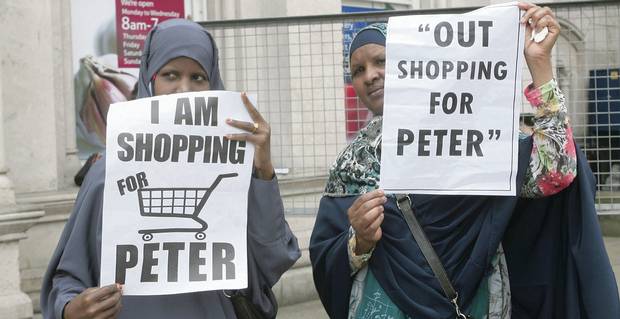
When he did, he said that Pastor McConnell had been demonised, that it was the duty of any preacher to denounce what he described as “false prophesy” and said he would not trust Muslims either, particularly with regard to those who had been involved in violence, or those who are “fully devoted to Sharia law, I wouldn’t trust them for spiritual guidance”; however he would trust Muslims to “go down to the shops” for him or to deal with a number of “day-to -day issues”.

Cue lots of people with their heads in their hands, especially those considering the Northern Ireland administration sponsored trips to the Middle East to promote trade and investment.

NWS_2014-06-02_NEW_006_31867640_I1

A newly elected unionist councillor for Belfast had that week been found to have tweeted a year earlier that “I’m so sick of the poor Catholic b*stards they make me sick I wish they would just go down to Ireland . .” but she was young and sectarianism is hardly news in the North of Ireland unless someone in the media decides to make it news.

But racist attacks, especially by loyalist paramilitaries, have already been in the news and have increased by 43 per cent over the year, twenty seven per cent of them in North Belfast.  Having been called upon to comment in order to denounce racism, Robinson was then called upon to apologise for his own offensive and insulting remarks.

Anna Lo, the Hong Kong born local politician, had just received some racist harassment herself and called upon him to resign if he did not publicly apologise, vowing to leave Northern Ireland because of local racism and  sectarianism and stating that she would not stand for election again.  One Democratic Unionist Party councillor then called her a “racist” and was dropped by that party as its candidate for mayor of Newtownabbey, which is adjacent to North Belfast.  Other ministers and unionist politicians backed McConnell and claimed Christianity was being persecuted.

Two Muslim men where then beaten in their homes in the north of the city and stated that their attack was connected to Robinson’s statement – he had “lit the fire”.

Some in the press and other unionist leaders attempted to minimise the impact of the insult by claiming he was just clumsy.  Michael Nesbitt, leader of the Unionist Party, claimed that “we say things we don’t really mean or express them in ways that perhaps we could have thought through better.”

Robinson then made a private apology to some prominent local Muslims, except it wasn’t an apology.  He didn’t admit to being wrong, did not withdraw the remarks and did not say he was unconditionally ‘sorry’.   What apparently he did say was that “If” anyone thought he had said anything derogatory “he would be hurt” and he would apologise, but he didn’t because he didn’t think so.  He had been ‘misinterpreted’.

So he might be the injured party in this episode and it was everybody else’s fault for not understanding him.

But still the calls for a public apology raged and eventually Peter Robinson did publicly apologise – except the apology wasn’t public.  It was one of those occasions when the media reports something and you look to see when and how it happened but you can’t actually find any evidence of it having happened, and when you look closer it appears that it hasn’t actually happened.  Yet most assume it has because it has been reported and before you now it it has happened because, well, that is how it has been reported.

In such cases this can only occur because everyone with any power to get across a media message has decided it’s in their interests to go along with the concealment.  For the unionist parties the interest involved is obvious.  Any gain in stature among its racist, sectarian and lumpen base has been achieved, while the reality of selling local business to Saudi Arabia etc. cannot be ignored so the controversy has to be closed down.

The British Government especially would be happy for the story to die no matter how this might happen and they showed no intention of doing anything that might shine a light on the bigoted character of their local political settlement, sold to the world as a model to be admired and to emulate.

But what about the nationalists, including Sinn Fein?  The second dog that did not bark was the failure of these parties to call upon Robinson to resign, as – to her credit – Anna Lo did.  Had such remarks been made in Britain by a leading member of the Conservative Government their feet would not have touched the ground as they headed for political exile and extinction. But not here.

What we got here was a bland resolution sponsored by Sinn Fein in the Northern Ireland Assembly opposing “racism, discrimination and intolerance of any kind, wherever it occurs”  but for God’s sake don’t mention that the First Minister has promoted all three.

What such resolutions reveal is not the willingness of Irish nationalism to oppose racism and bigotry but its willingness to avoid doing so, to avoid identifying and condemning it in reality, to replace lofty, banal and meaningless condemnations of racism in general for dealing with it in concrete reality.

Sinn Fein is setting itself up to be in Government North and South in 1916, 100 years from the Easter Rising that saw the beginnings of an attempt, that failed, to achieve Irish independence.  To do so it must ensure that there is an administration around in the North for it to be a part of.  Since this requires unionist participation no provocation or act, irrespective of how outrageous it is, will be allowed to threaten the political structure in the North no matter how rotten, dysfunctional and bereft of credibility it may prove itself to be.

In this way a political settlement based on sectarianism demonstrates its bigoted logic by ensuring that the most offensive statements can be made without fear.   In this way, but not only in this way, Irish nationalism becomes complicit in feeding the bigotry on which the Northern state rests, even while it self-righteously insists on its own non-sectarian character and its supporters continue to be the main victims of the bigotry.

What the Government parties are called upon to do, unionist and nationalist, is to deliver another document on “building a united, shared and reconciled community “, another piece of paper reviewing Stormont’s ‘Unite Against Hate’ campaign and together parrot inane promises from within ”its clear commitment within the Programme for Government.”

So if nationalism cannot provide an opposition to racist bigotry who can?

In a demonstration of thousands called quickly over social media a trade union spokesmen could only say that it was organised “in response to a worrying increase in the number of racist attacks in recent weeks, a situation which has been exacerbated by inflammatory comments by some religious and political leaders.”

Once again the identity of these racists couldn’t be stated.  Throwing a punch in mid-air takes the place of landing a blow on the real bigots who are allowed to continue to disclaim responsibility through the connivance of the media, political opponents and cowardice of others.

What political leaders are the racists?  How can you oppose something when you cannot even name it?  How are their excuses and non-apologies to be challenged?  How is the collusion of others to be highlighted and exposed?  How is their hypocrisy to be demonstrated?  And what is your alternative?

The trade unions bemoaned “the absence of the promised Racial Equality Strategy and the lack of coherent political leadership from the Northern Ireland Executive” as if pieces of paper are a solution and coherent racism would be better.

This hasn’t worked before and it’s not going to work now.

The Irish Congress of Trade Unions, Amnesty International and the Northern Ireland Council for Ethnic minorities called a second demonstration today and got a good turn-out given the bad weather.  Again however there was no call for Robinson to resign despite his remarks and his non-public public apology that retracted nothing of the substance of what he had said.

Some People Before Profit placards called for his resignation and some chants from the Socialist Party contingent called for him to go but the latter’s leaflet didn’t mention it and instead claimed his apology was a great victory for anti-racists despite it being obvious that these forces played a relatively minor role.

Such repulsive episodes highlight the rotten character of politics in the North of Ireland because they involve relatively new targets but the solution that is always proposed is that local politicians be something that they are not and do something opposite to what they have just done.  That they oppose bigotry and sectarianism even while the sectarian basis of the political settlement is supported because it is part of the peace process.  ‘Peace’ becomes the excuse for yet more and more injustice because an alternative to the present political deal cannot be conceived.

Debating what such an alternative could be would be a start to addressing this obstacle.