Socialists in Ireland opposed the Good Friday Agreement because it dictated continued imperialist rule in the North of Ireland that thus necessitated the continuation of sectarianism, enshrined in the rules governing the operation of the devolved administration at Stormont. The alternative to challenging sectarianism was to freeze it, registering the failure of republicans’ armed project to remove British rule and the inability of Unionism to reimpose the unilateral rule it had enjoyed since the creation of the state until 1972. For the British and for the Irish state freezing this volatility promised political stability, or at least the minimum of blowback from the North to either of their respective states.
The magic formula was ‘power sharing’. It hasn’t worked, and no one has claimed it has; except for widespread claims from local politicians, the two governments and the media that it is still the solution.
Widespread dismay at Stormont’s ineptitude long ago gave way to cynicism at its incompetence, dysfunction and mendacity. You can’t freeze sectarian competition, overseen by London, when the whole point of the system is to ensure the absence of power to the other side. That is the point of the arrangements – not to share power but to throttle the exercise of it by the other side. That’s why many people vote as they do – to stop ‘the other side’ as the only alternative to their own – no matter how useless etc. it may be.
It helps that neither Irish nationalism or Unionism has any social or political programme that could transcend sectarian division or promise an agenda that could win over those outside its core support. Unionism is based on sectarian division and on its continual assertion, while Irish nationalism has surrendered to the idea that it is a legitimate expression of cultural expression and political rights summed up in differing national identities. It promises to respect the Unionist tradition in its calls for an always imminent border poll for a united Ireland, while the Irish Government touts a ‘shared island’ project designed to lead to the holy grail of the reconciliation of the two traditions and ‘consensus’ on the future.
The Orangemen in Portadown have challenged Irish nationalism to put its money where its mouth is and show respect to its marching tradition, share the Garvaghy Road with its Orange parade, reconcile itself to the legitimacy of its right to so march, and thus accept a consensus that this is the future.
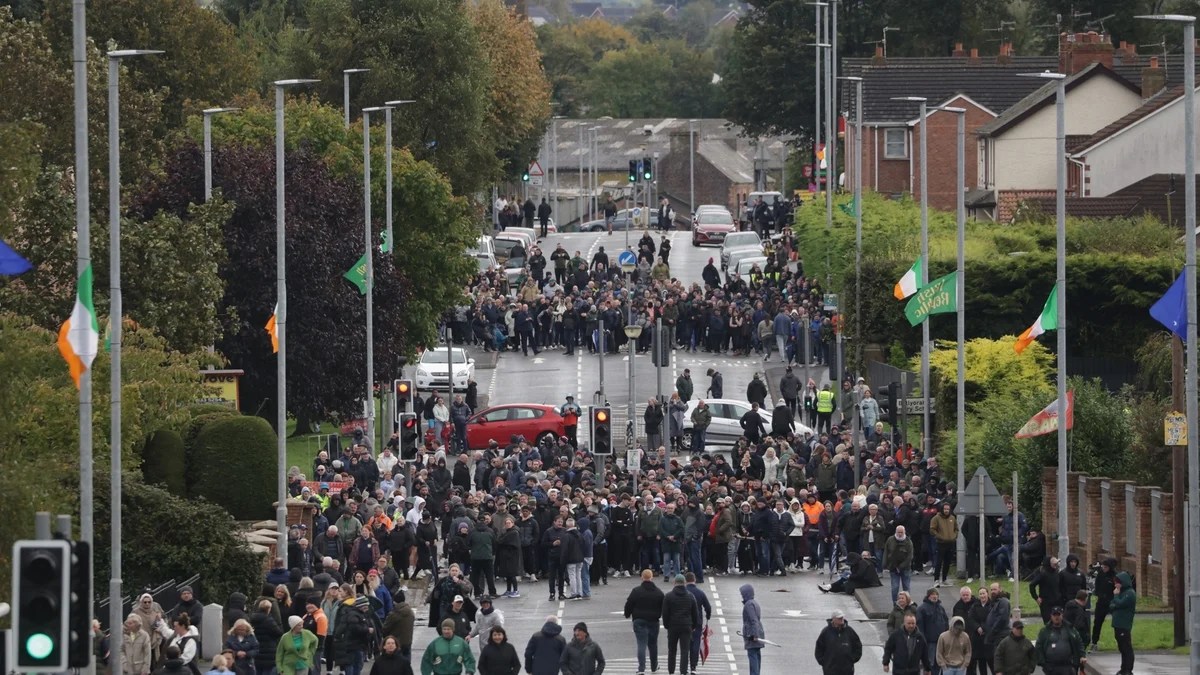
The residents of Garvaghy Road have said that they won’t respect anti-Catholic bigotry; won’t allow its neighbourhood to be subject to sectarian coat-trailing; won’t reconcile itself to a supremacist march that validates the supremacism of those marching and won’t accept that all this is their future.
Sinn Fein leaders turned up to the residents’ protest but they turned up politically naked. It is they who are partners in government with the Democratic Unionist Party, that just coincidentally is facing an election next year and is wracked by sex scandals. It is Sinn Fein that has presented itself as supporters of the institutional arrangements that have so obviously failed, including the Parades Commission that approved the Orange march, and the police whose evidence to the Commission ensured its approval.
The police are charged with enforcing the Commission decision but have balked at doing so because it can only succeed by beating the residents off the Road. Such an occurrence would destroy the credibility of any appeal to nationalists to support them and confirm the failure of the Sinn Fein strategy of being at Stormont. Every party supporting the current Good Friday Agreement – from the British and Irish governments, including the police, to the nationalist parties – know this. Rather than accept a forced march down the Garvaghy Road they are in the middle of kicking a can down it.
The cleanest solution for the British is to find a way to stop the Orange march – it’s what has worked for it and others for nearly thirty years. Unfortunately, the semblance of fair and objective discretion embodied in the Parades Commission has been exposed, along with the credibility of a police that advised it of no potential disorder but immediately imported police from Britain to deal with it as soon as the march had been approved.
Some other mechanism is now being called on to mediate a solution that is supposed to satisfy ‘both sides’ but which otherwise must satisfy the British who are in charge. They don’t care one way or the other whether the Orangemen march down Garvaghy Road; their objective is to stabilise their rule through Stormont by keeping both Sinn Fein and the DUP inside it.
The latter has been losing votes and is recording its lowest level of support for more than twenty years so an Orange march would boost its standing. Its long-stated opposition to the Good Friday Agreement doesn’t mean that it will walk out, as its guarded statements over the last few days have shown, but staying in while the Orange can’t march will expose weakness. On the other hand, imposing the march will damage Sinn Fein, whose support has also declined to the lowest in five years. Walking out of Stormont is not on its agenda either, at least not yet. On such shared objectives may rest a resolution although neither the Orange Order or the Garvaghy residents are puppets of either party.
Whatever ‘solution’ arises, the vulnerability and weakness of the existing governance arrangements have been exposed, and a credible socialist alternative remains to be created.

