Comments on the racist riots in Belfast and response (2 of 2)

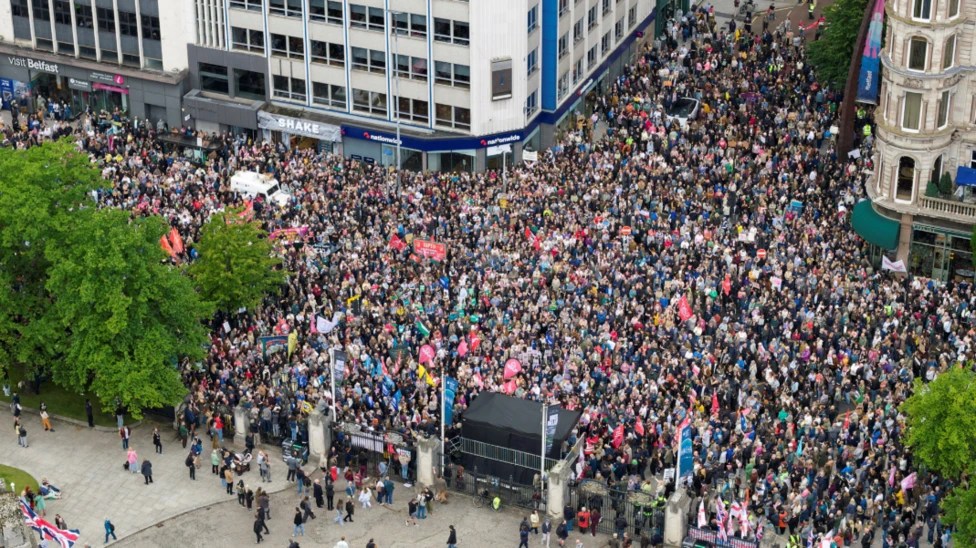
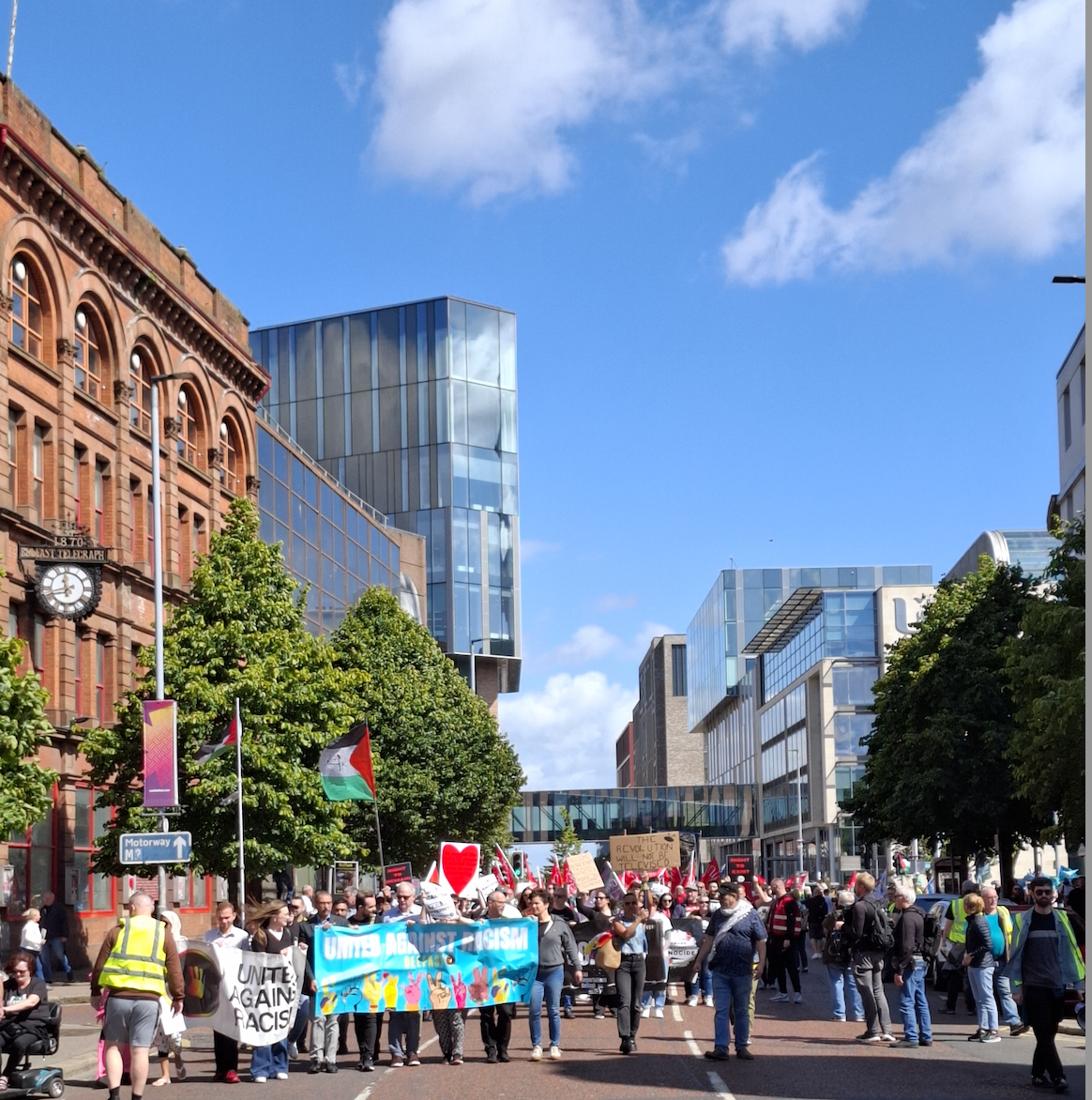
United Against Racism organised a rally in Belfast city centre to protest against the racist attacks.  It was recalled by a number of the speakers that we had been here before after previous riots, with the Green Party speaker stating that it was infuriating to be back again.  A summary of the speeches exposes the political weaknesses that help contribute to this, even while recognising the difficulty of what is required.  Not least of the problem is that there is not really an anti-racist movement and definitely not a coherent political alternative to the forces behind the racist mobilisations and the broader sympathy that lies behind them.

The range of speakers reflected the breadth of opposition to racism but at the cost of incoherence.  It’s not enough to be against racism – the racists have a policy – a political programme – no matter how primitive and inchoate, and the participants at the rally do not.

There were repeated chants of ‘Say it loud, say it clear, refugees are welcome here!’, which is a fine sentiment but not an argument or a policy.  There were frequent expressions that the rally represented the ‘real’ Belfast, repeated again by the following Monday’s editorial in the local paper ‘The Irish News’ – ‘the real face of both Belfast and modern Ireland was at show at the weekend . . .’  Unfortunately, the attacks were real, they were carried by real people, and they have a real base of support in Belfast and elsewhere in Ireland.

It might be countered that this is not what was meant by expressions of the ‘real’ Belfast but if it doesn’t mean what it says it doesn’t mean anything.  More importantly the phrase reveals a failure to recognise the real world, which is absolutely necessary to changing it and which failure to do so has all sorts of negative consequences.

Holding the rally was absolutely necessary to register the scale and scope of opposition to the attacks and in order to frame the issues raised in a more progressive way; to support those under attack and continued threat, and to give confidence to those opposed to racism and its violent expression.  The rally was correctly hailed as the largest anti-racist demonstration Belfast has seen, but it is not the sole representation of a city notorious for sectarianism and once described as ‘the race-hate capital of Europe’ in 2004, when the number of ethnic minorities was even smaller than it is now.

Organisers are claiming that 20,000 attended, when dividing by four might give a more accurate estimate, which is important only as another example of the failure to face reality.  Belfast has a history of sectarianism because there are a significant number of bigots, and religious bigotry regards racism as part of the family.  This constituency has a much longer history than any movement against racism.   It is extremely unlikely that racism will be defeated if sectarianism isn’t, which reveals the problem with a movement simply based on anti-racism.

The failure to deal with reality was expressed in the failure, so far as I noted, of any speaker to name the agents of the racist mobilisation.  Instead, the problem was an undefined ‘far-right’ and prominent individuals such as Elon Musk. The speaker from the Irish Congress of Trade Unions repeatedly employed this term, as if the trade union movement did not have a problem that a significant number of its own members in the North are loyalists.  On top of this is the acceptance that it is impossible to condemn loyalism without also demonstrating one’s own non-sectarianism by at the same time condemning republicanism.  Otherwise wider unionism might see it as evidence of a pro-nationalist bias. The result is that together they veto specific identification of the concrete and real adversary.

Ironically this means that the development of racism among nationalists cannot be separately identified as a problem should it arise; so the identity of the racist constituency is continually so abstract as to defy definition and concrete identification.  Calls for workers’ unity are all fine and good, but they remain rhetorical when the opposition within the working class isn’t recognised and challenged.

A by-product of this is the view that the trade union membership has a political unity that does not exist.  Hence the unreality of the ICTU and NIPSA speakers when the former said the trade unions would do ‘whatever it takes’ to drive out the far right and the latter that if there is another death the movement could ‘shut this place down’.  He asked for the rally to offer its support to a NIPSA motion to ICTU along these lines.  What this might mean in reality was unclear; what the possibility of it being carried was also unclear; that it would not be actioned is clear.

The trade union movement both North and South seek partnership with their respective governments and state, rather against the observations of a number of the speakers, which brings us to another illustration of the problem brought to the fore by the rally and the speeches.  Speaker after speaker criticised the Stormont Executive, the role of the police, of the state generally and the political parties.  These criticisms received widespread applause from the rally.

Unfortunately, the representative from the main party of the First Minister of the Stormont Executive, the Sinn Fein Lord Mayor of Belfast, was also applauded.  So was the Alliance Party representative, which is also part of the Executive.  The leader of the official opposition in the Stormont regime, the SDLP, was also applauded although it has been in the Executive until recently and is not at all opposed to Stormont.  All these speakers, plus the Green Party, support the police and support the state and also received the applause of the rally.

The Green Party speaker called for the Executive to develop various strategies against poverty, for equality and for refugees, while another speaker condemned the dead letter of the Executive’s existing race relations strategy.  Stormont has produced a number of strategies but this simply means that it has produced a lot of PDFs and word documents, and used up a lot of paper.  The ICTU speaker claimed that the problem was that the Executive was underfunded and that if this was rectified the money could help defeat the far right – the lack of money being the excuse of choice by the Executive as well.

It was claimed that this could get the far right out of the communities, which would equate to getting violent loyalists out of loyalist and unionist communities. This inadvertently rather encapsulates the failure to identify the problem, while raising the difficulty of doing so, and the challenge of defeating loyalism and its twin association with sectarianism and racism.

So, criticisms of the Executive were applauded while so also were the speakers representing the parties within it.  Criticisms of the police were applauded and so were the speeches of the parties supporting them.  The action of local groups and organisations in supporting and protecting those under threat were rightly applauded, yet most speeches looked to the state as the way forward (the one that was acknowledged to have failed). This was also applauded.

Behind these contradictions lays some awareness of the problems struggling to develop consciousness of what their resolution involves.*  The practical support of volunteers helping protect those threatened, and assisting their move if this was required, points to a political alternative that doesn’t rely on the forces that have failed but identifies these forces as a major part of the problem.

Why is it hard to understand that when the Stormont administration includes reactionary bigots providing political cover for the street thugs it cannot be the solution?  Whys is it not possible to follow the logic of the realisation that the sectarian structures of Stormont are not the answer to street sectarianism and its racist relative?  Of course, lack of an obvious political alternative is the most important reason, but just as the need for practical help for those under attack led to local anti-racists taking their own action, so does the creation of a political alternative require its creation by those who have felt the need to mobilise.  The question then becomes – what is the political basis for such an alternative?

If we look at the rally, there are no grounds for common political organisation based on the platform of speakers.  For example, Sinn Fein gets away with parading its anti-racist credentials in the North while the Party in the South moves to the right in an attempt to mollify racists.  There were banners from some trade unions but there was no mass mobilisation of the trade union membership just as there was no mass mobilisation of Sinn Fein members.

This is why we can say that there is no anti-racist movement.  This requires some political coherence and would have to move beyond simple anti-racism.  The size of the rally and that it took place at all are positives, as are the criticisms made of the state, but it is necessary to go way beyond this if we are not to simply repeat the rally outside Belfast City Hall next year, if not sooner.

* ‘We do not say to the world: cease your struggles, they are foolish; we will give you the true slogan of struggle. We merely show the world what it is really fighting for, and consciousness is something that it has to acquire, even if it does not want to.’ Karl Marx

Back to part 1

Anti-racists in Belfast push back against the fascists

A week after a far right rally in the city centre led to an impromptu march to South Belfast, and attacks on ethnic minorities, the far right thought that it could cement their success with a rally in the same place the following Friday night.

Their initial Saturday rally was already small but grew when it passed through some working class loyalist areas and headed for the areas with a more prominent ethic minority presence.  They were eventually stopped, not by the police, who limited themselves to a stationary presence, mainly to defend the Islamic Centre, but by residents of the lower Ormeau Road, a mainly working class nationalist area.

The following week there were numerous attacks on ethnic minority businesses and individuals, mainly in Belfast and mainly in loyalist areas, but not exclusively so.  The far-right rally drew some attention world-wide with pictures of racists waving British Union flags and Irish tricolours, with comments about how the infamous religious division in Ireland had been overcome.  In fact, the appearance together of Irish fascists and Irish loyalists is not something to write home about, but media pundits couldn’t resist commenting and far right bloggers around the world couldn’t help claiming an historic success.

The Belfast racist’s attempt to repeat their success on Friday night was an ignominious embarrassment.  An acquaintance of mine mentioned that he had gone into Marks & Spencer for a cut-price sandwich and had gone out the back door to have a look at the racist/fascist/loyalist admixture, only to find twenty or so guys, some with Glasgow Rangers football tops, wondering why they were so few.  In the end there were less than 100 facing a counter-demonstration of around 1,000. 

The counter-demonstrators had much fun chanting:

We are Many

You are Few 

We are Belfast

Who are You?

and

There are many, many more of us than you

There are many, many more of us than you

There are many, many more

Many, many more

Many, many, more of us than you

The following day thousands of demonstrators took to the streets for a demonstration to the same site in the front of the City Hall.

The actions of the residents of the lower Ormeau Road and the mass anti-racist demonstration has gone a long way to putting the racists and fascists back in their box, but there are many reasons not to think that this particular struggle has been won.

First, the Belfast events were part of a series alongside far right attacks in Britain and follow similar attacks in Dublin and across the Irish state.  In both of these the scale of attacks were much larger and broader.  The killing of three young girls blamed by far right rumours on a Muslim immigrant was the occasion for the attacks in Britain and these in. turn were the catalyst for the Belfast attacks.

The Belfast demonstration was attended by some far right protestors from Dublin, including from the Coolock group that had rioted to prevent the creation of accommodation for asylum seekers in the area.  Dozens of arson attacks across the Irish state have been made on such prospective sites and a major riot in Dublin in November followed an attack on young children by a man originally from Algeria.

Just as the attacks in Britain and the south are not new, neither are attacks on ethnic minorities across the North of Ireland, which became more frequent recently.   Most of these are in unionist or loyalist areas because demographic decline has meant that accommodation is more available and less expensive, while property for new ethnic shops is also cheaper.

For many older people the sight of significant (but still tiny) numbers of ethnic minority people is still in some ways remarkable.  It’s a bit like seeing young people wearing GAA (Gaelic Athletic Association) tops in places where previously even someone suspected of being a Catholic would have been in mortal danger.  It is visual confirmation of the relative decline in the unionist population and increase in the nationalist one, alongside their greater political and social prominence.

These working class Protestant areas would once have been full to the brim of a monocultural population which considered itself the rightful subjects of the state who could look down on the Catholics as second class citizens.  Against this, a significant number of Protestant workers were consciously non-sectarian and anti-sectarian but they did not define the tone of the neighbourhoods, especially during the Orange marching season.

Racism therefore has two reasons to be more prevalent in loyalist areas – ethnic minorities are more prominent, and loyalism has always been based on supremacism – expressed in sectarianism – for whom racism is not exactly a distant cousin.  Nationalists have in the past looked to the black civil rights movement in the US as analogous to their own discrimination and resistance and have looked upon racism among loyalists as confirmation of their own world view.

So, no one on the counter demonstration or the following day’s anti-racist march was wearing a Rangers top whereas there were many GAA tops and a few Glasgow Celtic shirts.  There were many Palestine flags and at least one Irish tricolour, while at one point a large part of the crowd was singing a song in Irish.  There was also a noteworthy republican presence on the Friday night counter demonstration.

This is not at all to suggest that the counter demonstration was a purely nationalist one or that the Saturday demonstration was either, even if the political speeches were by Sinn Fein, the SDLP and the People before Profit MLA from west Belfast.  No one on either demonstration would have considered it to be a nationalist one and it identified itself repeatedly in chanting that it was anti-racist and anti-fascist. No one, however, is blind to the obvious facts, including that the racist demonstrators waved union flags and posters and the previous Saturday’s racist march was made up of loyalists that the fascists from Dublin could ‘unite’ with.  The PSNI (Police Service of Northern Ireland) has stated that loyalist paramilitaries have been involved in the recent racist attacks.

There is thus some irony in the numerous placards and repeated declarations on the Saturday demonstration that it was in support of ‘diversity’ with one placard saying that Belfast itself was built on it. I doubt that any of the demonstrators expected their diversity to include their fellow demonstrators to be wearing Rangers or Linfield tops or waving Union and Ulster flags, or politicians from the DUP to be speaking from the back of the lorry.

Of course, when demonstrators talk about diversity they mean opposition to discrimination on grounds of race or sex or sexual orientation etc. and not politics, but this shows that politics is central and focusing on diversity erases this centrality.

One example was a young woman holding up a home-made placard telling the racist demo ‘check your privilege’.  If she had checked the racist demonstrators herself she might have noted that there wasn’t much evidence of privilege.  In general the rioters have been poor, ignorant and frequently quite stupid.  Of course they have been white, but so were the vast majority of the anti-racists.

A number of speakers pointed out that the racists are scapegoating asylum seekers and refugees for the failure of governments and their austerity policies.  They pointed to years of Tory austerity and to Starmer’s promised continuation of it, but these are not the only offenders.

These culprits are now offering their own law and order solution to racist violence and the main Muslim speaker at the Saturday rally, Raied al-Wazzan, Vice-chairman of the Northern Ireland Council for Racial Equality, called on everyone to support the police – the police that had just failed the previous week.

In Britain various police forces have been proved again and again to be racist and misogynistic while they have been embroiled in scandal after scandal including corruption and spying on left wing organisations.   In the North of Ireland they have an even worse history, including collusion with the loyalists that are now behind the racist attacks.

The call for the police to protect ethnic minorities from racism at least reveals that the immediate question is one of physical self-defence and the solution to that was demonstrated by the lower Ormeau Road residents.  Workers should organise to protect their own communities and by involving the targets of racism themselves.

This was something that wasn’t argued for at the rallies despite repeated chanting and invocations that “When migrants’ rights are under attack, what do we do? Stand up, fight back.”  Lots of slogans about fighting back but zero calls or steps at the rallies to begin organising it.  Instead, there were a number of calls for Hate Crime legislation to be introduced, which is a call for increased police powers, a step to close down free speech and a weapon that will be employed against the left and defenders of women’s rights.

While we had many pointing the finger at politicians who had sowed the seeds of racism by blaming refugees for poor public services that they had been responsible for reducing, there was not a murmur at Sinn Fein who had a speaker at the Saturday rally.  Not only has Sinn Fein imposed austerity in the North, while washing its hands of responsibility by blaming ‘London’, it has formed a partnership with the DUP that jointly dispenses little more than slush funds between republican supported and loyalist ‘community’ organisations that provide power and prestige to loyalist groups.

In the southern Irish state Sinn Fein has followed the example of the Tories and Labour in Britain, and Fine Gael and Fianna Fail in Ireland, in presenting refugees and immigrants as a problem, as something to be reduced and a population of the undeserving that must be expelled as soon as possible.

Sinn Fein’s new policy of an audit of services etc. in working class areas so that a rationale can be provided to prevent accommodating refugees within them is further pandering to racist opposition.  Applied in the North, the current areas of highest refugee populations would likely fall foul of a Sinn Fein ‘audit’.  You will not be surprised that this new great policy of Sinn Fein was not proposed at the Saturday rally.

There was only one discordant note from a speaker at the rally, when the NIPSA union leader and Socialist Party member Patrick Mulholland, noted that racists had waved both union flags and tricolours while they carried out their actions.  This resulted in a few grumbles from some in the crowd but has the unfortunate quality of being true.  Irish politicians and some left nationalists have complained that this is a misuse of the national flag and the racists and fascists have no right to it. Their problem is that the racists and fascists have as much reason to claim to be nationalists as any of the other nationalist organisations.

The strength of the anti-racist and anti-fascist movement was on display in Belfast over the weekend – its numbers, its enthusiasm and its determined opposition.  Also on display was its weakness – its reliance on the state and police, the hypocrisy of many of its adherents, the poverty of its immediate organisational objectives and weakness of overall political alternative.

The answer to racism and fascism is not ‘diversity’. Like gravity, such diversity exists anyway and will continue to exist whether celebrated or not. What matters is not that we are different in many ways but that we have cause to unite; the grounds for this unity is where our interests lie and that must be our central concern.