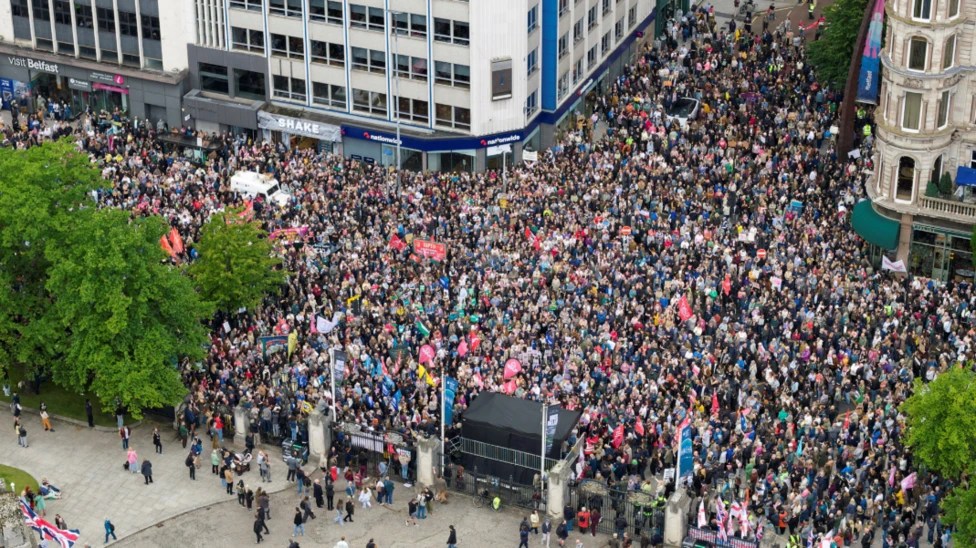
United Against Racism organised a rally in Belfast city centre to protest against the racist attacks. It was recalled by a number of the speakers that we had been here before after previous riots, with the Green Party speaker stating that it was infuriating to be back again. A summary of the speeches exposes the political weaknesses that help contribute to this, even while recognising the difficulty of what is required. Not least of the problem is that there is not really an anti-racist movement and definitely not a coherent political alternative to the forces behind the racist mobilisations and the broader sympathy that lies behind them.
The range of speakers reflected the breadth of opposition to racism but at the cost of incoherence. It’s not enough to be against racism – the racists have a policy – a political programme – no matter how primitive and inchoate, and the participants at the rally do not.
There were repeated chants of ‘Say it loud, say it clear, refugees are welcome here!’, which is a fine sentiment but not an argument or a policy. There were frequent expressions that the rally represented the ‘real’ Belfast, repeated again by the following Monday’s editorial in the local paper ‘The Irish News’ – ‘the real face of both Belfast and modern Ireland was at show at the weekend . . .’ Unfortunately, the attacks were real, they were carried by real people, and they have a real base of support in Belfast and elsewhere in Ireland.
It might be countered that this is not what was meant by expressions of the ‘real’ Belfast but if it doesn’t mean what it says it doesn’t mean anything. More importantly the phrase reveals a failure to recognise the real world, which is absolutely necessary to changing it and which failure to do so has all sorts of negative consequences.
Holding the rally was absolutely necessary to register the scale and scope of opposition to the attacks and in order to frame the issues raised in a more progressive way; to support those under attack and continued threat, and to give confidence to those opposed to racism and its violent expression. The rally was correctly hailed as the largest anti-racist demonstration Belfast has seen, but it is not the sole representation of a city notorious for sectarianism and once described as ‘the race-hate capital of Europe’ in 2004, when the number of ethnic minorities was even smaller than it is now.
Organisers are claiming that 20,000 attended, when dividing by four might give a more accurate estimate, which is important only as another example of the failure to face reality. Belfast has a history of sectarianism because there are a significant number of bigots, and religious bigotry regards racism as part of the family. This constituency has a much longer history than any movement against racism. It is extremely unlikely that racism will be defeated if sectarianism isn’t, which reveals the problem with a movement simply based on anti-racism.
The failure to deal with reality was expressed in the failure, so far as I noted, of any speaker to name the agents of the racist mobilisation. Instead, the problem was an undefined ‘far-right’ and prominent individuals such as Elon Musk. The speaker from the Irish Congress of Trade Unions repeatedly employed this term, as if the trade union movement did not have a problem that a significant number of its own members in the North are loyalists. On top of this is the acceptance that it is impossible to condemn loyalism without also demonstrating one’s own non-sectarianism by at the same time condemning republicanism. Otherwise wider unionism might see it as evidence of a pro-nationalist bias. The result is that together they veto specific identification of the concrete and real adversary.
Ironically this means that the development of racism among nationalists cannot be separately identified as a problem should it arise; so the identity of the racist constituency is continually so abstract as to defy definition and concrete identification. Calls for workers’ unity are all fine and good, but they remain rhetorical when the opposition within the working class isn’t recognised and challenged.
A by-product of this is the view that the trade union membership has a political unity that does not exist. Hence the unreality of the ICTU and NIPSA speakers when the former said the trade unions would do ‘whatever it takes’ to drive out the far right and the latter that if there is another death the movement could ‘shut this place down’. He asked for the rally to offer its support to a NIPSA motion to ICTU along these lines. What this might mean in reality was unclear; what the possibility of it being carried was also unclear; that it would not be actioned is clear.
The trade union movement both North and South seek partnership with their respective governments and state, rather against the observations of a number of the speakers, which brings us to another illustration of the problem brought to the fore by the rally and the speeches. Speaker after speaker criticised the Stormont Executive, the role of the police, of the state generally and the political parties. These criticisms received widespread applause from the rally.
Unfortunately, the representative from the main party of the First Minister of the Stormont Executive, the Sinn Fein Lord Mayor of Belfast, was also applauded. So was the Alliance Party representative, which is also part of the Executive. The leader of the official opposition in the Stormont regime, the SDLP, was also applauded although it has been in the Executive until recently and is not at all opposed to Stormont. All these speakers, plus the Green Party, support the police and support the state and also received the applause of the rally.
The Green Party speaker called for the Executive to develop various strategies against poverty, for equality and for refugees, while another speaker condemned the dead letter of the Executive’s existing race relations strategy. Stormont has produced a number of strategies but this simply means that it has produced a lot of PDFs and word documents, and used up a lot of paper. The ICTU speaker claimed that the problem was that the Executive was underfunded and that if this was rectified the money could help defeat the far right – the lack of money being the excuse of choice by the Executive as well.
It was claimed that this could get the far right out of the communities, which would equate to getting violent loyalists out of loyalist and unionist communities. This inadvertently rather encapsulates the failure to identify the problem, while raising the difficulty of doing so, and the challenge of defeating loyalism and its twin association with sectarianism and racism.
So, criticisms of the Executive were applauded while so also were the speakers representing the parties within it. Criticisms of the police were applauded and so were the speeches of the parties supporting them. The action of local groups and organisations in supporting and protecting those under threat were rightly applauded, yet most speeches looked to the state as the way forward (the one that was acknowledged to have failed). This was also applauded.
Behind these contradictions lays some awareness of the problems struggling to develop consciousness of what their resolution involves.* The practical support of volunteers helping protect those threatened, and assisting their move if this was required, points to a political alternative that doesn’t rely on the forces that have failed but identifies these forces as a major part of the problem.
Why is it hard to understand that when the Stormont administration includes reactionary bigots providing political cover for the street thugs it cannot be the solution? Whys is it not possible to follow the logic of the realisation that the sectarian structures of Stormont are not the answer to street sectarianism and its racist relative? Of course, lack of an obvious political alternative is the most important reason, but just as the need for practical help for those under attack led to local anti-racists taking their own action, so does the creation of a political alternative require its creation by those who have felt the need to mobilise. The question then becomes – what is the political basis for such an alternative?
If we look at the rally, there are no grounds for common political organisation based on the platform of speakers. For example, Sinn Fein gets away with parading its anti-racist credentials in the North while the Party in the South moves to the right in an attempt to mollify racists. There were banners from some trade unions but there was no mass mobilisation of the trade union membership just as there was no mass mobilisation of Sinn Fein members.
This is why we can say that there is no anti-racist movement. This requires some political coherence and would have to move beyond simple anti-racism. The size of the rally and that it took place at all are positives, as are the criticisms made of the state, but it is necessary to go way beyond this if we are not to simply repeat the rally outside Belfast City Hall next year, if not sooner.
* ‘We do not say to the world: cease your struggles, they are foolish; we will give you the true slogan of struggle. We merely show the world what it is really fighting for, and consciousness is something that it has to acquire, even if it does not want to.’ Karl Marx
Back to part 1

