I was in Glasgow when the riots in Belfast broke out following the savage attack on a white man by a Sudanese migrant. The mainstream media in Britain generally treated it as another example of the race riots carried out by the far right, most recently in Southampton, with references to the role of social media and mentions of Elon Must and Yaxley-Lennon, the guy you couldn’t even trust to tell you his real name.
Even from a distance it was clear that this wasn’t exactly the case. Musk and the British far-right might provide inspiration, and social media provide a mechanism to inform, but the riots were an Irish phenomenon. This is the third year in a row for such riots with social media again calling for a ‘cross-community’ racist mobilisation, including announcing meetings in nationalist areas such as Ardoyne. Instead, the riots and the attacks on immigrants, or those considered to have the wrong skin colour, were confined to loyalist areas, and republicans in Ardoyne mobilised to reassure and protect those residents in the area who were most vulnerable to attack.
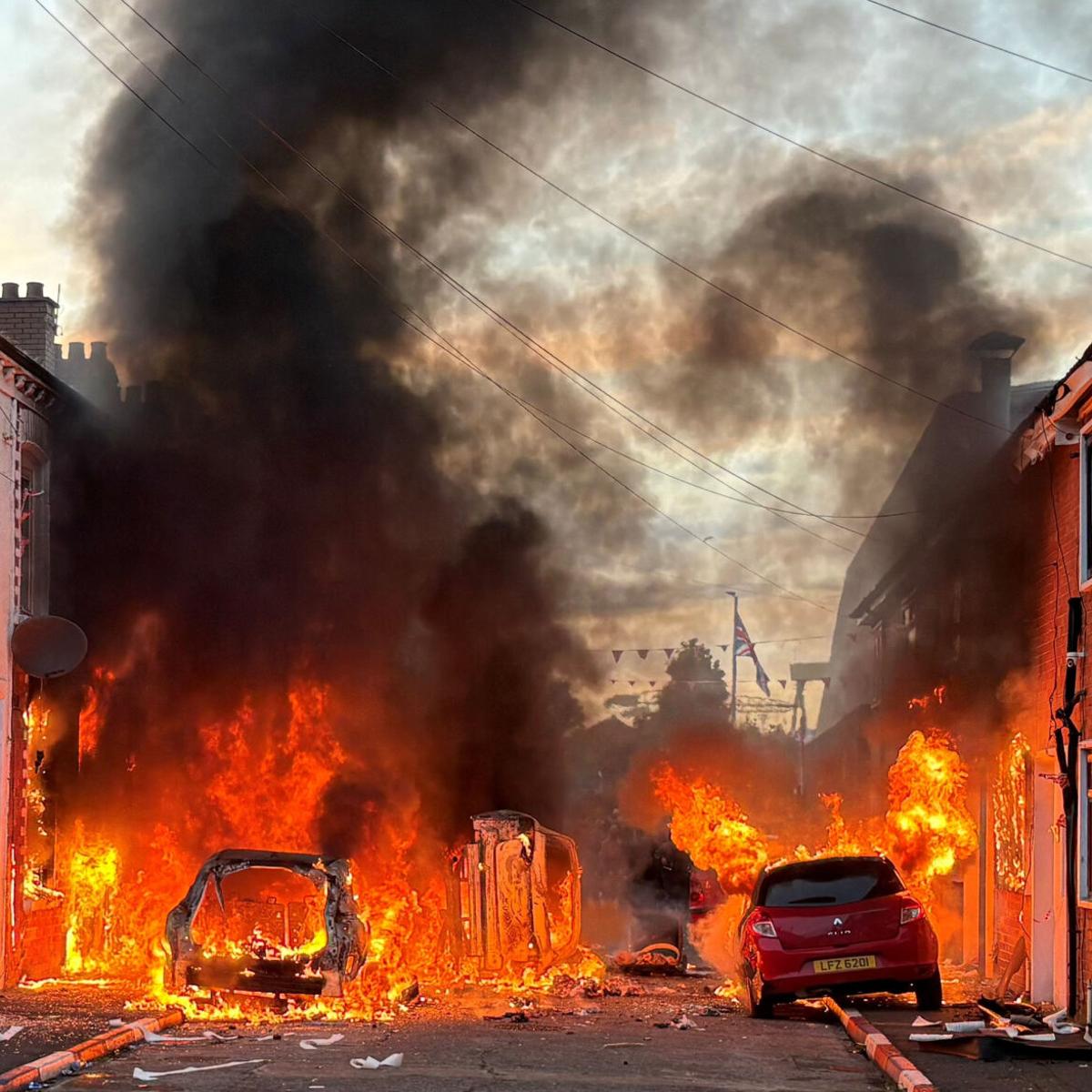
What wasn’t immediately clear from a distance was how widespread the racist mobilisation was. Despite the drama reported on the mainstream media, reports continually showed one street in flames, the glider bus on the Newtownards Road on fire and some other localised riots. By the historic standards of Belfast and the North of Ireland this was all relatively small, except that shops, schools and transport seemed to be closing down earlier than they had previously in worse circumstances.
When I got off the plane at Belfast there was a larger than usual number of police interviewing passengers and not necessarily checking ID. They were more interested in where you were from and where you were going to. I took it they were interested in identifying any loyalists of other far-right figures arriving to join the fray.
Unusually, I noticed the faces of those who weren’t white, including the black guy helping to give order to the airport taxi rank. The taxi driver, who was an immigrant as well, and having lived in Belfast for over ten years, was very scared, particularly when it became clear that at one point taxis were being stopped in some location(s) to check whether the driver had ethnic minority passengers.
This was one of the reasons for the perceived febrile nature of the events. The targets were immediately identifiable, unlike sectarianism where – despite the stereotypes – it is not usually obvious who is Catholic or Protestant. Every non-white face was a reminder of who the potential targets of racist violence were. The second startling images, perhaps especially for those not living in Belfast, was of masked men going door-to-door trying to identify and attack people of the ‘wrong’ colour.
Some commentators I saw were at pains to state that it would be wrong to paint the whole unionist ‘community’ as racist. This is an obvious truth, just as is the other claim that there are nationalist or Catholic racists. The point however is that it was only in loyalist areas that attacks took place. As one journalist pointed out – look down at the street and the footpaths are painted red, white and blue.
The police claimed that loyalist paramilitaries were not involved, which is nonsense. Not all these paramilitaries were active – the riots would have been significantly bigger if they were – so the police were playing the game of not blaming them as a means of encouraging those not yet involved to stay not involved.
For the police it’s a win because it might help minimise its immediate problem while the existence of these groups is publicly treated as not their problem. For the loyalists themselves their existence is their main objective and partial disorder both shows their capacity for violence and capacity to control it. Yes, we can be a threat, but one you can work with. And indeed, the British state has had no problem working with loyalist paramilitaries for decades – in the background, alongside, and fronting them up.
Lack of honesty in identifying one core issue of loyalist responsibility is one not confined to them or sections of the media, but as the next article will argue, it’s a bigger issue for those opposed to the attacks.
* * *
The reaction from the British government, in the shape of Keir Starmer, was the announcement that he would “crack down on anyone who is fuelling this division”, although this proved to be untrue because he continued to fuel it himself. The British Home Office let it be known that the racists had no need to do what they were doing because the government was already cracking down on immigration. “Government sources” let it be known that it would “intensify” its actions to “track down, detain, arrest and remove illegal immigrants from Northern Ireland”. It’s hard to see how this briefing to journalists would not validate in some way the racists and fail to reassure their victims.
The North of Ireland has a population that is 96% white, while Belfast is home to three-quarters of asylum seekers, quoted as around the 20th highest rate of all UK council areas. Yet Belfast is quoted as having had the highest number of immigration raids in the UK between 2018 and 2024. Whoever thinks this means that ‘cracking down’ needs intensified is living in their own world of racism, which thus includes the British government.
The Democratic Unionist Party has come under attack for playing its usual role of condemning violence while giving political cover. There is much talk, and not only by them, about ‘legitimate concerns about immigration’ and the ‘pressures on housing, healthcare and resources’, but the claim that the rioters are concerned about resources for healthcare, for example, doesn’t withstand examination when they target nurses and other healthcare workers for intimidation. It is a commonplace that these services rely on immigrant doctors, nurses and others. Frequent visits to local hospitals confirm this in abundance.
Reported racist incidents exceeded sectarian ones by nearly 2 to 1 in 2025/26, affecting a very small part of the population, and it has now been argued that sectarian conflict has been displaced by racist attacks. That these attacks are mainly by loyalists is a tacit claim that it is they who are mainly responsible for sectarianism, which is not the politically correct version of reality touted by most of the media in the North and by all of it in Britain.
It is only partially correct. Immigrants are mainly living in loyalist areas because that is where the available housing is, thereby also making them more accessible to attack. It has also been partially displaced to the sectarian institution at Stormont, where its has stagnated. This stagnation will not last and Stormont has already had repeated breakdowns. A final collapse threatens to put sectarian conflict back on the streets where it will join with the current violent racism. It is one of the ironies of the reaction to the riots that those opposed to the racist attacks look to Stormont for the answer, but we will look at this in the next post.
Forward to part 2

