Fragments of Victory’: The Contemporary Irish Left’, book review (5 of 6)

Fragments makes a series of observations about the political consciousness of the Irish working class, some of which we have already noted, such as the view of many on the Labour Party entering office that ‘the crisis was clearly not their fault and . . . the harsh austerity measures they took were seen as both forced by the Troika and, while painful, necessary.

It records the view of another author that the first year of crisis saw a large number of demonstrations but these ‘dried up once the public realised the magnitude of the banking crisis, and they were replaced by years of “muted protest”. Certainly, there was a sense of powerlessness at the scale and suddenness of the economic crash, a degree of acceptance of the official narrative . . .’ (p31)

It notes that the muting of protest was partially the result of emigration, particularly of the young with 106,000 leaving from 2009 to 2013.  ‘However, the muting of opposition was also due to the influence of the Labour Party and trade unions, which contained protest and channelled anti-government anger down institutional routes from 2009 to 2011.’ (p30). These organisations did indeed push anger down the road of inevitable failure, and yes, they were betrayed, but how was this possible?

One contributor notes that by late 2013 ‘it is difficult to overstate the feeling of exhaustion and disillusionment’, with the radical left ‘comprehensively defeated on the one anti-austerity struggle they’d seriously fought – household taxes.’ The ‘public mood was judged sullen but compliant’ and was successfully ‘blackmailed’ into voting yes to the EU’s fiscal Treaty in 2012 ‘even though this treaty restricted the possibility of future government spending” (p 40-41)

wrote about this result at the time, noting that:  ‘At 60 per cent Yes against 40 per cent No there is no room for doubt.  It is a decisive endorsement of government policy and a mandate for further cuts and tax increases.  The result should not have been unexpected given the political forces ranged in support of the Treaty, the support of big and small business, the failure of the trade union movement to oppose it and the inevitable support of the mass media.  In the general election last year the Irish people voted by a large majority for a new government in no important way different from the previous one and with no claim to pursue significantly different policies.’

I also noted that ‘Austerity isn’t popular despite the vote and never will be.  Even the Yes campaign was under instructions not to celebrate its victory . . . In October last year when the Austerity Treaty was originally being negotiated an opinion poll recorded 63 per cent opposed to it with only 37 per cent supporting.’  I noted that some people had changed their minds or perhaps did not have the confidence to follow through on their opposition.  This might have united around the demand to repudiate the debt taken on by the state on behalf of the banks and their bondholders, but this also meant opposition to the Troika upon whom the state had become reliant.  It also meant opposition to the administration in the US, even though its Secretary to the Treasury Timothy Geithner thought it was ‘stupid’ to guarantee the banks liabilities. 

I wrote a number of blogs on the issue of repudiating the debt herehere and here, and the disastrous and ‘stupid’ decision to bail out the bondholders in the first place.  Doing so was a real political challenge and required an alternative that didn’t exist.  Without this the failure of the opposition to austerity was inevitable, even if the question of the debt was only one element of the necessary political alternative.

Where the book completely fails is the neglect of what the political content of the alternative might have been, although this is revealing.  In recording the activity of the left its non-appearance reflects the absence of this in the anti-austerity movement as a whole and the failure to win any significant section of it to a socialist perspective.

The same contributor noted above goes on to say that at a later time ‘A proper balance sheet would recognise how the Labour Party and the aligned section of the union movement were rendered powerless to influence or sidetrack the anti-austerity movement.’ (p 42). He points to the drop on the Labour vote from 19 per cent in the 2011 general election to 7 per cent in the 2014 local elections and the ‘victory for left-wing independents and Trotskyist parties alike.’ (p 43)

He argues this was possible because in 2014 100,000 marched against water charges in October followed by 150,000–200,000 in November and 80,000 (in Dublin alone) in December in what was ultimately a winning struggle.  We have already noted the limp role that was expected of the trade unions and political parties in the campaign in the previous posts but the argument that the Labour Party and trade union leaders could not divert the campaign is correct.

It won because it was a community campaign based on mass protests, blocking the installation of water meters and non-payment of bills.  Independents and left wing candidates benefited from their role in the campaign which also distinguished itself by exposing the equivocating role of Sinn Fein. Despite the political weaknesses of the campaign that we noted previously its tactics were able to beat the counter-measures of the government where the previous campaign against household charges could not.

The campaign proved that individual campaigns, given the right circumstances, could defeat particular austerity measures even where the wider offensive was continued successfully. It should be recalled that the water charges campaign took off almost a year after the state exited the Troika bailout programme. It is also worth recording again the failure to draw the right political lessons as the trade union official who contributed the chapter on the campaign finishes his story by endorsing the statement by ‘one of the world’s greatest authorities on water’ that:

‘The Irish system of paying for water and sanitation services through progressive taxation and non-domestic user fees, is an exemplary model of fair equitable and sustainable service delivery for the entire world.’ (p 61)

In fact, the Irish water industry was wasteful and inefficient and state ownership is neither democratic nor socialist.  For this, workers’ cooperative ownership or the demand for workers’ control would have been necessary but the Irish left, like so much in the rest of the world, have become habituated to statist views of socialism that Marx repudiated but that have become entrenched through the domination of social democracy and Stalinism over the last one hundred years.

With such a political platform the problem of the state being the solution, when the solvency and policy of the state was the problem, was once again avoided because doing otherwise would raise the question of ownership and control that would show the platform’s inadequacy.

The main victory in Fragments of Victory was thus necessarily limited and could not be a springboard to address the many deficiencies of the resistance identified in the book.  These included the failure ‘to build lasting political and social institutions’ and ‘no lasting form of working-class self-organisation.’  Reliance on capitalist state ownership as ‘an exemplary model’  illustrates why a problem could not be addressed: that ‘the steps between the current situation and the long-term goal of socialism are less clear than ever before.’ (p192)

The view that the trade union bureaucracy was ‘rendered powerless to influence or sidetrack the anti-austerity movement’ is therefore only partially true. The politics of the bureaucracy, and of the Labour Party, were not challenged by a wider political alternative and the much-trumpeted militant tactics of the campaign were no substitute for it.

back to part 4

Forward to part 6
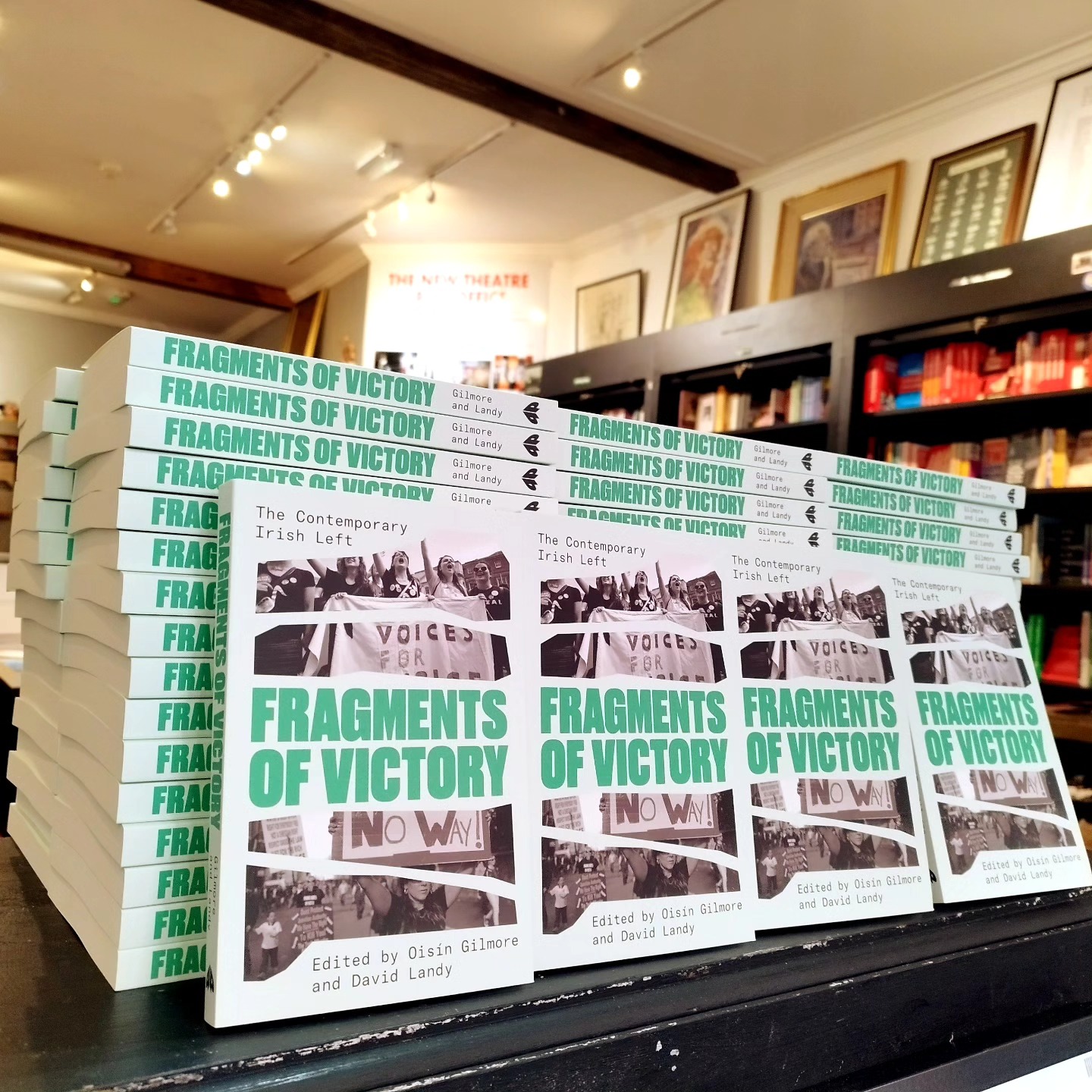
Fragments of Victory’: The Contemporary Irish Left’, book review (4 of 6)

In the previous post I argued that the leadership of the trade unions were unable and unwilling to challenge austerity because it would involve a political challenge to the state it had decades of ingratiating itself with it as its ‘social partner’.  However, I also noted that ‘the undeveloped and inadequate political consciousness of the working class itself [was] also a major factor’ in the union movement being unable to successfully resist austerity.

The socialist critique of the bureaucratic leadership of the trade unions is not that its passivity never reflects the views of its members but that the occasions in which members are prepared to take action are often betrayed and their passivity reinforced through ensuing demoralisation.

Protests and demonstrations (called by trade unions early in the economic crisis and also later) are only useful in so far as they are necessary steps to more effective action: by rallying the troops and persuading others that there are alternative courses of action and the means to achieve them.  Otherwise, they are what they are defined as, simply public expressions of objection, disapproval, or dissent, and public exhibitions of the attitude of a group toward an issue.

There is currently no other rival union leadership that believes in independent working class politics that is separate from and opposed to the state and seeks to increase the class’s political consciousness.  Bureaucratic organisation stifles any democratic control that might permit episodic bouts of struggle to advance and accumulate an understanding of class politics.  Lack of democracy and low participation are both causes and effects of political weakness.

Both the leadership and membership are wedded to the view that fundamental change can come only through the state as the only (legitimate) agent capable of achieving it.  All sections of ‘the left’, from Sinn Fein to supposed ‘Trotskyists’, have a political programme that hold that achievement of governmental office will enact this social transformation, and campaign on this basis.  How a capitalist state will permit this is never explained.

Of course, People before Profit and Socialist Party pay obeisance to the view that the capitalist state will have to be overthrown but this plays a role analogous to republicans’ view that the legitimate government of Ireland resides within the IRA.

During the crisis there was little to no awareness of the possibility of an independent working class political force as more than perhaps a vehicle to pressurise the state, or with a view to having its representatives occupy positions in its parliament so that they could legislate sought after policies and adopt necessary measures.

This reflects the widespread support for the democratic credentials of the state and its political system, further legitimised by the country’s colonial history and the struggle against it.  This gives the nationalism that is the express ideology of almost all political parties a progressive veneer and a reactionary essence.

Accompanying this is an acute awareness of the weakness of the small Irish state and its dependence on US investment and EU membership, where most power resides in the much larger European states.  There are some illusions in the independent sovereignty of the state but also awareness of its constraints.  When the Irish state became bankrupt the view that it could not resist the demands of the EU and US that it bailout the banks was reluctantly accepted because there appeared no alternative.

When your politics is based on winning concessions from the state, and/or the perspective of being the official government of the state, it is difficult to present these as possible when that state is bankrupt and your proposed actions are opposed by much more powerful states.  Not only does it look unconvincing, it actually is.  Hence the comment in the book, in relation to the Dáil, of the ‘futility of marching to an institution that was taking its own marching orders from elsewhere.’

One contributor to Fragments, writing about the trade union input into the one anti-austerity campaign that was successful – against water charges – reports that ‘political economy training . . . was the most impactful part of the campaign’. (p57) Except this training appears to have been peddling the same mistaken conception that state ownership is the answer that the whole crisis, and the response to it from the Irish state, should have utterly dispelled.

This campaign morphed into the Rights2Change movement that on paper united much of the left and some trade unions.  Its programme of rights, which went beyond the question of water, made sense only if the state had an obligation to satisfy them, and it didn’t begin to address the claims by the government about the lack of state resources to do so.  A programme based on the supposed moral obligations of the state was as weak as the commitment of the various organisations to the project. It demonstrated only that this spectrum of organisations was united in illusions in, and subservience to, the capitalist state.

Two aspects mentioned in the book illustrate these weaknesses: ‘throughout the period of Right2Water’s existence, nobody was working on the campaign full time. The bulk of the work on the union side was done by two or three trade union officials who also had their day jobs.’ (p61)

As to the unions role as a ‘pillar’ of the campaign, it was to ‘bring organisational skills . . . politically neutral; provide economic and political research; have activists in workplaces all over the country and bring financial assistance.’  (p 55) Nothing about workers action in the workplace and what sort of action its ‘activists’ should fight for.

The role of political parties was equally somnolent – to ‘bring political knowledge; an ability to raise issues in the Dail and have activists in communities all over Ireland.’  (p55) Again, without an acceptance that political debate over aims and strategy was absolutely required, as opposed to already accepted, there was no specifically political input sanctioned for political parties.

Like so many left campaigns, broadness was confused for depth, and political shallowness for agreement and unity.  One ridiculous outcome was that at one demonstration ‘we ended up with 36 speakers or acts.’ (p53) One unambiguously positive legacy of the campaign claimed by the writer is that the ‘unions and progressive political forces were in place to prevent the movement from being co-opted by the far right.’ (p60). Not a high bar.

If the original platform for the campaign was weak (that water was a human right), there remained differences on appropriate tactics, so it could be no surprise that this attempt at turning a ‘mass movements’ into a’ story of mass organisation’ rather than simply mass mobilisation’ was a failure (p180-1 &182). This meant that it was ‘large but ephemeral’, ‘failed to lay deep social roots’, ‘failed to identify an avenue through which society might be changed, and given this, . . .  failed to develop a mass political consciousness around the capitalist nature of our society or around what needs to be done to change it.’ (p183)

Sowing illusions in the state and failing to educate those mobilised on its unreformable class nature is guaranteed not to ‘develop a mass political consciousness around the capitalist nature of our society.’  The major success of resistance to austerity set out in the book came nowhere near this because it didn’t try, and it didn’t try because the left didn’t know what this would have to involve.

Back to part 3

Understanding ‘Citizen Marx’ 2 of 3

In one review of Citizen MarxMike Macnair states that ‘the conception of the democratic republic as the necessary first step to communism was, in fact, Marx’s conception: comrade Leipold has, I think, shown this beyond rebuttal.’  If this is taken to mean that the struggle always and everywhere involves firstly a fight for a bourgeois republic then we see that this is not the case. In the Paris Commune the struggle went immediately beyond it and Leipold argues that Marx never looked at the struggle for bourgeois democracy – a bourgeois republic – in the same way after it (see the previous post).

It is not true today because in many countries, capitalism is ruled by states with a democratic and republican form.  There are all sorts of restrictions and qualifications to this bourgeois democracy, and Marx noted and opposed them in his day, but this did not transform the working class struggle – and communists bringing ‘to the front, as the leading question in each, the property question’ – into a struggle first for a bourgeois ‘democratic republic’.  This is simply old-fashioned Stalinism in which the working class struggle is always limited to a fight for bourgeois democracy, and only when successful, then a struggle for socialism.  This never comes because the bourgeois allies asserted as necessary in the first struggle betray not only the struggle of the working class for socialism but also any struggle for democracy that involves the working class as an independent force.

Macnair appears to accept grounds for rejecting this approach today, on the basis that ‘It is nonetheless arguable that the more advanced stage of the spread of capitalism across the whole globe, and its decline at its core, means that we should focus more on socialisation: the immediate need to move beyond markets and privately-owned concentrations of capital as the means of coordinating human productive activities. . .  . In this sense socialisation is more immediately posed than it was in the later 19th century.’

This means that the working class is the majority of society, with the existence of a much more developed capitalist system that brings to the fore the question of working class dissolution of capitalist private property through socialisation of the productive forces.  To defend this process requires a Commune type state and not a bourgeois republic that will, no matter how democratic or republican, stand upon and defend capitalist property relations.

Unfortunately, Macnair rejects this – ‘There are two problems with this line of argument’ he claims. ‘The first is the Soviet case’ in which economic planning failed.  He argues that ‘Democratic republicanism is essential to effective economic planning; and, because it is essential to effective economic planning, it is also essential to believable socialism/communism.’

In fact, the Soviet Union was not an example of an ‘advanced stage’ capitalism and the initial major problem with socialisation of production was the small size of the forces of production that could most easily be socialised, and thus the associated weakness of the working class that would carry it out. This experience is not therefore an argument against working class socialisation of the forces of production and a state form of the Commune type adequate to defend this process.

The second problem he identifies with a ‘focus more on socialisation: the immediate need to move beyond markets and privately-owned concentrations of capital’ is not so much a structural feature of the current stage of capitalism (that it rules out socialisation) but an obstacle to it.  What he poses is an obstacle to any and all independent political action by the working class, including reform of the capitalist state that Macnair poses as the ‘necessary first step to communism.’

He writes that it is ‘illusory to imagine that it is possible to fight for “workers’ democracy” against the bureaucracy, without simultaneously proposing a constitutional alternative to the regime of the capitalist state as such. Without challenging the capitalist constitutional order, it is impossible to render transparent the dictatorship of the labour bureaucracy in workers’ organisations.’  The capitalist state must be democratised before the working class movement can also be so transformed appears to be the argument.

Democratising the capitalist state requires a force to do it, which presumably is the working class, but as long as the workers’ movement is strangled by bureaucracy this is not going to be done.  In terms of voting, elections in most minimally democratic bourgeois republics involve a bigger turnout than elections within trade unions, which illustrates the necessity to politicise the working class movement.  The prior task to making changes to the capitalist state is to dissolve illusions in it, including that it can be ‘really’ democratic and that it can be made a (more?) neutral mechanism that can be employed by the working class for its own ends.

Any mass mobilisation of the working class will face the immediate task of sidelining or removing the labour bureaucracy because the organisations and mobilisations this bureaucracy stifles are the workers own.  This task will need to be both independent of any change to the ‘constitutional order of the capitalist state’ and go beyond it.  Constitutional forms can change but the essential nature of the state remains.  Prioritising changing this is to invest in the capitalist state the power of making changes that only the self-emancipation of the working class can accomplish.  Why would a capitalist state, again no matter how democratic or republican, help ‘render transparent the dictatorship of the labour bureaucracy in workers’ organisations?’

Removing or otherwise destroying the labour bureaucracy will undoubtedly be accompanied with the need to struggle for goals outside the workers’ organisations, but these struggles should not be under the misapprehension that what we need is reform of the capitalist state constitution in order to change the constitution of the workers own organisations.  In so far as we often seek to change the operation of the capitalist state it is often to remove its influence on workers’ organisations.  The functioning of this state is not an example to follow, or an aid to understanding working class interests, but an obstacle to overcome including the many illusions workers have in it.

Attempts to give a place to republican politics within socialism that it should not have ignores the class character of even the most radical republicanism and inevitably drags us back to accommodation with the capitalist state.  This is not a lesson Citizen Marx teaches.

Back to part 1

Forward to part 3

‘The People’ before Profit? – Karl Marx’s alternative to capitalism (part 67)

The substitution of ‘the people’ for the working class as the subject of struggle is presented In Ireland, in an almost classic case, by the People before Profit organisation, whose reformist politics are based on actions demanded from the Irish capitalist state.  While ‘people’ are to come ‘before profit’, ‘people’ replaces the working class, while coming before profit still leaves profit in place.  And anyway, aren’t capitalists people as well? 

This precept fails to bring to the fore the ‘property question’, demanded by Marx in the Communist Manifesto, whereby the profit of capital arising from exploitation of the working class is not de-prioritised but abolished!

It might be argued ‘what’s in a name’, were it not for the fact that the name was deliberated on and selected precisely in order to avoid clearer identification with the working class and socialism. Presumably because reference to ‘the people’ is more readily acceptable; postponing the task of raising awareness of the paramount role of class and denying the centrality previously accorded to it by anyone calling themselves Marxist. In asserting the priority of the people, and so rejecting the primacy of class, the organisation is setting an example to be followed, not one to be excused or ignored.

Failure to root socialist politics in the material reality of the working class leaves it rootless and prey to the material reality of other forces – we have already pointed to the role of the state in the political alternative offered by People before Profit – but the ideologies encompassing this are many.  Nationalism and racism require denial of the separate political interests of the working class – socialism is international while racism denies working class unity.  It is precisely class interest that is the alternative to these reactionary programmes, not acceptance of the prior interests of an undifferentiated people.

It is possible to fill this missing foundation with moral claims to ‘humanity’ which bases internationalism on ‘human rights’; the ‘self-determination of (capitalist) states’, or protection of minorities based simply on their being a minority.  Similarly, it is possible to oppose racism based on human rights, ‘diversity’, ‘inclusion’ and opposition to ‘hate’, but these are even more vague and useless than the concept of ‘the people’.  Their employment by many on the left, tellingly often paraded under the banner of a ‘social justice’ movement, is testament to a collapse into liberal (i.e. bourgeois) politics compared to which the 19th century republicanism we have been examining in the previous posts looks positively revolutionary.

If class is not primary and immediately necessary in order to take forward a movement and programme what is opened up is the intrusion of a wide variety of identity politics that makes nationality, race, or sex etc. the primary means of securing freedom from oppression. This in turn can lead to ‘intersectional’ coalitions that further divide while pretending to unify.

It leads to rejection of the view that the working class is the only social force able to create a new society and which alone can unite the oppressed through the abolition of class. It thereby simply becomes one segment of society with no reason to prioritise its role more than any other.  Petty bourgeois ideas of individual subjective identity flourish where the nebulous abstraction of ‘people’ becomes the source of power to change the world.  With this view of politics the numerous instantiations of the people come to substitute for the working class, which in turn leads to the search for a mechanism for them to do so, and which is invariably found to be the state.

In 1849 Marx criticised the naive belief in a single “will of the entire people” rather than that of a singular ruling class (or grouping of classes) that might represent its own interest as that of society as a whole, or at least of its large majority:

‘For the National-Zeitung there exists one will of the entire people, which is not the sum of contradictory wills but a united and fixed will. How is that?

That is—the will of the majority.

And what is the will of the majority?

It is the will which emerges out of the interests, life situation, and conditions of existence of the majority.

In order to have one and the same will, the members of the majority must therefore have the same interests, the same life situation, the same conditions of existence, or must be temporarily linked together in their interests, their life situation, their conditions of existence.

In plain words: the will of the people, the will of the majority, is not the will of separate estates and classes but of one single class, and of those classes and fragments of classes that are socially—i.e., industrially and commercially—subordinated to this ruling class.

“What should we say to that?” Is the will of the entire people the will of the ruling class?’

(Marx, Marx and Engels Collected Works Vol 8 p272, Articles from the Neue Rheinische Zeitung)

Marx, in The Civil War in France, noted that the Paris Commune ‘was the first revolution in which the working class was openly acknowledged as the only class capable of social initiative, even by the great bulk of the Paris middle class—shopkeepers, tradesmen, merchants—the wealthy capitalists alone excepted. The Commune had saved them by a sagacious settlement of that ever-recurring cause of dispute among the middle classes themselves—the debtor and creditor accounts.’

It was necessary then (as it is now) for the working class to be the ‘universal’ class and to represent the needs of a society oppressed by the prevailing system: ‘For the first time in history the petty and moyenne middle class  has openly rallied round the workmen’s Revolution, and proclaimed it as the only means of their own salvation and that of France!.’ (Marx, The Civil War in France, Marx and Engels Collected Works Vol. 22 p336 & 496)

This was not something that Marx learned only from the Commune but was something strikingly demonstrated by it, particularly the need to win the majority of the population that was then composed of peasants.  How this need is addressed today depends on the particular class composition of society, but this requires that the idea of a unified people is abandoned and the various classes and their interests identified.  In relation to the peasantry, for example, it did not mean strengthening or enlarging their individual property, while a programme based on the demands of ‘the people’ would leave this wide open.

In the writings through which he and Engels formulated their particular politics, The German Ideology, he argued that ‘For each new class which puts itself in the place of one ruling before it, is compelled, merely in order to carry through its aim, to represent its interest as the common interest of all the members of society, that is, expressed in ideal form: it has to give its ideas the form of universality, and represent them as the only rational, universally valid ones.’ For the working class, this is realised through the abolition of all classes, including itself.

Marx identified this early in his political development (in 1843) before becoming a ‘Marxist’ and expressed himself in the language of the philosophy of the time: ‘No class of civil society can play this role without arousing a moment of enthusiasm in itself and in the masses, a moment in which it fraternises and merges with society in general, becomes confused with it and is perceived and acknowledged as its general representative, a moment in which its claims and rights are truly the claims and rights of society itself, a moment in which it is truly the social head and the social heart.’ (Marx, Introduction to A Contribution to the Critique of Hegel’s Philosophy of Right)

For this to happen the working class must win others as allies to its programme.  This can only be done if, in the words of The Communist Manifesto, socialists ‘disdain to conceal their views and aims.’  It will not be done by pretending that its views are those of an amorphous ‘people’.  You can only rally others to your flag if it is your flag.

Back to part 66

Forward to part 68

Part 1

‘The People’ vs the Working Class 

Republicanism and Communism differed on the nature of the revolution that was required and so disagreed on the social force that would accomplish it. For the former it was ‘the people’ and for the latter the ‘proletarians of all countries’, which should ‘unite.’

Republicans accused communists of “ignoring the rest of humanity” while they viewed the people as the non-elite sections of the population, which may or may not have included the capitalist class, depending on the particular republican view.  Karl Heinzen, for example, did not see the new bourgeoisie as the enemy.

Marx argued that “The people . . . was a vague expression” to be replaced “by a definite one, the proletariat . . .”  The attempt to use the former combined various classes with an assumed common interest so that any separation within them was an unwarranted division that set back their common interests.

Even were a “privileged class” identified such a view failed to identify the different interests of the ‘non-privileged’ classes as if they had common class interests, including, for example, the working class, independent artisans, peasants and other petty bourgeois classes.

Only an identification of class and their associated interests could specify their material interests that might unite them or divide them. Such an analysis was inevitable as soon as one identified the particular class interest of the “privileged class”, which might prove to be varied – feudal princes or modern capitalists for example – which would then identify the subordinate class(es) they oppressed and exploited.  Talk of “the people’ obscured the interests of all classes, particularly the subordinate ones, and most importantly for the creation of a new society, concealed or blurred the interests of the working class.

Marx argued that failure to identify the separate interests of the different classes making up “the people” resulted in a false understanding of contemporary political realities.  So, in the elections to the French Constituent National Assembly in 1848 the republicans’ “imaginary people” were replaced by the “real people” the majority of whom voted for the candidates of the anti-republicans and elected the representatives of the bourgeoisie and landowners.

‘Accordingly, when a struggle is impending, they do not need to examine the interests and positions of the different classes. They do not need to weigh their own resources too critically. They have merely to give the signal and the people, with all its inexhaustible resources, will fall upon the oppressors.’  (Marx in Marx and Engels Collected Works Vol 11 p 65)

In the event of defeat ‘then either the fault lies with pernicious sophists, who split the indivisible people into different hostile camps, or the army was too brutalised and blinded to comprehend that the pure aims of democracy are also the best thing for it, or the whole thing has been wrecked by a detail in its execution, or else an unforeseen accident has this time spoilt the game. In any case, the democrat comes out of the most disgraceful defeat just as immaculate as he was innocent when he went into it, with the newly-won conviction that he is bound to win, not that he himself and his party have to give up the old standpoint, but, on the contrary, that conditions have to ripen to suit him.’ (Marx in Marx and Engels Collected Works Vol 11 p 65-66)

Politics based on the purported interests of ‘the people’ create imaginary interests that are not shared.  Marx gives the example in France of its famous fraternité, which in the 1848 revolution ‘found its true, unadulterated and prosaic expression in civil war, civil war in its most terrible aspect, the war of labour against capital.’ (Marx in Marx and Engels Collected Works Vol 7 p 147)

Marx accused the republican, Karl Heinzen, of invoking the solemn concept of ‘humanity’ to distract from the fact that while individuals may adopt a position that does not accord with their class position, this cannot be true of ‘whole classes which are based on economic conditions independent of their own will.’ (Marx in Marx and Engels Collected Works Vol 6 p 330)

The result is to deny the reality of class struggle, which has the result not of abolishing it but of confirming the interest of the bourgeoisie.  In 1850 Marx and Engels wrote that:

‘The struggles of the various classes and factions of the classes against each other, whose progress through their individual stages of development actually constitutes the revolution, are in the view of our evangelists only the unfortunate consequences of the existence of divergent systems, whilst in reality the reverse is true, the existence of various systems is the consequence of the existence of the class struggles. This itself shows that the authors of the manifesto deny the existence of the class struggles. Under the pretext of combating dogmatists, they do away with all specific content, every specific party point of view, and forbid the individual classes to formulate their interests and demands vis-à-vis the other classes.  They expect them to forget their conflicting interests and to become reconciled under the flag of a vagueness as shallow as it is unblushing, which only conceals beneath the apparent reconciliation of all party interests the domination of the interest of one party—the bourgeois party.’  (Marx in Marx and Engels Collected Works Vol 10 p 530)

Concepts such as ‘the people’ are unable to identify the specific interest of classes and are very rarely appropriate terms of analysis.  Their use usually denotes a false unity of interest behind which lies the interests of the capitalist class.  This can also appear credible because the social system, the dominant mode of production, aligns with the interest of the dominant class.  So, the claim to represent or act in the interests of the people is also the primary ideological justification of the capitalist state.

The concept of the people is incapable of exposing the claims of the state to act on behalf of the people because it rejects the separate interest of the working class.  At most it permits the view that the state is imperfectly or unsatisfactorily acting on behalf of the people but that it can be made to act in a way that remedies this.  This is the basis for the view that the state can reform the social system in such a way as to truly implement the interests of ‘the people’ and therefore that the state itself can be made to carry this out by reforming itself.  It is what Marxist call reformism, which denies that a replacement of capitalism and its state is necessary or possible.

Part 66 of Karl Marx’s alternative to capitalism

Back to part 65

Forward to part 67

Part 1

Karl Marx’s alternative to capitalism part 56 – the conditions for emancipation

Containers sit on the tarmac at Felixstowe Port | Dan Kitwood/Getty Images

At the end of a lecture to workers in Brussels written in 1847, Karl Marx stated that:

‘Before we conclude, let us draw attention to the positive aspect of wage labour . .  . I do not need to explain to you in detail how without these production relations neither the means of production—the material means for the emancipation of the proletariat and the foundation of a new society—would have been created, nor would the proletariat itself have taken to the unification and development through which it is really capable of revolutionising the old society and itself.’

(Marx, “Wages”, Marx and Engels Collected Works, vol. 6, p 436.)

For him, capitalism had already so revolutionised society that it provided the conditions for the creation of a new one and the means to achieve the emancipation of the working class – ‘material conditions . . . that could be produced by the impending bourgeois epoch alone’ (Marx and Engels, Manifesto of the Communist Party. Collected Works, vol. 6, p 514)

Today, one very rarely reads a positive analysis of material conditions for working class emancipation created by capitalism, even though these have massively developed since Marx wrote these words, when they were really only becoming evident in one country and were too undeveloped even then.   They provide the most striking proof of the potential for the development of socialism out of present society.  In many respects however they are no longer recognised as such and rarely considered; in other respects they are rejected, but we will come to that later.

In Volume I of Capital Marx describes the creation of these conditions:

‘As soon as this process of transformation has sufficiently decomposed the old society from top to bottom, as soon as the labourers are turned into proletarians, their means of labour into capital, as soon as the capitalist mode of production stands on its own feet, then the further socialisation of labour and further transformation of the land and other means of production into socially exploited and, therefore, common means of production, as well as the further expropriation of private proprietors, takes a new form.’

‘That which is now to be expropriated is no longer the labourer working for himself, but the capitalist exploiting many labourers. This expropriation is accomplished by the action of the immanent laws of capitalistic production itself, by the centralisation of capital. One capitalist always kills many.’

‘Hand in hand with this centralisation, or this expropriation of many capitalists by few, develop, on an ever-extending scale, the co-operative form of the labour process, the conscious technical application of science, the methodical cultivation of the soil, the transformation of the instruments of labour into instruments of labour only usable in common, the economising of all means of production by their use as means of production of combined, socialised labour, the entanglement of all peoples in the net of the world market, and with this, the international character of the capitalistic regime.’ (Marx, Capital Volume I p929)

In earlier posts on Marx’s alternative to capitalism we outlined many of these and how the contradictions within this development, including that between the forces and relations of production, would lead to social revolution.  We outlined the increasing socialisation of production through the colossal expansion of capitalism across the world, turning more and more activities into commodities to be sold for profit, through a massive increase in the division of labour – within and between workplaces – that involves the the creation and enabling of new, previously undreamed of, technologies.

This massive ‘development of the forces of production is the historical task and justification of capital.  This is just the way in which it unconsciously creates the material requirement of a higher mode of production.’ (Capital Volume 3 p 181)

This is elaborated in the Grundrisse:

‘The great historic quality of capital is to create this surplus labour, superfluous labour from the standpoint of mere use value, mere subsistence; and its historic destiny is fulfilled as soon as, on one side, there has been such a development of needs that surplus labour above and beyond necessity has itself become a general need arising out of individual needs themselves – and, on the other side, when the severe discipline of capital, acting on succeeding generations, has developed general industriousness as the general property of the new species – and, finally, when the development of the productive powers of labour, which capital incessantly whips onward with its unlimited mania for wealth, and of the sole conditions in which this mania can be realized, have flourished to the stage where the possession and preservation of general wealth require a lesser labour time of society as a whole, and where the labouring society relates scientifically to the process of its progressive reproduction, its reproduction in a constantly greater abundance; hence where labour in which a human being does what a thing could do has ceased.’

‘Capital’s ceaseless striving towards the general form of wealth drives labour beyond the limits of its natural paltriness, and thus creates the material elements for the development of the rich individuality which is as all-sided in its production as in its consumption, and whose labour also therefore appears no longer as labour, but as the full development of activity itself, in which natural necessity in its direct form has disappeared; because a historically created need has taken the place of the natural one. This is why capital is productive; i.e. an essential relation for the development of the social productive forces. It ceases to exist as such only where the development of these productive forces themselves encounters its barrier in capital itself.’ (Marx, Grundrisse p 409-410)

The passages above, which might appear difficult – the first paragraph is comprised of only one sentence! – demonstrates capitalism’s contradictions, with its laying of the foundation for its supersession.  So, the drive for capitalism to ever greater exploitation of workers – by their giving up more and more of their time labouring for the capitalist that is not recompensed in wages – is indeed their intensified exploitation.  However, this very development of production, beyond what is required to simply maintain the working class at some minimum level of existence, expands productive powers in such a way that greater and higher needs can be satisfied – of course for the benefit of the capitalist class initially and to the utmost extent – but also increasingly for workers by increasing what they can consume; in their whole mode of living, and how they can further their personal interests and development.  Above all, this expansion can allow this development by potentially reducing the time necessary for work, permitting time to take part in the running of society while also pursuing other collective and individual interests.  The massive increase in the productivity of labour forced by capital in ruthless competition can be turned from a means of capitalist exploitation to working class emancipation.

Capitalist expansion of exploitation is ceaseless because it seeks the accumulation of wealth in the form of money, for which there is no limit, but at the same time must do this in the form of the creation of real objects and services which address genuine needs, even if capitalist society distorts and degrades their development and expression.  The potential freedom from want, insecurity, inequality and from the subordination of everyone subject to the imperatives of capitalist accumulation, is the foundation for the belief that the ending of the class system will herald the end of all social domination and oppression.

The capitalist has only a ‘transitory existence implied in the transitory necessity for the capitalist mode of production’ who ‘ruthlessly forces the human race to produce for production’s sake; he thus forces the development of the productive powers of society, and creates those material conditions, which alone can form the real basis of a higher form of society, a society in which the full and free development of every individual forms the ruling principle.’ (Marx Capital Volume 1 p 739)

Consequently, ‘from the moment that the bourgeois mode of production and the conditions of production and distribution which correspond to it are recognised as historical, the delusion of regarding them as natural laws of production vanishes and the prospect opens up of a new society, [a new] economic formation of society, to which the bourgeois mode of production is only the transition.’ (Marx, Theories of Surplus `value MECW Vo 33 p 346.) Capitalism is therefore just a transitional phase in the evolution of human society and its development of productive powers through which it shapes itself and its environment.

* * *

This post is the continuation of a series, the previous one of which is linked here, and the first of which can be found here.

Back to part 55

Forward to part 57

Being ready for socialism

Karl Marx’s alternative to capitalism part 47

In Marx’s Preface to a Contribution to the Critique of Political Economy, which we have so far used to signpost the nature of Marx’s alternative to capitalism, he writes that on “the economic structure of society, the real foundation . . . arises a legal and political superstructure . . . to which correspond definite forms of social consciousness . . .” When “the material productive forces of society come into conflict with the existing relations of production . . .” there “begins an era of social revolution.  The changes in the economic foundation lead sooner or later to the transformation of the whole immense superstructure.”

It is therefore the changes in the economic foundation within capitalism that lead “sooner or later” to the transformation of the “legal and political superstructure.”  It is not that this superstructure, including the state, leads to the era of social revolution.  What is involved are social changes, which in relation to the creation of socialism; the end of class division and disappearance of the state, cannot be the result of the ‘superstructure’ i.e., the state itself, but of the development of the productive forces and appropriately corresponding relations of production.  This might seem obvious when stated after quoting Marx, but this has not prevented a century of claims that a socialist state introduces socialism, the eradication of class division and the withering away of the state itself.

The “superior relations of production” under which this is achieved replace the old when the “material conditions for their existence have matured within the framework of the old society.”

Marx then states that “mankind thus inevitably sets itself only such tasks as it is able to solve, since closer examination will always show that the problem itself arises only when the material conditions for its solution are already present or at least in the course of formation.”

He has already stated that “in studying such transformations it is always necessary to distinguish between the material transformation of the economic conditions of production, which can be determined with the precision of natural science, and the legal, political, religious, artistic or philosophic – in short, ideological forms in which men become conscious of this conflict and fight it out.”

We should therefore know whether and to what extent material conditions are present, “or at least in the course of formation”, for the commencement of the transformation of capitalism.  In a previous post I argued that maturation of these material conditions should not be understood as requiring some absolute value but is a function of historical development.  

When first clarifying their ideas Marx and Engels noted this in general terms; rejecting the idea that the ‘degree of freedom’ to be achieved was a product simply of people’s views of its necessity:

“In reality, of course, what happened was that people won freedom for themselves each time to the extent that was dictated and permitted not by their ideal of man, but by the existing productive forces. All emancipation carried through hitherto has been based, however, on unrestricted productive forces. The production which these productive forces could provide was insufficient for the whole of society and made development possible only if some persons satisfied their needs at the expense of others, and therefore some — the minority — obtained the monopoly of development, while others — the majority — owing to the constant struggle to satisfy their most essential needs, were for the time being (i.e., until the creation of new revolutionary productive forces) excluded from any development.” (Marx and Engels, The German Ideology)

Given what Marx says in the 1859 Preface about the conditions required for solving the transformation of capitalism, it was open that there may be premature attempts to move to a new society.  Engels notes, in his Peasant War in Germany that the leader of the peasants, Thomas Müntzer, lived in an age which was “not ripe” for his ideas:

“Not only the movement of his time, but the whole century, was not ripe for the realisation of the ideas for which he himself had only begun to grope. The class which he represented not only was not developed enough and incapable of subduing and transforming the whole of society, but it was just beginning to come into existence. The social transformation that he pictured in his fantasy was so little grounded in the then existing economic conditions that the latter were a preparation for a social system diametrically opposed to that of which he dreamt. (page 78-79)

If this was obvious of the 16th century, in the Communist Manifesto Marx summarised the later experience of the young working class:

“the first direct attempts of the proletariat to attain its own ends, made in times of universal excitement, when feudal society was being overthrown, necessarily failed, owing to the then undeveloped state of the proletariat, as well as to the absence of the economic conditions for its emancipation, conditions that had yet to be produced, and could be produced by the impending bourgeois epoch alone.”

The material conditions necessary for a new society include a level of productive forces that are “appropriate” for the creation of new relations of production; but since this requires a “social revolution” the transformation involved also requires that this becomes a conscious struggle that is ‘fought out’.  We have been told in the 1859 Preface that how we understand this transformation, our consciousness of it, must itself be explained:

“Just as one does not judge an individual by what he thinks about himself, so one cannot judge such a period of transformation by its consciousness, but, on the contrary, this consciousness must be explained from the contradictions of material life, from the conflict existing between the social forces of production and the relations of production.” (Preface 1859)

In the Manifesto Marx notes that: 

“The revolutionary literature that accompanied these first movements of the proletariat had necessarily a reactionary character. It inculcated universal asceticism and social levelling in its crudest form.”

“The Socialist and Communist systems, properly so called, those of Saint-Simon, Fourier, Owen, and others, spring into existence in the early undeveloped period, described above, of the struggle between proletariat and bourgeoisie . . .”

“The founders of these systems see, indeed, the class antagonisms, as well as the action of the decomposing elements in the prevailing form of society. But the proletariat, as yet in its infancy, offers to them the spectacle of a class without any historical initiative or any independent political movement.”

“Since the development of class antagonism keeps even pace with the development of industry, the economic situation, as they find it, does not as yet offer to them the material conditions for the emancipation of the proletariat.”

Instead, their consciousness reflects their material reality:

“Historical action is to yield to their personal inventive action; historically created conditions of emancipation to fantastic ones; and the gradual, spontaneous class organisation of the proletariat to an organisation of society especially contrived by these inventors. Future history resolves itself, in their eyes, into the propaganda and the practical carrying out of their social plans.”

“In the formation of their plans, they are conscious of caring chiefly for the interests of the working class, as being the most suffering class. Only from the point of view of being the most suffering class does the proletariat exist for them.” 

As this quotation makes clear, given the requirement of maturation of the conditions that will permit new superior relations of production, it is not possible to leap over the development of these conditions; by attempting to disregard the absence of sufficient productive forces or attempting to replace existing relations of production with new ones when the productive forces will not support them, when the existing exploited class is insufficiently developed to abolish its own exploitation and that of exploitation more generally.

Twentieth-century history, in the shape of the Soviet Union and China (the Great Leap Forward and Cultural Revolution for example), is testament to the accuracy of these claims. These experiences threw up struggles, organisations, programmes and slogans that reflected their precocity but which unfortunately have been unthinkingly repeated without adequate consideration of their original circumstances and therefore their limitations.

Marx makes clear that solving the problems thrown up by such transformation will be possible when the conditions are present or “in the course of formation” with the implication that if they are not present or insufficiently in formation then the requisite tasks necessary for transformation cannot be accomplished.

In such circumstances the tasks revolve around existing development of the forces of production and class relations such that the working class is prepared and made ready to take into its own hands these forces.  As we have noted, Marx believed that the material conditions “could be produced by the impending bourgeois epoch alone.”

In The German Ideology Marx and Engels state that the abolition of exploitation “presuppose(s) a great increase in productive power, a high degree of its development. And, on the other hand, this development of productive forces (which itself implies the actual empirical existence of men in their world-historical, instead of local, being) is an absolutely necessary practical premise because without it want is merely made general, and with destitution the struggle for necessities and all the old filthy business would necessarily be reproduced.”

“. . . Communism is for us not a state of affairs which is to be established, an ideal to which reality [will] have to adjust itself. We call communism the real movement which abolishes the present state of things. The conditions of this movement result from the premises now in existence.”

There is no blueprint, there is no ideal state of affairs to be aimed at, and there is no master plan.  The movement begins where it is and involves the working class emancipating itself through changing its conditions, and changing itself, based on circumstances that already exist but are constantly developed, along the lines analysed and presented by Marx in Capital, and which we have extensively discussed in previous posts.

This movement does not stop after political revolution, and Marx states that “The proletariat will use its political supremacy to . . . increase the total productive forces as rapidly as possible.” (Communist Manifesto). Only in this way can humanity move from the want and inequality continually and necessarily reproduced under capitalism to society being able to “inscribe on its banners: From each according to his ability, to each according to his needs!” (Critique of the Gotha Programme)

Back to part 46

Forward to part 48

An exchange of views on Marx’s relations of production 2

The previous post raised a host of issues and it would take a great deal of time to address all of them adequately. Instead I’ll limit myself to only four, which I will still only touch upon.

1.In Marx’s time the main form of the petty bourgeoisie was the peasantry.   This class has declined dramatically across Europe, North America and Japan and is declining relatively in the rest of the world.  By contrast the working class, those that live by their wage labour, has grown enormously, and continues to do so, most recently in East Asian countries including China.  An ILO report from 2013 reported that in 2011 the world-wide labour force employed in agriculture was 1.208 billion, while that working in industry and services totaled 2.057 billion.  There may be more recent figures and more detailed analysis but the basic point would only be reinforced.

These trends are important because they reveal not just class numbers loosely defined but property relationships and class relationships as understood by Marxists. They reveal the growth of the class that Marx held was the grave-digger of capitalism and reduction in that class which owns, or is otherwise tied to, the means of production as land.  It also reveals the increasing role of capital and the class that personifies it. After all, the growth of wage labour and the working class implies the growth of capital that employs and exploits this wage labour.

2. It is argued that there is an emergence of a petty bourgeoisie and the example of Britain is referred to, where “the number of small firms paying taxes to the State as documented by government statistics is 5.7 million. a small firm in the statistics is defined as employing 250 people or less. Many of the 5.7 million we can presume to have families of at least one other person, so the number of people belonging to the petty bourgeoisie could be said to be about 11. 4 million.” Given that the population of the UK is 65.6m the petty bourgeoisie would be over 17% of this population.

But who are these petty bourgeoisie?  Well 76% of these small firms don’t employ anyone.  In Marxist parlance, they don’t exploit labour power. Of the remaining small businesses 96% employ an average of 1.6 workers.

On the other hand, seven thousand large businesses employ 40% of the labour force and account for 49% of total turnover of business.  The rest of the labour force, and just over half of the turnover, is accounted for 5,687,000 businesses. We therefore have a position in which 96% of businesses have fewer than 10 employees.

Over the 15 years from 2001 to 2016, in each year, 10% to 12% of businesses die while 10 to15% of businesses are born. Over ten years the odds aren’t good on surviving, although obviously, many do.  Not so far the makings of a powerful social class.

So over three quarters of the “petty bourgeoisie” don’t employ labour power.  They are self-employed.  So who are these self-employed?

It is first necessary to note that this group has grown in the UK over the last number of years from 3.3 million people in 2001 to 4.8 million in 2017, or from 12% of the labour force to 15%.  However, this growth has been driven by those self-employed who employ no one but themselves, accounting for 2.4 million in 2001 and 4 million in 2016.

The level of earnings among the self-employed is lower than those in employment.  The most common level is £400 per week for employees but only £240 per week for the self-employed, and the difference in the median earnings between the two groups has grown during these fifteen years.

Earnings of part time self-employed male workers were only just over half of their total income while almost 34% came from pension and retirement income, which was also the second most important source of income for female part-time self-employed workers, who also relied on benefits and tax credits for over 17% of their total income. Many of the self-employed are therefore at an age to collect their pension, or rely on welfare benefits and tax credits.

In terms of wealth just over 25% of the self-employed do not own property, while a slightly greater proportion (26.9%) of employees own no property.  The proportion owning less than £125,000 is less than 30% but around 35% for employees.  At the highest end about 10% of self-employed have property wealth of £500, 000 and over, while the share is only just over 5% for employees.

Just over 45% of the self-employed have no private pension wealth and the self-employed lag behind employees in all the income ranges of such wealth, from those with private pensions worth less than £25,000 to those that have pensions worth more than £500,000. If we look at financial wealth there is little difference between the two groups in the 35 to 54 age group, although 19.4% of the self-employed fall into the £100,000 and over range while only 12.2% of employees do so.

So even if we took, as a crude estimate, the top 20% of the self-employed as owning significant wealth, wealth that is however not enough to save them from working – as we have seen many still do so after retirement, we are talking about roughly 20% of 4.8m, which is nearly 1 million.

If we repeat the exercise of adding one additional family member, which may be on the low side, we get 2 million people.  If we add the number of small and medium businesses that actually employ people, and also add one family member to each, we get 2.7 million people.  In other words, this method of estimating the petty bourgeoisie gives us a total of 4.7 million, not 11.4.  If we round this figure up to 5 million (this is hardly a scientific exercise anyway) we get a percentage of 7.6% of the UK population. Even if we made a crude estimate to work out this group as a proportion of the adult population, the percentage would be something like 10% of the total population. By no means insignificant but less impressive when we consider the tiny fraction of the population that can be considered as consisting of the capitalist class and the vast majority who can be considered as the working class.

The point of this exercise is only to show that this approach to trying to show the power of a new petty bourgeoisie is faulty.  For example, many of the self-employed are construction workers enticed into such status through tax incentives, while many are described as ‘dependent self-employed’, who have none of the advantages of workers’ rights such as employment protection, holiday and sickness entitlements.  In these ways they are exploited more than many employed workers.

Of course, there are self-employed finance consultants, some making do after redundancy from the City; and others are IT consultants, journalists, engineers, accountants etc.  We have seen that many earn less than ordinary employees and could be more accurately classified as such.  The self-employed include in their ranks taxi drivers, plumbers, hairdressers, lorry drivers, musicians and other artists, as well as a host of others.  Legal definition should not get in the way of class analysis.

3. Belfast Plebian makes reference to the idea that the petty bourgeoisie “lived off a surplus extracted from the manual proletariat.”  So far as Marx was concerned the distribution of surplus value involved the payment of state employees out of the surplus created by workers in the productive sector of the economy through taxation.  By productive sector we mean productive of surplus value.  In this case cleaners in the NHS, civil servants in offices and teachers in schools are all paid from surplus value created by other workers.

Most people would understand these people as part of the working class, and they would be right. Irrespective of legal definition, this is also true of many self-employed workers.

Productive workers (productive of surplus value) are not by that account exploited by these workers, since the latter are paid a wage, not out of capital but out of taxation of surplus value.  Their labour is not exploited but the productive labour from which their wages originate is exploited by capital, which is taxed.  They are paid a wage that generally represents a value equal to their labour power, which may be less than the value that their labour time worked might otherwise produce in the productive sector.

Those self-employed, or highly paid state employees, or even more highly paid managers of capitalist enterprises, may be paid a salary that is so high it would not involve any exploitation, where they productive workers.  That is, their salary would cover not only the value of their labour power, the assumed value created by their necessary labour that corresponds to a normal wage, but also any potential surplus value that they could create, that normally would be appropriated by the capitalist as profit.

It should be recognised that many workers described as middle managers or even senior managers are not in any real sense allied to capital in the suppression of their fellow workers, in their assurance of the social reproduction of the capitalist system.  In the state sector in the NHS for example, you can be a ‘senior manager’ but have little control over the organisation you work for, and such control as you have is simply supervision of more junior staff, and if you’re lucky, some minor control over your own work.

Many professions are being proletarianised, with accountants and lawyers more and more divided between those training and earning a pittance; those qualified and hoping for a decent wage; and those earing smaller or larger fortunes at the top of the profession.

That a worker therefore lives off the surplus value created by another worker, either in the state or private sector, does not therefore make them part of the petty bourgeoisie; just as in the contrary case, someone earning a salary could be paid so much that they are amassing capital through savings. The latter might move from well-paid worker creating surplus value, to a petty bourgeois that isn’t exploited, to a manager aspiring to becoming a capitalist. As we have seen, most self-employed are not in the last camp, not in the second camp either, but are in the first – they are effectively working class.

4. Belfast Plebian states that ‘the division of mental and manual labour is directly bound up with the monopolisation of knowledge, Those ‘Marxists’ who do acknowledge the mediating role of the petty bourgeoisie try to save the two class schema of Marx by classifying the new petty bourgeoisie in terms more akin to high skilled workers and therefore still make them receptive to a future socialism, but what sort of socialism?”

Belfast plebian is right that what he calls the petty bourgeoisie are often skilled workers, as I have argued above.  In contrast to many socialists today, who equate socialism with the interests of simply the poor, it has often been reactionary conservatives who have appealed to skilled workers as a means of dividing the working class.

But Marx makes clear that capitalism makes the working class fit to become the ruling class of society and it has done so by increasingly destroying any basis for the monopolization of knowledge.  As this post makes clear, capitalism has created and is still creating an educated working class, and without it no socialism is possible.  Only a view that socialism arises solely from crisis and oppression can fail to recognise and welcome this development as, far from postponing or calling into question the potential to create a new society, the increasing education of working people makes it more likely.

And what sort of socialism does this make workers receptive to? Well, one in which they can develop to the full their existing freedom, knowledge and capacities, that capitalism has promised and given potential to, but which it frustrates and limits.  That is, not the experience of the Russian revolution, where workers found themselves reliant on ‘bourgeois’ experts, but rather the situation more prevalent now, in which they increasingly find the experts from within their own ranks.

Lenin never made the mistake of thinking socialism relied on the most oppressed, otherwise he would have stood on the ground of the peasantry.  Marxists believe the working class is the potential creator of a single class i.e. a classless society, because it is much more than an oppressed class but has the interests and capacity to liberate the whole of society.

Back to part 1

An exchange of views on Marx’s relations of production 1

In response to an earlier post on Marx’s views on the contradiction between the forces and relations of production, which gives rise to the potential transition to socialism, a comment questioned the relevance of Marx’s views on the relations of production for understanding current society.  This comment is reproduced below and will be followed by a reply in a further post.

~ ~ ~ ~ ~ ~ ~ ~ ~ ~

The historical scheme that Marx was familiar with is barely credible for us today. He argued that in the pre-capitalist era there existed two primary social classes the landed nobility and the peasant serfs. Then a third class emerged that developed the productive forces to a higher degree than was normal for feudalism, this class he called the bourgeoisie. The economic activity of the bourgeoisie really quite quickly brought into play a new class of wage labourers called the proletariat. So we had a transition out of feudalism requiring three classes, being superseded by a capitalist society involving only two primary social classes. The argument then goes the further development of the productive forces within capitalism requires another transition into a society consisting of only one social class, the ‘associated producers’. So we start with three social classes and end up with only one social class, this is not of conscious choice but due mainly to the economic rationality implicit in the act of developing the productive forces. 

The problem is that the schema leaves out the emergence of another social class that we like to dismiss all too readily, called the petty bourgeoisie. It has been a fixed point or Marxism to refer to this social class as a declining or disappearing social class, it is often referred to in the language of harsh politics as the reactionary or conservative social class, Trotsky even spoke about fascism in terms of the petty bourgeoisie having gone wild. The empirical evidence for the gradual disappearance of the petty bourgeoisie is based on economic criteria and not actual sociological numbers, what one could call a political criteria. In Britain for example the number of small firms paying taxes to the State as documented by government statistics is 5.7 million. a small firm in the statistics is defined as employing 250 people or less. Many of the 5.7 million we can presume to have families of at least one other person, so the number of people belonging to the petty bourgeoisie could be said to be about 11. 4 million. This is close to the 12 million who for about one hundred years have been voting for the Conservative Party.

One economic argument that is deployed to downgrade the social importance of the petty bourgeoisie is that the numerically large small business class is in the last instance dependent and subordinate to the real bourgeoisie that in numerical terms is very small, the so called 1 percent. So despite the large numbers, the petty bourgeoisie is responsible for a falling portion of the GDP. The assumption is that small businesses are by definition less efficient than large businesses, small farms and small shops etc. are sure to be eliminated by the larger efficient firms. 

The historical argument is that the petty bourgeoisie is bound to decline and disappear because they stand as an obstacle in the way of the further development of the productive forces. This was taken as basic to Marxist analysis until Nicos Poulantzas in his book Classes in Contemporary Capitalism proposed an account for an emergent class standing between the bourgeoisie and the proletariat that was qualitatively different from the historic property owning petty bourgeoisie, he called them the ‘new petty bourgeoisie’. He used three criteria to differentiate the new petty bourgeoisie, the most important being their supervisory and management position role within the monopoly firms. They were the numerous senior and junior managers, work supervisors, scientists, engineers, accountants, technical and legal staff advisers that the absentee bourgeoisie needed to maintain their portfolio owned firms :

‘The division of mental and manual labour is directly bound up with the monopolisation of knowledge,the capitalist form of appropriation of scientific discoveries and the reproduction of ideological relations of domination/subornation, by the permanent exclusion on the subordinated side of those who are deemed not to know how’

One revolutionary characteristic of this new petty bourgeoisie was their interest in developing the productive forces to the highest degree possible, maybe this might make them a potential resource for a transition to socialism but experience suggested otherwise. This looks like the very same class of ‘knowing people’ that Lenin had to call on to maintain and modernise the factories, and the same class that Stalin had to offer special economic privileges to keep them loyal, and the same knowledge class that eventually overthrew ‘socialism’ in the Soviet Union.

In short a third social class emerged between the two classes of bourgeois and proletarian, Poulantzas called them the ‘new petty bourgeoisie’, and this class does have an interest in the further development of the of the productive forces. It is because of the obvious presence of this social class that bourgeois commentary assures itself of the long term stability of capitalism, bourgeois commentary in academia and journalism operates under the assumption that we inhabit a class divided yet solid bourgeois society. The working class is an integral part of bourgeois society but it is not the only the real stakeholder, the big bourgeois in the form of the bankers and the global bond holders can be hated and despised without fear of social instability because they also are not the solid part, it is the the political solidarity of the old and the new petty bourgeois that really preserves the private property basis of capitalism.

Those ‘Marxists’ who do acknowledge the mediating role of the petty bourgeoisie try to save the two class schema of Marx by classifying the new petty bourgeoisie in terms more akin to high skilled workers and therefore still make them receptive to a future socialism, but what sort of socialism? Could it be the socialism of a new class society that became the Soviet Union? The class that came to organise the Soviet Union seems to fit with the three criteria Poulantzas used to define the new petty bourgeoisie that emerged out of monopoly capitalism:

1 They lived off a surplus extracted from the manual proletariat. 2 They conducted supervisory activity over other workers. 3 They performed mental labour and possessed specialised knowledge of a scientific kind.

Forward to part 2

Karl Marx’s alternative to capitalism part 17 – social classes

The relations established when people produce together is fundamental to the overall position they occupy in society. These relations of production are therefore fundamental to all the social and political questions faced by individuals.

Yet in mainstream conceptions of politics these fundamental relations do not exist – rent, profit and wages are all the expressions of relations of production but they are simply treated as a given, and the distribution of population in receipt of them also simply assumed.  Instead of examining the foundations of society, what already exists is simply assumed to be natural.

The class categories that are employed, such as ‘middle class’, are politically loaded to express either neutrality between those who work and those who own capital, and/or beg the question of what these people are in between.  Old class categories such as A, B, C1, C2, D and E are recognised as outdated even in their own terms while newer categories such as these don’t explain anything, while smothering fundamental divisions.  In Britain, and also Ireland, cultural expressions of class such as speech come to represent class, again without explaining it. Politics, as marketing, packages people into all sorts of random categories, from ‘squeezed middle’ to ‘just about managing’ to ‘people who get up early in the morning’ and ‘hard working families.’   How could real alternatives to what exists arise from such misconceptions?

All these categories appear as more or less random aspects of the lives of working people who above all else have to work for a living but cannot be categorised as such, cannot be informed that their fundamental characteristic is one of class defined by relations of production.  Other divisions heaped upon them, such as those based on religion or race, help make this a reality while these and other basic divisions such as sex overlay such division, adding, reinforcing and obscuring all at the same time but never replacing or eradicating.

Identification of new categories of social existence – be they defined in workers’ roles as consumers, the ‘affluent worker’, or as producers, ‘professionals’ or ‘precariat’ – might reflect some reality of capitalist development but never at the most fundamental level.

Marx doesn’t reject the reality behind these categories but sees their elaboration as the working out of the contradictory development of capitalism:

‘Incidentally, . . . although every capitalist demands that his workers should save, he means only his own workers, because they relate to him as workers; and by no means does this apply to the remainder of the workers, because these relate to him as consumers. In spite of all the pious talk of frugality he therefore searches for all possible ways of stimulating them to consume, by making his commodities more attractive, by filling their ears with babble about new needs. It is precisely this side of the relationship between capital and labour which is an essential civilising force, and on which the historic justification—but also the contemporary power—of capital is based.’ (Marx, Grundrisse)

This property of capitalism is not incidental, as Marx notes, ‘the simple concept of capital has to contain its civilising tendencies etc. in themselves; they must not, as in the economics books until now, appear merely as external consequences. Likewise, the contradictions which are later released, demonstrated as already latent within it.’

The unavoidable development of capitalism by its nature contains contradictions that are fundamental to it, and being fundamental, involve progress that presages its supersession by an alternative social system, based on its massive increase in the productivity of labour.  This gives rise to variations in the roles of workers in production and to their relation to, and aspirations for, the fruits of the productivity of labour in their role as consumers.

The relations of production therefore define the classes which individuals belong to, even if they have not the slightest notion that this is the class position they occupy or even misinterpret their class interests, whether due to racism, nationalism or whatever.  In reality most people do understand that they occupy a particular class position, and are members of a class, although fewer then define themselves and their social and political interests with class politics consistent with this position.

This is truer of individuals within the working class than capitalist class, whose members generally have a much higher level of consciousness of their membership of their class and appreciation of what political interests they therefore must pursue as a result. While socialists usually concern themselves with the point of view of the oppressed and exploited class and their political ideas; when it comes to the consciousness of the exploiting classes, the decisive role of production and productive relations on the form of political consciousness is much more apparent.

The rich are more conscious of their wealth and its source, because they have it, than those who actually created it but do not.  They are more conscious of who they continue to get it from, and their competitors for it, from within their class and from other classes.

This, however, does not also prevent some of them from misinterpreting their class interests or making erroneous political calculations. Not everything individual capitalists do reveals their essential ‘true’ nature and ‘true’ interests.  This is one reason why socialists should not simply seek the opposite of what one political representative or section of the capitalist class happens to advance at any particular time, but seek to identify and advance the political interests of the whole working class independently, taking account of the whole constellation of class relations.

Today, we only need to think of the numerous and varied state, state-sponsored and private think tanks proclaiming the benefits of capitalism, forecasting its development, developing policies for it and providing consultants to implement changes, to appreciate the level of class consciousness of the capitalist class, and also its variety of outlooks.

Classes are therefore collectives and not simply an addition of atomised individuals.  Atomised individuals as such do not exist, as we are all products of families, friends, work colleagues, and those we interact with on a daily basis.  More than that, our lives are products of millions of people we will never meet who set rules by which we live, through laws, regulations and standards.

Literally millions of people impact on our lives in a way that we take for granted most of the time, as we must or we would spend our time thinking of nothing else.  The cooperation among millions of people to ensure our society works, produces and consumes, that we may continue to live, grows and grows every year.

When we enter the world we do not choose how we do so and do not choose to which class we belong.  Only in young people’s sci-fi films, such as ‘Divergent’, is it possible to pick how one wants to live in society and the role we want to play.  Our position in society constrains our choices and conditions how we lead our lives, so determining our view of the world, which we can never look at totally afresh, free of any preconceptions.  What we can do is become as conscious as possible of what these are.

When Marxists therefore define a society as capitalist we mean certain things which must be studied in order to be fully understood.  Even the idea of capitalism as an example of a particular set of relations of production must be determined through research and study involving understanding the practical reality of individuals’ everyday lives.  The limits of such explanation must be determined in the process, and cannot be taken as completed or timeless without need for continual rethinking and development, just as the world changes and develops itself.

In capitalism, the relations of production define the existence of a class that has to sell its labour power in order to live and, in order that they produce for society, that they be combined with the means of production.  These means of production include factories, offices, transport, shops, warehouses, docks, mines and all machinery and equipment of every kind that workers employ when they work.  The latter are owned by a separate class of capitalists, and sometimes the state rather than private corporations.

Just as there are no individuals who can properly be understood apart from the world they inhabit, with its many other individuals, so classes cannot be understood at the individual level.  A worker may negotiate a pay rise with an employer, but what makes the worker a member of a class is that they cannot survive without selling their capacity to work to a capitalist.  Similarly, a capitalist is just such a person because they own the office or factory and the worker does not.  They have the money to pay the worker for her capacity to work on their behalf.  This work is carried out not because of the consumption needs of the capitalist but because he wants to make a profit from the labour performed by the worker.

A well-paid worker, or someone who considers themselves middle class, can hire childminders or even a few hours of a person to clean their house, but they will never get rich doing so because the childminder or cleaner is not paid in order to make a profit.  The money paid in wages to the childminder or cleaner is not therefore capital aimed at procuring profit.  No matter how well paid the worker is, she will not be better off financially from having paid wages to childminders or cleaners.

The capitalist on the other hand will hope to make a profit and become richer through paying wages to his workers, who can indeed be childminders or cleaners, whose services are sold to others, and who are paid less by the capitalist than the value of the labour they perform on his behalf.

The worker on the other hand, no matter how affluent she is likely to become, cannot abstain from selling her labour power because she has no other source of income.  For the vast majority neither savings nor family support can substitute for their wage or salary.

In such a society, the need to sell one’s labour power exists because the ability to cosume at the prevailing standard of living expected in that society cannot be achieved through the worker labouring on her own behalf or through ownership of capital in any form, be it money or material means of producing commodities.

At the beginnings of capitalism peasants or farmers who owned or had customary rights to land could provide for themselves and did not need to sell their ability to work to someone else.  Capitalism sometimes drove them from their land in order to make them dependent on selling their labour power to capitalists.  Ironic then, that capitalist ideologues condemn workers for not standing on their own two feet while their system originates, and can only stand on its feet, through depriving the labouring population of its independent ownership of the means of production.

These are the characteristic relations of production under capitalism.  These relations dominate people’s lives because they determine what they do eight or more hours a day; what income and security they can provide for their families; what levels of consumption they can aspire to; and what general social characteristics they will share with neighbours and friends.  In short, all these social characteristics are entwined with the relations of production, which are therefore infused into every aspect of our lives.  Our culture as expressed in everyday behaviour is not reducible to our relations of production but neither is it separate from these relations, which define the fundamental social relationships of which our daily lives consist.

This is what is meant by the first section, quoted in an earlier post, of the ‘Preface’ of 1859 drafted by Marx:

“In the social production of their existence, men inevitably enter Into definite relations, which are independent of their will, namely relations of production appropriate to a given stage in the development of their material forces of production. The totality of these relations of production constitutes the economic structure of society, the real foundation, on which arises a legal and political superstructure and to which correspond definite forms of social consciousness. The mode of production of material life conditions the general process of social, political and intellectual life. It is not the consciousness of men that determines their existence, but their social existence that determines their consciousness.”

Back to part 16

Forward to part 18