
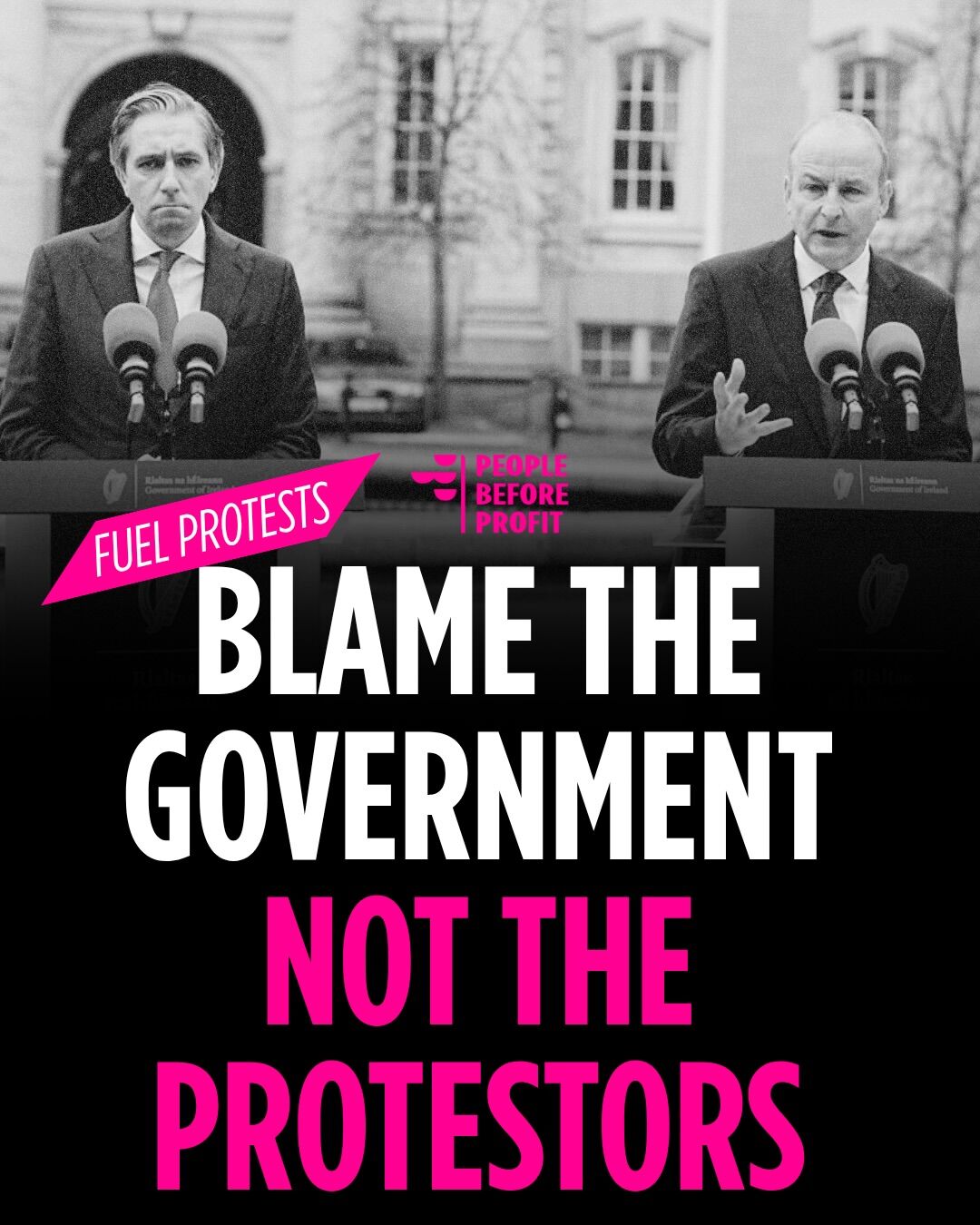
Political commentators are claiming that the much-publicised role of figurers from the far right in the recent fuel protests herald a significant development in its power and reach. The potential for this development also resides in the continuing war and blockade against Iran. It is forecast that if this does not stop before the end of June the run-down of existing stocks will see the price of Brent, a global oil benchmark, climbing to $150-$200 a barrel. In any case, a more general increase in prices is in the pipeline with an even greater hit on working class living standards.
This is not a question of ‘energy poverty’ – poverty is poverty and covers multiple items of consumption, which will become increasingly apparent as a result not just of rising prices but also of the failure of incomes to keep pace. Poverty demoralises those affected and those who might be vulnerable to falling into it, as well as the whole class that witnesses the deprivation that the state will permit. It will not just be a crisis of poverty but of expectations of the many who won’t go into poverty but will wonder what sort of life they’re going to have if this is what they get out of a period of a much-trumpeted economic success.
The ingredients that led to the protests are not going away; hence the importance of what the socialist movement can learn from them. A review of the experience by a British socialist here is therefore a useful point to continue to do this, following up on our initial assessment. The article reviewed compares the intervention of People before Profit with that of Sinn Fein and ends by saying that ‘the fuel protests showed PBP’s politics at their best.’ Even an initial thought can’t help but including how this could be true given its peripheral involvement and profile.
Perhaps this is justified by an examination of what the PbP political programme says, so let’s look at this. If we do, we can’t help wondering what the condemnation of the role of Sinn Fein does for People before Profit’s strategy of a left government, which has Sinn Fein as part of it. If SF has just failed in opposition, in what sense could it be a partner in anything pretending to be a meaningfully left alternative government? And if it is as bad as it is claimed, the likelihood of a left government in the near term is zero; in which case it’s not the alternative that People before Profit claim it is. In programmatic and strategic terms, it is a black hole into which everything else is sucked into and out of which there is nothing to see.
The author of the article himself demolishes this perspective in his response to the following comment by one of his readers: ‘In real terms PBP are the smallest part of a rickety anti-FFG coalition, within which SF is absolutely hegemonic. PBP are dependent on their transfers, work with them on a local level and have committed to going into government with them on some sort of a united front basis. I don’t say this to be annoying but just that it’s a bigger predicament than supposedly class independent programmes can solve.’
The author says that ‘The commenter is right that PBP’s class independence is real at the level of programme but constrained at the level of electoral arithmetic’ and that ‘the question of whether “external support contingent on a minimum programme” in practice becomes unconditional support for an SF government that delivers none of it is not answered by the programme document alone. It is answered by what PBP does when Sinn Féin fails to implement the programme . . .’ That Sinn Fein will not join in implementing a left programme that should be supported is presented here as a given. ‘PBP’s position is to offer external support to a Sinn Féin government that implements a minimum programme of reforms — which Sinn Féin will almost certainly not implement.’
So, the project of a Left Government as the alternative to 100 years of Fianna Fail and Fine Gael rule is not real; it’s a fraud that cannot work. So how is it an alternative? Is PbP going to spend the next number of years pushing an expected failure? Is it going to going to take responsibility for this failure, through its calling for transfers to Sinn Fein, or votes for it where it does not stand? Is it going to admit that it never expected it to work? And what does it think those persuaded to vote for it will think of this, or any further ideas it puts forward? Why would such an experience of failure not lead to demoralisation?
If this overall issue is not satisfactorily addressed or the questions that follow from it, what are we to make of the policies put forward by People before Profit that the article praises?
The comparison with Sinn Fein is put like this: ‘People Before Profit showed up with a programme. Sinn Féin showed up with a tax cut. The difference between those two responses is not tactical. It is the difference between a politics that names the system and a politics that names the government.’ This is a strange assertion since People before Profit’s proposals consistently condemn the government and don’t mention capitalism, i.e. ‘the system’.
What it condemns instead is ‘profiteering’, which is not at all the same thing. Reflecting its own name, profit is not to be replaced but rather something – ‘the people’ – prioritised before it. What level of profit is ‘profiteering’ is a matter of judgment, or rather a question of ownership and control. The main suggestion is for price caps, but it is acknowledged that previous government action to compensate for price increases was ‘wiped out almost immediately by the scale of the global commodity crisis.’
PbP wants ‘to set the maximum price for petrol, diesel, natural gas, electricity and heating oil in order to provide price stability and safeguard the people from huge price increases’ while acknowledging that ‘Ireland imports all of its oil requirements at prices determined by global markets.’ This is also almost true of gas, while around 80% of total energy is imported. In 2025 the average Brent price was $69.14 but could hit $150-$200 according to some forecasts.
The Irish government cannot control these prices and cannot promise price stability. In other words, it cannot control the capitalist world market. The proposed mechanism for doing so by PbP is explained in relation to home heating oil – that PbP would ‘establish a rebate scheme to compensate retailers for price differentials with wholesale costs.’ Since it can’t control these costs, it can’t know how much tax receipts are going to be handed over to retailers. The article by the British socialist states that PbP has a programme ‘and it was costed’, but unless it knows what the price of oil is going to be then this is complete nonsense.
PbP states that ‘Our demand is that companies are forced to open their books and fully justify any and all price increases.’ But who is going to look at the books and ensure that there are not ‘other’ books that reveal a truer position? And who is to decide what constitutes ‘justification’? Far from naming the system, and not the government, the entirety of the measures demanded by PbP is to be carried out by the government, which raises two problems. First the actual government that is in office that won’t do it and secondly the flaws in the idea of a ‘left’ government that we noted above.
People before Profit proposals entail taxing data centres but also want a ban on the construction of new data centres, a not entirely consistent position. Like limits to prices, there are definite constraints to what this sort of action can achieve, which is why socialists do not believe simply reforming the current system can meet the needs of the vast majority. Nationalisation of the energy industry, as it proposes, is not socialism and is not – in the words of the British socialist – ‘democratic ownership’, which can only arise from workers’ ownership. Large sectors of the energy industry are already owned by the state, including the largest electricity generator; the owner and operator of the transmission and distribution system, and the largest supplier of electricity to customers.
From the Marxist political point of view the most mistaken and false claim about the programme of People before Profit is that its ‘architecture deserves to be named specifically, because it is the clearest illustration of what distinguishes a transitional programme from a fiscal one.’ In fact, it is nothing of the sort: a socialist transitional programme is about what the working class must do to defend its interests and in doing so establish its own society. The People before Profit proposals are essentially about what the government should do, knowing that it won’t, and knowing that its own alternative proposals for government won’t either.
Forward to part 2

