Karl Marx’s alternative to capitalism part 6

china1larg.workers.giThe continued growth in the productive powers of society can only mean the increased productive power of human labour, exercised through increasing use of the implements of labour and the organisation and application of scientific knowledge.  This in turn can only manifest itself in the growth of the working class that exercises this power, wields the implements of labour and develops and applies advances in scientific knowledge.

The result has been the increasing creation of the material conditions that can provide the foundations for a more equitable and socially just society.  The most important of these is the growth of the global working class.

From 1980 to 2010 the world’s labour force grew by 1.2 billion, to approximately 2.9 billion, with almost 90 per cent of the growth occurring in what has been called developing countries, including 500 million in China and India.  In the process 620 million people have been lifted out of poverty, as defined by the World Bank at $1.25 per day (at 2005 purchasing power parity).  Global non-farm employment rose from 54 per cent of all jobs in 1980 to 70 per cent in 2010.

From 1990 to 2010 China’s productivity was estimated to have grown by an average of 9.8 per cent per year, about one fifth as a result of the move from countryside to the city.   Wages grew as a result, and the ‘Financial Times’ has recently reported that the scope for this mass migration to continue had now ended.  (All figures from McKinsey)

In what are called the advanced economies 165 million new non-farm jobs were created and a large number of these taken by women joining the workforce.  Over this period the number of women in the labour force rose by 77 million accounting for the majority, 61 per cent, of the net new additions of 122 million.

Average skill levels of the workforce have also risen with the number of college graduates in the world labour force doubling in the economically advanced countries and growing by two and a half times in developing countries.  Around 700 million high school graduates joined the world’s labour force, increasing the proportion of those with secondary education to 48 per cent in 2010 from 39 per cent in 1980.

The assumption that only the ‘advanced’ countries have educated workers with the knowledge and skills necessary for innovation and more advanced production is now untrue.  In 1970 approximately 30 per cent of university enrolments were in the United States but by 2006 this was only around 12 per cent. The share of the world’s Ph.D.’s accounted for by the US has fallen from around 50 per cent in the early 1970s to 18 per cent in 2004.  By 2005 South Korea was sending a larger proportion of its young people to university than the US. And, for example, only 10 per cent of Italy’s working age population had a college degree in 2010, lower than in Malaysia, Thailand and the Philippines.  Countries such as Indonesia, Brazil, Peru and Poland more than doubled their university enrolments in the 1980s and 1990s. (Quoted from ‘The new global labour market’)

The McKinsey report quoted above states that in the advanced countries the share of national income going to labour rose during the 1950s and 1960s, peaking in 1975, but has fallen ever since and is now below its 1950 level.  The wages of less skilled workers have stagnated or fallen in all but a handful of advanced countries while the incomes of those in the top 10 per cent have risen.  Capitalists complain that they cannot get the necessary skilled workers and unemployment among those with only secondary education is nearly twice as high as among those with college degrees.  In the advanced countries unemployment among the least skilled is two to four times higher than the most highly skilled.

As illustration of the insanity of capitalism’s failure to develop in any sort of rational manner, an article in the ‘Irish Times’ earlier this year notes that the Irish State has the dubious distinction of having the most overeducated workforce in Europe with around a third overqualified for the jobs that they do, just in front of Cyprus, Spain and Greece.  It reports one young woman with a degree and a Diploma in primary school teaching who made 80 job applications last year and didn’t get one interview.  As the duration of unemployment grows the skills previously acquired atrophy and the social labour expended on their acquisition is wasted.

So some educated workers can’t get a job commensurate with their education while capitalists complain they can’t get skilled workers.  A further twist is added when you consider the well paid jobs that some workers get have relatively little to do with their accumulated knowledge.

I recall reading some time ago an article in a British newspaper that noted that the knowledge and skills of those with science qualifications is socially wasted in jobs within the media industry, in companies like Google or Facebook, doing jobs that involved not much more than high-tech advertising and selling.  I know of one young woman who has a PhD. in science, in which she studied the transfer of drugs through the body for those with cystic fibrosis but who could only get a decent wage by requalifying as an accountant.

When production is profit driven, without any conscious societal mechanisms to determine social priorities, such waste appears in statistics as remarkable progress.  What isn’t measured is the potential contribution that millions of working people could make but can’t because of the lack of opportunities and subordination and lack of democracy in the workplace that stifles their ambition and creative powers.

Despite all this however it has to be understood that capitalism continues to develop, and the productive power of humanity continues to grow massively.  The need for skilled workers grows even if the system often wastes much of the knowledge and skills created.

There can be no doubt that the ‘civilising mission’ of capitalism, which the last few of these posts have been about, continues.  Of course it does not develop evenly and does not develop without antagonism or contradiction and in the next posts I will look some more at the limited and contradictory character of this development.

However if capitalism were simply as system in crisis we could not explain why it still exists.  If it were not still revolutionising the means of production and developing the productivity of labour it would no longer be the capitalism analysed by Marx and we would have to find some other approach to understanding it.

Most important of all, as I have said before: if capitalism created only oppressed, exploited and alienated human beings where could the alternative come from?

Back to Part 5

Forward to part 7

Karl Marx’s alternative to capitalism part 5: capitalism’s achievements

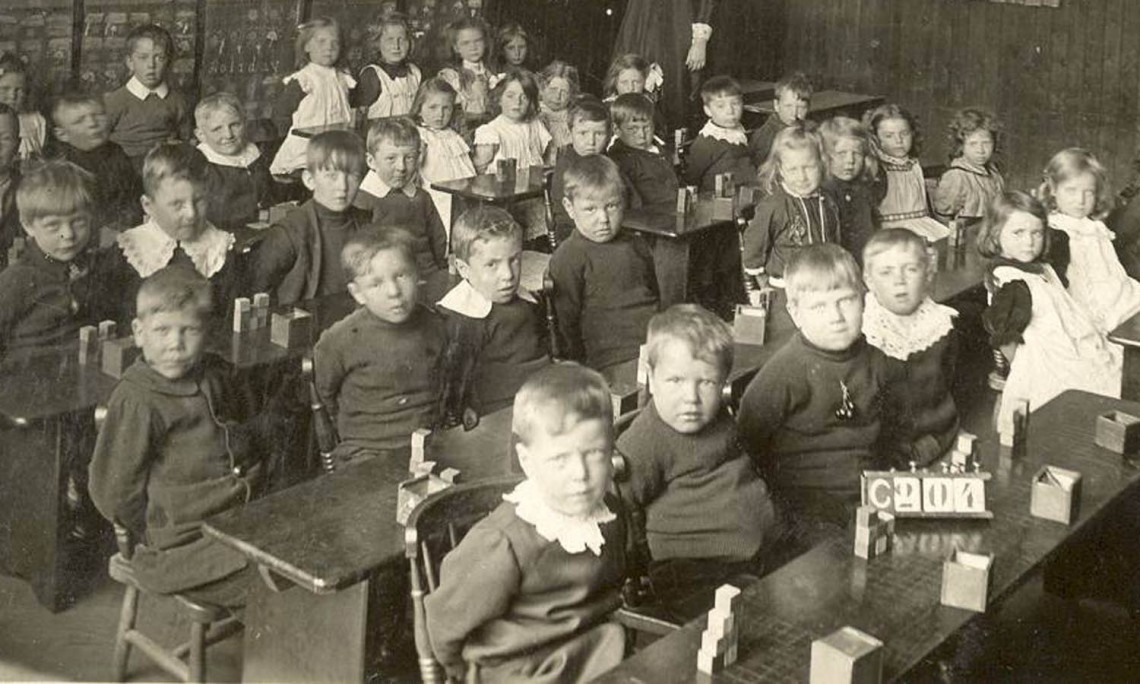
classroom-19th-century-1140x684One comment on an earlier post on the blog relating to the situation in Greece included the following: “So I think the task at hand is not to solve Greece’s economic crisis, this will certainly take years. Rather it is to add some political organisation and direction on to the instinct to fight. I believe that you are thinking too far ahead, overly concerned with what socialism should be in the future, and not really catching the fire of the present.”

Leaving aside whether this was true of this particular post on Greece or even of other posts; a point I have made is that the Marxist movement is too concerned with attempting to “catch the fire of the present”.  This has usually meant jumping on whatever bandwagon it thinks might propel it along in some opportunist direction.  This is informed by the view that socialism will arrive through a capitalist crisis that precipitates political revolution that will destroy the existing state and then introduce the new society.  All of which it will lead through “catching the fire” in some sort of eschatological conflagration.

Missing is the development of the alternative, evolving within capitalism in advance of any crisis, that creates and develops workers’ power in the present and most of all creates the conditions that means workers actually seek a socialist alternative long before any crisis.  Missing is the building of a working class movement that fights for an alternative society now, sees such a new society as its answer to its problems and does not limit itself to the necessarily defensive struggles against capitalist attacks.

This understanding of the working class movement, as embodying the future alternative within itself, is now more or less completely lost but would have been the foundation of workers’ socialist consciousness during most of the first century of the movement’s existence.  So, the building of mass workers’ parties, trade unions, friendly societies, educational organisations and cooperatives were all seen to be the visible rise of the more or less inevitable final victory of socialism.

No such confidence now pervades the socialist movement and part of this impoverished outlook is the perspective of fighting for and relying on the state to deliver the goods.  This and/or the view that some future, but always more or less near, political crisis will quickly precipitate a struggle and a consciousness adequate for a successful political revolution.   A view that forgets that socialist revolution is distinguished by it being primarily a social one and the Marxist view that social being determines consciousness: that is the development of consciousness is based on the development of capitalism, including what workers do over many decades to develop their own power and organisation within it. There is no exception in such a view for small groups propagandising for revolution, crisis or no crisis.

The patient building of workers organisations, such as cooperatives, is viewed by some as simply reform of capitalism when in fact no successful revolution will be possible without them.  Opposition to what has been termed the stages theory of revolution, that every workers struggle is inevitably limited to certain non-socialist goals, is confused with rejection of the truth that the working class will go through stages of development and that earlier stages that do not immediately threaten the system are also just as necessary because they are expressions of the workers own activity and power.

That this has been more or less forgotten is both a product and producer of the decline of the socialist movement.

That is why I started to write a series of posts on Marx’s alternative to capitalism, because without such an alternative there will be no, well to state the obvious – alternative!  It’s why this series is now continued.

*                                                     *                                                 *                                                              

In the last post on Marx’s alternative I said I would look at the evidence that the development of capitalism continues to provide the grounds for socialism as an alternative.  By this I mean the contradictory nature of capitalism is still creating on an increasing scale its gravediggers, the working class, and that even “with all the miseries it imposes upon them, the present system simultaneously engenders the material conditions and the social forms necessary for an economical reconstruction of society.” Marx.

A look at the long term development of capitalism illustrates what Marx called its civilising mission, a product not just of the growing requirements of capitalist production for an educated and relatively healthy workforce but of the needs of the capitalist state itself that provides most of this education.  By 1985 mass education was compulsory in 80 per cent of the countries of the world and over 90 per cent of the world’s children spent some time enrolled in school.

Estimates for the year 1900 put participation rates in primary education at under 40 per cent in most parts of the world outside North America, northwest Europe and English speaking areas of the Pacific, where it was over 70 per cent.  By the beginning of the twenty-first century every part of the world had achieved the minimum of the most industrialised countries at the start of the 20th century and most had exceeded it.

The picture of course is far from universally rosy and a 2007 UNESCO report estimated that in 2004 781 million adults did not have minimum literacy skills and close to 77 million children of school age were not enrolled in school.  Nevertheless the twentieth century was the first in human history in which the majority of the world’s population learned to read and write.

The development of higher level education has been just as dramatic.  In 1900 roughly half a million were enrolled in higher education institutions across the world.  By 2000 the number had grown two-hundredfold to 100 million people.  Growth in higher education has not slowed but accelerated in the latter part of the twentieth century; particularly after about 1960, with enrolment rates climbing rapidly, especially of women.  This growth has created what amounts to a global higher education system with “the same subjects . . . taught with the same perspectives leading to very similar degrees . .” (The Worldwide Expansion of Higher Education in the Twentieth Century)

If we look at population and health we can see the capacity of the productive system to support a growing population and improved health.  “Since 1800, global population size has already increased by a factor of six and by 2010 will have risen by a factor of ten. . . . The length of life, which has already more than doubled, will have tripled . . In 1800, women spent about 70 percent of their adult years bearing and rearing young children, but that fraction has decreased in many parts of the world to only about 14 percent, due to lower fertility and longer life.” (The Demographic transition: Three centuries of Fundamental Change)

Global life expectancy (years at birth) in 1700 was 27, still 27 in 1800, 30 by 1900 47 by 1950 and 65 by 2000, while population was 0.68 billion, 0.98, 1.65, 2.52 and 6.07 billion in the same years.  This decline in mortality began about 1800 in northwest Europe, and in many lower income countries at the beginning of the twentieth century, accelerating after the Second World War.

“The first stage of mortality decline is due to reductions in contagious and infectious diseases that are spread by air or water. Starting with the development of the smallpox vaccine in the late eighteenth century, preventive medicine played a role in mortality decline in Europe. However, public health measures played an important role from the late nineteenth century, and some quarantine measures may have been effective in earlier centuries. Improved personal hygiene also helped as income rose and as the germ theory of disease became more widely known and accepted. Another major factor in the early phases of growing life expectancy is improvements in nutrition. Famine mortality was reduced by improvements in storage and transportation that permitted integration of regional and international food markets . . .”

“In recent decades, the continuing reduction in mortality is due to reductions in chronic and degenerative diseases, notably heart disease and cancer (Riley, 2001). In the later part of the century, publicly organized and funded biomedical research has played an increasingly important part, and the human genome project and stem cell research promise future gains.”

“Many low-income populations did not begin the mortality transition until some time in the twentieth century. However, they then made gains in life expectancy quite rapidly by historical standards. In India, life expectancy rose from around 24 years in 1920 to 62 years today, a gain of .48 years per calendar year over 80 years. In China, life expectancy rose from 41 in 1950–1955 to 70 in 1995–1999, a gain of .65 years per year over 45 years.” (The Demographic transition: Three centuries of Fundamental Change)

Again however the gains in life expectancy are not uniform and the productive advances of capitalism, some of which are reflected in public health and medical advances, are subordinated to the accumulation of profit.  This is most clearly seen in the two significant exceptions noted in the article quoted above – the stagnation in mortality gains and increased mortality from HIV/AIDS in sub-Saharan Africa and the decline in life expectancy in Eastern Europe and the former Soviet Union arising from their transition to capitalism.  The article quotes the UN in 2002 noting that male life expectancy in the Russian Federation was 60, similar to that of India.

Back to Part 4

Forward to Part 6

Does capitalism still have a civilising mission? Marx’s alternative – part 4

huajian-shoe-factoryIn the last post on Marx’s alternative to capitalism I noted that he extolled the achievements of capitalism, without which socialism could not be built.  In the Grundrisse he noted “the great civilizing influence of capital; its production of a stage of society in comparison to which all earlier ones appear as mere local developments of humanity and as nature-idolatry.”

This is very far from the attitude of most Marxists today, who have a tendency to see crisis and decline everywhere.

Perhaps, as might be implied from the quote above, the progressiveness of capitalism is only in relation to previous society, and that today it is a wholly reactionary system from which no development is possible or at least none with any progressive features.  Its replacement must therefore arise from its contradictions and crisis and not from any progressive element within it.

The days of the progressive development of capitalism are over.

The Communist Manifesto is famous for its paean of praise to the wonders of capitalist achievements, and this at a time when capitalism hardy existed on most of the globe – “It has been the first to show what man’s activity can bring about. It has accomplished wonders far surpassing Egyptian pyramids, Roman aqueducts, and Gothic cathedrals; it has conducted expeditions that put in the shade all former Exoduses of nations and crusades . . . The bourgeoisie, during its rule of scarce one hundred years, has created more massive and more colossal productive forces than have all preceding generations together. ”

But perhaps again this praise is purely relative to earlier epochs.  Capitalism has exhausted any progressive content it once may have had.  After all, didn’t Lenin refer to the highest stage of capitalism and did Trotsky not say that:

“the economic prerequisite for the proletarian revolution has already in general achieved the highest point of fruition that can be reached under capitalism. Mankind’s productive forces stagnate. Already new inventions and improvements fail to raise the level of material wealth . . . The objective prerequisites for the proletarian revolution have not only “ripened”; they have begun to get somewhat rotten. Without a socialist revolution, in the next historical period at that, a catastrophe threatens the whole culture of mankind.”

That catastrophe did of course arrive in the shape of the Second World War and the potential for catastrophe undoubtedly continues to exist within capitalism today.  The decline of the United States and the rise of new powers once again raise the spectre of economic competition that may drive rival nation states into war.

A couple of weeks ago I was reading the Guardian review of books and a review of a book by the BBC correspondent Mark Urban, who argued that new powers are developing conventional forces that can begin to rival those of the US. This means that in any conventional conflict the US may be tempted or driven to use nuclear weapons.  It’s not as if they haven’t used them before.

“Now, says Urban, Russia, China and India have such strong conventional forces, and America has cut its forces so much, that in the event of a conflict “the US would be left with the choice of nuclear escalation or backing down”.  He adds: “Against a full-scale invasion of South Korea, the US would have little choice but to go nuclear.” Russia, China, India, Israel, Pakistan, North Korea and some other countries could “mount a credible conventional defence that would leave the United States having to think the unthinkable, with profound implications for the world”.”

While there is a lot more to say about such a scenario the point is that under capitalism humanity has no rational control of its own development and no guarantee against the most irrational acts leading to its destruction.

However the view noted above – that capitalism can no longer be viewed in fundamentally the same way as Marx did in the 19th century is mistaken.

Straight after noting capitalism’s wonders far surpassing the Egyptian pyramids, Roman aqueducts and Gothic cathedrals Marx states that “The bourgeoisie cannot exist without constantly revolutionising the instruments of production, and thereby the relations of production, and with them the whole relations of society. Conservation of the old modes of production in unaltered form, was, on the contrary, the first condition of existence for all earlier industrial classes. Constant revolutionising of production, uninterrupted disturbance of all social conditions, everlasting uncertainty and agitation distinguish the bourgeois epoch from all earlier ones.”

So the development of society continues under capitalism and the imperative to accumulate unpaid labour means the continued development of the forces and relations of production and growth of the working class.  As I will show in the next post this continues to require the phenomenon of the ‘great civilising influence of capital’ because if it did not, the development of capitalism would be away from a possible socialism and not towards it.

A working class more and more exploited and oppressed, more and more demoralised, despite the massively increased social division of labour and the cooperation required for it to function; and despite the undreamed of development of technology, would patently be unable to put itself forward as the new rulers of an even more advanced society.

A purely reactionary system without fundamental contradictions out of which a new society could emerge would not be that investigated by Marx.  A contradiction-ridden system on the other hand will combine development with retrogression, the potential for the new within the embrace of the old.

Crises will occur and must occur in some way if a new society is to be given birth out of the old but the nature of this crisis must be one that allows a new society to fully develop and not simply represent a process of decline of the old.  Under capitalism it is not crisis that create the contradictions of capitalism but crises which are the means of expressing these contradictions and resolving them in whatever way and for whatever period of time.

The importance of acknowledging this is apparent when we consider the ‘new’ phenomenon of anti-capitalism, as if being anti-capitalist is inherently progressive.  In the Communist Manifesto Marx was able to analyse various types of reactionary socialism, and various types of this exist today.  Much of the left is keen to retreat into nationalism and older forms of capitalist development in response to capitalist crises in their latest form, buttressed by the idea that there can be nothing progressive in its current development.

We see this today in much of the left’s opposition to the Euro for example, as if the drachma or punt were some sort of positive alternative.  In Ireland the nationalist and republican tradition has allowed many leftists to seek progress through assertion of a ‘national sovereignty’ that is simply impossible to achieve even if were desirable.

All seem to have forgotten that socialism is not the resistance of the working class to capitalism, which can continue ‘forever’ if it does not involve an alternative, and this alternative is a higher form of society, not a retreat into the past.

In the next post on Marx’s alternative I will look at the evidence that the development of capitalism that Marx thought provides the grounds for socialism continues to exist.

Back to Part 3

Forward to Part 5

The civilising mission of capitalism – Marx’s alternative part 3

lewis-hine1So Marx understood that capitalism’s compulsion to increase the appropriation of unpaid labour through development of the forces of production and exploitation of workers also meant the expansion of the consumption of the working class and development of its needs and capacities as a result; what has been called capitalism’s civilising mission. But Marx also referred to the “inherent barbarism of bourgeois civilisation.”

Today, and over the last half century, many people have been radicalised by the threats of nuclear annihilation or environmental catastrophe, both of which are products of capitalisms’ productive powers and its irrational social and political relations.  But opposition has more often than not failed to identify the source of the threat or the solution.

It has also been noted at the end of the twentieth century that there had not been a single year since 1816 without at least one war going on in the world.  The twentieth century itself witnessed human slaughter on a truly massive scale with more than 9 million deaths in the First World War and 57 million (37.8 million of them civilians) in the Second World War, with 80 million between 1900 and 1950 in total.  The relative peace since is purely relative with proud claims that war had been abolished in Europe, for example, blown away by the war in the former Yugoslavia and now in the Ukraine.

This contradiction is not one that exists in Marx’s argument but one that exists in reality, as Marx explains in Chapter 15 of Volume 1 of Capital:

“We have seen how this absolute contradiction between the technical necessities of modern industry, and the social character inherent in its capitalistic form, dispels all fixity and security in the situation of the labourer; how it constantly threatens, by taking away the instruments of labour, to snatch from his hands his means of subsistence, and, by suppressing his detail-function, to make him superfluous.

We have seen, too, how this antagonism vents its rage in the creation of that monstrosity, an industrial reserve army, kept in misery in order to be always at the disposal of capital; in the incessant human sacrifices from among the working-class, in the most reckless squandering of labour-power and in the devastation caused by a social anarchy which turns every economic progress into a social calamity.

This is the negative side. But if, on the one hand, variation of work at present imposes itself after the manner of an overpowering natural law, and with the blindly destructive action of a natural law that meets with resistance at all points, modern industry, on the other hand, through its catastrophes imposes the necessity of recognising, as a fundamental law of production, variation of work, consequently fitness of the labourer for varied work, consequently the greatest possible development of his varied aptitudes.

It becomes a question of life and death for society to adapt the mode of production to the normal functioning of this law. modern industry, indeed, compels society, under penalty of death, to replace the detail-worker of to-day, grappled by life-long repetition of one and the same trivial operation, and thus reduced to the mere fragment of a man, by the fully developed individual, fit for a variety of labours, ready to face any change of production, and to whom the different social functions he performs, are but so many modes of giving free scope to his own natural and acquired powers.”

Marx compares capitalism favourably to its predecessors:

“Thus the ancient conception, in which man always appears (in however narrowly national, religious, or political a definition) as the aim of production, seems very much more exalted than the modern world, in which production is the aim of man and wealth the aim of production.

In fact, however, when the narrow bourgeois form has been peeled away, what is wealth, if not the universality of needs, capacities, enjoyments, productive powers etc., of individuals, produced in universal exchange? What, if not the full development of human control over the forces of nature — those of his own nature as well as those of so-called “nature”? What, if not the absolute elaboration of his creative dispositions, without any preconditions other than antecedent historical evolution which make the totality of this evolution — i.e., the evolution of all human powers as such, unmeasured by any previously established yardstick — an end in itself?

What is this, if not a situation where man does not reproduce in any determined form, but produces his totality? Where he does not seek to remain something formed by the past, but is in the absolute movement of becoming?

In bourgeois political economy — and in the epoch of production to which it corresponds — this complete elaboration of what lies within man, appears as the total alienation, and the destruction of all fixed, one-sided purposes as the sacrifice of the end in itself to a wholly external compulsion.”

Overall growth of productive powers and increased planning within capitalism – between firms and countries – and increased coordination of a massively developed division of labour is a growth of human power and civilisation, not just potentially, but in creation of the preconditions for socialism; the potential for the creation of a society without material and cultural want, for a future society in which the level of production can remove the necessity for class inequality.

If socialism must arise out of capitalism and capitalism were purely barbaric, containing within it no contradictions that presage the new society, socialism would be a utopian dream because the agents of change who are to bring it about would simply be products of barbarism.

Back to Part 2

Forward to Part 4

Karl Marx’s alternative to capitalism – part 2

333869336In the first part of this post on Marx’s alternative to capitalism we noted that this was ‘simply’ the real alternative that is already growing within capitalism and is composed of the working class that the development of capitalism creates.

Workers have no, and are not to be encouraged to produce, “ready-made utopias”.   Such blueprints are always presented to workers rather than arising from them, they must “work out their own emancipation”.   In doing so they will necessarily “have to pass through long struggles, through a series of historic processes, transforming circumstances and men”. (Marx, The Civil War in France)

The working class is the product of the prodigious development of the forces of production under capitalism but it can only achieve emancipation if it becomes conscious of its revolutionary role. So, in some way, capitalism must not only provide for the development of the forces of production, increased division of labour and cooperation across the globe and increased planning within and between companies and production facilities, upon which a higher society can be built, but it must also provide the grounds for the development of this consciousness.

Capitalism does this by removing the relations of personal dependence that, for example, ties the peasant serf to the lord of the manor or the artisan to his master and to the Guild.  In doing so it atomises individuals and promotes an ideology of individuality that in juridical terms makes people free, independent and responsible but which in reality is expressed in an estrangement of people from each other.

This estrangement is routinely expressed through terms such as the ‘rate race’; the view that ‘charity begins at home’; that you ‘have to look after your own’, or ’look after number one’ or in the thousand and one various ways in which the unity of humanity is disintegrated and vanished under capitalism.  This is not primarily an ideological phenomenon but a realty that workers are indeed in a rat race.  As a poster campaign put it some years ago – many are only a couple of pay cheques away from homelessness.  Almost all workers are an illness away from relative or absolute poverty.  Lack of ownership of the means of producing a livelihood means an inescapable compulsion to sell one’s labour power in the market under circumstances more or less totally out of one’s control.

This estrangement is universal and the idea of free individuality finds roots from this universal separation.  Its universality creates the possibility of it being overcome. This is done through the development of the forces of production that puts workers in a similar relationship to those who own the means of producing life’s necessities creating the conditions within which unity around common class interests can be built.

The development of the forces of production themselves, based on advances in scientific understanding and its practical application, has implications both for the material and moral/spiritual development of the working class.  The extraordinary development of the productivity of labour that is a feature of capitalism cannot fail over an extended period to have an effect on the material conditions of the working class.  The current level of development of the productive forces could not have been achieved simply by seeking to meet and increase the consumption demands of the richest in society.

Capitalism constantly seeks to advance the consumption of society in order to accumulate capital and thus consciously and unconsciously produces new needs and new desires and, through this, new capabilities that create not just the material but also the spiritual and cultural preconditions for socialism.  If it did not, if capitalism left workers as limited and narrow in outlook as the peasant class that preceded it, there would be no grounds for a new higher society, for who would bring it into being?

This development takes place under capitalism, under the determining dynamic of the production of profit from the exploitation of labour, and thus this development is distorted, often thwarted, partial, uneven and limited.  It is subject to advance and retreat and it is ‘dumbed down’ and commodified.  It takes place not as a rational objective of society but as one whose development is in contradiction with the system’s rationale of seeking the expansion of capital through the appropriation of more exploited labour.

This process is what Marx calls the “civilising mission” of capitalism, without which there could be no talk of socialism:

“Thus, just as production founded on capital creates universal industriousness on one side — i.e. surplus labour, value-creating labour — so does it create on the other side a system of general exploitation of the natural and human qualities, a system of general utility, utilizing science itself just as much as all the physical and mental qualities, while there appears nothing higher in itself, nothing legitimate for itself, outside this circle of social production and exchange.

Thus capital creates the bourgeois society, and the universal appropriation of nature as well as of the social bond itself by the members of society. Hence the great civilizing influence of capital; its production of a stage of society in comparison to which all earlier ones appear as mere local developments of humanity and as nature-idolatry.

For the first time, nature becomes purely an object for humankind, purely a matter of utility; ceases to be recognized as a power for itself; and the theoretical discovery of its autonomous laws appears merely as a ruse so as to subjugate it under human needs, whether as an object of consumption or as a means of production.  In accord with this tendency, capital drives beyond national barriers and prejudices as much as beyond nature worship, as well as all traditional, confined, complacent, encrusted satisfactions of present needs, and reproductions of old ways of life

It is destructive towards all of this, and constantly revolutionizes it, tearing down all the barriers which hem in the development of the forces of production, the expansion of needs, the all-sided development of production, and the exploitation and exchange of natural and mental forces.” (Grundrisse)

But how can capitalism be called civilising?  Is it not the Marxist case that capitalism is inhuman and that the historic choice is between socialism and barbarism? Does Marx not speak, in relation to British rule in India, of “the profound hypocrisy and inherent barbarism of bourgeois civilisation.”

Back to Part 1

Forward to Part 3

Karl Marx’s alternative to capitalism – part 1

DSC_0136The reason why a person will identify themselves as a Marxist will be biographical, a product of their background, history and circumstances, their attitudes, character, personality and intellectual curiosity.  All these will be individual and accidental to a greater or lesser extent, the product of one’s actions and decisively, the views and actions of others that one comes into contact with, directly and indirectly.

On the other hand their background and circumstances and the views and actions of others that influence them will be social, the product of society as a whole.  Even their individual character and intellectual curiosity will be shaped strongly by their social circumstances.  So also the reason to identify as a Marxist is not individual or accidental but crucially derives from the content of Marxism itself.

It constitutes the most rational alternative to capitalism and all the irrationality and oppression that that system entails.  The most consistent and coherent alternative to capitalism is Marxist because Marxism comprehends capitalism in a way that is adequate to its replacement.

Marxism best encapsulates the view that ‘another world is possible’ because it best understands capitalism itself and can identify whether, and to what extent, an alternative can develop out of it.  Any alternative must come out of it in some way, yet be sufficiently different to actually be an alternative, and not a refurbished version of existing society which must enforce the limitations and strictures of the existing system. Marxism must therefore identify in what precisely this alternative consists.

The strength of Marxism is not that it has developed a brilliant idea from the brain of an exceptional intellect but that it seeks to bring to consciousness the development of capitalism itself and the alternative that is pregnant within it.

“In that case we do not confront the world in a doctrinaire way with a new principle: Here is the truth, kneel down before it! We develop new principles for the world out of the world’s own principles. We do not say to the world: Cease your struggles, they are foolish; we will give you the true slogan of struggle. We merely show the world what it is really fighting for, and consciousness is something that it has to acquire, even if it does not want to.” Karl Marx 1843.

If capitalism does not contain within it the struggles that will replace it, and the grounds for those struggles to succeed, then there will be no alternative to capitalism, at least not with the features or characteristics associated with a socialist alternative.

The claim that Marxism is the social and political alternative to capitalism thus rests on its claims to understand the development of capitalism so that the alternative it poses is not then a utopian one, sprouted more or less fully formed from the brain of this or that social reformer, but from the perceptible development of capitalism itself.

Just as the alternative to capitalism grows out of capitalism itself so too does the understanding of the alternative grow in the same way from the development of the system.

This is held to account for Marx’s known aversion to setting out a blueprint of what the alternative will look like.  It was, for example only when Marx was in his mid-50s that he claimed he had found, or rather the working class itself had found, through the experience of the Paris Commune of 1871: “the political form at last discovered under which to work out the economical emancipation of labour.”

In his review of this experience Marx made many observations on the alternative to capitalism that apply today, including that:

“The working class did not expect miracles from the Commune. They have no ready-made utopias to introduce par décret du peuple. They know that in order to work out their own emancipation, and along with it that higher form to which present society is irresistibly tending by its own economical agencies, they will have to pass through long struggles, through a series of historic processes, transforming circumstances and men. They have no ideals to realize, but to set free the elements of the new society with which old collapsing bourgeois society itself is pregnant.”

A book published a few years ago is an extremely useful guide to Marx’s concept of the alternative to capitalism, more particularly of the principles that underpin it.  It demonstrates that the alternative is not some perfected socialist state or society, not some condition of social equilibrium but a movement of people and their own self-activity and self-development.

“Communism is for us not a state of affairs which is to be established, an ideal to which reality will have to adjust itself. We call communism the real movement which abolishes the present state of things. The conditions of this movement result from the premises now in existence,” (Marx in The German Ideology).

There is no end-state to socialism, perfect or otherwise, but the social conditions that allow the full flourishing of the individual and humanity as a whole, which will in turn change social conditions.

Socialism cannot be reduced to principles such as a planned economy because planning itself is only one human activity, the totality of which is the expansive alternative that Marx foresaw.

The alternative to capitalism is the self-development of humanity, its overcoming of an alienated existence within which its own powers over its environment and its own development appear separated from and oppressive to it.  So humanity understands the danger of environmental destruction but has no transparent means of control to stop it despite its own actions being the cause of the threat.  So it witnesses economic disruption, unemployment, poverty and suffering, caused by a drop in ‘value’ of pieces of paper – shares, bonds, swaps, options, derivatives etc -that it has created but which by themselves are simply pieces of paper, which in any rational society it would be impossible for them to cause the suffering involved in economic crisis.

Emancipation therefore is the result of the actions of humanity itself, led by a class within society whose liberation must entail the liberation not only of itself but of society as a whole – what is called a universal class because it represents the universal interests of all humanity.

This universal class is the product of the prodigious development of the forces of production under capitalism, to a degree that could never have been conceived in previous history, including the rapid development of technology, scientific knowledge and overall cultural development.

It is people however who create history, ‘history’ itself does nothing, and it is the development of the working class that is the carrier of the wonders of the new capitalist society and the bearer of the new within it.

What is required then is that the working class becomes conscious of its role in existing society and the necessity for it to change this society.  Decisive for the working class is therefore its awareness of itself as a separate class with its own interests, requiring a change in the consciousness of the mass of workers.

This change in consciousness to an awareness of class interest does not mean the nullification of individual personality or character but the recognition of shared interests that will allow creation of a society in which the free development of individuals is the condition for the free development of everyone; no one is subject to the requirement to work to live in order that someone else can live without working.  The creation of wealth will be for the satisfaction of individual needs and desires and not the pathological pursuit of profit for a few.  People will labour to satisfy their needs not the accumulation of money, wealth and capital for others.

The structures of society will therefore be the consciously directed products of human activity, transparent in their operation.  They will not entail the domination of people by impersonal, disembodied powers such as the ‘rule of the free market’ or ‘rule of law’ or ‘state authority’, over which individuals feel and have no control.  No longer will workers face wage cuts or unemployment because the things they produce are no longer profitable to produce and the needs of ‘the economy’ then require the sacrifice of their livelihood.  Things no longer control them, they control the things that would not exist without them.  No longer will the price of pieces of paper wreak economic devastation.

Instead workers will control the things that are their creation, including the machines they build, the firms they create, the agencies that provide services or set rules for them – all the organisations appointed for any purpose that affect them.  They control them because they work in them.  Managing them is not a detached function to be carried out by a separate class or bureaucratic group but is the task of everyone.  Management and control become part of everyone’s job description.

By this means the supreme authority, the State, that rules over society is not set apart from it but is gradually abolished through its functions being incorporated into society itself and into its day to day functioning.  Only in this way can the  rule of a minority become the rule of the majority, can the working class become the new ruling class, before there is no class system whatsoever because no relations of economic and social domination exist.

For this to happen the majority of society have to be not so much ready to carry out these million and one tasks but more and more actually carrying them out beforehand.  The problem then is not so much to revolutionise the means of production or state structures but to revolutionise the working class.

So how does capitalism create the conditions for this?  In what way does capitalism itself prepare the ground for its supersession by the working class?

Forward to Part 2

The Politics of the Anti-Water Charges Campaign – Part 1

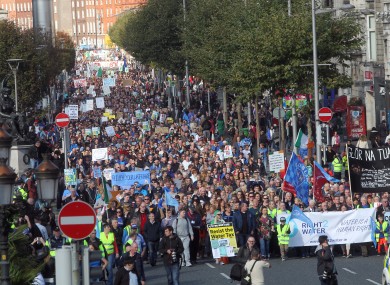
anti-water-charges-campaigns-protests-4-390x285I was sitting in a small café at 12 o’clock having a cup of tea and a bacon sandwich, with customers at only two other tables.  A group of four elderly people were talking at one while three middle aged men were talking at the other.  Both were discussing the water charges, their opposition to them and the march they were going to join in one hour’s time.

I joined a feeder march at Pearse Street that went up Dame Street, up to York Street, where it collected some more supporters, and then went round to St Stephen’s Green to stop  a few minutes outside the Dail to tell the Government that they “could stick their water meters up their arse”.  Even the Guards on duty outside had a smirk.  The thousand or so then took off to join the main rally outside the GPO in O’Connell Street where a number of other marches converged.

The demonstration was not as large as that of a few weeks before, which was estimated as 100,000, but this time there were dozens of other marches being held right across the State in cities and towns big and small.  Estimates are that in total the numbers were greater – 150,000.

On 11 October the apparently sudden scale of the opposition to water charges was reinforced by the victory in the Dublin by-election of the Anti-Austerity Alliance candidate, who defeated the firm favourite from Sinn Fein because that party had done a little too much talking out of both sides of its mouth and was seen as insufficiently opposed to the charges.

Sinn Fein posters were in evidence on the march on Saturday and it was noticeable that flags and banners from other republican groups were also in evidence.  The left groups were more peripheral than is usual in such marches and I didn’t see one trade union banner, although I could easily have missed it.

The demonstration was overwhelmingly working class, composed of what many on the left call ‘ordinary people’, although I’ve never considered myself extraordinary for example.  The other noticeable thing was the folk songs sung from the stage, the references to James Connolly and 1916 and the general referencing to Ireland’s rebel history.  It is as if, at least sections of the Irish working class go to sleep for a few years and that when they periodically wake up they look back to their greatest struggles and leaders, when their intervention into Irish history appeared to promise a new future. That hasn’t really been the case for a long time, at least in the South.  A Northern banner in solidarity might have highlighted the unfinished business.

While I was in the café I was reading ‘The Irish Times’ and in particular an article by Eamonn McCann entitled ‘Public finally take to streets as water proves a tax too far’.  I’m sure he didn’t write the headline so it is no criticism of him to point out that demonstrations in Dublin of 100,000 against austerity have already taken place over the last five years or so.  They were organised by the trade union movement and the demonstrators were betrayed by the leaders of that same movement, as McCann alluded to in his article.

So what makes this movement different, if it is?  Firstly there is a view that it could succeed, in fact an argument can be made that it is already succeeding.  The Government parties have already responded by concessions in the budget to lessen the impact of the charges and did so in such a hurry they messed it up.   The newspapers, radio and television news are full of reports of the panicked reaction by Government politicians, especially with an election around the corner; hundreds of thousands of registration forms sent by the new Irish Water company have not been returned and the deadline for returning them has been extended to the end of the month.

Opinion polls confirm the unpopularity of the charge and the effect of this on the popularity of the Governing parties.  Labour is already a dead duck and Fine Gael support has fallen while support for Sinn Fein and ‘independents’ has grown.  The new company is particularly disliked because of the millions of Euros being spent on consultants for a service the state has been providing for years (the same thing happened in the North when Northern Ireland Water was created).  Bonuses are also to be paid to Irish Water staff with those at the top getting much larger amounts than those at the bottom, with the added insult from the company that they continue to peddle the line that they aren’t really bonuses.

Irish workers facing these costs believe that they are already paying for water so in effect they are being asked to pay twice and for huge management consultant bills and bonuses on top.

But previous, more outrageous decisions have failed to generate resistance that actually looks like it might win.  The decision to bail out the banks, costing over €64 billion, dwarfs the water charges in scale, with bankers hardly more popular than the Executives of Irish Water – and bankers’ bonuses have certainly been larger.   So what has changed?

Going back to Eamonn McCann’s article in ‘The Irish Times’:  he says that paying for a substance so natural sparks a particular anger.  But this isn’t really the case – in the café one guy was saying that he would be prepared to pay for water, but not twice and not for the consultants and bonuses.  This, I think, is the widespread view.  People are aware that they have to pay for water and sewerage services and they know this because it is obvious.

The headline over the article by Eamonn McCann in ‘The Irish Times’ said ‘Public finally take to streets as water proves a tax too far’; and that is the main reason for the resistance – it is one step too far.  As one of the leaflets given out at the demonstration put it -“No more.”

The whole austerity offensive, austerity budget after austerity budget, the state effectively bankrupt, posed the question of how to resist – what to do?  And resistance had to have some idea of an overall alternative.  The Irish working class didn’t know what such an alternative would be and didn’t buy the one sold by most of the Left.  I have examined this alternative in a series of earlier posts, for example here, here and here.

On the other hand workers are now being told that economic growth is not only on the way but has actually arrived.  Unemployment has fallen and tax cuts are promised while cuts in services will end.  Things look like they may have bottomed out.  They don’t think that they need to pay this unfair bill and what’s more they think that there is something very practical that they can do to stop it.

They won’t get their water turned off if they don’t pay.  As a commercial semi-state company the money can’t be taken off them through deductions to their salaries and wages.  Sure there is the possibility of court cases but cases against hundreds of thousands?  Even reduction of water pressure to the home is not so easily achieved and possible to prevent with direct, mass action.  In other words it is beatable and the disarray of the Government has demonstrated to many that it can be beaten.

To be continued

‘Yes’, a non-nationalist argument for Scottish independence. Part 1

185coverThe May/June issue of Radical Philosophy has an interesting looking article entitled ‘Yes’ A non-nationalist argument for Scottish Independence, written by Neil Davidson who has written books on Scottish history and until recently was a member of the Socialist Workers Party.

So what is this non-nationalist argument?  Well we are well into over half of the article before this is directly addressed but it is this first part that is actually the most interesting.

But first Davidson mentions what he calls a pro-independence argument that can only be held in England.  This argument is that an independent Scotland would be social-democratic or even socialist and would inspire the English Left to seriously challenge neoliberalism.  If this were actually the case it would indeed be an argument for Scottish separation but it is not one that could only be held in England.  Why would it not be an important consideration for socialists in Scotland?  Or have the perspectives of supporters of Scottish separation unconsciously narrowed so much?

Davidson however notes that the powers already devolved have led only to “modest” although “real” reforms and that “there is nothing intrinsically progressive about Scottish statehood” although, as we shall see, the Left nationalist case is that there is something intrinsically progressive about separation.

Davidson points out contradictions within the Scottish National Party programme – opposition to nuclear weapons while supporting NATO membership and a low corporate tax (Irish-style) while promising Scandinavian-style welfare – and paints this as the starting point of the left critique of the independence movement.

While this may be true of some it is not the starting point of the Marxist critique of Scottish nationalism.  The so-called contradictions of SNP policy might be better understood as the usual double-talk of capitalist politicians.

Indeed for Davidson this double talk from the SNP, or its leadership at least, extends to the demand for independence itself.  He asserts that maximum devolution or ‘devo max’ is the constitutional option probably supported by most Scots, which begs the question of what is democratic in his support for separation, and is also what the SNP  leaders hope to achieve and what they think they can achieve.  This, he says, would also probably be acceptable to most Tories.

This is a striking admission of the manipulative nature of nationalism but what Davidson says about this aspect of the Scottish demand for independence has an even worse aspect.  The leadership of the SNP cannot come out openly for devo-max “without incurring the wrath of the fundamentalist-nationalist wing of his party, for whom anything less than independence is betraying the blood of Wallace and The Bruce, and so on.”

So what we have is nationalist fundamentalism driving the call for independence, leading the SNP party as a whole and trailing behind it the majority of the Scottish radical left, united in the call for a Yes vote.

And what this article purports to do is give us a good reason to join in.

Davidson doesn’t then give us his non-nationalist reason for following this nationalist-fundamentalist demand but instead goes on to critique arguments from the No side.

He states that the ‘No’ argument- that the demand for independence is a nationalist diversion from class issues that are essentially the same on both sides of the border – “does not deserve to be taken seriously”.  He does not however say why such a claim is mistaken and he does not say in what way the class issues that are primary and fundamental are not the same on both sides of the border.

He complains that supporters of Scottish independence are marked as nationalists but those supporting the status quo are not.  Why are those who want to maintain the current British state not British nationalists?  If they can detach their support for the British state from British nationalism why can’t supporters of Scottish independence divorce their support for an independent Scotland from Scottish nationalism?

There are two reasons.  Firstly Marxists can advocate a No vote, not by supporting the British state but simply accepting that it is a better framework to advance what they really value, which is the unity of the working class across nations.  On the other hand supporters of Scottish separation are compelled to defend the claim that Scottish independence, by itself, is progressive.

If there were some democratic content to the demand for independence on account of some lack of democracy arising from the union then there would be non-nationalist grounds for supporting formation of a new capitalist state, but there is none. Davidson is too knowledgeable about Scottish history to claim that this partner in Empire building is an oppressed nation.  So supporters of independence are reduced to calling for creation of a new border and a new capitalist state.  What is this if not nationalism?

The second reason is to do with the consequences of separation.  The argument presented on this blog before is that these would be wholly negative.  A new capitalist state would increase division where uncoerced union existed before.  It would strengthen the forces of nationalism by giving them a stunning victory that they would be stupid not to exploit.  A new state would engender competition, for example on reducing corporate taxes, and give nationalists many opportunities to demand support for ‘our’ new Scottish state and ‘our’ Scottish government.  A Yes vote would strengthen nationalism.  That’s why supporters of Scottish independence are accused of nationalism.

Davidson addresses other reasons why left objections to Scottish independence should be rejected, the most important of which is weakening of the British working class.

One aspect of this is the argument that the Labour Party would lose its Scottish MPs and would forever doom English workers to Tory rule.  Davidson correctly rejects this argument, describing it as a “type of political-emotional blackmail” although it is in fact a popular argument on the pro-independence Scottish Left who claim that the union dooms Scotland to Tory rule, although they seem less dismayed by Tartan Tory rule from the SNP.  Davidson correctly argues that the future electoral prospects of the Labour Party depend on the Labour Party.  But if this is the problem then this Party is the site of struggle, not a separate capitalist state.

A second argument refuted is that an independent Scotland would still be dominated by capital, much of it external in origin.  To this he responds “but who, apart from the most hopelessly naive ever imagined otherwise?”

This is ok as far as it goes, although reading some of the wilder left supporters of separation would give one the impression that a left wing Scotland will automatically take giant strides towards socialism free from union with England.  And most people who aren’t on the left are quite ignorant of the essential socialist argument about the internationalisation of capitalism.

The argument here however, which Davidson avoids, is whether there is any effect on working class power from the economy being dominated by foreign capital: in terms of capital’s ability to shift if it doesn’t get it way or ability to put downward pressure on union rights and corporate taxes for example.  In other words the question arises whether separation improves the framework and circumstances in which Scottish workers find themselves.  More developed analysis of this question instead of pat answers might indicate that it would not.

Davidson then addresses what he calls “by far the most serious left argument against Scottish independence” – “that it will undermine the British trade-union movement, by preventing cross-border unity”.

This however is only one aspect of the division of the British working class that would arise from separation, for by definition there would no longer be a British working class, but an English working class and a Scottish working class.  In itself this is an indication of just how important states are in defining the nature of the classes within their borders and one reason Marxists have opposed national division.

But for Davidson the disruption of unity is not an inevitable consequence of Scottish secession:

“Unity is not secured by the constitutional form of the state or by the bureaucratic structures of union organisation, but rather by the willingness to show solidarity and take joint collective action, across borders if necessary.”

Very true.  But can Davidson credibly deny that it is more difficult to create and maintain working class organisation across states than within them?  Is the whole history of the working class movement not that it is extremely difficult to create international workers unity because of the divisiveness of state organisation and nationalism?

Davidson notes that British unions organise in the Irish State but this rather disproves his argument since even in this case real unity, of objectives, of purpose and of action, is largely absent and much, much weaker than the unity within the purely British movement.  Irish workers face a different state with different policies, different economic and political conditions arising from different state organisation, and all this makes unity across Britain and Ireland much more problematic and difficult.

Can Davidson not see that the unity of English and Scottish workers is much greater than any unity of British and Irish workers?  As I have argued before, even within the one working class, within the Irish working class, the creation of two separate states North and South has deepened the division among Irish workers and is an enormous barrier to their unity.

Davidson gives the example of the Grangemouth dispute, the lessons of which I have looked at before, in order to argue that the existence of a UK-wide union did not prevent a debacle.  Quite true, but the issue is whether a Scotland-only union would have helped or whether, had the Grangemouth workforce belonged to a population which had decided it was better off without England and Wales, this would have stimulated solidarity action from English and Welsh workers.

Davidson also gives the example of coordinated strikes against austerity across European countries on November 12 2012.  The first point to make is that international strikes are rare.  The second is that the development of the European Union and particularly the creation of the Euro have played a large role in creating the grounds for international action by the working class.  National separation undermines these grounds.

Finally the left No argument which Davidson addresses is that “if Scottish independence is so unthreatening to capital, so divisive of the working class, why are most sections of the British – and, indeed, the European and US – ruling classes so opposed to it?”

Well, there is no indication that they are opposed to it because it will spur the development of a social-democratic or socialist Scotland that will inspire England as well.  That Davidson points out that the neoliberal ‘Economist’ magazine used to support Scottish independence demonstrates that it is quite possible to present an argument for an independent capitalist Scotland.  Indeed so much is this the case that this is the overwhelming argument being put forward by the Yes campaign.

That socialists should make up their minds by looking at what their enemies are saying is always stupid.  It is attractive only to those who don’t care to think for themselves and prevents any sort of critical thought.  Its exact stupidity is demonstrated here by the fact that the ‘Economist’ magazine changed its mind.  When the ‘Economist’ supported ‘Yes’ were socialists therefore to say ‘No’?  And after the ‘Economist’ changed its mind and decided ‘No’ was the answer were socialists to then say Yes?  Davidson is far too intelligent to go along with this but it is difficult to see what other point he is making here.

He says that he suspects the reason for the change of mind is “fear of the consequences for the British state, and consequences for capital invested in Britain” and this turns out to be his reason for supporting separation, as we shall see.

It is also fairly clear that opposition by most of big business, the EU bureaucracy and USA is because capitalism is increasingly international and needs international political mechanisms to assist its operation.  The international development of capitalism has been a feature almost from its beginning and was praised for its progressive potential by Marx and Engels in the ‘Communist Manifesto’, most remarkably because it gives rise to the class that will put in place an alternative – the working class.

To now seek national forms of economic and political organisation is backward, not only to the capitalist class but also to the working class.  The capitalist class in the referendum have made it clear that certain steps backward will not be taken such as leaving the European Union, setting up a new Scottish currency.  So Scotland will continue membership of NATO and financial regulation from London as well as an all-British energy market.

The working class is not obliged to support or go along with any of this but it is not in its interests to seek arrangements that will make it harder to organise internationally, while the capitalist class minimises the steps backward it has to take.

Socialism will be built on the international development of the forces of production, communication and society generally.  It will not be constructed on national roads to anywhere or anything.

In the next post I will look at what Davidson thinks the non-nationalist argument for Scottish Independence actually is.


A Scottish road to nationalism

Scotarmy

‘Is the a Scottish Road to Socialism?’, edited by Gregor Gall, Scottish Left Review press, 2007.

‘Scotland’s Road to Socialism: Time to Choose’, edited by Gregor Gall, Scottish Left Review press, 2013

I have mentioned before that the Yes side of the Scottish independence debate appears to present a positive message that contains hope and optimism while the No campaign appears negative and doubting.

Speaking to my daughter and sister however, it is similarly the case that the Yes campaign also has its powerful negative argument.  This consists of the claim that to vote No is to vote for the status quo and the status quo is neither popular nor acceptable.

But why is the status quo so bad?  What causes it to be like this?

For anyone who calls themselves socialist, by definition the problem is the social system.  One that produces disaffection everywhere and therefore cannot arise from ‘London rule’.  Socialists are also, or rather they should be, well used to nationalist campaigns that put the ills of society down to the nationality of the state, and which therefore obscure real causes.

Some on the left however have argued that Scottish workers and Scottish society generally is more progressive and that this justifies separation from England and Wales, in order to forge ahead in creating a more egalitarian society that can form a better starting point for the creation of socialism.

In a number of places within the two books reviewed the idea of making a fresh start is raised.  However what this demonstrates is not that some formula has been discovered that wipes the slate clean and allows past defeats to be overcome, but that the left has no answers to the problems that have beset socialism.  This means that these will still be there after independence, in worse circumstances and to a worse degree, should the objective of a separate Scottish capitalist state be achieved.

Even if it were true that the Scottish working class is more progressive, for a socialist this would mean finding ways through which Scottish workers could lead the rest of the British working class, of which they are an integral part.  Instead Scottish nationalists seek the creation of a separate state, one that can only be capitalist in current circumstances, and give it the role of catalyst for progressive change.

The key role of the state in substituting itself for the activity of the working class as the agent of change is demonstrated not only in the unavoidable claims that a Scottish state will be more progressive simply because it is Scottish but also in claims made for the unalterably reactionary nature of Britain as a political unit and the UK state.

In order to respond to the argument that, if they are more advanced, Scottish workers should lead their English and Welsh sisters and brothers, it is asserted that this cannot happen because there is something in  British politics or the UK state which just cannot be changed.  Behind the seemingly positive message of Scottish advance, of Yes to independence, is a pessimistic and very negative view of the British working class.  What lies behind the smokescreen of hope is a mountain of despair:

“There is a very simple answer to the question, ‘is socialism possible in contemporary Britain?’  On the basis that it is possible, the answer is yes, but it isn’t going to happen.” (Is the a Scottish Road to Socialism, p 57)

“. . . key vested interests are so entrenched within the very fabric of the UK state that it is difficult to see them ever relinquishing control.”  (Scotland’s Road to Socialism: Time to Choose p. 45)

“Labour can offer no guarantee that it can deliver greater capacity for providing ‘Scottish solutions to Scottish problems’ whilst defending the union.” (Scotland’s Road to Socialism: Time to Choose p. 59)

“We find ourselves in a unitary, multi-national British state that is politically locked into a neo-liberal world order.  In 2014, we have the opportunity to break free from that state and to start again in a newly independent country.” (Scotland’s Road to Socialism: Time to Choose p. 117-118)

“I find it simply impossible to look at Britain and conceive of any strategy at all that might even bring a hint of socialism to London. . . If we want change in our lifetimes, we’re going to need independence” (Scotland’s Road to Socialism: Time to Choose p. 128)

“There is not a scintilla of evidence that Labour can be reformed, that significant forces wish it to be reformed or that any UK socialist party can emerge to replace it.” (Scotland’s Road to Socialism: Time to Choose p. 157)

“This is what needs to be understood about Britain, that it is structurally incapable of being progressive.” (Scotland’s Road to Socialism: Time to Choose p. 164)

Since Scotland is an integral part of Britain and the state in Scotland a component part of the British state, the damnation of Britain and the British state is really an equal damning of Scotland.  Except that what these authors really mean is that it is England and the English that are the problem.  Otherwise their assertions make no sense whatsoever.

Somehow the unreformable nature of the British state and British politics does not apply north of the border.  Apparently a Scottish capitalist state can be reformed.  Such a new state will not be part of the neo-liberal world order.  How?  God knows – for even a workers revolution in Scotland that placed political power in the hands of a completely democratic workers’ state could not escape being locked into a neoliberal world order.

Only in a scenario of immediate spread of the revolution could it have any hope of surviving and still be something worthy of the description socialist.  But such a prospect would immediately depend on not just solidarity but spread of the revolution to, of all places, England and Wales.

Aware of the self-defeating argument that Scottish workers are better off being separated from England the argument is then put that the great leap forward by Scottish workers would act as an example which English and Welsh workers would follow.

The two problems with this is, firstly it isn’t shown how this cannot be done more easily by Scottish and English workers remaining united and avoiding nationalist division.  And secondly, the example that Scottish nationalism is giving to English workers is not the need for solidarity and unity but that English workers are incapable, that the Scots are better off advancing by themselves and that this is the way forward for them to follow.  So, if there is a No vote, what our left nationalists are really saying is that English workers should dump the Scots.

Left nationalists might reply that it is not English workers but the ‘British’ state that is unreformable but the nationalist argument is that this state cannot be dealt with by British workers but only by Scottish workers leaving it.  This can only mean that a new Scottish capitalist state will somehow be more reformable and/or that English workers are a drag on Scottish workers in defeating the British state.

Except it is not proposed to  destroy the capitalist character of the British State but simply to set up two capitalist states where previously only one existed.  Much is made of the dominance by the British state by the financial interests of the City of London, but Scottish separation is not going to do anything about that.  This dominance has been around for at least a century, it is not something new brought about by recent ‘neo-liberalism’.  As the Irish contribution to ‘Scotland’s Road to Socialism: Time to Choose’ explains, the new Irish state did nothing to reduce the power of the City of London when it was created.

What it did do was spawn a tiny competitor to it, the International Financial Services Centre in Dublin, which has been described as the wild west of international finance.  Irish workers now assert the sovereignty of their state through tax deals with US multinationals and no-union factories. The SNP promise exactly the same.  In the 1970s it promised that Scotland would be like Switzerland and in the 21st century that it would be like the Celtic Tiger, until it crashed and burned.

The example being set by left nationalism in Scotland is that the ills of capitalism, ‘neoliberalism’ and austerity, should be fought through small nations seeking independence.  Not by seeking the broadest unity of workers.

Independence is supported because it would be a defeat for the British state and the British state is a barrier to working class socialism.  In so far as it goes this is correct but what it leaves out is much more important than what it says.  It is not only the bones of the left nationalist argument but its whole physiology.  This makes it simple, simple minded and wrong.

Socialism is the movement of the working class and its conquest of economic, social and political power, irrespective of nationality.  It can exist only at an international level.  This too is a simple description.  But even at this simple level is shows the incompatibility of left nationalism with socialism.

In the case of Scottish nationalism the capitalist nature of the British state is confused with its being British which allows opposition to it being British hiding the fact that whatever replaces it will still be capitalist.  Scottish left nationalism seeks a new start on the basis of a newly independent nation but since Scotland is already a nation what they mean is that the new start depends on creation of a new capitalist state.  Unfortunately for such ideas, socialism is not the result or product of state action no matter how new or progressive that state is.

Nationalism, no matter how left it is, always confuses action by the state for socialism, so it calls upon the state to redistribute wealth and take control of resources ‘for the people’, whereas socialism calls upon workers to take ownership of production itself and build the power of its own organisations so that one day these can replace the state.  Internationalism is not the solidarity of one progressive state with another but is the international action of workers – from organising in parties and unions internationally to creating and building workers’ cooperatives internationally, across borders, not favouring the population within certain lines on a map.

The betrayal of socialism involved in the embrace of nationalism by sections of the Scottish left is revealed by this state-centred conception of socialism, although this is hidden from many because socialism is popularly identified with state action and in particular by the growth of gigantic, bureaucratic state power, exemplified by the Soviet Union.  This is one reason it remains unpopular among the mass of workers.

It is revealed in assertions that Scottish nationalism is really internationalist.  Often such claims are made on the basis of comparisons with the struggle for a separate state in Catalonia or the Basque Country or even Ireland, but what this reveals is not internationalism but the solidarity of nationalisms.

The point of nation states is that they compete with each other, sometimes through alliances with other nations.  In fact it is usually through alliances with other nations, but this doesn’t make such alliances examples of internationalism.  The Axis and Allied powers in World War II were not rival internationalisms except in the sense of being rival imperialisms.

For small countries such alliances are doubly necessary and necessarily involve subordination to bigger and more powerful states.  An ‘independent’ Scotland would be no different.

So the argument that independence is to be supported because it will be a significant defeat for the British state is weak because it will simply create two capitalist states where one previously existed.  It will set a rotten example for workers who seek solutions to austerity and will only exacerbate competition between nations from which workers will suffer.

National separation in the case of Scotland will not settle nationalist grievance but intensify it through Scottish competition with England.  It will not significantly weaken the international imperialist system either economically, since Scotland will remain a capitalist society, or politically, since Scotland will remain part of the EU and of NATO.

What it will do is promote nationalist solutions to the problems of capitalism, or ‘Scottish solutions to Scottish problems’ as one author put it.  It will further division of the British working class and make more difficult the radicalisation of this working class into a movement for a new society.

Apologists for Scottish nationalism claim that Scottish workers can still belong to British trade unions, although why they would want to if the British labour movement is an irredeemable failure is nowhere explained.  The history of Ireland shows the powerful divisive potential of creation of separate states even within a single national working class.  Partition has dramatically increased divisions in the Irish working class and not just along religious lines.

The small pro-nationalist left organisations in Scotland have already revealed their true colours when it comes to claims to internationalism.  Almost their first step is creation of separate Scottish organisations.  They are oblivious even to the possibility of supporting Scottish independence while seeking by their own organisation to demonstrate their longer term goal of workers unity by being part of a British socialist party.  This is because working class unity and internationalism has no real practical significance for their programme, activity or organisation.

There is therefore something positive in a No vote that rejects the despair of nationalism.  This is hope and faith in the unity of the British working class, an historical reality with a tradition that has overcome internal nationalist divisions in the past. The future of the Scottish working class lies in its unity with the rest of the British working class and building towards unity on a European scale, not national separation.



Scotland is different II

Image


IMG_0333a

the-england-scotland-border-thornaby-on-tees


‘Is there a Scottish Road to Socialism?’, edited by Gregor Gall, Scottish Left Review press, 2007.

‘Scotland’s Road to Socialism: Time to Choose’, edited by Gregor Gall, Scottish Left Review press, 2013

My sister received a leaflet from the local Scottish Socialist Party branch opposing the bedroom tax and saying it would be abolished by independence.  It also announced a meeting which would show Ken Loach’s film ‘Spirit of ‘45’, which records the famous victory of the Labour Party in the 1945 election.

It is therefore ironic to note that the Labour vote in 1945 in Scotland was not very different from the rest of the UK. One observer noted that “The most Conservative of the big British cities is – Glasgow!  And it did so by staying as it was before.  London is far “redder” than Glasgow” (quoted in ‘The Strange Death of Labour Scotland’, p. 205).

When one considers that the only party ever to get an overall majority of the vote in a Scottish election is the Conservative Party in 1955 a claim for Scotland’s necessary or intrinsic progressiveness looks pretty weak.  At this time many Scottish workers voted Conservative, the party having a membership of 250,000, and many were infected by Orange, anti-Catholic sectarianism.  This strain in Scottish society has of course very much diminished but it has not at all disappeared.

Historically Scotland was a stronghold of the Liberal Party; in the19th century it won a majority of the vote in every of the 20 elections held between 1832 and 1910.  Trade unions developed earlier in England and Scottish workers were lower paid and considered more docile.  This may have built a head of steam for ‘Red Clydeside’ before, during and after World War 1, on which rests to a significant degree Scotland’s reputation for workers’ militancy.

However the main burden of the argument for a more left wing Scotland rests on the domination of the Labour Party in Scotland for most of the last 50 years.  In 1959 the Conservative Party was still ahead of Labour but in the 1966 election Labour won 49.9%, the highest it was to achieve.

Subsequently the dominance of the Party relied more and more on the first-past-the-post electoral system and the limitations of its support were masked somewhat by the decline in the Conservatives, with that party being negatively affected by the electoral system.   So in the 1992 Westminster election the Tories gained over one quarter of the vote but only 11 (15%) of the seats.  In the following 1997 election its vote was 17.5% but it won no seats.  The decline of Labour is reflected in the fact that its vote in Glasgow in 2011 was less than 24% of its vote in that city in 1951 and this is only partly explained by the decline of the city itself.

The Labour Party was never the ‘national’ party of Scotland not only because its strength was essentially regional, for example it only won Edinburgh for the first time in 1984, but because the country’s class differences meant that it would have been very difficult for any single party to play this role.  It is this role that the SNP now hopes to take up but it can only succeed if class distinctions are buried.  Victory in the referendum would help such a project.

Two authors put the strength of the Labour Party in Scotland down to the relatively large role of council housing, the size of the trade union movement in Scotland and the political patronage of the Labour Party in local government.  They contrast this with the relative low membership of the Scottish party, which has generally been on the decline since the 1950s; its weak organisation, limited resources and relative lack of ideological ferment.

The decline in the three pillars of Labour is pretty dramatic: council housing fell from 54.4% of all homes in 1979 to 15.1% in 2005.  Trade union membership fell from 55% of the Scottish workforce in 1980 to 39.2% in 1991 and 32.2% in 2010.

Its power base in local councils has also declined.  In 1980 it won 45.4% of the vote, getting 494 councillors elected out of 1,182 seats and winning 24 out of 53 district councils while in the proportional vote election in 2007 it won only 28.1% of the vote, only 348 out of 1,222 seats and only 2 councils.  This decline has run parallel with nepotism and corruption scandals damaging the party but revealing the rotten underbelly of municipal state ‘socialism’.

Some of these trends are not unique to Scotland.  English council housing fell from a peak of 29% of homes in 1975 to 18% in 1985.  Trade union membership across the UK fell from a density of 55.4% in 1979 to 23.5% in 2009.  In English local government Labour had 9,630 out of 20,380 councillors (47.3%) in 1979 falling to 3,743 out of 18,216 (20.5%) in 2009. It controlled 169 out of 386 councils in 1998 (43.8%) and only 33 out of 351 in 2009 (9.4%).

Scotland has a proud history of working class struggle from Red Clydeside to the 16 month Upper Clyde Shipbuilders occupation beginning in 1971, to the 103 day sit-in in the Caterpillar plant in Uddingston in 1987 and the occupation of Timex in Dundee in 1993.  All this is something to learn from and share with workers from every other country as part of the international struggle of the working class, not a claim to some special badge of righteousness on which to pin a nationalist programme.

These can be seen as proud episodes in working class struggle within Scotland and Britain but they should not be placed within some supposed innate Scottish empathy with the oppressed that contrasts a Scottish “desire for fairness and justice” to the English ”ideological base”. (‘Scotland’s Road to Socialism, Time to Choose’, p. 34)  The Scottish working class never developed, even at the height of its militancy, a separate mass working class party or an autonomous political programme.  The story of the Scottish working class movement is inextricably linked with that of the British working class movement as a whole.  Within this framework each nation’s socialists can be proud of the history of revolt against oppression in their own particular country.

So while Scottish socialists can be proud of Red Clydeside, so English socialists can be proud of the Peasants Revolt, the Putney Debates, the Peterloo massacre, the Tolpuddle Martyrs,  the General Strike in 1926, Saltley Gate, Grunwick and  the heroic miners strikes in England, Wales and Scotland.

This is the history of the fight against exploitation and oppression that socialists across Britain should see as reference points in the fight for working class unity across the three nations.

Such an appreciation of the British class struggle would allow comparisons to be drawn between today’s referendum and previous elections.  In February 1974 the Tory Party in Government called an election in the wake of the miners’ strike under the slogan ‘Who Governs Britain?’ and after another election in October it was clear that is wasn’t the Tories when a new Labour Government was elected.  Today the independence referendum does not arise on the cusp of working class struggle in Scotland but is timed more to coincide with the 700th anniversary of a medieval battle.

A final argument can be put that, even if Scotland is not materially more left wing or progressive, left leadership can make the independence movement a progressive agent of change.  This is supported by the fact that supporters of independence, it is argued, are disproportionately left wing: “. . . the vast majority of support for independence in Scotland comes from the most progressive sections of society – young people and workers in Scotland’s larger town and cities.  On the other hand, who do we find lined up to support the British state?  The elderly (!), the wealthy, and those whose business and political interests mean that they have most to lose from the break up of the British state – in other words, the most conservative and reactionary elements of Scottish society.” (Is there a Scottish Road to socialism? p 53)

All three independent Scottish parties are on the political left and “believe in Scottish democracy” and Scottish nationalism now plays “a much more progressive role in recent decades”. (Is there a Scottish Road to socialism? p 48 & 52).  The SNP election programme contains “anti-imperialist pledges” it is claimed. (Time to Choose p. 36)

On the other hand even some supporters of independence would presumably regard this latter remark as nonsense, as the SNP “are a pro-capitalist party who favour neoliberal corporate control.” (Time to Choose p. 89)

Against the claim that the pro-independence support is relatively more left-wing others have argued that “only a minority of working people in Scotland currently support independence and most independence supporters do not have strongly socialist perspectives”.  The “programmatic demands and slogans of the main pro-independence party, the SNP, are likely to weaken rather than strengthen attitudes of working class solidarity in the process of any independence struggle.” (p 92)  Another author records an opinion poll which shows that of those supporting independence in 2002 46% were ‘left’ and 48% ‘centre/right’. (Is there a Scottish Road to socialism? P. 35)

Irrespective of left hopes of political leadership of the independence movement, it is the SNP which dominates in the real world.  Those claiming that a left leadership can make all the difference need to explain how this works in reverse when this is not the case. Does right wing leadership not rob the demand for independence of progressive content if left leadership is necessary?

It is also the base of the SNP which is the bedrock  of the independence vote – “elements of the new middle class, small businesses, unorganised sections of the working class, and nouveau riche ‘entrepreneurs’”. (Time to Choose p. 16)

Use of rather nebulous descriptions such as ‘left’, ‘right’ and ‘centre’ allows all sorts of violence to political principle to be perpetrated.  What matters is the objective significance of a political programme and practice. A demand becomes socialist not because a left wing movement takes it up.  It is equally logically possible that the Scottish left is less socialist for its championing of nationalism.

It is not what people think they are that matters but the objective meaning of their political programme.  Many women will be familiar with the guy who walks into a bar thinking he’s god’s gift to the opposite sex . . . Because parts of the left take up a cause it must therefore be progressive or correct needs to be demonstrated; it does not by itself stand as proof of anything.

The British working class – including its Scottish component – has suffered from ‘Thatcherism’ and the political retreat that this has engendered.  The rise of nationalism amongst much of the Scottish left is the product of this defeat as its rise is hardly conceivable without it.

This is not at all surprising.  What would be surprising would be that Scottish workers somehow resisted this shift, not by sticking to their traditional politics, but by embracing nationalism.

Were Scottish workers really so different, more radical and militant, this would be reflected in their ability to lead the rest of the British working class in resisting what is called neoliberalism.  The left case for independence has arisen because it has been unable to do so not because it is – uniquely within these islands – in a position to play this role.

This failure has led to, for some, a collapse into narrow nationalism while pretending that somehow Scotland is more left wing.  We will come to the proposed strategy that arises from this in the next post on the independence referendum.