The debate on socialist strategy and the Irish Left – Part 4

picture-17

As part of the Mendel-Gleason and O’Brien argument that the state is not essentially a capitalist one they state that society is more complicated than it once was.   Implicitly they must be arguing that it is less fully capitalist since the state now performs functions that workers should be defending.  Indeed they go much further than this:

“A further reason for not smashing the existing state is that we need it. . . . The modern state is needed for the simple reason that it performs socially necessary functions without which a technologically advanced, densely populated society would collapse. And compared to the pre WW I state, today’s one runs vastly more essential services like healthcare, education, food and pharmaceutical safety regulation, environmental controls, provision of infrastructure, and a civil and criminal justice system.”

“If those functions go unfulfilled by a future socialist polity, the day-to-day experience of life for everyone will quickly degrade leading to an erosion of support for the socialist government (or polity). Court summonses for drink driving, to take just one example, will have to be issued under a socialist administration just as much as they would under a capitalist one. In theory, the state justice system can be replaced by popular tribunals but rules of procedure, expertise in summarising and arguing the law, administrative clerks and the like cannot just be recreated at will. The legal norms are the product of a long, messy, and less than edifying social evolutionary process. Limited as they may be, they have the under-appreciated virtue of actually existing — not a trivial accomplishment.”

The last part of this long quote is particularly bad, with it having more in common with Edmund Burke than Karl Marx.  It is also amusing that they choose what might seem an everyday and unremarkable state function such as enforcing road traffic laws since we have just seen how the Irish State through the Garda have torn up thousands of penalty points. Even in performing such a humdrum function the state exhibits its propensity to bias and corruption.

As for the response to their overall argument, it is not the point that certain state functions, or rather certain functions currently carried out by the state, should not be done.  The question is how and by whom and for what purpose?

When we look at how the current state performs these roles we can see how it does so in subordination to the capitalist economic system.

We shall do this ‘logically’ but it should not be forgotten that the historical evolution of the state shows how it acquires its capitalist character.  So for example, as Marx pointed out, the growth of the state and the debts of the state became a powerful means of developing capitalist accumulation.

When capitalists turn money capital into productive capital they need to buy labour power capable of carrying out certain tasks effectively and efficiently.  Workers need to be healthy and with increasing levels of education to carry out increasingly complex tasks.  Even routine and boring tasks are not completely devoid of training.

The capitalists could try to pay for the health and education of their own workforce by themselves.  Unfortunately if some capitalists did this other capitalists would not and would then poach the healthy and skilled workers educated and kept healthy by competitors.  Such is one of the contradictions of capitalism.  Much better then to socialise the cost by getting the state to provide health services and education.

The market provided by the health and education services can then be milked by capitalist providers of health and education products such as drugs, medical equipment and hospitals and schools built through Private Finance Initiatives.

This then costs the health and education services more than necessary and results in either poorer quality services or higher taxes. And although these taxes are paid overwhelmingly by workers, who pay for the welfare state, the capitalists prefer cheaper and effective health and education services so that the value of labour power they pay for does not decline by higher taxes on workers’ income putting pressure on them to raise wages to compensate.

So the contradiction within capitalism isn’t removed, it is just displaced.  Getting the state to carry out functions doesn’t resolve the contradiction between seeking healthy and skilled workers and keeping down the costs while trying as much as possible to make these services easily exploitable commodities subject to direct capitalist provision.

The capitalist system doesn’t find it easy to negotiate through these requirements so, for example, it constantly reorganises the NHS in Britain, boosts then restricts private finance, changes school governance one way and then another and seeks to make working class children more suitable for employment while trying to limit the costs of educating them.

But all these changes of policy and seemingly confused changes of direction within state provided services are not direct examples of struggle between a progressive state and private capital but expressions of the contradictions of the capitalist system itself.

They do not reflect the pressure of the working class as against that of capitalists, although the working class will have its own views and interests bound up in such issues.

In Ireland and in Britain the working class has not been so weak for a very long time and while welfare is being tightened it is not being abolished.  Were welfare states the simple result of the balance of forces between capitalist and workers we would have expected much greater changes.

When the capitalist has bought labour power the state does not generally intervene in their prerogatives or that of their managers and then only if these are challenged by workers.  Factories and offices however generally don’t work without infrastructural facilities such as roads, transport, water and power and sometimes the state provides these or regulates the private companies that do.

Again the desires the private companies that do can often conflict with the needs of the private companies that use their services.

When production has ceased and the goods and services need to be sold to workers or to other capitalists the state intervenes by setting minimal standards, including contract laws and customer protection legislation, and supporting trade through tariff reductions, provision of insurance and sponsoring trade promotion.

When money is recovered from sales it goes into the financial system in one way or another and once again the venality of this system is a problem not just for workers but also for certain capitalists who would like the state to increase credit to business, reduce charges  and make the financial capitalists less privileged.  Opposition to ‘parasitic’ finance is not the monopoly of the left but has been a theme of the most reactionary movements in history.

In summary the main functions of the state as it has developed both reflects the needs of the growing capitalist system and reflects its contradictions.

An historical analysis also undermines the view that such aspects of the state as welfare, the ‘welfare state’, are examples of working class influence on what the state does.  The first steps in welfareism were taken by Bismarck in Germany, by the Liberal Party and Conservatives in Britain and a welfare state exists in the Irish State where there has never been a social democratic government of any type.

The argument that state functions have to be carried out for society to function is true but this does not support the Mendel-Gleason and O’Brien argument but exposes their strategy, for it is not technical aspects that define state functions but the social relations of production that define the roles that are performed.

Were the state to start to carry out the economic functions currently performed by the capitalist class and on an international basis it would undermine the functioning of the capitalist system itself and would lead to economic dislocation and collapse.

This would happen because of the sabotage of the capitalist class itself, because of the internationalisation of capitalist production which the nation state cannot substitute for without enormous economic regression and because the state cannot carry out the economic functions of capitalism without either being the capitalist itself or it beoming the sort of society we saw in Eastern Europe and the Soviet Union.

This sort of society proved unviable. It collapsed almost everywhere and is no model to emulate where it has not.  The inability of the state to substitute itself for capitalism both shows that it is not the road to socialism, or socialism would also be unviable, and that it is workers’ owned means of production that is.

In other words the functions carried out by the state that are recorded above are necessary for society to work without severe economic regression but only in so far as the society is a capitalist one.  Too little state intervention and the economic system will regress but too much and it invades what are more properly tasks of private capitalists.  The contradictory nature of capitalism, the bureaucratic rationality of aspects of state functioning and ideological disputes all mean that the concrete operation and role of the state is constantly in dispute.

The working class has an interest in who wins (temporarily) in this struggle but it does not take sides but advances its own powers to impose its own solutions upon the system and its state by ultimately replacing both.

The functions of the capitalist state are therefore performed because of the way the capitalist system works and are performed in a way determined by that system.  Just as the way the capitalist system works seems natural so does the workings of the state and the respective roles that they both have. All seem natural.

The economic system produces what Marx calls commodity fetishism where the attributes of people become the attributes of things.  The productive relations formed by people to produce the things they need become requirements of ‘the economy’, which has demands which people can’t control but can only accede to.

The actions of the state are complimentary to this economic system so that what it does not do – the activities of the capitalist class – also seems natural.  Just as capitalism delivers economic growth the state is seen to distribute the fruits of that growth.

The need of the former for the services of the latter become, as in the argument of Mendel-Gleason and O’Brien, mere technical functions that must be performed regardless so that the class character of the state is not at all fundamental.

These technical requirements however only exist because of the capitalist nature of the mode of production and would not exist as they do in another mode of production.  For example under a socialist mode of production health services, education, product safety and infrastructure provision would not be carried out by the state or any state-like body.

The capitalist character of the state is therefore reflected in a number of ways.

So for example, the claim that the state is autonomous is also held to be proof that it is not capitalist.  But to the extent it is not autonomous it directly reflects particular (capitalist) interests and for socialists the fact that it does in general exist autonomously from society is also demonstration that it exits separate and opposed to it, including from  the vast majority of society, particularly its working class.  Under the new society no body autonomous from society with any political powers would exist.  The powers of society would be wholly integral to it under socialism.

We have seen that what the state does and does not do demonstrates its capitalist character.  Under a new society it will disappear and no coercive body above or autonomous from society would exist.  The state, as Marxists have claimed, will wither away.

The personnel of the state are carefully selected, vetted and trained.  In Britain the most important forces declare loyalty not to the people but to the Queen.  In Britain and Ireland and elsewhere there is no greater crime than those committed against the armed forces of the state.  Witness the media coverage of killings of Garda for example.

The most senior positions in the state are almost invariable held by members of the most privileged classes and their rank and position within the state cements this where it does not create it.  Many can make a lucrative career on the Boards of capitalist corporations when they leave state employment.

The bureaucratic and hierarchical structure of the state reflects its need to insulate itself from democratic control and accountability.  When it needs to enforce its wishes it acts with force and decisively, it is hard.  When it evades accountability it appears as a blancmange, a maze and an impenetrable system in which no one appears to know how things work and no one is responsible.  One may as well try to pick up mercury with tweezers or cut through water.  Excuses are offered that we have asystemic failure but no one in this system made up of people is responsible.  Once again the actions of people become the property of things.

Laws are broken by the state so we have an enquiry.  When laws are broken by workers they are put in jail.  In no other country in Western Europe more than Ireland is it less credible to believe that the state is a neutral upholder of the law.   A cursory examination of the actions by state forces in the North of the country would explode the most ingrained prejudices, except of course the North of Ireland is always held up as a place apart.  And so the state always upholds the law except when it doesn’t.

The state is also a nation state so right from the start loyalty to it immediately involves division, the division of the working class, even when the workers belong to the same firm and would be out of work were their fellow (foreign) workers to fail to carry out their labour as they should.  The state teaches dependency on it not on the cooperative labour of the working class of all countries without which “a technologically advanced, densely populated society would collapse.”

The symbols, rules, hierarchies, uniforms, traditions and ideology of the state all make it inimical to working class self-emancipation from the rules symbols, rules, hierarchies, uniforms, traditions and ideology that oppress it.

In the final part of this post I will look at the argument that the state is, on the contrary, the mechanism of working class liberation.

The debate on socialist strategy and the Irish Left – Part 2

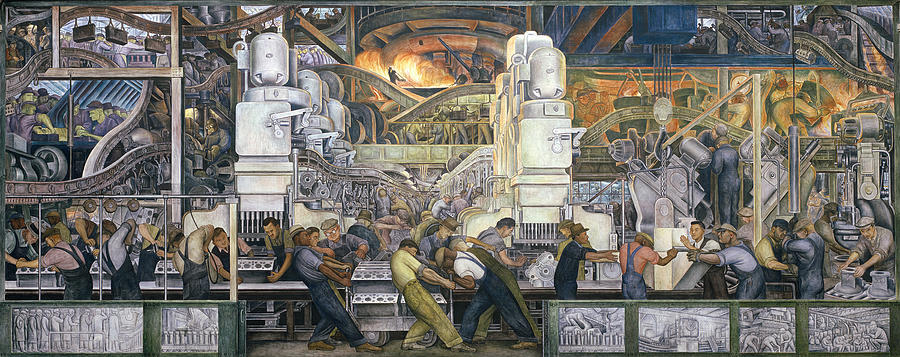
detroit-industry--north-wall-diego-riveraIn the first post I looked at those aspects of the Mendel-Gleason and O’Brien argument that I thought were broadly correct.  In this part I want to look at their other criticisms of what they see as the revolutionary approach and what I see as valid in their criticisms of what passes for revolutionary Marxism but what I believe is not necessary to it.

They state of the revolutionary approach that “destruction of the state is the order of the day, with the point of note being the sequence: first, the state, as the godfather of capital, must be taken out of the equation; only then can the working class organise, through new forms such as workers’ councils, the mass participation in public life necessary to the complete the journey to socialism.”

“Until a revolutionary situation arises in which the state can be smashed there are limits to what can be achieved on a mass scale since it is the process of revolution itself that draws the masses into public life.”

“The party that revolutionaries seek to build interacts with the masses during the revolutionary process and is the repository of the historical mission in less propitious times. But the revolutionary party itself has a different role than the workers councils and remains separate from them and pre-revolutionary mass organisations.  By separate we mean institutionally distinct, not that they never try to influence them.  Although naturally a pro-insurrectionary party would like to grow, it doesn’t aim to win a majority support for itself. . .”

“If anything the creation of permanent mass institutions becomes a fetter which prevents a revolutionary overthrow of capitalism by the treacherous actions of its bureaucratised leadership when the hour strikes.”

It is not that Mendel-Gleason and O’Brien are unaware of the dangers of bureaucratisation in the building of a socialist workers’ movement: “Clearly there is a danger that the day-to-day concerns force the grand vision into the background. Such is the risk of engaging with reality. But without being able to relate the day-to-day with the longterm project, the proponents of socialism will remain very isolated intellectuals.”

Mendel-Gleason and O’Brien also make criticisms of what they see as the anti-party and anti-political mindset of those who advocate workers’ councils but since I think this criticism is aimed mainly at anarchism and perhaps council communists I won’t take these arguments up.

If we work our way backwards through the criticisms above the first is the danger of bureaucratisation of workers’ organisations, especially through the long years (decades!) of non-revolutionary circumstances.  They are right to say that to try to seek to protect against this by avoiding the day-to-day concerns and small struggles of working people is failing to engage with reality.

We must start from where we are and not where we might want to be.  This might seem so obvious as to hardly require saying but take this from the British Socialist Workers’ Party article referred to in my last post:

“Who, after all, thinks that ‘in the present situation’ in France (or anywhere else) workers are going to try to centralise the power of their workers’ councils? The very precondition of such a development is that the ‘present situation’ has changed. The idea of revolution in a non-revolutionary situation is absurd. Every revolutionary situation has involved a split within the existing state apparatus and the existing ruling class. A revolutionary situation involves a crisis for the state, a loss of effectiveness. Without such a crisis there can be no revolution: that is part of the ABC of Marxism. It is precisely the crisis in the state which permits the emergence of a situation of ‘dual power’ and the possibility of a new form of state power conquering.”

The reformist approach to socialism is criticised by this writer for believing “the transition to socialism is to occur from the ‘present situation’ and without ‘economic collapse’.  In practice . . .  all reformists—seek(s) to construe a transition to socialism from the ‘present situation’.”

In other words revolutionary politics comes into its own when there is a revolutionary situation.  But of course how we get to this situation, how the working class is ready for it, how it has built its power and consciousness to the point where it can successfully challenge for power – all this has to be done precisely from the present situation.   After what has been decades in which there has patently not been revolutionary crises in the advanced capitalist states it is manifestly not enough to say that when such crises eventually erupt – although they will not even erupt without a prior revolutionising of working class consciousness, organisation and social power – we need to smash the capitalist state to effectively respond to the needs of such events.

Without a prior strategy to build up the power of the working class it will in all likelihood not be in a position to effectively challenge for power no matter what objective crisis capitalism undergoes.  The merit of the Mendel-Gleason and O’Brien argument is that they present this problem and it is the responsibility of Marxists to address it even if these authors use it as an argument against revolutionary destruction of the capitalist state.

There are other less crass ways of Marxists failing to engage with reality, such as demanding that campaigns or activity must meet some level of demands and therefore class consciousness that workers patently cannot rise to, at least not in current conditions or with the current level of political consciousness.  Some sections of the Left can then turn political demands not into bridges to advancing political consciousness but obstacles to action and subsequent rise in consciousness.

It is no doubt true that part of the reason for this is a belief by Marxists that the purpose of Marxism is to promote a revolutionary rupture and so seek to further this by advancing demands associated with partial struggles that if accepted by workers in such struggles can more or less quickly objectively clash with the logic of the capitalist system and therefore lead to revolutionary crisis.  The only problem of course is, as we have said above, it should be obvious that workers are many years from being in a position to perform such a role.  That many, many struggles cannot have a perspective of more or less raising the question of state power is hard to accept.

But it must be accepted because without being with the workers, no matter how backward their consciousness, socialism, real socialism, the socialism which is about the power of workers and not of the state, can by definition achieve nothing.

There are no formulas that guarantee this but it is important to dismiss formulas that guarantee against it.

Of course most left organisations claiming to be Marxist make the opposite mistake of dumbing down socialism so that it becomes an appeal to the state to accomplish what the working class is not yet willing or able to accomplish itself.

It is my view however that revolutionary politics not only exists in periods of relative class peace but must exist in such periods, if only because we have lived through decades of non-revolutionary conditions and the level of working class organisation and consciousness is now such that we cannot expect that this will be changed quickly.

Mendel-Gleason and O’Brien put forward similar ideas, without the view that revolution is necessary, but their argument is not always consistent.

Speaking of the tasks of the socialist movement now they say that: “We want to merge the socialists into mass organisations so that ideologically socialist parties exist on a truly large basis over a prolonged period of time, for decades at least, for centuries if necessary.”

But this sits uneasily with recognition of the dangers of bureaucratisation of the workers’ movement and how this weakens their case for a long term strategy of attrition: “The pressure of the wider pro-capitalist culture combined with the tendency towards increasing conservative apparatus makes the strategy of attrition a risky one. There is a race on between the socialist organisations aiming to transform capitalist society before capitalist society transforms them.”  A race lasting centuries?

Part of the problem Mendel-Gleason and O’Brien have is expressed in their description of their own strategy:

“The strategy of attrition is, therefore, compatible with a type of politics that is close to where many people already are. Its radicalism lies in its goals, not in its practice and this makes it easier to interact with non-socialists on an open basis. There is no need to hide its insurrectionary orientation because it doesn’t have one.”

The separation of goals and the practice of getting there inevitably means a failure to achieve the goals or leads to a different practice.  The view that socialism can be delivered by the state taking ownership of the economy, or redistributing wealth, does not lead to the working class achieving power but the extension of the power of the state.

Revolutionary politics therefore involves workers achieving what they can achieve by themselves.  The revolutionary content in any demand, or action or programme is the growth in the independent power and consciousness of the working class.  This obviously achieves its fullest extent when workers challenge for state power by attempting to destroy the state power wielded by the capitalist class and by creating its own.  But this does not prevent, rather it requires, years of workers learning that it is their own action that will deliver them what they want and what they need.

Building an independent trade union is more revolutionary than calling for increased taxation of the rich by the state even if some success attends the latter.  Creating a workers’ cooperative is more revolutionary than calling for the nationalisation of the banks even if banks, as they have been, are nationalised.  Workers fighting to control their own pension funds and taking them out of the hands of the bankers is more revolutionary than demanding that the state jail the corrupt bankers.  The latter happens in the US and the trial of the Anglo Irish bankers has begun.  They get jailed?  How does this advance the independent power of the working class?

We are now able to see how revolutionary politics is compatible with the long years of relative class peace as well as revolutionary crises.  We can evaluate political programmes as more or less revolutionary or reformist without being obliged to speculate on near-hand revolutionary crises.

We can say with Marx that:

“It is not a question of what this or that proletarian, or even the whole proletariat, at the moment regards as its aim. It is a question of what the proletariat is, and what, in accordance with this being, it will historically be compelled to do.”

But what the working class is and what it therefore does depends on its own existence, its own struggles and not on the actions of the state and those who inhabit it.

Much of the ‘transitional’ character of Trotsky’s transitional programme, upon which for many revolutionary politics must rest, does not connect the class struggle to the creation of an entirely new socialist mode of production.  This was something we saw in the first post and taken up in the comment to it.

That which does, the expropriation of capitalist enterprises, is wrongly bastardised into nationalisation by the capitalist state, see my earlier post.

We can now therefore look again at the description of revolutionary politics from Mendel-Gleason and O’Brien which we quoted earlier.

It is not necessary for revolutionary politics to claim that only revolution that can bring the working class into mass participation in politics.  Building workers cooperatives, trade unions and a workers’ political party are all necessary to stimulate and develop working class consciousness and organisation.  A revolution is not necessary for any of them.

It is a truism to say that only revolution expresses this participation to its fullest extent but even here the prior establishment, development and political defense of workers ownership requires certain levels and type of workers activity that political revolution is not a substitute for.  Cooperative production involves the working class learning the skills and experience of the future mode of production.

Revolutionaries do have to separately organise but this does not necessitate institutional separation in terms of a completely separate party.  Revolutionaries can seek to win a majority of the working class prior to a revolutionary situation.  It is not a fetter to win the majority of the working class to socialism; even if the majority of the working class did not actually support a revolutionary perspective.

The dangers of bureaucratisation and conservatism are real but deliberate minority status of the revolutionaries doesn’t protect either this minority or do anything to win a reformist majority.  Often of course reformist leaders will not give revolutionaries the choice of working within a larger reformist working class party but it is no answer to seek separation if revolutionaries are otherwise free to organise.

Revolutionaries do not believe that it is only after the working class has smashed the capitalist state that it can organise or we would have a classic chicken and egg situation – we can’t destroy the capitalist state until we are organised and can’t organise until we have destroyed the state.

It is in fact my argument that it is precisely the view of Mendel-Gleason and O’Brien, of attempting to use the existing state to create socialism and to organise primarily through electoralism, that restricts and limits the participation of workers in political activity and heightens the bureaucratisation of the workers’ movement.

It is obviously true that socialist revolution has not succeeded during the twentieth century but it is also true that this has been partly because the workers’ movement has been bureaucratised by and through the capitalist state that Mendel-Gleason and O’Brien think is the answer to the former failure.  And the strategy that produced this bureaucratisation was one of seeking election to office within the capitalist state when the working class was in a position only to administer capitalism not overthrow it.

In the next post I will look at the Mendel-Gleason and O’Brien view of the capitalist state some more.

The debate on socialist strategy and the Irish Left – Part 1

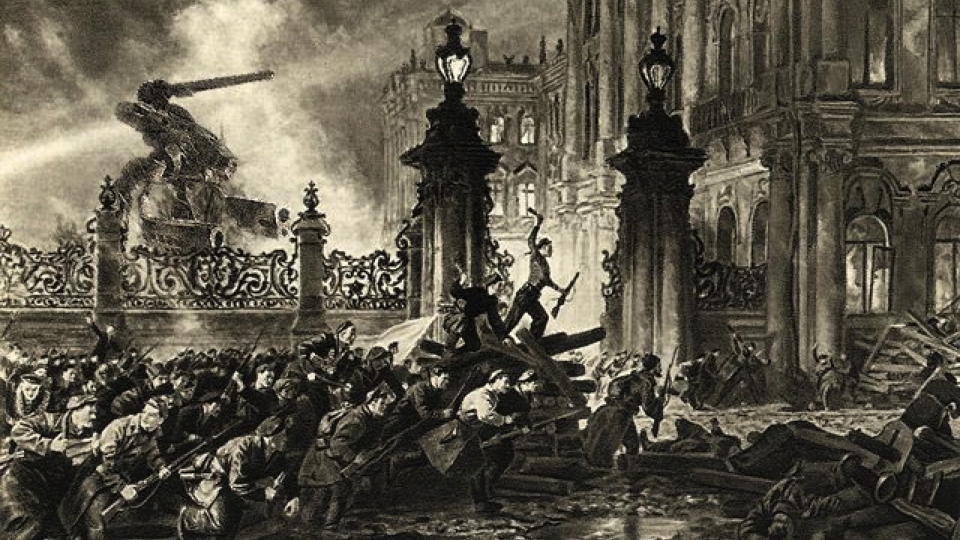
revolutionA couple of leading figures in the Irish Left Forum , Gavin Mendel-Gleason and James O’Brien, have written an extended piece on socialist strategy published here.   This has been subject to a ‘health warning’ and a critique on the Revolutionary Programme site here.  The latter is carried out mainly by simple reference to large quotations from Marx, Lenin and Trotsky.  The author gets away with this approach because these quotations are so apposite.

I welcome the intervention from the members of the Left Forum for the following reasons: They propose a strategy and practice that is already that of the Left groups in Ireland who claim to be Marxist.  The latter’s arguments are that the capitalist state can play a progressive role in the movement to socialism and that the main activity that workers and socialists should engage in is electoral intervention.  The left groups demands for nationalisation, increased state expenditure and taxation of the rich plus activity geared excessively to elections are evidence of this.

The difference between these groups and the Left Forum authors is that the latter put up an argument for such an approach.  Since it is common on the Left not to bother with such things this is to be welcomed.

The second reason is that the arguments put forward are important and some of them are correct.  These are not addressed in the reply noted above so I believe that some of the most important issues which they raise have not been adequately answered.

The third reason is that a debate on strategy is to be welcomed and if there is to be a debate there will be differences.  We should develop an ability to discuss them.  If we don’t or can’t then future initiatives at uniting socialists will be as unsuccessful as those in the past.

So what are the arguments and issues raised that are important and by and large correct? These are made mostly in the second part of the Mendel-Gleason and O’Brien piece.

The authors make the entirely valid point that “when capitalism tottered in September 2008 there wasn’t the slightest question that there was an alternative economic system that could step in and immediately take over.”  What this means is that we do not have an alternative, to be exact – an alternative that is both global and immediate.  We do have one that can grow and develop but not one that can challenge the capitalist system now.

It was lack of an alternative that explains why workers accepted, some even voted for, the imposition of manifestly unfair and hurtful measures in the EU referendum in Ireland in 2012.  In the post after the referendum I argued that it was precisely this lack of an alternative that was the main reason for the defeat in the austerity Treaty referendum, despite workers’ anger and frustration at what they were being asked to endorse.

is an expression of the weakness of the workers’ and socialist movement existing more or less everywhere, which Gavin Mendel-Gleason and James O’Brien also note. Their argument is that the perspective of a workers’ revolution to overthrow the capitalist state and usher in socialism is mistaken.

In making this argument they make some valid observations. They finish their analysis by saying, although they could have started it from here, that “Our short-term tasks do not involve overthrowing capitalism — a mode of production cannot even be overthrown. . .”  By this I assume that they mean that the capitalist mode of production cannot be overthrown without it being replaced (unless we envisage ruination as Marx put it in The Communist Manifesto) and it is the latter that is important, which might seem an obvious point except the question arises – replaced by what?

In the model of socialist revolution this is usually thought to mean replaced by ownership of the means of production by a workers’ state.  But states are just people organised in a certain way so how is this group of people to know how to run an economy and do so better than the capitalists if they have never done it before, have no practice and no plan to do so?

They have no plan to do so because the typical scenario for revolution is that it is a revolt against attacks on workers’ rights and not a conscious offensive to change the mode of production, which rather simply appears as a by-product of the need to smash the capitalist state through a mass strike and the creation of workers’ councils.

Some advocates of revolution accept this argument and therefore accept that socialist revolution will lead to economic collapse.  And although of course this is only temporary, a bit like a loss of form where your football team drops a few points – before going on to win the league, the prospect seems far from one that will sell socialism to most workers.  In fact it sometimes seems entirely light-headed and the product of a mentality entirely alien to most workers.

Take this example from the Socialist Workers Party in Britain. The writer says this – “we must be clear: a transition to socialism, to the complete reorganisation of society by the working class, cannot occur without ‘economic collapse’.  A socialist revolution involves ‘economic collapse’: the problem is to carry it through, decisively, so that economic recovery on a new basis can be started immediately.”

Let’s be very clear – if the socialist revolution leads to economic collapse it calls into question the readiness of the working class to be the new ruling class in the first place since it obviously lacks the power to prevent collapse and if this is the case what guarantees can there be that it would be capable of reversing it?  Especially “immediately”.

Mendel-Gleason and O’Brien state correctly that “getting past capitalism is an incredibly difficult problem,”  “At the outbreak of mass protest or revolution this is not a problem since the issue presents itself to the opposition in a simple way, e.g. “down with the regime”, “against the 1%”, “they all must go” (Argentina 2001). Sooner or later, however, it becomes necessary to move beyond a simple formulation of the problem and to advance structural solutions. “

“This transformation to socialism can only come from the working class having a pre-existing organisational capacity to take advantage of these developments, especially in the most advanced countries, of which the United States is currently the most important. That capacity takes decades to build up and it’s not a process that can be rushed or circumvented by some clever shortcuts and nor should it be.” “Unfortunately, it’s simply not possible to get big and capable institutions in one go.”

This seems obviously true and it is the necessity to build up the working class movement to such a position to effect revolution that is the task. Unfortunately this is not the task that Mendel-Gleason and O’Brien seek to solve by the strategy of increasing the power of the working class for they see the above problem as one that means that a revolutionary strategy is not appropriate.

One reason they posit for this is that the division of labour within modern economies has so developed that the intricate coordination necessary cannot arise from what is an essentially spontaneous process of revolution.  This view might therefore legitimately say that simply trying to make a virtue of this fact by admitting the inevitability of economic collapse also involves tacit admission of the dangers they see in revolution.

These include diminishing enthusiasm of the masses, because their revolutionary fervour is of recent, and therefore limited, vintage  since otherwise we would have had decades of a revolutionary situation, which is hardly credible.  This would be exacerbated by the drop in living standards consequent on ‘economic collapse’ and a similar consequential fall in political support for the revolutionary process.

These seem reasonable objections and it is up to those who defend and argue positively for the revolutionary overthrow of the capitalist state to present their strategy in such way that it plausibly answers this criticism. Before we look at this aspect however we should note other correct arguments advanced by Mendel-Gleason and O’Brien.

They rightly argue that there is “no shortcut to building up mass, popular organisations” and they are guilty only of exaggeration when they say that “in the absence of mass socialist-labour institutions workers’ capacity for action is restricted to protest and destruction.”

Protest demonstrations are the staple of left group activity and their electoral interventions are also a pure protest since they nowhere claim that they will form part of a government if elected. Mendel-Gleason and O’Brien argue that this is not enough “for the project of raising a socialist mode of production to dominance, via co-ops and labour unions.”

It is on building up this alternative that they concentrate their argument, pointing out the need to build specifically working class organisations , as the socialist movement used to do before the functions these organisations performed were taken over by the state and the majority of socialists took to believing that state action was somehow equivalent or substitute for working class self-activity. They point out the need for working class mass media and to the early history of the German Social Democratic Party and its ‘eco-system’ of social clubs, publications and summer camps etc.

They point out the failures of the Left’s favourite tactic of ‘single-issue’ campaigns which, besides usually being sectarian and right-ward looking fronts of one particular organisation, are incapable of getting beyond a single issue, incapable of broader radicalisation “so that when that campaign is over, irrespective of whether it has ended in victory or defeat, the next campaign must start from the same low basis.” These campaigns are structurally incapable of persisting through time and of achieving the cumulative growth of membership, organisation and consciousness on which alone a truly mass socialist working class movement can be developed

Some remarks on the internal organisation of the socialist movement are also in my view correct although not because of any original insight by Mendel-Gleason and O’Brien or myself.  Thus there is a need to fight for socialism within the working class movement of party, unions and cooperatives using the weapon of “freedom to organise and the freedom to articulate criticism and dissent.”  The petty bourgeois character of much of the left organisations is revealed by their inability to organise democratically.

So what is essentially valid in the argument is that while destruction of the capitalist state might solve the problem of armed reaction by that state (which is no small issue!) “it doesn’t . . . solve the problem of being able to transition to a socialist mode of production.” In the next part of this post I will look at what Mendel-Gleason and O’Brien have to say about the state itself.

Arguments against workers’ cooperatives: the Myth of Mondragon Part 2

mondragon-humanity-at-workIn Part one of this post I looked at the argument that the most famous example of workers’ cooperative ownership involves the division of the working class within the cooperative so that technicians and especially mangers have different views and interests from manual workers.  This is reflected in their relative enthusiasm for the cooperative form.

In fact there is no evidence or argument presented in the book under review that there is a fundamental difference of interest between managers and workers arising from class position within the relations of production, although some evidence that there is differing levels of enthusiasm.

I argued in response that the evidence for the view that there is weaker engagement of workers in the cooperative involves writing off the views of the higher paid workers, some of whom might be called managers, but that there is nevertheless some weak evidence of an unhealthy lack of participation by manual workers in decision making.  In Marx’s support for cooperative production he noted that:

“The co-operative factories of the labourers themselves represent within the old form the first sprouts of the new, although they naturally reproduce, and must reproduce, everywhere in their actual organisation all the shortcomings of the prevailing system. But the antithesis between capital and labour is overcome within them, if at first only by way of making the associated labourers into their own capitalist, i.e., by enabling them to use the means of production for the employment of their own labour.”

The evidence of the book is that some of the most political workers have organised to struggle against some of these shortcomings and have succeeded.  This response of the workers is one that should be supported rather than dismiss workers ownership outright.  To anticipate the whole argument – if workers should not take up experiments in running their own workplace how are they ever to be expected to – in one momentous event called revolution – ever to take over running the whole of society and creation of their own state to protect it?

The actions of these politicised workers show the role that a workers’ party could play in advancing the socialist project within cooperative production.

The argument of the book (The Myth of Mondragon) however is not only that the real workers cooperative, as opposed to the mythical one, divides workers within the cooperative but more especially has resulted in, and was meant to result in, the division of the working class in the local area and within the Basque country more generally.

The argument has already been referred to but it is made up of several components.  The first is that the cooperative has imposed middle-class values on workers by making them, in effect, small property owners.  In this they faithfully reflect the motives and views of the original sponsor of the cooperative in Mondragon, Catholic priest José Mariá Arizmendiarrieta, who was heavily influenced by Catholic social teaching and who sought to ameliorate class struggle through education and co-operativism.  Hence the significance noted in the first post of relatively more co-operators viewing themselves as middle class than workers in a private sector firm.

This fed into the views of Basque nationalism, particularly the bourgeois PNV (Partido Nacionalista Vasco) but also the radical nationalism of ETA, which, like the Irish versions of bourgeois and petty-bourgeois nationalism, liked to look on the Basque people as inherently egalitarian and predisposed to small property ownership which united the nation against the outside enemy, harking back to an original society free of class contradictions that preceded foreign rule.  For the radical nationalists the cooperative could simultaneously be supported by emphasising Basque unity and workers participation, so demonstrating the compatibility of nationalism and socialism while opposing any role for foreign multinationals.

The cooperative was thus a conscious political instrument to divide the working class, which was traditionally militant and socialist.  This division is also exhibited in resentment by some workers in Mondragon expressed in remarks that ‘los cooperativistas’ “have it easy”.

A third element of the argument is that it is no coincidence that the cooperative was set up under the fascist regime of General Franco since both co-operativism and fascism share a desire to negate class struggle.  Cooperatives were also supported by Mussolini and the Mondragon cooperative came into existence only because more militant forms of working class action were illegal and repressed.

The author of the book refers to the first criticisms of Mondragon by ETA which accused the Mondragon cooperative of dividing the local working class between co-operators and the rest because the cooperative workers did not want to engage in strikes with their fellow workers.

What is to be made of these arguments?

The argument that the cooperative workers have bought into the illusion that they are middle class is not strongly supported by the evidence in the book but if they did they would not be alone because such identification is not uncommon amongst many better off sections of the working class.  That through the cooperative, through their ownership of the firm, there is some basis for such a view is reflected in the quote from Marx above, that the workers make themselves their own capitalist.  However, this has not prevented workers expressing solidarity with their fellow workers or being sensitive to inequality within the workplace. Objectively their position is a transitional transcendence of capitalism but a very partial one, the more partial the more isolated it is, and cannot provide on its own guaranteed grounds for the development of socialist class consciousness.

This needs to be fought for by a working class party.  The class struggle is not abolished by cooperatives but is a means to pursue it and a battle ground on which to wage it.  The question is whether this battle involves growth and development of the cooperative form or not?  The answer for Marx was clear:

“. . . however excellent in principle and however useful in practice, co-operative labour, if kept within the narrow circle of the casual efforts of private workmen, will never be able to arrest the growth in geometrical progression of monopoly, to free the masses, nor even to perceptibly lighten the burden of their miseries. . . To save the industrious masses, co-operative labour ought to be developed to national dimensions, and, consequently, to be fostered by national means.”

That the Mondragon cooperative was sponsored by a Catholic priest should no more be a reason for condemning it than should the Bolsheviks have condemned the demonstration led by the Russian Orthodox priest Father Gapon, which sparked the revolution in Russia in 1905.

That cooperatives have existed under fascist regimes does not demonstrate that they are essentially instruments of fascism any more than it demonstrates that fascism is the essential expression of cooperatives.  In Italy Mussolini’s fascist thugs terrorised and burnt cooperatives before making them subordinate to the fascist regime.  In Spain the dictatorship of Franco could allow isolated cooperatives to the extent that they did not follow the path, recommended by Max to the First International above, that they expand and combine to develop nationally and indeed internationally.

The example of fascist sponsorship or acquiescence is but the most extreme warning to workers that the potential for their independent initiative should not be compromised by seeking the sponsorship of the capitalist state, no matter how democratic its form.  The revolutionary content of workers cooperatives, whatever its workers might believe at any particular point in time, is that they represent the independent actions of a class that is taking measures that undermines one pillar of existing society, which is the monopoly of the means of production in the hands of a separate class of capitalists.

The need to expand is not limited to national growth but is practical demonstration that workers ownership can only succeed internationally.  So far from supporting any form of nationalism it is practical vindication of the need for workers to reject national solutions, and not just at some future point in time but now.  Workers’ ownership should be extended internationally not tied to some view that workers are part of a purely national development of a specific country and its particular state, especially when this state is inevitably a capitalist one.  Workers of different nationalities united by ownership of the one enterprise with different workplaces in different countries would be powerful demonstration of unity of interest and practical international solidarity.

The first criticisms of ETA reflect a common view on the Left, which appears to be endorsed by the author of the book, which is that the struggle of trade unions against employers is a better model of class struggle than the development of workers’ cooperatives.  Hence the criticism that the cooperative workers often did not go on strike, even though the author quotes a local militant expressing the view that this is perfectly understandable.

Who would they be striking against?  If the purpose is not to influence or pressurise their employer, which is themselves, then it would be part of a movement to demonstrate support for particular demands and the strength of feeling and organisation behind those demands.  In that case this is what demonstrations and meetings are for.

In themselves trade unions do not exist to undermine capitalism but to enforce its operation by acting on one side of the supply and demand of labour power which sets its price.  It enforces the laws by which capitalism regulates workers alienation from ownership of the means of production, it does not in itself threaten it.  Strikes can be seen as a simple refusal to sell labour power for a period rather than an existential threat to the wages system itself.

Would Left critics criticise strikes that demanded workers ownership of their firms?  Or would this be seen as a demand not actually to be realised but one only useful in so far as it leads more or less quickly to revolution?  In which case what would they say if some workers, but not all, actually succeeded – fuggedaboutthat and let’s start all over again?

None of these points negate the argument that trade unions might not be helpful for cooperative workers in order to assist them in both elaborating alternative plans for their coop or to protect them against the actions of management. Particular interests of workers are not guaranteed by workers ownership but we should not believe that trade unions are somehow superior forms of workers’ organisation and representation than the organs of the cooperative.

The latter will be composed of all the workers while the trade union will usually not.  Trade unions are not inherently more democratic as the current bureaucratised organisations show.  Nevertheless for particular workers or in particular circumstances they may be useful in representing the interests of some workers even against the majority.  These workers need not be more backward but could be more advanced and we should not necessarily believe such organisation is required because the unions are needed to represent workers in the same way Lenin claimed they were required as protection against their own bureaucratised state.

The book recalls a significant strike in the Mondragon cooperative in 1974 sparked by job regradings and the system for their evaluation.  The strike only lasted one day, following a walk-out by some of the workforce, but twenty-four leaders were fired pending a vote of a general assembly of the workers.  When this assembly convened the workers voted to uphold the sackings.  A campaign was launched to let them return which eventually, in 1978, led to their being readmitted.

The strike and its aftermath exposed the political assumptions behind the participants on both sides with cooperative managers claiming the strikers were anti-Basque while some of the strikers went on to join a Maoist-oriented organisation.  Some Left organisations then went on to develop left-wing critiques of cooperativism.

The messiness of such events gives a headache to those who like their politics simple, with workers on one side and bosses on the other.  Simple trade unionism seems to provide for that although simple trade unionism does not go beyond capitalism, much of it is purely sectional and some of it is even reactionary.

Despite the authors apparent approval of this model of class struggle she notes that, contrary to her overall argument, that the “most important factor influencing the local labour movement” was the Moncloa Pact between the Left parties, including the Spanish Communist Party, the trade unions syndicates and the Spanish Government.  This accepted changes to the law which reduced workers’ rights below what had been provided under the Franco dictatorship.

So trade unions are not an anti-dote to workers’ failure to make islands of socialism out of workers’ cooperatives, which can hardly be expected because they haven’t been able to do that for themselves.  The answer is not to see workers cooperatives as alternatives to class struggle but as part of it.  Once again the question is whether the answer lies in expansion of cooperatives or their rejection.

The answer for Marx was that they should be developed.  This is elaborated on in the two posts recommended by Boffy in his comment on the first of these posts on Mondragon.

On their own a cooperative can easily be a capitalist enterprise owned by its workers in which, as Marx says, the workers become their own capitalist.  What makes them a powerful weapon of transformation is their development and growth into a social and economic alternative to capitalism through cooperation between them and their living example of workers’ power.

As isolated coops they are indeed subject to the economic and political subordination of the capitalist economy and its state.  If content to be providers of jobs and income only to their members there is clearly no wider ambition.  However as a cooperative movement determined to grow and develop in other areas of production, both to secure its own future and share its benefits with others, and to provide other cooperative services such as education, health and other socials services, it inevitably poses itself as an alternative to capitalist production and the capitalist state’s provision of services.  It becomes a political alternative because its growth, as an economic sector driven by the needs of its workers and their customers and not by profit, is a real, practical and living example of an alternative economic and social system.

The development of the cooperative sector to become such a political rival and alternative is at least partly dependent on Marxists fighting for such a perspective within cooperatives and for cooperatives to propagandise their alternative.  In Marx’s remarks to the First International he praises workers’ cooperatives and calls for the workers to pursue just such a task:

(a) We acknowledge the co-operative movement as one of the transforming forces of the present society based upon class antagonism. Its great merit is to practically show, that the present pauperising, and despotic system of the subordination of labour to capital can be superseded by the republican and beneficent system of the association of free and equal producers.

(b) Restricted, however, to the dwarfish forms into which individual wages slaves can elaborate it by their private efforts, the co-operative system will never transform capitalist society. to convert social production into one large and harmonious system of free and co-operative labour, general social changes are wanted, changes of the general conditions of society, never to be realised save by the transfer of the organised forces of society, viz., the state power, from capitalists and landlords to the producers themselves.

(c) We recommend to the working men to embark in co-operative production rather than in co-operative stores. The latter touch but the surface of the present economical system, the former attacks its groundwork.

(d) We recommend to all co-operative societies to convert one part of their joint income into a fund for propagating their principles by example as well as by precept, in other words, by promoting the establishment by teaching and preaching.

Let’s see how such a perspective might address another frequent criticism of Mondragon and other cooperative enterprises.  This is that the cooperative further divides the working class through its large use of temporary contract labour, as much as one third of a particular workforce in Mondragon.  These workers are not members of the cooperative with all the rights of membership and obviously have much less job security.  In these circumstances the workers are not their own capitalist, since they do not have membership of the cooperative, and are exploited not by themselves but by others – the Mondragon cooperative.

If it was the case that these workers were indeed needlessly kept on purely temporary contracts it would be open to the most class conscious workers within the cooperative to campaign and seek a vote on their award of cooperative membership.

On the other hand let us assume that the cooperative workforce does not accept this because it views these workers as an unfortunate but necessary buffer against periodic reductions in demand for their products, such fluctuations being an inevitable feature of capitalism.  Then it would not be possible to give these workers cooperative membership because the cooperative could not guarantee their continued employment should demand for the products they make fall.  This might be despite the fact that the Mondragon and other cooperatives seek to move workers around the wider cooperative group in order to protect the employment of their members.

The second class status of the workers could lead to resentment within the wider working class and support for the view that the cooperative workers are indeed a privileged layer that is separate from the rest of the workers.

What is the answer to this problem?

The answer is not obviously to give these workers the same rights as the rest of the cooperative workers for this solves no problem.  If demand does suffer a drop or there is some other crisis in the cooperative, for example if some customer does not pay up because it has gone out of business, the cooperative can choose to keep all its workers on the payroll and then either weather the storm or as a result go out of business altogether.

If the latter is the foreseeable result of the event then keeping all the workers on is a mistake, not only for those workers who could otherwise save their job but for the cause of worker owned production in general.  The whole cooperative would cease to exist when part of it at least could be saved.  If all the workers, including temporary workers, have equal rights how is it to be decided who will lose their job?

If this problem is to be minimised the cooperative should seek to be part of a wider federation of cooperatives so that downturns in economic activity in one area can be made up by possible growth in employment in another.  The larger the cooperative movement the more scope there is to diversify risk and build up reserves to protect its members during crises.  Were this to happen then cooperative production would be seen by workers in the capitalist sector as a real progressive alternative to the insecurity of the capitalist sector in which workers jobs are more or less quickly sacrificed for the profits of the big wigs.

The answer then is not to reject cooperative production but to seek its growth.

In the meantime there are steps that could be taken to defend the rights and position of temporary workers.  The first might be to ensure adequate union organisation and representation for them within the cooperative.  The second might be for these temporary workers to form or be part of a ‘temporary workers’ cooperative themselves, which has a membership across a number of firms that might not all have to be cooperative enterprises. (Just such an idea is proposed by Boffy in the posts referred to above).

In this way the temporary workers would not have to simply rely on the actions of others but would, through their own cooperative employment agency, take some control of their employment situation including building up reserves for bad periods, providing social insurance or job seeking support, including retraining facilities.  Such a cooperative could be the sponsor of a political campaign in defence of the rights of temporary contract workers.

To return to the main argument: the promotion of cooperative production is not an alternative to class struggle but a part of it.  It is the solution to a problem that many of those who believe in socialist revolution believe does not exist.  This problem is that the majority of the working class do not see any need for their own ownership and control of production.  They not only do not see the need for it but even if they did they have no experience of it, nor any particular, in fact any, view of how it would seek to achieve its aims.

The view that running society is something that can be done more or less easily on the morrow of the revolution does not ask why workers would carry out this revolution in the first place or why they would be fit to run things after it.  What is it they would seek to do differently and how could it be done?

Instead the process of revolution, as normally argued, envisages workers rebelling against attacks on their living standards and democratic rights through some sort of politicised general strike which develops into workers councils.  These will then take over from the capitalist state.  What is missing from this is any understanding of socialist revolution as a change in the mode of production.  From one based on profit to one based on use.  From one based on capitalist ownership of the means of production to one based on workers ownership.

We are asked in this scenario to believe that the whole working class will in one fit of more or less violent rebellion against repression etc, seek and know how to implement its own ownership of production but that such strivings should not be encouraged or expressed before the revolution in the growth of workers cooperatives.

There is no need for workers to learn about how to organise production within their own factories and offices.  No need to learn how to manage trade and production between other workplaces and customers.  No need to master how the economy works the better to make changes that benefit fellow workers and fellow consumers.  No need to learn how to compile economic plans within the firm, within the wider cooperative movement and the wider economy.

No need to learn by practical experience the role of the capitalist state in protecting capitalist property against rival workers’ owned property; to learn the need to build their own structures that will defend their plans to develop production as they see fit, and no need to seek to defend their own cooperative property through the overthrow of the capitalist state.

The argument is not whether cooperative production plays a role in the move to socialism but what role that is, over what period of time such production can realistically be expected to develop and what the role is of Marxists in politically fighting for and defending the growth of workers property.

Back to part 1
Why have the Irish not revolted? Part IV

gustave_dore_fourth_circle_dante_infernoIn much of Europe the workers movement developed in the latter half of the 19th century and first half of the 20th through industrialisation, the growth of trade unions and socialist parties and the radicalisation caused by two world wars, in particular by the first.  The socialist movement often led the struggle for democratic rights and freedoms and gained support as a result.

The Irish experience has been different, leading to a working class with a lower level of class consciousness.  While Ireland started to industrialise early it was thrown back by the development of superior industrial development in Britain.  What industrialisation did occur was small and mainly concentrated in the north east of the country.  Defeat and brutal repression of Ireland’s bourgeois revolution in 1798 led to a bitterly divided working class with the most extreme reactionary ideology dominating the most advanced industrial area.

The land question was denuded of its radical potential by this counter revolution and by the effects of the catastrophic famine in the middle of the19th century when, in a population of over 8 million, around a million died and a million emigrated and the population began a decline that did not reverse until the 1970s.  The number of agricultural labourers fell by 700,000 from 1845 to the early twentieth century, the number of small farmers was halved and the cottier class almost wiped out.  All this could only but weaken the potential base for a radicalised land movement.

The result of all this was that when the national movement erupted in the first decades of the twentieth century in a battle for an independent state it was dominated by middle class revolutionaries who subordinated workers’ interests with the demand that ‘labour must wait’, which has been pretty much the policy of Irish republicanism since.

The new truncated statelet these most conservative of revolutionaries created was dominated by the same economic subordination as that which preceded nominal independence, resulting in economic growth after foundation of the new state at very much the same rate as before its creation; and a polity not much different than before except for the role of the new Irish bourgeoisie that often proclaimed its Catholicism more than its nationality.

The working class in its majority never broke from this political class and the socialist movement has been small and peripheral.  The Second World War passed the Irish State by and during the 1950s emigration was higher relatively than it had been almost 100 years earlier, sapping all social classes of vitality and energy.

The Irish State caught the tail end of the world-wide post war economic boom and the workforce in industry increased from 259,000 in 1961 to 363,000 in 1981.  Overall however there was little increase as the numbers employed as agriculture continued to decline.  This growth in the working class led to some limited revival in socialism reflected in the Labour Party claiming ‘the 70s will be socialist’ before that decade came and went  and republicanism being genuinely influenced by socialist ideas, although of a Stalinist-type that did not offer any real alternative.

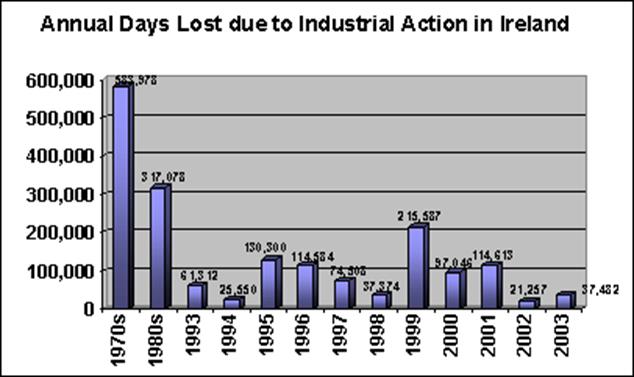
This period saw a large growth in the number of strikes so that at one point the Irish State had the highest number in Europe (see below).

strikestats

It also witnessed huge demonstrations against the high taxes imposed by the State on the working class, which amounted to 87 per cent of all income taxes in 1978. In 1979 over 150,000 workers demonstrated in Dublin with many thousands in thirty other towns including 40,000 in Cork.

At this point the Irish State’s model of economic development began to collapse. World-wide economic crisis, a weakening of foreign investment and bankruptcy of indigenous industry led to massive unemployment, renewed emigration and a ballooning State debt.  That the Irish working class and small socialist movement were unable to offer an alternative to the resulting capitalist restructuring and political offensive should not surprise.  There was no successful resistance and alternative created anywhere else.

The defeat of the tax struggles in the late seventies and early eighties and the inability to take advantage of ruling class political disarray, evidenced by repeated general elections in the first few years of the decade, plus the mass unemployment and emigration during the decade, weakened the working class both materially and politically.  The graph of strike activity above clearly shows a steep decline from the 1970s from which there has been no recovery.  It was in these circumstances that social partnership was imposed in the late 1980s.

Partnership signalled the move away from bargaining with the employers and State through militant action and acceptance that when the solvency of the State was in question this took priority.  Beginning in 1987 a series of deals were negotiated that meant accepting major cuts in pay and state services in order to reduce the massive State debt.  The parallels with today are obvious.

There was resistance to social partnership but it came in its most militant form from outside the trade unions and the trade union leaders were decisive in its relatively smooth introduction.  This defeat of militant workers action and acceptance of the prerogatives of capitalism was, as we have said, not at all unique to Ireland.

Across the world the ability and willingness of the working class to fight back in defence of its interests was set back.  Strike statistics are only the most graphic measure of this development.  Taking 42 countries and looking at the period between 1981-85 and 1996-2000 the number of countries in which strikes increased was 8 while there were 34 countries in which they declined.  In the group of countries in which strikes had risen the increase was only 5,183 while the reduction in strike numbers was 63,657 in the group of countries in which there was a decline.

In the Irish State the annual number of days lost in strikes fell from over 580,000 in the 1970s to 26,650 in 2005.  In the latter year there were only 15 strikes and only 10 in 2006, in which only 7,352 working days were lost, the lowest since records began in 1923.  In 2007, the last year of the boom, there were only 6.

As a percentage of the employed workforce trade union membership fell from 56.2% in 1987 to 42% in 1998.  Separate figures record a reduction from 46% in 1994 to 35% in 2004 while the Irish Congress of Trade Unions has admitted that density continued to fall, being lowest among young workers.  Where unions did exist member participation dropped and some of the features of bureaucratisation long normal at higher levels of trade unions infected union representatives further down the ranks.

All this occurred during an unprecedented boom in the economy, the period of the Celtic Tiger, when GDP growth ranged between 7.8% and 11.5% from 1995 to 2000 and between 4.4% and 6.5% from 2001 to 2007.  From 1990 to 2007 total employment grew from 1.160m to 2.112m, an increase of over 80%.  While incomes fell during the 1980s they grew rapidly during the Celtic Tiger.  The historical working class was recreated in many ways as a result of rapid economic growth both quantitatively as a result of falling unemployment, immigration and increased labour force participation rates and qualitatively as a result of the increased employment of women (whose number grew by over 125% from 1990 to 2007) and an influx of foreign workers.

The Irish working class was recreated as a result of a boom fuelled primarily by foreign investment, which excluded unions from its workplaces, increasing corporatism and bureaucratisation of the unions that did exist.  This within a world in which the historic goals of the working class movement – from progressive reform of the capitalist system to the view that it could be replaced – was increasingly discredited through the fall of Stalinism and defeat and retreat of workers struggles and the claims of social democracy.

The boom saw no political strengthening of the workers’ movement even as unemployment fell and the class objectively, at least in numbers, grew enormously.  As we said at the end of Part 3 capitalism is a revolutionary mode of production that recreates the working class.  In the Irish State it did so in a way and in circumstances that did nothing to overcome the historic political weaknesses of the class.  Indeed the trade unions became weaker as they bought into social partnership and the view that the interests of workers, State and bosses were best aligned.  Even the historic nationalist politics that has been hegemonic became encapsulated in the need to have a low corporation tax for US multinationals.

Lack of a strategic alternative, among other things, brought about defeat of the large struggles of the 1970s.  Unemployment, emigration and prolonged economic crisis brought an assault by the State on working class living standards and did so in such a way that it survived, even prospered, when the economy recovered and entered into a boom.  Social partnership sold the working class into sacrifices to bail out the State from bankruptcy and made the workers subordinate even when the boom gave them the conditions in which they could have recovered their strength and learnt to advance their own interests.  Instead, in so far as social partnership was later abandoned it was abandoned by the State.

The nationalist politics of the working class, the partnership with the state and the agreement of workers to sacrifice themselves on its alter came together in the reluctant acceptance of workers that they must bail out the banks and accept austerity when the economic crisis finally broke.  This dependence on the State can be seen in two other ways.

In Part 2 we noted that the left wing economist Michael Taft has claimed that the ‘squeezed middle’, the 4th to 8th deciles of income earners, suffered declines in direct income in the five years leading up to the crash, gaining only as a result of social transfers.  Social partnership involved a deal between the trade union leaders and the State/bosses in which workers refrained from industrial action and accepted lower than potential pay rises in favour of tax cuts.  This was not just the case in the final years of the boom but was the line pushed almost from the start – a policy that became more and more explicit as the partnership deals were negotiated.

Thus not only did the workers movement become denuded of any militant initiative but it became more and more dependent on the state, and this was true not only of public sector workers but of workers in the private sector as well.  Gross average industrial earnings grew by 25% in real terms in the 15 years between 1987 and 2000 but take home pay rose by 60% for a single person and 58% for married because taxation was cut.

Mainstream economists, in 2000, also reckoned that these tax cuts were regressive because they were largely achieved through reductions in tax rates, which favoured those on higher incomes.   It is well known that the State became excessively reliant on revenues from a credit boom but what this shows is that social partnership, and the whole strategy of the trade union leaders, was just as reliant.  But really, how could it be otherwise?

The second way this dependence increased can be seen in the simple growth of the state itself, true in all countries and not just of Ireland.  ‘The Economist’ reported that the average size of the state had grown from 12.7% of GDP in 1913 to 47.7% in 2009.  Even in the UK after decades of Thatcher and New Labour the size of the state remained around 44% from 1980 to 2005.  This translates into widespread and increasing dependence of the population on the state, which has become the supposed solution to every and all sorts of problems.

Such massive growth could not fail to have deep impacts on society at the ideological level and the ruling ideas that infect the working class.  Neoliberalism hasn’t done away with the State and neither has it weakened illusions in it.  The Irish State now presides over the world’s biggest property company (NAMA) after private capital made a mess of it.  The State is now the means by which the debts created by this private capital are made good by the working and middle class.

One business journalist has quantified some of the ways in which this dependency is transmitted:

“Irish Budget 2014: Half of Ireland’s population is on welfare and when recipients of child benefit, farmers dependent on public subsidies which are effectively welfare, accounting for 81% of average farm income in 2012; legal services costing the state about a half billion euros annually; public payments to doctors; a raft of corporate welfare schemes and the public service itself, at least while Karl Marx is likely to be disappointed that a few remnants of the failed communism experiment only remain, in Ireland there is a shining example of the halfway house known as socialism or to put it in non-ideological terms, dependency on the State.”

As we can see, he paints the growth of the capitalist state as somehow a practical example the ideas of Marx, and who can blame him?  It’s the view of most of the Left as well, who constantly call not on the working class to solve its own oppression but for the state to do it for them.

The journalist gives a host of facts that demonstrate the growth of dependency on the state -from the growth of social welfare expenditure from €9.5m in 2002 to €15.5m in 2007 when the crash came and to €20.7m in 2012.  The number of social welfare beneficiaries rose from 1.5m in 2002 to 1.6m in 2007 and 2.3m in 2012.  Of these 486,000 were on the Live Register.

He notes the increased number holding medical cards; the direct subsidies to private industry and agriculture – mostly to the biggest operators; the tax breaks for business and the direct procurement of goods and services from private capital.

However the bottom line with the austerity offensive is that the Irish State became bankrupt and could not afford to continue this, so introducing harsh cuts and tax increases.  The question we have sought to address is why Irish workers have not resisted, or resisted so little and to so little effect.

We have seen numerous reasons for this – from the historic weakness of the class; the recreation of such weakness in the defeats of the last few decades; international developments that have demonstrated the hardly unique character of the experience of Irish workers in this respect, and the particular role of trade union and political leaders, which again is far from unique to Ireland.  Only a few weeks ago I listened on the radio while a professor of economics in Madrid noted that commentators in Spain were wondering why Spanish workers were not reacting more angrily to austerity compared to their Portuguese neighbours.

The experience of Irish workers reflects the weakness of indigenous capitalism which the growth of foreign direct investment has not significantly altered.  The latter has only reinforced the weakness of Irish workers – they have hardly even attempted to unionise in the multinational sector and appear to have bought into the view that they must live through nine circles of hell before the proud Irish race will ever succumb to a headline corporation tax rate higher than 12.5 per cent.

Finally we have seen the very direct dependency of so many on the State that has just bankrupted itself bailing out the banks.  Unable to stop them doing so, in fact not even being asked if they agreed, and fed crap about the ‘cheapest bailout in history’, the working class was left with a choice – bail out the state it depended on for jobs and welfare or default when the only people in place who could carry out this policy was the same State that was demanding they pay up.  Without a mechanism to enforce default, even if that is what they wanted, and without an economic and political power base outside of dependency on the State, the choice was pretty clear, even if there could have been struggles that could have made it messy.

Put simply – how could workers tell the State to get stuffed when it relied on it so much?  The Left has peddled nonsense that the State can be made a means to redistribute wealth such that only the rich pay for capitalist crises but the workers haven’t bought this and some of the Left that calls itself Marxist is not actually supposed to believe it either.

The defeat inflicted on workers in the last five years should cause a rethink.  Renewed declarations of faith will not do.

Why have the Irish not Revolted? Part III

1913_LOCKOUT_ADVERT-1

The weakness of Irish workers resistance to austerity cannot be explained as a supposed result of this austerity having less effect than in other countries.  We have just witnessed the eighth austerity budget, the previous seven having cumulatively accounted for 17 per cent of current Gross Domestic Product.

The budget deficit in 2013 is higher than that of Spain, Portugal or Greece; there is at least another austerity budget pencilled in and the State debt is continuing to rise.  Next to nothing of the debt taken on in order to bail out the banks has been paid back and these banks are still saddled with mortgage customers who can’t pay their loans back.  Were the much trumpeted rebound of the property market to be anything substantial the banks would be repossessing and selling the vacated properties.  They’re not.

In other words the crisis isn’t over and neither is austerity, although faint hope that it is coming to an end plays one part in explaining latterly the weakness of protest and resistance.

The answer to the problem lies in the weakness of the Irish working class itself.  For Marx capitalism, in creating the working class, created its grave digger.  The nature of a particular capitalism goes a long way to explaining the nature of a particular working class and the weakness of the Irish working class is a reflection of the weakness of Irish capitalism.

An objection might be made to this that the Russian working class was the most ideologically advanced working class a century ago while Russian capitalism was weak. On the other hand capitalism in the United States has been the most advanced for a century or more but its working class is a byword for exceptional weakness.

The uneven and combined development of both societies has gone a long way to explaining this apparent anomaly and it is beyond the scope of this post to compare and contrast the development of the US and Russian socialist movements.  Over 100 years ago Karl Kautsky wrote on this question in ‘The American Worker’, relatively recently republished as part of a symposium in the journal ‘Historical Materialism’.

What we can say here in respect of Ireland is that its uneven historical development both inside the country, and as a region within the wider British economy, mainly as a reserve of agricultural production and labour power, has accounted for its historical weakness.

I was reminded of this nearly a year ago when I received a United Left Alliance (ULA) email newsletter what presented a series of proposed meetings to be organised by the ULA against austerity.  These meetings were to deal with different aspects of the issue such as the economy, health services etc.  In Russia a noteworthy feature of political and intellectual life a hundred years ago was the strength, vibrancy and hegemony of Marxism such that it dominated even the thinking of Russian liberals.

How different a situation from Ireland!  The speakers proposed for the ULA list of meetings demonstrated the reverse – the domination of Irish socialism by liberalism.  We can see this in everything from the Left’s opportunist search for unity with organisations that are far from working class in political character, from the Greens to Sinn Fein and populist independents, to their Keynesian economic alternative that relies on the goodness of the liberal capitalist state –taxing the rich and nationalising industry.

This of course feeds into the mis-education of workers who, while they may not reject the ULA’s state-reformism from a revolutionary perspective, have a healthy distrust of the really existing bureaucratic state they know.  And they have a healthy scepticism that this state will create a new economy and tax the rich when the most widespread view of politics and government is that the politicians and the state mandarins are only in it for themselves.

Acquaintance with the occupational training by FÁS and the decades-long state attitude to tax dodging by the elite has convinced workers that the state is rotten; a source of corruption, incompetence and of patronage which moves according to who you know or who you can lobby or to whom you can provide supplication.  Meanwhile Irish liberals bemoan the population’s lack of civic virtue and the Left feeds it nonsense about the capitalist state as the solution to austerity and poverty.

Lack of a response to austerity is in small part a result of this but more significantly a long result of Irish economic development and the working class and its movement, which it has produced.  The weakness of the working class movement is therefore of long vintage in Ireland.  The outstanding figure of Connolly, who remains a giant of working class history, and the courage of the 1913 lock-out, are today appropriated by the bureaucrats of ICTU and the Labour Party wielders of the austerity knife.  Where is the movement that can legitimately claim this heritage?

Connolly and 1913 shine so brightly because the working class movement has for most of Irish history been subordinated to other forces.  While capitalist relations developed early in Ireland and industrialisation grew beside that in Britain it was much reduced by its greater development in the latter so that by and large it became limited to the north-east of the country.  There a relatively compact and developed working class developed but the fatal disease affecting it has long been known.  It could therefore play no wider progressive leadership role for the rest of the country

There the creation of a reserve of agricultural production for Britain created the conditions for the famine in the middle of the 19th century that devastated the country and led to reactionary social and political consequences everywhere.

First were the direct effects of death and emigration which robbed the country of a growing domestic market on which capitalist production could grow.

Then there was its effect on the land question that provided the social basis of Irish nationalism but which, because of the famine and its effects, including emigration, could be solved without a wider popular alliance of forces that included the working class.  The Irish nationalist movement was thus alternately dominated by reactionary bourgeois forces heavily influenced by the Catholic Church or a republican tradition that had its most democratic leadership in the United Irishmen ripped from it at the end of the 18th century through severe repression and sectarianism.  Republicanism became a petty bourgeois movement largely indifferent if not hostile to working class politics when at its strongest.

It did develop a wing which looked at the working class as ‘the men of no property’ but only so that they would help win national freedom.  This grew into a socialist republican tradition but this has also looked to the working class as the force for national freedom.  Where in other countries the socialist movement has grown through leading a fight for democracy, in Ireland this has never happened.  The left wing of the democratic movement has on the other hand appropriated radicalism that might in different circumstances have flowed into the working class movement.

Instead of a socialist movement that has taken on board the tasks highlighted by republicanism we have had a republican movement with left wing views tagged on but which has more often than not simply not understood what a socialist programme is, although sadly they are not alone in this.  Thus left wing opinions have abounded in this part of the republican movement but opinions have substituted for programme.  Marxism, genuine Marxism, and not its bastard imitation Stalinism, has been almost non-existent.  So many of the most radical spirits in Ireland have left the country or been absorbed in the dead end of republican politics.

The famine also resulted in the growth of the enormous power of the Catholic Church.  It is commonplace to at least partly account for the weakness of the working class movement in Ireland by pointing to the sectarian division of the class.  This division was hardened and strengthened tremendously by partition, creating an additional divide between workers in the North and those in the South, on top of the religious divide.

What is more and more apparent however is not simply the effects of the division itself, in preventing unity across state jurisdictions or in spite of sectarian identification, but the paralysing influence of the resulting political forces within the separate parts of the working class.

Sectarian division allowed the Catholic Church to engage in social repression involving sexual abuse, censorship and imposition of a reactionary ideological environment that was consciously and vehemently anti-socialist.  The more that is learned about this repression the more its class aspects become apparent.

The extreme reactionary monarchist ideology is perhaps less important in the North among some Protestant workers than the sheer ideology of division itself, i.e. sectarianism.

The strength of both Catholic and Orange movements have in no small part been due to the creation of the two states issuing from the division of the country.  Again and again even today we see the state protect the most reactionary elements in society both North and South – the Northern state facilitate loyalist paramilitaries and the Southern State finance the organisations found guilty of systematic child abuse.

National oppression has prevented the Irish working class from being an organic part of the growth of the British working class movement which means it has never availed of its strengths while it has on the other hand imported and copied all its weaknesses, including economism and trade union type politics.

Upon this weakness of the working class has been built its political subordination; its domination in the South until recently by the bourgeois Fianna Fail and its saturation by sectarian politics in the North.  Without a strong socialist tradition the periodic shifts away from the traditional parties can go in almost any direction.

In the last election the Left captured the vote of a small bit of this but the apolitical and clientelistic character of Irish politics affects the Left.  This and the state-centred nature of its politics is the basis for the chronic sectarianism that has shattered the alliance the Left had formed.

As Marx said the growth of sectarianism is in inverse proportion to the development of the class as a whole and the weakness of the class is the fertile ground on which the narrow and blinkered outlook of much of the Left has been established.

So what we have had is an historically weak working class.  During the key episode of political struggle around and after the First World War it was subordinated and subordinated itself to bourgeois nationalist or sectarian forces.  The victory of the most reactionary of these forces combined with retarded economic development prevented the growth of a strong working class movement thereafter. The Irish state did not participate in the Second World War so its working class missed out in the radicalisation that accompanied it in many countries.

Marx however called capitalism a revolutionary mode of production that continually creates and recreates the working class.  While this historic political weakness weighs on today’s generations the system throws up new industries, new work relations, new circumstances enabling economic growth and new forms of working class development.  The historical development of the Irish working class during the 19th and much of the twentieth centuries cannot explain the current lack of combativity of the Irish working class because this combativity is capable of being changed and transformed.

The Irish working class continued to develop after the Second World War but this subsequent development did not create a break from its historic political weakness and to the extent it has not done so the weight of history continues to oppress.


Why have the Irish not revolted?

Public-service-workers-st-006The defeat of the opposition to the property tax and the ability of the Government to impose a second Croke Park austerity deal might lead many to conclude that resistance to austerity has been defeated.  Even before this many have commented that while Greece has witnessed violent protests and numerous general strikes the absence of such events from Ireland is notable and remarkable.  General strikes have also taken place in Spain and Portugal but not in the Irish State.

The relative electoral success of the United Left Alliance appeared to blind some to this but the collapse of the ULA has simply confirmed what is more generally understood to be the case.  More and more it is acknowledged on the Left that we have to face the reality as opposed to perennial false claims that an upsurge is taking place or is just around the corner.

Realistic assessments of the state of workers’ action have often been drowned out by childish claims that this shows one is insufficiently revolutionary, underestimates the workers , their ability to change their ideas quickly or that such views will not encourage workers to take action.  Not in front of the children appears to be the motto.  Workers are always ‘angry’ and all it needs is the right campaign, so long as it is active enough, to stir them into action.

Reality is imposing itself and no sound bites along the lines of ‘the darkest hour is just before dawn’ can hide the fact that the economic crisis has resulted in the imposition of austerity on workers without effective resistance.  Why is this?

First we must qualify the judgement that Irish workers are peculiarly useless.  Commentators have remarked in similar terms about the countries in southern Europe.  We have noted before that more or less spontaneous social explosions have not resulted in great advances by the working class.  Greek workers have been by far the most combative in terms of general strike action but in hardly anywhere has living standards plummeted so much.  I have also noted in one of my first posts that economic crises spurs growth in extreme reactionary forces and we have seen this is in Greece with the rise of the Golden Dawn movement.  So Greece is no model to seek to copy.

Secondly Irish workers have fought back albeit within very strict limits.  I can still remember the very large demonstration in November 2009 in Dublin, which had many working class people from outside the ranks of the trade unions taking part.  The following year public sector trade unions organised a successful strike.  At a local level in certain places and at certain times strong campaigns have developed against tax increases or hospital closures.  All this and more was reflected in the vote for ULA.

There is however an over-estimation about what workers can achieve within the limits of the capitalist system – a general misconception that workers’ struggles can overturn the laws of capitalism.    For example, if a company goes bust and attempts to close down, making all its workers redundant, it is pretty obvious that strike action will not achieve very much.

At this point many on the left propose that the capitalist state protect workers even though these same people have a part of their brain that tells them that the state is a weapon of the capitalist class that cannot be reformed and must be smashed.  They also believe that the emancipation of the working class must be achieved by workers themselves but usually object to the idea that, instead of the state, the workers should take over and own and run these workplaces as workers cooperatives.

It is a similar situation at the level of society as a whole and at an international level.  The Irish state was and still is bankrupt.  It needed a massive injection of money to save the banks and put itself in a position to start reducing its mushrooming debt.  Austerity is a means of doing this.  Again the Left argues that the state can adopt policies of taxing the rich and spending money on investment that will restore the capitalist economy to economic growth, which will then deal with the problem of the debt.

This is not however the view of socialists.  The socialist view, confirmed once again by recent events, is that capitalism inescapably produces economic crises which are dealt with and resolved by the laws by which the system works, including through unemployment and destruction of unsuccessful capital whose markets and sometimes businesses are picked up on the cheap by those remaining.  It is not possible for the capitalist system to prevent such crises by adopting policies of more investment, as for example argued by left followers of Keynes.

It is not therefore possible for workers no matter how well organised to prevent the laws of capitalism from working.  This at least was the view of Marx and the evidence of history would again confirm this.  So workers resistance against austerity may be able to ameliorate austerity but, in so far as they are necessary to lay the foundations of a new upturn, it is not possible for workers to prevent unemployment or wage cuts or tax increases in their entirety or even to a significant degree.  In other words it is not possible within the system to prevent capitalism periodically disrupting workers’ lives.  That’s why we oppose the system and why we propose a different one called socialism.  If we thought capitalism could work better without its nasty effects we wouldn’t be socialists would we?

Yet the left presents austerity as simply one policy option of the Government which it could choose to reject and replace with their own proposals.  But even the Keynesian alternative requires ‘counter cyclical’ state action.  In other words the austerity measures are simply postponed.  All the left’s proposals involve actions by the capitalist state in one way or another – tax changes, public investment, nationalisation etc.

The point in terms of the current argument is not that the Left is misleading workers into accepting reformist solutions that won’t work and this is a reason why resistance to austerity has been such a failure in Ireland.  These ideas are more widespread in southern Europe than they are here.  No, the issue is that, absent a socialist alternative being created, as long as capitalism exists the laws of capitalism will continue to work and impose themselves.  Resistance to austerity will therefore fail and this failure is bound in turn to lead to weakening of the resistance.

We must be careful however not to qualify the problem out of existence when it contains more than a grain of truth.  When Greek workers chanted “we are not Irish” on their May Day demonstration in Athens in 2010 they weren’t imagining the relative weakness of resistance in Ireland.

Nor can the question be dismissed by saying Irish workers did fight back – they did, but nowhere near to the extent required for success.

Nor is it credible to blame the poor politics or organisation of the Irish Left.

It is also not adequate to simply say that capitalism wins unless we create socialism. This is obviously true, although its logical implications for reformist strategies and policies are often ignored.  But it doesn’t come near explaining why the reformist strategies for resistance have elicited such weak workers’ action.  It’s hardly that Irish workers can see through such strategies and are ready for something more radical.

Socialism is not an event or a situation but a movement. Workers will only become capable of building a socialist movement and carrying out revolutionary change if they are also capable of mounting strong resistance to the ravages of capitalism.  In Ireland this hasn’t happened and there has been a retrogression of the small socialist movement, although this in itself is not particularly new.

So in Ireland the state has been able to pursue austerity policies that increase unemployment and wage restraint in order to restore its solvency in very much the same way capitalist crises work to   restore profitability in the private sector.  It has been able to do so without much of the resistance shown in other countries in a very similar situation.  This remains to be explained.

To be continued.

A new Left electoral campaign in Limerick

600802_517707581597926_1373887597_n

The Revolutionary Programme web site altered me recently to the latest electoral initiative of the Left – here.  The programme of this initiative is the following:

  • No to the Property, Water & Septic Tank Taxes – No to Deduction at Source.
  • No to all Austerity – ordinary people have paid enough.
  • For a united movement of ordinary people affected by home taxes and austerity – no to divisions based on race or nationality.
  • Tax the Wealthy as the alternative to austerity: For progressive taxation on the wealthy and corporate sector.
  • End the bailouts of banks and bondholders, instead use the money to create real jobs through a programme of necessary public works.
  • Our candidates if elected would:
    Fight against plans for Water Metering, Water Taxes and Water Privatisation.
    Oppose all cuts in council services or erosion of workers conditions.
    Make no deals on the Council with the austerity Parties (FF, FG, LP).
    Oppose the gravy train – no participation in junkets. Demand local planning for the community, not for developers or vested interests.

What attitude should Marxists take to this electoral initiative?

Just like every other party standing in an election it must surely be judged by what it says – by its professed programme or set of policies, providing of course these are also what it truly represents.

Can and should it be supported?

The electoral slate is clearly not a party and was organised by the Campaign Against Property Tax and Austerity but the logic of standing in an election is to act like a party and even more so if elected.  The failure of the Unite Left Alliance to do so has led to its demise.

The policies above are no way different from that of the ULA, except more limited.  The Left has argued over the last number of years that elections and those elected are there to advance ‘real’ struggles outside of parliament and council chambers.  The last few years have demonstrated conclusively however that it is the other way round – struggles in communities and estates have been means to advance electoral ambitions.  Electoralism is a dirty word on the Left but nothing would appear to describe the method of organising so accurately.

This initiative, the promised first of many, must be judged firstly on its own terms.

The short summary of its aims says it is against austerity and the various taxes that have made up a large part of this agenda.  The anti-property tax has failed so it will have to be explained how standing in elections will bring success.  Otherwise voters are being asked to vote for good intentions.  Councils can clearly not change the policy of central government so how will the taxes and austerity more generally be blocked and reversed?  No concrete and practical way forward is put forward.  Maybe it will be, but if it isn’t then it is purely propaganda.

If the reason for standing is to build the campaign this should be the main point of the programme but even here it should be explained how the campaign will achieve its aims.  Is, or rather was, a mass boycott a road forward given deduction at source?  If not what is the alternative – a mass political campaign aimed at persuading tax workers to refuse implementation of the tax?

What role is there for councils?  Are enough candidates standing to win a majority?  If so what would they do with such a majority?  Can they unite with other similarly minded councils to campaign against the tax?  What powers do councils have to frustrate or prevent this tax or austerity?  Will the new council promote workers control or ownership of council services?  What other steps will it take to promote the democratisation of local government?

If there is no possibility of winning a majority then what role would those elected take?  Will they release all information currently withheld on council activities?  How will they frustrate the local implementation of austerity?

If these questions aren’t put to the fore then, as I’ve said, what we are seeing is purely propaganda.  This does not mean that this aspect should be underestimated.  Even in periods of limited struggle, in fact particularly in such periods, the task of socialists is to try to educate as many workers as possible through propaganda.  Given the very small size of the socialist movement in Ireland this is by far and away its biggest task.  If it doesn’t get this right then the majority of what it is capable of doing is wasted if not positively harmful.

The thrust of the programme appears to be anti-austerity with the alternative being taxation of the wealthy – “for progressive taxation on the wealthy and corporate sector.”  It is also proposed to “End the bailouts of banks and bondholders, instead use the money to create real jobs through a programme of necessary public works.”

I have shown what is wrong with the idea you can tax the wealthy here and here so I won’t repeat my arguments again in this post.  The main problem is that it is not the wealth or high incomes of the rich that are the cause of austerity so even if it were possible to tax both effectively the cause of austerity would persist.  This cause is the economic crisis.  Because the economic system is a capitalist one the elementary task of a manifesto would be to state this and explain it.  Explain exactly how the way the capitalist system works has given rise to this crisis and will create more in future. This would be necessary in order to argue that the alternative to austerity from a working class point of view is socialism.  Explaining what this is would involve is an obvious next step – expropriation of capitalist ownership and workers ownership in its place and a workers’ state in place of the existing state.

Complaining that the programme does not mention socialism is not the problem since the programme is not a socialist one.  If this is the way it is then it is better that it does not claim to be socialist.

The programme proposes ending the bailouts of banks but does not explain how this might be done, the consequences or the alternatives.  Some of these issues are touched upon here, here and here.  How is the debt to be repudiated?  What debt is to be repudiated? How would credit be provided if the banks were allowed to fail?

Anyone who begins to think seriously about what “ending the bailouts” means will have these questions in their head and without an answer they will be open to accepting right wing claims that such proposals are not thought through , cannot be implemented or would be even more disastrous than what we already have.  Dealing with such claims is the important task of propaganda and at this point in time elections are useful means of getting across the message.

In the absence of all this the message put across is a radical Keynesian one, that is a capitalist one.  One that is temporarily more beneficial to working people but one, if followed,that would lead to inflation, wage cuts, unemployment, and calls for reducing budget deficits and tax increases later on.  That’s if it worked in the meantime!

From a political point of view therefore the programme does not assert separate working class politics but, in so far as it puts forward an alternative, puts forward the benign actions of the capitalist state as the solution.  It therefore doesn’t even get to first base in terms of a socialist alternative.  It may therefore be reformist but it isn’t working class reformism because it seems to rely solely on pressurising the state.

In terms of the reformist/revolutionary dichotomy it isn’t even the former since it lacks the courage of its convictions and fails to propose a Left Government for the Dail that could tax the rich and the corporations; burn the bondholders and use the money to create jobs in the public (read – capitalist state) sector.

A socialist programme would explain that fighting austerity is required to defend our living conditions but that this will ultimately fail unless the system is replaced.  Austerity can at best be ameliorated but such is the depth of the crisis it cannot be entirely halted and reversed under the present economic system.

Some will deny this and claim that austerity can be ended without changing the system; that the rich can be made to pay for their crisis and that policies of growth will ensure that this can happen.

On the other side will be those who will claim that austerity is an inevitable result of an economic crisis, which is caused by the capitalist system in its attempts to produce and accumulate capital beyond the conditions that allow it reproduce itself harmoniously.  The excessive expansion of credit is always a feature of capitalist crisis and the bigger the boom the bigger the bust, unless even more credit is injected into the economy in which case the bigger the boom  . . . No amount of regulation or honest government can prevent this without seriously gumming up the capitalist system, in which case you simply have a different sort of crisis with very much the same symptoms of unemployment etc.

On the first side of this debate will be the liberal defenders of Keynes, including their economists and leaders of the trade unions.  On the second, socialists, who can only consistently defend their ideas by understanding and presenting the arguments of Karl Marx, which is the reason Marx wrote ‘Capital’.

A recent post on the Michael Roberts blog has a couple of interesting points to make about these arguments.

He points to research showing that inequality of income reduced between 1910 and 1950 across the OECD (most advanced) countries, which calls into question the idea that capitalist crisis is a result of inequality that progressive taxation could cure.  This period, after all, covers the great depression of the 1930s.

He points to other research that:

“Credit booms mostly lead to financial crises, but inequality does not necessarily lead to credit booms. “Our paper looks for empirical evidence for the recent Kumhof/Rancière hypothesis attributing the US subprime mortgage crisis to rising inequality, redistributive government housing policy and a credit boom. Using data from a panel of 14 countries for over 120 years, we find strong evidence linking credit booms to banking crises, but no evidence that rising income concentration was a significant determinant of credit booms. Narrative evidence on the US experience in the 1920s, and that of other countries, casts further doubt on the role of rising inequality.

The problem with left solutions that highlight (sometimes more or less exclusively) inequality of income and wealth is that their solutions do nothing to tackle the origin and cause of this inequality.  The Michael Roberts blog points out that “in 2011, capital income constituted 60% of the top earner’s income compared to just 32% in the 1980s.”

The origin and cause is capitalist ownership of the means of production, including its purchase of labour power, its ownership of capital and the money and power this involves.  It is the relations of production in which workers have to sell their ability to work to a class of owners of the means of production that produces the gross inequalities in society.  Redistributing what is already produced, even were it possible, would not overturn this power relationship or the exploitation and oppression involved because it does not get to the heart of the matter.

In a country where little or nothing of this is understood the elementary task of socialists is to explain this to as wide a number of workers as possible and elections should be taken as an opportunity to do so.

So we are back to our question – should this electoral initiative be supported?

To the extent it has been judged as a more or less adequate immediate guide to action or corresponds to the  educational  needs of the working class the verdict would appear to be no.

Perhaps unity could not be agreed between the participants on any other basis and what we see is a campaign standing in an election not a party.  But was any other basis proposed or offered?  Was any discussed or do the participants see no problem in the platform of a campaign being adequate to a programme for an election?

It might truthfully be said that the low level of the programme reflects the low level of Irish workers’ class consciousness but this is not a way out of objections to it, for there is nothing in it to advance Irish workers’ understanding of the cause of the austerity they face or the great changes that are required to defeat it and establish a new society.

The only conditions upon which it would be possible to support this initiative is if it went further in arguing the socialist case or if it raised the prospect of invigorating a section of workers into activity, in which case through this activity they may learn about the roots of their predicament and themselves go beyond the timidity of the anti-austerity campaign.  To do the latter they may have to go beyond the existing Left groups who save what they think is socialism for potential recruits while the broader class of workers they address in electoral material, the purported agent of revolution, are fed re-heated capitalist reforms.

Anglo-Irish bank tapes – a rotten bank in a rotten State

swf+Anglo-Irish-BankRevelations by the ‘Irish Independent’ newspaper of taped telephone conversations between two senior Executives in the recently deceased Anglo-Irish Bank have aroused rage amongst a population already angry with bankers.

The expletive strewn – “we have to get the money in . . . get the fuckin’ money in, get it in” – and sometimes juvenile conversation – singing a comedy version of Deutschland Uber Allies – appears to show the two Executives planning to rope the Irish State, through the Central Bank, into bailing out Anglo to the tune of €7 billion, a number “picked out of my arse” as one Executive put it.  (The real figure proved to be over four times this amount!)

The cynicism and arrogance on display is summed up by their bragging that their losses are greater but that,  once hooked, the state will have to keep on paying  – “The reality is that, actually, we need more than that. But you know the strategy here is you pull them in, you get them to write a big cheque and they have to keep, they have to support their money” – while boasting that they would never pay it back.

On last nights’ ‘The Last Word’ radio programme the presenter Matt Cooper asked,in a tone of utter exasperation, whether this was a tipping point in the Irish population’s restrained reaction to the crisis, a crisis that has caused riots in other countries.   Would it lead to them . . . demanding a real inquiry into the banking crisis . . . because they needed someone to BLAME.  One of the interviewees however explained that inquiries are about finding out the facts.

The Government and opposition politicians have now rallied round a demand for another inquiry and the debate now will focus on what sort of inquiry will result.  Already however the call for an inquiry is being predicated on the view that the taped conversations demonstrate that the State was hoodwinked into bailing out the banks, particularly the exceptionally rotten Anglo-Irish.

I’m reminded of the words of the song from Alanis Morissette – “It’s the good advice that you just didn’t take. Who would’ve thought… it figures”.  That is because the State was not hoodwinked.  The State may well have been lied to, but the State turned round and lied to the Irish people.  Now the Irish State wants an inquiry, perhaps, all of five years afterwards so it can blame those already reviled and hated. This, so that it can continue to play the lead role in defending the banks and the economic system they sit upon.

The Irish State, its politicians and bureaucrats, claimed in September 2008 that the banking crisis was simply one of liquidity – the banks weren’t bust, they simply needed some cash to tide them over and then everything would be alright.  Basically the banks were solvent.

I claim no great powers of insight or clairvoyance when I say that I knew at the time that this was crap.  There were numerous voices, with no inside information, who knew it was crap and said so.  The inside information known to everyone that mattered would have proved it.  The Irish State was lying to save the bankers, the banks and the system.  This should not be a surprise for this is what the State is for.

And not just the local State, because the last five years have revealed that not only was it in support of bailing out banks that could not be saved but this was also the view of the European Union and the US Treasury.

Certainly, blame the banks for reckless and stupid lending but it was not the banks who made their debts the crippling burden on the people.  It took the State to do that.   Blaming the banks is a way of avoiding this, much harder to accept, reality.  Much harder to accept because we have just proved that you can change the government at the top of the State but you won’t change its role.  For the bleeding-heart liberals, and I include the leaders of the trade unions in this, this is especially a problem because the State is their only hope of making things better.

But there is an even more important reason to agree with the interviewee in the Today FM programme: that the point is to understand.  And what we have to understand is that the Irish bankers were not the only bankers to indulge in reckless lending.  It happened in the US, in Spain, in the UK and many other places right across the world.  It is happening in China today.  Criminal speculation is an inevitable part of economic booms under capitalism and cycles of boom and bust are an inevitable part of capitalism.

Blaming excessive credit expansion is fine, except that such expansion is inevitable in a boom – the bigger the boom the bigger the expansion of credit.  The problem is the system that makes credit expansion necessary.  No amount of regulation in a boom will prevent it.  New financial products, such as derivatives, or new institutions, such as a shadow banking system, are inevitable in a system defined by private property in the means of producing the wherewithal to live.   Blame greed – ok, but what other social pathology makes sense in the current economic system?  Blame the politicians – but how is the state to function without funding from the finance system?

In any new inquiry we will be invited to blame individuals, to which the implied answer is – ‘lock them up’, more power to the state, and individual banks, to which the answer is – ‘close them down’, when the real solution is to dismantle the economic system that makes such events inevitable.  Anglo will be made the focus of attention and held up as a rogue bank but Allied Irish cost almost as much and Irish Nationwide appears to have been even more rotten, however hard that may be to believe.

This view that the core and fundamental problem is the economic system and that the financial crisis and all its consequences are a result of it is not widely shared.  Yet the crisis demonstrates this dramatically.  Understanding this is an important and vital step to putting things right.  It is obvious that no State-backed inquiry could arrive at such conclusions.  We have had inquiries already which have been more soporific than enlightening.  That means the opportunity and necessity exists for the working class, or part of its movement, to launch their own inquiry to demonstrate the truthfulness of these claims.

Trade unionists should demand the unions launch their own inquiry.  The Left should campaign for this and if this fails it should launch its own inquiry, inviting evidence from workers in the banks and from left economists who can set out the mechanisms by which capitalism inevitably produces such crises.  An open forum of hearings and invitations to give evidence could provide the platform to educate workers and ourselves.  It might also invite proposals for alternatives.

In this respect the Left would do well to ponder the lessons to be derived from one part of the taped conversations.  In one recording, a Mr Bowe and another senior executive of Anglo, Peter Fitzgerald, are heard laughing about the prospect of nationalisation. They see it as “fantastic” and are delighted at the prospect of becoming civil servants.  This, of course, is exactly what happened. Why then would nationalisation be proposed by people calling themselves socialist?

Trotsky and nationalisation

trotskyIn two previous posts I have looked at Leon Trotsky’s transitional programme and the general approach to a working class programme which it encapsulated at a particular point in time. In this final post on the question I want to look directly at what Trotsky’s views were on nationalisation. As I said at the start of these posts, many organisations claiming inspiration from his politics place calls for state ownership high up in their political programme. This conflicts directly with Marx’s views but we need to look at Trotsky to see if this is also true of him.

First we should note that in the transitional programme Trotsky explicitly counterposes ‘expropriation’ to “the muddleheaded reformist slogan of ‘nationalisation’”. He gives four reasons for doing so. The first is that he rejects ‘indemnification’, i.e. compensation to the capitalists. Secondly he does so as a warning against reformist socialists who, while also advancing this demand, nevertheless remain the agents of capitalism. Thirdly he says workers must rely on their own strength. As we have stressed, nationalisation relies on the state. Lastly he does so because he links the question of expropriation with the seizure of power by the workers. This latter point is crucial in his presentation while, because we live in less revolutionary conditions, I have laid greater emphasis on his third reason.

Thus in the very next section of the programme from that above, in which he argues the importance and the benefits of expropriation of the banks and statization of the credit system, he says that the latter will “produce these favourable results only if the state power itself passes completely from the hands of the exploiters into the hands of the toilers.”

When pushed, Trotsky accepts that ‘nationalisation’ may be accepted as a slogan but only in so far as it actually means expropriation and involves a workers’ government to achieve it. In other words reason four must apply.

It is possible to argue that the socialist programme must be taken as a whole and that therefore calls for nationalisation are perfectly valid when part of a comprehensive programme. There are several problems with such an argument but we will point out only two.

First – try finding the call for destroying the capitalist state or creation of a workers’ state in the programme of the left that might act as an alibi for demanding capitalist state ownership in the here and now.

Allied to this is the second reason. In every advanced capitalist country the working class is separated from conquest of state power by a huge gulf in social and political development and experience. The left might often be opportunistic but it is not immune to registering this fact, if only through avoidance of demanding overthrow of the state. In effect a link between nationalisation and a change in the character of the state is non-existent and the former becomes a simple call for the capitalist state to take ownership from private capitalists.

In other words the organ of the capitalist class as a collective, and its principal organ of defence of its system, is called upon to play a role in the destruction of this class and system.

For some on the left their understanding of Marxism and the working class political programme has degenerated so much that nationalisation of the economy is itself seen as the transformation of capitalism into socialism. In such circumstances however the relations of production remain unchanged; capitalism continues and the working class remains exploited, oppressed and separated from the means of production. It is precisely the establishment of this last condition that made for the creation of capitalism, and its ending that will signal capitalism’s overthrow, when the working class as the associated producers become owners of the means of production.

Trotsky was scathing about just such a belief in the socialist character of nationalisation. When talking about expropriating the banks he says that “of course this question must be indissolubly linked to the question of the conquest of power by the working class.” In the same article (Trotsky, Nationalised Industry and Workers Control, Writings , 1939) he writes that “It would, of course, be a disastrous error, an outright deception, to assert that the road to Socialism passes, not through the proletarian revolution, but through nationalisation by the bourgeois state of various branches of industry and their transfer, into the hands of the workers’ organisations.”

In many formulations of the call for nationalisation there is not even a call for nationalised property to be transferred to workers’ organisations, although the sometimes call for nationalisation under workers control is a nod in this direction.

We are thus left in the following position having reviewed Trotsky’s programme:
The socialist programme must be understood as a whole and it involves the destruction of the capitalist state and creation out of the working class itself of the new state.

In no country does the working class accept such a task or seek a way to achieve it. In no county is it subjectively revolutionary.

Trotsky seeks to adapt the working class and its political consciousness to its historical task but if it is not seeking revolution and has a very low level of political consciousness how do we proceed in a revolutionary way that does not address workers with politics that undermines the revolutionary goal?

Trotsky said that “comrades are absolutely right when they say we should tell the workers the truth, but that doesn’t signify that every moment, every place, we state the whole truth, starting with Euclid’s geometry and ending with socialist society. We do not have the right to lie to them, but we must present to them the truth in such form, at such time, in such place, that they can accept it.”

It would therefore be wrong to believe that because the complete programme of revolution cannot right now profitably be canvassed among the working class that the programme that must be fought for is less revolutionary. This is so only in degree but not in any qualitative sense. The revolutionary programme does not lose traction, does not cease to truly encapsulate the interests and immediate tasks of the workers because we cannot yet concretely and practically today propose the arming of the working class and destruction and replacement of the capitalist state.

What is also not involved is shying away from arguing outright for a socialist society, a society run by workers, and nor is it necessary or desirable to run away from this vision to the refuge of an improved capitalism. The vision of a systemic alternative to capitalism must capture the working class for it to put it into practice. It cannot be the result of stumbling blindly into it through some disembodied ‘logic’ of class struggle. Not speaking the whole truth every time and everywhere does not mean renouncing the goal of socialism at any time.

The revolutionary programme in non-revolutionary conditions means first rejecting illusions in capitalism and in its state – encapsulated in the demand for nationalisation.

It involves rejecting the substitution of the state for tasks that must be accomplished by workers themselves and it means identifying the steps forward that workers must take to develop their political consciousness, through increasing their economic, social and political weight in existing capitalist society.

There is no shortage of demands which can do so. It involves the demand for workers’ cooperatives – production without capitalists, not just as an answer to failing enterprises but as the model for new ones, through employment of workers’ pension funds and sponsorship by existing workers organisations such as trade unions. This is a question to which we shall return.

It involves workers reclaiming their organisations from the bureaucracies which currently control them through challenging and defeating these bureaucracies. In Ireland one form this takes is opposition to the policy and practice of social partnership. This in turn may involve creation of new trade unions; whether this is so is a practical and tactical question involving judgments that must ensure socialists and other militants do not become isolated.

It means creation of a workers political party that does not become the creature of electoralist stratagems and of TDs, as in the dying ULA. Similarly it does not mean the erroneous view that declarations of revolutionary virtue can in themselves guarantee anything in the wider working class, within which lies the only promise of revolution. The working class will of necessity learn from its own mistakes just as in will be its own liberator.

A programme which proclaims that the emancipation of the working class will be the achievement of the working class itself would go a long way to providing such a programme, were awareness of the dangers of reliance on the capitalist state for solutions as strong as it should be. It is arguing against such illusions, at what might seem excessive length, that many of the posts on this blog have been directed.

It is therefore time to turn to alternatives.

Does the demand for workers control represent such an alternative and does its joining together with a call for nationalisation represent a positive overcoming of the reactionary character of the latter – nationalisation under workers control? (Hint – the answer is no).

Does the call for workers cooperatives represent a real working class alternative to capitalism? Not, it would appear, to the organisations in Ireland’s left. But are they right?