How can you support a united Ireland and not support Scottish independence? Part 1

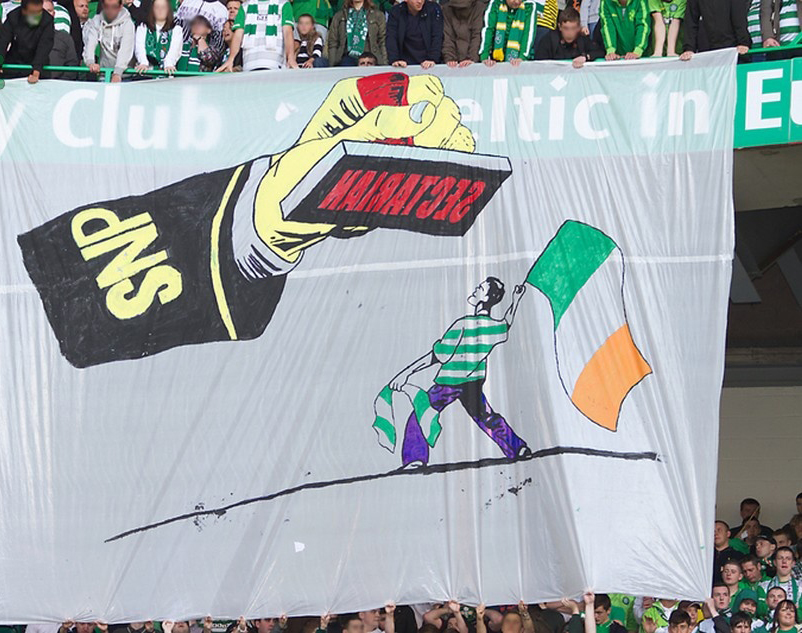
Celtic snp2_310902033This week I had a conversation arising out of Jeremy Corbyn’s interview in the Andrew Marr show on the BBC.  Like others I have spoken to who saw it I can’t remember ever making a point of watching until I knew it featured this interview.

The basic issue that arose was how Corbyn could claim to support a united Ireland but oppose Scottish independence.  Surely if you support the independence of one you should support it for the other?

Given that I agree with Corbyn I answered this question by pointing out that in both cases we were talking about removing borders (or stopping them being erected) and thereby preventing barriers to unity.

Through a united Ireland the unity of Irish people would be advanced, and by opposing the separation of Scotland from England and Wales you would support the unity of British people.  Since unity of the working class irrespective of nationality is a basic socialist principle it would require some argument to trump it.  None has been advanced for Scottish separation that isn’t either factually incorrect (like Scotland is an oppressed nation) or exceedingly weak (it would also be good for the English!).

An obvious response would be – does that mean you are also in favour of unity of Britain and Ireland?   And the answer is yes.  Provided the unity was one of equals, then there could be no objection to political arrangements that would further the erosion of national division and increase the grounds for united action by the working classes of the nationalities involved – English, Scottish, Welsh and Irish.  Previous unity of the islands involved British imperialist domination that was rejected by the majority of the Irish people and history demonstrated that no unity of the peoples was possible under these conditions, at that time at least. As I pointed out in this discussion – I am in favour of a united Europe.

The independence of Ireland has not been an over-riding principle for socialists and this is something that divides us from republicans, including those describing themselves as socialist republicans, or more bizarrely, republican socialists, whose socialism is in reality a variety of republicanism.  So much so that their socialism is not a means to overcome national division but a means of emphasising their nationalism: ensuring what they believe will be effective independence as opposed to nominal independence under a neo-colonial yoke.

What matters to socialists therefore is the unity of people, particularly of the working class, which is the bearer of a new socialist society, and not particularly the unity of state formations.  This is why socialists support self-determination so that unity is the voluntary unity required to overcome national divisions and not the forced unity of foreign rule and occupation.

As I have said before the absence of violent repression by English armed forces in Scotland stands in stark contrast to British repression in Ireland.  So while socialists support self-determination for Scotland we believe it should be exercised by continuing voluntary unity with the rest of Britain.  That the majority of Scottish people decided this in the referendum is therefore to be welcomed.

But if this is the case why do I support the unity of the Northern and Southern Irish states when quite clearly the majority in the north do not favour unity with the south?  Surely that would involve the coerced unity that you have just said you oppose?

Let’s leave aside for the purposes of this argument that unlike the Scots the population of Northern Ireland is not a nation and therefore not subject to the right of self-determination.  Leave aside also the argument that even if we restrict ourselves to the Protestant population it too, while being an identifiable people, are also not a nation and any purported right to self-determination on their behalf is transparently a means of frustrating the right to self-determination of the Irish people as a whole.

We’ll also ignore the historical fact that any declared separateness of the Ulster Protestants is inaccurate because it does not refer to Ulster but a truncated part of it and did not seem to arise when the whole of the island was ruled by Britain, when the Protestant population in the North was quite happy to consider itself Irish, the specifically ‘loyal’ part of the nation.

It’s much harder to put aside the coerced separation of partition and the continual violence needed to maintain it even if this is usually, but not always, ‘merely’ in the form of a threat to the majority of the Irish people residing south of the border.

We will however also ignore the visceral opposition to considering themselves Irish that some Northern Protestants express when the idea of a united Ireland is proposed.  Down this road leads capitulation to the most deranged bigotry – I recall being told by my father that my uncle refused to eat off a white plate with a green trim in a bed and breakfast in Blackpool, such was his sectarian impulses.  He even apparently showed some ambivalence about supporting the Northern Ireland football team because they played in green – much better the red, white and blue of Linfield and Rangers.

While it is of no interest of socialists to impose national identities on peoples against their will it is necessary for such identities to have some grounding in reality to be considered seriously by everyone else.

On this basis however it might seem that Irish Protestants in the northern state have some grounds to claim separate political rights since they obviously are in some senses a separate people.  It might appear that it doesn’t matter whether this is a nationality, defined as ‘Northern Irish’ or as simply British inhabitants of part of Ireland, or both.

What matters however again is the objective basis for claiming rights to self-determination because some of the argumentation above is really beside the point.

And the point is that (some) Irish Protestants have been provided with what they can consider self-determination, exercised as unity under the British state, which they chose to participate in through rampant and systematic sectarian discrimination; itself reflecting the objective fact that their claims for national status were based primarily on sectarian self-identification as a colonial population in what they considered, when it suited them, was (26/32 of) a foreign country.

Since for socialists national rights are democratic rights, which are reactionary if without democratic content, it would appear that the right to self-determination of the Irish/Ulster Protestants or Northern Ireland, however one wants to put it, is a reactionary demand that cannot be supported.  And it cannot be supported because not only does it not facilitate the unity of peoples but it furthers their disunity along sectarian grounds, plus the division that arises from living in two separate Irish states.  The violent and sectarian history of this self-determination is cast iron proof of the thoroughly reactionary nature of Irish unionism.

John McDonnell’s IRA apology

Brent-Hosts-Question-Time-1If you relied on the mainstream media to know what was happening in the world you would be mightily confused.  Some bearded, deluded and dishevelled guy has just become leader of the Labour Party.  Even worse, the BBC Six O’clock news led its programme with the announcement that he had just named a guy called John McDonnell as shadow chancellor, someone, the voiceover immediately told us, who once supported the IRA.

Who he was, what he had previously done that made him qualified for the job, what his economic policies were, none of these were the foremost issue for the BBC.

Now, John McDonnell has apologised for saying “It’s about time we started honouring those people involved in the armed struggle. It was the bombs and bullets and sacrifice made by the likes of Bobby Sands that brought Britain to the negotiating table.”

He explained the remarks by saying that  “I accept it was a mistake to use those words, but actually if it contributed towards saving one life, or preventing someone else being maimed it was worth doing, because we did hold on to the peace process.  There was a real risk of the republican movement splitting and some of them continuing the armed process. If I gave offence, and I clearly have, from the bottom of my heart I apologise, I apologise.”

A number of things should be said about this.

Firstly, there’s little point complaining about the obvious bias that pervades not only the Tory press but also the BBC.

This is fuelled by the social background of those in the organisation and their political views.  Their commitment to a view of objectivity and balance embraces such a narrow conception of what is acceptable that Corbyn and his supporters are clearly beyond the pale and don’t fall within the normal rules.

Along with this there is an inability to fully comprehend their politics, partly as a result of their limited experience of political debate that doesn’t stretch back beyond the Thatcherite consensus imposed on society during the 1980s.This means for example that the idea that the leader doesn’t make all the decisions is not seen as an example of democracy but as a weakness, causing confusion and division. And of course, there is fear of the Tories who have put the squeeze on the BBC as an organisation.

Complaining about bias is not going to change any of these.

What would change the situation is the British labour movement building its own mass media which, given modern technology, does not need to immediately seek to replicate the scale of the capitalist media.  Within the hundreds of thousands who voted for Jeremy Corbyn and the many more millions who support him there is the basis to do this.

The second thing to note is that the media presentation on this issue is only one example of a barrage of attacks that reveal not only bias but the current weakness of the Corbyn led movement.  It is not a surprise that Jeremy Corbyn and his support have not been prepared for the tasks of leading the opposition to the Tories.  They will obviously for example have to build a team to deal with a hostile media.

The greatest weakness however is not in this lack of media preparedness but in the weakness of their support among the mass of careerist Labour MPs.  It is this that has allowed the media to present the new leadership as shambolic.

There’s nothing that can immediately be done about this either.  In one ironic sense it is to be hoped that this right wing shower are actually motivated by careerism and not ideological fidelity to their rotten right wing politics.  If they are simply careerists they might understand that if they attempt to destroy Corbyn they will in all likelihood so damage their party that they would scupper their own careers as well.

In contrast the great strength of the Corbyn phenomenon, which put him where he is, is invisible, or invisible to the mass media anyway.  While appearing to recognise his mandate the media presents the world from ‘the Westminster bubble’, the same bubble it claims everyone else is outside of, although not apparently themselves.

Even in the case of John McDonnell’s apology on ‘Question Time’, the reporter in the local BBC Northern Ireland news noted that his apology seemed to go down well with the audience.

This support will be tested and its cohesion and growth depends not so much on Jeremy Corbyn himself but on what these people do.  In order to resist and fight the media as part of rebuilding the labour movement they must organise for this objective.  The arguments and political activism of hundreds of thousands will be the only effective response to a hostile media.

What Corbyn and McDonnell’s are now in a position to do is deliver political leadership, with arguments that can effectively galvanise, educate and rally their supporters.  Organisation of their support is the number one objective because only this support can convince the millions who can be won to their cause.

When it comes to the question of Ireland their position needs to be better.  The original political position of McDonnell arose because he put solidarity with the political leadership of the resistance to British rule before opposition to his own country’s oppression of Ireland.  And he did this at a time when this political leadership was surrendering its opposition.

So McDonnell claimed that armed struggle forced the British state to the negotiating table.  So it did, but once it got there this armed struggle showed how useless it was at getting anything from it.  It also showed that there wasn’t going to be any real negotiations unless the armed struggle stopped.  This is always the demand of the British and they get their way.  In fact it is more accurate to say that armed struggle gets them to the table which only becomes a negotiating table when they stop it.

But even in the recent ‘peace process’ this is to overstate its importance.  The Provos had to make significant political concessions before the British would get into substantive political talks, including accepting the supposed neutrality of the British state.  This is before we even consider the capitulation required before unionists would talk to them.

The result of these negotiations and the so-called peace process is something that the British Labour Party should not support.  It should reject the argument that an end to political violence is predicated on a sectarian and increasingly corrupt political settlement.  The political deal, one that has been in crisis since it was born, appeared after the ceasefires.  Of course the rotten nature of this settlement will pass the vast majority of British people by, but then so did the North of Ireland for decades before 1968.

The primary role of a Labour party is to support the independent organisation of workers and this is true of the Labour Party in the imperialist country.  This can best be done by solidarising with Irish workers’ own attempts to do this and campaigning to remove the foreign state presence that frustrates this.

In the North of Ireland the British state does this in a number of ways, including the sponsorship of loyalist paramilitaries and political policing of republicanism, where it has found ‘good’ republicans in the form of the Provos, for whom it will attempt to cover up violence, and ‘bad’ republicans who are labelled dissidents. (See here )

But even if Jeremy Corbyn became prime minister he would be able to do little to prevent the British military continuing its criminal conspiracies.  It swears loyalty to the Queen not parliament and certainly not to the people and it does so for a reason.  Marxists make the distinction between being in Government and being in power, between sitting on the top of a state and controlling and directing it.  The example of the British state’s operations in Ireland is graphic proof of the difference.

And there is yet another problem, as a comrade of mine put it last weekend at a rally in support of the refugees: Corbyn is more left wing than anyone in Ireland.  Who would be his political allies here?  Even if he wanted a united Ireland there is no significant political force in Ireland demanding it never mind in a position to do anything about it.

And don’t give me a response of ‘what about Sinn Fein’.  We have been at the stage for some time that when Sinn Fein politicians appear on TV claiming that they’re ‘for a united Ireland’ the reaction is one of – what?  Really?

What Sinn Fein does, its support for sectarian partitionist institutions and its ideological capitulation to unionism, betrays what it sometimes says about being republican.

The truth is that today there is no significant political force fighting for an end to imperialist rule.  Sinn Fein ‘support’ for a united Ireland is on a spectrum of such support declared by every nationalist party in the country and just as empty as the rest.

The task for Irish socialists is therefore very like the one for British socialists – rebuild a working class movement committed to democracy and socialism independent of their respective capitalist states.  That these are essentially the same is why socialists are internationalists.

For British socialists a democratic policy on Ireland is nothing to apologise for and nothing to hide from the British people, but it does not involve hitching their banner to the failed organisations of Irish nationalism including Provisional republicanism.


Political propagandists and political murder in Belfast

Feeney 1imagesAs the political crisis generated by the killing of Gerard McGuigan by IRA members threatens to spiral out of control the politically weary population is invited to pick sides on what is to happen next, with seemingly everyone in favour of keeping Stormont while everyone knows it’s rotten.

This appears to put the onus on being able to blame someone else in order to defend a sectarian corner and the particular rights assumed inside the settlement.

The ‘right’ attitude to the killing has therefore to be asserted first, although it is of the least concern to the parties involved in yet another round of talks.

As a result a notable feature of reaction to the murder of Gerard McGuigan has been the propensity of nationalist commentators to ventilate on the synthetic character of unionist outrage at the murder.  In other words the outrage is fake – they don’t care about dead ex IRA men.

If that were the only point being made the response should be one of agreement.  Yes, unionists have ignored state and loyalist violence and have collaborated openly with paramilitary groups so their condemnation of republican violence is hollow.  They don’t care about dead IRA men and their actions since the latest killing is guided by purely party political calculations.

But that isn’t all there is to it.  The point being made by these nationalist commentators is that what has happened shouldn’t be allowed to upset the current political arrangements because the outrage is phoney.  Just as I pointed out in the previous post on this (that the new peace institutions are now the justification for ignoring the killing of others) so expressing outrage at the killing is also to be discounted because the main unionist complainants are insincere.

And the fact that this outrage is insincere means that this is a purely manufactured crisis that originates in unionist bad faith.  This bad faith is therefore the problem.  The perfidious British however have turned this around, as they usually do, in order to appease unionism.

So nationalists are invited by these commentators to believe that what must be discussed now is not what the danger is to those who fall foul of the Provisional IRA but how the institutions can be saved.  The British are happy to go along with this but add that this involves giving the unionists confidence.  But since this a purely subjective thing we are in the world of Humpty Dumpty – confidence means just what unionists choose it to mean, neither more nor less.

So yes, nationalists have a point about pandering to unionist hypocrisy but they have a problem when they allow this hypocrisy to become their moral compass by replying to unionist hypocrisy with their own.

They have a problem when they excoriate British pandering to unionist violence while turning a blind eye to Provisional murder.  So the outrage at the latter is fake – let’s ignore both it and the event that occasioned it.  Then we can have our equal and opposite hypocrisy.  Unionists complain about Provo violence but we will turn a blind eye to it and complain about loyalist violence.

In this way the sectarian perfect circle of hell attempts to trap everyone within it, everything and everyone is to be defined by sectarian division.

A prime example of this capture by sectarian division, involving capitulation to acceptance of reactionary political violence, can be seen in the regular political columnist in the largest nationalist paper in the North, Brian Feeney in yesterday’s ‘Irish News’.

So the police fingering of Provisional IRA members for the murder of Kevin McGuigan was “ill-considered”.  As I also pointed out before – I wonder would he therefore have considered well-judged the previous failure to finger the loyalist UVF for the attempted murder of a young woman in the same area.

Feeney had a previous column on the unionist invention of the 1960s civil rights campaign as an IRA plot, a fiction of course, but what had this to do with the real IRA plot to kill McGuigan, unless he wanted to claim it too was another unionist fiction?

Instead he goes along with the Sinn Fein line that what this is all about is unionist refusal to live in equality with nationalists: “This refusal to accept mere equality prevents them seeing themselves in the same light as nationalists and republicans.”

He appears totally oblivious to the fact that with this attitude of Nelsonian ignorance of IRA responsibility in murder he should really be writing that nationalists should now see themselves in the same light as unionists, united equally in the same light of sectarian blindness.

By such a descent into sectarianism are nationalist claims for equality to become nationalist equality in sectarianism, which is indeed the political project of Sinn Fein.

He then makes hay with silly and insensitive remarks about “the futile and fatuous attempt to abolish the IRA.”  How would anyone know “if someone has left the IRA? . . how would anyone prove they’d left?”

So does Feeney not want to see the end of the UDA and UVF?  Would Feeney be questioning as futile and fatuous calls for an end to loyalist paramilitaries if they had just killed someone?

Sure how would you know whether they or the Provisional IRA had gone away or not?

Well here’s a start.  You might have a chance of convincing someone they had disappeared if they didn’t kill those who fall foul of them.

Feeney complains that the leader of the DUP Peter Robinson needs to feel that he is “not bound by any constraints that apply to normal relationships.”  Leaving aside what counts for normal in the North of Ireland, does he not think such a remark might also be pointed in another direction?

It was bad enough when the British so openly overlooked and colluded in political murder by loyalists but their shameless excuses for the Provisional IRA and its supposed peaceful intentions complete the circle that working people in the North have to break from.  In this case nationalist workers should see through the muck apparently thrown at the British and unionists because it’s really being thrown in their eyes.  Who else is expected to listen to Feeney?


The politics of murder in Belfast

images (11)The murder of Kevin McGuigan on 12 August in East Belfast is widely seen as revenge for the former’s claimed involvement in the earlier murder of Provisional IRA leader Gerard ‘Jock’ Davison.

The Police Service of Northern Ireland (PSNI) have done their bit to protect the Provisional movement by claiming that although Provisional IRA members were involved there is no evidence that it was authorised by the leadership.  Since complete denial of Provo involvement would stretch credibility to breaking point and reflect on the PSNI as well as the Provos, this was as much as they could do.

Of course this makes no sense, although it was notable that some nationalist commentators were prepared to swallow it.  Much amazement was feigned by unionists that an IRA even existed, so ‘answers’ were demanded.  The British Government said that of course it knew the IRA existed but that what was important was what Sinn Fein said (i.e. not what the IRA actually did) and especially that it continued to express support for the ‘principles of democracy and consent”.

The Garda in the South had previously claimed that the IRA had no military structure but are going to look at it again and the PSNI claimed it was a lobby group for “peaceful, political republicanism”.  Sinn Fein spokesmen claimed that of course the IRA was not involved, that it had “gone away” and all allegations to the contrary were ‘palitics’.

So the Provos continue to support the police but not as far as allowing them to get in the way of taking revenge or protecting themselves and their enormous financial empire. Support for the police is therefore purely ‘palitical’.

In the hypocrisy and lying stakes each out-does the other.

So the British Government and PSNI are claiming that while a much slimmed-down ‘peaceful’ IRA exists there is no evidence that it sanctioned the murder of McGuigan; although investigations will continue, which means that if it suits the political purposes of the British Government such a judgement can be easily changed. And easily justified – a ‘peaceful’ IRA with guns, that murders its enemies, and which by its very reduced size and tightness makes inconceivable the idea that the murder was not approved from the top.

The meaning of this is obvious: the British state and its police force doesn’t care if the Provisional IRA kills people it doesn’t like.  It doesn’t care if loyalist paramilitaries kill people they don’t like. Round the corner from where McGuigan was killed a young woman was almost killed by the loyalist Ulster Volunteer Force but the PSNI refused to blame the UVF who were responsible.

Today it is reported that the murder of another Short Strand man Robert McCartney by the Provos was subject of a secret deal between the PSNI and Provos, with the cops offering not to go after those who cleared up the murder scene, in exchange for Provo information on the less important hands-on killers.  No one has gone to jail and the Provos kept their mouths shut.

The political import of the killing is the following:

The Provos can kill and the state will give them impunity but it will expect a price to be paid.  Anyone who thinks that the end of Sinn Fein’s meagre opposition to austerity through opposition to some welfare cuts will not form part of the price probably believes that everything that the British Government, police, unionists and Sinn Fein has said about the murder of Kevin McGuigan is 100% true.

A message has been sent to all enemies of the Provos, political or criminal, that they are willing and able to kill, no doubt under some new set of initials such as AAD (Action Against Drugs).

The slow crumbling of the architecture of the political peace settlement has speeded up and now threatens the current arrangements.  The Ulster Unionist Party has withdrawn from the all-party Executive, putting pressure on its supposed more rabid rivals in the DUP to follow its lead.

The DUP has now proposed that Sinn Fein be expelled from the Executive, although Sinn Fein can prevent it, and only the British Government can do this.  If the British do not support such a move the DUP would then be forced to either put its money where its mouth is and walk themselves, bringing down the Executive, or reveal themselves as joined at the hip to the Provos in the great gravy train on the hill.  It might then start losing support.

As the pro-settlement ‘Irish News’ editorial put it today, the Executive is so discredited most will not care if it remains or goes.  And as I have noted before, the current Stormont regime is so rotten it has little credibility left.

The peace process has been built on the lie that the rotten sectarian arrangement brought about the absence of widespread political violence.  In fact the defeat of the Provos and the ending of widespread violence preceded the creation of the rotten sectarian arrangements.  Again and again the sectarian political settlement has been defended by the claim its overthrow would bring us back to the troubles.

The recent killings demonstrate precisely the opposite.  The existence of the sectarian Assembly and Executive is now justifying collusion between the state, Provos and loyalist paramilitaries in violence, intimidation and large scale criminality.  The message from the British pro-consul has been explicit:  as long as Sinn Fein supports the sectarian settlement and police that is what counts.  What it actually does will be excused and glossed over if remotely possible.  The so-called peace settlement and its preservation is now the justification for allowing political and criminal violence.

Socialists must continue to oppose this rotten settlement.  They should continue to oppose the PSNI and expose its collusion with the Provisional IRA and loyalist paramilitaries.  They should oppose the austerity imposed by the British Government and the Stormont parties, especially Sinn Fein and its phoney anti-austerity posturing.

It should likewise refuse to offer political support to any opposition by Sinn Fein to its exclusion from Government should this occur.  The Provisional movement is an obstacle to working class people in the North and South of Ireland identifying their own interests and defending them.

The UK general election part 3: sectarianism and democracy

SF 1 downloadIn the final post on the UK general election I want to look at the results from my own little polity and the political slum that is Northern Ireland.  Like all slums the blame for its condition lies with the landlord, the British state.  As usual all the tenants hope and expect that the landlord will clean it up. But it never does.

There the analogy should rest.  The most recent election was notable for what the front page of the Northern nationalist paper, ‘The Irish News’, described as ‘Nationalists turn away from the polls’.  Their parties, Sinn Fein and the SDLP, collected 38.4% of the vote while the DUP and Ulster Unionists captured 41.7%.  The latter figure does not include the various other unionist parties such as Traditional Unionist Voice and UKIP which brings the unionist total to 46.6%. If we include the Alliance Party, which is a unionist party in all but name, the unionist vote was 55.2%.

The message?  There isn’t going to be a United Ireland any time soon.  The Sinn Fein vote went down slightly by 1% even while the SDLP vote declined by 2.6% and it lost the Fermanagh and South Tyrone seat, not the way they wanted to enter into the historic hundredth anniversary of the 1916 rising.  ‘The Irish News’ explained that the nationalist vote had declined to its lowest level since the 1992 Westminster vote, which is before the ceasefires. That is, before the current peace process ‘strategy’ of republicans was/is supposed to deliver a united Ireland.

None of this fits with the accepted story of a rising Catholic population and a more and more demoralised Protestant one.  Sooner or later, the story goes, there will be a Catholic majority that will vote in a united Ireland. The truth of this is accepted by many and, I would hazard a guess, by many who would deny it vehemently in public.  I remember my aunt, a Shankill Road Protestant, remark about 25 years ago that there would eventually be a united Ireland, but not in her lifetime.  And she was at least half right in that.

Socialists have always supported self-determination for the Irish people as a whole, as the only democratic response to the Irish national question.  Not of course universally.  The Militant Tendency/Socialist Party tradition with its notoriously statist view of socialism, which incidentally has nothing to do with Marxism, has always managed to get it wrong.  Its statist view has seen it join left nationalist formations in Britain such as NO2EU, and it led the rightward collapse of the left in Scotland into Scottish nationalism.  In the North of Ireland on the other hand, entirely consistent with its accommodation to whatever nationalism is strongest, it has capitulated time and time again to loyalism and the British State.

This general response of socialist to the national question remains correct but the growth of nationalism in the North of Ireland, which now appears halted, has demonstrated that democracy is not a classless construct.  Bourgeois democracy in a society which has always been characterised by sectarianism has definite limits.

These limits are demonstrated in the more and more sectarian expression of northern nationalism.  This means that the expression of democracy by the working class can only be of a non-sectarian character, or it would fail to be a particular expression of the working class.  In other words the expression of a democratic alternative to partition must come from the working class and not from any nationalist formation.  It must therefore be non-sectarian, not in an unconscious sense, in which to be anti-imperialist is somehow also to be ‘objectively’ anti-sectarian, but in a conscious sense that this is the key objective – of uniting the working class.  Just like Scotland so must this be the case in Ireland, that socialism cannot be derived from what happens to be bad for the UK state but from the political unity of workers.

The degeneration of Sinn Fein and Irish republicanism demonstrates that fidelity to the belief in a united Ireland is no guarantee of progressive politics.  It used to be said that Irish republicanism was largely confined to Catholics because of sectarianism and this also remains true but it is also now the case that the Irish republicanism of Sinn Fein is confined to Catholics because it is sectarian.

Once the Provisionals stopped fighting the British and decided to join in the governance of its system, and started asking the landlord to sort out the slum – the landlord responsible for its creation – it stopped having any claim to progressive status.  It then became the most militant and vocal champion of Catholic rights, not civil rights, but sectarian rights.  This has been exposed in the case of a prominent Sinn Fein Minister and also in the recent election.

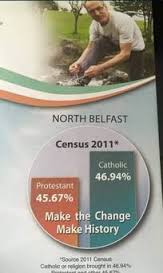
In North Belfast Sinn Fein put out an election leaflet that included a graphic showing the Catholic and Protestant proportions of the constituency, the none too subtle message being that the majority Catholic constituency should be electing a Sinn Fein MP.  But of course that also means that Protestants must vote for the sitting Unionist MP.

The Sinn Fein excuses for it only bury it deeper in the sectarian mire.  First the excuses arrived only after it spent weeks defending the leaflet.  Then it wanted, it said, to use the terms nationalist and unionist but the Post Office said census figures had to be couched in terms of Catholic and Protestant.  So what it is saying, after trying to blame the Post Office, is that  instead of rejecting the graphic it decided that yes indeed substitution of Nationalist and Unionist by Catholic and Protestant was fine.  Now we know what it means when it uses the former terms in future.

Oh, and one more thing.  It regretted its decision to include the graphic – as Mr Gerry Kelly said “I think, in retrospect, the decision then should probably have been to withdraw the graph, because it did give an argument to our opponents, whether that was the SDLP or unionists.”  Yes Gerry, you’re right about that.

SF2images (10)

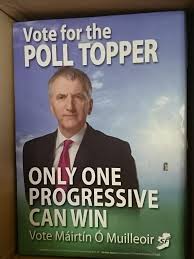
The reactionary position of Sinn Fein was also demonstrated in another graphic used on its leaflet for their candidate in South Belfast.  Having misleadingly described the candidate as ‘the poll topper’ – in fact the sitting MP was from the SDLP – it then said he was the ‘only Progressive Candidate who can win’ – clearly not the case since the SDLP were not listed by the leaflet as one of the five parties ‘united for austerity.’

These five parties were the Conservatives, DUP, UUP, UKIP and Alliance Parties. One of these parties stood out from the others – the DUP.  Why? – because Sinn Fein is in permanent coalition with this party.  And at the time the leaflet was put through the doors the Tories looked like they might be relying on the DUP to get them into power.

Wouldn’t that have looked lovely – the so-called anti-austerity Sinn Fein in Government with the DUP who were keeping the austerity-inflicting Tories in Government.  Don’t bother to try to work out how Sinn Fein would have justified it, they have been justifying inflicting one of the most right wing parties in Europe on this part of the continent for years.

‘The Irish News’ front page has reflected the disorientation of Northern nationalism following the election.  It produced some commentator to explain what had gone wrong.

Apparently  there is a ‘growing number of nationalists who appear switched off from the electoral process (reflecting) a community more at ease with Northern Ireland.’

The commentator said that “I think unionism is more highly strung about identity issues.  Nationalism is more happy in general with the status quo and there is a lack of competition between the parties.  Nationalism is suffering a retreat.”

Almost all of this is rubbish.

Yes, nationalism is suffering a retreat, it’s been retreating for years, and now endorses the legitimacy of partition and its institutions, the British nationality of Irish Protestants and the unionist veto on a united Ireland.

Contrary to its assertion, there is no lack of competition among nationalist parties and unlike unionism there was no electoral pact between the SDLP and Sinn Fein during the election.

Relatively high unionist participation in the election is not because they are more highly strung about identity; in fact the lack of unionist voter participation has been remarked upon for years.  Did they suddenly get a fit of the nerves just recently?  Newspapers have recently reported increasing numbers of parents from what is called ‘a Protestant background’ refusing to designate their children as Protestant at school.

The fall in the nationalist vote is not because nationalists are happy with the status quo but exactly the opposite.  The stench of nepotism, cronyism and corruption from Stormont is all the more repelling on the nationalist side given the claims to radical politics and progressive change from the nationalist parties, particularly Sinn Fein.

Instead the DUP/Sinn Fein coalition Government has been beset by crisis, incapacity, incompetence, secrecy, arrogance, lack of accountability, lack of transparency and financial scandal.  The simplest of questions don’t get answered for years (perhaps never) by Government departments with dozens of communications staff.

The latest such offerings are the revelation of the extent of the employment of Special Advisors (SPADS) employed by all the parties in office without any public recruitment process.  These SPADS are supposed to bring special skills to their political masters, the most prominent of which appears to be their close connection to the parties and their ability to hide any special skills.

A freedom of information request revealed that in one financial year the Stormont Executive spent almost £2m on these SPADS, more than the Scottish and Welsh governments combined.  In 2013/2014, the pay bands and grades for these special advisers varied across the UK, going from £36,000 up to £91,000.  In Scotland, three of them were in the top pay band while at Stormont all 21 posts were.

The second is the scandal around a contractor to the Housing Executive which we reported on before here and here.  The SPAD at the centre of the controversy, far from being dumped has been promoted while it is reported that the DUP member who took a more principled stand is being subject to disciplinary action by the party.  At the end of an editorial dripping with scorn ‘The Irish News’ declared of the Stormont regime that “it is increasingly doubtful if the institutions are worth preserving in the first place.”

When the main voice of constitutional nationalism expresses exasperation with the peace process institutions it really does mean a lot of nationalists are thoroughly disillusioned.  This is one of the main results of the election.  In itself it is not a positive but it is certainly a prerequisite for one to develop.


Screwing the unemployed in the North of Ireland

Belfast Plebian

work-fare211

One development in the North of Ireland that has come into existence largely unmentioned is Stormont’s new welfare to work programme. There have been quite a few of these in the past, New Deal, Steps to Work, but this one is more than just a hand me down modification, it fits with the now.

It emerged from out of the thinkery of the Department of Employment and Learning (DEL) as recently as 2012. The protocols were first aired in a draft published in April 2012 (feasibility study; DEL web site). Tenders were then put out to the private sector for attention at the beginning of 2013 and the Stormont Executive approved the full regulations in June 1914. Implementation of the programme started in October 2014 and it is still being rolled out. The Alliance party man in the Executive, Minister Farry declared that this was ‘a major change in the way we help people, focusing on providing more flexible support for individual’s needs and their barriers to work.’

It is certainly a major change all right; it is the semi- privatisation of Stormont’s unemployment responsibility. The job of getting the north’s unemployed reserve army into work has just been handed over to three ‘lead contractors’ i.e. to profit seeking private companies.

  • Belfast –Ingeus UK Ltd, supported by Armstrong Learning NI, People 1st, Springvale Learning, SES Consortium and Addiction NI.
  • Northern Region – EOS (Trading) Northern Ireland Ltd, supported by Elle Enterprises, Customised Training Services, Network Personnel, Ulster Supported Employment Limited, North City Business, Roe Valley Enterprise Ltd and Roe Valley Community Education Forum.
  • Southern Region –Reed in Partnership, supported by Global Education Ltd, Network Personnel, Rutledge Recruitment and Training and South Eastern Regional College.

From now on the private sector will be gifted an opportunity to make a profit out of the unemployed with contracts worth £35 million. The only objection raised by those MLA’s who were there for the Committee stage was that DEL had unkindly overlooked some locally run training organisations in favour of the bigger outsider businesses -Pat Ramsey of the SDLP worried that 400 jobs could be lost to local training organisations in the transition period.

Ingenus, for example is a welfare to work international business founded in 1989 by the wife of the former Australian Prime Minister Kevin Rudd.  Therese Rein sold the business to Providence Service Corporation of Arizona in April 2014 in a deal said to be worth £65 million in cash and another £25 million in stock options, and she agreed to stay on as the Chief Executive.

Although present in several countries, Ingenus makes seventy percent of its declared profit from the British Government’s welfare to work contracts. The Australian government has been pretty ruthless in the slashing of the social entitlements of workers and this gradgrind model is being imposed in Britain via companies like Ingenus.

Another lead contractor is Reed Partnership a division of the Reed Group that includes Reed Specialist Recruitment and Reed Online. The Reed Partnership boasts on its web site that it was the first welfare to work contractor to be trusted by New Labour to deliver the service under the New Deal Programme – “We launched as one of the first private welfare to work providers in the UK. Our first contract started in Hackney in 1998.”

News journalists in Britain frequently claim that the welfare to work programme has been an unmitigated disaster, on the basis that it has been shown to be not good value for the taxpayer’s money lavished on it.  It has been reported that less than 5 percent of those forced under its iron wheels find any permanent work. These sorts of ‘I feel sorry for the taxpayer’ type of political analyses has become the norm for almost all news media criticism of government policy.

When asked about the work programmes’ lamentable failure reported by the news media in England, the DEL civil servants simply told the Assembly Committee that civil servants were under no legislative obligation to take the poor results into consideration when inventing their own scheme specially tailored for the North of Ireland. The DEL officials told the Assembly Committee they were aiming at a better programme and at a higher achieving rate of 29%. Success is defined as finding a job for anyone on the programme for at least three or six months.

The ‘getting good value for taxpayers money’ model of social criticism is an absolutely hopeless one in dealing with the private welfare to work model as it is to be applied in the North of Ireland. The only model of political analysis useful here is the one that relates important government policy decisions directly to the aims of the Good Friday Agreement and fulfilling the mandate of the peace process.

The managerial side of the Stormont regime is certainly not dedicated to ‘helping’ the unemployed section of the working class into some new era of private sector prosperity – that much is obvious.  Rather it is preparing and training them for a future based on low expectations, frequent changes to part time working and acceptance of a long life on the minimum wage.

One of the most significant new protocols attached to the steps to success programme is that the new providers are not obligated by their DEL contract to offer training and education to their unemployed clients. All of the previous work programmes at least contained such a proviso, stipulating some skills training.  This new iteration does not.  It was no doubt thought to be an added expense that the private contractors could well do without.

There is no expectation that the jobs the private sector currently has on offer will be anything but part time, temporary, low skilled and low waged. The fact that the private contractors will receive a payment from the Department on the basis of any three or six months job take-up speaks volumes.

It should be said that participation on the new work programme is mandatory. Even the 60 to 65 age group are forced to take part, something that did not previously apply.

There are to be five client groups – Jobseekers 18-24, Jobseekers early entry, ESA’s (employment support allowance) voluntary ESA’s and Returners. The ‘client’s’ routine is to change from visiting the job centre once a fortnight, to show sufficient evidence of really seeking work, to carrying on with this plus an added second routine of meeting with the ‘provider’ at least three or four times per week for sessions lasting either one or two hours – supervised job searching to really really show they are seeking work.

The larger client group must do a minimum of five hours supervised searching spread out over the week.  This routine includes cold calling of employers who may not have even adverted any vacancies. This is obviously an enhanced surveilling of the lives of the unemployed. The ‘clients’ even have to hand over their mobile phone details and email addresses for random contacts about job offers. They also have to sign wavers allowing the providers to retain and make use of their personal details.

You are asked to inform them of any health problems you may have and to let them know if you are a ‘substance abuser.’  Some of the client groups have to agree to do work placements without pay. The client can in theory claim travelling expenses if they are especially diligent.  I had to delve deep into the DEL protocols documents to discover this.

Claims for travel expenses will be submitted at participant level and can be claimed on a four weekly basis. The Department will make payments within 30 working days of receipt provided receipts are offered.’ The least expensive way to travel in Belfast is to buy a bus day ticket costing £3.40 or £3.90. So the typical travel expense for participants is likely to be between 10 and 15 pounds per week. A single person under 25 on JSA receives £57.35 and the over 25 person gets £72.40. Obviously one training tip you are going to get on this programme is a vital lesson on keeping receipts.

Any unemployed person who is deemed not to be ‘performing’ to the protocols will be sanctioned with a withholding of benefit. The rules state that:

‘Your benefits will be stopped for two weeks for the first time you

  1. Give up, or fail to attend the required S2S attendance without good reason or are asked to leave for non-compliant behaviour.
  2. Your benefits will be stopped for four weeks for a second breach of the rules.
  3. It will be stopped for 26 weeks if the client breaks the rules for a third time.’

There is as yet no evidence available for current sanction rates in the North of Ireland. The rates of sanction penalisation in GB are amazingly high.  On 12 February, DWP published an important Freedom of Information response 2014-4972 showing the proportion of JSA claimants sanctioned and the numbers of repeat JSA sanctions.

Almost one-fifth (18.4%) of the 3,097,630 individuals who claimed JSA during 2013/14 were sanctioned: 568,430 people.  During 2013/14 the maximum number of JSA claimants at any one time was 1,474,428. This gives some idea of the amount of turnover in the claimant count.

We know from Stat-Xplore that there were 888,936 JSA sanctions in 2013/14, so that the average number of sanctions imposed on sanctioned claimants in 2013/14 was 1.56. It should be remembered that these figures show the proportion of claimants sanctioned after reviews/reconsiderations and appeals. The proportion sanctioned before these challenges in 2013/14 must have been about 20%.

Incredibly the Work Programme continues to deliver far more JSA sanctions than successful JSA job outcomes. The official statistics show that up to 30 September 2014 there had been 345,640 JSA Work Programme job outcomes and 575,399 JSA Work Programme sanctions.

This new policing regime for the unemployed is already in situ while the controversial welfare reform changes that have provoked so much comment are yet to be rolled out. One intention of the welfare reform plan in waiting is to push as many of the more costly benefit claimants into the cheaper Steps to Success programme.  This anticipated change is the reason why the bigger private sector welfare to work contractors from Britain are anticipating an increasing client base. The other is to harry as many people off the benefits system as is possible within the law.

The early signs are that it is working – the last three months have seen the biggest fall in live jobseeking claims ever recorded, 1,700 per month. Many are drifting on to other benefits like claiming sickness benefit but the the economically inactive count is also rising rapidly and last month it reached 28%, the highest by far in comparison with Britain. It is the high numbers of economically inactive that is now attracting the gradgrind attention of the neo- liberal economists.

How quickly the promises of the Good Firday Agreement have turned to dust for the working class. The peace process promised a better life for all and there was much talk of a lasting peace dividend. For a few years there was all the appearance of incresasing prosperity, but it was based on bank lending, rising house prices and some increased public spending.  In retrospect the material cause of the peace process can be said to be precisely this raised State spending.

A recent study carried out by the Nevin Economic Research Institute provided data showing how the cuts may impact.  According to the report three parliamentary constituencies, Foyle, West Tyrone and West Belfast have above-average public sector employment, with West Belfast the most vulnerable to job losses with over 45% of total employment being in the public sector.

A proposed public sector redundancy scheme was announced as part of the Stormont House Agreement. The scheme is intended to “re-balance” the local economy, which is said to be disproportionately dependent on the public sector, which accounts for 31% of total local employment.

The exact number of job losses in the scheme remains the subject of speculation. The DUP Finance Minister Simon Hamilton has announced an initial “closure” of 2,410 civil service posts over the next year but trade unions have estimated an eventual figure of 20,000 job losses. The report also highlighted that the retail and hospitality sectors, which make up the second and third highest sources of employment in West Belfast for example, and which are areas where those made redundant might find alternative employment, are also the sectors with the lowest wages. (NERI Research no 20 by Paul Mac Flynn)

If so many of our people, the ‘oppressed nationalists’ are being employed in secure long term jobs by the State why are we concentrating all our efforts on destroying it? This was the objective condition faced by the revolutionary movement organised by the republican movement pre-peace process.  The long war was never targeted at the private sector just the State. We know how that story turned out.

The republican movement disarmed and then married into the State to become senior board members in a logical exercise in political thinking. Things are now changing – the British government strategy of supressing the insurgency with above-normal levels of public spending is coming to an end. You could argue that the proposed rebalancing to a private sector based economy is simply the logical extension of neoliberal austerity economics. Yet a more precise argument would have to factor in a change in the political conditions and climate of opinion.

The republican organised insurgency is finished and the peace process leverage once thought to be with Sinn Fein has all but been used up. Martin McGuiness said recently that the Tories just don’t get it like Labour did.  This was a plea for special economic clemency for the North of Ireland.  But it is Sinn Fein that doesn’t get it.  We are no more special than the Greeks.  We surely are in new times.

Austerity and Sinn Fein

sfdownloadThe strike by public sector workers in the North of Ireland on March 13 was significant because the two major parties, including Sinn Fein, were a target of the strike, whether Sinn Fein or even some of the strikers liked it or not.  Sinn Fein obviously didn’t like it because it damaged its posturing as an anti-austerity party and trade union leaders didn’t like it because their strategy is to persuade the parties responsible for austerity to change their minds and try to get more out of the Treasury in London.

The latest multiyear budgetary programme of the Stormont administration is the second austerity programme which Sinn Fein has jointly authored while in office.  The first did not see the job losses witnessed in England, Wales and Scotland but it did see a reduction of around 14,000.  Pay and pension entitlement for public sector workers were also cut.  Along with almost every other public sector worker I have suffered two years of a pay freeze while inflation consistently exceeded the supposed target of the Bank of England and my pension contributions increased, while my benefits were reduced and I will have to work longer to get them.

The much vaunted protection of welfare in the new budget, whatever coverage it eventually has, will come from money taken from other public services, including cuts to education.  As one local newspaper columnist put it – these will include an end to free books for pre-school children, making Northern Ireland the only part of the UK that will not have the scheme.  This will save £250,000 a year, or one third of the £750,000 that 36 Sinn Fein politicians at Stormont paid to a party research company that was unable to show any research.

As also remarked, Sinn Fein’s often boasted politician’s salary at the industrial wage includes industrial scale expenses.  Widespread cynicism exists in ‘republican’ areas at the rise to riches of leading figures identified with the movement.

The much vaunted financial deal that saved the Stormont administration, before the latest crisis, was hailed for delivering an extra £2 billion to the Northern Ireland budget, except that it didn’t.  Only a third of it could be called new, which spread over 10 years is less than a third of 1% of what is spent each year.

The rest is loans or ‘flexibility’, which means that money that is for capital investment can be incurred on day-to-day expenditure.  You don’t have to be an accountant to realise that relying on loans and investment funds to pay for on-going expenses is not sustainable.  Further expenditure is allowed if funded by asset sales, which again is not sustainable, and raises a green light for privatisation.

Such privatisation would leave the lefty credentials of Sinn Fein wearing even thinner.

Not all the capital money will be spent on recurring expenses.  £700m can be spent (in fact must be spent or it won’t be spent at all) on paying off around 20,000 public sector employees through a voluntary exit scheme.  This is a major plank in the opposition of the trade unions but it is not clear that many workers themselves will not take the money and run.  Unfortunately the old union maxim that the job is not yours to sell is long forgotten.  It is obviously completely unknown to Sinn Fein who talk of losing only ‘posts’ as if this is not what is actually wrong about what they are doing.

It is claimed that there will be no compulsory redundancies but the NIPSA trade union has drawn attention to advanced plans to cut 50 jobs, or over half the workforce, from the Northern Ireland Association for the Care and Resettlement of Offenders (NIACRO).  As NIPSA points out, when NIACRO works with prisoners on release reoffending rates drop from over 50% to less than 25%. This has all the hallmarks of the stupid and counter-productive cuts often condemned by Sinn Fein.

The claim to be protecting the vulnerable now doesn’t look so strong.

An amount of £350m will go to capital investment in integrated education, which at least sounds progressive until it’s understood that this doesn’t involve Catholic and Protestant children being educated in the one classroom but actually often means two sectarian-denominated schools being put on the one campus.  The move towards a shared campus simply reflects the fact that sectarianism is becoming expensive.

Rather than signalling the end of sectarian schooling it shows the lengths that will be gone to in order to preserve this apartheid system.  But the sectarian education system also has the support of Sinn Fein.  It would appear that apartheid can be supported in this case if the justification  given for the original South African variety – separate but EQUAL – can be adhered to.

This isn’t even progressive never mind left wing or socialist.

That the new deal means no rejection of the previous imposition of reactionary Tory-Lib Dem policy is shown by the fact that the fines of £114m that had to be paid for not implementing the welfare cuts in 2014-2005 must be paid now, and the £100m loan required to balance the books in the same year must also be paid.

Last but not least the new financial arrangement allows the local administration to lower corporation tax, once again supported by Sinn Fein.  Their thread bare justification for this is the harmonisation of an all-island economy.  In fact, along with many republicans’ support for Scottish independence, it involves mutual competition of small states in a race to put more money into the fat pockets of mainly US multinationals.  Were the policy to succeed the London Treasury has stated clearly that the Stormont regime will have to pay it for its losses.

All of this passes Sinn Fein by.  It clings to its claims to be anti-austerity purely on its partial opposition to cuts in welfare benefits.  Its populist politics is revealed by its approach that workers are victims and its most vulnerable members should be given some form of protection by a benevolent state.

The effect of privileging one section of the working class above another is always to undermine and weaken its potential political unity.  In this case the potential unity of the working population and those on benefits, who are always the subjects of divisive attack by right wing forces.   By limiting its proclaimed anti-austerity agenda to support to some on benefits it plays into the divisive claims of these right wing forces.  Sinn Fein appears happy to see austerity delivered to those in work while proclaiming great concern for those who are unable to or cannot work.

The interests of the working class as a class and as a political force independent and opposed to the state are alien ideas to a purely nationalist movement.

Unfortunately it is also alien to the leaders of Ireland’s trade unions and their new proclaimed support for Sinn Fein is proof of this.  At the Sinn Fein Ard Fheis – that is even before Sinn Fein’s renewed expressions of concern for welfare claimants – the Irish Congress of Trades Unions President, Jack Douglas, extolled Sinn Fein’s adherence to the union cause.  That is after the austerity budget the Northern unions were calling a strike against!  A week or so earlier the leader of Ireland’s biggest union SIPTU, Jack O’Connor, hailed Sinn Fein as a potential partner of the Labour Party in Government. The same Labour Party that has been implementing the Troika austerity agenda it was elected promising to oppose.

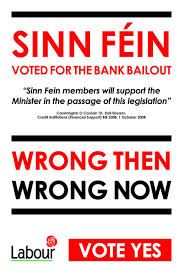
The performance of Sinn Fein in office in the North is a stark warning of its future role in the South but the record of Sinn Fein in the South is ample demonstration itself.  It was Sinn Fein who voted for the bank bailout that made the debts of the speculators the millstone round the neck of the workers.  Its ‘leading role’ in the resistance to austerity today is to identify itself with the campaign against water charges while seeking electoral advantage from it.  Beyond seeking votes from the campaign it has no strategy to make the campaign a success.

A couple of weeks ago an economist from Goldman Sachs claimed that the biggest threat to the Irish economy was that Sinn Fein would keep its promises on its opposition to austerity.  He needn’t have worried.

I remember around twenty years ago attending a meeting in Conway Mill on the Falls Road during which time Sinn Fein was trying to get into talks with the Unionists, who were refusing to engage. I asked Gerry Adams what he expected to achieve from such negotiations when the Unionists wouldn’t even talk to him.  A United Ireland he said.

Well we all know how that worked out.

Workers strike against austerity in the North of Ireland

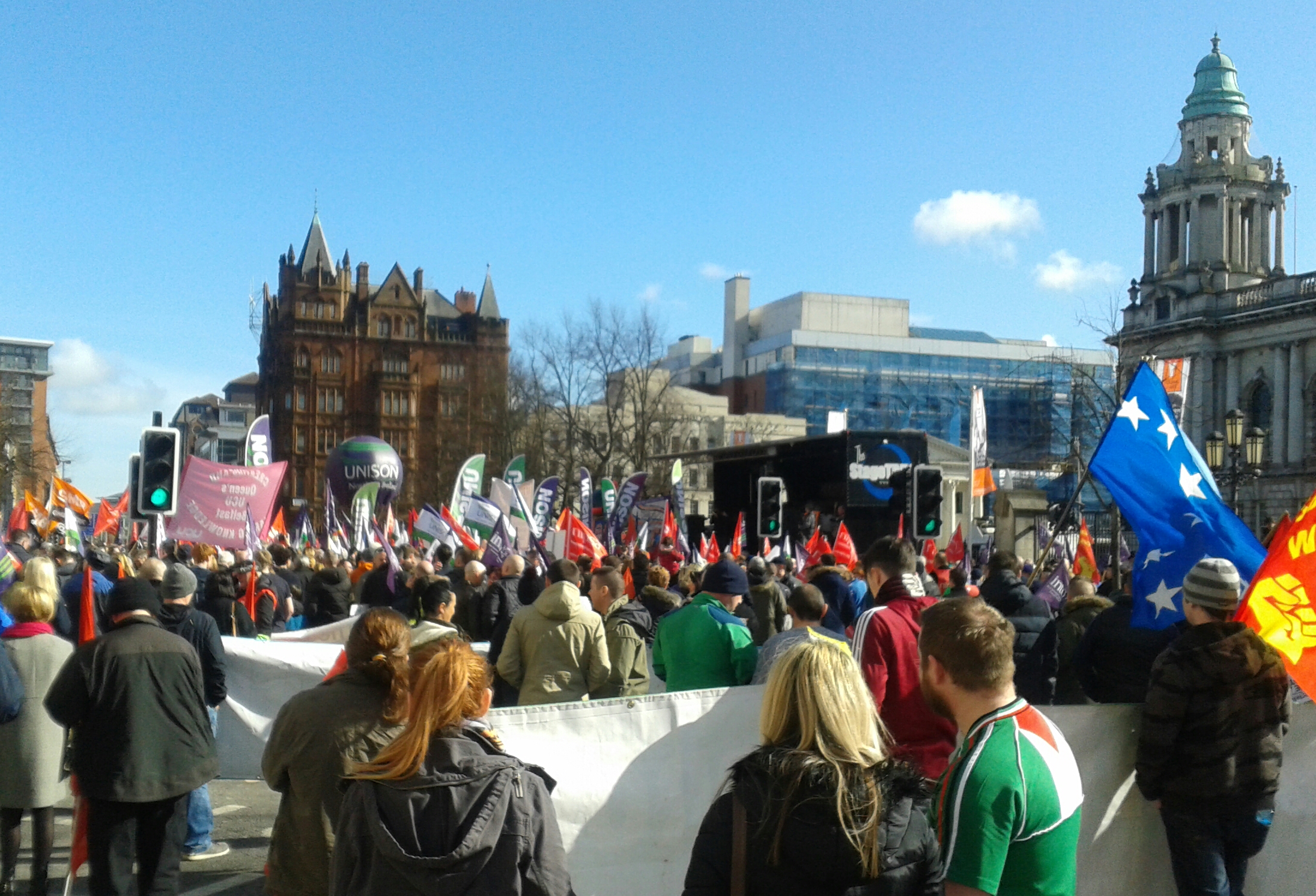
20150313_130323-1Tens of thousands of workers went on strike across the North of Ireland on March 13 in protest against cuts in jobs and services implemented by the devolved administration in Stormont.  The local administration is imposing the austerity agenda dictated by the Tory-Lib Dem coalition in London.  The strike was particularly successful because transport workers, including on the buses and trains, took part as well as those in the civil service, health and education.

Observance of the strike was good and pickets and rallies had respectable turnouts.  Workers have suffered a long period of declining living standards and are clearly willing to declare their opposition.  It would be a mistake however to exaggerate the stage we are at in the development of this struggle.  A glance at the numbers voting for strike action in a couple of the biggest unions involved shows the distance yet to go to build a strong and active movement.

In the trade union NIPSA, covering staff in Government departments and other bodies as well as admin and clerical staff in the health service, 52.9% or 4,201 voted for strike action in the civil service side out of a membership of around 20,600, with the health service side having an even lower turnout.  Not all of the membership was called upon to strike but the vast majority of members were affected.  In UNISON, with a membership mainly in the health service and some in education ,3,181 voted for strike action in a membership of around 40,000, again not all of whom would have been called upon to vote but a majority of whom would have been affected.  The strike had sympathy among the wider population but this finds no expression in organisation.

Many on the left have demanded another strike and have claimed that the recent ostensible U-turn by Sinn Fein on welfare cuts is a result of the strike.  However this would be to take the Sinn Fein position at face value, or rather take them at their word, and exaggerates the effect of the strike.  While it focused opposition to austerity, and can lay the grounds for a deeper campaign against it, the actions of Sinn Fein are not so much a reaction to the strike but the wider feeling of opposition to cuts.

The strategy of the trade union leaders is to lobby and put pressure on local political parties so that if the next Westminster election results in a hung parliament local politicians can demand and negotiate an end to, or at least an amelioration of, austerity imposed in the Northern Ireland.  It therefore takes as given the continued position of these parties and resists any project of setting up a political rival.  This is on the basis that to do so would inevitably require a position to be taken on the constitutional position of the Northern State.

Such a party would inevitably have Keynesian policies of greater state activity in taxing and spending.  In other words salvation would be presented as arriving from the state, so the programme of any such labour or workers’ party would very quickly run up against this challenge.  No autonomous development of the party would be possible.  It is now some years since a labourist project was attempted and the last one that set up the current political arrangements was an embarrassing failure.

The strike was however noteworthy because it was carried out explicitly against the policies of the local Stormont Executive, the centre piece of the peace process and the ‘new’ political settlement.  It also took place against the background of another ‘crisis’ in the process, with the whole financial arrangements of the local administration thrown into doubt by a late Sinn Fein withdrawal of support for the budget because the deal to preserve it did not fully cover the cuts in welfare that were to mirror ‘reforms’ in Britain.

Sinn Fein therefore paraded its anti-austerity credentials, which the media took to be another late intervention by Gerry Adams to shore up the anti-austerity stance of the party in the South of Ireland.  Sinn Fein faces a general election in the South within the year.  The party is riding high in the polls on the basis of this perceived position and it would not look good if it were seen to be implementing austerity in the North while claiming to oppose it in the South.   Sinn Fein therefore ‘supported’ the strike even if the strike was clearly against the budget it had just approved as a major part of the local administration.

This support was invisible in the well-attended rally in Belfast city centre on 13th and is based on the party once again talking out of both sides of its mouth.  A long established practice.

This most recently saw an outing through Sinn Fein’s vocal support for the Catholic teacher training college St Mary’s, which was threatened with cuts by the local administration.  The cuts were proposed by the Alliance Party Minister responsible who was simply implementing the reduced budget given to him by Sinn Fein and its Democratic Unionist Party partners.  The sectarian aspect of this support was lost on no one as similar cuts were to be made to the ‘Protestant’ teacher training college at Stranmillis.  In the end the two biggest sectarian parties – Sinn Fein and the DUP – got together to overrule the Alliance Party Minister.

The last minute opposition to the welfare arrangements therefore doesn’t inspire the view that Sinn Fein are a principled opponent of austerity but rather smack of an opportunist change of tack.  At their Ard Fheis in Derry the weekend before they dropped their bombshell the leader of Sinn Fein in Stormont, Martin McGuinness , was proclaiming great satisfaction with the deal and congratulating the party on how well it had done in the re-negotiated financial settlement with the British Government.

At the very best their new found concern means that they hadn’t done their sums right or had been rather easily hoodwinked by the DUP; or perhaps that they had re-evaluated the calculus of staying with the welfare cuts programme as it was going to develop – thus facing the flak when it was put into practice – as against provoking another ‘crisis’ and the fall-out that would then ensue.

That this was all a bit last-minute became clear from the Sinn Fein media performances to explain its change of approach.  One prominent spokesperson on local radio refused to say it was a question of money when it could hardly be anything else; then it was claimed that it would cost over £280m to put right before this became translated into a round figure of £200m when the round figure it would appear closest to would be £300m.  Unionist claims that it was clear in the deal that not all the benefit cuts would be covered by mitigation measures in the budget, and would not be permanent for new claimants, seemed more convincing.

Nevertheless, the row over the extent of the funds to cover cuts in welfare matters to those welfare recipients affected who are indeed, as Sinn Fein says, some of the most vulnerable. It doesn’t in the least affect the fraudulent nature of Sinn Fein’s anti-austerity posturing.

To be continued

Rape, Republicanism and Revenge

2014-10-28_new_4232679_I1A Belfast woman, Maíría Cahill, whose great-uncle Joe Cahill helped form the Provisional IRA in 1969, has claimed in a BBC programme that she was attacked and sexually abused by a much older IRA man from the age of 16 for a period of 12 months in 1997.

She has accused the Republican Movement of trying to force her to keep quiet about the rape and holding a “kangaroo court” in which she was interrogated about her claims.  “The only word I have for it is interrogation, because that’s exactly how it felt.” The IRA investigation lasted six months and included a face-to-face meeting with Cahill’s alleged abuser.  “They told me that they were going to read my body language to see who was telling the truth and that they were going to bring him into a room.”

She says that she was discouraged from going to the police, in line with Sinn Fein policy at the time.  When she did go to the police the prosecution authorities ensured that it was IRA membership charges that were first taken against the alleged rapist and those involved in the IRA investigation.

When these charges collapsed the prospect of conviction for rape also reduced so she withdrew support from the remaining trials.  She signed a withdrawal statement but maintained her claims of sexual abuse and her claims against the four people accused of subjecting her to an IRA interrogation. She also accused both the police and the Public Prosecution Service of failing her.

What we have then is the story of a rape victim who received no justice from the movement she supported and none from the state, which appeared, as usual, more interested in a political agenda than the concerns of a victim.

The case has become news just as an inquiry is to take place into child abuse at Kincora children’s home in east Belfast in the early 1970s.  It is widely suspected that the British security services colluded in a cover up of the horrific abuse that took place in the home in order to gather intelligence in pursuit of their dirty war.

The hands of the state when it comes to the North of Ireland are literally dripping with blood.

Not unexpectedly however most attention has been directed to Gerry Adams, who Cahill says she met to discuss her rape.  At this meeting she claims he suggested to her that abusers were so manipulative that they can make the abused actually enjoy their abuse.

Adams has rejected this and claims that he asked another female republican to tell Cahill to report her experience to the police.  Cahill in turn has argued that the idea that a senior republican would ask her to go to the police to give information against not only the IRA accused but also the IRA investigators as “absolutely ridiculous”.

The accusations against Gerry Adams come shortly after the conviction of his brother for abuse of his daughter, Gerry Adams’ niece.  Gerry Adams was again accused of doing little or nothing, failing to report the allegations to the police and of concocting a frankly incredible story regarding his own knowledge and actions.

Maíría Cahill continued to work for Sinn Fein even after her abuse and was briefly a member of the Republican Network for Unity, a political organisation very critical of Sinn Fein’s support for the police. She subsequently moved to support a campaign against former republican prisoners working in the new Stormont administration and she now declares her full support for the authorities and the police. She has also sought and received the public support of the leaders of Unionism and of the Southern capitalist parties.  As a result Sinn Fein has accused the latter of seeking political gain from her tragic experience.

Gerry Adams has subsequently given a very general apology on behalf of the IRA for its failures in the area of abuse, acknowledging that it had, on occasion, shot alleged sex offenders or expelled them.  The latter has raised a storm of protest from Southern politicians that the republican movement has in effect repeated the crimes of the Catholic Church by moving abusers about the country, free to abuse again.

The publicity surrounding the Maíría Cahill case has also brought out numerous allegations of IRA protection or leniency towards abuse by their own members in comparison to brutal treatment of others.

For Adams the disbandment of the IRA means there is no “corporate knowledge” to draw on in the Cahill case while he admits that the IRA was “singularly ill equipped” to deal with sexual abuse, although it presented itself as the alternative state for long enough.

So what are we to make of this?  One take on it is that what we are seeing is the politics of vengeance that does society no good.  The political ‘zig-zags’ of Maíría Cahill may obscure the political significance of her case but its significance is salient not only because of her own demands but also because of the other cases which the publicity she has generated has brought into the open.  In other words we are not simply dealing here with one person’s tragic experience that has no wider social significance.  This wider significance goes beyond the political impact of her case on the fortunes of Gerry Adams and Sinn Fein.

With regard to the latter we can lament her reliance on the state and any illusions on the justice to be received from it but in this respect the political significance of Maíría Cahill’s pursuit of justice through lobbying establishment politicians and the state, and her criticism of the handling of her case by Sinn Fein, is immeasurably less than the republicans own capitulation to the state and their embrace of it as the providers of justice.  Their treatment of Cahill is also of greater political significance given that they are a major political party seeking office, and the fact that this treatment appears to have been meted out to others.

Even in terms of her own particular situation, she was and is obviously caught between the devil and the deep blue sea.  She initially sought justice from the movement she supported and was betrayed.  The most charitable interpretation is that they let her down but having let her down they stand condemned for having abused and betrayed her.

And now she wants vengeance? As Leon Trotsky said “the feeling of revenge has its rights.”  It is not the case that she has no demands other than this.  She wants others put in the same position by the Republican Movement to come forward. She wants republicans to admit the truth of her claims and she wants help for her and other similar victims. These goals appear to me to be entirely supportable even if her road to achieving them is not. But, as I have noted, she initially chose a different road.  It is not difficult to understand how, given her circumstances, she chose the course she is now on.

The Socialist Democracy article noted above correctly argues that justice “can only be asserted by the self-organisation of the working class and oppressed” and that “to win justice we have to rebuild the self-organisation of the workers, not give backhanded support to the state and the mechanisms of class oppression.”  But this is hardly a task that one woman could be expected to take on board herself and if she did not see it as an option this reflects the current near invisibility of it as a practical option for her.

Which brings me to the political lessons that socialists must learn from this and similar episodes. The article states that “the IRA was a revolutionary nationalist army . . . the idea that it could effectively investigate rapes is ridiculous.” Yes indeed, just like the idea that it could defeat British rule.  Except it claimed it could do both and organised an armed campaign that assumed responsibility for both, a responsibility it has not properly accounted for. Instead the Republican Movement has rewritten the past (it fought for ‘equality’ not for ‘Brits Out’) and has relied on the British state to place it into its new arrangements for imperialist rule.

But let’s pause for a second to ask ourselves how an army, even an ‘army of the people’ could possibly represent an alternative state?  What sort of state would it be that is defined by, conditioned by and ruled by an army?  It’s not that the Republican Movement couldn’t help itself when it came to dealing with questions routinely addressed by the capitalist state, including rape allegations, but that Irish Republicanism has always elevated armed actions above political struggle, the liberation of the oppressed by the oppressed themselves.  When it has stopped doing so it has stopped being in any real sense republican.  It reminds one of the saying that you can do everything with a bayonet except sit on it.  Guns are no answer to fundamental social and political questions.  The singular in Adams’ “singularly ill equipped” can only truthfully refer to republican militarism that it embraced until it was defeated.

For Marxists it should be a salutary lesson that political programmes defined by what they are against; defined by ‘smashing the capitalist state’ are only progressive to the degree that the working class has built itself a democratic and viable alternative.  Too often this is not at all the case and justification for particular political positions is often reposed on the argument that it will split, weaken or smash the state while doing nothing to advance the organisation or political consciousness of the working class as the alternative.

Whatever political weaknesses that Maíría Cahill may have, they pale beside those of her abusers who must ultimately be held responsible for the trauma of which her political odyssey appears as an expression.

Racism and anti-racism in Belfast


DSC_0117“Islam is heathen, Islam is satanic, Islam is a doctrine spawned in hell.  Enoch Powell was a prophet, he called it that blood would flow on the streets and it has happened.”

When a Protestant minister in North Belfast’s Metropolitan Tabernacle Church declared that Islam was “satanic” and “heathen” and compared “cells” of Muslims in Britain to the IRA the First Minister of Northern Ireland, Peter Robinson, who is known to have attended the church, was widely called upon to speak out.

Oh dear.

When he did, he said that Pastor McConnell had been demonised, that it was the duty of any preacher to denounce what he described as “false prophesy” and said he would not trust Muslims either, particularly with regard to those who had been involved in violence, or those who are “fully devoted to Sharia law, I wouldn’t trust them for spiritual guidance”; however he would trust Muslims to “go down to the shops” for him or to deal with a number of “day-to -day issues”.

Cue lots of people with their heads in their hands, especially those considering the Northern Ireland administration sponsored trips to the Middle East to promote trade and investment.

NWS_2014-06-02_NEW_006_31867640_I1

A newly elected unionist councillor for Belfast had that week been found to have tweeted a year earlier that “I’m so sick of the poor Catholic b*stards they make me sick I wish they would just go down to Ireland . .” but she was young and sectarianism is hardly news in the North of Ireland unless someone in the media decides to make it news.

But racist attacks, especially by loyalist paramilitaries, have already been in the news and have increased by 43 per cent over the year, twenty seven per cent of them in North Belfast.  Having been called upon to comment in order to denounce racism, Robinson was then called upon to apologise for his own offensive and insulting remarks.

Anna Lo, the Hong Kong born local politician, had just received some racist harassment herself and called upon him to resign if he did not publicly apologise, vowing to leave Northern Ireland because of local racism and  sectarianism and stating that she would not stand for election again.  One Democratic Unionist Party councillor then called her a “racist” and was dropped by that party as its candidate for mayor of Newtownabbey, which is adjacent to North Belfast.  Other ministers and unionist politicians backed McConnell and claimed Christianity was being persecuted.

Two Muslim men where then beaten in their homes in the north of the city and stated that their attack was connected to Robinson’s statement – he had “lit the fire”.

Some in the press and other unionist leaders attempted to minimise the impact of the insult by claiming he was just clumsy.  Michael Nesbitt, leader of the Unionist Party, claimed that “we say things we don’t really mean or express them in ways that perhaps we could have thought through better.”

Robinson then made a private apology to some prominent local Muslims, except it wasn’t an apology.  He didn’t admit to being wrong, did not withdraw the remarks and did not say he was unconditionally ‘sorry’.   What apparently he did say was that “If” anyone thought he had said anything derogatory “he would be hurt” and he would apologise, but he didn’t because he didn’t think so.  He had been ‘misinterpreted’.

So he might be the injured party in this episode and it was everybody else’s fault for not understanding him.

But still the calls for a public apology raged and eventually Peter Robinson did publicly apologise – except the apology wasn’t public.  It was one of those occasions when the media reports something and you look to see when and how it happened but you can’t actually find any evidence of it having happened, and when you look closer it appears that it hasn’t actually happened.  Yet most assume it has because it has been reported and before you now it it has happened because, well, that is how it has been reported.

In such cases this can only occur because everyone with any power to get across a media message has decided it’s in their interests to go along with the concealment.  For the unionist parties the interest involved is obvious.  Any gain in stature among its racist, sectarian and lumpen base has been achieved, while the reality of selling local business to Saudi Arabia etc. cannot be ignored so the controversy has to be closed down.

The British Government especially would be happy for the story to die no matter how this might happen and they showed no intention of doing anything that might shine a light on the bigoted character of their local political settlement, sold to the world as a model to be admired and to emulate.

But what about the nationalists, including Sinn Fein?  The second dog that did not bark was the failure of these parties to call upon Robinson to resign, as – to her credit – Anna Lo did.  Had such remarks been made in Britain by a leading member of the Conservative Government their feet would not have touched the ground as they headed for political exile and extinction. But not here.

What we got here was a bland resolution sponsored by Sinn Fein in the Northern Ireland Assembly opposing “racism, discrimination and intolerance of any kind, wherever it occurs”  but for God’s sake don’t mention that the First Minister has promoted all three.

What such resolutions reveal is not the willingness of Irish nationalism to oppose racism and bigotry but its willingness to avoid doing so, to avoid identifying and condemning it in reality, to replace lofty, banal and meaningless condemnations of racism in general for dealing with it in concrete reality.

Sinn Fein is setting itself up to be in Government North and South in 1916, 100 years from the Easter Rising that saw the beginnings of an attempt, that failed, to achieve Irish independence.  To do so it must ensure that there is an administration around in the North for it to be a part of.  Since this requires unionist participation no provocation or act, irrespective of how outrageous it is, will be allowed to threaten the political structure in the North no matter how rotten, dysfunctional and bereft of credibility it may prove itself to be.

In this way a political settlement based on sectarianism demonstrates its bigoted logic by ensuring that the most offensive statements can be made without fear.   In this way, but not only in this way, Irish nationalism becomes complicit in feeding the bigotry on which the Northern state rests, even while it self-righteously insists on its own non-sectarian character and its supporters continue to be the main victims of the bigotry.

What the Government parties are called upon to do, unionist and nationalist, is to deliver another document on “building a united, shared and reconciled community “, another piece of paper reviewing Stormont’s ‘Unite Against Hate’ campaign and together parrot inane promises from within ”its clear commitment within the Programme for Government.”

So if nationalism cannot provide an opposition to racist bigotry who can?

In a demonstration of thousands called quickly over social media a trade union spokesmen could only say that it was organised “in response to a worrying increase in the number of racist attacks in recent weeks, a situation which has been exacerbated by inflammatory comments by some religious and political leaders.”

Once again the identity of these racists couldn’t be stated.  Throwing a punch in mid-air takes the place of landing a blow on the real bigots who are allowed to continue to disclaim responsibility through the connivance of the media, political opponents and cowardice of others.

What political leaders are the racists?  How can you oppose something when you cannot even name it?  How are their excuses and non-apologies to be challenged?  How is the collusion of others to be highlighted and exposed?  How is their hypocrisy to be demonstrated?  And what is your alternative?

The trade unions bemoaned “the absence of the promised Racial Equality Strategy and the lack of coherent political leadership from the Northern Ireland Executive” as if pieces of paper are a solution and coherent racism would be better.

This hasn’t worked before and it’s not going to work now.

The Irish Congress of Trade Unions, Amnesty International and the Northern Ireland Council for Ethnic minorities called a second demonstration today and got a good turn-out given the bad weather.  Again however there was no call for Robinson to resign despite his remarks and his non-public public apology that retracted nothing of the substance of what he had said.

Some People Before Profit placards called for his resignation and some chants from the Socialist Party contingent called for him to go but the latter’s leaflet didn’t mention it and instead claimed his apology was a great victory for anti-racists despite it being obvious that these forces played a relatively minor role.

Such repulsive episodes highlight the rotten character of politics in the North of Ireland because they involve relatively new targets but the solution that is always proposed is that local politicians be something that they are not and do something opposite to what they have just done.  That they oppose bigotry and sectarianism even while the sectarian basis of the political settlement is supported because it is part of the peace process.  ‘Peace’ becomes the excuse for yet more and more injustice because an alternative to the present political deal cannot be conceived.

Debating what such an alternative could be would be a start to addressing this obstacle.