
It is a commonplace that the Irish State has benefited from globalisation and the processes associated with it. This includes the development of the EU with its transfer of subsidies to offset increased competition with domestic capital and the wave of inward foreign direct investment to take advantage of the inauguration of the single market in 1992. It includes the worldwide growth of foreign investment dominated by information and communication technology. The names of companies from this sector investing in the Irish State is a who’s who of the top multinational firms, including Intel, Gateway, Dell, AST, Apple, Hewlett-Packard, Siemens-Nixdorff, Fujitsu, Microsoft and Oracle. [The inclusion of an number of major pharmaceutical companies would be necessary to illustrate the extent of the presence of US multinationals today, including Pfizer, AbbVie, Johnson & Johnson, Novartis, AstraZeneca, Merck, Amgen, Gilead Sciences and Nuritas.] The growth of the world market provided the platform and vehicle for the exports which powered the boom in the 1990s. The deregulation of international capital markets helped fuel the boom and prolong its life through the first decade of the new millennium.
The transformative power of the boom, turned a relatively underdeveloped economy into one of the most developed but did not change the relative weakness of native industrial capital. Despite unprecedented conditions for growth the indigenous sector did not develop the power to drive economic growth in the absence of foreign investment.(13) To this extent the Irish State was still one dominated by the capital accumulation needs of foreign capital. (14) Combined with political weakness this constituted continuing imperialist domination of the country. It also demonstrated the impossibility of any meaningful ‘independent’ development of capitalism. [This was not possible in 2007 and is not possible now, all the more visible by the turn towards protectionism and more open imperialist division and rivalry, which has exposed the need for international alliances among even the largest capitalists states.]
Working class
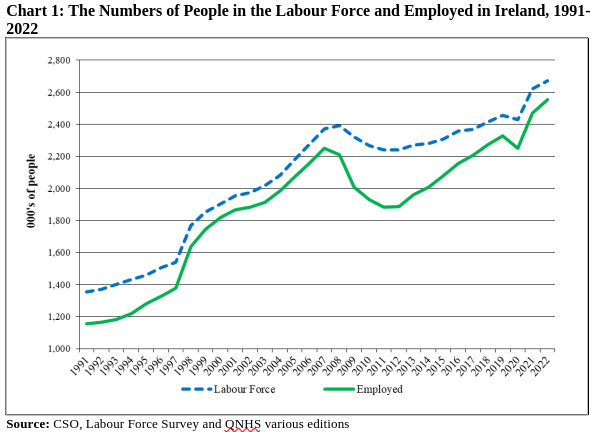
All this has meant a huge expansion of the working class with the labour force increasing from 1,354,400 in 1991 to 2,027,900 in the first quarter of 2006, an increase of nearly 50%.(15) Labour force participation rates have risen and immigration has increased.(16) A significant section of the Irish labour force is now involved in very advanced manufacturing production, in sectors associated with higher than average profits, and therefore objectively with the potential to win gains for themselves and set a benchmark for those in other sectors.(17) To some extent this has happened and real wages and living standards have increased, although this has had more to do with the natural propensity of the labour market to raise wages in a period of boom than any assertion of collective power by a working class labour movement.(18)
Once again, it is impossible to understand the Irish situation without placing it in a world framework and understanding international developments. At this level globalisation has generally been viewed as undermining workers power and the gains that they have historically made. It is also claimed that it will continue to do so in the future through a race to the bottom.
The ability of significant sections of capital to move to lower cost locations has weakened union bargaining power. It has weakened the ability of states to tax capital and raise the corporate taxes that fund welfare provision from which workers are assumed to disproportionately benefit.
We will make a number of points about these arguments here but will not deal with all the issues thrown up. Firstly, it is true that the power of the capitalist state vis-à-vis international capital has weakened. This is demonstrably true and can be seen from the experience of even the most powerful state, the US, when it was unable for example to prevent ending the convertibility of the dollar into gold in August 1971. This reflected the relative decline of the US economy and of the power of the US State to prevent it. This does not demonstrate an end to the major contradiction between the increasing internationalisation of production and the predominantly national state system but signals its raising to a new level. Nor does it ‘excuse’ the willing abandonment of national controls over the movement of capital which all states have legislated and enacted. Nor does it mean that the repressive power of states is somehow less or that workers should support the strengthening of capitalist state power against international economic forces. (19)
The reformist perspective that laments the processes by which state power is weakened in the face of international capital leads only to nationalist ‘solutions’ (protectionism and anti-foreigner proposals sometimes dressed up as progressive measures), which would inevitably line up the workers of one group of countries against those of another group, and two world wars in the last century testify to the fateful consequences of this sort of policy.
State sovereignty has been weakened, most in the smallest countries – although they had least already, but this does not explain the weakening of the workers movement worldwide, only the weakening of the bureaucracies that lead the national labour movements and which have relied on incorporation into their state for their privileged position. They are no longer able to deliver significant reforms, at least partly because the states that they rely on to deliver them do not have the same freedom of manouevre to accommodate them. The major reason however is trade unions’ growing weakness over the last number of decades. (20)
A third part of the explanation for the weakening of the working class movement at a world level is the introduction of new technology and work practices that make it harder to organise workers. These include new human resource management techniques including union busting; the growth of outsourcing and especially agency employment; subcontracted work; smaller scale employment sites and growth of temporary employment.
At a world level the opening up of China and India to multinational capital and the increased mobility of capital generally has created, or at least created movement towards, a world labour market – depressing the wages of the least skilled especially in the most developed countries, in effect the mobilisation of a world reserve army of labour. This is reflected in pressure to lower costs in the most developed countries and/or to recruit cheaper immigrant labour. In less developed countries it is reflected in huge migration to cities and the ending of non-wage sources of income that shielded the poor from the worst aspects of wage slavery and gave them some independence in relationship to capital.
All these trends are reflected in a falling share of wages within the economy. (21) It nevertheless still remains the case that around 74% to 86% of world inequality arises from between country inequalities rather than within country inequalities. (22) There thus exists a long way to go before the world working class faces roughly similar conditions which might help ground a common consciousness of its enemy and common terrain for fighting it.
Notes:
(13) The share of low-tech employment in indigenous industry is 74% while it is only 24% in foreign owned industry. The share of high-tech employment in indigenous industry in 10% while it is 56% in foreign owned industry. ‘The average foreign firm operating in Ireland exports 92% of gross output, compared with the indigenous average of 31% . . . Indigenous industry remains almost as strongly excluded from the high-tech sectors as it was in 1974.’ ‘Multinational Firms in the World Economy.’ G B Navaretti and A J Venables p. 202 & 203. See also the judgment of Frank Barry: ‘The structural weaknesses of indigenous industry manifest themselves across numerous dimensions. . . If Ireland’s foreign-owned sector were to be decimated for any reason, much of the economic progress made over the boom period could well disappear along with it.’ Op cit p. 8-9.
(14) Inward stocks of FDI as a percentage of GDP grew from 71.5% in 1990 to 129.7% in 2003 while the average for the EU15 was 10.9% in 1990 and 32.8% in 2003. European Economy No. 6 2005, European Commission, p. 399.
(15) ‘Population and Labour Force Projections 2006-2036, Central Statistics Office.
(16) The employment rate has increased from 53.9% in 1983 to 65% in 2003. ‘Employment Miracles’, U Becker & H Schwartz (eds.) p 12. Foreign born as a percentage of the population in the Irish State has grown from 6.1% in 1991 to 10.4% in 2002 and the inflow of non-Irish has increased officially by 150,000 in the three years after 2002, CSO. [Eurostat data indicates as of 2025 that approximately 23.3% of the Irish state’s resident population was foreign-born, or 1.267m.]
(17) The rate of return on US FDI in 1997 was 27.2% in the Irish State, 11.9% in Europe and 13% elsewhere. For chemicals the rates were 35.4%, 12.6% and 12.8% and for electrical and electronic equipment 35.5%, 15.6% and 14.4%. ‘Employment Miracles’, op cit p 144.
(18) The standardized unemployment rate has fallen from 13.4% in 1990 to 4.4% in 2006 while that of the OECD group of countries as a whole has remained comparatively stable – 6.1% in 1990 and 6% in 2006, OECD Employment Outlook 2007, OECD, p. 245. Real compensation of employees per head has increased by 1.6% per year between 1992 and 1996, 0.8% per year between 1997 and 2001 and 2.1% between 2002 and 2006. European Economy No.5 2006, European Commission, p. 143.
(19) A near example of the relationship between these two forces is given by Renault, the state owned car company in France, which implemented massive cuts through manipulation of competition between its French and Spanish plants with the object of reducing French workers terms and conditions. ‘Global Restructuring and the Power of Labour’, Bill Dunn, p. 76.
(20) Trade union density has fallen in most countries and in some over a long period. In the 1950s US density was one third of wage and salary earners, in 2000 it was 13%. In Canada union density dropped from 34.6% in 1985 to 30% in 2000. In the EU it fell from 37.3% in 1985 to 29.5% in 1997. In Korea it fell from 21% in 1980 to 11.6% in 2002. In Australia it declined from 40.5% in 1990 to 23.1% in 2002, from ‘Global Industrial Relations’ Edited by M J Morley, P Gunnigle and D G Collings. It is important to have some clarity over what this indicates – trends in organisation – rather than absolute measures of organisation, strength or militancy, because the coverage of collective agreements can be much wider than union membership. Bill Dunn, op.cit. p. 162. More importantly in France, where union density is 9% – much lower than for example the UK or Ireland, where it is 29% and 45% respectively, workers have engaged in huge strikes which have successfully defended their conditions and rights in sharp contrast to either of the latter two countries. ‘Global Industrial Relations’ op. cit. p. 74. Northern Ireland has the highest union density in the UK but nowhere in that state system is the working class more bitterly divided and weak.
(21) The adjusted wage share of the total economy (measured as the compensation per employee as a percentage of GDP at factor cost per person employed) fell for the EU15 from 74.5% in 1971-80 to 67.3% in 2001-2007. K Allen in ‘Contemporary Ireland a Sociological Map’ edited by S O’Sullivan, p 244. See also the graphs in chapter 5 ‘World Economic Outlook, April 07’ IMF quoted above.
(22) Quoted in B J Silver, ‘Forces of Labour: Workers’ Movements and Globalisation since 1870’ p. 10.
Back to part 2

