Northern Nationalism in Denial

untitledWednesday’s Northern nationalist paper ‘The Irish News’ betrays the exasperation of many at the continued widespread disruption and violence caused by loyalist protests.  Its front page headlines with ‘Arrest the loyalists who are taking us back to a wasteland’.  Inside, their columnist Brian Feeney excoriates the unionist leadership and their hypocrisy and mendacity.  He dismisses their ‘unionist forum’, which has been called by the unionist political leaders to unite all shades of unionism, and claims that they no longer rule the state, including the police, as they did in the past because “of a raft of legal changes which have gone through in the last 25 years guaranteeing equal rights for all.”  To paraphrase: Unionists will have to accept the reality of equality with nationalists and sit down with them to sort out their problems.

Meanwhile, on that day’s Dublin-based ‘The Irish Times’ its Northern editor reports on the flag riots and the new Unionist Forum and states that “most people will wish it good luck.”

What we have here is three examples in which reality, which stares one in the face, is ignored and sacrificed through ideological wishful thinking.  Let’s take them in turn.

First ‘The Irish News’ calls for the arrest of the loyalist protestors, expressing the now widespread view that they have broken the law and caused widespread disruption and intimidation with seeming impunity.  Inside it has a hard-hitting editorial which never mentions the only people who can carry out their demand and who have so utterly failed to do so – the police.

The new Police Service of Northern Ireland was supposed to banish into history the partiality of the Royal Ulster Constabulary but there is no apparent difference in the way the new PSNI has treated loyalist protest from the old RUC.  In the past this would have led to criticism of the latter but now nationalism supports the PSNI but is faced with the uncomfortable fact that the PSNI appears in no respect to be fundamentally different in its approach.  The paper’s editors are left calling on the new emperor to put on clothes while still cheering him and recoiling from pointing out he hasn’t got any on. It is unable to truly call the police to account or to explain its role in facilitating the protest because to do so might raise uncomfortable questions why all the “raft of legal changes” arising from the peace process have changed so little.

Which brings us to Brian Feeney, who has the same problem, because the last three weeks show that the Northern State continues to treat the two communities differently.  It is hardly conceivable that republicans could have caused the disruption of the past three weeks without vigorous suppression by the State.  So how can he claim that equality is a reality that unionists are refusing to accept?  Just who is blind to reality?

Even if the proposed Unionist Forum is simply an attempt to regain the political initiative by the Unionist parties who set the whole protest off, it signals that only sectarian organisation is capable of political effect.  The joint call by Peter Robinson of the DUP and Martin McGuinness of Sinn Fein for an end to the protests achieved absolutely nothing.  Brian Feeney calls for the unionists to sit down with nationalists apparently oblivious not only to the fact that they have been doing so throughout the crisis, in fact for over five years but that they have actually been in government together for all this time.  During these years they were supposed to be drawing up a joint anti-sectarianism strategy which was to include how to deal with such issues as flags.  So the clichéd call for the two parties to get together to sort out their differences now has to ignore that this has been a failure.  What’s the alternative now then?

Finally we have the pious declaration of the ‘The Irish Times’ Northern editor that most people will wish the Unionist Forum good luck.  As we have said, if it is to be more than a device for the unionist leaders to regain control, in which case it simply gives control back those who caused the protests in the first place, it will be a sectarian construction uniting the unionist political parties with the political fronts of the loyalist paramilitary outfits who have been organising much of the violence.  The policy of promoting these forces by the state became news again when it was revealed that ex-prisoner groups were to get £4 million in state funds through what has been widely described as a “slush-fund”.  The smell coming from it was such that the neither Peter Robinson nor Martin McGuinness wanted to be publically associated with it despite it coming out of their Office.  Fashionable talk about reconciling the combatants doesn’t look so smart when one set is promoting riots and intimidation in the streets and seemingly getting paid for it.

What we have therefore is Irish nationalism in denial of the reality that stares it in the face.  It is of course possible to deny reality for a long time even while this becomes more and more uncomfortable.  But it is not possible to do so forever.  Its smug assumption that what we have witnessed is unionism in crisis ignores its own role in covering for the Unionist political leaders who kicked the protest off and who they must now cling to as the way out of the protests. It is reflected also in its support for the police who have “facilitated” the protest.

If unionism is in crisis then in a system which is a joint sectarian carve-up so is nationalism.  Most nationalists may not believe it but that too stares them in the face when they can’t get home from work and can’t go Christmas shopping in Belfast city centre.

The 2011 census results in Northern Ireland

NorthernIrelandCouncils-religion2008 

The results from the 2011 Northern Ireland census have been eagerly anticipated because the Northern Ireland state was created, and continues to be justified, by a sectarian head count.  Had partition not been imposed on the island of Ireland either through the independence of the whole island or through continued British rule the census would be interesting but would not in itself raise the question of the state’s existence or legitimacy.  That the census raises both and by virtue of the religious affiliation of the people who live in it is in itself a condemnation of the Northern state.

The census revealed that the Protestant population has declined to 48% in 2011 from 53% in 2001 while that of the Catholic has increased to 45% from 44%.  In order to arrive at these figures the 17% who said they had no religion, or the religion was not stated, were asked what religion they were brought up in.  A sort of ‘you can run but you cannot hide’ from religion no matter how much you might want to.  This is similar to employment monitoring which asked not what your religion is but what community you are perceived to belong to. The latter leads to mistakes if you happen to read ‘The Irish News’ in your lunch break and show a partiality to Glasgow Celtic when discussing football in the office but have never ever been to your first holy communion.

In the latest census 5.6% say they neither belong to nor have been brought up in any religion, up from 3% who said they belonged to neither religious category in 2001.  The census of course is silent on whether anyone brought up in any religion, or who professes to be a member, has complete faith in that religion’s doctrines, respects its institutions and cadres, accepts and identifies with any of its associated cultural practices (like going to mass) or follows its leadership in any way.  So even on this the census raises more questions than it answers.

The question that an answer is sought for most is the political views of the population, which has always been strongly linked to religious affiliation.  The same problems arise in making any firm assessment of what this information means.  First political views are read across from identification of nationality rather as if the latter determined the former in some over-riding way.  However one can identify oneself as British and be appalled at the way sectarianism seeps from every pore of society and one can define oneself as Irish and still reject all the isms that supposedly accompany it such as Catholicism and nationalism.  The full range of political positions in between are absent from the census as is beliefs on how ones political views are to be put into action.

The census is full of boxes and people, even in Northern Ireland, do not fit into them, or if they do they often do not do so neatly.  The census itself is a means of forcing them to do so but because they don’t debate is now raging over what the figures mean.

So 40% said they had a British only national identity, 25% an Irish only identity and 21% a Northern Irish only identity.  It was possible for example to tick two boxes and say you were both British and Northern Irish, which was ticked by 6.2%; 5% were none of these nationalities.

It is the combination of the religion and nationality results that has raised most debate.  Are those that say they are Northern Irish mainly pointing to the fact that they are Irish but from the North, or simply as a matter of fact citizens of the Northern State, or are they saying that they recognise a separate Northern Ireland nationality that  may or may not thereby warrant a separate state?

Commentators have noted that a large section of the population that are Catholic have not identified themselves as Irish but probably as Northern Irish and some no doubt as British.  This information will be released later.  From this it might be judged that even if they are culturally Irish (whatever that means) they are either happy with British jurisdiction or might be, given certain conditions.  In any case they might not, if asked to in a referendum, vote for a united Ireland.  They are what has been described by First Minister Peter Robinson as Catholics who support the union and who the Democratic Unionist Party could canvass for support. Many in this group however currently vote for nationalist parties – either Sinn Fein or the SDLP.

This however shows only the limitations of deriving conclusions from figures in a census.  Robinson has made reference to a majority of Catholics who support the union.  He has also prominently supported loyalist bands parading past a Catholic Church at which one band had previously stopped and marched round in circles playing a sectarian song.  He also called onto the streets the loyalist mobs that have protested against the reduced flying of the union flag over Belfast City Hall.  This has resulted in violent demonstrations, attacks – particularly on the Alliance Party – and death threats.  Loyalist mobs have repeatedly blocked roads or carried out violent attacks.  They have wandered round Belfast City Hall with union flags singing sectarian songs associated with old and new Glasgow Rangers football club supporters and burning Irish tricolours.

The unionists have done this on the basis that the union flag is their flag, a symbol of unionist and Protestant identity.  The Catholics whom Robinson supposedly seeks support from are therefore being told to accept that the trappings of state are those of a different religion and alien political tradition.  The party traditionally associated with the pretence to a non-sectarian union with Britain is the Alliance Party which the DUP and loyalists have made a main target of their attacks.  So much for a non-sectarian Northern Ireland.

This week has also witnessed another report on the murder of solicitor Pat Finucane which revealed massive collusion between loyalist paramilitaries and the state.  The report, despite it being inadequate, has yet again revealed the widespread use by the British State of the most extreme sectarian bigots to kill anyone who gets in its way.

The report revealed that the forces of the British State in the shape of the army, police, security service and top level officials were all instrumental in murder.  The prominent Home office junior minister Douglass Hogg set the scent by declaring, after briefing by the police, that certain lawyers were unduly sympathetic to the IRA and legions of later government ministers and politicians did their bit by strenuously denying claims of collusion.  The report is unable to say how high up collusion went but is nevertheless sure that there was no overarching conspiracy.  The Finucane family have pointed out that those most damned are dead as are the organisations most criticised.  We are expected to believe that all this is in the past.

Unfortunately state collusion with loyalism never ended.  The treatment of widespread loyalist protest over the past week or so has revealed yet again the partial attitude of the police to loyalist illegality and violence.  The new police force declare that there is no evidence of the loyalist paramilitary leadership being involved while it is impossible to deny that the protests have been organised by these same organisations. The distinction between leadership and organisations is introduced to protect the leadership.

So we have the unionist movement claiming that the symbols of the British State are Protestant and another exposure of how this state has worked hand in glove with the most extreme bigots to kill those entirely engaged in lawful activity.  In the past week the widespread but relatively small protests have been allowed to cause considerable disruption where, had it been republican protest, it is almost certain they would have been suppressed.

In other words the State to which Catholics are more and more assumed to owe some loyalty to and to identify with has been found, both through its most fervent supporters and its officially authorised defenders, to be guilty of the most rabid bigotry and violence.  Therefore even if the former is true, and more Catholics are prepared to accept it, political developments may be such that is doesn’t matter what some people believe to be the case, it is what is actually the case that will matter.  In politics as in everything else people are free to believe what they want but they are not free to make what they want actually be the case.

While the census results cannot be read simply to determine and predict political developments, and they cannot even be confident in population projections, the figures revealed have their own political impact.

For a state set up on the basis of a sectarian head count that head count is important.  The publication of figures showing the Protestant population is no longer an absolute majority and the gap between them and the Catholic population is narrowing is a blow to unionist claims.

When the Northern state was set up Ulster Unionists had the opportunity to justify the Ulster part of their self-description by pushing for the inclusion of all 9 counties of the province within British jurisdiction.  They did not because they wanted their hold to be secure and it needed a sizeable Protestant majority because the support of the minority was not to be expected.  Now that the religious populations are so near in size it does not make sense to fight to make the state an expression of a sectarian identity if the purpose is to defend the union.  It does however make sense if the purpose is to maintain sectarian power and division.  It then makes perfect sense that even the slightest hint that within the Protestant community this sectarian solidarity is not primary should be squashed – hence the attacks on the Alliance Party.

On the other hand the census does not support a perspective based on a Catholic majority voting a united Ireland, at least not for a long time.  The previous census results appeared amidst widespread speculation of a large increase in the Catholic population, an increase that didn’t materialise.  This latest census has recorded only a small increase, albeit that Catholics are a majority in the youngest age groups.  Even in purely demographic terms this does not mean an inevitable Catholic majority and in political terms the significantly lower proportion defining themselves as Irish hardly gives confidence that even a future Catholic majority will simply demand a united Ireland.  This is especially so given that the Ireland that they might be united with is such an unattractive political entity.

With these alternative programmes and the near equivalence of populations the prognosis can hardly be one of stability.  The need for some alternative is currently championed by the call for mutual respect and reconciliation but this is proving more than a little difficult.  How can two mutually exclusive, even antagonistic, claims show respect to each other never mind be reconciled?  The DUP and Sinn Fein have supposedly been working on an anti-sectarian policy for five years and there is no sign of it while it took the unionist parties five days to propose the union flag fly all-year round at Stormont.

This policy of reconciliation is actually accommodation of sectarianism not its eradication.  Instead of the sectarian politicians being the solution it is unionist politicians who kicked off the recent protests.  Reconciliation means Sinn Fein covering up for the worst of unionist aggression.  So after getting the flag down (some of the time) Sinn Fein then votes along with those who created the violent protest in a hypocritical Assembly motion condemning violence, thus implicitly absolving the DUP and Unionist Party of responsibility.  The flying of the union flag, as we pointed out here before on this question, is a means of intimidation.  The purpose of it flying at City Hall as on every other Government building is to sanction the many, many more union flags that fly all over the North which tell Catholics that this place is not theirs and tells Protestants that their place is anti-Catholic.

The possibility of such a situation being compatible with a shared Northern Ireland national identity, much trumpeted by the media in the wake of the census results, is remote.  The only identity that can be shared by Protestants and Catholics is one that expresses something that they have in common. What is it that they have in common that could possibly form the basis for such unity?

Fighting over flags in Belfast

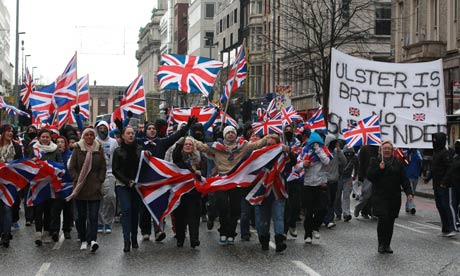
6The decision last night of Belfast City Council to stop flying the union flag 365 days a year, and not at all over other council buildings, resulted in a protest by around 1,000 loyalists outside the City Hall and ultimately a small disturbance. There was also trouble in East Belfast when the result was announced including an attack on a Catholic Church.

In preparation for the vote the Democratic Unionist Party had distributed tens of thousands of leaflets attacking the Alliance Party which had indicated it would not support unionist demands that it continue to fly all-year round but would propose that it fly only on designated days.  This is around 15 days a year on occasions like the Queen’s birthday and is the policy at Stormont where the devolved Assembly sits.  Nationalists had stated their intention to call for a vote which would have led to the flag not being flown at all and the Alliance proposal was seen as a compromise.  Holding the balance of power in the council it was widely expected the Alliance proposal would succeed, as it did.

In the build up to the council meeting the loyalist Progressive Unionist Party (PUP), which is the political front of the paramilitary Ulster Volunteer Force (UVF) stated that while its previous position was that it accepted the flag should only fly on designated days, now that it was being demanded by nationalists it would oppose it.  Sinn Fein has claimed that the UVF was prominent in the protest which led to the minor violence.  There is no doubt that loyalist paramilitaries were behind the violence in East Belfast.

At the demonstration the usual sectarian songs and slogans were recited and an Irish tricolour was burnt.  The BBC interviewed some participants in the protest.  One protested about the need to defend the flag that had been flown in Afghanistan while inside a DUP councillor protested that nationalists were attacking the union flag and other parts of Protestant identity.  The case against flying the flag could hardly have been better made by those opposed to it.

Loyalists defend the flag because it is a symbol of imperialist might and of sectarian identity while liberals complain that it is the flag of the country and should not be confused with sectarianism.

Of course flags are symbols of states.  They fly to denote the claims of that state over territory or over institutions.  They cannot be divorced from the history and policies of that state or institutions and they cannot be divorced from the actions of those who fly it.  For all these reasons the union flag is a symbol around the world of empire, military adventure and occupation and in Ireland it has a history of being identified with a sectarian state and sectarian practices.  The protestors were defending it because they support all of this, they support imperialism and sectarianism.

The approach of the PUP is instructive in this regard.  To Catholics their policy is – yes you can have rights, but only those we will let you have.  So you would not have to put up with the union flag flying every day if you had kept your mouth shut and not tried to change it but now that you have you must be prepared to suffer protest and intimidation.

This is the point that all those complaining about pointless arguments over flags refuse to take on board.  If the continued flying of that flag results from the exercise of intimidation then that is what the continued flying of that flag represents and that is what it symbolises.  It would do so, and has done so up to now, because that is what has allowed the flag to fly.  As a symbol it represents sectarian intimidation and the union flag symbolises the power of a state established by force and sectarian intimidation.  That it is now defended in such a way simply confirms this.

Some further observations can be made.

The rabidly sectarian character of the protest and opposition inside the council chamber blows yet another hole in the ‘campaign’, if that’s not too strong a word, by Peter Robinson and his claim that Catholics are happy with the union, partition and can be won to support the DUP.  If the flag of that union is claimed by its defenders as a part of a sectarian identity just what part of the state are Catholics supposed to identify with and support?

Garnering non-sectarian support for British rule is the role of the Alliance Party and it is no coincidence that the main target of the unionist campaign was this party.  The intention of the DUP is to win the East Belfast Westminster seat back from that party and sectarian flag waving is the way to do it.  That in doing so the claims of Robinson are exposed is not accidentally ironic.

The protest was relatively small despite the effort put into it but the reaction from the state was instructive.  The police had their usual low profile which was criticised by Sinn Fein and compared to what their activity would have been had 1,000 republicans turned up.  The presence of  figures reminds everyone, or rather it should, of the Chief Constable’s attendance at the PUP party conference earlier in the year.  This is now neatly sandwiched between UVF rioting in the lower Shankill and similar activity in the city centre and East Belfast.  This attendance signalled acceptance of such activity as part of the normal rules of the game but rules which should not be overstepped.

BBC interviewers refused to entertain criticism that loyalist figures were in attendance and might have something to do with the violence.  Fortunately one no longer has to worry whether the BBC will similarly refuse criticism of Osama Bin Laden on the grounds he is not in the studio to defend himself.

Concentration on the small size of the protest is therefore misplaced.  Unionism has increasingly taken to the streets, reflected in sectarian exhibitions in Donegall Street outside a Catholic Church and in the very large Ulster Covenant demonstration. The City Hall protest was sponsored by the main unionist parties who are both in government and they have signalled the issue is not over by promising to demand that the union flag is flown permanently at the cenotaph in the grounds of council buildings.

Even as low level controversy sectarianism is necessary for political rivalry and feeds continued division.  It sets wider political expectations and exposes the limited role of the state in combating expressions of sectarianism.  The liberal pretentions of the British state are allowed to continue to be presented as the only choice and the effect is to enforce an unacknowledged intimidation of alternatives.

In the larger scheme of things this particular issue does not threaten wider instability but it is one of a number of sectarian outbursts that remind everyone who cares to pay attention that the sectarian dynamics of Northern politics and society remain intact.  It is very unlikely that the continued brewing of this sectarian kettle will forever remain off boiling point.

The Bedroom Tax and the Inevitability of Civil Disobedience by ‘Belfast Plebian’

By now most people will have heard something about the new welfare regime due to kick in next year. The range of the welfare bill is so vast that it almost defies summary. The implications for the whole of the working class are very profound. To the unwary the welfare changes are of little importance because they think it will not impact on them, after all they are in steady employment.  Yet the changes will impact on the whole of the working class.  First of all steady employment cannot be guaranteed in the long-run recessionary economic cycle that we are certainly in and second because most workers have family circles especially parents and children that will be severely impacted. It should be stated at once that the number of unemployed in receipt of welfare benefits are in fact the minority, just over 60% of those in receipt of significant welfare benefits are in fact not unemployed.

Let’s pick out just one item that has gone largely unrecognised, changes to housing benefit and let’s be specific about it. In the north of Ireland there are currently 63,000 people registered as unemployed, however there are a lot more, 161,634 homes to be exact, in receipt of essential housing benefit, in fact 67,500 out of a total of 90,000 of Housing Executive households get the benefit, another 23,600 with Housing Associations and then another 70,000 renting in the private sector. In additions there are another 34,800 on the social need waiting list, 20,000 classified as emergency need. It is a reasonable assumption to make that most on that list would be in receipt of housing benefit if they could find a place to live.

Life is about to get a lot more difficult for many of those in receipt of housing benefit. For a start if you are single and under 35 you will only be allowed enough benefit to cover the cost of only one bedroom in a shared property. Where are you going to go to find this prized one bedroom?  Certainly not to the Housing Executive with its ever growing waiting list and reducing building programme, down to less than 2,000 planned properties. What then of the private rented sector?  Here rents are rising due to the mortgage crash – people who in the recent past could expect to get a mortgage are now no longer able get one.

The typical rent on a small house starts at about £600 per month, fine for some who have only just missed out on the mortgage bonanza but not for the poor benefit claimant who is facing a £400 cap which can only get progressively worse in relation to non-benefit tenants, the likely outcome being private landlords refusing to rent to the poor and a steady increase in homelessness.

Let’s move on now to the bedroom tax or as the government calls it, the over occupancy charge. From April next year those in receipt of Housing Benefit will have to pay a charge of 14% relative to the cost of rent for the audacity of having too much living space i.e. having an extra bedroom and others a stiffer 25% charge for having two extra rooms. You see the new welfare orthodoxy says that the working class have way too much spare capacity in their council homes.  So from April 2012 only one bedroom in a council property will be covered by housing benefit per person or per couple. If you have anything extra you will have to pay for it out of your universal credit. You see the new regime has moved on from merely targeting single people for penalty, it now reaches right into the working class family itself. If the person or couple have children the following rules will be applied.

A child aged 15 or under will be expected to share a single bedroom with another child of the same sex.

A child aged 9 and under will be expected to share with another child regardless of their sex.

You will be deemed to be over occupying your home if for example you are a single parent family living in a three bedroom council house with two teenage sons below the age of 15, or if you are a couple without children living in a two bedroom council flat, or again you will be deemed to be over occupying if you are a couple who have to sleep in separate bedrooms due to disability or sickness needs, or again you are a divorced or separated parent living in a two or three bedroom property who needs the rooms for children who only stay at weekends and holiday periods. There are just too numerous variations on this simple over occupancy theme to cover here. The above is just a sample.

How many people in the north of Ireland are to be classified by the Daily Mail mind-set as ‘wicked over occupiers?’ We don’t yet know; when Lord Freud was asked in the House of Commons about the likely outcome for the UK as a whole he confessed that the family friendly ConDem government had not bothered to commission any proper research. It has been left to charities to come up with some statistics; Shelter reckons there are probably about 800,000 miscreants in GB.  In respect of the north of Ireland all the housing charities think that the region will be affected the most, the minimal estimate I have seen is 7,000, but a web site in sympathy with the measure put it as high as two thirds of the current social housing tenants.

How much you pay will depend on your situation. The average council rent is approx. £72 per week, meaning an over occupier stands to lose at least £10 and maybe £18 from their living expenditure. To take one pertinent example, the current job seeker who is under 25 receives just £56.25 per week to live on; those over 25 receive £71. How many of those facing the over occupation charge will be able afford to keep the roof over their heads? Some will try and succeed, others will fail and will sooner or later be up for eviction. But for those scrimpers and savers who manage to make the payments there is a looming threat to their existence; the impending bedroom charge is not a final instalment, rather it is only a first instalment.

Just a year ago it was only the under 25s who were forced into one bedroom accommodation in the private sector, this has already changed to the over 35s. The Prime Minister is on record as saying that nobody has a social right to a home financed by the taxpayer, having a council home is a privilege he says not a right; he also says that he wants to dispense with what remains of social housing.

George Osborne recently proclaimed that he wants another £10 billion worth of cuts on welfare spending. In other words it won’t be very long before the charge is increased and more fall prey to the eviction notice. By the way, the small number of people who know about the new charges think that those who may fall into the classification scheme will be offered an alternative home if they can’t pay the charge, they are mistaken; there is no legal obligation on the housing authority to offer you something more suitable, this may be because these homes don’t actually exist.

What then has been the reaction of the local politicians who say they oppose the new reforms?  Answer – bluff and evasion? Well they have passed the welfare bill, so far without amendment, the so called concessions they are championing are entirely procedural. Are they preparing to drop the over occupancy charges? No sign of it. They play the evasion game by not talking about the housing benefit part of the welfare reform bill, hoping that nobody of any importance will notice it. It is to be revealed to the unsuspecting working class voter, Cilla Black style surprise! Surprise!

Come April next year people will suddenly find out about it and it will be too late for them to turn to the local politicians for some sort of protection. The politics of this whole affair needs to be discussed now. Why are the Tories attacking the living conditions of the working class in the home and not just in the workplace? They will not even save any money on housing benefit at least in the first instalment.  It makes no macroeconomic sense and looks more like a very nasty political stoke of class divide and rule than an attempt to solve the chronic housing crisis.  Perhaps they believe that it will destroy what little remains of working class social solidarity. We know that GB has a horrendous housing crisis, those who are desperate to find a home will now be ‘educated’ by the pernicious right wing press to blame those wicked over occupiers for their unfortunate condition.

One of the splendid ironies of the impending social disaster is that the seniors of both nationalists political parties swear that they were indeed the very the people who fashioned the civil rights movement that began life as a protest and even a disobedience campaign against the Orange States’ grossly unfair housing policy. If things are programmed by Stormont to follow the requisite course set by the Welfare Bill they will have to oversee a new set of grievances in respect of housing policy of even graver consequence than went before.

Untold numbers of working class people will not be able to meet the new rent charges out of living expenditure. Not being able to find alternative smaller homes when the eviction notices start to fly; they will inevitably opt to refuse to pack up and leave their existing homes. The nationalist politicians sitting in Stormont will have to persuade them that it is a bad idea to ‘squat’ in a house that they believed falsely was theirs by right.  They will have to tell them that the incomes of the hard pressed British ‘middle class’ taxpayer must take precedence over their own voters social need. They will have to appeal ever more to sectarian instincts rather than to definite social progress to keep the party vote in place. Long live the nationalist political class! Long live the unionist political class! Long live the new dispensation!

Belfast Trade Unions demonstrate against Austerity

Trade Unionists march against Austerity

As part of the trade union campaign against austerity across the UK the trade union movement in the North of Ireland organised a demonstration in Belfast to coincide with those in London and Glasgow.  It is difficult to estimate the size of the demonstration which appeared significant as it snaked its way through Belfast’s city centre but didn’t look impressive as it assembled and looked even less so at the final rally.  The latter however is a feature of trade union demonstrations. The notion that the purpose of a rally at the end is to explain what to do next and get everyone involved is as alien to most people at these things as little green men from Mars.  What happens next always depends on the decisions of the union leaders.  It is not for deciding by those involved.

Supporters of the United Left Alliance in the North correctly made this the subject of their leaflet and put forward the key task of the demonstration as one of creating a real permanent campaign against austerity:

“Last November saw 40,000 mobilised in Belfast in a general public sector strike  – but it was a one-off event and everyone went home again.  No further action was taken, there was no continuing campaign and the next public sector strike was much less successful.

Everyone is no less opposed to austerity and the Tories and Labour plans show the issue isn’t going away.

At the end of this demonstration we must make sure we don’t go away either.  To ensure that this doesn’t happen we need to come together to create an on-going cross-union permanent campaign that will oppose austerity.  Not one that pops up every six months but one that continues every week to campaign inside the trade unions, inside workplaces and inside communities to unite them all in a way that each of them cannot do by themselves.”

I overheard one of the trade union leaders responsible for the demonstration express her delight at the size of the turnout.  The demonstration was successful in so far as it confirmed that a basis exists for starting to build a wider and potentially successful campaign but one should not underestimate the obstacles.

The first is that the demonstration was no more than a few thousand at the very, very most.  It was dwarfed by the very, very large sectarian demonstration three weeks before, which commemorated the signing of the Ulster Covenant that led to partition.  This was celebrated by the participation of dozens of ‘kick the pope’ flute bands.  A prominent organiser of it was Nelson McCausland of the Democratic Unionist Party who has led the introduction of the Welfare Reform Bill in the Stormont Assembly, which imposes in Northern Ireland the cuts decided by the Tory Government in London.   It is ironic that many of the marchers in the Ulster Covenant commemoration will be shafted by these cuts.

The welfare changes introduce the biggest assault on entitlement in decades and were also supported by Sinn Fein.  The latter bring their own ironic aspect to its passage.  The back bone of Sinn Fein’s political machine is a network of advice centres at which Sinn Fein activists help those on welfare get as much as they can.  It is what they called ‘screwing the system’ when they first started doing it.  Now of course Sinn Fein has joined the system and the only people getting screwed are their constituents.  The first many of them will know about the changes will be when their benefits get cut.   They will then run to the advice centres where Sinn Fein will tell them ‘sorry but these are the new rules’.  What they won’t tell them is that Sinn Fein voted for them and had the power to stop them but didn’t.  While welfare is cut along with public sector pay Martin McGuinness will continue to complain that the British won’t let Sinn Fein and the DUP cut corporation tax.  Sinn Fein posturing has been particularly vacuous – they have said they ‘might’ make an issue of monthly payments of benefits and demand that they are paid fortnightly instead.

The third obstacle is reflected by the fact that so many walked away from the demonstration with no demand to those on the platform that they provide them with a strategy promising success.  The demonstrators were activists in their various trade unions and community groups but there is no understanding of the need for wider organisation.  They were there to protest and no more.

A protest is an expression of disapproval, summed up in the slogan ‘not in my name’.  It is not an alternative and it ultimately receives the following answer by the Government and State – ‘yeah, so what?’  Sinn Fein and the DUP live and breathe as defenders of their respective community against the other even as together they fillet both.  The limits of the trade union leaders’ challenge can be seen in the statement released before the demonstration:

“The devolved administrations must build a robust joint defence of the people who elected them.  Let this rally today send a message to our MLAs and our MPs from all political parties that we the people are firmly opposed to the failed policy of austerity which destroys lives and futures.”

An appeal to the political parties at Stormont and to Stormont itself is not a strategy.  It amounts to an appeal to the enemy.  The financial crisis exploded because of a property boom and the well-reported antics of the Developers’ Unionist Party and hidden ‘let’s get rich’ antics of the leaders of the Provisional Movement mean these people ae personally tied up with the system that is demanding the cuts.

The political sectarianism of the left means that it too is not an alternative.  It is unable to unite its tiny forces in an attempt to make a difference, although this is not the biggest problem.  The Left’s inability to organise in an open and democratic way means it cannot include the wider forces needed to create a real movement.  Were it to attempt to do so the Left group concerned would no longer retain control.  Since their absolute need for control is not just a rather unfortunate sectarian aberration in their practice but a foundation in principle of their existence- they all believe that they are the sole essential nucleus of the mass working class party of the future because of their particular approach to socialist politics -they are both practically and in theory sectarian.

The leaflet of the supporters of the United Left Alliance correctly put forward the next step – creation of a permanent campaign that is organised across unions by rank and file members, in workplaces and in communities and their community campaigns.  This is not just the next step in a campaign against austerity.  Just as socialism is the creation of working people themselves so is the resistance to capitalism, one of the means by which the capitalist system will be superseded by the power of a new ruling class, made up for the first  time by the vast majority of society.

Can Ulster Unionism be left wing?

Flags of the Left?

In this week’s Belfast nationalist paper ‘the Irish News’ their regular columnist Brian Feeney put forward the claim that Protestant unionist workers had been duped into believing that being left wing was also to be ‘disloyal’.  Presumably these workers can therefore be left wing and ‘loyal’.   Indeed this is the thinking behind recent proposals within the United Left Alliance to build a “new mass working-class party in Northern Ireland to unite the working class against sectarian division and against the right-wing austerity of the Assembly Executive.”

An obvious objection to the ULA proposal is that it claims to stand for workers unity while accepting the division of workers created by partition.  The only way this can be justified is by accepting unionist claims that such workers unity should not exist.

A smarter unionist might claim that the unity of Irish workers would break the unity of the workers in Northern Ireland with those in Britain.  The problem of course is that Irish workers unity is sacrificed for a unity that does not exist.  There is in reality no genuine UK workers unity because most British workers regard those from Belfast, Derry and Enniskillen as Irish.  No carnival of reaction predicted before, and confirmed afterwards, by partition is likely upon the separation of the North of Ireland from Britain.

So we are back to the repeated collapse of what often passes for socialism in Ireland before the veto on workers unity demanded by unionism.  If such unionism is inherently and unavoidably reactionary then it is clear that such a veto should be rejected.  It might only be accepted if it could be credibly claimed that Feeney is right – Protestant workers are merely duped into believing that being left wing is also to be ‘disloyal’.

Unfortunately Feeney gives enough examples of the reactionary character of real unionism, as opposed to the pretend hypothetical unionism that at no time and nowhere has existed, to demonstrate that a different sort will never exist.  He records the mass expulsions of Catholic workers from the shipyards by sectarian unionist mobs in 1912 and 1920 when around 2,000 were expelled in the former year and thousands more in the second.  Crucially he also notes that 500 Protestant workers were also expelled in 1912 and 1,800 in 1920.  These were ‘rotten Prods’ who failed to demonstrate their true credentials by not being bigots.

Feeney notes that these Protestant workers refused to put an ‘ethnic’ solidarity, in reality a sectarian solidarity, in front of any other.  Some supporters of the ULA are presumably content that Protestant workers can accept this sectarian solidarity while being ‘left wing’.  If they did not put this sort of sectarian solidarity first then there could in principle be no objection to proposals for the unity of the whole Irish working class.  Proposals within the ULA that avoid this conclusion are in practice accepting that sectarian identity must be accepted and accommodated.  In other words sectarianism must be accepted and accommodated.  Protestations to the contrary can in reality be dismissed.  Political positions have consequences and in this case these are quite clear.

Feeney records the words of Peter Robinson of the DUP that ‘the unionists of Ulster were a distinct people entitled to determine their own future.’  Since the most right wing forces will always be the most vigorous defenders of this position acceptance of it necessarily means acceptance of the leadership of Protestant workers by the most reactionary bigots.

As to the cogency of Robinson’s claims – the unionists of Ulster were happily the unionists of Ireland until they could no longer garrison it all whereupon they then demanded not that they determine their own future but that the imperialist power did.  This then amounted to the seizure of both more than the territory within which they were a comfortable majority and less than would include all the Ulster unionist people they claimed they were.  The character of the movement that expressed this people politically became evident when it came to determining not their own future but that of the large Catholic minority they took with them.  This minority was subject to sectarian pogroms and systematic discrimination for nearly half a century before a civil rights movement exposed the irreformibilty of this unionist movement.

We can go back to Feeney’s claim that Protestant workers have been duped into believing that being left wing is ‘disloyal’.  It is obvious that they have not.  For what is it that unionism claims that there must be loyalty to?  Loyalty to what?  Well – to Queen and country!  To a monarchy and an imperialist power.  To partition and division.  To a state based on a sectarian head count.  To the rights and privileges of Robinson’s ‘distinct people’.

How could you possibly be left wing without being disloyal to all that?

Apologists on the left for capitulation to unionism put forward the final argument that we must accept unionism because the vast majority of Protestant workers are unionists.  In fact it is this very fact that makes opposition to partition absolutely necessary.  Opposition to partition is not necessary despite the unionism of Protestant workers but because of it.  It is not possible to break their commitment to this reactionary political programme without defeating it and it can only be definitively defeated by destroying the state power on which it bases its power.

How deep is the division created by partition?

In an article in the ‘Irish Times’ a couple of weeks ago Andy Pollak, Director of the Centre for Cross Border Studies and a former Irish Times journalist, takes up the observation that “interest among people in the Republic these days in Northern Ireland is minimal.”  “As somebody who lives in the South and works in the North, my experience in recent years, as the economic and financial crisis has come to dominate public discourse, is that southerners largely don’t want to know any more.”  Since previous interest was taken mainly to be revulsion at the violence and gratitude that it was “up there” and not “down here” this might not seem a new issue.  In fact both reflect how deep is the division that partition has created after nearly a century of existence.

Pollak quotes the young woman in the audience of the RTÉ Frontline programme during last October’s presidential campaign who attacked Martin McGuinness: “As a young Irish person, I am curious as to why you have come down here to this country, with all your baggage, your history, your controversy? And how do you feel you can represent me, as a young Irish person, who knows nothing of the Troubles and who doesn’t want to know anything about it?”

First we must say that this is indeed a strong illustration of the division that exists between North and South of the border; all the stronger because of the happy ignorance that is displayed.  On the other hand this happy ignorance demonstrates that the division which she articulates is really an expression of the unity that she is so ignorant of.

Happy ignorance?  Well yes.  The young woman speaks of coming “down here to this country” which is actually the same country, while being a different state.  She mentions “all your baggage, your history, your controversy” without appearing to be aware that the State she lives in shares much of this baggage, history and controversy.  After all, is she not aware of the history that includes the War of Independence, the Civil War (mainly in the South) and baggage that includes Catholic Church domination of society that involved systematic and widespread abuse of thousands of women and children that still resonates today?  Is she not aware that ‘the troubles’ had its worst single episode of violence in the Southern State carried out partly by agents of the British State?  Happy in her ignorance because she herself declares she “knows nothing of the Troubles and . . . doesn’t want to know anything about it.”

The disconnect between this young woman’s understanding and real history is perhaps an example of the invention of nations that don’t exist, or sometimes later do come into existence.

Pollak says that “opinion polls over the past decade or so show that a bare majority of people in the Republic now say they want a united Ireland: for example, in the 1999-2000 European Values Survey, just 54 per cent of people favoured unity.”  He quotes one University College Dublin student as saying: “Neither of us want Northern Ireland: neither us nor the UK government. I’d say if you asked the majority of Irish people – yes, nationalists, out of a sense of allegiance, might say they wanted a united Ireland – but it’s really far more trouble than it’s worth.  I mean, to integrate Northern Ireland into this State – why would you be bothered? The status quo satisfies everyone.”

Let’s take this statement bit by bit as well. The UK state doesn’t want Northern Ireland?  A very common opinion but one that is impossible to square with the experience of the British State spending billions of pounds and engaging in a long counter-insurgency campaign in order precisely to keep hold of the Northern State.  We will not go into the reason why here but let us recall that Britain left previous parts of empire extremely reluctantly.  Why hasn’t it left this bit if it actually wants to in this case?

So “yes, nationalists, out of a sense of allegiance, might say they wanted a united Ireland – but it’s really far more trouble than it’s worth.”  What trouble might this be?  Well we know that just as partition was imposed on the Irish side of the Treaty negotiations on the basis of the threat of immediate and terrible war so we know that partition today must be unquestioned because of the perceived threat of loyalist violence.  A loyalist violence that the last thirty years have shown the British State is quite happy to support and sponsor.

Uniting Ireland? “Why would you be bothered? The status quo satisfies everyone.”  This is the decisive question.  Let’s start from the end and go to the start – “the status quo satisfies everyone.”  This is the status quo that includes the literal bankruptcy of the Irish State and its admitted loss of sovereignty over its economic affairs.  The more or less complete loss of respect and legitimacy of fundamental pillars of the Southern State – politicians, Catholic Church and crucial State institutions.  Yet  “the status quo satisfies everyone!!?”

I would bet that many UCD students are very far from satisfied with the status quo but that they don’t see their dissatisfaction with the Southern State as having anything to do with partition.  If it’s not part of the problem then why would opposition to partition be seen as part of the solution?  What we have is graphic demonstration of the division of the Irish people that partition has caused that satisfaction is expressed in a State which many are in despair of because its problems are not seen as having anything to do with the other bit of the country divided.

That the domination of the Southern State by outside powers, who have dictated that their banks must be protected by the Irish people bailing them out, is not connected at all with the political rule in the North of the foremost political power in Europe most enmeshed with banking is the result of a number of factors.

The first is that such is the seeming power of these outside forces they seem almost like a force of nature, or if not, then an unalterable fact of life.  The second is that when there has been opposition either to the Northern State or to how the Southern State exploits its citizens this opposition has made no attempt to link the two questions.  The third is the more or less complete absence of any force that wants to do this.

Instead workers have been able to react only to the more immediate appearances of their oppression. This appearance is framed as a political question by the State, which is often the mechanism for enforcing it and sometimes by the putative opposition putting forward the state under different governance as the solution to oppression.

This importance of the state in distorting socialist politics has been a theme of the blog so far.  For most people, including what passes for militant opposition, the necessity of fighting two States is one too many.  In fact consistently fighting one is one too many.  That is how deep the division created by partition is.

Scottish Independence and a United Ireland

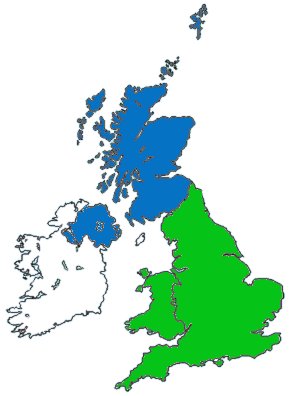
Peter Robinson, the leader of the Democratic Unionist Party and First Minister of the Northern Ireland administration made a speech last week about the attitude of unionists to a possible vote in Scotland for independence.  He didn’t think it would succeed and argued that there was no conflict between “one’s regional and national identity”.  Because the North of Ireland is just a region, and unionists believe themselves to be British, Robinson made the basic mistake of describing Scotland as a region when it is of course a nation.  The issues his speech touches on are interesting in a number of ways, especially the question of a United Ireland.

Firstly he states that even if Scotland voted for independence, he was confident “it would not alter Northern Ireland’s desire to maintain the link with England and Wales.”  But why England and Wales?  Why not Scotland?  We have all had to suffer the manifest nonsense of the existence of an ‘Ulster-Scots’ people with an Ulster-Scots’ language and an ‘Ulster-Scots’ culture yet nary a thought appears when it might seem there is a choice to be made between Scotland and the rest of Britain as our wider home.

This is of course because the ‘Ulster-Scots’ movement is a sectarian invention designed to prove the absolute and complete difference between the Irish, who have a real ancestral language, and can be taken as Catholic, and those who are not Catholic and support partition.  This is necessary to provide some legitimacy for this partition and the existence of the Northern State.   Marxists understand that all nations are inventions, it is just that one invented almost overnight on the basis of a non-language and another nation’s cultural heritage, whose purpose seems to fill in successful grant applications, is not very convincing.

The reason that an independent Scotland is not considered as the unit to which the Northern State must be subordinated is that it is too small and would not have the resource and power to enforce any challenge to the Northern State’s existence.  If that means sacrificing the blarney about kinship with Scotland, who cares?  After all didn’t unionists dump the identity of ‘loyal Irish’ when the majority of the Irish people decided they weren’t loyal?  And wouldn’t many also dump the loyalty to the Queen part of ‘loyal to Queen and country’ professions of faith should, heaven forbid, the British change their law, allow a Catholic to be head of State and the next King or Queen start believing in the doctrine of transubstantiation?

What matters is the existence of an outside power with the means to defend their claim to a privileged position within the population they have lived with for around four centuries.  Behind all the various labels they and others have attached – loyal Irish, Ulstermen, Ulster-Scots, British, British-Irish, Northern Irish – what is really sought is a designation that doesn’t make it quite so obvious that what is being claimed are sectarian rights.

The project tentatively raised in recent speeches by Peter Robinson about reaching out to Catholic unionists died a death when he recently supported sectarian loyalist parades past a Catholic Church in Belfast.  The attempts to dress unionism up in non-sectarian colours always fail.

A corollary of this is that those supporting Scottish independence because it will undermine Irish unionism are wrong because this unionism relies on State power directed from London, not any purported emotional or familial attachment to Scotland.  Equally the idea that because independence is sought on the grounds of democracy in Ireland, in the form of a United Ireland it should be supported for Scotland is also wrong.

For Marxists the objective is the unity of the working class across nations.  If it is not united, by definition it cannot act on behalf of its interests as a whole.  National divisions often prevent this unity.  To remove the salience of such divisions it is necessary that nations reflect no decisive material divisions beyond cultural ones that can be accommodated, involving difference without division.  For this to be the case there must be equality between nations.

Self-determination of nations is a means of ensuring that any nation suffering national oppression is able to escape this oppression and stand in a position of equality.  For small nations this is impossible in an imperialist dominated world so questions of nationality often frustrate international workers unity.  Nevertheless the removal of national divisions is also a process intrinsic to capitalist development and socialists must support the erosion and removal of divisions among workers due to nationality.

In Ireland partition has divided workers North and South and within the North on the grounds of religion. The removal of partition may be seen as part of a democratic process to remove the foundations of this division.  In principle partition and its associated divisions could just as well be undermined by a united polity across Britain and Ireland.  History has demonstrated that it is just this ‘unity’ that created and fostered this division in the first place.  A united and separate Irish State is therefore a legitimate project which could further the removal of divisions within Ireland and which socialists should recognise as progressive on this basis.

In Britain there is no real or substantive division among workers based on being English, Scottish or Welsh.  Creation of separate states, such as would  happen with Scottish independence, would however go a long way to creating the material foundation for such divisions. This would set back considerably the struggle for workers unity.

Scottish independence and a United Ireland do not have political dynamics that are at all similar and to believe so is in my view a mistake.  How do we know this?  Well this is one experience of Irish history that does have direct relevance to Scotland.  The creation of a separate state has deepened the divisions that existed in Ireland before partition because it created a new one.  This new one is also now strong and it is not one that is conducive to workers unity.  I’ll look at this in the next post.

Sectarianism in Belfast. What’s new?

On July 12 this year a loyalist flute band marched past St. Patrick’s Catholic Church in Donegall Street near Belfast city centre.  They stopped at that particular point by “pure chance” and started walking round in circles playing a tune known as the Famine Song, which contains the line “the famine is over, why don’t you go home?”  This song is sung by supporters of Rangers Football club in Scotland and refers to the large Irish and predominantly Catholic immigration into Scotland from the 19th century onwards.  It has been found to be both sectarian and illegal by the Scottish courts.  According to the band and their political apologists they were merely playing a pop song.  Perhaps it was again mere chance it doubles as a sectarian anthem.  Perhaps also those allegations of an attack on a cameraman filming this Orange version of the X Factor are also mistaken.

On this basis the Parades Commission, a quango established by the British government to adjudicate on contentious parades, decided the band could not take part in the loyalist parade last Saturday, which was to pass the same church.  The other bands were also only allowed to march by a single drum beat past the church.

Unionist politicians were outraged and issued a statement, along with assorted flute bands, denouncing the Parades Commission, saying they were running out of adjectives to describe it , so they gave some nouns instead – “arrogance”, “incompetence” and “general ignorance”. This statement was signed by prominent members of the Stormont Government who claimed that they could no longer let the Parades Commission do untold damage to the peace process. “Violence” would potentially ensue, they said.

So on Saturday the loyalist flute band at the centre of events marched as normal and played the normal sectarian tunes that are the staple of these ‘kick the pope’ bands, as did many of the rest. The normal sectarian insults were hurled, which are surprising only to those terminally stupid or naive.   The police did nothing that anyone could notice to prevent this.  Well, not exactly nothing: there is a picture of one policeman using a loudhailer to tell the passing bands that they were really not allowed to do what they were doing.  This robust action will no doubt be followed by the police warning burglars by megaphone that they are breaking the law when they are seen to break into someone else’s house in broad daylight. Through the Police Federation the police later complained of being caught in the crossfire, presumably between those intent on breaking the law and those who were, well, how shall we say it, wanting it upheld?

There were minor scuffles and one apparent loyalist from Scotland was arrested for running through a nationalist protest, although this was blamed by one unionist politician on a republican.

So we have a loyalist coat-trailing exercise in bigotry, defended by the most senior unionist politicians who warn of violence, which stokes up the adrenaline of the street level bigot but allows the unionist politician to deny any responsibility when the lighted match touches the blue touch paper.  The police wring their hands and the nationalist politicians talk about getting it all sorted out through talking.  You have to be very, very young not be aware that this record has been played a thousand times before.  So what’s new then?

Well what is new is supposed to be – everything!  We have a new peace process, a new political settlement, a new Government and a new coalition between the “two sides”.  Belfast has a new skyline with lots of new visitor attractions welcoming tourists, which is still a relatively new concept to Belfast.  We have new cafes and restaurants and art galleries and a new generation too young to remember ‘the troubles’ and which just wants to live in peace and has no time for this sectarian stuff.

But we have been here before.  Belfast in the 1960s was also a ‘happening’ city with a burgeoning night-life whose young generation was hailed as no longer interested in the sectarianism of the past.  The sixties brought new life, hope and light even to Belfast and not just the streets of London or San Francisco.  New housing was being created that was demolishing the slums that had no inside toilet and entries that doubled as permanent rubbish tips.  Some of this new corporation housing promised mixed estates and a new Unity Flats was built at the bottom of the Shankill Road only a couple of hundred yards, if that, from St. Patrick’s church.  Unity Flats was so called because it was to contain both Protestant and Catholic tenants, sharing the one space in harmony.

We all know, or at least have some vague idea, what happened at the end of the sixties.  That swinging decade that even moved in Belfast was very new and modern but Belfast was incapable of accepting civil rights, including fair allocation of housing and jobs and equal voting rights.  Instead it burst into violence, with Orange parades which were hyped up by unionist politicians and a police force that could not subject violent bigots to the normal restrictions of the ordinary law.  Of course this violent explosion hasn’t happened yet and in my view isn’t going to happen, not yet at least.

The mutual exhaustion of the contending political forces has not yet ended and been reversed.  The unionist leaders are attempting to exert pressure that might eventually usher in their preferred model of unionist-only rule but they are not in a position to force a confrontation that would see the British Government accede to their demands. It is not impossible that a violent eruption might occur that goes beyond unionist plans but it needs a realistic objective and the aim of getting Sinn Fein out of government has not yet become the unifying campaign theme within unionism and loyalist organisations that is required.

Instead the provocative and vitriolic sectarianism endorsed by unionist politicians in the highest offices of the Stormont administration erodes the faith of nationalists in the new deal. The approach of Sinn Fein to the recent events has been relatively muted and resembles nothing so much as the old SDLP approach which so many nationalists rejected by supporting the old (republican) Sinn Fein.  Here too however there is no unified project beyond staying in office and doing nothing to jeopardise the electoral prospects of Sinn Fein in the South.

The real republicans can attempt to take advantage of the disillusionment with the Sinn Fein reaction to the sectarian provocation and can build up their support base but what is their political project?  In so far as it simply involves a renewed armed campaign it only strengthens the ideological hold of the peace process even while more and more people, subconsciously at first, begin to wonder when exactly this process, like every other, is going to end.  The traditional republican policy isn’t credible except as a form of protest but outside of an overarching strategy this republicanism isn’t in a position yet to mobilise a large political opposition.

A large scale sectarian provocation might accelerate these trends and the planned large loyalist parade on 29 September past the same church certainly has the potential to be such a provocation.  It might at the least drive home the lessons of last Saturday if it goes ahead as the parade did then.

The condemnation by two Protestant church leaders of the sectarian behaviour of the loyalist bands shows how vulnerable the loyalists are to criticism.  It is their solutions and that of the Catholic Church that is the problem.  They both want to set the rulings of the Parades Commission as inviolable.  The Catholic Church is worse because it calls for special measures to apply when the parades pass a place of worship conveniently setting themselves up as victim, potentially privileged  protection in future while turning a blind eye to the fact that a sectarian march is a sectarian march no matter where it passes. Its vitriolic bigotry is no more acceptable a hundred yards from a church than right in front of it.

What is needed is an anti-sectarian campaign that is unafraid to name sectarianism when it sees it and is not seduced by the siren calls for equality of traditions, including mutual respect for each other’s culture.  There can be no equality for a tradition based on sectarian supremacy or respect for a culture soaked in bigotry.  Such a campaign would target not just loyalist parades but the sectarian policy creeping into housing policy and the recent discriminatory employment practices of Sinn Fein.  It would challenge the trade unions to take a principled stand and, at least in principle, should be capable of uniting much of the small left. The ULA could take the lead on this in the South by making it an issue on the floor of the Dail as the clarion call for an all-island campaign.  To do otherwise is to turn one’s back on sectarianism while claiming this as the means of opposing it.

The main task would be to rip away the protection of the current sectarian arrangements that are more and more revealing their true colours by refusing to subordinate anti-sectarianism to the demands of the peace process, however this is defined.  What sort of peace is it that allows, even sanctions, the displays of sectarian bigotry on display in Donegall Street on Saturday?

handshake and reconciliation

The handshake between the British Queen and Sinn Fein leader Martin McGuinness is something significant even though most people in the North of Ireland have shrugged their shoulders and have only at the last minute really taken it under their notice because of the hype from the media.  Both the British State and Sinn Fein wanted it to happen for their own reasons and were more than happy that it got the media blitz that it did.

Every commentator aware of the history has remarked on the sea-change that has taken place at this diamond jubilee visit compared to that during the Queen’s silver jubilee in 1977.  At that time republicans demonstrated and rioted against her visit while today the hand of friendship has been extended.  However beneath this difference the purpose of the visit has been exactly the same on both occasions although much more successful on this one.

The veteran journalist Peter Taylor has an item on the BBC news recalling his reporting on the visit for ITV in 1977 and the authorities in that station pulling his report ten minutes before it was due to be broadcast because it exposed the reaction to the visit.  The British government was engaged in a huge propaganda effort to treat the political conflict as simply one of criminality arising from sectarian communal conflict over which the State was an impartial enforcer of peace and order.  The purpose of the Queen’s visit, Taylor says, was to present her as a “great healer of the division between the two communities”.  His report of opposition to the visit exposed this as nonsense.

It did not, and does not today, matter that everyone knew it was nonsense.  The point was to set a public agenda behind which the real strategy of repression and political intrigue could be realised.  This strategy was ultimately successful, although it took over two decades to bear fruit through the ‘peace process’, in the cause of which almost anything is justified.

Today the visit of the Queen and Sinn Fein’s very public welcome is designed to prove the aims of the 1977 visit have now been achieved.  Both she and Martin McGuinness are the bearers of reconciliation and their handshake the equivalent of signing off on an agreement that the conflict that existed in 1977 is never going to return.  The Queen can visit Ireland and there is no reason in the world to object to her presence or protest at the assertion of imperialist rule that these visits represent.

Such claims are acceptable because such acceptance betokens reconciliation.  Of course this is presented as reconciliation of a divided community, of Protestant and Catholic, and who could oppose this?  Certainly not socialists for whom the unity of Protestant and Catholic workers is a fundamental objective and which cannot happen without reconciliation.  But the reconciliation on display yesterday was not between Protestants and Catholics but between the high representatives of their current political leaderships: the Queen as head of State of the imperial power and Martin McGuinness as the highest ranking nationalist minister in a sectarian administration of this imperial rule.  What is involved is not erasing of the division but acceptance of it and promise of continuation in perpetuity.  What has been reconciled is Sinn Fein with British rule.

What events this week have shown is that far from ending sectarianism this reconciliation promises its continuation.  For this week the rotten sectarian heart of the new political arrangements in the North has been shamelessly exposed.

Conor Murphy, the recent Sinn Fein Minister for the Department for Regional Development (DRD), was found by a Fair Employment Tribunal to have engaged in unlawful religious discrimination in appointing a Catholic to Chairman of Northern Ireland Water in a case taken by one of the Protestant applicants.

The Tribunal’s judgement was scathing of Murphy.  Both the successful Catholic candidate and Murphy claimed not to have met each other before the appointment and Murphy was “quite firm” in the view he had not met the applicant.  Murphy however had previously appointed him to two public bodies while claiming not to know where he lived, although he was from Murphy’s constituency and had also been Chairman of the local Health and Social Services Trust.   The tribunal nevertheless asserted that it “is satisfied, on the balance of probabilities, that the Minister did have contact with Sean Hogan, and met him when he was Chairman of the Health Trust in Newry, and that they knew one another.  The Tribunal finds that both Sean Hogan’s and the Minister’s evidence in these respects lacks credibility.”

The Tribunal also found that “for a four year period between 2007-2011, when the Minister was in charge of DRD, there was a significant disparity between the success rates of Protestant applicants and Catholic applicants within DRD, and that a Catholic applicant was at least twice as likely to be appointed than a Protestant applicant.  Statistics for other Government Departments show a ratio at or close to 1:1.  The Tribunal is satisfied that there was a material bias against the appointment of candidates from a Protestant background within DRD.  The Tribunal is concerned that Dr McKibbin, as Permanent Secretary within DRD at the material time, and currently Head of the Northern Ireland Civil Service, was not more aware of the situation.”

Even in the dark days of Unionist discrimination during the previous Stormont regime pre-1972 I can recall no case of a Minister and senior civil servant being implicated through exposure of such high profile discrimination.  It was actions like these that led to the civil rights movement and the fall of the old Stormont.  Yet there have been no words of criticism from the rest of Sinn Fein and in fact two Sinn Fein Ministerial colleagues of Murphy’s were consulted by him in making the appointment.  Murphy has continued to deny his guilt although it is impossible to believe that the evidence and judgement of the Tribunal would not be accepted by Sinn Fein if it involved Unionist discrimination against Catholics.

Sinn Fein’s claims to oppose sectarianism are badly damaged and their hypocrisy exposed.  Meet the new boss, same as the old boss.  The new Stormont promises sectarian discrimination just like the old one except that both sides will now be at it. The silence of the representatives of Unionism is deafening.  They knew that this is what they were agreeing to by accepting Sinn Fein in office because that is what being ‘in government’ is all about.  Small and relatively powerless local administrations do nothing but administer bureaucracy and distribute the spoils of office.  By their silence it is quite clear that Unionists will view the actions of Sinn Fein as licence to do the same.  The benefit to Catholics of Sinn Fein discrimination will be licence for Unionism to discriminate against them.

Sectarianism is to be more secure because everyone will be at it except of course that the whole point of discrimination is to arrive at an unfair and unbalanced outcome.  Equality of discrimination makes no sense at all and will be proved in the attempt to achieve it.  It is not an inherently stable proposition.  However the attempt to achieve it means that if there is to be real opposition to sectarianism and discrimination the unity of the working class becomes a more obvious need because both stand immediately to benefit.  Let Sinn Fein and the British State become reconciled to the current arrangements; the true cause of reconciliation belongs to those opposed to religious discrimination. By becoming ‘friends’ it must be made clear to working people of both religions that the Queen and the Minister are both on the other side.