A footnote on the pathology of imperialism part 1 – Lance Armstrong

lance imagesby Belfast Plebian

Just a few nights ago I watched a television programme broadcast on BBC Four about the career of Lance Armstrong, the many times winner of the most gruelling sporting event known to man, the Tour de France, and was riveted by it. To win that thing once takes some doing, you almost have be prepared to kill yourself to succeed. Now, Lance won that damn thing seven times. It is hardly surprising that American big business was inspired by Lance’s achievement

He became the pride of America, corporations invited him to represent them; he spoke to the workers about the importance of mental discipline, ambition and dedication; he became the friend of successive Presidents and near Presidents; he founded a multi-million charitable foundation that was endorsed my countless movie stars and celebrities.

What was extra special about Lance was that after winning his first Tour he was diagnosed with Testicular Cancer. Now this condition can be treated if it is recognised early. However Lance’s cancer had already spread into other parts of his body including his brain. So Lance’s road to recovery was fraught with difficulty. Yet recover he did, and he went back to France to win the race another six times. No wonder then that American capitalism was in awe of Lance the over achiever. I have to admit that even me, a full time slacker, was impressed.

However it later transpired that Lance had won his tours by cheating on a grand scale. He had linked up with an infamous sports scientist who knew how to juice up the body to make it perform well beyond its natural state. If you wanted to be part of Lance’s all conquering team you had to participate in his well-orchestrated cheating.

Most of Lance’s support team went along with it because they believed every other cycling team on the tour was likely doing something similar. In fact Lance was taking so much juice that it might have been the toxins that brought on the cancer in the first place

While watching the documentary film two thoughts formed in my mind. The first was that Lance was the perfect match up for a certain type of ruthless capitalism; the business press often celebrate the top business executives by labelling them alpha males, they seem driven to succeed and will stop at nothing.

My second thought was he was a type of sociopath.  This thought only came into my mind near the end of the film when Lance telephoned a former teammate and his wife to apologise for all the bad things he had done to them by lying about them at a judicial hearing and to the press. They were at first a little gob smacked that he had taken over an hour to apologise to them and even seemed open to believing him. But then they realised that Lance’s apology was in fact just another Lance tactic, it was merely a PR ploy invented by Lance and his public relations team to save what was left of his damaged reputation and declining financial position after he had been shown to be, not just a cheat, but also an unrelenting liar.

Now I am no psychiatrist, so I went to the World Wide Web to find out what the professionals have to say about the term sociopath that had popped into my mind while watching the documentary.

I found out that the term originates from the America of the 1930s and was considered a useful one for separating those with specific anti-social characteristics from people who were criminal and dangerous i.e. the psychopaths. Today it is a common description for a type of personality that belongs in a group who may be said to exhibit a syndrome known as anti-social personality disorder. The popular use of the term is a little bit worrying for professionals because it gets mixed up with another state of mind disorder that also belongs to the group syndrome, namely the psychopath.

People with anti-social personality disorder exhibit the following behaviours:

1 They often breach the moral codes and conventions of the community they were socialised by.

2 They routinely lie and deceive family and friends.

3 They are impulsive and don’t foresee the likely consequences of rash decisions.

4 They are more prone to confrontation and conflict with other people than is normal.

5 They don’t feel guilty about harming other people who they believe are placing obstacles in their way.

6 They easily forget about bad things they have done to others in the past and expect family and friends they have hurt to always welcome them back no matter.

7 They are selfish most of the time, and have little thought for the troubles of others.

This is not the full list of criteria used by professionals but it is the essence of the matter. It has been argued that in the USA about 3 percent of the population can be assumed to be in the sociopath group and 1 percent in the psychopath group.

Now I dare say that most people might think that they could qualify as fitting the description if faced with abnormal circumstances, but the sociopath and the psychopath belong there given normal circumstances, they have a right to belong there.

I put Lance in the sociopath box mainly because he appeared not to be violent and a danger to others in the physical sense. He is not Ben Logan, brilliantly acted by Ben Kingsley in the film Sexy Beast, as convincing a portrayal of a murdering psychopath, as you are likely to see on the big screen.

It is to our benefit that people with personality disorders are thought to be a minority within our community. However all things are relative and there is a difference between the number of probable sociopaths and the number of probable psychopaths. It is generally believed by people who research these things that psychopaths are a tiny minority because they are produced by a fault in their physical nature, while sociopaths are more likely to pop up because their condition is attributable to nurture.

Well if the number of sociopaths can change due to changing social conditions then we have to be made aware of how this works itself out. It seems that a very stressed family situation, involving the rearing of children, is the place to start, being the social condition that makes for an individual acquiring the personality disorder syndrome. If a probable 4 per cent belongs to the groups; that is still 1 in every 25 people that you might know. It should be pointed out that most people who have the condition do not suffer from what is called a psychosis, meaning a detachment from reality due to the experience of suffering delusions or hallucinations. In short they do not strike one as being mad.

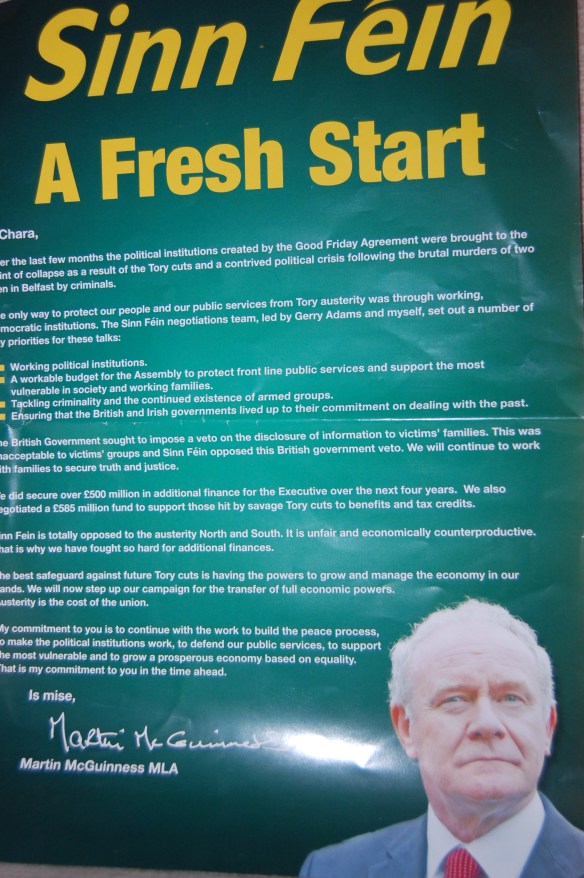
Use ‘ A Fresh Start’ to whitewash your dirty linen – maximum spin programme recommended

2015-11-24 21.25.27

The richest political party in Ireland paid for the Northern nationalist newspaper ‘The Irish News’ to include a glossy leaflet inside it, selling the latest political deal which has been negotiated between it, the British government, Irish government and the Democratic Unionist Party.

It’s called ‘A Fresh Start’ although it isn’t: the whole point of it is to refurbish the previous agreement, of which Sinn Fein had been an enthusiastic supporter.

So it’s not fresh, since it contains no new ideas, and because we have been here countless times before and the main point is to implement the Stormont House Agreement, it’s not a start either.   In fact according to Sinn Fein no fresh start was even necessary.

Not necessary because the first paragraph in its open letter states that the crisis which prevented the implementation of the Stormont House Agreement was provoked by Tory cuts and a contrived political crisis caused by the murder of two people; one of which was carried out by Provisional republicans (so the contrivance must be partly their responsibility).

The other respect in which they were responsible for the ‘contrived’ crisis was their acceptance and then refusal to implement all the Tory welfare cuts, in the process claiming opposition to austerity while implementing it in all its other aspects.   In their leaflet they state that “the only way to protect our people and our public services from Tory austerity was through working the democratic institutions.”  Except that implementing Tory austerity became the only way of saving “the democratic institutions”.

The new deal implements the Tory cuts to welfare, with apparently some local mitigating measures already agreed, and nothing more than that.  The hollowness of the previous angry Sinn Fein opposition to the Tories and their cuts has been exposed through the ‘Fresh Start ‘Agreement making provision for transferring the powers to make the cuts from Stormont to Westminster.  Not so much standing up to Tory cuts as handing over the knives to the Tories to make them.

In parenthesis it may be noted that during all this fake opposition to welfare cuts the people affected were as utterly dependent on Sinn Fein as they are on the benefits themselves and have seen this opposition withdrawn along with some of their benefits.  What it proves is that the only way to protect our people and our public services from Tory austerity is through working people organising to fight back and creating an alternative.

The next paragraph in their open letter notes that Sinn Fein is standing up for victims by demanding the British Government discloses information, which it is refusing to do.  What a pity then that this is repeated on the other side of the leaflet below a picture of Gerry Adams whose complete disclosure of the past involves complete denial of ever being in the IRA.

The next paragraph boasts of “securing over £500 million in additional finance for the Executive over the next four year.  We also negotiated a £585 million fund to support those hit by savage Tory cuts to benefits and tax credits”.

The last deal they walked away from, because it failed to protect welfare recipients sufficiently, provided for £564 million over 6 years.  Sinn Fein claimed that this roughly £95 million per year was not enough “to protect the most vulnerable in our society” but has now accepted that £86.25 million a year over 4 years to cover the same cuts will be a better deal!  The money they claim to have negotiated now – £585 million in total – will have to be set against not only previous cuts but the new cuts to tax credits introduced since the previous agreement.  Even the ‘new’ money may not be new at all and the lone Green party member of the Assembly has claimed that some of it will come out of the existing Social Security Agency budget!

So what about the first £500 million claimed by Sinn Fein?

Well most of that is earmarked for those traditional objects of Sinn Fein sympathy – security and social security.  £188 million will go to security, with £160 million going to the Police Service of Northern Ireland to tackle republicans (the dissident ones?), and £125 million going to clamping down on social security fraud and error ( the irony of this is matched only by their calling those who murdered Kevin McGuigan “criminals”).

In the debate following the Agreement neither Sinn Fein nor the DUP have been able to demonstrate that all the claims about there being new money stand up and that the partial and temporary welfare relief is not just going to be paid by existing budgets.

So when Sinn Fein claims in its leaflet that “Sinn Fein is totally opposed to the austerity North and South” this really means nothing very much in the North and will very likely mean not a great deal in the South either.

In the penultimate paragraph it says that “the best safeguard against future Tory cuts is having the powers to grow and manage the economy in our hands.”  So how have they done this and how do they propose to do it in future?

Well, the Agreement notes approvingly the reduction of 7,410 jobs from state employment in the three years between April 2014 and March 2016 and “If cost cutting does not achieve the results required the Executive will “consider revenue raising measures.”   To indicate the meeting of minds involved, and to demonstrate that we are all in it together, “the Executive commits itself to lowering corporation tax to 12.5% in April 2018.”

In addition the British Government will legislate to ensure that local spending plans cannot exceed what is permitted and will review the Block grant to Northern Ireland after four years to take account of the effect of the reduction in corporation tax, no doubt with a view to further reductions.  How all this is opposition to Tory austerity is anyone’s guess.

Rather stupidly the other side of the Sinn Fein leaflet advertises the opposition of the British Government to disclosing its role in the past, about which Sinn Fein has achieved absolutely nothing.  The Agreement includes as the first of its principles “the ending of paramilitarism”.  This is straight after The British Government has issued an ‘independent’ report saying that the IRA army council still exists, and of course following the murder of Kevin McGuigan, all while Sinn Fein continues to claim that the IRA has left the stage.

On the Unionist side the repeated collaboration with loyalist paramilitaries by the unionist parties is studiously ignored.

It would be tempting to point the finger at both Sinn Fein and the DUP for their hypocrisy but the British have a special talent when it comes to this sort of thing.  It was reported only last week that there have been only ten convictions based on membership of a paramilitary organisation since 1998 and none for nearly seven years.  So how come, all of a sudden, it’s become such a big deal?

A new task force made up of the Northern and Southern police forces and tax authorities is to be established but this will achieve what its masters want it to achieve.  It is the stick to the carrot of additional (or not so additional) money.  However, as it’s a cross-border body it’s clearly aimed at republicans.

What sticks in the craw most about this part of the deal is that the Executive, made up of Sinn Fein and the DUP etc., is to “undertake a public awareness campaign to raise public understanding of the harm done by paramilitarism.”  Yeah, we really don’t have a clue.

The heading for a ‘Shared Future’, costing £60 million over four years, gets one paragraph and explains nothing, which could mean it will never be spent or might be spent on buying off ‘community representatives’, as flagged in the latest loyalist offensive for ‘inclusion’ of their gangster outfits in the Stormont gravy train.

By contrast the section ‘Irish Government Financial Support’ gets two and a half pages, with the highlight a meager £75 million for a road, although it also includes such key aspects of the Agreement as “development of further cross-border Greenways and Blueway cycling-walking-water leisure routes, including the Ulster canal.” The Irish Government also champions the use of private finance to fund further infrastructure projects.  In other words the Irish Government is pretty irrelevant except to allow nationalists to claim some role for it, what role is pretty clear.

The rest of the Agreement promises to implement the previous Agreement on Flags, Identity, Culture and Tradition.  So, while the paper mentions sectarianism twice it mentions Flags twenty-two times.

The ‘Fresh Start’ also rather embarrassingly reminds nationalists that the British Government endorses “the need for respect for and recognition of the Irish language in Northern Ireland” but again this means nothing and reminds everyone of the failure of Sinn Fein to achieve its long held objective of an Irish language Act.

What to do about the past is the one area where failure is so total that the Agreement has to admit it.  Yet, rather than skirt round the issue in its leaflet, Sinn Fein states that dealing with the past was one if its four priorities – so what happened then?

If the only thing now that has yet to be agreed, and which will therefore involve yet more talks, is about the past, it will continue to be easy to present the problem as one of living in it.

The Sinn Fein leaflet then is a catalogue of failure and the new Agreement is an attempt to build on that failure.  It is such an open declaration of defeat that even some of those opposed to Sinn Fein appear to find it a bit embarrassing.  The ‘Irish News’ columnist Newton Emerson begins his assessment of the Agreement by saying:

“The ‘fresh start’ agreement is such a total defeat for Sinn Fein that it is positively bizarre.  Even as a unionist, I find it unnerving”

The leaflet aimed at their supporters is just as bizarre as their negotiations and their spin on it is empty and pathetic.

It should also be said that the Agreement is also a rejection of unionist appeals to take steps to ditch Sinn Fein and allow the unionists to begin running the local state apparatus without them.  This would represent a clear break from British strategy and a divided unionism is in no position to achieve this.

Besides, for the British, with ‘enemies’ like Sinn Fein who needs friends?


Fighting terrorism after Paris

_86692951_86692950One expression of the dogmatic campaign that has followed the terrorist attacks in Paris is the near hysterical reaction of politicians and media in Britain to Jeremy Corbyn’s reply to a question on support for a police shoot-to-kill policy, that he ‘would not be happy with it’.

This has evoked an opportunist and cynical moral outrage that seeks to marginalise opposition to repressive measures by making everyone feel that, of course, the very idea of opposition to such an idea is crazy.  Yet when you look at the question asked, Jeremy Corbyn would have had to be crazy to answer it in any other way – ‘would you be happy to order the police to shot to kill.’

So a politician orders the police to adopt a shoot-to-kill policy, a licence-to-kill, that, if it were to mean anything other than incoherent frothing at the mouth, would mean rewriting the law by simply ignoring it.

All obviously in the course of defending our liberties and the rule of law.  Giving the police the prior authority to kill in advance ‘of split-second decisions’ (what a contradiction that is for a start) is held up as defence of western civilisation.

Jean Charles de Menezes at Stockwell station on CCTV........pic by Gavin Rodgers/Pixel 07917221968

Jean Charles de Menezes at Stockwell station on CCTV……..pic by Gavin Rodgers/Pixel 07917221968

Has the name of John Charles de Menezes slipped from everyone’s memory already?  Isn’t it revealing that the same BBC that only five months ago was reporting the tenth anniversary of his murder are demanding  that just such an approach to policing is made the benchmark of a rational response to terrorism. Have the police ever shown any reluctance before to do anything other than shoot-first-ask-questions-later?  How many are languishing in jail for having murdered innocent people?

The great British liberal establishment once again demonstrates every criticism made of its hypocritical self-righteous arrogance to be completely true.  These liberals will wrestle with their conscience and their conscience will lose.  They will defend democratic and civil rights, except when they are under attack.  And they will defend our freedom by ridding us of as much of it as they can get away with.

What has been staggering has been the sheer stupidity of some of the contributions to this ‘debate’, a debate in which no one is allowed to present a different opinion.  One can almost still hear the BBC Radio 4 presenter raise his voice to exasperated levels asking why Corbyn didn’t answer a different question from the one he was asked.

We have a Labour MP saying, and I paraphrase: ‘we have bombed Iraq why can’t we bomb Syria – it would be like bombing Hamburg and not Berlin in the Second World War.’

They’re different bloody countries you idiot!

When you bomb a country you are declaring war on it.  (This blog by Boffy explains.)  Not hard to understand but easily proclaimed by the politically hysterical in the safe and secure knowledge that as long as you bare your bloated chest in moral outrage and demand more repressive measures you will be saved the cross examination meted out to Corbyn or, last night, to Ken Livingstone.

So the Radio 4 ‘Today’ programme had some Tory MP and ex-Brit (as we put it in this part of the world) saying that, just like the Prime Minister, we ‘shouldn’t look back’, which was in response to another interviewee pointing out the disastrous consequences of western intervention in the Middle East in the past.  The latter of course is called learning from history, or ‘evidence based policy’ as it might also be called nowadays.

For the educated and discerning liberal, with the memory of a goldfish, there is this article in ‘The Guardian’ which says – yes the west has screwed up the Middle East but (and this is the bit where you need a goldfish memory) Corbyn’s argument is “mangled history without a conclusion, half an argument, the sound of one hand wringing.”

So we begin with this “mangled history”:-

“The charge sheet against western policy dating back a generation is easily drafted. It takes moments to weave a tale of counterproductive geopolitical vandalism, starting from US support for the mujahideen against the Soviets in Afghanistan, via the chaos of post-Saddam Iraq, pausing to condemn blind eyes turned and arms sold to Saudi Arabia, whence the theology of infidel-murder pullulates.”

Only for all this to be simply “selective history that adorns jihadi propaganda” at the end of the short article.

This is not unlike some commentary on the Left which, recognising the thoroughly reactionary nature of Islamic fundamentalism and the attacks in Paris, seeks to deny that these acts are at least partly the result of imperialist intervention; as if this rather obvious fact necessarily lends some little bit of legitimacy to the terrorists’ actions.

So they echo in left phraseology the claim that the Paris attacks were solely motivated by a barbaric and obscurantist religious fanaticism, which at the very most uses western actions as cynical justification.

That it was indeed inspired by the former does not exhaust its motivation or that of those who join it.

With a liberal understanding of politics, of moral absolutes that get applied relatively- depending on the circumstances, but rolled out as absolutes again when it suits, it is easy to see the logic.  (A good article pointing out the hypocrisy is here.)

With a Marxist approach it is not.  Those who seek the development of a working class movement don’t have to think twice about denying anything legitimate in, or any progressive impulse within, movements that would happily destroy any manifestation of socialism in societies they control.

The reason all this is important is not really that we must demand fair and balanced coverage from the BBC.  If you’re waiting, hoping or something like expecting that, you must also be expecting a new ten-part series on massive welfare sponging by a long-established German immigrant family in a palace called Buckingham.

The class bias of the BBC is part of its DNA.  While we can expose it and condemn it and even demand it stop, the answer does not lie in expecting this to happen.  Its blatantly biased treatment of Corbyn will become a vaccine to more and more people, and will prove to be the case when the British labour movement builds its own mass media to counter the BBC and the gutter press who manufacture many of the stories it regurgitates.

The real importance of this analysis is the fact that the state that is the author of  the ‘mangled history’ is now presented as our only protector against unmerciful violence.  And the working class movement is in no position to present an immediate and live means of defence as an alternative.

An armed mass labour movement does not exist and will not forseeably for some time so our alternative means of defence starts with political argument.  And prime among these is a fact already apparent to many, that western imperialist intervention in the Arab region has fertilised the soil of Islamic fundamentalism and must share responsibility for the monster it has both directly and indirectly created.

To expect this imperialist state to place the needs of working people above its own needs is a political innocence that needs to be shaken off and renounced.

To win an argument that working people cannot rely on the armed forces of the state never mind agree it be allowed vastly increased powers is a difficult one where we are under direct threat and direct attack.  We should therefore not accept its exculpation of its own sins on the basis that we must simply damn the reactionary terrorists.  The depths of this terrorist reaction is testified not only by the barbarity of the attacks on ordinary working people but by their objective of seeking to make all of us part of the undifferentiated ranks of western decadence and aggression.

This is not the West that really exists just as Islamic fundamentalism is not the Arab world that exists.  There is a unity between the peoples of both that stands separate and above the alliance of western imperialists and reactionary rulers of the Arab peoples.

However far away this might now seem there will be no justice for those murdered through surrendering our own freedoms and cheering the imperialist acts of violence that brought us to where we now seek to escape from.


Karl Marx’s alternative to capitalism part 6

china1larg.workers.giThe continued growth in the productive powers of society can only mean the increased productive power of human labour, exercised through increasing use of the implements of labour and the organisation and application of scientific knowledge.  This in turn can only manifest itself in the growth of the working class that exercises this power, wields the implements of labour and develops and applies advances in scientific knowledge.

The result has been the increasing creation of the material conditions that can provide the foundations for a more equitable and socially just society.  The most important of these is the growth of the global working class.

From 1980 to 2010 the world’s labour force grew by 1.2 billion, to approximately 2.9 billion, with almost 90 per cent of the growth occurring in what has been called developing countries, including 500 million in China and India.  In the process 620 million people have been lifted out of poverty, as defined by the World Bank at $1.25 per day (at 2005 purchasing power parity).  Global non-farm employment rose from 54 per cent of all jobs in 1980 to 70 per cent in 2010.

From 1990 to 2010 China’s productivity was estimated to have grown by an average of 9.8 per cent per year, about one fifth as a result of the move from countryside to the city.   Wages grew as a result, and the ‘Financial Times’ has recently reported that the scope for this mass migration to continue had now ended.  (All figures from McKinsey)

In what are called the advanced economies 165 million new non-farm jobs were created and a large number of these taken by women joining the workforce.  Over this period the number of women in the labour force rose by 77 million accounting for the majority, 61 per cent, of the net new additions of 122 million.

Average skill levels of the workforce have also risen with the number of college graduates in the world labour force doubling in the economically advanced countries and growing by two and a half times in developing countries.  Around 700 million high school graduates joined the world’s labour force, increasing the proportion of those with secondary education to 48 per cent in 2010 from 39 per cent in 1980.

The assumption that only the ‘advanced’ countries have educated workers with the knowledge and skills necessary for innovation and more advanced production is now untrue.  In 1970 approximately 30 per cent of university enrolments were in the United States but by 2006 this was only around 12 per cent. The share of the world’s Ph.D.’s accounted for by the US has fallen from around 50 per cent in the early 1970s to 18 per cent in 2004.  By 2005 South Korea was sending a larger proportion of its young people to university than the US. And, for example, only 10 per cent of Italy’s working age population had a college degree in 2010, lower than in Malaysia, Thailand and the Philippines.  Countries such as Indonesia, Brazil, Peru and Poland more than doubled their university enrolments in the 1980s and 1990s. (Quoted from ‘The new global labour market’)

The McKinsey report quoted above states that in the advanced countries the share of national income going to labour rose during the 1950s and 1960s, peaking in 1975, but has fallen ever since and is now below its 1950 level.  The wages of less skilled workers have stagnated or fallen in all but a handful of advanced countries while the incomes of those in the top 10 per cent have risen.  Capitalists complain that they cannot get the necessary skilled workers and unemployment among those with only secondary education is nearly twice as high as among those with college degrees.  In the advanced countries unemployment among the least skilled is two to four times higher than the most highly skilled.

As illustration of the insanity of capitalism’s failure to develop in any sort of rational manner, an article in the ‘Irish Times’ earlier this year notes that the Irish State has the dubious distinction of having the most overeducated workforce in Europe with around a third overqualified for the jobs that they do, just in front of Cyprus, Spain and Greece.  It reports one young woman with a degree and a Diploma in primary school teaching who made 80 job applications last year and didn’t get one interview.  As the duration of unemployment grows the skills previously acquired atrophy and the social labour expended on their acquisition is wasted.

So some educated workers can’t get a job commensurate with their education while capitalists complain they can’t get skilled workers.  A further twist is added when you consider the well paid jobs that some workers get have relatively little to do with their accumulated knowledge.

I recall reading some time ago an article in a British newspaper that noted that the knowledge and skills of those with science qualifications is socially wasted in jobs within the media industry, in companies like Google or Facebook, doing jobs that involved not much more than high-tech advertising and selling.  I know of one young woman who has a PhD. in science, in which she studied the transfer of drugs through the body for those with cystic fibrosis but who could only get a decent wage by requalifying as an accountant.

When production is profit driven, without any conscious societal mechanisms to determine social priorities, such waste appears in statistics as remarkable progress.  What isn’t measured is the potential contribution that millions of working people could make but can’t because of the lack of opportunities and subordination and lack of democracy in the workplace that stifles their ambition and creative powers.

Despite all this however it has to be understood that capitalism continues to develop, and the productive power of humanity continues to grow massively.  The need for skilled workers grows even if the system often wastes much of the knowledge and skills created.

There can be no doubt that the ‘civilising mission’ of capitalism, which the last few of these posts have been about, continues.  Of course it does not develop evenly and does not develop without antagonism or contradiction and in the next posts I will look some more at the limited and contradictory character of this development.

However if capitalism were simply as system in crisis we could not explain why it still exists.  If it were not still revolutionising the means of production and developing the productivity of labour it would no longer be the capitalism analysed by Marx and we would have to find some other approach to understanding it.

Most important of all, as I have said before: if capitalism created only oppressed, exploited and alienated human beings where could the alternative come from?

Back to Part 5

Forward to part 7

Karl Marx’s alternative to capitalism part 5: capitalism’s achievements

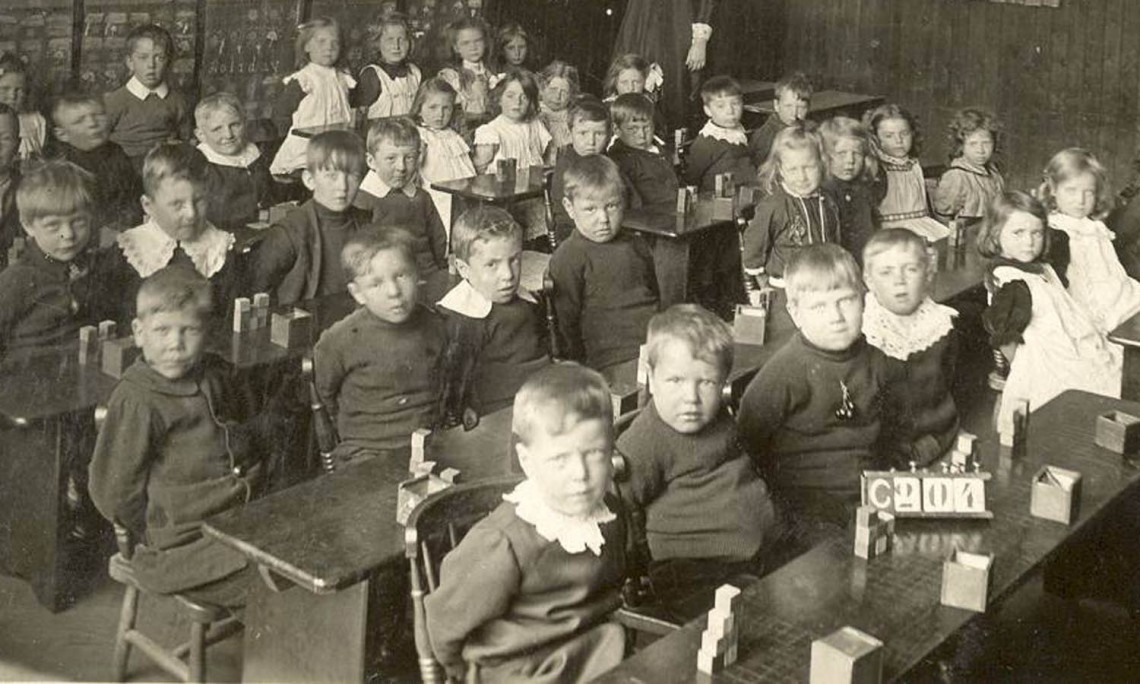
classroom-19th-century-1140x684One comment on an earlier post on the blog relating to the situation in Greece included the following: “So I think the task at hand is not to solve Greece’s economic crisis, this will certainly take years. Rather it is to add some political organisation and direction on to the instinct to fight. I believe that you are thinking too far ahead, overly concerned with what socialism should be in the future, and not really catching the fire of the present.”

Leaving aside whether this was true of this particular post on Greece or even of other posts; a point I have made is that the Marxist movement is too concerned with attempting to “catch the fire of the present”.  This has usually meant jumping on whatever bandwagon it thinks might propel it along in some opportunist direction.  This is informed by the view that socialism will arrive through a capitalist crisis that precipitates political revolution that will destroy the existing state and then introduce the new society.  All of which it will lead through “catching the fire” in some sort of eschatological conflagration.

Missing is the development of the alternative, evolving within capitalism in advance of any crisis, that creates and develops workers’ power in the present and most of all creates the conditions that means workers actually seek a socialist alternative long before any crisis.  Missing is the building of a working class movement that fights for an alternative society now, sees such a new society as its answer to its problems and does not limit itself to the necessarily defensive struggles against capitalist attacks.

This understanding of the working class movement, as embodying the future alternative within itself, is now more or less completely lost but would have been the foundation of workers’ socialist consciousness during most of the first century of the movement’s existence.  So, the building of mass workers’ parties, trade unions, friendly societies, educational organisations and cooperatives were all seen to be the visible rise of the more or less inevitable final victory of socialism.

No such confidence now pervades the socialist movement and part of this impoverished outlook is the perspective of fighting for and relying on the state to deliver the goods.  This and/or the view that some future, but always more or less near, political crisis will quickly precipitate a struggle and a consciousness adequate for a successful political revolution.   A view that forgets that socialist revolution is distinguished by it being primarily a social one and the Marxist view that social being determines consciousness: that is the development of consciousness is based on the development of capitalism, including what workers do over many decades to develop their own power and organisation within it. There is no exception in such a view for small groups propagandising for revolution, crisis or no crisis.

The patient building of workers organisations, such as cooperatives, is viewed by some as simply reform of capitalism when in fact no successful revolution will be possible without them.  Opposition to what has been termed the stages theory of revolution, that every workers struggle is inevitably limited to certain non-socialist goals, is confused with rejection of the truth that the working class will go through stages of development and that earlier stages that do not immediately threaten the system are also just as necessary because they are expressions of the workers own activity and power.

That this has been more or less forgotten is both a product and producer of the decline of the socialist movement.

That is why I started to write a series of posts on Marx’s alternative to capitalism, because without such an alternative there will be no, well to state the obvious – alternative!  It’s why this series is now continued.

*                                                     *                                                 *                                                              

In the last post on Marx’s alternative I said I would look at the evidence that the development of capitalism continues to provide the grounds for socialism as an alternative.  By this I mean the contradictory nature of capitalism is still creating on an increasing scale its gravediggers, the working class, and that even “with all the miseries it imposes upon them, the present system simultaneously engenders the material conditions and the social forms necessary for an economical reconstruction of society.” Marx.

A look at the long term development of capitalism illustrates what Marx called its civilising mission, a product not just of the growing requirements of capitalist production for an educated and relatively healthy workforce but of the needs of the capitalist state itself that provides most of this education.  By 1985 mass education was compulsory in 80 per cent of the countries of the world and over 90 per cent of the world’s children spent some time enrolled in school.

Estimates for the year 1900 put participation rates in primary education at under 40 per cent in most parts of the world outside North America, northwest Europe and English speaking areas of the Pacific, where it was over 70 per cent.  By the beginning of the twenty-first century every part of the world had achieved the minimum of the most industrialised countries at the start of the 20th century and most had exceeded it.

The picture of course is far from universally rosy and a 2007 UNESCO report estimated that in 2004 781 million adults did not have minimum literacy skills and close to 77 million children of school age were not enrolled in school.  Nevertheless the twentieth century was the first in human history in which the majority of the world’s population learned to read and write.

The development of higher level education has been just as dramatic.  In 1900 roughly half a million were enrolled in higher education institutions across the world.  By 2000 the number had grown two-hundredfold to 100 million people.  Growth in higher education has not slowed but accelerated in the latter part of the twentieth century; particularly after about 1960, with enrolment rates climbing rapidly, especially of women.  This growth has created what amounts to a global higher education system with “the same subjects . . . taught with the same perspectives leading to very similar degrees . .” (The Worldwide Expansion of Higher Education in the Twentieth Century)

If we look at population and health we can see the capacity of the productive system to support a growing population and improved health.  “Since 1800, global population size has already increased by a factor of six and by 2010 will have risen by a factor of ten. . . . The length of life, which has already more than doubled, will have tripled . . In 1800, women spent about 70 percent of their adult years bearing and rearing young children, but that fraction has decreased in many parts of the world to only about 14 percent, due to lower fertility and longer life.” (The Demographic transition: Three centuries of Fundamental Change)

Global life expectancy (years at birth) in 1700 was 27, still 27 in 1800, 30 by 1900 47 by 1950 and 65 by 2000, while population was 0.68 billion, 0.98, 1.65, 2.52 and 6.07 billion in the same years.  This decline in mortality began about 1800 in northwest Europe, and in many lower income countries at the beginning of the twentieth century, accelerating after the Second World War.

“The first stage of mortality decline is due to reductions in contagious and infectious diseases that are spread by air or water. Starting with the development of the smallpox vaccine in the late eighteenth century, preventive medicine played a role in mortality decline in Europe. However, public health measures played an important role from the late nineteenth century, and some quarantine measures may have been effective in earlier centuries. Improved personal hygiene also helped as income rose and as the germ theory of disease became more widely known and accepted. Another major factor in the early phases of growing life expectancy is improvements in nutrition. Famine mortality was reduced by improvements in storage and transportation that permitted integration of regional and international food markets . . .”

“In recent decades, the continuing reduction in mortality is due to reductions in chronic and degenerative diseases, notably heart disease and cancer (Riley, 2001). In the later part of the century, publicly organized and funded biomedical research has played an increasingly important part, and the human genome project and stem cell research promise future gains.”

“Many low-income populations did not begin the mortality transition until some time in the twentieth century. However, they then made gains in life expectancy quite rapidly by historical standards. In India, life expectancy rose from around 24 years in 1920 to 62 years today, a gain of .48 years per calendar year over 80 years. In China, life expectancy rose from 41 in 1950–1955 to 70 in 1995–1999, a gain of .65 years per year over 45 years.” (The Demographic transition: Three centuries of Fundamental Change)

Again however the gains in life expectancy are not uniform and the productive advances of capitalism, some of which are reflected in public health and medical advances, are subordinated to the accumulation of profit.  This is most clearly seen in the two significant exceptions noted in the article quoted above – the stagnation in mortality gains and increased mortality from HIV/AIDS in sub-Saharan Africa and the decline in life expectancy in Eastern Europe and the former Soviet Union arising from their transition to capitalism.  The article quotes the UN in 2002 noting that male life expectancy in the Russian Federation was 60, similar to that of India.

Back to Part 4

Forward to Part 6

How can you support a united Ireland and not support Scottish independence? Part 2

Roy-Keane-as-Braveheart-Paddy-Power-3When Irish unionists claim rights to self-determination history has shown that this is not a claim for equality but a claim on behalf of sectarian supremacy – a claim to the right to inequality.

But, the question can be put, if socialists regard self-determination as a means to facilitate the voluntary unity of nationalities surely a united Ireland will itself involve the forcible suppression of Protestants and of Protestant workers?  This would mean that while Irish unionism has no legitimacy the alternative of a united Ireland is also not one that socialists can support?

Some on the Left have stopped there, accepted this, and said that the only solution to the question of democratic national rights in Ireland is therefore socialism.  This tends to come from those for whom every thorny problem is solved by the invocation of socialism.

Workers’ opposition to mass immigration? A socialist society with full employment, great public services and housing would deal with objections.  Economic crises, with periodic mass unemployment and cuts in living standards? A socialist society!  Women’s oppression and racism? Socialism is the answer.  Workers’ passivity in the face of their right wing leaders’ betrayals?  A revolutionary party with a socialist alternative.  Sectarian division?  Workers unity around a socialist programme!

Such solutions are not so much an answer to a specific problem as an invocation that the problem would simply go away if it were made not to exist. It invokes an alternative reality and not an alternative set of policies to get there.  It says that the problems and challenges faced by workers are solved by socialism when in fact the reality is the reverse – socialism is created by workers.

This means working people being persuaded and organised to present answers to all these different questions, not invoking an idealist formula disembodied from those whose conscious actions alone can bring them about.  And the only people who can do this are working people themselves, with those who are socialists attempting to advance this process.

In the case of Ireland, the point of opposing self-determination for the Protestant Irish in the North is that such a claim is not compatible with workers’ interests.  It is not an invitation to violently impose a united Ireland.  Its purpose is to explain that the claiming of such rights is reactionary.  It is meant to identify unionist and loyalist ideas and movements as right wing by virtue of the demands they hold most dear.  In this sense the demand for a united Ireland is not one taken up despite the Protestant population but because of it, because it is they who are most saturated with reactionary sectarian and imperialistic ideology.

Treating it as a sanction to pursue an armed struggle against the wishes of the artificial majority in the Northern State is part of the Irish republican liberal understanding that there are rights which, if they exist, should be exercised regardless of any considerations of the reality in which they are supposed to be grounded.

This means for example that armed struggle by republicans is justified by the principle of the right of the oppressed to fight their oppressors by any means necessary, without stopping to ask ‘by any means necessary to achieve what?’  It means rights asserted as abstract principles without regard to efficacy or morality.

Socialism on the other hand is based on workers’ interests and needs grounded in the world they live in and not of abstractions that efface these needs and interests.

Opposition to Scottish independence by socialists can therefore only respond with bemusement to nationalist claims that every other country to achieve ‘independence’ has not wanted to go back, so that it can’t therefore be such a bad idea.

Well how many of these countries are really independent, of the requirements and pressures of capitalist globalisation for example?  How many of the workers in these countries have had their basic needs and interests resolved by the ‘independence’ of the countries they live in?  In what way does the principle of separation of itself address these problems; meaning have these nationalists really considered the alternatives; meaning also that if they have, this particular argument is not really one of principle at all.

The nationalists who claim that there are 200 or so nation states in the world – why has Scotland to be different – might want to ask how this world of nation states has fared in the twentieth century and whether it has been such a good way to order the world’s affairs.  Or have two world wars taught nothing?  Perhaps a look at the character of many of these states might make one think twice that this model is one to emulate.

When it comes to the demand for a united Ireland such a demand is both abstract and unrealistic outside of its insertion into a social and political struggle that understands it, not as the demand for a new Irish capitalist state, but as a means of reducing division; including by rejecting sectarian claims to state legitimacy and power by the Protestant population and rejecting the intervention of the British state to uphold such claims.

But it also means rejection of all the other ways in which division is imposed, including sectarian organisation of education and other state services both North and South, religious imposition of restrictions on women’s rights, sectarian employment practices, sectarian political arrangements such as Stormont and state sponsorship of armed sectarian paramilitary outfits.

It means building alternative centres of working class identification and power including a non-sectarian and anti-sectarian labour movement, trade unions and political parties, democratic campaigns, and workers cooperatives where workers livelihoods directly depend on their working together.

This socialist agenda is light years from nationalist answers. By understanding this workers might be able to see that the arguments of nationalists, their claims for rights that do nothing for workers, and their claims to address grievances which are either spurious or actually derive from class oppression are false.

concluded

How can you support a united Ireland and not support Scottish independence? Part 1

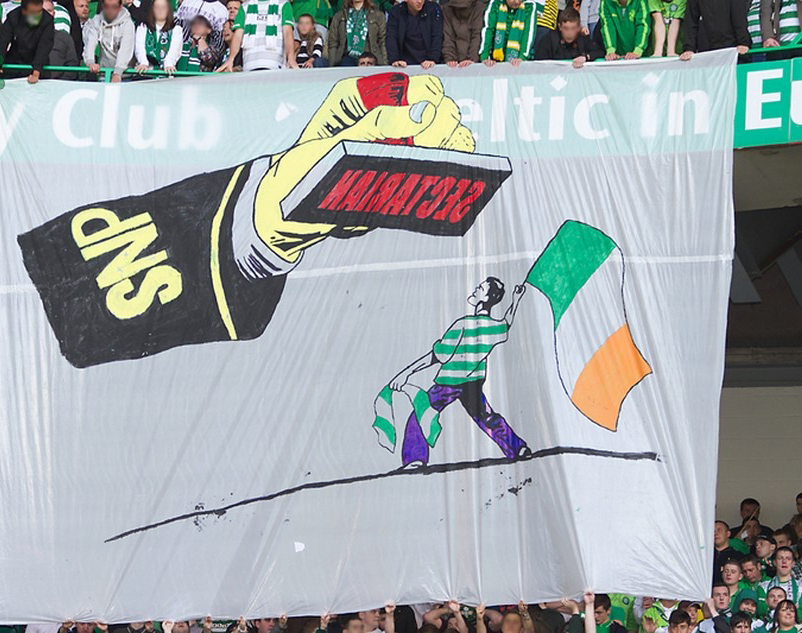
Celtic snp2_310902033This week I had a conversation arising out of Jeremy Corbyn’s interview in the Andrew Marr show on the BBC.  Like others I have spoken to who saw it I can’t remember ever making a point of watching until I knew it featured this interview.

The basic issue that arose was how Corbyn could claim to support a united Ireland but oppose Scottish independence.  Surely if you support the independence of one you should support it for the other?

Given that I agree with Corbyn I answered this question by pointing out that in both cases we were talking about removing borders (or stopping them being erected) and thereby preventing barriers to unity.

Through a united Ireland the unity of Irish people would be advanced, and by opposing the separation of Scotland from England and Wales you would support the unity of British people.  Since unity of the working class irrespective of nationality is a basic socialist principle it would require some argument to trump it.  None has been advanced for Scottish separation that isn’t either factually incorrect (like Scotland is an oppressed nation) or exceedingly weak (it would also be good for the English!).

An obvious response would be – does that mean you are also in favour of unity of Britain and Ireland?   And the answer is yes.  Provided the unity was one of equals, then there could be no objection to political arrangements that would further the erosion of national division and increase the grounds for united action by the working classes of the nationalities involved – English, Scottish, Welsh and Irish.  Previous unity of the islands involved British imperialist domination that was rejected by the majority of the Irish people and history demonstrated that no unity of the peoples was possible under these conditions, at that time at least. As I pointed out in this discussion – I am in favour of a united Europe.

The independence of Ireland has not been an over-riding principle for socialists and this is something that divides us from republicans, including those describing themselves as socialist republicans, or more bizarrely, republican socialists, whose socialism is in reality a variety of republicanism.  So much so that their socialism is not a means to overcome national division but a means of emphasising their nationalism: ensuring what they believe will be effective independence as opposed to nominal independence under a neo-colonial yoke.

What matters to socialists therefore is the unity of people, particularly of the working class, which is the bearer of a new socialist society, and not particularly the unity of state formations.  This is why socialists support self-determination so that unity is the voluntary unity required to overcome national divisions and not the forced unity of foreign rule and occupation.

As I have said before the absence of violent repression by English armed forces in Scotland stands in stark contrast to British repression in Ireland.  So while socialists support self-determination for Scotland we believe it should be exercised by continuing voluntary unity with the rest of Britain.  That the majority of Scottish people decided this in the referendum is therefore to be welcomed.

But if this is the case why do I support the unity of the Northern and Southern Irish states when quite clearly the majority in the north do not favour unity with the south?  Surely that would involve the coerced unity that you have just said you oppose?

Let’s leave aside for the purposes of this argument that unlike the Scots the population of Northern Ireland is not a nation and therefore not subject to the right of self-determination.  Leave aside also the argument that even if we restrict ourselves to the Protestant population it too, while being an identifiable people, are also not a nation and any purported right to self-determination on their behalf is transparently a means of frustrating the right to self-determination of the Irish people as a whole.

We’ll also ignore the historical fact that any declared separateness of the Ulster Protestants is inaccurate because it does not refer to Ulster but a truncated part of it and did not seem to arise when the whole of the island was ruled by Britain, when the Protestant population in the North was quite happy to consider itself Irish, the specifically ‘loyal’ part of the nation.

It’s much harder to put aside the coerced separation of partition and the continual violence needed to maintain it even if this is usually, but not always, ‘merely’ in the form of a threat to the majority of the Irish people residing south of the border.

We will however also ignore the visceral opposition to considering themselves Irish that some Northern Protestants express when the idea of a united Ireland is proposed.  Down this road leads capitulation to the most deranged bigotry – I recall being told by my father that my uncle refused to eat off a white plate with a green trim in a bed and breakfast in Blackpool, such was his sectarian impulses.  He even apparently showed some ambivalence about supporting the Northern Ireland football team because they played in green – much better the red, white and blue of Linfield and Rangers.

While it is of no interest of socialists to impose national identities on peoples against their will it is necessary for such identities to have some grounding in reality to be considered seriously by everyone else.

On this basis however it might seem that Irish Protestants in the northern state have some grounds to claim separate political rights since they obviously are in some senses a separate people.  It might appear that it doesn’t matter whether this is a nationality, defined as ‘Northern Irish’ or as simply British inhabitants of part of Ireland, or both.

What matters however again is the objective basis for claiming rights to self-determination because some of the argumentation above is really beside the point.

And the point is that (some) Irish Protestants have been provided with what they can consider self-determination, exercised as unity under the British state, which they chose to participate in through rampant and systematic sectarian discrimination; itself reflecting the objective fact that their claims for national status were based primarily on sectarian self-identification as a colonial population in what they considered, when it suited them, was (26/32 of) a foreign country.

Since for socialists national rights are democratic rights, which are reactionary if without democratic content, it would appear that the right to self-determination of the Irish/Ulster Protestants or Northern Ireland, however one wants to put it, is a reactionary demand that cannot be supported.  And it cannot be supported because not only does it not facilitate the unity of peoples but it furthers their disunity along sectarian grounds, plus the division that arises from living in two separate Irish states.  The violent and sectarian history of this self-determination is cast iron proof of the thoroughly reactionary nature of Irish unionism.

John McDonnell’s IRA apology

Brent-Hosts-Question-Time-1If you relied on the mainstream media to know what was happening in the world you would be mightily confused.  Some bearded, deluded and dishevelled guy has just become leader of the Labour Party.  Even worse, the BBC Six O’clock news led its programme with the announcement that he had just named a guy called John McDonnell as shadow chancellor, someone, the voiceover immediately told us, who once supported the IRA.

Who he was, what he had previously done that made him qualified for the job, what his economic policies were, none of these were the foremost issue for the BBC.

Now, John McDonnell has apologised for saying “It’s about time we started honouring those people involved in the armed struggle. It was the bombs and bullets and sacrifice made by the likes of Bobby Sands that brought Britain to the negotiating table.”

He explained the remarks by saying that  “I accept it was a mistake to use those words, but actually if it contributed towards saving one life, or preventing someone else being maimed it was worth doing, because we did hold on to the peace process.  There was a real risk of the republican movement splitting and some of them continuing the armed process. If I gave offence, and I clearly have, from the bottom of my heart I apologise, I apologise.”

A number of things should be said about this.

Firstly, there’s little point complaining about the obvious bias that pervades not only the Tory press but also the BBC.

This is fuelled by the social background of those in the organisation and their political views.  Their commitment to a view of objectivity and balance embraces such a narrow conception of what is acceptable that Corbyn and his supporters are clearly beyond the pale and don’t fall within the normal rules.

Along with this there is an inability to fully comprehend their politics, partly as a result of their limited experience of political debate that doesn’t stretch back beyond the Thatcherite consensus imposed on society during the 1980s.This means for example that the idea that the leader doesn’t make all the decisions is not seen as an example of democracy but as a weakness, causing confusion and division. And of course, there is fear of the Tories who have put the squeeze on the BBC as an organisation.

Complaining about bias is not going to change any of these.

What would change the situation is the British labour movement building its own mass media which, given modern technology, does not need to immediately seek to replicate the scale of the capitalist media.  Within the hundreds of thousands who voted for Jeremy Corbyn and the many more millions who support him there is the basis to do this.

The second thing to note is that the media presentation on this issue is only one example of a barrage of attacks that reveal not only bias but the current weakness of the Corbyn led movement.  It is not a surprise that Jeremy Corbyn and his support have not been prepared for the tasks of leading the opposition to the Tories.  They will obviously for example have to build a team to deal with a hostile media.

The greatest weakness however is not in this lack of media preparedness but in the weakness of their support among the mass of careerist Labour MPs.  It is this that has allowed the media to present the new leadership as shambolic.

There’s nothing that can immediately be done about this either.  In one ironic sense it is to be hoped that this right wing shower are actually motivated by careerism and not ideological fidelity to their rotten right wing politics.  If they are simply careerists they might understand that if they attempt to destroy Corbyn they will in all likelihood so damage their party that they would scupper their own careers as well.

In contrast the great strength of the Corbyn phenomenon, which put him where he is, is invisible, or invisible to the mass media anyway.  While appearing to recognise his mandate the media presents the world from ‘the Westminster bubble’, the same bubble it claims everyone else is outside of, although not apparently themselves.

Even in the case of John McDonnell’s apology on ‘Question Time’, the reporter in the local BBC Northern Ireland news noted that his apology seemed to go down well with the audience.

This support will be tested and its cohesion and growth depends not so much on Jeremy Corbyn himself but on what these people do.  In order to resist and fight the media as part of rebuilding the labour movement they must organise for this objective.  The arguments and political activism of hundreds of thousands will be the only effective response to a hostile media.

What Corbyn and McDonnell’s are now in a position to do is deliver political leadership, with arguments that can effectively galvanise, educate and rally their supporters.  Organisation of their support is the number one objective because only this support can convince the millions who can be won to their cause.

When it comes to the question of Ireland their position needs to be better.  The original political position of McDonnell arose because he put solidarity with the political leadership of the resistance to British rule before opposition to his own country’s oppression of Ireland.  And he did this at a time when this political leadership was surrendering its opposition.

So McDonnell claimed that armed struggle forced the British state to the negotiating table.  So it did, but once it got there this armed struggle showed how useless it was at getting anything from it.  It also showed that there wasn’t going to be any real negotiations unless the armed struggle stopped.  This is always the demand of the British and they get their way.  In fact it is more accurate to say that armed struggle gets them to the table which only becomes a negotiating table when they stop it.

But even in the recent ‘peace process’ this is to overstate its importance.  The Provos had to make significant political concessions before the British would get into substantive political talks, including accepting the supposed neutrality of the British state.  This is before we even consider the capitulation required before unionists would talk to them.

The result of these negotiations and the so-called peace process is something that the British Labour Party should not support.  It should reject the argument that an end to political violence is predicated on a sectarian and increasingly corrupt political settlement.  The political deal, one that has been in crisis since it was born, appeared after the ceasefires.  Of course the rotten nature of this settlement will pass the vast majority of British people by, but then so did the North of Ireland for decades before 1968.

The primary role of a Labour party is to support the independent organisation of workers and this is true of the Labour Party in the imperialist country.  This can best be done by solidarising with Irish workers’ own attempts to do this and campaigning to remove the foreign state presence that frustrates this.

In the North of Ireland the British state does this in a number of ways, including the sponsorship of loyalist paramilitaries and political policing of republicanism, where it has found ‘good’ republicans in the form of the Provos, for whom it will attempt to cover up violence, and ‘bad’ republicans who are labelled dissidents. (See here )

But even if Jeremy Corbyn became prime minister he would be able to do little to prevent the British military continuing its criminal conspiracies.  It swears loyalty to the Queen not parliament and certainly not to the people and it does so for a reason.  Marxists make the distinction between being in Government and being in power, between sitting on the top of a state and controlling and directing it.  The example of the British state’s operations in Ireland is graphic proof of the difference.

And there is yet another problem, as a comrade of mine put it last weekend at a rally in support of the refugees: Corbyn is more left wing than anyone in Ireland.  Who would be his political allies here?  Even if he wanted a united Ireland there is no significant political force in Ireland demanding it never mind in a position to do anything about it.

And don’t give me a response of ‘what about Sinn Fein’.  We have been at the stage for some time that when Sinn Fein politicians appear on TV claiming that they’re ‘for a united Ireland’ the reaction is one of – what?  Really?

What Sinn Fein does, its support for sectarian partitionist institutions and its ideological capitulation to unionism, betrays what it sometimes says about being republican.

The truth is that today there is no significant political force fighting for an end to imperialist rule.  Sinn Fein ‘support’ for a united Ireland is on a spectrum of such support declared by every nationalist party in the country and just as empty as the rest.

The task for Irish socialists is therefore very like the one for British socialists – rebuild a working class movement committed to democracy and socialism independent of their respective capitalist states.  That these are essentially the same is why socialists are internationalists.

For British socialists a democratic policy on Ireland is nothing to apologise for and nothing to hide from the British people, but it does not involve hitching their banner to the failed organisations of Irish nationalism including Provisional republicanism.


The scripted reactions to Jeremy Corbyn’s victory

corbynwinsimages (12)The scripts say it all.  Boffy’s blog has recorded two Tory spokespeople giving identical responses on television to the victory of Jeremy Corbyn as leader of the Labour party.  Looking at the BBC web site the SNP leader gave two identical answers to two different questions.  They’ve worked out their script beforehand and they’re sticking to it and it ain’t that impressive.

The Tories now know they have an opposition as opposed to competition.  Warning about the dire consequences of some things that many people actually agree with opens up the debate beyond the previous claustrophobic confines of what passed for politics.  They, the Labour Party, are a “serious risk” say the Tories.

Well so much for having no chance of being elected.

Watching the BBC and its litany of Blairite talking heads warning of the problems ahead isalmost amusing – picking a shadow cabinet, prime minister’s questions – how will he cope?; no experience – like has he ever helped pump up a credit bubble; and – the bit I’ve just watched – printing money!!  “The voters don’t understand the technicalities but they know it doesn’t make sense” says a Blair advisor, and you can be sure he doesn’t want them to know either.  Let’s just forget the Blair government’s presiding over a deregulated city that allowed banks to create massive amounts of money that dwarf the Corbyn plans for useful investment.

The BBC questions his ability to keep the Labour Party together after getting almost 60 per cent of the vote, while letting the potential right wing splitters off the hook.

The answer of the SNP leader was also scripted and like all good career politicians she stuck to it, regardless of the question.  She wants a progressive alliance with Labour against Tory cuts, which admits the initiative is really with Labour and only it has the power to defeat the Tories.

Still, while saying she wants an alliance she manages also to say the opposite – “it is clearer than ever that the only credible and united opposition to the Tories, actually north and south of the border, is the SNP”.

Does anyone think that makes any sense?  United – north and south of the border? The Scottish National Party?

All talk of the SNP wanting the Labour party to succeed in opposing the Tories is obvious nonsense. Where would the nationalist platform stand if the Labour Party actually defeated the Tories?

To be fair Nicola Sturgeon explains why it’s nonsense in the short 1 minute 18 second interview – “if Labour cannot quickly demonstrate that they have a credible chance of winning the next UK general election, many more people in Scotland are likely to conclude that independence is the only alternative to continued Tory government.”

Which is of course exactly what the SNP wants.

What about the SNP quickly demonstrating that it will oppose austerity once in office in Scotland?  Or are we to forget they have actually been in it for over 8 years?

So “we no longer have Red Tories” the journalist said – ouch! So Sturgeon repeats the BBC line – “the reality today is that, at a time when the country needs strong opposition to the Tories, Jeremy Corbyn leads a deeply, and very bitterly, divided party.”

So does the SNP want Jeremy to defeat the right wing of the party?  Or would it suit its purposes better for it to remain divided?  But since only a British Labour Government could scrap Trident as opposed to just shift it down the road where does that leave the apparent radical credentials of the SNP?  If nationalism sees itself getting stronger on the back of the working class movement failing isn’t it maybe time the left supporters of nationalism had a rethink?

Texting away to my daughter today I warmly welcomed the election of Jeremy Corbyn, said there was hope and quoted an old socialist slogan ‘lotta continua’ –the struggle continues.  But perhaps this is not quite right.

Jeremy Corbyn is not a revolutionary and his platform of ‘people’s quantitative easing’ is not that radical (see here and here) as he himself admits, and getting corporations to pay their taxes while saying the current taxes on the banks are about right, is not earth shattering.

But what it may be is eye opening and the beginning of something bigger.  So it’s not that the struggle continues but that in an important way it is beginning, and beginnings always bring hope.

Of course the left is always characterising whatever it does as the beginning, often to hide the fact that what it is doing is the same as before and it is failing, or it is actually the end and has already failed.

But you can’t really say that about the election of Jeremy Corbyn to the leadership of the British Labour party.


Scottish socialists debate independence 2

scottish_independence_sol-471450Neil Davidson argues that Scottish independence and separation would weaken British imperialism.  For Davidson, loss of nuclear weapons that might occur if they were no longer allowed to be sited in Scotland, might mean, for example, that (1) its permanent seat at the UN Security Council might go to India (also armed with nuclear weapons); (2) might weaken its usefulness to US imperialism and (3) presumably weaken the ideological hold of imperialist (i.e. nationalist) ideas on British workers.

Let’s look at these in turn.  Davidson refers to an excellent article in the ‘London Review of Books’ on the British experience in Afghanistan, which actually shows, not the usefulness of the British to the United States military but rather how bloody useless they really were, with overblown pretensions to ‘punch above their weight’ being demolished in the deserts of Helmand.

He fails to explain how replacing the declining imperialism of Britain with the rising capitalist power of India would be progressive, unless he thinks giving more legitimacy to the thieves’ kitchen that is the UN Security Council is some sort of advance. If removal from the Security Council would be a blow to the prestige of British imperialism and weaken its nationalist ideological hold over its people (approx. 63 million) does he not think that this might be balanced by an increase in the legitimacy of reactionary Indian nationalism and its reactionary ideological hold over a population of over 1.25 billion?

As pointed out before, British imperialism has been in decline for some time even with Scotland’s contribution, and will decline further with or without it:  “The strength of British imperialism has already declined by much more than Scottish separation could possibly achieve. Has the prospect for socialism increased during this time?  Has the strength of the working class increased as a result?  The answer is no and rips apart this ‘non-nationalist’ argument for Scottish independence.”

Davidson advances a number of arguments I have taken up before but it would appear that this bogus ‘anti-imperialist’ argument, that really defends a nationalism that has been knee-deep in imperialist blood-letting, is one he comes back to.

Davidson makes it clear in this debate that there is a range of arguments that others on the Scottish left advance in backing independence that he cannot support, including “claims that the Scottish are more democratic or radical than the English”, which he describes as “nonsense”.   This however is contradicted by his second major theme in support of independence, which is the supposed radically progressive character of the movement for independence, even though it’s pretty hard to ignore or deny its dominance by the right-wing SNP, a dominance rammed home after the referendum by the large numbers joining it.  If Davidson were correct we would have seen large numbers of the SNP leaving it to join the left, not traffic the other way (as Sandy McBurney points out).

Davidson, no doubt drawing on his role as a historian, also describes as “idiotic” the view that Scottish national identity existed in the 13th century, at Bannockburn and declaration of Arbroath, and he similarly describes the idea that Scotland is oppressed as also “historical nonsense”.

In fact, it would appear that Davidson finds it hard to swallow much of the nationalist case but that in spitting some of it out he is left with not very much to chew on.

He responds to Sandy McBurney’s analysis of the SNP by saying that it “is assumed that if independence happens, it will be all about the SNP.  But a yes vote on the basis of a mass, collective insurgency which is doing this for left-wing reasons would change the actual context in which the SNP come to power.  It’s not as if they could sail in and just do what they like, in that kind of context.”

But then, having invented an SNP led separate Scottish State that is beholden to a radical insurgent population (why would it still be led by the SNP then?) – an invented fantasy radical Scotland – he says about McBurney’s prognosis of a SNP led Scottish State that it is abstract: “This is a totally abstract argument, it wouldn’t face the actual situation we’d be in if Yes won.”

In other words if Yes had won it would inevitably have been a radical insurgent movement that achieved it so we should continue to make this our goal ignoring the very real unabstracted truth that the neoliberal SNP led and dominated the Yes campaign and, had it won, would have had masses of political credibility to do what it wanted.  Don’t believe me?

Well just look at it now.  It’s implementing austerity, as Sandy McBurney noted, yet tens of thousands of people opposed to austerity are not only voting for it but joining it!

Such is the nature of ideology that can blind people to what is happening in front of their eyes, because what is happening in front of their eyes has to be interpreted.  In a situation of a ‘charismatic’ leader, constant phrases about opposing austerity, constant declarations of the necessity for such austerity by the Tories, and lots of verbiage about the ‘Red Tories’ from left nationalist supporters, it is not altogether surprising that the SNP gets away with rank hypocrisy.  Nationalism is good at this sort of thing in quite a lot of places, including where I live.

So, while accusing McBurney of being abstract, it is actually Davidson who abstracts from the real world to build a political perspective that is not grounded in reality.  So he says that “neoliberalism has to be fought and we have to begin that fight somewhere.” But you always begin from where you are, i.e. with the working class and its organisations as they are.  Not by trying first to create a new capitalist state that for some unknown reason will make the job of opposing austerity easier.

And in fact while Davidson says that “you have to start from the situation you’re actually in”  he doesn’t actually do that.  While hundreds of thousands are joining the Labour Party to support Jeremy Corbyn, Davidson supports a new Scottish Left Project on the basis of a view that the fight for Scottish separation is left wing, when its advance has proved the opposite.  It is the SNP which has mushroomed as a result of the independence referendum despite previous claims that it was being led from the left.

Davidson appears to regret this and describes it as a problem but unfortunately the left nationalism he has hitched up to, albeit comparatively belatedly, bears some responsibility for this.  So when he asks whether it would have been better for the Scottish left to have “just sat around waiting”, “just sit back” and “fold our arms”, the answer is, in the absence of their doing something better like fighting nationalism, Yes.

To take up one last argument.  Davidson and others note that the British establishment, the US President and big business all support the unitary UK state while Sandy McBurney and others, like this blogger, accept the UK state and oppose Scottish separation.

We do so because, as Sandy McBurney states, this provides better conditions to defend and deepen working class unity.   Davidson’s challenge is that “they can’t both be right.”

The bigger sections of the capitalist class support the UK state, and also the European Union, because it provides the widest area within which they can advance their interests of accumulating capital with minimum obstacles to this process.

Marxists accept the UK state because it is the widest area within which the working class can currently organise relatively freely without the divisions caused by national borders and the attendant nationalist politics and ideology which divides it and its organisations.

While capitalism needs the state to defend its interests, and small capital might favour small capitalist states because they appear to better fit its narrower horizon (represented politically for example by the SNP or UKIP), it also seeks to internationalise its activities and have international state bodies that can support it in a way that a small nation state is less able to do.

The interests of the working class however lie in international unity of the class irrespective of nationality.  While those who wish to reform capitalism seek to get their hands on governmental office through operating the levers of the capitalist state, and sometimes see opportunities to achieve this more easily by making the state smaller – by having a separate Scottish state for example – this is not socialism.

Socialism by definition is international and Davidson knows that there is no such thing as socialism in one country – so why create new capitalist states to make the process of breaking out of nation states more difficult?

Marxists therefore have no allegiance to any capitalist state formation and wouldn’t shed any tears if a UK state was replaced by a European one that made the political and organisational unity of British, Irish, German, French and Polish workers etc. easier.

So, when both most of the capitalist establishment opposes Scottish nationalism and socialists do so as well and Davidson says “they can’t both be right”, the answer is – yes they can.

Just as the enemy of my enemy is not necessarily my friend so it is that the political position of the enemy does not require me to take up an equal and opposite position.  The simple minded propaganda of ‘Scotland more radical’ or ‘Scotland oppressed’ or the fanciful claims of the Radical Independence Campaign that Sandy McBurney points to, and Davidson makes no pretence to defend, are no guide for Scottish workers and neither is the attempt at apparently more sophisticated arguments in favour of independence advanced by Neil Davidson.