The Manchester bombing and Politics

Years ago ‘The Guardian’ ran an interview with celebrities on the last page of its Saturday magazine and always finished with the same question – how would you like to die?  The answer that I remember, the only one, was “after a long time and before my children”.  I thought then that this was the best answer that could be given.
It is thus harrowing beyond words for so many parents to lose young children to an act of random terrorism.   How can one reason this catastrophic event so that one might attempt to come to terms with it; to explain in even a small way to oneself what has happened and in so doing lessen the pain suffered, however little this might be?

In the finality of death many people turn to religion, to belief based on faith, which may be defined as to believe without justification, to believe in the most incredible things without any need to present argument or evidence.  Of course, these are often given, but they are all ultimately irrelevant for those that believe.

Tragedy thus invites inconsolable acceptance because it is irreversible, what has happened cannot be undone no matter how inconceivable or improbable and no matter how unjustified it has been to everyone affected.  Politicised religious fundamentalism can sanction the most barbaric acts while less radical religious expressions substitute consolation for comprehension for its victims.

The statement by religious fundamentalists in support of the Manchester bombing present a rationale based on killing ‘Crusaders’ but the declarations of support for it have also claimed that these ‘Crusaders’ are suffering in the same way that the children of Mosul and Raqqa have suffered.  In saying this they parade admission of their own barbarity on equal terms with the hated Crusaders without a single reflection on such identification.

Within the circle of religious responses there is only moral condemnation that accepts the other-worldliness of the action, which is often comforting for those grieving from indescribable loss but is precisely useless in every other respect: because of its divorce from reality, from this world, from the reality that created the bomber, the bomb, the pain inflicted and the future possibility of its repetition, who knows how many times.

While after such tragedies general moral statements are always to the fore, and the rituals of religious observance play a prominent role, the major response is one rooted firmly in this world.  From the work of the emergency services, hotels and taxi drivers helping the injured, rallies to express sadness and respect for the victims and their families; all these are the practical things that allow people to suffer with some purpose and some hope that they can continue to hold on to whatever they can of those they have lost.

However, to look beyond the immediate need to digest the shock of the attack and to focus on it as a singular event, as a way of giving due recognition to its magnitude, is often seen as to be passing too quickly over it and therefore to belittle its horror.  That is why the immediate instinct is to suspend discussion of everything else, to abandon the rolling cycle of news with its discussion of politics and the election.  While life must go on, it cannot go on as if nothing has happened and time is an essential aspect of doing so.

But not going on as if nothing has happened means quickly picking up the real-world nature of the bombing and determining who did it, how they did it, why they did it and whether there is anything to be done to stop it happening again. To attempt to ignore these questions and substitute general moral condemnation and police action only is an attempt to avoid reality and falls below what must be demanded by the living on behalf of the dead.  It is an insult to argue that inevitable questions thrown up by mass killing are off-bounds because of some rule of decorum that benefits none of us, but conveniently shields those responsible for security from scrutiny and accountability.

Jeremy Corbyn’s speech about the Manchester bombing did no more than express his revulsion against terrorism; express his opposition to scapegoating the wider Muslim population and draw the blindingly obvious lesson that the so-called ‘war against terror’ has failed.  He drew the lesson stated beforehand by Boris Johnstone, the Director General of MI5 and the Parliamentary Intelligence and Security Committee – that British foreign policy has increased the threat of terrorist attack on Britain.  This is not new, is not startling and is not irrational but is expressed in the statements of the Islamic fundamentalists themselves.

Andrew Neil spent an important part of his interview with Jeremy Corbyn quoting Islamic State that it was western values that it hated, as if western imperialist intervention in Arab countries was irrelevant.  Irrespective of just what exactly ‘western values’ are – food banks for the poor but palaces for royalty, colonial empire and genocidal slaughter – it is clear that unwillingness to face the foreseen and foretold consequences of intervention into Iraq and Libya etc. is itself deeply cynical and political.

Theresa May has accused Jeremy Corbyn of giving ‘excuses’ for terrorism and Boris Johnstone has accused him of attempting to’ justify’ or ‘legitimate’ terrorist attacks.

Lies, lies, lies.

To peddle such untruths in the wake of the attack demonstrates the contempt the Tories have for the lives of working people and their children who now deserve nothing more than that they hear the truth.  Without it there can be no justice and no closure, if such is possible. To pass over their loss with cynical lies is to belittle their suffering with the view that this is a thing to be twisted in the cause of mendacious political calculation. The Hillsborough inquiry has been one long and agonising lesson on the need for justice and the conspiracies within the establishment that have existed to deny it.

We do not know the links between the British state’s foreign policy interventions and this particular terrorist attack.  Instead we get repeated advocacy on behalf of the security services that they cannot keep tabs on every threat.  Listening to interview after interview on television and radio we hear repeated again and again the same unchallenged defence of the security services by a media supposedly tasked with revealing what is happening but which instead seems more intent on seeking to hide it.

Yet the more we learn of this particular attack the more obvious it becomes that credulity is stretched to breaking point when we are called upon to accept that it is perfectly understandable why this particular threat could not have been prevented.  How convenient to denounce the reasoned words of Jeremy Corbyn from a Government that sells massive quantities of arms to Saudi Arabia, the ideological inspiration of Islamic terrorism, and which has supported the same radical jihadi group in Libya that may well have carried out the attack.  ‘Move along, nothing to see here’ will not wash.

We do not know the exact connections between the bombers, the groups supported by the British state in their opposition to the Gaddafi regime, and the role played by Saudi Arabia, which Theresa May has made a particular point of patronising. It is impossible for us to know the truth, and that is the problem.  To point to the obvious links and connections that we do know of and to demand the truth is to open oneself up to shrill denunciations of conspiracy theory.  Yet to accuse MI5 and MI6 etc. of conspiracy is like accusing publicans of selling intoxicating substances or brothel keepers of selling sex.

It is not Jeremy Corbyn who is disrespectful of the victims of the Manchester bomb.  It is those who wish to close down an honest reckoning with the attack and bury it under ritual denunciations.  Behind these persists continuing collaboration and support for the reactionary Islamic radicalism which supports and defends western imperialist interests in the Arab and Middle East region.

The establishment, through its media and politicians, has a well-rehearsed procedure: it declares an issue to be ‘above politics’ or ‘above party politics’, often because it raises fundamental questions that it does not want people even to consider.  But this is precisely what politics is about.  The bombing of children in the name of a political cause screams as loudly as the explosion itself that this is a political issue, and Jeremy Corbyn is to be congratulated for speaking out against the Tory omertà.

On issue after issue, from Brexit to terrorism, the more Theresa May says nothing more than ‘trust me’ the more people turn against doing just this.  We are told that she is going to make security a central issue in the election but again it is one more issue upon which she has declared that we can say nothing.  It is not acceptable in relation to Brexit and it is certainly not acceptable when children are slaughtered.  Questions must be asked and answers pursued and Jeremy Corbyn has done a great service by creating the potential for this to happen.

Free trade and Socialism part 4 – Karl Marx on Free Trade ii

Much of the previous post setting out the circuit of capital accumulation is basic to the understanding of Marxists, although many would now not appreciate Marx’s view that socialists should not seek to destroy capitalism by simply trying to prevent it from working – by putting up barriers to trade and thus frustrate the conversion of money into commodities and commodities into money: M – C and C’ – M’.

The righting of the wrongs of capitalism can only be achieved by replacing the system of production and thus the way the reproduction of society takes place.  Since the precondition for this is the full development of capitalism, including creation of the working class as the immense majority of society, this cannot be done by seeking to make capitalism either not work, or seek to make it work differently from how it actually does and must work.

None of this prevents socialists fighting for reforms within capitalism, in order that workers’ lives are made better, but this objective cannot rely on the good intentions of the state and cannot even rely on the effects of trade union struggle.  As Marx puts it:

“the working class ought not to exaggerate to themselves the ultimate working of these everyday struggles [over wages]. They ought not to forget that they are fighting with effects, but not with the causes of those effects; that they are retarding the downward movement, but not changing its direction; that they are applying palliatives, not curing the malady.”

“They ought, therefore, not to be exclusively absorbed in these unavoidable guerilla fights incessantly springing up from the never ceasing encroachments of capital or changes of the market. They ought to understand that, with all the miseries it imposes upon them, the present system simultaneously engenders the material conditions and the social forms necessary for an economical reconstruction of society. Instead of the conservative motto: “A fair day’s wage for a fair day’s work!” they ought to inscribe on their banner the revolutionary watchword: “Abolition of the wages system!”

“ . . . Trades Unions work well as centers of resistance against the encroachments of capital. They fail partially from an injudicious use of their power. They fail generally from limiting themselves to a guerilla war against the effects of the existing system, instead of simultaneously trying to change it, instead of using their organized forces as a lever for the final emancipation of the working class that is to say the ultimate abolition of the wages system.”

So, restrictions on trade, as far as Marx was concerned, were not progressive and did not alter the basic relations of capitalist society.   And, of course, Marx was under no illusions as to what these relations were and what they entailed:

“To sum up, what is free trade under the present condition of society? Freedom of Capital. When you have torn down the few national barriers which still restrict the free development of capital, you will merely have given it complete freedom of action. So long as you let the relation of wage-labor to capital exist, no matter how favorable the conditions under which you accomplish the exchange of commodities, there will always be a class which exploits and a class which is exploited.”

“It is really difficult to understand the presumption of the free traders who imagine that the more advantageous application of capital will abolish the antagonism between industrial capitalists and wage-workers. On the contrary. The only result will be that the antagonism of these two classes will stand out more clearly.”

“Do not be deluded by the abstract word Freedom! Whose freedom? Not the freedom of one individual in relation to another, but freedom of Capital to crush the worker.”

This did not mean Marx sought to shackle capital, as those who seek to reform capitalism think can be achieved, or that its reactionary consequences can be fought by isolating their country from its international development – like leaving the ‘neoliberal’ EU and frustrating the globalisation of capital.

In concluding his speech on free trade Marx said this:

“Do not imagine, gentlemen, that in criticising freedom of commerce we have the least intention of defending protection. One may be opposed to constitutionalism without being in favor of absolutism.”

“Moreover, the protective system is nothing but a means of establishing manufacture upon a large scale in any given country, that is to say, of making it dependent upon the market of the world; and from the moment that dependence upon the market of the world is established, there is more or less dependence upon free trade too. Besides this, the protective system helps to develop free competition within a nation. Hence we see that in countries where the bourgeoisie is beginning to make itself felt as a class, in Germany for example, it makes great efforts to obtain protective duties. They serve the bourgeoisie as weapons against feudalism and absolute monarchy, as a means for the concentration of its own powers for the realization of free trade within the country.”

“But, generally speaking, the protective system in these days is conservative, while the free trade system works destructively. It breaks up old nationalities and carries antagonism of proletariat and bourgeoisie to the uttermost point. In a word, the free trade system hastens the Social Revolution. In this revolutionary sense alone, gentlemen, I am in favor of free trade.”

Unfortunately, today this approach is rejected by many calling themselves Marxist, who seek not only to protect “old nationalities” but actually to promote them, through for example support for Scottish separation. For them, the combined and uneven development of capitalism must be addressed through national separation on a more perfect basis, which unfortunately for those fooled by this scenario does not exist.

These Marxists might seek a way to demure from Marx’s words by stating that his views were particular to its time, when free trade represented the free development of a capitalism that was in some sense progressive as against reactionary feudal restrictions on free markets and development of the forces of production.

While this was certainly the situation that Marx quotes in the passage above, the current pursuit of national solutions against the development of international capitalist economic and political arrangements such as the EU, is equally reactionary since it also seeks to turn the clock back.

The defeats to the working class and socialism experienced in the twentieth century have been internalised into a predilection to state what you are against, with nothing beyond eschatological declarations of the need for revolution as something to say about what you are for.

So, in this view, socialism is to be built not on the foundation of capitalism and its achievements but on its collapse.  Capitalism must go back to national forms because the working class has failed to build itself an international unity, while this left fails to understand how impossible it would be for the working class to develop an international movement while capitalism is restricted within national economic and political forms.

The left that rails against free trade does not pause to think that the development of free trade within countries, such as Marx referred to above in relation to Germany, created exactly the same sort of circumstances for many workers as the freedom afforded to international trade does today. Yet these socialists are so limited by nationalism that they would find it incomprehensible to advocate restrictions on trade within countries.  As internationalists however, they should seek the minimisation of differences between the working classes of the different nations through the processes Marx stated above.

For many socialists internationalism has taken on a purely moralistic character because they reject the material foundations upon which it can become an immediate material need for workers.  This material need, an interest in fighting international capitalism can only be created through international capital accumulation creating an international working class more and more exposed to the reality that the system that exploits them and which they must resist is international and therefore the alternative to it must also international; there is no question of the alternative being a backward step in the socialisation of production.  As Marx says, this international development of capitalism “pushes the antagonism of the proletariat to the extreme point.  In a word, the free trade system hastens the social revolution.”

Back to part 3

An exchange of views on the French Presidential election

The following is a short exchange of views on Facebook on the French Presidential election which is taking place today:

LMcQ – See if you can guess which candidate’s leaflet has three explicitly racist pledges.  I’m struggling with this “they’re as bad as each other in the final analysis” line of argument.

Sráid Marx:  I don’t think that’s the argument being put. What about – how will Macron defend workers against fascism (or however one wants to characterise the FN) by implementing an austerity offensive against them, pushing them even further into the pursuit of bad alternatives (like FN)? And how will you explain to them that when you said they should vote for this offensive you didn’t actually mean you supported this offensive. I seem to remember we have been here before with a Le Pen and some geezer called Chirac and voting for the less worst alternative has just brought us to here. At what point, or how bad, would the lesser alternative have to be before you said – stop! The workers cannot lend support to those who simply prepare the way for the fascists and who you must at all times regard as your enemy. And if this is a frightening prospect to you that is only because your only defence ultimately is your own strength and this you cannot delegate – and certainly not to shits like Macron!

RM: Macron is an immediate short term defence against fascism simply because he is the only possible non-fascist outcome at this point. Everything starts from the present. The Chirac argument here is interesting. Yes, voting Chirac to defeat le Pen brought us to ‘now’ but that is surely a better option than to be looking back after 15 years of fascism in power!

Sráid Marx:  Everything starts from when it starts, which at any point in time is usually not the present. Today the weakness of the workers’ movement arises from its failure to successfully oppose austerity and build its own alternative political position in the past. This weakness is not addressed one iota by voting for Macron, in fact it is set back and will always be set back as long as the Macron’s of this world win and the likes of a Le Pen can be waived in front of us to get everyone to vote for the lesser evil. We know this because, as I said, it has happened before. An immediate defence against fascism? But the present passes into what we view now as the future and we will be weaker because we believed that Macron is some sort of defence. If he is one at the election then by definition his success is also a continuing defence, or do we only oppose and fight him unless there is an election. At what point do we say that workers must create their own alternative and cannot support the politicians and policies that brought us to this horrible choice? That is the political choice that we must take; that it is not on the ballot paper is more than unfortunate but that is the case nevertheless. Having our political choices determined by electoralism is not the way forward but is often a trap.

———————————————————————–

SD: In an election which can only have one of two outcomes the alternative to the lesser evil is the greater evil.

Sráid Marx: Of course you are correct, but the question is whether the lesser EVIL is actually too high a price to pay.

F-CL: Well, if you don’t go with the lesser, surely the question is, is the greater evil too high a price to pay?

Sráid Marx:  Yes, a very good answer. But it still leaves you with the option of determining that both evils cannot be endorsed and that the elections leave you with no acceptable choice and to reject the choice given to you. Or do you believe that in all elections one must vote and endeavour to find the lesser evil?

F-CL:  It depends on circumstances … if there is a real, public abstain campaign and a refusal to vote can be seen to have meaning in the election then I think not voting could be the best option. And having “None of the above” on the voting paper – so you can actually show rejection of all – would be good (in fact, I think we should have a policy of including this option in all votes). But in my experience it is very rare for this to be the case, and going for “None of the above” would encourage people to not maximise the opposition to the greater evil, so even if “None” were an option I think I would usually come down in favour of lesser evil

The other alternative justifying not voting is for the candidates to be as close to as awful as each other to make any differentiation pointless. But this awfulness also involves assessment of the perceived consequences of who gets voted in. Even if Macron and Le Pen are close to each other (in fact I don’t think they are), Le Pen getting in would boost the far right far more than Macron would and you have to take that into account as well as the politics of the candidates

SD:  Surely the issue is about which outcome leaves the working class best placed to fight. In almost all circumstances the working class and the oppressed are going to be able to resist a lesser evil better than they could resist a greater evil, otherwise it wouldn’t be a greater evil.

Sráid Marx:  Not if they are disarmed politically by believing their class enemy is in any sense their protector against reaction. Workers must be taught again and again that they share interests as a class and not with liberals or other bourgeois figures.

SD: That’s quite a big if that you have inserted there. You think it is possible to convince people threatened by the rise of the FN to abstain, yet you don’t believe it possible to convince people that voting for a lesser evil still means they need to organise against that lesser evil?

Sráid Marx:  First I think that the threat that they will most likely face is Macron and his reactionary agenda and a vote for him is a statement that ‘it could be worse’! If such a view is justified in the election – why not afterwards? Fighting the FN is not the only issue in this election. In fact the rise of the FN is due to the policies now being pursued by Macron, policies that the FN say they have an alternative and a left that simply wants to fight the FN and votes for Macron and his policies makes their pretence all the stronger. The message for an active abstention is that you cannot rely on a simple vote to stop the FN, that the FN will get stronger if everyone else rows behind Macron and his reactionary policies and only the FN is seen to stand against them all the way. It’s a message that if you hate or fear the FN there is no solution but your own activity and a workers’ alternative to the policies that Macron will pursue, which the FN will feed off and attempt to continue to grow from.

SD: But “active abstentions” don’t actually exist, except in the heads of ultra lefts who try to comfort themselves that doing nothing out of sectarianism is a political act. Voting or not voting won’t make an iota of difference as to whether people fight back after the election. It just might be slightly harder to do so with an FN president.

Sráid Marx:  Let’s assume for one moment you are right – this would still not justify support for Macron, nor would it invalidate the objections to such support. But while living in Belfast I have seen a number of active abstention campaigns where leafleting, postering and canvassing were all carried out to encourage abstention. It is not even a merely ‘ultra-left’ notion – the greatest number of posters I ever saw in an election in West Belfast was when the Provos wanted an abstention when Bernadette McAliskey stood for the European parliament and the republicans still opposed participation in Brit elections. As to whether voting will affect how people will behave after the election, it must be clear that a working class vote for Macron will strengthen him. It would really be a sort of ultra-leftism to believe workers will vote for a bourgeois candidate but mobilise against him the day after, on the understanding that he is the lesser evil. Of course I have seen a similar view that they would immediately mobilise against a Le Pen victory dismissed, although you only claim it might be slightly harder.


Free Trade and Socialism part 3 – Karl Marx on Free Trade i

When Karl Marx reviewed his career in 1859 he highlighted four works that he had written – The Poverty of Philosophy, Communist Manifesto, Wage-Labour and Capital and a pamphlet on Free Trade.  The last was given as a speech in 1848 at a time when the Corn Laws had recently been repealed in Britain, a sign of the triumph of industrial capital over landed interests, who had stood in the way of free trade and the interests of manufacturers in reducing wages through cheaper food imports.

Since the purpose of free trade was to reduce the price of corn upon which workers depended, and so allow a reduction in their wages, it might seem that Marx would either oppose the repeal of these Corn Laws or at best take the view of “a plague on both their houses”, and take no side between industrial capital and landlords.  As Marx noted:

“The English workers have very well understood the significance of the struggle between the landlords and the industrial capitalists.  They know very well that the price of bread was to be reduced in order to reduce wages, and that industrial profit would rise by as much as rent fell.”

Perhaps, in fact, Marx would oppose this strategy of the workers’ most immediate, growing and more important class enemy and oppose free trade?

Today a similar situation arises in the debate over leaving the European Union.  Why should workers concern themselves with either side of a debate over a European free trade arrangement when again it is one carried on between different fractions of the class enemy?

After all, it is argued that the EU is irreformably neoliberal, although those that argue this often point out that it hasn’t always been such; although this also immediately raises the issue that some sorts of capitalist arrangements are better for workers than others – an anti-austerity policy is better than a neoliberal one for example.

For others, as I have noted, it all “depends”, and the question of free trade is bound up with a range of other issues, often involving development of less industrialised countries, national oppression, “unfair” trade and super- exploitation of workers in less developed countries.  However none of this prevents one from forming a view on the question of free trade itself and facing the implications for workers of such a policy.

This was the approach taken by Marx.  In doing so he was abundantly clear what the nature of the argument was for free trade put forward by the economists representing industrial capital:

“The whole line of argument amounts to this: Free trade increases productive forces. When manufactures keep advancing, when wealth, when the productive forces, when, in a word, productive capital increases, the demand for labour, the price of labour, and consequently the rate of wages, rises also.”

“The most favourable condition for the workingman is the growth of capital. This must be admitted: when capital remains stationary, commerce and manufacture are not merely stationary but decline, and in this case the workman is the first victim. He goes to the wall before the capitalist. And in the case of the growth of capital, under the circumstances, which, as we have said, are the best for the workingman, what will be his lot? He will go to the wall just the same.”

“The growth of capital implies the accumulation and the concentration of capital. This centralisation involves a greater division of labour and a greater use of machinery. The greater division of labour destroys the especial skill of the labourer; and by putting in the place of this skilled work labour which any one can perform, it increases competition among the workers.”

“This competition becomes more fierce as the division of labour enables a single man to do the work of three. Machinery accomplishes the same result on a much larger scale. The accumulation of productive capital forces the industrial capitalist to work with constantly increasing means of production, ruins the small manufacturer, and drives him into the proletariat . . .”

“Finally, the more productive capital grows, the more it is compelled to produce for a market whose requirements it does not know—the more supply tries to force demand, and consequently crises increase in frequency and in intensity. But every crisis in turn hastens the concentration of capital, adds to the proletariat. Thus, as productive capital grows, competition among the workers grows too, and grows in a far greater proportion. The reward of labor is less for all, and the burden of labor is increased for some at least.”

For some modern Marxists many of these words of Marx make no sense – how many today would repeat his remark that “the most favourable condition for the workingman is the growth of capital”?  How many would welcome the increased accumulation of capital though it leads to crises and increased concentration of capital, because it adds to the proletariat?  When was the last time the growth of capital was welcomed even though it increases competition among workers?

Instead the depredations of capital are opposed on the basis that the effects of capitalism can be much reduced through trade union action, its evils ameliorated through state intervention, while confused notions are retained that revolution will spring naturally from capitalist crises and destroy the same state that introduced the reforms.

On only one aspect of his argument has it been widely accepted that it is not the job of socialists to prevent the development of capitalism, and this is the view that workers must be protected from the replacement of their labour by opposing the increased use of machinery.  As Marx notes – “there is no kind of manual labour which may not any day be subjected to the fate of the hand-loom weavers” whose labour was replaced by machinery, with the consequence that “the hand-loom weavers are on the verge of that state beyond which human existence can hardly be sustained. . .”

Yet today the view that free trade should be opposed in principle to protect workers from capitalist competition would be more widely held than the views expressed above.

For Marx, free trade was a moment in the accumulation of capital, as he set out in Capital Volume II in chapters one to three.  In the circuit of money capital, Marx sets out that money (M) is exchanged for commodities (C) which are then exchanged for another sum of money (M).  Obviously this has no purpose for a capitalist unless the second sum of money is larger than the first, or why bother?

Since at each stage in the exchange of money for a commodity and the commodity for money it is the exchange of equivalents, no one is short-changed, so where could a profit arise?  As Marx explains, the commodities purchased by money by the capitalist include machinery, raw materials etc. and labour power, which all go to create the newly created commodities which the capitalist sells for a larger amount of money than spent on buying the commodities used in production.  The increased value of the commodities sold for money by the capitalist arises in production so that in the circuit M – C – M’, the second M’ is larger than the first M and the whole point of the circuit for the capitalist becomes clear.

The sum of money M’ is larger than the original amount of M invested and the increase arises in production, from the employment of labour power, which is remunerated by wages.  Again the assumption is that wages equate to the value of labour power so that we again have an exchange of equivalents and no one is ‘cheated’.  The worker will receive wages to a value that will allow her or him to turn up for work every day in such a condition as will allow her or him to produce to the efficiency, quality and standard required in the particular society that exists at that time and place, and will allow new generations of workers to do the same.

However the value created by the worker in production, through their labour, is greater than the value they are paid in wages for their capacity to work, which is their handing over to the capitalist of their labour-power that the capitalist can direct with a view to producing a profit.  The circuit of capital is therefore better set out as M – C . . P . . C’ – M’; where the first C in the circuit includes the purchase of labour power for wages, P equals production carried out by the worker; the second C’ are the commodities produced by the worker and the second sum of money M’ includes the additional value created in production and included in the second C’. This is the output of production that can then be sold for a bigger sum of money that now includes the profit of the capitalist.

The inequality in capitalism, including different levels of exploitation and power, and the resulting insecurity, stress and degrees of poverty are a result of what arises in production and the class relations that are founded in this production.  To seek to right the wrongs of capitalism through opposition to trade, through trying to make it ‘fair’, or to seek to limit in any fundamental way the inequality and exploitation that capitalism gives rise to through changes to trade, is to miss the point.  All these are a result of the class relations resting in production.  To seek to limit trade is to seek to disrupt C’ – M’; to disrupt the accumulation of capital – or to make it ‘fair’ – when the problem lies within the whole circuit of capital, with the existence of production based on capital itself.

As Marx explained, in all the exchanges within this circuit we have the exchange of equivalents; before the commodities denoted as C’ are produced for sale other commodities, including machinery, raw materials and labour power are also sold and purchased.  Trade unions try to determine the level at which labour power is sold through fighting for “a fair days’ work for a fair days’ pay”, but even they cannot overturn the way capitalism works and cannot fundamentally alter the drive for profit that animates the circuit of capital. Trade unions can no more make capitalism fair than demands for fair trade can prevent exploitation or inequality in the class relations based on production.

Back to part 2

Forward to part 4

Free Trade and Socialism part 2 – the UK general election

Thersa May’s call for a general election has been hailed by the ‘Financial Times’ as a smart move that will give her and the pragmatic Tories some room to negotiate a trade deal with the EU that would be opposed by the zealot Brexiteers.  Today’s paper has a column by the chair of the Institute of Directors praising May while calling for some time for business to adjust to Brexit.  The rise in value of the pound after the news is seen as the smartest guys in the room welcoming the election announcement on precisely these grounds.  Whether this works or not is quite another matter and a decisive victory based on making sure Brexit happens is just as likely to strengthen the rabid demands of those clamouring for a hard Brexit as strengthen its more pragmatic supporters.

The election is therefore set to be all about Brexit and trust in May’s ‘leadership’, or rather her Tory arrogance that is sold as no-nonsense competence, seriousness and proficiency, which a certain section of workers still buy into on the basis of the everyday nationalism and class deference fed to them by the media.  However, even the newly moderated claims for Brexit are undeliverable: she says that she wants “a deep and special partnership between a strong and successful European Union and a United Kingdom that is free to chart its own way in the world”.

The relationship after Brexit can’t be “as deep and special” as the current one so it’s a loss on that one, and the UK will not be “free to chart its own way in the world” no matter how hard it fantasises.  In an issue of the same pink paper last week (and also today) its readers learn that the EU are about to freeze-out British companies’ participation in the European space programme and other EU contracts and funding.  It sounds much better to the ears of Brexiteers when they threaten to just pull the plug and leave without a deal but not quite so comforting when it is reported that the EU bureaucracy is drawing up plans to do exactly the same.

It was also reported in the FT that yet another Minister was visiting India trying to sell it something; Sir Michael Fallon being the empty-handed messenger this time.  The paper reported that ‘military experts say it is a sign of how the UK has been left behind. “If you look at the main four or five players in India, the UK is not there at this point in time”, and It reports that British arms exports fell from £966m in 2010 to £34m in 2015.

So instead of selling arms, Britain now wants to sell India its “arms procurement expertise” because the British might “help them decide what they need.”   The same (or perhaps different) British official thinks reminding the Indians that “the Indian army was created from the British army” and “we share . . an overall ethos” is good sales patter.  This ‘expertise’, the Indians have pointed out, includes ordering two aircraft carriers “that are seven years late . . . (and) are running massively over budget”, and this is without also considering that other problem arising in this British procurement exercise – ordering another aircraft carrier without aircraft for it to carry.

So, Britain is not going to find it easy to chart its own way in the world”; in fact it’s going to find it so hard it’s going to be charting not its own but other, bigger player’s ways in the world, especially as everyone knows, the US way.

Even thinking from first principles – how can you make your “own way” with trade?  Surely you need someone to trade with, someone who will want some say on the rules that govern it; someone who is very likely to be bigger and more powerful than Britain, or will have joined a trading arrangement that makes them bigger and more powerful.  A common strategy – except now for the Brits!

In other words, even if the Financial Times and the money men were correct in the short term, which generally is how long they think about, that May will minimise the impact of Brexit, Britain is going to be worse off.  As I have said before, the threats of a deregulated UK after Brexit are an acknowledgement that the Tory way of attempting to pay the price of Brexit will be to deliver the bill to the working class.  This sugar coats the Brexit pill for business but there will be no sugar coating the poison for workers.

In my last post I argued against the view that the question of trade was one that socialists could not take a side on; or that it ‘depended’ on something else and was therefore perhaps of secondary importance.  In my exchange of views on Facebook set out in that post I said that something could be learned from what Karl Marx thought of free trade.  Then at least, we may have some clue as to what ‘depends’ actually depends on.  Marx obviously thought it was an important issue, just as it is now through the issue of Brexit, and he had a clear position on it.  But I will look at this in the next post.

It is important to understand first that Brexit is bad for trade and will therefore indirectly be bad for workers.  Many workers see the link much more directly – car workers hope that the cars they build can be exported easily into the rest of Europe; university staff seek maintenance of EU grants for their research work; airline staff hope the company retains its base in the UK; farmers hope that they continue to get subsidies; finance workers hope their firms don’t up sticks to Paris or Frankfurt or Brussels or wherever; the list is a very long one.

Because any deal can only be worse and the only thing worse than a bad deal is no deal, the more far-sighted Tories either oppose Brexit or seek a ‘soft’ one.  It is these people that the markets and the ‘Financial Times’ editor and commentators hope will come to the rescue.  Having backed the Tories in the last election, even though it was only they who could deliver them the disaster of Brexit, these people still cling to them again, even while the Tories swear to god that they will deliver it no matter what.  But even with the sugar-coated promise of deregulation, the Tories are going to dash their hopes – the Tories have already promised not to give them the single market or a customs union.  The continuing support of business for the Tories is yet more evidence of their wilful ideological blindness.

Their logic is completely without merit – if the balance of power lies with the EU and the pressure of time is all on Britain, this will very quickly become apparent, in fact it already has as May’s changed tone once article 50 was triggered has shown. May now talks not only the nonsense quoted above but also about a transitional deal, “controlling” immigration not lowering it, perhaps through voluntarily allowing cheap exploitable labour into agriculture when it is needed and then chucking it out afterwards.  Or allowing entry to skilled workers for companies that lobby for it.  Payments can still be made to the EU for some sort of trade access and EU courts will still have ultimate say.  To which it might be asked – what’s the point of leaving, although the Tories think that, with an election victory, answering such a question can at least be postponed.  After all, the May strategy in this election appears to be to say as little as possible.  And there’s a logic to this as well – the same logic.

The Tories cannot promise a ‘soft’ Brexit, or the detail of what it might involve, or even a transitional deal, which has become the favoured option of some business opinion who hope it might morph into something permanent that isn’t hard-on Brexit.  The Tories can’t do these things because those are decisions that are not theirs to take.

The EU will decide whether after less than two years the UK can get lost “making its own way”.  The EU will decide whether there is a transitional deal and what it will look like.  Making any sort of promise during an election would simply invite EU leaders to point out what the real situation is – ‘you say it best when you say nothing at all’ is therefore the only sensible thing to do.  It might make you look increasingly stupid during an election campaign but May is relying on an existing poll lead and a fully undeserved reputation for competence.  And, of course, a compliant media.  How could anyone believe that only she can be trusted to be a strong negotiator with the EU when she’s even afraid to negotiate her way round a TV studio in a leaders’ debate?

If a ‘soft’ Brexit does not exist for the Tories it cannot exist for Jeremy Corbyn either.  The defence of workers’ interests that is the Labour Party’s platform cannot be implemented while leaving the EU.  For those who believe that socialism arises simply from revolution against capitalism and that the EU is a neoliberal conspiracy this is incomprehensible. It is nevertheless true because socialism will be built upon the foundations of the productive forces of capitalism and from transforming its social relations, not merely overturning them.

The more Corbyn stands up for the living standards and rights of working people the more this will conflict with a Brexit agenda, although again and again he turns away from this truth and damages his own case and the prospects for winning over the Remain voters.  The election will truly have revealed the bankruptcy of the bourgeois electoral process if May can keep her mouth shut about what Brexit actually entails and Corbyn can maintain that he will defend workers’ rights without threatening Brexit.

As for the prospects for the election itself; at the start of the campaign the press is clear that Labour is finished.  It must become clear quickly that this is not the case and even by doing this Labour will have registered a success.  Simply by standing up it can continue to fight and by continuing to stand prove the pundits wrong.  Tory arrogance can then first be halted, then challenged, and then thrown back in their faces.  The worst sort of defeat is when you don’t fight, and if you fight there’s always the possibility to win.

Back to part 1

Forward to part 3

Free Trade and Socialism part 1

My last post on the potential effects of Brexit on Ireland or even worse, the effects of the Irish State leaving the EU, led to the following exchange of views on Facebook:

PF:  This piece could have been written by a not especially radical employee of whatever the Industrial Development Authority is now called. …… workers will suffer because their main trading partner is leaving the neo-liberal EU? At least the Sticky 1977(?) plan for Southern capitalism had the merit of claiming a class analysis.

Sráid Marx:  But is it true?

PF:  Depends!

Sráid Marx:  On what?

PF:  It depends on the standpoint. Our man on the Dublin omnibus views everything through the prism of Brexit. Right at the end he says the Brit ruling class is undermining itself. There is, no doubt an ongoing debate, with most of big capital (and their media) opposing BREXIT (the Economist looks forward to it being overturned) while more ‘domestic’ capital – about 90% of firms – in the main support it. Not much to do with intelligence; much more to do with class interests.

As far as the interests of workers go, he suggests that wages will fall, with the implication that if Britain remained, they wouldn’t. Real wages in Britain have fallen over the past period, well before the Referendum. So this is a bit of a dodgy argument anyway.

For the rest of the piece he speculates on tariffs, foreign direct investment, the benefits of WTO rules, migration between the 26 Counties and the UK, the value of trade between the EU, Britain and the Republic and finishes with a swipe at Corbyn, the most left wing leader of the LP – EVER.

All of the economic analysis can be seen in any broadsheet newspaper any day – but the main point is not its orthodoxy. That surely is a problem from someone whose tag line contains the word Marx? The problem is this: everything is viewed through the apparent stupidity of Brexit. He takes sides in an argument between two factions of the capitalist class and berates them for not really understanding their own interests. What’s Marxist about that?

Where does this orthodox analysis lead? To an attack on Corbyn. For not saving the British capitalist class from its apparent Brexit folly by mobilising more Labour voters to support Remain? The political conclusion is even more bizarre. Presumably, the LP should ditch Corbyn and would soar to electoral victory on the promise of the heavenly ‘single market’. Since when has ‘free trade’ been a socialist demand?

If he really wants to see where this leads he should look to ‘Open Labour’, the recent creation of O’Jones and others. In order to advance their ‘Left’ coup against Corbyn, they must shut out the Left. Jones’ diatribes against Stop the War and Stand Up to Racism are designed precisely for this purpose. If the coup from the ‘Left’ succeeds (Momentum, itself divided, has been far too timid in fighting the Right in the apparatus) the Corbyn project is a goner and we’ll be back to a soft left leadership kowtowing to the well funded Blairite right. And they’ll have the right line on Brexit, immigration controls and so on. But they’ll still lose – at least while workers remember what they were like.

Sráid Marx:  So it depends on your standpoint, does it? So barriers to trading the goods and services produced by workers won’t have any effect – is that what you are saying? Less investment won’t have any effect on employment?

In my series of posts on Europe I advance an argument that I think allows workers to take a standpoint independent of the small capital that seems mainly to want out of the EU and the big capital that doesn’t. As for the socialist standpoint on free trade, if you simply google ‘Marx and free trade’ you should get an answer to ponder.

And please don’t put words in my mouth about wanting Corbyn replaced by some soft left alternative that would inevitably pave the way for a Blairite. Some more familiarity with my blog would quickly disabuse you of that speculation. And finally, there really shouldn’t be a debate about whether Brexit will lower wages because it is already happening.

KH:  What about CETA and the Fiscal Compact – that effectively wipes out possibilities of reflation/deflation as well as ability to control inflation rates. It is a completely symbolic gesture if you cannot mandate your own Central Bank to carry out your own sovereign economic and monetary policies, which instead, will be set out entirely in the interests of German rather than Scottish economy.

Only a fool would voluntarily give away national control over fiscal and monetary policy. Six years of EU austerity policies and three structural adjustment programs brokered in a bid to save a massively dysfunctional currency as well as corporate and financial interests have probably guaranteed the election of at least two neo-fascist governments in the next few years.

Wages have been lowered to such an extent in the EU since 2008 that you are happy to accept the election of Wilders et al due entirely to the austerity policies imposed by your beloved ECB.

PF: “So barriers to trading the goods and services produced by workers won’t have any effect – is that what you are saying?” Nation states, including the South of Ireland, used such barriers to protect the economy up to about 1960’s. And the majority of the 26 County working class supported Fianna Fail for exactly the same reason. It only ended when the US ruling class decided post-War that they wanted to muscle in on the pickings of the British Empire (Commonwealth). ‘Free trade’ (one of the reasons the Democrats lost and the AFL-CIO sit on Trump’s Economic Advisory Council) is no more socialist than protectionism.

*           *          *

There are a number of obiter dicta that could be made about the objections to my post on Brexit and Ireland including exhibition of a left-wing variant of ‘Gove’s disease’; that is an aversion to ‘experts’; a reincarnation of that other pathology – ‘project fear’ – which seemed to be a Pavlovian aversion to some variant of capitalist arguments, but in this particular case capitalist arguments you don’t have a convincing response to.

The left-wing Gove’s disease consists of an ability to dismiss argument or evidence that comes from bourgeois experts or those who place some reliance on the argument and evidence they present because:

  1. You don’t like them,
  2. No one on the left should employ them and
  3. You don’t have answer to them (or not one that addresses the point).

Unfortunately, workers are often impressed, confused or frustrated by these arguments and only rarely simply dismiss them, as we have been invited to do.  Socialists therefore need to understand and respond to them, extracting what is of value from them for the benefit of our class.  By analogy – much like Marx did with all those hours in the British library, where he didn’t spend his time simply reading socialist writers.

We have, then, an allegation of bourgeois ‘orthodoxy’ and then an assertion that what we need is “reflation as well as ability to control inflation rates.”  You must be able to “mandate your own Central Bank to carry out your own sovereign economic and monetary policies, which instead, will be set out entirely in the interests of German rather than Scottish economy.”

So, what we have is not an alternative to some sort of bourgeois orthodoxy but a different sort of bourgeois orthodoxy, one that is false.  It is orthodox because what it asserts is state (‘national’) intervention – presumably on behalf of workers – which is nothing to do with socialism since socialism is based on the power of the working class, including the power to destroy and supplant the capitalist state.

The only assumption that could make the demand for different orthodox capitalist economic policies legitimate is that some capitalist policies provide better conditions upon which workers can fight for their own interests, although never forgetting that the bourgeois alternative is ultimately to the benefit of capitalist system and cannot suspend forever its contradictions.

But I am criticised for wanting to take one side in an inter-capitalist dispute (a charge I reject) while it is asserted that socialists should fight for “your own sovereign economic and monetary policies, which instead [in the EU], will be set out entirely in the interests of German rather than Scottish economy”.  Now this really is taking sides on an inter-capitalist dispute.

It is false because, if the capitalist state could, through monetary policy, control the price of money capital, it would equally be able to control the price of all commodities, and why would this not include the value of labour power?  Being able to do so, why could it not plan the operation of the capitalist system through suitable prices so that it could avoid austerity, allow ‘sovereign’ control in the interest of ‘our’ economy (Scottish, Irish, insert country of choice) and in doing so provide well-paid and secure employment, welfare and public services for everyone?

But these are digressions.  The main point is that the original post argued that the disruption to existing free trade arrangements etc. would be bad for the working class and that there is a socialist position on this development.

So what then is the socialist position on free trade and is it one of ‘depends’?

Forward to part 2

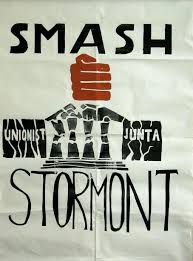
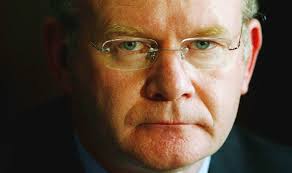
Martin McGuinness, personification of republicanism

On October 24 1990, a Derry man Patsy Gillespie was abducted by the IRA, tied to the driver’s seat of a van and told to drive the van packed with explosives to a British Army checkpoint on the border with Donegal.  While doing so his wife and children were held at gunpoint.  Two other such bombs were also delivered to targets on the border on the same day.  Using others to deliver bombs was a well-known IRA tactic and almost inevitably the driver got out at the target and warned of the bomb.

This time however the bomb was to be detonated by remote control or by the door of the van being opened, which Patsy Gallagher did as he struggled to free himself and get out of the van.  When it opened five British soldiers and Patsy Gallagher were killed; the largest part of him to be retrieved afterwards was part of his hand.  The use of a ‘human bomb’, as it was quickly called, caused widespread revulsion, including among nationalists.

Patsy Gallagher was killed because, according to the IRA, he was “a part of the British war machine”. He had been warned to leave his job because he worked at a British army base, as a cook.  He was, to use a more old-fashioned phase, a ‘collaborator.’

The deployment of three such attacks on the one day would had to have been sanctioned by the Northern Command of the IRA, whose Officer Commanding was Martin McGuinness.

Just under a decade later he was Minister of Education in the Northern Ireland Executive, the administration devolved from Westminster.  His Sinn Fein colleague in the Executive was Bairbre de Brun, who was Minister of Health.  One of her more important acts was to launch a review of acute services in Northern Ireland: “I want to hear all the arguments and weigh up the options before taking any final decisions. To put me in a position to take the necessary decisions, I need measured, informed and objective advice on how acute services can best be developed to meet the needs of our people.”

To lead this review she appointed a well-known figure, Maurice Hayes.  He had been the most senior Catholic civil servant at Stormont, supplying weekly reports on politics in the Irish State to the Northern Ireland Executive in 1974; later becoming head of personnel for the Northern Ireland Civil Service, Permanent Secretary of the Department of Health and Social Services and later Northern Ireland Ombudsman. He was Electoral Boundary Commissioner, a Senior Advisor to the Chair of the Constitutional Convention, a member of Lord Patten’s Commission to reform the police in the North of Ireland, and authored the report which led to the establishment of the office of Police Ombudsman.

In other words it could be said, if one wanted to, that when Sinn Fein got into office they asked the most senior ‘collaborator’ around to help them decide what they were going to do now they had got there.

Nothing epitomises the evolution of republican politics in the North of Ireland so much as the sequence of these two events.  In fact, it could be said that no two events define republican politics so much as the conjunction of these two events.  All the more important because they are now either forgotten, or, in the second case, were barely noticed at the time.

Of course, Martin McGuinness was later denounced for various actions by other republicans, including his condemnation of these republicans as traitors for shooting British troops; and for toasting the Queen in white tie and tails at Windsor Castle.  These were high-profile events but they were mainly symbolic.  The killing of Patsy Gallagher for being “a part of the British war machine” while hiring the biggest ‘castle Catholic’ when it entered office were not symbolic but very real.  These events tell us most of what we need to know about the politics of Martin McGuinness and Sinn Fein.

A working class cook had become a ‘legitimate target’ in a war which, when it ended, they could think of nothing better than to ask one of the most prominent Catholic establishment figures for advice on what they should do.  Militarist ‘anti-imperialism’ gave way to equally ineffective subordination as a parliamentary ‘opposition’ to British rule, an opposition that involved not being in opposition but being in government.  And with a party so right wing its antediluvian views resembles closely the most rabid base of Donald Trump.

Throughout their evolution, no matter what its twists and turns, the movement exhibited a complete lack of class politics.  The socialist opinions of some masked the right-wing politics of the movement as a whole.  As the old adage goes, opinions are like assholes – everyone’s got one.

The movement has been a vivid demonstration of lessons not widely enough appreciated – that ‘anti-imperialism’ does not necessitate socialism and that a predominantly working class base does not equate to politics defined by class.  A socialist assessment of the political life of Martin McGuinness that does not register these facts is worthless.

This is important because the political assessment of someone’s life often becomes more important than that life’s impact when it was lived.  Gerry Adams claimed that “Martin McGuinness never went to war, the war came to him.”  But this of course is untrue.

Martin McGuinness and the Provisional IRA did go to war.  The necessity for armed defence against sectarian pogroms was usurped by the Provisional IRA into a conscious offensive war that promised victory ’72, ’73 etc. It was they who claimed that only the IRA and its armed struggle could bring victory, by which they meant a united Ireland; but their struggle degenerated as the British State inevitably crushed it by its superior power.   They failed so comprehensively they now pretend this war was about something other than declared at the time, all about equality and not ‘Brits Out’.  In all this Martin McGuinness played a leading role.

I remember being asked by the wife of a republican whether I thought Martin McGuinness was a British spy.  Not because I had any more knowledge of the secret war than she had, because I was pretty sure I had less, but because despite this she really didn’t have a clue, or rather the clues were useless.  She simply wanted another opinion of someone who might have thought about it from a different perspective from her own.  The important point is that it was a legitimate question and one that will probably never go away (see the posts here and here.)

Politically it doesn’t really matter, because informers are as much a part of the republican movement and its history as anything else.  Secret conspiracies are particularly vulnerable to much more powerful secret conspiracies to counter them, and the British state is not short on this resource.  The role any individual can play is limited in most circumstances and particularly so  in the oppressive circumstances in which McGuinness was politically active.

His legacy is one of a failed armed campaign and collapsed political arrangements at Stormont that he fought doggedly to promote.  But the grubby reality of the latter is as clear as the brutality of the former.  This includes broken Sinn Fein promises to oppose welfare cuts and support for austerity and sectarian patronage.

No amount of media spin, lamenting the botched implementation of a renewable energy scheme, or failure of the institutions to deliver effective government, can hide the fact that the scheme was not botched – it worked perfectly – and Stormont is still effective in containing politics within sectarian boundaries, even when it only functions as a prize still to be realised.

In the latter part of his political career Martin McGuinness must be judged on both his pursuit of such an unworthy goal and his failure to achieve its lasting implementation.  To rephrase slightly: pity the land that needs heroes and sad the land that needs one like this.


Brexit and Ireland – part 3

The North of Ireland is the weakest part of the UK so should expect to be hit most by Brexit.  Local news has reported two companies as already shifting operations to the Irish State in preparation for the UK leaving.  The EU is the North’s largest export market and while for the UK as a whole, for the period 2004 to 2014, the share of exports going to non-EU countries has grown more than that to EU countries, this has not been the case for Northern Ireland. Since it has been pointed out that some agricultural products can pass across the border numerous times, the scope for tariff and non-tariff barriers to stifle this trade is significant.  Such tariffs generally range between 6 and 22 per cent

While for the three years reported in this paper, the share of EU exports going to the EU has been around 50% for the UK, it has been around 60% for Northern Ireland (NI). In terms of cross-border trade, exports from the North to the South are more important to the North than exports to the North are for the South.   Foreign Direct Investment uses Northern Ireland to export into the rest of the EU so any exit will hit this investment and this employment.

Finally, there is the loss of EU funding, especially for farmers, not that this seems to have prevented many unionist farmers from voting for Brexit.  The UK Department of the Environment, Food and Rural Affairs estimated that direct payments to farmers under EU Common Agricultural Policy subsidies represented 87% of annual farm income in NI.

Brexit could impel the UK into trade based on World Trade Organisation rules, just when the US under Trump signals that it may ignore these rules when it doesn’t suit.  China is also reported to be breaking WTO rules but the length of time it takes to rule on any breach and the potential for retaliation are strong impediments to enforcement.   In any case the UK is already failing to manage its trade and might be fined billions of Euros by the EU for failing effectively to police the existing EU rules.  Hardly an endorsement of its ability to look after its own borders after Brexit.

The new US administration is hailed as a potential alternative to the EU even while Trump threatens to restrict and withdraw US investment abroad.  You know Brexit is a disaster when the nationalist policy of the Trump administration is put forward as the alternative, but more importantly you know how stupid the Brexit idea is in the first place when you admit you need an alternative and don’t already have one.

If Brexit makes no sense in the North it scarcely represents an advantage to the South.  It may benefit from firms relocating from NI and Britain but this is likely to be relatively minor compared to the disruption to trade with the UK, which is worth over €1 billion per week.  Exports from the Irish agri-food sector to the UK amount to over €3 billion or over 50% of that sector’s value.  The Irish State has the biggest share of exports going into the UK of any EU country, so has the greatest exposure to potential reduction of this trade.  It also has one of the biggest numbers of its citizens living in the UK of any EU country, exposing them to the threats to their rights the Tories are deploying in an effort to get a better deal.

Merchandise exports from the Irish State to the UK were over 25% of such exports in 2015 while services traded to the UK were nearly 19% of such services.  It has been estimated that in 2014 200,000 people were employed as a direct result of exports to the UK, or over 10 per cent of employment.   Again any reduction in markets could lead to reduced employment, wages, tax receipts and thus state-funded services.

In this respect, it is interesting to note that many of the economic forecasts of the quantitative economic impact of Brexit show greater falls in wages than in economic growth generally, which is no doubt a feature of the models but which shows that it is assumed that workers will pay most from Brexit.

None of this is particularly surprising and most people just get numbed by too many figures.  The effects are recognised and the question is how these are to be mitigated.  The Tories talk about opening up Britain to the world, but this world includes a growing protectionist US; a more powerful China that has already forced a British climb-down over a nuclear power station; Japanese car companies who have done the same; a Commonwealth that is supposed to welcome a return to a 21st century British Empire, and the rest of the world, much of which is part of trade blocs that the British are rejecting.  Given this context, were Brexit to go ahead, the direction of the British state will be less under its control than it was inside the EU.

Similar problems will face the Irish State if Brexit goes ahead. Up to now it could straddle a growing relationship to the EU with historic but declining dependence on the UK; and it could do this while acting as if it was the latest State to join the Union, that is the union of the United States of America.  Brexit threatens the second and Trump threatens the third.  The first is threatened by the nature of the type of Brexit that may occur and by being squeezed by the US and Britain.

If controls on immigration that are under the authority of the EU and British impede migration to the UK, the importance of this migration will decline relative to the Irish State’s greater trade with the EU, making it more attractive to enter into the Schengen area to facilitate such trade.  Entry into the Schengen area for any reason would make problematic any more favourable Irish migration arrangements with the UK compared to others, who might object to less favourable arrangements for their own EU citizens. Either way migration links to Britain could suffer, and such migration (just like that to the US) has always been a safety valve for the young fleeing a country that is regularly unable to promise it a future.

So, if the UK leaving the EU will hurt both Irish States, it is hard to see the sense in advocating that the Irish State also leave.  Unlike in Britain this policy is really confined to sections of the Left and more ‘radical’ nationalists and republicans.  But at least it is consistent with the latter’s nationalism, while how the Left expects workers to become more internationalist while their country becomes more isolated is another sorrowful mystery; even the Tories recognise the need to develop international links.  But why would European workers rally to a movement that declares that the problem is their ‘foreign’ capitalist states and not its own.

But of course, some new orientation to the world would be necessary for an Irish State outside the EU and there is really only one immediate candidate – back to the loving embrace of the similarly isolated British State, ludicrously trying to re-live its imperial youth.  A death-embrace of two states simultaneously pursuing a race to the bottom as a low wage, deregulated, offshore tax haven.

In doing so an Irish State would suffer badly, and just like the economic models relating to Brexit, we can be certain that it would be Irish workers who would suffer most for the nationalist fantasy that is Irexit.  The idea that something progressive or even socialist could develop out of such a project is preposterous.

The Euro area is by far the Irish State’s biggest trading partner, €109 billion in combined exports and imports in 2013/2014, compared to €52 billion for the UK.  Much of the foreign direct investment in the Irish State is because of its access to the EU market and could be expected to leave if it left the EU.  Foreign owned companies account for more than 20 per cent of employment while they dominate exports.

The Irish State would have to create a new currency, especially if (in the very unlikely event) its exit was motivated by the nationalist Left, which regards the Euro as a devil incarnate.  Establishing the credibility of this currency would require massive austerity while failure to do so would guarantee massive inflation.  In either case living standards could be expected to plummet.

In both parts of Ireland Brexit and Irexit is and would be a disaster.

The Left supporters of Irexit would have to find a new name for the above description of the results of Brexit and Irexit, as dismissing it as another ‘Project Fear’ wouldn’t quite cut it, as the experience of attempting to destroy capitalism by destroying capitalism only became a reality.

How ironic that it is the ideological supporters of capitalism itself that are inflicting this damage, rather than the relatively irrelevant proponents of Lexit.  Not only is this Left’s programme of breaking with the EU being implemented by the likes of UKIP, Tories, the Daily Mail and The Sun but the nonsense of a ‘progressive’ Brexit is being pursued by Corbyn’s Labour Party.  And we can see how useless that is as well.

Rarely does this Left get such an opportunity to see its big policies implemented. Unfortunately, it’s unlikely they will learn anything from their errors, since they seem barely to recognise that what they have wanted is actually being implemented.

Concluded

Back to part 2


Brexit and Ireland part 2 – the hard border

border-brexitHaving at first said she didn’t want “to return to the borders of the past” between the North and the South of Ireland, Theresa May now says that “when the UK leaves the EU we aim to have as seamless and frictionless a border as possible between Northern Ireland and Ireland.”  What this means is that we will have a seam showing and lots of friction.

This is because, while Theresa May would like to portray the relationship as one between the North and South, the actual relationship is between the UK and the EU – this is the border that will exist post-Brexit.  Formulations to the contrary are but one example of the Brexiteers hopes to divide the EU so that it can obtain concessions from particular member states, in this case it would be in the form of a special deal for Northern Ireland.

This can range from continuing EU membership for the North (although this would create unmanageable problems in relation to Scotland) to border controls at Liverpool or Cairnryan.  This would then leave the need for potentially relatively minor checks at the Irish border itself.  Of course, we could get these checks at Belfast or Larne instead.

It was interesting that immigration checks into the UK at Dublin airport on behalf of the British was floated as a story a few months ago and flew longer than it should have, before being shot down on the grounds that the Brits can do their own dirty work (I paraphrase).  However, the Irish don’t mind the dirty work being done on their territory when it comes to the United States.  When it was also floated that the Irish State would not cooperate with racist immigration controls introduced by Donald Trump, it was quickly squashed when it was revealed, or anyway declared, that the Irish could do nothing about the pre-clearance carried out by the US immigration service on Irish soil.

Controls at British ports is about as good as it would get but it would only reveal that the fixation on the line on the map is a diversion by everyone involved.  Regardless of where the checks would take place they would be enforcing customs restrictions and any tariffs that have to be imposed.  Much of the work at the ports would just be checking while the real imposition of trade restrictions would take place in offices all across the UK and Ireland, processing the necessary paperwork and money flows.  It is these restrictions that would damage trade and thereby threaten employment.

The only point of checks on the border if they were already carried out at Liverpool or Larne would be if some smart ass thought they could avoid customs restrictions by siting themselves in Northern Ireland rather than in Britain, but if this happened to any extent the controls would move from Liverpool or Larne to Lifford, Dundalk and Newry.

Immigration and customs checks going into or out of the island might be sold as a special deal.  The British nationalism that is driving the demands for Brexit doesn’t give a damn about the Irish in the north of Ireland, if they get in the way of what suits the real British in England, Wales and Scotland.  The unionist supporters of Brexit in the North of Ireland might complain that they weren’t then being treated like the rest of her majesty’s subjects, but those of us old enough to remember the Belfast flight being off in some corner of the airport and having to fill in Prevention of Terrorism cards will have seen it before.

Besides checking on the import and export of goods, the other reason for border controls would be to check on people moving, so that those from the EU could not pass freely to the Irish State, then to the North and then to Britain.  The British, Irish and the EU have all signalled appreciation of the importance of the Common Travel Area between the Irish State and the UK, under which Republic of Ireland born are treated entirely the same as UK passport holders under the Ireland Act 1949, but this is within the gift of the EU.  Free entry, or looser entry from the island of Ireland would have to be compensated for by stricter controls within Britain itself, if it was believed that people from the EU were coming into Britain to get jobs through Ireland.  Already we have had xenophobic statements from senior Tories calling for registers of EU citizens employed in the UK.  This was rejected, but we haven’t gotten to the sharp end of the Brexit negotiations yet when the real aggro will start.  Welcome to the nasty world of a hard Brexit – the one we’re going to face.

Irish citizens living in the UK have had rights to welfare for decades before both the UK and Irish states joined the EU but under Brexit they will be EU citizens when the UK is no longer an EU member.  It cannot be assumed that the EU would be happy at discrimination against a majority of its citizens which favoured the Irish even if the British were happy to maintain these rights.  And what of those with Irish passports in Northern Ireland?  How are they to be identified, or rather identify themselves, to ensure that they don’t have second class rights as UK citizens?

All this explains the apparently surprising flurry of statements from Irish politicians talking about Brexit leading to a united Ireland – even from the most partitionist of sources.  But what they fret about is the cost to their own business and state on their side of the border, not sudden awareness of the calamitous results of partition on democratic rights.

That some people have taken these statements as more than bullshit is testament to failure to realise that the effects of the border are not primarily felt on the border itself but in the politics of the two societies that lie behind each side of it.  This is why much of the alarmist claims that Brexit will damage the peace process and/or will create conditions for a successful referendum to remove the border are so wide of the mark.

Everyone know the EU played a relatively minor role in the pacification of the North of Ireland.  The rush for Irish passports after the referendum is not enough to signal any mass change in political identity but a sensible pragmatic decision, which those choosing hope won’t come back to bite them.  They can, anyway, get two passports.  Northern Ireland voted Remain but even this split was very much, although not to the usual extent, based on sectarian lines.  Even where massive majorities of nationalists voted for Remain, such as in West Belfast, the turnout wasn’t great.  I know unionists who voted Remain and they’re still unionists, and being unionist means being trapped into a sectarian political state because unionism demands it even if these people don’t.

There is going to be no return to political violence because of a hard border, even if it does cause significant inconvenience for those living along it, which is the most likely outcome.  A bit of nationalist history is instructive here.

The recent ‘Troubles’ broke out not because of problems with the border – the IRA’s border campaign of 1956 to 1962 had achieved nothing and fizzled out.  It followed an earlier bombing campaign in Britain and previous demise of the original raison d’être of the anti-Treaty IRA, which was fighting the treachery of the Free State forces, in other words fighting the Southern State.  By the 1950s republicans had abandoned fighting the Free State and accepted it, so that now it is almost forgotten that this was the IRA’s primary purpose.  Instead, what drove the IRA to its more recent prominence was what society inside the Northern Ireland border was like – its sectarianism and capacity for violence in defence of it, particularly by State forces.

In other words, what will, and currently is, causing the degeneration of the ‘peace process’ political arrangements are the internal contradictions within the process itself.  This does not mean that external factors are unimportant.  In fact, my own view is that such factors will be decisive in clearing away the political slum that is Northern Ireland.  What it does mean is that the effects of Brexit will exacerbate the problems but not be their key cause.

It is not the erection of border posts that will matter, they will just be visible symbols of the changes occurring.  The IRA, of whichever group, is not going to relaunch any significant armed struggle directed against the border.  This border will be just as much an EU/Irish border as a British one and just as much, if not more, a requirement of the former as the latter, even if it is the British whose Brexit has brought it into a harder form.

What will matter is the damaging effects on the North and South of Ireland of Brexit and the competing demands of Britain, the US under Trump and the EU.  In periods of relative geo-political stability small countries and regions can appear relatively stable and entertain illusions of sovereignty and autonomy.  When big powers seek a reconfiguration of international structures they rarely give a f*** about the interests of small countries.

Forward to part 3

Back to part 1

Brexit and Ireland part 1 – the Irish Left

irexitI have just read that various police forces in Britain have taken steps to prepare for a spike in racist and ‘hate’ crimes once Article 50 is triggered in March.  It is also correctly predicted that the course of the negotiations will present numerous opportunities for nationalists and racists to turn the failure of these negotiations to deliver on their fantasies into attacks on foreigners.  What the Tories will do verbally in attacking the EU it can be safely assumed that nationalist street thugs will do with their fists.

The reactionary outcome of the Brexit referendum is so obvious that it is simply grotesque and monstrously stupid that those sections of the left who supported Brexit still see it as progressive.  How dim or blinded by political dogma does one have to be not to see the link between the rise in racist attacks and the encouragement given to racists by the Brexit result?

The reactionary consequences of Brexit are glaringly obvious yet the process is being touted by it supporters in Britain as the way forward for the left in the rest of Europe.  The reactionary dreamers of a long lost imperial glory want to go back to the past while left supporters of Brexit imagine that a massive step back to the past will somehow represent a great leap forward into the future.  One of the few difference between the former and the latter is that the former makes more sense!

The European left have the luxury of watching the British events from one remove, but it is not the only advantage that they have.  Having witnessed the dire outcomes of Brexit they should stand firmly against their own states seeking the nationalist short cut to a non-solution though exiting the EU.  They too, just like British workers, must be alert to any weakening and diminution of their rights arising from the Brexit negotiations.  Of course, were Brexit the progressive outcome claimed by some we should expect a boost to workers’ rights from the negotiations, but the ridiculousness of such a thought only exposes the idea as incredible.

This is particularly the case for Irish workers whose state has the strongest links to Britain and could be most immediately and directly affected.  Yet even in Ireland the same left supporters of Brexit trot out the same ignorant arguments in favour of the decision; despite the increased xenophobia, despite the increased racist attacks, despite the massive shift to the right in the agenda of the Tory government, and opposite incoherence of the Corbyn-led Labour Party.  Despite all the evidence that the consequences have been reactionary the Brexit-supporting left has learned nothing.

The basis for their support for Brexit is the same mistaken arguments of their co-thinkers in Britain. Thus, they say that “the EU is run in the interest of Europe’s bosses and bankers.”  It is “deeply undemocratic, anti-worker, racist and regressive.”  Yep, mostly very true, just like the Irish State itself, which is the alternative to the EU that they put forward.  The nation state that doesn’t even include all of the nation is the alternative to the increased unity of the various states which determine the EU’s policy.  Apparently this is because although the EU cannot be reformed, the Irish State can.

In fact the Irish left must be applauded for making their illusions in nationalism so clear – that their opposition to the EU is based on their belief that the various capitalist nation states can be reformed and become the route to socialism.  The task across Europe is “to bring Left governments to power which will nationalise industry, while the EU would only be “a fetter on a future left-wing government.”

Capitalist state ownership and its political power is presented as socialism without an inkling that socialism is the power of the working class, which it is the capitalist state’s function to suppress and repress.  This complete misunderstanding of what socialism is about means that there is no conception of how it can arise from the current system.

It is correctly recognised that the EU is an attempt to “overcome the limitations of the nation state, to allow the free flow of capital and labour so as to maximise profits as well as forming a more powerful geo-political bloc.  The withdrawal of one of its major economies represents a profound blow to these ambitions.”

This apparently is what makes Brexit progressive.  It’s as if the objective of socialism is to restrict the free flow of capital and to frustrate the maximisation of profits.  It is probably news to these socialists that this is not the objective of socialism.

Capitalism presents its own barriers to the free flow of capital and the maximisation of profit, and which are expressions of the contradictions of capitalism pointed out by Karl Marx 150 years ago.  The point of socialism is to resolve these contradictions through the birth of a new system, not to intensify capitalist contradictions as an objective in itself.

On the other hand, it is an objective of socialism to support “the free flow of labour” and it is the objective of socialism to “overcome the limitations of the nation state”.  In fact, one objection to capitalism is that it has so far proved unable to do this.  Socialists do not seek to go back to the nation state but forward beyond it based on the steps that capitalism has already taken.  The first is called freedom of movement, an elementary democratic right and vital to workers’ unity, and the second is called socialist internationalism, the idea of which the Brexit left seems totally innocent.

Finally, this Brexit-Irexit left want to land a profound blow against “forming a more powerful geo-political bloc” by forming a Lilliputian bloc of one.

This left proclaims that it voted for Brexit “not because we have anything in common with the nationalism and xenophobia of the likes of UKIP” but because the EU is neo-liberal etc.  But this is obviously untrue.  The proposed Brexit referendum was sufficiently to their liking that they voted for it, called on everyone else to vote for it, still support even now and call for other countries to emulate it.  Nothing in common?  Is all this just a coincidence then?

What they both have in common is a nationalist conception of politics that is centred on the professed progressive potential of the nation state.  Both seek national independence as a prerequisite for progress and state intervention as the key to it. Totally the opposite of the socialist view that unity across nations is the key for workers and the nation state an obstacle to this.

Even in terms of the specific role of increased state spending, the views of this left are not so far from some of the proposals for increased spending presented by those other nationalists Trump and le Pen.  The tide of reactionary nationalism that these two and the Brexiteers represent threatens trade wars justified by rabid jingoistic rhetoric and sabre rattling.  The world has been here before in the twentieth century.  Giving a left gloss on this growth of reactionary nationalism by tail-ending it is a massive mistake, only reduced in effect by the relatively small forces advocating it.

The Brexit-supporting left is oblivious to their own role in the growth of this nationalist politics.  It minimises the xenophobic and racist content of the Brexit referendum by claiming that the Remain campaign was also anti-immigrant, ignoring the difference in degree and importance of such ideas on each side.  How quickly the murder of a Labour MP by a nationalist fanatic is forgotten!  How likely was this to have arisen from a supporter of the Remain campaign?

This left doesn’t even believe its own excuses – acknowledging that “the majority of ‘Remain’ voters did so for very positive reasons – in opposition to the xenophobia and inward-looking nationalism of the forces which dominated the official ‘Leave’ campaign, expressing a desire for unity across national borders.”  A desire expressed in freedom of movement within the EU, a freedom ignored completely in the series of analyses reviewed for this post.

All this exposes the hollowness of proclaimed opposition to rising anti-immigrant prejudices, prejudices fuelled by the decision they supported and still support.  Political positions have a logic outwith the sincerest of intentions – it’s commonly called the road to hell being paved with good intentions.  But even here the articles can’t help skirt with prejudice by talking of the “strain” caused by immigration and “the real concerns over the effects of immigration.”

This left presents frankly delusional claims that Brexit has been good for the working class – “opportunities are posed for the working class to organise and assert their interests” and “the working class can now more easily shape the course of events than it could within the glass prison of the EU.”

But in the real world the increase in racist attacks continues and reactionary nationalist rhetoric intensifies.  The Tories threaten to create a low-wage, low tax and deregulated free market paradise off the coast of Europe – a threat to British workers and to all of Europe’s workers – not an opportunity.

Most directly and immediately it is a threat to Irish workers.  After all, who else occupies the low tax, low regulation, super-business friendly niche that the Tories threaten to move into more obviously than the Irish?  My goodness, we even speak the same language.  Of course, the Irish State is inside the EU, which is a great attraction to US multinationals, but this does not help trade barriers for Irish-owned industry buying or selling into Britain, when Britain leaves the EU.  So, what better solution than for the Irish state to leave the EU as well?  After all, this fits the Trump agenda into the bargain.  Just a pity that this particular nationalist agenda also presents its own threats to the Irish ‘model’ of development.

Whatever way you look at it the nationalist agenda espoused by the Brexit-loving Irish left doesn’t offer any solutions to Irish workers.  But then, the Brexit left knows this itself:

“The bosses in Ireland will attempt to go on the offensive against the pay and conditions of workers in an attempt to make Irish exports more “competitive”, in the context of Sterling devaluing against the Euro. In short it is workers in Ireland, both public and private sector, who will be hit by the economic fallout of Brexit. Already the ESRI have talked of wage cuts taking place of between 4-5% for up to 60,000 workers. There have also been reports that the government may seek to attack the pay of public sector workers.”

So “it is workers in Ireland . . . who will be hit by the economic fallout of Brexit”.  But sure, wouldn’t it grand all the same?

Forward to part 2