Crisis? What Crisis? part 2 – the Tories become the workers’ friend

theresaSome people might object to the view expressed in the previous post that the Tories are intent on even more drastic austerity – after all hasn’t the new Chancellor scrapped the target for achieving a budget surplus by 2020?  And as one Tory official is reported to have said – “perhaps only a Tory government can save capitalism from itself.”

And hasn’t Theresa May gone even further than this?  Hasn’t she said she will make capitalism fairer for workers, crack down on corporate greed, promote state intervention, provide for more workers’ rights and put “the power of government squarely at the service of ordinary working-class people.”  Hasn’t she criticised uncaring bosses, tax-avoiding multinationals and directors who took out “massive dividends while knowing the company pension is about to go bust”?

Yes of course, she has gone further, but none of these steps are necessary for a Tory government “to save capitalism from itself” and the chances of a Tory government putting “the power of government squarely at the service of ordinary working-class people” is zero.  So what is going on?  Is it just a case of ideology being employed, not to unconsciously blind the beholder, but consciously to blind those naive enough to believe Tory lies?

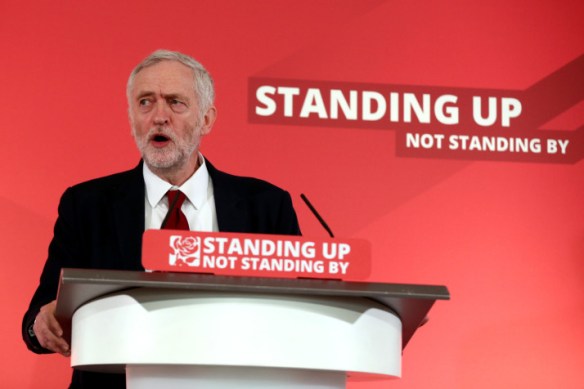
Before I answer this it is useful to make two observations. First, the language of the Tories shows how bankrupt the anti-Corbyn forces in the Labour Party are – afraid to mention class while the Tories outflank them from the left.  Just how much of a future would the Labour Party have if it stood permanently exposed on the left by a Thatcher Mark II?  What future would it have to endlessly repeat an approach symbolised by allowing cuts to disability benefits to go through only for the Tories to then scrap them?  Would the Labour right have wanted to abstain on scrapping them as well?

The second point is that this Tory rhetoric is described, by the same political commentators who got Brexit wrong, as the Tories moving against the Labour Party by ‘moving to the centre ground’.  This is almost as funny as their voting for Cameron while opposing Brexit.  Since when did promoting workers’ rights and cracking down on corporate greed, even if only verbally, been the centre ground – surely this is moving to the left?

And to answer the question – of course it’s moving to the left, and its only became the centre ground since Jeremy Corbyn arrived from Mars to become leader of that part of the British people regarded as swivel-eyed-mad-lefties by the media.  But of course it is also claimed he leads an ineffective opposition – despite him causing the ‘centre ground’ to shift leftwards.

It’s difficult to know whether this ridiculous view of the Tories’ approach is unconscious ideological self-deception – that the political battle is always fought on the centre ground –  without pausing to think just where this ground might be; but I tend to think that it’s more likely to be cover for the fact that the political commentators who write such rubbish know that it’s all Tory rhetoric without any chance of being implemented.  If the Tories have moderated austerity it is only because they fear they have to because, as we have seen, a Tory government is necessary “to save capitalism from itself”, or rather a new Tory government is necessary to save the country from the last Tory government.  But then, even the last Tory government carefully implemented austerity and extolled its virtues only to ensure it could continue as a political weapon and as an economic policy option that fitted an ideological agenda.  They were well aware, or at least some of them were, of the limits of a policy that involved bleeding the patient to death.

The case for this new Tory tilt to the left being a conscious attempt to blind those naive enough to believe Tory lies is supported for two reasons.  First, a ‘sovereign’ UK outside the EU will slip down the global power rankings like a stone.  It will be too big to ignore but too small to decisively shift its environment to its benefit.  The EU cannot afford to indulge its delusions of greatness because it’s big enough to matter but not big enough to influence the EU to submit to its claims or demands.  Some Tories might believe it can trade with the rest of the world while turning its back on those next door – that it already has almost half its trade with – but it requires outside investment to pay its way and this can only come through modelling itself as an attractive centre for foreign investment.

To do this will not entail the reassertion of British sovereignty but will expose its weakness and expose its lack of sovereignty.  The inability of relatively small and even medium sized states to interact in the world mainly to their benefit is precisely why larger economic blocs like the EU were formed.  The world will not change its rules because the British don’t like them.  The British state will therefore become weaker with less capacity to intervene and the economy it has to intervene into will be even more in need of assistance.

to be continued

Back to part 1

Forward to part 3

Crisis? What Crisis? part 1 – blinded by ideology

cameronOne of the very few things that has made me smile in the whole Brexit debacle has been the leader writers and columnists of the financial press, including the ‘Financial Times’ and ‘The Economist’.  Brexit is almost universally regarded by these people as a disaster and some have blamed David Cameron for being a reckless gambler and bringing them to their current predicament.

Yet it is these same commentators, who represent some of the most class conscious spokespeople for capitalism, who supported the Tories in the last election and who, when they did so, supported the only people who could make this whole disaster for them possible.  It is normal for these self-regarding experts, who prize their analytical capacity and steely objectivity, to damn the Left in any of its forms for being ideologically driven but in this case it is abundantly clear that they have been blinded by the own ideology.  If Cameron gambled, they gambled on the gambler – one derivative they shouldn’t have bought.

These commentators and the markets they service are now being dragged kicking and screaming to a ‘hard’ Brexit while their Tory favourites declare, in complete stupidity, that there is no such thing as a ‘hard’ or ‘soft’ Brexit.  Not only are the Tories not pushing for as open a trade relationship as possible and selling the importance of this to their electorate, while making vaguer and vaguer promises on limiting immigration; they are doing the opposite – signalling the primary importance of halting free movement of people and acceptance of worse trade terms from the EU as a result.  The drastic restrictions on immigration floated by some Tories are also not in the interests of big capitalists, who want as wide a labour market as possible from which to hire and fire.

One of Cameron’s allies in Cabinet is supposed to have said of the referendum that “it will be all about jobs and the economy and it won’t even be close.”  Now it’s all about immigration.  Except of course that beneath the political fog lies a reality that will bite regardless – and it will still include jobs and the economy.

Not that this reality is understood by everyone on the left.  In a monumental tribute to how ideology can also blind some ‘Marxists’ to reality we can turn to the most recent considerations on Brexit from the Socialist Workers Party.

This organisation supported Brexit and thought that, if it was all for the best possible reasons, changing one letter and calling it Lexit would make a difference.

It defends, if that is actually the right word, its support for Brexit by saying this was for two reasons – “first, and as a matter of principle, we oppose the EU as an engine for imposing neoliberalism. . .” – although it doesn’t then go on to explain just how this ‘principle’ did any good.  Or how one of the most neoliberal states in the EU – Great Britain – was an alternative.

The second reason is that “Brexit would cause a major crisis for British and, to a lesser degree, world capitalism.  This latter judgement has been vindicated.”  So it would appear that the SWP is happy it called Brexit right.

Regular readers of the blog will note that this view of crisis is one that I have criticised over a number of posts, starting with this one.  It is based on a view that since capitalism will be weakened and exposed by crises, and crises provides the opportunity to overthrow capitalism, we should be all in favour of such crises because we can demonstrate that we are right to condemn capitalism and right that it must be overthrown.  Such a view starts from what is bad for the system, not what is good for the working class; from what you are against and not from what you are for; does not understand that we have had plenty of capitalist crises and will have plenty more and none of them have so far brought about socialist revolution; that for crises to be the catalyst for socialism there must be some prior conditions in existence, including the level of the working class’s social power and class consciousness.  Failing all this, the desire for capitalist crisis is just light-minded political vandalism, a million miles from working class people who do not want to be the victims of such crises.

But the SWP can’t even get this story right.  They claim that Brexit will cause a major crisis for the British and also, to a lesser extent, for world capitalism but believe that this may or may not have an impact on economic growth; in other words on the accumulation of capital and everything that goes with it – profits, wages, jobs and standard of living etc.  So we are expected to believe that Brexit will cause a major crisis but it may not have any economic impacts!

It’s as if they don’t want to admit to the consequences of their actions, in so far as they bear a tiny responsibility for Brexit, but don’t want to appear as delusional as the Tory xenophobes who claim there will be no bad economic results.  For the SWP, their light-mindedness sticks out a mile when they simply state that “the truth is that one can argue the toss about this.”  Well maybe they should have argued the toss before Brexit and told their supports just what the economic consequences of Brexit might be.

Denying reality now involves ignoring falls in the value of sterling, which increases the cost of living for workers.  The external current account deficit is running at 6 per cent, the largest since the second world war, illustrating the impact of higher import costs on workers and also the funding needs to cover it that might drive up interest rates.  On top of this we can consider the effects on jobs of disruption to trade and investment arising from reduced access to exports, dearer imported inputs and reduced foreign investment.

Once again it’s important to state that there is no point ignoring the realities of capitalism and the harmful effects on workers of its difficulties if you don’t have an alternative to defend workers’ interests when these difficulties occur.  Socialists do not declare ‘bring it on’ to capitalist crises, not least because capitalism has never lost the knack of ‘bringing it on’ all by itself.

If the working class had strong, militant union organisation ready to challenge companies making pay cuts or ready to sponsor the take-over of companies declaring redundancies then it would be in a better position to defend itself.  If the working class had developed its own cooperative, worker-owned sector and was in a position to extend its scale when capitalism suffered a setback then a major crisis might herald radical change.  But it isn’t and it faces economic dislocation with a capitalist state headed by a governing party hell-bent on increasing neoliberal policies.

to be continued

The politics of conspiracy – the case of Denis Donaldson

donaldsonI remember a number of years ago I was handing out leaflets at a Sinn Fein meeting in Conway Mill on the Falls Road in Belfast.  It was about the relatively new peace process and it would be fair to say that the leaflet was not celebratory of the new initiative.  I was outside the room, although inside the Mill complex, but since the Provos came to regard the whole of West Belfast as theirs it came as no great surprise that one of their number decided I was trespassing on their territory.  As the years have gone by, and if rumours are to be believed, this is less and less their territory and more and more their property.

I was collared (not very roughly) by a then prominent Sinn Fein councillor and pulled (not very strongly) over to another prominent Sinn Fein member, Denis Donaldson.  The councillor wanted to know from Donaldson was it not alright that I should be handing out leaflets critical of Sinn Fein but should be told to get lost.  Denis Donaldson was no more interested in me giving out leaflets than the man on the moon and couldn’t even give a full shrug of the shoulders in apparent indifference; he couldn’t either be bothered to grunt any disapproval or otherwise.

The councillor was a bit exposed so he mouthed some vague displeasure to no particular point and I meandered back to outside the door to give out the rest of the leaflets.  As a comrade of mine put it, the Provos were more tolerant of other opinions when they were less ‘political’, when they confined themselves overwhelmingly to shooting and bombing, than they were to become during the peace process.

The point of this reminiscence is that Denis Donaldson was obviously the go-to guy at the meeting who determined what (or who) was allowed, in other words from ‘the army’.  Denis Donaldson was later revealed as a long term agent of MI5 and is now dead.  He was shot after being exposed as a spy in a remote and ramshackle cottage in Donegal. The rather pathetic circumstances of his death were fitting to someone who, unlike other agents, appeared too demoralised even to run in an attempt to save himself.

Now he has become a headline again because an ex-British soldier has alleged he was shot by the Provisional IRA and not by a ‘dissident’ IRA, which had claimed responsibility.  The headlines have been made because the ex-soldier has now written a book about his activities in the north of Ireland and accuses Sinn Fein leader Gerry Adams of having sanctioned the killing.  Adams, through his lawyer, has denied it.

One of Donaldson’s notable activities was his involvement along with two other men in an alleged Sinn Fein spy ring at Stormont.  He was subsequently charged only for prosecutors to drop the charges “in the public interest.”  In such cases “the public interest” is anything but the public interest and is invariably in the state’s interest.

In the south of Ireland an inquest into his death has been delayed 20 times at the request of the Garda Síochána due to concern that a detailed journal found in Donaldson’s cottage contains information about the organisation of the republican movement and about his activity as informer and the activity of the state forces.  It’s doubtful either Sinn Fein or the British State want the contents revealed.

So we have an ex-soldier selling a book making one claim and Adams making the opposite claim.  The ex-soldier also claims that he was previously going to seek to join the IRA before then joining the British Army.  He regards himself as a republican and supports Sinn Fein today, indeed he claims he did so even when serving for the British Army in Ireland!  One can hardly think of anything more bizarre! Indeed it’s hard to think of anything less credible, except for Gerry Adams’ claim that he was never in the IRA.  So on purely a priori grounds of credibility the ex-Brit appears to come out on top.  Does it matter?

In so far as it impinges on Adams it simply reminds one of his lack of principle, unwilling and incapable of defending what was the primary dogma of republicanism – driving the British out of Ireland by armed force. After this was surrendered nothing remained sacred.  Following this betrayal there has no repentance of Gerry who has denied his movement more than three times.  Any further promises – to oppose austerity etc – are open to charges of relying on the same level of credulity necessary to accept his claims to non-membership of the IRA.

In so far as the headlines recall the murky intrigue of the ‘dirty war’ it reminds everyone who lived through it of just how dirty it was.  It was well enough known that loyalist murder survived upon the tolerance and sponsorship of the British state.  What has become clearer since the ‘end’ of the various armed ‘campaigns’ is the degree of this sponsorship.  But even more revelatory has been evidence of British penetration of the republican movement and the betrayal of genuine republican activists by agents of the British State inside the movement.

What all this history has demonstrated is that the conspiracy of the state cannot be overcome by any revolutionary conspiracy.  Irish republicanism is pathologically disposed to such conspiracy and has failed again and again.

As I near the end of reading a recent biography called ‘Karl Marx – a Nineteenth Century Life’, one consistent feature of Marx’s political activity recorded in the book was his opposition to conspiracy as the means of working class organisation.  The political activity that won Marx to socialism and which he in turn fought for again and again was the open organisation of the mass of workers, in struggle for their own objectives based on their own class interests.  It was Marx’s view that these interests are ultimately revolutionary and either the workers became conscious of them, became revolutionary, or they “were nothing.”  Freedom cannot be made behind the backs of workers.  A class cannot come to control society without being aware of its control.

A movement that perennially fails to recognise such basic truths signifies one of two things.  It is incapable of learning or its goals are essentially not about the freedom of the working class.  In both cases conspiracy becomes a favoured means of organisation since, like Gresham’s law, bad organisation drives out good.

Add to this a militaristic outlook and all the horrors of the dirty war are almost inevitable.  It is however not inevitable that sincere working class people end up in such demoralised circumstances that death is almost invited.

Ireland – the Apple Republic part 2

apple-taxWhen a left wing TD called the decision of the Irish Government to appeal the decision that gives it €13+ billion “economic treason” against the Irish public he contributed nothing to clarifying for Irish workers the role of the state, which is precisely to defend big business against that part of the Irish public made up of workers, their families and small businesses, who mostly have little choice but to pay the state’s taxes.

Much better would be a socialist campaign to rally trade union branches, community groups, tenant associations, consumer groups and campaigns etc. to put together their own proposals as to how exactly the €13 billion should be spent.  The purpose would be to demonstrate that the needs of workers should come before those of multinationals and before the reputation and interests of the state and its ‘national interest’.  A campaign that sought to unite with the workers of other countries swindled out of tax receipts by Apple would go a long way to demonstrating that this is not about a race to the bottom that pits workers of one nationality against all others.

This would also allow working people to show, not least to themselves, that they can plan effectively how to spend the money, not just for their own benefit but in the interest of all working people. Its purpose would be to begin to instil a view within them that they should take control of society themselves rather than relying on the state to do the big things for them.

On this count the view expressed by another left wing TD was much closer to the mark.  Speaking in the Dáil Paul Murphy said: “Governments in capitalist societies are but committees of the rich to manage the affairs of the capitalist class. It is as simple as that …. All of the establishment parties represent the rich and the 1 per cent. We need to be rid of this committee of the rich, and we do not need it replaced with a reconfigured committee of the rich.”

The creation of a desire for, and mechanisms to achieve, an alternative to a “reconfigured committee of the rich” is precisely the objective of this proposal for working class activity.  Only by workers increasingly taking control over their lives now can we conceive an alternative that is real, compared to reliance on a state that always has your best interests as far away from its mind as possible.  The motto of socialists in this regard should be the famous quip of the British actor David Niven who, when speaking of Errol Flynn, once said “you always knew precisely where you stood with him because he always let you down.”[i]

A wider claim in relation to the Apple judgement and reaction to it is that such sharp practices are part and parcel of a policy of neoliberalism which is past its use by date.  The exhaustion of this policy has been expressed in the crisis of financialisation in 2008 and the failure of Eurozone austerity policies and similar policies in Britain, where their effects have not been quite so damning only to the extent that the Tories have failed to follow through fully on their austerity rhetoric.  In this view we will see a return to a class compromise that was supposedly the cornerstone of Keynesian policies practiced among the most developed countries after the Second World War.  Among these will be fair taxation of capital and the rich.

Against this it might be pointed out that the Apple ruling did not uphold any principle that taxes should be levied where real economic activity takes place and that in fact it was justified through an objection to state intervention, on the grounds of unfair state aid.

In 1997, even during the neoliberal era, EU Finance Ministers set up a Code of Conduct Group on business taxation that was charged with examining unfair tax practices and in succeeding years it abolished nearly 100 tax incentives across the EU.  Today it is the OECD which is supposed to be spearheading cooperation between governments on tax avoidance and evasion but this body has been a consistent supporter of neoliberalism.

In so far as there has been a trend in corporate taxation it has been a lowering of rates:

“Corporate tax is falling, both as a share of GDP and in the global tax take. . .  Within the last 20 years, corporate tax rates have fallen from around 45% to less than 30% on average in OECD countries. And lately, with increased mobility of multinational corporations, tax competition has intensified. Thus from 2000 to 2005, 24 out of the 30 OECD countries lowered their corporate tax rates while no member economy raised its rates.”

Closing or restricting some ‘loopholes’ is perfectly consistent with lowering rates because the loopholes become less and less relevant.  Reliance on the state to produce ‘fair’ taxation is like relying on Errol Flynn.  The Apple case, precisely because of its scale, is instructive in this and other respects.

The Left has pointed out the sheer scale of the windfall that the Irish Government is potentially spurning, pointing out its hypocrisy in demanding that the Irish people must do what the EU wants when it comes to austerity, bailing out the banks, ensuring no bond-holder is left behind and their demand that water charges simply must be paid.  When it comes to standing up for the Irish people no demand from the EU is too big but when it comes to standing up for the wealthiest multinationals no claim is too disreputable, no sacrifice too large and no neck so shiny and hard.

Commentators have pointed out that €13 billion would make up the budget for the health service for a year or it could take a significant chunk off the national debt of €200 billion.  It could pay the equivalent of a few years of the unpopular Universal Social Charge or it could mean a cash donation to everyone in the state of around €2,800 each, so that a household of four would get over €11,000.  A tidy sum for everyone in the State, or a significant boost to public services.

What it isn’t, despite its unprecedented size, is fundamental or transformative.  While it is a godsend of an example of taxing the rich, which much of the Left repeatedly presents as the answer to austerity and an exemplar of socialism, the Apple example shows that it is not.  Or not if one thinks of socialism as a fundamental change to society and a transformative change in working people’s lives.

What it is, is confirmation of the point made by Karl Marx many years ago, about the limits of distributing existing income or wealth, as opposed to changing the fundamentals of the ownership of productive resources that creates and recreates, again and again, this income and wealth.

“Any distribution whatever of the means of consumption is only a consequence of the distribution of the conditions of production themselves. The latter distribution, however, is a feature of the mode of production itself.

The capitalist mode of production, for example, rests on the fact that the material conditions of production are in the hands of nonworkers in the form of property in capital and land, while the masses are only owners of the personal condition of production, of labor power. If the elements of production are so distributed, then the present-day distribution of the means of consumption results automatically. If the material conditions of production are the co-operative property of the workers themselves, then there likewise results a distribution of the means of consumption different from the present one.

Vulgar socialism (and from it in turn a section of the democrats) has taken over from the bourgeois economists the consideration and treatment of distribution as independent of the mode of production and hence the presentation of socialism as turning principally on distribution. After the real relation has long been made clear, why retrogress again?”

This is the argument that goes to the root of the nonsense peddled by Michael Noonan that taxing Apple would mean “eating the seed potatoes” or Micheál Martin that “This model supports hundreds of thousands of jobs and pays for teachers, nurses and pensions in every part of our country.  What’s more, it has done so for decades.`’

Such is the significance of any battle over Apple’s taxes.  Reliance on multinational capital and all the crap that goes with it or a cooperative economy owned and controlled by workers not just in Ireland but everywhere.

[i] Of course the parallel isn’t exact – Niven and Flynn were “pals” while the working class and the capitalist state are enemies.  It is appropriate however that the above remark was made of an immature personal relationship that has no correspondence to the political stance workers must take against the state; even if failure to take such a stance reflects an undeveloped and therefore immature failure by some Irish socialists.

Back to part 1

Ireland – the Apple Republic part 1

apple_tax_european_union_sept022016The decision of the European Commission to require the Irish State to collect €13 billion in unpaid taxes, plus a potential €6 billion in interest, from US technology company Apple made headlines across the world.  Special tax arrangements, which appear not to have applied the State’s already low 12.5% corporate tax rate, led to an effective tax rate on Apple of 0.05% in 2011 and 0.005% in 2014.  Two tax rulings in 1991 and 2007 allowed an Irish company to book Apple sales across Europe, the Middle East, Africa and India in Ireland and attribute profit on these sales to a “head office” which was stateless, had no offices, had no employees and existed only on paper.

The Irish State has decided to appeal the ruling, as has Apple itself.  Apparently preventing the State from abjectly prostrating itself in front of Apple is an assault by the European Commission on the sovereignty of a small nation.  It supposedly calls into question Irish tax policy while the Government frantically claims that the ruling affects the arrangements of no other multinational.

The appeal is to protect Ireland’s reputation although being dragged kicking and screaming to apply your own laws without discrimination, while defending cheating other countries of tax revenue, is apparently good for it.  The appeal is to prove that the Irish State is not a tax haven although a tax rate of 0.005% would appear to be a decent definition of one and defending it would appear to be open acknowledgement of it.  The Irish Government seeks to defend its prerogative to set an (in)famous corporate tax rate of 12.5% but does so by defending a 0.005% rate.

€13 billion is a big number and is the biggest judgement in the history of EU competition law – the cumulative total of all EU cases involving repayment of illegal state subsidies over the past 15 years is less than €11 billion – and it has been imposed on Apple, the world’s biggest company by market capitalisation.

One explanation given for all this is that the Irish state is dominated by imperialism and plays its natural role as an obsequious supplicant to multinational capital.  This is ok as far as it goes but it doesn’t go far enough, either in explaining or in providing the grounds for an alternative.  If we start with the latter – an anti-imperialist struggle in Ireland to make the natural resources of Ireland the property of the Irish people isn’t a solution.

For a start, the main natural resource of Ireland is its people.  In fact the growth of technology, and companies like Apple, demonstrates that it is the knowledge and skills of workers which is the key to the most dynamic sectors of the economy.  So it is harnessing the power of workers that is the key to economic development in Ireland as elsewhere, not minerals under the earth or the factory building which house the most modern production.  The machines that power this production are obsolete within years; simple ownership of them does not guarantee the future unless workers not only own them but have the knowledge and capacity to continue to revolutionise their development.

Secondly an utterly subordinate role for Irish capitalism does not explain how it allowed itself to become the vehicle for depriving other European countries of tax revenue, which the EU ruling now gives the latter an avenue to pursue.  The ruling signals that although other EU states may not have liked the Irish State’s low corporate taxation regime, it was not such a problem if it remained relatively marginal.  After all, they’re all engaged in tax competition in one form or another as one facet of inter-state and inter-company rivalry.

The problem for the Irish is that they prostrate themselves disproportionately to the US, who don’t so much mind the role of Ireland as a tax haven since it is US tax rules which permit Ireland’s role of in tax avoidance and also still allows the US to take a cut if and when the profits are eventually repatriated, perhaps as a result of some tax amnesty.

The Irish State has thus put itself in the middle of a bigger competition between EU and US capital and however much it might be “closer to Boston than Berlin” and wallow in its generations of emigrant’s ties to the old sod, the Irish State is part of the EU.  Its facilitation of US companies through an effective tax haven can only be permitted so much success before the bureaucracy of the EU proto-state decided that it had gone too far.  The Irish are therefore not just functioning as a subordinate client to imperialism but play a particular role in inter-imperialist rivalry.

And it would be wrong to characterise this role as something anomalous to the normal functioning of capitalism.  Apple had over $215 billion in cash and assets sitting outside the US as of June this year, sitting there avoiding US taxation.  It has been estimated that this is only part of $1.4 trillion sitting offshore of the US, all avoiding tax and perhaps waiting for an amnesty and a nice big deal.

It has been estimated that about half of all lending and deposits originate in Offshore Financial Centres(OFCs), about half of which are also tax havens.  The Irish State comes in 9th on the list in terms of size of tax haven, behind the Cayman Islands, which is the largest, and Switzerland and the Netherlands, which are 7th and 8th respectively.  These OFCs account for receipt of about 30% of the world’s foreign direct investment and themselves originate a similar amount.

While the tax rulings in 1991 and 2007 were based on Apple’s proposals to the Irish State, there is nothing anomalous about this either.  The British ‘Guardian’ newspaper reported last Thursday that  “the government has effectively privatised tax policymaking and enforcement . . . a working group consisting entirely of representatives from GlaxoSmithKline, Rolls-Royce, Eisai pharmaceuticals, Syngenta, Shell, Dyson, Arm, KPMG, Vectura and AND Technology Research drafted what eventually became known as the Patent Box legislation. They secured a special tax concession worth over £1bn a year for large corporations.”

The EC ruling on Apple has been described as “a watershed” and liberal Irish commentators have argued that it’s a wake-up call – that the Irish State’s success, based on attracting multinationals through tax breaks, is not a strategy that will stand the test of time.  The Irish State and its apologists claim that their tax policy is actually an industrial policy, which should be regarded as a purely national issue, but if this were so then we would expect the Cayman Islands, the Bahamas and Jersey to be thriving centres of industrial production.  Their brass plate companies and those in Ireland shown how ridiculous this rebranding exercise really is.

Some states benefit from tax competition and some suffer losses.  The EU bureaucracy attempts to set rules that do not allow discrimination against European companies as if the European Union was one capitalist state, which it isn’t (yet).  The state aid case against the Irish State is not therefore a bolt from the blue.  Since 2000 there have been 400 state aid cases and 225 cases involving tax advantages across the EU.  The Irish State, as a fully paid up member of the EU, has approved European Commission investigation of the tax arrangements of fellow EU states.

In October last year the EC concluded that Luxembourg and the Netherlands had granted tax advantages to Fiat and Starbucks respectively and in January concluded the same in relation to Belgium’s treatment of at least 35 multinationals, mainly from the EU, amounting to €700 million that should be collected.  The EC is currently investigating Luxembourg and its relations with Amazon and McDonald’s.

Capitalist states therefore both cheat and enforce laws against cheating.  They both protect big business and tax it in order to pay for itself.  Mostly however they tax small businesses and workers to provide the services and infrastructure that allow society to operate and function, one that functions and operates according to the laws of capitalist accumulation.

Forward to part 2

Karl Marx’s alternative to capitalism part 10 – crises and contradictions iV

aaeb3f49f0044521a0b0904c2599b84b_18In 1921 Leon Trotsky argued that “If the further development of productive forces was conceivable within the framework of bourgeois society, then revolution would generally be impossible. But since the further development of the productive forces within the framework of bourgeois society is inconceivable, the basic premise for the revolution is given.”

I will argue against this view but it should not be taken that by this Trotsky believed that any particular country had to have fully developed capitalism before socialist revolution could succeed because obviously his theory of permanent revolution argued precisely that this was not the case. The argument just presented is a view of the world taken as a whole and not any particular country.

In his view capitalism could break at its weakest link but this is not Marx’s theory of the transition to socialism.  For capitalism not only to break but be replaced by socialism it is necessary that capitalism be broken not where it is weakest but where the working class is strongest, and the two are not the same.

The view that the productive forces have to have exhausted themselves has been a default view of much of the Marxist movement since 1938 and the writing of the Transitional Programme, which was called ‘The Death Agony of capitalism and the tasks of the Fourth international’.  Adherence to this view means accepting that we have been living during a period of capitalism’s death agony for the past nearly 80 years.

It is this that justifies the view that objective conditions make the world ripe for socialism and that what faces socialists is a crisis of working class leadership. The task is simply to fight for leadership of the working class as it presents itself; its objective position and situation within society is relevant only in so far as it lends itself to gaining such leadership.  Since capitalist crises cannot be definitively solved by capitalism then such crises provide the opportunity for Marxists to win this leadership.

Those who have read earlier posts in this series will know that I reject the view that the productive forces of capitalism have stagnated.  This view was certainly challenged by the post Second World War economic upturn.  Crisis conditions in the 1970s and 1980s might have revived the view that capitalism was in long term crisis but the period since has seen huge economic growth.

Again the view that capitalism is in crisis might be bolstered by the financial crash in 2008 and the secular stagnation following it that has been posited by some writers but such crises do not amount to the long term crisis of capitalism suggested by Trotsky and secular stagnation has yet to be demonstrated.  If it were, it would still not amount to the long term crisis of capitalism that has been claimed, except that stagnation is not compatible with capitalism and if it existed it would create conditions of crisis.  

In previous posts I noted that capitalism had continued to develop the productive forces over the last century, including the expansion of the working class, its health and education and also its living standards.  Of course this does not mean that the next century will follow the pattern of the last.  This is as unlikely as the twentieth century following the pattern of the 19th, but it is at least necessary to appreciate what has already happened before thinking we are qualified for the much more hazardous task of speculating on what will happen in the future.

Incheon01

A recent article in ‘New Left Review’ notes that:

“Our available economic resources are greater than ever before. Between 1980 and 2011 world GDP per capita (in constant prices and purchasing power parities) increased 1.8 times, the IMF reports. As a comparison, we may remember that between year 1 and 1820 global product per capita is estimated to have increased 1.4 times, and from 1870 to 1913 1.7 times. More reliable are figures for 1950–73, 1.9, and for 1973–2003, 1.6.”

In his book ‘Postcapitalism a Guide to Our Future’ Paul Mason quotes figures that show global GDP per person rising by 162 per cent between 1989 and 2012 and in the developing world by 404 per cent.  It rose by ‘only’ 33 per cent in the 100 years after the ‘discovery’ of the Americas and by 60 per cent in the fifty years after 1820.

Of course, this is not to deny the growth of inequality and ecological threat arising from the capitalist nature of such growth, how could it be otherwise?  Paul Mason notes that while the real incomes of two thirds of the world’s people rose significantly, as did that of the top 1%, the majority of people in America, Japan and Europe had no real increase and some a decline.  As the article in New Left Review notes:

“Furthermore, the conventional norm of progress obscures the unequal distribution of its opportunities. Almost half, 46 per cent, of the world’s income growth between 1988 and 2011 was appropriated by the richest tenth of humanity.  In the US, since the late 1990s, there has been a progressive decoupling of GDP per capita—advancing with short-lived fallbacks—and the family income of four-fifths of the population, which has been stagnating and recently declining, above all from the median and below. The spread of the Anglo-American financial crisis of 2008 has meant a substantial decline in the income share of the bottom 40 per cent in the recession-hit European countries, from Greece and Ireland to the UK and Spain.”

One Marxist[i] makes a persuasive case that the official figures underestimate the growth of specifically capitalist production because they ignore the conversion of the Stalinist states to a new economic system.  These figures treat the production in these states prior to the introduction of capitalism as if it were already capitalist but this ignores the boost to specifically capitalist production of the acquisition of productive forces on the cheap and the availability of huge pools of labour power that can now be exploited to further the accumulation of capital:

“In 1991 the centrally planned economies had a population that was 35 percent of that in the market capitalist economies. The restoration of capitalism in them massively increased the world’s working class that could be exploited by capital, while at the same time the world’s capitalists paid almost nothing to privatize the assets of entire economies. . . .By 2006 China, now the second largest capitalist economy in the world, employed 112 million industrial workers (Bannister 2009), not including millions more in the former USSR and CEE.”

“During the 1990s capitalist production of electricity rose 44 percent, aluminium 45 percent, hydraulic cement 60 percent, steel 39 percent, automobiles 21 percent, and GDP 42 percent, with the rate of increase accelerating the decade after. This is particularly significant as this period extends to 2010 and so includes the period of the credit crunch recession after 2008. The growth of output in the emerging markets has been combined with the accelerated decline of industrial output in the West, but this is a transfer of production, not its disappearance. By 2010 the transition economies as a proportion of total capitalist production produced 29 percent electricity, 52 percent aluminium, 65 percent hydraulic cement, 53 percent steel, 30 percent automobiles, and 26 percent of GDP.”

It is hardly credible that the objective and subjective conditions for socialism could be bifurcated for so long – that the problem is simply one of mis-leadership – while the social and political power of the capitalist class over the working class, effected by the enormous development of capitalism, reflected also in the ideological hold of the former over the latter, can be considered a secondary matter.

That this continuing subordination of workers by capitalism for decades, without challenge in any fundamental respect, could be considered not to have affected the consciousness of new generations of workers, were it true, would prove Marxism false.  The idea that the fundamental problem is simply one of working class leadership is not credible.

Marxists are always keen to assert that they do not seek crises and do not welcome the attacks on workers which large crises inevitably result in, including unemployment, wage cuts and attacks on workers’ democratic rights to organise.  But if crises do provide the opportunity to replace capitalism, and the grounds for socialism already exist, then this would be something of a puzzle.

In part we have already noted the answer – that crises openly express capitalism’s contradictions and posit the need for an alternative.  However, it matters not whether socialists wish or do not wish for crises, capitalism will see to it that they erupt anyway.  It is not workers who create economic crises but the contradictions of the system itself.

Socialists do not welcome crises in themselves because they become opportunities to overthrow capitalism only under certain conditions.  Since capitalism has had many crises and we do not have socialism we can infer that these conditions are rather restrictive, or have been so far.  Is there anything in Marx’s alternative that explains why this has been the case and therefore what might we change to address our failures so far?

An answer to this means going beyond seeing capitalist crises as simply the opportunity to overthrow capitalism without understanding what makes them such an opportunity, as opposed to an opportunity for capitalism to resolve its contradictions at workers’ expense.  The answer does not lie in the illusion that capitalism is a system in permanent crisis or is in an epoch of revolution. Crises there have been and even revolutions but clearly this hasn’t been enough for Marx’s alternative to have flowered.

The last 100 years has witnessed many revolutions.  The most important at the beginning of the last century were carried out under the banner of socialist revolution but they nearly all failed very quickly.  Later revolutions that destroyed capitalism did not usher in socialism or even societies controlled by workers taking decisive steps towards socialism.   The belief was widespread that socialist revolutions would be complemented by national liberation struggles which would lead to democratic revolutions, but again there were numerous democratic revolutions, few overthrew capitalism and none of them brought about socialism.

Since the decline of such struggles the most important revolutions have involved the overthrow of Stalinism and the concomitant reintroduction of capitalism while the Arab Spring has not resulted in any fundamental reordering of society, except in the sense that in some societies it has led to their disordering and collapse.

There have been plenty of revolutions but the changes have been mainly one of political regimes without fundamental changes to class rule, at least in the sense of the working class ruling society.  Such glimpses of a new worker-controlled society have been brief and fleeting.

Marx’s prognostication was that “the bourgeoisie cannot exist without constantly revolutionising the instruments of production, and thereby the relations of production, and with them the whole relations of society. Conservation of the old modes of production in unaltered form, was, on the contrary, the first condition of existence for all earlier industrial classes. Constant revolutionising of production, uninterrupted disturbance of all social conditions, everlasting uncertainty and agitation distinguish the bourgeois epoch from all earlier ones.” 

The history of modern revolutions is testimony to this.  The absence of working class revolution is not.  Ironically, if you seek to reduce Marxism to a task of resolving a crisis of leadership you weaken its explanatory power, its guide to political intervention and its appeal.

Marx was aware that sometimes decades of political development are necessary for a working class to make itself capable of ruling society.  This is true now for reasons that Marx could not be fully aware of.  What he did do however was provide analyses of capitalism that may help socialists appreciate why we have failed so far.

[i] On the Alleged Stagnation of Capitalism, William Jefferies, available on the net.

Back to part 9

Forward to part 11

Karl Marx’s alternative to capitalism – part 9 crises and contradictions iii

economic crisisCapitalism’s crises are the expression of its contradictions, among which must be those that provide grounds for resolution through working class creation of a socialist society.  While the absence of crisis at any time does not mean that the system’s contradictions have been removed, it signals that they must at least have been temporarily contained or limited while continuing to develop, without erupting into violent disruptions of the system. Marx reacted to the return to some sort of prosperity following a crisis as a signal that socialist revolution was for the time being off the agenda.

For capitalism the eruption of economic crisis is also the means by which the contradictions of capitalist accumulation are (temporarily) resolved, by reducing the costs of raw materials and machinery etc.; destroying competitors by making the least efficient firms go bust; increasing unemployment, so putting pressure on workers to increase the pace of work and reducing wages; and by prompting the state to lower legal protections for workers or lower corporate taxes etc.

Only in a crisis does it seem obvious that capitalism is unable to cater for the needs of the majority, and to a degree that stimulates mass resistance and opposition, so what then may result is a political crisis of its rule.  There is less reason to expect the working class and other oppressed parts of society to seek an alternative to the system if it is not in some sort of difficulty.

On the other hand if workers are not prepared to react to crises by defending gains and can’t be radicalised sufficiently to achieve overthrow of the system, or have the social and economic power to do so, then socialists must accept that the limits placed on the scope of working class action at such times do not yet include the system’s overthrow.

While economic and political crises signal the possibility of an alternative and a possible opportunity to create one there is no longer a view that they point to the inevitable triumph of socialism.  Crises can awaken workers to politics, can propel them to political organisation, push them to fight and make them seek out alternatives but if this is true of the vast majority and such development only takes place on the eve of revolution then it is only a minority who enter the fight with some idea of what that fight is, about how it might be won and what constitutes victory.  These are rather weak grounds on which to expect success.

As I noted in the last post – what attitude workers take to crises, how they understand them, who they blame and what solutions they seek are strongly conditioned by their previous experience prior to and outside capitalism’s difficulties.  This strongly determines the outcome of crises

“There are no permanent crises” Marx said, which means that such crises in themselves cannot be the grounds for socialism since these grounds must be continuous and persistent conditions within the capitalist system.  Crises therefore cannot be confused with the contradictions of capitalism that provide the source for anticipating its replacement.

So if not permanent crises, is it the nature of the stage of capitalism that warrants the claim that the possibility of socialism exists, as Marx claimed.  It would appear that for the majority of Marxists the answer is yes: we have been living within the highest stage of capitalism for the last one hundred or more years, set out most famously by Lenin in his short book – ‘Imperialism, the highest stage of capitalism’.

Further to this, the other Marxist leader of the Russian revolution wrote a political programme for his supporters in 1938 in which he clearly characterised the nature of the epoch during which he lived:

“The economic prerequisite for the proletarian revolution has already in general achieved the highest point of fruition that can be reached under capitalism. Mankind’s productive forces stagnate. Already new inventions and improvements fail to raise the level of material wealth. Conjunctural crises under the conditions of the social crisis of the whole capitalist system inflict ever heavier deprivations and sufferings upon the masses. Growing unemployment, in its turn, deepens the financial crisis of the state and undermines the unstable monetary systems. Democratic regimes, as well as fascist, stagger on from one bankruptcy to another.”

“All talk to the effect that historical conditions have not yet “ripened” for socialism is the product of ignorance or conscious deception. The objective prerequisites for the proletarian revolution have not only “ripened”; they have begun to get somewhat rotten. Without a socialist revolution, in the next historical period at that, a catastrophe threatens the whole culture of mankind. The turn is now to the proletariat, i.e., chiefly to its revolutionary vanguard. The historical crisis of mankind is reduced to the crisis of the revolutionary leadership.”

This political programme, The Transitional Programme, became the guiding strategy for those Marxists who rejected the distortion of socialism by Stalinism in the Soviet Union and who stood in the revolutionary tradition of Marx.

The view that socialism was retarded not so much by capitalism itself, or the political forces that defended it, but by other factors can easily be appreciated in a world in which the most powerful forces claiming to be Marxist ruled over vast parts of the globe. In these countries workers held no political power except through a bureaucracy that ruled in its name and unilaterally claimed to be its leadership.  As long as this was the case the struggle for genuine socialism had to counter the claims of Stalinism that the degenerate bureaucratic dictatorships in the Soviet Union and Eastern Europe were the future socialist society which Marx foresaw.  In this sense, the view that the crisis facing socialists boiled down to who was able to claim the mantle of leadership might seem to have not a little currency; if only because if Stalinism was socialism then the majority of workers and many Marxists weren’t interested.

Trotsky’s predictions of catastrophe should also be viewed in light of the headlong march towards world war, a war that would exceed the death and destruction of the Great War that had ended only twenty years before.  In fact this second world war had already begun with already catastrophic results for the Chinese people.  When we consider that the possible number of deaths due to World War II is as high as 80 million people it is no exaggeration to have stated in 1938 that “a catastrophe threatens the whole culture of mankind.”

What matters today is whether the context in which this happened now prevails, or has prevailed ever since it was written in 1938; in other words that “the economic prerequisite for the proletarian revolution has already in general achieved the highest point of fruition that can be reached under capitalism.”

If this were so then the series of posts of which this one is a part, dealing with Marx’s alternative to capitalism growing out of capitalism itself, would have little need to go beyond a political analysis of the class struggle and specifically how and why the working class still allows itself to be politically led by political forces opposed to the revolutionary overthrow of capitalism.

to be continued

Back to part 8

Forward to part 10

Towards a Revolutionary Party in Ireland?

swpieA friend sent me a link to an article he thought was dreadful saying it might be worth me replying to.  By coincidence I had looked at the site on Sunday to see the latest on what the Socialist Workers Party was saying and thought I would read one of the articles.  I saw this one but thought I wouldn’t waste reading yet another article on the revolutionary party.  Read one you’ve read them all.

Of course being bad isn’t necessarily a good reason to review something but I read it in my lunch break anyway.

Having done so I thought that it really is woeful and although it makes some unremarkable decent points these are put in the service of an argument so flabby it barely evokes disdain.  Lots of questions are raised but only in the question-begging sense and all the real difficulties are avoided.  Like when was the last time a party that could reasonably call itself revolutionary was built in Europe?

The article gives three reasons “why a revolutionary party must be built.”  The first is to “bring together activists from Clondalkin and Ballyfermot, Artane and Dun Laoghaire, Cork and Sligo, Wicklow and Wexford.”  The author has in mind the recent anti-water charges campaign but also recent strikes. “Without a party the tendency would be just to sit back as individuals either cursing at the TV or worse being influenced by it.”

A revolutionary party will tell workers not to trust their trade union leaders.  Their activists will provide workers with good arguments against racism because they have “people who know the facts, the history and the arguments.”

Why you need a party for activists to unite, in the water charges campaign for example, is not explained. In fact pretty obviously you don’t need a party, never mind a revolutionary one, you just need a democratic campaign.  Unfortunately the anti-water charges campaign never became such an organisation, which it should have been the priority of socialists to create.

Why you need a revolutionary party so you don’t sit on the couch and swear at the TV is beyond me.  I recall the SWP standing one of its leading members for leader of Ireland’s biggest trade union SIPTU but his manifesto never mentioned social partnership and the policy of open collaboration of the unions with the bosses and the state.  One part of history with its arguments and facts the author appears to have forgotten.

The second reason for needing a revolutionary party is that “forming a left government is, in itself, not enough.” The working class has to “move towards revolution and smashing of the capitalist state.”  Were I an innocent abroad I would wonder why the SWP, as part of People before Profit, stands in elections with a programme totally devoted to winning governmental office.  Because if it doesn’t the manifesto doesn’t make any sense.  No mention in it of distrusting the capitalist state never mind smashing it.

The final reason is that while revolutions may break out spontaneously they don’t succeed without a revolutionary party.  The author gives the example of the Irish revolutionary process between 1919 and 1923 and “the counter-revolution” that betrayed the 1916 rising.  A perfect example of what is wrong with the whole article.

Between 1919 and 1923 there was no socialist revolution to betray and 1916 was no such a revolution.  More facts and history misunderstood and arguments I take to task here, here, here and here.  To be fair to the SWP I don’t recall reading any left wing group doing anything other than paint the 1916 rising in colours of red that it didn’t display at the time.

The reason a revolutionary party is needed in a time of revolution is apparently because the working class will not have a uniform level of political consciousness.  And this is true.  What we don’t get explained is how the majority of workers will develop revolutionary consciousness.  It is this problem that I have been looking at in my series on Karl Marx’s alternative to capitalism.  And this is the real problem, given the total lack of real revolutionary challenge to capitalism for nearly a century.  In some countries, including Ireland, the challenge has never occurred or even looked likely.

The real deficiency with the hastily constructed article is the avoidance of this problem coupled with a view that a revolutionary party will be built by groups like the SWP.

Any movement of the working class capable of building a challenge to capitalism, that at some stage will achieve its overthrow in a political and social revolution, will be created over decades. It will involve political radicalisation that can only be the result of profound and lasting strengthening of the working class not simply in ideological or political terms but through its developing economic and social power – proving that ideas and politics reflect the economic and social development of society.  In short – the working class and its radicalisation will create the mass workers party capable of revolution and not small organisations.

This is what Marx meant by “the emancipation of the working classes must be conquered by the working classes themselves.”  The alternative conception of the SWP is of a crisis in which workers search for a solution and a revolutionary party becomes big enough to convince them to follow it in overthrowing capitalism.  It is not the result of a long-determined objective of greater numbers of workers based on their prior accumulation of economic, social and political weight in society that culminates in the conquest of political power.  Instead it becomes a question of accumulating, not this power, but the cadres of a small but ever-increasing organisation.  This prognosis becomes ridiculous when the smallness of the organisation reveals itself clearly to be inadequate to this historic task.  And the SWP author cannot help betraying this reality.

He claims that there is substantial radicalisation of the working class in Ireland North and South and that significant progress can be made in building a revolutionary party.  The first slip is to fail to define ‘significant’ and the second is to assume that the SWP is that revolutionary party.  The final one is the conclusion to the article where the task is reduced to recruiting individuals and having regular and interesting meetings.  In between is the attempt to buttress the first claim by pointing to the anti-water charges movement and the marriage equality referendum victory in the South.

As the author says, the anti-water charges movement reflected not only anger at this measure but also at the economic crash, the bank bail-out, wage cuts, the USC, Household Charge, community cuts, health cuts, housing crisis and “everything else”.  However the “water charges were a piece of pain that the working class felt it could do something about.”  However if we were really approaching the creation of a mass revolutionary party then this would simply not be the case.  The working class would feel it could do something about all these other injustices and would reflect its knowledge that it really did have the power to do something about all of them.

The anti-water charges campaign has led to no cumulative mass organisation of workers able to take up the other attacks.  The marriage referendum involved a democratic question that did not question capitalism so why would it lead to mass socialist radicalisation?  In the North the case for radicalisation rests on flimsy evidence that amounts to a few strikes, “small campaigns” and the election of two PbP candidates to the Stormont Assembly.  It therefore has to ignore the failure of the strikes, the smallness of the campaigns and the continued dominance by two sectarian parties one of which has ideological views about gay rights, women’s rights and evolution that might embarrass Donald Trump.

This overestimation of the significance of current facts is testament to a small organisation that thinks it has made it big, which it has in comparison to its previous history and others on the left, but which retains a narrow view of the world that ultimately reflects its still limited position in society.  The small mindedness of its politics is the failure to appreciate just how far away we are from revolution being on the agenda.  A cause for despair only if you fail to appreciate the facts, fail to understand history and have no arguments as to how revolutionary politics would be relevant in a prolonged non-revolutionary situation.

The SWP author is right to note that in Ireland there is no mass social democratic or Stalinist parties.  It is therefore the case that formations like the SWP/PbP and the similar Socialist Party/Anti-Austerity Alliance can potentially play a much more significant role in advancing the political organisation of the working class.  However to do this they will have to discard the narrow sectarian practices of the past, and face up to the more difficult questions that they face.  To do this would mean a truly revolutionary evaluation of their political history, the arguments they have unthinkingly relied upon and the real political facts of Irish society and its place in the world.  This article shows how far they are from carrying out such a task out and ironically how far they are from any sort of revolutionary party.

Karl Marx’s alternative to capitalism part 8 – crises and contradictions ii

A view common among Marxists is that socialism will arise out of a crisis of capitalism.  This is believed for a number of reasons.  The most fundamental is the view that socialism will arise from the contradictions of capitalism and these contradictions give rise to repeated crises; crises of overproduction, of profitability and of class relations.  Economic and political crises point to the inevitable triumph of socialism as every such capitalist difficulty signals the possibility of an alternative and the opportunity to create one.

A more common sense way of understanding it is that if capitalism continued to deliver the goods then why would anyone fight to change it?

These contradictions include the contradiction between capital and labour in which capital accumulates and grows through augmenting itself with the value created by labour for which labour is not remunerated in wages.  These contradictions also include the tendency for the development of the forces of production to conflict with the relations of production within which they develop.  The productive forces of machinery, technology and other means of production and productive relations determined by the ownership of these means of production by capitalists and the exclusion from ownership of those who create and work with these means of production, the working class.

The contradictions are the tension between the more and more effective socialisation of production and its private capitalist appropriation. Production is more and more subject to a division of labour with hundreds if not thousands of components produced and shipped from all over the world before final assembly in one location.  This final product such as a computer can then join thousands of other products in creation of another final product such as a car.  The workers who produce this final product likewise consume commodities created from all across the world which are themselves assembled from products created across the globe.  A vast meshed network of companies, of communications and transport has been created by capitalism that requires an enormous degree of co-ordination and planning by millions of workers to ensure this all takes place, and takes place profitably.

Yet this production is sold on a market in competition with other similar products from other companies or in competition with very different goods that could equally be bought instead.  Only after the fact is it recognised whether the labour employed in producing these goods has been wasted.  If the prices obtained for them do not result in sufficient profit the capitalists will close down, reducing production and reducing the market for goods generally as workers are laid off and supplier companies equally reduce employment.  If this happens on a big enough scale economic crises result.

Were imbalances in production to arise in an economy under workers’ collective ownership this production would be rebalanced without making workers suffer for any misallocation.  It would be in the interest of everyone to reallocate this labour to produce goods or services for which there is more need.  With capitalist appropriation however, despite the socialised nature of production, despite the enormous cooperation and scale of planning required, it is only the private profit of individual capitalist companies that counts.  And if this means closing down productive assets, wasting resources and creating unemployment well . . production is only for profit under capitalism.  It is competition not cooperation which predominates, competition between companies for sales of commodities and competition between companies to extract the maximum surplus from their own and other workers.

For Marxists this global economic result arises from the very nature of the commodity itself and its simultaneous existence as a use value and as a value.  As a commodity it must have usefulness for it to be purchased by anyone but it must also have a value that can be exchanged with other commodities and money.  At the end of the day it is the value in exchange that matters for the capitalist because it is from this aspect of the commodity that profit is derived.

A more common way of describing this is that production is for profit and not for use; commodities are produced only in so far as they procure a profit but which are only purchased in so far as they are useful.  Goods and services are produced which are profitable but which only a tiny minority of the world’s population find useful while goods useful to millions are not produced because they are not profitable.

The craziness of this has been on display in Ireland, which has had an enormous economic boom largely built in its last years upon housing and other property production. A boom that eventually turned to bust not because everyone had a decent home, or the commercial fabric of society had been completely renovated, but because the prices demanded by developers and construction firms could no longer be afforded by those expected to buy or rent. Prices collapsed, building firms went bust sacking tens of thousands of construction workers; developers went bankrupt, their loans could not be paid and the banks that lent them the money then also went bust, unable to remain solvent given the scale of the bad loans on their books.

The capitalist State then stepped in to assure the banks’ solvency by guaranteeing their loans and when it was proved that it could not afford to do so it too went bust; so the European Commission, European Central Bank and the International Monetary Fund also stepped in to ensure that the State could make good its guarantees to the banks – in exchange for the State cutting the tripe out of state services, increasing taxes, lowering public sector wages and reducing public sector employment.  The State survived all this by spreading its debts across the generations so that even in 2050 the children and grandchildren of the boom generation will be paying for the boom and the bust.

At the peak of the boom 90,000 houses a year were being built by employing around 274,000 workers. Last year fewer than 13,000 new homes were built while demand is running at 25,000 a year.  There are over 1,000 families homeless compared to 400 at the beginning of last year while there are an estimated 90,000 families on waiting lists for social housing.  But this is happening in a country that has 230,000 vacant homes, some in “ghost estates” in far-flung towns where few Irish people now wish to live — if they ever did.

This is reported in Ireland and elsewhere as if this was a peculiarly Irish problem, but not only have there been property booms across the world but housing and property booms are only the most visible manifestations of classic crises of overproduction that have been a feature of capitalism for almost two centuries.  Visible because the commodities overproduced sit there staring everyone in the face for years.  This is not an Irish problem, although it has to be said that the Irish are very good at doing it with houses, but is a classic capitalist problem of desperate need not being addressed because to do so would not deliver the requisite profit.

housing 1
It has been reported by the Society of Chartered Surveyors in Ireland that it costs €330,000 to provide a standard family home, a figure that appears to have changed little despite the deep recession!  Construction costs account for less than half of this figure with the rest made up of fees, levies, site acquisition costs, finance costs, and tax and profit margins.  Developers would rather hoard land they over-paid for in the boom because to do otherwise would mean them accepting a loss.  This would then hit the banks who everyone is pretending are now fine and no one wants a repeat of the 2008 crash.  So the process of the previous boom and bust is repeated for the sake of avoiding another one.
Housing 3

But very few people can afford houses at these prices and single people and those on even average incomes can’t afford them and would drown in a sea of debt if, or rather when, interest rates increase (although of course no one is thinking of this now). Instead the solutions put forward by the Government include grants to first time buyers, which will simply increase prices by the amount of the grant, or subsidies to developers, who will probably pocket the money while maintaining their asking price.  In short, the same policies pursued during the boom.  As the table below shows the huge debt already built up is a big constraint on any solution that seeks to stuff working class people with even more credit.

Housing 2

The solution is to build affordable houses by expropriating the land holdings of developers and re-employing many of the construction workers who were made unemployed in the crash.  However, this calls for a radical break with the prerogatives of private property which is a more entrenched religion in Ireland than theCatholic Church.

From the point of view of our look at Karl Marx’s alternative to this sort of mess there is another striking question that arises.  Just how do such crises lead to replacement of the system that produces them with a new one called socialism?

Yes, capitalism leads to these crises and yes, they would not arise within a socialist society, but what is the mechanism by which this contradiction leads from the former to the latter? What leads workers from recognising there’s a crisis to understanding that it’s a result of capitalism and agreeing that socialism is the answer, and then fighting to introduce it?  All while their starting point is not so much a very conscious rejection of socialism so much as a recognition/acceptance of capitalism because it is the system that actually exists, works (however badly) and places them in a subordinate position within which, by and large, they are powerless to effect very radical change, either as individuals or even as individuals that are part of collective organisations.

A lack of understanding of what socialism actually is and little confidence that the world can be changed, or that they must do it themselves, are not even the first condition of this problem but the result of the more basic conditions within which workers live.  Is there a contradiction at this more basic level of workers’ everyday lives that can provide the experience that they can learn from either directly or indirectly; that capitalism does not have to be accepted and that an alternative can actually exist, already exists even if in an underdeveloped form that must be developed further?

In all this it is clearly the development of political consciousness that is key.  Only through its development will workers become active makers of their own future, seeking greater and greater control over their lives and thus greater and greater control over society.  But Marxists believe that it is material conditions that generate consciousness and it is not at all clear that conditions of crisis can generate socialist consciousness.  They have not done so in Ireland.  Some of the first posts on this blog were a record of how previous capitalist crises generated reactionary solutions and the growth of xenophobic and racist solutions today are testament to this.

Marxists do not believe that the rational superiority of socialism on its own will lead to socialism.  Or rather, to be more precise, Marxists do not believe that rational argument about the superiority of socialism over capitalism will bring it about.  It plays a vital part in the work of socialists in the workers’ movement but rational argument is ultimately only powerful if it corresponds to the rational development of capitalism itself.

If capitalism tended more and more to a state antithetical to socialism, to a position that was further and further away from the possibility of collective workers’ ownership of the means of production, then ultimately no amount of rational argument about the putative superiority of socialism would matter because it could not arise in the real world. And if it could not arise in the real world the argument as to its superiority would not be rational either. A world built on unqualified love between all members of humanity may appear a rational argument, as opposed to the hate and oppression of the existing one, but it is not rational because we all know such a society cannot exist.

Crises are ephemeral, they are the means by which capitalism resolves its contradictions, even if only temporarily. They generally weaken the working class and its movement and they often present opportunities to disorient them.  They invite immediate solutions when many workers generally experience capitalism as individuals or are not grouped in organisations that are by their nature capable of providing answers.  What attitude workers take to crises, how they understand them, who they blame and what solutions they seek are strongly conditioned by their previous experience prior to and outside capitalism’s difficulties.  Generally this experience does not prepare them for taking conscious control of society, which is the essential challenge posed by the greatest crises.

Capitalist crises therefore give expression to the contradictions of capitalism but are not themselves the contradictions upon which the alternative higher form of society will arise.  History is replete with subordinate classes’ willingness to fight against their oppressor classes, such as the countless rebellions by Chinese peasants against their ruling dynasties or medieval peasants against their feudal lords.  But even when the contradictions involved in their class antagonism burst through in successful rebellion no stable society was created by these victorious oppressed class because the class contradiction evoked no mode of production resting on the unified class interests of the victorious class.

Even when the class of feudal lords disappeared from history it was not a peasant mode of production that was eventually built on the bones of their feudal rule.  Similarly, when the working class in Russia succeeded in overthrowing the Tsarist state and the capitalist economy in Russia it failed to create a new socialist society because the material conditions would not allow a new socialist mode of production to grow and develop.

So basing the alternative to capitalism on the crises of capitalism is not enough.  Developing consciousness of the need for an alternative is not even enough.  The contradictions that exist must contain within them the potential for a new socialist society to arise out of them.  In other words, it is not enough that there is contradiction but that the contradiction is resolved, in this case in a new and higher form of society.  And for this to be the case the nature of the contradiction has to contain the potential for this to occur.

It is not that the contradiction creates a clean slate upon which something new can be built but that the new arises from within the development of the contradiction itself.  Clearly the nature of this is therefore key, for its development must not only contain the end of the old but the beginning of the new at one and the same time.  Consciousness by the working class of the necessity for a new society is necessary for it to happen because it must be its creation but this is only possible if the process exists in reality.

Back to part 7

Forward to part 9

Karl Marx’s alternative to capitalism part 7 – crises and contradictions i

white-america-1-e1448033371744Last year an academic paper noticed that there has been a marked increase in mortality among white middle aged men and women in the United States between 1999 and 2013.  The effect of this has been dramatic: if the previous decline in mortality among this group of people had continued as before there would have been almost half a million fewer deaths during these years.

There has also been an increase in morbidity among this section of the population, reflected in increased self-reporting of poor health, pain and psychological stress.  Nor can this be put down to the well-known increase in obesity among some sections of the American population because this decline in the health of middle-aged men and women has affected both the obese and non-obese, with the former accounting for only a small fraction of the overall deterioration in health.  This worsening has particularly hit those with a poorer education, those with only a high school degree or less, and is primarily the result of increases in the rates of suicide, drug and alcohol poisoning and chronic liver disease and cirrhosis.

fd2a8a276c172deed75f43e23ef7b229The significance of this is even more noteworthy because this segment of the US working class was part of the embodiment in the middle of the twentieth century of the American dream and therefore of the capitalist vision epitomised during the American century.  Visions of white families in suburbs, owning automobiles and domestic appliances, in new homes with pretty gardens and white picket fences were a domestic ambition so strong it fired the imagination not only of American workers but millions of the poor across the world who wished to become American.  An ambition millions succeeded in achieving.

In the twenty first century this dream is collapsing amid widening inequality, stagnant wages, deindustrialisation and an increase in economic insecurity, with precarious employment and pensions reliant on the vagaries of the stock market.  It is reflected in large increases in disability; falling participation in the labour market, particularly among women and addiction to prescription painkillers where for every death in 2008 due to addiction there were 10 admissions for abuse, 32 emergency department visits, 130 people who were abusers or dependent and 825 non-medical users of the drugs.

I remember seeing a programme on the collapse of the Soviet Union which noted that a French researcher had predicted its fall due to an increase in infant mortality.  No one is predicting the collapse of US capitalism but things are really bad when people stop living longer and start dying earlier.

In my previous posts in this series on Marx’s alternative to capitalism I have noted the prodigious development of the capitalist system across the globe and its achievement of what Marx called its ‘civilising mission’.  This, I showed, was evidenced by increasing life expectancy, better health, higher levels of education, higher living standards and the sheer increase in numbers of the working class and the world’s population. In fact five out of six of my posts were an attempt to substantiate the argument that the civilising mission of capitalism continues into the twenty first century.

But surely this is now blown apart by this example of the death of the American dream, something inconceivable 60 years ago?

A few years ago I met an American socialist who I believe was from Detroit who was not so much arguing but simply incredulous that anyone could believe other than that capitalism was in crisis and failing badly

But world capitalism is not Detroit.

Accepting this point however, is it not the case that socialists should be pointing out the failures of capitalism, its crises and its contradictions?  After all, if capitalism is to be overthrown and replaced it must be because in some way it has failed.  Surely a capitalism that keeps on developing and retains a ‘civilising mission’ is not one that will suffer this fate? 

Should socialists not criticise capitalism and certainly not heap praise on it and its achievements?

Marx himself, although he praised capitalism’s prodigious development of the productive forces and the human capacities it had unleashed, hardly spared it his condemnation. Development brings industrialisation and the goods and services that change peoples’ lives for the better but it is built on exploitation of humanity and degradation of the planet’s resources and ecosystem.  Capitalist industrialisation brings the capitalist phenomenon of periodic or partial unemployment on a massive scale – “it makes an accumulation of misery a necessary condition, corresponding to the accumulation of wealth.” (Marx)

So the International Labour Organisation estimated that there were 218 million unemployed workers in 2009 and that of the 1.4 billion wage workers in 2011 many are only employed part time or precariously employed and a further 1.7 billion are “vulnerably employed”, being “own-account” workers (including street workers in poorer countries or those engaged in subsistence agriculture) and “contributing family workers” (those who worked unpaid in the home).  “In most of the world, open unemployment is not an option; there is no safety net of unemployment compensation and other social welfare programmes.  Unemployment means death, so people must find work, no matter how onerous the conditions” (Michael Yates, all quoted in ‘The Global Reserve Army of Labour and the New Imperialism’)

So why the series of posts on capitalism’s ‘civilising mission’?

The short answer is that the arguments set out above are mistaken.  The slightly longer answer is that they are wrong because they are one-sided.  The longer response again is that the whole answer is not simply an addition of capitalism’s achievements and its failures, of its successes and crises, or more simply of its good bits and its bad bits.  Even to understand its contradictions is not to think of a good side and a bad side in opposition.

To seek simply to condemn capitalism requires a standard by which it should be judged to have failed – it must have failed against some criteria.  Even if there were ‘good bits’ to capitalism to weigh in the balance against its ‘bad bits’, which together would allow one to make a judgement, some measuring criteria would be required by which to determine the relative weight and importance of its good and bad aspects.

But what would these criteria be?  They could be derived from what capitalism itself claims to defend, uphold and promote – economic growth, political equality, equality of opportunity, individual freedom, efficiency, modernisation and progress.  It would then be possible to, indeed socialist regularly do, expose these claims as hypocritical, false, misleading, one-sided and often simply untrue.  But this would be to limit one’s case to the criteria that capitalism’s defenders themselves identify as important and socialists usually find themselves making arguments that go beyond what capitalism can accommodate and what its supporters will consider legitimate.

Appeals to loftier ideals such as justice or fairness beg the question of how such things are to be defined and how realistic or practical any definition is, given the real world we live in.  A definition of justice that cannot possibly exist in the real world is not just because these criteria must apply to a world which is possible.  A just and fair world that cannot exist is neither just nor fair.  The civilising mission of capitalism is therefore not one of the ‘good’ sides of capitalism against which the bad must be weighed.  This civilising role of capitalism is itself grounds on which the alternative to capitalism rests.

I have tried to make this easier to appreciate by pointing out that the amazing economic growth of capitalism has produced an ever larger world working class without which, obviously, there can be no socialism.  And without a working class that has developed a relatively high cultural level we cannot expect socialism either.  The civilising mission of capitalism has created both.

This is generally understood among some Marxists only in the sense that unless the productive forces have developed sufficiently there will not be the level of resources necessary to ensure that inequality will not breed class divisions after any successful socialist revolution.  If society cannot develop sufficient levels of consumption to satisfy the needs of everyone then class divisions will re-emerge.  Society’s productive powers will be distributed so that these are owned by a separate class because society as a whole cannot address the needs of everyone. 

Leon Trotsky explained how this laid the foundation for the development of Stalinism after socialist revolution in Russia in 1917:

“The basis of bureaucratic rule is the poverty of society in objects of consumption, with the resulting struggle of each against all. When there is enough goods in a store, the purchasers can come whenever they want to. When there is little goods, the purchasers are compelled to stand in line. When the lines are very long, it is necessary to appoint a policeman to keep order. Such is the starting point of the power of the Soviet bureaucracy. It “knows” who is to get something and who has to wait.

A raising of the material and cultural level ought, at first glance, to lessen the necessity of privileges, narrow the sphere of application of “bourgeois law”, and thereby undermine the standing ground of its defenders, the bureaucracy. In reality the opposite thing has happened: the growth of the productive forces has been so far accompanied by an extreme development of all forms of inequality, privilege and advantage, and therewith of bureaucratism. That too is not accidental.

In its first period, the Soviet regime was undoubtedly far more equalitarian and less bureaucratic than now. But that was an equality of general poverty. The resources of the country were so scant that there was no opportunity to separate out from the masses of the population any broad privileged strata. At the same time the “equalizing” character of wages, destroying personal interestedness, became a brake upon the development of the productive forces. Soviet economy had to lift itself from its poverty to a somewhat higher level before fat deposits of privilege became possible. The present state of production is still far from guaranteeing all necessities to everybody. But it is already adequate to give significant privileges to a minority, and convert inequality into a whip for the spurring on of the majority. That is the first reason why the growth of production has so far strengthened not the socialist, but the bourgeois features of the state.” (The Revolution Betrayed)

So there are two reasons why socialists in particular should welcome the development of the productive forces that capitalism is responsible for – the material foundations for socialism in terms of sufficient consumption for everyone in society and the growth of the working class that develops as these productive forces develop.

To these are added the civilising mission of capitalism through the productive forces developing new and higher needs that lead to a higher cultural level among the working class, on which basis it becomes more and more fit to become the ruling class of a new society.

The development of the productive forces must also be welcomed for other reasons which we shall come to in future posts.  What is important for the argument here is that the development of capitalism’s productive forces is necessary for the future of socialism.  As Marx explained in a letter written two years before his death:

“The doctrinaire and necessarily fantastic anticipations of the programme of action for a revolution of the future only divert us from the struggle of the present.  . . . Scientific insight into the inevitable disintegration of the dominant order of society continually proceeding before our eyes, and the ever-growing passion into which the masses are scourged by the old ghosts of government – while at the same time the positive development of the means of production advances with gigantic strides – all this is a sufficient guarantee that with the moment of the outbreak of a real proletarian revolution there will also be given the conditions (though these are certain not to be idyllic) of its next immediate modus operandi [form of action].”

In this quote Marx does not seek to place class struggle and the development of the productive forces, which can only mean the development of capitalism, as opposites but welcomes both as positive factors leading to socialist revolution.  Yet many socialists cannot think how the development of capitalism assists its eventual overthrow and can only conceive that capitalism must be in perpetual crisis, feeling that without this not only is there no prospect for socialism but no rationale for it either.  But if this were true then the prodigious development of capitalism over the last two centuries or so would have proved the advent of socialism impossible.

It is enough to recognise that such a viewpoint, which leads to denying capitalism’s continuing growth, divorces socialists from some of the concerns of workers who experience its reality, its ‘good’ and ‘bad’ sides, without ideological blinkers. If it were indeed true that only capitalism’s failures or crises were grounds for socialism then we would have to recognise that those grounds are not enough.

So, the marked increase in mortality among white middle aged men and women in the United States between 1999 and 2013 is all the more remarkable because it contrasts sharply with the experience of other demographic groups.  Mortality declines among Hispanics and black non-Hispanics continued to decline, as they did for this segment of the population in France, Germany, UK, Canada, Australia and Sweden.

mortality

All-cause mortality, ages 45–54 for US White non-Hispanics (USW), US Hispanics (USH), and six comparison countries: France (FRA), Germany (GER), the United Kingdom (UK), Canada (CAN), Australia (AUS), and Sweden (SWE).

Back to Part 6

Forward to Part 8