 If we were to stop the clock in late 1969 in Northern Ireland, even at this point we would not have been witnessing the conflict that has been called ‘the Troubles’, as it is now commonly understood, though we would have seen enough to know that this was a possible destination. Defining when they started defines what they were.
To count October 1968 as its commencement would exclude the relatively low-level sectarian mobilisation of loyalism, aided by the state, which claimed a number of lives in the mid-1960s – sectarian killings by loyalist paramilitaries. Does this violence not deserve inclusion in anything called ‘the Troubles’?
It would exclude earlier attempts at achieving reform by numerous forces that all failed, yet the reasons for the failures determined the actions of those later fighting for civil rights and of those opposing them. How could an explanation for anything called ‘the Troubles’ exclude the birth of the movement that brought large numbers of Catholics and some Protestants onto the streets to demand civil rights and large numbers of loyalists to violently oppose them? How could we account for the Troubles without including the complete opposition of the Unionist state to reform that preceded 1968?
But perhaps dating the start of ‘the Troubles’ only requires the occurrence of greater levels of politically generated violence, even if what caused this is to be excluded. But what then determines our selection of an arbitrary level of violence to warrant inclusion? The violence in 1968 was shocking at the time in ways that much greater levels later were not.
Were we to date the Troubles to August 1969 we would have to exclude the formation of the civil rights movement and its campaign, its attempted suppression in October 1968, the significant mobilisation of loyalism on the streets and the collaboration with their violence by the Unionist state. We would define the commencement by a mass sectarian pogrom but exclude the organised intimidation that took place earlier in 1969, when again a number of people were killed. Are we to determine the start with a big bang that had no beginning?
Perhaps we define it by the arrival of British troops on the streets to prevent the rapid descent into growing civil war? Britain at this point then stood to impose reforms upon the Unionist Government in return for stabilising the existing political framework, disguised as stabilising a volatile political situation. But we would then exclude what brought them onto the streets in the first place and what led to their initial interventions. And how would we provide a coherent narrative if it began with British clashes with loyalism and support for the British Army by the Catholic population, which within two and a half years would be in complete opposition?
‘The Troubles’ therefore is a neologism designed to obscure. Defining it is not a real problem because it doesn’t refer to any single thing or event; as a name for a series of events it is misleading and insulting. Thousands of deaths characterised as ‘troubles’?
By August 1969 and the months after, the unionist regime and its mass base was still opposing reform, with those most vehement getting stronger as the Catholic population failed to go home and accept whatever the unionist regime decided to allow it. By this time the regime had demonstrated that many promised reforms were at its discretion and that it could not be relied upon to provide even the basic functions of a impartial state, its forces having collaborated with the most vicious sectarian attacks.
For these reasons the Catholic population understood that it still needed to mobilise to achieve the reforms promised, and even more important needed to maintain vigilance and organisation to defend itself against the de facto alliance between the Unionist state and loyalist vigilantes. The initial British intervention appeared to assist both objectives by placing political pressure on the Unionist regime and standing in the way of the worst loyalist violence. For some few months the most violent clashes in Belfast were between loyalists and the British Army – on 7 September, 27 September, 4 & 5 October, and 11 & 12 October 1969.
Unfortunately, the primary purpose of the intervention was to secure the same reactionary regime that was the barrier to thorough-going reforms and the ally of violent loyalism. The British Army was, after all, introduced ‘in aid of the civil power’, not a beleaguered minority. The Unionist regime therefore had its own leverage because the British had given it to them. When the British Home Secretary James Callaghan asked whether Chichester-Clarke could broaden his Government (presumably by recruiting some Catholics) he responded by saying that there was ‘absolutely no possibility’ of this.
There was therefore no possibility of any Catholic exercising governmental power, even on behalf of unionism, which might raise a question – what was the point of civil rights if this was excluded? This voluntary subordination, or rather deferment, to the Unionist regime was reflected on the ground by the British Army, which met weekly with the RUC and Unionist Government, by its ceasing cooperation in mid 1970 with the Derry Citizens Central Council.
This had been set up to administer the agreement between Derry Catholics and the British Army that regulated its policing role after its arrival on the streets in August 1969. It had been set up and was dominated by ‘moderates’, so refusal to cooperate with it signalled a changed approach to the whole Catholic population. When a spokesman for the British Army was asked about this decision he replied that ‘the army is subordinate to the Stormont Government. We will fall in with their plans.’
After a Scotland Yard investigation into the beating of Derry man Samuel Devenny met a wall of silence from the RUC, and no action was taken against police for their behaviour in the ‘battle of the Bogside’ – despite recommendation that it should – it appeared to many that the RUC was above the law. Catholic moderates were now put in the same position of powerlessness that for decades had made the Nationalist Party irrelevant. After everything that had happened, and irrespective of any reforms that were or were not slowly working their way through to implementation, this was not going to be sustainable.
Yet, once again, to write the story solely in this way is to ignore the support which the British Army originally received from the Catholic population. It would ignore the support of the leadership of the Catholic population behind the barricades for their being taken down and the state forces, so recently implicated in mass intimidation, being allowed back into the areas they had attacked. It would ignore the actions of the majority who refused to violently attack their neighbours because of their religion. Only when this is understood can we also appreciate the culpability of the Unionist regime and the British State for the further descent into violence that is normally painted as the result of increased sectarian clashes and which is known as ‘the Troubles’.
Certainly these clashes ratcheted up tension and fuelled those seeking to prevent any sort of meaningful reform, but on their own they could not be decisive. Even after the events in mid-August in Derry’s Bogside and in the Falls and Ardoyne, the Catholic population was prepared to see what the reforms would deliver. Impatience and suspicion grew as did the antipathy of Catholic youth to the new masters, while republicans also increased their support and organisation, but none of this made ‘the Troubles’ inevitable. The most radical demands of the Bogside defenders for example had been dropped, including the demand for an end to Stormont.
This situation however could not continue and the demands of the Catholic population had inevitably to come up against the prioritisation of the maintenance of the Stormont regime, which remained implacably opposed to Catholic political mobilisation. Tension between the local population and the British Army was inevitable and the routine symbolic manifestations of Protestant sectarianism, particularly loyal order marches, were bound to cause clashes.
A series of riots broke out in 1970 at the end of March and beginning of April in Ballymurphy in Belfast following an Orange parade, after which the British Army GOC threatened to shoot dead petrol bombers, the Provisional IRA said it would shoot at the army if anyone was killed and the loyalist UVF threatened to shoot one Catholic for every soldier.
At the end of June an Orange Order parade along the Whiterock Road in West Belfast was attacked by a Catholic crowd (according to the RUC and British Army), which involved shots being fired, perhaps by the Official IRA. ‘The Guardian’ correspondent on the scene stated that ‘the Orangemen were prepared for trouble: one could say with some fairness that they initiated it.’ One Protestant man, William Thomas Reid, was killed.
Later, on the same day, shots were fired into the Protestant Bray Street after clashes between rival crowds on the Crumlin Road, leading to the death of three Protestants in this and nearby streets. Prevented from attacking Catholic Ardoyne by the British Army the ‘huge [Protestant] mob, crazed by a vicious combination of drink and hatred’ turned on other targets, resulting in the shooting of one RUC man and one British soldier. A Provisional IRA leader in Ardoyne described the 27-28 June 1970 as the time when the IRA won the support of the local population, ensuring that there would be no repeat of the events of the previous August, although it has been pointed out that it was Catholic women who brought tea to the British troops after the rioting.
The British claimed that if the events of August 1969 were the fault of groups on the Protestant side, it was those on the Catholic side who were to blame ten months later.
The Orange parade that had taken place in the Whiterock Road was attended by loyalist bands from all over Belfast. One band returning from the parade passed by the Catholic Short Strand area in East Belfast, leading to a confrontation with local residents. The events during this clash are controversial, with claim and counter-claim that shots were fired during the encounter. The real trouble however took place that night and is the subject of even more controversy.
The appearance of an Irish Tricolour apparently prompted an attempted attack on the Short Strand by a Protestant mob, which the Provisional IRA had anticipated, firing shots out of Seaforde Street and subsequently from other locations, followed later by return fire from Protestants. In the ensuing exchanges of gunfire, which went on until daybreak, the leader of the Provisional IRA in Belfast Billy McKee was badly wounded.
The standard version of events is that the IRA defended the isolated Catholic area from loyalist attack. Local Protestants have bitterly disputed this, claiming that the attack was by nationalists on loyalists. Three people were killed, two Protestants and one Catholic, all shot by the IRA, with forty Protestants suffering bullet wounds but only one Catholic, Billy McKee. As a consequence, on the morning of 29 June a meeting of a few hundred Protestant workers in the nearby shipyard led to the expulsion of Catholic workermen, although most were back within the week. Loyalists started recruiting to the UVF in East Belfast and a new loyalist paramilitary group was set up, the Red Hand Commando.
These episodes bring into focus a central element of what has been called ‘the Troubles’; the resurgence of the IRA. The conflict that had erupted out of Catholic political mobilisation and loyalist attacks on Catholics and Catholic areas was seen as an opportunity for republicans to take the initiative, to attempt to relaunch their own organisation and advance their central political objective. As Brendan Hughes quoted Billy McKee saying:
‘this is our opportunity now with the Brits on the streets, this is what we wanted, open confrontation with the Army. Get the Brits out through armed resistance, engage them in armed conflict and send them back across the water with their tanks and guns. That was the Republican objective.’
Back to part 14
Forward to part 16

 District A, which included the centre of the City contained two potential flashpoints – Protestant Sandy Row and Catholic Markets – which remained quiet, with two local peace committees working together to maintain it. District D covered North Belfast, including the Antrim Road which had a number of potential areas of conflict, but saw no sign of serious disturbances, and again some co-operation helped prevent them. ‘E’ district covered East Belfast which included the small Catholic enclave of Short Strand and the RUC prevented two incursions by Protestant mobs; residents did put up barricades but did not seek to expel the RUC from the area. The Catholic Committee worked with the mainly Protestant ‘East Belfast Peace Committee’ and with RUC so that the police presence was ‘at the barest minimum.’ ‘F’ district was the site of a number of attacks on Catholic property but barricades on the Donegall Road ‘were manned by Catholics and Protestants working in harmony’ and peace was secured during this period.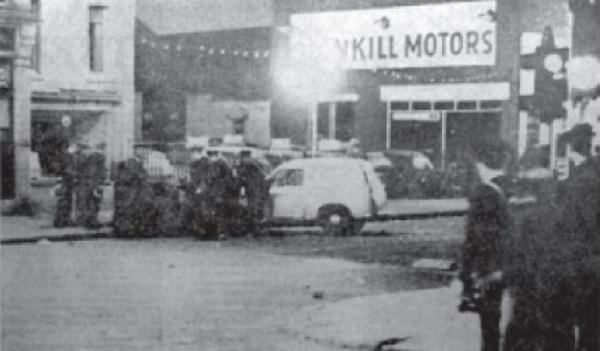

 While the EU may not have been a main actor to the Good Friday Agreement (GFA) or a party to it, and not seen at the time as particularly important to it, this does not thereby mean that Brexit and the creation of a hard border is unimportant.
 The Open Britain Campaign has
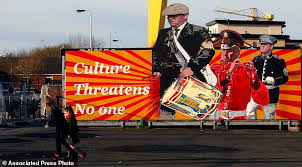 History has decisively proved that simple removal of Stormont did not entail a move to a united Ireland and that no such move was possible within the North itself. The downfall of Stormont left a strategic gap that was filled by IRA claims that it could drive the British out of Ireland by sheer will and its armed struggle.
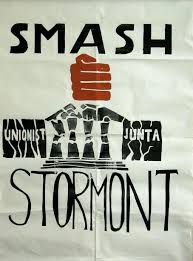 It is often argued in parts of the Irish and British left that the Northern Ireland state is irreformable. Not in the sense that all capitalist states cannot be reformed to become instruments of working class rule, but in the sense that it is irredeemably sectarian and can never become a ‘normal’ capitalist democracy in which religious division is not primary.