Karl Marx’s alternative to capitalism part 11 – crises and contradictions V

paris-communeWhen we consider the role of capitalist economic crises in the creation of a new society we are not short of guidance.  Capitalism has had so many crises that there have been innumerable opportunities to investigate just how such crises prompt or accelerate the socialist alternative.  In Ireland, the economic crash of 2008 destroyed the credibility of the main capitalist Party, Fianna Fail, whose Finance minister had hailed “the cheapest bail-out in the world” before it bankrupted the state and brought in the IMF, European Central Bank and European Commission to determine the state’s response to the crisis.

Yet this enormous crisis and exposure of the credibility of the economic and political system did not lead to any qualitative increase in the power of the Irish working class or of those political forces seeking to replace capitalism with socialism.  Indeed there appears to be a greater chance of more or less the same economic and political crises happening again, with an overheated property market, massive debt, and the working class responding only to the rhythms of the capitalist boom and bust, currently by attempting to make wage gains during the boom but without any perspective for the bust.

In this its short-sightedness is understandable and so is that of the left that claims to be far more far-seeing and which would claim that, like Marx, “in the movement of the present, they also represent and take care of the future of that movement.”

But only if the left learns that it must properly prepare for such crises and not simply await them, hoping that they push workers into its arms, will it have learnt something.  The experience of previous generations of socialists should be drawn upon to see what lessons must be learned.  It is clear that Marx himself learnt from crises and from the role they could play in ushering in or assisting workers’ revolution.

Even as a young man Marx understood the need for patience and preparation – “we must expose the old world to the full light of day and shape the new one in a positive way. The longer the time that events allow to thinking humanity for taking stock of its position, and to suffering mankind for mobilising its forces, the more perfect on entering the world will be the product that the present time bears in its womb.”

A few years later Engels made a similar observation:

Question 15: Do you intend to replace the existing social order by community of Property at one stroke?

Answer: We have no such intention. The development of the masses cannot he ordered by decree. It is determined by the development of the conditions in which these masses live, and therefore proceeds gradually.

The point is not that both Marx and Engels sought to delay revolution but that they understood its prerequisites.  At this time they believed that not all countries were ripe for social revolution, which would depend mainly on the fate of Britain.

Even in the democratic revolution in Germany in 1848 Marx was clear that revolution could not be decreed, even if certain lines of march could be advanced:

“We do not make the utopian demand that at the outset a united indivisible German republic should be proclaimed, but we ask the so-called Radical-Democratic Party not to confuse the starting-point of the struggle and of the revolutionary movement with the goal. Both German unity and the German constitution can result only from a movement in which the internal conflicts and the war with the East will play an equally decisive role. The final act of constitution cannot be decreed, it coincides with the movement we have to go through. It is therefore not a question of putting into practice this or that view, this or that political idea, but of understanding the course of development. The National Assembly has to take only such steps as are practicable in the first instance.”

Marx also believed that capitalist prosperity could rule out revolution, which could only come from crisis:

“Given this general prosperity, wherein the productive forces of bourgeois society are developing as luxuriantly as it is possible for them to do within bourgeois relationships, a real revolution is out of the question. Such a revolution is possible only in periods when both of these factors – the modern forces of production and the bourgeois forms of production – come into opposition with each other. . . . A new revolution is only a consequence of a new crisis. The one, however, is as sure to come as the other.”

But this does not mean that out of each and every crisis would come revolution and it is apparent that as he got older Marx became less sanguine about the impact of crisis itself as the harbinger of workers’ revolution.  The recent biographer Jonathan Sperber notes that “after the disappointment of his hopes of revolution to follow in the wake of the global recession of 1857, Marx rather downplayed the importance of crises for the end of capitalism.” (Karl Marx, a Nineteenth Century Life)

Marx was aware that revolution was not merely an exercise of will and might need decades for the working class to train itself for the exercise of power.  His attitude to the situation facing French workers in 1870 when the Prussian army had defeated France is instructive of his serious attitude to revolution and his understanding of the conditions for success.  He noted that in relation to the new French republican Government that “any attempt at upsetting the new Government in the present crisis, when the enemy is almost knocking at the doors of Paris, would be desperate folly.  . . . Let them calmly and resolutely improve the opportunities of Republican liberty, for the work of their own class organisation.”

Nevertheless, when French workers rose up and created the Paris Commune Marx leapt to its defence, explaining the attitude that all sincere socialists take when workers enter struggle: “World history,” he wrote, “would indeed be very easy to make, if the struggle were taken up only on condition of infallibly favourable chances.”  As Engels noted of the events in the 1848 revolutions:

“A well-contested defeat is a fact of as much revolutionary importance as an easily-won victory. The defeats of Paris in June, 1848, and of Vienna in October, certainly did far more in revolutionizing the minds of the people of these two cities than the victories of February and March. The Assembly and the people of Berlin would, probably have shared the fate of the two towns above-named; but they would have fallen gloriously, and would have left behind themselves, in the minds of the survivors, a wish of revenge which in revolutionary times is one of the highest incentives to energetic and passionate action. It is a matter of course that, in every struggle, he who takes up the gauntlet risks being beaten; but is that a reason why he should confess himself beaten, and submit to the yoke without drawing the sword?”

We cannot always pick our battles, but if we can we should, and it is on the basis of what we want that we should plan and prepare, what we should build for and base our politics on.  As Marx said of the First International:

“The political movement of the working class has as its object, of course, the conquest of political power for the working class, and for this it is naturally necessary that a previous organisation of the working class, itself arising from their economic struggles, should have been developed up to a certain point.”

“On the other hand, however, every movement in which the working class comes out as a class against the ruling classes and attempts to force them by pressure from without is a political movement. . . .  On the other hand the movement to force an eight-hour day, etc., law is a political movement. And in this way, out of the separate economic movements of the workers there grows up everywhere a political movement, that is to say a movement of the class, with the object of achieving its interests in a general form, in a form possessing a general social force of compulsion. If these movements presuppose a certain degree of previous organisation, they are themselves equally a means of the development of this organisation.”

“Where the working class is not yet far enough advanced in its organisation to undertake a decisive campaign against the collective power, i.e., the political power of the ruling classes, it must at any rate be trained for this by continual agitation against and a hostile attitude towards the policy of the ruling classes.”

In speaking of the results of the Paris Commune Marx noted that:

“The working class did not expect miracles from the Commune. They have no ready-made utopias to introduce par décret du peuple. They know that in order to work out their own emancipation, and along with it that higher form to which present society is irresistably tending by its own economical agencies, they will have to pass through long struggles, through a series of historic processes, transforming circumstances and men.”

dead-communards

It would be wrong to see this prognosis as out of date, made archaic and obsolete by almost 150 years of intervening history.  This is obviously not the case.  The working class of today is very different from that of the late 19th century, with the many struggles the latter gained consciousness from a matter of history and not lived experience.  In many ways it has to painfully learn lessons previously acquired through bitter and desperate struggle.  It has also to “pass through long struggles” and “through a series of historic processes” through which it will be transformed and be transforming.

In terms of economic and social development the objective grounds are today much more favourable across the world.  In terms of the social and political power of the working class, in many countries it is no more stronger now than it was 100 years ago or 50 years ago.  This is a glaring contradiction and it is one that requires explanation, although not only that.

As Marx famously said  “the philosophers have only interpreted the world, in various ways; the point is to change it.”  So it is not so much explanation as practical solution that is required, which necessitates increased organisation and heightened political consciousness.  Crises throw up the need for this and do not offer solutions but simply opportunities to face the challenges that either success or failure in developing this organisation and consciousness make workers more or less ready for.

In the next post I will look at a couple of Marxist contributions to this problem written in the late 1960s and mid-1970s.

Back to part 10

Forward to part 12


Karl Marx’s alternative to capitalism part 10 – crises and contradictions iV

aaeb3f49f0044521a0b0904c2599b84b_18In 1921 Leon Trotsky argued that “If the further development of productive forces was conceivable within the framework of bourgeois society, then revolution would generally be impossible. But since the further development of the productive forces within the framework of bourgeois society is inconceivable, the basic premise for the revolution is given.”
I will argue against this view but it should not be taken that by this Trotsky believed that any particular country had to have fully developed capitalism before socialist revolution could succeed because obviously his theory of permanent revolution argued precisely that this was not the case. The argument just presented is a view of the world taken as a whole and not any particular country.

In his view capitalism could break at its weakest link but this is not Marx’s theory of the transition to socialism.  For capitalism not only to break but be replaced by socialism it is necessary that capitalism be broken not where it is weakest but where the working class is strongest, and the two are not the same.

The view that the productive forces have to have exhausted themselves has been a default view of much of the Marxist movement since 1938 and the writing of the Transitional Programme, which was called ‘The Death Agony of capitalism and the tasks of the Fourth international’.  Adherence to this view means accepting that we have been living during a period of capitalism’s death agony for the past nearly 80 years.

It is this that justifies the view that objective conditions make the world ripe for socialism and that what faces socialists is a crisis of working class leadership. The task is simply to fight for leadership of the working class as it presents itself; its objective position and situation within society is relevant only in so far as it lends itself to gaining such leadership.  Since capitalist crises cannot be definitively solved by capitalism then such crises provide the opportunity for Marxists to win this leadership.

Those who have read earlier posts in this series will know that I reject the view that the productive forces of capitalism have stagnated.  This view was certainly challenged by the post Second World War economic upturn.  Crisis conditions in the 1970s and 1980s might have revived the view that capitalism was in long term crisis but the period since has seen huge economic growth.

Again the view that capitalism is in crisis might be bolstered by the financial crash in 2008 and the secular stagnation following it that has been posited by some writers but such crises do not amount to the long term crisis of capitalism suggested by Trotsky and secular stagnation has yet to be demonstrated.  If it were, it would still not amount to the long term crisis of capitalism that has been claimed, except that stagnation is not compatible with capitalism and if it existed it would create conditions of crisis.  

In previous posts I noted that capitalism had continued to develop the productive forces over the last century, including the expansion of the working class, its health and education and also its living standards.  Of course this does not mean that the next century will follow the pattern of the last.  This is as unlikely as the twentieth century following the pattern of the 19th, but it is at least necessary to appreciate what has already happened before thinking we are qualified for the much more hazardous task of speculating on what will happen in the future.

Incheon01

A recent article in ‘New Left Review’ notes that:

“Our available economic resources are greater than ever before. Between 1980 and 2011 world GDP per capita (in constant prices and purchasing power parities) increased 1.8 times, the IMF reports. As a comparison, we may remember that between year 1 and 1820 global product per capita is estimated to have increased 1.4 times, and from 1870 to 1913 1.7 times. More reliable are figures for 1950–73, 1.9, and for 1973–2003, 1.6.”

In his book ‘Postcapitalism a Guide to Our Future’ Paul Mason quotes figures that show global GDP per person rising by 162 per cent between 1989 and 2012 and in the developing world by 404 per cent.  It rose by ‘only’ 33 per cent in the 100 years after the ‘discovery’ of the Americas and by 60 per cent in the fifty years after 1820.

Of course, this is not to deny the growth of inequality and ecological threat arising from the capitalist nature of such growth, how could it be otherwise?  Paul Mason notes that while the real incomes of two thirds of the world’s people rose significantly, as did that of the top 1%, the majority of people in America, Japan and Europe had no real increase and some a decline.  As the article in New Left Review notes:

“Furthermore, the conventional norm of progress obscures the unequal distribution of its opportunities. Almost half, 46 per cent, of the world’s income growth between 1988 and 2011 was appropriated by the richest tenth of humanity.  In the US, since the late 1990s, there has been a progressive decoupling of GDP per capita—advancing with short-lived fallbacks—and the family income of four-fifths of the population, which has been stagnating and recently declining, above all from the median and below. The spread of the Anglo-American financial crisis of 2008 has meant a substantial decline in the income share of the bottom 40 per cent in the recession-hit European countries, from Greece and Ireland to the UK and Spain.”

One Marxist[i] makes a persuasive case that the official figures underestimate the growth of specifically capitalist production because they ignore the conversion of the Stalinist states to a new economic system.  These figures treat the production in these states prior to the introduction of capitalism as if it were already capitalist but this ignores the boost to specifically capitalist production of the acquisition of productive forces on the cheap and the availability of huge pools of labour power that can now be exploited to further the accumulation of capital:

“In 1991 the centrally planned economies had a population that was 35 percent of that in the market capitalist economies. The restoration of capitalism in them massively increased the world’s working class that could be exploited by capital, while at the same time the world’s capitalists paid almost nothing to privatize the assets of entire economies. . . .By 2006 China, now the second largest capitalist economy in the world, employed 112 million industrial workers (Bannister 2009), not including millions more in the former USSR and CEE.”

“During the 1990s capitalist production of electricity rose 44 percent, aluminium 45 percent, hydraulic cement 60 percent, steel 39 percent, automobiles 21 percent, and GDP 42 percent, with the rate of increase accelerating the decade after. This is particularly significant as this period extends to 2010 and so includes the period of the credit crunch recession after 2008. The growth of output in the emerging markets has been combined with the accelerated decline of industrial output in the West, but this is a transfer of production, not its disappearance. By 2010 the transition economies as a proportion of total capitalist production produced 29 percent electricity, 52 percent aluminium, 65 percent hydraulic cement, 53 percent steel, 30 percent automobiles, and 26 percent of GDP.”

It is hardly credible that the objective and subjective conditions for socialism could be bifurcated for so long – that the problem is simply one of mis-leadership – while the social and political power of the capitalist class over the working class, effected by the enormous development of capitalism, reflected also in the ideological hold of the former over the latter, can be considered a secondary matter.

That this continuing subordination of workers by capitalism for decades, without challenge in any fundamental respect, could be considered not to have affected the consciousness of new generations of workers, were it true, would prove Marxism false.  The idea that the fundamental problem is simply one of working class leadership is not credible.

Marxists are always keen to assert that they do not seek crises and do not welcome the attacks on workers which large crises inevitably result in, including unemployment, wage cuts and attacks on workers’ democratic rights to organise.  But if crises do provide the opportunity to replace capitalism, and the grounds for socialism already exist, then this would be something of a puzzle.

In part we have already noted the answer – that crises openly express capitalism’s contradictions and posit the need for an alternative.  However, it matters not whether socialists wish or do not wish for crises, capitalism will see to it that they erupt anyway.  It is not workers who create economic crises but the contradictions of the system itself.

Socialists do not welcome crises in themselves because they become opportunities to overthrow capitalism only under certain conditions.  Since capitalism has had many crises and we do not have socialism we can infer that these conditions are rather restrictive, or have been so far.  Is there anything in Marx’s alternative that explains why this has been the case and therefore what might we change to address our failures so far?

An answer to this means going beyond seeing capitalist crises as simply the opportunity to overthrow capitalism without understanding what makes them such an opportunity, as opposed to an opportunity for capitalism to resolve its contradictions at workers’ expense.  The answer does not lie in the illusion that capitalism is a system in permanent crisis or is in an epoch of revolution. Crises there have been and even revolutions but clearly this hasn’t been enough for Marx’s alternative to have flowered.

The last 100 years has witnessed many revolutions.  The most important at the beginning of the last century were carried out under the banner of socialist revolution but they nearly all failed very quickly.  Later revolutions that destroyed capitalism did not usher in socialism or even societies controlled by workers taking decisive steps towards socialism.   The belief was widespread that socialist revolutions would be complemented by national liberation struggles which would lead to democratic revolutions, but again there were numerous democratic revolutions, few overthrew capitalism and none of them brought about socialism.

Since the decline of such struggles the most important revolutions have involved the overthrow of Stalinism and the concomitant reintroduction of capitalism while the Arab Spring has not resulted in any fundamental reordering of society, except in the sense that in some societies it has led to their disordering and collapse.

There have been plenty of revolutions but the changes have been mainly one of political regimes without fundamental changes to class rule, at least in the sense of the working class ruling society.  Such glimpses of a new worker-controlled society have been brief and fleeting.

Marx’s prognostication was that “the bourgeoisie cannot exist without constantly revolutionising the instruments of production, and thereby the relations of production, and with them the whole relations of society. Conservation of the old modes of production in unaltered form, was, on the contrary, the first condition of existence for all earlier industrial classes. Constant revolutionising of production, uninterrupted disturbance of all social conditions, everlasting uncertainty and agitation distinguish the bourgeois epoch from all earlier ones.” 

The history of modern revolutions is testimony to this.  The absence of working class revolution is not.  Ironically, if you seek to reduce Marxism to a task of resolving a crisis of leadership you weaken its explanatory power, its guide to political intervention and its appeal.

Marx was aware that sometimes decades of political development are necessary for a working class to make itself capable of ruling society.  This is true now for reasons that Marx could not be fully aware of.  What he did do however was provide analyses of capitalism that may help socialists appreciate why we have failed so far.

[i] On the Alleged Stagnation of Capitalism, William Jefferies, available on the net.

Back to part 9

Forward to part 11

Karl Marx’s alternative to capitalism – part 9 crises and contradictions iii

economic crisisCapitalism’s crises are the expression of its contradictions, among which must be those that provide grounds for resolution through working class creation of a socialist society.  While the absence of crisis at any time does not mean that the system’s contradictions have been removed, it signals that they must at least have been temporarily contained or limited while continuing to develop, without erupting into violent disruptions of the system. Marx reacted to the return to some sort of prosperity following a crisis as a signal that socialist revolution was for the time being off the agenda.
For capitalism the eruption of economic crisis is also the means by which the contradictions of capitalist accumulation are (temporarily) resolved, by reducing the costs of raw materials and machinery etc.; destroying competitors by making the least efficient firms go bust; increasing unemployment, so putting pressure on workers to increase the pace of work and reducing wages; and by prompting the state to lower legal protections for workers or lower corporate taxes etc.

Only in a crisis does it seem obvious that capitalism is unable to cater for the needs of the majority, and to a degree that stimulates mass resistance and opposition, so what then may result is a political crisis of its rule.  There is less reason to expect the working class and other oppressed parts of society to seek an alternative to the system if it is not in some sort of difficulty.

On the other hand if workers are not prepared to react to crises by defending gains and can’t be radicalised sufficiently to achieve overthrow of the system, or have the social and economic power to do so, then socialists must accept that the limits placed on the scope of working class action at such times do not yet include the system’s overthrow.

While economic and political crises signal the possibility of an alternative and a possible opportunity to create one there is no longer a view that they point to the inevitable triumph of socialism.  Crises can awaken workers to politics, can propel them to political organisation, push them to fight and make them seek out alternatives but if this is true of the vast majority and such development only takes place on the eve of revolution then it is only a minority who enter the fight with some idea of what that fight is, about how it might be won and what constitutes victory.  These are rather weak grounds on which to expect success.

As I noted in the last post – what attitude workers take to crises, how they understand them, who they blame and what solutions they seek are strongly conditioned by their previous experience prior to and outside capitalism’s difficulties.  This strongly determines the outcome of crises

“There are no permanent crises” Marx said, which means that such crises in themselves cannot be the grounds for socialism since these grounds must be continuous and persistent conditions within the capitalist system.  Crises therefore cannot be confused with the contradictions of capitalism that provide the source for anticipating its replacement.

So if not permanent crises, is it the nature of the stage of capitalism that warrants the claim that the possibility of socialism exists, as Marx claimed.  It would appear that for the majority of Marxists the answer is yes: we have been living within the highest stage of capitalism for the last one hundred or more years, set out most famously by Lenin in his short book – ‘Imperialism, the highest stage of capitalism’.

Further to this, the other Marxist leader of the Russian revolution wrote a political programme for his supporters in 1938 in which he clearly characterised the nature of the epoch during which he lived:

“The economic prerequisite for the proletarian revolution has already in general achieved the highest point of fruition that can be reached under capitalism. Mankind’s productive forces stagnate. Already new inventions and improvements fail to raise the level of material wealth. Conjunctural crises under the conditions of the social crisis of the whole capitalist system inflict ever heavier deprivations and sufferings upon the masses. Growing unemployment, in its turn, deepens the financial crisis of the state and undermines the unstable monetary systems. Democratic regimes, as well as fascist, stagger on from one bankruptcy to another.”

“All talk to the effect that historical conditions have not yet “ripened” for socialism is the product of ignorance or conscious deception. The objective prerequisites for the proletarian revolution have not only “ripened”; they have begun to get somewhat rotten. Without a socialist revolution, in the next historical period at that, a catastrophe threatens the whole culture of mankind. The turn is now to the proletariat, i.e., chiefly to its revolutionary vanguard. The historical crisis of mankind is reduced to the crisis of the revolutionary leadership.”

This political programme, The Transitional Programme, became the guiding strategy for those Marxists who rejected the distortion of socialism by Stalinism in the Soviet Union and who stood in the revolutionary tradition of Marx.

The view that socialism was retarded not so much by capitalism itself, or the political forces that defended it, but by other factors can easily be appreciated in a world in which the most powerful forces claiming to be Marxist ruled over vast parts of the globe. In these countries workers held no political power except through a bureaucracy that ruled in its name and unilaterally claimed to be its leadership.  As long as this was the case the struggle for genuine socialism had to counter the claims of Stalinism that the degenerate bureaucratic dictatorships in the Soviet Union and Eastern Europe were the future socialist society which Marx foresaw.  In this sense, the view that the crisis facing socialists boiled down to who was able to claim the mantle of leadership might seem to have not a little currency; if only because if Stalinism was socialism then the majority of workers and many Marxists weren’t interested.

Trotsky’s predictions of catastrophe should also be viewed in light of the headlong march towards world war, a war that would exceed the death and destruction of the Great War that had ended only twenty years before.  In fact this second world war had already begun with already catastrophic results for the Chinese people.  When we consider that the possible number of deaths due to World War II is as high as 80 million people it is no exaggeration to have stated in 1938 that “a catastrophe threatens the whole culture of mankind.”

What matters today is whether the context in which this happened now prevails, or has prevailed ever since it was written in 1938; in other words that “the economic prerequisite for the proletarian revolution has already in general achieved the highest point of fruition that can be reached under capitalism.”

If this were so then the series of posts of which this one is a part, dealing with Marx’s alternative to capitalism growing out of capitalism itself, would have little need to go beyond a political analysis of the class struggle and specifically how and why the working class still allows itself to be politically led by political forces opposed to the revolutionary overthrow of capitalism.

to be continued

Back to part 8

Forward to part 10

Karl Marx’s alternative to capitalism part 8 – crises and contradictions ii

A view common among Marxists is that socialism will arise out of a crisis of capitalism.  This is believed for a number of reasons.  The most fundamental is the view that socialism will arise from the contradictions of capitalism and these contradictions give rise to repeated crises; crises of overproduction, of profitability and of class relations.  Economic and political crises point to the inevitable triumph of socialism as every such capitalist difficulty signals the possibility of an alternative and the opportunity to create one.

A more common sense way of understanding it is that if capitalism continued to deliver the goods then why would anyone fight to change it?

These contradictions include the contradiction between capital and labour in which capital accumulates and grows through augmenting itself with the value created by labour for which labour is not remunerated in wages.  These contradictions also include the tendency for the development of the forces of production to conflict with the relations of production within which they develop.  The productive forces of machinery, technology and other means of production and productive relations determined by the ownership of these means of production by capitalists and the exclusion from ownership of those who create and work with these means of production, the working class.

The contradictions are the tension between the more and more effective socialisation of production and its private capitalist appropriation. Production is more and more subject to a division of labour with hundreds if not thousands of components produced and shipped from all over the world before final assembly in one location.  This final product such as a computer can then join thousands of other products in creation of another final product such as a car.  The workers who produce this final product likewise consume commodities created from all across the world which are themselves assembled from products created across the globe.  A vast meshed network of companies, of communications and transport has been created by capitalism that requires an enormous degree of co-ordination and planning by millions of workers to ensure this all takes place, and takes place profitably.

Yet this production is sold on a market in competition with other similar products from other companies or in competition with very different goods that could equally be bought instead.  Only after the fact is it recognised whether the labour employed in producing these goods has been wasted.  If the prices obtained for them do not result in sufficient profit the capitalists will close down, reducing production and reducing the market for goods generally as workers are laid off and supplier companies equally reduce employment.  If this happens on a big enough scale economic crises result.

Were imbalances in production to arise in an economy under workers’ collective ownership this production would be rebalanced without making workers suffer for any misallocation.  It would be in the interest of everyone to reallocate this labour to produce goods or services for which there is more need.  With capitalist appropriation however, despite the socialised nature of production, despite the enormous cooperation and scale of planning required, it is only the private profit of individual capitalist companies that counts.  And if this means closing down productive assets, wasting resources and creating unemployment well . . production is only for profit under capitalism.  It is competition not cooperation which predominates, competition between companies for sales of commodities and competition between companies to extract the maximum surplus from their own and other workers.

For Marxists this global economic result arises from the very nature of the commodity itself and its simultaneous existence as a use value and as a value.  As a commodity it must have usefulness for it to be purchased by anyone but it must also have a value that can be exchanged with other commodities and money.  At the end of the day it is the value in exchange that matters for the capitalist because it is from this aspect of the commodity that profit is derived.

A more common way of describing this is that production is for profit and not for use; commodities are produced only in so far as they procure a profit but which are only purchased in so far as they are useful.  Goods and services are produced which are profitable but which only a tiny minority of the world’s population find useful while goods useful to millions are not produced because they are not profitable.

The craziness of this has been on display in Ireland, which has had an enormous economic boom largely built in its last years upon housing and other property production. A boom that eventually turned to bust not because everyone had a decent home, or the commercial fabric of society had been completely renovated, but because the prices demanded by developers and construction firms could no longer be afforded by those expected to buy or rent. Prices collapsed, building firms went bust sacking tens of thousands of construction workers; developers went bankrupt, their loans could not be paid and the banks that lent them the money then also went bust, unable to remain solvent given the scale of the bad loans on their books.

The capitalist State then stepped in to assure the banks’ solvency by guaranteeing their loans and when it was proved that it could not afford to do so it too went bust; so the European Commission, European Central Bank and the International Monetary Fund also stepped in to ensure that the State could make good its guarantees to the banks – in exchange for the State cutting the tripe out of state services, increasing taxes, lowering public sector wages and reducing public sector employment.  The State survived all this by spreading its debts across the generations so that even in 2050 the children and grandchildren of the boom generation will be paying for the boom and the bust.

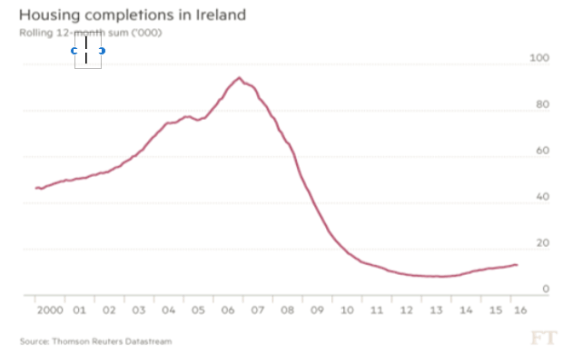
At the peak of the boom 90,000 houses a year were being built by employing around 274,000 workers. Last year fewer than 13,000 new homes were built while demand is running at 25,000 a year.  There are over 1,000 families homeless compared to 400 at the beginning of last year while there are an estimated 90,000 families on waiting lists for social housing.  But this is happening in a country that has 230,000 vacant homes, some in “ghost estates” in far-flung towns where few Irish people now wish to live — if they ever did.

This is reported in Ireland and elsewhere as if this was a peculiarly Irish problem, but not only have there been property booms across the world but housing and property booms are only the most visible manifestations of classic crises of overproduction that have been a feature of capitalism for almost two centuries.  Visible because the commodities overproduced sit there staring everyone in the face for years.  This is not an Irish problem, although it has to be said that the Irish are very good at doing it with houses, but is a classic capitalist problem of desperate need not being addressed because to do so would not deliver the requisite profit.

housing 1
It has been reported by the Society of Chartered Surveyors in Ireland that it costs €330,000 to provide a standard family home, a figure that appears to have changed little despite the deep recession!  Construction costs account for less than half of this figure with the rest made up of fees, levies, site acquisition costs, finance costs, and tax and profit margins.  Developers would rather hoard land they over-paid for in the boom because to do otherwise would mean them accepting a loss.  This would then hit the banks who everyone is pretending are now fine and no one wants a repeat of the 2008 crash.  So the process of the previous boom and bust is repeated for the sake of avoiding another one.
Housing 3

But very few people can afford houses at these prices and single people and those on even average incomes can’t afford them and would drown in a sea of debt if, or rather when, interest rates increase (although of course no one is thinking of this now). Instead the solutions put forward by the Government include grants to first time buyers, which will simply increase prices by the amount of the grant, or subsidies to developers, who will probably pocket the money while maintaining their asking price.  In short, the same policies pursued during the boom.  As the table below shows the huge debt already built up is a big constraint on any solution that seeks to stuff working class people with even more credit.

Housing 2

The solution is to build affordable houses by expropriating the land holdings of developers and re-employing many of the construction workers who were made unemployed in the crash.  However, this calls for a radical break with the prerogatives of private property which is a more entrenched religion in Ireland than theCatholic Church.

From the point of view of our look at Karl Marx’s alternative to this sort of mess there is another striking question that arises.  Just how do such crises lead to replacement of the system that produces them with a new one called socialism?

Yes, capitalism leads to these crises and yes, they would not arise within a socialist society, but what is the mechanism by which this contradiction leads from the former to the latter? What leads workers from recognising there’s a crisis to understanding that it’s a result of capitalism and agreeing that socialism is the answer, and then fighting to introduce it?  All while their starting point is not so much a very conscious rejection of socialism so much as a recognition/acceptance of capitalism because it is the system that actually exists, works (however badly) and places them in a subordinate position within which, by and large, they are powerless to effect very radical change, either as individuals or even as individuals that are part of collective organisations.

A lack of understanding of what socialism actually is and little confidence that the world can be changed, or that they must do it themselves, are not even the first condition of this problem but the result of the more basic conditions within which workers live.  Is there a contradiction at this more basic level of workers’ everyday lives that can provide the experience that they can learn from either directly or indirectly; that capitalism does not have to be accepted and that an alternative can actually exist, already exists even if in an underdeveloped form that must be developed further?

In all this it is clearly the development of political consciousness that is key.  Only through its development will workers become active makers of their own future, seeking greater and greater control over their lives and thus greater and greater control over society.  But Marxists believe that it is material conditions that generate consciousness and it is not at all clear that conditions of crisis can generate socialist consciousness.  They have not done so in Ireland.  Some of the first posts on this blog were a record of how previous capitalist crises generated reactionary solutions and the growth of xenophobic and racist solutions today are testament to this.

Marxists do not believe that the rational superiority of socialism on its own will lead to socialism.  Or rather, to be more precise, Marxists do not believe that rational argument about the superiority of socialism over capitalism will bring it about.  It plays a vital part in the work of socialists in the workers’ movement but rational argument is ultimately only powerful if it corresponds to the rational development of capitalism itself.

If capitalism tended more and more to a state antithetical to socialism, to a position that was further and further away from the possibility of collective workers’ ownership of the means of production, then ultimately no amount of rational argument about the putative superiority of socialism would matter because it could not arise in the real world. And if it could not arise in the real world the argument as to its superiority would not be rational either. A world built on unqualified love between all members of humanity may appear a rational argument, as opposed to the hate and oppression of the existing one, but it is not rational because we all know such a society cannot exist.

Crises are ephemeral, they are the means by which capitalism resolves its contradictions, even if only temporarily. They generally weaken the working class and its movement and they often present opportunities to disorient them.  They invite immediate solutions when many workers generally experience capitalism as individuals or are not grouped in organisations that are by their nature capable of providing answers.  What attitude workers take to crises, how they understand them, who they blame and what solutions they seek are strongly conditioned by their previous experience prior to and outside capitalism’s difficulties.  Generally this experience does not prepare them for taking conscious control of society, which is the essential challenge posed by the greatest crises.

Capitalist crises therefore give expression to the contradictions of capitalism but are not themselves the contradictions upon which the alternative higher form of society will arise.  History is replete with subordinate classes’ willingness to fight against their oppressor classes, such as the countless rebellions by Chinese peasants against their ruling dynasties or medieval peasants against their feudal lords.  But even when the contradictions involved in their class antagonism burst through in successful rebellion no stable society was created by these victorious oppressed class because the class contradiction evoked no mode of production resting on the unified class interests of the victorious class.

Even when the class of feudal lords disappeared from history it was not a peasant mode of production that was eventually built on the bones of their feudal rule.  Similarly, when the working class in Russia succeeded in overthrowing the Tsarist state and the capitalist economy in Russia it failed to create a new socialist society because the material conditions would not allow a new socialist mode of production to grow and develop.

So basing the alternative to capitalism on the crises of capitalism is not enough.  Developing consciousness of the need for an alternative is not even enough.  The contradictions that exist must contain within them the potential for a new socialist society to arise out of them.  In other words, it is not enough that there is contradiction but that the contradiction is resolved, in this case in a new and higher form of society.  And for this to be the case the nature of the contradiction has to contain the potential for this to occur.

It is not that the contradiction creates a clean slate upon which something new can be built but that the new arises from within the development of the contradiction itself.  Clearly the nature of this is therefore key, for its development must not only contain the end of the old but the beginning of the new at one and the same time.  Consciousness by the working class of the necessity for a new society is necessary for it to happen because it must be its creation but this is only possible if the process exists in reality.

Back to part 7

Forward to part 9

Karl Marx’s alternative to capitalism part 7 – crises and contradictions i

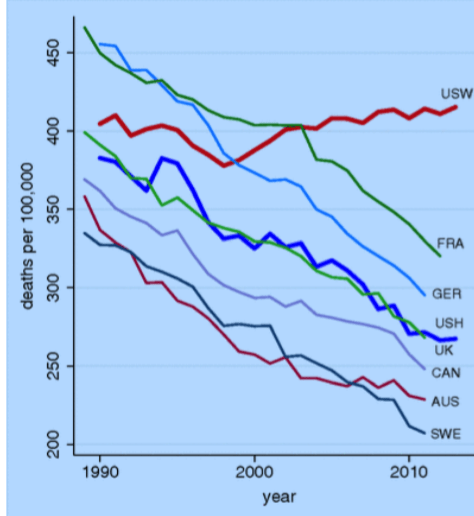
white-america-1-e1448033371744Last year an academic paper noticed that there has been a marked increase in mortality among white middle aged men and women in the United States between 1999 and 2013.  The effect of this has been dramatic: if the previous decline in mortality among this group of people had continued as before there would have been almost half a million fewer deaths during these years.

There has also been an increase in morbidity among this section of the population, reflected in increased self-reporting of poor health, pain and psychological stress.  Nor can this be put down to the well-known increase in obesity among some sections of the American population because this decline in the health of middle-aged men and women has affected both the obese and non-obese, with the former accounting for only a small fraction of the overall deterioration in health.  This worsening has particularly hit those with a poorer education, those with only a high school degree or less, and is primarily the result of increases in the rates of suicide, drug and alcohol poisoning and chronic liver disease and cirrhosis.

fd2a8a276c172deed75f43e23ef7b229The significance of this is even more noteworthy because this segment of the US working class was part of the embodiment in the middle of the twentieth century of the American dream and therefore of the capitalist vision epitomised during the American century.  Visions of white families in suburbs, owning automobiles and domestic appliances, in new homes with pretty gardens and white picket fences were a domestic ambition so strong it fired the imagination not only of American workers but millions of the poor across the world who wished to become American.  An ambition millions succeeded in achieving.
In the twenty first century this dream is collapsing amid widening inequality, stagnant wages, deindustrialisation and an increase in economic insecurity, with precarious employment and pensions reliant on the vagaries of the stock market.  It is reflected in large increases in disability; falling participation in the labour market, particularly among women and addiction to prescription painkillers where for every death in 2008 due to addiction there were 10 admissions for abuse, 32 emergency department visits, 130 people who were abusers or dependent and 825 non-medical users of the drugs.

I remember seeing a programme on the collapse of the Soviet Union which noted that a French researcher had predicted its fall due to an increase in infant mortality.  No one is predicting the collapse of US capitalism but things are really bad when people stop living longer and start dying earlier.

In my previous posts in this series on Marx’s alternative to capitalism I have noted the prodigious development of the capitalist system across the globe and its achievement of what Marx called its ‘civilising mission’.  This, I showed, was evidenced by increasing life expectancy, better health, higher levels of education, higher living standards and the sheer increase in numbers of the working class and the world’s population. In fact five out of six of my posts were an attempt to substantiate the argument that the civilising mission of capitalism continues into the twenty first century.

But surely this is now blown apart by this example of the death of the American dream, something inconceivable 60 years ago?

A few years ago I met an American socialist who I believe was from Detroit who was not so much arguing but simply incredulous that anyone could believe other than that capitalism was in crisis and failing badly

But world capitalism is not Detroit.

Accepting this point however, is it not the case that socialists should be pointing out the failures of capitalism, its crises and its contradictions?  After all, if capitalism is to be overthrown and replaced it must be because in some way it has failed.  Surely a capitalism that keeps on developing and retains a ‘civilising mission’ is not one that will suffer this fate? 

Should socialists not criticise capitalism and certainly not heap praise on it and its achievements?

Marx himself, although he praised capitalism’s prodigious development of the productive forces and the human capacities it had unleashed, hardly spared it his condemnation. Development brings industrialisation and the goods and services that change peoples’ lives for the better but it is built on exploitation of humanity and degradation of the planet’s resources and ecosystem.  Capitalist industrialisation brings the capitalist phenomenon of periodic or partial unemployment on a massive scale – “it makes an accumulation of misery a necessary condition, corresponding to the accumulation of wealth.” (Marx)

So the International Labour Organisation estimated that there were 218 million unemployed workers in 2009 and that of the 1.4 billion wage workers in 2011 many are only employed part time or precariously employed and a further 1.7 billion are “vulnerably employed”, being “own-account” workers (including street workers in poorer countries or those engaged in subsistence agriculture) and “contributing family workers” (those who worked unpaid in the home).  “In most of the world, open unemployment is not an option; there is no safety net of unemployment compensation and other social welfare programmes.  Unemployment means death, so people must find work, no matter how onerous the conditions” (Michael Yates, all quoted in ‘The Global Reserve Army of Labour and the New Imperialism’)

So why the series of posts on capitalism’s ‘civilising mission’?

The short answer is that the arguments set out above are mistaken.  The slightly longer answer is that they are wrong because they are one-sided.  The longer response again is that the whole answer is not simply an addition of capitalism’s achievements and its failures, of its successes and crises, or more simply of its good bits and its bad bits.  Even to understand its contradictions is not to think of a good side and a bad side in opposition.

To seek simply to condemn capitalism requires a standard by which it should be judged to have failed – it must have failed against some criteria.  Even if there were ‘good bits’ to capitalism to weigh in the balance against its ‘bad bits’, which together would allow one to make a judgement, some measuring criteria would be required by which to determine the relative weight and importance of its good and bad aspects.

But what would these criteria be?  They could be derived from what capitalism itself claims to defend, uphold and promote – economic growth, political equality, equality of opportunity, individual freedom, efficiency, modernisation and progress.  It would then be possible to, indeed socialist regularly do, expose these claims as hypocritical, false, misleading, one-sided and often simply untrue.  But this would be to limit one’s case to the criteria that capitalism’s defenders themselves identify as important and socialists usually find themselves making arguments that go beyond what capitalism can accommodate and what its supporters will consider legitimate.

Appeals to loftier ideals such as justice or fairness beg the question of how such things are to be defined and how realistic or practical any definition is, given the real world we live in.  A definition of justice that cannot possibly exist in the real world is not just because these criteria must apply to a world which is possible.  A just and fair world that cannot exist is neither just nor fair.  The civilising mission of capitalism is therefore not one of the ‘good’ sides of capitalism against which the bad must be weighed.  This civilising role of capitalism is itself grounds on which the alternative to capitalism rests.

I have tried to make this easier to appreciate by pointing out that the amazing economic growth of capitalism has produced an ever larger world working class without which, obviously, there can be no socialism.  And without a working class that has developed a relatively high cultural level we cannot expect socialism either.  The civilising mission of capitalism has created both.

This is generally understood among some Marxists only in the sense that unless the productive forces have developed sufficiently there will not be the level of resources necessary to ensure that inequality will not breed class divisions after any successful socialist revolution.  If society cannot develop sufficient levels of consumption to satisfy the needs of everyone then class divisions will re-emerge.  Society’s productive powers will be distributed so that these are owned by a separate class because society as a whole cannot address the needs of everyone. 

Leon Trotsky explained how this laid the foundation for the development of Stalinism after socialist revolution in Russia in 1917:

“The basis of bureaucratic rule is the poverty of society in objects of consumption, with the resulting struggle of each against all. When there is enough goods in a store, the purchasers can come whenever they want to. When there is little goods, the purchasers are compelled to stand in line. When the lines are very long, it is necessary to appoint a policeman to keep order. Such is the starting point of the power of the Soviet bureaucracy. It “knows” who is to get something and who has to wait.

A raising of the material and cultural level ought, at first glance, to lessen the necessity of privileges, narrow the sphere of application of “bourgeois law”, and thereby undermine the standing ground of its defenders, the bureaucracy. In reality the opposite thing has happened: the growth of the productive forces has been so far accompanied by an extreme development of all forms of inequality, privilege and advantage, and therewith of bureaucratism. That too is not accidental.

In its first period, the Soviet regime was undoubtedly far more equalitarian and less bureaucratic than now. But that was an equality of general poverty. The resources of the country were so scant that there was no opportunity to separate out from the masses of the population any broad privileged strata. At the same time the “equalizing” character of wages, destroying personal interestedness, became a brake upon the development of the productive forces. Soviet economy had to lift itself from its poverty to a somewhat higher level before fat deposits of privilege became possible. The present state of production is still far from guaranteeing all necessities to everybody. But it is already adequate to give significant privileges to a minority, and convert inequality into a whip for the spurring on of the majority. That is the first reason why the growth of production has so far strengthened not the socialist, but the bourgeois features of the state.” (The Revolution Betrayed)

So there are two reasons why socialists in particular should welcome the development of the productive forces that capitalism is responsible for – the material foundations for socialism in terms of sufficient consumption for everyone in society and the growth of the working class that develops as these productive forces develop.

To these are added the civilising mission of capitalism through the productive forces developing new and higher needs that lead to a higher cultural level among the working class, on which basis it becomes more and more fit to become the ruling class of a new society.

The development of the productive forces must also be welcomed for other reasons which we shall come to in future posts.  What is important for the argument here is that the development of capitalism’s productive forces is necessary for the future of socialism.  As Marx explained in a letter written two years before his death:

“The doctrinaire and necessarily fantastic anticipations of the programme of action for a revolution of the future only divert us from the struggle of the present.  . . . Scientific insight into the inevitable disintegration of the dominant order of society continually proceeding before our eyes, and the ever-growing passion into which the masses are scourged by the old ghosts of government – while at the same time the positive development of the means of production advances with gigantic strides – all this is a sufficient guarantee that with the moment of the outbreak of a real proletarian revolution there will also be given the conditions (though these are certain not to be idyllic) of its next immediate modus operandi [form of action].”

In this quote Marx does not seek to place class struggle and the development of the productive forces, which can only mean the development of capitalism, as opposites but welcomes both as positive factors leading to socialist revolution.  Yet many socialists cannot think how the development of capitalism assists its eventual overthrow and can only conceive that capitalism must be in perpetual crisis, feeling that without this not only is there no prospect for socialism but no rationale for it either.  But if this were true then the prodigious development of capitalism over the last two centuries or so would have proved the advent of socialism impossible.

It is enough to recognise that such a viewpoint, which leads to denying capitalism’s continuing growth, divorces socialists from some of the concerns of workers who experience its reality, its ‘good’ and ‘bad’ sides, without ideological blinkers. If it were indeed true that only capitalism’s failures or crises were grounds for socialism then we would have to recognise that those grounds are not enough.

So, the marked increase in mortality among white middle aged men and women in the United States between 1999 and 2013 is all the more remarkable because it contrasts sharply with the experience of other demographic groups.  Mortality declines among Hispanics and black non-Hispanics continued to decline, as they did for this segment of the population in France, Germany, UK, Canada, Australia and Sweden.

mortality

All-cause mortality, ages 45–54 for US White non-Hispanics (USW), US Hispanics (USH), and six comparison countries: France (FRA), Germany (GER), the United Kingdom (UK), Canada (CAN), Australia (AUS), and Sweden (SWE).

Back to Part 6

Forward to Part 8

Does capitalism still have a civilising mission? Marx’s alternative – part 4

huajian-shoe-factoryIn the last post on Marx’s alternative to capitalism I noted that he extolled the achievements of capitalism, without which socialism could not be built.  In the Grundrisse he noted “the great civilizing influence of capital; its production of a stage of society in comparison to which all earlier ones appear as mere local developments of humanity and as nature-idolatry.”

This is very far from the attitude of most Marxists today, who have a tendency to see crisis and decline everywhere.

Perhaps, as might be implied from the quote above, the progressiveness of capitalism is only in relation to previous society, and that today it is a wholly reactionary system from which no development is possible or at least none with any progressive features.  Its replacement must therefore arise from its contradictions and crisis and not from any progressive element within it.

The days of the progressive development of capitalism are over.

The Communist Manifesto is famous for its paean of praise to the wonders of capitalist achievements, and this at a time when capitalism hardy existed on most of the globe – “It has been the first to show what man’s activity can bring about. It has accomplished wonders far surpassing Egyptian pyramids, Roman aqueducts, and Gothic cathedrals; it has conducted expeditions that put in the shade all former Exoduses of nations and crusades . . . The bourgeoisie, during its rule of scarce one hundred years, has created more massive and more colossal productive forces than have all preceding generations together. ”

But perhaps again this praise is purely relative to earlier epochs.  Capitalism has exhausted any progressive content it once may have had.  After all, didn’t Lenin refer to the highest stage of capitalism and did Trotsky not say that:

“the economic prerequisite for the proletarian revolution has already in general achieved the highest point of fruition that can be reached under capitalism. Mankind’s productive forces stagnate. Already new inventions and improvements fail to raise the level of material wealth . . . The objective prerequisites for the proletarian revolution have not only “ripened”; they have begun to get somewhat rotten. Without a socialist revolution, in the next historical period at that, a catastrophe threatens the whole culture of mankind.”

That catastrophe did of course arrive in the shape of the Second World War and the potential for catastrophe undoubtedly continues to exist within capitalism today.  The decline of the United States and the rise of new powers once again raise the spectre of economic competition that may drive rival nation states into war.

A couple of weeks ago I was reading the Guardian review of books and a review of a book by the BBC correspondent Mark Urban, who argued that new powers are developing conventional forces that can begin to rival those of the US. This means that in any conventional conflict the US may be tempted or driven to use nuclear weapons.  It’s not as if they haven’t used them before.

“Now, says Urban, Russia, China and India have such strong conventional forces, and America has cut its forces so much, that in the event of a conflict “the US would be left with the choice of nuclear escalation or backing down”.  He adds: “Against a full-scale invasion of South Korea, the US would have little choice but to go nuclear.” Russia, China, India, Israel, Pakistan, North Korea and some other countries could “mount a credible conventional defence that would leave the United States having to think the unthinkable, with profound implications for the world”.”

While there is a lot more to say about such a scenario the point is that under capitalism humanity has no rational control of its own development and no guarantee against the most irrational acts leading to its destruction.

However the view noted above – that capitalism can no longer be viewed in fundamentally the same way as Marx did in the 19th century is mistaken.

Straight after noting capitalism’s wonders far surpassing the Egyptian pyramids, Roman aqueducts and Gothic cathedrals Marx states that “The bourgeoisie cannot exist without constantly revolutionising the instruments of production, and thereby the relations of production, and with them the whole relations of society. Conservation of the old modes of production in unaltered form, was, on the contrary, the first condition of existence for all earlier industrial classes. Constant revolutionising of production, uninterrupted disturbance of all social conditions, everlasting uncertainty and agitation distinguish the bourgeois epoch from all earlier ones.”

So the development of society continues under capitalism and the imperative to accumulate unpaid labour means the continued development of the forces and relations of production and growth of the working class.  As I will show in the next post this continues to require the phenomenon of the ‘great civilising influence of capital’ because if it did not, the development of capitalism would be away from a possible socialism and not towards it.

A working class more and more exploited and oppressed, more and more demoralised, despite the massively increased social division of labour and the cooperation required for it to function; and despite the undreamed of development of technology, would patently be unable to put itself forward as the new rulers of an even more advanced society.

A purely reactionary system without fundamental contradictions out of which a new society could emerge would not be that investigated by Marx.  A contradiction-ridden system on the other hand will combine development with retrogression, the potential for the new within the embrace of the old.

Crises will occur and must occur in some way if a new society is to be given birth out of the old but the nature of this crisis must be one that allows a new society to fully develop and not simply represent a process of decline of the old.  Under capitalism it is not crisis that create the contradictions of capitalism but crises which are the means of expressing these contradictions and resolving them in whatever way and for whatever period of time.

The importance of acknowledging this is apparent when we consider the ‘new’ phenomenon of anti-capitalism, as if being anti-capitalist is inherently progressive.  In the Communist Manifesto Marx was able to analyse various types of reactionary socialism, and various types of this exist today.  Much of the left is keen to retreat into nationalism and older forms of capitalist development in response to capitalist crises in their latest form, buttressed by the idea that there can be nothing progressive in its current development.

We see this today in much of the left’s opposition to the Euro for example, as if the drachma or punt were some sort of positive alternative.  In Ireland the nationalist and republican tradition has allowed many leftists to seek progress through assertion of a ‘national sovereignty’ that is simply impossible to achieve even if were desirable.

All seem to have forgotten that socialism is not the resistance of the working class to capitalism, which can continue ‘forever’ if it does not involve an alternative, and this alternative is a higher form of society, not a retreat into the past.

In the next post on Marx’s alternative I will look at the evidence that the development of capitalism that Marx thought provides the grounds for socialism continues to exist.

Back to Part 3

Forward to Part 5

The civilising mission of capitalism – Marx’s alternative part 3

lewis-hine1So Marx understood that capitalism’s compulsion to increase the appropriation of unpaid labour through development of the forces of production and exploitation of workers also meant the expansion of the consumption of the working class and development of its needs and capacities as a result; what has been called capitalism’s civilising mission. But Marx also referred to the “inherent barbarism of bourgeois civilisation.”

Today, and over the last half century, many people have been radicalised by the threats of nuclear annihilation or environmental catastrophe, both of which are products of capitalisms’ productive powers and its irrational social and political relations.  But opposition has more often than not failed to identify the source of the threat or the solution.

It has also been noted at the end of the twentieth century that there had not been a single year since 1816 without at least one war going on in the world.  The twentieth century itself witnessed human slaughter on a truly massive scale with more than 9 million deaths in the First World War and 57 million (37.8 million of them civilians) in the Second World War, with 80 million between 1900 and 1950 in total.  The relative peace since is purely relative with proud claims that war had been abolished in Europe, for example, blown away by the war in the former Yugoslavia and now in the Ukraine.

This contradiction is not one that exists in Marx’s argument but one that exists in reality, as Marx explains in Chapter 15 of Volume 1 of Capital:

“We have seen how this absolute contradiction between the technical necessities of modern industry, and the social character inherent in its capitalistic form, dispels all fixity and security in the situation of the labourer; how it constantly threatens, by taking away the instruments of labour, to snatch from his hands his means of subsistence, and, by suppressing his detail-function, to make him superfluous.

We have seen, too, how this antagonism vents its rage in the creation of that monstrosity, an industrial reserve army, kept in misery in order to be always at the disposal of capital; in the incessant human sacrifices from among the working-class, in the most reckless squandering of labour-power and in the devastation caused by a social anarchy which turns every economic progress into a social calamity.

This is the negative side. But if, on the one hand, variation of work at present imposes itself after the manner of an overpowering natural law, and with the blindly destructive action of a natural law that meets with resistance at all points, modern industry, on the other hand, through its catastrophes imposes the necessity of recognising, as a fundamental law of production, variation of work, consequently fitness of the labourer for varied work, consequently the greatest possible development of his varied aptitudes.

It becomes a question of life and death for society to adapt the mode of production to the normal functioning of this law. modern industry, indeed, compels society, under penalty of death, to replace the detail-worker of to-day, grappled by life-long repetition of one and the same trivial operation, and thus reduced to the mere fragment of a man, by the fully developed individual, fit for a variety of labours, ready to face any change of production, and to whom the different social functions he performs, are but so many modes of giving free scope to his own natural and acquired powers.”

Marx compares capitalism favourably to its predecessors:

“Thus the ancient conception, in which man always appears (in however narrowly national, religious, or political a definition) as the aim of production, seems very much more exalted than the modern world, in which production is the aim of man and wealth the aim of production.

In fact, however, when the narrow bourgeois form has been peeled away, what is wealth, if not the universality of needs, capacities, enjoyments, productive powers etc., of individuals, produced in universal exchange? What, if not the full development of human control over the forces of nature — those of his own nature as well as those of so-called “nature”? What, if not the absolute elaboration of his creative dispositions, without any preconditions other than antecedent historical evolution which make the totality of this evolution — i.e., the evolution of all human powers as such, unmeasured by any previously established yardstick — an end in itself?

What is this, if not a situation where man does not reproduce in any determined form, but produces his totality? Where he does not seek to remain something formed by the past, but is in the absolute movement of becoming?

In bourgeois political economy — and in the epoch of production to which it corresponds — this complete elaboration of what lies within man, appears as the total alienation, and the destruction of all fixed, one-sided purposes as the sacrifice of the end in itself to a wholly external compulsion.”

Overall growth of productive powers and increased planning within capitalism – between firms and countries – and increased coordination of a massively developed division of labour is a growth of human power and civilisation, not just potentially, but in creation of the preconditions for socialism; the potential for the creation of a society without material and cultural want, for a future society in which the level of production can remove the necessity for class inequality.

If socialism must arise out of capitalism and capitalism were purely barbaric, containing within it no contradictions that presage the new society, socialism would be a utopian dream because the agents of change who are to bring it about would simply be products of barbarism.

Back to Part 2

Forward to Part 4

Karl Marx’s alternative to capitalism – part 2

333869336In the first part of this post on Marx’s alternative to capitalism we noted that this was ‘simply’ the real alternative that is already growing within capitalism and is composed of the working class that the development of capitalism creates.

Workers have no, and are not to be encouraged to produce, “ready-made utopias”.   Such blueprints are always presented to workers rather than arising from them, they must “work out their own emancipation”.   In doing so they will necessarily “have to pass through long struggles, through a series of historic processes, transforming circumstances and men”. (Marx, The Civil War in France)

The working class is the product of the prodigious development of the forces of production under capitalism but it can only achieve emancipation if it becomes conscious of its revolutionary role. So, in some way, capitalism must not only provide for the development of the forces of production, increased division of labour and cooperation across the globe and increased planning within and between companies and production facilities, upon which a higher society can be built, but it must also provide the grounds for the development of this consciousness.

Capitalism does this by removing the relations of personal dependence that, for example, ties the peasant serf to the lord of the manor or the artisan to his master and to the Guild.  In doing so it atomises individuals and promotes an ideology of individuality that in juridical terms makes people free, independent and responsible but which in reality is expressed in an estrangement of people from each other.

This estrangement is routinely expressed through terms such as the ‘rate race’; the view that ‘charity begins at home’; that you ‘have to look after your own’, or ’look after number one’ or in the thousand and one various ways in which the unity of humanity is disintegrated and vanished under capitalism.  This is not primarily an ideological phenomenon but a realty that workers are indeed in a rat race.  As a poster campaign put it some years ago – many are only a couple of pay cheques away from homelessness.  Almost all workers are an illness away from relative or absolute poverty.  Lack of ownership of the means of producing a livelihood means an inescapable compulsion to sell one’s labour power in the market under circumstances more or less totally out of one’s control.

This estrangement is universal and the idea of free individuality finds roots from this universal separation.  Its universality creates the possibility of it being overcome. This is done through the development of the forces of production that puts workers in a similar relationship to those who own the means of producing life’s necessities creating the conditions within which unity around common class interests can be built.

The development of the forces of production themselves, based on advances in scientific understanding and its practical application, has implications both for the material and moral/spiritual development of the working class.  The extraordinary development of the productivity of labour that is a feature of capitalism cannot fail over an extended period to have an effect on the material conditions of the working class.  The current level of development of the productive forces could not have been achieved simply by seeking to meet and increase the consumption demands of the richest in society.

Capitalism constantly seeks to advance the consumption of society in order to accumulate capital and thus consciously and unconsciously produces new needs and new desires and, through this, new capabilities that create not just the material but also the spiritual and cultural preconditions for socialism.  If it did not, if capitalism left workers as limited and narrow in outlook as the peasant class that preceded it, there would be no grounds for a new higher society, for who would bring it into being?

This development takes place under capitalism, under the determining dynamic of the production of profit from the exploitation of labour, and thus this development is distorted, often thwarted, partial, uneven and limited.  It is subject to advance and retreat and it is ‘dumbed down’ and commodified.  It takes place not as a rational objective of society but as one whose development is in contradiction with the system’s rationale of seeking the expansion of capital through the appropriation of more exploited labour.

This process is what Marx calls the “civilising mission” of capitalism, without which there could be no talk of socialism:

“Thus, just as production founded on capital creates universal industriousness on one side — i.e. surplus labour, value-creating labour — so does it create on the other side a system of general exploitation of the natural and human qualities, a system of general utility, utilizing science itself just as much as all the physical and mental qualities, while there appears nothing higher in itself, nothing legitimate for itself, outside this circle of social production and exchange.

Thus capital creates the bourgeois society, and the universal appropriation of nature as well as of the social bond itself by the members of society. Hence the great civilizing influence of capital; its production of a stage of society in comparison to which all earlier ones appear as mere local developments of humanity and as nature-idolatry.

For the first time, nature becomes purely an object for humankind, purely a matter of utility; ceases to be recognized as a power for itself; and the theoretical discovery of its autonomous laws appears merely as a ruse so as to subjugate it under human needs, whether as an object of consumption or as a means of production.  In accord with this tendency, capital drives beyond national barriers and prejudices as much as beyond nature worship, as well as all traditional, confined, complacent, encrusted satisfactions of present needs, and reproductions of old ways of life

It is destructive towards all of this, and constantly revolutionizes it, tearing down all the barriers which hem in the development of the forces of production, the expansion of needs, the all-sided development of production, and the exploitation and exchange of natural and mental forces.” (Grundrisse)

But how can capitalism be called civilising?  Is it not the Marxist case that capitalism is inhuman and that the historic choice is between socialism and barbarism? Does Marx not speak, in relation to British rule in India, of “the profound hypocrisy and inherent barbarism of bourgeois civilisation.”

Back to Part 1

Forward to Part 3

Karl Marx’s alternative to capitalism – part 1

DSC_0136The reason why a person will identify themselves as a Marxist will be biographical, a product of their background, history and circumstances, their attitudes, character, personality and intellectual curiosity.  All these will be individual and accidental to a greater or lesser extent, the product of one’s actions and decisively, the views and actions of others that one comes into contact with, directly and indirectly.

On the other hand their background and circumstances and the views and actions of others that influence them will be social, the product of society as a whole.  Even their individual character and intellectual curiosity will be shaped strongly by their social circumstances.  So also the reason to identify as a Marxist is not individual or accidental but crucially derives from the content of Marxism itself.

It constitutes the most rational alternative to capitalism and all the irrationality and oppression that that system entails.  The most consistent and coherent alternative to capitalism is Marxist because Marxism comprehends capitalism in a way that is adequate to its replacement.

Marxism best encapsulates the view that ‘another world is possible’ because it best understands capitalism itself and can identify whether, and to what extent, an alternative can develop out of it.  Any alternative must come out of it in some way, yet be sufficiently different to actually be an alternative, and not a refurbished version of existing society which must enforce the limitations and strictures of the existing system. Marxism must therefore identify in what precisely this alternative consists.

The strength of Marxism is not that it has developed a brilliant idea from the brain of an exceptional intellect but that it seeks to bring to consciousness the development of capitalism itself and the alternative that is pregnant within it.

“In that case we do not confront the world in a doctrinaire way with a new principle: Here is the truth, kneel down before it! We develop new principles for the world out of the world’s own principles. We do not say to the world: Cease your struggles, they are foolish; we will give you the true slogan of struggle. We merely show the world what it is really fighting for, and consciousness is something that it has to acquire, even if it does not want to.” Karl Marx 1843.

If capitalism does not contain within it the struggles that will replace it, and the grounds for those struggles to succeed, then there will be no alternative to capitalism, at least not with the features or characteristics associated with a socialist alternative.

The claim that Marxism is the social and political alternative to capitalism thus rests on its claims to understand the development of capitalism so that the alternative it poses is not then a utopian one, sprouted more or less fully formed from the brain of this or that social reformer, but from the perceptible development of capitalism itself.

Just as the alternative to capitalism grows out of capitalism itself so too does the understanding of the alternative grow in the same way from the development of the system.

This is held to account for Marx’s known aversion to setting out a blueprint of what the alternative will look like.  It was, for example only when Marx was in his mid-50s that he claimed he had found, or rather the working class itself had found, through the experience of the Paris Commune of 1871: “the political form at last discovered under which to work out the economical emancipation of labour.”

In his review of this experience Marx made many observations on the alternative to capitalism that apply today, including that:

“The working class did not expect miracles from the Commune. They have no ready-made utopias to introduce par décret du peuple. They know that in order to work out their own emancipation, and along with it that higher form to which present society is irresistibly tending by its own economical agencies, they will have to pass through long struggles, through a series of historic processes, transforming circumstances and men. They have no ideals to realize, but to set free the elements of the new society with which old collapsing bourgeois society itself is pregnant.”

A book published a few years ago is an extremely useful guide to Marx’s concept of the alternative to capitalism, more particularly of the principles that underpin it.  It demonstrates that the alternative is not some perfected socialist state or society, not some condition of social equilibrium but a movement of people and their own self-activity and self-development.

“Communism is for us not a state of affairs which is to be established, an ideal to which reality will have to adjust itself. We call communism the real movement which abolishes the present state of things. The conditions of this movement result from the premises now in existence,” (Marx in The German Ideology).

There is no end-state to socialism, perfect or otherwise, but the social conditions that allow the full flourishing of the individual and humanity as a whole, which will in turn change social conditions.

Socialism cannot be reduced to principles such as a planned economy because planning itself is only one human activity, the totality of which is the expansive alternative that Marx foresaw.

The alternative to capitalism is the self-development of humanity, its overcoming of an alienated existence within which its own powers over its environment and its own development appear separated from and oppressive to it.  So humanity understands the danger of environmental destruction but has no transparent means of control to stop it despite its own actions being the cause of the threat.  So it witnesses economic disruption, unemployment, poverty and suffering, caused by a drop in ‘value’ of pieces of paper – shares, bonds, swaps, options, derivatives etc -that it has created but which by themselves are simply pieces of paper, which in any rational society it would be impossible for them to cause the suffering involved in economic crisis.

Emancipation therefore is the result of the actions of humanity itself, led by a class within society whose liberation must entail the liberation not only of itself but of society as a whole – what is called a universal class because it represents the universal interests of all humanity.

This universal class is the product of the prodigious development of the forces of production under capitalism, to a degree that could never have been conceived in previous history, including the rapid development of technology, scientific knowledge and overall cultural development.

It is people however who create history, ‘history’ itself does nothing, and it is the development of the working class that is the carrier of the wonders of the new capitalist society and the bearer of the new within it.

What is required then is that the working class becomes conscious of its role in existing society and the necessity for it to change this society.  Decisive for the working class is therefore its awareness of itself as a separate class with its own interests, requiring a change in the consciousness of the mass of workers.

This change in consciousness to an awareness of class interest does not mean the nullification of individual personality or character but the recognition of shared interests that will allow creation of a society in which the free development of individuals is the condition for the free development of everyone; no one is subject to the requirement to work to live in order that someone else can live without working.  The creation of wealth will be for the satisfaction of individual needs and desires and not the pathological pursuit of profit for a few.  People will labour to satisfy their needs not the accumulation of money, wealth and capital for others.

The structures of society will therefore be the consciously directed products of human activity, transparent in their operation.  They will not entail the domination of people by impersonal, disembodied powers such as the ‘rule of the free market’ or ‘rule of law’ or ‘state authority’, over which individuals feel and have no control.  No longer will workers face wage cuts or unemployment because the things they produce are no longer profitable to produce and the needs of ‘the economy’ then require the sacrifice of their livelihood.  Things no longer control them, they control the things that would not exist without them.  No longer will the price of pieces of paper wreak economic devastation.

Instead workers will control the things that are their creation, including the machines they build, the firms they create, the agencies that provide services or set rules for them – all the organisations appointed for any purpose that affect them.  They control them because they work in them.  Managing them is not a detached function to be carried out by a separate class or bureaucratic group but is the task of everyone.  Management and control become part of everyone’s job description.

By this means the supreme authority, the State, that rules over society is not set apart from it but is gradually abolished through its functions being incorporated into society itself and into its day to day functioning.  Only in this way can the  rule of a minority become the rule of the majority, can the working class become the new ruling class, before there is no class system whatsoever because no relations of economic and social domination exist.

For this to happen the majority of society have to be not so much ready to carry out these million and one tasks but more and more actually carrying them out beforehand.  The problem then is not so much to revolutionise the means of production or state structures but to revolutionise the working class.

So how does capitalism create the conditions for this?  In what way does capitalism itself prepare the ground for its supersession by the working class?

Forward to Part 2

Visiting Trier

DSC_0208Last year I went on my holidays to the French wine region of Alsace although I did very little drinking as most of the time I was driving.  As a quid pro quo I was able to take the opportunity to drive over and visit Trier in Germany.

Trier is a contestant for Germany’s oldest city, a UNESCO world heritage site and the location of notable Roman buildings. Of course for a Marxist it is also distinguished as the birthplace of Karl Marx, which has been turned into a museum, and it was for this reason that I ventured out of France.

If I thought the French didn’t pay much attention to speed limits it appeared to me that the Germans didn’t have one.  On two rather short journeys to and from Trier to the French border I came across three traffic accidents including one rather nasty one in which an occupant was being cut out of a car.

Having arrived safely at our very functional hotel, which consistent of separate concrete boxes called rooms and a bigger box that doubled as reception and breakfast area, we took a dander round the town where I explained that it was unusual to have anything to do with Marxism as a local tourist attraction.  It was pointed out to me that the most memorable aspect of this was the local tourist bus painted with Karl Marx’s mug.

DSC_0016

The next morning we had breakfast in reception, in which the juice and Rice Crispies were almost in the street.  All very lean I was told, proving to me that I am not the only one who doesn’t really switch off when on holiday.  The big TV behind the desk was showing the news on some local channel.  I was too far away to hear but this wasn’t a problem as I don’t speak German anyway.  And in any case my eagerness to see who had won the Scottish referendum was being addressed by an interview with a guy who had a very bad Mel Gibson Braveheart haircut, and a Saltire painted across his face.  He had the demeanour of Mel at the end of the film when he was on the rack.  I guessed who had won.

We then took in the museum and the audio tour that outlined Marx’s family background and history, the story of his political involvement and an AB of his ideas.  It was competently done, without being ruined by the reformist bias I had feared from it being run by the Sozialdemokratische Partei Deutschlands  (SPD) and its Friedrich Ebert Foundation, named after a real reactionary bastard, whose historical role might well make those who think social democracy has turned right under neoliberalism rethink just how left it was beforehand.

It was a bit bemusing to find out that the young Karl had hardly got out of his nappies before he had moved house along with his family, but you hardly treat such a visit as a religious pilgrimage, in which you touch the foot of the statue of the blessed man or feel his earthly presence.

DSC_0040

Like all museums it had a shop but inexplicably nothing for lovers of Flat Whites or three-shot Cappuccinos.  Being a sucker for a certain type of tat I attempted to buy a bust of the man himself ( you’ve already got one); a Karl Marx mug (it’s too tacky); some red wine (I’m sure it’s just not nice) and a fridge magnet (you don’t even know what it says because you can’t speak German).  However I did get away with the museum exhibition booklet and a bar of ‘Karl Marx Fine Chocolate’, which I haven’t yet opened just for badness.

What didn’t fully strike me as very poor until much later was the paucity of Marx’s writings that were for sale, but then the SPD believes that his writings really are only a museum piece, and the shop is for taking things away.  The best the exhibition booklet could come up with, in its final words on ‘Marx in the Twenty-First Century’, was that “engagement with the methods of Karl Marx and the questions he posed will continue to be meaningful”.  You don’t say.

The final chapter, on ‘Embracing of the Ideas of Karl Marx Worldwide’, cited the following, among others, as coming under his influence or claiming to express his ideas – Mao Tse-tung, Pol Pot, the ANC, Fidel Castro, Salvador Allende and liberation theology.  When we add the various ‘Marxist’ schools including the Frankfurt school, structuralism, post-Marxism and Analytical Marxism etc. and the experience of the various state regimes that have laid claim to Marx as their inspiration – from the Soviet Union to Albania – we can see the obstacles to engaging with Marx in a way that is not only meaningful but faithful to his writings.

DSC_0210

So why bother?  A look at the activities of today’s organisations claiming to be Marxist shows that the political programmes put forward hardly correspond to his oft-stated views.  From capitalist state ownership as the road to, and destination of socialism, to strikes for higher wages as ‘going to the heart of the system’, if you hang around the Left long enough you will hear every competing conception of socialism that Marx fought against being presented  as the authentic expression of his views.

Quotes from Marx are regularly thrown about but rarely after actually reading the original.  In Ireland our latest Marxist TD is shown on YouTube commencing an educational meeting with a quote from Marx’s Capital, which he admits he hasn’t read but which the chair of the meeting assures him ‘nobody has’.

By reading the original the original meaning might actually be understood.  A very simple reason why to bother.

But the answer is not simply to ‘go back to Marx’ as a way of overcoming the obstacles created by the distortion of his teachings by many who have claimed to be his followers.

This is not least because they have sometimes genuinely sought to apply his teachings, albeit often in a one-sided and partial way, providing one-sided and partial truths.  The direct words of Marxism expressed by Marx have been supplemented by the history of the development of his ideas and of the working class movement and it would be in complete conflict with his method to seek to go beyond the failures of both by simply claiming they are ‘wrong’, isolating ourselves from them and ignoring the lessons to be learned.

The history of Marxism and of the working class movement is now the ground on which both must be renewed.  Such renewal requires not just engagement with the direct views of Marx but also with the fragmentation and degeneration of Marxism and the labour movement.  The experience of both cannot be ignored or wished away and the alienation arising from them must be overcome because this alienation is now part of the reality we must seek to change, just as Marx sought to change the reality that he faced, including the various schools of socialism that he considered must be overcome and banished during his time.