The debate on socialist strategy and the Irish Left – Part 5

The strategy of attrition proposed by Mendel-Gleason and O’Brien proposes democratisation of the existing state through electoralism. They pose the question of the existing state as “whether its form in the advanced capitalist countries is so antithetical to socialism that it is of little use in the project of socialist transformation. But what is this form?”

Irish-times-march232011

I have tried to answer this question in the last post by setting out that the form the state takes is an expression of its role in resolving class conflict according to the rules of the capitalist system.  The rule of law performs an ideological role by disguising the rule of people, a particular class of people.

The capitalist state is adept at hiding its class nature as does the economic system itself because the rules of the state are universal in the same degree as the laws of the capitalist economy.  To challenge either is to invite economic, social or political collapse – unless one has a real, practical and concrete alternative.

The class character of society is not hidden from Mendel-Gleason and O’Brien but the class character of the state is, so that they consider democracy as something that is devoid of any essential class character.  There is only more or less democracy; not ‘bourgeois’ democracy or ‘proletarian’ democracy.

Presumably as the state becomes more democratic it reflects more and more the interests of the majority working class within society and if this were the only distinction between their view and that of classical Marxist then it might be argued that there would be differences only of terminology and views on the possibility of such democratisation.

Unfortunately this is not the case because their view of a democratised state leaves out the essential content of workers democracy, which because it is the rule of the vast majority of a class whose interests lie in the abolition of all oppression and exploitation, leads not to the perfection of the state but to its disappearance.

So the answer to their question is Yes, the “form [of the state] in the advanced capitalist countries is . . . antithetical to socialism [so] that it is of little use in the project of socialist transformation.”

The post by Revolutionary Programme sets out the views of Marx as to what a working class state might look like including the revocability of the elected, their working class membership, the working character of the elected body and the payment of the elected at a workers’ wage.

Much of the functions of the present state, such as education, would no longer belong to the state proper but would be functions of society.  Other functions would also be abolished in their present form such as the standing army and become a workers’ militia staffed by workers for short periods.  Hierarchical structures would be reduced and eventually eliminated while those at the top of certain functions would be elected and thus cease to be directly accountable parts of the state but an accountable part of the wider society.

Such a state that immediately begins to wither away is incompatible with the existing state which distinguishes itself by characteristics that are precisely opposed to these.  The capitalist state stands above and apart from society, apart from its ‘vested interests’, and prides itself on its hierarchical and bureaucratic character, its rules, its procedures and pure administrative logic.

Its staff pride themselves not on what they have in common with wider society but their professionalism that separates them from it.  Its representatives, elected and non-elected, require ‘adequate’ remuneration so that they aren’t vulnerable to corruption from it.  Their position must be insulated from popular pressure especially in choreographed periodic elections when extra care must be taken by the non-elected through entering a period of purdah and the elected have a few weeks in which to attempt to manipulate political debate.

Those who make laws must not be infected by their application.  Hierarchies are required to discipline and train the state’s staff in the rigours of bureaucracy.  All this is cemented by an ideology that eschews particular interests that actually do exist in favour of the interests of the state itself or the interests of the nation, which do not exist, except to hide the interests of the nation’s ruling class.

Such a state can only be separate and stand above and apart from society because society stands apart from the functions of the state.  This can only happen when society is characterised by the ownership of its productive powers by a small class and by the existence of a much larger class without ownership of any productive property and thus in little or no position to assert rights or interests within society or have them reflected by the state.  If the latter did the state would disintegrate through the struggle of incompatible interests.

Thus whatever impact working class struggle has on the workings of the state it is relatively minor and certainly cannot transform it into a mechanism for advancing the socialist project.

Where the productive powers of society, including its factories, offices, warehouses, transport, hospitals and schools are the collective property of society and controlled and managed by its members the possibility exists for the functions of the state to merge with this society.  Under capitalism no such possibility exists.

This is why the alternative democratisation proposed by Mendel-Gleason and O’Brien, of the state becoming the tool for the socialisation of production, does not succeed.  Even by doing so it does not cease to stand above society, above the working majority, who continue to work for it and not for themselves.   The state cannot therefore socialise society as it ‘socialises’ production.

For them the ‘herculean’ task becomes one of “learning to guide a large bureaucracy into a democratic mode of operation.”  In the same breath they say that it is “only in certain forms of organisation and under certain conditions that their (workers) capacity is actually realised.”  Unfortunately large bureaucracies are not one of them.  In fact such bureaucracies are the antithesis of free and democratic organisation.  How do you guide the democratic operation of bureaucracies without them either ceasing to be bureaucracies or ceasing to be guided?

The Stalinist states, the capitalist states, and the workers organisations in capitalists countries are all evidence of the incompatibility of bureaucracy with workers democracy.  Elsewhere in their argument Mendel-Gleason and O’Brien recognise this but unfortunately the logic of their position compels them to propose the employment of bureaucracy to extend democracy within the existing state.

I am reminded of the quote by Lenin, exasperated by the growing bureaucratisation of the new workers’ state: “If we take Moscow with its 4,700 Communists in responsible positions, and if we take the huge bureaucratic machine, that gigantic heap, we must ask: who is directing whom? I doubt very much whether it can be truthfully said that the Communists are directing that heap. To tell the truth, they are not directing, they are being directed.” (Works, vol. 33, page 288, our emphasis)

The working class is now more cultured than was the Russian working class of the 1920s but the state bureaucracy is now also much larger.  Besides the impossibility of steering a large bureaucracy to democracy, why would one want to? Surely the task is to remove bureaucracy in the way described by Marx and removing functions from it to be democratically run by the workers as part of the rest of society?

The strategy of Mendel-Gleason and O’Brien to achieve such democratisation of the state through a political party seems wilfully to ignore the lessons of the degeneration of the Russian revolution.

Their proposals do not undermine bureaucracy but are inevitably built on its own principles since it is the state which they propose must be at the “centre” of democratisation.

So, for example “the state could mandate various banks to invest according to certain criteria which have won support through the majority socialist party.”

How could the state mandate the banks in any sort of sensible way as to how or where to invest?  What rules, which the banks already have, would they devise and bring to bear that those seeking money would not then present in a tick-box manner simply to get the money?  The lending decisions of the banks would therefore have to be monitored.

The decision of where to invest would now involve two parties where previously one existed.  But it is argued that it is the socialist party that will know what these rules should be although how a political party will know this is a mystery.  So we actually have three parties involved now where one existed before and we get more bureaucracy.

What we don’t get is any idea that workers taking control of production should establish their own banks and, being directly involved in production and finance, might have a better idea about where to invest.

But no, it is the state “by using its legislative and judicial functions in a pro-labour way . . . which promotes workers’ self-activity.”  As an example they argue that a bureaucratic ‘independent’ judicial process must decide whether workers can take over their workplace and create a cooperative enterprise.

“Workers would not be handed the products; the socialist militants would still have to persuade the workers in each enterprise to seek their legal right. Independent jury tribunals can decide in these and other cases between employers and workers. Assuming the juries are randomly selected, as they are now, then the working class will make up its majority, thereby facilitating pro-labour judgments. Of course, if the tribunals were to return consistently anti-labour decisions, we would have good evidence that support for socialisation was waning.”

Everything I have said about bureaucratic rules and the supposed independence of the state is employed to enforce dependence of workers on the state even when they seek to establish their own ownership of production.

Again the idea that workers should be free to establish their own cooperative production free from state interference seems alien to this idea of a rules-based socialism; for what is more rules-based that judicial proceedings where those with the greatest resources (the capitalist) argue and frustrate those with far less resources?  The reality of class justice in current society, which also has working class juries, seems to be lost on Mendel-Gleason and O’Brien.

To be continued.

The debate on socialist strategy and the Irish Left – Part 4

picture-17

As part of the Mendel-Gleason and O’Brien argument that the state is not essentially a capitalist one they state that society is more complicated than it once was.   Implicitly they must be arguing that it is less fully capitalist since the state now performs functions that workers should be defending.  Indeed they go much further than this:

“A further reason for not smashing the existing state is that we need it. . . . The modern state is needed for the simple reason that it performs socially necessary functions without which a technologically advanced, densely populated society would collapse. And compared to the pre WW I state, today’s one runs vastly more essential services like healthcare, education, food and pharmaceutical safety regulation, environmental controls, provision of infrastructure, and a civil and criminal justice system.”

“If those functions go unfulfilled by a future socialist polity, the day-to-day experience of life for everyone will quickly degrade leading to an erosion of support for the socialist government (or polity). Court summonses for drink driving, to take just one example, will have to be issued under a socialist administration just as much as they would under a capitalist one. In theory, the state justice system can be replaced by popular tribunals but rules of procedure, expertise in summarising and arguing the law, administrative clerks and the like cannot just be recreated at will. The legal norms are the product of a long, messy, and less than edifying social evolutionary process. Limited as they may be, they have the under-appreciated virtue of actually existing — not a trivial accomplishment.”

The last part of this long quote is particularly bad, with it having more in common with Edmund Burke than Karl Marx.  It is also amusing that they choose what might seem an everyday and unremarkable state function such as enforcing road traffic laws since we have just seen how the Irish State through the Garda have torn up thousands of penalty points. Even in performing such a humdrum function the state exhibits its propensity to bias and corruption.

As for the response to their overall argument, it is not the point that certain state functions, or rather certain functions currently carried out by the state, should not be done.  The question is how and by whom and for what purpose?

When we look at how the current state performs these roles we can see how it does so in subordination to the capitalist economic system.

We shall do this ‘logically’ but it should not be forgotten that the historical evolution of the state shows how it acquires its capitalist character.  So for example, as Marx pointed out, the growth of the state and the debts of the state became a powerful means of developing capitalist accumulation.

When capitalists turn money capital into productive capital they need to buy labour power capable of carrying out certain tasks effectively and efficiently.  Workers need to be healthy and with increasing levels of education to carry out increasingly complex tasks.  Even routine and boring tasks are not completely devoid of training.

The capitalists could try to pay for the health and education of their own workforce by themselves.  Unfortunately if some capitalists did this other capitalists would not and would then poach the healthy and skilled workers educated and kept healthy by competitors.  Such is one of the contradictions of capitalism.  Much better then to socialise the cost by getting the state to provide health services and education.

The market provided by the health and education services can then be milked by capitalist providers of health and education products such as drugs, medical equipment and hospitals and schools built through Private Finance Initiatives.

This then costs the health and education services more than necessary and results in either poorer quality services or higher taxes. And although these taxes are paid overwhelmingly by workers, who pay for the welfare state, the capitalists prefer cheaper and effective health and education services so that the value of labour power they pay for does not decline by higher taxes on workers’ income putting pressure on them to raise wages to compensate.

So the contradiction within capitalism isn’t removed, it is just displaced.  Getting the state to carry out functions doesn’t resolve the contradiction between seeking healthy and skilled workers and keeping down the costs while trying as much as possible to make these services easily exploitable commodities subject to direct capitalist provision.

The capitalist system doesn’t find it easy to negotiate through these requirements so, for example, it constantly reorganises the NHS in Britain, boosts then restricts private finance, changes school governance one way and then another and seeks to make working class children more suitable for employment while trying to limit the costs of educating them.

But all these changes of policy and seemingly confused changes of direction within state provided services are not direct examples of struggle between a progressive state and private capital but expressions of the contradictions of the capitalist system itself.

They do not reflect the pressure of the working class as against that of capitalists, although the working class will have its own views and interests bound up in such issues.

In Ireland and in Britain the working class has not been so weak for a very long time and while welfare is being tightened it is not being abolished.  Were welfare states the simple result of the balance of forces between capitalist and workers we would have expected much greater changes.

When the capitalist has bought labour power the state does not generally intervene in their prerogatives or that of their managers and then only if these are challenged by workers.  Factories and offices however generally don’t work without infrastructural facilities such as roads, transport, water and power and sometimes the state provides these or regulates the private companies that do.

Again the desires the private companies that do can often conflict with the needs of the private companies that use their services.

When production has ceased and the goods and services need to be sold to workers or to other capitalists the state intervenes by setting minimal standards, including contract laws and customer protection legislation, and supporting trade through tariff reductions, provision of insurance and sponsoring trade promotion.

When money is recovered from sales it goes into the financial system in one way or another and once again the venality of this system is a problem not just for workers but also for certain capitalists who would like the state to increase credit to business, reduce charges  and make the financial capitalists less privileged.  Opposition to ‘parasitic’ finance is not the monopoly of the left but has been a theme of the most reactionary movements in history.

In summary the main functions of the state as it has developed both reflects the needs of the growing capitalist system and reflects its contradictions.

An historical analysis also undermines the view that such aspects of the state as welfare, the ‘welfare state’, are examples of working class influence on what the state does.  The first steps in welfareism were taken by Bismarck in Germany, by the Liberal Party and Conservatives in Britain and a welfare state exists in the Irish State where there has never been a social democratic government of any type.

The argument that state functions have to be carried out for society to function is true but this does not support the Mendel-Gleason and O’Brien argument but exposes their strategy, for it is not technical aspects that define state functions but the social relations of production that define the roles that are performed.

Were the state to start to carry out the economic functions currently performed by the capitalist class and on an international basis it would undermine the functioning of the capitalist system itself and would lead to economic dislocation and collapse.

This would happen because of the sabotage of the capitalist class itself, because of the internationalisation of capitalist production which the nation state cannot substitute for without enormous economic regression and because the state cannot carry out the economic functions of capitalism without either being the capitalist itself or it beoming the sort of society we saw in Eastern Europe and the Soviet Union.

This sort of society proved unviable. It collapsed almost everywhere and is no model to emulate where it has not.  The inability of the state to substitute itself for capitalism both shows that it is not the road to socialism, or socialism would also be unviable, and that it is workers’ owned means of production that is.

In other words the functions carried out by the state that are recorded above are necessary for society to work without severe economic regression but only in so far as the society is a capitalist one.  Too little state intervention and the economic system will regress but too much and it invades what are more properly tasks of private capitalists.  The contradictory nature of capitalism, the bureaucratic rationality of aspects of state functioning and ideological disputes all mean that the concrete operation and role of the state is constantly in dispute.

The working class has an interest in who wins (temporarily) in this struggle but it does not take sides but advances its own powers to impose its own solutions upon the system and its state by ultimately replacing both.

The functions of the capitalist state are therefore performed because of the way the capitalist system works and are performed in a way determined by that system.  Just as the way the capitalist system works seems natural so does the workings of the state and the respective roles that they both have. All seem natural.

The economic system produces what Marx calls commodity fetishism where the attributes of people become the attributes of things.  The productive relations formed by people to produce the things they need become requirements of ‘the economy’, which has demands which people can’t control but can only accede to.

The actions of the state are complimentary to this economic system so that what it does not do – the activities of the capitalist class – also seems natural.  Just as capitalism delivers economic growth the state is seen to distribute the fruits of that growth.

The need of the former for the services of the latter become, as in the argument of Mendel-Gleason and O’Brien, mere technical functions that must be performed regardless so that the class character of the state is not at all fundamental.

These technical requirements however only exist because of the capitalist nature of the mode of production and would not exist as they do in another mode of production.  For example under a socialist mode of production health services, education, product safety and infrastructure provision would not be carried out by the state or any state-like body.

The capitalist character of the state is therefore reflected in a number of ways.

So for example, the claim that the state is autonomous is also held to be proof that it is not capitalist.  But to the extent it is not autonomous it directly reflects particular (capitalist) interests and for socialists the fact that it does in general exist autonomously from society is also demonstration that it exits separate and opposed to it, including from  the vast majority of society, particularly its working class.  Under the new society no body autonomous from society with any political powers would exist.  The powers of society would be wholly integral to it under socialism.

We have seen that what the state does and does not do demonstrates its capitalist character.  Under a new society it will disappear and no coercive body above or autonomous from society would exist.  The state, as Marxists have claimed, will wither away.

The personnel of the state are carefully selected, vetted and trained.  In Britain the most important forces declare loyalty not to the people but to the Queen.  In Britain and Ireland and elsewhere there is no greater crime than those committed against the armed forces of the state.  Witness the media coverage of killings of Garda for example.

The most senior positions in the state are almost invariable held by members of the most privileged classes and their rank and position within the state cements this where it does not create it.  Many can make a lucrative career on the Boards of capitalist corporations when they leave state employment.

The bureaucratic and hierarchical structure of the state reflects its need to insulate itself from democratic control and accountability.  When it needs to enforce its wishes it acts with force and decisively, it is hard.  When it evades accountability it appears as a blancmange, a maze and an impenetrable system in which no one appears to know how things work and no one is responsible.  One may as well try to pick up mercury with tweezers or cut through water.  Excuses are offered that we have asystemic failure but no one in this system made up of people is responsible.  Once again the actions of people become the property of things.

Laws are broken by the state so we have an enquiry.  When laws are broken by workers they are put in jail.  In no other country in Western Europe more than Ireland is it less credible to believe that the state is a neutral upholder of the law.   A cursory examination of the actions by state forces in the North of the country would explode the most ingrained prejudices, except of course the North of Ireland is always held up as a place apart.  And so the state always upholds the law except when it doesn’t.

The state is also a nation state so right from the start loyalty to it immediately involves division, the division of the working class, even when the workers belong to the same firm and would be out of work were their fellow (foreign) workers to fail to carry out their labour as they should.  The state teaches dependency on it not on the cooperative labour of the working class of all countries without which “a technologically advanced, densely populated society would collapse.”

The symbols, rules, hierarchies, uniforms, traditions and ideology of the state all make it inimical to working class self-emancipation from the rules symbols, rules, hierarchies, uniforms, traditions and ideology that oppress it.

In the final part of this post I will look at the argument that the state is, on the contrary, the mechanism of working class liberation.

The debate on socialist strategy and the Irish Left – Part 3

medium_Capitalism

“Marxists see the state as a form of class rule. It is not a free floating entity above the messy reality of class conflict but rather a tool for suppressing the exploited, that is, an organisational tool of those in control of the means of production. For much of history, this is essentially an accurate description and it remains fundamentally true to this day. In Ireland alone, the continuous and truly massive transfer of wealth from workers to capitalists arising from the latter’s losses in property speculation is a graphic illustration of the balance of class power.”

“. . . But modern society is more complicated than pre-capitalist social formations. The exploited are not as powerless and thus have gained a measure of influence over the state itself, the degree of which depends on the balance of class forces at any given juncture. The strength of the working class in Europe over the 20th century is reflected in the significant gains that it made, winning concessions on everything from maternity pay to lower retirement, from national health services to a reduction in militarism.”

“The western state is open to influence by other sectors. That is, it is dominated by capitalists and will, when push comes to shove, tend to favour their interests rather than those of other sectors. That tendency, however, demonstrates not that the state is intrinsically structured to deliver capitalism but that the social dominance of the capitalists manifests itself in the political choices made by those who control the state. Capitalist control of the investment process is key because most states are dependent on capitalists for a functioning economy, which itself is necessary to keep its population relatively satisfied and to generate income via taxation.”

“The state’s own capacity to reproduce itself, then, is dependent on capitalist investment but importantly it is not itself a capitalist formation as is proven by the existence of non-capitalist sovereign powers throughout history. The state, as a powerful entity with a distinct history and a degree of freedom regarding accruing resources, could attempt to usurp the capitalist position by supplanting its role in the investment process. Indeed, that is what we largely advocate. . . and a process of democratisation of the state is best seen as a parallel process to democratising the ownership of capital itself, rather than as either as a precursor or a successor to it. Until that balance of power is altered there is little reason to expect the state to escape its subservience to the needs of capitalists.”

“The state, in other words, does not operate on capitalist lines. It operates in a capitalist context. . .  The state is not, then, an eternal verity destined to contaminate all those who touch it but rather a site of struggle that reflects the balance of forces in wider society. It is a tool whose usefulness depends very much on who is wielding it and for what purpose. . . . but even if the premise of the state as an intrinsically capitalist one does not hold up, there is the further issue of whether its form in the advanced capitalist countries is so antithetical to socialism that it is of little use in the project of socialist transformation.”

These are the views of Gavin Mendel-Gleason and James O’Brien on the state.  In summary they say that the state has become more complicated, and so it has, and give its welfare functions as evidence of this.  The state has had a long history and has not always been capitalist and nor is it intrinsically capitalist now.  Rather it is open to pressure from forces in society, including the working class.  However the role of investment by capitalists, on which the state itself depends for functioning, means that the state tends towards supporting capitalism.  This however can be changed as both the state and capital is democratised with democratisation of the former being the means to democratise the latter.  So much so that it can be used to transform current society into a socialist one.

The view of Mendel-Gleason and O’Brien is essentially of a rather passive reflector of outside forces that has developed its own interests but which is a powerful mechanism that can be employed to revolutionise society.  Not altogether a very consistent or coherent analysis.

Let’s take the role of investment which Mendel-Gleason and O’Brien say is the key question.

Why is it that only the capitalists invest and so can influence the form of the state and how it operates?

This is because capitalism rests on the exclusion of the working class from ownership of the means of production.  When capitalists invest they also buy the labour power of workers and in order to make a profit, to extract surplus value in Marxist terms, they must pay workers less for the labour they perform than is included in what they produce.  The value of the labour performed by workers that they receive in wages is less than the value of the goods and services they produce.  This surplus value pays for the state among other things.

This arrangement seems natural and democratic since no one is compelled to work for any particular employer, can start their own business if they want and can ask for higher wages if they think they deserve more.  They enter into an employment contract voluntarily and as citizens with equal rights.  The state sets laws which reflect and guarantee this natural, democratic and equitable arrangement.

Mendel-Gleason and O’Brien can presumably see that the process of investment is but one part of an economic arrangement that places some with the ownership of capital and the many without and that this is neither natural or democratic nor equitable.  The role of the state is to protect this system so why can they not see that it too is neither natural or democratic or equitable but is rather intrinsically oppressive because it is based on the capitalist system itself?

If the state more and more took over the role of investment, i.e. took over the role of employing workers to produce surplus value, it would not be democratising capital but itself becoming the capitalist.

The apparent harmony of the capitalist system is exposed when  workers challenge the right of capital to exploit them either through strikes, occupations, pickets or pursuit of any restriction on capital that the owners of the means of production find unacceptable.  The state in these cases protects strike breakers, expels workers occupying workplaces, restricts or attacks pickets and allows sometimes the most egregious behaviour of capitalists to go unpunished.

The state will often sacrifice its own tax revenue to defend capitalists and in the case of the Irish state will see itself go bankrupt to bail out native and foreign bond holders and the banks.

What the state does not do, and has never done, anywhere and at any time – even in periods of mass working class pressure when Mendel-Gleason and O’Brien say it should – is organise strikes, attack strike breakers, plan occupations and pass laws that threaten the profitability of capitalism.  Sometimes, in extremis, it will nationalise capitalist concerns but since the state is itself capitalist this can easily be reversed, as it has been so many times.

The harmony of capitalism is therefore undermined by class struggle and the state exists to resolve this conflict.  Since this conflict can be resolved in ‘normal’ and peaceful periods through negotiation or compromise the state will support this.  In periods of crisis when it cannot be resolved the state will apply its force to defend capitalism.

In normal times the basic legitimacy and rules of capitalism are not contested so resolution means defending capitalism by default.  In periods of crisis workers break the rules and the state, as rule maker, must defend these rules or see its role destroyed so that defending itself is coincidental with defending the capitalist system on which the rules are based.

Since the rules apply to everyone and, as we have said, the economic system seems natural, democratic and equitable the rules and the state that defends them appear not to be defending any particular interest but the general interest, the national interest.  Workers who break the rules are charged with attacking the national interest, which is one reason why socialists are so opposed to nationalism since it binds workers to a state that defends and protects their exploitation.

So the state does indeed reflect class struggle but it is the means by which one class deploys the overwhelming power it disposes of in society, by virtue of its monopoly of the ownership of the means of production, to dominate and suppress the class of workers on whom it relies to expand its capital.

As law maker it sets rules which can only be consistent with the dominant mode of production and which are ultimately enforced by the most openly and patently reactionary arms of the state – the police, army, prisons and judicial system.  By these rules, as the old English saying goes:

They hang the man and flog the woman,

Who steals the goose from off the common,

Yet let the greater villain loose,

That steals the common from the goose.

The capitalist state therefore appears to be autonomous from any particular economic interest but the essential characteristic of the state is not its autonomy but its class character.  This autonomy is often exaggerated by Marxists and it is not uncommon for particular capitalist class interests to dominate to the detriment of others.  Political history is replete with conflicts between various sections of the capitalist class – industrial versus landed, large versus small, monopoly versus competitive, national versus comprador and foreign, declining versus growing, financial versus manufacturing.  This is why ideally the state does have autonomy.  But it cannot have it from the system as a whole.

How the state does this is a question of historical development but we must nail the argument that just because the state existed before capitalism and therefore could not then have been capitalist, it is not its class character which is its essential nature.  Before the capitalist state there was a feudal state and sometimes the bourgeoisie fought what is termed ‘bourgeois revolutions’ in order to make the state a capitalist one.

In these cases the transference of power was one from one exploiting class to another while socialism is the taking of power by the exploited majority.  That is why it cannot be achieved by simply taking over an oppressive and exploitative mechanism and developing it into a mechanism of liberation and freedom.  But we shall come back to that.

Arguments against workers’ cooperatives: the Myth of Mondragon Part 2

mondragon-humanity-at-workIn Part one of this post I looked at the argument that the most famous example of workers’ cooperative ownership involves the division of the working class within the cooperative so that technicians and especially mangers have different views and interests from manual workers.  This is reflected in their relative enthusiasm for the cooperative form.

In fact there is no evidence or argument presented in the book under review that there is a fundamental difference of interest between managers and workers arising from class position within the relations of production, although some evidence that there is differing levels of enthusiasm.

I argued in response that the evidence for the view that there is weaker engagement of workers in the cooperative involves writing off the views of the higher paid workers, some of whom might be called managers, but that there is nevertheless some weak evidence of an unhealthy lack of participation by manual workers in decision making.  In Marx’s support for cooperative production he noted that:

“The co-operative factories of the labourers themselves represent within the old form the first sprouts of the new, although they naturally reproduce, and must reproduce, everywhere in their actual organisation all the shortcomings of the prevailing system. But the antithesis between capital and labour is overcome within them, if at first only by way of making the associated labourers into their own capitalist, i.e., by enabling them to use the means of production for the employment of their own labour.”

The evidence of the book is that some of the most political workers have organised to struggle against some of these shortcomings and have succeeded.  This response of the workers is one that should be supported rather than dismiss workers ownership outright.  To anticipate the whole argument – if workers should not take up experiments in running their own workplace how are they ever to be expected to – in one momentous event called revolution – ever to take over running the whole of society and creation of their own state to protect it?

The actions of these politicised workers show the role that a workers’ party could play in advancing the socialist project within cooperative production.

The argument of the book (The Myth of Mondragon) however is not only that the real workers cooperative, as opposed to the mythical one, divides workers within the cooperative but more especially has resulted in, and was meant to result in, the division of the working class in the local area and within the Basque country more generally.

The argument has already been referred to but it is made up of several components.  The first is that the cooperative has imposed middle-class values on workers by making them, in effect, small property owners.  In this they faithfully reflect the motives and views of the original sponsor of the cooperative in Mondragon, Catholic priest José Mariá Arizmendiarrieta, who was heavily influenced by Catholic social teaching and who sought to ameliorate class struggle through education and co-operativism.  Hence the significance noted in the first post of relatively more co-operators viewing themselves as middle class than workers in a private sector firm.

This fed into the views of Basque nationalism, particularly the bourgeois PNV (Partido Nacionalista Vasco) but also the radical nationalism of ETA, which, like the Irish versions of bourgeois and petty-bourgeois nationalism, liked to look on the Basque people as inherently egalitarian and predisposed to small property ownership which united the nation against the outside enemy, harking back to an original society free of class contradictions that preceded foreign rule.  For the radical nationalists the cooperative could simultaneously be supported by emphasising Basque unity and workers participation, so demonstrating the compatibility of nationalism and socialism while opposing any role for foreign multinationals.

The cooperative was thus a conscious political instrument to divide the working class, which was traditionally militant and socialist.  This division is also exhibited in resentment by some workers in Mondragon expressed in remarks that ‘los cooperativistas’ “have it easy”.

A third element of the argument is that it is no coincidence that the cooperative was set up under the fascist regime of General Franco since both co-operativism and fascism share a desire to negate class struggle.  Cooperatives were also supported by Mussolini and the Mondragon cooperative came into existence only because more militant forms of working class action were illegal and repressed.

The author of the book refers to the first criticisms of Mondragon by ETA which accused the Mondragon cooperative of dividing the local working class between co-operators and the rest because the cooperative workers did not want to engage in strikes with their fellow workers.

What is to be made of these arguments?

The argument that the cooperative workers have bought into the illusion that they are middle class is not strongly supported by the evidence in the book but if they did they would not be alone because such identification is not uncommon amongst many better off sections of the working class.  That through the cooperative, through their ownership of the firm, there is some basis for such a view is reflected in the quote from Marx above, that the workers make themselves their own capitalist.  However, this has not prevented workers expressing solidarity with their fellow workers or being sensitive to inequality within the workplace. Objectively their position is a transitional transcendence of capitalism but a very partial one, the more partial the more isolated it is, and cannot provide on its own guaranteed grounds for the development of socialist class consciousness.

This needs to be fought for by a working class party.  The class struggle is not abolished by cooperatives but is a means to pursue it and a battle ground on which to wage it.  The question is whether this battle involves growth and development of the cooperative form or not?  The answer for Marx was clear:

“. . . however excellent in principle and however useful in practice, co-operative labour, if kept within the narrow circle of the casual efforts of private workmen, will never be able to arrest the growth in geometrical progression of monopoly, to free the masses, nor even to perceptibly lighten the burden of their miseries. . . To save the industrious masses, co-operative labour ought to be developed to national dimensions, and, consequently, to be fostered by national means.”

That the Mondragon cooperative was sponsored by a Catholic priest should no more be a reason for condemning it than should the Bolsheviks have condemned the demonstration led by the Russian Orthodox priest Father Gapon, which sparked the revolution in Russia in 1905.

That cooperatives have existed under fascist regimes does not demonstrate that they are essentially instruments of fascism any more than it demonstrates that fascism is the essential expression of cooperatives.  In Italy Mussolini’s fascist thugs terrorised and burnt cooperatives before making them subordinate to the fascist regime.  In Spain the dictatorship of Franco could allow isolated cooperatives to the extent that they did not follow the path, recommended by Max to the First International above, that they expand and combine to develop nationally and indeed internationally.

The example of fascist sponsorship or acquiescence is but the most extreme warning to workers that the potential for their independent initiative should not be compromised by seeking the sponsorship of the capitalist state, no matter how democratic its form.  The revolutionary content of workers cooperatives, whatever its workers might believe at any particular point in time, is that they represent the independent actions of a class that is taking measures that undermines one pillar of existing society, which is the monopoly of the means of production in the hands of a separate class of capitalists.

The need to expand is not limited to national growth but is practical demonstration that workers ownership can only succeed internationally.  So far from supporting any form of nationalism it is practical vindication of the need for workers to reject national solutions, and not just at some future point in time but now.  Workers’ ownership should be extended internationally not tied to some view that workers are part of a purely national development of a specific country and its particular state, especially when this state is inevitably a capitalist one.  Workers of different nationalities united by ownership of the one enterprise with different workplaces in different countries would be powerful demonstration of unity of interest and practical international solidarity.

The first criticisms of ETA reflect a common view on the Left, which appears to be endorsed by the author of the book, which is that the struggle of trade unions against employers is a better model of class struggle than the development of workers’ cooperatives.  Hence the criticism that the cooperative workers often did not go on strike, even though the author quotes a local militant expressing the view that this is perfectly understandable.

Who would they be striking against?  If the purpose is not to influence or pressurise their employer, which is themselves, then it would be part of a movement to demonstrate support for particular demands and the strength of feeling and organisation behind those demands.  In that case this is what demonstrations and meetings are for.

In themselves trade unions do not exist to undermine capitalism but to enforce its operation by acting on one side of the supply and demand of labour power which sets its price.  It enforces the laws by which capitalism regulates workers alienation from ownership of the means of production, it does not in itself threaten it.  Strikes can be seen as a simple refusal to sell labour power for a period rather than an existential threat to the wages system itself.

Would Left critics criticise strikes that demanded workers ownership of their firms?  Or would this be seen as a demand not actually to be realised but one only useful in so far as it leads more or less quickly to revolution?  In which case what would they say if some workers, but not all, actually succeeded – fuggedaboutthat and let’s start all over again?

None of these points negate the argument that trade unions might not be helpful for cooperative workers in order to assist them in both elaborating alternative plans for their coop or to protect them against the actions of management. Particular interests of workers are not guaranteed by workers ownership but we should not believe that trade unions are somehow superior forms of workers’ organisation and representation than the organs of the cooperative.

The latter will be composed of all the workers while the trade union will usually not.  Trade unions are not inherently more democratic as the current bureaucratised organisations show.  Nevertheless for particular workers or in particular circumstances they may be useful in representing the interests of some workers even against the majority.  These workers need not be more backward but could be more advanced and we should not necessarily believe such organisation is required because the unions are needed to represent workers in the same way Lenin claimed they were required as protection against their own bureaucratised state.

The book recalls a significant strike in the Mondragon cooperative in 1974 sparked by job regradings and the system for their evaluation.  The strike only lasted one day, following a walk-out by some of the workforce, but twenty-four leaders were fired pending a vote of a general assembly of the workers.  When this assembly convened the workers voted to uphold the sackings.  A campaign was launched to let them return which eventually, in 1978, led to their being readmitted.

The strike and its aftermath exposed the political assumptions behind the participants on both sides with cooperative managers claiming the strikers were anti-Basque while some of the strikers went on to join a Maoist-oriented organisation.  Some Left organisations then went on to develop left-wing critiques of cooperativism.

The messiness of such events gives a headache to those who like their politics simple, with workers on one side and bosses on the other.  Simple trade unionism seems to provide for that although simple trade unionism does not go beyond capitalism, much of it is purely sectional and some of it is even reactionary.

Despite the authors apparent approval of this model of class struggle she notes that, contrary to her overall argument, that the “most important factor influencing the local labour movement” was the Moncloa Pact between the Left parties, including the Spanish Communist Party, the trade unions syndicates and the Spanish Government.  This accepted changes to the law which reduced workers’ rights below what had been provided under the Franco dictatorship.

So trade unions are not an anti-dote to workers’ failure to make islands of socialism out of workers’ cooperatives, which can hardly be expected because they haven’t been able to do that for themselves.  The answer is not to see workers cooperatives as alternatives to class struggle but as part of it.  Once again the question is whether the answer lies in expansion of cooperatives or their rejection.

The answer for Marx was that they should be developed.  This is elaborated on in the two posts recommended by Boffy in his comment on the first of these posts on Mondragon.

On their own a cooperative can easily be a capitalist enterprise owned by its workers in which, as Marx says, the workers become their own capitalist.  What makes them a powerful weapon of transformation is their development and growth into a social and economic alternative to capitalism through cooperation between them and their living example of workers’ power.

As isolated coops they are indeed subject to the economic and political subordination of the capitalist economy and its state.  If content to be providers of jobs and income only to their members there is clearly no wider ambition.  However as a cooperative movement determined to grow and develop in other areas of production, both to secure its own future and share its benefits with others, and to provide other cooperative services such as education, health and other socials services, it inevitably poses itself as an alternative to capitalist production and the capitalist state’s provision of services.  It becomes a political alternative because its growth, as an economic sector driven by the needs of its workers and their customers and not by profit, is a real, practical and living example of an alternative economic and social system.

The development of the cooperative sector to become such a political rival and alternative is at least partly dependent on Marxists fighting for such a perspective within cooperatives and for cooperatives to propagandise their alternative.  In Marx’s remarks to the First International he praises workers’ cooperatives and calls for the workers to pursue just such a task:

(a) We acknowledge the co-operative movement as one of the transforming forces of the present society based upon class antagonism. Its great merit is to practically show, that the present pauperising, and despotic system of the subordination of labour to capital can be superseded by the republican and beneficent system of the association of free and equal producers.

(b) Restricted, however, to the dwarfish forms into which individual wages slaves can elaborate it by their private efforts, the co-operative system will never transform capitalist society. to convert social production into one large and harmonious system of free and co-operative labour, general social changes are wanted, changes of the general conditions of society, never to be realised save by the transfer of the organised forces of society, viz., the state power, from capitalists and landlords to the producers themselves.

(c) We recommend to the working men to embark in co-operative production rather than in co-operative stores. The latter touch but the surface of the present economical system, the former attacks its groundwork.

(d) We recommend to all co-operative societies to convert one part of their joint income into a fund for propagating their principles by example as well as by precept, in other words, by promoting the establishment by teaching and preaching.

Let’s see how such a perspective might address another frequent criticism of Mondragon and other cooperative enterprises.  This is that the cooperative further divides the working class through its large use of temporary contract labour, as much as one third of a particular workforce in Mondragon.  These workers are not members of the cooperative with all the rights of membership and obviously have much less job security.  In these circumstances the workers are not their own capitalist, since they do not have membership of the cooperative, and are exploited not by themselves but by others – the Mondragon cooperative.

If it was the case that these workers were indeed needlessly kept on purely temporary contracts it would be open to the most class conscious workers within the cooperative to campaign and seek a vote on their award of cooperative membership.

On the other hand let us assume that the cooperative workforce does not accept this because it views these workers as an unfortunate but necessary buffer against periodic reductions in demand for their products, such fluctuations being an inevitable feature of capitalism.  Then it would not be possible to give these workers cooperative membership because the cooperative could not guarantee their continued employment should demand for the products they make fall.  This might be despite the fact that the Mondragon and other cooperatives seek to move workers around the wider cooperative group in order to protect the employment of their members.

The second class status of the workers could lead to resentment within the wider working class and support for the view that the cooperative workers are indeed a privileged layer that is separate from the rest of the workers.

What is the answer to this problem?

The answer is not obviously to give these workers the same rights as the rest of the cooperative workers for this solves no problem.  If demand does suffer a drop or there is some other crisis in the cooperative, for example if some customer does not pay up because it has gone out of business, the cooperative can choose to keep all its workers on the payroll and then either weather the storm or as a result go out of business altogether.

If the latter is the foreseeable result of the event then keeping all the workers on is a mistake, not only for those workers who could otherwise save their job but for the cause of worker owned production in general.  The whole cooperative would cease to exist when part of it at least could be saved.  If all the workers, including temporary workers, have equal rights how is it to be decided who will lose their job?

If this problem is to be minimised the cooperative should seek to be part of a wider federation of cooperatives so that downturns in economic activity in one area can be made up by possible growth in employment in another.  The larger the cooperative movement the more scope there is to diversify risk and build up reserves to protect its members during crises.  Were this to happen then cooperative production would be seen by workers in the capitalist sector as a real progressive alternative to the insecurity of the capitalist sector in which workers jobs are more or less quickly sacrificed for the profits of the big wigs.

The answer then is not to reject cooperative production but to seek its growth.

In the meantime there are steps that could be taken to defend the rights and position of temporary workers.  The first might be to ensure adequate union organisation and representation for them within the cooperative.  The second might be for these temporary workers to form or be part of a ‘temporary workers’ cooperative themselves, which has a membership across a number of firms that might not all have to be cooperative enterprises. (Just such an idea is proposed by Boffy in the posts referred to above).

In this way the temporary workers would not have to simply rely on the actions of others but would, through their own cooperative employment agency, take some control of their employment situation including building up reserves for bad periods, providing social insurance or job seeking support, including retraining facilities.  Such a cooperative could be the sponsor of a political campaign in defence of the rights of temporary contract workers.

To return to the main argument: the promotion of cooperative production is not an alternative to class struggle but a part of it.  It is the solution to a problem that many of those who believe in socialist revolution believe does not exist.  This problem is that the majority of the working class do not see any need for their own ownership and control of production.  They not only do not see the need for it but even if they did they have no experience of it, nor any particular, in fact any, view of how it would seek to achieve its aims.

The view that running society is something that can be done more or less easily on the morrow of the revolution does not ask why workers would carry out this revolution in the first place or why they would be fit to run things after it.  What is it they would seek to do differently and how could it be done?

Instead the process of revolution, as normally argued, envisages workers rebelling against attacks on their living standards and democratic rights through some sort of politicised general strike which develops into workers councils.  These will then take over from the capitalist state.  What is missing from this is any understanding of socialist revolution as a change in the mode of production.  From one based on profit to one based on use.  From one based on capitalist ownership of the means of production to one based on workers ownership.

We are asked in this scenario to believe that the whole working class will in one fit of more or less violent rebellion against repression etc, seek and know how to implement its own ownership of production but that such strivings should not be encouraged or expressed before the revolution in the growth of workers cooperatives.

There is no need for workers to learn about how to organise production within their own factories and offices.  No need to learn how to manage trade and production between other workplaces and customers.  No need to master how the economy works the better to make changes that benefit fellow workers and fellow consumers.  No need to learn how to compile economic plans within the firm, within the wider cooperative movement and the wider economy.

No need to learn by practical experience the role of the capitalist state in protecting capitalist property against rival workers’ owned property; to learn the need to build their own structures that will defend their plans to develop production as they see fit, and no need to seek to defend their own cooperative property through the overthrow of the capitalist state.

The argument is not whether cooperative production plays a role in the move to socialism but what role that is, over what period of time such production can realistically be expected to develop and what the role is of Marxists in politically fighting for and defending the growth of workers property.

Back to part 1
One Year to the Scottish referendum on Independence

_65598596_ballotToday marks one year until the Scottish people vote on whether Scotland is to be independent and this morning I listened to an interview with Scotland’s Deputy First Minister Nicola Sturgeon on radio 4.  It was an interesting interview both for what was said and what was not said.

Invited by the interviewer to agree that the Scottish people will decide based on what was economically good for them she agreed.  What made the difference she said was that decisions on what should happen in Scotland are best taken in Scotland.

There was no mention of the issue being in any sense one of national and democratic rights, nothing about national oppression.  This would of course be a hard argument to make given that Scotland can exit the UK without facing the sort of threats and war that Ireland suffered almost 100 years ago.

The argument that decisions under independence would be taken in Scotland took something of a battering when Sturgeon accepted that the Scottish National Party favoured retaining sterling as the currency.  That’s a bucket load of decisions still being taken in London then, either in Downing Street or Canary Wharf.  It was also somewhat embarrassing when the interviewer quoted a statement by the SNP leader Alex Salmond in 1999 that described sterling ‘as a millstone round Scotland’s neck’.  For many years he had supported joining the Euro until the crisis in the Eurozone made this a less easy and obvious sell.  The change she said had been prompted by advice from ‘experts.’

Since the SNP also favour Scotland’s membership of the EU and NATO plus keeping the British monarchy the elements of independence start to look less impressive. More decisions from Brussels and Washington here.

The interview elicited the real concern for independence mentioned by Sturgeon, which is increased control over the levers of the State and its ability to tax and distribute the proceeds, including operation of the welfare state.  On this score the SNP have simultaneously attempted to present a future independent Scotland as some sort of social-democratic nirvana while also promising lower corporation taxes for foreign companies.

In this respect it seeks to emulate the Irish State and previously held the latter up as a model of what an independent Scotland could achieve until the proverbial hit the fan and the Irish became a model for austerity instead of prosperity.  The Irish are no longer referred to as the future and nationalists have to defend themselves against the charge that a newly independent state could not afford to support the large Scottish financial sector should it go into the same sort of crisis as the 2008 credit crunch.  Royal Bank of Scotland and HBOS (Halifax Bank of Scotland) featured prominently in that financial crisis.

The case for independence then revolves around the respective ownership shares by Scotland and rump UK of the oil reserves and the national debt.  Ownership is a question of geography not of class.  Once again ownership by the state or at least increased capacity to tax resources is held up as in the interests of Scottish workers.

The state, in this case an independent Scottish one, is presented as the vehicle to deliver on the needs of workers.  The concern of the SNP to capture control of the state machine, irrespective of its actual power to control the economy – absent an independent currency and insertion into the EU – betray the real class forces behind the pursuit of independence.

Those on the left in Scotland supporting independence in effect tail end the promises of these forces that the capitalist state, in this case an independent Scottish one, can be the vehicle for working class advance.  As I have been at pains to point out in numerous posts it is the independent movement of the working class itself that will deliver and represent such an advance.  It cannot be devolved to the capitalist state whether newly minted or not.

The attractions of nationalism boil down to the attractions of state power which have less and less substance the smaller the state but which seemingly have greater and greater attraction the smaller and therefore closer it comes to some people being beside it.

In a debate that assumes capitalist ownership, that assumes a capitalist state, that revolves around nationality but excludes any opposition to national oppression the tasks of Marxists is a difficult one.

The first is to base oneself on the commonality of class interests regardless of nationality as the bedrock of working class unity and need for internationalism.  This requires defence of the Scottish people’s right to self determination free from any sort of outside threat or force.  It involves opposition to nationalist arguments and those which present the state as the vehicle for progress.  It requires being alive to the prospect that such a debate will increase the divisions between Scottish and other British workers and also divide the Scottish working class itself between those more and more committed to nationalist solutions and those who see no reason for an independent state.

Opinion polls appear to show a comfortable majority against independence and it looks likely at this point that the referendum will result in a vote against it.  In the meantime the referendum is an important event that has important implications for the development of working class politics not only in Scotland but also in the rest of the UK.  The parallels drawn with Ireland by many in the debate demonstrate that it has important implications here as well.

Some Scottish commentators have noted the dominance of the issue in the media inside Scotland and comparative absence in the rest of Britain.  I hope the blog will be able to keep up with and contribute to understanding this important struggle.  The relationship between socialism and nationalism is one that has repeatedly proven a difficult one for socialists and the Scottish debate may allow us to learn more about how best to address the difficulties.

Nationalism, Sectarianism and Democracy in the North of Ireland

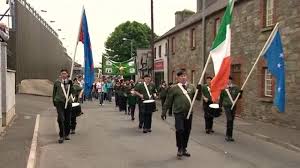
castledergMarxists have regarded the struggle against British rule in the North of Ireland as a legitimate one in the sense that it is a fight against an imperialist state and its political rule in a country in which it has no democratic right to exercise its powers.  This is reflected in the undemocratic partition of the country and its reliance on a colonial movement which has proven incapable of providing or allowing basic democratic rights to its neighbours of a different religion. The legitimate democratic rights of this population have never been advanced but have always been subsumed under a bigoted and triumphalist programme of support for sectarian privilege and for the most reactionary characteristics of the British State.

Imperialist rule has thus always involved promotion and pandering to the worst aspects of sectarianism.  During ‘the troubles’ this involved repeated attempts to give coherence and effectiveness to loyalist gangs who were often more interested in pure criminality than their reactionary political programme.  This included planting security services agents into the loyalist paramilitaries, arming these gangs, providing them with intelligence on targeting, facilitating their actions and preventing other arms of the police from apprehending their killers.

What has often struck commentators on loyalist violence has been its sheer frenzied brutality and savagery, a feature of extreme reactionary violence everywhere.

This year the British State has once again indulged loyalist violence – during the flags protests – and the more honest local journalists have reported the patronage by the state and politicians of the loyalist paramilitary group, the Ulster Volunteer Force, especially in East Belfast.

This organisation has gained confidence and power in Protestant working class areas through State acceptance of its nefarious activities.  Rather than attempt to completely destroy the most vicious supporters of British rule the British State has attempted to tame it and make it amenable to its own more measured policies.  The riot in July in the Woodvale area after a local Orange parade was prevented going past a Catholic area, and the riot in Belfast City Centre to prevent a Republican demonstration, show how limited the success of such a policy has been.

The claims of loyalism that it is simply defending its culture and traditions are without any merit.  Its culture is one of sectarian practices, made-up of borrowings from others and simple invention.

Attending a loyalist parade made up of bowler hated men declaring temperance and loyalty to the British monarchy, as long as it remains Protestant, led by aggressive flute bands sometimes named after sectarian killers and followed by drunken and hate filled followers will tell you most of what you need to know about the nature of Ulster unionism.

The Marxist opposition to British rule and loyalism and attendant defence of Irish nationalist claims is therefore mainly a negative one.  It is a positive one to the extent that this Irish nationalism puts forward and advances real democratic demands.

It is therefore possible to imagine (but only imagine!) a situation in which Protestant workers opposed a united Ireland because Irish nationalism wished to foist a catholic clerical regime on a genuine outpost of the British State, which was integrated into that State, was part of its on-going political development and in which this outpost of Irish workers were fully integrated into the British class struggle.  In such a situation it might be the case that the demand s of Irish nationalism would be reactionary – a call to disrupt a united working class which had overcome sectarian division and which was moving instead to a programme of independent working class politics.

To present such a scenario is to demonstrate how far reality is from the real situation and why Marxists adopt the programme for Ireland that they do. The scenario above is put forward purely to illustrate the approach which Marxist take and to distinguish it from all varieties of Irish nationalism.  Marxists are primarily concerned with the unity and independent struggle of the working class irrespective of nationality.  The programme of the socialist movement can only be successful if the disunity caused by nationalist division is overcome.

This means that there is no automatic support for the activities of Irish nationalists and republicans.  Marxists defend the democratic content of the struggle of those oppressed but this does not mean support for its expression in nationalist politics.  Marxists do indeed distinguish between the nationalism of the oppressed and the nationalism of the oppressor but that does not mean they support the former.

In the recent dispute over parading Sinn Fein has more and more shifted its political position to one of recognising that the Protestant population of the North of Ireland is British and can therefore claim rights that are equivalent, but not greater, than those of the Catholic Irish.  Marxists accept neither of these arguments – that the Protestant population is British or that even if it was its political claims therefore have to be supported.  For the loyalists their demands continue to mean the assertion of sectarian privilege.

The acceptance of the political legitimacy of unionism, defined by itself in sectarian terms, means that Sinn Fein’s own claims become judged by the same measure.  This is indeed why Sinn Fein has moved to this position.  It is the logic of the peace process, its ‘parity of esteem’, ‘reconciliation between the two traditions’, mutual understanding, respect and equality of rights and all the other honeyed phrases behind which lie behind poisonous sectarianism.

The logic of the political settlement in the North is sectarian competition where once it was purely sectarian domination and Sinn Fein has bought into this.  Thus it declares its interests in the concepts appropriate to this sectarian competition.

The statement by it on the recent IRA commemoration in Castlederg shows all this. The local Sinn Fein councillor said

‘This parade is organised to show respect for those who gave their lives for this community. It should never have been an issue of controversy- it has been ‘made’ controversial by unionist politicians. We have proposed this initiative to take the controversy out of it while reducing tension.

“Our initiative will consist of choosing to go along John Street which avoids passing the cenotaph and the Methodist church.

“On the back of this initiative, we wish to engage with all key stakeholders in relation to the issue of the town center being designated as a shared space for all traditions, in this mainly nationalist town.

“There has been around 20 unionist parades through the town centre in 2013 so far without objection, we understand and accept peoples Britishness- others need to understand and accept our Irishness.”

So the IRA fought for Catholic freedom not Irish freedom unless Sinn Fein now equates the latter with the former, which appears to be the case.  At the same time it now recognises the legitimacy of the claims of Irish Protestants to be British so there appears no reason why one sectarian groups’ claims should have priority over the other.

What we have is endless competition with no reason to judge any particular outcome fair or appropriate, except that it exists and it exist only as a result of struggle between the groups, presided over by the British State.

What this means is that where the civil rights struggle once demanded an end to sectarian domination, essentially discrimination against Catholics by unionism, now the necessary democratic struggle would appear to be against sectarian competition, essentially discrimination by unionists against Catholics and nationalists against Protestants.

Sectarian competition is however unstable.  Unionism wants sectarian privilege while Sinn Fein claims it wants equality but it has demonstrated that it seeks equality not through unity, which is the only way it could exist or be brought about, but through sectarian claims on behalf of Catholics, because they are Catholics and because they are claiming Catholic rights.

It is now lost on a whole generation that the demands for civil rights and equality were demands for democratic rights irrespective of religious beliefs not because of them.  It is lost on this generation that claiming Catholic rights is not the same as claiming civil rights.

The civil rights’ demand for equality required unity because civil rights were disconnected from religious belief.   Now rights are claimed by virtue of religion.  Equality now means the equality of resources to sectarian groups, which can only be achieved by ensuring the continued existence and political priority of these groups.  Demands are made that those not designating themselves in sectarian terms must do so or someone must label them on their behalf.  In other words equality now requires sectarianism.

If sectarian domination was unstable this sectarian competition is even more so.  The current political situation is unstable because not only is it impossible to have stable agreement on the equitable sharing of sectarian rights but such equality does not yet exist.

Despite decades of Sinn Fein ‘leadership’ in West Belfast the social and economic problems of the constituency are among the worst.  Unemployment among Catholics is still worse than among Protestants.  Thousands of Orange parades still proclaim their sectarian superiority except everyone is now called upon to be tolerant, seek reconciliation with the participants and show non-sectarianism by accepting the displays of bigotry.

In such an Orwellian world sectarianism is to be eradicated by support for sectarianism.  And then we are to be amazed how on earth the problem hasn’t disappeared and often appears to be getting worse.

To be continued.

Workers’ control of production Part 2

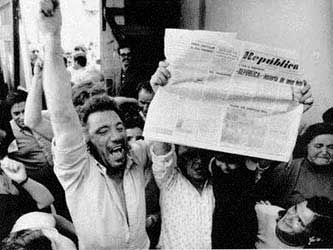
0425.1974_Portugal-newspapeIn my last post on workers’ control I noted that it inevitably arose as a result of crisis, and crises are by their nature temporary, occasioned by society-wide political upheavals or by threatened closure of a particular workplace that is perhaps producing unnecessary products, is working in an obsolete manner or is otherwise failing to compete successfully in the capitalist market.

In Britain in the 1970s there were more than 260 occupations of workplaces by their work forces including, perhaps most famously, at Upper Clyde Shipbuilders in Glasgow, usually sparked off by closures, layoffs, redundancies, dismissals or threats of closure.  Such occupations were spontaneous, often acts of desperation and with no real planning.  If successful, the numbers occupying would be offered jobs by a new employer although this number would usually be less than when the occupation would have begun.  When no new owners would appear the occupations might attempt to become workers’ cooperatives but the motivation was normally a pragmatic search for a solution rather than something drawn from political commitment and ideology.

The occupations were often built by shop stewards and sometimes at odds with the official trade union movement, a situation we see again and again and a result of factors far from accidental.

The theme of ‘industrial democracy’ was very much alive and in 1974 the Conservative Government called a general election on the issue of “who governs Britain”, in direct reference to the miners who had engaged in successful strike action.  The Tories lost and the new Labour Party Government included Tony Benn, who wanted greater involvement of workers in their workplaces.  He also came into conflict with trade union leaders who opposed his dealings with rank and file groups of workers.  “The whole machine is against you” Benn told one supporter of an occupation at Imperial Typewriters.

Workers’ cooperatives received the support of Benn, who was in a position to do something as Minister at the Department of Industry, but his financial help was relatively small and most industrial aid continued to go towards private industry.  That which did go to the cooperatives was mainly for compensation to previous owners who were paid for obsolete plant.  This left the new cooperatives under-capitalised and without the necessary resources to carry out research and development.  They generally lasted only a short space of time but still sometimes produced radical, innovative and still exemplary struggles.  One such was as at Lucas Aerospace, where workers pioneered conversion plans to socially useful production, again opposed by the union leadership.

By the end of the decade however these types of struggles had declined dramatically.  Few of the experiments in workers’ ownership survived and as history is usually written by the winner the victory of Thatcher, built on the attacks on workers commenced by Labour, left a legacy of disappointment and nostalgia in some old enough to remember.  This has affected the Left up to today in so far as it is suspicious, if not actually hostile, to workers’ cooperatives.  This is a profound mistake as the willingness of workers to fight for ownership and control of their own workplaces is an instinctive impulse to go beyond capitalism.

The history of American workers organisation in the 1930s is perhaps more celebrated than this experience but in some ways was more limited.  Workers and trade union power grew during the decade not just because of the struggle of workers to organise, most famously in Minneapolis, but because of the strong growth of US manufacturing industry.  Between 1936 and 1939 workers occupied 583plants in sit-down strikes in defence of their terms and conditions, protection of wages, achievement of union recognition, or prevention of sell-outs where recognition already existed. These were often successful.

Unfortunately there followed 70 years of union-management collaboration – no strike agreements during the second world war; the witch hunt and expulsion of socialist activists in the McCarthy period; mob penetration of the union movement and the turning of the union bureaucracy into a world-wide vehicle of the US state in its cold war with the Soviet Union.  The US union movement has now declined so much that in most of the private sector it is irrelevant, with unionisation accounting for only 7.5 per cent in the private sector in 2008.  In some workplaces where unions do ‘organise’ workers are not even aware there is a union!

The history of American workers’ militancy drives home a lesson to be  learnt from the British experience of the 1970s and 1980s – that politics are not only determined by workers militancy and their experiments with workers control but that politics can influence decisively the short and long-term success of these experiments.

In the end the question of politics is crucial, which is why Marxists believe that working class conquest of state power – revolution – is decisive.  It is important however not to telescope the path to this destination.  Revolution is decisive only if the material basis for working class rule is present.  This is not simply a question of the level of economic development but of the social and political development of the working class.  Without both of these the question of revolution is not posed practically i.e. in reality, no matter what more general ‘crisis of capitalism’ is evident.

The analysis of workers’ control in these posts is based on the belief that working class conquest of state power is necessary but that the immediate question is how to make that a widely shared goal given the low level of class consciousness and struggle than now pertains.

It is therefore important to attempt to draw lessons from the impact of political developments on workers attempts at independent organisation in the workplace.  In turn we can then look at the role of workers’ organisation in the workplace for its impact on wider political struggle.  This will reveal the limits as well as the strengths of a workplace-based strategy and what political demands should be raised as a result.  Such lessons informs the opposition to calls for nationalisation that have been argued in many earlier posts.

For example in the Spanish revolution in the 1930s it was the Republican state that strangled the workers’ and peasants’ collectives rather than the fascist counterrevolution.  Clearly in this case a call for this government to nationalise such collectives would not have made much sense.  Anarchists believed these collectives were a means of controlling the Republican authorities but clearly what was needed was an alternative Government and state – perhaps built on these bodies.

In Yugoslavia self-management was a means of mobilising the population against economic blockade and potential invasion, boosting production, minimising the power of the trade unions during a labour shortage and hoping that the workers would discipline themselves.  Unfortunately self-management as then practised led to accusations of workers’ neo-capitalism in which the enterprises were seen as the workers property, narrowly conceived, so that they competed with each other in a capitalist-like manner.  Self-management became not a means of workers self-realisation but a trade union-like bargaining system of clientelism and patronage.  Increased enterprise autonomy acted to dissolve wider working class solidarity leaving enterprise loyalty and territorial state loyalty as the alternative, one which ultimately descended into bitter and bloody nationalist war.  On the way to this dénouement it has been argued that enterprise autonomy became a mechanism to insert the Yugoslav economy directly into the capitalist world market.  Increased autonomy became the means of strengthening management power not workers’ autonomy.

Both Spain and Yugoslavia are testament to the fact that without real working class political and state power workers’ control can be subverted and/or crushed.  I have argued that it is the lack of workers’ economic power and experience before revolutionary crises that has weakened the struggle for their class rule thus making revolutionary success less likely in such crises.  But it is also true that such episodic economic power is doomed without a political project.  In Poland workers councils existed in 1945, 1956, 1970 and 1980-81 but revolution there became a restoration of capitalism.

In nationalist revolutions, such as in Indonesia, the most radical actions of workers are betrayed by a backward political consciousness; as when workers control is achieved and defended not as an extension of workers’ power as a class but as the property and achievement of the new independent (still capitalist) state.  This state can indulge in the wildest revolutionary rhetoric but as long as its power is not an extension of that of the workers it is just rhetoric, to be retracted when the new state feels itself more in control.  It succeeds in this as long as workers power is mistakenly seen by its holders as the gift of the newly independent state.  The examples of nationalism trumping the radical actions of workers are legion and proof again that revolutionary action does not automatically generate revolutionary socialist politics and consciousness.

What is clearly decisive is workers’ own consciousness and workers control, self-management or councils are not in themselves decisive in determining it.  This however is not the question and not the argument being put.  There is no ‘magic’ strategy guaranteeing a workers’ victory but there are more or less adequate roads and strategic conceptions.

The argument here is that workers’ control, and in the longer term, workers’ ownership can provide a more solid, permanent and robust material basis for the development of the necessary socialist consciousness than simple trade unionism, no matter how militant.  More realistic than reliance on spontaneous political revolutions to do all the work of consciousness raising in the necessarily short space of time in which they take place and certainly more than demands for nationalisation, which for example were obviously meaningless in both Yugoslavia and Poland.

What workers ownership should do is provide a basis and foundation for a political programme that seeks to extend and deepen this form of ownership and give it a political dimension, to make easier removal of the division between the political and the economic that characterises capitalism.  Workers’ collective control and ownership of the state can be more easily argued for on the basis of their wider ownership in the economy.

The argument is more easily advanced if there exists a successful worker owned and controlled sector of the economy that can be presented as an alternative to the capitalist owned sector or the illusion that a benevolent state can take ownership of the latter in order to benefit workers.  On this basis the socialist project can become a political one for which the ideal form to advance it is a mass workers’ party.  Such a project can begin to win the battle for hegemony within societies which are currently dominated by capitalist ideas despite the objective failures of that system.  A real material basis for an alternative is provided that can focus generalised discontent that now expresses itself in free-floating ethical concerns for justice and can find no more specific or concrete alternative than vague calls that ‘another world is possible.’  Instead through development of workers’ cooperatives and the wider labour movement another world is built in front of our eyes.

The absence of such hegemony of ideas, and its corollary – that no alternative to the capitalist system seems possible – results in the upheavals that returned societies to capitalism in Eastern Europe and the Soviet Union.  This wider and deeper lack of legitimacy of the socialist project weighs heavily on the spontaneous activity of workers even when they have engaged in the most radical activity.

In the Portuguese revolution in 1974 a movement within the army overthrew the dictatorship and between May and October of that year 4,000 workers’ commissions were established following mass meetings.  Not only factories but empty houses and apartments were occupied.

Within these commissions political competition developed between the Portuguese Communist Party and smaller revolutionary currents.  A failed right wing coup shifted events further to the Left.  Workers councils became not just organs of control in the workplace but organisations of struggle that could potentially threaten the power of the capitalist state.

In the end however they proved too weak and were unable to pose a political alternative to the quickly developing normal organisations of capitalist democracy – trade unions, political parties, parliament and the state.  In the end the Portuguese Socialist Party became the mechanism for a stabilisation of capitalist rule and bourgeois democracy.

Short-lived experiments in workers control and ownership were not in themselves capable of establishing hegemony for the project of workers’ state power.  A deeper and wider radicalisation was required.

The point is that this can take time and can only come about through the development of socialist consciousness in the working class over a more or less extended period and this must rest on a material base.  This can only be the development of the power of the workers in existing capitalist society, expressed in democratic trade unions, political parties, cultural organisations and workers cooperatives.

The opposite of this road is reliance on the state, expressed in the demand for nationalisation.  In Spain, Eastern Europe, Indonesia and Portugal it was the State which became the guarantor of capitalist ownership and power.

Today we are in circumstances where workers must not only defend themselves against the depredations of capitalism – battling against austerity – but socialists must also look to ways in which to advance a workers consciousness that seeks permanent expression of their needs and powers.  Not just defending immediate interests but looking and taking care of the future of the movement and workers’ position in society.

But it is not simply about the needs of the present as against the needs of the future because Marxism is the belief, confirmed by nearly two centuries of industrial capitalism, that it is not possible to satisfy the needs of workers today by only fighting today’s battles.  A socialist society is the future only because it is the answer to the challe-nges and problems of the present.  The demands for workers control and ownership express this view and are rejection of the clam that the existing capitalist state, by nationalisation etc, can provide the answer.

Workers’ control of production

rr06[1]In my review of the programme put forward by the left in Ireland, generally no different from other countries across Europe and further afield, I have argued that while it may be better for workers than the current austerity policies it is not socialist.  By this I mean that it does not involve a class alternative, an alternative to capitalism, one that involves ownership of the means of production moving to the working class.

Only in one area is this not the case: the Left’s occasional demand for workers’ control.  Even in these cases I have argued that the proposals are not put forward within any real practical perspective but put forward in such a way that they must assume a near revolutionary situation.  Demands for widespread workers’ control are only a practical proposition in such circumstances.

In current conditions demands for workers’ control simply demonstrate a lack of seriousness by those proposing them.  In the article by Trotsky previously quoted, he states that “before this highly responsible fighting slogan is raised, the situation must be read well and the ground prepared. We must begin from below, from the factory, from the workshop.”

This is to be done by revolutionaries gauging the moods of other workers – “to what extent they would be ready to accept the demand to abrogate business secrecy and to establish workers’ control of production. . . . Only in the course of this preparatory work, that is the degree of success, can (we) show at what moment the party can pass over from propaganda to further agitation and to direct practical action under the slogan of workers’ control.”

“It is a question in the first period of propaganda for the correct principled way of putting the question and at the same time of the study of the concrete conditions of the struggle for workers’ control.”

One small means of doing this recently was, when the banking crisis erupted, members of Socialist Democracy leafleted bank workers in Dublin asking them to let other workers know what was going on in the banks through leaking internal emails etc.  This small step abrogating business secrecy is a first step to workers’ control.  The poor response showed that the preparatory work described by Trotsky had yet to begin.

In this post I want to look at what is meant by workers’ control and how this is a result of the working class’s historical experience of this means of struggle.  The experience shows that it inevitably arises as a result of a crisis, and crises are by their nature temporary, occasioned by a society-wide political crisis or by the threatened closure of a particular factory that is producing unnecessary products, is working in an obsolete manner or is otherwise failing to compete successfully in the capitalist market.

How to institutionalise such control in periods of relative calm is a central problem we will look at in future. Relying on temporary crises to quickly provide workers with answers to the problems posed by their taking control has not resulted in success.  Revolutions of themselves do not give all the answers to the problems posed by revolution, at least not unless they are prepared for and prepared for well.  Since revolution is the task of workers themselves we are talking about how they can be prepared to take on the tasks of control.  Such preparation involves convincing at least some of them them that they should want to control or manage their own places of work as well as how they might be able to do so.  Only in this way can the superiority of worker owned and managed production be demonstrated.

The historical understanding of what workers’ control means derives mainly from the experience of the Russian revolution in 1917; the only successful workers led revolution.  Yet the goal of this revolution was initially a democratic republic, not a workers’ state, with the result that only a ‘transitional’ social and economic programme was on the agenda.  A decision to seize power by the Bolshevik Party could not change the level of economic and social development in itself.  We can see from an earlier post that this informed Lenin’s view that the immediate economic programme was one more akin to state capitalism than complete working class ownership and  power over the economy.

This is decisive in understanding the development of the revolution.  The workers could seize state power in order to stop the war, support distribution of land to the peasantry and attempt to put some organisation on production but workers could not by an act of will develop the Russian economy under  their own control and management, at least not outside of a successful international revolution, and this never came.

Workers’ control in such a situation did not, and at least initially could not, equate to complete management.  In Russian ‘kontrol’ means oversight; a “very timid and modest” socialism, as the left Menshevik Sukhanov put it.  The Bolsheviks understood that workers’ control was not socialism but a transitional measure towards it.  Capitalists would and did continue to manage their enterprises.  (The historian E H Carr reported that in some towns workers who had driven out their bosses were forced to seek their return.)

This approach was supported by the factory committees created by the workers during the revolution.  These committees initially hardly went beyond militant trade unionism but did not accept management prerogatives as inevitable and, as the bosses increasingly sabotaged production, they increased their interventions to take more radical measures of control.

The workers nevertheless saw the solution to their problems as soviet power and state regulation, evidence by their acceptance of a purely consultative voice in state-owned (as opposed to privately owned)enterprises.  This reflected the worker’s weakness, expressed by one shipyard worker on the eve of the October revolution at a factory committee conference: “often the factory committees turn out to be helpless . . . Only a reorganisation of state power can make it possible to develop our activity.”  Thus much of the activity of the factory committees was attempting to find fuel, raw materials and money simply to keep factories going and real management was sometimes consciously avoided.

Trade union leaders criticised the factory committees for only looking after the interests of their own plants and for not being independent of the capitalists who owned them. The workers in the committees were themselves keenly aware of being compromised by the capitalist owners, of being given responsibility without effective power.

While the revolution was supposed to have a transitional character in economic terms, workers were faced with greater and greater sabotage and recognised that the worsening crisis required a solution that could only come from the state, which would provide the centralised control that would combat economic dislocation. The weakness of the workers themselves can be quantified by the decline in their number.  In 1917 the industrial workforce in Petrograd was 406,312 but fell to 339,641 by the start of 1918 and only 143,915 by May of that year.

Although more active forms of workers’ control were sanctioned after the revolution, it had been increasing anyway, the steps towards the central state regulation that had been championed were constrained by the lack of an “organised technical apparatus, corresponding to the interests of the proletariat”, as the resolution unanimously adopted by the January 1918 Factory Committee conference put it.  Nevertheless the conference called for the immediate nationalisation of factories in a good physical and financial situation.

The economic situation however was desperate as the new state faced immediate armed attack.  The Factory Committee conference noted that: “Every one of us knows that our industrial life is coming to a standstill and that the moment is fast approaching when it will die.  We are now living through its death spasms.  Here the question of control is no longer relevant. You can control only when you have something to control.”

Widespread nationalisation was introduced but it was viewed as a necessity compelled by circumstances, not a positive choice and not one driven by socialist ideology.  Alongside this nationalisation was increasing centralisation of economic decision making, which was imposed on the factories.

But of course if the workers were unable to run the factories how could they run the state?  Complaining that the factory committees were ignoring everything but their own local interests and themselves disorganising production one section of the state’s economic organisation stated that reorganisation would not happen “without a struggle of the worker’s government against the workers’ organisations.”

All these quotes are taken from the article by David Mandel in the collection of articles on workers’ control in the book ‘Ours to Master and to Own: Workers control from the Commune to the Present.’  In this he states that the contradiction between planning and workers self-management can be resolved if there are conditions allowing for significant limitations on central control and these conditions also provide workers with security and a decent standard of living.  Both, he says, were absent in Russia.  More important for the argument here is his view that there must be a working class capable of defending self-management.

This too did not exist in Russia and our very brief review shows this.  The Bolsheviks were acutely aware of the low cultural development of Russian workers, evidenced through their lack of education, high levels of illiteracy, lack of technical skills and lack of experience in the tasks of economic administration and management.  That their numbers declined dramatically, not least because of the demands of the Red Army, leaves no grounds for surprise that this experiment in workers’ control did not prove successful.

The limited character of the initial steps in control and the awareness workers had of their lack of skills were revealed in their calls for the state to reorganise production.  While certain centralised controls over the economy are a necessity, and this is doubly so in order to destroy the power of the ruling classes, the socialist revolution is not about workers looking to any separate body of people to complete tasks that it must carry out.

If workers could not control production they could not be expected to control state power.  This was to turn out to be the experience of the revolution and in its destruction by Stalinism the state turned into the ideal personification of socialism.

This identification of socialism with the state in the minds of millions of workers across the world continues, a product of Stalinism and of social democracy but gleefully seized on by the right.  Since the state is organised on a national basis this also entailed socialism’s corruption by nationalism.

The path required to developing and deepening a genuine workers’ revolution lay not in seeking salvation in the state but in workers creation of this state themselves out of their own activity in the factory committees and soviets.  The coordination, centralisation and extension of the functions of these bodies would ideally have been the means to build a new state power that could destroy and replace the old.  It would also have been the organisation that would have combatted economic dislocation and provided the means for cooperative planning of production and trade with the independent peasantry.

In this sense the Russian revolution is not a model for today.  While workers control came to the fore in this revolution its limitations must be recognised and a way looked to that would overcome them in future.

It might be argued that the backward cultural level of the Russian working class, while acknowledging its high class consciousness, is not a problem today.  After all the working class in Ireland, Britain and further afield is literate, educated and with a large number educated to third level education.  The working class is the vast majority of society, which it was not in Russia in 1917.  Many workers are now highly skilled albeit specialised.  This however is a one sided way of looking at things. 

Firstly on the technical side the very specialisation that makes some workers skilled reflects an increased division of labour that in so far as it is deep, widespread and reflected also in a division of social roles militates against the widespread accumulation of the skills and experience of management and control.

Many workers reflect their specialisation in a narrowing of outlook but illustrates that the increased division of labour is foremost a question of political class consciousness which is at least in part a reflection of social and economic stratification of the class.  Thus some workers see themselves as professionals – engineers, accountants, managers etc. and regard themselves as middle class.  Just like white collar workers and state civil servants in the Russian revolution they do not identify themselves as workers with separate political interests along with other workers slightly below them in the social hierarchy.  They do not identify with socialism.

Modern society in this way reflects early twentieth century Russia: the working class does not rule society, even at the behest of the capitalist class, but there are numerous social layers (the middle classes) who help the capitalist class to do so, and they imbue into themselves and others the political outlook of their masters.

Because the division of labour is increasingly an international phenomenon the road of revolution at initially the national level poses even bigger problems for workers management of production than existed in Russia in 1917.  Especially in Ireland production is often a minor part of an internationally dispersed process so that control of the whole is exercised elsewhere.  How then do workers take control of such production in any one country especially one lower down the value chain?

For these reasons revolution needs to be prepared.  It needs prepared in the sense that workers must be won to a fully conscious commitment to their becoming the ruling class of society; a rule based on their ownership and management of the forces of production.  In order to achieve this, the force of example rather than simply the power of argument is necessary.  In other words workers must have seen and experienced ownership and management.  This can provide many with the experience and knowledge necessary to lead the whole class to own and manage the whole economy when such control is the basis for their own state power, after capitalist state power has been destroyed.

The best, in fact only way, to prepare for socialism is through practice, practice in asserting the interests of the working class as the potential new dominant class of society.  Demands for nationalisation are demands that someone else, the state – because the state is a group of people – create the good society.  And when anyone is asked to create the good society it is always what is good for them.

Such dominance is more than simple resistance to the exploitation of the old society but must in some way herald the new.  Opposition to austerity for example can only ameliorate the effects of capitalism and does not provide panaceas – not even ‘taxing the rich.’  The real importance of fighting austerity therefore lies in the building of the organisation and class consciousness of the working class. This is what Marx meant when he wrote in ‘The Communist Manifesto that:

“the Communists fight for the attainment of the immediate aims, for the enforcement of the momentary interests of the working class; but in the movement of the present, they also represent and take care of the future of that movement.”  The future is that in its “support (for) every revolutionary movement against the existing social and political order of things” communists “in all these movements, (they) bring to the front, as the leading question in each, the property question, no matter what its degree of development at the time.”

This then is the importance of workers’ control and workers ownership.  It is the question of the future of the movement of the working class because it brings to the fore “the property question.” 

I shall look at it some more in future posts.

Marx on pre-capitalist societies: review of ‘Marx at the Margins’ part IV

karl-marx-theoristBy Belfast Plebian

Marx published very little in the last ten years of his life and did not even manage to finish volumes two and three of Capital.  Some historians have said that he ran out of mental capacity. There were only two important documents published, small in size: the Critique of the Gotha Programme of 1875 is a schematic appraisal of the muddled socialism of Germany Social Democracy and the other a revised version of the Communist Manifesto for mainly Russian readers published just a month before Marx died in March 1883

It is the second document that offers a clue to what Marx was researching in his later years.  Marx and Engels state in the preface that they had neglected to say much concerning social developments in the United States of America and also in Russia in the original Manifesto. They then present a brief synopsis of the condition of the small independent farmers in the United States under the duress of expanding capital while turning to conditions in Russia they note the rise of a new revolutionary movement. They then attempt to take stock of the revolutionary potential contained within the primeval communal relations of the Russian society:

‘Can the Russian obshchina, a form , albeit heavily eroded, of the primeval communal ownership of land, pass directly into the higher form of communal ownership? Or must it first go through the same process of dissolution that marks the West’s historical development? Today there is only one possible answer: If the Russian revolution becomes the signal for a proletarian revolution in the Wes , so that the two complement each other , then Russia’s peasant communal land ownership may serve as the point of deparure for a communist development.’(T.Shanin p139)

In 1983 Teodor Shanin published a ground breaking book called ‘Late Marx and the Russian Road: Marx and the peripheries of capitalism’, a collection of Marx’s draft sketches and letters dealing with questions posed by the development of embryonic capitalism in Russia.

In a letter addressed to the Russian populist writer Nikolai Mikhailovsky Marx explained his research: ‘In order to reach an informed judgement on Russia’s economic development, I learned Russian and then for many years studied official and other publications relating to the question’.(Shanin p135)   Marx also says that ‘I have come to the conclusion that if Russia continues along the pathway she has followed since 1861, she will lose the finest chance ever offered by history to a people and undergo all the fateful vicissitudes of the capitalist regime.’ Marx stated his thesis tentatively referring to the now hectic undermining by both Russian and foreign capital of the customs of the usually isolated communal villages.

What Marx seemed most eager to banish in the mind of his Russian populist reader was the idea that he had arrived at a general philosophical account of modern historical developments.  Marx’s letter was a response to a sympathetic review by Mikhailovsky of Capital Volume One, an appraisal that had ascribed to Marx a unilinear account of necessary historical development.

The Russian populist had said in the review that Marx:  ‘In the sixth chapter of Capital, the section called  So called Primitive Accumulation, here, Marx has in view a historical sketch of the first steps of the capitalist process of production, but he gives us something much bigger, a whole philosophical-historical theory. This theory is of great interest in general and especially great interest for us Russians.’

In his reply Marx is determined to say that he has no such general theory of historical development ‘The chapter on primitive accumulation claims no more than to trace the path by which, in Western Europe, the capitalist economic order emerged from the womb of the feudal economic order….Thus events of striking similarity, taking place in different historical contexts, led to totally disparate results.  By studying each of these developments separately, one may easily discover the key to this phenomenon, but this will never be attained with the master key of a general historical-philosophical theory, whose supreme virtue consists in being suprahistorical.’(Shanin 136)

The above is important for it distances the late Marx from some of his own more rigid conceptions as articulated in the German Ideology and from the common ‘historic Marxism’ thesis that what Marx was about was revising the Hegelian philosophy of History in a materialist direction. The idea that Marxism is a failed Universal Theory of History is still the predominant one in social science.

The other equally important point was that Russia and other pre-capitalist societies ought not to be conflated with Western feudalism. Marx was in fact researching various pre-capitalist societies that were not feudal in the European sense.  When he spoke of an Asiatic mode of production he was not using the construction in a geographical sense, for it included most of South America and even parts of North Africa, especially Algeria.  Marx was not even trying to describe the pre-capitalists societies in any historical-anthropological way.  What he was really interested in was how capitalist expansion was penetrating and transforming pre -capitalist societies that had no feudal past, in short the disruption being wrought by the advancing capitalist-colonialism of his own lifetime. (We do not say imperialism for this terminology was not used by Marx.)

Marx conducted his research using his normal method of reading the leading bourgeois authors and compiling excerpts from them with his own added comments.  He made extensive excerpts and notes drawn from authors such as: the pioneering anthropologists  Henry Morgan’s ‘Ancient Society’ 1877; the evolutionist John Lubbock’s ‘The  Origin of Civilisation and the Primitive Conditions of Man’ 1870; Maxim Kovalevsky’s  study of India ‘Communal Landownership, the Causes, Course and Consequences of its Decline’ published in Russian in 1879; the political historian Henry Sumner Maine’s ‘Early History of Institutions’ (1885); notes of sixteen thousand words on John Phear’s ‘The Aryan Village of India and Ceylon’ 1 1880 and Robert Sewell’s ‘Analytical History of India’ 1870.

Much of this material had to do with the communal and clan structures of the still prevailing pre-capitalist societies. Marx appropriated, albeit critically, these works.  He portrays Maine as an ideologue defending capitalism and empire rather than a genuine historical scholar.  He agrees with Kovalevsky’s arguments covering changes to the communal property forms in India but criticises him for sometimes conflating India with European feudalism.

Marx declares one maxim of his method as ‘One has to be on guard when reading the histories of primitive communities written by bourgeois authors. They do not even shrink from falsehoods. Sir Henry Maine, for example, who was an enthusiastic collaborator of the English government in carrying out its violent destruction of the Indian communes, hypocritically assures us that all of the government’s noble efforts to maintain the communes succumbed to the spontaneous power of economic laws!’ (Shanin 107)

Anderson, basing himself on notes by Kovalevsky, argues that, Marx created a typology of communal forms across many societies and made differing assessments of their durability.  The second theme in the notes and drafts is a comparison between Russia and other ‘Asiatic communes’. To be sure he had not worked out a theory of revolution for Russia or for the others he had studied; moreover he was careful to take note of the political independence of Russia as an important difference.

In respect of the potential for social resistance Anderson argues that of the several communal forms that he had studied, Marx thought they were not as resistant to elimination as those that were rooted in Russia. This was due more to the fact that most of the others had already been conquered by colonial capitalism.  Marx’s guess on Russia is best stated in this from a letter quoted in the Shanin collection: ‘What threatens the life of the Russian commune is neither an historical inevitability nor a theory; it is oppression by the State and exploitation by capitalist intruders made powerful, at the expense of the peasants, by this same State.’   

Anderson concludes by saying that he hopes that his journey into Marx’s writings on nationalism, race, ethnicity and non-Western societies has revealed the multidimensional character of his overall intellectual projects, especially in his later years. Marx’s critique of capitalism was far broader than is usually supposed.

Anderson has done this, though he may have talked more about gender relation.  He mentions differences between Marx and Engels on how they each made use of the findings of Morgan’s study of the origins of patriarchy but he does not develop it much.

There are just a few other points I would like to make that Anderson in his restraint refrains from making.

One point about historical materialism that springs to mind after reading Anderson’s book is that it is not a finished theory and has no pretension to be a finished one.  It must be open to new evidence and new experiences.  If it is taken up as a closed system it would only become a sort of repository of past societies, like a great city museum stuffed full of abandoned knowledge and artefacts.

Another point concerns the assessment of the idea of progress that inheres within historical materialism. The bourgeois ideology of progress is rampant and without qualification: capitalism always improves the world through its free production of commodities, its new technologies, its science and its legal and political forms.

In so far as there is an opposition to this bourgeois credo of progress it can take on more than one mask.  In our time the most forceful originates from the mind of the German philosopher F. Nietzche, who declares in his ‘The Anti-Christ’ of 1888 that ‘Progress is merely a modern idea, that is to say a false one.’  Nietzche was much more impressed by the knowledge and art of the ancient world than he was with the modern one, as are his most intelligent followers.

This is not the kind of opposition, said Marx, that the workers and oppressed of the modern world need, the opposition of reactionary modernism.  Yet the socialist movement in the broad sense has been damaged by the full embrace of the capitalist ideology of progress.  In the first instance, with the progressive Germany ideology of Social Democracy and the Second International, revolution was no longer necessary as steady progress was already happening under capitalist conditions.  This steady progress must we remind ourselves included an acceptance of progressive colonialism.

Then there was the progress of actually existing socialism, supervised by the Stalinist bureaucracy and its ideology of State controlled economic progress.  Soviet society was reputed to be one without social contractions

Yet Marx assesses capitalism and its progress under the auspicious of dialectical contradiction; all progress within capitalism is torn by irony, even the breakthroughs of science are bundled with contradiction.  Medicines are withheld by patents and the Internet technologies are distorted by corporations, to cite just a few examples.

When we speak about the dialectic we are in fact using irony rather than a special kind of logic. The use of dialectic was spoken about by Plato in his dialogues.  Socrates was the master of subjective irony.  When Hegel revived the use of the dialectic he tell us that he learned it by studying the dialogue by Plato called the Meno.

Marx is the master of something more than subjective irony, he is the master of objective irony, he found it especially in the capitalism-colonialism of his own time and the quotes I have picked out from Anderson’s study are replete with this objective irony.

Finally something should be said about the controversy over Marx’s occasional referrals to the Asiatic and feudal modes of production.  Marx in fact wrote more words about Asiatic society than he did about Ancient or Feudal society, yet in the official Stalinist literature it went unmentioned.  The Communists spoke of the slave owning, feudal and then capitalist modes of production but not the Asiatic. Why was all talk of Asiatic society covered up by the Stalinist ideologues?

The best known book on this is a tendentious one by Karl Wittfogel called Oriental Despotism published in 1957.  The book is tendentious because Marx stopped speaking about pre-capitalism societies in terms of Oriental Despotism at an early stage, and because it is doubtful Marx had developed an account of such societies to the point that he was confident in naming them as belonging to a separate mode of production; the societies were too various for him to make that mistake.

Finally the Stalinists did not censure the terminology primarily because it sounded more like a description of the despotic Soviet Union under Stalin but because referring to the feudalism of China or India or Vietnam facilitated an international politics of anti-capitalist revolution that conceded revolutionary leadership to a class of supposed ‘progressive capitalists’ who were an integral part of common national and democratic revolution directed against the colonists and a class of reactionary feudal landowners.  It hardly mattered that Marx thought these Asiatic societies were not feudal in the European sense.      

Kevin Anderson has produced an admiral book.

concluded

Marx on Poland and Ireland: review of ‘Marx at the Margins’ part II

170px-Marx_oldby Belfast Plebian

Marx served as the chief European correspondent of the New York Tribune, the most important newspaper in the United States in the nineteenth century. Anderson believes these articles ‘constitute a far more serious and sustained affair than is generally realised. They fill most of the contents of volumes 12 through 17 of the MECW, each of which runs to over five hundred pages.’ All too often these articles have been seen as mere digressions from the more important economic works Marx was preparing roughly at the same time.

Their relative neglect is due in part to what Marx himself said about them in a letter disparaging his own involvement with political journalism. One letter Marx sent to a German comrade residing in the United States said he found the ‘perpetual scribbling for the newspapers tiresome’ and expressed a wish ‘ to withdraw into solitude for a few months and work at my economy.’

The articles were also ignored because in the beginning the principal students of the works of Marx were non English speaking Europeans who thought of him primarily as a writer of German prose and even as a strictly European intellectual. In more recent times the journalism has been downgraded due to a sarcastic criticism at the hands of some influential post colonial writers who have uncovered in them a so called Marxist justification for progressive colonialism.

Marx’s 1853 articles on India, especially his ‘The British rule in India’, are believed to espouse a doctrine of an enlightened colonialism. Edward Said’s book ‘Orientalism’ avers that in ‘article after article he [Marx] returnedwith increasing conviction to the idea that even in destroying Asia, Britain was making possible a realsocial revolution.’ Anderson accepts that some of the early Tribune articles contain Eurocentric generalisations.  In about the time of the communist manifesto Marx tended to extol the benefits of an inventive British capitalism over the cost of massive social dislocation. A dialectic relationship of both is present but not always so, and the neutral idea that all pre-modern societies like in India and China are destined to make an adjustment to a foreign induced capitalist modernisation is powerfully present.

Anderson presents the case that the Tribune articles on pre-modern and ‘barbarous Asian despotism’ register a steady shift in emphasis, becoming more dialectical and if anything the negative side of capitalist progress is emphasised and a critical support for political resistance to colonialism becomes more the norm.

What can be said with Said and others is that their criticism of Marx rests only on a few early Tribune opinion pieces and extrapolations from the general drift of the unrevised versions of the communist Manifesto, without appreciation of Marx’s constant revisions to his own analysis. What changed between 1853 and 1872-83 was his greater understanding and assessments of the various communal relations still dominant at that time.

Marx actually went on to identify at least three types of early communal relationships; the Greco-Roman, Germanic and the Asiatic. In the argument of 1853 the communal social relations present in these societies at the village level created a very repressive control by the village community over the non-free individual and made the basis for a despotic State, hence they were taken to be ‘barbarous.’ Marx then began to assess them differently and in the Grundrisse he states that the ‘The Asiatic form necessarily hangs on most tenaciously and for the longest time.

Already in the Grundrisse of 1857-58 he was beginning to characterise the communal relations as containing both despotic and democratic potential. He also began to think that it was not the supposed common ownership of land that differentiated these pre capitalist social formations but the use of collective labour in working the land that really marked them out. Thus in the 1880s he wrote that the Russian village with its communal social organisation might be able to avoid all of the exploitation typical of capitalist progress by revolutionising itself and overthrowing the landed class and by linking up with the workers movements in the West.  Marx in fact refers to such an alternative in the preface to the Russian edition of the Communist Manifesto, although it should be borne in mind that he was not proposing a unique Russian road to socialism.


Marx was not defending communal social  relations in their existing forms in any unqualified fashion, for he also argued they needed to be revolutionised from within and linked to technological achievements from without . In this way, these indigenous social forms, and the defence of them against capitalist encroachment, could form the starting point for a wider communist transformation that would involve both large agrarian societies like India or Russia and the revolutionary labour movements of already industrialising ones like England, France and Germany.

In the occasional scribbling on the British colonialists and their actions in India and China Marx became ever more contemptuous of what the British colonial-capitalists were actually achieving: ‘More than that of any other nation, the history of English economic management in India is a history of futile and actually stupid (in practice, infamous) experiments . In Bengal they created a caricature of English large scale landed property; in the south east they created a caricature of peasant smallholdings. In the north-west they did all they could to transform the Indian economic community with communal ownership of the soil into a caricature of itself.’(Grundrisse p. 451)  

The developing journalism of Marx also refutes the widely held idea that he took no interest in the national movements of his own time.  It has been widely trumpeted that Marx raised up the idea of trans-national social class to such a height in his dialectic that the idea of ‘national right’ was completely suppressed altogether in his mind. In textual terms, much of the critique of Marx and Engels on nationalism centres on their early ethnocentric disparagement of some of the Slavic societies of Eastern Europe and the Balkans as “unhistorical” nations.

This thesis is challenged in the examples of Poland and Ireland, both primarily rural societies with no organised communist movement. Anderson shows that Marx’s support for Polish independence was one of the great political passions of his life. One source of our confusion stems from the fact that some influential post Marx socialists developed a pronounced opposition to Polish independence and an explicit critique of Marx, especially Rosa Luxembourg and even Karl Kautsky.  Also with Stalin, who partitioned Poland in 1939-41, everything to do with Polish independence was labelled a counterrevolutionary deviation, while most of Marx’s writings on Poland were expunged from the official collections.

The historian of ideas Isiah Berlin is just one of many influential liberals who have charged Marx with a political blindness in respect of the great national movements of the nineteenth century. A study of Marx’s writings on various national struggles, especially those covering Poland and Ireland, showed that he in fact related the workers struggles to the key national struggles without compromising the higher cause of communist revolution.

Anderson shows that the themes of nation and race were intertwined with class analysis and were not relegated to minor matters in his own active political life.  In fact they took up most of his Marx’s time as a leader of the First International and were at the core of his clashes and controversies with rival socialist tendencies (mainly Proudhonist and Bakuninist), covering the entire duration of the First International.

Anderson writes that: ‘In Marx at the Margins, I did try to respond to serious scholarly critiques of Marx on nationalism and ethnicity such as those by Ephraim Nimmi (1994), who carried out a textual analysis of Marx’s voluminous writings on nationalism. I generally eschewed reference to the kinds of peremptory (and textually unsupported critiques of those like Giddens who seem to get a free pass so long as their target is Marx.’

In the document of 1864, the ‘Inaugural Address’ of the International, which in effect became its programme, the main theme was of course the international battle between capital and labour, however even here Marx referred to Ireland, Poland and the American civil war.

The period of the First International was also the period of the first drafts of Capital and all three political struggles feature heavily in the historical side of the economic critique. The importance of the American civil war for International Labour is cited in the very preface of the first edition of volume 1 of 1867. The ideological divisions that caused an eventual split in the First International were over Marx’s insistence that the workers movement should not restrict its own outlook to reductive class questions. At the time of Pierre Joseph Proudhon’s death in 1865, Marx wrote a long article in German in which he repeated his earlier critiques of the French utopian socialist’s economic theories. He also added a stinging rebuke directed against Proudhon’s thoughts on Poland: ‘ his last work, written against Poland, in which for the greater glory of the tsar he expresses moronic cynicism, must be described as…not merely bad but base.’

A year later, opposition to Marx emerged within the International among some of its French-speaking members, most of them influenced by Proudhon. In keeping with the viewpoint that labour should not involve itself in wider political issues, but stick to social and economic ones, they opposed singling out Poland for specific advocacy. In a letter Marx send to Engels dated January 5, 1886 Marx says that Poland is the basis of the dispute ‘A plot has been hatched…it is tied up with that pack ofProudhonists in Brussels. The real crux of the controversy is the political question.’

Marx opened the year 1867 in the midst of his finishing the final draft of Capital with a lengthy, well researched speech to a London meeting commemorating the 1863 Polish uprising sponsored by the International and a Polish exiles group. Marx avers that Poland remains the key to a revolution on Continental Europe because it would undermine the reactionary grip of Russia: ‘There is only one alternative left for Europe, Asiatic barbarism under Muscovite leadership will burst over her head like a lawine (avalanche), or she must restore Poland.’       ` 

After Marx set about constituting the International he became heavily involved with Irish affairs and this was underpinned by a substantial amount of private study. His first interest was following the struggle for land reform and he went more deeply into the class structure of rural Ireland, summarising his findings in a July 11th Tribune article ‘The Indian Question-Irish Tenant Right:

A class of absentee landlords has been enabled to pocket, not merely the labour, but also the capital of whole generations, each generation of Irish peasant sinking a grade lower in the social scale, exactly in proportion to the exertions and sacrifices made for the raising of their condition and that of their families. If a tenant was industrious and enterprising he became taxed in consequence of his industry and enterprise. If on the contrary he grew inert and negligent he was reproached with the “aboriginal faults of the Celtic race”.  He had accordingly no other alternative left but to become a pauper-to pauperise himself by industry or to pauperise by negligence.  In order to oppose this state of things “Tenant Right” was proclaimed in Ireland….England has subverted the conditions of Irish society. At first it confiscated the land, then it suppressed the industry by Parliamentary enactments and lastly it broke the active energy by armed force.  And thus England created those abominable conditions of society which enable a small caste of rapacious lordlings to hold the land and to live upon it. Too weak yet for revolutionising those social conditions the people appeal to Parliament, demanding at least their mitigation and regulation.’ Marx then detailed the vociferous opposition from the land-owning classes to the tenants’ rights law proposed to Parliament in June 1853.

After a break of two years Marx returned to the subject of Ireland with an article called Ireland’s Revenge written for the Neue Order-Zeitung on March 16, 1855 and another eulogising the deceased Irish Chartist leader Feargus O’Connor: ‘he died  as a pauper in the true sense of the word, the burial expenses were met by the working class of London.’ Three years later he wrote another article for the Tribune in January 1859 speaking of the ‘excitement in Ireland about a witch hunt directed against Irish conspirators.’

Kevin Anderson summarises the result of the first phase of the study of social conditions in Ireland covering the 1850s in three propositions:

1. While they (Marx and Engels) enunciated clear support for the struggles of the Irish they always counselled Irish revolutionaries to devote more attention to the internal class dynamics of Irish society. In this they were especially critical of the upper class Catholic nationalism of O’Connell.

2. They urged Irish revolutionaries to develop the firmest unity with British workers particularly the mass-based Chartist movement, pointing out that the Chartists supported the repeal of the Union of Ireland and England.

3. They singled out Irish immigrant labour in Britain, both as an index of Irish oppression at home and as a factor holding down the wages of English workers. Moreover they argued that British rule in Ireland proved that the British State could be just as repressive  as continental regimes like Bonapartist France or Prussia.

to be continued.