Winners and Losers at Drumcree

In the previous post I noted that ‘the cleanest solution for the British is to find a way to stop the Orange march’, and so it proved; they just banned it themselves with the police playing ball by passing them their now revised view that contrary to its previous advice, the march would indeed cause considerable disorder. Unionists raged that this was riding roughshod over ‘law and order’, but as a friend, and definitely not a Marxist, said to me: everyone in Northern Ireland knows what respect for the law means, and he didn’t need to say what that was. Like Northern Ireland Water employees coming out of a blocked sewer, no party would come out clean.

Unionism is the big loser.  The militant anti-Good Friday Agreement wing lost but will be strengthened in its claims that the Agreement is a nefarious assault on the Protestant people. As one man interviewed on TV put it – prevention of walking down Garvaghy Road is an attack on ‘our’ right to walk the Queen’s highway. Aside from someone having to tell him the bad news about the Queen, he should be acquainted with the fact that the British preventing Orangemen marching is as traditional as their ‘traditional’ routes, and goes back not just to the last century but to the one before that.

The march was for some just a means to destroy the Agreement and in this aspect it made some progress, although it does not involve a new presumption that the Orangemen have a right to march that can only be overturned on the strongest of grounds, as one of them claimed. Nevertheless, they will go on trying and in other contested parades. They will be strengthened if only because their rival has been weakened but overall, unionism will be more divided.

The DUP is the big loser as its inability to ensure that the parade goes through is exposed, its weakness compounded by refusing to expel Sinn Fein from office at Stormont by bringing the whole house of cards down. Its decline in electoral support is forecast to continue with speculation that it will lose members to its right – a more reactionary alternative is always available in Unionism. Being seen to back down from this challenge has been hailed by commentators in the media as making Sinn Fein the big winner, with predictions that the falling share of its vote will be reversed in the Stormont election scheduled for May next year. It responded to the outrage among nationalists (and others) by participating in the residents’ protests and demanding that the parade be stopped. It would have been a form of attempted suicide if it had not.

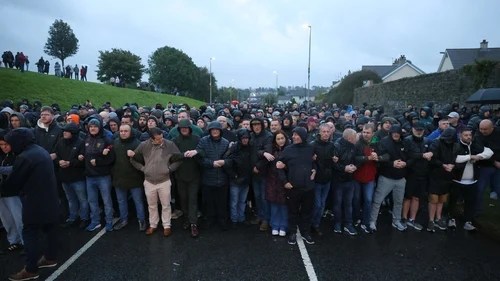
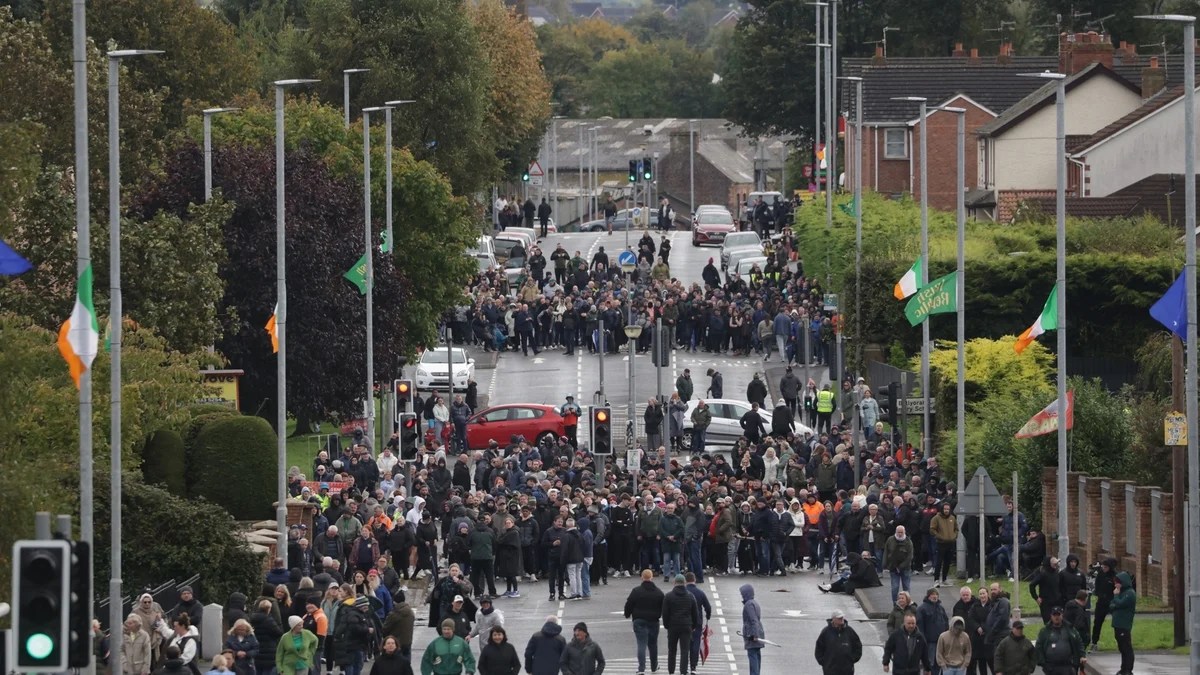
I wrote in the previous post that Sinn Fein turned up at the protests ‘politically naked’, which might seem to be at odds with their acclaimed triumph. The victory however belongs to the residents. It was their mobilisation that prevented the march. It was their opposition that galvanised the appearance of a letter by Protestants opposing the parade, and prompted the support of celebrities, who are always able to garner notice beyond either their number or influence. Their opposition also won widespread support in the rest of the country, North and South. The effect of all this, whatever its political weakness, was to support presentation of the issue not as one of mutual sectarianism by both sides but resistance of one side against it.

In addition to the reasons set out in the previous post, the political nudity of Sinn Fein is exposed by one lesson of the whole affair that more than a few have pointed out: the impasse created by the initial success of Orange demands and the deadlock at Stormont point to the need for a united Ireland to prevent this sort of thing happening again and again. Yet Sinn Fein cannot openly and forcefully put this case because it clashes both with the whole ethos of the peace process and Good Friday Agreement it purports to wholeheartedly support, and with all the flannel about reconciliation and respect for the two traditions which this entails. The residents of Garvaghy Road have just said that they are not reconciled to Orange parades and that they do not respect a tradition that is made up of sectarian bigotry and triumphalism. Most immediately, if they are right – what are Sinn Fein doing at Stormont?

Even in victory Sinn Fein is politically bereft. Media commentary has centred on whether the DUP should leave the Executive, which allows Sinn Fein to avoid the question; just as the DUP can more easily avoid it if the question is focused on Sinn Fein. Yet another example of the parties’ symbiotic relationship. Sinn Fein harps on constantly about the need for a referendum on Irish unity but cannot claim its necessity in order to deal with the demands of the Orange Order. A united Ireland is apparently to result in the same reconciliation with sectarianism that it is supposed to deny. It exposes one of the paradoxes of the claimed need for a united Ireland: aside from satisfying nationalist aspirations – that a united Ireland is a good thing by definition – why is it needed?

Without the intervention of a politically independent working class a united Ireland will involve the 26 county state becoming a 32 county one, with new deformations to accommodate unionists in the North. It’s why conversations about unity in the South centre around flags and anthems, or about special arrangements for the North that don’t involve a democratic challenge to sectarianism but some undemocratic mechanism to accommodate it.

This is illustrated by the other loser from Drumcree – the Irish government.  Taoiseach Micheál Martin damned Sinn Fein because calls for the British to ban the parade down Garvaghy Road were too ‘simplistic’, while Minister for Foreign Affairs Helen McEntee said that the only solution was where the Orange Order and residents could come to an agreement.  No it wasn’t and no it didn’t!

Since nearly all the calls for a united Ireland appear to involve the continuation of Orange parades, a government like the current one in Dublin would be worse than the British one in London! A united Ireland that fails to challenge and defeat sectarianism, but instead panders to it, is not one the Irish working class should support. As nationalism flaps about trying to state what its new Ireland would be like, the working class badly needs its own version and its own movement to fight for it.
Behind the stand off at Drumcree

Socialists in Ireland opposed the Good Friday Agreement because it dictated continued imperialist rule in the North of Ireland that thus necessitated the continuation of sectarianism, enshrined in the rules governing the operation of the devolved administration at Stormont.  The alternative to challenging sectarianism was to freeze it, registering the failure of republicans’ armed project to remove British rule and the inability of Unionism to reimpose the unilateral rule it had enjoyed since the creation of the state until 1972.  For the British and for the Irish state freezing this volatility promised political stability, or at least the minimum of blowback from the North to either of their respective states.

The magic formula was ‘power sharing’.  It hasn’t worked, and no one has claimed it has; except for widespread claims from local politicians, the two governments and the media that it is still the solution.

Widespread dismay at Stormont’s ineptitude long ago gave way to cynicism at its incompetence, dysfunction and mendacity.  You can’t freeze sectarian competition, overseen by London, when the whole point of the system is to ensure the absence of power to the other side.  That is the point of the arrangements – not to share power but to throttle the exercise of it by the other side.  That’s why many people vote as they do – to stop ‘the other side’ as the only alternative to their own – no matter how useless etc. it may be.

It helps that neither Irish nationalism or Unionism has any social or political programme that could transcend sectarian division or promise an agenda that could win over those outside its core support.  Unionism is based on sectarian division and on its continual assertion, while Irish nationalism has surrendered to the idea that it is a legitimate expression of cultural expression and political rights summed up in differing national identities.  It promises to respect the Unionist tradition in its calls for an always imminent border poll for a united Ireland, while the Irish Government touts a ‘shared island’ project designed to lead to the holy grail of the reconciliation of the two traditions and ‘consensus’ on the future.

The Orangemen in Portadown have challenged Irish nationalism to put its money where its mouth is and show respect to its marching tradition, share the Garvaghy Road with its Orange parade, reconcile itself to the legitimacy of its right to so march, and thus accept a consensus that this is the future.

The residents of Garvaghy Road have said that they won’t respect anti-Catholic bigotry; won’t allow its neighbourhood to be subject to sectarian coat-trailing; won’t reconcile itself to a supremacist march that validates the supremacism of those marching and won’t accept that all this is their future.

Sinn Fein leaders turned up to the residents’ protest but they turned up politically naked.  It is they who are partners in government with the Democratic Unionist Party, that just coincidentally is facing an election next year and is wracked by sex scandals.  It is Sinn Fein that has presented itself as supporters of the institutional arrangements that have so obviously failed, including the Parades Commission that approved the Orange march, and the police whose evidence to the Commission ensured its approval.

The police are charged with enforcing the Commission decision but have balked at doing so because it can only succeed by beating the residents off the Road. Such an occurrence would destroy the credibility of any appeal to nationalists to support them and confirm the failure of the Sinn Fein strategy of being at Stormont. Every party supporting the current Good Friday Agreement – from the British and Irish governments, including the police, to the nationalist parties – know this. Rather than accept a forced march down the Garvaghy Road they are in the middle of kicking a can down it.

The cleanest solution for the British is to find a way to stop the Orange march – it’s what has worked for it and others for nearly thirty years. Unfortunately, the semblance of fair and objective discretion embodied in the Parades Commission has been exposed, along with the credibility of a police that advised it of no potential disorder but immediately imported police from Britain to deal with it as soon as the march had been approved.

Some other mechanism is now being called on to mediate a solution that is supposed to satisfy ‘both sides’ but which otherwise must satisfy the British who are in charge. They don’t care one way or the other whether the Orangemen march down Garvaghy Road; their objective is to stabilise their rule through Stormont by keeping both Sinn Fein and the DUP inside it.

The latter has been losing votes and is recording its lowest level of support for more than twenty years so an Orange march would boost its standing. Its long-stated opposition to the Good Friday Agreement doesn’t mean that it will walk out, as its guarded statements over the last few days have shown, but staying in while the Orange can’t march will expose weakness. On the other hand, imposing the march will damage Sinn Fein, whose support has also declined to the lowest in five years. Walking out of Stormont is not on its agenda either, at least not yet. On such shared objectives may rest a resolution although neither the Orange Order or the Garvaghy residents are puppets of either party.

Whatever ‘solution’ arises, the vulnerability and weakness of the existing governance arrangements have been exposed, and a credible socialist alternative remains to be created.

Groundhog Day. Stormont is back! Again!

I remember giving out leaflets at a Sinn Féin demonstration on the Falls Road in about 1993.  The demonstration was called to support the Hume-Adams Agreement, hammered out between the leaders of the SDLP and Sinn Féin after several secret meetings.  No one knew what was in the Agreement, but thousands of republican supporters came out to show their support for it.

I don’t think my comrades, or I, ever had such a keen and eager crowd as the demonstrators queued up to get a copy.  It was clear that they thought they might find out what it was they were demonstrating in support of.  That in itself told us an awful lot about the political consciousness of rank and file republicans at the early stages of the peace process – they were going to faithfully follow their leadership, wherever it led them and swallow whatever they were told.

Many, many subsequent leaflets, and meetings through the long peace process changed nothing of their approach, or raised in them any consciousness that they might require a more critical approach, one that involved some scepticism of where their leadership was taking them.

Only a few years before, in 1987, Sinn Féin had published a document called ‘A Scenario For Peace’ in which it set out its proposals for a settlement to end the conflict.  It included that Britain should declare its intention to withdraw; the Royal Ulster Constabulary and Ulster Defence Regiment would be disbanded; ‘political’ prisoners should be unconditionally released; and Britain should provide a subvention for an agreed period to facilitate harmonisation of the northern and southern economies. In return, unionists would be offered equal citizenship within the new Ireland.

Well, the Hume-Adams talks were not about this agenda, and neither was the peace process.  The British have not gone, the RUC and UDR were indeed disbanded but the former was replaced by the PSNI and the latter were a unit of the British Army, and it certainly hasn’t gone away.  Political prisoners were released but not unconditionally, Britain imposed austerity (and Sinn Féin helped implement it).

The peace process in its various guises is now longer than the war it was supposed to end, and the former looks harder to get to the end of than the latter did.  When it was announced that the devolved Stormont Assembly was coming back, and a Sinn Féin leader, Michelle O’Neill, would be first minister, it was declared by Mary Lou McDonald that this showed that a united Ireland was “within touching distance”.  Of course, the Provisional republican movement has been promising a united Ireland since the early 70s, that is, for over half a century.  A unionist commentator noted recently that a recent opinion poll showed no increase in support for a united Ireland in the North over the last couple of decades.

Some columnists have claimed that the real significance of the return of the DUP to the Assembly and Government is this accession to the post of first minister of Sinn Féin, even while they admit that this is symbolic since the unionist deputy first minister has equal power.  No decision can be taken by the first minister if not agreed by the deputy and the post cannot be filled in the first place without unionist agreement.

In order to minimise unionist opposition to the deal between the DUP and British government over the ‘Irish Sea border’ the process of getting DUP agreement and all it entails is being rushed through.  The DUP Executive thus voted for the deal without seeing it; fittingly appropriate to the return of what passes for democracy in the North of Ireland.

This democracy, in the shape of the Stormont Assembly, has been suspended at least eight times, ranging from a single day to a couple of years.  It has been functioning for only sixty per cent of its existence and subject to a number of reviews and changes with yet more changes now widely canvassed. The sectarian, corrupt, incompetent and clueless governance it has provided and the future problems considered inevitable by everyone who thinks about it (and many don’t) means that the rules are not the problem.

Public services, from health to roads, are routinely described as being in crisis, while others such as education and voluntary organisation are subject to open sectarian practices. It has been claimed that these issues can only be put right by local governance, but its track record shows that it is as much responsible for the decay as British rule.  The repeated suspension allows the alibi to be sold that were it not for suspension public services would be much better.  The previous suspension following the Sinn Féin walk-out, after the DUP-implicated Renewable Heat Incentive scandal, showed levels of incompetence that could more easily be explained as corruption.

The return of Stormont is therefore no step forward, never mind a panacea, and is mainly an unstable framework to accommodate sectarian competition, one that has not proved to be very stable.  It stands on its rotten foundations only because there is no outside force to push it over, while those that have knocked it over temporarily have been internal.  It is widely accepted among the population and further afield because no alternative seems possible, which is why the DUP have gone back in.  This also helps explain why the misgivings of many unionists, and significant opposition, will be unsuccessful in stopping the Assembly’s return.

The opposition has no credible leadership, which would have to come from within the DUP itself, and there is as yet no real sign of this.  Further demoralisation of unionism is therefore one (welcome) result.

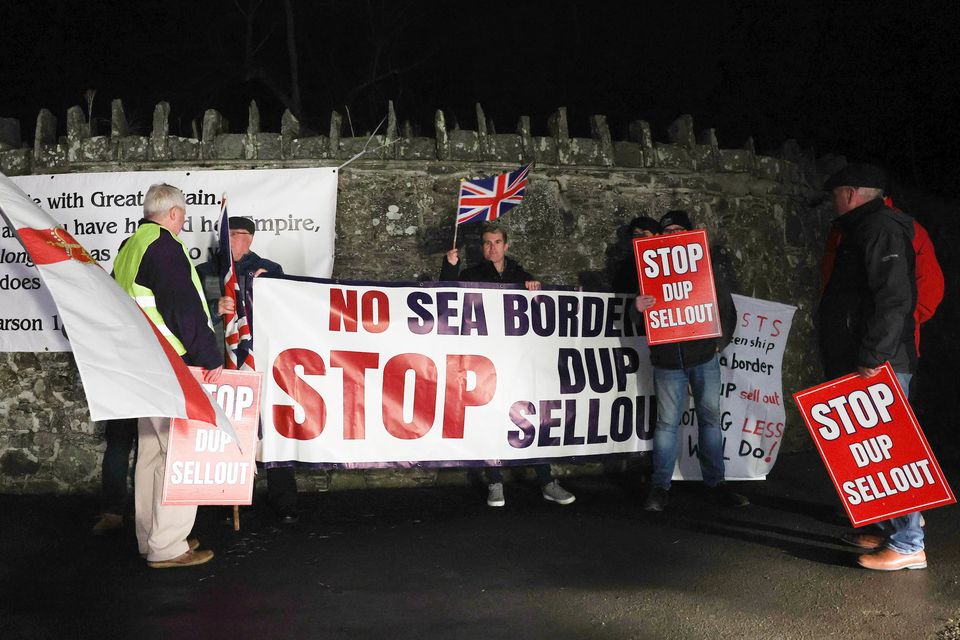
That this is the case throws light on the claim by the DUP leadership that their new deal is a significant victory. Packaged as a joint British government/DUP initiative, and launched by a joint press conference, there is not the slightest pretence at non-partisanship by the British: ‘Safeguarding the Union’ is the name of Command Paper1021.

Its content in 77 pages could safely be accommodated at one tenth of the length.  The measures introduced include proposed legislation to say that Northern Ireland is part of the UK – who would have thought it?  It has proposed legislation to ‘future-proof the effective operation of the UK’s internal market by preventing governments from reaching a future agreement with the EU like the Protocol’, which by definition cannot achieve what it claims.  It also includes a ‘commitment to remove the legal duties to have regard to the “all-island economy” in section 10(1)(b) of the European Union (Withdrawal) Act 2018.’  A bit of red meat for the DUP, and sticking it to Irish nationalism North and South, that will make little or no difference.

It promises that ‘Legislative change to recognise the end of the automatic pipeline of EU law . . . which applies in Northern Ireland is now properly subject to the democratic oversight of the Northern Ireland Assembly through the Stormont Brake and the democratic consent mechanism.’  This implies either future bust-ups with the EU if single market changes are not incorporated into the Northern Ireland market, or a formality to cover regulatory alignment.  The Brexiteers in Britain are aghast at this as they no doubt realise it might not be the former.

Media reporting has suggested that the EU Commission has yet to look at the Agreement but that ‘no red lines’ have been crossed; however, it is hard to believe it has not been agreed and only kept quiet in order to help the DUP sell it as an act of undiluted British sovereignty.

The ‘democratic consent mechanism’ that is held to act as a check on unwelcome EU encroachment states that it can be triggered by a majority of local members of the Assembly and not by some ’cross-community consent’ mechanism.  It is hard to be optimistic that this whole area will not entail future argument.

Other measures include promises on maintaining trade flows that can’t be honoured and a number of new quangos that will deliver more red tape that Brexit promised to get rid of.

The main gain pointed to by Jeffrey Donaldson is the removal of routine checks on certain exports from Britain to Northern Ireland that were set to reduce anyway but are now declared to be zero.  This is on goods, such as retail to consumers for example, that will stay in Northern Ireland and not considered to be at risk of going further into the Irish state and thus the EU single market proper.

Donaldson has, however, claimed too much – that there is unfettered trade between GB and NI and therefore no sea border.  The command paper states that ‘there will be no checks when goods move within the UK internal market system save those conducted by UK authorities as part of a risk-based or intelligence-led approach to tackle criminality, abuse of the scheme, smuggling and disease risks.’

‘Abuse of the scheme’ must mean that checks will be made if it is suspected that goods purportedly sent for sale only in Northern Ireland are actually heading further.  The acceptance of such controls by the DUP has so far been rather successfully sold by the leadership as simply a common sense measure that ensures that checks are made at the Northern Ireland ports instead of a long and windy North-South border.

This problem arises only because of Brexit, which the DUP supported, and of course the argument makes sense in its own terms; except those terms mean acceptance that there is a trade border on the Irish Sea because there had to be one somewhere, and its not south of Newry and north of Dundalk.  The opponents of the Agreement among unionists are therefore right that single market membership means EU law applying in Northern Ireland.  They go wrong when they, like the other hard Brexiteers, assume that the British government must pursue widespread non-alignment, without which Brexit makes even less sense that it already does.

In the last few weeks public sector workers in the North have engaged in very large strike action in pursuit of wage demands designed to recover some of their lost real incomes.  It has, however been subsumed under the politics of Stormont return, even while the trade unions have demanded that the British Government pay up and not use the lack of an Assembly as an excuse. It was supposedly putting pressure on the DUP to get back so the workers could get payed when the DUP didn’t, and doesn’t, give a toss.

The return of Stormont has not been lauded and celebrated as in previous ‘returns’ and the population is jaded by repeated failure and broken promises of a ‘new approach’.  The real new approach required is, unfortunately, a long way off.