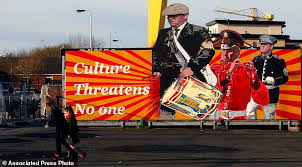
 History has decisively proved that simple removal of Stormont did not entail a move to a united Ireland and that no such move was possible within the North itself. The downfall of Stormont left a strategic gap that was filled by IRA claims that it could drive the British out of Ireland by sheer will and its armed struggle.
From then on, the struggle could go nowhere with such a view and nowhere is where it went. While civil rights protest, and wider Catholic grievance and mobilization could bring Stormont down it could not implement its own solution while a struggle was waged solely in the North, even if it enjoyed Southern sympathy. Only within a wider social movement for change could a progressive solution be imposed against unionist and British state opposition but this is still not even yet a practical proposition.
In terms of the reformability of the North it must also be obvious that the Stormont of today is not the Stormont of 1972. The idea that Catholics and nationalists could be in office was incredible in 1972 yet today Sinn Fein is in office. It is therefore equally obvious that you cannot re-run the story line again and expect the downfall of Stormont to be the same step forward that it was in 1972, even if the first time this step forward made evident the crisis in perspective for the next step.
Today Catholics and nationalists are not demanding the downfall of Stormont but that Sinn Fein stick it up to the unionists and demand equality within it. Unfortunately, the equality demanded is not that of civil rights, which started the whole struggle off, but of communal sectarian rights which socialists must oppose.
The nature of the counter-revolution in Northern Ireland (if it can be put that way) is that the struggle for unity around civil rights has been corrupted to one of sectarian rights with most people oblivious to the difference. Calls for a Workers’ Republic in such a situation takes us no step forward in the real world unless it signals not an end-point but a process to get us there – just as for Marx communism was not a state of things but a movement that abolished the present state of things.* So what then is this movement given today’s conditions and circumstances and how will it abolish the present state of things from the premises currently given?
Despite the experience of incompetence, corruption and general venality there is little demand for the downfall of Stormont except from those who say they prefer Direct rule from a British state with a reputation for some minimal probity and competence (that will suffer greatly from Brexit). The only other constituency is that which has been dismissed as dissident republicanism, which despite decades of Provisional betrayal of the traditional republican programme cannot convince anyone, including itself, that it can do anything other than repeat the failure of the Provos.
The task of socialists in elections therefore is to begin, and we really are only at the beginning, to break down the sectarian solidarity, not by thinking we could simply remove the mock-Parliament that oversees it but by building a movement that goes through Stormont in order to destroy it. If this much experience of sectarian corruption and its baleful effects that we have endured is not enough to expose it and the uselessness to workers of sectarianism then it is unfortunately the case that we need to experience more of it, and we will, and crucially to have a socialist presence that can expose it and present a concrete alternative. And by concrete I obviously mean more than slogans – slogans are easy and if sectarian division was amenable to easy slogans we wouldn’t still be faced by its dominance.
So pretending that workers are already virtually united is as barren as the view that, even though they aren’t, a direct struggle for state power and creation of their own Republic is a concrete alternative. If it is not, then socialists are clearly fighting to build a working class movement not win this movement to revolutionary politics as if this were Russia 1917 or Germany 1918 or Spain in the 1930s. If we are faced with the task of building this labour movement then we can only be in the position of seeking reforms since only the working class through its mass movement can achieve a social revolution.
There are two questions to consider at this point as a possible objection to what I have just said. First, while social revolution can only be carried out by the working class acting as a class, political revolutions that do not require the overthrow of capitalism obviously can be carried out by movements that aren’t socialist. Most political revolutions of the last couple of hundred years have not been working class or socialist. Such non-socialist revolutions can be progressive if they place the working class in a better position to fight for its own interests, if for example they increase the scope and capacity for workers to organise.
For a number of reasons a political revolution that creates an independent Irish democratic Republic (that is still capitalist) is unlikely to happen. First, no significant class or political force is interested in carrying it out and the same applies to the international configuration of classes and forces that will be decisive for political and social change in Ireland. Those who think that struggle for such a democratic revolution will travel towards a socialist one in some version of revolution that keeps going are wrong. The social revolution is not something the working class will stumble upon in the course of seeking something much more limited.
The second point is that fighting to create an independent working class movement that fights for reforms that are designed primarily to strengthen itself is itself a revolutionary approach. What is reformist is not seeking to strengthen the working class movement through smaller or greater steps or leaps but rather to seek to advance its cause through reliance on the capitalist state through nationalisation or other state intervention, or confusing socialism with left-wing MPs and TDs in or out of governmental office.
All this is very general and presents the socialist alternative at a very high level of principles which should guide more concrete and specific proposals. However, even at this high level it is already clear that this approach differs from that practiced by the Irish left.
To make this alternative more specific is not a question of a set of proposals that guarantee growth of the left. Ultimately a party of the working class cannot rise any higher than the working class itself. The working class party is only such if it is part of the working class, yet both preponderant left approaches are not about how this working class can be made stronger but assume that it just has to be led differently.
But the fact that working people in the North of Ireland vote massively for sectarian based parties is not simply a question of leadership but reflects the divisions in society which mean that class cleavage is not decisive to the everyday experience that shapes their political consciousness. How this is changed is the problem and only the self-activity of working people themselves is capable of accomplishing this task – the emancipation of the working class is a task for the working class itself and socialists can only help to lead such a process by being leaders in rebuilding the labour movement to become the political representative of the class as a whole.
Since elections in themselves are a small part of working class experience, though play a rather larger role in their experience of politics, it is outside elections that the working class alternative will be built. In elections, you only reap what you have sown. As Engels put it “universal suffrage is the gauge of the maturity of the working class. It cannot and never will be anything more in the present-day state.” In other words, it will not be the road to socialism, and the generally pitiful votes for self-declared socialist candidates shows how far to maturity it has to go. Facing this reality is the first step to changing it. Pretending that either it is anything other than badly divided or that it can be presented with the task of overthrowing the state is to fail to take that step.
*“Communism is for us not a state of affairs which is to be established, an ideal to which reality [will] have to adjust itself. We call communism the real movement which abolishes the present state of things. The conditions of this movement result from the premises now in existence.”
Back to part 1
See also here
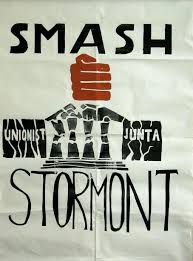 It is often argued in parts of the Irish and British left that the Northern Ireland state is irreformable. Not in the sense that all capitalist states cannot be reformed to become instruments of working class rule, but in the sense that it is irredeemably sectarian and can never become a ‘normal’ capitalist democracy in which religious division is not primary.
 I’ve just finished watching Question Time and the performances of Theresa May and Jeremy Corbyn. I can’t remember the last time I watched it and I haven’t a clue when the next time will be after having watched this one.
 Years ago ‘The Guardian’ ran an interview with celebrities on the last page of its Saturday magazine and always finished with the same question – how would you like to die? The answer that I remember, the only one, was “after a long time and before my children”. I thought then that this was the best answer that could be given.
 Much of the previous post setting out the circuit of capital accumulation is basic to the understanding of Marxists, although many would now not appreciate Marx’s view that socialists should not seek to destroy capitalism by simply trying to prevent it from working – by putting up barriers to trade and thus frustrate the conversion of money into commodities and commodities into money: M – C and C’ – M’.

 When Karl Marx reviewed his career in 1859 he highlighted four works that he had written – The Poverty of Philosophy, Communist Manifesto, Wage-Labour and Capital and a pamphlet on Free Trade.
 My last
  On October 24 1990, a Derry man Patsy Gillespie was abducted by the IRA, tied to the driver’s seat of a van and told to drive the van packed with explosives to a British Army checkpoint on the border with Donegal. While doing so his wife and children were held at gunpoint. Two other such bombs were also delivered to targets on the border on the same day. Using others to deliver bombs was a well-known IRA tactic and almost inevitably the driver got out at the target and warned of the bomb.
