
 When I first heard that the British Government had agreed that there would be “regulatory alignment” in trade across the Irish border I immediately though ‘perfidious Albion’ again – appearing to say one thing when meaning something else entirely; in fact almost its opposite. When I then heard that this formulation replaced the Irish Government one of “no regulatory divergence”, I believed my suspicions were confirmed.
While appearing to accept harmonisation of regulatory regimes, “regulatory alignment” is perfecting consistent with parallel regimes, as in parallel lines that never meet and that never involve harmonisation. Such an arrangement might even mean a UK line of “bargain basement” regulation far below that of the higher EU line of more stringent regulation.
So, my immediate question was whether the EU were going to buy it? I thought that the Irish Government could hardly do so, even if it had most to gain from getting progress to an overall trade deal it could not let it be based on separate regimes that would require a ‘hard’ border to police the different goods and services that were the products of two regulatory regimes. But it had always been wondered in Ireland how much and how far the EU would back the little Irish State that had been so easily bossed about during the collapse of its banking system, to the benefit of the larger member states.
But then the Irish border is not simply an Irish border, something the thickest of Brexiteers have had difficulty in understanding, but is an EU border, and the EU could not compromise its internal market by allowing the free circulation of any old “bargain basement” crap within that market.
My suspicions about British intent seemed confirmed the next day when the British Minister for cocking up the negotiations David Davis said that Teresa May had “made a very plain case for the sorts of divergence that we would see after we left . . . that there are areas in which we want to achieve the same outcomes, but by different regulatory methods”.
“Alignment is not harmonisation. It is not having exactly the same rules; it is sometimes having mutually recognised rules, mutually recognised inspection and all that sort of thing. That is what we are aiming at”. “I have explained to the House that regulatory alignment is not harmonisation. It is a question of ensuring similar outcomes in areas where we want to have trade relationships and free and frictionless trade. Anything we agree for Northern Ireland in that respect, if we get our free trade area, will apply to the whole country”.
In other words, the British had been continuing their policy of cherry-picking the EU Single Market, which the EU had rejected, and an approach accurately described as ‘having your cake and eat it’.
The DUP then came along and torpedoed the deal, making the British Prime Minister look like the disaster she patently is.
But now we have a real deal (?) agreed by all sides, where once again we see that “In the absence of agreed solutions, the United Kingdom will maintain full alignment with those rules of the Internal Market and the Customs Union . . “ (para. 48) That word again.
But this deal has been signed off and Leo Varadkar has called it “bulletproof” with only “stylistic changes” from the earlier draft while newspapers have run with headlines proclaiming a “soft’ Brexit. On the right, Nigel Farage has been declaring the deal a “capitulation”, although he’s been declaring a sell-out for a while now and, true to his little Englander outlook, he’s much more exercised about the so-called ‘divorce bill’ that the Irish question. And when I say the Irish question, I mean the problem the Irish have when they vote one way and the British state decides you’re having something else.
Crucially, May has retained the support, for now, of the leading Brexiteers in the Tory Party, although it’s an open question how long that will last. She has got it past the DUP, who are nevertheless unhappy with it.
So, what’s in the new deal?
Well, if you read it, the first thing that might strike you is that it’s not really a deal, at least not in the sense that it’s a locked down agreement. The deal is a “joint report”; it “records the progress” made and that both parties have only “reached agreement in principle.”
In paragraph 5 it says:
“Under the caveat that nothing is agreed until everything is agreed, the joint commitments set out below in this joint report shall be reflected in the Withdrawal Agreement in full detail. This does not prejudge any adaptations that might be appropriate in case transitional arrangements were to be agreed in the second phase of the negotiations, and is without prejudice to discussions on the framework of the future relationship.”
So there is no final agreement.
In the section on Ireland and Northern Ireland paragraph 43 restates the British promise of no ‘hard border’ (presumably in Ireland), which, without the necessary deal or detail, means not very much; while it also promises to preserve the integrity of the UK market (para.45) – so no border on the island and no border at the Irish sea either, it would appear. But unless the EU decides that its Single Market and Customs Union will not be protected, this cannot be the case – there has to be a border somewhere, if the UK is to leave the EU.
The next paragraph states that:
“The commitments and principles outlined in this joint report will not pre-determine the outcome of wider discussions on the future relationship between the European Union and the United Kingdom and are, as necessary, specific to the unique circumstances on the island of Ireland. They are made and must be upheld in all circumstances, irrespective of the nature of any future agreement between the European Union and United Kingdom.”
This appears to say that the deal, in so far as it actually is a deal, is for Ireland only, except a UK commitment made in the previous paragraph states that it applies to the UK market as a whole in the sense that the integrity of this internal market will be preserved. There is evidently a problem here so how will this be addressed?
Paragraph 49 appears to provide some guidance:
“The United Kingdom remains committed to protecting North-South cooperation and to its guarantee of avoiding a hard border. Any future arrangements must be compatible with these overarching requirements. The United Kingdom’s intention is to achieve these objectives through the overall EU-UK relationship. Should this not be possible, the United Kingdom will propose specific solutions to address the unique circumstances of the island of Ireland. In the absence of agreed solutions, the United Kingdom will maintain full alignment with those rules of the Internal Market and the Customs Union which, now or in the future, support North-South cooperation, the all- island economy and the protection of the 1998 Agreement.”
Here we have the problem of avoiding he hard border restated and a promise that the British will propose a solution, one they have promised since the start and on which they have delivered nothing.
Except this time, the report states what happens if this failure continues and it is on this that the supporters of a ‘soft’ Brexit might seem to be right – that a soft Brexit is the result of the joint report. Without a solution to avoid a hard border, agreed with the British, the single market and customs union will apply. Of course, this application is qualified, limited by the terms after the word “which”, including the 1998 Belfast Agreement and implicitly the specific areas of economic cooperation mentioned in it, and it still only talks about alignment.
But the next paragraph appears to address this limitation:
“In the absence of agreed solutions, as set out in the previous paragraph, the United Kingdom will ensure that no new regulatory barriers develop between Northern Ireland and the rest of the United Kingdom, unless, consistent with the 1998 Agreement, the Northern Ireland Executive and Assembly agree that distinct arrangements are appropriate for Northern Ireland. In all circumstances, the United Kingdom will continue to ensure the same unfettered access for Northern Ireland’s businesses to the whole of the United Kingdom internal market.”
But this doesn’t remove the problem of continuing barriers on the Irish border but restates that there will be no barriers at the Irish sea – so we are back to where we were in terms of mutually incompatible promises of no real borders anywhere. This paragraph simply adds that there will be no new barriers between Northern Ireland and Britain unless the NI Assembly decides there should be, except the next sentence rule out the North deciding the trade position of the rest of the UK.
More contradictions are thus included in this paragraph on top of those already existing. Except this paragraph has effect only if there are no agreed solutions to the Irish border arrangements, and that gets us back to the text of the previous paragraph, and that the UK will “maintain full alignment with those rules of the Internal Market and the Customs Union which, now or in the future, support North-South cooperation, the all- island economy and the protection of the 1998 Agreement.”
Paragraph 49 restates the UK commitment to avoiding a hard border and describes that “any future arrangements must be compatible with these overarching arrangements.” But it then says that the UK’s intention is to achieve these objectives through the overall EU-UK relationship. In other words, the way to avoid a border within Ireland and one between the island and Britain is to have no real border between the EU and the UK – a really ‘soft’ Brexit!
The short paragraph 51 is certainly compatible with such an approach – “Both Parties will establish mechanisms to ensure the implementation and oversight of any specific arrangement to safeguard the integrity of the EU Internal Market and the Customs Union.” Of course, this could also mean that the British would have to police the Irish border if Northern Ireland was to leave the Customs Union and Single Market ,and not simply leave it to the Irish as some have declared it would.
So, what we have is an agreement that is only a “joint report” which is not finally agreed, with contradictory drafting. In other words, it’s a political agreement and it is only politically that it can be judged, although of course the words on the page are not unimportant, if only because they set out the terrain of differences and Jean-Claude Junker has made it clear that it is the starting point for the withdrawal agreement.
On this count the only way to make what’s in it intelligible and remotely consistent is to see the UK remaining within the Customs Union and Single Market. But we also know that cannot be the case, at least not yet, because the Tory Party has obviously not agreed it.
From Theresa May’s point of view the can has been kicked down the road on Ireland, while agreeing to the ‘divorce’ bill. Despite the nonsense mantra that “no deal is better than a bad deal” she appears to have woken up to the fact that no deal is the worst deal, but she can’t sell it to the Brexit fundamentalists.
She could not let the talks collapse at this stage because she would then have failed. There would be no need for her and her Tory rebels could plan to get rid of her. The pace of withdrawal of business from the UK would accelerate and she would be to blame. The accumulating contradictions of Brexit as a project would crystallise and her Government would collapse.
The EU has no reason to see the talks collapse now either. They do not want ‘no deal’ and also want an agreement, if not as desperately as the British should, and more time allows, well, more time for the British to come to their senses, through whatever set of circumstances brings this about. – defeat for the Tory Brexiteers in parliament or a Corbyn Government.
From a political point of view therefore the fight against Brexit and this Tory Government goes on. Its Brexit policy has been demonstrated to be indefensible and the contradictions that sit on the page of the ‘joint report’ will play themselves out in the living world. The working class must fight its corner because it has a real stake in the outcome.
 The Bolsheviks faced the same problems as their Tsarist predecessors, caused by war and economic collapse. It was their ideology that determined their particular responses.
 All political forces in the revolution made their own political choices, which conditioned the choice of others. As the revolution developed the liberal Cadet party moved increasingly into an alliance with the remnants of the old Tsarist regime and the forces that had supported it, including the nobility, generals and landowners. Such an alliance demanded continued support for the war, opposition to peasant expropriation of landed estates and defence of the prerogatives of capitalist owners of factories, which were more and more subject to workers’ control.
 If we consider the conditions that gave rise to the Russian Revolution, these were massive economic dislocation caused by war on an unprecedented scale and an equally unprecedented social and political crisis that rocked the existing state to its foundations, creating a revolution outside the control of any political force.
 We have just celebrated the centenary of the Russian Revolution, the key reference point for Marxists and their politics during these one hundred years.
 When I
  A small slit in the wall at the wooden pole was used to shoot the unsuspecting prisoner in the back of the neck, sometimes with a dum dum bullet, while a gramophone playing in the first room helped cover the noise of the shot in the execution room, which was itself sound-proofed. Within ten weeks in the autumn of 1941 over 10,000 had been shot. The newly arrived prisoners rarely lived longer than a couple of days.
 The front-page headline of ‘The Irish News’ yesterday read ‘Sinn Fein and DUP accused of ‘political carve-up’ of £4m’ – a report on the joint decision of the two parties in Belfast City Council to spend £2m on museums and a ‘training hotel’. The training hotel is a ‘social economy training hotel’ in the loyalist Shankill area and the museums include an Orange Hall museum and a ‘James Connolly Interpretive Centre.’
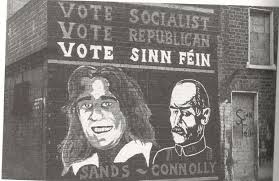 The second point I want to respond to in the response to my initial posts is what Socialist Democracy have to say about the nature of Sinn Fein (SF), which in my view is once again confused.
 In two
