The state of job creation

In my last post on the politics of the left I questioned proposals on state investment as the answer to unemployment.  In this post I want to look at this further.  The Nevin Economic Research Institute (NERI), an economic think-tank affiliated to the Irish Congress of Trade Unions has published a similar proposal to that of the United Left Alliance (ULA).

Its paper is entitled ‘An Examination of the Effects of an Investment Stimulus’ and its research shows that an investment stimulus of €1 billion would create about 16,750 short term jobs and between 675 and 850 long term jobs.    In the longer term the competitiveness of the economy is increased so that the economy grows, which increases taxation, which more than offsets the interest cost of any loan to fund the investment in the first place.  This means that “overall there is a long-term permanent decrease in the government deficit as a result of an investment stimulus.”  This is what has been referred to often as growing our way out of the crisis and debt problem.  NERI therefore proposes a phased investment stimulus of €15 billion over 5 years.

The net cost per job created, at around €34,500, is nearly the same for both the NERI and ULA proposals.  The paper by NERI sets out more fully its assumptions so it is fair to assume that these are not dissimilar to those of the ULA, which in any case we can also fairly adduce from the ULA proposals themselves.

In order to arrive at its estimates the NERI researchers use an economic model.  Like all models these require assumptions as to how the economy works and therefore how the parameters of various economic variables interact, e.g. how imports will increase given a certain increase in income as employment increases.  This is calculated from historic data from the Irish economy.  The HERMIN model used “combines Keynesian short term features with neoclassical longer term features.”

This is a problem, or rather there are two problems, not perhaps so much for the presumably Keynesian researchers at NERI but for the ULA, whose biggest components claim to be Marxists.  The Marxist analysis of the way capitalism works is very different from the Keynesian or neoclassical one.  Unfortunately, through the budget proposals of the ULA and their similarity to those of NERI, the policy proposals of the ULA display much affinity to Keynesian economics.  We have noted this already in their definition of the problem as being one of insufficient demand, which is also the view of Keynesian economists.

For Marxists this is indeed a feature of the current crisis, indeed of all crises.  Where the difference lies is that Keynesians think that this problem can be put right by state-led investment while for Marxists the lack of sufficient demand is really just one expression of deeper problems but not the fundamental cause of the crisis, which will not be put right by expansion of state expenditure.  This fundamental difference is invisible when the proposals of the ULA and NERI are compared.

For Keynesians the capitalist economy can reach equilibrium, where demand for investment funds and its supply are equal, in a situation where there is nevertheless massive unemployment, both of people and resources.  The autonomous action of the state in increasing investment can solve this problem and bring the system back into an equilibrium that resolves the unemployment problem.  For Marxists state investment can at most postpone the crisis but is not itself an answer.  By contrast the ULA present it as part of the answer.

For Keynesians the autonomous action of the state can provide a solution because the system can reach equilibrium and investment can be the driver of the economy to this equilibrium.  As the Keynesian Minsky puts it –“Investment and government spending call the tune for our economy because they are not determined by how the economy is now working.”  That a model shows state investment to be self-financing when that model contains Keynesian assumptions can hardly be called convincing. Keynesianism believes that “if entrepreneurs can only screw themselves up to do enough investment, it will eventually justify itself, since the income generated will absorb the excess capacity.” (Robin Mathews in ‘The Trade Cycle’)[i]

On the other hand Marxists see this type of statement as an example of bourgeois economists overwhelming tendency to assume that the capitalist economy works like a socialist one; that all production will more or less fulfil a useful role.  After a crisis based on massive construction expenditure that powered a phenomenal boom and then bust, this is just an incredible assumption.  The NERI and ULA proposals are based on further infrastructure spending by the same state that encouraged the last ‘stimulus’. That NERI believes this will lead to long term growth is again built into the neoclassical assumptions of the model.  Neoclassical economics assumes that capitalist markets are totally free and efficient.  A model built on such long term assumptions could hardly show anything else.

Neoclassical economics assumes that production is efficient and finds a market and that growth is the result.  Marxism makes no such assumptions but instead demonstrates the contradiction at the heart of an economy determined, not by autonomous investment, but by the pursuit of profit.  The recent massive overproduction of infrastructure was massively profitable, which is why it continued for so long.  The contradiction between this profitability and real need; the contradiction between the limitless expansion of capital and the limit of the market, was suspended temporarily and resolved temporarily by the expansion of credit.  When this expansion of credit can no longer continue the limits of the market are exposed and massive overproduction , which inevitably involves massive over-accumulation of capital, is revealed.  Keynesianism’s answer is to continue the accumulation because investment will find its own market and in any case can be autonomous within the system, as we have seen.  Marxists believe on the contrary that the accumulation of capital is determined by profit and lack of it may see accumulation shudder to a halt and collapse.

In a contest of economic ideas, between neoclassical economics where crisis are not supposed to happen and are self-correcting when they do, and Marxism, in which overaccumulation driven by super-profits is periodically inevitable, the real world has given a decisive confirmation of the latter. In a contest in which Keynesianism can assume investment creates its own demand and is self-financing and Marxism which points out the contradiction in production between use and profit, the empty office blocks and ghost estates are again striking confirmation of the truthfulness of the latter.  So why oh why would the left want to promote Keynesian solutions?

There is absolutely no reason to believe that a renewed burst of construction spend would not create new imbalances.  Perhaps the left believes that because the state carries out the spend it does not have to earn a profit but this is false for a number of reasons.

First it has to pay for the investment.  If it takes out a loan it will have to pay it back and if the investment does not create tax revenue by promoting further private capitalist investment it will not raise the necessary tax.  In these circumstances taxation would have to come instead from workers or business, which would remove the stimulus that has been created.  If the investment does stimulate or facilitate private investment then this only confirms ULA reliance on the state promoting capitalism as the way out of crisis.

Although the ULA does call for €5.3 billion of state investment in modern industry it calls for much more, €26 billion, to be invested in infrastructural investment.  In fact even some of the modern industry investment is in infrastructure.  Such infrastructural investment is normally not competitive with the main private capitalist industries but complimentary to it, facilitating it to make profits.  By making such spend central to its economic alternative the left, subconsciously no doubt, evidences the inadequacy of its alternative and subservience to capitalism.

An alternative is that state investment is directed to the production of goods and services that people actually need and want and are prepared to pay for.  This would indeed be competitive with private capitalist owned industry but this is not what is proposed by NERI or the ULA.  Instead either taxes or the promotion of private capitalist production through helpful infrastructure is proposed.

In our last post on this we questioned the policy of reliance on state investment given its history of incompetence, even in areas of no great complexity or requiring no great innovation.  The left sometimes excuses this (why?) as the result of subordination of the public sector to private capitalism.  And the answer to this is yes, that is what the capitalist state is for.  It is not for creating competition to private capitalism so why would the left demand that it does?

Even if the specific proposals of the left, in the particular circumstances that Irish workers face, are not practical this is not the main objection to them.  The main objection to them has possibly more force where they actually to work.  For if they worked, even if only temporarily, they would be both a diversion from creation of a socialist alternative and some evidence that this alternative is not needed.  The success of state industry would be the success (temporarily) of state capitalism.

The successful development of capitalism has been facilitated by the state many times and it may be argued that the more recent, and quicker, that development the more it has relied on the state.  This may be true going back through the development of every new major capitalist power from Holland in the 17th century, to Britain in the 18th, Germany and America in the 19th and 20th, the Asian Tiger economies of the late twentieth century and the Chinese of the 21st century.

The socialist alternative is something very, very different from this but the left’s fixation on the power of the capitalist state is strong and we shall look at the question some more.


[i] The quotations above are taken from a new paper that compares the Marxist explanation that the capitalist economy is driven by profit with the Keynesian alternative of the role of investment – ‘Does investment call the tune? Empirical evidence and endogenous theories of the business cycle’ See link.
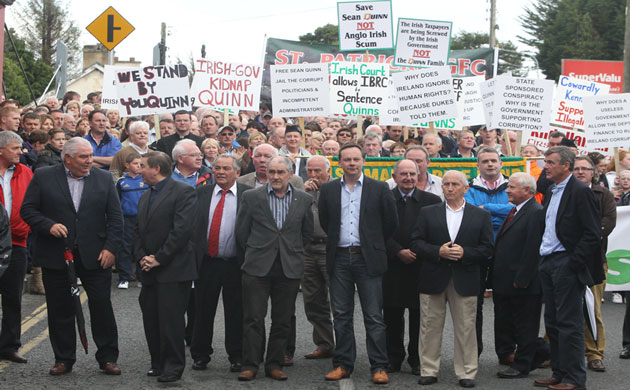
 

Workers rally in support of Millionaire Quinn

Ireland is in the throes of an economic slump with official unemployment at nearly 15 per cent despite emigration.  Severe cuts are being inflicted on essential public services; there are large cuts in take home pay and glaring inequality as the wealth of the richest in society has actually risen in the last few years.  So how do we explain that in one corner of Ireland four thousand of the plain people of Ireland demonstrated in support of a man who was very recently the richest man in the country and who was at the centre of a disastrous attempt to buy the most rotten of Ireland’s very rotten banks?

In a small corner of County Cavan thousands demonstrated in support of Sean Quinn as he dodges and dives to keep large bits of his foreign property empire out of the hands of the successor to the Anglo-Irish Bank from which he took out loans to buy the property but is now unable to pay back.  The property was security for the loans and now that he can’t repay the loans the State, through the Irish Bank Resolution Corporation (IBRC), wants the property.  In effect the local population was demonstrating in favour of Quinn holding on to this empire by underhand and devious means ,to keep it out of the hands of a state bankrupt and making huge cuts that affect those demonstrating as much as anyone.

In this he was supported by a local and high-profile priest, by a local Sinn Fein MP and by a number of senior and well-known figures within the Gaelic Athletic Association.  The columnist Kevin Myers once wrote that he could imagine Ireland without Fianna Fail, without the Irish language and without the Catholic Church but he could not imagine it without the GAA.  Especially in most of rural Ireland that is how important the GAA is to local society.  It is such a huge and varied organisation that it cannot be said that the GAA as a body supports Quinn but the members present were too numerous and prominent for the relationship to be simply dismissed.  Sean Quinn’s brother Peter is an ex-President of the Association and a further ex-President Sean Kelly, a Fine Gael MEP, also issued a statement in support.

I was having a conversation in the car with my other half when she said that they all had one thing in common – they were all men for whom it is always about them.  When I also pointed out that it could be said they were also all quite well off, Catholic or ‘culchies’, she thought for a moment and said – no, it’s all about them being men with their masculine egos.  Then I said that the worst aspect of all this was that so many ordinary people had come out to support him but she disagreed with this as well and said they were demonstrating because he had given them work.

Quinn is by far the biggest employer in the area with cement and glass businesses, a large hotel and latterly branching out into insurance.  It was his €2.3 billion gamble on buying Anglo-Irish Bank that brought this business empire down.  There seems little recognition locally however that not only has he sought to deprive the state of much needed funds and caused an increase in everyone’s insurance premiums required to pay for his mistake but he gambled with people’s jobs to enrich himself when he was already filthy rich.

Now, while claiming through tears, that he is a victim, a man with plain needs and modest life style he has ensured that his relatives have been paid hundreds of thousands of Euros from the Russian property companies that he is trying to keep hold of. The wife of his son has, for example, been paid €320,297 after tax by a Russian company owned by the Irish State while being a part time receptionist at a motor dealership in north Dublin.  Yet people on a fraction of this came out to declare that he has been hard done by!

For some the demonstration of support is but the latest expression of a long lived Irish slavish mentality that has much in common with peasant attitudes of supine deference to a local feudal Lord. The great and the good declare the Lord one of us and the serfs oblivious to their real interests blindly obey their masters and betters.  Such a view however is only possible from outside.

Cavan and Fermanagh are not some atavistic backwater with ignorant peasants innocent of the sophisticated ways of the modern world.  What is in evidence is not some centuries-old peasant tradition of subservience.  The rural location gives some apparent justification to such views but the industries they work in are modern, few make money directly from the land and they are as educated as anyone in the country.  What is expressed is a particularly personal and local phenomenon of dependency which characterises the whole country and which is only particularly noticeable because of the scale of the local dependency.

The obvious power of the Quinn family in economic terms has been extended naturally into an ideological and social power over the local community and become repulsive to many only because it is so personal and accentuated by the local circumstances.  Expressed in a rural idiom it is easy and tempting for others to ridicule and mock but such acerbic criticism has much bigger targets if it were only to look.

In what way is the subservience of some of Cavan people any different to the subservience of all the people of the Irish State to an unholy trinity of State, banks and property developers   who have placed on their shoulders a debt so huge that their children will be paying for it for decades to come?  In what way is the willingness to support the local Lord any different from the near universal political agreement across the State that the richest multinationals, including speculative financial institutions, should shape economic and social policy, despite the economic disaster they are so closely associated with, while the poorest and most vulnerable must suffer?  If the slavish dependency of some people in Cavan offends so much why doesn’t the much greater dependency of the whole country not also?

The exhibition of subservience witnessed in one part of rural Ireland is not to be excused.  It must be understood and above all recognised as simply a particularly obvious reflection of the exploitation and oppression of the working people of Ireland.  In this respect it is fundamentally no different from the position of workers anywhere.  The notion that Quinn gave people work is accepted as fact just as capitalists employ workers while workers are employed.  But Quinn didn’t give people work, the people gave work to Quinn and he gave them back an amount of money worth less than the work they provided.

Under a system of private ownership by capitalists of the means of production it is nearly always the case that it appears that the capitalist gives work to the workers, and it is not that this is a pure illusion.  In a very real sense workers do depend on capitalists for jobs, which they create and destroy regularly.  This dependency and its results become obscene in some circumstances but it exists everywhere.

It’s time that working people, some of them, started to put forward an alternative, starting with the left and not one that presents the state as the fountainhead of this alternative.  The alienation of people in Cavan from this state (and the banks it supported), easily pictured as a remote Dublin cabal, is a distorted reflection of what would otherwise be a healthy impulse.

After all, for socialists the alternative to Quinn is not the Irish Bank Resolution Corporation, is it?

Back to the Future? – the State to deliver jobs?

Before it went on holiday the government announced the stimulus package for the economy that many in opposition had demanded. An additional €2.25 billion is to be spent over the seven years to 2018 on roads, schools, a new college site in north Dublin, primary health care centres and Garda headquarters. The government claimed it will create 13,000 new jobs and is designed as a stimulus to the economy that will promote growth.  Green Party leader Eamon Ryan got it right when he said the “plan is a throw-back to the last century when the only way Irish politicians knew of stimulating the economy was to pump money into the construction industry.”

Unemployment is 309,000 or over 440,000 if you include part time, seasonal and casual workers entitled to Jobseeker’s benefits or allowances.  The stimulus will therefore not stimulate very much.  The chief Economist for the Irish Congress of Trade Unions (ICTU) nevertheless said it was “an important step in Ireland’s recovery.”  The Irish Business and Employer’s Confederation (IBEC) welcomed it in almost identical words saying it was “an important first step in helping to restore domestic demand in the Irish economy.”

The feeling of déjà vu became overpowering when the Minister announcing it, Labour’s Brendan Howlin, had to ‘explain’ why road projects were going ahead in his own constituency.  His Department was also unable to provide a journalist with any cost/benefit analyses for individual projects, which are always nice to see even when they begin ‘once upon a time’.  A commentator described one road project as “largely a vanity project” and that it “never added up even at the height of the boom.”

The money will come from what’s left of the National Pension Reserve Fund, so workers will know their future pension money is being craftily spent.  Some will come from the European Investment Bank but it’s not clear how much.  Some will come from the sale of state assets.  This is where the state buys duff things from the private sector – like banks – which cost it a lot of money and sells good stuff – like companies that make profits – which also cost it money.

No spanking new construction project would be complete without the involvement of the banks and they too will be involved, although again it isn’t known by how much, but since these are funded by the State this doesn’t really matter that much.  Finally, to complete the story, much use will be made of Public Private Partnerships, a partnership where one partner gives money to the other, for example when roads don’t have the traffic that was predicted but one partner gets paid anyway.  Again we don’t know the figures but we’re not expected to get much exercised over this because it’s all for a good cause, although it’s the usual story of being bribed by your own money.

Fianna Fail complained that many of the announcements would have no effect for six years, which might have been a good thing had it applied to their own policies.  They complained that some of the announcements were bringing back projects that the government had just cancelled, such as the Grangegorman project, which inspires confidence that planning by the capitalist state will continue to be used as a weapon to discredit socialist planning. The word planning might however be going a bit too far since Howlin said it would be nice to give the new jobs to people from the Live Register and also to apprentices who haven’t finished their training, but “I don’t want to promise  that that can be done.”   It’s wonderful how governments can promise to spend billions of workers’ pension and tax money while saying that they can’t promise that it will deliver what it’s supposed to deliver.  The sense of building new health facilities while preparing to get rid of health staff and of building new college facilities while cutting the number of lecturers seemed not to have been questioned by many.

The Irish State doesn’t have a great record when it comes to investment.  It bought 700 electronic voting machines for €55 million and they didn’t work.  It wasted money on hospital co-location, decentralisation and €100 million on the ‘Bertie Bowl’.  It commissioned a PPARS IT system for the health service with an original budget of €9 million in 1997 which ballooned to €120millin in 2004 before being pulled in 2007.  The Auditor General reported that the roads programme which was supposed to cost €5 billion ended up costing €20 billion.  The high-technology Media Lab Europe set up jointly with the Massachusetts Institute of Technology was to focus on the development of digital technology but went into liquidation within five years with consultants describing its output as “mediocre, “surprisingly weak” and “dismal”.

The United Left Alliance’s budget statement stated that “the current crisis cannot be resolved without a state led programme of investment.”  It proposes a reversal of cuts in capital spending and an emergency state programme of infrastructure investment costing €26 billion to get 150,000 back to work.  If we assume unemployment at around 310,000 this would still leave 150,000 unemployed. What happens to them?  The programme is to last “for at least five years”.  What happens after that? The economic contraction has already been going nearly five years and the slump could continue five more.

The ULA wants to employ workers’ private pension funds just like the government wants to use the pension funds of public sector workers.  The ULA wants the latter money, €5.3 billion, to fund investment in modern industry and it rejects privatisation.  Instead it wants state companies to carry out this investment.  If successful this might make some further dent in the unemployment total and at the cost of job creation estimated in its infrastructure programme this would reduce unemployment by perhaps 30,000. Of course there would be further multiplier effects but this depends on the overall performance of the economy.

It is the assumption around this performance that motivates both the proposals of the government and the ULA.  As we have seen, the bosses organisation IBEC, and also ICTU, see the problem as one of insufficiency of demand and the government’s stimulus “an important first step in helping to restore domestic demand in the Irish economy.”  The ULA say “direct government job creation through public works is necessary to promote effective demand and halt the deepening crisis.”  The government, bosses, trade unions and the left offers a similar analysis of the problem and a rather similar remedy.  Of course the trade unions and left oppose privatisation but state ownership in itself is not socialist. What we have, as in the sphere of taxation, is a difference of quantity in the measures being proposed, not a difference of quality.

What the ULA proposes, based apparently on a Keynesian analysis of the problem, is not socialist although, if successful, would have a big impact on defending workers’ living standards by reducing unemployment and defending its welfare entitlement, take home pay and public services.  Were its proposals to succeed they would go some way to providing a capitalist alternative to the policies of austerity although they would do little to prevent the regular future occurrence of capitalist crises.

Lest it be thought this judgement too harsh let’s go back to just one proposal of the ULA, that of using workers’ pension funds.  This is a proposal that the capitalist state that has saddled the working class with an unsupportable debt and denuded its state pension fund, imperilling the pensions of future workers, should also take a chunk of workers’ private pensions, and it with its sterling record of investment and economic management.  In effect it’s a capitalist expropriation of workers funds with no more than a promise from a politician for comfort, and a few Irish workers have had letters of comfort from the Irish State before.

The workers should take over management of their own pension fund?  They should promote worker owned firms to address the problem of unemployment?  Heaven forbid!  That sounds like socialism.