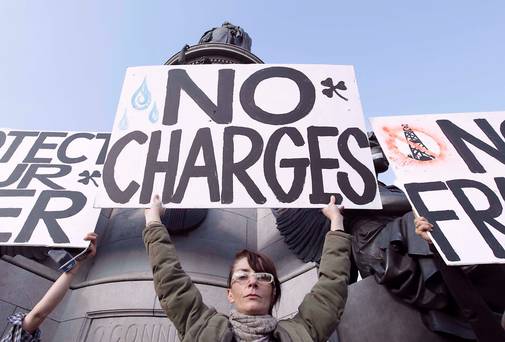
‘Fragments of Victory’: The Contemporary Irish Left’, book review (2 of 6)

In the book’s introduction we are informed that after the 2016 general election one in 20 members of the parliament was a Trotskyist”, which would, for example, translate to over 30 MPs at Westminster.  In the conclusion it notes that this election was ‘perhaps the greatest electoral success of Trotskyism in any western country ever’, ‘the development of one of the strongest electoral lefts in western Europe’ (p177)

Except this avoids the question of what manifesto – what political programme – did these ‘Trotskyists’ get elected on that was in some way supported?  Was it in any way a revolutionary socialist one and if not, in what sense was it a vote for Trotskyism or for Trotskyists? What wider movement, if any, did the vote reflect?  How isolated was it, or was it the vanguard of a much wider radicalisation?

Fragments initially appears to be organised around the concept that there is some identifiably coherent ‘left’, except reading it reveals that this is not the case.  There is however some commonality that we alluded to at the end of the previous post, but it is this commonality that is itself incoherent.

We are informed that the Irish were one of the ‘strongest electoral lefts in western Europe’ and that this ‘left’ not only includes the ‘Trotskyists’ but also Sinn Fein; so we know that however strong this left became in electoral terms its political unity is at the very least questionable. You can assemble the various parts but it becomes less an alternative the more it is put together.

On page1 we learn that the left ‘won some victories’ (a near unique achievement in western Europe during this period) that ‘other countries could learn from.’  Yet in this introduction we are also informed that the austerity following the economic crisis ‘created a collapse of living standards, experienced by many’ with emigration that exceeded ’even the highest rates . . . of the past’.(p 13) 

On page 3 we learn that apart from Sinn Fein other left wing parties and campaigns ‘have struggled in the face of the new political challenges’ while despite ‘widespread support for leftwing politics, the left has failed to build lasting political and social institutions . . . After a decade that saw the left win real victories, mobilise hundreds of thousands and transform the electoral landscape, in many ways the left finds itself in a strangely weak position.’  These judgements are all in one paragraph!

In the conclusion, after noting some successes, including electoral gains, it states that ‘despite these successes, the left is in many ways as weak as it was pre-2008.  No lasting form of working-class self-organisation has emerged.  Union density is lower now than it was in 2007.  No mass parties have emerged.’ (p177-8)

On the next page we learn that ‘These apparent advances by the left in Ireland contrast sharply with the decline of its counterparts in most of the West . . . the left in many countries is in a worse position than it was before the crisis.’ (p 178). ‘The advance of the left in Ireland is even more striking when the political situation in pre-crisis Ireland is compared with that of Western European states.’ (p179).

It notes the failure of Syriza in Greece and Irish hopes for it, although Ireland did not even produce a Syriza and, as the book acknowledges, its defeat led Sinn Fein to shift its rhetoric to the right, opening the door to junior partnership in government with one of the two main bourgeois parties.  Gerry Adams is quoted –“I have to say, I never really subscribed to that notion of a left-wing government, certainly not in the short term.  I mean, who are the left.” (p 171) A very good question, to which Adams gives one element of an answer – it doesn’t include Sinn Fein.

This favourable comparison with the rest of Europe sits uncomfortably with the observation that ‘Missing in Ireland, especially in the early years, were the massive explosions of protest seen in other countries during 2009–13’. (p 184). 

Nevertheless, we are told that ‘The material successes of the Irish left and its social movements have been unique . . .’ (p185) and ‘the achievements of the social movements since 2008 are striking.  There are some real, substantial victories. Hundreds of thousands were mobilised. And the political culture of Ireland was definitely changed.  The neoliberal consensus . . . is over.’  ‘Today the left in Ireland is no longer marginal. While in almost all of Europe the last few decades have witnessed the decline of the left. In Ireland it has grown in strength’ demonstrating ‘what can be achieved.’  ‘There is today in Ireland significant support for the left . . .’ (p191)

These advances were apparently based on an already well-positioned movement because ‘in some ways, the left in Ireland was well prepared for the crisis.’ (p185). By this is meant that it was not focused on identity politics and ‘cultural questions’ although in fact this is not the case.  It is just that the majority of the Irish left have swallowed gender identity politics for example with hardly a debate, mirroring the introduction of gender self-id recognition carried out by the state purposely also without debate.

The conclusion presents ‘two key findings’, including that ‘the 2008-18 period saw the emergence of major mass movements that have both fundamentally changed Ireland’s political life and can provide lessons for the left internationally.’ (p188)

‘Trickier to identify, but unquestionably real, Ireland is a more leftwing country than it was in 2007 . . . Between the summer of 2021 and the summer of 2024, the left consistently outpolled the right, whereas before 2008, the left only had a third of the support for rightwing parties.’  Also adduced as evidence is that there is now recognition of the need for state intervention to solve the housing crisis. (p184). The problem with the latter however is that this state intervention has largely been to incentivise private sector solutions, which the left has denounced.

The success is qualified – ‘looking forward, the achievements of the last 15 years seem rather more fragmented’ and even the ‘electoral gains arising from a period of struggle . . . is now very much in the rear-view mirror.’  In the same paragraph it notes that the campaign victories over abortion rights and water tax ‘failed to result in lasting organisations.’ (p191). The other ‘side of the coin’ as the book puts it. (p3)

Capitalist crisis did not see ‘the re-emergence of working-class self-organisation and provide a space for the activity of the radical left’ while ‘mass movements were less a story of mass organisation than mass mobilisation’ (p180-1,182)

The movements since 2008 were ‘large but ephemeral’, ‘failed to lay deep social roots’, ‘failed to identify an avenue through which society might be changed, and given this, they have failed to develop a mass political consciousness around the capitalist nature of our society or around what needs to be done to change it.’  While they apparently ‘frequently terrified the ruling elite’ ‘they have never presented a serious challenge to the existing order.’ (p183)

Despite the positive evaluation and even with the qualifications, which leave a rather confusing picture, the real damaging conclusion is contained in these comments:

‘In many ways, despite the victories of the left since 2008, the future looks bleak.’ (p190). ‘It is hard to believe Sinn Fein will deliver the change that many desire . . [and] It is unlikely the Trotskyist People before Profit will manage to articulate a viable alternative . . .’ (p191) So despite short-term victories’, ‘the steps between the current situation and the long-term goal of socialism are less clear than ever before.’ (p192)

The book’s last words are that ‘it is clear that fragments of victory are not enough.’ (p 192) with the fatal verdict that despite the ‘striking’ advance of the left and ‘the apparent success of the Irish left’, the radical left ‘were engaged in a form of politics incapable of realising its own aims.’  (p179 &181)

Back to part 1

Forward to part 3
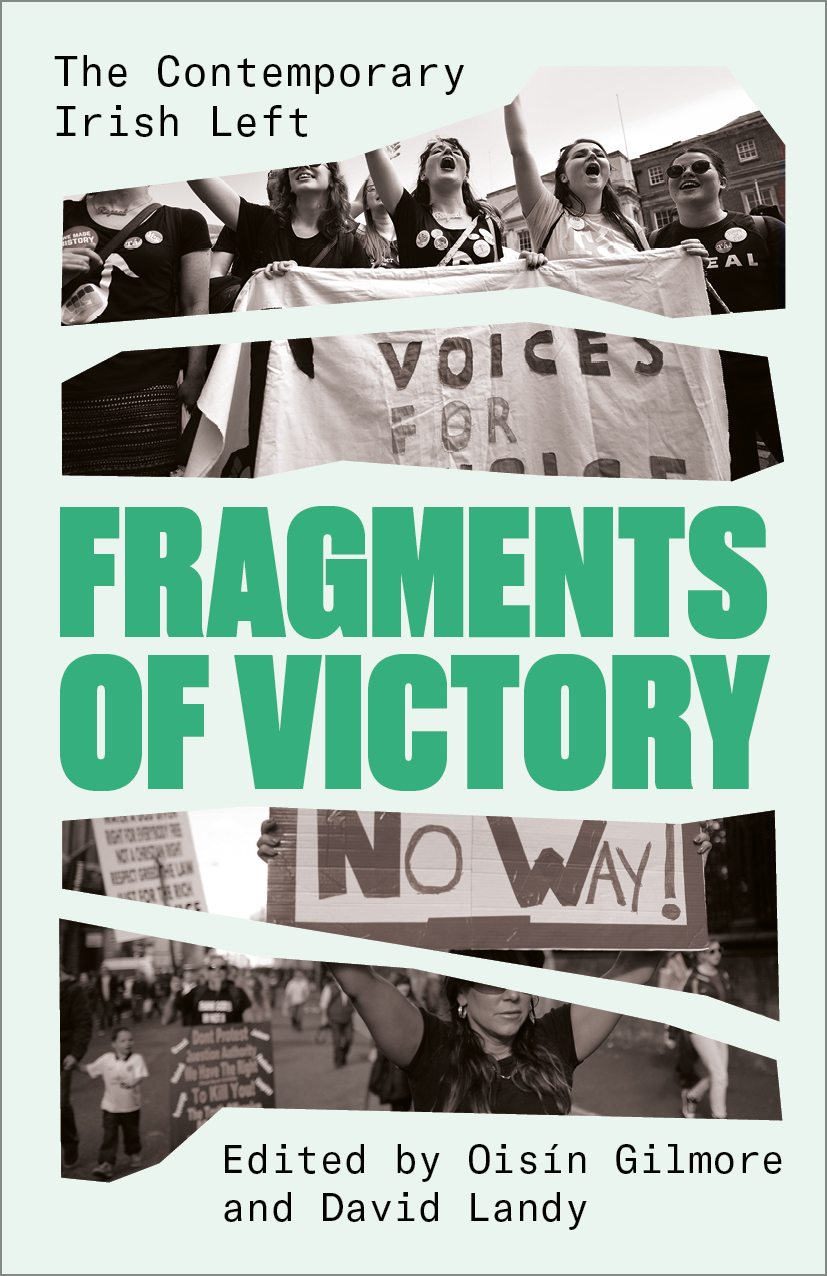
‘Fragments of Victory’: The Contemporary Irish Left’, book review (1 of 6)

Reading ‘Fragments’ I was reminded of the statement by Marx that ‘We develop new principles for the world out of the world’s own principles. We do not say to the world: cease your struggles, they are foolish; we will give you the true slogan of struggle. We merely show the world what it is really fighting for, and consciousness is something that it has to acquire, even if it does not want to.’

Fragments sets out to record the struggles of the Irish left (in the Irish state) over the past few decades so that the reader can form a view on its successes and failures.  In doing so we can apply Marx’s prescription and determine to what extent it shows the left ‘what it is really fighting for’ so that it can be conscious of the lessons that should be learned.

There are some obstacles in the way, including the variety of authors with different viewpoints although an introduction and conclusion is meant to summarise the results.  The major problem is the definition of what it means to be ‘left’.  In the introduction Sinn Fein and the Green Party are listed as left even though the major theme of the book is the response to the implementation of austerity following the collapse of the Celtic Tiger and the consequent bankruptcy of the State.

During this period Sinn Fein presided over austerity while in a coalition government with the DUP in the North, while the Green Party entered into a coalition with Fianna Fáil in 2007 that bailed out the banks and inaugurated widespread cuts in social welfare and wages.

As part of the relaunch of Stormont in 2015 the ‘Fresh Start’ agreement committed the parties, including Sinn Fein, to reducing NI civil service staff numbers: ‘Between April 2014 and March 2016, the NICS is set to reduce headcount by approximately 5,210 and between April 2015 and March 2016 a further 2,200 will exit from the wider public sector.’ The Green Party supported the bank bailout that the state could not afford, which resulted in the intervention of the Troika of the European Commission, European Central Bank and IMF, along with the huge austerity necessary to satisfy their demands.

Even taking account of the elastic possibilities permitted by employing a relative term such as ‘left’, it is difficult to sustain any claim that these parties are in any substantial or verifiable way left-wing.  Sinn Fein was described by a comrade of mine a long time ago as containing members with left-wing opinions and right-wing politics.  The party has, in the meantime, fully confirmed this judgement while in government.  The Green Party began life as The Ecology Party promising ‘a radical alternative to both Capitalism and Socialism’ but in office twice it has displayed no alternative to capitalism and therefore no alternative to socialism.

Looking at political struggle through the lens of ‘left’ versus ‘right’ has therefore the potential to obfuscate as much as it clarifies.  A more illuminating approach is to set out the class nature of the politics of a political party and to explain why different parties with generally similar class natures have the politics that they do, even if they have different colouration.

Thus, as a nationalist party, Sinn Fein is a petty bourgeois party that considers the Irish people as one, with any class distinctions completely secondary and subordinate to the interest of the nation and its state, which can represent the true interests of all the people simply because of their nationality.  The Green Party claimed at its birth to have a radical alternative but also rejected a class approach through its largely petty bourgeois base and ideology.  It confirmed its class character by its members enthusiastically joining Fianna Fáil in government (voting 86% in favour) and by its commitment to the banks and austerity.

It might appear difficult to assign a class identity to some parties, and any classification has to be justified, but this is precisely the point of identifying the class nature of the forces involved.  As petty bourgeois parties, both Sinn Fein and the Greens have imposed austerity on workers while espousing radical rhetoric.  Calling them left is an attempt to obscure this and works to introduce doubt that they will not always fall on the side of the capitalist class in a struggle.

Fragments demonstrates this repeatedly, even when making secondary observations, for example that individual members of Sinn Fein were active in the Campaign Against the Household and Water Taxes but that the party was not: ’This form of partial (non-)commitment proved to be the defining feature of Sinn Fein’s approach to most political struggles of the time.’ (p37)

Approaching politics this way allows us to make judgements of other ‘left’ parties such as the Labour Party and Social Democrats etc. and permits an understanding of their behaviour during this period.  While the Labour Party paraded its ‘Labour’s Way’ as resistance to ‘Frankfurt’s Way’ while in opposition, it had no alternative to austerity when in government.  The doubling of its vote in the 2011 general election was a prelude to its consequent decimation in the next one.  ‘Labour’s Way’ didn’t become Frankfurt’s Way’, not having an alternative meant it always was.

Was the 2011 vote for Labour therefore a victory for the ‘left’ and was its subsequent decimation a defeat?  Did those who voted Labour in 2011 make an advance in consciousness or do so by deserting it in 2016? Or were they just registering disappointment and resignation?

Fragments offers the view that despite Labour delivering austerity when in office ‘the new government retained a huge amount of goodwill . . . the crisis was clearly not their fault and . . . the harsh austerity measures they took were seen as both forced by the Troika and, while painful, necessary’, while ‘the ‘honeymoon lasted for much of 2011 . . .’  (p31) So, were these views completely discarded when the Labour Party was dumped out of office? Was there any real advance in consciousness of an alternative when it happened?  Is roping the Labour Party into ‘the Left’ clarifying either history or the future?

Today, all these parties are allied in supporting Catherine Connolly for the post of President with the additional enthusiastic support of People before Profit and Solidarity.  The latter’s politics are supposed to be based on the view that existing power in capitalist society does not come from parliament but from the permanent state apparatus and the economic and social power of the capitalist system, yet they promote the idea that election to a post that is admitted not only to be without power, but forbidden to exercise any, would be a major advance.

Paul Murphy, People before Profit TD, states on Facebook that ‘this is a rare opportunity for the left to come together, and elect a voice for workers, for women and for neutrality.  Change starts here.’ This is a left that includes all the parties above that have been tried and tested.

In doing so all sorts of illusions in the role of bourgeois politics and institutions; about the ability of one person to represent the nation, and all the people within it; because of a one-off vote, and of the way ‘change’ can be made, are strengthened against an alternative view that real change comes from the organisation and struggles of the working class itself.

Are such views ‘Trotskyist’, as Paul Murphy’s organisation is called in the book? Or is this term used because that is just how it is usually described, or should such a designation not require some comparison of its political practice to a reasonable account of what Trotskyism is?  The umbrella term of ‘left’ addresses these questions by rendering them unimportant, and this is a problem.

To anticipate one message of this review; Fragments provides enough testimony to show that a different approach is necessary and that an alternative is required to the illusion that there is a ‘left’ that should be united to advance the cause of the working class.

It demonstrates, in its own way, that only a class analysis can explain events, including the actions of the state, why it succeeded in imposing austerity and why the resistance to it was unable to rise to the challenge.  Explaining all this in terms of whether certain actors, institutions or policies were ‘left’ or ‘right’ is hopeless not only because of the vagueness of the terms but because all of these acted out of material interests, as they perceived them, and these in turn were based on objective factors that were fundamentally determined by class relations.

Forward to part 2

Understanding ‘Citizen Marx’ 3 of 3

Engels once said that ‘Marx and I, for forty years, repeated ad nauseam that for us the democratic republic is the only, political form in which the struggle between the working class and the capitalist class can first be universalised and then culminate in the decisive victory of the proletariat.’

The context was a claim against him that when ‘the socialist party, will become the majority’ it will ‘then proceed to take power.’  Engels however stated that ‘For a start, I have never said the socialist party, will become the majority and then proceed to take power.  On the contrary, I have expressly said that the odds are ten to one that our rulers, well before that point arrives, will use violence against us, and this would shift us from the terrain of majority to the terrain of revolution . . .’

Responding to the question of what form this power would take – ‘Will it be monarchic, or republican, or will it go back to Weitling’s utopia’, Engels replied that of course the Reichstag deputies are republicans and revolutionaries, the question of a Republic being the most controversial political question in Imperial Germany at that time.

Engels goes on to ask whether it is implied ‘that the German socialists attribute no more importance to the social form than to the political form? Again he would be mistaken. He should be well enough acquainted with German socialism to know that it demands the socialisation of all the means of production. How can this economic revolution be accomplished? That will depend on the circumstances in which our party seizes power, on the moment at which and the manner in which that occurs.’ (Engels, Reply to the Honourable Giovanni Bovio MECW Vol 27 p271)

What Engels is making clear is that the fight for democracy is vital to the struggle of the working class to achieve political power not that it is necessary to have a republic as the first step to communism. Even where the question of a Republic was the unmentionable political issue, the objective was ‘the socialisation of all the means of production.’

On a separate occasion he said that ‘If one thing is certain it is that our party and the working class can only come to power in the form of the democratic republic. This is even the specific form for the dictatorship of the proletariat . .’ (emphasis added – SM) On the question of a Republic he explains the content of the demand, if it is not possible to employ the term itself: ‘But the fact that in Germany it is not permitted to advance even a republican party programme openly, proves how totally mistaken is the belief that a republic, and not only a republic, but also communist society, can be established in a cosy peaceful way’

‘However, the question of the republic could possibly be passed by. What, however, in my opinion should and could be included is the demand for the concentration of all political power in the hands of the people’s representatives. That would suffice for the time being if it is impossible to go any further.’ (Engels A critique of the draft Social-Democratic programme of 1891, MECW Vol 27 p227)

Engels in his postscript to Marx’s Civil War in France wrote ‘And people think they have taken quite an extraordinary bold step forward when they have rid themselves of belief in hereditary monarchy and swear by the democratic republic. In reality, however, the state is nothing but a machine for the oppression of one class by another, and indeed in the democratic republic no less than in the monarchy; and at best an evil inherited by the proletariat after its victorious struggle for class supremacy, whose worst sides the proletariat, just like the Commune, cannot avoid having to lop off at the earliest possible moment, until such time as a new generation, reared in new and free social conditions, will be able to throw the entire lumber of the state on the scrap-heap.’

‘From the outset the Commune was compelled to recognize that the working class, once come to power, could not manage with the old state machine . . .’  The bourgeois republic was not therefore the mechanism to advance towards communism.

Marx noted of the Paris Commune that ‘the political rule of the producer cannot co-exist with the perpetuation of his social slavery.’

Back to part 2

‘The People’ before Profit? – Karl Marx’s alternative to capitalism (part 67)

The substitution of ‘the people’ for the working class as the subject of struggle is presented In Ireland, in an almost classic case, by the People before Profit organisation, whose reformist politics are based on actions demanded from the Irish capitalist state.  While ‘people’ are to come ‘before profit’, ‘people’ replaces the working class, while coming before profit still leaves profit in place.  And anyway, aren’t capitalists people as well? 

This precept fails to bring to the fore the ‘property question’, demanded by Marx in the Communist Manifesto, whereby the profit of capital arising from exploitation of the working class is not de-prioritised but abolished!

It might be argued ‘what’s in a name’, were it not for the fact that the name was deliberated on and selected precisely in order to avoid clearer identification with the working class and socialism. Presumably because reference to ‘the people’ is more readily acceptable; postponing the task of raising awareness of the paramount role of class and denying the centrality previously accorded to it by anyone calling themselves Marxist. In asserting the priority of the people, and so rejecting the primacy of class, the organisation is setting an example to be followed, not one to be excused or ignored.

Failure to root socialist politics in the material reality of the working class leaves it rootless and prey to the material reality of other forces – we have already pointed to the role of the state in the political alternative offered by People before Profit – but the ideologies encompassing this are many.  Nationalism and racism require denial of the separate political interests of the working class – socialism is international while racism denies working class unity.  It is precisely class interest that is the alternative to these reactionary programmes, not acceptance of the prior interests of an undifferentiated people.

It is possible to fill this missing foundation with moral claims to ‘humanity’ which bases internationalism on ‘human rights’; the ‘self-determination of (capitalist) states’, or protection of minorities based simply on their being a minority.  Similarly, it is possible to oppose racism based on human rights, ‘diversity’, ‘inclusion’ and opposition to ‘hate’, but these are even more vague and useless than the concept of ‘the people’.  Their employment by many on the left, tellingly often paraded under the banner of a ‘social justice’ movement, is testament to a collapse into liberal (i.e. bourgeois) politics compared to which the 19th century republicanism we have been examining in the previous posts looks positively revolutionary.

If class is not primary and immediately necessary in order to take forward a movement and programme what is opened up is the intrusion of a wide variety of identity politics that makes nationality, race, or sex etc. the primary means of securing freedom from oppression. This in turn can lead to ‘intersectional’ coalitions that further divide while pretending to unify.

It leads to rejection of the view that the working class is the only social force able to create a new society and which alone can unite the oppressed through the abolition of class. It thereby simply becomes one segment of society with no reason to prioritise its role more than any other.  Petty bourgeois ideas of individual subjective identity flourish where the nebulous abstraction of ‘people’ becomes the source of power to change the world.  With this view of politics the numerous instantiations of the people come to substitute for the working class, which in turn leads to the search for a mechanism for them to do so, and which is invariably found to be the state.

In 1849 Marx criticised the naive belief in a single “will of the entire people” rather than that of a singular ruling class (or grouping of classes) that might represent its own interest as that of society as a whole, or at least of its large majority:

‘For the National-Zeitung there exists one will of the entire people, which is not the sum of contradictory wills but a united and fixed will. How is that?

That is—the will of the majority.

And what is the will of the majority?

It is the will which emerges out of the interests, life situation, and conditions of existence of the majority.

In order to have one and the same will, the members of the majority must therefore have the same interests, the same life situation, the same conditions of existence, or must be temporarily linked together in their interests, their life situation, their conditions of existence.

In plain words: the will of the people, the will of the majority, is not the will of separate estates and classes but of one single class, and of those classes and fragments of classes that are socially—i.e., industrially and commercially—subordinated to this ruling class.

“What should we say to that?” Is the will of the entire people the will of the ruling class?’

(Marx, Marx and Engels Collected Works Vol 8 p272, Articles from the Neue Rheinische Zeitung)

Marx, in The Civil War in France, noted that the Paris Commune ‘was the first revolution in which the working class was openly acknowledged as the only class capable of social initiative, even by the great bulk of the Paris middle class—shopkeepers, tradesmen, merchants—the wealthy capitalists alone excepted. The Commune had saved them by a sagacious settlement of that ever-recurring cause of dispute among the middle classes themselves—the debtor and creditor accounts.’

It was necessary then (as it is now) for the working class to be the ‘universal’ class and to represent the needs of a society oppressed by the prevailing system: ‘For the first time in history the petty and moyenne middle class  has openly rallied round the workmen’s Revolution, and proclaimed it as the only means of their own salvation and that of France!.’ (Marx, The Civil War in France, Marx and Engels Collected Works Vol. 22 p336 & 496)

This was not something that Marx learned only from the Commune but was something strikingly demonstrated by it, particularly the need to win the majority of the population that was then composed of peasants.  How this need is addressed today depends on the particular class composition of society, but this requires that the idea of a unified people is abandoned and the various classes and their interests identified.  In relation to the peasantry, for example, it did not mean strengthening or enlarging their individual property, while a programme based on the demands of ‘the people’ would leave this wide open.

In the writings through which he and Engels formulated their particular politics, The German Ideology, he argued that ‘For each new class which puts itself in the place of one ruling before it, is compelled, merely in order to carry through its aim, to represent its interest as the common interest of all the members of society, that is, expressed in ideal form: it has to give its ideas the form of universality, and represent them as the only rational, universally valid ones.’ For the working class, this is realised through the abolition of all classes, including itself.

Marx identified this early in his political development (in 1843) before becoming a ‘Marxist’ and expressed himself in the language of the philosophy of the time: ‘No class of civil society can play this role without arousing a moment of enthusiasm in itself and in the masses, a moment in which it fraternises and merges with society in general, becomes confused with it and is perceived and acknowledged as its general representative, a moment in which its claims and rights are truly the claims and rights of society itself, a moment in which it is truly the social head and the social heart.’ (Marx, Introduction to A Contribution to the Critique of Hegel’s Philosophy of Right)

For this to happen the working class must win others as allies to its programme.  This can only be done if, in the words of The Communist Manifesto, socialists ‘disdain to conceal their views and aims.’  It will not be done by pretending that its views are those of an amorphous ‘people’.  You can only rally others to your flag if it is your flag.

Back to part 66

Forward to part 68

Part 1

Bourgeois democracy – reply to a critical reader

In the previous post a reader of the blog expressed disagreement with my approach in a comment.

He stated that “I find it hard to fathom how you can heavily criticise bourgeois democracy like you did in a recent post and at the same time advocate for something you call democratic rights.”

The comment doesn’t reference the particular post and makes only general references that are difficult to identify, including reference to the views of Marx as quoted by Paul Cockshott. I agree with the comment by Boffy in response that:

“I am always rather suspicious of people who cite what Marx and/or Engels are supposed to have said about something, without actually giving the quote, and source of it, because I have frequently found that either the claim is false, altogether, or else, the context, and text of what they said completely changes the meaning of what is being claimed. Given what they say in the Communist Manifesto about workers having no country, and the fact that they were themselves refugees from Germany, makes me doubt what is being claimed for them, here.”

I can only add that it is not altogether clear what the comment Boffy responded to is claiming.

In relation to bourgeois democracy – this post being one example – it is one political form of the dictatorship of capital – the exploitation of the working class, which is separated from the means of production and subject to wage slavery, as its labour power becomes a commodity.  I don’t see how you can be a Marxist and not take this view.

Does this mean we cannot demand and fight for democratic rights within capitalism?  Only the most formal of formal logics could lead to such a view and someone who regularly quotes philosophical thinkers should know this.

The fight for democratic rights was recognised by Marx as necessary in order for the working class to develop itself politically so that it could have the freedom to identify its separate interests, organise around them and struggle for the realisation of the dictatorship of the proletariat.  The word ‘dictatorship’ has rather changed its meaning since it was used by Marx and does not refer to lack of freedom but to the economic and social domination of the working class – uniting the working class with the means of production through cooperative and common ownership, the ending over time of the wage relationship and thus ending of exploitation.

The struggle for this freedom includes the struggle for democratic rights which are not “abstract principles . . .like as a magician pulling rabbits out of a hat” but are concrete measures to be imposed on, or accepted by, the state through working class struggle.  One of the points I have made continually is not to base the struggle for these rights on appeals to the state but to be won by the workers themselves, in opposition to the state if necessary.

He asks “Are your democratic rights legal claims that somehow endure without the presence of a State”?

Marxists do not invent a world subsisting without a state; we recognise the real world that exists in which there is one.  It is why Marxism has no need to invent such things as natural law.  Rights are not worth much if they cannot be validated and this very often is done by the state: so often the democratic rights demanded are demanded from the state, to be accepted by or imposed on it, but always with the view that it is the power and activity of the working class that will ultimately protect and defend them, to whatever extent this can be done within capitalism.

Marxists believe that society can only be understood as it really is – and thereby changed –  by recognising that it is structured by classes with their irreconcilable interests. It is the writer of the comment who is guilty of proposing ‘abstract’ ‘principles’ and ‘morals’, which is why he states that he doesn’t understand what I have written.  It is why he says such things as “I can honestly say I don’t know what these things are” and that “I might not agree with humanitarian morality but at least I could say I understood what was going on.”

When he says that he “would be happier if you and others who speak up for and march out for the asylum seekers did so on the basis of some common humanitarian morality” he simply says that he would be happier if I lapsed into the “abstract principles” he denounces as akin to “pulling rabbits out of a hat.”

He provides me with the option of justifying my position by saying that “I can see how you might get around the problem by imputing an interest and not a morality to the working class.”  And this is roughly what I have done, although I would not put it in those terms.  This, however, is an option that he obviously rejects, yet also rejecting a general “humanitarian morality” as an alternative. Where that leaves him is not my problem.

He then states: “let’s us assume that the bulk of the working class misrecognises the interest you impute to them or consciously rejects that interest. Well you are back with your principles again, an undisclosed humanitarian morality. It turns out therefore that lurking behind the objective interest of the working class is an undisclosed humanitarian morality.”

This is a big, big assumption, and the history of the working class demonstrates that significant numbers have identified that they have a separate interest.  This is demonstrated objectively in the alienation of the working class; its distrust of its rulers and opposition to many of its actions – including those rulers support for the current genocide in Palestine. It is demonstrated in its separate organisations, and in its long history across the world of class struggles big and small – from strikes to revolutions.

Naturally the bourgeois media, culture industry and education system ignores or distorts all this, which makes its undeniable existence all the more necessary to recognise and appreciate.  But let us presume that the assumption is correct for the sake of argument.

If it were true that “the working class misrecognises the interest you impute to them or consciously rejects that interest”; i.e. that it never develops class consciousness; then yes, there would be no material interests that could be realised, and any such interest would be abstract, therefore general and “undisclosed.” The point of the blog is to disclose this interest and advance understanding of what it is so that it can be realised in the real world, through informing working class struggles that are going on quite independent of it.

This is where morality ceases to be abstract, is attached to material interests, where ‘what is’ meets ‘what should be’.  To understand this, it is necessary in some way to be part of the struggle to understand and change the world.  The commentator is not part of this, so appears incapable of understanding Marxism. It is this purely contemplative perspective that, it seems, means that he never gets the point. 

Has the Irish Left missed the boat?

Screen-Shot-2015-05-31-at-02.29.362An article in the ‘Village’ magazine presents the argument that the Left has missed the opportunity to translate widespread opposition to water charges into a significant challenge to the status quo in the coming general election.

As a hard fact that must be faced, the author of it notes that it’s now possible to imagine not only a Fine Gael and Fianna Fail coalition but even the re-election of a Fine Gael/Labour Party Government.  What a kick in the teeth that would be!  Rather like the re-election of the Tories in Britain.  “It’s time for some serious self-criticism” he says.

The conclusion drawn, although it remains totally unexplored, is that the people “have found the alternatives unconvincing.”  That is, they have found the left alternative unconvincing.

It’s not clear to me from the argument of the article that many ever did but I’m not going to go very far in this post in looking at this either.

Instead I want to reflect on the response that the article has evinced from the Socialist Party TD Paul Murphy.  While there appears to be a debate here the grounds of it are very narrow indeed.

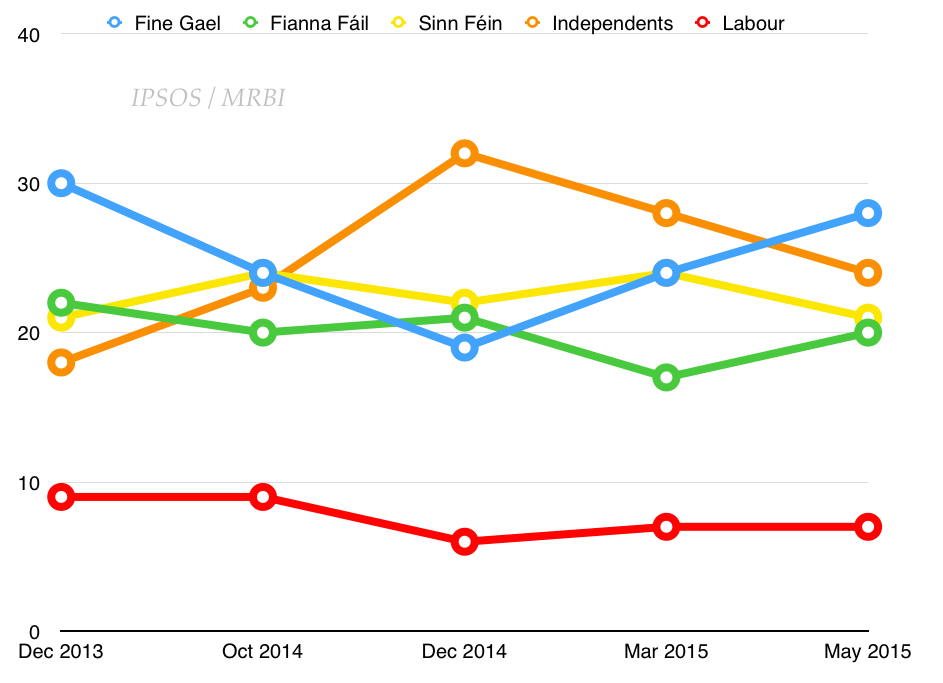
In his call for self-criticism Ronan Burtenshaw first points to opinion polls which showed a rise in support for independents during 2014, from 18% or 22% (depending on the poll) to 32% and 30%.  Support for the two established right-wing parties on the other hand had fallen from 30%/28% and 22%/22% for Fine Gael and Fianna Fail respectively to 19%/21% and 21%/19%.

The problem he points to is that in May this year one poll showed support for independents down to 24% and another back down at 22%.  Since he explains the original increase as a result of a series of mass mobilisations against water charges he argues that the effect of this “has evaporated pretty much completely.”

Paul Murphy argues that Ronan’s conclusion is wrong –

“His conclusion, that the fall in opinion polls is because people looked at the alternatives and found them to be unconvincing, simply does not flow from the data, or his preceding analysis. Instead, I would contend that the opinion polls worsened primarily because of the decline of major mobilisations as well as because the low point for the government wasn’t fully capitalised on by a sufficiently authoritative force to consolidate the indicated trends.”

The second part of this explanation is part-admission of Burtenshaw’s case – his argument that the alternative was not convincing might be seen as just another way of saying that there was no sufficiently authoritative force to consolidate gains.

Of course what Paul Murphy is arguing is that if the forces arguing for the left alternative were bigger its alternative would have been accepted by more people and there is nothing inherently unpersuasive about the left alternative.  But this leaves aside the problem why the left was not bigger and why its argument, if it was persuasive, did not lead to further growth than it did, or rather did not allow growth to be maintained.  If it was persuasive would it not also have been authoritative and, if authoritative is a euphemism for being bigger, how did being persuasive not lead to this increased size?

Paul Murphy argues that Burtenshaw’s case has two flaws, the first of which is that it ignores the temporary impact on the popularity of the governing parties of victory in the referendum on marriage equality.  He says that this allowed the Labour Party in particular “to wrap itself in a rainbow flag and present itself as socially progressive . . . I think much of that can be reversed as people are reminded by the real role of the Labour Party”, which includes further privatisation of Aer Lingus.

By the way, Murphy accuses Burtenshaw of ‘confirmation bias’.  That is the tendency to interpret new evidence as confirmation of one’s existing beliefs or theories.  But Murphy is guilty of this himself, no more obvious than when he dismisses the Labour Party’s role in the marriage equality referendum.  The “real role of the Labour Party” that Murphy wishes to counterpose to its progressive role in the recent referendum includes support for such liberal measures as marriage equality.

But Paul Murphy’s bigger argument is that the decline in opinion poll ratings was due to the absence of visible mass mobilisations around water charges such as the huge demonstrations that started in Dublin and around the State in the last quarter of 2014.  There is no doubt some merit in this argument but it is not as strong as it is presented and does not bear the weight he places on it.

But he also acknowledges two things which again support Burtenshaw’s argument about the weakness of the Left’s alternative.  The first is admission that the role of the leaders of the Right2Water campaign cannot be substituted by the campaigns of the Left, (which calls into question the creation of separate campaigns by the Left groups).

Second is the acknowledgement that protest demonstrations cannot in themselves be the answer.  They cannot substitute for a movement, one that is organised with permanent structures, which provide it with a life of its own outside the calls of unelected leaders to come onto the streets.  So Murphy admits that “It may not be the case that the same level of mobilisation could be achieved now.”

So if the decline in poll ratings is at least partly due to the decline in mass protest and the decline in mass protest is at least partly unavoidable this looks very much like another admission of the weakness of the Left alternative.  Even with support from the Right2Water leaders a series of mass protests could not continue to have the same effect as the first demonstrations that were such a shock to the political system.

Partly this is because the political consciousness of many participants does not go beyond protest politics, involving illusions that the Governing parties will listen, content that they have protested, or simply unable to find a way to turn anger and protest into an alternative.

Less importantly, but necessary to learn, the decline is due to the excessive weight put on the tactic of non-payment by some on the Left.  This tactic might be helped by regular mass demonstrations of opposition but this is not an absolute requirement.   It does not justify a separate campaign with this tactic as its raison d’etre, with its necessary downgrading of creation of a genuine democratic and united campaign that the Right2Water should have been and should still become.

So another illustration of weakness is the inability of the Left to effectively challenge the Right2Water leadership to create a genuine democratic campaign.

The weight put on the tactic of non-payment can be interpreted to mean that more or less on its own it will deliver victory, so why be so concerned about anything else?  But this anything else, as I have noted before, includes the opposition responding to a particular tactic with one of its own such as deducting payment out of incomes.

The Government has also responded by major concessions in terms of the amount to be paid.  As I have also noted before with the carrot comes the stick and shortly after the carrot came the attempts to criminalise and intimidate opposition activists through arrests.

So no tactic by definition is a guarantee of success.

The anything else also involves the whole austerity offensive to which non-payment is so clearly not relevant.  Cuts in services, unemployment, increases in taxes and wage cuts are not going to be prevented or reversed by non-payment so an anti-austerity campaign that features so heavily on non-payment as the key to success has a big question to answer about how success will be achieved in all the other, bigger areas in which austerity has bitten into workers’ living standards.  How if only non-payment works can we fight back in these other areas?

The biggest challenge to the Left which the anti-water charges campaign cannot by itself answer is the seeming success of the governing parties in implementing austerity and now being in a position to claim success.

The upturn in economic fortunes is real.  Unemployment has fallen, the series of major cut-backs has ended and new increases in public spending, cuts in taxation and pay Increases are promised.

The contribution of Eoin Ó Broin from Sinn Fein makes a number of correct points in relation to this:

“Trying to read the poll-on-poll movements against specific political events is always speculative.

Fine Gael’s poll decline in the second half of 2014 was as much to do with the controversies surrounding medical cards, penalty points and Garda Ombudsman as it was to do with the politics of water.

Indeed middle class discomfort with water charges during 2014 had more to do with the initial charging regime, the handing over of PPS numbers and the excessive costs of Irish Water than with principled opposition to the charges and privatisation.

It is not at all clear that the Right2Water mobilisations had any material impact on Fine Gael’s poll numbers or standing with the electorate during 2014.

Replacing Shatter and Reilly with Fitzgerald and Varadkar coupled with the impact of job growth and tax cuts on middle class voters is clearly driving the Fine Gael poll recovery.

Alan Kelly’s revised water package will also have eased the concerns of some middle class voters.”

While one can argue that it is very unlikely that the protests had no impact on the polls, it would be hardly deniable that both the polls and the protests flowed from the same anger at austerity and the charges in particular.  As I have pointed out before, the fact that there appears a clear way of defeating them, through non-payment, has been a big spur to mobilisation.

Also suspect is Ó Broin’s focus on the influence of the events he mentions on the middle class.  There is no reason why changed economic conditions will not have influenced many working class voters as well

Finally, there are two other aspects upon which those involved in this debate are not really so very far apart.   Regardless of the recent movement in the polls, they all note positively the long-term decline in the support levels of the three establishment parties (Fine Gael, Fianna Fail and Labour).

Burtenshaw points out that these parties received over 90% of the vote in every election from 1965 to 1989 while he quotes one recent poll that now puts their support at 57%.

However the participants to the discussion acknowledge, but refuse to digest, the reality that the majority of the electorate have not broken from the politics that delivered them austerity.  The evidence for this is pretty clear – from the 57% figure just quoted, to the election of a Fine Gael Government in 2011, the passing of the austerity referendum in 2012 and the character of much of the opposition to the established parties today.

The biggest and most coherent bloc of this opposition is Sinn Fein, which only the politically naïve could believe will oppose austerity in any comprehensive way.  The experience in the North is well known to political activists on the Left, while workers supporting Sinn Fein will take it at its word, and will then judge it on its actions.  Sinn Fein is no more than a more modern version of the old populist Fianna Fail and neither its nationalism nor its political practice is left wing, never mind socialist.

Meanwhile the Left has collapsed its political judgement and political practice into seeking a ‘left’ alternative instead of a socialist one.  It moved from an analysis based on some version of socialism to one in which the alternative must be ‘left wing’, to one that is simply termed ‘anti-establishment.’  But much of this anti-establishment vote is not even left-wing never mind imbued with any sort of socialism.

As Burtenshaw states:  “In the vast majority these new independent voters weren’t defining as Left but were a nebulous grouping, supporting a wide variety of positions, who found a degree of representation in being “independent” of established politics or wanted an alternative to “party politics” as practiced in Ireland.”

Of independents he notes that “this category, of course, included People Before Profit and the Anti-Austerity Alliance, though neither registered more than one percent at any stage.”

No one disputes this, but it rather puts into perspective any illusion of a Left Government after the next election.

Burtenshaw is right that the Left needs to be self-critical.

The spontaneous outburst of anger that arose in the anti-water charges demonstrations and the organisation of it thereafter will not of itself create the working class movement that is needed.

It will not be a question of surfing the wave of working class struggle; not a question of seizing some short term opportunity that will render history the long term weakness of Irish workers’ political consciousness, and it is not a question of what the Left does or does not do before the next election.

In the next post I’ll look at the most important aspect in which the contributors to the discussion are more or less agreed – the political programme to be advanced as the solution, whether currently estimated to be convincing and authoritative or not.

The next step in the campaign against water charges?

Screen Shot 2014-12-10 at 01.50.42_0The Right2Water Campaign posted a message at the very end of 2014 setting out the tasks for 2015:

“So where to now? If we are to elect people who enact the laws we, the people, need in the next election to continue to unite on what we agree on and not sow division and discord over tactical approaches as some are currently endeavouring to do. We need to grow and develop the unity that has rocked the establishment and the media – not splinter in 100 different directions as Irish people have (to their great cost) many times before thereby allowing an elitist minority to reap and sow at great cost to the common good. It’s been the way of it for much too much of our history. Can we unite and through solidarity fundamentally change how our water, our housing, our jobs, our education and our health services are paid for and delivered in all our interests?”

The statement, and let’s leave aside the exact status of it for the moment, has been criticised on the Revolutionary Programme blog.  The criticism of ‘electoralism’ is correct in my view but the first problem is not the desire to somehow, in some way, at some time, lever the people mobilised by the campaign into support for some electoral initiatives, alliances or whatever.

There will be elections at some point not too far away and those opposed to water charges and austerity in general would be remiss in not seeking to utilise them to advance their struggle. Of course critics will claim, with previous ‘form’ for justifying such claims, that elections are typically used not to advance the struggle but the struggle used to advance elections.

For Marxists like the Revolutionary Programme blogger and myself the road to change, even for any significant reforms, never mind revolutionary change, will come primarily  from the actions of working people themselves and not from legislators “that enact laws that are wanted and needed by the people they are elected to represent, not Corporations and their cronies.”

Our view comes from our understanding of how the state works and how the nature of the state is such that it cannot fundamentally change society or challenge the priorities set by the corporations and their cronies.  This is because power and resources are distributed and reproduced by an economic system over which the Dail has little, and certainly no fundamental, control.  In Ireland this is much more obvious since the most dynamic sector of the economy is that controlled by US multinationals and Irish people are used to accepting that neither they nor their legislators control these multinationals.

To fundamentally challenge the priorities of the capitalist economy would mean either putting the system in crisis or compelling more radical transformation to a new system.  It stands to reason that if people are put before profit in a system that puts profit before people that the system will start to malfunction or at the very least not function as well – through capitalists taking their money out of the country, failing to invest or simply stirring up political opposition to change.  Alternatively, a completely new system requires something much more fundamental than changing the 166 people sitting in the chamber of the Dail.

This doesn’t mean nothing can be done short of some revolutionary change but it does mean that certain limits are put on such change; the fundamental driver for it will exist outside the Dail; such change can only be temporary if more fundamental change is not made and essential change requires action by the working class itself and not by people elected by it to do it on their behalf.

At the very least those advocating the election of those who will “enact the laws we, the people, need” are required to explain what will be done, who will do it and how it will be done.

If this really is the way forward there can be no objection to debating it.  If Marxists lose the debate and such a reformist road is carried then that will be accepted because it is only by changing workers’ minds that the Marxist alternative can come alive anyway.  Marxists are not opposed to reforms, we are in favour of them, strongly in favour of them, especially when they are posed as a real alternative not to revolution but to no change at all.

What’s more we do not believe that no reforms are possible, just that they will be contested, limited and will not conflict fundamentally with putting profit before people.

What Marxists might really object to now is that such top-down politics is often advanced in a top-down way by those most loudly proclaiming their bottom-up politics.

In Britain a working class party, at least in terms of support, exists in the form of the Labour Party through which the struggle to advance such reforms can be made.  In Ireland the Irish Labour Party excites the hopes of a smaller or larger minority of workers at various times, only for it to betray those hopes.  But it does not retain workers’ allegiance so that some continuing struggle within it can form the basis of advancing Irish workers political consciousness and organisation.

So no obvious candidate for the party needed to fulfil the perspectives of the Right2Water Campaign’s authors exists.  For many people newly drawn into political activity against the water charges this will be an obvious difficulty.  But it is not the most immediate.

The most immediate is the fact that what exists is a campaign against water charges that has no structure, or rather no democratic structure, so that it cannot decide whether any of the ideas put forward in the statement should be supported, because ‘it’ – a campaign – does not exist in any sort of form that could make a decision.  Nor is there any proposal in the statement to bring one into existence through, for example, a national conference and a democratically elected leadership accountable at all times to campaign supporters.

In a previous post I noted that it would be necessary to develop the scope and demands of the campaign but that this would need to be prepared.  Such preparation involves creating arrangements that allow people to discuss what they think collectively, whether they think the campaign should adopt additional objectives to that of opposing charges, and whether certain tactics should be promoted or not.  Even the statement leaves open the reality that the charges still exist, have not been killed off, and have a zombie-like existence – being half-dead and half-alive.  We have all seen enough zombie movies to know they keep on coming back to life to bite us.

Finally, but perhaps firstly, those involved in the campaign could hardly do better than follow the advice, once given by Tony Benn, and ask five questions of the campaign leaders: “what power do you have; where did you get it; in whose interests do you exercise it; to whom are you accountable; and, how can we get rid of you? Anyone who cannot answer the last of those questions does not live in a democratic system.”

This is all very simple.  If someone thinks the campaign should support certain candidates in an upcoming election they must be able to answer these questions when anyone in the campaign asks them.

Workers’ Cooperatives as an alternative to capitalism – 1

420389_494371703955556_1654331871_nIn October I was invited to speak at a meeting organised by the Glasgow South branch of Left Unity on the subject of workers’ cooperatives.  The post below is the first part of the text on which the speech delivered was based.  I would like to thank the comrades for the invitation and for the couple of pints in the pub afterwards.


The first thing I want to do is look at two problems to which I think workers’ cooperatives can play an important role in providing an answer.

In 2008 the Irish banking system was on the verge of complete collapse.  It had lent exorbitant amounts of money to commercial property development and for the construction of houses.  Not only finance but employment and state revenue became overly dependent on construction.  When the price of houses rose beyond a certain point, and when the commercial property market became saturated, the over-extension of property developers became evident in bad loans that bankrupted the banks.

This was an international problem because much of the financing of Irish banks came from Britain, the US and Germany for example.  The bankruptcy of the Irish banks would thus have had severe repercussions for investors in these and other countries, including the financial institutions in these countries.

To save the Irish banking system, to bail out the native bankers and foreign investors, the Irish Government launched a bailout of the banks through a state guarantee of all their liabilities, worth around €440 billion in an economy nominally producing €154 billion a year.  It was declared ‘the cheapest (bailout) in the world’ by the Irish Finance Minister.  This could not possibly be afforded and has so far cost an estimated €64 billion, although the exact figure is still a matter for development.

This bill and the huge budget deficit caused by the collapse of construction resulted in a series of attacks on working class living standards involving seven austerity budgets consisting of a variety of tax increases, cuts in public services and investment, the robbery of workers’ pension funds, massive unemployment, emigration and lots of praise from around the world at how well the Irish swallowed the austerity medicine.  From poster boy for the boom the Irish have become poster child for austerity.

In the following election the ruling Fianna Fail party was badly mauled and a coalition of Fine Gael and Labour Party was elected on the promise of a ‘democratic revolution’ and by Labour the promise it would reign in Fine Gael.  The vote was a choice between ‘Labour’s way or Frankfurt’s way.’

In truth however no one could really be surprised that this coalition continued and intensified the policies of austerity began by Fianna Fail.  That anyone thought differently demonstrated only a very low political awareness.

On the ‘left’ 5 United Left Alliance candidates were also elected and 14 Sinn Fein TDs out of a total of 166, although Sinn Fein had also voted for the bail-out.

In 2012 the Irish State was compelled to hold a referendum on the new EU Fiscal Compact that limited state deficits and debt.  It basically required signing up to continued austerity which is why it was called the ‘austerity treaty’.  Despite the unpopularity of austerity it was approved by 60% to 40%.  In my view a crucial reason for this was the complete lack of a convincing alternative.

What was the alternative proposed?

This consisted of a number of elements – repudiating the debt, opposing austerity, taxing the rich, and increasing public expenditure in order to improve public services, boost employment and further economic growth.

There are two points to note about this alternative – first it doesn’t change the nature of the economic system, it is what is called Keynesianism.  This does not mean that socialists should not support some of these measures, or point out the hypocrisy in their not being implemented.  But the question is, if the problem is capitalism and this alternative doesn’t threaten the system then quite obviously it cannot be a solution.

The second flows from this, because if it isn’t a solution would it actually work?  I’ll just take two examples from this programme – why on earth would the rich allow their wealth and income to be taken off them?  And how then could the state increase public sector investment when it was heading towards budget deficits of over 13%?

This illustrates a deeper problem with looking to the state as a solution.  This is because the burden placed on Irish workers was not simply, or even mainly, carried out by the banks and property developers.  It was the State that made their debts the debts of the Irish people and it has been the State that has increased taxes and cut services, making their own particular contribution to cutting wages and increasing unemployment.

Since the state is a capitalist state, funded and staffed at the highest levels by the propertied classes this can really be no surprise.  The actions of the capitalist state are not therefore the answer.  Not only does it not have any interest in providing a solution but it is incapable of being the solution.  State ownership, bureaucratic ownership, is not democratic and is totally unsuited to running productive activities the civil servants that staff it have no knowledge of.

There is no point calling for the state to nationalise the banks – they did and that was precisely the problem!

At bottom this is the root of the failure of resistance to austerity and is why it has not only failed in Ireland but in every other country affected by the financial crash.

The second point is connected to all this.  If the Keynesian alternative is not a road to socialism what is the road to it?

The alternative to the view that the capitalist state will reform society is that the state is actually the mechanism for enforcing oppression and exploitation and should therefore be smashed.  In this scenario of revolution the oppression of capitalist society breeds resistance which develops into a revolutionary seizure of power by the working class that then proceeds to build a new socialist society.  In this society the market is replaced by planning and capitalist economic crises become history.

But how are workers to become aware that their own ownership and control is the alternative?  How does it not only come to consciousness of this but is actually trained, ready and able to play this role?  How in the middle of crisis is a workers’ economy supposed to rise from the ashes more or less fully formed and present itself as a qualitative advance on what has went before?

Of course in some ways capitalism itself anticipates this planning through the growth of big business with advanced forms of planning within it, increased cooperation between companies that ostensibly are in competition and increased interdependency of different firms and different countries, encapsulated in the term globalisation.  This has all been demonstrated negatively through the simultaneous near collapse of the financial system, world trade and economic growth through the credit crunch plus the increased role of the state despite privatisation.

There is however one thing missing from this anticipation of the new society in the existing one and one thing missing from the scenario of revolutionary overthrow.

The missing factor is what the new society, the harbinger of socialism, actually is – the rule of the working class and its allies; the rule of the majority of society in place of the capitalist class and its managers, bureaucrats and politicians who all currently administer its rule.

Where in the anticipation of socialism within existing capitalist society is the growth of workers participation in running the economy, in preparation for taking over complete control?  Where are the grounds for workers to build a new society before, during and after revolution?  Where is the alternative that would avoid a new version of Stalinism where the State rules society rather than a society ruled by workers subordinating the state? Where even arises the motivation for workers to see that their own rule is the only valid unfolding of their resistance to the exploitation, oppression and iniquity of current society?

How are workers to come to see that it is they that not only can but must take control of society and its productive powers if they do not first take initial steps now through workers’ cooperatives?  Are we to believe they will suddenly come to realise through a revolution – an episode of at most a few years – that they must take over the economy?  How will they come to seek this as their solution unless many of them have already tried to do it and become committed to it?


The Politics of the Anti-Water Charges Campaign – Part 3

2014-10-18_iri_4011307_I1An old military maxim is that no battle plan survives engagement with the enemy.  And so it proved when the Government thought it could impose water charges on a population ground down by austerity. Unfortunately for them a sizeable section of the Irish working class decided it had had enough and that this was one bite of austerity that wouldn’t be taken.

As I said in a previous post, it began to appear in the last few months that this was a battle the Government was losing.  The announcement of further drastic changes to the Government’s plans this past week suggests that this is even truer now.

The charge that was provisionally priced at €176 in July is now €60 and is €160 for households with two or more adults – if the charge is paid and an absurdly name conservation rebate of €100 is claimed.  The cap on charges will be in place until the end of 2018 with the promise of continuing caps thereafter.  The introduction of charges is postponed for three months to January 2015; late/non payment penalties will be €30 for a single adult and €60 for other households.  PPS numbers will not be required and trickle water restrictions will not be imposed, with promises that court action will not be taken against non-payment.  Privatisation of Irish Water is off the agenda with other promises that legislation will be introduced to require a plebiscite before such action could be taken in future.

The Right2Water campaign noted “that the level of charges has been significantly reduced” and the Socialist Party TD Ruth Coppinger, interviewed on RTE Six One News, noted that they were low.  The Socialist Party has claimed that the non-payment charges will kick in at the time of the next general election and will become the major issue within the election campaign but then make the argument that the Government won’t be able to impose them.

The argument of the campaign is that the water charges need to be scrapped, that promises of future low levels of charging are worthless, that Irish Water should either be scraped as well or else it should be retained in ‘public’ ownership, and that promises not to privatise it are also worth nothing.

The argument can also be put that for many working people €160 is €160 they already can’t afford and for others it will tip them significantly into financial hardship.  The amount is not a lot but its impact is so much more painful the less it can be afforded.

None of this however may be enough; for now it is the campaign that is faced with its battle plan’s survival after further engagement with the enemy.  A campaign that has highlighted the cost of water charges and the tactic of non-payment now has to answer when the cost has been significantly reduced and a credible promise is made that it will not be increased quickly.  Can the campaign be maintained and can it grow and develop?

The current weakness of enforcement measures means that non-payment may not immediately have the intimidatory effect that they might have had, but the flip side of this is that the cost of paying for many is no longer prohibitive.  As I noticed in the previous post, given European Commission clearance the amount of money involved for the State is not unmanageable.  It can afford to retreat on this.

So as things stand the victory is not complete, but then no success is ever permanent until the final victory.  One small part of austerity has been rolled back but the decisive question is how the success that has been achieved can be copper fastened and advanced.

There is no silver bullet as an answer to this question or even a combination of answers such as sunlight, garlic and a wooden stake through the heart of the vampire.

But we do know that the answer lies with those who have been mobilised in the Right2Water campaign and the militant and active campaigns that have been organised at a local level.

The immediate requirement is to make the campaign a real coherent movement with democratic functioning so that all those involved can contribute to deciding what their collective attitude is to the Government’s concessions and what they are going to do next.  No one is going to decide for them. If they have the power to put the Government into disarray they should and must have the power to make their own decisions.  See the initiative launched here.

It is likely the case that the issue of water charging is still the struggle that will unite active opposition to austerity and that other issues might accrete to the campaign at a local level but cannot do so as part of an overall policy unless and until the democratic organisation into a State-wide campaign has been achieved.

Time now gained can be used to campaign among the trade unions and workers to boycott and black charging and create a real campaign against water charging within the union movement.

Despite the reduction in charges there is no reason that non-payment should not be a part of the campaign.  It should not however be allowed to become a means of dividing those opposed to the charges and should not be made into a loyalty test of opposition.

This does not exclude putting it up to political parties to state their policy.  It is not the views of individual TDs or councillors that is the issue.  It is a political question, a question of tactics not a moral obligation that failure to live up to will mean eternal damnation.

Some on the left appear to want membership cards, justifying it by reference to the Labour Party having subscription charges.  I think this is misplaced and the necessity of having an organisation to belong to i.e. a real democratic state-wide organisation comes before the levying of membership charges.  Membership of what and what are my rights of membership in this organisation would be the first questions if a membership card was put in front of me

The comparison with Labour raises the question whether the campaign can be treated as a political party or at least a political vehicle that stands in elections.  This is a question particularly exercised by the Left whose reformist politics leaves no conception of an alternative to electoral intervention, tailor made as it is to sectarian competition.

The failure of the Left to unite despite minimal political differences disqualifies them as adequate vehicles for the workers involved in the campaign to join as a means for electoral intervention.

In relation to the water charges electoralism only has meaning if it has the potential to see those opposed to charges become a majority in the Dail. But even this is not enough since it has become obvious that the charges could be abolished with little respite from the rest of the austerity agenda.   Standing in an election requires an alternative to this and as I have posted before, the Left doesn’t have this alternative.

In this respect the weakness that is exposed by elections – that an anti-austerity majority will not be elected – means that a full political programme is not required for electoral intervention.  We won’t be the Government so we don’t need to pretend we will.

But this means understanding the limits of the intervention and not seeking to provide comprehensive answers that are thereby comprehensively wrong.  A more limited programme would make clear that the elections are subordinated to the campaign rather than the Left which has a shameful history of subordinating the campaign to electoral intervention.

This is therefore the first reason why the elections are important (although they should not form the basis of a timetable for activity now).  They allow an opportunity for the campaign to grow and develop; for the election to produce a bigger campaign at the end of it and not for the campaign to produce a bigger number of TDs.

The second aspect of this is that when the elections arrive they will be the biggest task facing the opposition to austerity and they therefore need an intervention by those opposed to it.  The scale and political programme that this challenge to austerity will pose will be determined by the political development of the campaign between now and the election.  This is another reason why a functioning campaign must be created as quickly as possible.