What are we to make of an article from a left web site that starts like this:
‘The supply of cluster munitions by the US to Ukraine must be opposed. Anti-capitalists and internationalists support unconditionally the people of Ukraine in their armed resistance to liberate their country from the Russian genocidal invasion. But the support for Ukraine is not necessarily uncritical. We have been critical of the Zelensky government attack on labour rights in the country and its embracing of neoliberal policies. Now we have to criticise its use of cluster munitions.’
The first sentence might seem to require no comment, but even this is not the case, what does opposition entail?
The second declares that the Russian invasion is ‘genocidal’, which is simply untrue. However bad it is, the point of the invasion is not to destroy the Ukrainian people, and such claims only promote the war: after all, if this is the point of the invasion then there is no point in not fighting to the death, and, given such stakes, the use of old cluster bombs hardly looks excessive.
The truth, however, is that the purpose of the Russian invasion, as the article later acknowledges, is not this, but ‘Ukraine’s de-Nazification and demilitarization and implicitly integration into Russia’s orbit.’ However one understands this, it is far from the destruction of the Ukrainian people, and the employment of the term not only belittles the history the word does apply to, but also shows scant regard to the real nature of the war, what approach should thereby be taken to it, and therefore how it might be ended.
We have been over many times the deception of describing the war as one of ‘the people of Ukraine in their armed resistance to liberate their country’, when the war is waged by the Ukrainian state and the liberation sought includes areas that wouldn’t welcome it. What matters here is the assertion that ‘Anti-capitalists and internationalists support unconditionally’ Ukraine in its war. In other words, all the words of condemnation of the use of cluster munitions will not dent their support for ‘Ukraine’, so simply dissolve into moral handwringing.
How do we know that this condemnation is worthless? Well, because it involves no change in approach, as the article acknowledges. It says that ‘support for Ukraine is not necessarily uncritical. We have been critical of the Zelensky government attack on labour rights in the country and its embracing of neoliberal policies. Now we have to criticise its use of cluster munitions’. So, previous criticism has not dented support and neither will the use of cluster munitions; just as previous claims that the supply of offensive weapons would not be supported, so this red line of the pro-war left breaks exactly at the same time as western imperialism crosses it, in perfect sequence.
If this ‘left’ can support a capitalist state when it attacks workers’ rights and imposes ‘neoliberalism’, by which is presumably meant rabidly pro-capitalist policies, what barriers remain? What could the Ukrainian state do that would lead this ‘left’ to oppose it when its support is ‘unconditional’? In the major geopolitical struggle in the world today, what role does this left play that is in any meaningful way different from western imperialism itself? If ‘unconditional’ means what it says, then there can be no conditions placed on imperialist support for its ally. This ‘left’ has bound itself in a tight embrace not only with the rotten and corrupt Ukrainian state and its ruling class but with their own states and their own ruling classes.
‘It is understandable that Ukraine wants to get all the arms necessary to get a quick and decisive victory against the Russian army’, says the article! Has the author not noted that the war has been going on for 18 months; that the much anticipated Ukrainian counter-offensive is stalling and was never expected to achieve much anyway; that the Russians are now advancing as much as the Ukrainians? Does this left accept every stupid statement of the Ukrainian state at face value; and if it does, how does this not invalidate its own qualms about cluster munitions if the possibility of ‘a quick and decisive victory’ is not a reasonable thing to anticipate?
Their lofty and high-minded approach departs further from the real world as it states that ‘whatever the military arguments, opposing the precepts of the Convention on Cluster Munitions will make it harder for Ukraine to argue for the international rule of law. If Ukraine gets weapons that most UN member states (including the UK) are seeking a ban on, it will affect its ability to win solidarity and condemnation of Russia’s illegal occupation by these states.’
What exactly is the ‘international rule of law’, perhaps their ‘left’ version of the imperialist ‘international rules-based order? ‘ Both equally fictitious and utterly irrelevant when conflict becomes a test of strength and power. Who will be affected by the claimed reduced Ukrainian ability to ‘win solidarity’ when this left itself will not be impacted in its own support? Does it believe western imperialism gives a shit about the impact of cluster munitions?
Perhaps it believes that there are sections of the world’s population who will oppose cluster munitions and not hold a position of ‘unconditional’ support to Ukraine; who might then question the virtue of this state and the justness of its war, and might then go on to draw conclusions about it–that it should be opposed, and the cluster munitions-wielding Ukraine should not be supported?
What then for the loyal left, which supports Ukraine ‘unconditionally?’ Surely it would be honour bound to redouble its defence of Ukraine against any possible wavering of support. That, anyway, is the logic of its position, the logic of its ‘opposition’ to cluster munitions.
Of course, in mealy-mouthed fashion it notes that ‘Ukraine has also used cluster munitions, albeit on a much smaller scale. While not used on cities, they nevertheless did cause death and injuries to civilians.’
At this point one might wonder what the point of the article is; this boat has already sailed, so why the advice that ‘If Ukraine wants to maintain the solidarity around the world, it should not break the ban on cluster munitions by over 100 countries’?
Ukraine has not signed the Convention on Cluster Munitions, so has not and is not breaking from its policy, or previous practice (as in 2014-2015 in Donetsk city for example) and has repeatedly asked to be supplied by them.[i] The pro-war left makes no distinction between solidarity with Ukraine as a state, as a people, or a working class, but in this case it is clearly only the state that can decide not to use cluster bombs. So, it either has to appeal to this state to forego their use, which is hardly likely, or to its population or working class, although this would open up recognition of the difference and invite the conclusion that they are not synonymous and even have separate interests.
It is also a bit absent to dismiss the ‘military arguments’ with a ‘whatever.’ The pro-war left have pointed to the absolute necessity for military support–‘Ukraine also needs a mass solidarity internationalist movement that supports its armed resistance’–and since Ukraine is running out of ammunition, the US has stated it has no choice but to supply cluster munition because it doesn’t have any other.
The whole article is blind to its deception. It reads as the necessity to maintain the reputation of the Ukrainian state, with opposition to cluster munitions entirely secondary. Where, for example, is the appeal for the Russian state not to deploy them, or to the international working class to demand this? But of course, on the coat tails of western states and their mass media, Russia, its people and its working class are beyond the pale.
Human Rights Watch is quoted as documenting their use, but that ‘Ukraine used cluster munitions, albeit on a much smaller scale. While not used on cities, they nevertheless did cause death and injuries to civilians.’ But this is not quite what the report, and one referenced by it, says:
‘Ukrainian cluster munition rocket attacks in the city of Izium in 2022 killed at least eight civilians and wounded 15 more, Human Rights Watch said. . . . The total number of civilians killed and wounded in the cluster munition attacks that Human Rights Watch examined is most likely greater. Russian forces took many injured civilians to Russia for medical care and many had not returned when Human Rights Watch visited.’
‘Ukrainian armed forces reportedly used cluster munitions in attacks on Izium city, Kharkivska region, between March and September 2022, when it was controlled by Russian armed forces, according to the Independent Commission of Inquiry on Ukraine. The commission provided three examples illustrating this use of cluster munitions in Izium..’
‘Anti-Capitalist Resistance’, that stands over this article, is blind to the reality of this war because it has abandoned a Marxist understanding of what is going on. That is why the article is incoherent. Nothing provides a better example of this than the statement that ‘Reconstruction after the war must be for another Ukraine with economic and social justice, not one where the country’s assets are handed over to western capitalism.’
How this is to be achieved through the arms of western imperialism wielded by a corrupt capitalist Ukrainian state is unexplained. No explanation is possible.
Marx said of his politics that it did not appeal to “an ideal to which reality [will] have to adjust itself” but was based on “the real movement which abolishes the present state of things”. The reality of the war in Ukraine will not adjust itself, during or after, to the otherworldly moralising of Anti-Capitalist Resistance, and the movement that will abolish war is that of the working class, not ‘the Ukrainian resistance’, not ‘a mass solidarity internationalist movement that supports its armed resistance’, and not the supply of only ‘good’ weapons by Western imperialism so that the blushes of ACR can be spared.
[i] These requests follow (according to a report) that ‘Ukraine in 2011 . . . cluster munitions constituted 35 percent of its stocks of conventional weapons, which totaled two million tons of ammunition.’
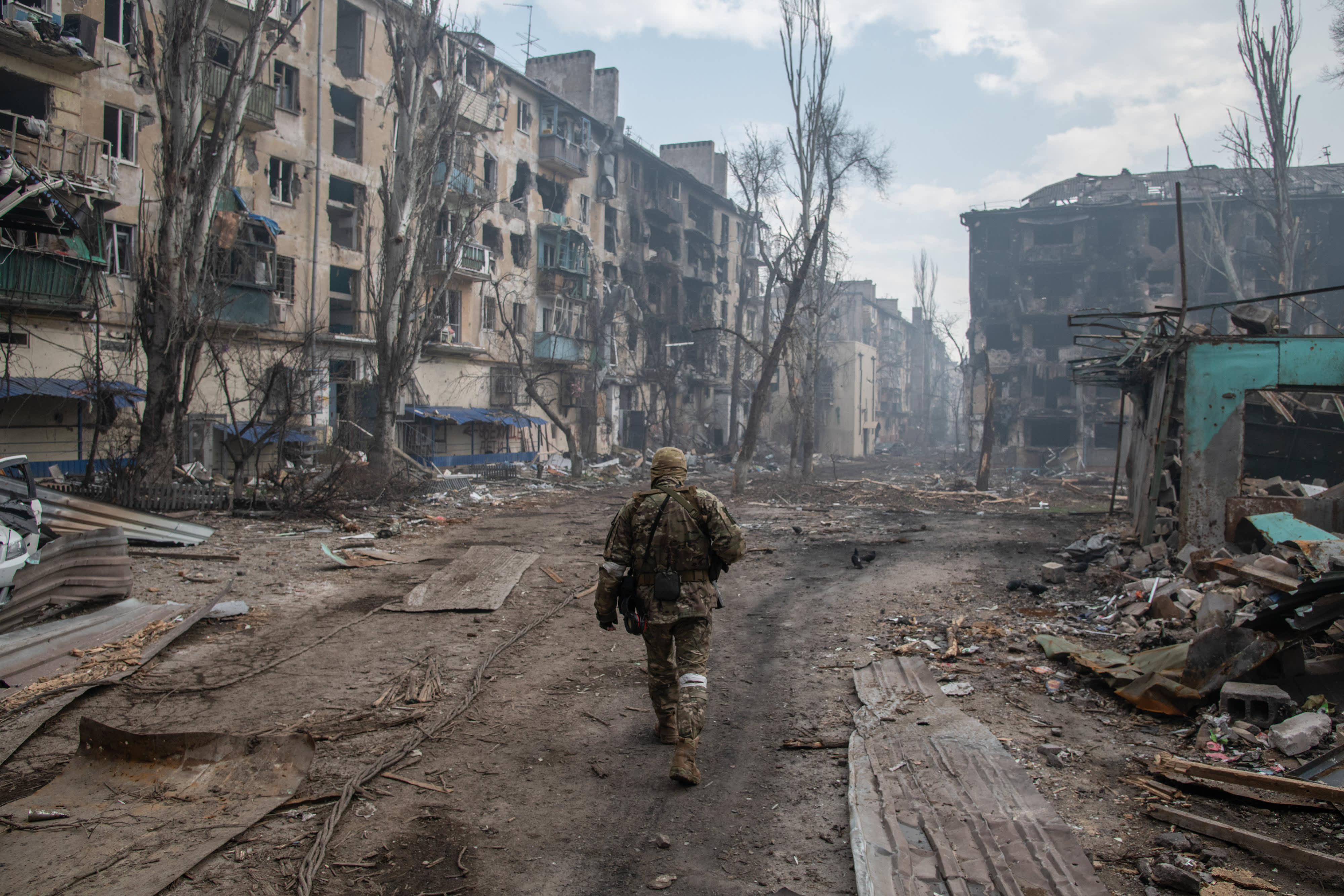
A Russian soldier walks in the rubble in Mariupol’s eastern side, where fierce fighting takes place between Russian and pro-Russia forces and Ukraine on March 15, 2022.
Maximilian Clarke | SOPA Images | Lightrocket | Getty Images
This is a joint statement, by the authors of Sráid Marx and Boffy’s Blog, on the global crisis of Marxism, which has become manifest in the collapse of many “Marxist” organisations into social-imperialism, in relation to the Ukraine-Russia War. Those organisations have abandoned the independent third camp of the international proletariat, and, instead, lined up behind one of the contending imperialist camps of NATO/Ukraine or Russia/China. They have sought to place the world labour movement back to the position prior to World War I (WWI), which led to the split in the Second International and formation of the Third International, although such a development is not possible, today, if only because no real International exists, making the situation similar to that prior to Marx and Engels establishing the First International.
This crisis of Marxism has been a long time coming. Its roots lie in the nature of what passed for Marxism in the post-war period, a ‘Marxism’ that was, in fact, a form of petty-bourgeois socialism, manifest in its attitude to the state as the means of historical change, rather than the independent self-activity, and self-government of the working-class, and, concomitantly, in its attitude to the national question and nation state. Both of us, with a combined experience of nearly a century in the labour movement, were recruited, in our youth, into different Trotskyist organisations – the International Marxist Group (IMG)/Peoples Democracy in Ireland, and International Communist League (I-CL), respectively – of which we were members for many years, and yet, freed from the barriers to critical thinking imposed by membership of such sects, we have, independently of each other, arrived at almost identical conclusions about the nature of the Left, and on the critical issues of the day for the labour movement.
We have set out below a statement on the fundamental issues we believe lie behind the recent failure of many groups and individuals to develop an independent working class position on the war in Ukraine, and how this very open betrayal is a result of previous errors now compounded into an outright defence of the capitalist state. While both of us have been activists in Western Europe, and our arguments are derived directly from this experience, the issues raised are relevant to Marxists everywhere and the experience of others across the world will confirm this experience and the lessons drawn that we have set out below.
The State
This ‘Marxism’ is fundamentally distinguished from other forms of socialism by its attitude to the state. Not only did Marx and Engels talk about the state withering away under communism, both were intensely hostile to the capitalist state, as the state of the class enemy. In “State and Revolution”, Lenin points out that Marx’s attitude to it was the same as the anarchists.
“… it was Marx who taught that the proletariat cannot simply win state power in the sense that the old state apparatus passes into new hands, but must smash this apparatus, must break it and replace it by a new one.”
It is only in this latter sense that Marxists differ from the anarchists, i.e. in the need for the proletariat, after it has become the ruling-class, to establish its own semi-state, to put down any slave-holder revolt by the bourgeoisie. The idea that Marxists can call upon the existing capitalist state to act in its interest is, then, absurd. That opportunist attitude to the state was promoted by the Lassalleans, and Fabians, in Marx and Engel’s generation, and, as Hal Draper sets out, in The Two Souls of Socialism, became the ideology of The Second International. Marx opposed it in The Critique of The Gotha Programme, and Engels followed that with many letters, and also in his own Critique of The Erfurt Programme, in which he opposed the idea of a welfare state, National Insurance, and other forms of “state socialism”.
As Lenin says,
“Far from inculcating in the workers’ minds the idea that the time is nearing when they must act to smash the old state machine, replace it by a new one, and in this way make their political rule the foundation for the socialist reorganization of society, they have actually preached to the masses the very opposite and have depicted the “conquest of power” in a way that has left thousands of loopholes for opportunism.”
(ibid)
Stalinism adopted this opportunist attitude to the state. In the post-war period, it was taken on by organisations claiming the mantle of Trotskyism. In Britain, for example, the Revolutionary Socialist League, better known as The Militant Tendency, talked about a Labour Government nationalising the 200 top monopolies, but all these organisations raised demands for the capitalist state to nationalise this or that industry, usually to avoid bankruptcy, and they continue to do so. Even more ludicrously, they combine these utopian demands to the capitalist state with the further demand that it also then grant, to the workers in the industry, “workers’ control”, as though such a request would ever likely succeed, other than in conditions of dual power in society, i.e. conditions in which workers have established their own alternative centres of power, in the form of workers’ councils, enabling them to impose workers’ control, arms in hand.
What such demands also illustrate is a dangerous failure to distinguish the difference between government and state. Governments of different complexions come and go at frequent intervals, as does the bourgeois political regime, appearing as either “democracy” or “fascism”, which are simply masks which the bourgeoisie adopt according to their needs, but the state itself remains as the real power in society, permanently organised as the defender of the ruling class, including against the government if required.
Authentic Marxism, therefore, rejects these opportunist appeals to the state to act in the interests of the working-class. Our method is that of the self-activity and self-government of the working-class, which must organise itself to become the ruling class, and, in so doing, bring about its own liberation. We look to the advice of Marx and Engels and The First International to develop its own cooperative production, rather than to the capitalist state and we advise it, at all times, to take its own initiative in addressing its needs within capitalism. This includes organising its own social insurance, to cover unemployment, sickness and retirement, rather than relying upon the vagaries of state provision, which is geared to the fluctuating interests of capital, and its economic cycles, not the interests of workers.
Of course, as Marx sets out in Political Indifferentism, if the capitalist state does provide such services, we do not advocate a sectarian boycott of them, out of a sense of purity. As Marx sets out in The Poverty of Philosophy, what makes the working-class the agent of progressive historical change is precisely its struggle against the conditions imposed upon it, which results from the limits of capitalism, and to breach those limits by replacing capitalism. Capitalism is progressive in developing the forces of production, via the accumulation of capital. This has led it to maximise the exploitation of labour/rate of surplus value but does not mean that we advocate no resistance to its demands for wage cuts, or lower conditions. We point to the limited ability of capitalism to maximise the rate of surplus value, and so develop productive forces, as well as the limited ability of workers to raise wages, within the constraints of capitalism, and consequently, the need to abolish the wages system itself.
Nor do we advocate a boycott of socialised healthcare, education and social care systems, but point out their limited capitalist nature, the lack of democratic control and so on. We oppose any regression to less mature capitalist forms of private provision, not by defending the existing state forms, but by arguing the need to move forward to new forms directly owned and controlled by workers themselves. Whilst we offer support to workers’ struggles for improvements in existing provision, and for democratic control, we do so all the better to demonstrate to workers that so long as capitalism exists, no such permanent improvement and no real democratic control is possible.
All large scale industrial capital is now, socialised capital, be it state capital or that of corporations, and so properly the collective property of the “associated producers”, as Marx describes it in Capital III. Unlike the socialised capital of worker cooperatives, it is not, however, under the control of the associated producers, of the working class, but of shareholders and their Directors. Short of a revolutionary situation, and condition of dual power, workers cannot force the state to concede control over that capital to them. Even the social-democratic measures, such as those in Germany, providing for “co-determination” of enterprises, are a sham that retains control for shareholders, and simply incorporate the workers in the process of their own exploitation.
Similarly, we do not support the sham of bourgeois-democracy, which is merely a facade for the social dictatorship of the bourgeoisie, and its state, a facade they will drop in favour of fascism if their rule is challenged by workers. We defend the democratic rights afforded to workers – to organise and to advance their class interests – but we do not confuse defence of those rights, which the working class can use, with defence of the bourgeois democratic state that continually seeks to limit, erode and threaten them outright.
We recognise, however, that millions of workers do continue to harbour illusions in bourgeois democracy, and, so long as they do, we must try to break them from it. That is not done by a sectarian abstention, but by utilising it, and demanding it be consistent democracy. For example, abolition of Monarchy and hereditary positions and titles, election of judges and military top brass, abolition of the standing army, and creation of a popular militia under democratic control. We support the workers in any such mobilisation and demands for consistent democracy, but we offer support only as the means of demonstrating the limits to such democracy and the possibility of a higher alternative, so enabling them to shed their illusions in that democracy.
The means by which we seek to mobilise the workers, in all such struggles, are not those of bourgeois society, but those of the encroaching socialist society of the future. We advocate the creation of workplace committees of workers that extend across the limited boundaries of existing trades unions; we advocate, as and when the conditions permit, the linking up of such committees into elected workers’ councils, and the joining together of this network of workers councils on a national and international basis. We reject the idea of reliance on the capitalist state and its police to “maintain order”, or of its military to provide defence of workers, and instead look to democratically controlled Workers’ Defence Squads and Workers Militia to defend workers’ interests, including against the armies of foreign powers, terrorists and so on.
The National Question and The Nation State
The opportunist view of the state differs from the Marxist view, by presenting the state as some kind of non-class, supra-class, or class neutral body, standing above society, whereas Marxists define it as what it is, the state of the bourgeois ruling class. The opportunist view of the state is a petty-bourgeois view, reflecting the social position of the petty-bourgeoisie as an intermediate class, standing between the bourgeoisie and the proletariat, and which sees its role as mediating between these two great class camps.
It denies the class division of society. The symbol of this denial is the use of phrases such as “the nation”,“society”, “the people” and so on, which subsume the antagonistic classes, in each society, into one “nation”, and then transforms the state into being the state of “the nation”, or “the people”, rather than of the ruling class. This used to be the ABC of Marxism, and yet the Ukraine-Russia War, has seen a large part of the Left collapse into these opportunist and nationalist, as opposed to socialist, ideas.
The logic of this opportunist position flows inevitably from their view of the state as the agent of social change, as against the role of the working-class itself. It is necessarily a petty-bourgeois, nationalist view, as against a proletarian, internationalist view. It demurs from class struggle, in order to privilege and promote the combined interests of all classes within the nation, as a “national interest”, which necessarily sets that “national interest” against the “national interest” of other nations. The interests of workers of different nations are, thereby, brought into an antagonistic relation with each other, rather than with their own ruling class. Again, this used to be the ABC of Marxism, symbolised by Marx’s statement that the workers have no country, and appeal, in The Communist Manifesto, “Workers of The World Unite”.
In WWI, the opportunists in the Second International, continued to repeat these statements, but only as mantras, whilst, in practice, abandoning class struggle, and lining up under the banner of their particular capitalist state, in alliance with their own bourgeoisie. This characterises the positions of much of the Left, in relation to the Ukraine-Russia war, whether they have lined up in support of the camp of NATO/Ukraine on the one side, or Russia/China on the other, under claims of an “anti-imperialist” struggle, or war of national independence/national self-determination.
Marx argued that the workers of no nation could themselves be free, whilst that nation held others in chains. That is why it is the duty of socialists, in each nation, to oppose their own ruling class in its attempts to colonise, occupy, or in any other way oppress other nations. While the formation of nation states was historically progressive, as it was necessary for the free development of capitalist production and its development of the productive forces, the subsequent destruction of nation states, and formation into multinational states, is also historically progressive, for the same reason. But, just as Marxists’ recognition of the historically progressive role of capitalism, in developing the productive forces, which involves it exploiting workers, does not require us to acquiesce in that exploitation, so too the historically progressive role of imperialism, in demolishing the nation state, and national borders, does not require us to acquiesce in its methods of achieving that goal. (See: Trotsky – The Programme of Peace).
In both cases, we seek to achieve historically progressive goals, but without the limitations that capitalism imposes on their achievement, by moving beyond capitalism/imperialism to international socialism and communism. The struggle against militarism and imperialist war is fundamental to presenting the case, and mobilising that struggle for, the overthrow of capitalism, and its replacement by international socialism. We carry out these struggles on the basis of the political and organisational independence of workers from the bourgeoisie and its state, on the basis of Permanent Revolution. (See Marx’s Address to the Communist League, 1850)
This was the basis of the position set forward by Lenin in relation to The National Question. The task of Marxists, in oppressor states, is to oppose that oppression by their own ruling class and to emphasise the right to free secession, whilst the task of Marxists in oppressed states is also to oppose their own ruling class, pointing to its exploitation of the workers, and unreliable and duplicitous nature, and emphasising not the right to free secession, but the right to voluntary association. It is what determines the Marxist position of opposing, for example, Scottish nationalism, Brexit, or other such forms of separatism across the globe. As Lenin put it, we are in favour of the self-determination of workers, not the self-determination of nations.
In 1917, following the February Revolution, in Russia, the Mensheviks, and some of the Bolsheviks, such as Stalin, Kamenev and Zinoviev, also changed their position of opposing the war, and argued that the Russian state had become “revolutionary democratic”, i.e. a non-class state, overseeing a non-class form of democracy. Lenin vehemently opposed that social-patriotism, and threatened to split the party unless it was rejected. However, this position was never abandoned by Stalin, who resumed it after Lenin’s death, making it the foundation of his strategy of the Popular Front, applied in relation to national liberation struggles, for example “the bloc of four classes”, in China, in 1925-7, and in opposing fascism, as applied in France (1934-9), and in Spain (1934-6), and subsequently, in Stalinism’s collapse into what Trotsky called “communo-patriotism” in WWII.
In the post-war period, it was not only social-democrats, reformists and Stalinists that adopted this class collaborationist Popular Front approach. In place of the Marxist principle of the self-determination of the working-class, the petty-bourgeois Left, including those that described themselves as “Trotskyist”, threw themselves into supporting struggles for national self-determination and did so, not on the basis of simply opposing the role of their own ruling-class, but of actively supporting the bourgeois and petty-bourgeois nationalist forces engaged in those struggles.
Indeed, not only were the forces involved the bourgeois class enemy of the proletariat, but, in many cases, as in, for example, Korea, Vietnam, Algeria and so on, they were aggressively anti-working-class forces with which Marxists should have had no truck whatsoever, and against which Marxists should have been warning the workers, and against which they should have been aiding workers to defend themselves. (See: The Theses On The National and Colonial Questions). Again, the petty-bourgeois socialists had adopted the mantra of “My enemy’s enemy is my friend”, identifying imperialism as the enemy, and so the bourgeois and petty-bourgeois nationalists fighting that imperialism, as their friend. This was even the case where these forces violently suppressed Trotskyists within their own country. Today these forces have presided over or opened the door not to workers’ power but to capitalism.
This was never the position of Marxism, as set out, for example, in the Comintern’s Theses On The National and Colonial Questions. It is a perversion of that position introduced by Stalinism, and later adopted by the petty-bourgeois Left, in part under pressure from Stalinism, but also from peer pressure in the petty-bourgeois, student milieu in which it became embedded, and from which came much of the movement in support of these national liberation struggles, and from which it sought to recruit new members. In line with the principles of Permanent Revolution, first set out by Marx in his 1850 Address, not only was it necessary to ensure the political and organisational independence of the proletariat, and to arm it to defend itself against the national bourgeoisie, but, in so far as the proletariat was led to form any temporary tactical alliance with the peasantry and petty-bourgeoisie, it was on the basis of an alliance with those masses, and not with the parties representing those classes, and certainly not with the bourgeois state.
“Lenin, it is understood, recognized the necessity of a temporary alliance with the bourgeois-democratic movement, but he understood by this, of course, not an alliance with the bourgeois parties, duping and betraying the petty-bourgeois revolutionary democracy (the peasants and the small city folk), but an alliance with the organizations and groupings of the masses themselves – against the national bourgeoisie.”
This is in stark contrast to the position of the Left, in all national liberation struggles, in the post-war period, and in its position in relation, now, to the Ukraine-Russia war.
The Russia-Ukraine War
Like WWI, the Russia-Ukraine war has become an acid test of the Left. As with WWI, most of that Left has failed the test. That the Left social-democrats, the reformist socialists, and Stalinists should fail only repeats their failures going back to WWI, but for those that claim the mantle of Trotskyism to fail it indicates the crisis of Marxism, and that the nature of that Left, as described above, is actually petty-bourgeois.
It is no surprise that those that have collapsed into becoming cheerleaders for one or other of the two contending imperialist camps have done so by using the arguments that opportunists used in WWI, and in WWII, based upon arguments of national self-determination, and “anti-imperialism”. But, nor is it a surprise that the Stop The War Coalition, which opposes the war on both sides, does so not on the basis of Marxism and Leninism, and the principles of class struggle and revolutionary defeatism, but on the basis of opportunism and social-pacifism.
The Marxist position is not only that the war is reactionary on both sides, and so we oppose the war; it is also a recognition that such wars are not inexplicable events, or caused by fascist megalomaniacs, but flow from the nature of imperialism, its drive to create a global single market, dictated by the needs of large-scale capital itself. It is inevitably led to do this by the violent competition of nation states (and alliances of such states), each seeking to assert their dominant position in any new international formation. Simply appealing for peace is therefore utopian, and ultimately reactionary, just as much as appealing for capitalist enterprises to stop competing against each other or forming larger monopolies and cartels.
We do not argue for an end to capitalist competition or monopolies, but for workers to take over those monopolies, and, thereby, to be able to replace competition with increasing cooperation between them, as part of a planned organisation of production and distribution. That is the real basis of class struggle, not economistic, distributional struggles for higher wages within a continuation of capitalism. Similarly, we do not argue for an end to wars between capitalist states, or the destruction of nation states and formation of larger multinational states, such as the EU, as part of forming a world state, but for workers to overthrow the existing capitalist states and establish workers’ states, as the only permanent means of ending wars, and rationally constructing a single global state, based upon voluntarily association. That is the basis of class struggle at an international level, of the concept of revolutionary defeatism, as against utopian demands for peace, the demands of social-pacifism.
The Marxist position of revolutionary-defeatism, in relation to the Russia-Ukraine War, as with any such war, is not simply about opposing the war, but about explaining to workers that these wars are fought using their blood, but not for their interests, and that they will continue to suck their blood so long as capitalism continues to exist. In the same way that Marxists intervene in strikes to explain that workers will continue to have to strike for decent wages, so long as capitalism exists, and that such strikes will not, ultimately, prevent their condition in relation to capital deteriorating; so they intervene in imperialist wars to explain that they will continue so long as capitalism/imperialism exists, and so the answer is not a utopian demand for peace, but a class struggle for the overthrow of capitalism/imperialism itself, to turn the imperialist war into civil war!
In the post-war period, the petty-bourgeois Left became engrossed in the rash of “anti-imperialist” and national liberation struggles that erupted as the old European colonial empires collapsed, in part under pressure from US imperialism that sought to break open all of the monopolies and protected markets of those colonial empires, in order to give free access to US multinational corporations to exploit vast reserves of labour. At the same time, Stalinism encouraged the development of support for such movements, as agents of the global strategic interests of the USSR, in competition with US imperialism. As in China, in 1925-7, it sought to ally itself with the national bourgeoisie, and subordinate the interests of workers and poor peasants in these former colonies to that of the national bourgeoisie, which it sought to draw into its orbit, as symbolised by the Third World Movement. This same, class collaborationist, Popular Front approach, was adopted by the Stalinists in the formation of the various Solidarity campaigns established to support these “anti-imperialist”, national liberation struggles.
Whilst the “Trotskyist” Left continued to repeat the mantra of opposition to Popular Fronts, in practice, and seeing large numbers of students drawn to the campaigns of solidarity with this or that national liberation movement, nearly all of which were bourgeois in nature, and many of which were particularly authoritarian and anti-working-class, as with the Algerian NLF and Viet Cong, it joined in, and promoted these kinds of cross-class, popular frontist organisations. It did so for fear of isolation and losing out in the potential for expanding its contact lists of possible new members in its rivalry with competing sects.
The Ukraine Solidarity Committee is just the latest in a long list of such cross-class, Popular Frontist organisations that throws their support behind, and so acts as useful idiots for, some reactionary national bourgeoisie, which is the enemy of the workers of the given state. In the past, these Popular Front organisations often gave a pass to the USSR and its allies, whereas, today, the USC gives a pass to, and allies with, NATO imperialism and its associates in the EU, G7 and so on. On the other side, those social-imperialists that have thrown themselves into a cross-class alliance in support of Putin’s Russia and Xi’s China, on the basis that they are being threatened by NATO/US imperialism, are simply the mirror image of the USC.
What Is To Be Done?
As two individuals, we do not suffer the hubris of thinking that we have the answers to this modern crisis of Marxism, but we do believe that such a crisis exists when self-proclaimed Marxists openly support one capitalist state in war against another, each backed by one or the other of the two largest capitalist states in the world A similar condition exists today as that in the early days of Marxism, with only a handful of authentic Marxists, amidst a sea of petty-bourgeois sects that portray themselves as Marxists while peddling reformist programmes; a still not insignificant number of Stalinists and other Left reformists; and with mass workers parties that have reverted to being simply openly bourgeois parties, much as with the British Liberals and German Democrats of 1848.
Indeed, the British Labour Party, under Starmer, has declined even more than that, becoming dominated by the reactionary, petty-bourgeois nationalism promulgated by the Tory party. Yet, in the absence of mass socialist workers parties, the working-class continues to engage in its own struggles, for increased wages to counter inflation, for example, but also to look to these bourgeois workers’ parties (or simple bourgeois parties) as their political representatives, and Marxists cannot ignore this reality. Our task is to work alongside the working-class, in and out of struggle, and break it from the current delusions in those parties, and in bourgeois-democracy itself.
Appeals to create yet another Marxist sect, or to create some new Workers Party have proven to be pointless. Engels advised US socialists to work with the existing workers parties, and, likewise, prior to the creation of the Labour Party, advised Eleanor Marx and her associates to work with the Liberal Clubs, rather than the existing sects such as the SDF or ILP. As he noted, in 1848, he and Marx and their supporters had joined the German Democrats, and operated inside it, as its organised Left-Wing.
Our fundamental principle, as set out by Marx in his 1850 Address, is to maintain the political and organisational independence of the working-class as it seeks its self-emancipation. But, as Marx and Engels showed, that is not incompatible with working inside existing mass workers parties. Whether that is done openly or covertly is only a question of tactics, determined by what is possible at the given time. The existence of the Internet to produce online publications and networks makes that much easier today than it was even 25 years ago.
In the 1930’s, when the forces congregating around him and his supporters were very small, Trotsky advised them to join the various socialist parties, so as to operate within them, as an organised Left-Wing, and, thereby, to begin to build the required numbers for the creation of new mass revolutionary parties. It was the formation of an undeclared United Front with those rank and file workers. It is again forced upon us given the tiny forces of authentic Marxism. Our goal is not some Quixotic attempt to capture those parties, but simply to build the required numbers of authentic Marxists to be able to create effective revolutionary workers parties as alternatives to them, and, then, to move from an undeclared United Front with the rank and file of those parties to an open and declared proposal for a United Front, exposing the leaders of those parties and drawing ever larger numbers of workers to the banner of international socialism.
That is in the future, but the first step is to establish a network of authentic Marxists, much as Marx and Engels did with the Communist Correspondence Committees, and as Lenin and Plekhanov did with the Marxist discussion circles that over time laid the basis for the creation of the RSDLP.
If you are in agreement with the principles set out above, in this joint statement, whether you are an individual or organisation, we ask you to contact either of the authors via the comments sections of these statements on our respective blogs. If you have a social media presence, then give us the details so that we can share it with our readers, and we would ask that you do the same, for everyone else as part of an expanding global network of authentic Marxists, each supporting, in whatever way they can, the work of the others, and facilitating a discussion and development of authentic Marxist ideas.
Supporters of the Ukrainian state repeatedly refer to Vladimir Putin’s responsibility for the war and frequently cite his speeches as a guide to Russian motivation, often around the creation of Ukraine as part of the Soviet Union in 1922 or the essential unity of Russians and Ukrainians. In doing so they not so much contradict Putin as ape him in holding up a distraction that is obviously incapable of explaining why the invasion happened. An invasion to right the wrongs of 1922? Why now? Ukrainians will be persuaded that they are really little Russians through an invasion? Who could be that stupid?
It’s not that looking at what Putin or others say is not some guide to the actions of the Russian state but the leftists don’t quote those words of Putin that do most explain his decision–as one in defence of the interests of the Russian capitalist state.
As one of a number of previous posts explain, repeated warnings were made by Russia that Ukraine joining NATO was a red line, with many others predicting conflict if this line was crossed. Suddenly, however, for supporters of Ukraine these words from Russia are irrelevant and have nothing to do with its motivation and intentions or cause of the war, because if this was the case then their favourite capitalist state would bear some responsibility for it and so would NATO. This would then leave them looking like suckers in traipsing behind both, as minor camp followers of the Western war caravan pouring what it can afford into Ukraine.
Having failed to pay attention to what Putin said before the invasion ignorance now is not so much bliss as necessary to maintain their illusions in Ukraine and the West, on just about everything. The massive propaganda campaign of the Western state and corporate media evokes not a single rebuke as this left is perfectly happy to have swallowed the blue pill.
But there is really no excuse. It is unforgiveable to support one capitalist state in war with another, especially when this state is a proxy for the most powerful imperialist alliance in the world. Unfortunately, when you are plugged into this western imperialist matrix you see and hear what you want and justify your position by quoting Putin, except when he says something that indicates his articulation of the vital interests of the Russian state and that might explain its actions.
In this situation this pro-war left becomes an echo chamber of the bourgeois media in which we have repeated denunciation of Russian ‘talking points’, even when these ‘points’ relate to why the war actually started. So let’s look at some of what Putin said before the invasion; if any of the pro-war left is reading this they can scroll away now and click on something else, like ‘The Guardian’ maybe or the BBC, New York Times, CNN or any of the capitalist media outlets selling the same story and damning Russian ‘talking points’.
The historian Geoffrey Robertsstates that ‘the first public sign that Putin was getting seriously concerned about the Ukraine situation were these remarks to his Security Council in May 2021’ when he said that:
‘It appears, and this is highly regrettable, Ukraine is being turned, slowly but steadily, into an antipode of Russia, an anti-Russia, a territory from which, judging by all appearances, we will never stop receiving news that requires special attention in regard to protecting the national security of the Russian Federation.’
Putin maintained support for the Minsk agreements, stating that ‘We have no other tool to achieve peace, and I believe they should be treated very carefully and with respect…’ This was, of course, before the other Western parties to these agreements revealed that they were purely to give time for Ukraine to build up its military capability.
This it did through growing western military support from 2014, mainly from the United States, which became more open and with clearer purpose:
‘In 2017 the Trump Administration began selling lethal weapons to Ukraine. Western states began to train Ukraine’s armed forces and allow their participation in military exercises. In February 2019, Ukraine’s constitution was amended to make NATO membership a compulsory government goal. Zelensky . . . in March 2021 . . adopted the Crimean Platform – a programme to secure the return of Crimea to Ukraine by any means necessary, including unspecified military measures.’
‘In April, there was a confrontation between Russian and Ukrainian naval forces in the sea of Azov, which ended without violence, but in June the United Kingdom agreed to enhance Ukraine’s seaborne capabilities. That same month NATO reaffirmed its commitment to Ukraine’s eventual membership of the alliance. In July, the United States and Ukraine co-hosted a naval exercise in the Black Sea that involved 32 countries and in August signed a US-Ukraine Strategic Defense Framework, followed a couple of months later by a Charter on Strategic Partnership. Between March and June, NATO conducted Defender 21, a multinational military exercise focussed on defending Europe from Russian attack.’
‘Russia responded to these developments by staging its own military exercises and by deploying more and more troops to areas bordering Ukraine. Estimates vary, but these certainly numbered tens of thousands by the autumn and increased rapidly during the ensuing war threat crisis. Ukraine responded by substantially increasing its forces in the Donbass area. According to Russian claims, half of Ukraine’s regular army was deployed there by the end of 2021.’
Putin said of Ukraine in November 2021 that “it is imperative to push for serious, long-term guarantees that safeguard Russia’s security in this direction because Russia can’t be constantly thinking about what could happen there tomorrow.” On 1st December he said that:
‘The threat on our western border is really growing, and we have mentioned it many times. It is enough to see how close NATO military infrastructure has moved to Russia’s borders. This is more than serious for us. In this situation, we are taking appropriate military-technical measures… ‘
‘While engaging in dialogue with the United States and its allies, we will insist on the elaboration of concrete agreements that would rule out any further eastward expansion of NATO and the deployment of weapons systems posing a threat to us in close proximity to Russia’s territory. We suggest that substantive talks on this topic should be started.’
‘I would like to note in particular that we need precisely legal, juridical guarantees, because our Western colleagues have failed to deliver on verbal commitments, Specifically, everyone is aware of assurances they gave verbally that NATO would not expand to the east. But they did absolutely the opposite. In effect, Russia’s legitimate security concerns were ignored and they continue to be ignored in the same manner.’
The next day the Russian foreign minister Lavrov stated: “Absolutely unacceptable is the transformation of our neighbouring countries into a bridgehead for confrontation with Russia and the deployment of NATO forces in the immediate vicinity of areas of strategic importance to our security.’
Only the most stupid or mendacious could possibly claim that noting these remarks excuses Russia, are irrelevant or need not be heard, or that they are diversions away from the real reasons behind the invasion. These purported reasons are, after all, other points quoted from Russians. The leaders of western imperialism are not stupid and I presume to believe that the majority of the pro-war left are not mendacious.
One of the problems with the view that the war in Ukraine is unprovoked is that it erases much of history, wipes clean western imperialist actions, supports the idea that this imperialism is democratic, and robs the working class of the knowledge it needs to orient itself in the world.
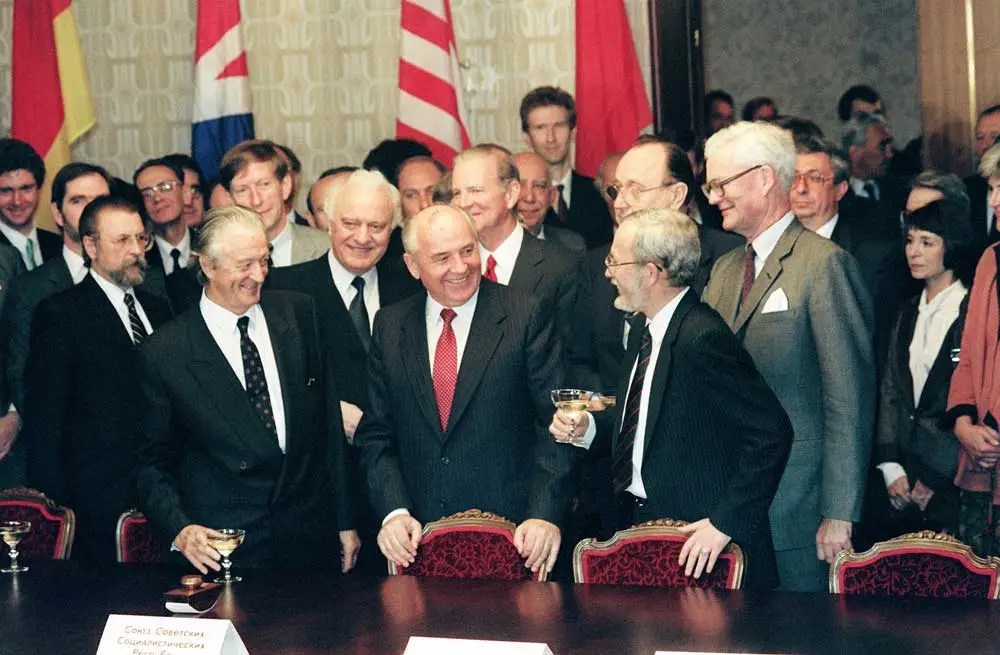
Far from being unprovoked the war is a result of repeated provocations that we can outline, beginning with the collapse of the Soviet Union and Warsaw Pact, when the Soviet foreign minister Eduard Shevardnadze made this “reasonable proposal” to James Baker, the US secretary of state: “Let’s disband both NATO and Warsaw Pact.” It hardly needs saying what the reply was and how it relates to the current war; unless of course you belong to the band of ‘socialists’ who blame Russia in toto.
There was nevertheless an obvious problem for western imperialism, and the United States in particular: how to justify the existence of NATO as a ‘defensive’ alliance when the enemy no longer existed. Further to this, the problem was couched in the context of a possible Soviet Union offer for quick unification of Germany in return for leaving NATO and declaring neutrality. This was even further complicated by the knowledge that this offer would have “widespread support among the members of the public in both East and West Germany”, as the German chancellor Helmut Kohl later admitted. Polling showed that 84 per cent of West Germans wanted to denuclearise their country and leaving NATO in return for German reunification would win widespread support across the country.
The US and NATO has portrayed its expansion into central and Eastern Europe as an exercise in democracy–’all the countries joined of their own free will’–but the German events are only one example of the dismissal of the views of local populations that was repeated later in Ukraine. This includes Soviet offers to get rid of nuclear weapons that the US rejected but that, if we follow the logic of the pro-war left, we should now endorse. Not that this left currently follows its own reasoning to its conclusion. It is just that it has no logical claim to reject it, and leaves the working class in the West open to the argument that the problem is an aggressive Russia and the solution a suitably armed NATO with nuclear capability to prevent Russia from doing what it wants.
The US faced the additional problem that the German foreign minister Hans-Dietrich Genscher publicly supported the idea that there should be no expansion of NATO to the East, something repeated on several occasions. The US was bitterly opposed, as one US official stated in an internal memorandum, this “would forfeit the prime assets . . . that have made the United States a post-war European power.” However, when Gorbachev stated that any expansion of the “zone of NATO” was unacceptable, US secretary of state James Baker stated, according to Gorbachev, that “we agree with that.” This, of course, was a lie, one that became particularly controversial and the focus of repeated complaints by the Russians that are still routinely derided by the western media today, but was repeated by Kohl in relation to the territory of the then East Germany.
While the German chancellor was saying that NATO would not expand its territory eastward into East Germany, Genscher repeated the position that “for us, it is clear: NATO will not extend itself to the East”. The secretary general of NATO, Manfred Worner, also asserted that the fact it would ‘not deploy NATO troops beyond the territory of the Federal Republic gives the Soviet Union firm security guarantees.’
After agreement to German reunification the problem then became how to remove Soviet troops without also having to remove NATO ones. Proposals by Gorbachev for the Soviet Union to join NATO were rebuffed, as were later attempts by Yeltsin and still later ones by Putin for Russia to become a partner of western imperialism; something that discomforts both supporters of ‘Russia is to blame’ and ‘Russia is to be supported’ camps today.
The weakness of the Soviet Union at this time was exposed by its requests to Germany for funding for its troops stationed in the country, a weakness that the West, and particularly the US, exploited when it promoted the shock therapy applied to introduce capitalism into Russia. Throughout the NATO expansion, Russia was too weak to resist, and the US was able to proclaim a “new world order” that included this expansion and wars against Iraq and Afghanistan plus others. It might seem impossible to separate this history of imperialist aggression from the war in Ukraine, but that is exactly what supporters of the war must affirm if it is to be seen as uniquely free from Western complicity.
However, as early as 1992 an official of the US State Department had contacted the Ukrainian ambassador in Washington to urge Ukraine to join NATO, while in the following year the Ukrainian deputy foreign minister was stating that it was “unacceptable for NATO to expand without Ukraine becoming a full member.” Russian leaders were meanwhile saying that it should be first.
In 1994, Ukraine was the first post-Soviet country to conclude a framework agreement with NATO through the Partnership for Peace initiative, a road by which Central and Eastern European countries could join NATO, and was its most enthusiastic participant, seeking to join exercises and contributing 400 troops to the Implementation Force in Bosnia in 1995. The next year its Foreign Minister discussed the potential to become an ‘Associate Member’ of NATO while Russia made it known that this would be considered an ‘unfriendly policy’ with ‘all the resulting consequences.’
In 1997 the Ukraine Foreign Minister went further in stating the strategic goal as complete integration into NATO. Later he voiced concern that this might involve the deployment of nuclear weapons in Ukraine’s western neighbours and proposed a nuclear-weapons free zone, which NATO rejected.
Ukrainian President Kuchma continued steps to join the European Union and in 2002 established a schedule for meeting accession requirements by 2011, while the Ukrainian National Security and Defence Council also discussed the need to “start practical implementation of the course to join NATO”. Ukraine continued to pass parliamentary resolutions stating its objective of joining NATO until mid-2004, sending 1,650 troops to support the US occupation of Iraq. In 2005 the new President, Yushchenko, sought a NATO Membership Action Plan, and in 2008 the Ukrainian government’s aspiration that Ukraine would become a member was approved at the NATO summit in Bucharest, pushed by the United States against some European reservations.
Yet opinion polls regularly recorded that there was still not majority support within the country for membership, with opposition reaching over 60 per cent in one poll, a result confirmed and reported in others here and here. One other from Gallup reported as its conclusion that ‘Ukrainians Likely Support Move Away From NATO, Residents more likely to view NATO as a threat than protection.’
As one of these argued: ‘As for public opinion, NATO membership should generally not be a matter of broad public acquiescence, but of a conscious geopolitical choice by a consolidated national elite. As part of NATO’s post-Soviet expansion, only Slovenia and Hungary have held referendums on membership – and Hungary’s was nonbinding. Slovakia’s 1997 referendum was declared invalid, as it gathered only 10 percent of eligible voters.’
Opinion polls in Ukraine repeatedly demonstrated majority opposition to NATO membership, or at least major division, even after the Ukrainian government approved ‘a four-year, $6 million “information campaign” to improve NATO’s image.’ The article quoted above argued that ‘While the jury is still out regarding its effectiveness, even with the best of PR campaigns and outreach programs, the West by now has generally accepted the uncomfortable fact that NATO may never gain broad popularity among Ukrainians, especially in the eastern regions of the country.’
We now know, of course, that the United States never gave up intervening into Ukrainian politics with the objective of moving the country into NATO. The author of these lines showed remarkable naivety in believing that popular opposition was anything more than an obstacle to be overcome rather than a democratic wish to be respected. The price to be paid to overcome this obstacle was forecast right from the start, as we see below.
Russia reaffirmed its opposition to NATO expansion, and in particular into Ukraine and Georgia, on the grounds of violation of the principle of equal security and the creation of new dividing lines in Europe. While Putin claimed that Russia had ‘no right to interfere’ with Ukraine foreign policy’, and if it wanted to restrict its sovereignty (by joining NATO) ‘that is its own business’, Foreign Minister Lavrov stated that “Russia will do everything it can to prevent the admission of Ukraine and Georgia into NATO’.
In the 2004 ‘Orange Revolution’ the American columnist Charles Krauthammer stated that ‘this is about Russia first, democracy only second . . . The West wants to finish the job begun with the fall of the Berlin Wall and continue Europe’s march to the east . . . The great prize is Ukraine’. As Putin complained, they “have lied many times’ and in Ukraine “have crossed the line”. “Everything has its limits.” The Russian political scientist Sergei Karaganov was even more blunt in stating in 2011 that “NATO expansion into Ukraine is something Russia would view as absolutely unacceptable because it then becomes a vital threat. In political jargon, this kind of threat means war.’ (The quotations not referenced are taken mainly from. ‘Not One Inch, America, Russia, and the Making of Post-Cold War Stalemate’, M E Sarotte, Yale University Press)
* * *
At the start of the invasion I commented on Facebook that the Russians had warned that Ukraine could not join NATO and that this was a red line, only to be rebuked that, in effect, I was saying that Ukraine ‘was asking for it’. I replied that this was, as a matter of simple fact, what had just happened.
Facebook is not a great medium for political debate so it should be elaborated here that, as we can see, the Ukrainian state played its own role in advancing the war through its repeated attempts to join NATO, even voting to place it as a constitutional imperative in 2019. So, while the Ukrainian people did not invite war, its political leadership and its western backers certainly did. How tragic is it then to now rally to the defence of the state that walked you into war and rely on western imperialist forces that led you there?
Even in 2012 only 28 per cent of Ukrainians supported membership of NATO. What we see here is thus a sterling example of the old socialist maxim that ‘the main enemy is at home’; in this case the main enemy of the Ukrainian working class was its own capitalist state for whom it is now fighting and dying. How much more obvious must it be that this should be opposed by all those who claim to be socialists and Marxists? How obvious is it now that if they don’t, their claims to express any sort of socialism must be repudiated?
On February 24 2022 the US President Joe Biden condemned Russia’s invasion as “a brutal assault on the people of Ukraine without provocation, without justification, without necessity” and a “flagrant violation of international law.” Putin he said, “rejected every good-faith effort the United States and our Allies and partners made to address our mutual security concerns through dialogue to avoid needless conflict and avert human suffering,”
Boris Johnson pronounced that ‘President Putin has chosen a path of bloodshed and destruction by launching this unprovoked attack on Ukraine’, while then foreign secretary, Liz Truss, said she had summoned the Russian ambassador “to meet me and explain Russia’s illegal, unprovoked invasion of Ukraine”. The British Government website continues to have this as its leader – ‘The UK and our allies condemn the Russian government’s unprovoked and premeditated war against Ukraine.’
The Irish Government as part of the EU has repeatedly supported its sanctions, even demanding they go further, joining Poland and Baltic states in calling for more. Upon the invasion Tánaiste Leo Varadkar stated that whilst Ireland is militarily neutral, “in this conflict, Ireland is not neutral at all”, stating its “unwavering and unconditional” support for Ukraine.’
This Wikipedia entry sets out a whole list of States responses in which the word ‘unprovoked’ appears 29 times at my last count.
The media followed suit: the New York Times described it as ‘an unprovoked invasion’; the Financial Times a ‘naked and unprovoked aggression’; the Guardian ‘an unprovoked assault’, while the Economist thundered that ‘Russia’s president has launched an unprovoked assault on his neighbour.’
On 14 October 2022, Defenders Day in Ukraine, the US ambassador issued a video message saying:
‘The United States, our partners and allies, will continue to support Ukraine to hold those who commit war crimes accountable and to work to bring together the world to maintain pressure on the Kremlin until it ends its brutal, unprovoked war against Ukraine and our shared values. And we will continue to stand with Ukraine for as long as it takes.’
The position of much of the Western Left, certainly in Britain, is much the same, with a recent Ukraine Solidarity Campaign statement also calling for ‘a week of action’ against ‘the brutal and unprovoked invasion’. It sees no provocation; absolves western imperialism and the Ukrainian state and regime of any responsibility; supports ‘Ukraine’s freedom, presented as ’self-determination’; has failed to oppose sanctions while mouthing hypocrisies about not supporting them either; sets no political limits to its support – that is ‘unconditional’; and supports western supply of arms, which along with sanctions and financial support are the main western imperialist interventions.
If anything, the political resources required by the support of the pro-war Left for Ukraine might seem to be much greater than that of the various capitalist states, politicians and media. It has faced opposition from those socialists opposed to capitalist war, something that has been a principle of our politics at least from the exemplary case of the First World War, the character of which has recently been graphically exposed by the film “All Quiet on the Western Front’. The pro-war left has had to face this opposition–which capitalist Governments and its bourgeois media are not of course concerned with–and reject its arguments, sometimes claiming how comfortable it is for its critics that they take such a position!
However, because it claims the mantle of socialism its position very quickly became dishonest, confused, as well as reactionary. Consider the exchange of views in Britain between Anti-Capitalist Resistance (ACR) and the Stop the War coalition (StW). Like many organisations not interested in principled politics, ACR argues the prime necessity for action and berates Stop the War for putting up conditions to joint activity.
We have dealt with what sort of anti-war movement is required before, so suffice to say here that its own insistence on the absence of certain demands, such as opposition to NATO, is also a precondition. The point of a political campaign is to fight for particular objectives that are directly relevant and to raise the consciousness of the working class. To exclude certain demands is to avoid fighting for these objectives and failure to raise political consciousness around them. Lack of concern for political principle leads to this obvious truth being passed over.
Since it is impossible to hide the political differences, it quickly became clear that those such as ACR calling for a broad approach, ‘designed to build the broadest possible movement against the war’, were not actually against the war but for it, war until Ukrainian victory. This is where the pro-war position is dishonest.
ACR refuses to support demands opposing NATO, rejecting the view that ‘NATO’s expansion has “contributed to the war”’, stating that ‘this is not clear at all. It could equally be argued that Russia’s invasion of Ukraine was an act of unprovoked imperialist aggression.’ Having said that it could equally be argued that the war was the fault of Russia, what ACR really means is that Russia was wholly at fault, and the problem with the StW coalition is that it is not ‘engaging with the central issue: the unprovoked war on Ukraine.’
ACR wants to oppose an ‘unprovoked attack on Ukraine’, oppose the war and ‘to organise constructively against it – not in a way that fans the flames of war – which is why the demand “No to war” is included – but in a way that solidarises with the plight of the Ukrainian people.’ It thinks, or perhaps pretends to think, that you can demand solidarity with one of the sides waging without supporting war and without fanning its flames, all while supporting a greater and greater supply of weapons. This is where the pro-war position is (shall we say?) confused.
In their exchange of views the StW coalition raised the question of opposing arms expenditure as an urgent issue, but ACR regarded this as belonging to ‘a whole range of other criticisms’ that can be parked and not form part of the movement. But this identification of the issue by the StW coalition turned out to be very prescient: the British Trade Union Congress voted shortly after to support increased ‘defence spending’, more honestly stated as spending on war. The ACR position would have left, and still would, any supposed anti-war position silent in this debate. Since, in any case, the ACR defends the arming of Ukraine by the British state this is a perfectly logical position for it to take. This is just one case in which the pro-war position is reactionary.
As the argument supported by ACR shows, the stance of the pro-war left rests, like that of western imperialism in general, on the view that the Russian invasion was unprovoked. Of course, provocation does not equate to justification or automatically follow from it. In the world of capitalist state competition provocation may be seen as sometimes inevitably resulting in war, but that does not require socialists to support either the provocation or the response. In fact, opposition to both is clearly a principled socialist approach.
But this would not be enough for the pro-war left because admission of western imperialist and Ukrainian provocation would require taking this principled position. Both western imperialism and Ukraine would then be seen as playing their own part in causing the war; Ukrainian agency as they call it, and having responsibility for it, in which case defending either would be anathema. The pro-war left cannot concede this reality; let’s call it the homage that treachery pays to principle.
The pro-war left denies reality when it absolves western imperialism and Ukraine of any provocation and therefore any responsibility. In doing so, in denying recent history and current reality it signs up to an infantile view saturated with bourgeois morality in which Ukraine is Good and western imperialism Innocent; innocent of acting on its essential nature.
The reality of capitalist war becomes instead a morality tale of heroic resistance, and the messy reality is only so much noise – unpleasant, unwelcome and better drowned out. The unpleasant nature of Ukrainian nationalism for example, that shades into the relatively large constituency for fascism; or the fact that there are a large number of Ukrainians who support Russia, are just irrelevant noise to signal.
Instead, they can fight for what is Good; while other socialists fight in opposition to their own capitalist state and capitalist class, watching and reading mass media propaganda about the ‘unprovoked’ war.
An argument related to the demand that Ukraine should be supported on the grounds of national self-determination is a general argument that there is a right to self-defence, although this is a no more cogent argument than that deriving from a claim to self-determination. The civilian population of Donetsk could claim the same right to defend themselves from increased attacks by the Ukrainian military just before 24 February 2022, and the population of Crimea and Donbas more generally have the same right against the plans of the Ukrainian state to conquer and reoccupy their territories. By demanding membership of NATO the Ukrainian state has given validity to assertion of this same right by the Russian state to defend itself and its supporters in these areas. Lacking any class basis those supporting either Ukraine or Russia can, and do, parrot the same arguments that thus expose each other to the same rejoinder and counterclaim.
This argument is not to say that at the level of individual Ukrainians it is not permissible for them to defend themselves, but what the pro-war left is proposing is political support to the Ukrainian state and armed forces that are carrying out the fighting. This is how those Ukrainians who are fighting for their state see it, expressed in nationalist terms as defence of their country. But as Marxists maintain, countries are not united and the interests of the different classes composing it are antagonistic. At the level of individuals, it has made more sense to leave the county or relocate, as millions have done, and as we have noted before, those nearer the front line are more in favour of peace than those further away cheering for victory.
In other words, this claim that seems so straightforward, and may even appear to be so at the level of the individual, does not exist, and what we need is what we set out at the start – a Marxist analysis of the cause and nature of the war as determined by its historical origins and development and the nature of the participants and their objectives.
The reliance on an abstract right to self-defence is empty since socialists recognise no such right for the capitalist class or its state, which is why the support for the latter by the Second International was recognised as such a historical betrayal in August 1914. What its twenty-first century imitators repeat is the lack of any principled Marxist position, retreating to the refuge of abstract moralism, which Marxists, going back as far as Marx himself, find repugnant because behind it lies the interests of the capitalist class–presented as universal truths–universal precisely because everyone, from right to left, can espouse them.
So, what we are left with are vacuous moral statements that don’t amount to an argument – that invasions are bad, that the Russians are aggressive and cruel and human rights must be protected. That a Ukrainian invasion of Crimea would be bad, that the demand for NATO membership is aggressive and that Ukrainian fascists can hardly be trusted not to be cruel and deny human rights, are all objections to such claims. It could be argued that the first catalogue of Russian immorality is what counts but that requires argument that the Ukrainian one doesn’t, (or perhaps doesn’t even exist if the western media is to be believed). But it’s obvious that occupation of Crimea would involve violence and oppression, that NATO is an aggressive imperialist alliance, that fascist units exist in the Ukrainian armed forces and that these armed forces are not the first to abide strictly by the laws of war.
So much of the argument in support of Ukraine is therefore based on arguments which dissolve when attached to concrete reality, only to return in abstract moral declarations. We are not therefore on the terrain of Marxist analysis and Marxist politics, which explains why it is impossible for this left to take such a position. It is why their arguments are so similar to that of western imperialism, its politicians, think tanks and media commentators, and their solutions so aligned.
Marxism is thus utterly unnecessary and irrelevant to the arguments of the pro-war Left, all of which can be repeated without any reference to it, something that has escaped them. There are no grounds presented for even the theoretical unity of all the workers of Ukraine and Russia; their support for war involves their unity with Ukrainian capitalism and western imperialism, something that doesn’t escape their notice but the significance of which does.
If successful, the victory of Ukraine, US imperialism and its NATO satraps would mean the occupation of areas where they are rejected by the local population and will see Ukraine subject to the tender mercies of western imperialism. To expect ‘a more just and democratic post-war reconstruction’ from this partnership that they have supported is the height of naivety, if not stupidity.
The pro-war left claims ‘that If we are not seen to be on the side of the people of Ukraine, then the only voices they will hear will be those of western imperialists, not those of the socialists and internationalists.’ But if these so-called ‘socialist and internationalist’ voices are saying the same thing as the western imperialists, and they are, why should anyone care?
Supporters of Ukraine claim that those who refuse to support its state deny the agency of Ukrainians and make it all about the west and western imperialist intervention. But it is these people who deny the agency of Ukraine and Ukrainians.
Ukraine, for them, has no role in starting the war but is simply its victim. We are asked to support ‘Ukraine’ and the ‘Ukrainian resistance’ but these have no agency outside the Ukrainian state and the Ukrainian armed forces because outside them they don’t exist. The first is a corrupt capitalist state on a level with Russia and the second is the major repressive force of this state, with particularly reactionary elements such as fascist units in the army. Supporters of Ukraine do not so much justify support for them as dissolve them into abstractions that do not exist in concrete realties.
The motivation of western imperialist backing of Ukraine is usually not examined, or passed over with nebulous remarks that have no significance to taking a political stand. The history of its intervention is treated as irrelevant; its inherently oppressive and repressive character has gone missing, and what this implies for the nature of its intervention in Ukraine and the politics of the war is normally terra incognita and is staying that way. It would appear that all we can do is point out the absurdity of the demands of those supporting Ukraine, such as the call for Britain ‘gifting to Ukraine . . . all the surplus UK military equipment due to be replaced, especially the 79 Challenger tanks, 170 Scimitar reconnaissance vehicles, all Warrior infantry fighting vehicles, Typhoon fighter aircraft – to help Ukraine win more quickly, with less suffering.’
This must be the first time tanks, fighting vehicles and fighter aircraft will ensure ‘less suffering.’ It is assumed that Ukraine will win and win more quickly, presumably because the western media has told them this, and that winning more quickly will not involve inflicting suffering more quickly, or perhaps this is something that also does not exist–the suffering of others. Meanwhile the British capitalist state can get on with modernising its tanks, fighting vehicles and war planes, perhaps for its next progressive imperialist intervention, or whatever.
However, yet another solidarity with Ukraine statement has felt the need to address the role of NATO but does so by somehow giving it no real agency in enforcing its own interests; becoming a prop in the war that is subsidiary in determining its nature, while the rest of the world, including the Ukrainian state, regards its role as vital and critical to success. The supporters of Ukraine again invent a world that does not exist.
The statement says that ‘we should be critical of of the Zelenski government which has embraced neoliberalism . . . and seeks to join the European Union and NATO’, but this criticism is not an obstacle to support! It says that ‘the supply of arms should be without strings or illusions in NATO and the West because the supply of arms can be used to control the scope and duration of the war’. So imperialism with not seek to impose its own interests but supply billions of dollars and Euros of weapons without strings, and this is called politics without illusions! When has imperialism not acted in its own interest but instead on behalf of a ‘national liberation’ struggle?
‘NATO and Western imperialism are backing Ukraine for their own geopolitical interests, so there should be no illusion that NATO and Western imperialism are forces for democracy’, the statement says. No more ‘illusions’ again; but if NATO is backing a ‘national liberation’ struggle then, by definition, it is a ‘force for democracy’. It doesn’t matter how many times you say ‘but NATO is not a force for democracy’ and ‘is the military wing of Western imperialism . . .’ and NATO is acting to ‘defend its geopolitical interests’ while it also supports a war that you claim is progressive and justified. Something has to give.
So who is mistaken here? Is imperialism being fooled into supporting a progressive war of national liberation, an anti-imperialist war? Or are the Left supporters of the Ukrainian state denying the reactionary character of the Ukrainian state and its pursuit of NATO membership; and wrongly supporting NATO intervention in the belief that its geopolitical interests advance democracy, although we are asked to believe that this is not what NATO is about? In what world does any of this make any sense?
Perhaps it is the one that exists in the ‘proxy war between Western and Russian imperialism’ in which ‘NATO has used the Russian invasion to give itself a new purpose’; but whatever new purpose NATO has given itself, it is not one of fighting for democracy. Such a world does not exist and all claims to it doing so are false, shockingly misleading the workers living in NATO countries.
But let us give it one more chance. We are told that ‘when internationalists support the Ukrainians’ right to resist military the Russian invasion and obtain arms from NATO countries, it is not an endorsement of NATO. There have been many movements of national liberation in the past which have called upon imperialist countries for arms without being condemned by socialists: Irish nationalists in 1917, the Spanish republic in 1936, the communist resistance in World War Two, to name a few.’
So maybe such a world existed in the past?
Let’s just take the Irish example. Was Ireland an independent state in 1916 or a British colony? Were the Irish rebels in 1916 seeking to join the German imperialist alliance, or did they claim ‘We serve neither King nor Kaiser’? Did the Irish workers movement participate as a separate political and armed force from the bourgeois nationalists, and did not James Connolly repeatedly declare the political independence of the Irish working class? Was his anti-imperialism the anti-imperialism of opposition to foreign rule or opposition also to capitalism and for the creation of a Socialist Republic? Where does the capitalist Ukrainian state and the ‘Ukrainian resistance’ stand on all these questions today?
But let’s not leave the Irish analogy there. What happened to the Irish national struggle when the forces of the working class proved to be too weak and the movement became a purely bourgeois one? ‘Labour’ was told to wait, just as in Ukraine today, and the forces of bourgeois nationalism accepted a settlement with imperialism that left the working class more divided than before, subject to two reactionary regimes that inflicted years of austerity, unemployment and emigration built upon Catholic Church abuse of women and children and Protestant sectarianism and discrimination. Today the capitalist Irish state supports the Ukrainian capitalist state and imperialism, particularly that of the US, upon which its current success depends; which brings us to the core argument of the left supporters of Ukraine.
Beside the unprecedented assortment of support from western imperialism the left supporters of Ukraine present one Marxist-sounding justification, although bourgeois politicians and the media state it as well. This is the demand for Ukrainian self-determination, upon which we get the idea of national liberation and the analogy with Ireland. In this there might seem an argument that at least exists, and it does, except it does not exist for Marxists.
After World War I, US President Woodrow Wilson made himself and the policy famous through his espousal of self-determination, but this is not the grounds for a socialist argument, including his ignoring the demands of some nationalities while upholding others. Through the Treaty of Versailles, the ground was prepared for another world war that further exposed the elastic character of bourgeois support for self-determination. Even before this, the credo of self-determination of nations had failed in the 1848 revolutions in Europe.
The demand, in so far as Lenin actually upheld it, is subsidiary to the self-determination of the working class and involved supporting, if necessary, the demands of nationalities imprisoned within empires or held as colonies. Ukraine became an independent state in 1991 and does not cease to be one because it is losing (or winning according to its supporters) a war with another independent capitalist state. If it is further claimed that socialists should support the prerogatives of a capitalist state in war then it should be clear what this means – the demands of the capitalist state assume priority, which must necessarily therefore involve the subordination of the working class to its rights and requirements.
The interests of the working class either do not then exist, or are identical to those of its capitalist state. If it is further claimed that it is only in this one respect that the interest of the working class and capitalist state are the same, then this fails to recogniser that self-determination of the Ukrainian capitalist state means that it determines what it requires, what it does, and its freedoms without restriction, otherwise it is not self-determining.
If the attempt is made to wriggle out of this definitional constraint and it is claimed that it is the country (or nationality) that self-determination applies to, then we must recall Marx’s description of history: ‘History does nothing . . . it “wages no battles”. It is man, real, living man who does all that, who possesses and fights; “history” is not, as it were, a person apart, using man as a means to achieve its own aims; history is nothing but the activity of man pursuing his aims.” In our case, it is not ‘the country’, or ‘Ukraine’, that ‘wages battles’ but the Ukrainian state and its armed forces.
For the supporters of Ukraine the idea of an immaterial entity to which self-determination applies has been propagated through repeated use of the words Ukraine, Ukrainian resistance, and Ukrainian people when what that corresponds to in reality is the state, the armed forces of that state and a population divided by class in which these socialists wrap up the interests of the working class inside that of the first two – the state and its armed forces.
Reference is sometimes made to particular Ukrainian workers, with the pious invocation to accept their views, as if their coming from a Ukrainian must entail unimpeachable endorsement and acceptance, although their views are presented as privileged not because of their power to advance our understanding but because of their position as potential victims of war. In effect they become props to a story that is being more and more determined by western imperialism, and certainly not by any independent political role that these workers play.
The term ‘Ukrainian people’ is an abstraction without apposite reality, since this people is divided, with some supporting Russia. For supporters of the Ukrainian state this latter people effectively does not exist, so the argument for self-determination does not apply for them. Not so much Lenin as Woodrow Wilson again.
In any case the Leninist argument advances only the right to set up a separate state and this the Ukrainians already have. What the capitalists and its politicians do with this is something else entirely, and socialists do not follow them in order to ensure this capitalist state achieves maximum capacity to act autonomously and independently. Even if we did, it would be a very hard argument to make that the dependence on western imperialism is the road to such freedoms. Since Ukraine has been, and still does, seek membership of NATO, such membership could easily be accused of threatening the same rights that would logically have to apply to Russia.
The only counterargument to this is to claim that Ukraine should not be subordinated to imperialism (e.g. should not be subject to debt dependence), which as we have seen in the statement of the Ukrainian Solidarity Campaign is not an argument but a pious wish, and one that support for reliance on the west and its weapons exposes as either rank stupidity or hypocrisy. Again a reality is invoked that does not and cannot exist.
“What appears to characterise (opportunist) practice above all? A certain hostility to ‘theory’. This is quite natural, for our “theory”, that is, the principles of scientific socialism, impose clearly marked limitations to practical activity–insofar as it concerns the aims of this activity, the means used in attaining these aims, and the method employed in this activity. It is quite natural for people who run after immediate “practical” results to want to free themselves from such limitations and to render their practice independent of our “theory”. However, this outlook is refuted by every attempt to apply it in reality.”
Rosa Luxemburg, ‘Reform or Revolution’.
A year after the Russian invasion of Ukraine the clear and hard division in the socialist movement can hardly be said to have mellowed. The escalation of western involvement has not caused supporters of Ukraine to miss a beat in their support, despite initial indications that they saw possible limits to their defence of imperialist intervention. Indeed, the most startling aspect of their response was the immediate support given to the intrusion of western imperialism, thus placing themselves on the same side as the US, and with objectives identical to it and its NATO allies. Anti-imperialist rhetoric continues to be espoused by pointing solely at Russia while demanding that their own imperialist state intervene more strongly to arm the Ukrainian state.
So sudden and complete was this conversion to seeing western imperialism as key to a progressive solution that no further political moves were required to justify the alliance of this left with their own capitalist state and its imperialist allies. This leap into bed with its previous class enemies was carried out with agreement on what the nature of the war was, who the necessary allies were, what the objectives of the war were, and what should be done about it.
Of course, like repeated references to a certain imperialism, the rhetoric has included left phraseology, but this can’t disguise the fundamental identities: the courtiers of western imperialism have themslves denounced imperialism. Such has been the decisiveness of the embrace of the Ukrainian state that their ‘opposition’ to the war means opposition to Ukrainian defeat, not to the war itself, and Ukrainian victory is construed in the most comprehensive and absolute terms.
Their position is bolstered by the unprecedented support for the war by the Western media, which has been little more than propaganda for this imperialist alliance; war pornography but without the pictures that reveal the real brutality. Their moral certitude, which they believe arises from the clarity of what is happening, is assisted enormously by the western media’s one-sided presentation. Even when western diplomats get exasperated at Ukrainian lies, such as its continued claim that it was a Russian missile that landed in Poland and killed two men, this left does not miss a beat to ask what else might not be true? The effect of sanctions on the world’s poor or on workers living standards in their own countries are all an inevitable price to be paid from the perspective of the war being Russia’s fault and its effects only to be ended by its defeat. Nothing its own imperialist state does can be challenged when it is recognised as the only force able to help win the war that it supports. When you have picked a horse, it is relatively easy to see everything through its blinkers.
A third factor is the unattractive nature of Russia itself, a corrupt and authoritarian capitalist state, but this only invites comparison with the Ukrainian state itself, which is hardly very different and certainly not when it is allied with western imperialism, whose toll of death and destruction dwarfs that of Russia. If Putin is a criminal, Bush and Blair are godfathers, and their successors Biden and Johnson, Truss and Sunak etc. are no different. But it is precisely the refusal to go there that is the problem, because the signal fact that the Russian invasion on 24 February was wrong cannot possibly justify support for the Ukrainian capitalist state and its imperialist backers.
Writing from Ireland it is beyond lamentable to see people who opposed the British armed forces in the North of Ireland suddenly find common cause; effectively demanding that the Minister of Defence, whose own military record here is censored, call for their power to be wielded to implement imperialist interests in Eastern Europe.
Condemning the Russian invasion on the grounds of opposition to imperialism while failing to recognise the Ukrainian desire to become part of the biggest imperialist alliance, and also failing to recognise the role of this alliance in a war in which Ukraine is its proxy, makes all claims to support for Ukraine on an ‘anti-imperialist’ basis not only groundless but thoroughly dishonest.
And this is the issue; a position on the war can only be satisfactorily approached through a Marxist analysis – of the cause and nature of the war as determined by its historical origins and development and the nature of the participants and their objectives. When we look at it from this aspect, left support for Ukraine does not so much fall apart as simply not exist.
So right from 24 February 2022 their claim was that the war was caused by Putin. One man caused it, arising out of his cranium with his imperialist obsession and a distorted and false view of Ukrainian history, including the view that Ukraine was not a real country and Ukrainians were a variety of Russian. Far from looking for the material roots of a war that has impacted the world, the moral left discovered from the start that it was Putin’s view of history that explained it.
Not that Putin’s ideas explained everything, for this left everything did not have to be explained, only the invasion, as this determined everything relevant to understand and upon which to strike a political position. And because nothing prior to this matters, and everything subsequent depends absolutely on it, disagreement with their political position is admission of moral failure. As the late socialist Andrew Collier put it, ‘liberals have a notorious tendency to construct values which might explain their opponents’ policies.’
That this justification for their approach does not fall apart but simply does not exist is illustrated, among other things, by the fact that what Putin actually said before the invasion–that was most directly relevant to it–was all but ignored, which we shall look at in a future post along with other claims.
When the war in Ukraine broke out the Western powers rushed to supply weapons to the Ukrainian state, which became the purported bearer of freedom for the whole of Europe, if not the rest of the world because much of the rest of the world understood that the United States and Europe were not defenders of freedom.
In Ireland the government parties floated the idea of the state joining NATO so it too could supply weapons, but the rapid response by the Irish people showed that this idea was very unpopular and would require a lot more work to force through. After an apparent slight from Volodymyr Zelensky about the Irish contribution to the Ukrainian cause the government parties proclaimed that their contribution would be to provide a refuge for Ukrainians fleeing the war.
Very quickly government ministers were predicting that as many as 200,000 Ukrainian refugees were to be supplied with accommodation, which on the face of it seemed incredible. This was a government and state that had proved incapable of solving a homelessness problem of around 10,000, while massive house price increases had made buying one impossible for many, rents were astronomical, and much of the newly built housing stock was dangerous or becoming rapidly uninhabitable.
However an unprecedented propaganda campaign ensured that the cause of the Ukrainian state received much sympathy, and did so in Ireland, so much so that a state notorious for corruption and reactionary nationalism was embraced by almost everyone from right-wing governments to much of the left. Ironically this left has just recalled thirty years since the massive anti-war demonstrations against the imminent invasion of Iraq by the US and Britain etc. Today this left not only supports war but supports the US and Britain etc. supplying arms to ensure that the war continues to be fought, by a country that itself provided soldiers to occupy Iraq following the invasion.
Opposition to war has become support for war and opposition to western imperialism has become defence of western imperialism in its support for a state that wants to join its imperialist alliance. From the cause of death and destruction and oppression, these powers are accepted as defenders against these calamities, and the massive drive to rearmament has left this left trailing behind, endorsing the supply of weapons to its new ally while stuck with a past politics that recognises western imperialism as a prime source of war and oppression in the world. Of course, something will have to give here.
This is the first context to the refugee crisis in Ireland but one that was all but ignored by the demonstration in support of refugees in Dublin on Saturday, even though the massive increase in refugee numbers is mainly accounted for by Ukrainians. Not one of the left leaflets distributed at the demonstration mentioned the war, or so much as mentioned Ukraine, and I saw only one makeshift flag in Ukrainian colours, with no identifiable Ukrainian contingent on the demonstration.
The second context is the crises in housing and health services and stress on the provision of state services more generally. There is a valid argument that younger immigration will provide greater services than they will consume, but this will not immediately be the case and especially with so many Ukrainians being women with young children. Childcare costs can be extortionate in Ireland. When we also consider that refugee provision has been placed in mainly working class areas or in small rural towns, but not in more affluent and middle class areas, we can see why it would cause resentment Opinion polls have shown both support for refugees but also concern that the country has taken too many. There are also widespread complaints of lack of consultation with local communities before placing refugees in accommodation. Behind all this lies both valid complaints that there are inadequate services but also racism.
One reason why ‘war’ and ‘Ukraine’ was unmentioned at the demonstration is that the target of much racist invective, protest and attacks has been against non-Ukrainian asylum seekers. This includes men from Georgia and Albania, who have been particularly targeted. One can’t help but believe that were Georgia invaded by Russia or Albania by Serbia the Irish state would be proclaiming their needs and absolute requirement for emergency assistance.
The state and its governing parties have led the way into a crisis in which the far right and racist forces have mobilised in local areas to attack refugees and turn local people against them, with lurid stories of sexual harassment by refugees against Irish women and other racist tropes learnt from abroad. Irish people and existing asylum seekers have seen their demand for accommodation grow, and their needs be unmet, only to witness the government parties proclaim emergency measures to accommodate Ukrainian refugees.
The prioritisation of Ukrainians and creation of double standards when it comes to treatment of those seeking refuge in Ireland has not prevented the state’s efforts to assist Ukrainians from staggering from crisis to crisis with no evidence of the ability to create the required capacity in the short term or existence of a longer-term plan. This is not in the least surprising. The Irish state has failed to provide adequate housing for the pre-existing population and its health services have continually been in crisis. It has been silent on complaints that large numbers of refugees will not help this situation while it has all but ignored the full needs it has created.
It has therefore opened the door to racist and xenophobic arguments and agitation and has now started to row in behind them. It has promised to clamp down harder on asylum seekers while it proclaims the necessity to support more Ukrainian refugees, with the threat of more deportations of the former. It makes claims of their cheating to be here in the first place as a result ”criminal gangs”’ and human “traffickers”; makes statements denying that single men are being placed in accommodation, as if they were indeed the threat proclaimed by racists, and the new Taoiseach Varadkar has now declared that immigration policy must become “firm and hard”.
The real failure of the state and government parties to provide adequate state services is being blamed on refugees by the far right, which has not targeted the largest group of arrivals–Ukrainians fleeing war–but instead refugees who are not so obviously white and ‘deserving’. The state, on the other hand, has also declared these refugees uniquely deserving while it supports a war that has caused them to flee their homes in the first place, with continued support only promising more to follow. This combination is one more reactionary consequence of a reactionary war.
The demonstration on Saturday was called after increasing anti-immigrant protests by the far right that have grown in number, particularly noticeable because of their previous absence and the naive and stupid notion that the Irish (of all people!) were immune from the racism that has grown across Europe. I went down to it from Belfast to support it, see its size and its composition and because it was important to rebuff the mobilisations of the far right for whom control of the streets is a strategic objective. A large demonstration would signal where it stood in terms of such mobilisation and the terms on which the whole argument could be waged. A large demonstration of the left would not be enough to meet these requirements.
In the event the demonstration was larger than such a mobilisation, consisting of a wide cross-section of the population, from outside of the left or who it would normally be able to mobilise. In this it was impressive and just about achieved its purpose. It was not however, in my estimate and those of a couple of comrades, 50,000 strong, but perhaps just more than half that number. It was largely Dublin-based and did not have the predominantly working class composition of the water charges demonstrations or of the very large demonstration against austerity that followed the crash of the Celtic Tiger. It did however contain a significant number from ethnic minorities and from the left and some trade unions. These were predominantly its activists and not significant numbers from the trade union membership, which would have made it much larger.
The left has built itself an electoral base in Dublin and Cork and its grass-roots organisation should be well placed to defeat attempts by the far right to organise in local areas, but it is not quite as simple as that. Building an electoral base is not the same as building a movement. People before Profit seemed to be aware of this, as it faces defeat by Sinn Fein in the next elections, and its main message on the demonstration was for people to join it. Unfortunately, it is not an organisation with the capacity to contain a mass membership and an electoral base is not an organisational one. Its leaflet called for a left government and for everyone to support its legislative motion in the Dáil on housing, proposals that are hardly adequate.
Any left government will require a Sinn Fein leadership and its left credentials are threadbare, even if it may have the capacity and scope for some social-democratic measures. What such a government could not be is a working class one – but then a ‘left’ government does not have to be working class, the term ‘left’ in an Irish context does not imply very much. An organisation that thinks the role of working class activity is to support votes in parliament has got it arse about face. Other left leaflets pointed to the need for working class unity and for it to organise and mobilise, but this requires challenging the bureaucratic character and leadership of the trade unions and these left organisations neither prioritise this nor have the capacity to be exemplars of healthy democratic organisation themselves.
It also requires the correct political approach, and too much of the demonstration was an expression of liberalism and not socialist politics. Not so long ago the left exposed the inane character of abstract nouns, such as the ‘war on terror’ but now it appears not to object to the demand to oppose ‘hate’ or support ‘diversity’, as if there are not some things, such as racism, that should be hated. Supporting ‘diversity’ is a bit like declaring your support for gravity, it doesn’t matter if you do or you don’t, it will still exist. To paraphrase Terry Eagleton, a diverse number of racists would not be a step forward. If you want the opposite of division it is called unity, and then you need to say who should unite and for what purpose.
The rise of the far right has been prepared by the failure for years of the Irish State and government parties to provide adequate state services for the majority of the Irish people, and for its similar failure in relation to those refugees it has, and has not, encouraged to come to Ireland. Its policies have sewn the division between natives and refugees and between first class refugees who are white–and victims of a war it has supported–and those second class others seeking refuge who it has determined are a problem.
The crucial issues facing Irish workers, Ukrainian refugees and asylum seekers are therefore the same with the same guilty forces responsible for their plight. Their common need should be clear, as is the need for working class unity and for working class organisation to express it. Many organisations supported the demonstration in Dublin on Saturday. Those with a commitment to the interests of the working class, including Ukrainian refugees and asylum seekers, should form a united organisation that can provide a programme for further action at national and local level that offers not only opposition to the far right but an alternative.
Kier Starter, leader of the British Labour Party, flagging his alterrnative (Photo: Stefan Rousseau/PA)
Where does the current political crisis put the left? I can’t remember a time when it has been so divided, not only over the causes of a crisis but what to do about it. Brexit, Covid lockdowns and the Ukraine war have all contributed, as have years of printing money. Yet many on the left have supported Brexit, demanded more severe lockdowns, supported war and western sanctions, and it even has its fair share of proponents of Modern Monetary Theory.
Even the minimum of policies raises division: against austerity includes opposition to energy price increases, which can be solved by ending support for war and removing sanctions. Opposition to the threats to workers living standards, and attacks on democratic rights opened up by the threats of removing EU laws, can be advanced by opposing Brexit. This means giving focus to the awareness of the majority that Brexit has failed, by explaining the purpose of re-joining the EU.
Photo: Morning Star
The Labour Party isn’t going to fight for these because it has, like some on the left, supported all the steps that got us here. Some on the left have therefore said that it is better to face a weakened Tory government than a stronger Labour one committed to more or less the same agenda, so we shouldn’t call for a general election.
There are things wrong with this, although it has the merit of admitting that the left is chronically weak. This should give it pause to recognise just how close, or rather how far away, it is to leading any revolutionary change, and to considering just what the preconditions for this would be.
Opposition to the call for a general election may reveal the belief that your alternative is weak but the weakness of your enemy will not make up for it. Labour support for ‘balancing the books’, and therefore austerity, can easily permit their implementation by Sunak if he introduces the odd seemingly ‘fair’ implementation of pain, which would also prevent Labour from shouldering the blame. The effect of further Tory mistakes and division could either be to encourage opposition to austerity or usher in a Starmer government essentially wedded to the same project.
Calls for a general election to kick out the Tories should not be opposed but since we know that it’s not nearly enough the left should concentrate not on this but on what Marx would have called the momentary interests of the working class as well as its future.
This means supporting and generalising the strikes workers are taking to defend their living standards. It means politicising them, including with the demand to bring down the Tories with the purpose of also setting the expectations that will be placed on any alternative Government, including a Labour one. It means organising in the trade unions to make them more democratic, which is easier to do when workers are engaged in union activity, and building the grounds for longer term rank and file activity. It means similar activity in the Labour Party, and since this is mainly a defensive struggle against the leadership, it means defending existing rights and supporting the very few potential candidates who will get to stand in an election that support working class action.
If it is argued that the Labour Party is dead then such a view must be tested by the activity that can be organised within it; by the possibility of activating members and recruiting others through the strikes that are taking place, and some proof that the lessons of numerous attempts to organise a party outside it have been learnt. It’s not enough to say that numerous battles have been lost if it is not clear to thousands of Labour members that the war inside it is over and definitively lost. It’s not enough to propose some party that does not exist to something you claim is dead but will in some way have to be recognised as very much alive for millions who will vote for it.
Unity on the left is not enough. There is no point blindfolding ourselves to Brexit, which cannot, like Starmer hopes, simply be parked, but has to be opposed. Those who have supported it show no sign of recognising their mistake when it stares them in the face. Likewise, what is the point of demanding protection from the enormous increase in energy prices while supporting war and the sanctions that make it inevitable? The political struggle against these disastrous positions must continue.
The left, both in Britain and Ireland has put forward actions that the state must implement to address these problems: through nationalisation of energy companies, windfall taxes or price caps, increased state spending and taxation of the rich. All of these rely on the state doing what the working class needs to do itself, and the state doesn’t exist for this purpose. We have all just been given a huge lesson on who really controls society and what they are prepared to do even to a pro-capitalist Government that doesn’t play by its rules.
Nationalisation will not gain control over the supply of gas and oil so nationalising retail companies (known as suppliers in the industry) will not reduce prices; and you can’t nationalise companies in other countries. This is also the case in Ireland, where much of the industry is already nationalised. You certainly can’t nationalise Russian gas, but you can pay a lower price for it, if you argue it’s generally good practice to buy from the cheapest supplier.
You can’t continue to increase workers income from state payments to make up for inflation when the financial markets won’t even support unfunded tax cuts for the rich. While it’s an acceptable propaganda demand to increase taxation on the rich you won’t be able to make this the answer to the crisis. The underlying weakness of British capitalism is set to continue worsening, especially outside the EU, and redistribution of the tax burden isn’t going to change this.
The Tories have already overturned proposals to reverse corporation tax increases and there comes a point where significant increases would simply amount to a form of state capitalism, and one that is to the benefit of workers! That’s not the society we live in, or one that could possibly exist. Income taxes on the rich require a government to legislate it; require a capitalist class to accept it without shifting its incomes abroad, and a state willing to implement it. The British tax authorities have proved time and time again their willingness to indulge tax avoidance and evasion by corporations and the rich. Tax incentives are as much a part of the code as levies and these always apply to the rich; workers don’t need an incentive to work since it’s the only way they can afford a tolerable or decent standard of living.
The recent crisis of the British state’s creditworthiness was caused not by proposed tax cuts for the rich but by increased debt caused by income payments during the pandemic, and early predictions of a £150 billion bill for energy supports to energy companies in lieu of consumers paying. The idea that the financial markets will accept lending money to fill any gap left after screwing Britain’s rich, so that the incomes of the working class can be protected, ignores the political interests of the players involved in these markets. At the very least increased interest rates would be demanded if steps along this road were taken, which means they would get their pound of flesh one way or the other.
It makes no sense to offer alternatives that depend on actions by the state when you also argue any possible government won’t introduce them. To paraphrase Marx again, the emancipation of the working class must be conquered by the working class itself. So must the fight against austerity, the defence of living standards and against war.
Under capitalism the place of the working class is determined by its absence of property ownership – the means of producing goods and services. If you create these by your labour but don’t own them, you can’t expect to receive the revenue arising from them, and especially from a state that is there to defend existing property rights.
This means that the income of the working class comes overwhelmingly from wages and if these are being reduced through inflation the correct response is to increase them, including through strikes. The working class in many countries is now in the fortunate position of being in a period of low unemployment where it can take advantage of its position in the labour market to organise, demand wage increases and fight for them. The longer term perspective is to take ownership of the means of production, and thus of the goods and services produced, so it can determine the distribution of the incomes derived from their use and sale. In this it will obviously come up against the state determined to defend the rights of existing ownership.
It should be axiomatic for the left that the benevolence of the state is not the answer. It takes the workers’ own money and then decides how much of it to give back, to whom and for what purpose. It also borrows, then taxes workers to repay the borrowing. In all this it buys the goodwill of workers with their own money, pretending it is that of the government. The problem of lack of income then becomes one of demanding that the state gives you more, in the form of lower taxes, higher welfare and pensions, payments for not working (as in Covid) or subsidies to pay energy bills.
This analysis derives from very basic understandings derived from Marxism that many of its adherents accept in theory only to forget in practice. The failure produces a phenomenon not unknown to Marx.
It produces an inverted reality in which workers seek salvation in actions by the instrument of their subordination. It illustrates the grain of truth in accusations of the right that welfare dependency creates a culture of dependency, of which the politics of much of the left is a demonstration. It is indeed ironic that the right often betrays a better appreciation of the role of the state than many self-described socialists.
This state-centred socialism has resulted in support for Brexit because it is believed that somehow the British state can be relied upon to be more progressive than any European one, and can become the vehicle to introduce socialism.
It fuelled demands for more stringent lockdowns during the pandemic because the state can miraculously give people money to buy goods and services it then prevents them from making and providing.
The Left’s “zero-COVID” strategy in operation in China (Chinatopix Via AP)
It now results in support for a notoriously corrupt capitalist state and its armed forces because it supposedly embodies the interests of Ukrainian workers; indeed the workers of the world, even while it acts on behalf of the most powerful states, together forming what is customarily called imperialism.
From all this we can see that the task of the left in assisting the British working class in the current political crisis needs some work itself. A lot of work.