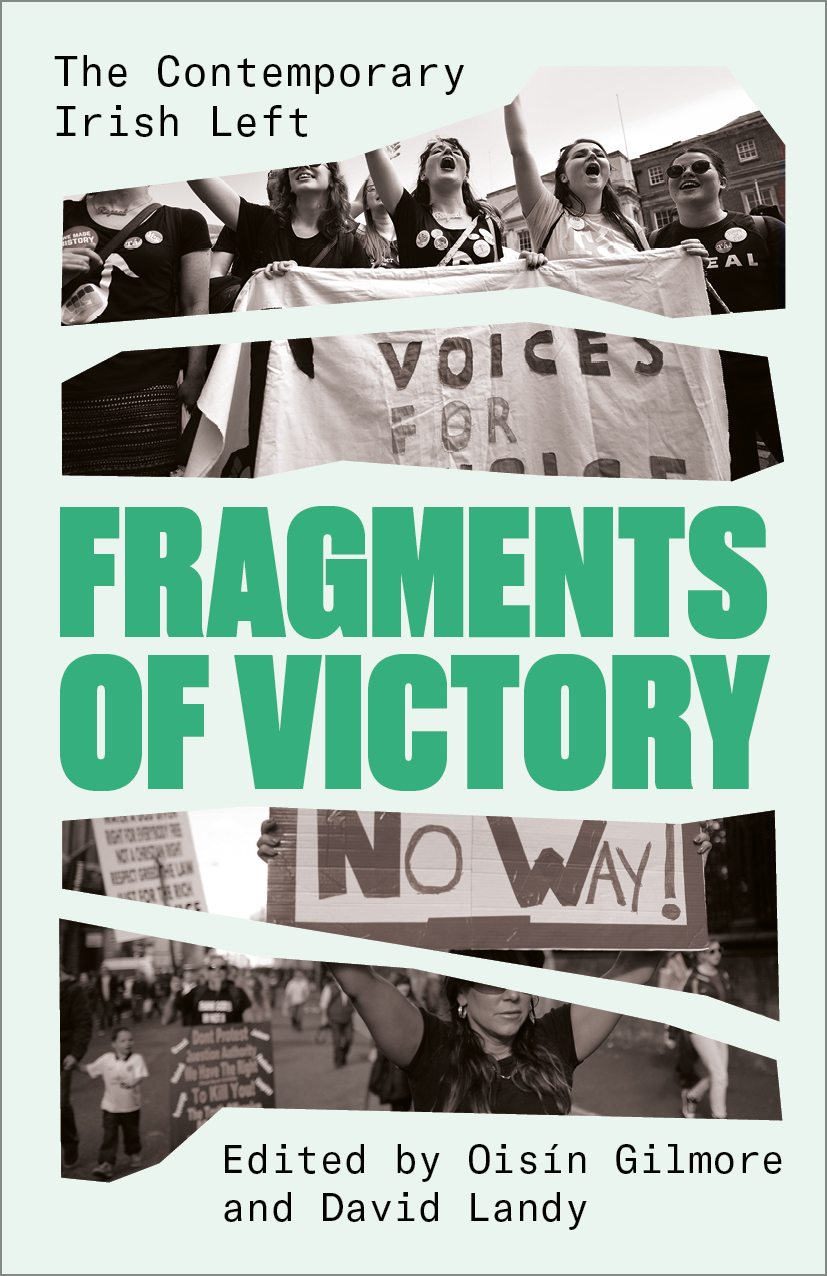
‘Fragments of Victory’: The Contemporary Irish Left’, book review (2 of 6)

In the book’s introduction we are informed that after the 2016 general election one in 20 members of the parliament was a Trotskyist”, which would, for example, translate to over 30 MPs at Westminster.  In the conclusion it notes that this election was ‘perhaps the greatest electoral success of Trotskyism in any western country ever’, ‘the development of one of the strongest electoral lefts in western Europe’ (p177)

Except this avoids the question of what manifesto – what political programme – did these ‘Trotskyists’ get elected on that was in some way supported?  Was it in any way a revolutionary socialist one and if not, in what sense was it a vote for Trotskyism or for Trotskyists? What wider movement, if any, did the vote reflect?  How isolated was it, or was it the vanguard of a much wider radicalisation?

Fragments initially appears to be organised around the concept that there is some identifiably coherent ‘left’, except reading it reveals that this is not the case.  There is however some commonality that we alluded to at the end of the previous post, but it is this commonality that is itself incoherent.

We are informed that the Irish were one of the ‘strongest electoral lefts in western Europe’ and that this ‘left’ not only includes the ‘Trotskyists’ but also Sinn Fein; so we know that however strong this left became in electoral terms its political unity is at the very least questionable. You can assemble the various parts but it becomes less an alternative the more it is put together.

On page1 we learn that the left ‘won some victories’ (a near unique achievement in western Europe during this period) that ‘other countries could learn from.’  Yet in this introduction we are also informed that the austerity following the economic crisis ‘created a collapse of living standards, experienced by many’ with emigration that exceeded ’even the highest rates . . . of the past’.(p 13) 

On page 3 we learn that apart from Sinn Fein other left wing parties and campaigns ‘have struggled in the face of the new political challenges’ while despite ‘widespread support for leftwing politics, the left has failed to build lasting political and social institutions . . . After a decade that saw the left win real victories, mobilise hundreds of thousands and transform the electoral landscape, in many ways the left finds itself in a strangely weak position.’  These judgements are all in one paragraph!

In the conclusion, after noting some successes, including electoral gains, it states that ‘despite these successes, the left is in many ways as weak as it was pre-2008.  No lasting form of working-class self-organisation has emerged.  Union density is lower now than it was in 2007.  No mass parties have emerged.’ (p177-8)

On the next page we learn that ‘These apparent advances by the left in Ireland contrast sharply with the decline of its counterparts in most of the West . . . the left in many countries is in a worse position than it was before the crisis.’ (p 178). ‘The advance of the left in Ireland is even more striking when the political situation in pre-crisis Ireland is compared with that of Western European states.’ (p179).

It notes the failure of Syriza in Greece and Irish hopes for it, although Ireland did not even produce a Syriza and, as the book acknowledges, its defeat led Sinn Fein to shift its rhetoric to the right, opening the door to junior partnership in government with one of the two main bourgeois parties.  Gerry Adams is quoted –“I have to say, I never really subscribed to that notion of a left-wing government, certainly not in the short term.  I mean, who are the left.” (p 171) A very good question, to which Adams gives one element of an answer – it doesn’t include Sinn Fein.

This favourable comparison with the rest of Europe sits uncomfortably with the observation that ‘Missing in Ireland, especially in the early years, were the massive explosions of protest seen in other countries during 2009–13’. (p 184). 

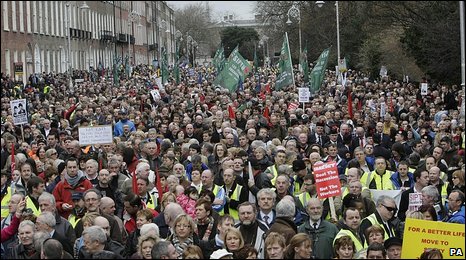
Nevertheless, we are told that ‘The material successes of the Irish left and its social movements have been unique . . .’ (p185) and ‘the achievements of the social movements since 2008 are striking.  There are some real, substantial victories. Hundreds of thousands were mobilised. And the political culture of Ireland was definitely changed.  The neoliberal consensus . . . is over.’  ‘Today the left in Ireland is no longer marginal. While in almost all of Europe the last few decades have witnessed the decline of the left. In Ireland it has grown in strength’ demonstrating ‘what can be achieved.’  ‘There is today in Ireland significant support for the left . . .’ (p191)

These advances were apparently based on an already well-positioned movement because ‘in some ways, the left in Ireland was well prepared for the crisis.’ (p185). By this is meant that it was not focused on identity politics and ‘cultural questions’ although in fact this is not the case.  It is just that the majority of the Irish left have swallowed gender identity politics for example with hardly a debate, mirroring the introduction of gender self-id recognition carried out by the state purposely also without debate.

The conclusion presents ‘two key findings’, including that ‘the 2008-18 period saw the emergence of major mass movements that have both fundamentally changed Ireland’s political life and can provide lessons for the left internationally.’ (p188)

‘Trickier to identify, but unquestionably real, Ireland is a more leftwing country than it was in 2007 . . . Between the summer of 2021 and the summer of 2024, the left consistently outpolled the right, whereas before 2008, the left only had a third of the support for rightwing parties.’  Also adduced as evidence is that there is now recognition of the need for state intervention to solve the housing crisis. (p184). The problem with the latter however is that this state intervention has largely been to incentivise private sector solutions, which the left has denounced.

The success is qualified – ‘looking forward, the achievements of the last 15 years seem rather more fragmented’ and even the ‘electoral gains arising from a period of struggle . . . is now very much in the rear-view mirror.’  In the same paragraph it notes that the campaign victories over abortion rights and water tax ‘failed to result in lasting organisations.’ (p191). The other ‘side of the coin’ as the book puts it. (p3)

Capitalist crisis did not see ‘the re-emergence of working-class self-organisation and provide a space for the activity of the radical left’ while ‘mass movements were less a story of mass organisation than mass mobilisation’ (p180-1,182)

The movements since 2008 were ‘large but ephemeral’, ‘failed to lay deep social roots’, ‘failed to identify an avenue through which society might be changed, and given this, they have failed to develop a mass political consciousness around the capitalist nature of our society or around what needs to be done to change it.’  While they apparently ‘frequently terrified the ruling elite’ ‘they have never presented a serious challenge to the existing order.’ (p183)

Despite the positive evaluation and even with the qualifications, which leave a rather confusing picture, the real damaging conclusion is contained in these comments:

‘In many ways, despite the victories of the left since 2008, the future looks bleak.’ (p190). ‘It is hard to believe Sinn Fein will deliver the change that many desire . . [and] It is unlikely the Trotskyist People before Profit will manage to articulate a viable alternative . . .’ (p191) So despite short-term victories’, ‘the steps between the current situation and the long-term goal of socialism are less clear than ever before.’ (p192)

The book’s last words are that ‘it is clear that fragments of victory are not enough.’ (p 192) with the fatal verdict that despite the ‘striking’ advance of the left and ‘the apparent success of the Irish left’, the radical left ‘were engaged in a form of politics incapable of realising its own aims.’  (p179 &181)

Back to part 1

Forward to part 3

‘Fragments of Victory’: The Contemporary Irish Left’, book review (1 of 6)

Reading ‘Fragments’ I was reminded of the statement by Marx that ‘We develop new principles for the world out of the world’s own principles. We do not say to the world: cease your struggles, they are foolish; we will give you the true slogan of struggle. We merely show the world what it is really fighting for, and consciousness is something that it has to acquire, even if it does not want to.’

Fragments sets out to record the struggles of the Irish left (in the Irish state) over the past few decades so that the reader can form a view on its successes and failures.  In doing so we can apply Marx’s prescription and determine to what extent it shows the left ‘what it is really fighting for’ so that it can be conscious of the lessons that should be learned.

There are some obstacles in the way, including the variety of authors with different viewpoints although an introduction and conclusion is meant to summarise the results.  The major problem is the definition of what it means to be ‘left’.  In the introduction Sinn Fein and the Green Party are listed as left even though the major theme of the book is the response to the implementation of austerity following the collapse of the Celtic Tiger and the consequent bankruptcy of the State.

During this period Sinn Fein presided over austerity while in a coalition government with the DUP in the North, while the Green Party entered into a coalition with Fianna Fáil in 2007 that bailed out the banks and inaugurated widespread cuts in social welfare and wages.

As part of the relaunch of Stormont in 2015 the ‘Fresh Start’ agreement committed the parties, including Sinn Fein, to reducing NI civil service staff numbers: ‘Between April 2014 and March 2016, the NICS is set to reduce headcount by approximately 5,210 and between April 2015 and March 2016 a further 2,200 will exit from the wider public sector.’ The Green Party supported the bank bailout that the state could not afford, which resulted in the intervention of the Troika of the European Commission, European Central Bank and IMF, along with the huge austerity necessary to satisfy their demands.

Even taking account of the elastic possibilities permitted by employing a relative term such as ‘left’, it is difficult to sustain any claim that these parties are in any substantial or verifiable way left-wing.  Sinn Fein was described by a comrade of mine a long time ago as containing members with left-wing opinions and right-wing politics.  The party has, in the meantime, fully confirmed this judgement while in government.  The Green Party began life as The Ecology Party promising ‘a radical alternative to both Capitalism and Socialism’ but in office twice it has displayed no alternative to capitalism and therefore no alternative to socialism.

Looking at political struggle through the lens of ‘left’ versus ‘right’ has therefore the potential to obfuscate as much as it clarifies.  A more illuminating approach is to set out the class nature of the politics of a political party and to explain why different parties with generally similar class natures have the politics that they do, even if they have different colouration.

Thus, as a nationalist party, Sinn Fein is a petty bourgeois party that considers the Irish people as one, with any class distinctions completely secondary and subordinate to the interest of the nation and its state, which can represent the true interests of all the people simply because of their nationality.  The Green Party claimed at its birth to have a radical alternative but also rejected a class approach through its largely petty bourgeois base and ideology.  It confirmed its class character by its members enthusiastically joining Fianna Fáil in government (voting 86% in favour) and by its commitment to the banks and austerity.

It might appear difficult to assign a class identity to some parties, and any classification has to be justified, but this is precisely the point of identifying the class nature of the forces involved.  As petty bourgeois parties, both Sinn Fein and the Greens have imposed austerity on workers while espousing radical rhetoric.  Calling them left is an attempt to obscure this and works to introduce doubt that they will not always fall on the side of the capitalist class in a struggle.

Fragments demonstrates this repeatedly, even when making secondary observations, for example that individual members of Sinn Fein were active in the Campaign Against the Household and Water Taxes but that the party was not: ’This form of partial (non-)commitment proved to be the defining feature of Sinn Fein’s approach to most political struggles of the time.’ (p37)

Approaching politics this way allows us to make judgements of other ‘left’ parties such as the Labour Party and Social Democrats etc. and permits an understanding of their behaviour during this period.  While the Labour Party paraded its ‘Labour’s Way’ as resistance to ‘Frankfurt’s Way’ while in opposition, it had no alternative to austerity when in government.  The doubling of its vote in the 2011 general election was a prelude to its consequent decimation in the next one.  ‘Labour’s Way’ didn’t become Frankfurt’s Way’, not having an alternative meant it always was.

Was the 2011 vote for Labour therefore a victory for the ‘left’ and was its subsequent decimation a defeat?  Did those who voted Labour in 2011 make an advance in consciousness or do so by deserting it in 2016? Or were they just registering disappointment and resignation?

Fragments offers the view that despite Labour delivering austerity when in office ‘the new government retained a huge amount of goodwill . . . the crisis was clearly not their fault and . . . the harsh austerity measures they took were seen as both forced by the Troika and, while painful, necessary’, while ‘the ‘honeymoon lasted for much of 2011 . . .’  (p31) So, were these views completely discarded when the Labour Party was dumped out of office? Was there any real advance in consciousness of an alternative when it happened?  Is roping the Labour Party into ‘the Left’ clarifying either history or the future?

Today, all these parties are allied in supporting Catherine Connolly for the post of President with the additional enthusiastic support of People before Profit and Solidarity.  The latter’s politics are supposed to be based on the view that existing power in capitalist society does not come from parliament but from the permanent state apparatus and the economic and social power of the capitalist system, yet they promote the idea that election to a post that is admitted not only to be without power, but forbidden to exercise any, would be a major advance.

Paul Murphy, People before Profit TD, states on Facebook that ‘this is a rare opportunity for the left to come together, and elect a voice for workers, for women and for neutrality.  Change starts here.’ This is a left that includes all the parties above that have been tried and tested.

In doing so all sorts of illusions in the role of bourgeois politics and institutions; about the ability of one person to represent the nation, and all the people within it; because of a one-off vote, and of the way ‘change’ can be made, are strengthened against an alternative view that real change comes from the organisation and struggles of the working class itself.

Are such views ‘Trotskyist’, as Paul Murphy’s organisation is called in the book? Or is this term used because that is just how it is usually described, or should such a designation not require some comparison of its political practice to a reasonable account of what Trotskyism is?  The umbrella term of ‘left’ addresses these questions by rendering them unimportant, and this is a problem.

To anticipate one message of this review; Fragments provides enough testimony to show that a different approach is necessary and that an alternative is required to the illusion that there is a ‘left’ that should be united to advance the cause of the working class.

It demonstrates, in its own way, that only a class analysis can explain events, including the actions of the state, why it succeeded in imposing austerity and why the resistance to it was unable to rise to the challenge.  Explaining all this in terms of whether certain actors, institutions or policies were ‘left’ or ‘right’ is hopeless not only because of the vagueness of the terms but because all of these acted out of material interests, as they perceived them, and these in turn were based on objective factors that were fundamentally determined by class relations.

Forward to part 2

The domestication of the Irish Left

Marxists believe that power in society resides in capital, in the capitalist system and its property relations in which ownership and control of the means of production etc. are monopolised by one class.  In the form of money, capital can be otherwise employed to gain political influence through the media, buy politicians and discipline governments through speculation on the bond markets.  Capital strikes can disable economies just as individual capitals can close down workplaces overnight destroying the livelihoods of their workers.

On top of this are states that defend these property relations through a multitude of laws bolstered by assumptions about the primacy of bourgeois private property rights that are considered holy writ.  Should this be questioned the state is also composed of forces armed with the monopoly of violence to police and impose the requirements of these property relations.  Since such relations involve the exclusion of ownership and control by the majority there is nothing democratic about them and no bourgeois claims to democracy entertain the notion that there should be democratic ownership and control of the economy.

Instead such claims to be democratic rely on parliamentary institutions that are dignified with reverential rules and procedures, the better to elevate their status above their essential subordination to the real power in society.  Incantations about their sacred embodiment of democracy cover for this subordination while most people vaguely register their awareness of the sham through a view of all politicians as essentially liars.

This, however, is a purely cynical reaction and is not the ground for either an adequate understanding of what is going on or the envisioning of a genuine democratic alternative.  Nationalism provides additional glue to bind workers to their (nation) state and the claims it makes for itself on their behalf, but more and more decisions are taken at an international level where real democracy is even more obviously absent. It is generally considered in most of Europe that its people live in a ‘democracy’.  The job of socialists is to make them aware that this is bourgeois democracy and that it is a sham that they should seek to change.  Moreover they need to be convinced that the state they are invoked to give allegiance to does not defend their interests.

One very small example of the fraudulent character of bourgeois parliamentary democracy has erupted in Ireland as the governing parties have voted to restrict the speaking time of the opposition, reduced its own exposure to questioning, and allocated opposition time to a group of ‘independents’ who have all declared full support for the government and have a number of members as ministers within it.  As all the opposition parties have put it, you are either in the government or in the opposition – you cannot be in both.

Dáil sitting has been suspended before in much disorder but was suspended again yesterday when the change in Dáil standing orders was pushed through without debate by the Ceann Comhairle (the Speaker of the House). She is supposed to be independent but was elected as a member of the same ‘independent’ group and appointed as part of the secret deal that no doubt lies behind the speaking privileges now given to it.

This is no doubt a cynical political stoke that should be opposed. The up-its-backside liberal propaganda news sheet ‘The Irish Times’ opined that “normal Dáil business” must “resume immediately” so that a list of issues can be discussed. These include climate and health care that “normal Dáil business” has failed to successfully address for decades.  Even these relatively minor attacks on democratic functioning do not find this liberal mouthpiece defending it.

Of course, the government is committing much greater crimes against democracy than these latest shenanigans, including allowing planes delivering arms to Israel to pass through Irish air space.  Like governing party claims before the general election about the number of houses that were being built or support for the Occupied Territories Bill, this is a government that cannot be trusted to tell the truth.

The opposition parties, including People before Profit, have united to ‘stridently’ oppose this ‘alarming’, ‘outrageous’ and ‘unprecedented’ plan and to defend the ‘fundamentals of parliamentary democracy’.  There has been a lot of talk about the government’s changed procedures reducing their ability to ‘hold the government to account’ and to ‘represent their constituents’.

But this follows People before Profit centring their recent electoral campaign on ending 100 years of unbroken office by the two ugly twins who nevertheless won the recent general election.  When has either Fianna Fail or Fine Gael been held to account over this 100 years?  When has it been punished for its failures, lies, hypocrisy and previous much more authoritarian measures?  In what way do impassioned speeches by People before Profit TDs excoriating government ministers to an almost empty Dáil chamber – shown regularly on social media – embody holding these ministers to account?

The man in the centre of it all,’independent’ TD Michael Lowry, has been found by a state tribunal to be “profoundly corrupt” but here he was giving two fingers to the PbP TD Paul Murphy! Why is he not in jail, never mind inducing the government to tear up Dáil standing orders on his behalf?  Tribunal after tribunal has demonstrated that there is no justice from the state and the Dáil chamber is incapable of delivering it either.  More evidence of the sham that is bourgeois democracy!  Why not say this?

Rather than use the episode to demonstrate this to the Irish working class, to further explain the limits and hypocrisy of bourgeois democracy, and to call out the alternative, People before Profit has decided to become bourgeois democracy’s most vocal defender.  Rather than use it as support for the argument that the working class will not find real democracy within a bourgeois parliament, it declares the vital need to support its fraudulent claims that it can allow workers to hold the government to account’, i.e. criticise and punish it.  Instead of exposing the hot-air bloviating that passes for democracy it holds out the necessity for extra hours of fine speeches.

Illusions in bourgeois democracy run deep in Irish society, as in most advanced capitalist states, with the continued election of Lowry and the ugly party twins as plenty of evidence.  Every opportunity to expose it should be grabbed.  Ironically, a previous posture of doing this – of exposing the hollowness of bourgeois democracy evidenced again by this latest stroke – would have been more powerful in embarrassing the government than the strident claims that more time to ask questions and talk to an almost empty room is vital to democracy.

To go back where we started – with Marxist principles.  These declare that the emancipation of the working class will come from the activity of the working class itself, a principle precisely counterposed to the parliamentary illusions of much of the left.  Real power comes from outside, that of both the capitalist system and of the working class.  It is on the power of the working class and its organisations outside that socialists need to focus, and which could do with much greater democratic functioning. Illusions in the Dáil are only for those for whom these illusions are comforting and who seek a career within it.

Nationalism planning for a United Ireland

The Belfast paper – The Irish News – has a column every Saturday by Patrick Murphy that regularly flagellates Sinn Fein for its hypocrisy and incompetence, sectarianism and corruption, its elevation of the cause of a united Ireland over a united people, and the constitutional question over questions of economic and social equality and poverty. Most of all it is criticised for its nationalism, even its betrayal of it through its recognition of the legitimacy of the ‘two traditions’ in Ireland, which translates as two nations and thereby betrays its own stated goal of a united nation.

Sinn Fein is not the only target and the SDLP and Southern parties get a lashing now and then as well.  It’s a bit repetitive, even if accurate in its own way, and his style can sometimes be irritating.  Anyway, the irony is that for all his economistic denunciations of nationalism, he is actually a bigger nationalist than the SDLP, Southern parties and Sinn Fein.

His bête noir is the European Union, which he sees as robbing Ireland of its sovereignty with Irish membership akin to allying with the British Empire against Germany in World War I, betraying Connolly’s entreaty to ‘serve neither King nor Kaiser but Ireland’. Of course, he has no difficulty is demonstrating the imperialist character of the EU and its current complicity in the imperialist and Zionist genocide in Palestine etc.  But he is no Marxist and so is unable to appreciate that his belief in a sovereign independent Ireland is a pipe-dream; a reactionary attempt to turn the clock back to a world of independent nation states that also ironically never existed and will never exist.  A recent article by Boffy sets out what is going on here.

By coincidence the Saturday issue of The Irish Times has an article by the Taoiseach Simon Harris setting out the need for the Irish State to defend its current success from the potentially devastating effects of a Trump presidency through some sort of ‘diplomatic offensive’.  This can only involve reminding Trump of how useful the Irish state is for the United States – “Ireland’s offering is one that speaks to Trump . . .”  Since what speaks to Trump most of all is willing and obsequious servility, the Irish are well practised in ingratiating themselves with US presidents, getting the opportunity to do so every St Patricks day with a ridiculously over-sized bowl of shamrock.  What handing over the bowl by the Irish Taoiseach symbolises is the handing over of the country to its true and ultimate chieftain.

The idea of Patrick Murphy that Ireland could genuinely be an independent and sovereign state, against the United States and outside of the European Union, is so divorced from reality it has been abandoned by every other Irish nationalist party.  Irish socialists should not take on the burden of trying to claim it and should instead recognise the ending of the era of nation states as heralding the ending (very painful ending) of capitalist nation states and inevitably of the nationalist ideology that is sustained by them.

The decline of nation states and agglomeration of super-states and imperialist alliances, demonstrated by the US and China and by NATO and BRICS, is an expression of the development of the productive forces of capitalism upon which the possibility of socialism rests.  The intensifying competition and rivalry between these imperialist states and their alliances poses an existential challenge to the interests of the working class, which, as Marx said, has no fatherland but can only assert its interests as an international class.

This means opposition to imperialist war, which currently means opposition to the imperialist conflict in Ukraine and the country’s proxy war on behalf of western imperialism against Russia.  It means rejecting the idea that an old slogan, and one not understood, of self-determination can be proclaimed as justification for supporting one or other side of this imperialist rivalry and the war it has generated.

That consciousness, including political consciousness, often lags behind economic and social development is nothing new and partly explains why many on the left have become enthusiasts for one imperialist alliance or the other.  This leads to hypocritical claims of opposition to oppression by the other side while ignoring the oppression of the favoured imperialism.  So, for example, the United States is claimed to be the key enemy of the working class of the whole world, including of Russia and China, while the role of these states in oppressing their own working class is a “separate question”, as one apologist for these states put it to me.

But let’s get back to the Murphy column in The Irish News.  He notes the recent ‘plan’ by Sinn Fein minister Conor Murphy to create 10,000 new student places centred on Derry.  He notes that it is based not on the purpose of new university facilities and what their wider role might have for development but mainly on where they will be sited.  Along with nearly all Stormont ‘plans’ it doesn’t have the money behind it to make it happen but promises to at least have some.  In this respect it is better than the new Health Service three year plan, recently announced while the first year was already three-quarters over and which promised new stuff if it had the money and cuts in the meantime.  This didn’t stop it being welcomed.

One of the many criticisms of the Conor Murphy plan was that it was a Northern Ireland plan that will reach full fruition by 2032, by which time his party leader has promised that Northern Ireland will not exist! Oh dear, nationalists revealing that they don’t believe their own hype?  I have to admit I almost laughed out loud.

Sinn Fein has been banging the drum on the ‘conversation’ about a united Ireland for years, demanding that the Irish government and everyone else start planning for it, lest the project suffer from the same lack of preparation as Brexit.  And here it is presiding over plans that ignore it!  Repeated calls for plans are followed by silence and their complete absence. Why? Because any plans would immediately confront obstacles that no one wants to talk about; assurances no one would believe, and promises that would invite the response of ‘why don’t you do that now then?’

Behind the empty rhetoric is the reality that nationalism itself has nothing to offer, which the utterly incapable Stormont regime has demonstrated in spades.  For socialists, the national question and a united Ireland is an Irish democratic revolution which cannot promise radical economic and social advance outside of an accompanying socialist revolution. All the limitations to an independent and united Ireland set out above would apply.

At most it is the act of uniting the country alone that would be justified as a democratic advance itself and during ‘the Troubles’ this was how it was implicitly understood.  Now, it is claimed by nationalists that it will have all sorts of other economic and social benefits that Sinn Fein says everyone else must plan for but which it can’t convincingly demonstrate exist and can’t plan for itself.  Instead, what political arrangements that are touted are flimsy and insubstantial – a new flag or national anthem – or actually undemocratic – some mechanism to guarantee continuing unionist power and influence.

All around us we see the pervasiveness of nationalist thinking and the failings of its nostrums.

First steps for the left in the new Dáil

When the Dáil met following the general election the order of business included the nomination of a new Taoiseach and the position of a new Ceann Comhairle (Speaker of the Dáil).  The latter became part of the horse-trading between Fianna Fáil and Fine Gael and the Independent group of TDs (who are FF/FG in all but name) so that the three of them could form a stable administration.  With no principled difference between any of them the issues were all about divvying up the spoils of office, which included the role of Ceann Comhairle.  This comes with a salary of €255,000 a year, which is greater than that of the Taoiseach.

The Independent group let it be known that this was one bauble that they wanted and the two main parties thought about it.  Their wish was granted and their nominee, Verona Murphy, was approved following, rather appropriately, the proposal of Michael Lowry.  Murphy had previously lost the support of Fine Gael as a candidate following remarks about asylum seekers needing to be “deprogrammed”, as they may have been “infiltrated by Isis”, and further comments claiming that Isis had “manipulated children as young as three or four”.  Lowry had long ago been removed as a candidate of the Fine Gael party following a number of scandals.

This has passed without much fuss as par for the course for bourgeois politics in Ireland. Unfortunately, the Socialist Party TD Ruth Coppinger missed the point by stating that “in rallying behind its selection for Ceann Comhairle, it could be the first and last rally for women that the next government is likely to do when it comes in.”  The point of Murphy being the first woman to be elected Ceann Comhairle was really beside the point, but pretending to make it so reflected the influence of identity politics on Coppinger and the Irish left.

More importantly, Coppinger registered her abstention on the more significant business of the nomination of Mary Lou McDonald of Sinn Fein as the new Taoiseach, “simply because we do not have a real prospect of an alternative government.”  It is beyond doubt that Coppinger will vote many times over her next few years in the Dáil on motions that will have no chance of being passed or against others she will have no chance of stopping. Why is this an obstacle now?

If her rationale was a cop-out, People before Profit’s support for a Sinn Fein Taoiseach made no sense at all.  Its leader, Richard Boyd Barrett, stated that “People Before Profit will be supporting the nomination of Deputy Mary Lou McDonald, not because we agree with Sinn Féin – we disagree with it on many things, not least its refusal to rule out coalition with Fianna Fáil and Fine Gael – but because we believe parties on the left have an obligation to end 100 years of Fianna Fáil and Fine Gael and put together the first left-wing government this State has ever seen.”

Besides the absurdity of supporting an alternative government based on a party you do not agree with, or doing so on the assumption that this is a ’party of the left’ – what exactly constitutes being left-wing? – how could this party ‘put together the first left-wing government this State has ever seen”? So focused and fixated is People before Profit on ‘ending 100 years of Fianna Fáil and Fine Gael government’ that what it is replaced with appears to be utterly secondary – even admitting Sinn Fein’s potential to go into coalition with either (or both?) of them anyway!

If Coppinger’s remarks were an admission of failure of the ‘left-wing government’ project, Richard Boyd Barrett’s were a judgement on the retrograde consequences of pretending to pursue it in circumstances in which it is impossible.  The only good thing in this case about writing a blank cheque for a Sinn Fein government is that it cannot cash it.  While Coppinger cops out on what is a question of principle – what sort of administration a Sinn Fein Taoiseach would preside over? – Boyd Barrett votes in principle for a principle he cannot possibly support – a Sinn Fein Taoiseach leading a government that is not committed to opposing either Fianna Fáil or Fine Gael participation within it.

The whole performance is political theatre, which – with the season that is in it – is a pantomime.  Grubby deals accompany political posturing that reflects no good on any of the participants and is of no educational value at all to workers looking in.

People before Profit’s Paul Murphy says “What should the left do now? Rule out coalition with Fianna Fáil and Fine Gael and put forward left-wing policies”; except the first has been determined irrelevant by the recent election while ‘putting forward left-wing policies’ begs the question of what is meant by ‘left-wing’ and what is meant by ‘policies’?

People before Profit stood on a manifesto saying that “The first step in bringing about fundamental change will be the formation of a Left Government – one that excludes FF and FG.”  That is now stuffed, with no elections likely for a few years, even were it the case that working class struggle should revolve round them, or that it need start with the actions of TDs in the Dáil.  Were we now to take them at their word we would have to wait to the next general election to take “the first step in bringing about fundamental change.”

Such change does not come from parliament, not from ‘left’ governments and not even from the state, which People before Profit seems to pretend is governed by the first two.  The first step is never the action of ‘left’ governments, parliaments or the capitalist state but from the independent action of the working class.

It is not the role of the ‘left’ to lead in the Dáil while the working class is a supporting act outside.  Some part of the People before Profit thought process knows all this but has not the first idea how to operationalise it.  Even were it only able to identify it at a very general level, it would be a good first step to doing the first thing about it, a good New Year’s resolution perhaps.

The Irish general election (2 of 2) – what lies beneath

When five political commentators were asked for the main moment of the election campaign, they all mentioned the TikTok Taoiseach’s snubbing of a disability care worker when he was on one of his many walkabouts.  It “cut through” to the public, as the saying goes, and probably did lower the Fine Gael vote a little.  However, in the grand scheme of things all it demonstrated was the irrelevance of the campaign, which has been described as a non-event.  Unlike recent general elections in many other countries, the incumbents were returned to office, providing evidence of political stability that does not exist elsewhere.  This stability rests on uncertain foundations.

The election was called following a large give-away budget of tax reductions and increased state spending, followed by a campaign where everyone promised even more tax cuts and increased spending.  This included the previous austerity-merchants in Fianna Fáil and Fine Gael. Halfway during the campaign, when Sinn Fein joined the club, Fine Gael launched hypocritical denunciations that it was about to break the “state piggy bank”.

On the surface, the only difference between the governing parties and the different varieties of opposition was how much they would spend. People before Profit claimed that their clothes were being stolen by everyone, at least for the election, while media commentators claimed that the widespread consensus on increased state intervention showed what an essentially leftwing country Ireland was.  Since PbP argues that such intervention is an expression of socialist politics these claims would be right – if PbP was also right, which it’s not.  The view of politics as a spectrum from left to right implies no fundamental difference between the government and opposition but only shades or degrees of difference.

If this didn’t provide the grounds for major change, and the existing alignment of party support made it unlikely, the most important reasons for continuity are the foundations of the state itself and the economic success that has satisfied a significant part of the population, if only on the grounds that it could be a lot worse and recently was.  The ‘left’ appeared as wanting to share the gains more equally.  Unfortunately, those seeking equality inside the Irish state have to reckon on the giant inequality outside on which it would have to be based and which determines it.

The largesse of recent budgets, and the promises of more during the election, rest on the existence of the Irish state as a tax haven where many US multinationals have decided to park their revenue for tax purposes alongside some of their real activities.  Over half of the burgeoning corporate tax receipts come from just ten companies, with the income taxes of their employees also significant.  Trump has threatened tariffs on the EU, which threatens the massive export by US pharmaceutical firms to the US, and has promised to reduce corporate taxes, which also reduces the attractiveness of the Irish state to multinational investment.  It is not so long since the shock of the Celtic Tiger crash, so very few will not be aware of the vulnerability of economic success and the finances of the state.

This vulnerability was ignored in recent budgets and election promises while the electorate is blamed for seeking short term gains that are all the political class can truthfully promise.  Failure to invest in infrastructure has weakened the state’s long term growth with the major shortfalls ranging wide, across housing, health, transport, childcare and other infrastructure such as energy and water.  This has led to calls for increased state expenditure as the existing policy of throwing money to incentivise private capital has fallen short even while the money thrown at it has mushroomed.  Bike sheds in Leinster House costing €336,000, and a new children’s hospital that had an estimated cost of €650m in 2015, but costed at €2.2 billion at the start of the year – apparently the most expensive in the world – are both examples of the results of a mixture of a booming capitalist economy and state incompetence.

The consequences are an electorate that wants change but doesn’t want or can’t conceive of anything fundamental changing.  Government and opposition differ on degree but avoid the thought of challenging the constraints their lack of an alternative binds them to.  Trump is only one of them; Irish subservience to the US has already destroyed all the blarney about Irish support for the Palestinian people.  Gestures like recognition of a corrupt Palestinian state are nauseating hypocrisy beside the secret calls to the Zionist state promising lack of real action; selling Israeli war bonds to finance genocide by the Irish central bank, and the three wise monkeys of the three government parties ignoring the use of Irish airspace to facilitate the supply of weapons employed in the genocide.

The Irish state is not in control of its destiny and its population is aware of its vulnerability.  For a left that bases itself on the capacity of the state this is a problem; involving not just the incompetence, the bottleneck constraints on real resources, and the international subservience to Western imperialism.  The fundamental problem is in seeing the state as the answer.  Were the Irish state stronger, it would have joined NATO and more directly involved itself in the war in Ukraine; it would have intensified its support to US multinationals, and perhaps been a bit better at building bike sheds and a children’s hospital.  

Parts of the left seems to think the current Irish state can oppose NATO, oppose war and perhaps tax US multinationals a bit more.  It is, however, currently on the road to effective NATO membership; is more or less unopposed in its support for Ukraine in its proxy war; and already taxes multinationals on a vastly greater scale than almost any other country I can think of. 

The left doesn’t have an alternative ‘model’ because its alternative isn’t socialist, but simply development of the state’s existing role, presided over by some sort of inchoate left government, the major distinguishing characteristic of which is that it doesn’t include Fianna Fáil and Fine Gael.  This is so anaemic a strategy it avoids all the above reasons why it has minority support.

The terms in which this is popularly understood do not go in the direction of a socialist programme because of the generally low level of class consciousness, but a genuinely socialist path requires rejection of the current statist approach of ‘the left’.  That this too is currently very far away reflects not only the very low level of class consciousness but also how the forces that are responsible for this have also debased the left itself, especially the part that thinks itself really socialist.  Instead, we have the stupidities arising from the commonality of increased state intervention among all the parties repeatedly declared to be proof that Ireland is a left wing country.

These constraints explain the difficulty in creation of a left alternative to a Fianna Fáil and Fine Gael government; the fragmentation of the left and its Oliver Twist policies of simply asking for more.  There are numerous permutations possible before any purported left government would arise, with Sinn Fein, Independents, Social Democrats, Labour Party, and others all willing to go into office with either (or both) of them.  About the least likely is a ‘left’ government (in any meaningful sense) that excludes them and is composed of Sinn Fein – the austerity party in the North – and the Labour Party and Social Democrats whose whole rationale (as the good bourgeois parties that they are) is to get into office – they don’t see the purpose of being involved in politics if you don’t.

All the calls for a ‘left’ government free of the two uglies is based on the same bourgeois conceptions.  Even if only on the grounds of the Chinese proverb – to be careful what you wish for, the failure in the election to achieve such a government is not grounds for mourning, even if the result invites it.

Back to part 1

The Irish general election (1 of 2) – As you were

A continuation of the status quo is the result of the general election in the Irish state, with the two main capitalist parties, Fianna Fáil and Fine Gael, gaining 42.7% of the first preference vote.  Falling just short of the 88 seats needed for a majority there are enough independents, who are FF and FG in everything but name, to prop them up.  The only surprise is that Fianna Fáil topped the poll, the same party written off following it presiding over State bankruptcy and Troika vassalage after the crash in 2008.

Their main opposition, Sinn Fein, gained 19% and is more than willing to go into a coalition but ‘the left’ by which it might form an alternative one is too small and fragmented, and FF or FG will only consider it as a partner if they have to, and they don’t, so this route to government participation is also closed off to it.  It has pulled its familiar trick, practised to perfection in the North, of claiming victory, which is only possible if you accept the disastrous previous local and European results as the benchmark. At one point, in the summer of 2022, an opinion poll put it on 36% but in the election its vote fell by 5.5% on the previous general election.  Beyond the various figures, it will be staying in opposition, which is not at all where it wants to be.

The third leg of the existing government – the Green Party – collapsed from 12 to only 1 seat, that of its leader who now has no followers in the Dáil. Its previous participation in office led to its complete wipe out in 2011, following its collaboration in the bail-out of the banks and imposition of austerity.  Like its fellow Green parties across Europe, its ‘left’ alternative credentials are to be taken seriously only by the terminally naïve.

On what is called ‘the left’, two parties did reasonably well in terms of their expectations.  The vestal Social Democrats gained seats and 4.8% of the vote, while the shop-worn Labour Party staged its own return from near-death by gaining seats and a 4.7% share.  They too have no justifiable route into government since FF and FG don’t need them that much and they would have little leverage on policy. They know they would likely suffer the fate of the Greens for their inevitable disappointing of the hopes of their supporters, busting the illusion that they are in some way ‘an alternative’.   The unsullied Social Democrats are relative latecomers, which will be their major USP until they see their next career move as being junior ministers, while the problem with the Labour Party is that having nine lives as a junior partner in government has required suffering the same number of deaths. It could nevertheless still be a hard habit to break but this time probably just deferred.

The People before Profit – Solidarity alliance will continue to get state-funding with 2.8% of the vote, an increase of 0.2% but with a loss of two seats from 5 to 3.  The core objective of being part of a left-alternative government to Fianna Fáil and Fine Gael might be said to have been destroyed except that it never existed in the first place. Neither formally nor informally was it advanced and ‘failed’ not only because of the continuing success of the main capitalist parties, even if much reduced by historical standards, but also by the weakness and incoherence of what PbP-Sol thinks of as ‘the left’.  To its credit the Solidarity section of the alliance is less inclined to consider Sinn Fein as left but either way, the perspective of a left alternative government as a realistic alternative to the various permutations of the current bourgeois groupings has been exposed again.  State funding, speeches in the Dáil and political social-work by TDs and would-be TDs are not only not a socialist alternative but not even a credible means of achieving the PbP-Sol reformist project.

On the right, the Catholic Aontú party made an advance with two seats and 3.9% of the vote while the Independent Ireland grouping won 4 seats and 3.6%.  Beyond these more openly right-wing groups, a couple of independents made ground with anti-immigrant politics and the far-right also stood candidates in a coordinated attempt tom unite by not standing against each other.  None were elected but what was noteworthy was their presence.  They have not yet congealed into a movement with a leader and have been stymied by the absorption of the anti-immigrant message by the main bourgeois parties and independents to varying degrees.

The result then is a return to government in some form of the existing main capitalist parties and the continued exclusion of the fragmented opposition, which was always the most likely outcome and partly accounts for the reduced turnout –down from 62.9% in the 2020 election to 59.7%.  The lowest in the history of the state. Almost as many didn’t vote as will have supported the two parties dominating the government. Some commentators, and the opposition, have attempted to explain that there are bubbling undercurrents waiting to have their effect but it is better to start explaining the apparent stability before explaining that something very different is really going on.

Forward to part 2

A World going to War and the resistance (1 of 3) – Palestine and Lebanon

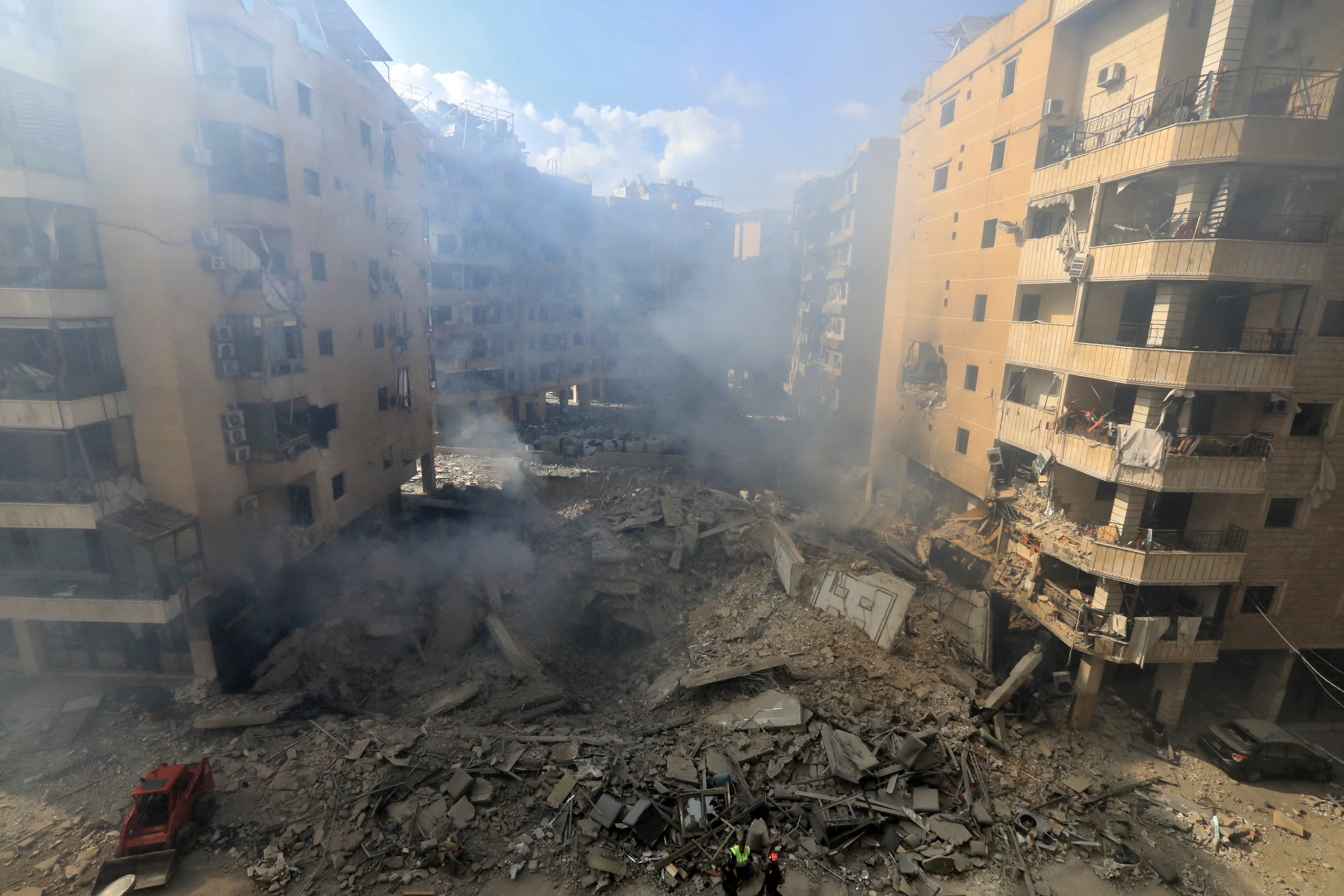
Beirut Photograph: AFP/Getty Images

Israel is reported to have killed more than a thousand people in its two weeks of bombing Lebanon and has now started a land invasion, which has caused a displacement of more than a million people, almost a fifth of the population.  It continues to murder hundreds of civilians in Gaza with the death toll approaching 42,000, not including many more buried under the rubble of destroyed buildings. One estimate, and not the highest, is 186,000!

After repeated provocations Iran attacked Israel with an unknown number of missiles that Israel says were mainly shot down, while video evidence claimed to show that many were successful, although it is not obvious that they hit their intended targets.  A main objective appears to have been to impact military airbases.

Iran reportedly gave notice to both the US and Israel that it was going to attack, allowing the Israelis to remove their aircraft from harm’s way, while it also said that its response to the provocations had finished.

Netanyahu shamelessly and offensively publicised his order to kill the leader of Hizbollah (and those unconnected who were near him) when he was at the UN in New York, straight after a speech in which he claimed that “Israel seeks peace. Israel yearns for peace. Israel has made peace and will make peace again.” After the Iranian missile strike he warned that Iran had made a “big mistake” and threatened that it “will pay for it”.

After the continuing genocide in Gaza, the more than thousand killed in Israeli bombing and now ground invasion of Lebanon, Keir Starmer declared that he and the country he claims to speak on behalf of, “stands with Israel” and recognises its right to self-defence.  The Labour Defence Secretary John Healey said that British forces had “played their part in attempts to prevent further escalation”, which must be his way of boasting that British aircraft helped the genocidal Israeli military to stop the Iranian missiles.  The US has already sent more military into the region and also boasted of its efforts against the missilles.

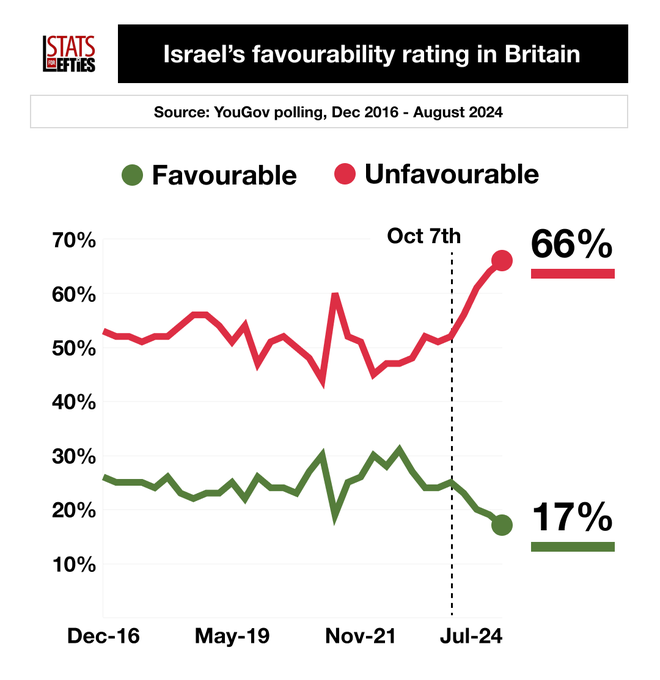
No one reading this will need an exposition of the lies and hypocrisy these statements involve, told by either the Zionist leaders or their Western backers: the selective condemnation of terrorism, selective endorsement of the right to self-defence, selective concern for civilian casualties and selective condemnation and sanctions against outside invasion.  All this is obvious.  Starmer’s support and defence of the genocidal Zionist regime has played a part in the collapse of his already low popularity and that of his government – his net approval number is now minus 30 and his government less popular than the one that has just been shredded:

More demonstrations are taking place and planned across the world, following the mass walk-out of delegates to the UN at the start of Netanyahu’s speech.  The pathetic role of the Irish delegation was clearly exposed by their staying in their seats to listen to the latest catalogue of lies that insults its listeners.

The Irish people have an opportunity to demonstrate their opposition to genocide and the attack on Lebanon through a march on Saturday.  The support declared for it reveals widespread support but also the depth of much of it. What is the purpose of this demonstration and the campaign generally? Is pointing out the hypocrisy of the government and its actions anywhere near enough?

The purpose, it would seem, can only be to put pressure on the government to take action but the repeated demands on the Government by some opposition TD’s have only been met by revelations that it will not even enforce its own laws that might somewhat inconvenience the transport of weapons to Israel – allowing flights over Irish airspace without any question.  The governing parties are riding high in the polls and are busy bribing the population with their own money in the budget – their money and that amassed as a tax haven for US multinationals. If putting pressure on it is the objective, the question must be asked – what pressure?

The political voices of these 160 civil society organisations supporting the demo have been demanding various actions from the Irish government for a year, with no success beyond its hypocritical statements that rival those of the other Western powers.  After a short time, this reveals not the power of public opinion but its weakness and that of the solidarity campaign that seeks to mobilise it.  It reveals the political poverty of demanding that the Irish bourgeoisie do something that is not in its interest.  If you expect they will do so you are naïve at best and if you don’t you are fooling your supporters and yourself.  

Look at the organisations supporting the demonstration! They include the trade unions and will probably include Sinn Fein; the party that partied with genocide Joe on St Patricks day.  Who could possibly feel pressure from such hypocrites?  The governing parties could easily turn round to the trade unions and ask – what have you done to boycott the Zionist state?

In other words, the Palestine solidarity campaign should be demanding that those who claim to support it do something, beyond supporting demonstrations that long ago revealed that bourgeois governments don’t care what their populations think as long as they can get away with it. If these governments will not take action, it needs to be taken for them, or rather – against them.

That means demanding that Sinn Fein boycott the genocidal US regime and the trade unions campaign to persuade their members to take direct action to boycott Israeli bound armaments etc. and defend them when they do.  If they don’t then their participation in solidarity demonstrations is a sham and by extension is a fraud on all the other participants who are genuinely opposed to the actions of the Zionist state and want to do something about it.

The Irish state is a very junior and subordinate partner in a Western imperialist alliance that supports the Zioinist state because this state is the West’s – primarily the US’s – instrument of power in the Arab world and beyond.  To expect that it will rebel against its dominant partners is delusional, and continual demands that it do so miseducates and misdirects everyone who doesn’t understand this. It must stop, and the campaign look to Irish workers as the means to put pressure on imperialism, starting by opposing their own state that is a part of it.

Forward to part 2

Bourgeois democracy in Ireland in two Acts (2) – Orwellian and Surreal

Bourgeois democracy can not only lie, it can also invent crimes for which you can be punished.  The Government is going ahead with the hate crime bill, shorn of its hate speech elements.  This follows its stinging defeat in the family and care referendum in which it also lied about the implications of what it was proposing when asked whether these had been raised within it as a concern.

The original proposals about ‘hate’ speech were particularly threatening but the retention of the definition of “protected characteristics” raises all sorts of questions that the government will again have to spin and lie about in order to defend.

These “protected characteristics” include ‘race, colour, nationality, religion, ethnic origin, descent, sex characteristics, sexual orientation, disability and gender’.  Beyond general issues about the wisdom of agreeing to greater repressive powers for the state, and the inclusion of essentially subjective considerations such as ‘hate’ in punishment, there are two questions – what is ‘sex characteristics?’  Is this just another term for sex, in which case what is the point of two words instead of just three letters?

The second is the definition of gender included in the legislation: “’gender” means the gender of a person or the gender which a person expresses as the person’s preferred gender, or with which the person identifies, and includes transgender and a gender other than those of male and female”.

This farrago of words is obviously not a definition of anything, certainly not of ‘gender’ or ‘transgender’, and as I have written before, it’s doubtful that one can be clearly stated.  It seeks to protect people who are ‘other than those of male and female.’  Who are they?  Where are they and how do they, or could they, exist?  In what way is this not putting into law the nonsensical ideas of gender identity ideology that the Government parties don’t have the courage to openly argue for?

When the right wing Senator Michael McDowell asked the Department of Justice what is intended by the term ‘transgender’ and ‘a gender other than those of male and female’ he got no response.  Instead, the department provided a statement that included this: 

“If someone is assaulted because they are transgender, that is a hate crime.”

“People identify as non-binary. That’s a fact. If someone follows a non-binary person after they leave a gay nightclub, and then assaults them while shouting homophobic abuse, they would likely be charged with assault causing harm aggravated by hatred (carrying a max sentence of 12 years, instead of 10 years because of the aggravating factor). If it’s not found that it has been aggravated by hatred, then the person could still be charged with assault causing harm,” it said. “A definition is required to protect that person. It has absolutely no implications outside of this law.” (Emphasis added – Sráid Marx)

The department also asked: “Does Michael McDowell believe that this person should be protected by this law, or does he believe this person should have to identify as male or female to be protected?”

There is so much that is simply stupid in this that it’s difficult to know where to start.

I am quite sure that Michael McDowell would respond that it does not require anyone to identify as anything in order to be protected, which is what the Department of Justice seems to imply. Or does the Department believe it must be proved that an assailant knows the inner thoughts of someone in order to secure conviction or aggravated punishment?  For that is what the department assumes when it wants to protect someone who is in some way not either male or female and walks out of a gay club.

How on earth could someone be attacked for being ‘non binary’ without the assailant having some prior knowledge of the person?  If a stranger was attacked for coming out of a gay club it is much more likely that any motive beyond purely violent intent would consist of homophobia, which is obviously what would be indicated by their “shouting homophobic abuse”.

It is indeed a fact that “people identify as non-binary” but it is also a fact, that the government wants to elide, that there is no such thing as a non-binary person (neither male nor female or both).  Assaulting someone for this reason is not an assault on someone because of what they are (e.g. gay) but an assault because of their (misconceived) ideas about what they are.  Since such ideas are as varied as there are ‘genders’, the state has opened up a panoply of grounds upon which to claim hate crime warranting additional punishment.

The state may have dropped attacks on free speech that might lead to criminal punishment arising from disagreement with the idea of the many ‘genders’ claimed by some activists, but this still leaves open the potential for punishment for those disputing such claims.  This may seem absurdly alarmist but it is already the case that the Department of Justice is implying that only inclusion of a gender identity in a victim ensures protection, something just as absurd.

The ability of the state to conjure up offences and therefore punishment on grounds that are non-existent is surreal.  The word Orwellian is overused but the Irish state is claiming that not only can it identify the inner thought crime of an accused but also that the inner thoughts of the victim can also be divined by the accused and in turn accessed by the state.

It is a feature of gender identity ideology that it throws up such idiocies that are easily dismissed, but these are a result of the foundational one that men can be women just by claiming to be one, and this is one nonsensical claim that is already being validated and legislated for.

McDowell has also noted that ‘the Bill suggests that there are genders (plural) other than male or female. It does not enumerate or describe such other genders”. He argues that unspecified genders beyond male and female would raise questions “over statutory provisions providing for gender balance in judicial appointments, board compositions, etc”.  “There is no case for legislating for an open-ended multiplicity of subjective genders the meaning of which is obscure,” he said.

The idea that the numerous legal and social provisions based on gender – understood as sex – will not be affected by the legal recognition in this Bill is naïve at best and does not accord with experience across the world.  I have argued elsewhere that these implications are reactionary.  They have included attacks on freedom of belief; freedom of speech and freedom of association; destroying women’s sex based rights; putting males in female spaces; attempting to obliterate sexual orientation and lying to children that they can change sex before they even have a full appreciation of what it is.

Those who think that because McDowell is right wing he cannot be quoted or we cannot agree with him on this should consider why a government and state that is complicit in genocide, as we pointed out in the previous post, should now be considered to be in the vanguard of social progress.  They might also consider that Genocide Joe Biden described trans rights as “the civil rights issue of our time. There is no room for compromise when it comes to basic human rights”. Tell that to the Palestinian people.

Back to part 1

Bourgeois democracy in Ireland in two Acts (1) – supporting the Palestinians

In June the Taoiseach Simon Harris assured the Dáil that “no airport in Ireland or Irish sovereign airspace is being used to transport weapons to the conflict in the Middle East or any other war”.  The Ditch web site in September began reporting that nine such flights had been made to Israel, although the site reported that there were, and no doubt still are, many more.  It noted that ‘Carrying munitions of war through Irish airspace without permission from the minister for transport is a criminal offence punishable by up to three years’ imprisonment.’   

Harris stated in June that “In relation to the overflights, the Government of Ireland has never provided any permission for such an overflight to take place in terms of carrying munitions and therefore the Government wouldn’t have been in a position to inform the Dáil of such a flight. That position is quite clear,” which means that unless the Government expressly permits the law to be broken, it hasn’t been.  It would appear that it is only broken when it has been admitted but since the Government is never going to ask to inspect aircraft overflying or landing, it is never going to be admitted, and we just have to accept that the law has not been broken and Irish neutrality policy has not been breached.

In response to the evidence that neither of these things are true the Government has called an investigation into its own actions, as if it doesn’t know what it has been doing. Meanwhile Harris accused his critic, Sinn Fein’s Mary Lou McDonald, of “misleading people” and of trying to “muddy the waters”, which would make more sense if it was self-criticism.

The Green Party Minister of Transport has claimed that “no airport in Ireland, or Irish sovereign airspace, has been used to transport weapons directly to Israel” while he has also claimed that he supports new legislation that would allow random checks.  The sponsors of separate legislation have pointed out that the government already has powers to carry out checks but it isn’t using them, while it’s opposing their own proposals. The Minister has promised to “sit down with my officials and with legal experts over the coming months to make sure that new legislation is developed that is watertight, is workable, and is compliant with international aviation law.” Sitting for months is as near an honest admission of what action it will take as the government is likely to provide.

The prospects of any further Government legislation that would be implemented can be gauged by the fate of the Occupied Territories Bill, which would ban and criminalise “trade with and economic support for illegal settlements in territories deemed occupied under international law”, most notably Israeli settlements in the occupied territories.

This was passed in both Houses of the Oireachtas but has been stymied for four years, with yet another statement by Harris that he would seek “fresh legal advice” to extend the never ending delay.  The message is that a majority in the legislature can vote for something that is undoubtedly approved by the majority of the people but this doesn’t mean the Government will do anything to implement it.  The Ditch again explained the precise mechanism employed in this particular case, one of the many in bourgeois democracies to ensure that what democracy there is is suited only for the bourgeoisie:

‘On 25 February, 2019 Hadie Cohen from the Israeli Ministry of Justice emailed colleagues.’

‘Cohen referred to a “confidential call” (emphasis Cohen’s own) with Paschal Donohoe. Cohen said Donohoe told Israeli finance minister Moshe Kahlon that the Irish government would “block” the bill.’

“We understand that during a confidential call on 13 February between the Irish Minister of Finance and his Israeli counterpart, the Irish minister confirmed that the Irish government will be using a procedure known as “money message” to seek to block the progress of the draft Irish legislation criminalising dealings with products and services from the settlements – the Control of Economic Activity (Occupied Territories) Bill 2018,” wrote Cohen.’

‘The “money message” was invoked by ‘then foreign minister SImon Coveny [who] said government would invoke article 17.2 of the constitution . . . Coveney said government had to do this, not to frustrate the democratic process as critics of the money message argue, but because government’s “view is that additional costs will also arise from voted funds for certain Irish diplomatic missions abroad should this bill be enacted. I should state clearly at this point that because of these costs across a wide range of areas, there can be no doubt that the bill will require a money message to proceed to committee stage.” More sitting down with legal experts perhaps to ensure nothing is done.

Paschal Donohoe has denied this call but only in the sort of non-denial denial manner, similar to the non-apology apology.  What all this demonstrates is that the Irish State is no different from every other capitalist state, which are committees to run the affairs of the bourgeoisie that inevitably involve conspiracies to lie to their own people.

The Irish State joins with the others in the West in having its fingerprints all over genocide in Palestine, laced with its own particular flavour of hypocrisy, all the more disgusting because it pretends to be the very opposite if what it claims – to be in support of the Palestinian people based on its own experience of colonialism. Its reputation as an ally of the Palestinian people is exposed as a fraud and its public spats with Israel a piece of theatre.

Given this exposure of gross hypocrisy we can clearly see the futility of repeated petitions and demands by many on the left that the Irish state take action against Israel in order to help bring an end to the genocide. It is simply not in its interest to do so. The state is in hock to US multinationals, something referenced every day in the media reports of the increase in corporation taxes received from them. When it looks like some gesture might be made the US has ensured that its client Israel is protected and the Irish told what it cannot do.

The only force in Ireland with the capacity to prevent the transportation of weapons, and this itself is limited, are Irish workers, but pointed questions, petitions and criticism is never levelled by the likes of People before Profit at the trade union leaders who refuse to organise and advocate such action. The various mechanisms employed by the state to avoid taking action will not be changed by speeches in the Dáil. Action must be taken outside it, advocated and encouraged through speeches at meetings and in workplaces of those we want to take the necessary direct action; against the wishes of the government and state and the genocidal governments it stands in support of.

Workers’ democracy is the alternative to the conspiracy and lies of bourgeois democracy, and no matter how weak workers’ democracy is, it is much, much stronger than reliance on the bourgeois kind.

Forward to part 2