The book we have been reviewing has noteworthy things to say about the origins of Covid19 in China, including the speculation that it originated in a laboratory. It also has interesting things to say about the interest of certain US officials in closing down any debate about it. It states that ‘we now have more evidence of Covid transmission months before the first cases associated with the Wuhan wet market’. (p230-1) For our current purposes, the most relevant Chinese experience is the example it set for the policy of zero-covid.
It would be naïve to believe that the outcome of any review of this approach now would force reconsideration by its supporters; the general experience of much of the left is that it quickly moves on, muttering about the revolutionary party being the memory of the working class while forgetting what it did the year before, especially when experience calls into question their previous approach.
The slow car-crash that is Brexit does not seem to have affected British and Irish left support for it, except for parroting the same excuses that the right wing supporters of it have – ‘it wasn’t properly tried’. In both cases the world in which they claim it could have been a success does not, and did not, exist.
The recent book‘Breakneck: China’s Quest to Engineer the Future’ has a chapter setting out the authors experience of living in China during the pandemic. He explains that at first the zero-Covid policy seemed to work, so that by spring 2020 the ‘strategy had broadly halted the transmission of the virus. (p133) If the app on your mobile showed green you were free to enter most public spaces but if it was yellow it indicated that you ‘had had some degree of proximity to a positive case’, while if it was red, you were probably already ‘hauled off to quarantine.’ Unfortunately, simply walking past a restaurant with a previously known case could turn it yellow even if you didn’t go in.
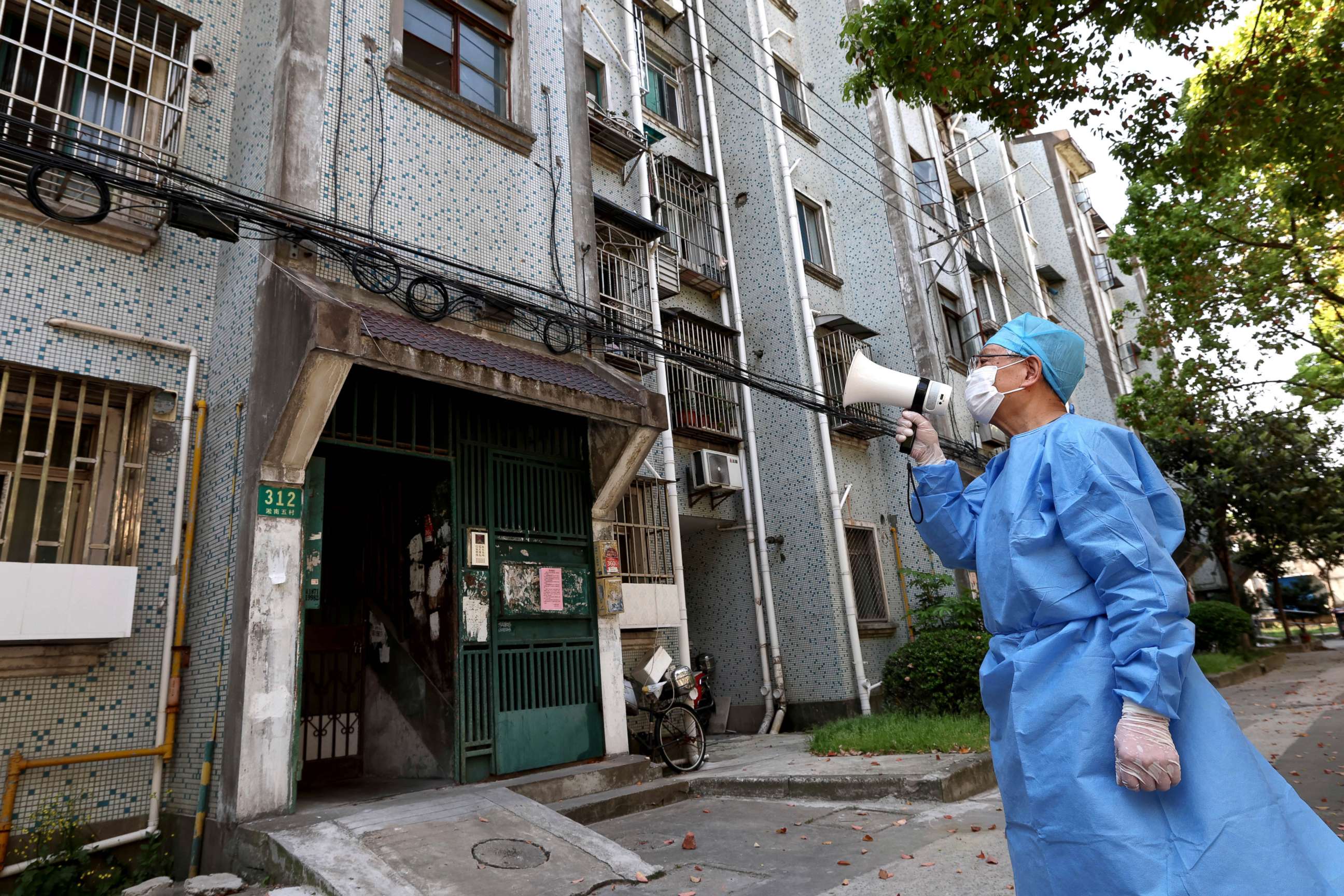
Later, in 2021, the strict policy caused more significant issues. A story went viral of an eight-month pregnant woman refused entry to a hospital until she had negative test who bled heavily and miscarried outside. In 2022 a few cleaning staff were infected in Shanghai, and following mass testing and tracing, lockdown meant that everyone in the apartment buildings, no matter how high-rise, were not allowed to leave, while those testing positive were quarantined in a centralised facility.
The authorities in Shanghai claimed on the 24 March 2022 that there were no plans for a lockdown, except two days later they said that Shanghai was too important for the global economy and announced a lockdown would start the next day. Drones flew over the city with megaphones attached barking orders to those on the street without a mask or involved in an illegal gathering. “Repress your soul’s yearning for freedom” began blasting on loop from the drones with their lights blinking, with an additional message “do not open your windows to sing, which can spread the virus.”
‘Over April 2022, stress in Shanghai spiked to unimaginable levels’ (p139). Failure to warn about the lockdown meant the failure of people to stockpile food, which became ‘the primary worry for most people . . . when they could not leave their homes.’ (p139). The authorities promised food deliveries (of random items) but these ‘ran out of steam,’ while ‘much of the food that made it into the cities rotted before it could be delivered to residents.’ (p139 & 140).
One reason the policy failed was that each person had to report for a test, sometimes twice a day. Everyone in a compound had therefore to report to the medical team, and either caught it from a neighbour while waiting for the test or caught it from the person doing the testing.
On top of the government doing ‘everything it could to frighten people’ for two years, those found positive, including their whole household, were taken from their home and moved to huge quarantine facilities to be disinfected. In Shanghai the largest such facility contained 50,000 beds, with one CNN producer placed there describing lights that never turned off, loudspeakers demanding residents attend tests at 6am the next day, and ‘everywhere the stench of toilets or unwashed laundry.’ (p144)
Children and babies were separated from their parents and, just like other countries, prioritisation of Covid meant cases of more serious disease were downgraded or ignored. This involved making the provision of fever medication difficult, including ibuprofen, that might have allowed people to disguise their Covid infection: it ‘denied its people fever medications during a fever-producing pandemic.’ (p165)
The author of the book notes that people had a variety of experiences, ‘from the nightmarish to the merely difficult’, leading to protests –‘banging pots and pans during the night became a much-shared form of protest, with a few videos portraying whole buildings of people engaged in cathartic screaming . . .’ (p 145 & 146). Protest videos posted online were deleted quickly by state censors, while the author recounts the original censorship by the state at the beginning of the pandemic to ensure that no negative news emerged while an important political meeting was taking place.
The focus on zero-Covid was bound to lead to excesses, leading to bizarre episodes of fresh-caught fish and pandas being tested, and workers streaming out of their office when a rumour would circulate that everyone in it might be put into lockdown. The author judges that, in comparison to the US, ‘in retrospect, China’s response to Covid looks shambolic as well.’ (p158). The problem was zero-Covid meant excesses that were not bizarre or amusing. In Sichuan, people fleeing buildings during an earthquake were prevented from leaving their trembling structures, and ten people died in a fire in Urumqi when pandemic-control barricades prevented the fire service from putting water directly onto the fire.
Despite the fear of the pandemic generated by the state, protests against the controls introduced by lockdown began to develop as anger against them grew. These included workers at Foxconn factories facing off against riot police, and a late night protest by young people chanting ‘Down with the Communist Party! Xi Jingping step down!’ While ‘the number of protesters was never very large . . . they were special because they involved upper-class Chinese families: wealthy people who didn’t want to suffer lockdown and well-off youths who attended good schools. The Communist Party had always counted on these people for their support. The denouement of China’s Covid experience features broad exhaustion’ By December 2022 many controls were no longer enforced while ‘the government’s response grew erratic. Nearly three years after it began, zero-Covid was over’ but ‘unfortunately, the state has suppressed any official memory of Shanghai’s lockdown . . .’ (p163-165 & 168)
A bit like the Western left supporters of the same policy.
In the previous post I said that the results of the war in Ukraine would include the deaths of hundreds of thousands; massive physical destruction; a Ukrainian state more corrupt and more subject to imperialist predation; increased division within the working class; and both NATO and the reactionary Russian belligerents remaining in place.
Yet the pro-war Western left defends NATO because without it Ukrainian victory would be inconceivable and it is this victory that they prioritise above all else. This is an inescapable consequence of their position.
Alternatively, some other leftists, in mirror image, support the victory of Russia but in doing so also bear responsibility for supporting the consequences of the war. They take this position on the grounds of opposition to US imperialist hegemony and for some, that a more multipolar or ‘pluripolar’ world is the pivotal objective. They do not seem to appreciate that the wars in Ukraine and Middle East are the results of the developing of this multipolar world, which is another name for imperialist rivalry and conflict. Only the historically ignorant could believe that the development of a multipolar capitalist world would not lead to imperialist conflict and war.
The idea that a more multipolar world will lead to equality of nations makes no sense to anyone who believes that capitalist states are political formations that compete with each other in an analogous way that capital itself competes – by destroying or expropriating rivals. Socialists believe that workers should not side with their own capitalist state and should fight it, just as we call on workers to oppose their own capitalist exploiter; supporting your own capitalist state is analogous to supporting you own exploiter.
That many have come to this sorry end means that they have also ended any real connection with socialism, regardless of any subjective beliefs. It’s not that they are stupid; it takes some intelligence to construct the respective arguments but the results above are the same whatever the rationale advanced.
It matters not if you think China is socialist and therefore you should support its ally Russia, because this means you desert the Chinese working class and Russian. It matters not that you do so to defend colonial or semi-colonial countries, because the point about multipolarity is that many of these countries have advanced and developed so that they exploit the rivalry within the multipolar system to defend their own state and class interests. The language of anti-imperialism, or anti-colonialism, is often employed by them to denounce other capitalists’ interests and power.
By coincidence, a friend sent me a link to an article that illustrates one consequence of the development of the multipolar world – the ability of some states to balance between US & Western imperialism on the one hand and China & Russia on the other. The article points to this in terms of economic collaboration between many BRICS countries and the Zionist state of Israel, exploding the idea that there is emerging some state alignment of the good guys against the bad. Not only are there no good guys but even pretence that there is a unified group doesn’t survive the obvious divisions within them, as the article illustrates.
One rationale for support for Russia was made on Facebook, which read: ‘In truth what will bring about a new revitalised working class movement is the fall of US imperialism. The world policeman will no longer be able to intervene throughout the world to suppress movements fighting for social equality. A big step forward for humanity. For instance, if there was no US imperialism there would be no genocide of the Palestinians and Israeli would cease to exist as a settler and apartheid state.’
The article referenced above makes clear that, while the US is currently decisive in defending the Zionist state, there are no principled reasons why other imperialist and capitalist powers would not do so also, just as they currently hypocritically collaborate with it. The principal reason that they do not, or cannot do so now, is because US imperialism is already doing it. Israel would not be averse to being someone else’s imperialist enforcer if it had to; its history shows previous reliance on the British, German and French imperialism, not to mention the early approval of the Soviet Union.
None of the capitalist states that are rivals of the US have demonstrated that they would not carry out the same policy as the US, were they in the same hegemonic position. Belief in a multipolar world seems to be under the illusion that such a world would involve the removal or amelioration of inter-imperialist rivalry and conflict, as opposed to the reality of its intensification, demonstrated in the current wars in Europe and Middle East. In such a situation, support for one or other imperialist alliance is not a temporary tactical or strategic approach but a fundamental capitulation to never-ending support for imperialism, whatever its particular variety might be.
There are two ways in which ‘the fall of US imperialism’ could occur and ‘the world policeman . . .no longer be able to intervene throughout the world’. The first is if a rival imperialist bloc defeated it, in which case there would be a new imperialist hegemon ‘able to intervene throughout the world’. What reason, let’s call it success, would lead this hegemon to behave differently? Would its current left supporters then withdraw their support or stick with it?
The second is if the US hegemon was overthrown by the working class. Let’s say through a combination of military defeat and internal revolt. The task of the working class in these circumstances, assuming for the sake of argument that only US imperialism ‘fell’, would be to defend itself against the rival hegemonic imperialist alliance. This would be because this new hegemon would recognise what its current left supporters do not, that its real enemies are the working class. In this case it is more likely that the rival imperialist alliance would seek to defend the newly subordinated US imperialism from overthrow by the working class and seek to crush it themselves.
What sense does it make to support this potential alternative imperialist hegemon unless one swallows the nonsense that China is either socialist, or is some sort of peaceful version of capitalism, which in either case would require ditching everything taught by Karl Marx about what capitalism is and what is involved in rule by the working class? Or even if one doesn’t consider oneself a Marxist, how is such a view given any confirmation by the history of the world over the last 150 years?
Whatever the steps necessary to establish an independent working class force in the world, they will not be taken through supporting either Western imperialism or the China-Russia Axis, not least because each makes their working class a prisoner of its own state and thereby prevents their unity across their division.
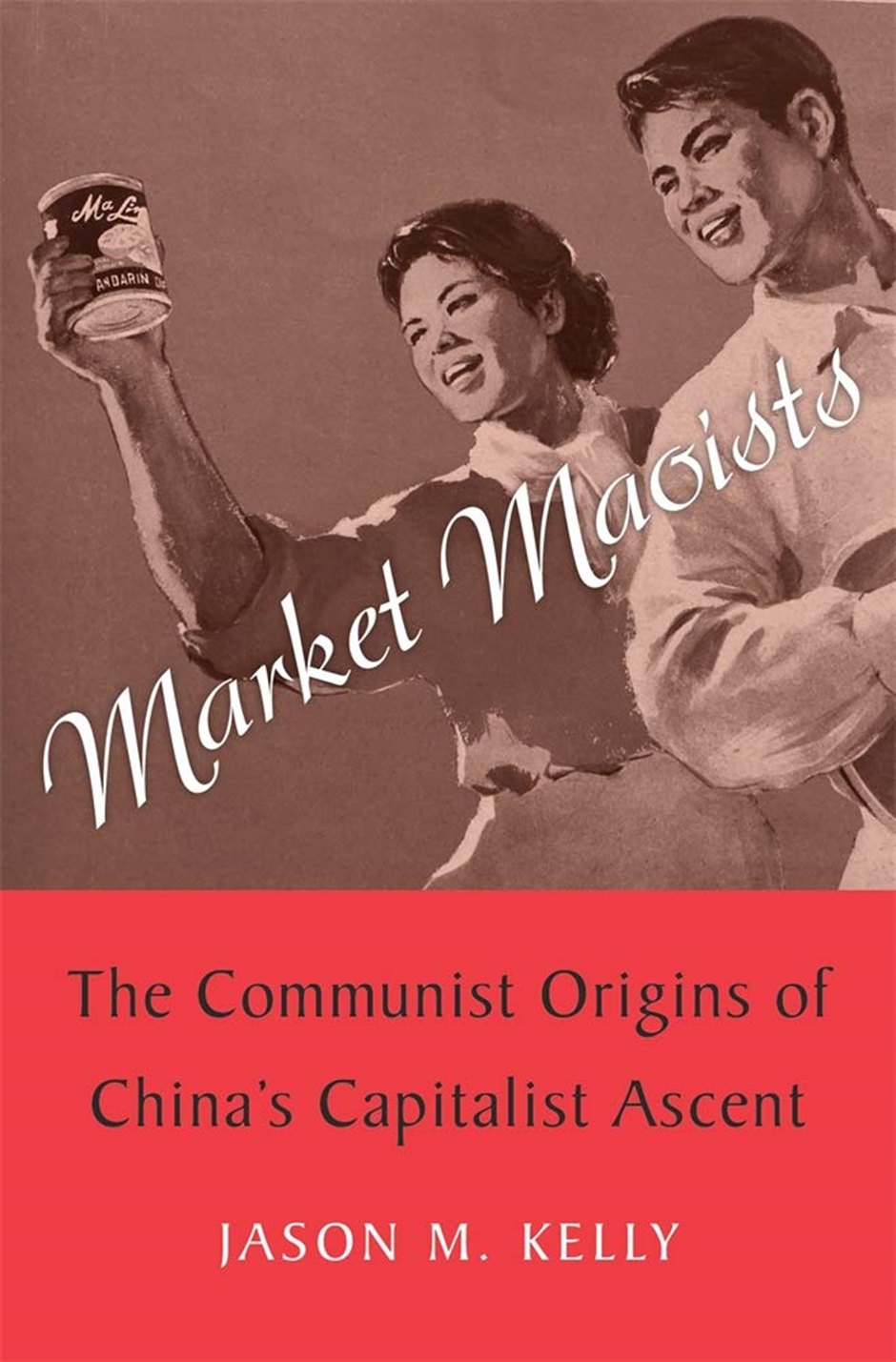
The rapid economic growth of China to one of the world’s leading powers has prompted debate on how this was achieved, from its extreme poverty to the prodigious development associated with its insertion into the world capitalist system. This book traces the evolution of the earlier relations between China under Mao and the capitalist world, before the explicit economic reorientation and while still proclaiming adherence to the revolutionary transformation to socialism.
The fact that the Chinese Communist Party (CCP) still proclaims socialism, and that before the Deng Xiaoping era China had relations with the capitalist world, means that the story is not a simple one, hence the debate on whether China today is capitalist or imperialist. This book doesn’t directly address these issues but seeks to provide the story of the early Maoist relations with the capitalist world, starting with the semi-underground trading arrangements set up by the CCP in British ruled Hong Kong in 1938, years before the conquest of political power nationally in 1949.
In the first full year of Maoist rule roughly 74 per cent of trade was with capitalist countries; two years later this had fallen to 21 per cent, with the share taken by the Soviet Union etc. dramatically increasing. Like the experience of the USSR surveyed in the previous post, China sought to trade its farm goods for advanced technology and equipment, plus chemicals and fuels, in order to build its industry.
As is well known, the 1949 revolution did not initially involve state takeover of all private capitalist enterprises and the Maoists were acutely conscious of their lack of economic experience, which had been limited to relatively remote rural regions. CCP policy involved repeatedly contacting foreign capitalists to explore trading opportunities, and the book records their meeting in Tianjin with the American Chamber of Commerce to discuss cooperation, although with no success.
This policy was very much encouraged by Stalin, with the Maoist leadership supporting trade with Japan despite the very recent and brutal war against their occupation. This and later engagements were far from smooth. For Stalin, geopolitical considerations of defending the Soviet Union were paramount while the Chinese sought to expose latent contradictions between Japan and the US; something which was to become a recurring theme as the US attempted to isolate the new regime and China attempted to wriggle free. Other capitalist states showed themselves to be more open to acceptance of it by way of developing trading opportunities.
The eruption of the Korean war set back Mao’s plans; when meeting with Stalin for the first and only time he told him that “China needs a period of 3–5 years of peace”. Their negotiations yielded a new Sino-Soviet Treaty in 1950 but relationships were not particularly warm as Stalin kept Mao hanging about Moscow for a second meeting in order to show him who was boss.
Most welcome was a loan from the Soviet Union, its need apparent from the government budget in the first three months of the new year being nearly balanced, having been in deficit by nearly two-thirds in the previous year.
The importance given to trade was made clear through the decision to break the unwritten rule – that commercial work should remain in the hand of trusted CCP members – and employ technical experts from the old Nationalist regime. The new Korean war-time conditions meant a return to clandestine trading activities, with the CIA estimating that “China was smuggling between two hundred and three hundred tons of strategic materials from Hong Kong to mainland China every night.” (page 82)
The launch of the “three Anti Campaign” targeting corruption, waste and obstructionism in 1951 was followed in 1952 by the “Five Anti Campaign” which mobilised the population against China’s corrupt bourgeoisie. Native private capitalists would no longer be protected as the CCP consolidated its control of the economy.
These campaigns also involved targeting the type of individuals that the Party wanted to recruit to agencies set up to assist its development of trade with capitalist countries, a problem that was to recur again, requiring the support of leading sections of the bureaucracy for the state bodies involved and their work. Zhou Enlai told the Chinese delegation to an international conference in Moscow that “You must make friends widely, don’t just make friends with progressives; make reactionary friends, too.” (page 89). The US opposed the conference but the Chinese delegation were able to sign its first contract with the British, while the CIA lamented that “our side can be expected to sustain loss after loss.” (page 91)
The CCP showed its elastic use of Marxist categories, developing “a new narrative for China’s place in global markets, one that centred on the theme of trading with capitalists as an anti-imperialist struggle.” (page 99).
In this vein, the end of the Korean war in 1953 was received by China as an opportunity to undermine the US blockade and use the Geneva Conference, organised to settle the peace at the end of hostilities, to enhance the new line of “peace in economics”. In that year the country’s volume of trade reached its highest level since 1930; exchange with the capitalist countries growing by 29 per cent on the previous year. China however was still not important globally, so this didn’t prevent its share of capitalist countries’ trade falling relatively as world exchange soared.
On the back of this the CCP elaborated the concept of the “five principles of peaceful coexistence”, which entailed containing American imperialism and hastening the demise of capitalism. Meanwhile relations with other capitalist countries such as Britain and France could be improved.
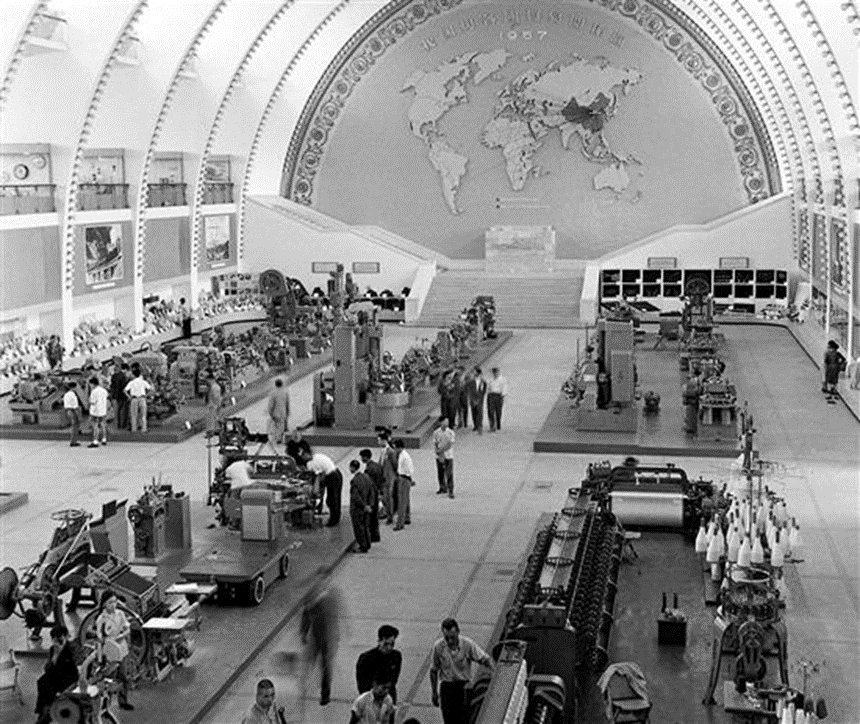
In 1958 China opened its first significant trade exhibition in Canton from April 25 to May 25 hosting 1,200 people from nineteen countries. Later in the year Britain decided unilaterally to eliminate the differential (greater restrictions compared to the Soviet Union) in controls on exports to China, followed within weeks by a host of other countries including France, West Germany, Italy and Holland.
Not long after this Mao launched the Great Leap Forward, by which he hoped to mobilise the population to overcome existing material constraints and rapidly accelerate the industrialisation and modernisation of the country. It was a project that seemed directly to contradict the foundations of the Marxist doctrine he claimed to hold, which recognised that the underdevelopment of the forces of production could not be overcome by sheer will. In the event, they couldn’t, and the initiative failed in its objective, including that of catching up with Britain in fifteen years.
Part of it was meant to involve a key role for trade with foreign capitalism. Like the Soviet Union, taxation of agriculture – in effect the peasant – was to provide the resources to feed the growth of the working class which would also allow for increased trade with foreign capitalism. Unfortunately, this period saw political considerations lead to a major spat with Japan and a fall in trade until the early 1960s.
This, however, was only one aspect of the harmful effects of the Great Leap Forward on the conduct of trade policy. Decentralisation of decision making led to import orders from capitalist markets in the first six months exceeding by twice the ministry budget for the whole year. Targets were missed, foreign currency reserves fell and the risk arose of defaulting on contracts. The central state struggled to regain control while “chaos” reigned in Chinese ports causing “crippling” delays. (page 145)
Japanese business and others started to complain about Chinese price “dumping”, pirating of designs and copying of Western patents. Other South-East Asian countries complained of special financial inducements, while China encouraged ethnic Chinese in these countries to boycott Japanese goods, although British diplomats in a number of them reported scant evidence of this happening.
At the same time relations with the Soviet Union started to fall apart and China launched an artillery attack on the Nationalist Kuomintang-occupied Island of Jinmen. For Mao this was part of the effort to rally the people to the demands of the Great Leap Forward.
Zhou Enlai again intervened to support the organisation of the work of the Ministry of Foreign Trade, including to ensure contracts with foreign capitalist were honoured. At a meeting of staff he told them that “[we would] rather ourselves not eat or eat less, not use or use less, and fulfil the contracts already signed.” (page 149). The Ministry had for years been aware of the need to defend China’s credit rating and Zhou was concerned that dumping was affecting relations with capitalist countries, including India, which was concerned about “dumping” of cotton on the market.
Zhou acknowledged that international trade with capitalists was a form of class struggle, ‘but China could not afford to struggle blindly.’ The Ministry had to differentiate between different capitalists in order to serve China’s diplomatic objectives and avoid behaviour that would undercut relationships. (page 150).
Zhou emphasised the political purpose of trade but the Ministry was caught between the demands of the Great Leap Forward (GLF) and commercial requirements. He repeated the mantras of zili gengsheng (revival through one’s own efforts) and repudiated the concept of shangzhan (“commercial war”), emphasising heping jingji (“peaceful economics”. (Page 152) ‘“The Great Leap Forward must also accord with objective realties”, he said. “Foreign trade cannot jump 40–50 percent all at once,” he told ministry officials.’ (page 152).
Unfortunately, ‘Zhou’s call for a more moderate trade policy in late 1958 proved too nuanced for the brute force of the GLF’. New, more modest, targets for exports and imports were set but ‘still exceeded the actual 1958 values by 19 percent and 3 percent respectively.’
Inevitably contracts were not fulfilled. Like the other aspects of the GLF, ‘the situation became absurd. Regions without a single walnut tree had been ordered to harvest the nuts for export.’ (page 153). The demands of the GLF for “more, faster, better, more economical” continued into the new decade.
The state failed to meet its grain target but exceeded its export targets as the last-ditch efforts of the Ministry of Foreign Trade to do so were successful. Food stocks declined precipitously in 1959 and early 1960 and a crisis was imminent: ‘people were already starving in some places. The bottom was falling out of the Great Leap Forward.’ (page 158)
Relations with the Soviet Union finally collapsed and the Ministry of Trade had nowhere to turn except the capitalist world for the imports necessary for modernisation and the grain necessary to save lives in the famine. The Maoist regime was led to discover that Soviet “revisionism” was worse than US imperialism. One task considered an immediate priority was consequently taken to be wiping out the debt to the ‘socialist countries’, necessary in order to defend China’s “international reputation” (guoji shang de shengyu).
The Chinese state struggled to procure the grain necessary to avoid greater catastrophe, especially while trying to keep the famine a secret. Billed as a great step forward to socialism, and while denouncing “revisionism”, the Great Leap Forward precipitated the requirement for grain imports from the capitalist world throughout the first half of the 1960s. (Although the degree to which other factors were responsible is controversial). It compelled compromising on the principle of avoiding capitalist debt, which up to then had had the effect of limiting China’s fuller entry into the world capitalist market.
The necessity to regularly import grain from the capitalist world, and maximise exports to it in order to earn the foreign currency to pay for the grain, while husbanding its reserves, meant that foreign trade could no longer be ‘tightly scripted, discrete transactions conducted at arm’s length’. Jason Kelly states that ‘It presaged a much more consequential shift in China’s relationship to the global economy that would occur during Reform and Opening.’(page 176)
Trade then increased, first with Japan, then with Western Europe, so that trade with the capitalist world that had been 18 per cent of the total in 1955 reached 70 per cent by volume in 1964. The CCP also moved away from the Great Leap Forward, Zhou Enlai telling the National People’s Congress in 1962 that ‘“blindness” (mangmuxing) to objective laws had marred China’s socialist construction.’ (page 184)
China was, however, about to go through another tumultuous upheaval before learning the same lesson again. The Great Proletarian Cultural Revolution (1966-1976), of which the late socialist Neil Davidson said ‘every word was a lie’, launched an antibureaucratic campaign against potential capitalist restoration that included familiar target such as ‘bourgeois specialists’ and ‘venerable masters’.
Launched by a section of the CCP bureaucracy it was ended by same, although in-between it witnessed mass assaults on the state apparatus, so that its origin eventually allowed for the manner of its ending. The Cultural Revolution hit China’s trade but the “figures seem mild in relation to the chaos . . . These were significant declines, but not catastrophic” and “were not caused solely by the Cultural Revolution.” (page 189)
These developments, including skirmishes with the Soviet Union from 1967 but more seriously in 1969, led to rapprochement with the United States. The logic of socialism in one country, the unity of the Communist – more accurately Stalinist – World, took a giant step towards its ultimate conclusion. China’s planners thus forecast a significant increase in trade with the capitalist world in the fourth Five-Year Plan (1971–1975), including import of whole plant equipment, and later for thousands of foreign workers to come to work in the country.
Many of these developments to closer ties with the capitalist world, and without all the talk about it undermining that world, preceded the changes introduced by Deng Xiaoping, who until 1973 was repairing tractor parts in Jiangxi Province following his purge. The following years saw the post-Mao leadership of Hua Guofeng launch an even larger, too large as it turned out, import programme, while other CCP leaders worried that China was embracing capitalist markets ‘too enthusiastically.’ (page 208)
Deng Xiaoping, speaking to Party officials in 1978, sums up the history presented in the book: “when Comrade Mao Zedong was alive, we also wanted to expand economic and technological exchanges between China and the outside world, including developing economic and trade relations with some capitalist nations, and even the introduction [into China] of foreign capital, joint ventures, etc.” (page 209).
The book chronicles the early history of one aspect of China’s relationship with capitalism and illustrates incidentally the Marxist understanding of the necessary preconditions for the achievement of socialism and the inevitable failure of trying to leap over them or seeking to achieve this goal in a single country. The book is, of course, not written from a Marxist perspective and given the size and importance of China, and its rich history over the last 70 or so years, it can be no more than a partial history. It is nevertheless very interesting for its exploration of one aspect of China’s less recent economic development.