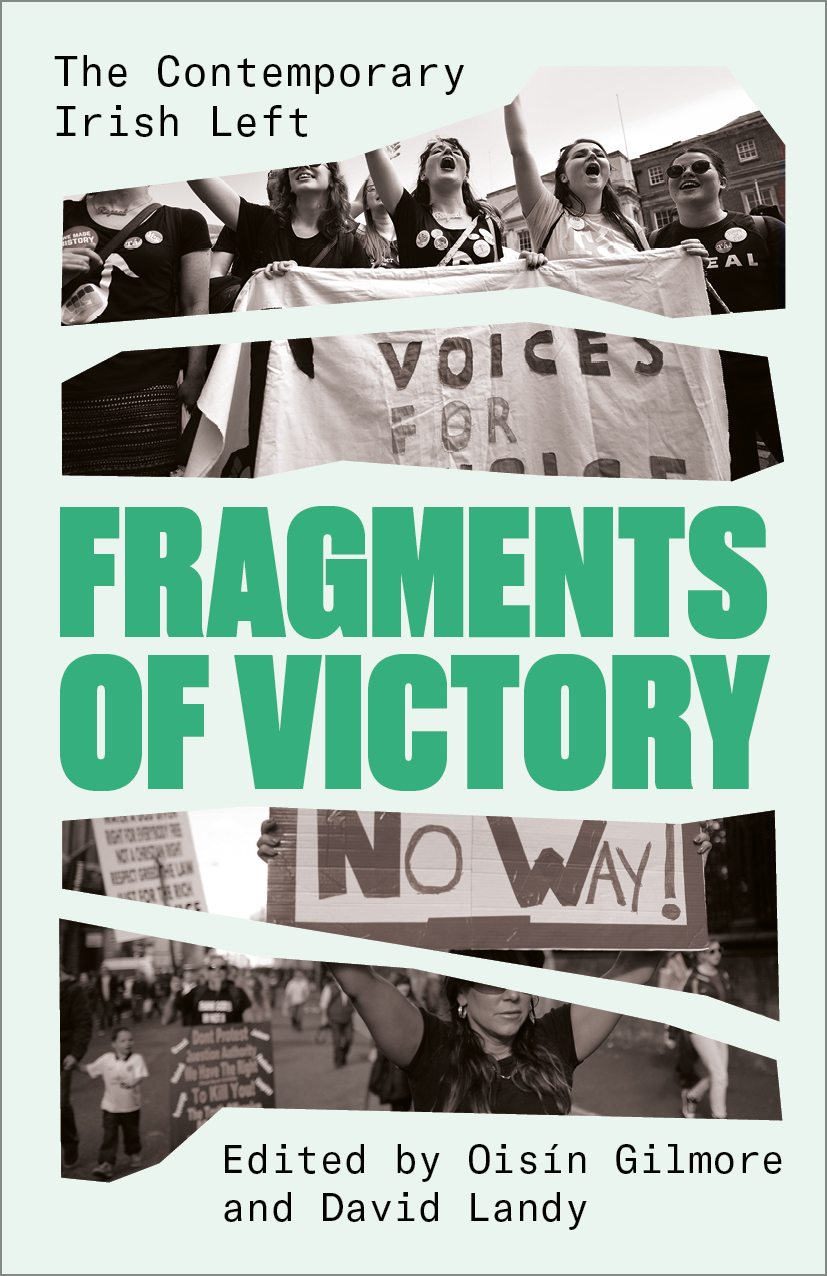
‘Fragments of Victory’: The Contemporary Irish Left’, book review (2 of 6)

In the book’s introduction we are informed that after the 2016 general election one in 20 members of the parliament was a Trotskyist”, which would, for example, translate to over 30 MPs at Westminster.  In the conclusion it notes that this election was ‘perhaps the greatest electoral success of Trotskyism in any western country ever’, ‘the development of one of the strongest electoral lefts in western Europe’ (p177)

Except this avoids the question of what manifesto – what political programme – did these ‘Trotskyists’ get elected on that was in some way supported?  Was it in any way a revolutionary socialist one and if not, in what sense was it a vote for Trotskyism or for Trotskyists? What wider movement, if any, did the vote reflect?  How isolated was it, or was it the vanguard of a much wider radicalisation?

Fragments initially appears to be organised around the concept that there is some identifiably coherent ‘left’, except reading it reveals that this is not the case.  There is however some commonality that we alluded to at the end of the previous post, but it is this commonality that is itself incoherent.

We are informed that the Irish were one of the ‘strongest electoral lefts in western Europe’ and that this ‘left’ not only includes the ‘Trotskyists’ but also Sinn Fein; so we know that however strong this left became in electoral terms its political unity is at the very least questionable. You can assemble the various parts but it becomes less an alternative the more it is put together.

On page1 we learn that the left ‘won some victories’ (a near unique achievement in western Europe during this period) that ‘other countries could learn from.’  Yet in this introduction we are also informed that the austerity following the economic crisis ‘created a collapse of living standards, experienced by many’ with emigration that exceeded ’even the highest rates . . . of the past’.(p 13) 

On page 3 we learn that apart from Sinn Fein other left wing parties and campaigns ‘have struggled in the face of the new political challenges’ while despite ‘widespread support for leftwing politics, the left has failed to build lasting political and social institutions . . . After a decade that saw the left win real victories, mobilise hundreds of thousands and transform the electoral landscape, in many ways the left finds itself in a strangely weak position.’  These judgements are all in one paragraph!

In the conclusion, after noting some successes, including electoral gains, it states that ‘despite these successes, the left is in many ways as weak as it was pre-2008.  No lasting form of working-class self-organisation has emerged.  Union density is lower now than it was in 2007.  No mass parties have emerged.’ (p177-8)

On the next page we learn that ‘These apparent advances by the left in Ireland contrast sharply with the decline of its counterparts in most of the West . . . the left in many countries is in a worse position than it was before the crisis.’ (p 178). ‘The advance of the left in Ireland is even more striking when the political situation in pre-crisis Ireland is compared with that of Western European states.’ (p179).

It notes the failure of Syriza in Greece and Irish hopes for it, although Ireland did not even produce a Syriza and, as the book acknowledges, its defeat led Sinn Fein to shift its rhetoric to the right, opening the door to junior partnership in government with one of the two main bourgeois parties.  Gerry Adams is quoted –“I have to say, I never really subscribed to that notion of a left-wing government, certainly not in the short term.  I mean, who are the left.” (p 171) A very good question, to which Adams gives one element of an answer – it doesn’t include Sinn Fein.

This favourable comparison with the rest of Europe sits uncomfortably with the observation that ‘Missing in Ireland, especially in the early years, were the massive explosions of protest seen in other countries during 2009–13’. (p 184). 

Nevertheless, we are told that ‘The material successes of the Irish left and its social movements have been unique . . .’ (p185) and ‘the achievements of the social movements since 2008 are striking.  There are some real, substantial victories. Hundreds of thousands were mobilised. And the political culture of Ireland was definitely changed.  The neoliberal consensus . . . is over.’  ‘Today the left in Ireland is no longer marginal. While in almost all of Europe the last few decades have witnessed the decline of the left. In Ireland it has grown in strength’ demonstrating ‘what can be achieved.’  ‘There is today in Ireland significant support for the left . . .’ (p191)

These advances were apparently based on an already well-positioned movement because ‘in some ways, the left in Ireland was well prepared for the crisis.’ (p185). By this is meant that it was not focused on identity politics and ‘cultural questions’ although in fact this is not the case.  It is just that the majority of the Irish left have swallowed gender identity politics for example with hardly a debate, mirroring the introduction of gender self-id recognition carried out by the state purposely also without debate.

The conclusion presents ‘two key findings’, including that ‘the 2008-18 period saw the emergence of major mass movements that have both fundamentally changed Ireland’s political life and can provide lessons for the left internationally.’ (p188)

‘Trickier to identify, but unquestionably real, Ireland is a more leftwing country than it was in 2007 . . . Between the summer of 2021 and the summer of 2024, the left consistently outpolled the right, whereas before 2008, the left only had a third of the support for rightwing parties.’  Also adduced as evidence is that there is now recognition of the need for state intervention to solve the housing crisis. (p184). The problem with the latter however is that this state intervention has largely been to incentivise private sector solutions, which the left has denounced.

The success is qualified – ‘looking forward, the achievements of the last 15 years seem rather more fragmented’ and even the ‘electoral gains arising from a period of struggle . . . is now very much in the rear-view mirror.’  In the same paragraph it notes that the campaign victories over abortion rights and water tax ‘failed to result in lasting organisations.’ (p191). The other ‘side of the coin’ as the book puts it. (p3)

Capitalist crisis did not see ‘the re-emergence of working-class self-organisation and provide a space for the activity of the radical left’ while ‘mass movements were less a story of mass organisation than mass mobilisation’ (p180-1,182)

The movements since 2008 were ‘large but ephemeral’, ‘failed to lay deep social roots’, ‘failed to identify an avenue through which society might be changed, and given this, they have failed to develop a mass political consciousness around the capitalist nature of our society or around what needs to be done to change it.’  While they apparently ‘frequently terrified the ruling elite’ ‘they have never presented a serious challenge to the existing order.’ (p183)

Despite the positive evaluation and even with the qualifications, which leave a rather confusing picture, the real damaging conclusion is contained in these comments:

‘In many ways, despite the victories of the left since 2008, the future looks bleak.’ (p190). ‘It is hard to believe Sinn Fein will deliver the change that many desire . . [and] It is unlikely the Trotskyist People before Profit will manage to articulate a viable alternative . . .’ (p191) So despite short-term victories’, ‘the steps between the current situation and the long-term goal of socialism are less clear than ever before.’ (p192)

The book’s last words are that ‘it is clear that fragments of victory are not enough.’ (p 192) with the fatal verdict that despite the ‘striking’ advance of the left and ‘the apparent success of the Irish left’, the radical left ‘were engaged in a form of politics incapable of realising its own aims.’  (p179 &181)

Back to part 1

Forward to part 3
‘Fragments of Victory’: The Contemporary Irish Left’, book review (1 of 6)

Reading ‘Fragments’ I was reminded of the statement by Marx that ‘We develop new principles for the world out of the world’s own principles. We do not say to the world: cease your struggles, they are foolish; we will give you the true slogan of struggle. We merely show the world what it is really fighting for, and consciousness is something that it has to acquire, even if it does not want to.’

Fragments sets out to record the struggles of the Irish left (in the Irish state) over the past few decades so that the reader can form a view on its successes and failures.  In doing so we can apply Marx’s prescription and determine to what extent it shows the left ‘what it is really fighting for’ so that it can be conscious of the lessons that should be learned.

There are some obstacles in the way, including the variety of authors with different viewpoints although an introduction and conclusion is meant to summarise the results.  The major problem is the definition of what it means to be ‘left’.  In the introduction Sinn Fein and the Green Party are listed as left even though the major theme of the book is the response to the implementation of austerity following the collapse of the Celtic Tiger and the consequent bankruptcy of the State.

During this period Sinn Fein presided over austerity while in a coalition government with the DUP in the North, while the Green Party entered into a coalition with Fianna Fáil in 2007 that bailed out the banks and inaugurated widespread cuts in social welfare and wages.

As part of the relaunch of Stormont in 2015 the ‘Fresh Start’ agreement committed the parties, including Sinn Fein, to reducing NI civil service staff numbers: ‘Between April 2014 and March 2016, the NICS is set to reduce headcount by approximately 5,210 and between April 2015 and March 2016 a further 2,200 will exit from the wider public sector.’ The Green Party supported the bank bailout that the state could not afford, which resulted in the intervention of the Troika of the European Commission, European Central Bank and IMF, along with the huge austerity necessary to satisfy their demands.

Even taking account of the elastic possibilities permitted by employing a relative term such as ‘left’, it is difficult to sustain any claim that these parties are in any substantial or verifiable way left-wing.  Sinn Fein was described by a comrade of mine a long time ago as containing members with left-wing opinions and right-wing politics.  The party has, in the meantime, fully confirmed this judgement while in government.  The Green Party began life as The Ecology Party promising ‘a radical alternative to both Capitalism and Socialism’ but in office twice it has displayed no alternative to capitalism and therefore no alternative to socialism.

Looking at political struggle through the lens of ‘left’ versus ‘right’ has therefore the potential to obfuscate as much as it clarifies.  A more illuminating approach is to set out the class nature of the politics of a political party and to explain why different parties with generally similar class natures have the politics that they do, even if they have different colouration.

Thus, as a nationalist party, Sinn Fein is a petty bourgeois party that considers the Irish people as one, with any class distinctions completely secondary and subordinate to the interest of the nation and its state, which can represent the true interests of all the people simply because of their nationality.  The Green Party claimed at its birth to have a radical alternative but also rejected a class approach through its largely petty bourgeois base and ideology.  It confirmed its class character by its members enthusiastically joining Fianna Fáil in government (voting 86% in favour) and by its commitment to the banks and austerity.

It might appear difficult to assign a class identity to some parties, and any classification has to be justified, but this is precisely the point of identifying the class nature of the forces involved.  As petty bourgeois parties, both Sinn Fein and the Greens have imposed austerity on workers while espousing radical rhetoric.  Calling them left is an attempt to obscure this and works to introduce doubt that they will not always fall on the side of the capitalist class in a struggle.

Fragments demonstrates this repeatedly, even when making secondary observations, for example that individual members of Sinn Fein were active in the Campaign Against the Household and Water Taxes but that the party was not: ’This form of partial (non-)commitment proved to be the defining feature of Sinn Fein’s approach to most political struggles of the time.’ (p37)

Approaching politics this way allows us to make judgements of other ‘left’ parties such as the Labour Party and Social Democrats etc. and permits an understanding of their behaviour during this period.  While the Labour Party paraded its ‘Labour’s Way’ as resistance to ‘Frankfurt’s Way’ while in opposition, it had no alternative to austerity when in government.  The doubling of its vote in the 2011 general election was a prelude to its consequent decimation in the next one.  ‘Labour’s Way’ didn’t become Frankfurt’s Way’, not having an alternative meant it always was.

Was the 2011 vote for Labour therefore a victory for the ‘left’ and was its subsequent decimation a defeat?  Did those who voted Labour in 2011 make an advance in consciousness or do so by deserting it in 2016? Or were they just registering disappointment and resignation?

Fragments offers the view that despite Labour delivering austerity when in office ‘the new government retained a huge amount of goodwill . . . the crisis was clearly not their fault and . . . the harsh austerity measures they took were seen as both forced by the Troika and, while painful, necessary’, while ‘the ‘honeymoon lasted for much of 2011 . . .’  (p31) So, were these views completely discarded when the Labour Party was dumped out of office? Was there any real advance in consciousness of an alternative when it happened?  Is roping the Labour Party into ‘the Left’ clarifying either history or the future?

Today, all these parties are allied in supporting Catherine Connolly for the post of President with the additional enthusiastic support of People before Profit and Solidarity.  The latter’s politics are supposed to be based on the view that existing power in capitalist society does not come from parliament but from the permanent state apparatus and the economic and social power of the capitalist system, yet they promote the idea that election to a post that is admitted not only to be without power, but forbidden to exercise any, would be a major advance.

Paul Murphy, People before Profit TD, states on Facebook that ‘this is a rare opportunity for the left to come together, and elect a voice for workers, for women and for neutrality.  Change starts here.’ This is a left that includes all the parties above that have been tried and tested.

In doing so all sorts of illusions in the role of bourgeois politics and institutions; about the ability of one person to represent the nation, and all the people within it; because of a one-off vote, and of the way ‘change’ can be made, are strengthened against an alternative view that real change comes from the organisation and struggles of the working class itself.

Are such views ‘Trotskyist’, as Paul Murphy’s organisation is called in the book? Or is this term used because that is just how it is usually described, or should such a designation not require some comparison of its political practice to a reasonable account of what Trotskyism is?  The umbrella term of ‘left’ addresses these questions by rendering them unimportant, and this is a problem.

To anticipate one message of this review; Fragments provides enough testimony to show that a different approach is necessary and that an alternative is required to the illusion that there is a ‘left’ that should be united to advance the cause of the working class.

It demonstrates, in its own way, that only a class analysis can explain events, including the actions of the state, why it succeeded in imposing austerity and why the resistance to it was unable to rise to the challenge.  Explaining all this in terms of whether certain actors, institutions or policies were ‘left’ or ‘right’ is hopeless not only because of the vagueness of the terms but because all of these acted out of material interests, as they perceived them, and these in turn were based on objective factors that were fundamentally determined by class relations.

Forward to part 2

Understanding ‘Citizen Marx’ 3 of 3

Engels once said that ‘Marx and I, for forty years, repeated ad nauseam that for us the democratic republic is the only, political form in which the struggle between the working class and the capitalist class can first be universalised and then culminate in the decisive victory of the proletariat.’

The context was a claim against him that when ‘the socialist party, will become the majority’ it will ‘then proceed to take power.’  Engels however stated that ‘For a start, I have never said the socialist party, will become the majority and then proceed to take power.  On the contrary, I have expressly said that the odds are ten to one that our rulers, well before that point arrives, will use violence against us, and this would shift us from the terrain of majority to the terrain of revolution . . .’

Responding to the question of what form this power would take – ‘Will it be monarchic, or republican, or will it go back to Weitling’s utopia’, Engels replied that of course the Reichstag deputies are republicans and revolutionaries, the question of a Republic being the most controversial political question in Imperial Germany at that time.

Engels goes on to ask whether it is implied ‘that the German socialists attribute no more importance to the social form than to the political form? Again he would be mistaken. He should be well enough acquainted with German socialism to know that it demands the socialisation of all the means of production. How can this economic revolution be accomplished? That will depend on the circumstances in which our party seizes power, on the moment at which and the manner in which that occurs.’ (Engels, Reply to the Honourable Giovanni Bovio MECW Vol 27 p271)

What Engels is making clear is that the fight for democracy is vital to the struggle of the working class to achieve political power not that it is necessary to have a republic as the first step to communism. Even where the question of a Republic was the unmentionable political issue, the objective was ‘the socialisation of all the means of production.’

On a separate occasion he said that ‘If one thing is certain it is that our party and the working class can only come to power in the form of the democratic republic. This is even the specific form for the dictatorship of the proletariat . .’ (emphasis added – SM) On the question of a Republic he explains the content of the demand, if it is not possible to employ the term itself: ‘But the fact that in Germany it is not permitted to advance even a republican party programme openly, proves how totally mistaken is the belief that a republic, and not only a republic, but also communist society, can be established in a cosy peaceful way’

‘However, the question of the republic could possibly be passed by. What, however, in my opinion should and could be included is the demand for the concentration of all political power in the hands of the people’s representatives. That would suffice for the time being if it is impossible to go any further.’ (Engels A critique of the draft Social-Democratic programme of 1891, MECW Vol 27 p227)

Engels in his postscript to Marx’s Civil War in France wrote ‘And people think they have taken quite an extraordinary bold step forward when they have rid themselves of belief in hereditary monarchy and swear by the democratic republic. In reality, however, the state is nothing but a machine for the oppression of one class by another, and indeed in the democratic republic no less than in the monarchy; and at best an evil inherited by the proletariat after its victorious struggle for class supremacy, whose worst sides the proletariat, just like the Commune, cannot avoid having to lop off at the earliest possible moment, until such time as a new generation, reared in new and free social conditions, will be able to throw the entire lumber of the state on the scrap-heap.’

‘From the outset the Commune was compelled to recognize that the working class, once come to power, could not manage with the old state machine . . .’  The bourgeois republic was not therefore the mechanism to advance towards communism.

Marx noted of the Paris Commune that ‘the political rule of the producer cannot co-exist with the perpetuation of his social slavery.’

Back to part 2

Understanding ‘Citizen Marx’ 2 of 3

In one review of Citizen MarxMike Macnair states that ‘the conception of the democratic republic as the necessary first step to communism was, in fact, Marx’s conception: comrade Leipold has, I think, shown this beyond rebuttal.’  If this is taken to mean that the struggle always and everywhere involves firstly a fight for a bourgeois republic then we see that this is not the case. In the Paris Commune the struggle went immediately beyond it and Leipold argues that Marx never looked at the struggle for bourgeois democracy – a bourgeois republic – in the same way after it (see the previous post).

It is not true today because in many countries, capitalism is ruled by states with a democratic and republican form.  There are all sorts of restrictions and qualifications to this bourgeois democracy, and Marx noted and opposed them in his day, but this did not transform the working class struggle – and communists bringing ‘to the front, as the leading question in each, the property question’ – into a struggle first for a bourgeois ‘democratic republic’.  This is simply old-fashioned Stalinism in which the working class struggle is always limited to a fight for bourgeois democracy, and only when successful, then a struggle for socialism.  This never comes because the bourgeois allies asserted as necessary in the first struggle betray not only the struggle of the working class for socialism but also any struggle for democracy that involves the working class as an independent force.

Macnair appears to accept grounds for rejecting this approach today, on the basis that ‘It is nonetheless arguable that the more advanced stage of the spread of capitalism across the whole globe, and its decline at its core, means that we should focus more on socialisation: the immediate need to move beyond markets and privately-owned concentrations of capital as the means of coordinating human productive activities. . .  . In this sense socialisation is more immediately posed than it was in the later 19th century.’

This means that the working class is the majority of society, with the existence of a much more developed capitalist system that brings to the fore the question of working class dissolution of capitalist private property through socialisation of the productive forces.  To defend this process requires a Commune type state and not a bourgeois republic that will, no matter how democratic or republican, stand upon and defend capitalist property relations.

Unfortunately, Macnair rejects this – ‘There are two problems with this line of argument’ he claims. ‘The first is the Soviet case’ in which economic planning failed.  He argues that ‘Democratic republicanism is essential to effective economic planning; and, because it is essential to effective economic planning, it is also essential to believable socialism/communism.’

In fact, the Soviet Union was not an example of an ‘advanced stage’ capitalism and the initial major problem with socialisation of production was the small size of the forces of production that could most easily be socialised, and thus the associated weakness of the working class that would carry it out. This experience is not therefore an argument against working class socialisation of the forces of production and a state form of the Commune type adequate to defend this process.

The second problem he identifies with a ‘focus more on socialisation: the immediate need to move beyond markets and privately-owned concentrations of capital’ is not so much a structural feature of the current stage of capitalism (that it rules out socialisation) but an obstacle to it.  What he poses is an obstacle to any and all independent political action by the working class, including reform of the capitalist state that Macnair poses as the ‘necessary first step to communism.’

He writes that it is ‘illusory to imagine that it is possible to fight for “workers’ democracy” against the bureaucracy, without simultaneously proposing a constitutional alternative to the regime of the capitalist state as such. Without challenging the capitalist constitutional order, it is impossible to render transparent the dictatorship of the labour bureaucracy in workers’ organisations.’  The capitalist state must be democratised before the working class movement can also be so transformed appears to be the argument.

Democratising the capitalist state requires a force to do it, which presumably is the working class, but as long as the workers’ movement is strangled by bureaucracy this is not going to be done.  In terms of voting, elections in most minimally democratic bourgeois republics involve a bigger turnout than elections within trade unions, which illustrates the necessity to politicise the working class movement.  The prior task to making changes to the capitalist state is to dissolve illusions in it, including that it can be ‘really’ democratic and that it can be made a (more?) neutral mechanism that can be employed by the working class for its own ends.

Any mass mobilisation of the working class will face the immediate task of sidelining or removing the labour bureaucracy because the organisations and mobilisations this bureaucracy stifles are the workers own.  This task will need to be both independent of any change to the ‘constitutional order of the capitalist state’ and go beyond it.  Constitutional forms can change but the essential nature of the state remains.  Prioritising changing this is to invest in the capitalist state the power of making changes that only the self-emancipation of the working class can accomplish.  Why would a capitalist state, again no matter how democratic or republican, help ‘render transparent the dictatorship of the labour bureaucracy in workers’ organisations?’

Removing or otherwise destroying the labour bureaucracy will undoubtedly be accompanied with the need to struggle for goals outside the workers’ organisations, but these struggles should not be under the misapprehension that what we need is reform of the capitalist state constitution in order to change the constitution of the workers own organisations.  In so far as we often seek to change the operation of the capitalist state it is often to remove its influence on workers’ organisations.  The functioning of this state is not an example to follow, or an aid to understanding working class interests, but an obstacle to overcome including the many illusions workers have in it.

Attempts to give a place to republican politics within socialism that it should not have ignores the class character of even the most radical republicanism and inevitably drags us back to accommodation with the capitalist state.  This is not a lesson Citizen Marx teaches.

Back to part 1

Forward to part 3

Understanding ‘Citizen Marx’ 1 of 3

The book Citizen Marx, which deals with Marx’s engagement with republicanism, has been favourably reviewed in a number of socialist publications.  In previous posts we have shown that this was an engagement coloured by competition for the allegiance of a radicalising working class.  This involved starting from a materialist analysis of the conditions facing workers and other classes, which brought to the fore the property question and involved a clear separation of socialist politics from even the most radical republicanism.

The book notes both Marx and Engels very brief alignment with anti-political communism that eschewed political struggles because of their claimed irrelevance to the over-riding social question, which resolved into the question of property.  For Marx and Engels this involved the socialisation of production by the working class that would lead to the abolition of all classes, including itself.

This required the conquering of political power by the working class and the book deals with Marx and Engels treatment of the Paris Commune as the first example of the capture of such power (with some qualifications).  Many of their tributes to it and the force of its example included elements of the democratic functioning of the Commune that were championed by republicanism, for example the direct election of workers’ delegates to state office and their being subject to recall.

This state however was to be a workers’ state, and qualitatively different to existing capitalist states, whether an absolute monarchy, constitutional monarchy or bourgeois republic.  It was to be a state not ‘superimposed upon society’ but ‘one completely subordinate to it.’ (Citizen Marx p 392)

‘It was essentially a working-class government, the produce of the struggle of the producing against the appropriating class, the political form at last discovered under which to work out the economical emancipation of Labour.’   (Marx and Engels Collected Works, Volume 22 p334)

The most famous lesson learned was that ‘the working class cannot simply lay hold on the ready-made state machinery and wield it for their own purpose. The political instrument of their enslavement cannot serve as the political instrument of their emancipation.’  (MECW Vol 22 p533)

This is not the bourgeois state democratised, à la radical republicanism, but the destruction of the bourgeois state and creation of one that would serve as a political instrument of working class emancipation.  And as the emancipation of the working class was to be achieved by the working class itself this meant not just creation of a workers’ state but the working class emancipating society from the state – a state not ‘superimposed upon society’ but ‘one completely subordinate to it.’  As Bruno Leipold notes in Citizen Marx, for Marx the Commune was a ’Revolution against the State itself . . . a resumption by the people for the people, of its own social life.’  It was “the people acting for itself by itself.’ (Citizen Marx p 389 & 366)

Leipold states that through the experience of the Commune Marx not only changed his understanding of what a ‘social republic’ was but that this also ‘went hand in hand with a new attitude to the bourgeois republic.  While his Commune writings contain similar condemnations of the emancipatory limits of the bourgeois republic that we find in his 1848 writings, we find no corresponding statements that the bourgeois republic still remains the terrain on which this emancipation is to be fought for.’ (Citizen Marx p 357)

Much of the book covers the period before the Paris Commune and deals with the role of the working class in a purely democratic revolution, i.e. a bourgeois revolution.  Marx and Engels set out the policy of communists, in which the working class, particularly in Germany, must fight for a democratic republic – as an independent force – alongside the bourgeoisie (if and when it does indeed fight) in circumstances where it cannot yet impose its own interests because of undeveloped material conditions.

Forward to part 2

The Story of Brexit (3 of 3) – Britain punching its weight

Book Review ‘Inside the Deal: How the EU got Brexit Done’, Stefaan De Rynck, Agenda, 2023

At one point in the Brexit negotiations Michel Barnier pointed out that in the area of security policy the UK was promising to do more together with the EU than it had done before; as De Rynck puts it, trying ‘briefly to hold on to its lead role on EU military operations.’  It continued to present itself as the bridge between the EU and US, except the EU ‘failed to see any benefit in not liaising directly with the US instead.’  When Johnson won the election in December 2019 this approach for a closer relationship on security and foreign policy was dropped.

What came later, we now know, is acting as an instrument of US policy in the war in Ukraine; scuppering early negotiations by promising western military support to the Ukrainian regime and continuing to ‘punch above its weight’ by promises of weapons deliveries like tanks designed more to pressurise others than to make a critical contribution itself.

De Rynck doesn’t explain the about-face, except that Trump had criticised NATO, implying a reduced priority for Europe ,while he had already promised Britain a trade deal “very quickly”.  His ambassador to the UK supported Brexit – “you have a great future outside the EU”  he said – while US State Department officials warned against no deal and stated their wish that security cooperation be maintained at “current levels”

De Rynck admits that the EU negotiators were initially less confident of maintaining a united front on foreign and security policy than on the economic front, and implies concern that some East European countries might want different outcomes.  He argues however that Brexit has strengthened EU security arrangements and its autonomous decision making in which the UK will no longer be involved.  He argues that weakening the single market would have eroded both and reduced the ‘strategic potential of a more Global Europe’.  On the other hand, its development, including a ‘single market for defence industries’, is a precondition for development of this role.

This assessment is informed by the start of the war in Ukraine and the alliance with the US in opposition to Russia, including sanctions that have substituted cheaper Russian energy for more expensive US sources.  The introduction of the Inflation Reduction Act in the US is now also a threat to EU industry with its subsidies attracting European industry to the US.  When the problem of Ukrainian refugees is added, it is clear that the ‘strategic potential of a more Global Europe’ faces a threat from the US in relation to which Britain has acted as supplicant and surrogate.

De Rynck makes none of these observations in the book but alludes to this role in recording previous US opposition to the EU’s satellite navigation system Galileo, which Britain had at first also opposed.   He reports that the EU Commission came close to abandoning the project, although went ahead when Denmark switched sides, Tony Blair withdrew British reservations and Germany promised to pay.  This then gave the EU its own alternative to the American Global Positioning System.

The British claimed that they had been able to limit Galileo to civil applications, and continued to veto military uses, but by 2015 they announced their intentions to use it for military purposes, including for the guidance of targeted weapons.  ‘Losing access’ to the system was therefore a significant Brexit problem.

De Rynck explains that the EU were willing to allow the UK to use the system’s military grade signal, but Britain also wanted access to the source code for economic and military purposes and complained it could not be the only member of the UN Security Council without full control of its own navigation system.  After a ‘bitter’ debate, and threat and counter-threat, the purpose claimed for Brexit of “taking back control” did indeed mean losing it, and Britain did become the only member of the UN Security Council without full control of its own navigation system.

A core justification of Brexit was the ‘opportunity’ to change its policies, regulations, and product requirements.  Brexit, it seemed to everyone, would be pointless without this.  However, rather than see how EU rules would continue to apply post-Brexit, the EU initially concentrated on what guarantees any alternative arrangements could offer, on effective dispute settlement and on credible unilateral remedies, all of which were agreed three years later.

In between the British complained that the EU approach did not seek to replicate its trade negotiations elsewhere, like those with Japan or New Zealand. Michael Gove said Britain was willing to reintroduce tariffs in exchange for the EU lowering its demands on a level playing field only to be told that there was no time to go line by line through each product, and in any case, it would not buy a lighter version of the level playing field.

Britain made proposals and then withdrew them; it proposed a Canada style trade agreement and then backtracked when what this meant was explained to them. ‘What makes the UK “so unworthy” complained David Frost, as the British declared their sovereignty, only to be told that sovereignty was a two-way street; the EU was itself annoyed that what was on offer to them was less than what the British were offering to Japan, Ukraine and Australia.

It seems almost incredible that, given the course of the negotiations recorded in the book, the British continued to argue that cooperation should rely on trust rather than rules.  The EU was perfectly aware that the negotiations were mainly just to ‘get Brexit done’ without any genuine commitment to any written agreement.

De Rynck states that ‘despite some failed EU demands and compromises, the outcome was largely in line with what the EU set out at the start.’   ‘The UK government played a game of chicken, by itself’ and ‘as a more diverse and bigger economy, the EU had no interest in accommodating the UK . . .’

The majority of the British people now regard Brexit as a mistake.  The sign on the side of the bus promising money to the NHS looks like the con it was as the NHS collapses, highlighted by media reports of incidents of raw sewage pouring out inside crumbling hospitals.  This, and every other Brexit promise, has literally turned to shit and the wonder is that anyone thinks being poorer is part of the solution to anything.

Guardian commentators like Polly Toynbee write articles setting out how awful Brexit has been but with no proposal to reverse it – ‘Most people are now in favour of rejoining the EU, but Labour is right to steer clear of another row over Europe’ she says.   Gideon Rachman writes columns for the ‘Financial Times’ about how it can be reversed but has nothing more to propose than two referendums on the tenth anniversary of the 2016 leave vote.

The British state is in confusion about what to do, evidenced by the meeting of the great and good, leavers and remainers, reported to arise because ‘Brexit is not delivering’.  Its proclaimed purpose however was “about moving on from leave and remain, and what are the issues we now have to face.”  As if the issue is not what brought them together in the first place and the answer obvious.

As one commentator in ‘The Irish Times’ said, ‘it is hard to understand the 40 per cent who still agree with the decision’.  On the left, among the Lexit supporters, there equally appears to be no remorse, just excuses like the assorted Tories, UKIPers, xenophobes and racists who were equally committed to a Britain-alone approach.

The book by the EU insider reveals no secrets but describes the British negotiation process as confused, inept and as full of wishful thinking as the Brexit project itself.  It faithfully records the bluster and threats that no one with any appreciation of the balance of power could take seriously.  It points to the folly of left supporters of Brexit who supported it when all this was obvious.  Did they expect the negotiations would deliver some advance for the British working class?  I suppose that they must, in which case the book is another testament to the stupidity of Brexit, Lexit or whatever its supporters want to call it, now that it’s no longer just an idea and so not what they wanted.

Back to part 2

The story of Brexit (2 of 3) – Britain’s Irish problem

Steve Bell ‘The Guardian’

Book Review ‘Inside the Deal: How the EU got Brexit Done’, Stefaan De Rynck, Agenda, 2023

In Ireland one of the lessons supposedly to be learned from Britain leaving the EU is the necessity to have a plan for what you want to do when you succeed, with the mess associated with Brexit due to its supporters not having one.  Some leave campaigners did want to put together a plan but apparently Dominic Cummings opposed this on principle.  So now, supporters of a referendum on a united Ireland are keen to get a plan on what it would look like and how it would be implemented.  Of course, the experience of the Brexit referendum and its consequences demonstrate that the problem with it was not the absence of a cunning plan but that it was simply a bad idea. 

Brexit immediately gave rise to the potential for hardening the existing political border, with leaving the customs union and single market raising the prospect of checks to be applied to goods entering and exiting the single market. This was the case even if Theresa May repeatedly said that there would be “no going back to the borders of the past.”

Both the EU and the British negotiators were concerned that whatever solution was proposed to avoid a hard border within the island did not (or did) become leverage for the new border that would exist between Britain and the EU.  That concern continued to exist even after a first agreement was made with Theresa May that a ‘backstop’ would be in place, which would ensure–absent any other agreed solution–that Northern Ireland would remain aligned with EU rules, although this would entail checks between Britain and the North of Ireland.  As a sign of things to come the British government blocked civil servants in the North from engaging with the EU on how this might work.

As noted in the previous post, the British would rapidly disavow at home what they had just agreed, and May renounced her commitment in the House of Commons as something no prime minister could ever accept.  But if this was the case, a ‘soft’ Brexit would have to cover all the UK and this was not acceptable to those for whom Brexit meant Brexit, whatever Brexit actually meant. Jeremy Corbyn once again demonstrated the poverty of his own position by supporting the backstop but wanting domestic guarantees of a soft Brexit.

De Rynck describes British politics as a ‘farce’, noting that ‘May could not claim publicly she had obtained a customs union for fear of upsetting her backbenchers, which suited Corbyn’s fear that he would have to explain his own opposition to a deal his party officially wanted.’

The focus on the North of Ireland that frustrated the Tory Brexiteers so much only existed because it starkly revealed the illusion of Brexit itself, and the phantasy that was the deal that they thought they could get.  Irish nationalists could be forgiven for seeing what was happening as karma – British weakness being exposed by their clinging to one of their last colonies.  However, a survey of Tory MPs revealed that only one third of them thought the border was a serious matter, so it’s doubtful this was the source of much discomfort for them. 

British think tanks sought out a different solution that avoided the necessity for checks and a border where they would have to take place, including ‘Max fac’, which the EU rejected but De Rynck suggested ‘some elements could be useful to soften friction for goods moving from Britain to Northern Ireland’.  In the end, of course, May couldn’t get her deal through, and Boris Johnson turned the backstop into a ‘frontstop’.

De Rynck completes the picture of British political farce by noting the position of the Democratic Unionist Party, which believed that EU support for its Irish member state would collapse in the end.  He recalls that Barnier “pushed Foster and her party to come up with its own solution but there was never a plan from the DUP”, quelle surprise.

He notes their June 2017 manifesto, surely being one of very few to have read it, which affirmed Northern Ireland’s “unique history and geography”, its “particular circumstances” and its need for “ease of trade with the Irish Republic and throughout the European Union.” The DUP advocated “Northern-Ireland specific solutions through active executive engagement”.  Its leader, Arlene Foster, was later to highlight the benefits to Northern Ireland of being in both the UK and EU markets; but not for the first time, and certainly not for the last, the most extreme elements set the agenda for the rest to follow and it became the overwhelming policy of unionism to condemn these sort of arrangements as a threat to their ‘precious union’. 

While Johnson turned the backstop into immediate application, or at least pretended to, he also wanted a particular voting procedure that would ensure local Northern-Ireland consent to its peculiar arrangements.  The EU agreed that the NI Assembly should have the right to confirm the requirements of the deal over time but thought that its ability to overrule the initial Westminster decision made no sense.  The British negotiators wanted the local Assembly to approve the deal and to require a majority of both nationalists and unionists, which given the latter’s deepest affection for saying ‘No’ would have meant they would have said no and there would have been no deal.

It might appear easy to discern British motivation for asking for this provision because they might have believed that the unionists’ ‘No’ could perhaps be a means of putting pressure on the EU to deliver a better deal.  The approach of the EU however, was that while it was up to the UK to determine its internal political arrangements, these were not determining a deal with the European Union.  Today, the DUP is still opposed to the final deal and is in effect attempting to impose its veto, but it is not a party to the talks and it will not determine their outcome.

The final deal was concluded with the same familiar backdrop as the preceding negotiations.  The Daily Telegraph reported a cabinet minister’s “fury” at the EU’s “demands for more concessions” while at the same time Johnson decided to sign up to it.  He later met representatives of Northern Ireland manufacturing, assuring them that they could throw any customs forms requested in the bin, and they could call him if they had a problem. I would not be surprised if they immediately reflected that there was no problem for which he would be regarded as the solution.  As we have now been assured, Johnson did not know what he was signing up to, writing in the Daily Telegraph that the protocol he agreed to couldn’t have meant introducing trade barriers, because that’s not what he meant, and so it would be vital to now “close that option down.”  

On the EU side, it would appear from De Rynck that the EU was happier with the Johnson deal than with May’s proposed all-UK membership of a common customs territory, with its pursuit of some sort of “max-fac” means of reducing customs checks.  He nevertheless contends that “the EU compromised more on Northern Ireland than on any other withdrawal issue”.   This might be true, because it is also clear that in terms of the other two issues, in respect of Britain’s financial settlement and the rights of citizens, the EU essentially got what it wanted. 

Back to part 1

Forward to part 3

The story of Brexit (1 of 3) – How not to negotiate

Book Review ‘Inside the Deal: How the EU got Brexit Done’, Stefaan De Rynck, Agenda, 2023

This book tells the story of the Brexit negotiations from the point of view of the EU by a senior EU negotiator.  It is a reminder of the tortuous course of the process and the more or less complete failure of the British government to achieve its objectives, not least because it was never too clear about what these were; or perhaps more accurately, if it did have ideas, these were none to clear and not possible to achieve.

Anyone with any interest in Brexit will be aware that Britain appeared to believe that the EU needed Britain more than Britain needed the EU and that certain countries had a particular interest in the British market. These would be keen on a deal that facilitated unrestricted access; for example that German car makers would put pressure on Angela Merkel to make sure no barriers were put up to selling their cars in Britain. In fact German industry (and others, including the Spanish so reliant on British holiday makers) lobbied to ensure protection of the EU’s single market.

This meant British diplomacy believed it could prise individual states away from the EU negotiators and undermine a united EU response.    This was backed up by repeated threats that if Britain didn’t get what it wanted it could walk away with no deal.  This was sometimes accompanied by threats of ending security cooperation, which the author of the book acknowledges the British usually to the lead on.  Ironically it was the EU in the final agreement that rejected an important aspect of military cooperation in which the British were very keen to be involved.

Their negotiating tactics often amounted to not negotiating and dragging their feet, as if the EU would come running, expecting the EU to be in some way desperate to maintain the relationship due to the cost of the divorce.  Merkel recalled at an informal occasion at Davos that ‘May kept asking me to make an offer’, as if the party walking away should be given whatever was required to have it still hanging around. Merkel said “I told her it is the UK that is leaving.  The UK should tell us what it wants.”

British tactics also involved repeatedly deferring Brexit through delaying notification of leaving, extending the period of negotiation, and demanding a transition period while then running down the clock in the face of deadlines that piled on the pressure to get a deal.  This pressure was placed particularly on the British side because Tory leaders were continually under pressure from their Eurosceptic MPs to demonstrate progress in getting Brexit done.  What would be the problem if the EU did indeed need Britain so much?

While this was supposed to be the case, British sources continually leaked stories to the media in London that the EU negotiators had made outrageous demands that Britain had rejected. EU negotiators then began to find that this was the prelude to acceptance of the actual EU proposals, at which point the press in London would claim a great victory!

De Rynck notes that while the British media in Brussels often had a better grasp of what was going on, their counterparts in London regurgitated the same Brexit delusions of Tory MPs for home consumption.  This was the case even where the British made agreements and then talked at home as if they hadn’t, or openly backtracked on them in front of the domestic audience. Threats would be made, and no action ever follow.

While the whole exercise was based on ‘taking back control’ the negotiations revealed how little control Britain had; its parsimony on protecting citizen’s rights in the Withdrawal Agreement revealing the reactionary priorities behind the project.  Taking back control meant taking control of citizens’ rights and trashing them.  Theresa May would tell Italian television she was guaranteeing the rights of their compatriots in the UK at the same time as her negotiating team was arguing to take some away.

And it wasn’t even the rights of foreigners that were to be discarded.  De Rynck writes – that ‘Madrid seemed more concerned about the Brits in Spain than London was an impression activist NGOs often confirmed at that time in conversations with Barnier’s team.’  Some EU states wanted EU nationals to have the same rights in the UK as UK nationals would have, except that this would give UK nationals in the EU more rights and better protection than EU nationals in the UK.

De Rynck appears to view with some wry amusement the visits to Brussels of British political delegations to meet with Michel Barnier, including those tasked with monitoring the Brexit process, with their innocent suggestions for progress but clear incomprehension about what the problem was.

He makes clear that the united response by the EU member states and refusal to be divided was a result of EU membership and its single market being much more important to them than Britain.  The EU was completely conscious that it was the stronger party and British claims that it was going to get ‘a great trade deal’ with the United States, as promised by Donald Trump, failed completely to influence EU negotiators.  None of the US officials met by an EU delegation to Washington supported Britain and audiences were mostly in favour of deepening the single market in order to benefit US investment.  The EU was also aware of British intentions to make agreements and not implement them, which is why unilateral enforcement was included in the texts.

It never struck the British that if they hadn’t got what they wanted by threatening to leave they weren’t going to get it once they had decided to go.  Boris Johnson had claimed that after voting to leave Britain would get a better deal than David Cameron’s attempt before it, while some member states thought Cameron had got too much. 

The British never seemed to ‘smell the coffee’ even after the repeated refusal of members states to enter into bilateral discussions, or to appreciate that British political difficulties and divisions did not mean that the EU would decide they should be helped to overcome them. Rather it was taken as a warning for EU negotiators not to get embroiled.  Repeated resignations by British negotiators, of David Davis, Dominic Raab and David Frost no doubt assisted the Brexiteers in not learning from experience, although perhaps resignation was the best course individuals could take to avoid their fingerprints over failure.

Above all, the EU was determined to protect its single market, which meant that there was to be no cherry-picking and no having cake and eating it, where Britain would be able to have access for some favoured sectors but not for others.  Neither was there to be mutual recognition of each other’s standards, which effectively meant the British could establish the market’s rules.  EU negotiators raised the issue of their own sovereignty when the British proclaimed theirs, while other Eurosceptics such as Le Pen in France, Geert Wilders in the Netherlands, Salvini in Italy and the Sweden Democrats rowed back on their opposition to the EU or the Euro.

De Rynck has negative judgements to make on the British Labour Party, which he accuses of having givien a blank cheque to the Conservative government by voting for withdrawal without knowing the destination the government wanted to go in.  He records that Starmer while accompanying Corbyn, just like Theresa May, wanted full single market access while restricting free movement of EU nationals.  The Labour MP Hilary Benn, who led the House of Commons Committee on Exiting the EU, visited Brussels and asked questions ‘from a different galaxy.’  Benn wondered why divergence from EU rules was a problem as the UK would still be more aligned than any other country. From the point of view of the EU, and apart from dynamic alignment being a problem, there was no point to Brexit if the British did not change their rules, with this change expected to be in the opposite direction. Why would it agree to that?

Forward to part 2

‘The Year the World went Mad’: a review (2)

In his book Mark Woolhouse provides the story of the Covid-19 pandemic in Britain and his role as an advisor to the British and Scottish Governments.

His restrained story does not cover all aspects of the pandemic and the Governments’ response, but it is nevertheless pretty damning.  He notes that that Scottish Government didn’t set up its own expert advisory committee and have its first meeting until three days after the first lockdown, ‘by which time the course of the epidemic in Scotland and the UK . . . was pretty much set’. He criticises the World Health Organisation (WHO) for only declaring a pandemic until well into March, so undermining early action in the UK, and by which time he deems it also ‘pretty much irrelevant.’ 

In fact, WHO comes in for other scathing criticism, including for its approval of China’s strict lockdown policy – “China’s bold approach . . . has changed the course of a rapidly escalating and deadly epidemic’ it said at the end of February 2020, even as Covid-19 had already spread to forty-eight countries.  Nearly three years later China’s strict lockdown policy is falling apart and the call by the Director-General of WHO to follow its policy now looks foolish.

The UK had its own problems right from the start, including the assumption in its pre-existing planning that it was going to be fighting an influenza pandemic.  As Woolhouse puts it, the modelling group he sat on ‘had to contend with one challenge right away; it was set up to tackle the wrong disease.’

The difference this made can be seen in the models created to inform decisions on what action to take against the spread of the disease.  More appropriate for an influenza pandemic, the ‘new, bespoke coronavirus models’ included the impact of schools but not of care homes for the elderly.  Covid-19 was a disease massively disproportionately affecting the elderly, with the average age of death in the UK at 78 and 80 for deaths attributed to coronavirus, but having generally only mild effects on children.  The original influenza models also didn’t include lockdown.

Woolhouse says that ‘We’d done our homework, but we’d prepared for the wrong exam’.  He still claims that they ‘were useful tools’ but also that ‘I wouldn’t want decision-making to be over-reliant on models either’.  Unfortunately, he also says that ‘in March 2020 . . . you could easily get the impression that the UK government’s mantra of ‘following the science’ boiled down to following the models.  That’s how it looked and that’s how the media presented it.’

The models were used to produce an R number every week: the average number of cases generated by a single case. ‘The R monster turned out to be quite dangerous . . . The relentless focus on the R number detracted from the usual public health priorities of saving lives and preventing illness.’  This, for him, was part of a wider problem, accusing many scientists of ignoring elementary principles of epidemiology and abandoning objectivity and common sense.

One example, that was employed as an ignorant term of abuse also on the left, was the damning of ‘herd immunity’, and he criticises the editor of the leading medical journal ‘The Lancet’ for continuing ‘to rail against their straw man version of a herd immunity strategy.’

This criticism of the approach of many scientists is measured and unpolemical, and he presents it from an insider perspective in which models create scenarios and not predictions. He nevertheless finds a particular target in the Imperial College report number 9, which generated a worst-case scenario of half a million deaths in the UK by the end of July.  He admits to generating such a scenario himself.  ‘The problem was that these worst-case scenarios weren’t realistic and weren’t intended to be.’  This one however had the very real consequence of making lockdown ‘accepted as a necessity the first time it was proposed.’

The strategic objectives were presented as saving lives and protecting the NHS.  As Woolhouse notes, if this meant ‘trying to minimise deaths due to novel coronavirus while ignoring deaths from other causes, and if social distancing is the intervention of choice, then we don’t need a complex computer model to tell us what to do.’

Boris Johnson’s ‘flattening the curve’ to ‘protect the NHS’ had two problems according to him.  Firstly, flattening infections and hospitalisation reduced peak demand on NHS services but prolonged it, and the NHS couldn’t cope with either. The NHS therefore required more resources and, while it got new hospital facilities, these remained largely unused because it didn’t get the required staff.  Woolhouse claims the UK got what he predicted – ‘yo-yoing between intolerably severe restrictions and unsustainable pressure.’

In my own posts during the pandemic, I argued that protecting the NHS was attractive to politicians because it would also protect them from accountability for their prior policy of running the service down.  Ritual hand-clapping on the street became the substitute, while we are now invited to condemn NHS workers for striking to recover the fall in living standards incurred over the past number of years.  Perhaps these workers would be in a stronger position today if the failures of government had been exposed during the pandemic instead of demanding more of the same policy.

Woolhouse admits to supporting the introduction of the first lockdown despite concerns, because there was no other option on the table, he was unsure of the effect of earlier measures and he was not prepared to take the risk.  The central message of the book however is that lockdown was wrong and there was an alternative.  He argues that there were already marked shifts in people’s mobility before lockdown and that the latter ‘seems to have come late to the party and had surprisingly little effect.’  Imperial College published a counter-factual analysis ignoring this voluntary activity and exaggerating the effect of lockdown.  

Woolhouse notes some problems with its analysis.  Sweden never went into full lockdown but brought the epidemic under control. Imperial then claimed implausibly that its banning of mass gatherings had had the same effect. Other researchers came up with the quite different conclusion that the UK epidemic was already in decline before lockdown took effect.  He doubts that ‘anyone would claim now that the March 23rd lockdown saved anywhere near half a million lives.’

His alternative was to act earlier, but not to introduce the lockdown that was implemented, while lifting restrictions earlier.  ‘Lockdown was never going to solve the novel coronavirus problem, it just deferred it to another day, and it did so at a great cost.  Epidemiologists and modellers knew that it was going to be the case from the outset. It turned out policy-makers did not . . .’

‘Lockdown was conceived by the World Health Organisation and China as a means of eradicating novel coronavirus once and for all from the face of the earth. With hindsight, this plan was doomed from the outset . . . The world was given an intervention that only made sense in the context of eradication as the preferred means to control a disease that was clearly here to stay.’

Many on the left maintained this position – of zero-Covid – long after this was obvious, while the World Health Organisation eventually backed away from the policy.  In October 2020 it stated that ‘we really do appeal to all world leaders: stop using lockdown as your primary control method.’

As Woolhouse puts it – ‘tragically, this appeal came seven months too late and by that time a colossal amount of damage had already been done.’

Back to part 1

Forward to part 3

‘The Year the World went Mad’: a review (1)

‘The Year the World went Mad; a scientific memoir’, Mark Woolhouse, Sandstone Press, 2022

The working class in Ireland and Britain face dramatic cost of living crises caused by inflation, and in the UK by austerity justified by claims that the public sector deficit has dramatically increased.  The BBC reports that ‘the cost of living is currently rising at its fastest rate in almost 40 years’ and that ‘the UK faces its biggest drop in living standards on record.’  This is ‘largely due to the war in Ukraine and the fallout of the pandemic’ says the BBC.

In Britain the sudden collapse of the pound following the Liz Truss/Kwasi Kwarteng budget was the result of large unfunded tax cuts that the international finance markets would not accept.  One reason they did not accept them was the previous massive expenditure arising from the Covid-19 pandemic.  In Britain and the North of Ireland the cost has been estimated as £376 billion, or 15 per cent of total Government debt and enough to fund over eight and a half years of a deficit that supposedly justifies the current austerity.

The war in Ukraine has resulted in sanctions by the West on Russia, which has in response limited energy supplies to the West.  Sanctions have also disrupted trade and increased many commodity costs, exacerbating the inflationary effect of state expenditure during Covid and the money printed through quantitative easing.  There was always going to be a price to be paid for the money spent as a result of the lockdown policy and sanctions on Russia and it is hardly a surprise that it is being imposed on working people.  What should be a surprise is that the Left should have opposed incurring these costs in the first place but didn’t.

In so far as the war in Ukraine goes, much of the Left has been an echo of Western Governments, which so far have been willing to incur the pain as long as it can be transferred on to rivals and/or dumped on workers.  The voices of the pro-war Left tend to mute when it comes to accepting responsibility for supporting the sanctions policy and consequent assault on working class living standards.

As far as the policy of lockdown during Covid is concerned, the problem would be massively worse had much Left advice to extend and deepen lockdown been accepted.  This book by a member of the British and Scottish Governments’ Covid-19 advisory bodies is a Professor of Epidemiology and a critic of both of their pandemic policies.  He is critical of the lockdown policy of both, of its health, social and economic costs, and insists there was a better way.

If his credentials are supposed to inspire confidence it should of course be remembered that there were many other scientists and medical experts who would disagree with his analysis and conclusions.  Appeals to authority are not going to take you very far.  It is necessary, as always, to think for yourself. His book is worth reviewing because he was an insider in the Governments’ responses and therefore in an advantageous position to recount their decisions and why they were made.  He can also provide background to the pandemic and the response to it but essentially his analysis backs up what was very largely known during lockdown and which led this blog and others to reject the consensus that lockdown was the only correct response.

As to why so much of the Left supported lockdown, this in itself is no pointer to a correct policy; we long ago left the terrain of seeking comfort in majority opinion on this end of the political spectrum.  Stalinism, social democracy and ultra-left sectarians have been making up the majority of it for a long time and even the last grouping almost invariably seeks maximum action by the state as the answer to immediate political and social problems, washed down with a heavy dose of scatological political prognoses based on the supposed radicalisation of the working class through a seemingly permanent capitalist catastrophe.

If capitalism is in permanent crisis then it would seem obviously impossible that the greatest political, social and health disasters are anything other than the immanent outcomes of capitalist economics and the calculated strategies of the representatives of the capitalist class.  This resulted in some on the left demanding even greater lockdowns because the existing ones were either a sham or simply inadequate.  This involved highlighting the potentially worst possible outcomes, repeating the greatest scares and calling for the most drastic actions.

Their recommended policy ignored the level of repression required to enforce their preferred extreme version of lockdown, and ignored the real costs of existing lockdowns and the very impossibility of achieving more restrictive enforcement. It ignored the stupidity of closing down production of goods and services while calling on the state to fund the incomes of workers who produce them so that they could buy the goods and services that they were being paid not to produce.  Anything else was denounced as sacrificing lives for profit, as if under capitalism the goods and services required to produce and reproduce life could be created any other way.

From this perspective the advantage of this book is that it is not in the least concerned with much of the disputation on the left, but may be read as a critique of their proposed approach from which they might at least ask–did we get it wrong?

Forward to part 2