Joint Statement by Sráid Marx and Boffy’s Blog

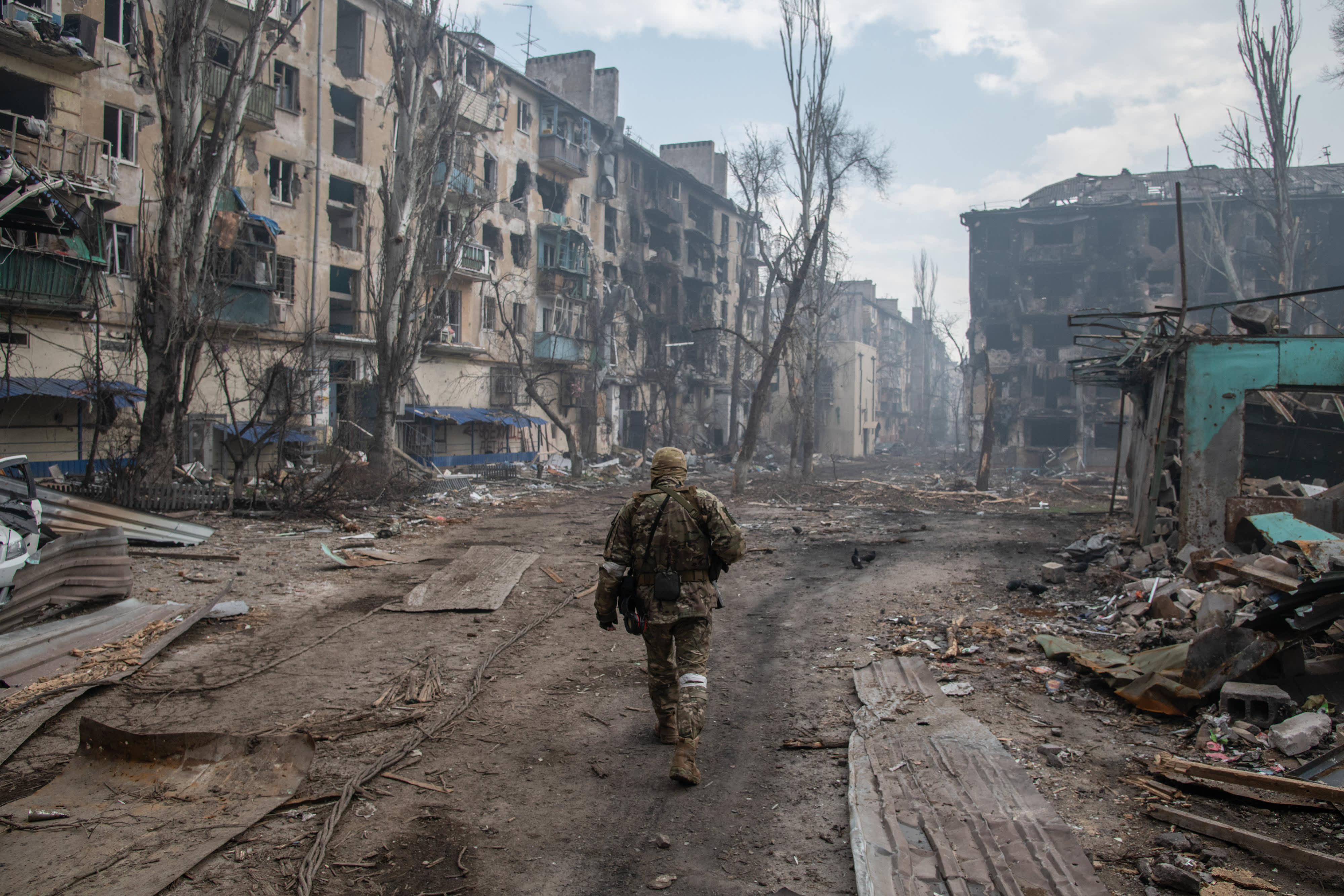
A Russian soldier walks in the rubble in Mariupol’s eastern side, where fierce fighting takes place between Russian and pro-Russia forces and Ukraine on March 15, 2022.

Maximilian Clarke | SOPA Images | Lightrocket | Getty Images

This is a joint statement, by the authors of Sráid Marx and Boffy’s Blog, on the global crisis of Marxism, which has become manifest in the collapse of many “Marxist” organisations into social-imperialism, in relation to the Ukraine-Russia War.  Those organisations have abandoned the independent third camp of the international proletariat, and, instead, lined up behind one of the contending imperialist camps of NATO/Ukraine or Russia/China.  They have sought to place the world labour movement back to the position prior to World War I (WWI), which led to the split in the Second International and formation of the Third International, although such a development is not possible, today, if only because no real International exists, making the situation similar to that prior to Marx and Engels establishing the First International.

This crisis of Marxism has been a long time coming. Its roots lie in the nature of what passed for Marxism in the post-war period, a ‘Marxism’ that was, in fact, a form of petty-bourgeois socialism, manifest in its attitude to the state as the means of historical change, rather than the independent self-activity, and self-government of the working-class, and, concomitantly, in its attitude to the national question and nation state.  Both of us, with a combined experience of nearly a century in the labour movement, were recruited, in our youth, into different Trotskyist organisations – the International Marxist Group (IMG)/Peoples Democracy in Ireland, and International Communist League (I-CL), respectively – of which we were members for many years, and yet, freed from the barriers to critical thinking imposed by membership of such sects, we have, independently of each other,  arrived at almost identical conclusions about the nature of the Left, and on the critical issues of the day for the labour movement.

We have set out below a statement on the fundamental issues we believe lie behind the recent failure of many groups and individuals to develop an independent working class position on the war in Ukraine, and how this very open betrayal is a result of previous errors now compounded into an outright defence of the capitalist state.  While both of us have been activists in Western Europe, and our arguments are derived directly from this experience, the issues raised are relevant to Marxists everywhere and the experience of others across the world will confirm this experience and the lessons drawn that we have set out below.

The State

This ‘Marxism’ is fundamentally distinguished from other forms of socialism by its attitude to the state.  Not only did Marx and Engels talk about the state withering away under communism, both were intensely hostile to the capitalist state, as the state of the class enemy.  In “State and Revolution”, Lenin points out that Marx’s attitude to it was the same as the anarchists.

“… it was Marx who taught that the proletariat cannot simply win state power in the sense that the old state apparatus passes into new hands, but must smash this apparatus, must break it and replace it by a new one.”

It is only in this latter sense that Marxists differ from the anarchists, i.e. in the need for the proletariat, after it has become the ruling-class, to establish its own semi-state, to put down any slave-holder revolt by the bourgeoisie.  The idea that Marxists can call upon the existing capitalist state to act in its interest is, then, absurd.  That opportunist attitude to the state was promoted by the Lassalleans, and Fabians, in Marx and Engel’s generation, and, as Hal Draper sets out, in The Two Souls of Socialism, became the ideology of The Second International.  Marx opposed it in The Critique of The Gotha Programme, and Engels followed that with many letters, and also in his own Critique of The Erfurt Programme, in which he opposed the idea of a welfare state, National Insurance, and other forms of “state socialism”.

As Lenin says,

“Far from inculcating in the workers’ minds the idea that the time is nearing when they must act to smash the old state machine, replace it by a new one, and in this way make their political rule the foundation for the socialist reorganization of society, they have actually preached to the masses the very opposite and have depicted the “conquest of power” in a way that has left thousands of loopholes for opportunism.”

(ibid)

Stalinism adopted this opportunist attitude to the state. In the post-war period, it was taken on by organisations claiming the mantle of Trotskyism.  In Britain, for example, the Revolutionary Socialist League, better known as The Militant Tendency, talked about a Labour Government nationalising the 200 top monopolies, but all these organisations raised demands for the capitalist state to nationalise this or that industry, usually to avoid bankruptcy, and they continue to do so.  Even more ludicrously, they combine these utopian demands to the capitalist state with the further demand that it also then grant, to the workers in the industry, “workers’ control”, as though such a request would ever likely succeed, other than in conditions of dual power in society, i.e. conditions in which workers have established their own alternative centres of power, in the form of workers’ councils, enabling them to impose workers’ control, arms in hand.

What such demands also illustrate is a dangerous failure to distinguish the difference between government and state.  Governments of different complexions come and go at frequent intervals, as does the bourgeois political regime, appearing as either “democracy” or “fascism”, which are simply masks which the bourgeoisie adopt according to their needs, but the state itself remains as the real power in society, permanently organised as the defender of the ruling class, including against the government if required.

Authentic Marxism, therefore, rejects these opportunist appeals to the state to act in the interests of the working-class.  Our method is that of the self-activity and self-government of the working-class, which must organise itself to become the ruling class, and, in so doing, bring about its own liberation.  We look to the advice of Marx and Engels and The First International to develop its own cooperative production, rather than to the capitalist state and we advise it, at all times, to take its own initiative in addressing its needs within capitalism.  This includes organising its own social insurance, to cover unemployment, sickness and retirement, rather than relying upon the vagaries of state provision, which is geared to the fluctuating interests of capital, and its economic cycles, not the interests of workers.

Of course, as Marx sets out in Political Indifferentism, if the capitalist state does provide such services, we do not advocate a sectarian boycott of them, out of a sense of purity.  As Marx sets out in The Poverty of Philosophy, what makes the working-class the agent of progressive historical change is precisely its struggle against the conditions imposed upon it, which results from the limits of capitalism, and to breach those limits by replacing capitalism. Capitalism is progressive in developing the forces of production, via the accumulation of capital. This has led it to maximise the exploitation of labour/rate of surplus value but does not mean that we advocate no resistance to its demands for wage cuts, or lower conditions.  We point to the limited ability of capitalism to maximise the rate of surplus value, and so develop productive forces, as well as the limited ability of workers to raise wages, within the constraints of capitalism, and consequently, the need to abolish the wages system itself.  

Nor do we advocate a boycott of socialised healthcare, education and social care systems, but point out their limited capitalist nature, the lack of democratic control and so on.  We oppose any regression to less mature capitalist forms of private provision, not by defending the existing state forms, but by arguing the need to move forward to new forms directly owned and controlled by workers themselves.  Whilst we offer support to workers’ struggles for improvements in existing provision, and for democratic control, we do so all the better to demonstrate to workers that so long as capitalism exists, no such permanent improvement and no real democratic control is possible.

All large scale industrial capital is now, socialised capital, be it state capital or that of corporations, and so properly the collective property of the “associated producers”, as Marx describes it in Capital III.  Unlike the socialised capital of worker cooperatives, it is not, however, under the control of the associated producers, of the working class, but of shareholders and their Directors.  Short of a revolutionary situation, and condition of dual power, workers cannot force the state to concede control over that capital to them.  Even the social-democratic measures, such as those in Germany, providing for “co-determination” of enterprises, are a sham that retains control for shareholders, and simply incorporate the workers in the process of their own exploitation. 

Similarly, we do not support the sham of bourgeois-democracy, which is merely a facade for the social dictatorship of the bourgeoisie, and its state, a facade they will drop in favour of fascism if their rule is challenged by workers.  We defend the democratic rights afforded to workers – to organise and to advance their class interests – but we do not confuse defence of those rights, which the working class can use, with defence of the bourgeois democratic state that continually seeks to limit, erode and threaten them outright.  

We recognise, however, that millions of workers do continue to harbour illusions in bourgeois democracy, and, so long as they do, we must try to break them from it.  That is not done by a sectarian abstention, but by utilising it, and demanding it be consistent democracy.  For example, abolition of Monarchy and hereditary positions and titles, election of judges and military top brass, abolition of the standing army, and creation of a popular militia under democratic control.  We support the workers in any such mobilisation and demands for consistent democracy, but we offer support only as the means of demonstrating the limits to such democracy and the possibility of a higher alternative, so enabling them to shed their illusions in that democracy.

The means by which we seek to mobilise the workers, in all such struggles, are not those of bourgeois society, but those of the encroaching socialist society of the future.  We advocate the creation of workplace committees of workers that extend across the limited boundaries of existing trades unions; we advocate, as and when the conditions permit, the linking up of such committees into elected workers’ councils, and the joining together of this network of workers councils on a national and international basis. We reject the idea of reliance on the capitalist state and its police to “maintain order”, or of its military to provide defence of workers, and instead look to democratically controlled Workers’ Defence Squads and Workers Militia to defend workers’ interests, including against the armies of foreign powers, terrorists and so on.

The National Question and The Nation State

The opportunist view of the state differs from the Marxist view, by presenting the state as some kind of non-class, supra-class, or class neutral body, standing above society, whereas Marxists define it as what it is, the state of the bourgeois ruling class.  The opportunist view of the state is a petty-bourgeois view, reflecting the social position of the petty-bourgeoisie as an intermediate class, standing between the bourgeoisie and the proletariat, and which sees its role as mediating between these two great class camps. 

It denies the class division of society.  The symbol of this denial is the use of phrases such as “the nation”,“society”, “the people” and so on, which subsume the antagonistic classes, in each society, into one “nation”, and then transforms the state into being the state of “the nation”, or “the people”, rather than of the ruling class.  This used to be the ABC of Marxism, and yet the Ukraine-Russia War, has seen a large part of the Left collapse into these opportunist and nationalist, as opposed to socialist, ideas.

The logic of this opportunist position flows inevitably from their view of the state as the agent of social change, as against the role of the working-class itself.  It is necessarily a petty-bourgeois, nationalist view, as against a proletarian, internationalist view.  It demurs from class struggle, in order to privilege and promote the combined interests of all classes within the nation, as a “national interest”, which necessarily sets that “national interest” against the “national interest” of other nations.  The interests of workers of different nations are, thereby, brought into an antagonistic relation with each other, rather than with their own ruling class.  Again, this used to be the ABC of Marxism, symbolised by Marx’s statement that the workers have no country, and appeal, in The Communist Manifesto“Workers of The World Unite”.

In WWI, the opportunists in the Second International, continued to repeat these statements, but only as mantras, whilst, in practice, abandoning class struggle, and lining up under the banner of their particular capitalist state, in alliance with their own bourgeoisie.  This characterises the positions of much of the Left, in relation to the Ukraine-Russia war, whether they have lined up in support of the camp of NATO/Ukraine on the one side, or Russia/China on the other, under claims of an “anti-imperialist” struggle, or war of national independence/national self-determination.  

Marx argued that the workers of no nation could themselves be free, whilst that nation held others in chains.  That is why it is the duty of socialists, in each nation, to oppose their own ruling class in its attempts to colonise, occupy, or in any other way oppress other nations.  While the formation of nation states was historically progressive, as it was necessary for the free development of capitalist production and its development of the productive forces, the subsequent destruction of nation states, and formation into multinational states, is also historically progressive, for the same reason.  But, just as Marxists’ recognition of the historically progressive role of capitalism, in developing the productive forces, which involves it exploiting workers, does not require us to acquiesce in that exploitation, so too the historically progressive role of imperialism, in demolishing the nation state, and national borders, does not require us to acquiesce in its methods of achieving that goal.  (See: Trotsky – The Programme of Peace).

In both cases, we seek to achieve historically progressive goals, but without the limitations that capitalism imposes on their achievement, by moving beyond capitalism/imperialism to international socialism and communism.  The struggle against militarism and imperialist war is fundamental to presenting the case, and mobilising that struggle for, the overthrow of capitalism, and its replacement by international socialism.  We carry out these struggles on the basis of the political and organisational independence of workers from the bourgeoisie and its state, on the basis of Permanent Revolution.  (See Marx’s Address to the Communist League, 1850)

This was the basis of the position set forward by Lenin in relation to The National Question.  The task of Marxists, in oppressor states, is to oppose that oppression by their own ruling class and to emphasise the right to free secession, whilst the task of Marxists in oppressed states is also to oppose their own ruling class, pointing to its exploitation of the workers, and unreliable and duplicitous nature, and emphasising not the right to free secession, but the right to voluntary association.  It is what determines the Marxist position of opposing, for example, Scottish nationalism, Brexit, or other such forms of separatism across the globe.  As Lenin put it, we are in favour of the self-determination of workers, not the self-determination of nations.

In 1917, following the February Revolution, in Russia, the Mensheviks, and some of the Bolsheviks, such as Stalin, Kamenev and Zinoviev, also changed their position of opposing the war, and argued that the Russian state had become “revolutionary democratic”, i.e. a non-class state, overseeing a non-class form of democracy.  Lenin vehemently opposed that social-patriotism, and threatened to split the party unless it was rejected.  However, this position was never abandoned by Stalin, who resumed it after Lenin’s death, making it the foundation of his strategy of the Popular Front, applied in relation to national liberation struggles, for example “the bloc of four classes”, in China, in 1925-7, and in opposing fascism, as applied in France (1934-9), and in Spain (1934-6), and subsequently, in Stalinism’s collapse into what Trotsky called “communo-patriotism” in WWII.

In the post-war period, it was not only social-democrats, reformists and Stalinists that adopted this class collaborationist Popular Front approach.  In place of the Marxist principle of the self-determination of the working-class, the petty-bourgeois Left, including those that described themselves as “Trotskyist”, threw themselves into supporting struggles for national self-determination and did so, not on the basis of simply opposing the role of their own ruling-class, but of actively supporting the bourgeois and petty-bourgeois nationalist forces engaged in those struggles.

Indeed, not only were the forces involved the bourgeois class enemy of the proletariat, but, in many cases, as in, for example, Korea, Vietnam, Algeria and so on, they were aggressively anti-working-class forces with which Marxists should have had no truck whatsoever, and against which Marxists should have been warning the workers, and against which they should have been aiding workers to defend themselves.  (See: The Theses On The National and Colonial Questions).  Again, the petty-bourgeois socialists had adopted the mantra of “My enemy’s enemy is my friend”, identifying imperialism as the enemy, and so the bourgeois and petty-bourgeois nationalists fighting that imperialism, as their friend.  This was even the case where these forces violently suppressed Trotskyists within their own country.  Today these forces have presided over or opened the door not to workers’ power but to capitalism. 

This was never the position of Marxism, as set out, for example, in the Comintern’s Theses On The National and Colonial Questions.  It is a perversion of that position introduced by Stalinism, and later adopted by the petty-bourgeois Left, in part under pressure from Stalinism, but also from peer pressure in the petty-bourgeois, student milieu in which it became embedded, and from which came much of the movement in support of these national liberation struggles, and from which it sought to recruit new members.  In line with the principles of Permanent Revolution, first set out by Marx in his 1850 Address, not only was it necessary to ensure the political and organisational independence of the proletariat, and to arm it to defend itself against the national bourgeoisie, but, in so far as the proletariat was led to form any temporary tactical alliance with the peasantry and petty-bourgeoisie, it was on the basis of an alliance with those masses, and not with the parties representing those classes, and certainly not with the bourgeois state.

“Lenin, it is understood, recognized the necessity of a temporary alliance with the bourgeois-democratic movement, but he understood by this, of course, not an alliance with the bourgeois parties, duping and betraying the petty-bourgeois revolutionary democracy (the peasants and the small city folk), but an alliance with the organizations and groupings of the masses themselves – against the national bourgeoisie.”

(Trotsky – Problems of The Chinese Revolution)

This is in stark contrast to the position of the Left, in all national liberation struggles, in the post-war period, and in its position in relation, now, to the Ukraine-Russia war.

The Russia-Ukraine War

Like WWI, the Russia-Ukraine war has become an acid test of the Left.  As with WWI, most of that Left has failed the test.  That the Left social-democrats, the reformist socialists, and Stalinists should fail only repeats their failures going back to WWI, but for those that claim the mantle of Trotskyism to fail it indicates the crisis of Marxism, and that the nature of that Left, as described above, is actually petty-bourgeois.  

It is no surprise that those that have collapsed into becoming cheerleaders for one or other of the two contending imperialist camps have done so by using the arguments that opportunists used in WWI, and in WWII, based upon arguments of national self-determination, and “anti-imperialism”.  But, nor is it a surprise that the Stop The War Coalition, which opposes the war on both sides, does so not on the basis of Marxism and Leninism, and the principles of class struggle and revolutionary defeatism, but on the basis of opportunism and social-pacifism.

The Marxist position is not only that the war is reactionary on both sides, and so we oppose the war; it is also a recognition that such wars are not inexplicable events, or caused by fascist megalomaniacs, but flow from the nature of imperialism, its drive to create a global single market, dictated by the needs of large-scale capital itself.  It is inevitably led to do this by the violent competition of nation states (and alliances of such states), each seeking to assert their dominant position in any new international formation.  Simply appealing for peace is therefore utopian, and ultimately reactionary, just as much as appealing for capitalist enterprises to stop competing against each other or forming larger monopolies and cartels.

We do not argue for an end to capitalist competition or monopolies, but for workers to take over those monopolies, and, thereby, to be able to replace competition with increasing cooperation between them, as part of a planned organisation of production and distribution.  That is the real basis of class struggle, not economistic, distributional struggles for higher wages within a continuation of capitalism.  Similarly, we do not argue for an end to wars between capitalist states, or the destruction of nation states and formation of larger multinational states, such as the EU, as part of forming a world state, but for workers to overthrow the existing capitalist states and establish workers’ states, as the only permanent means of ending wars, and rationally constructing a single global state, based upon voluntarily association.  That is the basis of class struggle at an international level, of the concept of revolutionary defeatism, as against utopian demands for peace, the demands of social-pacifism.

The Marxist position of revolutionary-defeatism, in relation to the Russia-Ukraine War, as with any such war, is not simply about opposing the war, but about explaining to workers that these wars are fought using their blood, but not for their interests, and that they will continue to suck their blood so long as capitalism continues to exist.  In the same way that Marxists intervene in strikes  to explain that workers will continue to have to strike for decent wages, so long as capitalism exists, and that such strikes will not, ultimately, prevent their condition in relation to capital deteriorating; so they intervene in imperialist wars to explain that they will continue so long as capitalism/imperialism exists, and so the answer is not a utopian demand for peace, but a class struggle for the overthrow of capitalism/imperialism itself, to turn the imperialist war into civil war!

In the post-war period, the petty-bourgeois Left became engrossed in the rash of “anti-imperialist” and national liberation struggles that erupted as the old European colonial empires collapsed, in part under pressure from US imperialism that sought to break open all of the monopolies and protected markets of those colonial empires, in order to give free access to US multinational corporations to exploit vast reserves of labour.  At the same time, Stalinism encouraged the development of support for such movements, as agents of the global strategic interests of the USSR, in competition with US imperialism.  As in China, in 1925-7, it sought to ally itself with the national bourgeoisie, and subordinate the interests of workers and poor peasants in these former colonies to that of the national bourgeoisie, which it sought to draw into its orbit, as symbolised by the Third World Movement.  This same, class collaborationist, Popular Front approach, was adopted by the Stalinists in the formation of the various Solidarity campaigns established to support these “anti-imperialist”, national liberation struggles.

Whilst the “Trotskyist” Left continued to repeat the mantra of opposition to Popular Fronts, in practice, and seeing large numbers of students drawn to the campaigns of solidarity with this or that national liberation movement, nearly all of which were bourgeois in nature, and many of which were particularly authoritarian and anti-working-class, as with the Algerian NLF and Viet Cong, it joined in, and promoted these kinds of cross-class, popular frontist organisations.  It did so for fear of isolation and losing out in the potential for expanding its contact lists of possible new members in its rivalry with competing sects.

The Ukraine Solidarity Committee is just the latest in a long list of such cross-class, Popular Frontist organisations that throws their support behind, and so acts as useful idiots for, some reactionary national bourgeoisie, which is the enemy of the workers of the given state.  In the past, these Popular Front organisations often gave a pass to the USSR and its allies, whereas, today, the USC gives a pass to, and allies with, NATO imperialism and its associates in the EU, G7 and so on.  On the other side, those social-imperialists that have thrown themselves into a cross-class alliance in support of Putin’s Russia and Xi’s China, on the basis that they are being threatened by NATO/US imperialism, are simply the mirror image of the USC.

What Is To Be Done?

As two individuals, we do not suffer the hubris of thinking that we have the answers to this modern crisis of Marxism, but we do believe that such a crisis exists when self-proclaimed Marxists openly support one capitalist state in war against another, each backed by one or the other of the two largest capitalist states in the world  A similar condition exists today as that in the early days of Marxism, with only a handful of authentic Marxists, amidst a sea of petty-bourgeois sects that portray themselves as Marxists while peddling reformist programmes; a still not insignificant number of Stalinists and other Left reformists; and with mass workers parties that have reverted to being simply openly bourgeois parties, much as with the British Liberals and German Democrats of 1848.

Indeed, the British Labour Party, under Starmer, has declined even more than that, becoming dominated by the reactionary, petty-bourgeois nationalism promulgated by the Tory party.  Yet, in the absence of mass socialist workers parties, the working-class continues to engage in its own struggles, for increased wages to counter inflation, for example, but also to look to these bourgeois workers’ parties (or simple bourgeois parties) as their political representatives, and Marxists cannot ignore this reality.  Our task is to work alongside the working-class, in and out of struggle, and break it from the current delusions in those parties, and in bourgeois-democracy itself.

Appeals to create yet another Marxist sect, or to create some new Workers Party have proven to be pointless.  Engels advised US socialists to work with the existing workers parties, and, likewise, prior to the creation of the Labour Party, advised Eleanor Marx and her associates to work with the Liberal Clubs, rather than the existing sects such as the SDF or ILP.  As he noted, in 1848, he and Marx and their supporters had joined the German Democrats, and operated inside it, as its organised Left-Wing.  

Our fundamental principle, as set out by Marx in his 1850 Address, is to maintain the political and organisational independence of the working-class as it seeks its self-emancipation.  But, as Marx and Engels showed, that is not incompatible with working inside existing mass workers parties.  Whether that is done openly or covertly is only a question of tactics, determined by what is possible at the given time.  The existence of the Internet to produce online publications and networks makes that much easier today than it was even 25 years ago.

In the 1930’s, when the forces congregating around him and his supporters were very small, Trotsky advised them to join the various socialist parties, so as to operate within them, as an organised Left-Wing, and, thereby, to begin to build the required numbers for the creation of new mass revolutionary parties.  It was the formation of an undeclared United Front with those rank and file workers.  It is again forced upon us given the tiny forces of authentic Marxism.  Our goal is not some Quixotic attempt to capture those parties, but simply to build the required numbers of authentic Marxists to be able to create effective revolutionary workers parties as alternatives to them, and, then, to move from an undeclared United Front with the rank and file of those parties to an open and declared proposal for a United Front, exposing the leaders of those parties and drawing ever larger numbers of workers to the banner of international socialism.

That is in the future, but the first step is to establish a network of authentic Marxists, much as Marx and Engels did with the Communist Correspondence Committees, and as Lenin and Plekhanov did with the Marxist discussion circles that over time laid the basis for the creation of the RSDLP.  

If you are in agreement with the principles set out above, in this joint statement, whether you are an individual or organisation, we ask you to contact either of the authors via the comments sections of these statements on our respective blogs.  If you have a social media presence, then give us the details so that we can share it with our readers, and we would ask that you do the same, for everyone else as part of an expanding global network of authentic Marxists, each supporting, in whatever way they can, the work of the others, and facilitating a discussion and development of authentic Marxist ideas.
Civil Rights and Socialist strategy 4 – the failure of the Left


In looking back at the civil rights movement Eamonn McCann argued that “the left had a lot of influence in the early days of the civil rights movement. We frittered it away. No question of that. We frittered it away. We have to learn lessons from that and look back.”  In doing this on the fortieth anniversary of 1968 he wrote that “in the long run, we didn’t punch our weight.”

McCann also noted the weakness of republicanism in Derry in the 1960s, which won less than 3,000 votes in a constituency with more than 25,000 Catholics in 1966, while in West Belfast IRA leader Billy McMillen came fourth out of four with just 6.3 per cent of the vote in 1964.

However, McCann also made the point that the radicals of around twenty to thirty in Derry were weak – a “relatively small, raggedy band of socialists”; “no sizeable socialist party was built from the experience, no distinctive socialist current emerged”. “What was needed . . . were clear ideas and coherent organisation, which wasn’t our strong suit.”

He complained that it was difficult to engage in political debate within the Derry Citizens’ Action Committee, with anyone raising class politics denounced as splitting the all-class unity of the Committee.  He remarked on the radicals “blithe disregard for organisation and structure, because we had underestimated the depth of the sectarian division and the hold of nationalism on the Catholic community, because we had not been engaged in building a serious socialist party.”

McCann states that there was no clarification of differences, with “little serious effort to draw a line of demarcation with nationalism.’  This was especially needed in 1969 as the anger of youth flowed “through unimpeded among nationalist channels, eventually, into the IRA.”

He noted the way barricades were thrown across the entrance to Catholic areas, which he saw as confirming sectarian division, and the absence of the organised workers’ movement from the civil rights struggle.  In relation to the latter “we were too far out in front. [We] had lost contact with the main formation of the class and the only institution in the North which organised across the sectarian divide, the union movement, in which we might have grounded ourselves, or cleared ground for a new departure.”

McCann does record that in the 1969 Stormont election Peoples Democracy “was able to address mainly-Protestant workforces, emphasising the class basis of its hostility to unionism . . . but given the spontaneous nature of the socialists’ main organisational expression – the PD – and the absence of clear-cut ideas, the militancy came across as much as a reflection of gut opposition to the Northern state as of conscious adherence to socialist politics.”

He quotes Bernadette Devlin, after she won a by-election to become a Westminster MP –“there may not be 30,000 socialists in this constituency, but it has a socialist MP.”  As he also records, “events had been rushing forward, pell-mell, helter-skelter, at a pace never previously experienced in stultified Northern Ireland, hurtling, as we thought, towards a possibly imminent resolution.  It was vital not to be left behind.  So no time to stop, analyse, synthesise.  In the blur of activity, we missed the moment.”

“This is not to say that if we had all been hardened revolutionaries with clear ideas, working patiently, efficiently to build a revolutionary socialist party, things would have worked out very differently”, acknowledging the historical weight of communal rather than class allegiance and the failure of the official labour movement.  His “realistic possibility” was one of “recruiting relatively rapidly from angry, urgent working class youth” and “entering 1969 not as a hubbub of socialist individuals but as a serious socialist organisation, capable of taking on and competing for popular support. . .” (all quotes from ‘Socialism and 1968’, in ‘Spirit of ’68’ edited Pauline McClenaghan)

If we review this argument, we can see that it isn’t altogether consistent.  It is argued that the left did not punch its weight but began the struggle as a “small, raggedy band”.  Before civil rights agitation took off the group was presented with a perspectives document that acknowledged their poor prospects, with the great mass of people seeing “religion, not class, as the basic divide in our society.”

Elsewhere he notes that although the left played a prominent role in organising marches; putting out leaflets and bulletins; running a radio station and in standing as candidates in  elections, that during their speeches “when the people were applauding [it] was not so much what we said but the way we said it.”  He notes correctly that prominent involvement in mass agitation did not mean that they had real political leadership or, as Bernadette Devlin put it – she was a socialist MP but not elected by socialist constituents.

McCann argues in his book ‘War and an Irish Town’ that mass influence is meaningless “unless one is in the process of forging a political instrument necessary to lead such agitation to victory . . .” and “we have learned that it is impossible to do that if one is not forearmed with a coherent class analysis of the situation and a clear programme based on it.”

Both of these are claims are true but his later assessment that things might not have worked out very differently had this been the case – and it can be argued that socialists at the time did argue vociferously for a socialist approach – nevertheless is also true.  These two requirements posed by McCann were not enough and their absence itself needs explanation, not simply in terms of the failures of individuals involved.

Perhaps they could have done better, as we can all have done better in our political careers, but this does not make our failure to do things as best they could be done the cause of wider failure by the movement or the class.  The point of this series of posts has been to understand what happened in order to do better now, but what happened was the outcome of forces much stronger than the left input into these events.

The left perspective document in 1968 quoted by McCann was not wrong to note the strength of sectarian division and the unionist and nationalist politics that divided workers within the North.  As I have noted a number of times, the short duration of the civil rights struggle, as well as its very uneven development, meant there was little time to challenge the historically developed political consciousness already imbued within Irish workers.

And this partially explains why republicanism, despite its obvious weakness in Belfast and Derry, was able to grow rapidly while the left did not.  Irish republicanism is not an alternative to nationalism but simply a variety of it, its most militant manifestation.  The transformation of consciousness required to move from support for the Nationalist Party to Republicanism is qualitatively different from one required to move from any sort of nationalism to socialism.  It should be recalled that, for many Catholic workers, this move to more militant nationalism was not made until republicans stopped being republican, in the traditional militant sense, and had given up armed struggle.

McCann notes that it was difficult to engage in debate within the Derry Citizens Action Committee (DCAC) because this would be denounced as political and divisive of Catholic unity.  He also argues that not enough was done to distinguish the socialist case from the nationalist one.  But there is ample evidence of socialists arguing the case for class politics through many of their interventions, and while their failure to build a significant socialist organisation was something that might otherwise have been achieved, this outcome was not primarily due to their failure to distinguish themselves as socialists.

Both McCann in Derry, Bernadette Devlin in her election campaign, and Peoples Democracy generally, were all loud in their opposition to green capitalism and their support for working class unity.  They failed because of the strength of its division, and while as Marxists this may be regrettable to have to admit, it is not at all incomprehensible. The difficulty of intervening in the DCAC that McCann noted did not make refusing to enter it an answer, but reflected the consciousness not only of the middle class leadership of the DCAC but of the Catholic workers it led, as McCann himself has noted.  The difficulty also remained outside the DCAC and most leftists joined it (although it would appear with little influence) because they feared isolation outside it.

The forces overwhelming the small and divided socialist movement, as McCann appears to recognise, were the events that “had been rushing forward, pell-mell, helter-skelter, at a pace never previously experienced in stultified Northern Ireland, hurtling, as we thought, towards a possibly imminent resolution.”

A whirlwind of events can sometimes suggest more fundamental changes occurring than actually are, and that requires analysis, which McCann notes was missing.

But this is still true today, with this lesson still unlearned, with the left now bigger but no nearer building a genuine working class party, which requires not just a much bigger mass membership but a class conscious class from which to draw its ranks and a democratic culture that can provide the analysis with which it can take leadership.

Today the left in Ireland, and not not just Ireland by any means, is still too much impressed by action and not by the consciousness that drives it, and is in turn derived from it.  Honest and sober analysis still escapes it, with support for Brexit a particularly egregious example of a mistaken political programme.  Even when criticising what he sees as the failure of the left in the late sixties to build a serious socialist organisation he repeats the idea that what was needed was to recruit “rapidly from angry, urgent working class youth”, themselves the product of the “pell-mell, helter-skelter” of events that the left sought to keep up with.

As these lines are posted mass demonstrations and riots are taking place in the US following another racist killing by the police.  References have been made to this being an American ‘revolution’ when in fact we are a very long way from the American working class posing a socialist revolution,  Presenting the missing ingredient as a revolutionary party begs all the questions about the nature of the working class and its movement from which it alone can be created.

The erection of barricades to separate Catholic areas under attack from the RUC and loyalists, symbolising for McCann the obstacles to unity between Catholic and Protestant workers, is testament to the strength of sectarian division but does not make their erection mistaken.  Hence the tragedy.

His speculation that socialists might have grounded themselves in the trade union movement, but had become separated from it, does indeed argue correctly for an orientation by socialists to the working class as it is, and not to counterpose one’s own sectarian interests, organisation and programme to the workers own movement, but McCann himself notes the passivity of the official movement and its effective abstention from the civil rights campaign.  To reverse this would have required a fight inside the trade unions, against its leadership, and this could only have succeeded in a struggle in which socialists had won the support not only of many Catholic workers (from nationalism) but also Protestant workers (from unionism).

No one can claim that this could have been achieved in a few years; it is the work of many years and involves forces greater than exist within the six counties.  In the meantime it could not have been wrong to orient to those willing to campaign for democratic rights in order that they might be directed to such an orientation.

That there is still no settled view on what socialists should have done in 1968 – 69 is not surprising since this is largely fed by what socialists think we should be doing now.

Back to part 3

Forward to part 5

Derry TUC publishes a Workers’ Charter

On May Day Derry Trades Union Council (DTUC) launched a Workers’ Charter and published it in local newspapers.  It argued the need for trade unions and for workers to organise to push for real change.
The Charter raised ‘the Red Flag of workers’ unity and socialism’, calling for ‘a Living Wage for all’ and ‘a shift in the balance of wealth and power away from corporations and the rich and towards the rest of us.’

We should therefore ask ourselves – what does this wealth and power consist of, where does it come from and how do workers shift the balance?

If the Coronavirus crisis has taught us anything, it is that the wealth of society is the product of the labour of the working class, with some of the lowest paid workers recognised as key to the functioning of society.

So if they are so crucial, why is this not recognised in the remuneration they receive?

The reason that they enjoy so little of the fruits of their labour is that their labour power is exercised for the production of profit, because production only takes place in pursuit of it, and is derived only from the labour performed by workers for which they are unpaid.  That is why they must now work and why they are paid so little.  They don’t own or control the corporations that they work for, which provides the enormous incomes and wealth of those who do, so the economy is not a function of need but of the expansion of this unpaid labour.

The supermarket workers do not own Tesco, which is paying out a £900m dividend to its owners despite getting a tax break, but they are absolutely necessary for this dividend to exist.  Many firms loaded with debt will get Government bail outs while the private equity firms that own this debt sit on $2.5 trillion of cash.  The state will not take this into account as they do the meagre incomes and savings of workers who apply for welfare.

The rich owners of corporations are rich because they own the means of producing the wealth of society. Their wealth and power comes from control over the production that generates current income and accumulated wealth. Health Service workers such as cleaners, nurses and doctors are exposed to danger because they also don’t own and control the NHS. They have no more control over their pay and conditions than those who work in private hospitals or private care homes.  If they did the shortage of personal protection equipment would not have existed.

The answer to shifting the wealth and power in society is therefore to shift ownership and control of production to the people who work to create this wealth.

Derry TUC correctly point out that vast sums of money have been found to cover the Covid-19 emergency after years of tiny wage increases for health service and other workers – ‘the money was there all along’.  It wants a tax-free payment of £1,500 for all front-line workers plus an additional four bank holidays a year.

But the money wasn’t there all along.  It has been borrowed.  It’s now a question of whether, how and who will pay it back.  Money was found for the financial crisis of 2007-08 but austerity was imposed to pay for it.

The DTUC statement says that the government is putting the ‘economy’ and profits ahead of protecting people and public health.

But the ‘economy’ is also about the production of all the goods and services that are required to protect people and their public health.  Not only the goods and services the NHS needs, that NHS workers need, but all the other economic activity that pays the taxes that funds the health service and other services, including any tax-free payments of £1,500.

The ‘economy’ is not something separate from the activity of working people, that has needs wholly separate from their needs.  That is the lie peddled by the Government and bosses.  The working class is the working class because it is the prime productive force of the ‘economy’.

The ‘economy’ is not just the production of profit but also the production of what people need in order to live in a civilised society.  We cannot survive without continuing to produce and no amount of additional money will be of any use to us if we cannot continue to produce.  Working people will be the first to suffer, and the last not to, if whole parts of the ‘economy’ are closed down.

That is the prime contradiction of the capitalist system – that it is production for profit but must also satisfy human need – and capitalism incurs crises because of this opposition.

The battle now is to ensure that the terms and conditions of those workers who return to work are safe and acceptable, and that depends on workers being ready to go to work organised and ready to stand up to the demands of their bosses.  That is the lesson from health workers already having to face a lack of PPE.  This requires introducing as far as possible mechanisms of workers control.

It also means the organisation of all those workers who are now unemployed and who are threatened with being idle in the longer term.

Workers cannot afford not to work, they aren’t capitalists, and capitalism does not pay for workers unless it is profitable.  It would be the height of stupidity to say that we should not return to work because this is demanded only because the bosses want to make money.  Of course they do!  Until we have a new society based on production for need, and not profit, we have no choice but to recognise this reality, to face up to the economy we actually live in and struggle within it to defend ourselves while also fighting to change it.

Capitalism will not be overthrown by refusing to work, or pretending we can change its laws by simply demanding that profit no longer rules.

Once again, it is workers ownership and control of production that is key to workers’ defence and a socialist alternative.

The DTUC says that ‘globally, one per cent of the population holds half the world’s wealth.  We need a new system’.  But why is this true?

The world’s decisive capitalist class and its corporations (with its various States) holds the vast majority of wealth creation – that is what defines them.  They are smaller than even one per cent, and own or control much more than half.  Their lavish riches composed of multiple residences, private islands, yachts, private planes, fancy cars, jewellery, stocks and shares, and bank accounts with millions, are only the product of their real wealth and power, which is their ownership of production and the political power that derives from it.

Derry TUC points specifically to the amount of money spent in the UK defence budget, ‘set to reach £55 billion’.  But why only this? UK ‘defence’ spending is only 2.1% of GDP.  What about the other 97.9% that is all produced by workers?  Should it not also be directed to their needs?  And how else would this be done except by controlling it, which means owning it?

The statement calls for ‘a government of the people’, investing this money in areas such as green energy, but why should the State own and control this?  The Irish State already owns significant parts of the energy industry in the North of Ireland as well as in the South, and this isn’t socialism. Governments already invest significant amounts in Green energy through subsidies to wind farms and taxes on consumption but this has not brought the transformation of society any closer.

The point is not to increase this state ownership but for workers to develop their own energy production, something more and more possible with smaller and more distributed renewable power generation. The point is to increase the wealth and power of the working class, not the State that defends the existing capitalist system and subsidises the capitalist class.

Derry TUC says that ‘politics has taken power away from the people moved towards the major corporations.’ But this is misleading.

The most fundamental power has always lied with the capitalist class, its system and the laws by which it operates.  The capitalist class and its state has increased its power over many years but it has always had power over the working class.  Working people can defend themselves and resist, but to create their own power and to create a society in which their power prevails requires an economy owned and controlled by workers and by no one else.  To fight for this requires more than bigger and better trade unions; it requires the creation of a mass democratic working class Party.

This is the lesson we must re-learn and teach every May Day.

In his inaugural address to the workers of the First International Marx extolled –

‘the still greater victory of the political economy of labour over the political economy of property. We speak of the co-operative movement, especially the co-operative factories raised by the unassisted efforts of a few bold “hands”. The value of these great social experiments cannot be overrated. By deed instead of by argument, they have shown that production on a large scale, and in accord with the behests of modern science, may be carried on without the existence of a class of masters employing a class of hands’

To achieve this, Marx said, ‘the great duty’ of the working classes was to ‘conquer political power’ and this required the organisation of a working class party.

The policy of that Party cannot afford to defer the tasks of the working class to the capitalist state, or to pretend that tinkering with the distribution of the fruits of labour through increasing wages etc. is a substitute for revolutionising the distribution of the ownership and control of production.

As Marx said in the ‘Critique of the Gotha Programme’, a programme representing an earlier Workers’ Charter:

‘Any distribution whatever of the means of consumption is only a consequence of the distribution of the conditions of production themselves. The latter distribution, however, is a feature of the mode of production itself. The capitalist mode of production, for example, rests on the fact that the material conditions of production are in the hands of nonworkers in the form of property in capital and land, while the masses are only owners of the personal condition of production, of labour power. If the elements of production are so distributed, then the present-day distribution of the means of consumption results automatically.’

‘If the material conditions of production are the co-operative property of the workers themselves, then there likewise results a distribution of the means of consumption different from the present one. Vulgar socialism (and from it in turn a section of the democrats) has taken over from the bourgeois economists the consideration and treatment of distribution as independent of the mode of production and hence the presentation of socialism as turning principally on distribution. After the real relation has long been made clear, why retrogress again?’

Why indeed?


Civil rights and socialist strategy 2 – fighting for reforms

The long history of sectarian division; support for imperialist rule by many Protestant workers; and illusions in different variants of Irish nationalism by Catholic workers, is the reason why I stated at the start of the previous post  that the most significant weakness of the civil rights movement was that it was short-lived: the sectarian character of the Northern State immediately tested the small movement, and with the intervention of the British State, effectively destroyed it.
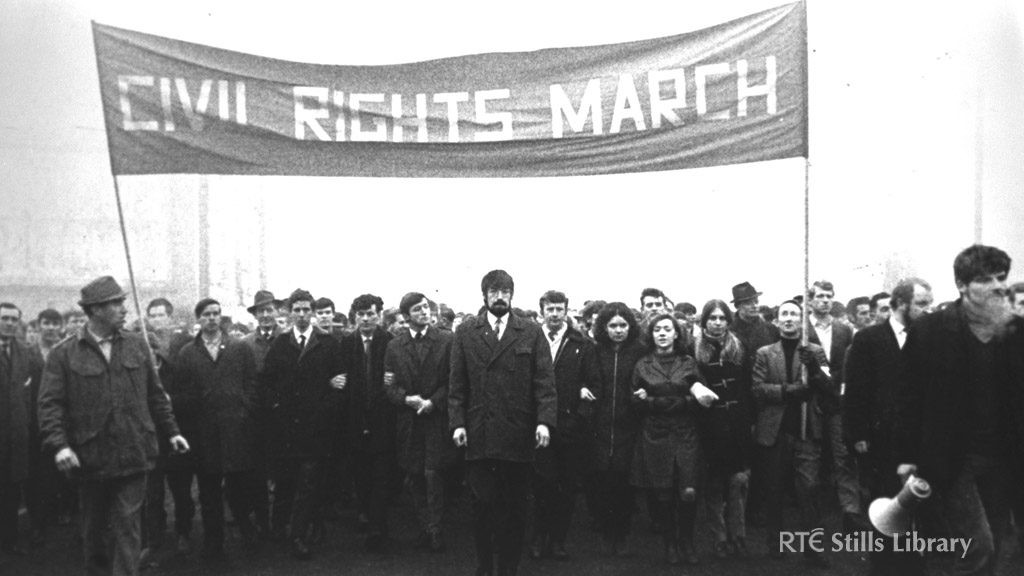
So there was no prolonged period in which a mass civil rights movement could struggle to win over the participation of the labour movement or sections of it, which really means winning over significant numbers of Protestant workers; this movement proclaimed its own unity only by not challenging political division.  We should also be clear that workers unity was not possible by relegating this struggle to a still-to-be-born united workers struggle for socialism.  Unity would not have come from waiting for the labour movement to act before acting outside it because the labour movement didn’t even act when a non-sectarian movement was created and did act.

This chronic weakness, which existed at the all-island level, where the whole Irish trade union movement was also not mobilised, demonstrates how far away the grounds were for a socialist solution.  Yet most of the radical left considered that what was necessary was a socialist struggle and what was posed was a fight for revolutionary politics against the explicit reformism of the Official republicans and Communist Party.  The Northern State could not be reformed and the fight was one against partition and for a Workers’ Republic.  This perspective needs some unpacking.

We have already seen that one version of it is the view that economic and social – ‘class’ demands – should have been brought to the fore and the key to socialism was winning over the labour movement.

A second version is that since the North is irreformable the struggle for reforms should be superseded by the fight for a united Ireland and a Workers’ Republic, in which case demands for reform such as civil rights should also be superseded or at most given a subsidiary role, in perhaps detonating the struggle or being only one subsidiary part of it.  In this view the demand for civil rights does not (certainly automatically) unite workers but exposes the need to destroy the Northern State, whose existence determines and ensures the division.

The struggle for democracy shows the need for a struggle against the state and for socialism – a process of permanent revolution whereby the state’s inability to deliver democracy exposes the need to destroy it, which can only be achieved through a Workers’ Republic since the capitalist Southern State also does not wish to challenge British rule (which stands behind the Unionist state) and seeks stability through continued partition.

In this view the shift in the struggle from civil rights to one against the State itself is a progressive one, moving from the illusion that reforms can be achieved and are sufficient to an explicit opposition to an irreformable state.  This brings closer workers appreciation that the struggle commenced can only be successfully concluded as a struggle for a Workers’ Republic as opposed to a united capitalist Ireland.  The demands of the struggle become progressively more advanced.

Unfortunately, of course, the struggle also progressed in advance of the majority of the working class.  Civil rights was overtaken by the sectarian mobilisation of grassroots unionism and by repression from the Unionist regime, which itself challenged the struggle for reform to become one of struggle against the state’s existence, or at least in the form of the Unionist regime that was in place.  This pushed the movement further than the forces against the state were capable of successfully going or many wanted to go.  While the struggle for civil rights moved to one against the existence of Stormont itself, this begged many questions about goals and strategy which could bring it about, and what would happen thereafter, that weren’t answered and that lay behind the seemingly endless years of ‘the Troubles’.

A third version of this left view at first glance appears different, but some have argued for it and the view above.  It argues that the Northern State could not be reformed (and we must leave aside here what the definition and scope of such reform is) but that any such radical reform would remove the foundations of the state and lead to its dissolution.

This was never the conception of the argument as understood at the time in so far as, and to the extent that, it was understood at all; because if this was the case the argument might have been to continue to fight for fundamental reform as the way of maximising working class unity while undermining the state.  Such an argument does not preclude seeking the end of then Stormont regime, as opposed to seeking the more or less immediate end of the Northern State itself.

All of these perspectives envisaged the direct intervention of the British State, even if this was not thought through, and such intervention was the goal of the civil rights movement, either because of the belief that Unionism would not reform without British pressure or that they would not reform at all.

In summary, the first left view regarded a socialist programme that included civil rights within it as the key to achievement of working class unity, primarily within the North.  The second looked to the struggle for democracy breaking the bounds of civil rights to become a struggle against the Northern State itself and partition, with the solution as a Workers’ Republic.  The primary struggle was thus against British imperialist rule with the expectation that this struggle would more or less automatically grow into a socialist one.  The third regards the struggle for radical reform as sufficient to undermine the Northern State and pose the question of a united Ireland and a Workers’ Republic.

These more strategic conceptions lie behind the differences that arose on the left about the correct intervention into the civil rights movement that arose during this time, and since, by those directly involved and which we shall look at next.

Back to part 1

Forward to part 3

Civil rights and socialist strategy 1 – what was civil rights for?

The civil rights movement, considered as those that sought mass participation, was disparate in organisation and uneven in strength, including geographically across Northern Ireland.  It consisted, inter alia, of the Northern Ireland Civil Rights Association (including its sponsoring organisations), various organisations in Derry including the Citizens Action Committee, and Peoples Democracy, as well as numerous local initiatives coloured by local circumstances.  This heterogeneity reflected unity around the immediate demands and fundamental differences over end goals.  Above all the movement was short-lived and none of the perspectives behind support for civil rights was able to see their particular view confirmed.

For example, the middle class leadership that later formed the Social Democratic and Labour Party (SDLP) sought a partnership with the Unionist regime in Stormont and the solution of the issues raised by civil rights through local parliamentary reform, in which the legitimate and democratic aspirations of the Catholic minority would be respected following pressure from the movement and from Westminster.  The increasing use of violent repression, the slowness and limited character of reforms, and the priority given to support for the regime by the British Government meant this strategy collapsed.

Republicans who were later to become the Official Republican Movement, and its allies, thought of civil rights as a means of removing obstacles to the unity of workers in the North.  There is nothing wrong with this view since it is obvious that no political unity could be achieved while accepting the inequality between Protestant and Catholic workers, which was fundamental to their disunity.

They were correctly criticised by others on the Left for not putting such unity within the framework of the unity of all of Ireland’s workers, not just in the North but between North and South.  But civil rights didn’t address this problem and for the Officials the necessary first step was therefore progress within the North, and given their statist view of the road to and content of socialism – deriving from Stalinism – this meant reform of the Northern State.

The Provisionals, which did not exist during most of the period covered in the previous series of posts, did not have much use for the civil rights movement since for them its primary function was to demonstrate the irreformable nature of the Northern State, which could only be destroyed by the armed struggle of the IRA.

For the radical left, civil rights was also viewed as a means to unite the working class, but as part of a revolutionary process and not, like the Officials, one of reform.  There were a number of ways in which this could be conceived, including that it was necessary to put forward a socialist programme, sometimes concieved as transitional demands, within which civil rights was only one component.  Peoples Democracy raised left wing demands and slogans as part of its support and participation in the civil rights movement and recognised the importance of uniting workers North and South.  Unfortunately, their symbolic march from the North to the South in 1969 demonstrated not only the weakness of socialists but of the grounds for working class unity between the North and South.

This might seem to be a flawed judgement, since the largest membership organisation in Ireland, North and South, was the trade union movement with, for example over 200,000 members in the North.  However, as we have seen in these earlier posts, the official movement may have passed resolutions that supported civil rights but its leadership never fought for its members to campaign for them, either by setting up its own campaign or supporting NICRA.

Despite its moderate demands and determinedly non-sectarian purpose no trade union affiliated to NICRA, and when a sectarian pogrom blew up in August 1969 the trade unions stood four-square behind the Unionist state.  The working class, as in all developed capitalist societies, has potentially enormous power but this potential has never been fully expressed and the working class was politically divided.

To say that working class unity was necessary to destroy sectarianism is simply to say that working class unity was necessary to achieve working class unity.  In other words, such a perspective doesn’t get you very far.

It has often been proposed that a programme weighted more towards ‘class’ demands was necessary to win Protestant workers, who might argue that the inequality that was claimed to exist wasn’t doing them much good and that equality of poverty was not a sensible way to win them over.  Unfortunately, there were real inequalities between the working class of each religion and this was something many Protestants were unwilling to acknowledge or to accept the significance and importance of.

For some, acceptance of the demands of the civil rights campaign meant accepting the legitimacy of Catholic grievances and so their responsibility, or complicity, in letting it happen.  This challenged both liberal pretensions of Britishness and more extreme views about Catholic disloyalty. It is also not the case that Protestant workers opposed the demand for civil rights because they saw it as a Trojan horse towards a capitalist united Ireland.  The imperialist and monarchy-supporting Unionist tradition was and is reactionary across the board and opposed a united Ireland whether it was socialist or not; in fact communism was as dirty a word as Republicanism for the vast majority of Unionist workers.

The view that demands that challenged the ills of capitalism should be primary left open how important should be considered the civil rights denied to Catholics. When this was put up to the labour movement through a campaign made up overwhelmingly of working class and poor Catholics it became a choice of whether to participate, and attempt to lead that campaign, or stand aside.  The labour movement chose the latter and the excuse that the civil rights campaign was not the way to do things rings hollow when no other way was put forward and previous more sedate means had ignominiously failed.

It is not accidental that the view that civil rights was not the issue, but general want and poverty, was argued at different times by hardliners in the Unionist Government who wanted promises of job creation etc to defuse demands for civil rights; the middle class leadership of the Derry Citizens Action Committee who appreciated the poverty that existed and wished to take the edge off confrontation with the Unionist regime and seek and accommodation with it; and various left figures who sought to turn the underlying shortage of jobs and housing etc. into a struggle against these deprivations and for a socialist solution.

This last view is only true at a certain level of abstraction, i.e. when one discounts the actual grievances around inequality which existed and passes over the actual political struggle and campaigns that prevailed.  It also ignores that the demand for civil rights challenged sectarianism directly, and all of the above recoiled for different reasons and to differing extents from this reality and what it then entailed.  For Unionist hardliners the reason was the integrity of their regime; for middle class Catholics the possibility of compromise with this regime, and for some on the left the unwillingness to accept the real mass support for the regime among Protestant workers.

The radical left inside the campaign did try in various ways to raise wider economic and social demands, explaining their opposition to the capitalist Southern State and support for jobs, houses and decent wages for everyone.  This message was carried forward through propaganda, marches, meetings and elections.  In recollections by all the left leaders involved at the time, whatever their disagreements then and now, it is clear that the necessity for such an approach was understood and acted upon.  These forces however were too small and the working class too divided and in thrall to unionism and nationalism for their actions to succeed.

Forward to part 2

Back to last part of history of the civil rights movement

Should socialists support a border poll? 5 – a socialist approach

The leader of the SDLP Colm Eastwood has claimed that there would be a special place in hell for those who call for a referendum on Irish unity without a plan, saying a border poll should not be held until work to build a new and reconciled Ireland was completed.  Gerry Adams has made a similar statement on the need for preparation.

We have seen in earlier posts that unity of the working class, especially within the North, does not mean reconciliation to bigotry and sectarianism.  It does not therefore mean the sort of reconciliation that Irish nationalism, endorsed by the British State, has put forward in the name of “equality of the two traditions.” These traditions are defined by sectarianism in one case and by a nationalism incapable of going beyond Catholic support on the other.

Nationalism is now dead as a practical programme, in the sense that the objective of an economically and politically independent and sovereign nation is now impossible.  Brexit is demonstrating this is the case for a much larger and more powerful nation, never mind for a much smaller and weaker one.  We are seeing that the attempt to do so is inevitably reactionary as it seeks a world that has disappeared.

This is not to say that the demand for self-determination by the Irish people is not a democratic demand that socialists should endorse.  It is one of many democratic demands that cannot be fully delivered under the current capitalist system; but in terms of setting up a wholly separate sovereign state Ireland has missed that nationalist bus.  Small nations, in fact even the big ones, are now subject to international capital, an international division of labour, and international political organisation in a way that did not exist 100 years ago.

The fate of the nominally independent part of Ireland, which started its road to statehood almost 100 years ago, demonstrates this today through its reliance on multinational capital and its membership of the European Union.  To seek an Irish capitalism without such capital, and outside the EU, is to doom the Irish working class to a perfectly national form of capitalism that can no longer exist, and which would be reactionary from the point of view both of capitalism and socialism.

It is no accident that the most militant republicans support Brexit, but this is only testament to their programme of independence being utopian – it is not possible to achieve. Utopias can be forward or backward looking and theirs is forward looking in terms of seeking the end of direct foreign rule, a rule that has engendered deep and malignant division, but is backward, not only in its continued devotion to militarism, but also to the idea of undiluted and undivided national sovereignty and independence.

Socialists seek not only the unity of the working class within nations but between nations.  This unity cannot be the unity of self-sufficient and independent states, since the productive powers of capitalism have long ago burst out of such narrow confines.  The unity of nations that socialists seek is now one of mutual dependence and cooperation.

This is obviously a long-term perspective but it informs our attitude to a border poll today, for example in the primacy of the pursuit of working class unity.  For socialists, removal of the border is a necessary part of the struggle for working class unity.  So too is opposition to Brexit, which much of the Irish Left and militant republicanism support.

Unfortunately, the working-class movement is a very long way from being able to offer a credible plan for unification based on its existing organisations and structures.  If the call for a border poll means anything more than a statement of principle then this must be accepted.  The only possible form a united Ireland could take today, after a majority in favour of it in the North following a poll, would involve the incorporation of the North into the South.

While much of the left might propose a left Government in the South, this too is far off and is not a perspective that would convince anyone that the immediate result of a United Ireland would be incorporation into a left social democratic state.

Support for a border poll is not therefore a stand-alone demand but focuses the socialist and working class movement on what it can do to make such a poll an opportunity to fight for the unity of the working class.  Today, when there is no immediate likelihood of a border poll, it requires that socialists state what we would mean by having a ‘plan’ of our own, to put it in the words of Colm Eastwood.  Or as socialists would put it – a programme to fight for that would, if successful, lead not only to territorial and state unity, but also the much increased unity of the Irish working class, as part of a wider united European working class.  Obviously, this last objective would mean opposition to Brexit and Irexit.

Since leading by example far surpasses any other means of seeking support, what this must involve is the growth and strength of the working class movement itself – its trade unions, political parties and campaigns.  At present the meshing of the trade unions in social partnership and the devotion of the left to state ownership as socialism, means the working class movement does not offer Northern workers any alternative to simple incorporation by the southern state.

The working class movement itself is in many ways a husk, with empty trade union branches and hollowed out parties.  This is the case even in its supposed advanced, activist form.  In the last Southern local elections a spokesperson for People before Profit stated that it lost seats because it could not get its vote out – a humiliating admission that its support is not more political than the bourgeois parties but less so. Many unions are no advertisement for democracy and most parties on the left are sects incapable of containing political differences that will and must arise in truly mass parties of the working class.

As we have noted before, much of the left is actually reactionary, including its support for Brexit, accompanied by its dishonesty in not fighting openly for Irexit.  Not all members of the relevant organisations support Brexit but where then is the open debate that might inform workers of the issues at stake?  In its approach to democracy, the internal regimes of these organisations contain little debate of political principle and not much on strategy and tactics.  How to implement the line is usually the only thing up for some discussion.

If we accept that there must be no coercion of a nationalist majority, under the guise of any requirement for an increased majority (or the latest version of this – parallel majorities), it is also true that there can be no coercion of Protestant workers. This does not mean acceptance of a veto by loyalism, of the sort we have examined in the last few posts.  There can be no admission that any loyalist reaction must have its objections accepted.  The unity of the working class requires the defeat of sectarian division and the political forces that represent it.

While the Socialist Party for example has also expressed opposition to coercion, it is clear that this concern is rather one-sided.  History has shown that democracy in Ireland has been subject to coercion mainly from the British State, usually in alliance with unionism.  It is not only possible but inevitable that a majority vote for a united Ireland in the North would be subject to unionist threats and violence. As this series of posts has made clear, the answer to the first question that this poses is opposition in principle to this veto.

The second question is how to minimise this coercion, and this firstly means opposing any threat by the British State, or any section of it – national or local – seeking to prevent unity or determine is nature and shape.  This is where the unity of workers across the two islands and Europe is necessary to isolate and repulse such coercive threats and actions.  This is not just a question of opposing and preventing loyalist intimidation of Catholics, the first victims of loyalist intimidation are always fellow Protestants who don’t accept that their religious identity requires them to be sectarian.

Before all this however comes the task of reducing Protestant support for unionism and increasing support for a democratic solution.  This means the socialist and working class movement breaking from its alliances with the Northern and Southern States and asserting its independence. It means demonstrating through deeds, and not just expression of principles, that it opposes sectarianism no matter from where it comes.  On this it does not have a very good record.

In the South there has been no anti-clerical movement and the left has avoided direct challenge to the power of the Catholic Church.  It has not been the left that demolished the reputation of the Church but the actions of the Church itself and media exposure of its crimes, particularly against women and children.  If any movement deserves credit for openly campaigning against the church it is the women’s movement, and at most the left can claim some credit for having supported it.

What the left has not done is seek to demolish the structural power of the Church.  Instead it almost appears content to believe that the power of the Church has gone, rather than confronting the reality that as long as its structural supports are maintained it has not been defeated.

Such defeat means something more than a loss of reputation, it means a debate on the democratic alternative to Church control of education and health services.  So, for example, despite the victory for abortion rights the Church’s potential role in maternity services shows the importance of destroying this structural power.

In terms of the North it also means opposing Catholic Church power in education and health, something the left has not done and radical nationalists have opposed.  For example, I recall at one meeting in a republican club in West Belfast, when an ex-IRA prisoner complained that he could not get a teaching job, one of my comrades told him – it wasn’t the British who discriminated against him.

Yet there has been no campaign against Church control.  Such opposition would of course  be vigorously opposed by the Church, on the basis that it was yet another sectarian Protestant assault on Catholics.  And there is no doubt widespread support among Catholic workers for sectarian education, simply assumed by them to such an extent that it is not even considered to be sectarian.  I have been to enough Masses to know that the clergy regularly ask congregants to pay for ‘their’ Catholic schools.

I also recall one member of the organisation I belonged to resigning when he found out that socialists do not support more state funding for Catholic education on grounds of equality, but an end to church control in the first place.  Such mistaken ideas hide behind the argument that state control is control by the imperialist state, ignoring the fact that British rule has long supported Catholic Church control.

The socialist position is democratic control of schools by workers themselves and complete separation of church and state.  To put it bluntly – Protestant workers should not pay for Catholic Church control of education, and neither should Catholic workers, or those who don’t define themselves as either.  This means there should also be no exemption from discrimination legislation allowing Church authorities to discriminate against non-Catholic teaching applicants.

The demonstration of opposition to all sectarianism is the alternative to “equality of the two traditions” and its ‘left’ variant of the Socialist Party, which seeks its own reconciliation with sectarianism through, for example, conferring legitimacy on loyalist reaction.  The only possible grounds for the latter is that it has some positive content.

For Catholic workers it means that they identify themselves not as a religious group defending a sectarian interest but as a section of the population that has faced discrimination and seeks an end of all privilege and sectarian rights. The view that because Catholics have historically been the sufferers of sectarian oppression, they can be relied upon to oppose all cases of it in the future is to believe that oppression somehow makes whole populations more righteous by virtue of their oppression, something that does not bear any historical investigation.  One only has to think of the appalling fate of millions of Jews at the hands of fascism and the repugnant use of this suffering by Zionism to excuse and justify the shocking oppression of the Palestinian people.

The strength of the Catholic population’s support for sectarian education is simply an example of the impact that the existence of a sectarian state has on how the society within it operates.  It is yet another illustration why the destruction of that state is required to eradicate it.  Too many Catholics object to a sectarian state but not to one sectarian policy of that state – a united Ireland but not a united classroom.

Without a strong working class and socialist movement it cannot be anticipated that a united Ireland can be brought about without coercion, even with the validation of a majority vote for it within the North.  This does not lessen our support for it as a component part of the necessary struggle of the working class in Ireland, because such a struggle will minimise such coercion and maximise the working class unity to be gained.

On the other hand, opposition to a border poll and a potential majority for a united Ireland on the grounds that this in itself involves coercion of Protestant workers must be rejected, not least because in such circumstances coercion will come immediately, if not long before, from loyalist reactionaries, with or without support of the British State or elements of it.  Such a position does not represent opposition to coercion but support for it.

Such then are examples of the issues faced by socialists, and the approach that should be taken.  There is little likelihood of a majority vote for a United Ireland within the North in the near future, and nationalist calls for a poll without a wider programme that demonstrates its progressive content is not something we should support.  Our support for a poll, in principle, and in practice, arises from our objective of a united working class and the achievement of this requires more than simply a majority vote.  Our support therefore rests on quite different grounds and we should neither reject this support nor surrender the grounds for it.

Concluded

Back to part 4

The Socialist Party and Brexit 2 – part of the programme?

Following economic recession the second possible consequence of Brexit predicted by the Socialist Party is increased division and instability in the North.

Increased division on the island is of course inevitable, since that is the purpose of Brexit – to exit the arrangements that entail the existing unity of the European Union that includes the whole island.  On exit the UK will become a ‘third country’ and the only question is the degree of separation.

Given that left supporters of Brexit see the rules of the Single Market and Customs Union as so harmful to the interests of the working class it must be expected that the sort of Brexit they seek involves a high degree of separation and therefore a meaningful and significant border.

It  doesn’t matter that left supporters of Brexit blame the EU for this – the Socialist Party says that “after a hard Brexit the logic of the workings of the EU is that a hard border would have to be put in place” – the result is the same.  The Party states that “a Labour government should seek to re-open negotiations and demand an entirely different relationship with the EU, based on the interests of working-class people, not the 1%.”

One has to ask however – why would the EU, if it is the irreformable neoliberal construction that is claimed, strike an agreement in the interests of the working class, whatever that might be?  If it were possible there would seem to be little reason to leave in the first place.   Why not use membership to effect such changes for the whole EU instead?

But this is not the perspective of the Socialist Party, which is wedded to a very particular scenario of the way forward, which is “the necessity of a left government having to carry through a rupture with capitalism and adopting a socialist programme.” This “rupture” with capitalism is to be achieved through the “democratic public ownership of the key sectors of the economy”; i.e. through nationalisation supported by the mass activity of the working class.  This must be carried out by each state separately as nationalisation is by definition the action of an individual state.

This essentially nationalist approach to socialism lies behind the Party’s support for Brexit.  At the immediate level this perspective takes shape in the following expected results:

“Socialists in Ireland would welcome the return of a Labour government in Britain. If such a government were to adopt a position of socialist opposition to the EU this would transform the situation. Corbyn should speak over the heads of the Commission, reaching out to working class people across Europe in rejecting neo-liberal rules, calling for co-ordinated action for Green Energy on a Europe wide basis, and popularising a socialist vision of Europe. A left Labour government would be able to call on workers throughout the continent to fight the ‘race to the bottom’ in their own countries and mobilise against attempts by their own governments or the EU to pursue punitive measures against other workers whether in Britain or elsewhere.”

Why a left movement in Britain would be more powerful in reaching out to the rest of Europe’s workers by leaving the EU, instead of remaining and seeking unity of the workers’ movement across Europe, is unexplained.  But this is precisely what supporters of Brexit would need to demonstrate – why an exit was necessary and why it would be more successful in achieving wider European unity. How would leaving assist “co-ordinated action for Green Energy on a Europe wide basis” for example?

Unity of Europe’s workers, through its trade unions, works councils, political parties and workers’ cooperatives is possible but it is made easier by being within a common EU framework, in which Europe’s capitalist classes are seeking their own form of unity.  Only from a perspective in which the rupture with capitalism must first come from national governments in each individual capitalist state is it possible to simply assume without argument that international workers’ unity must follow this and not be immanent from the start.

So at an abstract level the Socialist Party maintains its international socialist credentials by considering such unity only as an end result after almost all the problems have previously been solved:

“Socialists are in favour of a genuinely united Europe. This will only be possible when the socialist transformation of society allows the coming together of nations of Europe in a democratic, European-wide confederation.”

The Party considers its approach to be consistent with the approach of the transitional programme as codified by Leon Trotsky.  This can be stated rather briefly as a programme fought for by a revolutionary party that starts from today’s objective conditions and from the existing level of consciousness of the working class.  It demonstrates through the demands raised in today’s struggles the necessity to take ever more radical measures that culminate in the working class seeing the need for, and being organised to achieve, socialist revolution.

This is the transition that the programme is meant to achieve, as opposed to demands that simply reform aspects of capitalism but do not fundamentally change it, and the maximum programme which demands this fundamental change through demands for socialism and socialist revolution.

There are lots of issues bundled within such a view, and lots of Trotskyists who would hotly dispute that the Socialist Party’s version is consistent with Trotsky’s programme, but that is not what I want to discuss here.  Rather it is to question how support for Brexit can possibly be seen as being part of any transitional approach.  I have written many posts on why I think socialists should oppose Brexit so the purpose here is a much narrower one and is confined to the role that supporting Brexit plays in the Socialist Party’s politics.

The first problem in the Party’s support for Brexit is that it then either abstains or is confused on just what this policy entails.  So it says that:

“We say that whatever way the different capitalist vested interests resolve their business dispute, it must be done without any physical or repressive borders.”

So having voted for a Brexit, to be determined by a reactionary Tory Government and EU bureaucracy, the Party leaves it for these capitalist interests to decide what it means, to ‘resolve’ the issues (within certain limits).  How does this engage the working class in seeking to impose its own solutions?

The view that a Corbyn led Government could simply re-negotiate all the bad neo-liberal rules away and leave the same market access is even more delusional than the Boris Johnson idea that Great Britain can get Johnny foreigner to allow it to have cake and eat it.  Does the Socialist Party really think Jeremy Corbyn could negotiate away the bad bits of the Single Market and customs union for the whole EU, or even just for the UK? And if it was just for the UK, would this not mean that there wasn’t really a Single Market? And if only for the UK, what then for the rest of Europe’s workers, including the Irish?

Would those Irish workers not within the UK have to await its own left government, one that is not on the horizon, before it too would attempt to copy any Corbyn success? Or would it not make a lot more sense for a left Labour government in the UK to fight within the EU alongside allies across the continent, including in the Irish State?

Since we don’t have a left Labour Government in Britain or the short-term prospect of one in Ireland, what is the policy that the workers movement should fight for right now to make Brexit a ‘good’ Brexit, or does silence on this indicate that one does not exist?

So, the first problem is that the Socialist Party has advocated a policy of Brexit for which it has no concrete idea how to give any progressive content.

In an instinctive reaction against their own sterility members of the Party have made a virtue out of their impotence and argued that no positive policies should be put forward in this situation, but instead only negative demands:

“Deliberately not putting forward positive demands, or advocating a particular arrangement post-Brexit, has been correct, and broadly remains correct however. There are issues on which it is not for the worker’s movement to come forward with solutions which address the concerns of the ruling class, and in the main this is one such.”

But of course, a content will be given to Brexit and it will be a wholly reactionary one, and it is really not good enough to vote for a reactionary policy, saying it is progressive and a step forward, and then be unable to build positive demands out of it and arising from it.

The final illustration that the policy of Brexit has no place in any socialist programme is that the Socialist Party is totally silent on the most obvious of questions.  If Brexit is the right policy for the British working class, indeed for all the workers of the EU, why does the Party not follow up on the ‘success’ in Britain and call for the Irish State to leave the EU as well?

It would appear no one in the Party wants to do this, but it is not because they all believe it is wrong. Instead they have saddled themselves with a policy that they dare not proclaim. Every argument defending Brexit and every claim that it is necessary is but another demonstration of the dishonesty of the Party to workers that it proclaims require its leadership – because it is not actually asking the workers to follow it.  It is not leading but hiding.

Once again, the political impotence of the policy is so clear that it cannot be replicated: the nationalist nature of it imposes its own logic regardless of the left illusions of its supporters.  There is no transitional content whatsoever.

Brexit has thus exposed fundamental flaws in the state-socialist programme of the Party, a programme which identifies socialism with state ownership and the route to working class power with governmental office.  Since the state is a nation state this almost inevitably involves conceiving of socialism, and the road to it, in national terms.  And so the Party gets it totally wrong when it comes to key international questions such as the European Union and Brexit.

In the final post I will look at the national question and how the Party’s policy on Brexit fails the challenge of uniting Ireland’s workers.


The 17th World Congress of the Fourth International (6) – the opposition “strategic hypothesis”

Given the circumstances as set out in the opposition document, the key question for  revolutionary politics would seem to be how working class political consciousness can be advanced. And the authors are aware; the text says “In that sense, our main task is to re-build class consciousness.”

To this question, they provide the following answer:

“The most effective way to do so is still by the struggle of the working class interest against that of the bourgeoisie. Rallies, demonstrations, occupations, assemblies, strikes; those are still the best tools for raising the consciousness of the oppressed. This does not mean that we ignore parliamentary elections. But we do subordinate them to mobilization.”

No doubt the comrades would say that this must be combined with revolutionary propaganda and agitation and raising the demands contained within the transitional programme, but this is still a very incomplete understanding of how class consciousness is created.  It also involves an instrumental view of the working class, one that sees it coming to socialism not through well thought-out conviction, based on its experience within the forces and relations of capitalist production, but because it arises as a result  of carrying out much more limited aims that have been posed through strikes and assemblies etc.

It is assumed that more or less spontaneous and partial opposition to the harmful effects of capitalism, which by their nature can only be episodic (see below reliance on this not being the case), will be transformed into comprehensive opposition to the system itself and commitment to a socialist alternative. The missing catalyst being revolutionary propaganda, slogans and agitation; in other words, the presentation of socialist ideas.

Of course, it is always rejected that this is a rather idealist (propagandist) view, and that it is the experience of collective action and struggle, combined with socialist agitation and propaganda, that will effect the necessary changes in consciousness. But it is nevertheless the case that, in the case of the traditional Trotskyist conception of a transitional programme, that workers are led to socialist revolution through a rising set of demands that arise from more limited struggles over narrower objectives.

One problem is that such periods of heightened class struggle are necessarily brief, and the period in which the more advanced demands and slogans of the struggle are to be raised even briefer.  Yet this is not consistent with the need for the working class to be fully informed and committed to the task of owning, controlling and developing the complex society within which we live, with a more or less clear idea of what it will do as the new ruling class.  Instead such a role is to fall to it as a necessary, but initially unforeseen, requirement in order to achieve more limited objectives.[i]

This is not such a stretch if the objective is simply seen as the capture of political power, however conceived (involving governmental office, regime change, or a brand new machinery of state), but this is not what socialist revolution is primarily about.  Political power is necessary in order to defend new relations of production, not to create them, otherwise these new relations will more likely become the creation of the state itself.  We know that this has failed and has never been the definition of socialism anyway.  Socialist revolution is above all a fundamental social revolution and such nature distinguishes it from all the radical political revolutions that do not signify fundamental reorganisation of society.

The conception of how working class consciousness develops put forward in the document  is therefore a limited and partial conception, one that also ignores the economic and social circumstances of workers as lived in their everyday lives, and which has historically been the impulse behind their seeking after an alternative society, one that arose even before Marx studied this experience and developed his ideas on how the development of capitalism gives rise to its gravediggers.

Since this has been a long-standing theme of the blog I won’t go into it here, except to say that the anticipation of socialism through worker cooperatives, and the role that these can play as concrete ‘schools of socialism’, and not just strikes as “schools of class-struggle”, has not been appreciated by the opposition.

This is important because consideration of this would help the opposition grapple with some of the problems they recognise but which their overall “strategic hypothesis” blinds them to a solution:

“The strategic hypothesis we advance to end capitalism and patriarchy is a non-stop series of mobilizations that make the working class aware of the necessity of taking power for real social change. Strikes are not a fetish but an essential route to raise workers’ reliance on their own potential power. Strikes are “schools of class struggle” because they are moments in which the working class can self-organize. It is by means of conflict that workers create automatic responses and mechanisms to resist the bourgeoisie’s policies. Revolutionaries should not ignore today’s struggles, even if they are small. To the contrary, we must take part in them. Therefore, we need to find solutions to our deficiency in having a strong presence within the working class and taking part in its battles.”

It is not so much that the perspective of an ‘insurrectionary general strike’ is wrong; although with a large worker-cooperative sector and a perspective of taking state power, a simple strike is clearly inadequate if not misdirected.  It is that the “automatic response and mechanisms to resist the bourgeoisie’s policies” is also obviously inadequate since the point of revolution is to impose an alternative, not simply to resist the existing one. Why should those demanding such an alternative become the leader of the working class when the class fights simply within the existing relations of production and assumes their continuation, which is, after all, what strikes in and of themselves do?

What has come to fill this incomplete and inadequate conception of working class consciousness and revolution is a conception of the revolutionary party as an unduly separate agency in the revolution.  As I have noted in earlier posts on the FI debate, the working class party is often seen as arising from Marxists building their own organisations instead of it being the creation of the working class itself.

Obviously, Marxists will debate what they have to do; but what they have to do must proceed from what has to be done, in the sense of what has to happen, what has to be achieved, by the working class itself, which must itself build its own party. Otherwise it will not be its own party, but a political layer of the working class with greater potential to separate itself from it. As it has done, repeatedly, in the past.

So, the question is, how does the working class generate the class consciousness and organisation to fight capitalism and impose its alternative? This is not the same as, and is not reducible to, capitalist crises generating mass mobilisations, which a bigger or smaller party leads to overthrowing the state and introducing a different one.

The opposition seeks to replicate the experience of Lenin and the Bolsheviks, but even this paradigmatic conception of the revolutionary party fails to understand that the Bolshevik Party became the party it was because the working class made it their own instrument of revolution.  The subsequent failure of that party and revolution was the failure of the Russian working class itself, its size, its own weakness, dissolution, re-composition and incorporation of its best (and worst) elements into the bureaucratisation of the state.

The perspective of building mass action to a climacteric episode reduces the goal of socialist revolution to a single event and to a single path to it, one focused on state power and destruction of the capitalist state. It is to reduce such revolution to a political process only, which is only one (crucial) aspect of a wider and deeper social transformation.

Political revolution can only also be a social revolution if it is the culmination of much deeper developments within the social and economic progress of capitalism.

If the destruction of the capitalist state is to inaugurate working class power, or rather to be a necessary step to creation of a workers state that will defend the already advancing social and economic power of the working class, the working class must already have taken major steps to economic, social and political hegemony, steps which political revolution seeks to complete.

The more common reduced focus, reflected in the opposition “strategic hypothesis”, leads to many weaknesses, some of which appear in the text. So, in promoting a “transitional programme for the 21stcentury” it is stated that:

“A primary focus of this program is the expropriation of the key sectors of the economy. The bank crisis and bail-outs provided a new opportunity to explain and popularize the need for bank nationalization.”

But expropriation is not at all the same as nationalisation and those who think ownership by the capitalist state is progressive have not, for example, considered the experience of the Irish State, in which nationalisation was the means of transferring the liabilities of the banks to the shoulders of working people.

Similarly, we are invited to have illusions in the progressiveness of the creation of new capitalist states:

“In the oppressed nations we support a balance between the democratic fight for the right to self-determination and the fight for a society without classes. It means that, according to our strategy, the struggle for national freedom can be useful for working class emancipation only when led by the working class itself.”

While, with regard to the second sentence of this extract, it may sometimes be necessary for the working class to seek to lead such struggles, it is not always the case that this assertion is true.  It is however very definitely not the case that we should seek to balance the struggle for democratic freedoms under capitalism with the struggle for socialism. If the former is not a necessary part of the struggle for the latter why would socialists and workers support it? Why should workers sacrifice any of their struggle for socialism in some balancing exercise?

This repeated deference to the state, the capitalist state, which is the only one existing, arises from the surrender of tasks that belong to the working class to this state – nationalisation rather than workers’ cooperative ownership; welfare states rather than workers control of welfare provision, previously done through friendly societies, and defence of the democratic rights of capitalist states as the default position in national conflicts rather than workers unity.  It reflects the growing power of the capitalist state over the twentieth century; the influence of social democracy and Stalinism, and the increased role of the capitalist state in the capitalist mode of production, ‘neoliberalism’ notwithstanding.

Socialism has thus become synonymous with statification for many, and this error is not corrected by thinking a workers’ government or a workers’ state carrying out the task of social transformation solves the problem.  The workers’ state is a transitional concept in which the latter part of the term suffocates the former to the extent that it predominates.  This is because the state, even a workers’ state, is a body separate from society and standing over and apart from it. Socialism involves the withering away of the state and this can only be so if working class rule is based outside the state and reflects its role in the new relations of production, which the state is called upon to defend but not be the substance of.

In summary, the opposition is caught between defending what it considers the historic programme of the Fourth International in a different historical period and attempting to square this with the decline of working class consciousness that has occurred since that programme was first promulgated.  The answer is not to stake a claim to false optimism, which foresees a future rapid radicalisation sweeping all before it in rather short order, but understand why it didn’t work before and what the lessons are of the much longer and wider experience of the vastly larger working class has been since 1938.

The majority appear to have a more sober appreciation of the political situation but no way of not capitulating to it, while the opposition seeks not to capitulate but unable to come to terms adequately with the demands placed on revolutionaries arising from it.

[i]This is not to deny that socialists should not seek to radicalise such struggles and the working class itself in the process; but it is to deny that this is the highway to socialist revolution, considered in its totality.

Back to part 5

Forward to part 7

The 17th World Congress of the Fourth International (5) – the opposition need for a revolutionary party

The documents of the opposition to the leadership of the Fourth International have the benefit a greater clarity of exposition. In their document ‘Let’s seize the opportunities, and build an international for revolution and communism’ the opposition criticises the majority line of building broad parties “without clear programmatic and strategic boundaries”, leading to betrayal of the traditional revolutionary programme of the International.
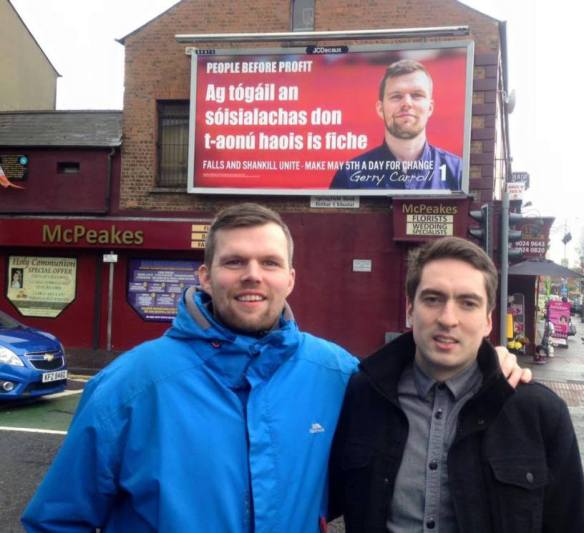
Thus, they point out that in Italy for example the “FI comrades supported in Parliament the formation of a Prodi government and voted for the war budget.”  Furthermore –

“Our ability to defend either the principle of class independence or to maximize the ability of our social class to act independently from the bourgeoisie and its State, is undermined when support is given to a politician linked to a bourgeois party, like Bernie Sanders, or to a personality with no ties to the labour movement, like Pablo Iglesias.”

Through this mistaken policy of the FI, the opposition argues that the majority “implicitly gave up on the relevance of revolution, seeing it as something to be accomplished in the distant future.”

It is not however clear to me that the opposition document makes any more convincing case that (their conception of) revolution is more relevant today, or in the short term, than that of the majority.  Small organisations without the participation or support of the mass of the working class bring the reality of revolution no nearer if they have no means of making their revolutionary programme the activity of the working class itself.

As Marxists, and therefore laying claim to a theoretical understanding superior to that of the mass of reformist (at best) workers, the opposition text should set out what the preconditions for socialist revolution are, and how Marxists might contribute to the working class accomplishing such a revolution.  But these preconditions appear to be assumed rather than explained.

Assertion of working class independence is fine and many of the criticisms of the experience of carrying out the majority perspective are true, but the traditional programme put forward by the opposition is presented in abstract terms and for Trotsky a programme must be concrete and have practical relevance.  I have addressed this problem before – here, here and here – so I will not repeat the arguments there.

The document fails to explain what independent working class politics means in a period like today, which is decidedly not a revolutionary one, or to be more specific, not one in which the working class in its majority seeks to conquer political power.

The problem that I pose is not one that the opposition would probably recognise, for they see the working class coming rapidly to political consciousness out of capitalist crises and the mass action prompted by such crises.  In the document they explain their conceptions, which are the traditional ones of many Marxists.  So, let’s look at what these are.

The opposition states that “We do not share the current FI leadership’s appreciation of the current situation. While it does feature an increasingly violent onslaught by the bourgeoisie, it is nonetheless contradictory and holds possibilities for revolutionary communists to be heard and to gain strength.”

It must be said that the last part of this involves a weak claim and one rather solipsistic.  No explanation is given as to how the mass of workers will come to socialist political consciousness, although it might be inferred this is a result of “revolutionary communists” being heard and gaining strength, that is, mainly through propaganda.

The epochal task of transforming the capitalist mode of production to socialism is however reduced to building an organisation that is currently without significant influence.  How this might be expected is unexplained.

One is left with an impression similar to that of listening to bold and incredible religious claims – the more enormous the claim the more requirement there is to provide equivalent justification for it.

The main opposition text asserts that the tendency for the rate of profit to fall is at the root of the capitalist crisis but this is neither proved, nor is it necessary.  In the document, it is implied that the capitalist crisis will not be escaped from spontaneously but through a historic defeat of the working class. The assessment is therefore incapable of understanding the massive growth of capitalism over the last period, which is reflected in the document’s own acknowledgement that:

“In fact, the working class is globally more numerous today than ever. In South Korea alone there are as many wage-earners today than there were in the whole world at the time of Karl Marx. The working class, which in our view is composed of wage workers who do not exercise management power, today constitutes between 80 and 90 per cent of the population in the most industrialized countries, and almost half of the total global population.”

“Globally, the number of industrial workers worldwide went from 490 million in 1991 to 715 million in 2012 (ILO data). Industry even grew faster than services between 2004 and 2012! The industrial sector did not shrink, but the agricultural sector did, from 44 to 32 per cent of the global workforce.”

But this incredible growth could only happen through rapid accumulation of capital, which makes a nonsense of any claim that capitalism has been in more or less permanent crisis during this period.  How could such accumulation have occurred with a declining rate of profit?  Either it did not fall or a fall does not reduce massive accumulation of capital.  Neither of which is a comfortable view for those making the argument.

A large number of the authors are Greek and it is understandable that the crisis conditions in that country may have coloured conceptions of the world capitalist system. But Greece is not the world and the world is not Greece.

What the authors have confused is the ever-present contradictions of capitalism, with its exploitation, oppression and inequality, and its tendency to war and violence, with capitalist crisis.  The former exist, even when capitalism is booming, in fact such things as exploitation must increase in such circumstances, but this does not mean capitalism is in crisis, as if a non-crisis capitalism entailed peace, equality, and humane and genial progress.

The problem with capitalism is that even when it achieves progress it does so through brutal oppression and exploitation, and yes, through recurrent crisis, which is how the system resolves temporarily some of its contradictions, only to create the basis for further crises in the process.  But this isn’t the same as crisis as understood by the document, which is one that calls into question the reproduction of the system.

The authors of the document note that:

“By reorganizing industry worldwide, capitalist globalization created new working classes in the southern countries, whose potential was shown by the recent mobilizations: the wave of strikes happening in China since 2010, the 2015 massive strikes in Bursa, Turkey, the formation of mass militant unions in Indonesia, the role of the union movement and of mass strikes demanding the resignation of South Korea’s Prime Minister in late 2016.”

They note that:

“we also see the renewed interest in socialism illustrated by Jeremy Corbyn’s double leadership victory in the British Labour Party, and the renewed interest in socialist ideas in the United States. All these signs indicate that the elements for anti-capitalist awareness are present. It is, nonetheless, a very uneven and limited process. Currents hostile to socialism are reaping the fruits of the deep discontent. The electoral audience of the FIT in Argentina, the recomposition of the union movement in South Africa, despite the limitations of both experiences, and above all, the renewed interest in “socialism” in the United States indicate that anti-capitalist ideas can acquire a mass audience.”

The document notes that they need to build the labour movement independent of the official union leaderships, and so capable of self-organisation.  But they state that the “elements for anti-capitalist awareness” that are present are “very uneven and limited’, that anti-capitalist ideas “do not yet have “a mass audience” and the type of labour movement they seek has yet to be built.

So, we have recurrent capitalist crises.  We have huge growth in the size of the working class and the creation of new working classes across the globe with enormous potential. We are told that the elements for anti-capitalist awareness are present (but not what they are), while anti-capitalist ideas “do not yet have “a mass audience” and the type of labour movement sought has yet to be built.

We are also told that there is “an increasingly violent onslaught by the bourgeoisie”, and one that is usually considered to have gone on for years, with more than a little success.  Yet one other, it would seem, is that the current, more or less immediate, relevance of socialist revolution has not diminished.

To be continued.

Back to part 4

Forward to part 6

Socialist Strategy – reply to a critic 3

In a 1 June article Socialist Democracy (SD) wrote that “a popular slogan by People before Profit (PbP) candidates – “we are neither Orange or Green, but Socialist!” – is a form of neutrality that draws an equals sign between Irish republicanism, with its revolutionary and what Lenin called “generally democratic” content and the utterly reactionary and counter-revolutionary politics of Unionism.”

In another post SD say that “This neutrality ignores socialist support for democratic rights and the frequent alliances between republicanism and socialism that are part of our history. It can blind workers to the very real mechanisms employed by loyalism and the state to combat radicalism amongst Protestant workers and prevent working class unity.”

First some basic points.  Saying you are neither Orange or Green, unionist or nationalist, is not to equate the two, no matter how SD convinces itself it does.  It is a matter of fact, and a matter of principle that socialists are not unionists or nationalists.

It is similarly the case that socialists do not believe that workers should be led by either unionists or nationalists.  We do not believe nationalism can deliver the equality that socialists support never mind the fundamental reorganisation of society we seek, and which makes us socialists.

It is therefore not only permitted, but absolutely required, that socialists state that they are socialist!  At a very basic level it is as simple as that.  It is also the case that they need to do so to distinguish themselves from Irish unionism and Irish nationalism.  In the SD version of democratic alliances with republicanism it would seem that we cannot say that we are not unionist or nationalist, which amounts to politically surrendering your flag.

Does SD believe that Irish nationalism, in whatever form, can unite the Irish working class?  If so, it should reconsider its independent existence.  If not, it should drop this ridiculous line of criticism, and in doing so the comrades should consider how they ended up defending such a position.

I will venture that they did so because of their understanding of nationalism. As quoted above, SD states that “Irish republicanism . . (has a) revolutionary and what Lenin called “generally democratic” content”, forgetting the fact that Sinn Fein is no longer standing by the traditional republican programme. The Provisional republicans, as SD say (in their article of 10 March) have moved from “armed struggle to constitutional nationalism.”

Their failure to register this when condemning PbP must have something to do with their declared opposition to the slogan of the PbP and their claim that this disregards “the generally democratic programme of Irish nationalism.” (1 June 2017)

SD state in their response to my original posts that “all theories have to deal with real life”.  So how does the theory that the programme of Irish nationalism is “generally democratic” stand up to real life?

Let’s examine the concrete, real life expressions of Irish nationalism, and not the theoretical one clearly envisaged by SD.

Fine Gael and Fianna Fail, the ‘United Ireland Party’ and ‘Soldiers of Destiny’, are both reactionary Irish nationalist parties of the capitalist class.  Sinn Fein, by SD’s own admission, is a “constitutional nationalist” party and cannot be considered as either a party of working class interests or even of revolutionary nationalism.  The role of the real republicans is actually obstructive of working class unity, since they convince everyone including themselves that the only alternative to the peace process and the current sectarian arrangements is militarist violence.  In doing so they don’t threaten British rule but bolster it.

So, in the real world, just what nationalist movement does SD defend and support, so much so that it wishes not to declare socialist independence from it?

Socialist Democracy do advance correct criticisms of PbP, but they are lost in an avalanche of the good and the simply atrocious, which will convince no one who is not already convinced.  Its articles are written in such a way that it is not clear that they are designed to convince anyone not already on-side, but simply to declare a position.

This reaches the point that even when PbP make clear that it is not neutral on the question of democratic rights and the issue of the border this isn’t welcomed, but dismissed – “ A key slogan of the new [People before Profit] election campaign is for a socialist united Ireland.  Is this anything but a re-branding following fierce criticism of their previous position of neutrality between the reactionary ideology of loyalism and the generally democratic programme of Irish nationalism? (Emphasis added by Sráid Marx).

In summary, my original posts were designed to raise the problem of strategy that socialists face in the North of Ireland.  The response from Socialist Democracy does not take us any step forward.  My initial overall impression when coming to draft this reply to their criticism was that the comrades are wrong in several serious respects in relation to socialist strategy.  In drafting the response my final overall impression is now one of their more or less complete confusion arising from misunderstanding the reactionary role of Irish nationalism.

On this there is obviously much more to say (see this post and ensuing discussion for example). The demand for an end to partition and national self-determination has historically been reflected through Irish nationalism (and still is today by the real republicans), but the utter inadequacy of nationalist politics in maintaining any democratic content in these demands in its real world political manifestations, in its political parties and programmes, is something that must be understood.  Otherwise the essential role of socialist organisation and a socialist programme, based on the self-activity of the working class itself, and not on organisation and a political programme divorced from it, is not understood.

Irish nationalism must be combatted North and South because (among other important reasons) it cannot uphold the democratic impulses that are contained, and have erupted periodically, within the Irish working class.  This much should be obvious in the South of the country.  It should certainly not be defended because at some times and in some places it has taken leadership of struggles that have had such a democratic content.  Not least because it will fail and end up strangling such democratic dynamics while sidelining and opposing socialism.

This is what happened over the period following the rise of the civil rights movement, where Irish nationalism, in the shape of republicanism, substituted itself, its methods and its programme for this mass democratic struggle, and then helped bury it in the sectarian deal brokered by imperialism.

This is the underlying political analysis that answers a question that might be posed by my posts – does any of this matter?  The SD response states that “perhaps criticism of Socialist Democracy and its politics is simply commonplace”, but the author will know that it is, in fact, much more commonly ignored.

Socialist Democracy wants to resist the rightward drift of the socialist movement in Ireland, and its arguments would ideally be as powerful as pure argumentation can be in countering this drift. Unfortunately, its arguments cannot play such a role, and if the comrades seek that they should they will have to be seriously revised.

concluded

Back to part 2