G8: The Mafia Empire Part 2

obama in sunglasses

By Belfast Plebian

In 1967 LIFE Magazine published an exposé on organized crime in America. FBI Director J. Edgar Hoover admitted publicly for the first time that the Mafia did in fact exist and that the Gambino and Genovese families exercised ironclad control over the Waterfront Unions in New York and New Jersey.  Director Hoover had for thirty years refused to publicly acknowledge that the Mafia existed, his conviction was that organised labour in America had much more to fear from Communist and Socialist control than from mobsters. President Nixon stayed true to the FBI spirit when he commuted the jail sentence of Teamster President and Mafia candidate Jimmy Hoffa.

It is now part of common folklore that workers’ unions in the United States were often controlled by Mafia figures, films such as on the Waterfront have confirmed the idea . However what is less well know is the fact that Mafia figures were often encouraged by the spooks and right wing politicians to take control of the labour unions, indeed it is in this division of social life that they came together on mutual terms.  In July 1936 Luck Luciano was sentenced to 30 to 50 years in Sing Sing Correctional Facility. In 1942 the US government struck a deal with him, in return for a commutation of his sentence his union agents would monitor subversive activity on the docks on behalf of naval intelligence.  Here’s a report from a more recent study of the special relationship between the Mafia bosses and the right wing political bosses: 

‘Among the most unusual Federal Prosecutions during the 1980s were the weapons trafficking and murder solicitation trials of a rogue retired Officer of the U. S. Intelligence community, Ed Wilson.  As detailed in Peter Maas’ book MANHUNT, Ed Wilson’s career offered a rare glimpse into the interactions between the CIA and the labour union movement.  Recruited by the CIA while in college back in the dark days of the Cold War, the CIA first sent Wilson through the School for Industrial and Labour Relations at Cornell University in New York City.  After graduation Wilson convinced Paul Hall, the President of the International Seafarers Union to hire him as an Organizer. Hall sent Wilson to Belgium, where Wilson infiltrated the Communists involved in the Union movement and performed various ‘dirty tricks’ against Labour leaders. Wilson then returned to the United States where he obtained work in the International Department of the A.F.L. – C.I.O. Wilson’s biographer relates that while the Seafarers were not aware that Wilson was in fact working for the CIA, the AFL-CIO was aware. This organization has long maintained close ties to the U. S. Intelligence community and to this day labour activists in the United States will jokingly refer to this organization as the ‘AFL-CIA!’ The AFL-CIO then sent Wilson to Latin America to infiltrate the various Communist-dominated labour Unions.

The only point I am making here is that the labour unions are penetrated and controlled much more comprehensively by all sorts of political gangsters than from mobsters, entire union federations have been lost to independent workers. 

Next we come to violence and murder. Let’s compare G8 leader Obama with the very worst of the Mafia killers, Louis ‘Lepke’ Buchalter. Who the heck was he you ask?  Well he was another close associate of Lucky Luciano who back in the day controlled the garment unions of New York.  In the 1930’s Lepke was a pioneer labour racketeer and he wasn’t even Italian, he was in fact Jewish. What made Luciano stand out from the other mobsters was that he wasn’t a nationalist, he learnt his trade from New York’s Jewish mobsters especially Arnold the brain Rothstein and many of his long time friends Frank Costello and Meyer Lansky, who were also Jews. It was this willingness to associate with mobsters from outside of the Sicilian-Italian community that set him on a collision course with the traditional Bosses like Joe Masseria and Salvatore Maranzano.  Since all of the G8 leaders come to Fermanagh acting solely on the so called national interest, they walk at least one step behind the more open minded crime boss.

Lepke had another string to his bow apart from labour racketeering – hiring mobsters that he knew to kill people on contract.  In the early 1930s, Buchalter joined Charles “Lucky” Luciano and other Mob bosses to form the “National crime syndicate”.  Luciano’s associates Benjamin “Bugsy” Siegel and Meyer Lansky formed Murder Incorporated a name applied to them by the media when the first court cases came to light. Originally a band of killers, they were used to fulfil many non-Mob related contract killings. Buchalter and his partner, Albert “the Executioner” Anastasia would take control over Murder Inc. when Siegel and Lansky’s business endeavours became respectable. Buchalter was responsible for contract killings throughout the country, including the killing of the Mob hit man and bootlegger Dutch Schultz.

In 1935, law enforcement estimated that Buchalter and Shapiro had 250 assassins working for them, and Buchalter was grossing over $1 million per year in profit. They controlled rackets in the trucking, baking, and garment industries throughout New York. It is believed the corporate Jewish killers may have killed nearly a thousand people on contract before they were stopped.  The killers were put on a retainer fee and paid an extra $5,000 when the job was done; the most prolific of them Harry Pittsburg Phil Strauss notched up over a hundred burns. If the killers were caught the best Jewish lawyers, money could buy would represent them, and their families were looked after.

Their most famous hit was on one of their own; Dutch Schultz was planning to bump off special prosecutor and later to become a Presidential candidate Thomas E Dewey. The crime syndicate decided that Dutch needed to be taken care of as he was just so reckless.  Lepke the best organiser of Murder Incorporated was eventually caught and executed in Sing Sing prison  in March 1944.

Now this is all very serious stuff but in terms of well-organised killing it is still small-scale stuff.

Obama is openly referred to, even in a few of the mainstream media outlets, as the drone killer, the assassination President, and the police surveillance President.  One person who’s been working hard to expose what he has been sanctioning is investigative journalist Jeremy Scahill, a long-time war correspondent for the Nation and the writer, producer of the startling new film “Dirty Wars,” which hits the cinemas in America just this week. “Dirty Wars” documents Scahill’s exploration of the campaign of drone strikes outside the recognized battle zone, in countries like Pakistan, Yemen and Somalia.  He also found, after digging, the existence of the secret military strike force called the Joint Special Operations Command, or JSOC, which literally became famous overnight after the killing of Osama bin Laden.

He says ‘because Obama is who he is, an incredibly brilliant man who has the trust of the overwhelming majority of liberals — and probably a significant number of traditional conservatives, at least on these issues — he is going to go down in history as creating a systematized embrace of assassination as a central component of U.S. security policy. It’s not that the U.S. hasn’t been engaged in assassination basically from the beginning, but we now have this Nobel Peace Prize-winning transformational president, who is a constitutional lawyer, making it a permanent part of the national security infrastructure. While saying, ‘We don’t want a perpetual state of war,’ he’s building the machinery for a perpetual state of war.”

Here’s an exasperated review of a segment of the new film by journalist Andrew O Hehir  ‘Scahill’s film also spends quite a bit of time exploring the story of Anwar al-Awlaki the radical imam who was born in Las Cruces, N.M., and killed by a drone strike in Yemen in 2011. (His teenage son Abdulrahman, also a U.S. citizen, was later killed, apparently by accident or as collateral damage.) While the moral and legal quandaries posed by killing an American citizen without any pretence of due process have been much discussed – and we may never know exactly why the Obama administration deemed Awlaki such an imminent threat as to merit summary execution – “Dirty Wars” reminded me of the larger and more disturbing narrative that led up to that drone attack in the desert. In the immediate aftermath of the 9/11 attacks, Awlaki, who was then the imam of a Washington-area mosque, frequently appeared in the media as a voice of moderate Islam. He spoke out against terrorism, decried the 9/11 hijackers as Muslim renegades and was invited to speak at the Pentagon on the role of Islam in the contemporary world. The lunch menu that day, Scahill says, included bacon sandwiches. “Which gives you a sense of how awesome the Pentagon’s intelligence was? You invite an imam to come and speak about Islam, and you offer him a bacon sandwich.”

I am not going to pursue the Obama and murder theme any further, if you still need to be convinced, try watching the film ‘Dirty Wars.’

I think I have done enough to show there is a correspondence between the wicked ways of the Mafia Bosses and the self serving ways of the current crop of Political Bosses currently meeting as the G8 in Fermanagh.  I never claimed that they were identical and I would have to admit that the Political Bosses often have to face more complex dilemmas.  There is a serious case for the justification of Machiavellian politics which states that it is much easier for an ordinary person to refrain from doing bad things than it is for a Political Boss to do so.  This implies that a Mafia Boss can simply decide to abide by the law without prejudice to themselves while a Political Boss has no such luxury, if he did he might well bring a heap of trouble onto the citizens of his country.

The natural circumstance of politics is so extreme that the breaking of every moral convention and constitutional law is a sort of fait accompli for every potential the Political Boss. If you can’t stand the heat don’t even get into the kitchen.

Machiavelli is the political philosopher most often associated with training the political bosses to think and act in away that is incompatible with ordinary decency.  Leo Strauss once said he was inclined to the view that Machiavelli was a teacher of evil. This is what he said :

“What other description would fit a man who teaches lessons like these: princes ought to exterminate the families of rulers whose territory they wish to possess securely; princes ought to murder their opponents rather than to confiscate their property since those who have been robbed, but not those who are dead, can think of revenge, men forget the murder of their fathers sooner than the loss of their patrimony; true liberality  consists in being stingy with one’s own property and in being generous with what belongs to others; not virtue but the prudent use of virtue and vice leads to happiness; injuries ought all to be done together so that, being tasted less, they will hurt less, while benefits ought to be conferred little by little, so that they will be felt more strongly; a victorious general who fears that his prince might not reward him properly, may punish him for his anticipated ingratitude by raising the flag of rebellion; if one has to choose between inflicting severe injuries and inflicting light injuries one ought to inflict severe injuries; one ought not to say to someone whom one wants to kill ‘give me your gun, I want to kill you with it’ but merely, ‘give me your gun’ for once you have the gun in your hand, you can satisfy your desire. If it is true that only an evil man will stoop to teach maxims of public and private gangsterism, we are forced to say that Machiavelli was an evil man.” 

We will take it as evident that the political designation ‘Prince’ has wider application than just to a traditional Monarchy – it can refer to States, Heads of States, political parties, heads of political parties and so forth.  The Italian Marxist Gramsci sometimes abbreviated the revolutionary workers party with the designation Prince in his prison writing. In the same study above Professor Strauss referred to the modern alternative to the Politics of the Prince. He quotes Thomas Paine : ‘The Independence of America was accompanied by a revolution in the principles and practice of  Governments…Government founded on a moral theory, on a system of universal peace, on the hereditary Rights of Man, is now revolving from west to east by a stronger impulse than the Government of the sword revolved from east to west.’( Thomas Paine Rights of Man second introduction) 

Professor Strauss seems to be indicating that the new Democracy of America was founded on the basis of a moral and political law that had no room for Machiavellian style dirty politics. The politics of the new democracies were intended to be different from the Roman politics Machiavelli had studied. The G8 seems to point to a higher standard by excluding China, the second economy of the world from their deliberations presumably on the basis that it is not a democratic State.

Professor Strauss is famous for refuting what he called historicist accounts of political and social thought. What he meant by that was the thesis that the political philosophy of a certain historical period was necessarily bound to that period, so much so that it was an expression of it. So the harshness of Machiavelli political philosophy was merely a reflex of the division of Italy into warring city States and foreign kingdoms.  The political thought of Thomas Paine was a reflex of a middle class capitalist development and the political thought of Karl Marx was just a reflex of the early exploitative industrial capitalism of the nineteenth century.

He thought of political philosophy in terms of permanent alternatives rather than passing ideologies always to be superseded by historical change, and he thought of Machiavelli politics as one permanent alternative that could rise up in any era.  He thought of Marxism in terms of historicism and argued it was self- refuting because it predicted its own passing away due to necessary historical change.  How he asked could Marxist thought still claim to be relevant when the nineteenth century conditions that produced the ideas of Karl Marx no longer existed nearly 150 later

We will not seek to rule on Marxism and historicism here but suffice to say that we don’t think Machiavellian or its alternative Marxist politics has been superseded by necessary historical developments.  Machiavelli belongs to the long history of capitalism that includes the Italy of the city state and the merchant capitalism that originated in these very City States.  The politics of imperialism are linked by the capitalist economy so private and public gangster politics are as relevant now as they were in Michiavelli’s time.
The G8 comes to Northern Ireland

DSC_0394The leaders of the G8 group of the wealthiest countries are meeting this week in rural County Fermanagh.  That some of the most powerful political leaders on the planet are visiting us is yet again another opportunity to demand of the local population the most obsequious and embarrassing homage to our betters.  Deference normally required only for royalty.  A columnist in a local paper reported that claims had been made that the visit would boost the local economy by something like £700 million, a figure so outlandish it does not even deserve ridicule.  More sober estimates have come in at less than £100 million but if the experience of Scotland is any guide the costs will easily exceed this and today I saw first-hand evidence that this will indeed be the case.

As is usual the media have been on overdrive to sell how wonderful this all is, normally in some vague and unspecified way, for example ‘it puts us on the map’, as if we weren’t already on it, and it gives us the opportunity to sell Northern Ireland. How often can you sell something that never gets bought?  It was the occasion for yet another economic package, announced by David Cameron, Peter Robinson and Martin McGuinness.  But again it was déjà vu all over again.

The local Executive, it was announced, will be able to borrow an additional £100m for capital projects for shared housing for example.  But the Executive has just confirmed that it is incapable of providing shared housing through its handling of the old Girdwood British Army base in North Belfast.

And no one will be able to tell you what golden opportunities were being missed until now by absence of this money .

More measures to boost lending to business was promised but it has been reported in the financial press that the ConDem coalition has totally failed in its attempts to achieve this goal with its own schemes in Britain.  Borrowing just when bond yields are rising across the globe, even after countries have printed money like never before – heralding an end the recent era of low interest rates and an interest rate rise that may have devastating economic consequences – does not look the cleverest policy in terms of timing.  Projects to be financially profitable will have a higher hurdle to jump over than before.

More peace money is promised while the local paper’s front page reported this week that there had been  a 25 per cent increase in paramilitary intimidation; sanctioned by the local police who have approved the loyalist UVF’s marking of territory in East Belfast by their flying of their paramilitary flags on anything that doesn’t move.  Meanwhile the DUP and Sinn Fein leaders hatch an £80m slush fund for these same paramilitaries.

We are promised yet another investment conference while having witnessed the utter failure of previous ones and most recently been treated to the farce of Peter Robinson and Martin McGuinness’s ‘investment-promoting’ visits to China and Brazil. Again we are promised another look at devolution of powers to reduce corporation tax as if a different result might be expected.  The example of the Republic across the border should demonstrate even to the terminally stupid that low corporation tax is perfectly compatible with bankruptcy.

It is simply impossible for anyone with any appreciation of recent events not to be cynical because no matter how jaundiced a view one takes of this event it is exceeded by the malignant contempt shown by the visiting leaders and their local satraps.

Obama has sanctioned spying powers that make George Orwell’s 1984 look like a photograph of the future and he approves drone attacks that murder dozens if not hundreds of civilians.  We have Russia’s Vladimir Putin whose wars in the Caucuses have involved utter devastation on an enormous scale. Then we have the Japanese, attempting to lay the foundation for a new nationalist militarism by rewriting its murderous imperial history. These are the leaders we are asked to welcome as if we are blessed to breathe the same air.

But reality intrudes and the real character of their visit is revealed by the security clamp-down that looks like and feels like a police state. Roads in Fermanagh have been blocked for a month, causing problems for small businesses in the area, while young people doing their year-end exams have been told to get to school at an unearthly hour to do them.  Fences have been built and thousands of security personnel brought in.  Belfast city centre on Monday morning looks like it is to be closed down.  Sixteen miles of the M2 motorway into the city is also to be closed so that Obama can speak at the Waterfront Hall in praise of the peace process that never ends and never ends promising the end of strife.  Government workers have been told by email that they may have difficulty getting to work but should therefore plan to travel longer, get in earlier and leave later – section 3.11 of Annex 2 paragraph 4.1 of the HR policy is referenced.  With no hint of irony the responsibility to maintain services to the public is repeated.

The reality of the visit is revealed by the fresh painting over of empty shops in the county town of Enniskillen to make them look like they are open and full of people. Oh, and the hotel complex the meeting is in isn’t really in administration, not being a casualty of the Irish property boom.  The plan is obviously that the hype will cover up the reality and, well, if it doesn’t, we’ll be outa here soon anyway.

Holding the G8 in Northern Ireland was seen as a bold step.  Wasn’t this the scene of decades of trouble and didn’t the G8 risk occasioning more?  Hadn’t previous summits been the cause of widespread protest wherever they were held?

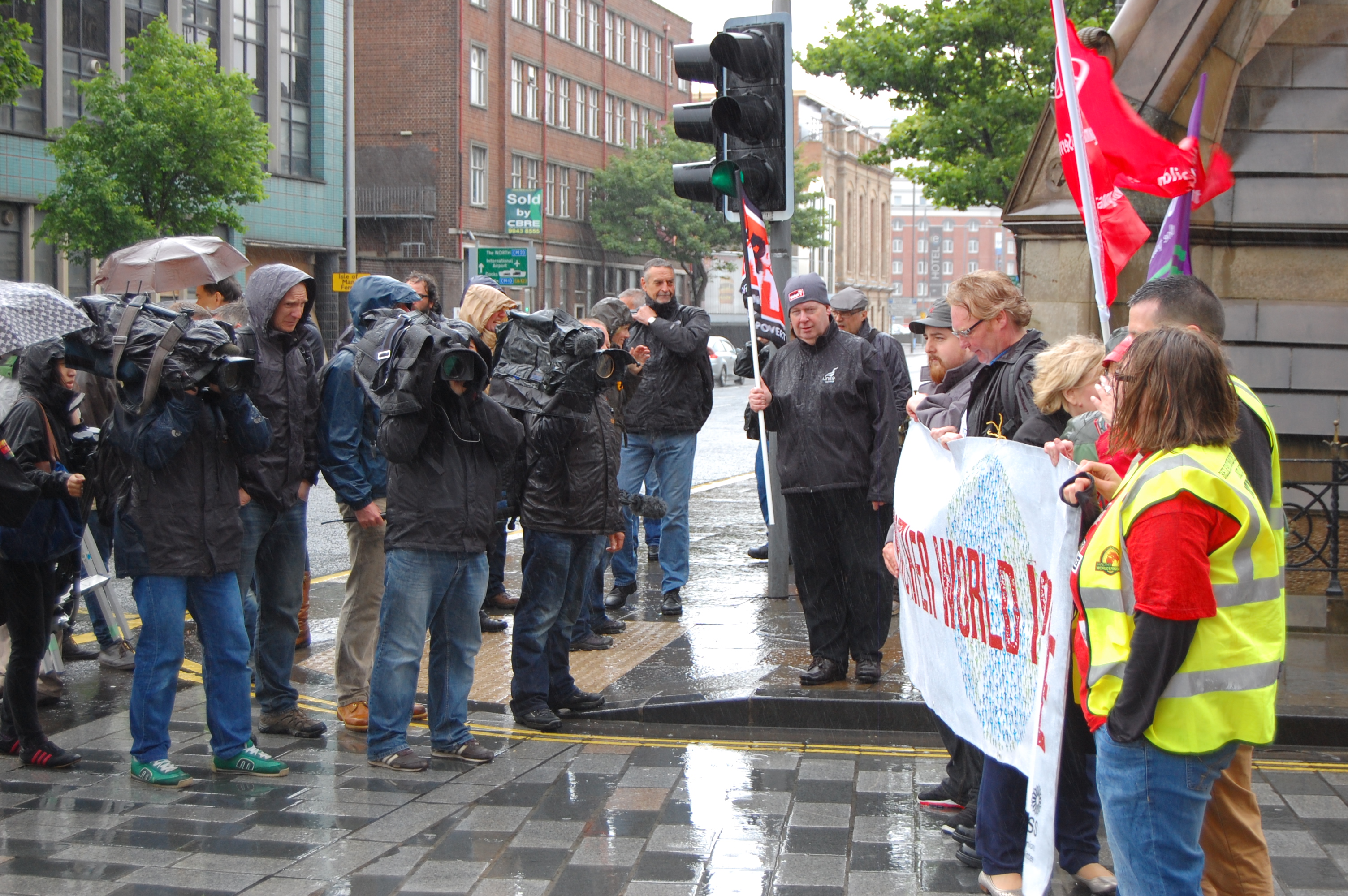
Well today, Saturday, was to be evidence of the scale of the opposition to the G8 leaders and their crimes.  A demonstration had been called by trade union leaders and assorted NGOs.

Unfortunately this opposition proved that it wanted to show, not that a different world was possible, but that a slightly different world would be nice.  The hype of the G8 cheerleaders was replicated in the ICTU Northern Ireland Committee’s leaflet, which promised ‘what is sure to be one of the largest mass mobilisations of peoplepower Belfast has seen.’   The demo was in fact no more than 2,000 people – maximum – and not much different than the usual May Day demonstration.  The annual 12 July Orange bigot-fest is many times larger.  The slogan of the demonstration that ‘they are G8 – we are 7 billion’ looked very hollow. Belfast City centre was unusually quiet.  The alternative of having the demonstration through some working class areas would never have crossed anyone’s mind, certainly not that of the trade union leaders.

As I walked the less than half mile to the demonstration starting point through Belfast city centre I must have passed about 70 police land rovers, and that was just on the route that I took.  Most of the coppers were English – they looked like they weren’t natives and were very much more po-faced than the local cops, despite the overtime.  There were hundreds of them.  A bigger case of over-kill it would be hard to imagine.  It might even be embarrassing for their top brass, were the media to make anything of this OTT display of the state’s repressive power.  This was a demo called by ICTU for god’s sake!

This is the same ICTU that has for years either been in partnership with the state, as in the South, or seeking partnership, in the North.  Its leader was a member of the Southern State’s Central Bank, the Regulator that allowed the ‘wild west’ financial system to accumulate so much debt it bankrupted the country.  This is the trade union movement responsible for the Irish being renowned throughout Europe for their ability to accept austerity that has caused riots in Greece, Spain and Portugal.  It wants a ‘better and fairer way’ to inflict the pain of austerity.  It doesn’t actually want to overthrow capitalism and socialism was not a word I heard at the rally at the end of the demonstration.

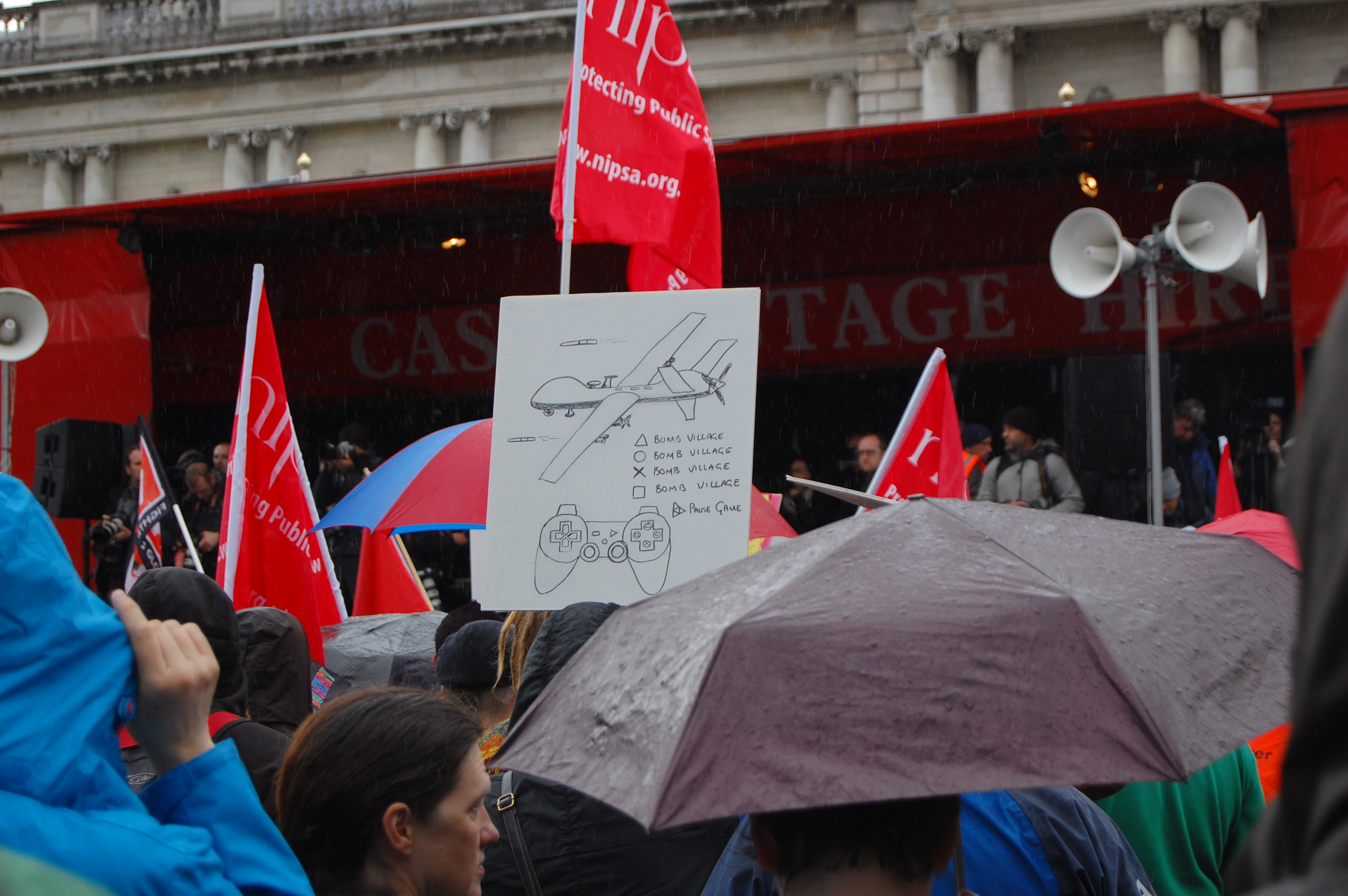
DSC_0416 Instead the speeches were declarations of opposition to bad things and support for good things and appeals to moral values such as fairness and justice.  Unfortunately the world is only as fair and a just as we can make it and in the meantime it is as just and as fair as the capitalist class considers it should be based on how it defines both.

What was missing was any strategy to change this situation and any agency that could enact this strategy.  What we were left with were appeals to the governments against whom we were actually demonstrating; appeals to the same states whose job it is to defend the system, not change it – the same state that put on show such a massive show of force to justify its hyping up of dire threats of violence.

As I and my friend left the rally and went into Boots for a short cut my friend was told to take down his hood – it had been pouring down for hours.  An older woman with grey hair was also told to take down her hood although she demanded to know why?  Was she hiding her identity so she could trash capitalism and then run into the street and avoid the hundreds of cops outside?  (Most of the bigger shops had massively increased security on their doors, another example of the hype surrounding the visit of the leaders of the ‘free’ world.)

One footnote: the rally outside the City Hall at the end of the demonstration was jeered and heckled by a group of perhaps 50 loyalists from the Shankill Road who were continuing their own protest against the butchers’ apron no longer being flown 365 days a year.  Ironically it was flying today, it being a ‘designated day’ because it was the Queen’s birthday – she has two don’t you know. These reactionary bigots sang sectarian songs including the ‘Billy Boys’, i.e. they were ‘up to their necks in fenian blood’ – a favourite of supporters of the now deceased football club Glasgow Rangers.  They waved the Israeli flag when the Palestinian cause was mentioned, booed loudly when the ‘Irish trade union movement’ was referenced and jeered when Derry was called Derry.

DSC_0408

For some on the left being anti-sectarian means pretending that Irish nationalism is just as sectarian as loyalism and there exists by definition a sectarian equals sign between the political expressions of the catholic population and the Protestant one.  That, in my 35 years of political demonstrations, I have never come across contingents of loyalists on trade union and socialist demonstrations while republican contingents, just as they were today, are commonplace and unremarkable, might therefore seem strange.  If I believed what some of the Left do this fact would be inexplicable. The loyalists however know they are reactionary and today they knew that they hated those on the demonstration.  They felt safe in the knowledge that the demonstrators were either ‘fenians’ or, even worse, ‘rotten prods’.

One other footnote:  there was no Sinn Fein contingent on the demonstration.  Even a few years ago they would have sent a youth contingent to keep up pretence of some radical credentials.  Now instead they parade the hope of corporation tax cuts and multinational investment beside the DUP and a British Tory prime minister announcing imperialist intervention in yet another country, this time Syria.  Their non-participation is one welcome clarification of what was otherwise unfortunately not much more than an exhibition of weakness before power.

Workers say NO to Croke Park 2

5178_54_news_hub_5200_328x250Commentators across Europe, indeed the world, have marvelled at the ability of the Irish to suffer punishing austerity without strikes, riots and political convulsions.  Local commentators have basked in their acclaim as the austerity poster-boy – in damning comparison to those Greeks and other southern Europeans.  Instead the Irish voted for a European austerity Treaty and voted in a Fine Gael-led coalition with politics no different from the previous Fianna Fail led one.   If opinion polls are to be believed, many have gone back to supporting the utterly discredited Fianna Fail.  The recent Meath by-election saw the Fine Gael candidate handsomely returned and the particular local circumstances do not adequately explain it.

Irish workers accepted the tearing up of the existing social partnership deal and voted for a new one called Croke Park, which inflicted cuts in services and conditions, including yellow pack terms and conditions for younger workers, in return for no compulsory redundancies.

Unemployment however has soared, reaching over 14 per cent officially and, according to the IMF, over 23 per cent if the underemployed are included.  This is despite emigration of tens of thousands of the younger generation to destinations across the world.

Yet still the ‘fighting Irish’ showed no signs of fighting.

Until now.

This is the significance of the vote on a new Croke Park deal.  Irish workers have said NO.

If it has been a surprise to many on our side it has been a shock to the Government who thought their threats, bullying and intimidation would work.  Above all they thought the rotten leadership of the Irish trade union movement, which supported the new deal, would pull it through.

Its mouthpieces in the media reacted with denial.  The ‘Irish Times’ journalist said “it was so close”, “if 1,000 members of SIPTU had voted the other way, or if more of its members had been minded to come out and vote – there was an extraordinarily low turnout of 45 per cent – the deal would have sufficient support to be ratified.”

There is a grain of truth in this but we will come back to this.  Let us first note that the press and media betray once again their class character by agonising about how the democratic wishes of the workers can be subverted by ‘tweaking’ the deal to get it through.  You will search in vain for commentary deliberating over how the workers’ majority can assert and validate their democratic decision.

The deal has been rejected but the vote is a mere inconvenience.  It doesn’t count.  The workers can say anything they want and will be listened to, but only if they agree.  Like European referendums voting is to allow worker s to approve the plans of the capitalist class and its state.  Again and again Irish workers are taught this lesson – voting is not a choice, it’s a stamp made of rubber.

Instead we are fed rubbish that a vote that saw the deal decisively rejected by a majority of two to one, 115,000 to 55,000, could somehow have been passed “if 1,000 members of SIPTU had voted the other way, or if more of its members had been minded to come out and vote.”  The votes of those who didn’t vote are ‘virtually’ counted to support austerity while in fact the vote against will have awakened the many workers who didn’t vote to the possibility of voting against the Government, the State, the mass media and their own rotten leaderships.

But even these propagandists of the system couldn’t help but recognise that many workers voted no, not because they were personally affected very badly by the deal, but because they didn’t think they should vote for other workers to take a pay cut.

The grain of truth – that the result could have been very different – is a reflection of the bureaucratic nature of the trade union movement, where a majority of 60,000 might be reversed by 1,000 voting differently in the biggest union.  This is only one illustration of what is now the biggest question that is to be answered, which is not the one asked in the media – of what will the Government do?  The real question is – what will, or can, the workers do about their leaders who recommended and argued for and censored the opposition to this rotten deal?

The problem is neatly encapsulated by a report on the Irish National Teachers Organisation Conference at which delegates wanted to put an emergency motion calling on the leadership to have a strategy in place if there was a No vote.  This was ruled out of order but a weaker one was allowed.  Only when delegates booted this out was a compromise motion passed that called “on the central executive committee to urgently liaise with the executives of other public service unions with a view to promoting and planning a public service solidarity alliance of trade unions across the public service.”

What this episode reveals all too obviously is the restrictions placed on workers by union bureaucracy and this bureaucracy’s intention of relying on the Government to ‘tweak’ the deal so it can be imposed on the membership.  It shows the awareness of trade unionists that a strategy is required and one that seeks the maximum unity.  The obvious weakness involves relying on the same union bureaucrats to provide this strategy and implement it.

Putting together a convincing strategy will not be easy but the vote itself is a massive step forward, as is the appreciation of the need for a strategy and for this to be based on unity within the union movement.

Very early on in the current crisis the then Government relatively easily divided workers through claiming those working in the public and private sectors had separate and opposing interests.  The union leaders seemed only too happy to walk into this trap.  Their willingness to sacrifice services for short-term and increasingly illusory benefits for public sector workers has failed even these workers as their pay has been slashed and the deal they signed up to was torn up with union consent.  Meanwhile the workers who use these services have had some confirmation that the quality of these services may suffer to defend the conditions of those who deliver them.

The initial reaction against this disastrous approach was recourse to an even more divisive one, with the creation of a Frontline Alliance that saw narrow trade unionism prioritise the interests of some workers who are on the frontline of some services, implying a common interest not shared across all workers.  However I’ve yet to meet a frontline service that could operate without the support of rearguard(?) workers.

Even this signalled not some reduced form of trade union unity but the plaintive cries of the ‘special case’.  I remember listening to an interview some months back on ‘The Last Word’ on Today FM with a group of union leaders from this Alliance.  What was most striking was that when they were interviewed one-by-one there was hardly the slightest hint of a common grievance.  They seemed totally ignorant of how narrow their complaints seemed and how stupid a strategy is which is based on claiming special treatment when such an all-engulfing attack is being meted out.

There are other courses of action and what might seem like alternative courses for workers looking to fight back are in fact the same struggle.

The view that it is impossible to get the union movement to fight back without first kicking out its rotten leadership replaces a task on which workers have just voted – rejection of Croke Park 2 – with one they have not had placed clearly before them, debated and decided upon.  There is limited traction in simply claiming ‘betrayal’ and saying these leaders must be replaced now before a real struggle to give effect to the No vote can be realised.

The entirely justified and valid view that the current union leaders must be replaced can be achieved by demonstrating to the majority of members the practical effects of these leaders supporting attacks on their interests while frustrating any resistance.  In the course of mounting this resistance the task of replacing these leaders can be posed but not as a precondition or prior requirement for such resistance.

The related questions of whether workers should demand that their leaders hammer out a united strategy or should unite at rank and file level to achieve this themselves are also not opposed.  While rank and file workers must unite across unions to create their own structures this can only be in addition to the established ones. In this way they might demand that their separate leaderships take action and also advance towards an end-point where, if they do not, workers are in a position to pose this task practically themselves.

In doing so workers might learn that replacing the current leaders is not enough and that what is really required is an entirely rejuvenated trade union movement.  One that is open, democratic and not in thrall to either bureaucratic leaders or bureaucratic structures and rules.  A big step forward has been taken with the No vote and the Government is faced with the threat of resistance.

As this post is finished it is reported that the Government does indeed intend to ‘tweak’ the deal in what is called a “carrot and stick approach”.   Since it still intends to make the same amount of cuts what won’t change are the pain and divisiveness of the tweaked deal and the threats that will accompany it.  Like donkeys workers are expected to look at a carrot paraded in front of them while what they feel is the stick.

Support the ICTU demonstrations!

frame-1-ictu-protest-march-over-the-governments-four-year-austerity-plan-assembling-at-christchurch-in-dublin-irelandThe Irish Congress of Trade Unions is meeting on Wednesday to discuss the possibility of organising a series of demonstrations across the Irish State in opposition to austerity and debt.  It has issued a press statement outlining its reasons; in particular it is targeting the issue of debt and has indicated that demonstrations might take place in a number of towns and cities including Dublin, Cork, Galway, Sligo, Limerick and Waterford.

The possibility of these being organised should be welcomed but more important, if they take place, they should be supported.  It gives working people an opportunity to demonstrate their opposition to austerity, to demonstrate the scale and anger of their opposition and put forward what they think should be the alternative.

It gives the small socialist movement an opportunity to campaign in the working class to make these events as large as possible so that the demonstrations can convince and give confidence to others to also oppose austerity and oppose the crippling debt.  It gives it the opportunity to speak to workers to take action outside as well as inside the trade union movement and in the private sector as well as the public sector.  The purpose would be to begin reuniting workers who have been successfully divided into union and non-union and between public and private sector by the propaganda of the State, employers and media.

A real campaign at union and community group meetings, at workplaces and in the streets including door to door leafleting and canvassing should aim to mobilise as many as possible to turn out, should the demonstrations be called.  Right away attempts should be made to extend the numbers building the demonstrations through meetings organised to discuss the demonstrations and how they could be made as large as possible.

These meetings should not simply be organising meetings but should also discuss why we oppose austerity and the debt, how they are affecting the lives of working people, how we should organise against them and what our alternative should be.  What for example is our position on debt default?  What role does strike action have in a campaign against austerity and default?

There are many issues facing workers and socialists have the opportunity to give them the possibility of coming together beyond the existing union movement to unite and discuss all these issues.

In this blog I have addressed these questions here, here, here and here.

What have been called as one-off demonstrations should be supported in order to make them an on-going campaign both before and after they take place.

All this is primarily the task of the socialist movement but it is not limited to it.  There are many opposed to austerity and many campaigns against its effects that should take the opportunity to better organise and unite with each other to discuss what should be the alternative.

An additional onus is however placed on the socialist movement.  It claims to stand for the interests of the whole working class and has a special duty to take every step to unite it in defence of its own interests.  This has two aspects.  First it must unite itself to carry out the task of uniting workers.  Otherwise it is weaker and opens itself to charges of incompetence, hypocrisy or political sectarianism.  The second is to create a campaign which is open and democratic and which at the very least offers the possibility, if not yet the certainty, of uniting the most militant workers.

The unity of the socialist movement in such a task should in principle be easier since it has theoretically already achieved some level of unity through the United Left Alliance.  The ULA should immediately discuss how such an opportunity can be utilised to build an anti-austerity campaign, on what basis it should be built and what policies it should fight for.  This is, after all, something which the ULA said it was going to do when it got elected and it would not do to renege on promises, just like the Labour Party and all the other right wing parties, once elected to the Dail.

Complete agreement should be no barrier to taking this action.  A democratic campaign would in any case allow everyone to argue its particular view on the way forward and the alternative.  In a democratic campaign of action there would be no role for vetoes.

The objective on the day would be a united left contingent, united around an agreed programme and demands, offering an on-going campaign to everyone at the demonstration who didn’t just want to go home afterwards to watch themselves on the RTE news.  The size and resonance of such a contingent would testify to the potential to build real and lasting opposition to austerity.

There is of course a flip side.

To borrow from management-speak: for every opportunity there is a threat and for every potential strength a potential weakness.  To fail to take opportunities threatens the effectiveness of resistance to austerity and to fail to strengthen the resistance will result in weakening it.  The ULA through its minor electoral success has given itself some responsibilities which it should relish as opportunities to help workers build a movement against austerity.

Support, build and go way beyond the ICTU demonstrations!