Nationalism, Sectarianism and Democracy in the North of Ireland

castledergMarxists have regarded the struggle against British rule in the North of Ireland as a legitimate one in the sense that it is a fight against an imperialist state and its political rule in a country in which it has no democratic right to exercise its powers.  This is reflected in the undemocratic partition of the country and its reliance on a colonial movement which has proven incapable of providing or allowing basic democratic rights to its neighbours of a different religion. The legitimate democratic rights of this population have never been advanced but have always been subsumed under a bigoted and triumphalist programme of support for sectarian privilege and for the most reactionary characteristics of the British State.

Imperialist rule has thus always involved promotion and pandering to the worst aspects of sectarianism.  During ‘the troubles’ this involved repeated attempts to give coherence and effectiveness to loyalist gangs who were often more interested in pure criminality than their reactionary political programme.  This included planting security services agents into the loyalist paramilitaries, arming these gangs, providing them with intelligence on targeting, facilitating their actions and preventing other arms of the police from apprehending their killers.

What has often struck commentators on loyalist violence has been its sheer frenzied brutality and savagery, a feature of extreme reactionary violence everywhere.

This year the British State has once again indulged loyalist violence – during the flags protests – and the more honest local journalists have reported the patronage by the state and politicians of the loyalist paramilitary group, the Ulster Volunteer Force, especially in East Belfast.

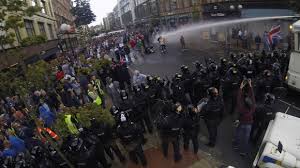
This organisation has gained confidence and power in Protestant working class areas through State acceptance of its nefarious activities.  Rather than attempt to completely destroy the most vicious supporters of British rule the British State has attempted to tame it and make it amenable to its own more measured policies.  The riot in July in the Woodvale area after a local Orange parade was prevented going past a Catholic area, and the riot in Belfast City Centre to prevent a Republican demonstration, show how limited the success of such a policy has been.

The claims of loyalism that it is simply defending its culture and traditions are without any merit.  Its culture is one of sectarian practices, made-up of borrowings from others and simple invention.

Attending a loyalist parade made up of bowler hated men declaring temperance and loyalty to the British monarchy, as long as it remains Protestant, led by aggressive flute bands sometimes named after sectarian killers and followed by drunken and hate filled followers will tell you most of what you need to know about the nature of Ulster unionism.

The Marxist opposition to British rule and loyalism and attendant defence of Irish nationalist claims is therefore mainly a negative one.  It is a positive one to the extent that this Irish nationalism puts forward and advances real democratic demands.

It is therefore possible to imagine (but only imagine!) a situation in which Protestant workers opposed a united Ireland because Irish nationalism wished to foist a catholic clerical regime on a genuine outpost of the British State, which was integrated into that State, was part of its on-going political development and in which this outpost of Irish workers were fully integrated into the British class struggle.  In such a situation it might be the case that the demand s of Irish nationalism would be reactionary – a call to disrupt a united working class which had overcome sectarian division and which was moving instead to a programme of independent working class politics.

To present such a scenario is to demonstrate how far reality is from the real situation and why Marxists adopt the programme for Ireland that they do. The scenario above is put forward purely to illustrate the approach which Marxist take and to distinguish it from all varieties of Irish nationalism.  Marxists are primarily concerned with the unity and independent struggle of the working class irrespective of nationality.  The programme of the socialist movement can only be successful if the disunity caused by nationalist division is overcome.

This means that there is no automatic support for the activities of Irish nationalists and republicans.  Marxists defend the democratic content of the struggle of those oppressed but this does not mean support for its expression in nationalist politics.  Marxists do indeed distinguish between the nationalism of the oppressed and the nationalism of the oppressor but that does not mean they support the former.

In the recent dispute over parading Sinn Fein has more and more shifted its political position to one of recognising that the Protestant population of the North of Ireland is British and can therefore claim rights that are equivalent, but not greater, than those of the Catholic Irish.  Marxists accept neither of these arguments – that the Protestant population is British or that even if it was its political claims therefore have to be supported.  For the loyalists their demands continue to mean the assertion of sectarian privilege.

The acceptance of the political legitimacy of unionism, defined by itself in sectarian terms, means that Sinn Fein’s own claims become judged by the same measure.  This is indeed why Sinn Fein has moved to this position.  It is the logic of the peace process, its ‘parity of esteem’, ‘reconciliation between the two traditions’, mutual understanding, respect and equality of rights and all the other honeyed phrases behind which lie behind poisonous sectarianism.

The logic of the political settlement in the North is sectarian competition where once it was purely sectarian domination and Sinn Fein has bought into this.  Thus it declares its interests in the concepts appropriate to this sectarian competition.

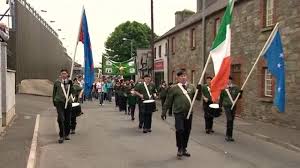
The statement by it on the recent IRA commemoration in Castlederg shows all this. The local Sinn Fein councillor said

‘This parade is organised to show respect for those who gave their lives for this community. It should never have been an issue of controversy- it has been ‘made’ controversial by unionist politicians. We have proposed this initiative to take the controversy out of it while reducing tension.

“Our initiative will consist of choosing to go along John Street which avoids passing the cenotaph and the Methodist church.

“On the back of this initiative, we wish to engage with all key stakeholders in relation to the issue of the town center being designated as a shared space for all traditions, in this mainly nationalist town.

“There has been around 20 unionist parades through the town centre in 2013 so far without objection, we understand and accept peoples Britishness- others need to understand and accept our Irishness.”

So the IRA fought for Catholic freedom not Irish freedom unless Sinn Fein now equates the latter with the former, which appears to be the case.  At the same time it now recognises the legitimacy of the claims of Irish Protestants to be British so there appears no reason why one sectarian groups’ claims should have priority over the other.

What we have is endless competition with no reason to judge any particular outcome fair or appropriate, except that it exists and it exist only as a result of struggle between the groups, presided over by the British State.

What this means is that where the civil rights struggle once demanded an end to sectarian domination, essentially discrimination against Catholics by unionism, now the necessary democratic struggle would appear to be against sectarian competition, essentially discrimination by unionists against Catholics and nationalists against Protestants.

Sectarian competition is however unstable.  Unionism wants sectarian privilege while Sinn Fein claims it wants equality but it has demonstrated that it seeks equality not through unity, which is the only way it could exist or be brought about, but through sectarian claims on behalf of Catholics, because they are Catholics and because they are claiming Catholic rights.

It is now lost on a whole generation that the demands for civil rights and equality were demands for democratic rights irrespective of religious beliefs not because of them.  It is lost on this generation that claiming Catholic rights is not the same as claiming civil rights.

The civil rights’ demand for equality required unity because civil rights were disconnected from religious belief.   Now rights are claimed by virtue of religion.  Equality now means the equality of resources to sectarian groups, which can only be achieved by ensuring the continued existence and political priority of these groups.  Demands are made that those not designating themselves in sectarian terms must do so or someone must label them on their behalf.  In other words equality now requires sectarianism.

If sectarian domination was unstable this sectarian competition is even more so.  The current political situation is unstable because not only is it impossible to have stable agreement on the equitable sharing of sectarian rights but such equality does not yet exist.

Despite decades of Sinn Fein ‘leadership’ in West Belfast the social and economic problems of the constituency are among the worst.  Unemployment among Catholics is still worse than among Protestants.  Thousands of Orange parades still proclaim their sectarian superiority except everyone is now called upon to be tolerant, seek reconciliation with the participants and show non-sectarianism by accepting the displays of bigotry.

In such an Orwellian world sectarianism is to be eradicated by support for sectarianism.  And then we are to be amazed how on earth the problem hasn’t disappeared and often appears to be getting worse.

To be continued.
‘Sins of the Father’ by Conor McCabe – a book review

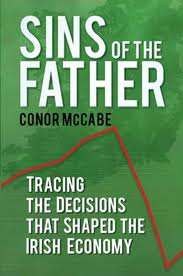
downloadThis book sets out to explain why the banking crisis in the Irish state developed the way it did and how property and financial speculation has been so prominent a feature of its economic development.  It is therefore an argument against the view that the crisis has been the result of some sort of moral collapse in certain sections of society.

Along the way the author, Conor McCabe, disposes of some common beliefs about the role of property in the Irish psyche, convincingly demonstrating that property ownership is not hard-wired into the Irish but has been consciously and repeatedly promoted by the state and employed as a means of strengthening particular class interests.  Thus the first Cumann na nGaedeal government promoted – as a solution to the notorious condition and shortage of decent housing for the working class – better housing for the middle class!

In an earlier version of the recent bailout of the banks he notes that helping the middle classes and property speculators with state money was the way the first Government decided to deal with tenements and slums.  As if proving there is truly nothing new in the world he notes the development of Dublin suburbs in the 1930s with little or no infrastructure or amenities.

The effects of this over the decades was to create a situation in which if you wanted a house you needed to buy one.  Public housing was neglected, a choice of last resort, and the earlier desire of workers to rent was blocked.  Even so the relatively recent and rapid rise in the proportion of home ownership is surprising, rising from 25 per cent in 1961 to 75 per cent in 1986. So much for property ownership being in the DNA!  In fact, as the author shows, it has been consciously promoted as a means of preventing “social unrest”, “revolutionary change” and because “there is no greater barrier against communism.”

McCabe points to the argument that the property boom at the turn of the century crowded out investment in productive activities and shows that State tax breaks helped fund the speculation that fuelled it.  Just as the State helped pump up the bubble it then stepped in to prop up the same interests that were behind it when it burst.  In this sense the State’s response to financial collapse was no turning point.  He effectively shows that British landlordism of the 19th century was replaced by a native version for the 20th and 21st.  Government policy helped create huge overproduction: in 2010 the number of empty housing units was counted as 302,625 – excluding holiday homes!

Conor is aware that all this is a description of the property boom and bust but is not an explanation (see page 56).  To do this he then presents a fuller history of Irish economic development.  It is not the case however that further, fuller and more complete description is explanation either.

If particular and contingent historical factors are not the explanation of the deeper causes of the boom and bust, but rather the concrete form in which the underlying contradictions played out, then it is only these fundamental processes which can provide a satisfactory explanation.  Or at least one that seeks to advance an argument that the causes of the crisis were in some way more than accidental.  Being more fundamental they can explain similar phenomena in more varied, concretely different circumstances – in countries as different as Japan, Spain, the USA and UK.  In fact the very variety of situations giving rise to similar symptoms of crisis point to systemic contradictions.

What the book does do very well however is show the particular features of Irish economic development, including the weakness of an economy which was governed as if it was still a region of Britain but which was cut off from the potential supports that this might have involved.

Nor did this change with the election of a Fianna Fail government in 1932, which introduced tariffs: at this point the State was described as virtually the last free-trading economy in the world.  There was no introduction of a separate currency or Central Bank and parity with Sterling was maintained.  In important ways the economy remained a region of Britain no matter the declaration of a Republic after World War II.

The resulting failure led to the new policy of promoting multinational investment, which was seen by the State as the least disruptive way of responding to international pressures to develop while protecting the existing class structure and minimising economic change.   McCabe emphasises the limits of multinational investment and the fact that money flows from it enter and exit the State with relatively modest impact. He quotes an assessment that this foreign investment did not develop a manufacturing base ‘comparable’ other small countries and argues its real importance lay in the opportunities provided to native property developers and financial and banking interests which service the investment.  This process fed into a property bubble in the 1960s which burst in the 1970s, again fuelled by state tax incentives but also state demand for the property developed.

He gives examples of the extraordinary tax incentives given to foreign investment and how State policy allowed the companies involved to do more or less what they wanted including at Bantry Bay where, in 1979, over 50 lives were lost in an oil explosion.  It transpired that the necessary safety measures had not been implemented and Gulf Oil had been allowed to regulate itself.  The Treaty Ports had been returned from the Brits but the Irish State had connived in the creation of another; all under the banner of economic development.

The policy was held up as a success but it was still recognised that it was a qualified one and accepted that indigenous industry had failed to create self-sustaining industrialisation.  Foreign investment remained largely divorced from local industry and the government sponsored Telesis report noted that only 8 per cent of components and sub-assemblies in the foreign engineering sector were sourced locally.  However, like inquiries and reports before it (and after) the Telesis Report was “greeted with fanfare and followed with silence.”

The major innovation came instead in the financial services sector where State policy had always been to maintain the parity link with sterling.  For Conor McCabe parity also meant poverty: the value of the Irish currency was maintained at too high a level to facilitate the development of competitive industry.

He does not delve into what a lower level would have meant for Irish workers as a lower valued currency would also have meant lower wages and a lower standard of living, all else being equal.  All else not being equal would have depended on the Irish State having a successful policy of state-led industrial development, not just throwing tax breaks and grants at private capitalists. In part his history is designed to show the strength of those class interests in the State who made their money through agriculture, property and banking and for whom all this would have been, at best, an unnecessary experiment.

That this ultimately was a feature of continuing imperialist domination – expressed in the relatively weak native capitalist development; in state institutions and policy and in other cultural traits – is not developed in the book.  The book is relatively short so this is not a criticism.  This subject raises political questions that have bedevilled an understanding of the relationship between ‘national oppression’ and capitalist exploitation and it is no criticism that this is not gone into.  It was not the purpose of the book. The State maintained the link with sterling until joining the Exchange Rate Mechanism but devaluation drove home the lesson that the link was more than just a policy decision but reflected a deeper economic relationship.

The book repeatedly shows the linkage between State policy and class interests.  Conor shows that the setting up of the Irish Financial Services Centre (IFSC) represented no exception to the state’s patronage of banking and financial interests, or a radically new economic development, and accepts the case that the IFSC is a tax haven, reporting its reputation even before the crash as the “wild west of European finance.”

He records the almost forgotten fact that the bank bail-out of 2008 was not the first and that tax payers had already bailed out Allied Irish Bank (AIB) before – in 1985.  While it has become fashionable to excoriate Anglo-Irish Bank at least it only went bust once.  The Fine Gael led Government of the time included Alan Dukes who, in the latest banking disaster, reprised his role by impersonating a Director of Anglo-Irish supposed to represent the public interest.  In 1985 AIB was saved from going bust by the tax payer who then watched seven days later this same bank announce unchanged dividends to its shareholders!  There followed years of law-breaking by the whole banking industry for which not one banker paid any penalty.  Put into context, the bail-out of 2008 becomes both more shocking and less surprising.

The book pulls together the various aspects of Irish economic development to show how the State’s policies, especially tax breaks and almost non-existent regulation, came together in the 2008 crisis. Property speculation fed on a limited boom partly fuelled by foreign investment which, boosted by state policy, became super-charged by credit speculation.  It was, in this sense, not at all new but rather the culmination (until the next time?) of the sins of the father. And the sins were many.

The book ends too summarily and in doing so appears to endorse more state spending on infrastructure as part of the solution: a liberal, Keynesian answer to the crisis.  One is compelled to ask in what way this is an alternative to what has gone before.  In so far as construction paid for by the state is designed to boost private capitalist investment there appears no major difference. (This is by no means the only similarity.) It is yet another tribute to the forces and policies described in the book, the power of the existing system and status quo, that those who are popularly viewed as its most vocal critics often simply echo it.

In the conclusion Conor McCabe notes that the new state did not have an independent economy.  What he has done is give a good account of the internal structure of this subordination and the class and state that constituted its structure.  But this is obviously only half the story.  If the economy was not independent a full description or analysis would have to describe and explain the much stronger international forces on which this subordination rested.

This itself would only be possible by recognising, as we have said, that the Irish State was not the only one to suffer a financial crisis and that, whatever its peculiarities might be, other crises in the US and Spain and before that in Japan, and perhaps tomorrow in China and Britain, point to a systemic crisis; in other words a crisis of capitalism.  Explaining how the Irish crisis took the form it did is impossible to do fully without also explaining why there was a crisis in the first place, one shared with other countries with a very different historical development.

Although beyond the scope of the book it is nonetheless a necessary task for Irish socialists.  Conor McCabe is not to be criticised for not doing what he did not intend and which others have not done.  Rather it is to be hoped that he can play a significant role in this collective task.  It will therefore be interesting to see what he writes in future because while the bad news is that the first edition of ‘Sins of the Father’ has sold out the good news is that the second is on its way.

Loyalists riot in Belfast against Republican demonstration

images (3)

By Belfast Plebian

Yesterday I decided to participate in an anti-internment demonstration in Belfast. I could not get to the starting point so thought to join at the midpoint in central Belfast.  The demo I think was organised to do three things: to commemorate the August 1971 introduction of imprisonment without trail, to highlight the continuation of the same policy by less conspicuous means, imprisonment for long stretches of time under the guise of waiting for a trial date; internment on remand, and finally the abuse of the prisoners at Guantanamo Bay and in other ‘special facilities’.

I am not big on the commemoration thing, a street demonstration is a very inferior way of coming to a coherent understanding of past political events, however the other two are very important just now because the democratic rights of common people are under sustained attack in the countries that first originated them, namely in the United States, France and Britain.

The comprehensive attack on democratic rights is turning into something ever more serious in most bourgeois democracies.  Just last month the British Government passed into law something called the Justice and Security Act 2013 (JSA). The key provision creates a new procedure to permit the use of secret evidence and testimony against a defendant in any civil case in the UK.  The new measure constitutes yet another negation of the democratic rights of the individual in relation to the powers of the State.

The new provision is called ‘a closed material procedure’ (CMP) and it means that a defendant’s barrister will have no right to question the evidence against a client if the CMP procedure is invoked by the State.  The new courts will also now have the power to make use of evidence against defendants not previously disclosed to their legal team.

The JSA is a response to the case of Binyam Mohammed, a British citizen who was detained at Guantanamo. His legal team had forced a civil action against the British government for being complicit in his torture in 2011 and evidence came to light in court that showed that British police agents had secretly assisted in his torture and rendition.  The judge in the case had ruled that the secret police material was admissible. Now this sort of secret evidence is to be totally closed to viewing.

The new act is a change to the already highly restrictive Public Interest Immunity procedure frequently used during the ‘troubles’ to keep evidence of crimes committed by the security forces from legal examination.  From now on, even the presiding judge in a case will no longer have a say on what kind of evidence can be scrutinised by a jury.  It means the abandonment of civil courts presided over by judges in favour of political courts manipulated government officials against selected defendants.  In the closed material procedure only the government and its lawyers will be present before the judge.  The defendant and their lawyer will not be present in court, they will not be permitted to see the evidence being presented if it depends on ‘sensitive security material’. Also the defendant is not entitled to know the reasons why the judge came to a decision. The Act is to apply to ‘all relevant civil proceedings’ in the High Court, Court of Appeal, Court of Sessions and the Supreme Court. The above is just one way by which the rights of people are being curtailed by government.

The problem you always have to deal with when defending basic democratic rights in the North of Ireland is that those who do so are habitually associated with republican inspired anti- British feeling, not just by the State officials but by the organised part of political Unionism. So as I strode into the city centre the first thing I noticed was a very large number of angry loyalists gathered at one end of Royal Avenue, who were obviously hell bent on preventing a so called ‘dissident republican’ march from getting into their beloved British city centre.

They had been gathering for hours and had reached two thousand strong by about six o’clock. I wondered why there were so few police officers on duty, only a tiny fraction of the number that had been on duty for the G8 demo and I wondered why so many loyalists had been allowed to gather unhindered on the very street that the anti-internment demo was supposed to pass along.

I mingled with the loyalists for about an hour; the mood was ugly and the loyalists looked well up for a street battle. A riot then kicked into full swing when the police asked some loyalists to move into a designated zone behind a makeshift barrier consisting of a handful of police land rovers. It was pretty obvious that there would be no anti-internment rally passing down Royal Avenue this evening.  The loyalists were by now in full riot mode, getting tore into the police at close quarters, tossing bricks and bottles.

It was very striking just how many loyalists had turned out to stop what they considered to be a provocation by the ‘other side’ from holding a small political demonstration. The ‘other side’ were the despised Irish republican enemy without any equivocation or qualification. To be honest it has hard to see how the loyalists present could ever be reconciled to the State granting the same right to free assembly for republicans and reds in a city that they maintain is exclusively British and monarchist.

It does not look good for the ‘shared future’, with so many alienated loyalists regularly attacking the PSNI on the streets.  The DUP and the Unionist Party are clearly feeling a rising pressure to resile from the rather forced agreement they made with Sinn Fein called the Good Friday Agreement.

The British government on its part has no big idea or plan to settle things with the loyalists. The big idea of bourgeois democracy I believe includes a principle best articulated by Abe Lincoln in the famous Gettysburg Address, that in a democracy in contrast to a monarch- aristocracy ‘all men are created equal’: meaning they are all entitled to the same constitutional rights as something universal.

Bourgeois democracy is built on two platforms: free and fair elections leading to a democratic government and universal democratic rights. Ulster Unionism currently bows down to only the one platform of bourgeois democracy, the free and fair elections platform part, and even this is qualified by the anti-democratic forced partition of 1920

When the great majority of Irish nationalists voted in favour of the Good Friday Agreement it surely indicated that they were now ready to treat partition as an accidental error and not a terrible historical grievance perpetuated against them. They believed that by dropping the Irish constitutional articles on sovereignty, this act of political humility would be enough to lend a necessary democratic legitimacy to a perpetually insecure Unionism that would be great enough to allow for a future of peace and equality.

But Unionism accepted the offer ever so reluctantly and made no corresponding provision for Lincoln’s universal rights; unionist democracy just stayed thinking and behaving as in the past; an elected government should mean majority rule, and we the Protestants are the majority and our rights must come first. It should be recalled that the majority of unionists actually opposed the initial Trimble made Good Friday Agreement.

Majority rule was in fact the democratic cry of the Southern Confederacy; those states commanded a popular majority in favour of maintaining things as they stood, and in 1860 this so happened to include slavery.  The best of them who were not slave owners fought in the name of a democratic majority rule, a right of self- government in the seven and then eleven Southern States.  In their minds Lincoln was the opponent of democracy, the Tyrant of the Federal Union. The task of educating the American people in 1860 as to the essence of bourgeois democracy, that it was about more than not just having an elected government but was also about universal rights fell to Lincoln. The example of the American Confederacy is good reason why self-government in the name of a majority is not always for the better.

I am not suggesting that British Unionism in Ireland is in favour of slavery; in fact it has always favoured free wage labour and private property.  What I am suggesting is that it has no stomach for digesting the bourgeois principle that all men are created equal, and this is at the very heart of the matter and largely explains why there is so little of what is termed normal democratic politics to be seen in the here and now.

It should be said, this is not unique to Ireland, it appears almost everywhere in variations.  Across the Middle East the overthrowing of the military dictatorships in Iraq, Libya, Egypt were superseded by democracies that insisted on the unalloyed sectarian viewpoint of the majority must rule, there is no room for universal democratic rights. Marxists in particular need constant reminding that just getting to the normal state of bourgeois democracy and keeping it going is a massive undertaking in itself.

Karl Marx in1860 thought that if the side of Lincoln were defeated it would be a massive blow to the historical advance of the working class in Europe.  Leon Trotsky argued in 1933 that the smashing of bourgeois democracy in Germany would be a much greater blow to the international working class than the Stalinists at that time imagined. It is all too easy to downgrade the democratic rights side of the socialist programme in pursuit of the maximum or even the transitional demands of the socialist programme.

I decided to move away from the town centre and try and join up with the anti-internment demo at another place. I was told that the demo would most likely be rerouted along Millfield, a street that connects North Belfast to the lower Falls Road. As I took to my heels the police decided to do a pincer on the hundred or so mainly nationalist youths still standing at the juncture of Castle Street and Royal Avenue. They came at us from two directions and forced us up into Castle Street.

It was then that the nationalists realised their chance of joining the demo in the city centre was gone for this time. Some of them began chanting the familiar old anti police slogan SS-RUC, others mentioned groundhog day and moved away – the police had capitulated in the face of loyalist fury said others.  I walked up to Millfield and waited and waited without really knowing what was happening, the wait lasted for a couple of hours

Eventually, at about nine o’clock the head of the demo appeared, it was a substantial demo of about 1800 people; they looked tired but not demoralised.  The 300 hundred or so people waiting for them to arrive cheered and clapped like supporters standing at a football match. They joined the demonstration and it proceeded to snake its way up the Falls Road to the final destination point in Andersonstown.

I did not stay to listen to the speeches; I guessed they would be of a traditional republican hue something that I have heard many times before. I had still some walking to do to get back home, the buses were not operating, it was eleven thirty when I finally made it back to the house, an intended hour spent at a demo had turned into a seven hour marathon. 

Making a political assessment of the significance of the demo is a little more difficult than with loyalism. The demo was the biggest one that has occurred in Belfast organised by diverse republican and residents groups not aligned to Sinn Fein. The very subjective impression I got was that those on and those supporting the demo were drawn mainly from the very poorest segment of Belfast society, the loyalists gathering was composed of working class people too but they looked more prosperous in their general appearance.

They were certainly the sort of working class people who in earlier days used to be solid behind the IRA and Sinn Fein. The fact that Sinn Fein has lost some of its urban working class support is not that significant in electoral terms because the party has definitely replaced that support with those who used to be sympathetic to the political party of steady decline the SDLP.

A feature worth mentioning is the age profile, previous republican demos that I have witnessed were staffed by well seasoned not to say aging types; the bulk of the people on this one were under 30. What was positive was a genuine will not to get drawn into a sectarian street battle with loyalists. One young republican that I spoke to was worried that loyalists had come out to block their way. Why, he asked, do loyalists fight against things like demanding an end to interment on demand, something that oppresses them as much as it does us?

I think the organisers of the demonstration will be pleased with what they got and they will likely try to build on it by staging more of the same. However it might still be the case that the marked increase in the numbers of young people participating may actually just be a response to the rising tide of loyalist provocations generated by more and more loyalist street activities. It is too early to say if this represents a turning point against Sinn Fein within the old core republican community.  

A couple of other things are worthy of note. I have listened to a good number of nationalists speak well of the PSNI of late for standing up to loyalist threats of violence, a nationalist expectation that the police will continue to perform well may well lead to a big let down in the near future with unpredictable consequences for those politicians who are trusting them the most.

It was also evident that there were no socialist currents either on the parade or around the fringes.  They have abandoned all thought of unfulfilled democratic tasks in pursuit of socialism for today, or rather what they consider to be socialism.  The assessment they make of the recalcitrant republicans is one they hold in common with hired pundits who work for the capitalist owned press; that they are dreadful atavistic nationalists whose time has thankfully gone.

I don’t really share this mode of thought because it is too undifferentiated; all of the recalcitrant republicans are not unthinking militarists. ‘The Irish News’ referred to all involved as ‘dissident republicans’ but it was certainly more diverse than that expression suggests. Today basic democratic rights are being shredded all too readily, the prospect for socialist advances are very poor in both Ireland and Britain and politics at this time of austerity is favouring the right wing rather than the left wing – just look at the advance of UKIP compared to the abject failures of the socialists to the left of the labour Party.

The pressures of being in government for the foreseeable future are sure to test an inexperienced Sinn Fein’s capacity for political survival and in the absence of anything even vaguely resembling a socialist movement in the North of Ireland the social conditions may well favour a surprising republican revival.

Workers’ control of production Part 2

0425.1974_Portugal-newspapeIn my last post on workers’ control I noted that it inevitably arose as a result of crisis, and crises are by their nature temporary, occasioned by society-wide political upheavals or by threatened closure of a particular workplace that is perhaps producing unnecessary products, is working in an obsolete manner or is otherwise failing to compete successfully in the capitalist market.

In Britain in the 1970s there were more than 260 occupations of workplaces by their work forces including, perhaps most famously, at Upper Clyde Shipbuilders in Glasgow, usually sparked off by closures, layoffs, redundancies, dismissals or threats of closure.  Such occupations were spontaneous, often acts of desperation and with no real planning.  If successful, the numbers occupying would be offered jobs by a new employer although this number would usually be less than when the occupation would have begun.  When no new owners would appear the occupations might attempt to become workers’ cooperatives but the motivation was normally a pragmatic search for a solution rather than something drawn from political commitment and ideology.

The occupations were often built by shop stewards and sometimes at odds with the official trade union movement, a situation we see again and again and a result of factors far from accidental.

The theme of ‘industrial democracy’ was very much alive and in 1974 the Conservative Government called a general election on the issue of “who governs Britain”, in direct reference to the miners who had engaged in successful strike action.  The Tories lost and the new Labour Party Government included Tony Benn, who wanted greater involvement of workers in their workplaces.  He also came into conflict with trade union leaders who opposed his dealings with rank and file groups of workers.  “The whole machine is against you” Benn told one supporter of an occupation at Imperial Typewriters.

Workers’ cooperatives received the support of Benn, who was in a position to do something as Minister at the Department of Industry, but his financial help was relatively small and most industrial aid continued to go towards private industry.  That which did go to the cooperatives was mainly for compensation to previous owners who were paid for obsolete plant.  This left the new cooperatives under-capitalised and without the necessary resources to carry out research and development.  They generally lasted only a short space of time but still sometimes produced radical, innovative and still exemplary struggles.  One such was as at Lucas Aerospace, where workers pioneered conversion plans to socially useful production, again opposed by the union leadership.

By the end of the decade however these types of struggles had declined dramatically.  Few of the experiments in workers’ ownership survived and as history is usually written by the winner the victory of Thatcher, built on the attacks on workers commenced by Labour, left a legacy of disappointment and nostalgia in some old enough to remember.  This has affected the Left up to today in so far as it is suspicious, if not actually hostile, to workers’ cooperatives.  This is a profound mistake as the willingness of workers to fight for ownership and control of their own workplaces is an instinctive impulse to go beyond capitalism.

The history of American workers organisation in the 1930s is perhaps more celebrated than this experience but in some ways was more limited.  Workers and trade union power grew during the decade not just because of the struggle of workers to organise, most famously in Minneapolis, but because of the strong growth of US manufacturing industry.  Between 1936 and 1939 workers occupied 583plants in sit-down strikes in defence of their terms and conditions, protection of wages, achievement of union recognition, or prevention of sell-outs where recognition already existed. These were often successful.

Unfortunately there followed 70 years of union-management collaboration – no strike agreements during the second world war; the witch hunt and expulsion of socialist activists in the McCarthy period; mob penetration of the union movement and the turning of the union bureaucracy into a world-wide vehicle of the US state in its cold war with the Soviet Union.  The US union movement has now declined so much that in most of the private sector it is irrelevant, with unionisation accounting for only 7.5 per cent in the private sector in 2008.  In some workplaces where unions do ‘organise’ workers are not even aware there is a union!

The history of American workers’ militancy drives home a lesson to be  learnt from the British experience of the 1970s and 1980s – that politics are not only determined by workers militancy and their experiments with workers control but that politics can influence decisively the short and long-term success of these experiments.

In the end the question of politics is crucial, which is why Marxists believe that working class conquest of state power – revolution – is decisive.  It is important however not to telescope the path to this destination.  Revolution is decisive only if the material basis for working class rule is present.  This is not simply a question of the level of economic development but of the social and political development of the working class.  Without both of these the question of revolution is not posed practically i.e. in reality, no matter what more general ‘crisis of capitalism’ is evident.

The analysis of workers’ control in these posts is based on the belief that working class conquest of state power is necessary but that the immediate question is how to make that a widely shared goal given the low level of class consciousness and struggle than now pertains.

It is therefore important to attempt to draw lessons from the impact of political developments on workers attempts at independent organisation in the workplace.  In turn we can then look at the role of workers’ organisation in the workplace for its impact on wider political struggle.  This will reveal the limits as well as the strengths of a workplace-based strategy and what political demands should be raised as a result.  Such lessons informs the opposition to calls for nationalisation that have been argued in many earlier posts.

For example in the Spanish revolution in the 1930s it was the Republican state that strangled the workers’ and peasants’ collectives rather than the fascist counterrevolution.  Clearly in this case a call for this government to nationalise such collectives would not have made much sense.  Anarchists believed these collectives were a means of controlling the Republican authorities but clearly what was needed was an alternative Government and state – perhaps built on these bodies.

In Yugoslavia self-management was a means of mobilising the population against economic blockade and potential invasion, boosting production, minimising the power of the trade unions during a labour shortage and hoping that the workers would discipline themselves.  Unfortunately self-management as then practised led to accusations of workers’ neo-capitalism in which the enterprises were seen as the workers property, narrowly conceived, so that they competed with each other in a capitalist-like manner.  Self-management became not a means of workers self-realisation but a trade union-like bargaining system of clientelism and patronage.  Increased enterprise autonomy acted to dissolve wider working class solidarity leaving enterprise loyalty and territorial state loyalty as the alternative, one which ultimately descended into bitter and bloody nationalist war.  On the way to this dénouement it has been argued that enterprise autonomy became a mechanism to insert the Yugoslav economy directly into the capitalist world market.  Increased autonomy became the means of strengthening management power not workers’ autonomy.

Both Spain and Yugoslavia are testament to the fact that without real working class political and state power workers’ control can be subverted and/or crushed.  I have argued that it is the lack of workers’ economic power and experience before revolutionary crises that has weakened the struggle for their class rule thus making revolutionary success less likely in such crises.  But it is also true that such episodic economic power is doomed without a political project.  In Poland workers councils existed in 1945, 1956, 1970 and 1980-81 but revolution there became a restoration of capitalism.

In nationalist revolutions, such as in Indonesia, the most radical actions of workers are betrayed by a backward political consciousness; as when workers control is achieved and defended not as an extension of workers’ power as a class but as the property and achievement of the new independent (still capitalist) state.  This state can indulge in the wildest revolutionary rhetoric but as long as its power is not an extension of that of the workers it is just rhetoric, to be retracted when the new state feels itself more in control.  It succeeds in this as long as workers power is mistakenly seen by its holders as the gift of the newly independent state.  The examples of nationalism trumping the radical actions of workers are legion and proof again that revolutionary action does not automatically generate revolutionary socialist politics and consciousness.

What is clearly decisive is workers’ own consciousness and workers control, self-management or councils are not in themselves decisive in determining it.  This however is not the question and not the argument being put.  There is no ‘magic’ strategy guaranteeing a workers’ victory but there are more or less adequate roads and strategic conceptions.

The argument here is that workers’ control, and in the longer term, workers’ ownership can provide a more solid, permanent and robust material basis for the development of the necessary socialist consciousness than simple trade unionism, no matter how militant.  More realistic than reliance on spontaneous political revolutions to do all the work of consciousness raising in the necessarily short space of time in which they take place and certainly more than demands for nationalisation, which for example were obviously meaningless in both Yugoslavia and Poland.

What workers ownership should do is provide a basis and foundation for a political programme that seeks to extend and deepen this form of ownership and give it a political dimension, to make easier removal of the division between the political and the economic that characterises capitalism.  Workers’ collective control and ownership of the state can be more easily argued for on the basis of their wider ownership in the economy.

The argument is more easily advanced if there exists a successful worker owned and controlled sector of the economy that can be presented as an alternative to the capitalist owned sector or the illusion that a benevolent state can take ownership of the latter in order to benefit workers.  On this basis the socialist project can become a political one for which the ideal form to advance it is a mass workers’ party.  Such a project can begin to win the battle for hegemony within societies which are currently dominated by capitalist ideas despite the objective failures of that system.  A real material basis for an alternative is provided that can focus generalised discontent that now expresses itself in free-floating ethical concerns for justice and can find no more specific or concrete alternative than vague calls that ‘another world is possible.’  Instead through development of workers’ cooperatives and the wider labour movement another world is built in front of our eyes.

The absence of such hegemony of ideas, and its corollary – that no alternative to the capitalist system seems possible – results in the upheavals that returned societies to capitalism in Eastern Europe and the Soviet Union.  This wider and deeper lack of legitimacy of the socialist project weighs heavily on the spontaneous activity of workers even when they have engaged in the most radical activity.

In the Portuguese revolution in 1974 a movement within the army overthrew the dictatorship and between May and October of that year 4,000 workers’ commissions were established following mass meetings.  Not only factories but empty houses and apartments were occupied.

Within these commissions political competition developed between the Portuguese Communist Party and smaller revolutionary currents.  A failed right wing coup shifted events further to the Left.  Workers councils became not just organs of control in the workplace but organisations of struggle that could potentially threaten the power of the capitalist state.

In the end however they proved too weak and were unable to pose a political alternative to the quickly developing normal organisations of capitalist democracy – trade unions, political parties, parliament and the state.  In the end the Portuguese Socialist Party became the mechanism for a stabilisation of capitalist rule and bourgeois democracy.

Short-lived experiments in workers control and ownership were not in themselves capable of establishing hegemony for the project of workers’ state power.  A deeper and wider radicalisation was required.

The point is that this can take time and can only come about through the development of socialist consciousness in the working class over a more or less extended period and this must rest on a material base.  This can only be the development of the power of the workers in existing capitalist society, expressed in democratic trade unions, political parties, cultural organisations and workers cooperatives.

The opposite of this road is reliance on the state, expressed in the demand for nationalisation.  In Spain, Eastern Europe, Indonesia and Portugal it was the State which became the guarantor of capitalist ownership and power.

Today we are in circumstances where workers must not only defend themselves against the depredations of capitalism – battling against austerity – but socialists must also look to ways in which to advance a workers consciousness that seeks permanent expression of their needs and powers.  Not just defending immediate interests but looking and taking care of the future of the movement and workers’ position in society.

But it is not simply about the needs of the present as against the needs of the future because Marxism is the belief, confirmed by nearly two centuries of industrial capitalism, that it is not possible to satisfy the needs of workers today by only fighting today’s battles.  A socialist society is the future only because it is the answer to the challe-nges and problems of the present.  The demands for workers control and ownership express this view and are rejection of the clam that the existing capitalist state, by nationalisation etc, can provide the answer.

Marx on Poland and Ireland: review of ‘Marx at the Margins’ part II

170px-Marx_oldby Belfast Plebian

Marx served as the chief European correspondent of the New York Tribune, the most important newspaper in the United States in the nineteenth century. Anderson believes these articles ‘constitute a far more serious and sustained affair than is generally realised. They fill most of the contents of volumes 12 through 17 of the MECW, each of which runs to over five hundred pages.’ All too often these articles have been seen as mere digressions from the more important economic works Marx was preparing roughly at the same time.

Their relative neglect is due in part to what Marx himself said about them in a letter disparaging his own involvement with political journalism. One letter Marx sent to a German comrade residing in the United States said he found the ‘perpetual scribbling for the newspapers tiresome’ and expressed a wish ‘ to withdraw into solitude for a few months and work at my economy.’

The articles were also ignored because in the beginning the principal students of the works of Marx were non English speaking Europeans who thought of him primarily as a writer of German prose and even as a strictly European intellectual. In more recent times the journalism has been downgraded due to a sarcastic criticism at the hands of some influential post colonial writers who have uncovered in them a so called Marxist justification for progressive colonialism.

Marx’s 1853 articles on India, especially his ‘The British rule in India’, are believed to espouse a doctrine of an enlightened colonialism. Edward Said’s book ‘Orientalism’ avers that in ‘article after article he [Marx] returnedwith increasing conviction to the idea that even in destroying Asia, Britain was making possible a realsocial revolution.’ Anderson accepts that some of the early Tribune articles contain Eurocentric generalisations.  In about the time of the communist manifesto Marx tended to extol the benefits of an inventive British capitalism over the cost of massive social dislocation. A dialectic relationship of both is present but not always so, and the neutral idea that all pre-modern societies like in India and China are destined to make an adjustment to a foreign induced capitalist modernisation is powerfully present.

Anderson presents the case that the Tribune articles on pre-modern and ‘barbarous Asian despotism’ register a steady shift in emphasis, becoming more dialectical and if anything the negative side of capitalist progress is emphasised and a critical support for political resistance to colonialism becomes more the norm.

What can be said with Said and others is that their criticism of Marx rests only on a few early Tribune opinion pieces and extrapolations from the general drift of the unrevised versions of the communist Manifesto, without appreciation of Marx’s constant revisions to his own analysis. What changed between 1853 and 1872-83 was his greater understanding and assessments of the various communal relations still dominant at that time.

Marx actually went on to identify at least three types of early communal relationships; the Greco-Roman, Germanic and the Asiatic. In the argument of 1853 the communal social relations present in these societies at the village level created a very repressive control by the village community over the non-free individual and made the basis for a despotic State, hence they were taken to be ‘barbarous.’ Marx then began to assess them differently and in the Grundrisse he states that the ‘The Asiatic form necessarily hangs on most tenaciously and for the longest time.

Already in the Grundrisse of 1857-58 he was beginning to characterise the communal relations as containing both despotic and democratic potential. He also began to think that it was not the supposed common ownership of land that differentiated these pre capitalist social formations but the use of collective labour in working the land that really marked them out. Thus in the 1880s he wrote that the Russian village with its communal social organisation might be able to avoid all of the exploitation typical of capitalist progress by revolutionising itself and overthrowing the landed class and by linking up with the workers movements in the West.  Marx in fact refers to such an alternative in the preface to the Russian edition of the Communist Manifesto, although it should be borne in mind that he was not proposing a unique Russian road to socialism.


Marx was not defending communal social  relations in their existing forms in any unqualified fashion, for he also argued they needed to be revolutionised from within and linked to technological achievements from without . In this way, these indigenous social forms, and the defence of them against capitalist encroachment, could form the starting point for a wider communist transformation that would involve both large agrarian societies like India or Russia and the revolutionary labour movements of already industrialising ones like England, France and Germany.

In the occasional scribbling on the British colonialists and their actions in India and China Marx became ever more contemptuous of what the British colonial-capitalists were actually achieving: ‘More than that of any other nation, the history of English economic management in India is a history of futile and actually stupid (in practice, infamous) experiments . In Bengal they created a caricature of English large scale landed property; in the south east they created a caricature of peasant smallholdings. In the north-west they did all they could to transform the Indian economic community with communal ownership of the soil into a caricature of itself.’(Grundrisse p. 451)  

The developing journalism of Marx also refutes the widely held idea that he took no interest in the national movements of his own time.  It has been widely trumpeted that Marx raised up the idea of trans-national social class to such a height in his dialectic that the idea of ‘national right’ was completely suppressed altogether in his mind. In textual terms, much of the critique of Marx and Engels on nationalism centres on their early ethnocentric disparagement of some of the Slavic societies of Eastern Europe and the Balkans as “unhistorical” nations.

This thesis is challenged in the examples of Poland and Ireland, both primarily rural societies with no organised communist movement. Anderson shows that Marx’s support for Polish independence was one of the great political passions of his life. One source of our confusion stems from the fact that some influential post Marx socialists developed a pronounced opposition to Polish independence and an explicit critique of Marx, especially Rosa Luxembourg and even Karl Kautsky.  Also with Stalin, who partitioned Poland in 1939-41, everything to do with Polish independence was labelled a counterrevolutionary deviation, while most of Marx’s writings on Poland were expunged from the official collections.

The historian of ideas Isiah Berlin is just one of many influential liberals who have charged Marx with a political blindness in respect of the great national movements of the nineteenth century. A study of Marx’s writings on various national struggles, especially those covering Poland and Ireland, showed that he in fact related the workers struggles to the key national struggles without compromising the higher cause of communist revolution.

Anderson shows that the themes of nation and race were intertwined with class analysis and were not relegated to minor matters in his own active political life.  In fact they took up most of his Marx’s time as a leader of the First International and were at the core of his clashes and controversies with rival socialist tendencies (mainly Proudhonist and Bakuninist), covering the entire duration of the First International.

Anderson writes that: ‘In Marx at the Margins, I did try to respond to serious scholarly critiques of Marx on nationalism and ethnicity such as those by Ephraim Nimmi (1994), who carried out a textual analysis of Marx’s voluminous writings on nationalism. I generally eschewed reference to the kinds of peremptory (and textually unsupported critiques of those like Giddens who seem to get a free pass so long as their target is Marx.’

In the document of 1864, the ‘Inaugural Address’ of the International, which in effect became its programme, the main theme was of course the international battle between capital and labour, however even here Marx referred to Ireland, Poland and the American civil war.

The period of the First International was also the period of the first drafts of Capital and all three political struggles feature heavily in the historical side of the economic critique. The importance of the American civil war for International Labour is cited in the very preface of the first edition of volume 1 of 1867. The ideological divisions that caused an eventual split in the First International were over Marx’s insistence that the workers movement should not restrict its own outlook to reductive class questions. At the time of Pierre Joseph Proudhon’s death in 1865, Marx wrote a long article in German in which he repeated his earlier critiques of the French utopian socialist’s economic theories. He also added a stinging rebuke directed against Proudhon’s thoughts on Poland: ‘ his last work, written against Poland, in which for the greater glory of the tsar he expresses moronic cynicism, must be described as…not merely bad but base.’

A year later, opposition to Marx emerged within the International among some of its French-speaking members, most of them influenced by Proudhon. In keeping with the viewpoint that labour should not involve itself in wider political issues, but stick to social and economic ones, they opposed singling out Poland for specific advocacy. In a letter Marx send to Engels dated January 5, 1886 Marx says that Poland is the basis of the dispute ‘A plot has been hatched…it is tied up with that pack ofProudhonists in Brussels. The real crux of the controversy is the political question.’

Marx opened the year 1867 in the midst of his finishing the final draft of Capital with a lengthy, well researched speech to a London meeting commemorating the 1863 Polish uprising sponsored by the International and a Polish exiles group. Marx avers that Poland remains the key to a revolution on Continental Europe because it would undermine the reactionary grip of Russia: ‘There is only one alternative left for Europe, Asiatic barbarism under Muscovite leadership will burst over her head like a lawine (avalanche), or she must restore Poland.’       ` 

After Marx set about constituting the International he became heavily involved with Irish affairs and this was underpinned by a substantial amount of private study. His first interest was following the struggle for land reform and he went more deeply into the class structure of rural Ireland, summarising his findings in a July 11th Tribune article ‘The Indian Question-Irish Tenant Right:

A class of absentee landlords has been enabled to pocket, not merely the labour, but also the capital of whole generations, each generation of Irish peasant sinking a grade lower in the social scale, exactly in proportion to the exertions and sacrifices made for the raising of their condition and that of their families. If a tenant was industrious and enterprising he became taxed in consequence of his industry and enterprise. If on the contrary he grew inert and negligent he was reproached with the “aboriginal faults of the Celtic race”.  He had accordingly no other alternative left but to become a pauper-to pauperise himself by industry or to pauperise by negligence.  In order to oppose this state of things “Tenant Right” was proclaimed in Ireland….England has subverted the conditions of Irish society. At first it confiscated the land, then it suppressed the industry by Parliamentary enactments and lastly it broke the active energy by armed force.  And thus England created those abominable conditions of society which enable a small caste of rapacious lordlings to hold the land and to live upon it. Too weak yet for revolutionising those social conditions the people appeal to Parliament, demanding at least their mitigation and regulation.’ Marx then detailed the vociferous opposition from the land-owning classes to the tenants’ rights law proposed to Parliament in June 1853.

After a break of two years Marx returned to the subject of Ireland with an article called Ireland’s Revenge written for the Neue Order-Zeitung on March 16, 1855 and another eulogising the deceased Irish Chartist leader Feargus O’Connor: ‘he died  as a pauper in the true sense of the word, the burial expenses were met by the working class of London.’ Three years later he wrote another article for the Tribune in January 1859 speaking of the ‘excitement in Ireland about a witch hunt directed against Irish conspirators.’

Kevin Anderson summarises the result of the first phase of the study of social conditions in Ireland covering the 1850s in three propositions:

1. While they (Marx and Engels) enunciated clear support for the struggles of the Irish they always counselled Irish revolutionaries to devote more attention to the internal class dynamics of Irish society. In this they were especially critical of the upper class Catholic nationalism of O’Connell.

2. They urged Irish revolutionaries to develop the firmest unity with British workers particularly the mass-based Chartist movement, pointing out that the Chartists supported the repeal of the Union of Ireland and England.

3. They singled out Irish immigrant labour in Britain, both as an index of Irish oppression at home and as a factor holding down the wages of English workers. Moreover they argued that British rule in Ireland proved that the British State could be just as repressive  as continental regimes like Bonapartist France or Prussia.

to be continued.

Northern Nationalism in Denial

untitledWednesday’s Northern nationalist paper ‘The Irish News’ betrays the exasperation of many at the continued widespread disruption and violence caused by loyalist protests.  Its front page headlines with ‘Arrest the loyalists who are taking us back to a wasteland’.  Inside, their columnist Brian Feeney excoriates the unionist leadership and their hypocrisy and mendacity.  He dismisses their ‘unionist forum’, which has been called by the unionist political leaders to unite all shades of unionism, and claims that they no longer rule the state, including the police, as they did in the past because “of a raft of legal changes which have gone through in the last 25 years guaranteeing equal rights for all.”  To paraphrase: Unionists will have to accept the reality of equality with nationalists and sit down with them to sort out their problems.

Meanwhile, on that day’s Dublin-based ‘The Irish Times’ its Northern editor reports on the flag riots and the new Unionist Forum and states that “most people will wish it good luck.”

What we have here is three examples in which reality, which stares one in the face, is ignored and sacrificed through ideological wishful thinking.  Let’s take them in turn.

First ‘The Irish News’ calls for the arrest of the loyalist protestors, expressing the now widespread view that they have broken the law and caused widespread disruption and intimidation with seeming impunity.  Inside it has a hard-hitting editorial which never mentions the only people who can carry out their demand and who have so utterly failed to do so – the police.

The new Police Service of Northern Ireland was supposed to banish into history the partiality of the Royal Ulster Constabulary but there is no apparent difference in the way the new PSNI has treated loyalist protest from the old RUC.  In the past this would have led to criticism of the latter but now nationalism supports the PSNI but is faced with the uncomfortable fact that the PSNI appears in no respect to be fundamentally different in its approach.  The paper’s editors are left calling on the new emperor to put on clothes while still cheering him and recoiling from pointing out he hasn’t got any on. It is unable to truly call the police to account or to explain its role in facilitating the protest because to do so might raise uncomfortable questions why all the “raft of legal changes” arising from the peace process have changed so little.

Which brings us to Brian Feeney, who has the same problem, because the last three weeks show that the Northern State continues to treat the two communities differently.  It is hardly conceivable that republicans could have caused the disruption of the past three weeks without vigorous suppression by the State.  So how can he claim that equality is a reality that unionists are refusing to accept?  Just who is blind to reality?

Even if the proposed Unionist Forum is simply an attempt to regain the political initiative by the Unionist parties who set the whole protest off, it signals that only sectarian organisation is capable of political effect.  The joint call by Peter Robinson of the DUP and Martin McGuinness of Sinn Fein for an end to the protests achieved absolutely nothing.  Brian Feeney calls for the unionists to sit down with nationalists apparently oblivious not only to the fact that they have been doing so throughout the crisis, in fact for over five years but that they have actually been in government together for all this time.  During these years they were supposed to be drawing up a joint anti-sectarianism strategy which was to include how to deal with such issues as flags.  So the clichéd call for the two parties to get together to sort out their differences now has to ignore that this has been a failure.  What’s the alternative now then?

Finally we have the pious declaration of the ‘The Irish Times’ Northern editor that most people will wish the Unionist Forum good luck.  As we have said, if it is to be more than a device for the unionist leaders to regain control, in which case it simply gives control back those who caused the protests in the first place, it will be a sectarian construction uniting the unionist political parties with the political fronts of the loyalist paramilitary outfits who have been organising much of the violence.  The policy of promoting these forces by the state became news again when it was revealed that ex-prisoner groups were to get £4 million in state funds through what has been widely described as a “slush-fund”.  The smell coming from it was such that the neither Peter Robinson nor Martin McGuinness wanted to be publically associated with it despite it coming out of their Office.  Fashionable talk about reconciling the combatants doesn’t look so smart when one set is promoting riots and intimidation in the streets and seemingly getting paid for it.

What we have therefore is Irish nationalism in denial of the reality that stares it in the face.  It is of course possible to deny reality for a long time even while this becomes more and more uncomfortable.  But it is not possible to do so forever.  Its smug assumption that what we have witnessed is unionism in crisis ignores its own role in covering for the Unionist political leaders who kicked the protest off and who they must now cling to as the way out of the protests. It is reflected also in its support for the police who have “facilitated” the protest.

If unionism is in crisis then in a system which is a joint sectarian carve-up so is nationalism.  Most nationalists may not believe it but that too stares them in the face when they can’t get home from work and can’t go Christmas shopping in Belfast city centre.

The 2011 census results in Northern Ireland

NorthernIrelandCouncils-religion2008 

The results from the 2011 Northern Ireland census have been eagerly anticipated because the Northern Ireland state was created, and continues to be justified, by a sectarian head count.  Had partition not been imposed on the island of Ireland either through the independence of the whole island or through continued British rule the census would be interesting but would not in itself raise the question of the state’s existence or legitimacy.  That the census raises both and by virtue of the religious affiliation of the people who live in it is in itself a condemnation of the Northern state.

The census revealed that the Protestant population has declined to 48% in 2011 from 53% in 2001 while that of the Catholic has increased to 45% from 44%.  In order to arrive at these figures the 17% who said they had no religion, or the religion was not stated, were asked what religion they were brought up in.  A sort of ‘you can run but you cannot hide’ from religion no matter how much you might want to.  This is similar to employment monitoring which asked not what your religion is but what community you are perceived to belong to. The latter leads to mistakes if you happen to read ‘The Irish News’ in your lunch break and show a partiality to Glasgow Celtic when discussing football in the office but have never ever been to your first holy communion.

In the latest census 5.6% say they neither belong to nor have been brought up in any religion, up from 3% who said they belonged to neither religious category in 2001.  The census of course is silent on whether anyone brought up in any religion, or who professes to be a member, has complete faith in that religion’s doctrines, respects its institutions and cadres, accepts and identifies with any of its associated cultural practices (like going to mass) or follows its leadership in any way.  So even on this the census raises more questions than it answers.

The question that an answer is sought for most is the political views of the population, which has always been strongly linked to religious affiliation.  The same problems arise in making any firm assessment of what this information means.  First political views are read across from identification of nationality rather as if the latter determined the former in some over-riding way.  However one can identify oneself as British and be appalled at the way sectarianism seeps from every pore of society and one can define oneself as Irish and still reject all the isms that supposedly accompany it such as Catholicism and nationalism.  The full range of political positions in between are absent from the census as is beliefs on how ones political views are to be put into action.

The census is full of boxes and people, even in Northern Ireland, do not fit into them, or if they do they often do not do so neatly.  The census itself is a means of forcing them to do so but because they don’t debate is now raging over what the figures mean.

So 40% said they had a British only national identity, 25% an Irish only identity and 21% a Northern Irish only identity.  It was possible for example to tick two boxes and say you were both British and Northern Irish, which was ticked by 6.2%; 5% were none of these nationalities.

It is the combination of the religion and nationality results that has raised most debate.  Are those that say they are Northern Irish mainly pointing to the fact that they are Irish but from the North, or simply as a matter of fact citizens of the Northern State, or are they saying that they recognise a separate Northern Ireland nationality that  may or may not thereby warrant a separate state?

Commentators have noted that a large section of the population that are Catholic have not identified themselves as Irish but probably as Northern Irish and some no doubt as British.  This information will be released later.  From this it might be judged that even if they are culturally Irish (whatever that means) they are either happy with British jurisdiction or might be, given certain conditions.  In any case they might not, if asked to in a referendum, vote for a united Ireland.  They are what has been described by First Minister Peter Robinson as Catholics who support the union and who the Democratic Unionist Party could canvass for support. Many in this group however currently vote for nationalist parties – either Sinn Fein or the SDLP.

This however shows only the limitations of deriving conclusions from figures in a census.  Robinson has made reference to a majority of Catholics who support the union.  He has also prominently supported loyalist bands parading past a Catholic Church at which one band had previously stopped and marched round in circles playing a sectarian song.  He also called onto the streets the loyalist mobs that have protested against the reduced flying of the union flag over Belfast City Hall.  This has resulted in violent demonstrations, attacks – particularly on the Alliance Party – and death threats.  Loyalist mobs have repeatedly blocked roads or carried out violent attacks.  They have wandered round Belfast City Hall with union flags singing sectarian songs associated with old and new Glasgow Rangers football club supporters and burning Irish tricolours.

The unionists have done this on the basis that the union flag is their flag, a symbol of unionist and Protestant identity.  The Catholics whom Robinson supposedly seeks support from are therefore being told to accept that the trappings of state are those of a different religion and alien political tradition.  The party traditionally associated with the pretence to a non-sectarian union with Britain is the Alliance Party which the DUP and loyalists have made a main target of their attacks.  So much for a non-sectarian Northern Ireland.

This week has also witnessed another report on the murder of solicitor Pat Finucane which revealed massive collusion between loyalist paramilitaries and the state.  The report, despite it being inadequate, has yet again revealed the widespread use by the British State of the most extreme sectarian bigots to kill anyone who gets in its way.

The report revealed that the forces of the British State in the shape of the army, police, security service and top level officials were all instrumental in murder.  The prominent Home office junior minister Douglass Hogg set the scent by declaring, after briefing by the police, that certain lawyers were unduly sympathetic to the IRA and legions of later government ministers and politicians did their bit by strenuously denying claims of collusion.  The report is unable to say how high up collusion went but is nevertheless sure that there was no overarching conspiracy.  The Finucane family have pointed out that those most damned are dead as are the organisations most criticised.  We are expected to believe that all this is in the past.

Unfortunately state collusion with loyalism never ended.  The treatment of widespread loyalist protest over the past week or so has revealed yet again the partial attitude of the police to loyalist illegality and violence.  The new police force declare that there is no evidence of the loyalist paramilitary leadership being involved while it is impossible to deny that the protests have been organised by these same organisations. The distinction between leadership and organisations is introduced to protect the leadership.

So we have the unionist movement claiming that the symbols of the British State are Protestant and another exposure of how this state has worked hand in glove with the most extreme bigots to kill those entirely engaged in lawful activity.  In the past week the widespread but relatively small protests have been allowed to cause considerable disruption where, had it been republican protest, it is almost certain they would have been suppressed.

In other words the State to which Catholics are more and more assumed to owe some loyalty to and to identify with has been found, both through its most fervent supporters and its officially authorised defenders, to be guilty of the most rabid bigotry and violence.  Therefore even if the former is true, and more Catholics are prepared to accept it, political developments may be such that is doesn’t matter what some people believe to be the case, it is what is actually the case that will matter.  In politics as in everything else people are free to believe what they want but they are not free to make what they want actually be the case.

While the census results cannot be read simply to determine and predict political developments, and they cannot even be confident in population projections, the figures revealed have their own political impact.

For a state set up on the basis of a sectarian head count that head count is important.  The publication of figures showing the Protestant population is no longer an absolute majority and the gap between them and the Catholic population is narrowing is a blow to unionist claims.

When the Northern state was set up Ulster Unionists had the opportunity to justify the Ulster part of their self-description by pushing for the inclusion of all 9 counties of the province within British jurisdiction.  They did not because they wanted their hold to be secure and it needed a sizeable Protestant majority because the support of the minority was not to be expected.  Now that the religious populations are so near in size it does not make sense to fight to make the state an expression of a sectarian identity if the purpose is to defend the union.  It does however make sense if the purpose is to maintain sectarian power and division.  It then makes perfect sense that even the slightest hint that within the Protestant community this sectarian solidarity is not primary should be squashed – hence the attacks on the Alliance Party.

On the other hand the census does not support a perspective based on a Catholic majority voting a united Ireland, at least not for a long time.  The previous census results appeared amidst widespread speculation of a large increase in the Catholic population, an increase that didn’t materialise.  This latest census has recorded only a small increase, albeit that Catholics are a majority in the youngest age groups.  Even in purely demographic terms this does not mean an inevitable Catholic majority and in political terms the significantly lower proportion defining themselves as Irish hardly gives confidence that even a future Catholic majority will simply demand a united Ireland.  This is especially so given that the Ireland that they might be united with is such an unattractive political entity.

With these alternative programmes and the near equivalence of populations the prognosis can hardly be one of stability.  The need for some alternative is currently championed by the call for mutual respect and reconciliation but this is proving more than a little difficult.  How can two mutually exclusive, even antagonistic, claims show respect to each other never mind be reconciled?  The DUP and Sinn Fein have supposedly been working on an anti-sectarian policy for five years and there is no sign of it while it took the unionist parties five days to propose the union flag fly all-year round at Stormont.

This policy of reconciliation is actually accommodation of sectarianism not its eradication.  Instead of the sectarian politicians being the solution it is unionist politicians who kicked off the recent protests.  Reconciliation means Sinn Fein covering up for the worst of unionist aggression.  So after getting the flag down (some of the time) Sinn Fein then votes along with those who created the violent protest in a hypocritical Assembly motion condemning violence, thus implicitly absolving the DUP and Unionist Party of responsibility.  The flying of the union flag, as we pointed out here before on this question, is a means of intimidation.  The purpose of it flying at City Hall as on every other Government building is to sanction the many, many more union flags that fly all over the North which tell Catholics that this place is not theirs and tells Protestants that their place is anti-Catholic.

The possibility of such a situation being compatible with a shared Northern Ireland national identity, much trumpeted by the media in the wake of the census results, is remote.  The only identity that can be shared by Protestants and Catholics is one that expresses something that they have in common. What is it that they have in common that could possibly form the basis for such unity?

Marxism and the State

In a previous post I said that I would be looking at the Marxist view of the State and in this post I will look at some aspects of Karl Marx and Frederick Engels’ original view.   For them the possibility of socialism was not that it best met some general principles of justice or equality but that it was based on the actual social and political development of the existing capitalist system.  If there were no developments within capitalism that might form a real foundation for achieving the former ideals then these ideals were practically worthless.  The question however is on what developments within capitalism is the potential for socialism based?

It is undoubtedly the case that the state plays a greater and greater role in capitalist society and that as this system has developed so has the role of the state.  That this has been so despite decades of rhetoric by the most ideologically rabid supporters of capitalism against the state ranks as only further proof of its central role.  The state also played a major role in the creation of the capitalist system although its importance may be subject to historical debate.

On this basis the majority of the socialist movement has come to identify socialism with this state either through state ownership, regulation, taxation or state expenditure on ‘public’ services.  In the form of Stalinism it has taken the shape of the most gargantuan forms of state power which has assumed prerogatives in social life that have associated the liberatory content of socialism with the totalitarian nightmares of Orwell’s 1984.

This has nothing to do with Marxism.  In fact the intellectual journey by which the young Marx came to ‘Marxism’ involved an utter and complete opposition to the state, as formulated by the German philosopher Hegel, which Marx carried out through his ‘Critique of Hegel’s Philosophy of Right’.  Marx’s view of socialism was not an ideal state which society must seek to achieve but the movement of a class to achieve political power as the means by which to ensure its own and humanity’s social liberation.  Socialism is therefore the movement of the working class to achieve power, not the actions of a state and especially not a capitalist one!

For Marx therefore the active germ of socialism is not expressed under capitalism by the growth of the state but by the growth in the social and political power of the working class, which itself is based on the objective development of the capitalist system.  The growth of the state does not in itself herald the new society because Stalinism has demonstrated that a society based on even the state of a superpower is not a historically viable social formation.

The Marxist view of the increasing role of the state was explained by Engels in relation to his native Germany under the Chancellor Bismarck:

“. . . only when the means of production and distribution have actually outgrown the form of management by joint-stock companies, and when, therefore, the taking them over by the State has become economically inevitable, only then — even if it is the State of today that effects this — is there an economic advance, the attainment of another step preliminary to the taking over of all productive forces by society itself. But of late, since Bismarck went in for State-ownership of industrial establishments, a kind of spurious Socialism has arisen, degenerating, now and again, into something of flunkyism, that without more ado declares all State-ownership, even of the Bismarkian sort, to be socialistic. Certainly, if the taking over by the State of the tobacco industry is socialistic, then Napoleon and Metternich must be numbered among the founders of Socialism.

If the Belgian State, for quite ordinary political and financial reasons, itself constructed its chief railway lines; if Bismarck, not under any economic compulsion, took over for the State the chief Prussian lines, simply to be the better able to have them in hand in case of war, to bring up the railway employees as voting cattle for the Government, and especially to create for himself a new source of income independent of parliamentary votes — this was, in no sense, a socialistic measure, directly or indirectly, consciously or unconsciously. Otherwise, the Royal Maritime Company, the Royal porcelain manufacture, and even the regimental tailor of the army would also be socialistic institutions, or even, as was seriously proposed by a sly dog in Frederick William III’s reign, the taking over by the State of the brothels.”

In the development of capitalism increased socialisation of production that anticipates and presages socialism is reflected in the increased role of the state and in this sense only is it progressive in that it signals the development of society towards socialism.  This does not mean that socialists should give any political support to this increased role of the state never mind put it forward as socialist in itself.  The development of capitalism has created and continues to create massive misery and exploitation through driving people from the countryside to cities and is progressive because it creates a working class which is the bearer of a new society but no one thereby claims that socialists should support this process politically.

This again is presented by Engels:

“But, the transformation — either into joint-stock companies and trusts, or into State-ownership — does not do away with the capitalistic nature of the productive forces. In the joint-stock companies and trusts, this is obvious. And the modern State, again, is only the organization that bourgeois society takes on in order to support the external conditions of the capitalist mode of production against the encroachments as well of the workers as of individual capitalists. The modern state, no matter what its form, is essentially a capitalist machine — the state of the capitalists, the ideal personification of the total national capital. The more it proceeds to the taking over of productive forces, the more does it actually become the national capitalist, the more citizens does it exploit. The workers remain wage-workers — proletarians. The capitalist relation is not done away with. It is, rather, brought to a head. But, brought to a head, it topples over. State-ownership of the productive forces is not the solution of the conflict, but concealed within it are the technical conditions that form the elements of that solution.”

Support for nationalisation as a socialist measure is a short-cut, a short-cut to nowhere:

“It is a purely self-serving falsification by the Manchesterite [laissez-faire] bourgeoisie to label every intervention into free competition as `socialism’: protective tariffs, guilds, tobacco monopoly, statification of branches of industry,…, royal porcelain factory. We should criticize this, not believe it. If we do the latter and base a theoretical argument on it, then it will collapse along with its premises” (Engels quoted in Draper, Karl Marx’s Theory of Revolution, 1990,p.96)

From the glorification of the power of the state comes the betrayal of socialism in the form of nationalism which is why it is so apt that this is often expressed in the demand for nation-alisation, as if the more of this demanded the more radical is the socialism.

This type of ‘socialism’ is often also associated with ethical considerations of justice and equality and the view that this can be achieved through state action.  This opens up the possibility of the latter becoming prettified beyond all recognition.  So vast bureaucracies become socialist institutions and means tested, inadequate benefits dispensed through pipettes become a whole new model of society.

If statisation is the advance of socialism then reforming this state is inherently the way forward and electoral success to reach the ‘pinnacle’ of this society becomes the most natural means to its attainment.  Calls for widespread nationalisation, defence of the welfare state without the least criticism of it, demands on the capitalist state to do things it simply will not and cannot do and rank electoralism are all consistent with each other and hallmarks of many of today’s ‘Marxists’.  As Marx was himself compelled to say of some of his ‘followers’, if this is Marxism I am no Marxist.

In his career Marx came across this approach to politics, which is all too familiar today, in the shape of the German Ferdinand Lassalle, who sought state aid for workers cooperatives as the germ of a future socialism, of which the workers were not yet ready to openly fight for.  Today some demands for nationalisation and state redistributive policies are designed to manoeuvre workers into a movement for socialism without even mentioning the word never mind traducing its real content.

Frederick Engels and Eduard Bernstein penned a critique of this sort of approach:

“If the masses could not yet be interested in the actual end of the movement, the movement itself was premature and then, even were the means attained, they would not lead to the desired end. In the hands of a body of working-men not yet able to understand their historical mission, universal suffrage might do more harm than good, and productive co-operative societies – with State-credit could only benefit the existing powers of the State, and provide it with a praetorian guard. But if the body of working-men was sufficiently developed to understand the end of the movement, then this should have been openly declared. It need not have even then been represented as an immediate aim, to be realised there and then. Not only the leaders, however, but every one of the followers that were led ought to have known what was the end these means were to attain, and that they were only means to that end.”

Today calls on the state to do good are presented as the means to win workers’ votes, which will ultimately lead to socialism, while the goal is considered too advanced to be put forward clearly, put to them as something that they must do and only they can achieve.  The avoidance of socialism and its real content today goes under the name of anti-capitalism or under the banner of broad left parties and alliances which hide what its sponsors claim they really stand for.

Let’s be clear about what the nature of Marx and Engels’ argument was.  It has been compared to their attitude to reforms.  Thus while they were in favour of many reforms to the capitalist system, the purpose of such reforms was to place the working class in a better position to carry out the revolutionary overthrow of capitalism.  It was not because such reforms of themselves were the means to bring socialism into effect.

So today socialists should not reject demands on the state or recoil from calls for nationalisation where these might be appropriate.  These proposals should not however be considered the basic mechanism for the transition to socialism; the all-encompassing framework for the programme that becomes its heart, body and soul and the all-embracing grounds on which the socialist argument takes place.  However as we have noted before this is exactly the role that the capitalist state plays today in the politics and programme of the left.  In a number of posts this has been explained; from the demands that the state tax the rich to investment to create jobs and nationalisation as if this were socialism itself.

The difference can quite easily be seen,on the one hand, in opposition to austerity, cuts in public services and opposition to privatisation, which should all be supported, and, on the other hand, putting forward as the socialist solution massive state investment  as the answer to unemployment, economic insecurity, inequality and low standards of living.  While such a policy by the capitalist state might be better for workers in that it provides some protection and better grounds for workers’ own organisation it is not itself the workers’ own alternative.  Nationalisation, state investment and taxation are not solutions and certainly not socialist ones.  All this has been explained in previous posts.

One other thing must also be explained.  Opposition to austerity must be supported, be part of the Marxist programme, because this is something to be carried out by workers themselves.  Keynesian programmes of state-led investment hand everything over to the state to achieve.  It remains in control, dictates how much and what is to be done, when, where and how.  It is precisely to remove all this from state control that is the task of the working class.

This is what Marx meant when he said that “every step of real movement is more important than a dozen programmes” which has been re-translated today so that state reformist electoral programmes are mistaken for real movement.  This denial of the primary role of workers’ own activity is reflected also in these organisations sectarian organisational practices and electoralism which are simply the everyday practical out-workings of a programme that signals dependence on the state for solutions that should come from the workers themselves.

Thus for Marx, support for workers cooperatives in ‘Capital’ is distinguished from Ferdinand Lassalle’s state aid for producers’ co-operatives  – “as far as the present co-operative societies are concerned, they are of value only insofar as they are the independent creations of the workers and not protégés either of the governments or of the bourgeois.”

For Marx and Engels “the emancipation of the working classes must be conquered by the working classes themselves.”  This is the starting point for today’s struggle for socialism, not faith in the benign actions of the capitalist state.

How deep is the division created by partition?

In an article in the ‘Irish Times’ a couple of weeks ago Andy Pollak, Director of the Centre for Cross Border Studies and a former Irish Times journalist, takes up the observation that “interest among people in the Republic these days in Northern Ireland is minimal.”  “As somebody who lives in the South and works in the North, my experience in recent years, as the economic and financial crisis has come to dominate public discourse, is that southerners largely don’t want to know any more.”  Since previous interest was taken mainly to be revulsion at the violence and gratitude that it was “up there” and not “down here” this might not seem a new issue.  In fact both reflect how deep is the division that partition has created after nearly a century of existence.

Pollak quotes the young woman in the audience of the RTÉ Frontline programme during last October’s presidential campaign who attacked Martin McGuinness: “As a young Irish person, I am curious as to why you have come down here to this country, with all your baggage, your history, your controversy? And how do you feel you can represent me, as a young Irish person, who knows nothing of the Troubles and who doesn’t want to know anything about it?”

First we must say that this is indeed a strong illustration of the division that exists between North and South of the border; all the stronger because of the happy ignorance that is displayed.  On the other hand this happy ignorance demonstrates that the division which she articulates is really an expression of the unity that she is so ignorant of.

Happy ignorance?  Well yes.  The young woman speaks of coming “down here to this country” which is actually the same country, while being a different state.  She mentions “all your baggage, your history, your controversy” without appearing to be aware that the State she lives in shares much of this baggage, history and controversy.  After all, is she not aware of the history that includes the War of Independence, the Civil War (mainly in the South) and baggage that includes Catholic Church domination of society that involved systematic and widespread abuse of thousands of women and children that still resonates today?  Is she not aware that ‘the troubles’ had its worst single episode of violence in the Southern State carried out partly by agents of the British State?  Happy in her ignorance because she herself declares she “knows nothing of the Troubles and . . . doesn’t want to know anything about it.”

The disconnect between this young woman’s understanding and real history is perhaps an example of the invention of nations that don’t exist, or sometimes later do come into existence.

Pollak says that “opinion polls over the past decade or so show that a bare majority of people in the Republic now say they want a united Ireland: for example, in the 1999-2000 European Values Survey, just 54 per cent of people favoured unity.”  He quotes one University College Dublin student as saying: “Neither of us want Northern Ireland: neither us nor the UK government. I’d say if you asked the majority of Irish people – yes, nationalists, out of a sense of allegiance, might say they wanted a united Ireland – but it’s really far more trouble than it’s worth.  I mean, to integrate Northern Ireland into this State – why would you be bothered? The status quo satisfies everyone.”

Let’s take this statement bit by bit as well. The UK state doesn’t want Northern Ireland?  A very common opinion but one that is impossible to square with the experience of the British State spending billions of pounds and engaging in a long counter-insurgency campaign in order precisely to keep hold of the Northern State.  We will not go into the reason why here but let us recall that Britain left previous parts of empire extremely reluctantly.  Why hasn’t it left this bit if it actually wants to in this case?

So “yes, nationalists, out of a sense of allegiance, might say they wanted a united Ireland – but it’s really far more trouble than it’s worth.”  What trouble might this be?  Well we know that just as partition was imposed on the Irish side of the Treaty negotiations on the basis of the threat of immediate and terrible war so we know that partition today must be unquestioned because of the perceived threat of loyalist violence.  A loyalist violence that the last thirty years have shown the British State is quite happy to support and sponsor.

Uniting Ireland? “Why would you be bothered? The status quo satisfies everyone.”  This is the decisive question.  Let’s start from the end and go to the start – “the status quo satisfies everyone.”  This is the status quo that includes the literal bankruptcy of the Irish State and its admitted loss of sovereignty over its economic affairs.  The more or less complete loss of respect and legitimacy of fundamental pillars of the Southern State – politicians, Catholic Church and crucial State institutions.  Yet  “the status quo satisfies everyone!!?”

I would bet that many UCD students are very far from satisfied with the status quo but that they don’t see their dissatisfaction with the Southern State as having anything to do with partition.  If it’s not part of the problem then why would opposition to partition be seen as part of the solution?  What we have is graphic demonstration of the division of the Irish people that partition has caused that satisfaction is expressed in a State which many are in despair of because its problems are not seen as having anything to do with the other bit of the country divided.

That the domination of the Southern State by outside powers, who have dictated that their banks must be protected by the Irish people bailing them out, is not connected at all with the political rule in the North of the foremost political power in Europe most enmeshed with banking is the result of a number of factors.

The first is that such is the seeming power of these outside forces they seem almost like a force of nature, or if not, then an unalterable fact of life.  The second is that when there has been opposition either to the Northern State or to how the Southern State exploits its citizens this opposition has made no attempt to link the two questions.  The third is the more or less complete absence of any force that wants to do this.

Instead workers have been able to react only to the more immediate appearances of their oppression. This appearance is framed as a political question by the State, which is often the mechanism for enforcing it and sometimes by the putative opposition putting forward the state under different governance as the solution to oppression.

This importance of the state in distorting socialist politics has been a theme of the blog so far.  For most people, including what passes for militant opposition, the necessity of fighting two States is one too many.  In fact consistently fighting one is one too many.  That is how deep the division created by partition is.

Survey on Scottish Independence

Having written the post on Scottish independence and a United Ireland last week, by coincidence this week the British Social Attitudes survey reported on attitudes to Scottish independence in Scotland and the wider UK.  It has prompted me to note a couple of other issues that should be taken into account by socialists when considering this question.  The survey reported that 32% of people in Scotland support Scottish independence, nine points higher than in 2010 but two points lower than in 2005.  So we have seen a significant increase but still very much a minority view which historically has been the case.  Since no majority demand for independence is being made just why would socialists support it?

The creation of new nation states is not a demand of socialists and may be supported only if it has some progressive social and political content – such as removal of oppression – that (unfortunately) takes a nationalist form.  As the reality of a referendum vote becomes nearer the reactionary content of the demand for Scottish independence becomes clearer, including low corporate taxation, retention of the monarchy, staying in NATO, retention of the pound sterling and financial regulation from London.

The demand for independence also feeds on what is a positive impulse – that the closer the levers of state are the better, which is why the survey also recorded that 43% of people in Scotland wanted Holyrood (seat of the devolved administration) to make “all” decisions.  The higher figure emerged in a question in which the word “independence” was not used, and where a second option on so-called devo-max – more power short of independence – was given.  The report also said that people were, on balance, relatively favourable to the concept of independence.

The report also recorded that those in England surveyed who said Scotland should leave the UK had increased to 26% from 14% in 1997.  This might be linked to the view that Scotland gets more than its fair share of public spending, which increased to 44% from 32%.  From such views it is not an enormous leap to believing that the problem of cuts in services can be ameliorated by reducing the spending in Scotland.  Such are the divisive results of playing with nationalism.

Some supporters of Scottish independence justify this support by claiming that Scotland is a more left wing country and that it would have a more left wing government if not encumbered with the Tory majority in England and Wales.

There are two problems with this argument.  The first is that setting up the answer as a nationalist one is not progress, especially as we see more and more that the content of independence is reactionary.  Secondly the argument accepts that English workers can just, how shall we put it, get stuffed by their Tory majority.  The thought of seeking to use the claimed left majority in Scotland to leverage a wider left majority, it’s called workers unity, doesn’t appear as a consideration.  This has negative effects on English workers’ consciousness which again is more or less ignored by left wing Scottish nationalists.  The evidence of this we see above.

The argument has been advanced that what is at stake is the integrity of the UK state and that socialists are not defenders of this state.  This is quite true.  It is claimed that what is involved in Scottish independence is precisely this question.  This is only half true.  It is also claimed that the objective of socialists is to break up the UK state.  This is not true.  The objective is to create a workers state.  Scottish independence means not only breaking up the UK state but putting forward the creation of a smaller capitalist State as the solution.  A socialist one? This is not true at all.

The SNP-run Scottish government is planning to hold a referendum on independence in autumn 2014.  Socialists should oppose Scottish independence in this referendum.