 Boris Johnsons has more or less announced the end of lockdown in his own incoherent way, while some on the left in Britain are claiming the advent of (further?) “mass murder.”
” Workers who do not feel safe returning to their job should continue to be paid by the furlough scheme.”
It must be said that thousands of people, especially the old, have died unnecessarily. Their deaths could have been prevented by prompt and appropriate Government and State action. Their deaths are to be laid at the door of both.
The article points out the undoubted incompetence, mendacity and utter shambles of the response to Covid-19, but on the face of it it makes little sense. Workers are not afraid of mass murder, at least not the ones I work with or those I meet. They fear, to a greater or lesser extent, catching Covid and being exposed to the risks involved. Those risks for the majority of the population are small and most people know it.
Those who are vulnerable have a greater fear, of their being lumped in with the greater population on the way out of lockdown in the same way as they were in the way in: that is without proper appreciation of their vulnerability and the necessary measures to protect them.
By exaggerating the threat to the general population the threat to them was underestimated because it failed to adequately distinguish between them. This lack of differentiation removed the focus on those most at risk, and then the price that they paid, by a Government that couldn’t protect them, so pretended it was going to protect everyone – by declaring instead that it was going to protect the NHS.
A policy of blanket opposition to a return to work does nothing to help.
First, everyone will have to go back to work before any possible second wave because the Government and employers will compel them and because the effects of continuing to pay people for not working will be worse. The demand for furlough payments might seem revolutionary because it challenges the profitability of the capitalist system but if there is no real possibility of overthrowing capitalism in the next few months (pretty much a given for me) then simply proposing bankrupting the state and multiple businesses is not socialism but a form of nihilism.
Second, most workers are working and drawing a line in the sand over those not doing so, or like me working from home, is really to have missed the fact that the majority of workers have been working away throughout, and we would be facing many more deaths had they not done so.
In my own work, the local union committee is discussing with management how the staff are coping with working from home, and we have successfully argued that consultation on returning to work can wait until this is completed. This is a reflection of the concerns of staff. But as I have just said, this is unsustainable and the local union committee is clear that the issue will quickly turn to what terms we return on. For a socialist the question is – how do we impose some control over that return? No one, and certainly not me, will be declaring the potential advent of mass murder.
The virus has not inflicted the casualties many predicted. It is clear most people have relatively little to be concerned about. The point now is to protect the most vulnerable in a way that was not done before when the lockdown was first implemented. Saying everyone is facing massive danger doesn’t help this task but detracts from it. If the danger facing everyone is at this level why have the vulnerable suffered so much more?
Over half the deaths in the North and South of Ireland have been in care homes for older people and the failure to protect them has been repeated in many countries. In the North of Ireland (and also in relation to services in the South) and in Britain, the NHS stopped doing its day job and became a National Covid Service. Countless people will die because of this. Countless, in the sense of very many and countless in the sense that many will not be identified as having died from lack of health services that they might otherwise have received. And this isn’t an issue belonging to the past.
The disastrous performance of health services resulted from their working to a political agenda determined by the Governments in power, whether it be the Tories in Britain, the unelected Fine Gael in the Irish State or the coalition of reactionaries in the North of Ireland. For them the issue was one of political performance and credibility. The Tories highjacked the NHS brand, so easily done since they are in charge of it; the Irish administrations did the same with perhaps less outrageous brass neck, and they all did what politicians do and fight a political campaign as well as a public health one.
The Tories showed their utter incompetence while Varadkar’s Fine Gael gained popularity with a combination of nationalism, fear, an overwrought initial threat of the virus that didn’t materialise, subsidies to workers and business; the fact lockdown hasn’t lasted too long, and of course the fact that the Irish State sits between its two greatest cultural and economic influences – Britain and the US – who are widely regarded as having f****d it up.
Now they face two issues. The backlog of healthcare cases, which in both Irish States is horrendous, as it also is in Britain, and how to approach a second wave. Oh . . . and how the bill for the lockdown is going to be paid and who is going to pay it.
If what I have heard about Belfast is correct and applies more widely, the health systems are still going to be focused on Covid and how they are going to address the second wave. The excuses trotted out everywhere for the failure to protect the most vulnerable do not inspire confidence that they will receive the protection and support they need the next time, if there is one.
Promises that cancelled and postponed services will be renewed are not completely reassuring when this is caveated with ‘explanations’ that re-creating these services will not be as quick as shutting them down, and that some services will return at much reduced capacity.
At the start of the lockdown it was argued that what was going on was not social distancing but physical distancing, and that this was a more accurate description. But that has not really proved to be the case. One metre or two depends on the expert medical advice you listen to. The fear and confusion involved with Covid-19 has led to a situation of social distancing in which the State and mass media has imposed a climate of fear that has justified the most draconian restriction of civil and democratic rights, and without the protest it has deserved.
Dependence on the state and its propaganda that (some) socialists have lamented and opposed has grown enormously. To oppose it has been seen as the preserve of the deranged right, who unfurled the banner of freedom only as outriders for that part of the capitalist class that most exploited it workforce or who otherwise wanted out of the lockdown as quickly as possible. The left’s penchant for highlighting opposition to the far right kicked in with warnings that this would assist the secret project of less extreme Government leaders getting ready for implementing the same policy.
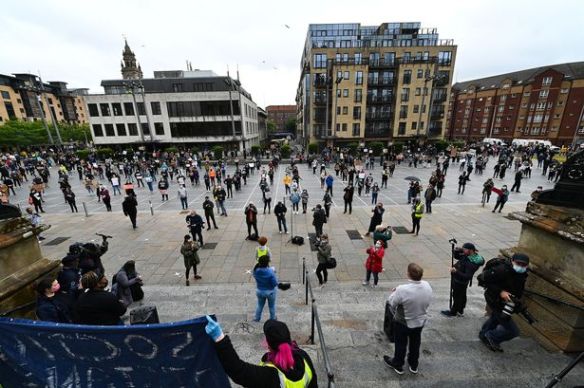
Only the protests against the state murder of George Floyd in the US, encapsulated in the Black Lives Matter protests, has shattered the instruction that the people must do as they are told. Social distancing was more or less ignored. Social isolation, whether in terms of ‘stay at home’ or unemployment, is no basis on which to create a working class movement, a task not suspended by the virus.
The left, or much of it, has saddled itself with a policy of maintaining a lockdown that largely doesn’t exist for many; will not exist for much longer; is unsupportable; that incurs costs workers will face paying or an almighty fight to oppose, and misses the main issue, which is not to extend lockdown but to try to help workers take some form of control over how it is ended, while accepting that it will and it must.
There is of course the alternative to what I have just said; that what I am advocating is a continuation of mass murder and that this is what we are about to face.
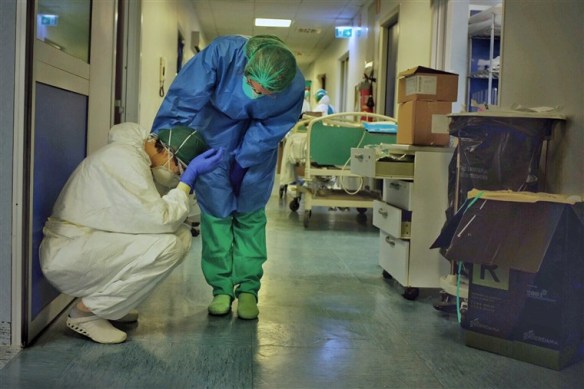
 I watched the BBC Panorama programme on the NHS and the Government failure to prepare properly for the Covid-19 pandemic, despite warnings. It focused on its failure to stock and resupply adequate amounts of appropriate Personal Protection Equipment, and to spin the amount of PPE newly received by, for example, counting a pair of gloves as two items and including cleaning disposables as equipment.
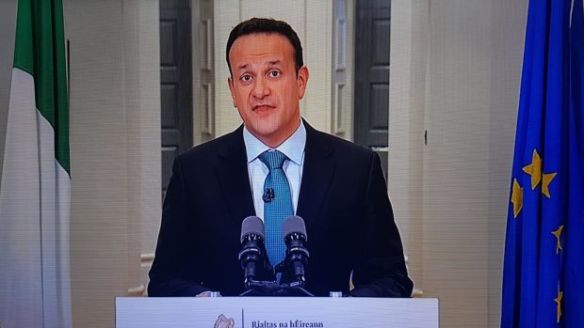 The British Government’s approach to the Coronavirus has been the subject of much, almost smug, criticism on this side of the Irish Sea. In the North nationalists, and not only they, have called for an all-island approach and rejection of the British strategy of ‘herd immunity’. Every British failure has been criticised and the response of the Irish Government lauded.
 In my previous