
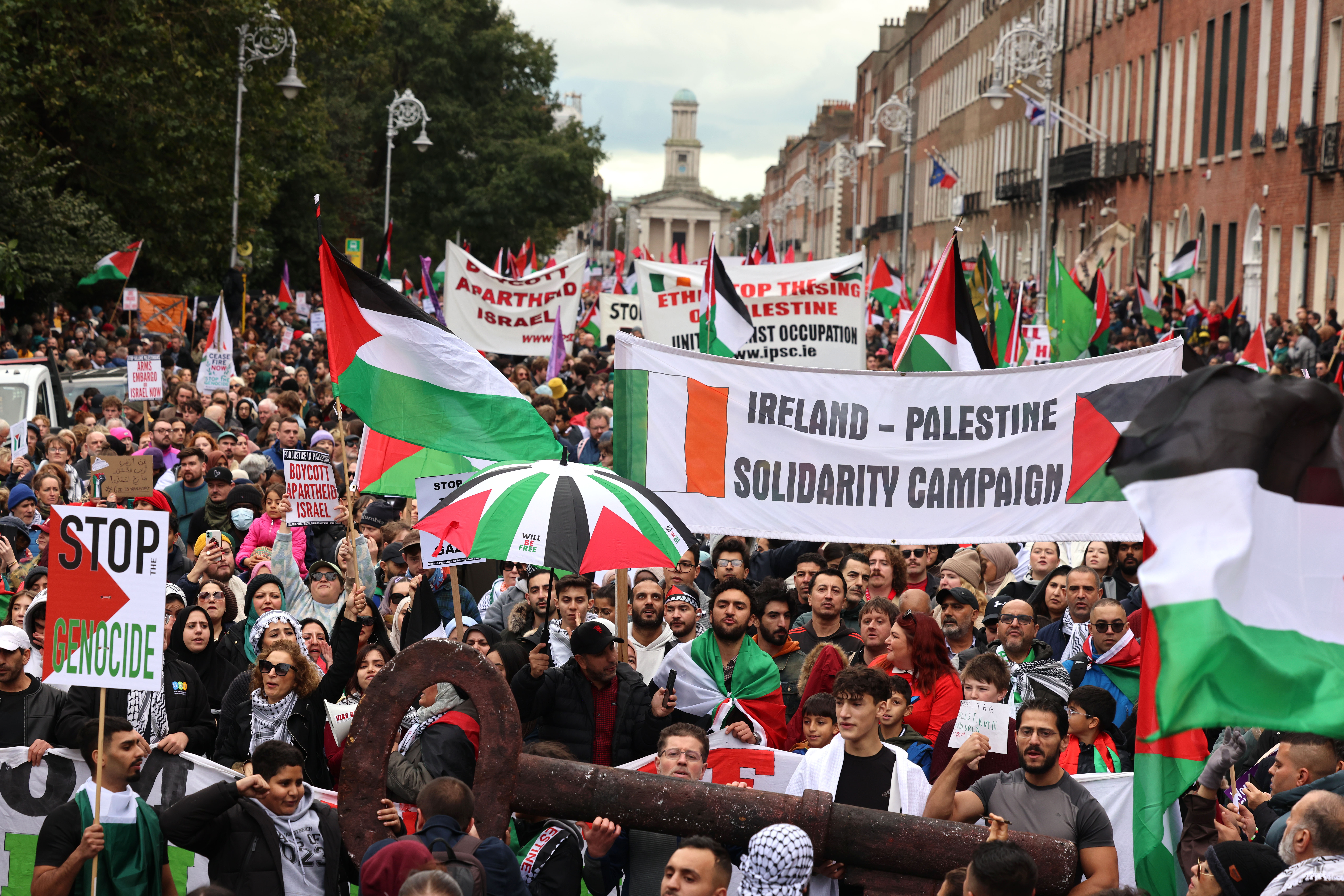
Solidarity with the Palestinian people (3 of 3) – Solidarity with Hamas?

National demonstration in support of Palestine, Dublin. Photograph: Dara Mac Dónaill / The Irish Times

In the previous post I stated that the October 7 attack by Hamas precipitated the current genocide in Gaza, as in to hasten the occurrence of something; hastily, or suddenly.  This does not make Hamas responsible for the genocide.  This responsibility belongs to the Zionist state and to its US sponsor as well as those states that have also supported and defended it.  As the first post made clear, this includes the Irish State, which studiously permits and facilitates the transfer of weapons and munitions from the US to Israel.

The responsibility of the Zionist state for genocide should not be a surprise, since the state itself is a settler colonial creation founded on the dispossession of the native Palestinian population subject to repeated expulsions and attacks.  The viciousness of the Zionist state and of its response to any challenge has routinely been disproportionate and the evolution of Zionist politics from labour to far-right reflects the logic of its existence.

All this does not excuse Hamas from criticism that it provoked an attack for which it was totally unable to defend the people that it claimed to represent.  This is essentially the argument of the Counterpunch article that I referenced before and which is illustrative of the arguments presented in the previous post. 

On the Oct 7 attack the Counterpunch article states that ‘Hamas must have known that Israel would react with massive destruction in Gaza after the October 7th attacks’ and that its  ‘military strategy was suicidal and poorly planned, also entailing war crimes against civilians which the leadership must have known would lead to the total destruction of Gaza.’  It further argues that ‘those who wish to engage in deluded fantasies like endless military confrontation having been the only avenue available to Hamas are quite deficient in their analysis which is bereft of intellectual rigor, to say the least. This sentiment is often felt by those attempting to appear the most revolutionary by taking what they perceive to be the most radical position.’

The failures of Hamas flow from the nature of the organisation: ‘the bulk of Palestinian resistance fighters—the actual fighters of Hamas and other entities—are acting out of anger and a desire for revenge, as the majority of them have lost family members due to Israeli attacks’; however ‘Hamas’ leaders . . . have climbed to the apex of power amongst the exploited and now seek their own privileges, power and financial gain.’

Hamas are described as corrupt ‘kleptocrats keen on getting rich, content with the privileges they possess in real life, and if they’re assassinated or killed in combat by the Israelis, then they believe they’ll be absolved in the afterlife—as Islamic fundamentalists do.’  An example of their corruption is provided – ‘Hamas had agreed to let the PA develop Gaza’s natural gas fields in exchange for a portion of the profits during negotiations with the US, Israel and Egypt. Simply put, Hamas’ leaders had decided they would sell their own people out to the Americans and Israelis—who effectively control the PA—in exchange for a cut on the back end.’

It is ironic therefore that the authors of the article argue that this is the alternative to HAMAS’s militarist adventurism and that the example provided by the Irish peace process is one to be emulated.  The Irish example helps point to why they are wrong.

The success of the Good Friday Agreement, such as it actually exists, is largely due to the failure and unpopularity of the militarism of the IRA.  What is wrong with this peace process is not that this militarism was abandoned but that without it the IRA and Irish republicanism generally had no political alternative to British imperialism.  The circumstances in Palestine are radically different from the North of Ireland, including that there was never any threat of genocide to the nationalist population.

So, while imperialism in Ireland and the Irish state are genuine in seeking a pacified Northern state with nationalist participation in the local administration, the view that ‘for now only a two state solution along the 1967 borders seems even remotely achievable’ after ‘Palestine [is] developed and modernized under US-Israeli-PA rule’ is hopelessly optimistic and misguided.  The two state policy has been endorsed by most of western imperialism for a long time and shown to be a fraud.  The Zionist regime has rejected it and, as the authors explain , its initial support for Hamas was precisely to help prevent it.

On its own, their proposal for the economic and social development of the Palestinian areas (under what currently could only be some sort of imperialist rule) is not wrong.  It is better, infinitely better, than genocide, but it fails to appreciate that the policy of genocide and steps to ethnic cleansing are a rejection of it by imperialism and Zionism, and of itself is not a policy of the working class, rather than simply potentially the best current conditions to allow one to develop. 

The article, at best, falls into the familiar trap of providing ‘solutions’ that are not those of the working class because the working class cannot provide its own. It does this instead of accepting weakness and pursuing a policy of opposition, one that doesn’t pretend to the current possibility of socialist revolution.  The writings of Marx and Engels are replete with such a policy where the working class is too weak or undeveloped to impose its own power but should not therefore politically support that of the bourgeoisie.

One of the ways by which better conditions for a working class alternative can be created is a working class led solidarity movement that sees this as one of its tasks.  This involves opposition to genocide and western imperialist complicity but also an open policy of supporting a working class policy and movement.

This is a long way from the current humanitarian solidarity that refuses to take a position on the political solution while, in doing so, leaving reactionary forces to fill in the gap.  It involves hoping that imperialism will do what it has demonstrated it has no intention of doing; hoping the Zionist state will be forced by imperialism to accept it, and hoping the reactionary Arab regimes will play a positive role in pushing this along, as opposed to their current closer and closer accommodation with both imperialism and Zionism.

Back to part 2

Solidarity with the Palestinian people (2 of 3) – Socialist solidarity

Belfast City Hall 5 April 2025

A friend sent me an article on the Counterpunch website that looked at Hamas and the October 7 attack that precipitated the current genocide in Gaza, which I will look at it in the next post.  It raises issues about solidarity with oppressed groups by socialists and what, if anything, socialists have to say that is different.  Having something different to say isn’t in itself a reason to say it, but if socialists think they have a distinctive view of the world and don’t have anything very different to say it implies that their socialism isn’t very important.

Socialism is international or it is nothing.  By this we mean that the cause of the working class in other countries is our cause and that socialism cannot exist within a single country.  This means that we seek to advance the socialist struggle of the workers in every country and that a victory in another country is a victory for us.  This is the material basis of solidarity for socialists.

Of course, in doing so we oppose oppression in every country, but you do not need to be a socialist to do this and we are socialists not just because we oppose oppression but because we believe only socialism – only the actions of the working class – can defeat oppression and establish freedom.  And this goes for the struggle in Palestine as well, although often these considerations appear to disappear when socialists discuss it.

Instead, we get statements such as the following – ‘that we must not only oppose oppression but support the oppressed, the right to resist oppression and the resistance itself.  We also get formulas that we should not take sides in intra-Palestinian political disputes, which only the Palestinians should engage in and determine.

If we work backwards – what is this last idea but a form of identity politics?  That Palestinians are a group apart with ideas and movements separate from the rest of the world’s struggles with nothing to learn from them; nothing to learn from the long history of working class struggle across the planet? If they are so different as to have nothing to learn then they would have nothing to teach us either. Either they are uniquely blessed with a political leadership beyond criticism because it never gets anything wrong, or it gets it wrong but is beyond help.  If neither of these are true, is it because we have no right to speak about their struggle or only to do so to voice our support? (Do we take this view about every struggle: of the French working class or German or any other?).

If it is the last argument, this simply leaves us back at the start and fails to argue why socialists have no right to state what we think is good or bad for the struggle; one that we have said is part of our own world-wide struggle and on which we are also at least partly dependent.  In short, the international struggle for socialism is something that involves Palestine and therefore involves us.

It might be argued that the struggle in Palestine is not about socialism, but this is no answer since socialists have a position on all struggles against oppression and these very often do not immediately raise the possibility of a socialist victory.  Otherwise, in today’s condition of the class struggle, we would silence ourselves across most of the world.

Of course, what we have to say should be within the framework of solidarity with the oppressed and should have something relevant and positive to contribute, but part of our solidarity is that we believe we do have something distinctive to contribute, not least because for us, solidarity is not an act of altruistic humanitarian concern for others but is part of our own fight.  The only basis for refusing to engage in debate on the way forward for the Palestinian struggle is the belief that it is separate from us: ‘In our thousands! In our millions! We are all Palestinians!’ becomes not only untrue (we are not suffering genocide!) but is also denied and rejected by the claim that we are not permitted to offer our own views.

This, however, is the most common view of solidarity, which thus becomes a sort of activist charitable exercise fed by the politics of self-determination of nations.  The socialist view is the primacy of self-determination of the working class, as an international class that can unite politically and organisationally, which is obviously impossible without debate, argument and disagreement.

Where does this leave us with the formulation that we must not only oppose oppression but support the oppressed, the right to resist oppression and the resistance itself? 

First, even oppressed people’s and nations are composed of classes involving class exploitation and oppression.  Genocide only partly qualifies this, as those with lots of money will always find a way to use it to their benefit.  Class divisions have a bearing not only on whether and how to resist oppression but also on the objectives of resistance.  Class struggle doesn’t disappear and socialists above all should recognise this in their solidarity and within the solidarity movement.

So what about the right to resist?  Socialists are in favour of the working class and other oppressed groups resisting exploitation and oppression but do so on the basis that capitalism exploits and oppresses, and that class struggle exists as a result.  As Marxists we understand that capitalism gives rise to the potential for socialism because of the nature of its development.  From this arises the struggle for socialism, not some moral right to resist that is independent of the circumstances and conditions in society.  This is important for how we resist, which we will explore in relation to Gaza in the next post.

In general, however, socialists are always to the fore in advocating resistance to exploitation and oppression, with the view that advancing towards the alternative is what matters above all.  We therefore support the oppressed by seeking to end their oppression, which ultimately can only be through the working class becoming the ruling class of society.

This leads to the final claim, that those in solidarity with the oppressed must also solidarize with the resistance and with the resistance movement, and this is where the biggest difference arises.  Since our view of solidarity is not dictated by any moral assertion there can be no moral claim on us to support resistance movements that are themselves reactionary, and this obviously includes Islamic political movements (as opposed to democratic and socialist movements composed of religious believers).

Solidarity arises from common interests and purposes.  What common interests and purposes arise between reactionary movements in conflict with imperialism and socialists?  To ask the question is almost to answer it.  Both can be opposed to imperialism on the grounds of some common effects of its rule or intervention but reactionary movements that come into conflict with imperialism are not anti-capitalist, never mind socialist, so their opposition is limited and qualified.  Ultimately their interests and purposes are opposed to those of socialists and is the reason for separate organisation and politics in the first place.

Since our primary interests and purposes are separate any common activity is also limited and qualified and there can be no unqualified or unconditional support.  Common objectives may allow episodic common actions and organisational cooperation to achieve them but there are no grounds for avoiding criticism or separate organisation.

We therefore do not give political support to reactionary movements on the grounds that they embody the resistance of the oppressed, because that resistance is politically reactionary and cannot represent their full and complete interests.  Whether these movements are in our own country or another does not fundamentally change this but at most determines the emphasis to be placed on opposition to our own state for whatever role it plays in the oppression.

In practice many socialists acknowledge this while denying it in words and will criticise the Palestinian Authority but not Hamas, for example on the illogical grounds that ‘denunciation of HAMAS is simply a mechanism for supporting genocide.’  Such an overblown statement scarcely warrants a response.  See below a better statement by this organisation to the Belfast rally pictured above. 

Back to part 1

Forward to part 3