Workers strike against austerity in the North of Ireland

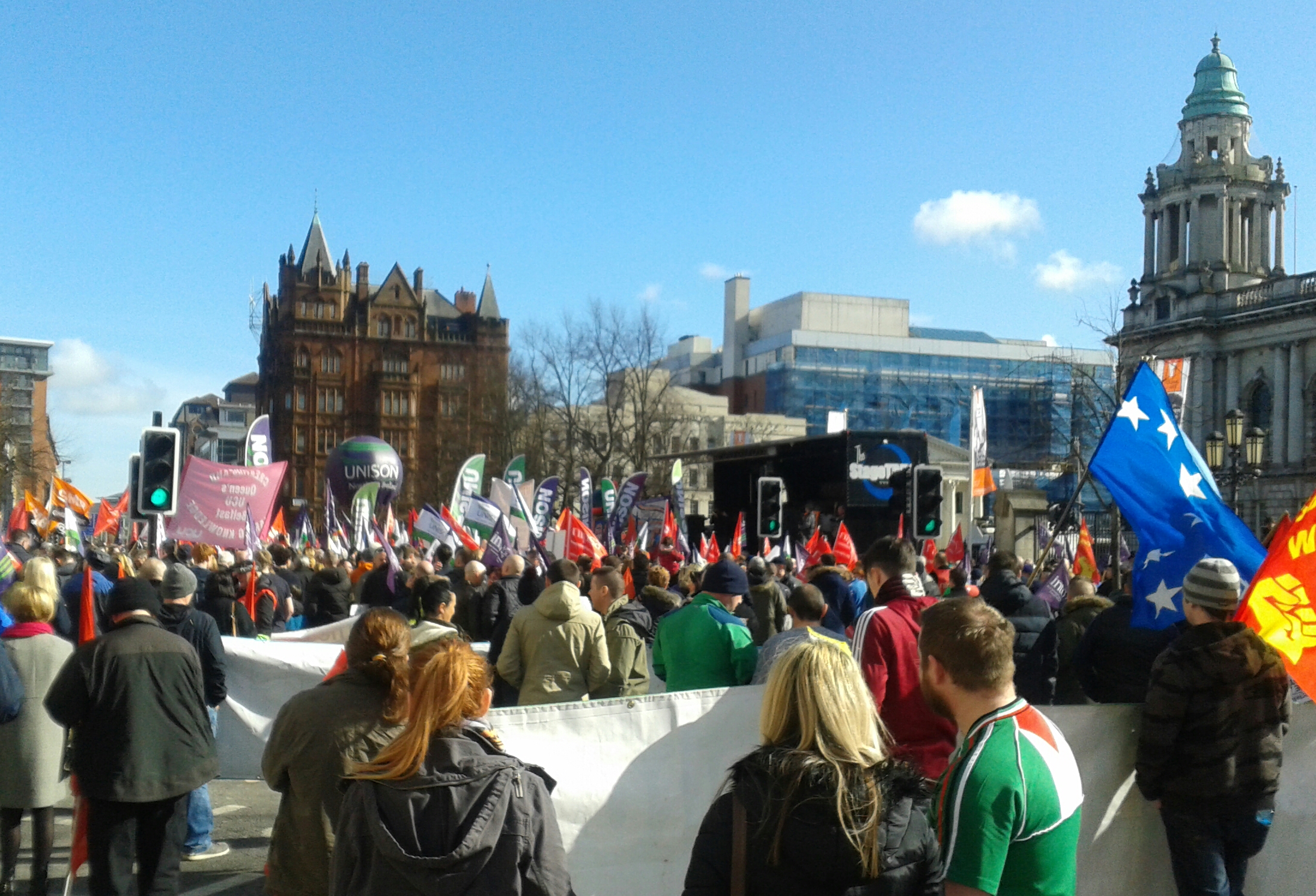
20150313_130323-1Tens of thousands of workers went on strike across the North of Ireland on March 13 in protest against cuts in jobs and services implemented by the devolved administration in Stormont.  The local administration is imposing the austerity agenda dictated by the Tory-Lib Dem coalition in London.  The strike was particularly successful because transport workers, including on the buses and trains, took part as well as those in the civil service, health and education.

Observance of the strike was good and pickets and rallies had respectable turnouts.  Workers have suffered a long period of declining living standards and are clearly willing to declare their opposition.  It would be a mistake however to exaggerate the stage we are at in the development of this struggle.  A glance at the numbers voting for strike action in a couple of the biggest unions involved shows the distance yet to go to build a strong and active movement.

In the trade union NIPSA, covering staff in Government departments and other bodies as well as admin and clerical staff in the health service, 52.9% or 4,201 voted for strike action in the civil service side out of a membership of around 20,600, with the health service side having an even lower turnout.  Not all of the membership was called upon to strike but the vast majority of members were affected.  In UNISON, with a membership mainly in the health service and some in education ,3,181 voted for strike action in a membership of around 40,000, again not all of whom would have been called upon to vote but a majority of whom would have been affected.  The strike had sympathy among the wider population but this finds no expression in organisation.

Many on the left have demanded another strike and have claimed that the recent ostensible U-turn by Sinn Fein on welfare cuts is a result of the strike.  However this would be to take the Sinn Fein position at face value, or rather take them at their word, and exaggerates the effect of the strike.  While it focused opposition to austerity, and can lay the grounds for a deeper campaign against it, the actions of Sinn Fein are not so much a reaction to the strike but the wider feeling of opposition to cuts.

The strategy of the trade union leaders is to lobby and put pressure on local political parties so that if the next Westminster election results in a hung parliament local politicians can demand and negotiate an end to, or at least an amelioration of, austerity imposed in the Northern Ireland.  It therefore takes as given the continued position of these parties and resists any project of setting up a political rival.  This is on the basis that to do so would inevitably require a position to be taken on the constitutional position of the Northern State.

Such a party would inevitably have Keynesian policies of greater state activity in taxing and spending.  In other words salvation would be presented as arriving from the state, so the programme of any such labour or workers’ party would very quickly run up against this challenge.  No autonomous development of the party would be possible.  It is now some years since a labourist project was attempted and the last one that set up the current political arrangements was an embarrassing failure.

The strike was however noteworthy because it was carried out explicitly against the policies of the local Stormont Executive, the centre piece of the peace process and the ‘new’ political settlement.  It also took place against the background of another ‘crisis’ in the process, with the whole financial arrangements of the local administration thrown into doubt by a late Sinn Fein withdrawal of support for the budget because the deal to preserve it did not fully cover the cuts in welfare that were to mirror ‘reforms’ in Britain.

Sinn Fein therefore paraded its anti-austerity credentials, which the media took to be another late intervention by Gerry Adams to shore up the anti-austerity stance of the party in the South of Ireland.  Sinn Fein faces a general election in the South within the year.  The party is riding high in the polls on the basis of this perceived position and it would not look good if it were seen to be implementing austerity in the North while claiming to oppose it in the South.   Sinn Fein therefore ‘supported’ the strike even if the strike was clearly against the budget it had just approved as a major part of the local administration.

This support was invisible in the well-attended rally in Belfast city centre on 13th and is based on the party once again talking out of both sides of its mouth.  A long established practice.

This most recently saw an outing through Sinn Fein’s vocal support for the Catholic teacher training college St Mary’s, which was threatened with cuts by the local administration.  The cuts were proposed by the Alliance Party Minister responsible who was simply implementing the reduced budget given to him by Sinn Fein and its Democratic Unionist Party partners.  The sectarian aspect of this support was lost on no one as similar cuts were to be made to the ‘Protestant’ teacher training college at Stranmillis.  In the end the two biggest sectarian parties – Sinn Fein and the DUP – got together to overrule the Alliance Party Minister.

The last minute opposition to the welfare arrangements therefore doesn’t inspire the view that Sinn Fein are a principled opponent of austerity but rather smack of an opportunist change of tack.  At their Ard Fheis in Derry the weekend before they dropped their bombshell the leader of Sinn Fein in Stormont, Martin McGuinness , was proclaiming great satisfaction with the deal and congratulating the party on how well it had done in the re-negotiated financial settlement with the British Government.

At the very best their new found concern means that they hadn’t done their sums right or had been rather easily hoodwinked by the DUP; or perhaps that they had re-evaluated the calculus of staying with the welfare cuts programme as it was going to develop – thus facing the flak when it was put into practice – as against provoking another ‘crisis’ and the fall-out that would then ensue.

That this was all a bit last-minute became clear from the Sinn Fein media performances to explain its change of approach.  One prominent spokesperson on local radio refused to say it was a question of money when it could hardly be anything else; then it was claimed that it would cost over £280m to put right before this became translated into a round figure of £200m when the round figure it would appear closest to would be £300m.  Unionist claims that it was clear in the deal that not all the benefit cuts would be covered by mitigation measures in the budget, and would not be permanent for new claimants, seemed more convincing.

Nevertheless, the row over the extent of the funds to cover cuts in welfare matters to those welfare recipients affected who are indeed, as Sinn Fein says, some of the most vulnerable. It doesn’t in the least affect the fraudulent nature of Sinn Fein’s anti-austerity posturing.

To be continued

The civilising mission of capitalism – Marx’s alternative part 3

lewis-hine1So Marx understood that capitalism’s compulsion to increase the appropriation of unpaid labour through development of the forces of production and exploitation of workers also meant the expansion of the consumption of the working class and development of its needs and capacities as a result; what has been called capitalism’s civilising mission. But Marx also referred to the “inherent barbarism of bourgeois civilisation.”

Today, and over the last half century, many people have been radicalised by the threats of nuclear annihilation or environmental catastrophe, both of which are products of capitalisms’ productive powers and its irrational social and political relations.  But opposition has more often than not failed to identify the source of the threat or the solution.

It has also been noted at the end of the twentieth century that there had not been a single year since 1816 without at least one war going on in the world.  The twentieth century itself witnessed human slaughter on a truly massive scale with more than 9 million deaths in the First World War and 57 million (37.8 million of them civilians) in the Second World War, with 80 million between 1900 and 1950 in total.  The relative peace since is purely relative with proud claims that war had been abolished in Europe, for example, blown away by the war in the former Yugoslavia and now in the Ukraine.

This contradiction is not one that exists in Marx’s argument but one that exists in reality, as Marx explains in Chapter 15 of Volume 1 of Capital:

“We have seen how this absolute contradiction between the technical necessities of modern industry, and the social character inherent in its capitalistic form, dispels all fixity and security in the situation of the labourer; how it constantly threatens, by taking away the instruments of labour, to snatch from his hands his means of subsistence, and, by suppressing his detail-function, to make him superfluous.

We have seen, too, how this antagonism vents its rage in the creation of that monstrosity, an industrial reserve army, kept in misery in order to be always at the disposal of capital; in the incessant human sacrifices from among the working-class, in the most reckless squandering of labour-power and in the devastation caused by a social anarchy which turns every economic progress into a social calamity.

This is the negative side. But if, on the one hand, variation of work at present imposes itself after the manner of an overpowering natural law, and with the blindly destructive action of a natural law that meets with resistance at all points, modern industry, on the other hand, through its catastrophes imposes the necessity of recognising, as a fundamental law of production, variation of work, consequently fitness of the labourer for varied work, consequently the greatest possible development of his varied aptitudes.

It becomes a question of life and death for society to adapt the mode of production to the normal functioning of this law. modern industry, indeed, compels society, under penalty of death, to replace the detail-worker of to-day, grappled by life-long repetition of one and the same trivial operation, and thus reduced to the mere fragment of a man, by the fully developed individual, fit for a variety of labours, ready to face any change of production, and to whom the different social functions he performs, are but so many modes of giving free scope to his own natural and acquired powers.”

Marx compares capitalism favourably to its predecessors:

“Thus the ancient conception, in which man always appears (in however narrowly national, religious, or political a definition) as the aim of production, seems very much more exalted than the modern world, in which production is the aim of man and wealth the aim of production.

In fact, however, when the narrow bourgeois form has been peeled away, what is wealth, if not the universality of needs, capacities, enjoyments, productive powers etc., of individuals, produced in universal exchange? What, if not the full development of human control over the forces of nature — those of his own nature as well as those of so-called “nature”? What, if not the absolute elaboration of his creative dispositions, without any preconditions other than antecedent historical evolution which make the totality of this evolution — i.e., the evolution of all human powers as such, unmeasured by any previously established yardstick — an end in itself?

What is this, if not a situation where man does not reproduce in any determined form, but produces his totality? Where he does not seek to remain something formed by the past, but is in the absolute movement of becoming?

In bourgeois political economy — and in the epoch of production to which it corresponds — this complete elaboration of what lies within man, appears as the total alienation, and the destruction of all fixed, one-sided purposes as the sacrifice of the end in itself to a wholly external compulsion.”

Overall growth of productive powers and increased planning within capitalism – between firms and countries – and increased coordination of a massively developed division of labour is a growth of human power and civilisation, not just potentially, but in creation of the preconditions for socialism; the potential for the creation of a society without material and cultural want, for a future society in which the level of production can remove the necessity for class inequality.

If socialism must arise out of capitalism and capitalism were purely barbaric, containing within it no contradictions that presage the new society, socialism would be a utopian dream because the agents of change who are to bring it about would simply be products of barbarism.

Back to Part 2

Forward to Part 4

Karl Marx’s alternative to capitalism – part 2

333869336In the first part of this post on Marx’s alternative to capitalism we noted that this was ‘simply’ the real alternative that is already growing within capitalism and is composed of the working class that the development of capitalism creates.

Workers have no, and are not to be encouraged to produce, “ready-made utopias”.   Such blueprints are always presented to workers rather than arising from them, they must “work out their own emancipation”.   In doing so they will necessarily “have to pass through long struggles, through a series of historic processes, transforming circumstances and men”. (Marx, The Civil War in France)

The working class is the product of the prodigious development of the forces of production under capitalism but it can only achieve emancipation if it becomes conscious of its revolutionary role. So, in some way, capitalism must not only provide for the development of the forces of production, increased division of labour and cooperation across the globe and increased planning within and between companies and production facilities, upon which a higher society can be built, but it must also provide the grounds for the development of this consciousness.

Capitalism does this by removing the relations of personal dependence that, for example, ties the peasant serf to the lord of the manor or the artisan to his master and to the Guild.  In doing so it atomises individuals and promotes an ideology of individuality that in juridical terms makes people free, independent and responsible but which in reality is expressed in an estrangement of people from each other.

This estrangement is routinely expressed through terms such as the ‘rate race’; the view that ‘charity begins at home’; that you ‘have to look after your own’, or ’look after number one’ or in the thousand and one various ways in which the unity of humanity is disintegrated and vanished under capitalism.  This is not primarily an ideological phenomenon but a realty that workers are indeed in a rat race.  As a poster campaign put it some years ago – many are only a couple of pay cheques away from homelessness.  Almost all workers are an illness away from relative or absolute poverty.  Lack of ownership of the means of producing a livelihood means an inescapable compulsion to sell one’s labour power in the market under circumstances more or less totally out of one’s control.

This estrangement is universal and the idea of free individuality finds roots from this universal separation.  Its universality creates the possibility of it being overcome. This is done through the development of the forces of production that puts workers in a similar relationship to those who own the means of producing life’s necessities creating the conditions within which unity around common class interests can be built.

The development of the forces of production themselves, based on advances in scientific understanding and its practical application, has implications both for the material and moral/spiritual development of the working class.  The extraordinary development of the productivity of labour that is a feature of capitalism cannot fail over an extended period to have an effect on the material conditions of the working class.  The current level of development of the productive forces could not have been achieved simply by seeking to meet and increase the consumption demands of the richest in society.

Capitalism constantly seeks to advance the consumption of society in order to accumulate capital and thus consciously and unconsciously produces new needs and new desires and, through this, new capabilities that create not just the material but also the spiritual and cultural preconditions for socialism.  If it did not, if capitalism left workers as limited and narrow in outlook as the peasant class that preceded it, there would be no grounds for a new higher society, for who would bring it into being?

This development takes place under capitalism, under the determining dynamic of the production of profit from the exploitation of labour, and thus this development is distorted, often thwarted, partial, uneven and limited.  It is subject to advance and retreat and it is ‘dumbed down’ and commodified.  It takes place not as a rational objective of society but as one whose development is in contradiction with the system’s rationale of seeking the expansion of capital through the appropriation of more exploited labour.

This process is what Marx calls the “civilising mission” of capitalism, without which there could be no talk of socialism:

“Thus, just as production founded on capital creates universal industriousness on one side — i.e. surplus labour, value-creating labour — so does it create on the other side a system of general exploitation of the natural and human qualities, a system of general utility, utilizing science itself just as much as all the physical and mental qualities, while there appears nothing higher in itself, nothing legitimate for itself, outside this circle of social production and exchange.

Thus capital creates the bourgeois society, and the universal appropriation of nature as well as of the social bond itself by the members of society. Hence the great civilizing influence of capital; its production of a stage of society in comparison to which all earlier ones appear as mere local developments of humanity and as nature-idolatry.

For the first time, nature becomes purely an object for humankind, purely a matter of utility; ceases to be recognized as a power for itself; and the theoretical discovery of its autonomous laws appears merely as a ruse so as to subjugate it under human needs, whether as an object of consumption or as a means of production.  In accord with this tendency, capital drives beyond national barriers and prejudices as much as beyond nature worship, as well as all traditional, confined, complacent, encrusted satisfactions of present needs, and reproductions of old ways of life

It is destructive towards all of this, and constantly revolutionizes it, tearing down all the barriers which hem in the development of the forces of production, the expansion of needs, the all-sided development of production, and the exploitation and exchange of natural and mental forces.” (Grundrisse)

But how can capitalism be called civilising?  Is it not the Marxist case that capitalism is inhuman and that the historic choice is between socialism and barbarism? Does Marx not speak, in relation to British rule in India, of “the profound hypocrisy and inherent barbarism of bourgeois civilisation.”

Back to Part 1

Forward to Part 3

Karl Marx’s alternative to capitalism – part 1

DSC_0136The reason why a person will identify themselves as a Marxist will be biographical, a product of their background, history and circumstances, their attitudes, character, personality and intellectual curiosity.  All these will be individual and accidental to a greater or lesser extent, the product of one’s actions and decisively, the views and actions of others that one comes into contact with, directly and indirectly.

On the other hand their background and circumstances and the views and actions of others that influence them will be social, the product of society as a whole.  Even their individual character and intellectual curiosity will be shaped strongly by their social circumstances.  So also the reason to identify as a Marxist is not individual or accidental but crucially derives from the content of Marxism itself.

It constitutes the most rational alternative to capitalism and all the irrationality and oppression that that system entails.  The most consistent and coherent alternative to capitalism is Marxist because Marxism comprehends capitalism in a way that is adequate to its replacement.

Marxism best encapsulates the view that ‘another world is possible’ because it best understands capitalism itself and can identify whether, and to what extent, an alternative can develop out of it.  Any alternative must come out of it in some way, yet be sufficiently different to actually be an alternative, and not a refurbished version of existing society which must enforce the limitations and strictures of the existing system. Marxism must therefore identify in what precisely this alternative consists.

The strength of Marxism is not that it has developed a brilliant idea from the brain of an exceptional intellect but that it seeks to bring to consciousness the development of capitalism itself and the alternative that is pregnant within it.

“In that case we do not confront the world in a doctrinaire way with a new principle: Here is the truth, kneel down before it! We develop new principles for the world out of the world’s own principles. We do not say to the world: Cease your struggles, they are foolish; we will give you the true slogan of struggle. We merely show the world what it is really fighting for, and consciousness is something that it has to acquire, even if it does not want to.” Karl Marx 1843.

If capitalism does not contain within it the struggles that will replace it, and the grounds for those struggles to succeed, then there will be no alternative to capitalism, at least not with the features or characteristics associated with a socialist alternative.

The claim that Marxism is the social and political alternative to capitalism thus rests on its claims to understand the development of capitalism so that the alternative it poses is not then a utopian one, sprouted more or less fully formed from the brain of this or that social reformer, but from the perceptible development of capitalism itself.

Just as the alternative to capitalism grows out of capitalism itself so too does the understanding of the alternative grow in the same way from the development of the system.

This is held to account for Marx’s known aversion to setting out a blueprint of what the alternative will look like.  It was, for example only when Marx was in his mid-50s that he claimed he had found, or rather the working class itself had found, through the experience of the Paris Commune of 1871: “the political form at last discovered under which to work out the economical emancipation of labour.”

In his review of this experience Marx made many observations on the alternative to capitalism that apply today, including that:

“The working class did not expect miracles from the Commune. They have no ready-made utopias to introduce par décret du peuple. They know that in order to work out their own emancipation, and along with it that higher form to which present society is irresistibly tending by its own economical agencies, they will have to pass through long struggles, through a series of historic processes, transforming circumstances and men. They have no ideals to realize, but to set free the elements of the new society with which old collapsing bourgeois society itself is pregnant.”

A book published a few years ago is an extremely useful guide to Marx’s concept of the alternative to capitalism, more particularly of the principles that underpin it.  It demonstrates that the alternative is not some perfected socialist state or society, not some condition of social equilibrium but a movement of people and their own self-activity and self-development.

“Communism is for us not a state of affairs which is to be established, an ideal to which reality will have to adjust itself. We call communism the real movement which abolishes the present state of things. The conditions of this movement result from the premises now in existence,” (Marx in The German Ideology).

There is no end-state to socialism, perfect or otherwise, but the social conditions that allow the full flourishing of the individual and humanity as a whole, which will in turn change social conditions.

Socialism cannot be reduced to principles such as a planned economy because planning itself is only one human activity, the totality of which is the expansive alternative that Marx foresaw.

The alternative to capitalism is the self-development of humanity, its overcoming of an alienated existence within which its own powers over its environment and its own development appear separated from and oppressive to it.  So humanity understands the danger of environmental destruction but has no transparent means of control to stop it despite its own actions being the cause of the threat.  So it witnesses economic disruption, unemployment, poverty and suffering, caused by a drop in ‘value’ of pieces of paper – shares, bonds, swaps, options, derivatives etc -that it has created but which by themselves are simply pieces of paper, which in any rational society it would be impossible for them to cause the suffering involved in economic crisis.

Emancipation therefore is the result of the actions of humanity itself, led by a class within society whose liberation must entail the liberation not only of itself but of society as a whole – what is called a universal class because it represents the universal interests of all humanity.

This universal class is the product of the prodigious development of the forces of production under capitalism, to a degree that could never have been conceived in previous history, including the rapid development of technology, scientific knowledge and overall cultural development.

It is people however who create history, ‘history’ itself does nothing, and it is the development of the working class that is the carrier of the wonders of the new capitalist society and the bearer of the new within it.

What is required then is that the working class becomes conscious of its role in existing society and the necessity for it to change this society.  Decisive for the working class is therefore its awareness of itself as a separate class with its own interests, requiring a change in the consciousness of the mass of workers.

This change in consciousness to an awareness of class interest does not mean the nullification of individual personality or character but the recognition of shared interests that will allow creation of a society in which the free development of individuals is the condition for the free development of everyone; no one is subject to the requirement to work to live in order that someone else can live without working.  The creation of wealth will be for the satisfaction of individual needs and desires and not the pathological pursuit of profit for a few.  People will labour to satisfy their needs not the accumulation of money, wealth and capital for others.

The structures of society will therefore be the consciously directed products of human activity, transparent in their operation.  They will not entail the domination of people by impersonal, disembodied powers such as the ‘rule of the free market’ or ‘rule of law’ or ‘state authority’, over which individuals feel and have no control.  No longer will workers face wage cuts or unemployment because the things they produce are no longer profitable to produce and the needs of ‘the economy’ then require the sacrifice of their livelihood.  Things no longer control them, they control the things that would not exist without them.  No longer will the price of pieces of paper wreak economic devastation.

Instead workers will control the things that are their creation, including the machines they build, the firms they create, the agencies that provide services or set rules for them – all the organisations appointed for any purpose that affect them.  They control them because they work in them.  Managing them is not a detached function to be carried out by a separate class or bureaucratic group but is the task of everyone.  Management and control become part of everyone’s job description.

By this means the supreme authority, the State, that rules over society is not set apart from it but is gradually abolished through its functions being incorporated into society itself and into its day to day functioning.  Only in this way can the  rule of a minority become the rule of the majority, can the working class become the new ruling class, before there is no class system whatsoever because no relations of economic and social domination exist.

For this to happen the majority of society have to be not so much ready to carry out these million and one tasks but more and more actually carrying them out beforehand.  The problem then is not so much to revolutionise the means of production or state structures but to revolutionise the working class.

So how does capitalism create the conditions for this?  In what way does capitalism itself prepare the ground for its supersession by the working class?

Forward to Part 2

Visiting Trier

DSC_0208Last year I went on my holidays to the French wine region of Alsace although I did very little drinking as most of the time I was driving.  As a quid pro quo I was able to take the opportunity to drive over and visit Trier in Germany.

Trier is a contestant for Germany’s oldest city, a UNESCO world heritage site and the location of notable Roman buildings. Of course for a Marxist it is also distinguished as the birthplace of Karl Marx, which has been turned into a museum, and it was for this reason that I ventured out of France.

If I thought the French didn’t pay much attention to speed limits it appeared to me that the Germans didn’t have one.  On two rather short journeys to and from Trier to the French border I came across three traffic accidents including one rather nasty one in which an occupant was being cut out of a car.

Having arrived safely at our very functional hotel, which consistent of separate concrete boxes called rooms and a bigger box that doubled as reception and breakfast area, we took a dander round the town where I explained that it was unusual to have anything to do with Marxism as a local tourist attraction.  It was pointed out to me that the most memorable aspect of this was the local tourist bus painted with Karl Marx’s mug.

DSC_0016

The next morning we had breakfast in reception, in which the juice and Rice Crispies were almost in the street.  All very lean I was told, proving to me that I am not the only one who doesn’t really switch off when on holiday.  The big TV behind the desk was showing the news on some local channel.  I was too far away to hear but this wasn’t a problem as I don’t speak German anyway.  And in any case my eagerness to see who had won the Scottish referendum was being addressed by an interview with a guy who had a very bad Mel Gibson Braveheart haircut, and a Saltire painted across his face.  He had the demeanour of Mel at the end of the film when he was on the rack.  I guessed who had won.

We then took in the museum and the audio tour that outlined Marx’s family background and history, the story of his political involvement and an AB of his ideas.  It was competently done, without being ruined by the reformist bias I had feared from it being run by the Sozialdemokratische Partei Deutschlands  (SPD) and its Friedrich Ebert Foundation, named after a real reactionary bastard, whose historical role might well make those who think social democracy has turned right under neoliberalism rethink just how left it was beforehand.

It was a bit bemusing to find out that the young Karl had hardly got out of his nappies before he had moved house along with his family, but you hardly treat such a visit as a religious pilgrimage, in which you touch the foot of the statue of the blessed man or feel his earthly presence.

DSC_0040

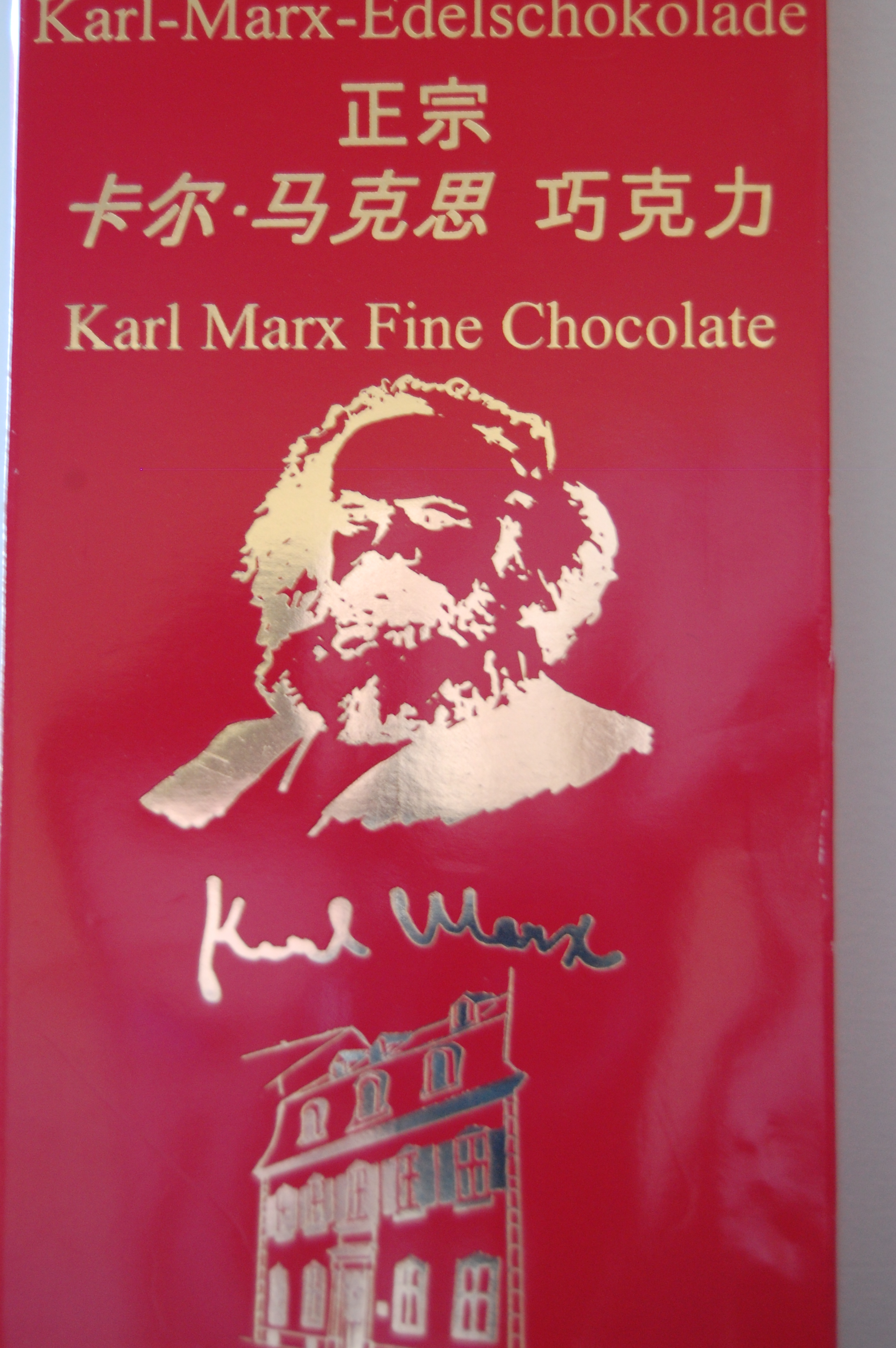
Like all museums it had a shop but inexplicably nothing for lovers of Flat Whites or three-shot Cappuccinos.  Being a sucker for a certain type of tat I attempted to buy a bust of the man himself ( you’ve already got one); a Karl Marx mug (it’s too tacky); some red wine (I’m sure it’s just not nice) and a fridge magnet (you don’t even know what it says because you can’t speak German).  However I did get away with the museum exhibition booklet and a bar of ‘Karl Marx Fine Chocolate’, which I haven’t yet opened just for badness.

What didn’t fully strike me as very poor until much later was the paucity of Marx’s writings that were for sale, but then the SPD believes that his writings really are only a museum piece, and the shop is for taking things away.  The best the exhibition booklet could come up with, in its final words on ‘Marx in the Twenty-First Century’, was that “engagement with the methods of Karl Marx and the questions he posed will continue to be meaningful”.  You don’t say.

The final chapter, on ‘Embracing of the Ideas of Karl Marx Worldwide’, cited the following, among others, as coming under his influence or claiming to express his ideas – Mao Tse-tung, Pol Pot, the ANC, Fidel Castro, Salvador Allende and liberation theology.  When we add the various ‘Marxist’ schools including the Frankfurt school, structuralism, post-Marxism and Analytical Marxism etc. and the experience of the various state regimes that have laid claim to Marx as their inspiration – from the Soviet Union to Albania – we can see the obstacles to engaging with Marx in a way that is not only meaningful but faithful to his writings.

DSC_0210

So why bother?  A look at the activities of today’s organisations claiming to be Marxist shows that the political programmes put forward hardly correspond to his oft-stated views.  From capitalist state ownership as the road to, and destination of socialism, to strikes for higher wages as ‘going to the heart of the system’, if you hang around the Left long enough you will hear every competing conception of socialism that Marx fought against being presented  as the authentic expression of his views.

Quotes from Marx are regularly thrown about but rarely after actually reading the original.  In Ireland our latest Marxist TD is shown on YouTube commencing an educational meeting with a quote from Marx’s Capital, which he admits he hasn’t read but which the chair of the meeting assures him ‘nobody has’.

By reading the original the original meaning might actually be understood.  A very simple reason why to bother.

But the answer is not simply to ‘go back to Marx’ as a way of overcoming the obstacles created by the distortion of his teachings by many who have claimed to be his followers.

This is not least because they have sometimes genuinely sought to apply his teachings, albeit often in a one-sided and partial way, providing one-sided and partial truths.  The direct words of Marxism expressed by Marx have been supplemented by the history of the development of his ideas and of the working class movement and it would be in complete conflict with his method to seek to go beyond the failures of both by simply claiming they are ‘wrong’, isolating ourselves from them and ignoring the lessons to be learned.

The history of Marxism and of the working class movement is now the ground on which both must be renewed.  Such renewal requires not just engagement with the direct views of Marx but also with the fragmentation and degeneration of Marxism and the labour movement.  The experience of both cannot be ignored or wished away and the alienation arising from them must be overcome because this alienation is now part of the reality we must seek to change, just as Marx sought to change the reality that he faced, including the various schools of socialism that he considered must be overcome and banished during his time.

Syriza and Ireland

syrizaimagesThis Sunday the Greek people will go to the polls in an election that could see the beginning of the end of austerity in Europe.  That anyway is the view of some on the left across Europe.

The potential election of a Coalition of the Radical Left (Syriza) Government, promising a radical reduction in the debt burden, has the potential to galvanise and set an example to the rest of the PIIGS.  It could incite a combined movement in Portugal, Ireland, Italy, Greece and Spain that would reduce the debt of these countries which has been a prime driver of austerity.  Through radically reducing the requirement to service and pay down enormous debts such a step could launch a definitive movement away from neoliberalism towards a radically different Keynesian social democratic alternative.

The elections in Greece will be followed this year by elections in Spain, in which a like-minded Podemos movement has grown, and in Portugal, and may also be joined by an election in Ireland despite the claims of the current Government that it will run in office until 2016.  Of the five PIIGS therefore at least three and possibly four may see elections this year.  Even elections in Britain could see the ousting of the Tory devotees of austerity and neoliberalism.  In fact the policy that might inspire the PIIGS is not confined to them but might apply right across Europe.  And Syriza is in the vanguard of this movement.

Is such a scenario a real possibility?

Let us notice what makes such a claim plausible.

Firstly the proposals of Syriza are not solely on behalf of the Greek people although as a Government it will be able to negotiate only on their behalf.  Syriza proposes a European Debt Conference modelled, with delicious irony, on effective debt forgiveness of (West) Germany in 1952.  This was carried out explicitly in order, or so it was claimed, to normalise relations between Germany and its creditors and to promote economic development.   That deal wrote off half of the debt, stretched repayment of the rest and for the first few years provided only for payment of interest, which was also limited.

Syriza proposals are more limited. Their policy could be based on an academic paper which proposes that half of the debt would be bought up by the European Central Bank (ECB) with either an interest holiday or interest charged on the remaining debt at a low rate.  The debt taken on by the ECB would not be written off but would be paid back only when the remaining debt left to the country had been reduced to 20 per cent of Gross Domestic Product (GDP).  In effect economic growth and inflation will have eroded the real value and real impact of debt repayment.

However in one very important sense the proposals are much more radical than the German precedent, because the Syriza proposal is that this plan applies to every country in the Eurozone with debt over 50 per cent of GDP (all but three countries).  The Irish state for example would see its debt reduced from 108 per cent of GDP to 50 per cent, saving €3.7 billion each year in interest payments, so reducing the need for cuts or tax rises and facilitating greater state spending and investment.[i]

It has been estimated that this would reduce sovereign debt in the Eurozone area by about €4.5 trillion.  It is asserted that this would not risk inflation because the ECB debt purchases would be funded by massive borrowing from private banks.  There would be no money printing since the money is borrowed.  And sure why worry about inflation when deflation is so clearly the enemy?  And who pays the interest on these loans?

Well, it is recognised that there will be losses in paying back the private banks, between €50bn – €60bn in each of the first 5 years, and €1trilion over 40 years, but it is argued that the borrowing costs of the ECB would be low and that renewed economic growth would compensate.  It would be cheaper than the current policy of austerity and expansion of the ECB balance sheet required to bail out the banks.

It is recognised that this may not be enough in the short term for some countries so that, for example, in order to prevent continued austerity in Greece the ECB would have to take over the debt that would be required to be issued in the next five years.  This would also be required because over 50% of outstanding debt has to be paid back within the next 5 years in Italy, Spain, France, Holland and Belgium and to cover this new debts would have to be taken on.

For Marxists the point is not that some monetary scheme has been devised that will solve capitalisms’ problems.  Nor is it the point that Syriza will go into negotiations and cannot expect, as in all negotiations, to get its original plan agreed, even discounting some conscious intention to betray the hopes of its supporters in order to accept the logic of capitalism.

The significance of the proposals is that it provides a concrete platform around which workers across Europe can organise and struggle together, and a series of elections that can be a focus for such struggle.  This is not to invest illusions in either elections or Syriza, who are condemned by some for having shifted from a policy of debt repudiation to one of simply extending repayment under more favourable terms.   If a practice of simply condemning the limitations of reformist politics were the answer we would no longer have the problem.

The Syriza programme is one that workers and socialists can support because it reduces the burdens they face and would deal a big political and ideological blow to austerity and the parties who have peddled it.  It would deal a real blow to reactionary political parties seeking nationalist or fascist solutions.  Through a successful campaign workers could gain strength and confidence to build up their organisations, their own social and political power and their own confidence and class consciousness.  The latter is the role that Marxists can play by advancing a programme that does all these things.

The victory of Syriza would allow an opportunity to directly organise workers on an international programme on an international basis.  It is remarkable that this significance has been somewhat missed.  So, for example, the call promoted by the Fourth International correctly argues that “their victory will be ours, but their defeat too” but appears to fail to appreciate that this can be so because other European workers will not just be in solidarity with Greek workers but can actually be part of the same struggle, demanding the same deal for their country, so that “our victory will be ours and our defeat will be ours too.”

This is made tactically easier by Syriza not proposing either to leave the Euro or leave the EU.  There can be no pretext that the demands of Syriza can be dismissed because they no longer want to belong to the club.

These policies have been condemned as examples of betrayal of earlier more radical promise but they are not just tactically recommended.  As argued before in the various posts on ‘The Left Against Europe’, the growing unity of capitalism provides the material basis for the international unity of the working class.  This is why a united international struggle against austerity is more immediately and concretely possible in the Eurozone than one against similar policies pursued more or less independently by separate capitalist states each with their own currency.

So to return to our question – is such a scenario possible?

It is possible to argue that it is, for the simple reason that the Greek debt is too big to be paid back anyway.  Some means of addressing it is required and the Syriza route is eminently preferable for workers than the slow death march of austerity and repeated minor debt ‘haircut’ so far embarked upon.

The second is that by the very fact that the Syriza plan is reformist there is no necessity for a life and death struggle by the forces of capitalism to defeat it.  The Syriza plans do not call the system into question, which both sets limits to what it can achieve but also provides scope for negotiations between a Syriza Government (and other PIIIGS Governments should they be elected or so inclined) and the IMF/ECB /EU/German State alliance.

The rallying of the Greek workers behind Syriza is one of many proofs that a revolutionary overthrow of Greek capitalism is not currently on the cards and is not therefore a realistic immediate alternative.  The revolutionary alternative today consists of preparing for such an eventuality tomorrow.

Not by either passively or even ‘aggressively’ preparing for socialist revolution but by the cumulative development of the power of the working class suggested above, with the certain knowledge that a revolutionary break with the capitalist state and system will be required.

To condemn Syriza for negotiating with capitalism when it cannot be overthrown is a bit like condemning trade unions for negotiating a pay award when they should be overthrowing the wages system.

The third has been pointed out here – Syriza will be damned if it does not get some sort of result and the executor of that judgement may be the fascists of New Dawn.  It is not only Syriza who has an interest in ensuring this doesn’t happen.

‘Ireland is not Greece’ we have been told repeatedly over the past five years or so.  If Syriza is anyway half successful Ireland will look pretty stupid if it isn’t.

[i] It is interesting that the authors go beyond the argument that this is some sort of socialism saying that “The left ought to be strategically against privatizations, having at the same time as an ultimate target the gradual historical replacement of “state control” by democratic forms of social control (unfortunately this type of discussion has not been adequately developed within the left).”

The Paris attacks

paris imagesWhen the events in Paris unfolded last week I initially thought that I was witnessing marginalised and alienated young people involved in acts of reactionary medieval brutality.  However the terrorists, and that is exactly what they were, employing the weapon of violence in order to terrorise into silence critics of their religion, were not young.  Nor was their inspiration.

Perhaps this does not matter.  Seeing them as marginalised and alienated adults is not so very different from seeing them as disaffected youth who are rebelling against an authority they despise.  It does however make it easier to appreciate that not every act of the marginalised and alienated is a distorted expression of progressive impulses.  For the second half of my initial view can hardly be challenged – that the Islamic fundamentalism expressed by the attackers is reactionary and characterised by medieval barbarism.

The forces mobilised by fundamentalism in such attacks should no more be seen as potential candidates for enlistment in the socialist cause, but who have unfortunately been led astray,  than are those who normally make up the ranks of the lumpenproletarian supporters of fascism.  Not all victims of capitalism are candidates for its socialist opposition.  That has never been the case, nor will it ever be the case.  The basis for socialism is not the most angry, desperate or oppressed but the working class and particularly its most enlightened sections.

These are not people who seek a failed or counterproductive means to an end with some progressive content.  The victory of Islamic fundamentalism over imperialism in countries with a Muslim majority is no sort of victory for the working class.  The enemy of my enemy is not by this fact my friend and the view that the greatest enemy is imperialism does not relegate to minor status the reactionary forces that seek to take society backwards.  This is especially true for socialists in those countries in which fundamentalism is strong and who do not have the luxury of seeing these forces as second order opponents or worse, genuine expressions of some sort of anti-imperialism.

The Anti-Capitalist Party in France states:

“This murderous violence comes from somewhere. It’s created in the heart of the social and moral violence which is very familiar to large numbers of the young people who live on the working class estates. It’s the violence of racism, xenophobia, discrimination and the violence of unemployment and exploitation. This barbarous violence is the monstrous child of the social war that the right and the left are waging in the service of finance. On top of this there are the wars they have started against Iraq, in Afghanistan, Libya, Africa and Syria. . . .”

But we can identify the ‘somewhere’ more accurately, for there is a direct connection between the murderous violence and reactionary social forces in what is called the Middle East, reactionary forces that are the enemy not only of French workers but of young people and workers in the countries of the Middle East.

The Anti-Capitalist Party also says that “there is no answer to the social decomposition of which the crime against Charlie Hebdo is a dramatic expression unless we fight the politics which make it possible.” But this social decomposition has taken the form in this case of Islamic fundamentalism, which must be fought.

The argument that the enemy is imperialism and the task is to oppose it as the root cause of the Paris events cannot excuse the need to respond to these attacks in the appropriate way, to identify the actions as wholly reactionary – the acts themselves, their motivation and their consequences.

In any case imperialism and fundamentalism are not opposites.  State sponsors of Islamic fundamentalism, such as Saudi Arabia, are often supported by imperialism and no general distinction can be drawn between the two such that opposition to one can be fundamentally separated from opposition to the other.  The forces of Islamic fundamentalism are at least partly the direct and indirect result of the actions of imperialism.  That they are only partly the result means that while opposition to one cannot be separated from opposition to the other neither can opposition to one be reduced to opposition to the other.

While some of this fundamentalism now pretends to an anti-imperialism this is the purest opportunism behind which lie reactionary class and ideological interests.  That first great fundamentalist state, Iran, now collaborates with imperialism in fighting a separate fundamentalist movement in the shape of the Islamic State.  The Islamic fundamentalists of Pakistan were for long dismissed by the Pakistani people as the B-team for the army that was the solid ally of the United States.  And we all are aware of the alliance between fundamentalism and the US in the war against the Soviet Union in Afghanistan.

Above all Islamic fundamentalism is an enemy of democracy and socialism.

It is therefore appropriate that the terrorist attacks have been used by the security agencies of western imperialist States to seek greater powers.  Even while the terrorists were known to these agencies and they failed to prevent the attacks.

Ordinary citizens cannot rely or place their trust in these agencies.  Their original sponsorship of Islamic fundamentalism in the war against the Soviet Union cannot be dismissed as a ‘mistake’ nor, as noted, can their continued collaboration with the most barbaric regimes that support various branches of fundamentalism be ignored.  “Saudi Arabia Launches Huge Arms Buying Spree; France to Net Most Orders” is one headline that shows both ugly faces of this alliance.

The restriction of democratic rights in France, Britain or Ireland will not come from these fundamentalists who do not have the power to implement their political programmes in these countries but from security apparatuses demanding greater powers.  It is not that the terrorists seek the implementation of repression in some misguided belief that this will stir resistance.  They do not seek resistance to the restriction of democratic rights because they do not support such rights themselves.  The whole idea of such a motivation would not cross anybody’s mind.

The reactionary character of these attacks is widely understood, which is why in France there has been widespread expression of the view that the division that the attacks seek to create must be opposed.  The latter is a progressive impulse that can only be consistent if it expresses complete opposition to fundamentalist terror and any racist or anti-Muslim response.

The indiscriminate murder of writers and journalists and any person that was in the Charlie Hedbo offices can also therefore only be seen as an attack on the right to freedom of speech, in this case the right to criticise Islam.  The attack was not an attack on Islamophobia or on racism.  The political programme of Islamic fundamentalism does not care for the equality of religious affiliation but regards non-believers in its faith as infidels.

In this sense statements that express the view that the “cartoons such as those published by Charlie Hedbo do nothing to advance the cause of freedom of speech. Rather, they amount to hate speech” do not change the nature of the attack.  In this situation it is necessary to identify clearly what has happened without fear that it compromises some political standpoint, which by virtue of being compromised demonstrates its misconception.

Such rights are purely bourgeois democratic rights?  Of course they are.  Is France not a capitalist country?  Bourgeois freedom of speech leads to the expression of views we dislike, even abhor?  How could it be otherwise?

But is it not better, much better, for French workers of all religions and none to have such democratic rights?  Are we only to defend freedom of speech when it is to our taste?  And for how long would that position be taken seriously?

The anti-Islam cartoons did not advance freedom of speech?  But were they not an expression of it?  And if there were no more cartoons ridiculing Islam, what would that be an expression of?  Is the Marxist critique of Islam also to be subordinated to the view that the oppression of Muslims means that the religious sensitivities of that people must not be offended lest their oppression be enhanced?  Where then are these peoples’ route out of oppression?  How are socialists in ‘the West’ to point out the hypocrisy of Christian support for war if religion is above criticism?

Perhaps it is only the religion itself that should be spared criticism but not its institutions?  But what of states where there is no separation?  Like many where Islam is the majority religion.

So the immediate response must be that of defending democratic rights and opposing the terrorism that seeks to destroy such rights.  It requires opposition to the security agencies of the State and the attempts to turn the actions of fundamentalists against every adherent of the Islamic faith through attacks on mosques and individual Muslims.

Such a defence must raise the banner of democracy against the fundamentalists that would destroy it, the repressive agencies of the State that would subordinate it to their control and to its false friends in the capitalist parties for whom it is accepted only in so far as it does not develop to threaten their system.

Does all this get to the root of the problem?

Is this root the alienation of capitalism or more specifically the imperialist domination and war against countries that are mainly Muslim?  Is it Islamic fundamentalism or religion in general?

I have mentioned a number of times that socialists are defined by what they are for but knowing what you are against is not a small thing either.  In Ireland we have socialists who are sanctimonious in their opposition to religious sectarianism but studiously avoid determining its exact concrete nature.

So yes capitalist alienation is expressed in the acts of desperate people who engage in barbarous acts of violence but we know that this alienation arises from the rather more concrete circumstances of imperialist domination and war in certain Muslim countries.  It would be impossible to effectively fight the violence of the Paris attacks without also opposing imperialist violence in these countries.  But the fundamentalist response to this imperialist violence in Paris and in these countries themselves is itself barbaric and must be opposed, in the interests of the potential victims of terrorism in France and in the Muslim world.

But if we know the causes of this alienation we also know how it has come to express itself in the backward form of Islamic fundamentalism.  We are therefore required to fight this reactionary, obscurantist ideology and programme.

Fundamentalism has grown not just because of the actions of imperialism, and the failure of nationalist and leftist programmes and movements in many Muslim countries, but also because it can more readily gain acceptance due to the fact that the populations are already deeply religious.

Combatting this is no easy task and, while opposition to religion must be a principle, its prosecution can only be carried out with regard to ensuring that those who want to fight for a better world in the here and now are not rejected for their belief in a hereafter world.  Such a fight will involve opposition to the material privileges of religion through its support by the state and through an alternative to the social programmes of well-funded fundamentalist movements.

In ‘the West’ it also means fighting the privileges of religion and for complete separation of church and state, in circumstances where it is rather easier to fight the material and ideological basis of religion.

As in all struggles it is necessary to be with the workers, in this case in their genuine expressions of revulsion at the terrorist attacks and their sincere advocacy of democratic rights, even, if not especially, when these are cynically and hypocritically appropriated by the likes of the dignitaries of such imperialism and Islamic fundamentalism who took part in the million person march in Paris.  At the same time it is necessary to put forward the equally sincere and honest programme that such violence can only be ended by opposition to Islamic fundamentalism, the imperialism that is its partner in barbarism and the irrational belief systems that so easily sanctify both.

The next step in the campaign against water charges?

Screen Shot 2014-12-10 at 01.50.42_0The Right2Water Campaign posted a message at the very end of 2014 setting out the tasks for 2015:

“So where to now? If we are to elect people who enact the laws we, the people, need in the next election to continue to unite on what we agree on and not sow division and discord over tactical approaches as some are currently endeavouring to do. We need to grow and develop the unity that has rocked the establishment and the media – not splinter in 100 different directions as Irish people have (to their great cost) many times before thereby allowing an elitist minority to reap and sow at great cost to the common good. It’s been the way of it for much too much of our history. Can we unite and through solidarity fundamentally change how our water, our housing, our jobs, our education and our health services are paid for and delivered in all our interests?”

The statement, and let’s leave aside the exact status of it for the moment, has been criticised on the Revolutionary Programme blog.  The criticism of ‘electoralism’ is correct in my view but the first problem is not the desire to somehow, in some way, at some time, lever the people mobilised by the campaign into support for some electoral initiatives, alliances or whatever.

There will be elections at some point not too far away and those opposed to water charges and austerity in general would be remiss in not seeking to utilise them to advance their struggle. Of course critics will claim, with previous ‘form’ for justifying such claims, that elections are typically used not to advance the struggle but the struggle used to advance elections.

For Marxists like the Revolutionary Programme blogger and myself the road to change, even for any significant reforms, never mind revolutionary change, will come primarily  from the actions of working people themselves and not from legislators “that enact laws that are wanted and needed by the people they are elected to represent, not Corporations and their cronies.”

Our view comes from our understanding of how the state works and how the nature of the state is such that it cannot fundamentally change society or challenge the priorities set by the corporations and their cronies.  This is because power and resources are distributed and reproduced by an economic system over which the Dail has little, and certainly no fundamental, control.  In Ireland this is much more obvious since the most dynamic sector of the economy is that controlled by US multinationals and Irish people are used to accepting that neither they nor their legislators control these multinationals.

To fundamentally challenge the priorities of the capitalist economy would mean either putting the system in crisis or compelling more radical transformation to a new system.  It stands to reason that if people are put before profit in a system that puts profit before people that the system will start to malfunction or at the very least not function as well – through capitalists taking their money out of the country, failing to invest or simply stirring up political opposition to change.  Alternatively, a completely new system requires something much more fundamental than changing the 166 people sitting in the chamber of the Dail.

This doesn’t mean nothing can be done short of some revolutionary change but it does mean that certain limits are put on such change; the fundamental driver for it will exist outside the Dail; such change can only be temporary if more fundamental change is not made and essential change requires action by the working class itself and not by people elected by it to do it on their behalf.

At the very least those advocating the election of those who will “enact the laws we, the people, need” are required to explain what will be done, who will do it and how it will be done.

If this really is the way forward there can be no objection to debating it.  If Marxists lose the debate and such a reformist road is carried then that will be accepted because it is only by changing workers’ minds that the Marxist alternative can come alive anyway.  Marxists are not opposed to reforms, we are in favour of them, strongly in favour of them, especially when they are posed as a real alternative not to revolution but to no change at all.

What’s more we do not believe that no reforms are possible, just that they will be contested, limited and will not conflict fundamentally with putting profit before people.

What Marxists might really object to now is that such top-down politics is often advanced in a top-down way by those most loudly proclaiming their bottom-up politics.

In Britain a working class party, at least in terms of support, exists in the form of the Labour Party through which the struggle to advance such reforms can be made.  In Ireland the Irish Labour Party excites the hopes of a smaller or larger minority of workers at various times, only for it to betray those hopes.  But it does not retain workers’ allegiance so that some continuing struggle within it can form the basis of advancing Irish workers political consciousness and organisation.

So no obvious candidate for the party needed to fulfil the perspectives of the Right2Water Campaign’s authors exists.  For many people newly drawn into political activity against the water charges this will be an obvious difficulty.  But it is not the most immediate.

The most immediate is the fact that what exists is a campaign against water charges that has no structure, or rather no democratic structure, so that it cannot decide whether any of the ideas put forward in the statement should be supported, because ‘it’ – a campaign – does not exist in any sort of form that could make a decision.  Nor is there any proposal in the statement to bring one into existence through, for example, a national conference and a democratically elected leadership accountable at all times to campaign supporters.

In a previous post I noted that it would be necessary to develop the scope and demands of the campaign but that this would need to be prepared.  Such preparation involves creating arrangements that allow people to discuss what they think collectively, whether they think the campaign should adopt additional objectives to that of opposing charges, and whether certain tactics should be promoted or not.  Even the statement leaves open the reality that the charges still exist, have not been killed off, and have a zombie-like existence – being half-dead and half-alive.  We have all seen enough zombie movies to know they keep on coming back to life to bite us.

Finally, but perhaps firstly, those involved in the campaign could hardly do better than follow the advice, once given by Tony Benn, and ask five questions of the campaign leaders: “what power do you have; where did you get it; in whose interests do you exercise it; to whom are you accountable; and, how can we get rid of you? Anyone who cannot answer the last of those questions does not live in a democratic system.”

This is all very simple.  If someone thinks the campaign should support certain candidates in an upcoming election they must be able to answer these questions when anyone in the campaign asks them.

Workers’ cooperatives as an alternative to Capitalism – 2

10698536_420301091453164_5593204590190940624_nMarxists believe that conditions determine consciousness.  The ideas that most people have are products of their circumstances.  Currently workers sell their labour power as a commodity.  That is why they concentrate efforts on the price of their labour power (wages) and the terms and conditions at which it is sold.

It is why they value those services that they cannot provide for themselves individually but are unable to provide collectively because they lack the consciousness and organisation to do so.  This includes such things as unemployment insurance, pensions, health care and education.

The sanctification of capitalist private property means that the former is not strictly political while the distribution of the revenue from capitalism is.  Through the latter the working class is made dependent on the state for these services, including through employment in their delivery.  The welfare dependency culture repeated like a mantra by the right has this much basis in fact.

What there is not therefore is the material basis for the growth of a consciousness that workers should own, manage and control the productive activities of the economy and the state.  Instead the growth of the state and its acknowledged political leadership are the grounds for the view that the redistributive powers of the state are the basis for a solution.  This mistaken view takes the extreme form on the Left that the state should take over production itself.  Of course this has been tried.  It didn’t work well.

What we have with the Keynesian alternative then is an expectation, doomed to disappointment, that the capitalist state will divide the fruits of capitalism to benefit those who have first been exploited in opposition to those who have carried out the exploitation, which must remain in place in order to continue funding the redistribution.

Marxists believe that the future socialist society is not utopian because current society contains its anticipation in various ways.  Capitalism is pregnant with the future socialism; except that if the state is the embryo then the pregnancy taken to full term does not result in socialism but something else entirely.

Workers’ cooperatives are one of the crucial elements of this anticipated new society growing within the womb of the old.  It reunites workers with the means of production and removes the capitalist from the workplace.  It gives ownership to the workers and elevates their power, confidence and consciousness.  It can prepare the workers involved and other workers for the task of making the whole economy the property of the working class, which is socialism.

Workers ownership can provide the basis for workers to provide the services that are currently provided by the state and which leaves them at the mercy of the state and the politicians who preside on top of it.  Such services include education, health, welfare and pensions.  Workers self-provision of this would result in their own priorities being imposed on their provision.

However to posit this as the alternative immediately demonstrates a major difficulty.  While it is possible to envisage workers cooperatives supplanting individual capitalist production it is much more difficult to envisage this in regard to the services now provided by the State.  What this once again demonstrates is the role of the state as defender of the capitalist system – through exclusion of the working class from direct control within society and protection of the accumulation needs of capitalism.

Workers’ self-provision of what are now services provided by the state would necessarily lead not to demanding more taxation by the state but less, so that workers would have more control of their earnings and would have more to pool together and employ to their collective benefit.  In short workers would take more and more responsibility for their own lives, even when temporarily or permanently unable to work.  The dependence on the capitalist state would be weakened, at least in this respect.

In Ireland workers would have the grounds for recognising that there is an alternative economic development model to reliance on US multinationals.  They would have an example of a model of development that didn’t rely on the state.  They would have a living alternative to the threats that they need the capitalist banks.

Instead of workers relying on the state to provide for them by taxing the rich or investing in infrastructure to promote private capitalist investment they would have an alternative in which it is their own activity which is the alternative to capitalist crisis.

Is this the viewpoint of a reformist and utopian scenario?  I think not.

Firstly thousands of cooperatives already exist; they are not purely idealistic mental constructions.  What’s more they can be, and many are, very successful; providing hundreds of thousands of jobs.  Living proof that workers can do without capitalists to tell them what to do.  Workers can take control, can make decisions and can be successful.

The spread of workers’ cooperatives in entirely possible, their growth and development is not precluded by any necessarily limiting factor in capitalist development, at least to the point where capitalist accumulation appears threatened by it.

The trade union movement and the political organisations of the working class can play an important role in their development.  Workers’ cooperatives are therefore not an alternative to the existing workers movement but are something that can be complementary to its development, freeing it more and more from dependence on private capital and the state.

In fact workers’ cooperatives will inevitably demonstrate through their development the antipathy of the state to workers ownership and the power that workers as a class will develop as a result of its development.  The state will inevitably be used by the class it serves, the capitalist class, to undermine competition from workers cooperatives and support private capitalist accumulation.  Such a development will clarify the lines of battle between the workers’ movement and the capitalist system.

Workers’ cooperatives are not an alternative to class struggle but a means of carrying it out.  The creation of workers’ cooperatives in Argentina following its capitalist crises is evidence of this – how much better to promote workers’ cooperatives before such cataclysmic crises rather than in their midst or aftermath.

When workers say – “where is your socialist alternative after over a 150 years of your movement?”, we might have a living movement to point to rather than a simple promise for the future.

And such a movement will be an international one because just as capitalist development has become international there is every reason why workers’ cooperative production should also be international.  Every bit of such development will strengthen the international bonds between workers and undermine nationalist solutions that are currently growing.

In other words workers’ cooperatives provide the living link between resistance against the injustice of the current system and the creation of a real alternative.  Instead of simple rejection of cuts and lack of democracy workers’ cooperatives not only posit employment and democracy within the cooperative but the transition to a new society.  Workers’ cooperatives thus provide the material basis for linking the struggle against capitalism to the creation of socialism.

Workers’ cooperatives are not a magic bullet answer to the current crisis on the Left.  There is no simple or singular programmatic answer to a crisis that exists at the level of working class consciousness and organisation.  But for the Left a programmatic answer is currently by far and away the most important contribution that it can provide to workers.

Traditionally the revolutionary left has rejected workers’ cooperatives because they have been seen as an alternative to revolution – a militant class struggle against capitalists and the state culminating in an insurrection, the smashing of the capitalist state and creation of a new one.  I don’t think anyone can credibly claim that the patient work of class organisation involved in union organising, party building and creation of workers’ cooperatives would get in the way of a burgeoning revolutionary movement.  Anyway, when was the last revolution in an advanced capitalist state, one in which the working class is the vast majority of society?

It can be legitimately claimed that workers in existing cooperatives lack socialist consciousness so how can they provide the material basis for socialism?  This objection however must also take on board the reality that decades of union organisation has also not turned the majority of trade unionists into socialists.  However no one advocates abandoning the organisation of trade unions.

Finally an objection is made that workers’ cooperatives will simply teach workers to exploit themselves within a market economy based on competition.  They will simply become their own capitalists.

However, at the extreme, the ownership of all production by the working class would not only remove the capitalist class but would also remove the need for all allocation by the market, or by socially necessary labour time, to use the strictly Marxist definition.  In other words workers’ cooperatives would cooperate with each other.  Such competition as would exist would not play the same role as capitalist competition just as the continued existence of money tokens would not make it a capitalist system.

So for example, a factory making shoes that became unfashionable would not close down and throw its workers into unemployment but would see them transfer to either production of shoes that were in demand or to some entirely different branch of production.  Other workers would support this because they would all know that what they produce might equally go out of fashion, become technologically obsolete or have its workforce reduced by automation.  In the same way the receipt of money as salaries and wages would not mean that this money would exist as capital, able to purchase labour power in the pursuit of profit.

The current value of workers’ cooperatives is not just as living practical examples of socialism but that they allow theoretical and political clarification of just exactly what socialism is.  They shine a light on the difference between workers power and all the solutions that rely on the state – from Keynesianism to nationalism.

This is the second part of the post.  The first part appeared here.

Belfast socialists discuss Scotland after the referendum

A left non-nationalist rally in Glasgow

                                                                                                                                                                                                                                     A left non-nationalist rally in Glasgow

Last night I went to a meeting organised by the Irish Socialist Network (ISN) on Scotland after the referendum in the Realta Centre in Belfast.  The speaker was Colm Breathnach, who is Irish and a former member of the ISN but is now living in Scotland

He said at the start that he was not going to go over the pros and cons of the vote but look at the situation now.  In fact a lot of what he had to say was about the pros and cons of the referendum campaign and his impressions of it, and particularly of the Radical Independence Campaign (RIC) , of which he is a supporter.

He enthused about the activity of what he called this ‘mass movement’ the like of which he had not seen or been involved in before.  It was described as a grass-roots progressive campaign that effectively led the Yes campaign in the referendum and dragged it, and thereby the SNP, to the left.

He supported independence because it gave the working class a ‘better terrain’ on which to fight.  He gave a consistently positive and enthusiastic account of the pro-independence movement and of his impressions of those involved.  He criticised the fear spread among workers by the No campaign while acknowledging that their fear of the consequences of independence was at least partly justified.  He claimed the independence movement was a reflection of progressive working class politics while also acknowledging that a lot of working class people voted No.

He claimed to have no illusions in the SNP but his criticisms of it were muted, very muted in fact, and he didn’t find it necessary to provide any clear characterisation of the nature of that party. His attitude to the Labour Party on the other hand was scathing – a ‘husk’ that no one progressive could possibly support.

He rejected the charge that the left in Scotland were following reactionary nationalism and told me, it was me who put this to him, that I hadn’t been listening to what he had said.  The Yes campaign had been about the vision of a new fairer society and not about national identity or nationalism.

The debate therefore started and ended where it might have been expected to – impressions of a movement for independence that wasn’t nationalist and an incredulous denial that the campaign for a separate state had been a nationalist one.  Weren’t there different sorts of nationalism anyway e.g. British nationalism and Palestinian nationalism?  They weren’t all the same.  He was in favour of internationalism and working class solidarity and unity among Scottish, English and other European workers.

He said accusingly, that if I wanted the Scottish, Welsh and English working class to be united in one state why wouldn’t I want the Irish to be included as well?  Why wouldn’t I be in favour of the Irish Republic rejoining Britain?

Oh my god!  If ever an argument could be expected to crush opposition to nationalism (or whatever it is) in front of an audience from a republican background this was it!  How on earth could anyone succumb to a view that had this as its logical conclusion?

All this was at the end of the meeting so there was no opportunity to reply.  I’m glad however I have a blog.

Listening to a speaker it can be very easy to follow their stream of argument without noticing the holes and contradictions within it, especially if one hasn’t got a strong and considered view on it already.  But surely I cannot have been alone in wondering why it was necessary to claim there are different sorts of nationalism when the Yes campaign was very, very definitely not a nationalist one.

Surely it was noticed that the claim he wanted unity among Scottish, English and Welsh workers sat in flat contradiction to the view that he very definitely didn’t want them all to coexist in the one state. Was this not privileging the interests of separate (capitalist) states over the unity of the working class irrespective of nationality?  Well that’s how it looked to me.

I heard echoes of the view that working class unity among nationalities is possible without their being in the one state but the ridiculous argument that being inside one state doesn’t makes this easier was not advanced in justification. Instead I was asked why I supported the existence of the British state formation, the implication being that one formation of capitalist states is as good as another (although the implications of this for the demand for a separate Scottish state were probably furthest from the speaker’s thoughts).

I would have replied, had I the opportunity, that the British State has the advantage of already existing and containing within it a voluntary union of nationalities; that socialists are in favour of the voluntary union of nationalities; that the working class in Britain is united in one labour movement irrespective of nationality with a long tradition that includes exemplary struggle and that, yes ,this should even include the Irish if such unity could be voluntary and on the basis of equality.  That is, there would be an absence of the national oppression that has characterised previous and current British rule in Ireland and that has been absent from relations with Scotland except in relation to the latter’s role as oppressor

There is nothing special about the form of the British state in achieving this except that nationalist division would be a backward step away from it.  If the British state proved a barrier to wider unity on a continental state then calling for its supersession would be progressive.  In any case the creation of a European working class movement is required and every step in defeating nationalist division is to be welcomed.

None of this would have convinced the speaker because for him the British working class does not exist.

I put it to him that when I used to live in Scotland in the 1970s the Left in Scotland opposed Scottish nationalism as reactionary and it now supports this nationalism, but that this support does not make it progressive.  He said things had changed.  And so they have, in the way I have just described.

I also put it to him that the rise of Scottish nationalism had divided the British working class and divided the working class in Scotland.  The demand for independence if successful would mean dividing the British working class movement including its trade unions.  It was in reply to this that I was told that the British working class doesn’t exist ‘except in some peoples’ heads.’

This is no doubt why left supporters of Scottish separation hardly ever consider the unity of the British working class or factor it into their analysis.  It’s much simpler to pretend it simply doesn’t exist. We have had this argument on the blog before.

What we might have expected was some explanation of why socialists should support a separate Scottish state.  Providing a ‘better terrain’ was as much as we got, yet no one thought to ask what this meant or, more bluntly – is that it?

All in all I didn’t learn anything new from the meeting but most of the participants will at least have been exposed to some of the arguments and will have found it in some way informative.  The meeting was therefore a modest success.

I had however hoped that I would have learned more, which is why at the start of the meeting I asked some questions.

Colm said during his speech that he accepted the result of the referendum so I asked him what he meant by this and in order to explain what I meant by asking him this I said did he accept it as an exercise in self-determination by the Scottish people.

In reply he said that in saying he accepted it he meant he did not go along with the conspiracy theorists who claimed the result had been the subject of fraud, as some nationalists have claimed. But he asked what I meant by the question to which I explained – did he think the referendum was a legitimate exercise of self-determination?  His answer was less than clear.

He criticised the pro-union bias of the media – the newspapers and particularly the coverage of the BBC in Scotland.  The bias of the media is not new but such bias is a part of what Marxists call bourgeois democracy and the referendum was a part of this democracy.  He did not address the real point of the question and by failing to do so he and the nationalist movement consciously or unconsciously avoid its implications.  That is the implications of having lost.

The point of the question was to elicit his view whether, in saying he ‘accepted’ the result, he was accepting that the Scottish people had been given the opportunity to freely exercise self-determination and had done so by supporting union within the UK state.  Many nationalists appear to believe that self-determination only exists if it results in a separate state, as if determining one’s future only takes place when you vote the way they like.

The very non-committal answer showed an unwillingness to accept that the referendum was a legitimate exercise in self determination that should be accepted as such.  Whatever grounds for demanding separation exist they can not therefore include the claim that the Scottish people have not been given the opportunity to freely vote for ‘independence’ and were thereby subject to some form of national oppression. In this respect the answer showed that the left supporters of separation appeared no more inclined to really accept the result than the broader nationalist movement.  In doing so they ignore the implications for what they do next.

And this was my next question.  I asked what the strategy of the left supporters of independence was now?  Did they still hold that independence was necessary for the working class to move forward?  Or did his claim that this was really not a nationalist movement but a movement for social justice mean they would fight austerity without also requiring unity around independence?

Would they recognise that the austerity offensive from the Government in London is enforced by the Scottish Government, just as it is being enforced in the North of Ireland by Stormont, and seek unity with English and Welsh workers to oppose it?  Or would they seek to fight alone, so unnecessarily weakening themselves and the rest of the British working class?

I got a very unclear answer which involved acknowledging that whether the demand for independence was a high or low priority would be determined.  He was still strongly in favour of it.

Since the immediate requirement is to fight austerity and a new referendum is not immediately on the cards the prevarication revealed the divisiveness of the nationalist project.  In practice this means continued division of the British working class, which the nationalists appear to think doesn’t exist but the Condem Government is screwing nevertheless.

Repeatedly the speaker said that the Radical Independence Campaign was not a nationalist movement but he admitted that half of its supporters were members of the SNP, which has grown very significantly since the referendum.  They will no doubt campaign for and vote for this party.  The SNP is riding high and is reaping the benefits of relative success in the referendum.  Majorities in favour of ‘independence’ were recorded in Glasgow, Dundee and many other mainly working class areas.

Only by being unclear about what the SNP is; only by denying that a separate state is a nationalist and divisive demand and only by failing to recognise the harm this does to a united working class response to austerity can this be seen as in any way progressive.  Nationalism is what was on offer in the referendum and nationalism is what many voted for regardless of what they thought they were doing.  Colm mentioned false consciousness in his speech but didn’t properly identify who was falling victim to it.

Already figures on the Left are calling for a vote for the SNP at the next election.  The same SNP that colluded with the Tories when first entering into government in Scotland.  The same SNP that repeatedly accused the Labour Party of cuddling up to the Tories in the No campaign and the same SNP whose leader was such an ally of Rupert Murdoch.

This makes perfect sense if, as much of the Left appears to believe, ‘independence’ is the indispensable condition for progress.  The left voting for a right wing, pro-capitalist, pro neo-liberal party is the result of its collapse into nationalism.  Going by the meeting there is precious little sign of re-evaluation