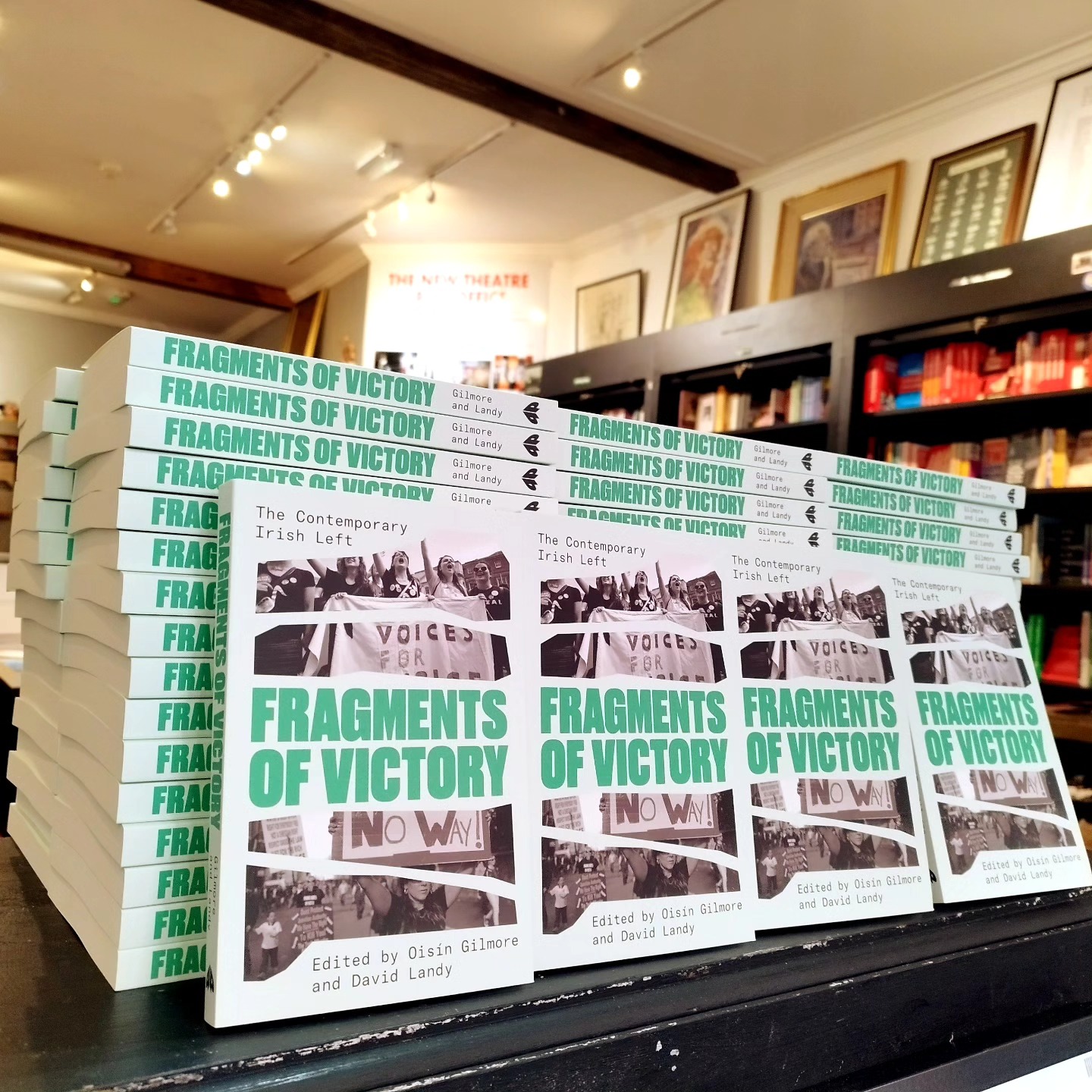
Fragments of Victory’: The Contemporary Irish Left’, book review (5 of 6)

Fragments makes a series of observations about the political consciousness of the Irish working class, some of which we have already noted, such as the view of many on the Labour Party entering office that ‘the crisis was clearly not their fault and . . . the harsh austerity measures they took were seen as both forced by the Troika and, while painful, necessary.

It records the view of another author that the first year of crisis saw a large number of demonstrations but these ‘dried up once the public realised the magnitude of the banking crisis, and they were replaced by years of “muted protest”. Certainly, there was a sense of powerlessness at the scale and suddenness of the economic crash, a degree of acceptance of the official narrative . . .’ (p31)

It notes that the muting of protest was partially the result of emigration, particularly of the young with 106,000 leaving from 2009 to 2013.  ‘However, the muting of opposition was also due to the influence of the Labour Party and trade unions, which contained protest and channelled anti-government anger down institutional routes from 2009 to 2011.’ (p30). These organisations did indeed push anger down the road of inevitable failure, and yes, they were betrayed, but how was this possible?

One contributor notes that by late 2013 ‘it is difficult to overstate the feeling of exhaustion and disillusionment’, with the radical left ‘comprehensively defeated on the one anti-austerity struggle they’d seriously fought – household taxes.’ The ‘public mood was judged sullen but compliant’ and was successfully ‘blackmailed’ into voting yes to the EU’s fiscal Treaty in 2012 ‘even though this treaty restricted the possibility of future government spending” (p 40-41)

wrote about this result at the time, noting that:  ‘At 60 per cent Yes against 40 per cent No there is no room for doubt.  It is a decisive endorsement of government policy and a mandate for further cuts and tax increases.  The result should not have been unexpected given the political forces ranged in support of the Treaty, the support of big and small business, the failure of the trade union movement to oppose it and the inevitable support of the mass media.  In the general election last year the Irish people voted by a large majority for a new government in no important way different from the previous one and with no claim to pursue significantly different policies.’

I also noted that ‘Austerity isn’t popular despite the vote and never will be.  Even the Yes campaign was under instructions not to celebrate its victory . . . In October last year when the Austerity Treaty was originally being negotiated an opinion poll recorded 63 per cent opposed to it with only 37 per cent supporting.’  I noted that some people had changed their minds or perhaps did not have the confidence to follow through on their opposition.  This might have united around the demand to repudiate the debt taken on by the state on behalf of the banks and their bondholders, but this also meant opposition to the Troika upon whom the state had become reliant.  It also meant opposition to the administration in the US, even though its Secretary to the Treasury Timothy Geithner thought it was ‘stupid’ to guarantee the banks liabilities. 

I wrote a number of blogs on the issue of repudiating the debt herehere and here, and the disastrous and ‘stupid’ decision to bail out the bondholders in the first place.  Doing so was a real political challenge and required an alternative that didn’t exist.  Without this the failure of the opposition to austerity was inevitable, even if the question of the debt was only one element of the necessary political alternative.

Where the book completely fails is the neglect of what the political content of the alternative might have been, although this is revealing.  In recording the activity of the left its non-appearance reflects the absence of this in the anti-austerity movement as a whole and the failure to win any significant section of it to a socialist perspective.

The same contributor noted above goes on to say that at a later time ‘A proper balance sheet would recognise how the Labour Party and the aligned section of the union movement were rendered powerless to influence or sidetrack the anti-austerity movement.’ (p 42). He points to the drop on the Labour vote from 19 per cent in the 2011 general election to 7 per cent in the 2014 local elections and the ‘victory for left-wing independents and Trotskyist parties alike.’ (p 43)

He argues this was possible because in 2014 100,000 marched against water charges in October followed by 150,000–200,000 in November and 80,000 (in Dublin alone) in December in what was ultimately a winning struggle.  We have already noted the limp role that was expected of the trade unions and political parties in the campaign in the previous posts but the argument that the Labour Party and trade union leaders could not divert the campaign is correct.

It won because it was a community campaign based on mass protests, blocking the installation of water meters and non-payment of bills.  Independents and left wing candidates benefited from their role in the campaign which also distinguished itself by exposing the equivocating role of Sinn Fein. Despite the political weaknesses of the campaign that we noted previously its tactics were able to beat the counter-measures of the government where the previous campaign against household charges could not.

The campaign proved that individual campaigns, given the right circumstances, could defeat particular austerity measures even where the wider offensive was continued successfully. It should be recalled that the water charges campaign took off almost a year after the state exited the Troika bailout programme. It is also worth recording again the failure to draw the right political lessons as the trade union official who contributed the chapter on the campaign finishes his story by endorsing the statement by ‘one of the world’s greatest authorities on water’ that:

‘The Irish system of paying for water and sanitation services through progressive taxation and non-domestic user fees, is an exemplary model of fair equitable and sustainable service delivery for the entire world.’ (p 61)

In fact, the Irish water industry was wasteful and inefficient and state ownership is neither democratic nor socialist.  For this, workers’ cooperative ownership or the demand for workers’ control would have been necessary but the Irish left, like so much in the rest of the world, have become habituated to statist views of socialism that Marx repudiated but that have become entrenched through the domination of social democracy and Stalinism over the last one hundred years.

With such a political platform the problem of the state being the solution, when the solvency and policy of the state was the problem, was once again avoided because doing otherwise would raise the question of ownership and control that would show the platform’s inadequacy.

The main victory in Fragments of Victory was thus necessarily limited and could not be a springboard to address the many deficiencies of the resistance identified in the book.  These included the failure ‘to build lasting political and social institutions’ and ‘no lasting form of working-class self-organisation.’  Reliance on capitalist state ownership as ‘an exemplary model’  illustrates why a problem could not be addressed: that ‘the steps between the current situation and the long-term goal of socialism are less clear than ever before.’ (p192)

The view that the trade union bureaucracy was ‘rendered powerless to influence or sidetrack the anti-austerity movement’ is therefore only partially true. The politics of the bureaucracy, and of the Labour Party, were not challenged by a wider political alternative and the much-trumpeted militant tactics of the campaign were no substitute for it.

back to part 4

Forward to part 6
Fragments of Victory’: The Contemporary Irish Left’, book review (4 of 6)

In the previous post I argued that the leadership of the trade unions were unable and unwilling to challenge austerity because it would involve a political challenge to the state it had decades of ingratiating itself with it as its ‘social partner’.  However, I also noted that ‘the undeveloped and inadequate political consciousness of the working class itself [was] also a major factor’ in the union movement being unable to successfully resist austerity.

The socialist critique of the bureaucratic leadership of the trade unions is not that its passivity never reflects the views of its members but that the occasions in which members are prepared to take action are often betrayed and their passivity reinforced through ensuing demoralisation.

Protests and demonstrations (called by trade unions early in the economic crisis and also later) are only useful in so far as they are necessary steps to more effective action: by rallying the troops and persuading others that there are alternative courses of action and the means to achieve them.  Otherwise, they are what they are defined as, simply public expressions of objection, disapproval, or dissent, and public exhibitions of the attitude of a group toward an issue.

There is currently no other rival union leadership that believes in independent working class politics that is separate from and opposed to the state and seeks to increase the class’s political consciousness.  Bureaucratic organisation stifles any democratic control that might permit episodic bouts of struggle to advance and accumulate an understanding of class politics.  Lack of democracy and low participation are both causes and effects of political weakness.

Both the leadership and membership are wedded to the view that fundamental change can come only through the state as the only (legitimate) agent capable of achieving it.  All sections of ‘the left’, from Sinn Fein to supposed ‘Trotskyists’, have a political programme that hold that achievement of governmental office will enact this social transformation, and campaign on this basis.  How a capitalist state will permit this is never explained.

Of course, People before Profit and Socialist Party pay obeisance to the view that the capitalist state will have to be overthrown but this plays a role analogous to republicans’ view that the legitimate government of Ireland resides within the IRA.

During the crisis there was little to no awareness of the possibility of an independent working class political force as more than perhaps a vehicle to pressurise the state, or with a view to having its representatives occupy positions in its parliament so that they could legislate sought after policies and adopt necessary measures.

This reflects the widespread support for the democratic credentials of the state and its political system, further legitimised by the country’s colonial history and the struggle against it.  This gives the nationalism that is the express ideology of almost all political parties a progressive veneer and a reactionary essence.

Accompanying this is an acute awareness of the weakness of the small Irish state and its dependence on US investment and EU membership, where most power resides in the much larger European states.  There are some illusions in the independent sovereignty of the state but also awareness of its constraints.  When the Irish state became bankrupt the view that it could not resist the demands of the EU and US that it bailout the banks was reluctantly accepted because there appeared no alternative.

When your politics is based on winning concessions from the state, and/or the perspective of being the official government of the state, it is difficult to present these as possible when that state is bankrupt and your proposed actions are opposed by much more powerful states.  Not only does it look unconvincing, it actually is.  Hence the comment in the book, in relation to the Dáil, of the ‘futility of marching to an institution that was taking its own marching orders from elsewhere.’

One contributor to Fragments, writing about the trade union input into the one anti-austerity campaign that was successful – against water charges – reports that ‘political economy training . . . was the most impactful part of the campaign’. (p57) Except this training appears to have been peddling the same mistaken conception that state ownership is the answer that the whole crisis, and the response to it from the Irish state, should have utterly dispelled.

This campaign morphed into the Rights2Change movement that on paper united much of the left and some trade unions.  Its programme of rights, which went beyond the question of water, made sense only if the state had an obligation to satisfy them, and it didn’t begin to address the claims by the government about the lack of state resources to do so.  A programme based on the supposed moral obligations of the state was as weak as the commitment of the various organisations to the project. It demonstrated only that this spectrum of organisations was united in illusions in, and subservience to, the capitalist state.

Two aspects mentioned in the book illustrate these weaknesses: ‘throughout the period of Right2Water’s existence, nobody was working on the campaign full time. The bulk of the work on the union side was done by two or three trade union officials who also had their day jobs.’ (p61)

As to the unions role as a ‘pillar’ of the campaign, it was to ‘bring organisational skills . . . politically neutral; provide economic and political research; have activists in workplaces all over the country and bring financial assistance.’  (p 55) Nothing about workers action in the workplace and what sort of action its ‘activists’ should fight for.

The role of political parties was equally somnolent – to ‘bring political knowledge; an ability to raise issues in the Dail and have activists in communities all over Ireland.’  (p55) Again, without an acceptance that political debate over aims and strategy was absolutely required, as opposed to already accepted, there was no specifically political input sanctioned for political parties.

Like so many left campaigns, broadness was confused for depth, and political shallowness for agreement and unity.  One ridiculous outcome was that at one demonstration ‘we ended up with 36 speakers or acts.’ (p53) One unambiguously positive legacy of the campaign claimed by the writer is that the ‘unions and progressive political forces were in place to prevent the movement from being co-opted by the far right.’ (p60). Not a high bar.

If the original platform for the campaign was weak (that water was a human right), there remained differences on appropriate tactics, so it could be no surprise that this attempt at turning a ‘mass movements’ into a’ story of mass organisation’ rather than simply mass mobilisation’ was a failure (p180-1 &182). This meant that it was ‘large but ephemeral’, ‘failed to lay deep social roots’, ‘failed to identify an avenue through which society might be changed, and given this, . . .  failed to develop a mass political consciousness around the capitalist nature of our society or around what needs to be done to change it.’ (p183)

Sowing illusions in the state and failing to educate those mobilised on its unreformable class nature is guaranteed not to ‘develop a mass political consciousness around the capitalist nature of our society.’  The major success of resistance to austerity set out in the book came nowhere near this because it didn’t try, and it didn’t try because the left didn’t know what this would have to involve.

Back to part 3

Mission creep Ukraine (2 of 2)

The views of more honest Western commentators, that the Russian invasion has been provoked, have been roundly denounced as the work of Putin apologists who are excusing the invasion.  However, knowing the invasion was provoked neither excuses it nor requires one to support it.  It was open to the left opponents of the invasion to acknowledge this as well, but many of them didn’t. They came out with the same response as the vast majority of bourgeois propagandists and politicians in the West in denouncing any recognition of this reality as an apology for Putin.

In other words, the pro-war left joined in the whitewashing of their own imperialism’s responsibility for the war.  They didn’t have to, but they did.  For many bourgeois writers, simply setting out known facts and accepted realities, and pointing out the role of the West did not invalidate their support for it because for them NATO is a very good thing.

Such an approach was not open to the left supporters of Ukraine because they can’t claim the same innocent character for NATO.  They therefore couldn’t acknowledge the previous close cooperation of Ukraine with Western imperialism, otherwise the alliance now so obvious during the war would be seen as the flowering of an existing collaboration, robbing Ukraine of its cloak of innocent bystander.   The so-called Marxists were thus left hiding the role of their imperialism much more radically than even the more honest of its bourgeois supporters!

The most that would be admitted was that western imperialism was supporting Ukraine ‘for its own selfish interests’, as if this disposed of the matter; as we have seen, these leftists were claiming that ‘NATO won’t intervene’ and that even though Ukraine had the right to seek help, this was something ‘which it won’t get’.

Others stated that ‘we are without hesitation in favour of the delivery of defensive weapons to the Ukrainian resistance.’  This source further said that ‘we must also oppose the delivery of air fighters to Ukraine that Zelensky has been demanding. Fighters are not strictly defensive weaponry, and their supply to Ukraine would actually risk significantly aggravating Russian bombing.’

Of course, the Bradley’s, Abrams, Leopards, Chieftains, HIMARS, ATACMs, Storm Shadows and F16s etc. have disposed of the ridiculous notion that ‘NATO won’t intervene.’  Has the exposure of their blunder caused them to row back?  Of course not.  Even the supply of F16s that was previously opposed has not signalled the least change, except of course that the supply of increasingly powerful weaponry does represent a change in the real world that the social-imperialist supporters of Ukraine refuse to acknowledge.

By doing so these leftists effectively stake a claim for the same innocent character of NATO intervention that its Western bourgeois allies do, its ‘selfish interests’ notwithstanding.  By virtue of the Ukrainian fight being simply defensive, so therefore (we must assume) is the NATO supply of weapons!  NATO, though it is threatening expansion into Russia’s next door is still presumably a defensive alliance!  All its moves, as that of Ukraine, are simply written off as reflexes to Russian aggression.  As we said in the first post – opposition to imperialism means opposition to Russian imperialism, no more and no less. Russian imperialism has thus performed the amazing feat of rendering Western imperialism non-imperialistic!

The problem for this left is that it left a lot of hostages to fortune; we have already seen the delusion involved in the statements that NATO won’t intervene and won’t supply weapons.  It has supplied so many it has seriously depleted the stocks it says it needs for itself! It now needs massive rearmament to continue its support to Ukraine, which presumably must also be supported by the pro-war left. Once more the ‘selfish interests’ behind this must again presumably be considered entirely secondary, if not irrelevant.

Joe Biden made it very clear before the war that he knew that the invasion would take place but was not the least interested in seeking to stop it: he would not “accept anybody’s red lines.”  Instead, he had “the most comprehensive and meaningful set of initiatives to make it very, very difficult for Mr Putin to go ahead and do what people are worried he’s going to do.” Except, these weren’t measures to stop an invasion but to hammer Russia after it had done so.

The escalation of weaponry supplied since these “initiatives” is both a sign of the intention of Western imperialism to prosecute a proxy war and a sign that it has been losing.  The first leftist quote in the previous post stated that “Ukrainians have the right to take weapons from wherever they can get them in a fight to the death with the invaders.”  The insouciance to the prospect of ‘fighting to the death’ with the help of weapons from imperialism has otherwise been correctly described as ‘fighting to the last Ukrainian’, and lies behind certain imperialist interests demanding conscription of the youngest cohort to the Ukrainian army.  

Such is the policy of Western imperialism (now with the added twist that Trump wants to make money out of it) and also the policy of the social-imperialists.  Having admitted that the supply of Fighter aircraft “would actually risk significantly aggravating Russian bombing”, this has proved to be the case; yet it has given rise to no re-evaluation of support for Western intervention.  Like the imperialists themselves, the resulting retaliation by Russia suffered by the Ukrainian population is completely secondary to the cause they jointly support.

The firing of long range missiles into Russia with the direct participation of western troops has dramatically escalated Western provocation that increasingly incentivises Russia to escalate in return since the price paid may be less than that of acceptance: with the lack of deterrence of further western escalation if it does not.  This logic is not inevitable, the weapons supplied by the West have not been able to gravely hurt Russia, never mind deliver the victory that Ukraine has until recently claimed it could achieve. I don’t know if its Western left supporters are still under this illusion.

Without a mass antiwar movement seeking to prevent it escalation is made more likely, but in any case out of our hands, and less likely the weaker Western imperialism is.  How far we are from such a movement can be seen in the need for articles like this one attempting to stop much of the left from supporting the war, with all its escalation and potential for further in the future.

The first quotation states that ‘NATO won’t intervene because it doesn’t want a new world war.’  The author obviously saw that such an intervention threatens it.  Well, NATO has intervened – big time – and the author and his fellow social-imperialists are still cheerleading it.   Has the threat disappeared or does it not matter anymore? Or does the sacred character of the Ukrainian capitalist state demand that the risk to the future of all of humanity is a risk worth taking?

Perhaps the author has forgotten his statement; although forgetting that one foresaw the potential for a world war when the circumstance that might bring it about have been amplified would show remarkable detachment.  Alternatively the author might not have really believed the statement, in which case there would still exist a degree of detachment.

In any case, the exposure of the claims of the supporters of the Western imperialist alliance in its war against Russia fully confirms its political bankruptcy.  Its predictions have been disproved and its statements of position have been exposed as false.  Running through them is the thread of social-imperialist politics – socialism in words and pro-imperialism in practice.

Back to part 1