G8: The Mafia Empire Part 1

putin in glasses

by Belfast Plebian

‘We shall not shock anyone, we shall merely expose ourselves to good-natured or at any rate harmless ridicule, if we profess ourselves inclined to the old fashioned and simple opinion according to which Machiavelli was a teacher of evil.’ Leo Strauss


The wiseguys are again meeting at a secluded location, not at the Apalachin retreat in upstate New York as depicted in the Godfather movie, they did that one back in 1957, but at a lakeside hotel in Fermanagh. The world’s most feared political gangsters are holding two days of much needed sorting out talks, for their dark mutterings and latent rivalries have reached a point of near breakdown in diplomacy. The quarrels between them have become so heated that they imply in an undeclared war over the future of Syria and beyond that you can see through in the ongoing currency war between them.

It is my contention that there is a strong correspondence between the politics of the G8 and the Mafia politics of the recent past.  When I say correspondence I do not mean identity.

The political gangsters of today are therefore obliged to acknowledge a debt to the late great mafia boss Salvatore Luciano, the mobster who dreamt up the idea of a Mafia Commission to settle intense quarrels over criminal opportunities. Lucky Luciano established the Mafia Commission in 1931, a corporate body to mitigate the violent disagreements among the warring crime gangs.  Luciano wanted to end the chaos that had led to a bloody and self -destructive gang war in New York and Chicago during the 1920s. In 1925 he was grossing over 12 million dollars a year and had a net income of around 4 million dollars after the cost of bribing the politicians, judges and police was deducted.

But his private fortune was put in jeopardy by the intense gang rivalries, which escalated into a fierce street battle known as the Castellammarese War, that raged from 1928 to 1931 and resulted in the deaths of at least 60 top mobsters. So he looked for a way to lessen the strife and violence and found it in the Commission, a corporate body that has endured for over seventy years.

Lucanio did not want to be an Italian- American Caesar. He realised that the best way for him to stay alive and rich was to let the most powerful crime families run there own internal affairs, but establish an administration to settle their differences and to mobilise enough combined muscle to crush any new rivals. He established a mob board of directors known as the Commission to oversee all criminal and business activities and to mediate strife between the contending families. It was to meet every five years and its decisions were non-negotiable.

The Commission officially comprised seven crime families; the heads of the New York five plus, the Chicago Outfit of Al Capone and the Buffalo based crime family led by Stefano Magaddino. The Commission did not stop all gang warfare, but it did reduce the number and scale of them; when one gang transgressed against another it would often find itself at war with all the rest. There was no single ruler of the Commission, but there was a nominated chairman who was oath honoured to stand for the common good.

The Commission largely succeeded, for what we find is that while the personnel of the ‘FAMILIES’ frequently changed, over time the same crime families stayed on top of the underworld from then until today: The Bonanno crime family, the Colombo crime family, the Gambino crime family, the Genovese crime family, the Lucchese crime family, the Philadelphia crime family and finally Al Capone’s Chicago outfit.  They established a better capitalist crime model for themselves than the current rather shaky G8 one and it is the reason why Time Magazine once called Lucky Luciano one of the most influential Americans of the twentieth century.

“I learned too late that you need just a good brain to make a crooked million as an honest million. These days you just apply for a license to steal from the public. If I had my time again I’d make sure I got my license first.”  Lucky Luciano.

The G8 – the people who got  the licence first.

If you succeed in politics you can usually surpass anything a Crime Family Boss can do in almost every division of life including killing and enriching yourself at the cost of others. Take Tony Blair for example.  Everyone knows about his illegal and immoral acts of killing, but what of his wealth? Here is a report just picked up from reading yesterday’s newspaper (Daily Mail Saturday 15, 2013). Depending on how you cut it Blair is now worth £60 million or £80 million.  He has set up a Byzantine network of inter-related companies to funnel his vast tribute for being a useful Prime Minister. Useful for whom you might ask, well useful for the Banksters.

His first tribute after leaving office came from the world’s leading investment bank JP Morgan Chase.  He has been a senior adviser for the last five years on a £2.5 million salary and his preferred mode of transport these days is a rented Gulf Stream V private jet. He says he was able to facilitate the bank’s clients due to high-level political contacts made with the Rwanda government when he was Prime Minister. The former PM has also done a deal to promote the dodgy government of Kazakhstan, he apparently gives it advice on good governance and this has already netted him £16 million

He has been receiving £1 million a year for advising the Abu Dhabi sovereign wealth fund where it is safe to invest their oil money. He is said to be as thick as thieves with the super rich Sheikh Hamad bin Jassim bin Jaber al Thani, the PM of Qatar. One of his other rewards for once holding political office came from the Kingdom of Kuwait – this netted him a swell £27million and his think tank was asked to produce a report on the future of the Kingdom called Kuwait Vision 2035.

There is plenty more of that sort of stuff in the newspaper article. Tony Blair is an example of a political mobster of the very successful type. The thing that makes these ‘democrats’ different is that they have to wait to leave political office before collecting the readies rather than taking it while they are in office, say like ‘oligarchs’ like President Putin, another of the G8 stars.

President Putin officially lists his salary at 5.8 million rubles, about $190,000  a good deal less than Obama’s official salary of $400,000.  He also claims that he has very little personal wealth.  During his election campaign he claimed he had $180.000 in his bank account, owned three Russian made cars and a small apartment in Moscow, so a lot less than Obama’s personal wealth estimate of $12million.

Here is an independent assessment of his personal wealth made by a celebrity magazine:

‘So what evidence is there of Putin’s secret obscene fortune? Let’s start with the small stuff. Putin is known to sport a $150,000 Patek Philippe watch on most occasions and his total collection has been valued at at $700,000.  He also has full access to a $40 million ultra luxury yacht that features a wine cellar, Jacuzzi, helipad and outdoor barbecue area   In terms of living accommodations, Putin has access to 20 mansions throughout the world including a lavish ski lodge and Medieval castle.  The crown jewel of his property portfolio is a $1 billion palace overlooking the Black Sea that he allegedly owns through an anonymous trust.  Furthermore, Putin makes frequent use of 15 Presidential helicopters and more than 40 private jets, many of which feature gold plated interiors . If Vladimir Putin’s net worth truly sits at $70 billion, that would be enough to make him the second richest person on the planet right behind Carlos Slim Helu. It would likely also represent one of the largest personal fortunes ever accumulated by a sitting President. The only other world leader who possibly looted more cash from his country was Muammar Gaddafi who after 40 years of power stashed away a reported $200 billion in ill-gotten oil money.’

It might of course be argued that Tony Blair is a rogue politician, that the Heads of States of our Democracies are usually very different from him and therefore different from the Bosses of the Mafia Families. Yet ex-President Clinton has trousered a lot more tribute than Tony Blair and Obama will certainly get filthy rich when he finally hangs his coat up on the White House door.

Some of our more notorious mobsters believe they have a good handle on the entire thing. Here are a few quotes from Al Capone about living in the world’s purest democracy.  Al didn’t ever get too caught up in the whole democracy thing ‘capitalism is just the legitimate racket of the ruling class’. . . ‘This American system ofours, call it what you will, gives each and every one of us a great opportunity if only we seize it withboth hands and make the most it’. The mobsters can never fathom how they are doing anything different from the politicians and that often is their weakness, the bankers and lawyers of the democracies get the law on their side before they commit the crimes, or if they do the crime without the assistance of the law they get the politicians to amend the law to make sure they avoid the normal consequences of the law.

In every episode of the Max Keiser show on Russia Today evidence is produced to demonstrate how the law is broken and amended to help the financial criminal elite of Wall Street and the City of London. In March of this year a US Senate committee compiled a 300 page report documenting the fraudulent and criminal practices sanctioned by Mr Blair’s favourite bank and the largest dealer in derivatives trading in the world.  Despite all the evidence, no legal action was deemed appropriate, and the CEO Jamie Dimon remains a Consigliere to the President concerning the financial markets.

The late John Gotti was once the Boss of the powerful Gambino family.  is advice to the young included the following: ‘be nice to the bankers. Always be nice to the pension fund managers. Always be nice to the media. In that particular order.’  The Mafia ‘philosophy of self enrichment without conscience’ is perfectly suited to the present condition of finance-dominated capitalism.  It is certainly difficult to spot the difference between what the law calls loan sharking and current legal lending.

The loan shark figures a lot in Mafia books and films, the person or business that offers loans at extremely high interest rates and the smaller the loan the more onerous the repayments. In the early days of Mafia loan sharking it was confined to payday lending on potential wages with most of the customers being office clerks and factory workers. The 1952 film ‘Loan Shark’, featuring mobster favourite George Raft, depicts the whole payday loan racket.

In the 1960s the Mob shifted their loansharking to small businesses as they had assets that could be confiscated if payment was overdue. The irony is that the Mafia historians tell us that payday lending to workers largely disappeared by the 1970s.  Now of course they are back with the sanction of the law and the backing of the politicians. In Britain the Campaign group Debt on our Doorstep campaigns against the practice, if you are interested go to their web site for some horrific stories.

One of the big players in the payday loan racket is Wonga, the sponsor of Blackpool football club.  Last year it declared £45million in profit, by advancing over 4million loans. The annual interest rate on its payday loan is 4,214 percent.  One of Wonga’s main stockholders is Dawn Capital, whose chairman is called Adrian Beecroft who is a donor to the Conservative party.  The Prime Minister David Cameron asked his friend Mr Beecroft to prepare a report on the future of employment law and he recommended that employers be given the right under the law to sack workers at will and without explanation.  The oily rag PM liked the idea but the Liberals thought it was a bit strong for now so it did not become law. Once again the immoral activities of the Mafia mobsters have been superseded by the legal activities of the political gangsters.

Lets move on to tax. The Mafia bosses never like to pay tax, they are very much in the low tax political camp. This brings us to Al Capone; in 1927 it is estimated he made about $100 million, the equivalent of about $1.2 BILLION today.  Despite his profession the authorities could never pin a serious crime on him with the Treasury Department attributing this to his ‘natural Italian secretiveness.’  He was maybe helped by the fact that no witnesses would testify against him, but the main reason was he was generous with his money.  It is estimated he spent over $30 million in 1927 on gifts to politicians, judges and police chiefs.

Al Capone was eventually convicted and sent down because he was a tax evader, yet how was this conviction lawful?  Capone had this to say: ‘the income tax law is a load of bunk. Thegovernment can’t collect legal taxes from illegal money.’  When he was sent down it was the toughest sentence ever imposed on a tax evader. Capone told the newspaper guys: ‘I’ve been made an issue, I guess I’m not complaining. But why don’t they go after all of those bankers who stole the savings of thousands of poor people and lost them in bank failures? How about that?  Isn’t it a lot worse to take the last few dollars some family has saved-perhaps to live on while the head of the family is out of a job-than to sell a little beer.’ 

This of course is an example of trying to get the victims of the capitalist system on to your side when you have just become undone and disgraced politicians frequently play this populist card, nevertheless we appreciate the point. Many respectable people got rich during the prohibition era by selling alcohol as a legal medicine.  The fine novel ‘The Great Gatsby’ is a fictional account of a legal medicinal bootlegger. The father of the Kennedy political dynasty held such a licence and he used it to stock his warehouses in the period just before the end of prohibition.

But what about tax evasion and tax avoidance?  Davis Cameron says this is to be one of the big-ticket items on the agenda of the G8 summit. He claims he wants to see companies pay their fair share in tax but he doesn’t try to define fair. One can just imagine him raising the matter at the G8 to the annoyance of the French President.  Here is what he had to say one year ago to the very day: “If the French go ahead with a 75% top rate of tax we will roll out the red carpet and welcome more French businesses to Britain and they will pay taxes in Britain and that will pay for our health service, and our schools and everything else.”

Let’s now add a little bit more beef to his speech from the G20 meeting in Mexico 2012: “Every country sets its own tax rates, but I think in a world of global capital, in a world where we’re competing with each other, in a world where we want to send a message that we want you to build businesses, grow businesses and invest, I think it’s wrong to have completely uncompetitive top rates of tax.”  The oily rag PM is just playing with the public over tax.

Consider this snippet from a recent white paper covering the status of the UK oversees territories: the UK’s parliament has “unlimited power to legislate for all its overseas territories and crown dependencies”.  He is putting on a show as if to say all he can do is try to persuade Bermuda, Cayman Islands and the Channel Islands etc to play fair on tax, when he could command them to do so.  They will of course carry on as before and Cameron will stand back and shrug his shoulders. You should not be fooled into thinking that the British government is responding to the campaigns of the NGO’s to make tax on companies into a social issue.  What he is defending Britain from is criticism from the other G8 political leaders, especially that coming out of the Congress in Washington who think the political class in Britain have effectively turned the country into one big Tax Haven to the detriment of Uncle Sam and others. 
The G8 comes to Northern Ireland

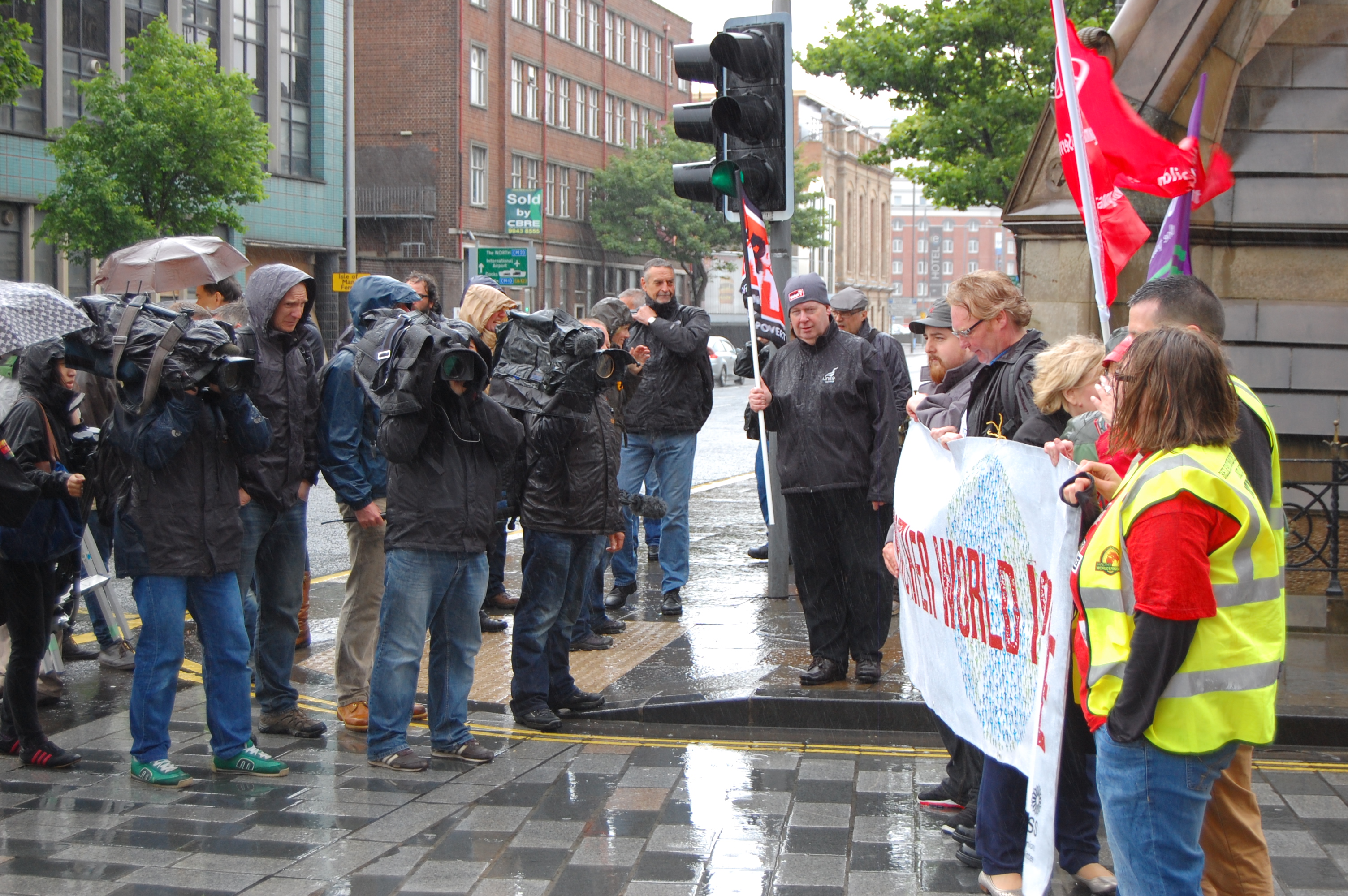
DSC_0394The leaders of the G8 group of the wealthiest countries are meeting this week in rural County Fermanagh.  That some of the most powerful political leaders on the planet are visiting us is yet again another opportunity to demand of the local population the most obsequious and embarrassing homage to our betters.  Deference normally required only for royalty.  A columnist in a local paper reported that claims had been made that the visit would boost the local economy by something like £700 million, a figure so outlandish it does not even deserve ridicule.  More sober estimates have come in at less than £100 million but if the experience of Scotland is any guide the costs will easily exceed this and today I saw first-hand evidence that this will indeed be the case.

As is usual the media have been on overdrive to sell how wonderful this all is, normally in some vague and unspecified way, for example ‘it puts us on the map’, as if we weren’t already on it, and it gives us the opportunity to sell Northern Ireland. How often can you sell something that never gets bought?  It was the occasion for yet another economic package, announced by David Cameron, Peter Robinson and Martin McGuinness.  But again it was déjà vu all over again.

The local Executive, it was announced, will be able to borrow an additional £100m for capital projects for shared housing for example.  But the Executive has just confirmed that it is incapable of providing shared housing through its handling of the old Girdwood British Army base in North Belfast.

And no one will be able to tell you what golden opportunities were being missed until now by absence of this money .

More measures to boost lending to business was promised but it has been reported in the financial press that the ConDem coalition has totally failed in its attempts to achieve this goal with its own schemes in Britain.  Borrowing just when bond yields are rising across the globe, even after countries have printed money like never before – heralding an end the recent era of low interest rates and an interest rate rise that may have devastating economic consequences – does not look the cleverest policy in terms of timing.  Projects to be financially profitable will have a higher hurdle to jump over than before.

More peace money is promised while the local paper’s front page reported this week that there had been  a 25 per cent increase in paramilitary intimidation; sanctioned by the local police who have approved the loyalist UVF’s marking of territory in East Belfast by their flying of their paramilitary flags on anything that doesn’t move.  Meanwhile the DUP and Sinn Fein leaders hatch an £80m slush fund for these same paramilitaries.

We are promised yet another investment conference while having witnessed the utter failure of previous ones and most recently been treated to the farce of Peter Robinson and Martin McGuinness’s ‘investment-promoting’ visits to China and Brazil. Again we are promised another look at devolution of powers to reduce corporation tax as if a different result might be expected.  The example of the Republic across the border should demonstrate even to the terminally stupid that low corporation tax is perfectly compatible with bankruptcy.

It is simply impossible for anyone with any appreciation of recent events not to be cynical because no matter how jaundiced a view one takes of this event it is exceeded by the malignant contempt shown by the visiting leaders and their local satraps.

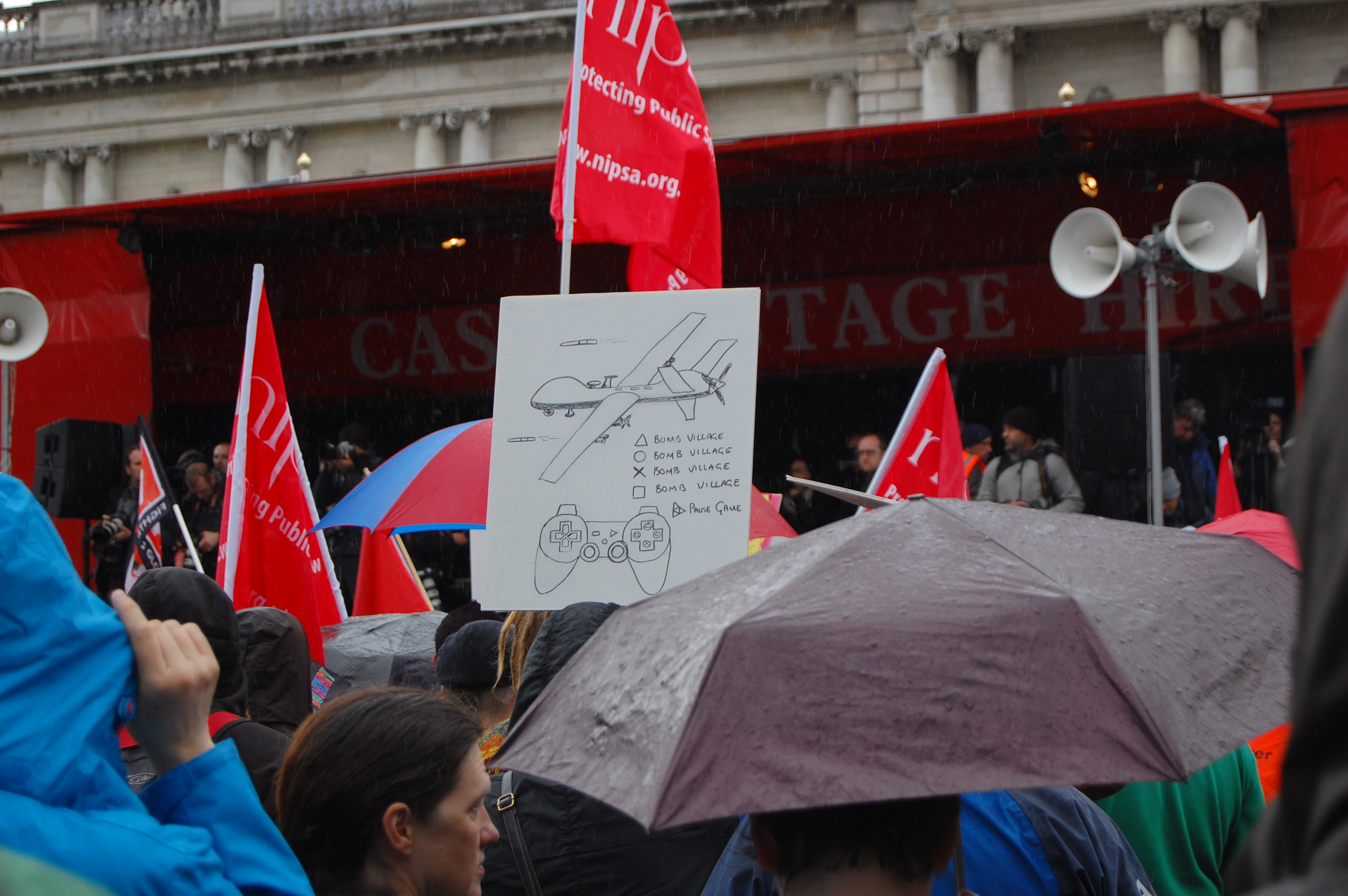
Obama has sanctioned spying powers that make George Orwell’s 1984 look like a photograph of the future and he approves drone attacks that murder dozens if not hundreds of civilians.  We have Russia’s Vladimir Putin whose wars in the Caucuses have involved utter devastation on an enormous scale. Then we have the Japanese, attempting to lay the foundation for a new nationalist militarism by rewriting its murderous imperial history. These are the leaders we are asked to welcome as if we are blessed to breathe the same air.

But reality intrudes and the real character of their visit is revealed by the security clamp-down that looks like and feels like a police state. Roads in Fermanagh have been blocked for a month, causing problems for small businesses in the area, while young people doing their year-end exams have been told to get to school at an unearthly hour to do them.  Fences have been built and thousands of security personnel brought in.  Belfast city centre on Monday morning looks like it is to be closed down.  Sixteen miles of the M2 motorway into the city is also to be closed so that Obama can speak at the Waterfront Hall in praise of the peace process that never ends and never ends promising the end of strife.  Government workers have been told by email that they may have difficulty getting to work but should therefore plan to travel longer, get in earlier and leave later – section 3.11 of Annex 2 paragraph 4.1 of the HR policy is referenced.  With no hint of irony the responsibility to maintain services to the public is repeated.

The reality of the visit is revealed by the fresh painting over of empty shops in the county town of Enniskillen to make them look like they are open and full of people. Oh, and the hotel complex the meeting is in isn’t really in administration, not being a casualty of the Irish property boom.  The plan is obviously that the hype will cover up the reality and, well, if it doesn’t, we’ll be outa here soon anyway.

Holding the G8 in Northern Ireland was seen as a bold step.  Wasn’t this the scene of decades of trouble and didn’t the G8 risk occasioning more?  Hadn’t previous summits been the cause of widespread protest wherever they were held?

Well today, Saturday, was to be evidence of the scale of the opposition to the G8 leaders and their crimes.  A demonstration had been called by trade union leaders and assorted NGOs.

Unfortunately this opposition proved that it wanted to show, not that a different world was possible, but that a slightly different world would be nice.  The hype of the G8 cheerleaders was replicated in the ICTU Northern Ireland Committee’s leaflet, which promised ‘what is sure to be one of the largest mass mobilisations of peoplepower Belfast has seen.’   The demo was in fact no more than 2,000 people – maximum – and not much different than the usual May Day demonstration.  The annual 12 July Orange bigot-fest is many times larger.  The slogan of the demonstration that ‘they are G8 – we are 7 billion’ looked very hollow. Belfast City centre was unusually quiet.  The alternative of having the demonstration through some working class areas would never have crossed anyone’s mind, certainly not that of the trade union leaders.

As I walked the less than half mile to the demonstration starting point through Belfast city centre I must have passed about 70 police land rovers, and that was just on the route that I took.  Most of the coppers were English – they looked like they weren’t natives and were very much more po-faced than the local cops, despite the overtime.  There were hundreds of them.  A bigger case of over-kill it would be hard to imagine.  It might even be embarrassing for their top brass, were the media to make anything of this OTT display of the state’s repressive power.  This was a demo called by ICTU for god’s sake!

This is the same ICTU that has for years either been in partnership with the state, as in the South, or seeking partnership, in the North.  Its leader was a member of the Southern State’s Central Bank, the Regulator that allowed the ‘wild west’ financial system to accumulate so much debt it bankrupted the country.  This is the trade union movement responsible for the Irish being renowned throughout Europe for their ability to accept austerity that has caused riots in Greece, Spain and Portugal.  It wants a ‘better and fairer way’ to inflict the pain of austerity.  It doesn’t actually want to overthrow capitalism and socialism was not a word I heard at the rally at the end of the demonstration.

DSC_0416 Instead the speeches were declarations of opposition to bad things and support for good things and appeals to moral values such as fairness and justice.  Unfortunately the world is only as fair and a just as we can make it and in the meantime it is as just and as fair as the capitalist class considers it should be based on how it defines both.

What was missing was any strategy to change this situation and any agency that could enact this strategy.  What we were left with were appeals to the governments against whom we were actually demonstrating; appeals to the same states whose job it is to defend the system, not change it – the same state that put on show such a massive show of force to justify its hyping up of dire threats of violence.

As I and my friend left the rally and went into Boots for a short cut my friend was told to take down his hood – it had been pouring down for hours.  An older woman with grey hair was also told to take down her hood although she demanded to know why?  Was she hiding her identity so she could trash capitalism and then run into the street and avoid the hundreds of cops outside?  (Most of the bigger shops had massively increased security on their doors, another example of the hype surrounding the visit of the leaders of the ‘free’ world.)

One footnote: the rally outside the City Hall at the end of the demonstration was jeered and heckled by a group of perhaps 50 loyalists from the Shankill Road who were continuing their own protest against the butchers’ apron no longer being flown 365 days a year.  Ironically it was flying today, it being a ‘designated day’ because it was the Queen’s birthday – she has two don’t you know. These reactionary bigots sang sectarian songs including the ‘Billy Boys’, i.e. they were ‘up to their necks in fenian blood’ – a favourite of supporters of the now deceased football club Glasgow Rangers.  They waved the Israeli flag when the Palestinian cause was mentioned, booed loudly when the ‘Irish trade union movement’ was referenced and jeered when Derry was called Derry.

DSC_0408

For some on the left being anti-sectarian means pretending that Irish nationalism is just as sectarian as loyalism and there exists by definition a sectarian equals sign between the political expressions of the catholic population and the Protestant one.  That, in my 35 years of political demonstrations, I have never come across contingents of loyalists on trade union and socialist demonstrations while republican contingents, just as they were today, are commonplace and unremarkable, might therefore seem strange.  If I believed what some of the Left do this fact would be inexplicable. The loyalists however know they are reactionary and today they knew that they hated those on the demonstration.  They felt safe in the knowledge that the demonstrators were either ‘fenians’ or, even worse, ‘rotten prods’.

One other footnote:  there was no Sinn Fein contingent on the demonstration.  Even a few years ago they would have sent a youth contingent to keep up pretence of some radical credentials.  Now instead they parade the hope of corporation tax cuts and multinational investment beside the DUP and a British Tory prime minister announcing imperialist intervention in yet another country, this time Syria.  Their non-participation is one welcome clarification of what was otherwise unfortunately not much more than an exhibition of weakness before power.

Why are the flag protests still going on?

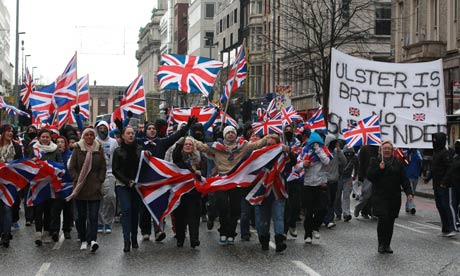
Loyalists march in Belfast waving British Union flagsWhen I first posted on the flag controversy I argued that the issue was not one of identity or culture or any supposed rights attaching to either of these but one of intimidation; as clear as day from the moment protesters attempted to get into the City Hall as the vote was taken. In fact it was clearer even earlier when the two main Unionist parties put out leaflets in East Belfast in a transparent attempt to prepare for the ousting of the Alliance Party MP.  Unionists had already supported flying of the flag on designated days, and not every day, in Lisburn and presumably the protesters hadn’t then noticed any loss of identity or culture.

As the protests have continued their intimidatory character has become more obvious: from preventing people getting to hospital to attacks on political representatives to attacks on Catholic homes in the Short Strand area of East Belfast. As the violence has increased the number of arrests by the police has fallen. The Police Service of Northern Ireland (PSNI) has stated that it is not possible to arrest those flagrantly breaking the law which is, of course, an open incentive to continue to do so.

The numbers involved have been relatively small, the core rioters have been youths and the PSNI have pointed to individuals in the paramilitary UVF as being responsible for organising the rioting. The protests, even the ‘peaceful’ ones, have been characterised by sectarian displays.

The political organisation behind the protests, in so far as it exits, is composed of marginal, relatively unknown figures or individuals with little political credibility. Their call for a return to direct rule by the British State was seen as confirmation of their marginal status and further betrayed their sectarian objective and its lack of any democratic content.

While unionist politicians have attempted to rationalise and defend the motivations of the protesters these have been exploded by the actions of the protesters themselves. So they hold up the union flag demanding ‘Hands off our Flag’, with the ‘our’ underlined. In other words the union flag is a Protestant flag and is to be defended as a sectarian symbol.

Having originated in an opportunist attempt by unionist politicians to unseat the Alliance Party the issue was initially held up as one of the right to fly the union flag 365 days a year. The acceptance by republicans that instead it could fly on the Queen’s birthdays (she has two) or the Earl of Wessex birthday etc. etc. is held up as a stunning denial of Protestant cultural rights and identity. As if understanding the absurdity of this, spokesmen for the protesters and others have listed a catalogue of grievances of which the flag issue was ‘just the straw that broke the camel’s back.’ All grievances have been blamed on republicans and nationalists.

This list includes unemployment, educational disadvantage and a supergrass trial that threatens to put some leading UVF figures behind bars. The latter is reported by some journalists as the real reason this organisation continues to keep the protests going. None of these are the result of action by, or the responsibility of, nationalists and republicans. Unemployment, educational disadvantage and poverty are the responsibility of the State from which they wish to be directly ruled and the worst areas for social and economic disadvantage are still by and large Catholic.

The idea that Protestants are unable to express their Britishness, which the more it is expressed the less those who are British recognise themselves in it, is risible. As we have said ‘Hands off our Flag’ is an expression of sectarianism, and they still want it 24/7/365 irrespective of all the other complaints.

So what we have then are relatively small protests involving mainly youths and a hard core of Loyalist paramilitaries some of whom might be facing serious criminal charges in the not too distant future. The political leadership of the protests is extremely weak and is denounced by all mainstream unionist leaders, if only for party political purposes – the Democratic Unionist Party now claims it is the target of the protests, how ironic.

The complaints of the protesters are blamed on those with nothing to do with their grievances and their demands vary over time and are in turn incoherent and contradictory. We are asked to feel their pain as they attempt and often succeed in widespread and sometimes random acts of intimidation on everyone else, regardless of religious background. There is no doubt that the vast majority of the population is fed up with the protests and there is limited appeal for incoherent violence. Many, like the State itself, have assumed, and still assume, that they will burn themselves out.

So how come the protests are able to continue? The most immediate answer is the one we have mentioned. The police have let them. It is assumed by many that once the protests are over the PSNI will quietly round up the miscreants but there is limited reason to assume this. The Chief Constable, fresh from conferring legitimacy on the political front of the UVF by attending and speaking at its conference last year has really said they can do nothing now to stop them. However the loyalist paramilitaries are thoroughly penetrated by the British security services and have in the past been financed, armed and provided with intelligence by them.

The PSNI has said that around 4,000 have taken part in recent protests and they can’t ‘wade in’, ignoring that single republican demonstrations of greater number have in the past received exactly this treatment. The point is not to demand such repression on loyalists because the forces of the state are clearly not an answer to loyalist paramilitarism.

This immediate answer is also the deeper answer. For all their small size and the opprobrium heaped upon them the protesters are not as isolated as they appear.

It was mainstream unionism which kicked the protests off. Their rank and file political representatives have appeared regularly on the protests and their leadership has endorsed their demands. The loyalist paramilitary leaderships have not disowned and expelled their wayward local leaderships and the unionist political parties and paramilitaries have come closer together, most visibly in the new unionist forum. The nationalist and republican parties have called on these mainstream unionist parties to do the right thing as the peace process deal they have sold themselves into necessitates an alliance with unionism. Coalition government is what they have demanded for decades and they have no other strategic perspective. In this way they are prisoners of their unionist partners in government just as they are now wedded to political support for the PSNI.

So the protesters are tied to the unionist parties by their function as foot soldiers for ‘peaceful protest’, by ideology and their ties to loyalist paramilitaries. The state sponsors these paramilitaries but like rabid dogs are not under total control. The paramilitaries are working more closely with the unionist parties and these unionist parties are in government with nationalists and republicans, who are clinging to them for a solution because they value their role in government above all else, including what being in it can actually deliver.

All this is understood by many people if not in quite the way just explained. There is for example the understanding that if the police went in tough to arrest violent protesters or simply to prevent obstruction of the roads this could trigger wider involvement by paramilitaries. Unionist parties might then row in to excuse, justify and attempt to gain control of the protests. The republican and nationalist policy of hugging these unionists would be put under strain and the potential would thereby be created that the existing careful political deal could unravel. This of course is an extreme but not inconceivable scenario.

It is not that the state forces could not succeed in facing down this challenge because it is still unlikely the majority of the population would engage in open rebellion but the existing political dispensation would come under extreme stress. For the British state there might be no victory.

Should they capitulate to the most rabid expressions of sectarian intimidation they leave themselves open to similar challenge in the future and in the meantime convince the nationalist population nothing has really changed – they continue to live in an orange state where loyalist sectarianism sets the rules. If they win they run the risk of inflicting the sort of defeat on unionism that republicanism has just suffered. This led republicans to giving up their armed campaign, accepting partition, accepting Stormont, supporting the police, disarming and then dissolving the IRA. Were a similar defeat inflicted on unionism where goes the basis for British rule and a separate Northern state?

The existing policy of softly, softly or bribes to the criminals involved is therefore an attractive option, as might some concession on flag waving at the City Hall, except that it works only in the short term. Instead of an immediate crisis a gangrenous corruption discredits the state and eats away at its foundations and its legitimacy.

All this reflects that the population of the north of Ireland is still bitterly divided as is the working class despite the hot air about the new modern Northern Ireland, its peace process and the solving of an 800 year old Irish question.

This does not mean that nothing can be done by those seeking to awake from this nightmare of history but this requires that we also stop dreaming that this nightmare is something other than what it is and speak the truth, however unpalatable. There is no progressive impulse behind the protests. They are entirely reactionary and they should be opposed be anyone who considers themselves anti-sectarian. This opposition needs to be organised and make its presence felt. Only then can a path be chartered out for the many workers, Protestant and Catholic, trapped inside this sectarian state.

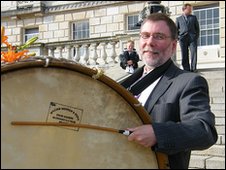
Nelson McCausland, a little man with a big loud drum. (by Belfast plebian)

47925243_3707225203_e18c6d4d4e-1It is a hell of a misfortune that at this time of a drastic need for some form of social protection for hard pressed working class families we are saddled with a social development minister in the Stormont Executive whose opinions accord well with the right wing government across the pond and who is also regarded by many as a hardened religious sectarian. This little man with the big drum is also proving to be the most active of the generally passive Stormont ministers.

It should be said at the outset that he took on the ministerial portfolio at a very awkward juncture when the Tory austerity plans where already in an advanced state. The SDLP of course vacated the crucial social development portfolio as soon as they caught sight of the content of the welfare reform bill and Sinn Fein screamed PASS to the chance to take over the department from the SDLP following the May 2011 assembly elections. Why Sinn Fein chose to take on the department of arts and culture, the one with the smallest budget and largely symbolic importance rather than one of the key economic departments stands as an interesting question without of course an answer.

Nelson McCausland is known for being an ardent Unionist, a formidable Orangeman and monarchist, a ‘pro-life’ evangelical Christian who is also a Creationist and of course a great enthusiast for something called the Ulster-Scots culture. Indeed it can be persuasively argued that he more than any other individual is responsible for the ideological mishmash called Ulster-Scots culture. When he was appointed to his previous ministerial post in 2009, in charge of dolling out money to the arts and science cliques, his primary mission was to raise Ulster-Scots heritage up a couple of intellectual notches to the status of ‘a traditional culture’ and therefore make it worthy of taxpayer cash. The small budget didn’t deter Nelson too much.

Before he captured the minister for arts and culture portfolio he was the director of a lobby organisation called the Ulster-Scots Heritage Council. Back in those days he had little or no money to promote Ulster Scots heritage as a rival to the Irish language and culture movement and so no one of any intellectual standing took him too seriously. It was only when he got his hands on the department cash card that the little man with the big drum had to be listened to by the typically anti heritage arts cliques.

For a brief moment Nelson attracted the attention of the middle brow Guardian newspaper, thus earning a wider notoriety and crossing swords with non-other than uber-scientist Richard Dawkins who declared that the minister was an unfit person to be in charge of science museums. This was after Nelson wrote to the Ulster Museum requiring that it display a range of Creationist inspired artefacts to offer the North’s naive children a legitimate alternative to the “unproved theory of evolution.”

It didn’t take much to put down poor Professor Dawkins, faced with the acuity of Ulster’s superior evangelical mind. “Dawkins is an arrogant and militant atheist who prides himself on his knowledge and reason. He loves to demean and disparage others but this time the mighty man came unstuck” declared Nelson on his personal blog.

Being anti-modern in evolutionary science has not stopped the little man with the big drum being a very successful politician, He is already into his second ministerial position and is easily the busiest minister. Some people think they know why he is so successful. The key to his lasting popularity they say is to be found in his very frequent sectarian public outbursts, something that goes down well in loyalist flag waving working class districts. Let’s run through just a few of his more recent efforts.

On the third of October the Belfast Telegraph ran a story -‘Fury after Nelson McCausland says there’s no need for more Derry housing funds.’ It emerged that the minister had refused a recent appeal by Derry City Councillors for additional funds for the Housing Executive to build more social housing in the city. The latest figures revealed that the number of families and single people on waiting lists had passed the 3,000 mark

Sinn Fein councillor Tony Hassan said ‘we get a letter back from the minister’s secretary and to me it was disgraceful.’ The SDLP councillor John Tierney called the statement of the minister ‘crazy’. And here’s a nice Nelson touch – ‘the minister’s letter also referred to Derry City Council in the address and throughout as City Council of Londonderry.’

On the 25 September he faced down an SDLP sponsored motion calling for a three month parliamentary suspension for supposedly breaching the ministerial code by failing to condemn illegal acts conducted by a royal black band parade as it swaggered outside St Patrick’s Church on Donegall Street in Belfast. The suspension motion attracted a lot of media attention and was voted down. And so the little man’s political stock went up within his own party. McCausland, more than most DUP politicians, gets a kick out of baiting both ‘republican’ and nationalist politicians. He runs his own blog just to keep the invective regular.

In mid-June we can pull out another two media stories, ably covered by the online newspaper the Detail. The story broke that Nelson McCausland had caused worry and anger among Housing Executive workers when he chose to provide fellow DUP assembly colleague Paula Bradley with the religious breakdown of staff employed in North Belfast in the most public way. The decision was strongly criticised by trade union officials who warned that publication of the religious designation of workers in specific localities might put them at risk.

Less than a week later a car belonging to a Housing Executive employee was destroyed after it was set on fire by masked youths as it was parked outside the agency’s district office in Newtownabbey. ‘The Detail understands that Housing Executive officials have been forced to review security measures at offices across Belfast as a result of the attack. In a series of questions to DSD ‘we asked Mr McCausland to explain why he decided to publish the figures against the advice of his own officials and despite staff concerns…We also asked DUP MLA Paula Bradley why she had originally asked for a religious breakdown of staff… she chose not to respond.’

Also in June McCausland was criticised for blocking plans to build 200 new houses for people deemed to be nationalists on the vacant site of the former Girdwood army base in North Belfast. ‘However the Detail can now reveal new evidence showing that the DUP minister held discussions with the Housing Executive to ensure that four loyalist areas in north Belfast were given preferential treatment to be included in a new housing building scheme despite having little or no sign of any significant homelessness.’ Nationalists make up most of the 1,300 people in homeless stress in North Belfast.

The Detail obtained evidence that emergency approval was used to ensure that the four estates were added three months after the three year building plan had been finalised by the Housing Executive. The change was all down to pressure from the DSD and was a clear breach of a 40 years old protocol that social housing should be allocated strictly on the basis of priority of need and not on the basis of political or religious affiliation. This incidentally dragged Sinn Fein into the mix as they had agreed to the decision at local level talks.

And here is one from this month, this time from Nelson’s personal blog. Under the heading Biased Broadcast Corporation he complains about a pro Sinn Fein bias at, of all places, BBC Northern Ireland . He thunders against a BBC documentary that he hasn’t even seen about the life of the youngest Lord Mayor of Belfast, who happens to be a member of Sinn Fein, councillor Niall O Donnghaile.

He notes ‘This is not the first BBC documentary on a Lord Mayor. There was also a documentary on Alex Maskey, who was Lord Mayor in 2002. In between there were eight other Lord Mayors and they were drawn from all the larger political parties, but the BBC has decided that the only party whose Lord Mayors merit a BBC documentary….There is an onus on the BBC to acknowledge that it was wrong to give preferential treatment to Sinn Fein, to determine how this happened, to ensure that it does not happen again and to take action to redress this balance.’ There is a lot of this type of thing on Nelson’s blog, most of it aimed at excoriating Sinn Fein, his partner in government.

So Nelson’s strong electoral success can be attributed to some degree to what appears to be his carefree sectarian mud-slinging that goes down well with his many loyalist followers. However this is not what I want to focus on so much, rather I want to show up his other prejudice, his right wing class prejudices that make him the emblematic leader of the main party of government at Stormont.

Nelson holds strong opinions on socio-economic matters but critics prefer to ignore them, all the more to encourage him to just get on with his ministerial post. If only Nelson would just do his job and not court publicity things would be fine say his newspaper critics. But Nelson is getting on with his job. In fact he has the two biggest policy initiatives of the Executive on his agenda, implementing the welfare reform bill and dismantling the Housing Executive.

We can pick up the thread of Nelson’s approach to welfare reform from his offering on the bedroom tax. The chief executive of the Northern Ireland Federation of Housing Associations (NIFHA) Cameron Watt recently called on Nelson to delay the implementation of the bedroom tax until the Universal Credit is actually ready to go. This would of course only mean a postponement of about six months, from April 2013 to October 2013.

According to NIFHA this is ‘necessary, realistic and fair.’ Nelson rejected the very meek proposal outright saying that ‘I intend to increase funding available for discretionary housing payments to be made to all social housing tenants.’ In other words if any of the 34,000 tenants experience problems with rent they might be able to get a discretionary payment to help them out. Housing officers are to be offered a new career path into becoming poor law guardians.

The public line of the Stormont Executive is that it is being blackmailed by the Con-Dem government into progressing the welfare reform bill. If it was down to them it would not happen but if they put obstacles in its way they would face financial penalties

Yet in his speech to the NIFHA conference Nelson says “Turning now to events at a UK level, everyone in the room will be aware of the welfare reform agenda which is progressing. We know that its implementation is unavoidable. I think most of us will agree that the key principles behind this legislation are positive and we should recognise the real positives and opportunities that can be achieved as a result of some of these reforms.”

The principle that Nelson likes most is the one that says a welfare system should promote personal and social responsibility. In fact Nelson being a keen evangelical is happy to edge the State out of welfare provision and get the churches in. His department has already licensed a couple of schemes to that end.

We find an article on his blog of 25 November 2012 called signposts for funding churches “The Minister for Social Development, Nelson McCausland, believes that there is a very critical role to be played by the faith sector in developing strategic partnerships with Government to help deliver practical approaches to tackling poverty. For this reason, the Minister funds the Faith Forum for Social Development …. Minister McCausland wants all faith-based groups to become engaged with the Department whether it is on local Neighbourhood Renewal Partnerships, benefit uptake or helping ensure the connections exist between vulnerable citizens and agencies such as the Social Security Agency or the Housing Executive. There is no cost to them and only benefits to be gained by those most in need.

Nelson’s DSD operates something called the Voluntary and Community Unit which doles out millions to agencies like the Law Centre, Citizens Advice Bureau and Northern Ireland Council For Voluntary Action. It also funds the Regional Infrastructure Programme which has an annual budget of 3 million to fund community groups. Some scope then for Nelson to put his own brand of welfare policy into operation.

The day Nelson became Social Development minister in May 2012 was the day the death knell sounded for the Northern Ireland Housing Executive (NIHE) and of socialised housing. Nelson has chosen to make social housing his battlefront. We already mentioned the clash over the abandoned Girdwood Barracks, the emails seeking knowledge of the religious makeup of the Belfast offices in February 2012 and the publication of Catholic numbers working in Newtownabbey.

There has also been his row with the senior management over a £7 million repair contract with a company situated in East Belfast, Red Sky. The contract was terminated in July 2011 following accusations that the company had engaged in a practice of overcharging. Huge political pressure was piled on the NIHE to overturn the termination of the contract

Three days into his post Nelson met with the NIHE chairman Brian Rowntree to ask that the decision be suspended for six months. The investigative magazine the Detail gained access to the emails. The NIHE chairman sent one to the Department for Social Development (DSD) Permanent Secretary Will Haire on July1 saying he had ‘serious concerns and misgivings’ over the pressure being applied by the DSD over the contract and asked that the minister take a step back. The DSD permanent secretary emailed back saying ‘I believe that you should withdraw the remarks you made.’ Four days later Mr Rowntree resigned as Chairman citing personal reasons.

Nelson knows a few things about the NIHE that are not to his liking. He knows that it came into being to end the allocation of social housing on the basis of religious affiliation and he knows it always has had a catholic majority in its staff. But putting the sectarian boot into the NIHE is not his only motivation. He does not like its social democratic ethos. He is in fact busy drawing up plans to have it broken up and privatised.

It is likely that the 90,000 tenants will be transferred to private Housing Association where rents are higher. A good number of redundancies will follow out of the 2,800 staff. For those who think he will face opposition from Sinn Fein – think again. In July Stormont announced that it had set itself a target of transferring 2,000 homes to Housing Associations and a number of British based Housing Associations are said to be taking soundings. The public justification for the change is stated in the consultation documents, which is the need to raise a billion pounds for repair work. The NIHE is not able to raise loans from private banks but Housing Associations can do so.

What is motivating the politicians in the Stormont Executive to break up and privatise the NIHE? Some might think it is pure sectarianism. But if it is, what about Sinn Fein? Do they also want a sectarian carve up? Is it simply a relentless falling into line to what is happening to social policy in Britain, with the varied the attacks on the social housing sector? Is it the Stormont Executive looking for one way to cut its own costs in this time of austerity? Or is it that nobody wants to rock the Stormont boat too much in case it sinks and so Nelson must be left to pursue his own private political agenda with a minimum of opposition? Maybe all the above motivations are factors? What do you think?

Northern Nationalism in Denial

untitledWednesday’s Northern nationalist paper ‘The Irish News’ betrays the exasperation of many at the continued widespread disruption and violence caused by loyalist protests.  Its front page headlines with ‘Arrest the loyalists who are taking us back to a wasteland’.  Inside, their columnist Brian Feeney excoriates the unionist leadership and their hypocrisy and mendacity.  He dismisses their ‘unionist forum’, which has been called by the unionist political leaders to unite all shades of unionism, and claims that they no longer rule the state, including the police, as they did in the past because “of a raft of legal changes which have gone through in the last 25 years guaranteeing equal rights for all.”  To paraphrase: Unionists will have to accept the reality of equality with nationalists and sit down with them to sort out their problems.

Meanwhile, on that day’s Dublin-based ‘The Irish Times’ its Northern editor reports on the flag riots and the new Unionist Forum and states that “most people will wish it good luck.”

What we have here is three examples in which reality, which stares one in the face, is ignored and sacrificed through ideological wishful thinking.  Let’s take them in turn.

First ‘The Irish News’ calls for the arrest of the loyalist protestors, expressing the now widespread view that they have broken the law and caused widespread disruption and intimidation with seeming impunity.  Inside it has a hard-hitting editorial which never mentions the only people who can carry out their demand and who have so utterly failed to do so – the police.

The new Police Service of Northern Ireland was supposed to banish into history the partiality of the Royal Ulster Constabulary but there is no apparent difference in the way the new PSNI has treated loyalist protest from the old RUC.  In the past this would have led to criticism of the latter but now nationalism supports the PSNI but is faced with the uncomfortable fact that the PSNI appears in no respect to be fundamentally different in its approach.  The paper’s editors are left calling on the new emperor to put on clothes while still cheering him and recoiling from pointing out he hasn’t got any on. It is unable to truly call the police to account or to explain its role in facilitating the protest because to do so might raise uncomfortable questions why all the “raft of legal changes” arising from the peace process have changed so little.

Which brings us to Brian Feeney, who has the same problem, because the last three weeks show that the Northern State continues to treat the two communities differently.  It is hardly conceivable that republicans could have caused the disruption of the past three weeks without vigorous suppression by the State.  So how can he claim that equality is a reality that unionists are refusing to accept?  Just who is blind to reality?

Even if the proposed Unionist Forum is simply an attempt to regain the political initiative by the Unionist parties who set the whole protest off, it signals that only sectarian organisation is capable of political effect.  The joint call by Peter Robinson of the DUP and Martin McGuinness of Sinn Fein for an end to the protests achieved absolutely nothing.  Brian Feeney calls for the unionists to sit down with nationalists apparently oblivious not only to the fact that they have been doing so throughout the crisis, in fact for over five years but that they have actually been in government together for all this time.  During these years they were supposed to be drawing up a joint anti-sectarianism strategy which was to include how to deal with such issues as flags.  So the clichéd call for the two parties to get together to sort out their differences now has to ignore that this has been a failure.  What’s the alternative now then?

Finally we have the pious declaration of the ‘The Irish Times’ Northern editor that most people will wish the Unionist Forum good luck.  As we have said, if it is to be more than a device for the unionist leaders to regain control, in which case it simply gives control back those who caused the protests in the first place, it will be a sectarian construction uniting the unionist political parties with the political fronts of the loyalist paramilitary outfits who have been organising much of the violence.  The policy of promoting these forces by the state became news again when it was revealed that ex-prisoner groups were to get £4 million in state funds through what has been widely described as a “slush-fund”.  The smell coming from it was such that the neither Peter Robinson nor Martin McGuinness wanted to be publically associated with it despite it coming out of their Office.  Fashionable talk about reconciling the combatants doesn’t look so smart when one set is promoting riots and intimidation in the streets and seemingly getting paid for it.

What we have therefore is Irish nationalism in denial of the reality that stares it in the face.  It is of course possible to deny reality for a long time even while this becomes more and more uncomfortable.  But it is not possible to do so forever.  Its smug assumption that what we have witnessed is unionism in crisis ignores its own role in covering for the Unionist political leaders who kicked the protest off and who they must now cling to as the way out of the protests. It is reflected also in its support for the police who have “facilitated” the protest.

If unionism is in crisis then in a system which is a joint sectarian carve-up so is nationalism.  Most nationalists may not believe it but that too stares them in the face when they can’t get home from work and can’t go Christmas shopping in Belfast city centre.

The 2011 census results in Northern Ireland

NorthernIrelandCouncils-religion2008 

The results from the 2011 Northern Ireland census have been eagerly anticipated because the Northern Ireland state was created, and continues to be justified, by a sectarian head count.  Had partition not been imposed on the island of Ireland either through the independence of the whole island or through continued British rule the census would be interesting but would not in itself raise the question of the state’s existence or legitimacy.  That the census raises both and by virtue of the religious affiliation of the people who live in it is in itself a condemnation of the Northern state.

The census revealed that the Protestant population has declined to 48% in 2011 from 53% in 2001 while that of the Catholic has increased to 45% from 44%.  In order to arrive at these figures the 17% who said they had no religion, or the religion was not stated, were asked what religion they were brought up in.  A sort of ‘you can run but you cannot hide’ from religion no matter how much you might want to.  This is similar to employment monitoring which asked not what your religion is but what community you are perceived to belong to. The latter leads to mistakes if you happen to read ‘The Irish News’ in your lunch break and show a partiality to Glasgow Celtic when discussing football in the office but have never ever been to your first holy communion.

In the latest census 5.6% say they neither belong to nor have been brought up in any religion, up from 3% who said they belonged to neither religious category in 2001.  The census of course is silent on whether anyone brought up in any religion, or who professes to be a member, has complete faith in that religion’s doctrines, respects its institutions and cadres, accepts and identifies with any of its associated cultural practices (like going to mass) or follows its leadership in any way.  So even on this the census raises more questions than it answers.

The question that an answer is sought for most is the political views of the population, which has always been strongly linked to religious affiliation.  The same problems arise in making any firm assessment of what this information means.  First political views are read across from identification of nationality rather as if the latter determined the former in some over-riding way.  However one can identify oneself as British and be appalled at the way sectarianism seeps from every pore of society and one can define oneself as Irish and still reject all the isms that supposedly accompany it such as Catholicism and nationalism.  The full range of political positions in between are absent from the census as is beliefs on how ones political views are to be put into action.

The census is full of boxes and people, even in Northern Ireland, do not fit into them, or if they do they often do not do so neatly.  The census itself is a means of forcing them to do so but because they don’t debate is now raging over what the figures mean.

So 40% said they had a British only national identity, 25% an Irish only identity and 21% a Northern Irish only identity.  It was possible for example to tick two boxes and say you were both British and Northern Irish, which was ticked by 6.2%; 5% were none of these nationalities.

It is the combination of the religion and nationality results that has raised most debate.  Are those that say they are Northern Irish mainly pointing to the fact that they are Irish but from the North, or simply as a matter of fact citizens of the Northern State, or are they saying that they recognise a separate Northern Ireland nationality that  may or may not thereby warrant a separate state?

Commentators have noted that a large section of the population that are Catholic have not identified themselves as Irish but probably as Northern Irish and some no doubt as British.  This information will be released later.  From this it might be judged that even if they are culturally Irish (whatever that means) they are either happy with British jurisdiction or might be, given certain conditions.  In any case they might not, if asked to in a referendum, vote for a united Ireland.  They are what has been described by First Minister Peter Robinson as Catholics who support the union and who the Democratic Unionist Party could canvass for support. Many in this group however currently vote for nationalist parties – either Sinn Fein or the SDLP.

This however shows only the limitations of deriving conclusions from figures in a census.  Robinson has made reference to a majority of Catholics who support the union.  He has also prominently supported loyalist bands parading past a Catholic Church at which one band had previously stopped and marched round in circles playing a sectarian song.  He also called onto the streets the loyalist mobs that have protested against the reduced flying of the union flag over Belfast City Hall.  This has resulted in violent demonstrations, attacks – particularly on the Alliance Party – and death threats.  Loyalist mobs have repeatedly blocked roads or carried out violent attacks.  They have wandered round Belfast City Hall with union flags singing sectarian songs associated with old and new Glasgow Rangers football club supporters and burning Irish tricolours.

The unionists have done this on the basis that the union flag is their flag, a symbol of unionist and Protestant identity.  The Catholics whom Robinson supposedly seeks support from are therefore being told to accept that the trappings of state are those of a different religion and alien political tradition.  The party traditionally associated with the pretence to a non-sectarian union with Britain is the Alliance Party which the DUP and loyalists have made a main target of their attacks.  So much for a non-sectarian Northern Ireland.

This week has also witnessed another report on the murder of solicitor Pat Finucane which revealed massive collusion between loyalist paramilitaries and the state.  The report, despite it being inadequate, has yet again revealed the widespread use by the British State of the most extreme sectarian bigots to kill anyone who gets in its way.

The report revealed that the forces of the British State in the shape of the army, police, security service and top level officials were all instrumental in murder.  The prominent Home office junior minister Douglass Hogg set the scent by declaring, after briefing by the police, that certain lawyers were unduly sympathetic to the IRA and legions of later government ministers and politicians did their bit by strenuously denying claims of collusion.  The report is unable to say how high up collusion went but is nevertheless sure that there was no overarching conspiracy.  The Finucane family have pointed out that those most damned are dead as are the organisations most criticised.  We are expected to believe that all this is in the past.

Unfortunately state collusion with loyalism never ended.  The treatment of widespread loyalist protest over the past week or so has revealed yet again the partial attitude of the police to loyalist illegality and violence.  The new police force declare that there is no evidence of the loyalist paramilitary leadership being involved while it is impossible to deny that the protests have been organised by these same organisations. The distinction between leadership and organisations is introduced to protect the leadership.

So we have the unionist movement claiming that the symbols of the British State are Protestant and another exposure of how this state has worked hand in glove with the most extreme bigots to kill those entirely engaged in lawful activity.  In the past week the widespread but relatively small protests have been allowed to cause considerable disruption where, had it been republican protest, it is almost certain they would have been suppressed.

In other words the State to which Catholics are more and more assumed to owe some loyalty to and to identify with has been found, both through its most fervent supporters and its officially authorised defenders, to be guilty of the most rabid bigotry and violence.  Therefore even if the former is true, and more Catholics are prepared to accept it, political developments may be such that is doesn’t matter what some people believe to be the case, it is what is actually the case that will matter.  In politics as in everything else people are free to believe what they want but they are not free to make what they want actually be the case.

While the census results cannot be read simply to determine and predict political developments, and they cannot even be confident in population projections, the figures revealed have their own political impact.

For a state set up on the basis of a sectarian head count that head count is important.  The publication of figures showing the Protestant population is no longer an absolute majority and the gap between them and the Catholic population is narrowing is a blow to unionist claims.

When the Northern state was set up Ulster Unionists had the opportunity to justify the Ulster part of their self-description by pushing for the inclusion of all 9 counties of the province within British jurisdiction.  They did not because they wanted their hold to be secure and it needed a sizeable Protestant majority because the support of the minority was not to be expected.  Now that the religious populations are so near in size it does not make sense to fight to make the state an expression of a sectarian identity if the purpose is to defend the union.  It does however make sense if the purpose is to maintain sectarian power and division.  It then makes perfect sense that even the slightest hint that within the Protestant community this sectarian solidarity is not primary should be squashed – hence the attacks on the Alliance Party.

On the other hand the census does not support a perspective based on a Catholic majority voting a united Ireland, at least not for a long time.  The previous census results appeared amidst widespread speculation of a large increase in the Catholic population, an increase that didn’t materialise.  This latest census has recorded only a small increase, albeit that Catholics are a majority in the youngest age groups.  Even in purely demographic terms this does not mean an inevitable Catholic majority and in political terms the significantly lower proportion defining themselves as Irish hardly gives confidence that even a future Catholic majority will simply demand a united Ireland.  This is especially so given that the Ireland that they might be united with is such an unattractive political entity.

With these alternative programmes and the near equivalence of populations the prognosis can hardly be one of stability.  The need for some alternative is currently championed by the call for mutual respect and reconciliation but this is proving more than a little difficult.  How can two mutually exclusive, even antagonistic, claims show respect to each other never mind be reconciled?  The DUP and Sinn Fein have supposedly been working on an anti-sectarian policy for five years and there is no sign of it while it took the unionist parties five days to propose the union flag fly all-year round at Stormont.

This policy of reconciliation is actually accommodation of sectarianism not its eradication.  Instead of the sectarian politicians being the solution it is unionist politicians who kicked off the recent protests.  Reconciliation means Sinn Fein covering up for the worst of unionist aggression.  So after getting the flag down (some of the time) Sinn Fein then votes along with those who created the violent protest in a hypocritical Assembly motion condemning violence, thus implicitly absolving the DUP and Unionist Party of responsibility.  The flying of the union flag, as we pointed out here before on this question, is a means of intimidation.  The purpose of it flying at City Hall as on every other Government building is to sanction the many, many more union flags that fly all over the North which tell Catholics that this place is not theirs and tells Protestants that their place is anti-Catholic.

The possibility of such a situation being compatible with a shared Northern Ireland national identity, much trumpeted by the media in the wake of the census results, is remote.  The only identity that can be shared by Protestants and Catholics is one that expresses something that they have in common. What is it that they have in common that could possibly form the basis for such unity?

Fighting over flags in Belfast

6The decision last night of Belfast City Council to stop flying the union flag 365 days a year, and not at all over other council buildings, resulted in a protest by around 1,000 loyalists outside the City Hall and ultimately a small disturbance. There was also trouble in East Belfast when the result was announced including an attack on a Catholic Church.

In preparation for the vote the Democratic Unionist Party had distributed tens of thousands of leaflets attacking the Alliance Party which had indicated it would not support unionist demands that it continue to fly all-year round but would propose that it fly only on designated days.  This is around 15 days a year on occasions like the Queen’s birthday and is the policy at Stormont where the devolved Assembly sits.  Nationalists had stated their intention to call for a vote which would have led to the flag not being flown at all and the Alliance proposal was seen as a compromise.  Holding the balance of power in the council it was widely expected the Alliance proposal would succeed, as it did.

In the build up to the council meeting the loyalist Progressive Unionist Party (PUP), which is the political front of the paramilitary Ulster Volunteer Force (UVF) stated that while its previous position was that it accepted the flag should only fly on designated days, now that it was being demanded by nationalists it would oppose it.  Sinn Fein has claimed that the UVF was prominent in the protest which led to the minor violence.  There is no doubt that loyalist paramilitaries were behind the violence in East Belfast.

At the demonstration the usual sectarian songs and slogans were recited and an Irish tricolour was burnt.  The BBC interviewed some participants in the protest.  One protested about the need to defend the flag that had been flown in Afghanistan while inside a DUP councillor protested that nationalists were attacking the union flag and other parts of Protestant identity.  The case against flying the flag could hardly have been better made by those opposed to it.

Loyalists defend the flag because it is a symbol of imperialist might and of sectarian identity while liberals complain that it is the flag of the country and should not be confused with sectarianism.

Of course flags are symbols of states.  They fly to denote the claims of that state over territory or over institutions.  They cannot be divorced from the history and policies of that state or institutions and they cannot be divorced from the actions of those who fly it.  For all these reasons the union flag is a symbol around the world of empire, military adventure and occupation and in Ireland it has a history of being identified with a sectarian state and sectarian practices.  The protestors were defending it because they support all of this, they support imperialism and sectarianism.

The approach of the PUP is instructive in this regard.  To Catholics their policy is – yes you can have rights, but only those we will let you have.  So you would not have to put up with the union flag flying every day if you had kept your mouth shut and not tried to change it but now that you have you must be prepared to suffer protest and intimidation.

This is the point that all those complaining about pointless arguments over flags refuse to take on board.  If the continued flying of that flag results from the exercise of intimidation then that is what the continued flying of that flag represents and that is what it symbolises.  It would do so, and has done so up to now, because that is what has allowed the flag to fly.  As a symbol it represents sectarian intimidation and the union flag symbolises the power of a state established by force and sectarian intimidation.  That it is now defended in such a way simply confirms this.

Some further observations can be made.

The rabidly sectarian character of the protest and opposition inside the council chamber blows yet another hole in the ‘campaign’, if that’s not too strong a word, by Peter Robinson and his claim that Catholics are happy with the union, partition and can be won to support the DUP.  If the flag of that union is claimed by its defenders as a part of a sectarian identity just what part of the state are Catholics supposed to identify with and support?

Garnering non-sectarian support for British rule is the role of the Alliance Party and it is no coincidence that the main target of the unionist campaign was this party.  The intention of the DUP is to win the East Belfast Westminster seat back from that party and sectarian flag waving is the way to do it.  That in doing so the claims of Robinson are exposed is not accidentally ironic.

The protest was relatively small despite the effort put into it but the reaction from the state was instructive.  The police had their usual low profile which was criticised by Sinn Fein and compared to what their activity would have been had 1,000 republicans turned up.  The presence of  figures reminds everyone, or rather it should, of the Chief Constable’s attendance at the PUP party conference earlier in the year.  This is now neatly sandwiched between UVF rioting in the lower Shankill and similar activity in the city centre and East Belfast.  This attendance signalled acceptance of such activity as part of the normal rules of the game but rules which should not be overstepped.

BBC interviewers refused to entertain criticism that loyalist figures were in attendance and might have something to do with the violence.  Fortunately one no longer has to worry whether the BBC will similarly refuse criticism of Osama Bin Laden on the grounds he is not in the studio to defend himself.

Concentration on the small size of the protest is therefore misplaced.  Unionism has increasingly taken to the streets, reflected in sectarian exhibitions in Donegall Street outside a Catholic Church and in the very large Ulster Covenant demonstration. The City Hall protest was sponsored by the main unionist parties who are both in government and they have signalled the issue is not over by promising to demand that the union flag is flown permanently at the cenotaph in the grounds of council buildings.

Even as low level controversy sectarianism is necessary for political rivalry and feeds continued division.  It sets wider political expectations and exposes the limited role of the state in combating expressions of sectarianism.  The liberal pretentions of the British state are allowed to continue to be presented as the only choice and the effect is to enforce an unacknowledged intimidation of alternatives.

In the larger scheme of things this particular issue does not threaten wider instability but it is one of a number of sectarian outbursts that remind everyone who cares to pay attention that the sectarian dynamics of Northern politics and society remain intact.  It is very unlikely that the continued brewing of this sectarian kettle will forever remain off boiling point.

Belfast Trade Unions demonstrate against Austerity

Trade Unionists march against Austerity

As part of the trade union campaign against austerity across the UK the trade union movement in the North of Ireland organised a demonstration in Belfast to coincide with those in London and Glasgow.  It is difficult to estimate the size of the demonstration which appeared significant as it snaked its way through Belfast’s city centre but didn’t look impressive as it assembled and looked even less so at the final rally.  The latter however is a feature of trade union demonstrations. The notion that the purpose of a rally at the end is to explain what to do next and get everyone involved is as alien to most people at these things as little green men from Mars.  What happens next always depends on the decisions of the union leaders.  It is not for deciding by those involved.

Supporters of the United Left Alliance in the North correctly made this the subject of their leaflet and put forward the key task of the demonstration as one of creating a real permanent campaign against austerity:

“Last November saw 40,000 mobilised in Belfast in a general public sector strike  – but it was a one-off event and everyone went home again.  No further action was taken, there was no continuing campaign and the next public sector strike was much less successful.

Everyone is no less opposed to austerity and the Tories and Labour plans show the issue isn’t going away.

At the end of this demonstration we must make sure we don’t go away either.  To ensure that this doesn’t happen we need to come together to create an on-going cross-union permanent campaign that will oppose austerity.  Not one that pops up every six months but one that continues every week to campaign inside the trade unions, inside workplaces and inside communities to unite them all in a way that each of them cannot do by themselves.”

I overheard one of the trade union leaders responsible for the demonstration express her delight at the size of the turnout.  The demonstration was successful in so far as it confirmed that a basis exists for starting to build a wider and potentially successful campaign but one should not underestimate the obstacles.

The first is that the demonstration was no more than a few thousand at the very, very most.  It was dwarfed by the very, very large sectarian demonstration three weeks before, which commemorated the signing of the Ulster Covenant that led to partition.  This was celebrated by the participation of dozens of ‘kick the pope’ flute bands.  A prominent organiser of it was Nelson McCausland of the Democratic Unionist Party who has led the introduction of the Welfare Reform Bill in the Stormont Assembly, which imposes in Northern Ireland the cuts decided by the Tory Government in London.   It is ironic that many of the marchers in the Ulster Covenant commemoration will be shafted by these cuts.

The welfare changes introduce the biggest assault on entitlement in decades and were also supported by Sinn Fein.  The latter bring their own ironic aspect to its passage.  The back bone of Sinn Fein’s political machine is a network of advice centres at which Sinn Fein activists help those on welfare get as much as they can.  It is what they called ‘screwing the system’ when they first started doing it.  Now of course Sinn Fein has joined the system and the only people getting screwed are their constituents.  The first many of them will know about the changes will be when their benefits get cut.   They will then run to the advice centres where Sinn Fein will tell them ‘sorry but these are the new rules’.  What they won’t tell them is that Sinn Fein voted for them and had the power to stop them but didn’t.  While welfare is cut along with public sector pay Martin McGuinness will continue to complain that the British won’t let Sinn Fein and the DUP cut corporation tax.  Sinn Fein posturing has been particularly vacuous – they have said they ‘might’ make an issue of monthly payments of benefits and demand that they are paid fortnightly instead.

The third obstacle is reflected by the fact that so many walked away from the demonstration with no demand to those on the platform that they provide them with a strategy promising success.  The demonstrators were activists in their various trade unions and community groups but there is no understanding of the need for wider organisation.  They were there to protest and no more.

A protest is an expression of disapproval, summed up in the slogan ‘not in my name’.  It is not an alternative and it ultimately receives the following answer by the Government and State – ‘yeah, so what?’  Sinn Fein and the DUP live and breathe as defenders of their respective community against the other even as together they fillet both.  The limits of the trade union leaders’ challenge can be seen in the statement released before the demonstration:

“The devolved administrations must build a robust joint defence of the people who elected them.  Let this rally today send a message to our MLAs and our MPs from all political parties that we the people are firmly opposed to the failed policy of austerity which destroys lives and futures.”

An appeal to the political parties at Stormont and to Stormont itself is not a strategy.  It amounts to an appeal to the enemy.  The financial crisis exploded because of a property boom and the well-reported antics of the Developers’ Unionist Party and hidden ‘let’s get rich’ antics of the leaders of the Provisional Movement mean these people ae personally tied up with the system that is demanding the cuts.

The political sectarianism of the left means that it too is not an alternative.  It is unable to unite its tiny forces in an attempt to make a difference, although this is not the biggest problem.  The Left’s inability to organise in an open and democratic way means it cannot include the wider forces needed to create a real movement.  Were it to attempt to do so the Left group concerned would no longer retain control.  Since their absolute need for control is not just a rather unfortunate sectarian aberration in their practice but a foundation in principle of their existence- they all believe that they are the sole essential nucleus of the mass working class party of the future because of their particular approach to socialist politics -they are both practically and in theory sectarian.

The leaflet of the supporters of the United Left Alliance correctly put forward the next step – creation of a permanent campaign that is organised across unions by rank and file members, in workplaces and in communities and their community campaigns.  This is not just the next step in a campaign against austerity.  Just as socialism is the creation of working people themselves so is the resistance to capitalism, one of the means by which the capitalist system will be superseded by the power of a new ruling class, made up for the first  time by the vast majority of society.

Can Ulster Unionism be left wing?

Flags of the Left?

In this week’s Belfast nationalist paper ‘the Irish News’ their regular columnist Brian Feeney put forward the claim that Protestant unionist workers had been duped into believing that being left wing was also to be ‘disloyal’.  Presumably these workers can therefore be left wing and ‘loyal’.   Indeed this is the thinking behind recent proposals within the United Left Alliance to build a “new mass working-class party in Northern Ireland to unite the working class against sectarian division and against the right-wing austerity of the Assembly Executive.”

An obvious objection to the ULA proposal is that it claims to stand for workers unity while accepting the division of workers created by partition.  The only way this can be justified is by accepting unionist claims that such workers unity should not exist.

A smarter unionist might claim that the unity of Irish workers would break the unity of the workers in Northern Ireland with those in Britain.  The problem of course is that Irish workers unity is sacrificed for a unity that does not exist.  There is in reality no genuine UK workers unity because most British workers regard those from Belfast, Derry and Enniskillen as Irish.  No carnival of reaction predicted before, and confirmed afterwards, by partition is likely upon the separation of the North of Ireland from Britain.

So we are back to the repeated collapse of what often passes for socialism in Ireland before the veto on workers unity demanded by unionism.  If such unionism is inherently and unavoidably reactionary then it is clear that such a veto should be rejected.  It might only be accepted if it could be credibly claimed that Feeney is right – Protestant workers are merely duped into believing that being left wing is also to be ‘disloyal’.

Unfortunately Feeney gives enough examples of the reactionary character of real unionism, as opposed to the pretend hypothetical unionism that at no time and nowhere has existed, to demonstrate that a different sort will never exist.  He records the mass expulsions of Catholic workers from the shipyards by sectarian unionist mobs in 1912 and 1920 when around 2,000 were expelled in the former year and thousands more in the second.  Crucially he also notes that 500 Protestant workers were also expelled in 1912 and 1,800 in 1920.  These were ‘rotten Prods’ who failed to demonstrate their true credentials by not being bigots.

Feeney notes that these Protestant workers refused to put an ‘ethnic’ solidarity, in reality a sectarian solidarity, in front of any other.  Some supporters of the ULA are presumably content that Protestant workers can accept this sectarian solidarity while being ‘left wing’.  If they did not put this sort of sectarian solidarity first then there could in principle be no objection to proposals for the unity of the whole Irish working class.  Proposals within the ULA that avoid this conclusion are in practice accepting that sectarian identity must be accepted and accommodated.  In other words sectarianism must be accepted and accommodated.  Protestations to the contrary can in reality be dismissed.  Political positions have consequences and in this case these are quite clear.

Feeney records the words of Peter Robinson of the DUP that ‘the unionists of Ulster were a distinct people entitled to determine their own future.’  Since the most right wing forces will always be the most vigorous defenders of this position acceptance of it necessarily means acceptance of the leadership of Protestant workers by the most reactionary bigots.

As to the cogency of Robinson’s claims – the unionists of Ulster were happily the unionists of Ireland until they could no longer garrison it all whereupon they then demanded not that they determine their own future but that the imperialist power did.  This then amounted to the seizure of both more than the territory within which they were a comfortable majority and less than would include all the Ulster unionist people they claimed they were.  The character of the movement that expressed this people politically became evident when it came to determining not their own future but that of the large Catholic minority they took with them.  This minority was subject to sectarian pogroms and systematic discrimination for nearly half a century before a civil rights movement exposed the irreformibilty of this unionist movement.

We can go back to Feeney’s claim that Protestant workers have been duped into believing that being left wing is ‘disloyal’.  It is obvious that they have not.  For what is it that unionism claims that there must be loyalty to?  Loyalty to what?  Well – to Queen and country!  To a monarchy and an imperialist power.  To partition and division.  To a state based on a sectarian head count.  To the rights and privileges of Robinson’s ‘distinct people’.

How could you possibly be left wing without being disloyal to all that?

Apologists on the left for capitulation to unionism put forward the final argument that we must accept unionism because the vast majority of Protestant workers are unionists.  In fact it is this very fact that makes opposition to partition absolutely necessary.  Opposition to partition is not necessary despite the unionism of Protestant workers but because of it.  It is not possible to break their commitment to this reactionary political programme without defeating it and it can only be definitively defeated by destroying the state power on which it bases its power.

How deep is the division created by partition?

In an article in the ‘Irish Times’ a couple of weeks ago Andy Pollak, Director of the Centre for Cross Border Studies and a former Irish Times journalist, takes up the observation that “interest among people in the Republic these days in Northern Ireland is minimal.”  “As somebody who lives in the South and works in the North, my experience in recent years, as the economic and financial crisis has come to dominate public discourse, is that southerners largely don’t want to know any more.”  Since previous interest was taken mainly to be revulsion at the violence and gratitude that it was “up there” and not “down here” this might not seem a new issue.  In fact both reflect how deep is the division that partition has created after nearly a century of existence.

Pollak quotes the young woman in the audience of the RTÉ Frontline programme during last October’s presidential campaign who attacked Martin McGuinness: “As a young Irish person, I am curious as to why you have come down here to this country, with all your baggage, your history, your controversy? And how do you feel you can represent me, as a young Irish person, who knows nothing of the Troubles and who doesn’t want to know anything about it?”

First we must say that this is indeed a strong illustration of the division that exists between North and South of the border; all the stronger because of the happy ignorance that is displayed.  On the other hand this happy ignorance demonstrates that the division which she articulates is really an expression of the unity that she is so ignorant of.

Happy ignorance?  Well yes.  The young woman speaks of coming “down here to this country” which is actually the same country, while being a different state.  She mentions “all your baggage, your history, your controversy” without appearing to be aware that the State she lives in shares much of this baggage, history and controversy.  After all, is she not aware of the history that includes the War of Independence, the Civil War (mainly in the South) and baggage that includes Catholic Church domination of society that involved systematic and widespread abuse of thousands of women and children that still resonates today?  Is she not aware that ‘the troubles’ had its worst single episode of violence in the Southern State carried out partly by agents of the British State?  Happy in her ignorance because she herself declares she “knows nothing of the Troubles and . . . doesn’t want to know anything about it.”

The disconnect between this young woman’s understanding and real history is perhaps an example of the invention of nations that don’t exist, or sometimes later do come into existence.

Pollak says that “opinion polls over the past decade or so show that a bare majority of people in the Republic now say they want a united Ireland: for example, in the 1999-2000 European Values Survey, just 54 per cent of people favoured unity.”  He quotes one University College Dublin student as saying: “Neither of us want Northern Ireland: neither us nor the UK government. I’d say if you asked the majority of Irish people – yes, nationalists, out of a sense of allegiance, might say they wanted a united Ireland – but it’s really far more trouble than it’s worth.  I mean, to integrate Northern Ireland into this State – why would you be bothered? The status quo satisfies everyone.”

Let’s take this statement bit by bit as well. The UK state doesn’t want Northern Ireland?  A very common opinion but one that is impossible to square with the experience of the British State spending billions of pounds and engaging in a long counter-insurgency campaign in order precisely to keep hold of the Northern State.  We will not go into the reason why here but let us recall that Britain left previous parts of empire extremely reluctantly.  Why hasn’t it left this bit if it actually wants to in this case?

So “yes, nationalists, out of a sense of allegiance, might say they wanted a united Ireland – but it’s really far more trouble than it’s worth.”  What trouble might this be?  Well we know that just as partition was imposed on the Irish side of the Treaty negotiations on the basis of the threat of immediate and terrible war so we know that partition today must be unquestioned because of the perceived threat of loyalist violence.  A loyalist violence that the last thirty years have shown the British State is quite happy to support and sponsor.

Uniting Ireland? “Why would you be bothered? The status quo satisfies everyone.”  This is the decisive question.  Let’s start from the end and go to the start – “the status quo satisfies everyone.”  This is the status quo that includes the literal bankruptcy of the Irish State and its admitted loss of sovereignty over its economic affairs.  The more or less complete loss of respect and legitimacy of fundamental pillars of the Southern State – politicians, Catholic Church and crucial State institutions.  Yet  “the status quo satisfies everyone!!?”

I would bet that many UCD students are very far from satisfied with the status quo but that they don’t see their dissatisfaction with the Southern State as having anything to do with partition.  If it’s not part of the problem then why would opposition to partition be seen as part of the solution?  What we have is graphic demonstration of the division of the Irish people that partition has caused that satisfaction is expressed in a State which many are in despair of because its problems are not seen as having anything to do with the other bit of the country divided.

That the domination of the Southern State by outside powers, who have dictated that their banks must be protected by the Irish people bailing them out, is not connected at all with the political rule in the North of the foremost political power in Europe most enmeshed with banking is the result of a number of factors.

The first is that such is the seeming power of these outside forces they seem almost like a force of nature, or if not, then an unalterable fact of life.  The second is that when there has been opposition either to the Northern State or to how the Southern State exploits its citizens this opposition has made no attempt to link the two questions.  The third is the more or less complete absence of any force that wants to do this.

Instead workers have been able to react only to the more immediate appearances of their oppression. This appearance is framed as a political question by the State, which is often the mechanism for enforcing it and sometimes by the putative opposition putting forward the state under different governance as the solution to oppression.

This importance of the state in distorting socialist politics has been a theme of the blog so far.  For most people, including what passes for militant opposition, the necessity of fighting two States is one too many.  In fact consistently fighting one is one too many.  That is how deep the division created by partition is.