Irish Elections (1) – Sinn Fein was the future once?

For years Sinn Fein in the North was accused of acting as both government and opposition, enacting right wing policies in government while presenting itself as anti-establishment, pretending to oppose the sort of politics it was itself carrying out.  It talked out of both sides of its mouth and had more sides than the Albert Clock, as we say in Belfast.

It got, and still does to a lesser degree, get away with it because its dumping of traditional republicanism has been continually praised while its clinging to symbolic remembrance of its dead armed struggle is repeatedly damned.  More fundamentally, it succeeded because it is the most vigorous defender of Catholic rights in the ‘new’ political settlement that has been anointed saintly status by the powers that be, stretching from Washington and London to Dublin and Belfast, not to mention Brussels.

It has had lots of powerful friends on its journey from rebels to politicians, happy to indulge its self-ID as progressive radicals while it became the centrepiece of a regime of dysfunctional failure.  It could forever bask in the naked contempt of its unionist coalition partners, the best of enemies, while telling its supporters that a united Ireland was ‘within reach’. What made it repellant to some made it attractive to others.

*                   *                  *

During a walk-about with a Sinn Fein candidate in last weeks local elections an Irish Times journalist noted that some potential voters appeared to treat the party as if it was already in Government – part of the establishment – and part of the problem it was presenting itself as the solution to.  Waving Tricolours and singing rebel songs doesn’t exactly distinguish you in the South, which now routinely names itself Ireland, leaving the North to get along with Northern Ireland, the nomenclature that unionists goad Sinn Fein with its unwillingness to allow pass its lips.  Now Sinn Fein has found in ‘Ireland’ a new rival that claims to be even more nationalist than it and waves the flag even more vigorously.  The structural conditions applying in the North don’t exist south of the border so are no help to it.

The rise of the far-right and its opposition to immigration, especially in some working class areas of Dublin, is widely held to be a major reason for the apparently sudden and stunning setback to Sinn Fein in the local and European elections held last week.  In an opinion poll in June 2022 it was recording support at 36 per cent, by far the biggest party.  Last week it gained only 12 per cent of the first preference vote and would be the fourth largest if we count the bag of independents as a party.  In 2020 it suffered from standing too few candidates to maximise seats from 25 per cent of the vote while in 2024 it stood too many.

It isn’t Fine Gael or Fianna Fail who are labelled the traitors now, although Sinn Fein long ago found that approach would get them nowhere.  It is now Sinn Fein who are the traitors to the Irish nation, who support a ‘new plantation’ and who refuse to prevent immigration when ‘Ireland is full’.   It is Sinn Fein that is now accused by the assorted racists, far right and fascists as betrayers of the ordinary working class Irish.

All the anti-immigrant tropes that have been seen across Europe are now a ready currency in Ireland and Sinn Fein is the primary political target.  Within less than a couple of years a self-satisfied liberal view that Ireland was more or less immune from the rising tide of racism and xenophobia so prevalent elsewhere has been evaporated.

The growth of the population has largely been due to immigration while the keenness of the Irish bourgeoisie to show its support for Ukraine (in the absence of an ability to provide weapons or troops) has meant that over 100,000 Ukrainian refugees have been welcomed.  This has been followed by an increase in refugees from other countries, less welcome, not least because they aren’t white and no political capital is accrued by having them.

The Irish State was already undergoing a housing shortage when it decided to open its doors to these refugees; stumbling from one emergency measure to another in order to cope while offering welfare rates on a par with the natives.  As the number of those seeking international protection also grew local protests against the housing of these refugees developed in small towns and mainly working class areas of Dublin.

Numerous arson attacks prevented accommodation from being created for refugees while local people claiming not to be racist protested, claiming only to be concerned with the lack of local GP or other health services; an existing shortage of accommodation, or the turning of a local hotel that might have brought in tourists into a refuge for asylum seekers.  The localism of political activity in much of Ireland found it easier to mobilise against asylum seekers than against the failure of the state to keep health, education and housing in line with a growing population.  No doubt many of the local protesters are voters for the bourgeois parties responsible for the policies that led to the failure.

The governing parties decided to clamp down and the toughened rhetoric on immigration became one of control – ‘firm and fair’ – the same reactionary rhetoric employed elsewhere that everyone knows means an attack on the rights of refugees.  The governing parties had found a scapegoat for their failures and a handy weapon against its political rival in Sinn Fein: opinion polling claimed to show that part of its support was more opposed to immigration than that of other parties.

The party first tried to dampen this by arguing that the Government had failed to talk to or consult properly with local people about the accommodation of refugees in their areas but one of their TDs had to admit that “we were a bit all over the place.”  This has settled down to more or less aping the rhetoric of the Government and policies that are more or less the same.

None of this could appease those looking for a quick racist solution and who aren’t going to be convinced by the benefits of immigration, not least because they haven’t seen any.  The benefits of opposing anti-immigrant and racist solutions from a socialist point of view don’t exist for those who don’t have a socialist project and don’t see any utility in working class politics.  Sinn Fein can’t argue this way and even the left mainly presents liberal and human rights arguments that are no part of this politics.

Sinn Fein thus doesn’t escape blame from more backward and reactionary workers while its more liberal and vaguely progressive supporters won’t support it bowing too far in their direction.  Both have reason to doubt the party, with the recorded decline in its support preceding the more recent prominence of migration.

There is only so much complaining you can do before you’re asked to explain what you’re going to do about it, arising from doubts about exactly what you stand for.  U-turns have been public and obvious over a range of issues, including the price of housing, proposed hate legislation, support for the failed referendum proposals that were roundly defeated and then reversal of a promise to re-run the vote if they failed.  All these are small relative to the fundamental U-turns in the North, but this just illustrates the different environment it has to work in.

*                   *                  *

Sinn Fein is not yet the past, but it doesn’t look like the future now either.  That famous Irishman Oscar Wilde said that “there is only one thing in life worse than being talked about, and that is not being talked about.”  Sinn Fein has been much talked about leading up to the elections and especially about the results, including by the leader of the current Government coalition.  You’re not supposed to talk ill about the dead in Ireland so Sinn Fein isn’t dead, but it isn’t the main story and we’ll talk about that next.

Forward to part 2
Groundhog Day. Stormont is back! Again!

I remember giving out leaflets at a Sinn Féin demonstration on the Falls Road in about 1993.  The demonstration was called to support the Hume-Adams Agreement, hammered out between the leaders of the SDLP and Sinn Féin after several secret meetings.  No one knew what was in the Agreement, but thousands of republican supporters came out to show their support for it.

I don’t think my comrades, or I, ever had such a keen and eager crowd as the demonstrators queued up to get a copy.  It was clear that they thought they might find out what it was they were demonstrating in support of.  That in itself told us an awful lot about the political consciousness of rank and file republicans at the early stages of the peace process – they were going to faithfully follow their leadership, wherever it led them and swallow whatever they were told.

Many, many subsequent leaflets, and meetings through the long peace process changed nothing of their approach, or raised in them any consciousness that they might require a more critical approach, one that involved some scepticism of where their leadership was taking them.

Only a few years before, in 1987, Sinn Féin had published a document called ‘A Scenario For Peace’ in which it set out its proposals for a settlement to end the conflict.  It included that Britain should declare its intention to withdraw; the Royal Ulster Constabulary and Ulster Defence Regiment would be disbanded; ‘political’ prisoners should be unconditionally released; and Britain should provide a subvention for an agreed period to facilitate harmonisation of the northern and southern economies. In return, unionists would be offered equal citizenship within the new Ireland.

Well, the Hume-Adams talks were not about this agenda, and neither was the peace process.  The British have not gone, the RUC and UDR were indeed disbanded but the former was replaced by the PSNI and the latter were a unit of the British Army, and it certainly hasn’t gone away.  Political prisoners were released but not unconditionally, Britain imposed austerity (and Sinn Féin helped implement it).

The peace process in its various guises is now longer than the war it was supposed to end, and the former looks harder to get to the end of than the latter did.  When it was announced that the devolved Stormont Assembly was coming back, and a Sinn Féin leader, Michelle O’Neill, would be first minister, it was declared by Mary Lou McDonald that this showed that a united Ireland was “within touching distance”.  Of course, the Provisional republican movement has been promising a united Ireland since the early 70s, that is, for over half a century.  A unionist commentator noted recently that a recent opinion poll showed no increase in support for a united Ireland in the North over the last couple of decades.

Some columnists have claimed that the real significance of the return of the DUP to the Assembly and Government is this accession to the post of first minister of Sinn Féin, even while they admit that this is symbolic since the unionist deputy first minister has equal power.  No decision can be taken by the first minister if not agreed by the deputy and the post cannot be filled in the first place without unionist agreement.

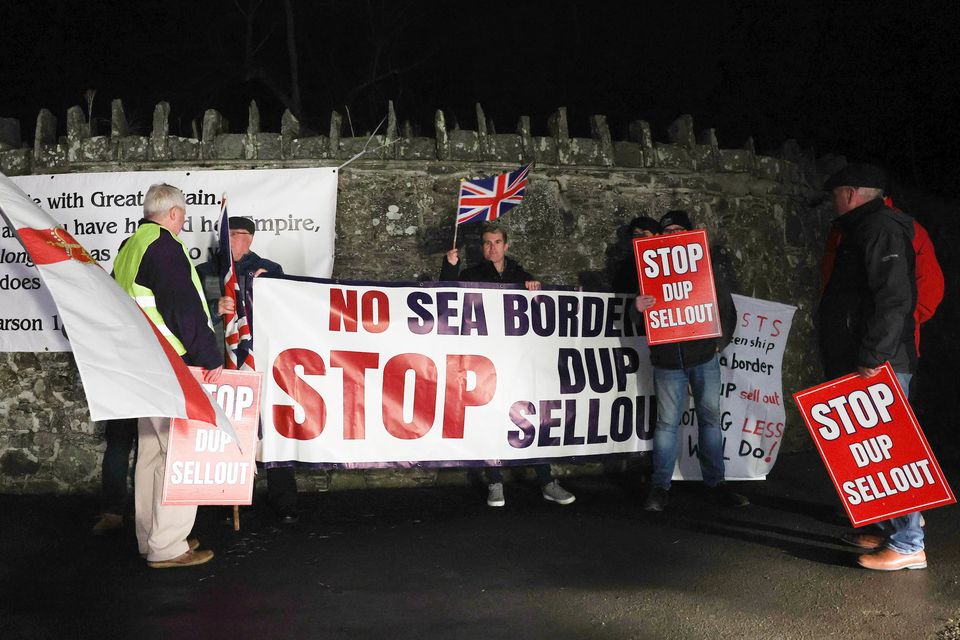
In order to minimise unionist opposition to the deal between the DUP and British government over the ‘Irish Sea border’ the process of getting DUP agreement and all it entails is being rushed through.  The DUP Executive thus voted for the deal without seeing it; fittingly appropriate to the return of what passes for democracy in the North of Ireland.

This democracy, in the shape of the Stormont Assembly, has been suspended at least eight times, ranging from a single day to a couple of years.  It has been functioning for only sixty per cent of its existence and subject to a number of reviews and changes with yet more changes now widely canvassed. The sectarian, corrupt, incompetent and clueless governance it has provided and the future problems considered inevitable by everyone who thinks about it (and many don’t) means that the rules are not the problem.

Public services, from health to roads, are routinely described as being in crisis, while others such as education and voluntary organisation are subject to open sectarian practices. It has been claimed that these issues can only be put right by local governance, but its track record shows that it is as much responsible for the decay as British rule.  The repeated suspension allows the alibi to be sold that were it not for suspension public services would be much better.  The previous suspension following the Sinn Féin walk-out, after the DUP-implicated Renewable Heat Incentive scandal, showed levels of incompetence that could more easily be explained as corruption.

The return of Stormont is therefore no step forward, never mind a panacea, and is mainly an unstable framework to accommodate sectarian competition, one that has not proved to be very stable.  It stands on its rotten foundations only because there is no outside force to push it over, while those that have knocked it over temporarily have been internal.  It is widely accepted among the population and further afield because no alternative seems possible, which is why the DUP have gone back in.  This also helps explain why the misgivings of many unionists, and significant opposition, will be unsuccessful in stopping the Assembly’s return.

The opposition has no credible leadership, which would have to come from within the DUP itself, and there is as yet no real sign of this.  Further demoralisation of unionism is therefore one (welcome) result.

That this is the case throws light on the claim by the DUP leadership that their new deal is a significant victory. Packaged as a joint British government/DUP initiative, and launched by a joint press conference, there is not the slightest pretence at non-partisanship by the British: ‘Safeguarding the Union’ is the name of Command Paper1021.

Its content in 77 pages could safely be accommodated at one tenth of the length.  The measures introduced include proposed legislation to say that Northern Ireland is part of the UK – who would have thought it?  It has proposed legislation to ‘future-proof the effective operation of the UK’s internal market by preventing governments from reaching a future agreement with the EU like the Protocol’, which by definition cannot achieve what it claims.  It also includes a ‘commitment to remove the legal duties to have regard to the “all-island economy” in section 10(1)(b) of the European Union (Withdrawal) Act 2018.’  A bit of red meat for the DUP, and sticking it to Irish nationalism North and South, that will make little or no difference.

It promises that ‘Legislative change to recognise the end of the automatic pipeline of EU law . . . which applies in Northern Ireland is now properly subject to the democratic oversight of the Northern Ireland Assembly through the Stormont Brake and the democratic consent mechanism.’  This implies either future bust-ups with the EU if single market changes are not incorporated into the Northern Ireland market, or a formality to cover regulatory alignment.  The Brexiteers in Britain are aghast at this as they no doubt realise it might not be the former.

Media reporting has suggested that the EU Commission has yet to look at the Agreement but that ‘no red lines’ have been crossed; however, it is hard to believe it has not been agreed and only kept quiet in order to help the DUP sell it as an act of undiluted British sovereignty.

The ‘democratic consent mechanism’ that is held to act as a check on unwelcome EU encroachment states that it can be triggered by a majority of local members of the Assembly and not by some ’cross-community consent’ mechanism.  It is hard to be optimistic that this whole area will not entail future argument.

Other measures include promises on maintaining trade flows that can’t be honoured and a number of new quangos that will deliver more red tape that Brexit promised to get rid of.

The main gain pointed to by Jeffrey Donaldson is the removal of routine checks on certain exports from Britain to Northern Ireland that were set to reduce anyway but are now declared to be zero.  This is on goods, such as retail to consumers for example, that will stay in Northern Ireland and not considered to be at risk of going further into the Irish state and thus the EU single market proper.

Donaldson has, however, claimed too much – that there is unfettered trade between GB and NI and therefore no sea border.  The command paper states that ‘there will be no checks when goods move within the UK internal market system save those conducted by UK authorities as part of a risk-based or intelligence-led approach to tackle criminality, abuse of the scheme, smuggling and disease risks.’

‘Abuse of the scheme’ must mean that checks will be made if it is suspected that goods purportedly sent for sale only in Northern Ireland are actually heading further.  The acceptance of such controls by the DUP has so far been rather successfully sold by the leadership as simply a common sense measure that ensures that checks are made at the Northern Ireland ports instead of a long and windy North-South border.

This problem arises only because of Brexit, which the DUP supported, and of course the argument makes sense in its own terms; except those terms mean acceptance that there is a trade border on the Irish Sea because there had to be one somewhere, and its not south of Newry and north of Dundalk.  The opponents of the Agreement among unionists are therefore right that single market membership means EU law applying in Northern Ireland.  They go wrong when they, like the other hard Brexiteers, assume that the British government must pursue widespread non-alignment, without which Brexit makes even less sense that it already does.

In the last few weeks public sector workers in the North have engaged in very large strike action in pursuit of wage demands designed to recover some of their lost real incomes.  It has, however been subsumed under the politics of Stormont return, even while the trade unions have demanded that the British Government pay up and not use the lack of an Assembly as an excuse. It was supposedly putting pressure on the DUP to get back so the workers could get payed when the DUP didn’t, and doesn’t, give a toss.

The return of Stormont has not been lauded and celebrated as in previous ‘returns’ and the population is jaded by repeated failure and broken promises of a ‘new approach’.  The real new approach required is, unfortunately, a long way off.

A year of Covid-19 (4) – a tragedy to be forgiven?

It’s almost as if someone has been reading these posts on the course of Covid-19 in Ireland.  Fintan O’Toole’s latest column (paywall) in ‘The Irish Times’ also notes some of the mistakes made in its early management and, while he treats the Irish approach as one of ad-libbing and improvisation, he lends a sympathetic ear to the early performance.  To what extent is this justified?
Well, let’s start with the scope afforded by this forgiveness: “when it’s all trial and error, no one should be tried for making an error – even when, as in the case of nursing homes and residential institutions – the flaws were fatal.”  But consider if we change the tense of the sentence – ‘even when . . . the flaws are fatal’.

‘Error’ he goes on to say ‘is moreover built into the structure of science . . . but science isn’t a set of certainties . . . to follow science is to follow evidence and with a new disease the evidence has been constantly evolving.’

Well, yes and no.  The important link between the worst effects of the virus and a person’s underlying conditions has been more and more understood.  On the other hand, as I noted at the end of the previous post – ‘one aspect . . . has appeared stubbornly consistent, the median age of those dying was reported in mid-January to be 82.’  Most recently, of over 1,500 deaths in care homes 369 were in January alone, a five-fold increase from December to January.

The Health Service Executive (HSE) noted on 21 January that the 27th of the month would be the anniversary of the first meeting of the National Public Health Emergency Team (NPHET), the crisis management team for the pandemic.  It was noted in April that no mention of nursing homes had been made in its first 11 meetings, with the HSE claiming that the Health Information and Quality Authority (HIQA) that attended the meetings were supposed to represent the interests of older people.

While boasting of the support given to care homes the HSE officials were at this time unable to provide up-to-date figures of deaths within them or a breakdown between state and private providers.  Neither did they answer as to whether any of the deaths could have been avoided.

Around the same time that NPHET was being set up a number of important academic papers were just being published on the effects of the new disease (here and here), including evidence of the effect of the pandemic in China.  The notable paper from Imperial College in London included further disclosure of the much greater threat to older people posed by the virus.  While the infection fatality rate was 0.002% for children aged 0 – 9, the rate for those 80+ was 9.3%, 4,650 times higher.  While these absolute figures were too high the relative differences remained.

Clearly avoiding infection was many multiples more important for older people than for the very young. Even between the age groups 40 – 49 and 60 – 69 the relative fatality rate was nearly 15 times higher for the latter group.  So protecting the older age groups was vital, which involved isolating them from potential infection.  How could these most vulnerable people be effectively separated?

Fortunately, many of these people were already relatively isolated in social care facilities, while identification of those in the community would be relatively straightforward.  Unfortunately, this relative isolation was not a protection.

While the health regulator was supposed to represent the interests of older people the HSE was there to protect the health of the whole population.  It became apparent however that the facilities they managed, controlled and regulated had become prime sites of infection, all while the NPHET engaged in interminable debate about opening or closing shops, hospitality, schools and workplaces etc.

When it wasn’t about the various levels of lockdown that were never applied at the levels specified, it was about testing and tracing, which didn’t identify where the virus was coming from and was later no longer advised for close contacts of confirmed cases.  So, what had been the point of it?

At the beginning of this year ‘senior sources’ were reporting the exhaustion of their approach, admitting that there was “not much else that can be done”, which didn’t stop the debate of vanishing returns continuing.  Today it revolves around rules for entry from outside the state, which is almost a moot point given the levels of domestic infection.  More honestly, it is being reported that ‘Ministers and senior officials’ view it as ‘more about politics than public health.’

Yet the places where around half of the deaths have occurred – residential homes and hospitals – are spared the outrage they properly deserve.  On 26 January it was reported that the level of infections among staff and patients in health care settings had never been higher.  And three days later the Chief Medical Officer was explaining that there was an “exceptionally elevated” infection rate among those aged over 85; that 55 recent deaths were associated with hospitals and 140 with nursing homes; and that we could “expect a large number of additional deaths in the coming weeks.”  Not much had changed over the year despite the ‘trial and error’ of ‘following the science.’

The state has incurred increased debt of around €20 billion in 2020 through various lockdowns but it is still unable to target resources effectively at the greatest problem: the daily death toll for Tuesday was the highest of the pandemic and the median age is still 80+.

It cannot be that a targeted prevention strategy would cost too much or that resources could not be prioritised – €2 billion would go a long way towards protecting older people never mind €20bn.  If even half the current death toll had been avoided and it was now around 1,750 who had died, would this justify the lockdown of society along with its enormous cost?  Would it not have been possible to identify those with the underlying conditions that make them vulnerable apart from advanced years, accounting for well over 90% of deaths? And would it then not have been possible to recognise the difference between those dying with Covid-19 and those from Covid-19?

But why would new problems be adequately addressed by the Irish health system when forever problems have not? When it turns out that the new problems are really the old ones?  As was pointed out by one TD early on, the Health Regulator – supposed to represent the interests of older people – had already reported that in care homes the compliance rates for risk assessment and infection control had fallen from 27 per cent to 23 per cent between 2017 and 2018.

Repeated problems identified have never been adequately addressed, with the HIQA complaining in November that nursing home residents were picking up the infection in hospitals and then being returned to their homes, while care home staff were being lost to contact tracing teams and agency staff were not being included in testing.

As Prof Sam McConkey, an infectious disease specialist with the Royal College of Surgeons, put it “nursing homes have been chronically under-staffed for several years.  They are going to have to start cherishing their staff as the most important thing they have.”  If staff were paid adequately they wouldn’t have to take second jobs, which might for example go some way to addressing the problem that staff weren’t turning up for testing and some were showing up for work while showing symptoms.

Some care homes were simply too small with too few resources. In some residential facilities for people with disabilities derogations were given to staff to continue working though they were identified as having possible close contact with infection.  They had not been tested and it was not clear when they would.

Yet, repeatedly bizarre statements have been issued by those in charge, including that NPHET was proposing setting up an infection-control team – in mid-December!  As if infection control was not a standard and routine hospital requirement. Or that there were difficulties in approving employment of nurses for care homes from India, Philippines and other countries outside Europe, reported in January, when many problems were the result of shortages of staff.

All this was occurring at the same time as repeated statements were made by the NPHET, which we noted in the previous post, that “there was simply no way of protecting nursing homes or any other institutional setting if we don’t control the spread of this infection in the community.” Then saying that vulnerable groups in care settings were a priority although also saying that it was “not realistic to think we could keep it out of homes.”

Unfortunately, seeking to prevent community infection through a generalised lockdown makes all talk of prioritisation a nonsense.  A general lockdown is precisely not to prioritise, and the actions and non-actions of the state are convincing evidence of this lack of ordering of risk.  To talk then, as O’Toole does, of inevitable mistakes is itself to fall into the error of identifying policy as simply mistakes.   Even in the case of vaccination, the representative body of private nursing homes has complained that just 10 per cent of the initial 77,000 vaccinations administered by mid-January were within nursing homes.

The identification, right from the start, that Covid-19 represented a specific threat should have been met with targeted and focused measures to protect those most vulnerable.  The ramshackle and incoherent attempt to lock everybody up, that cannot be sustained, has diverted attention away from this task.

That diversion continues with a false debate over a ‘Zero-Covid’ strategy, which is simply a variant of the current approach.  Like the existing approach, it targets what measures are required to support closing society instead of what measures are needed to keep it open.  It again ignores experience of just who is threatened and how specific measures might be implemented to protect them.

Both the current approach and its extension into a ‘Zero-Covid’ one can’t tell us how long we would have to be locked up for and how we could be sure that whatever metric of success is decided upon could be achieved on a sustainable basis.  What ‘Zero-Covid’ would gain in reducing deaths associated with Covid-19 would be more than offset by the costs of an intensified and indefinite lockdown, which if the advocates of it had been followed, would have been in place since March. Both ultimately can only be sold to an increasingly weary population by promising something that they can’t deliver: the development of the pandemic has had more to do with the weather than lockdown measures, and the end-point of immunity through vaccination may be illusory if new variants are impervious to the vaccines just developed.

In this case, and it may be the situation anyway, living with Covid-19 will be required and immunity through infection become the outcome, if not the objective.  In any case and in the meantime, the policy should be directed to protection of the most vulnerable.  In relation to the assessment of O’Toole, the prerequisites for forgiveness do not exist.

Back to part 3

A year of Covid-19 (3) – the Irish experience of following ‘the science’

Following ‘the science’ and its scientists that we looked at in the two previous posts does not look well in hindsight, as a short review of the course of the pandemic in the Irish State demonstrates.  In the early days these were forecasting 20,000 deaths, six times the current figure which is just over 3,300, and an even greater over-estimate than the influential Imperial College paper that forecast a possible 500,000 deaths in the UK.
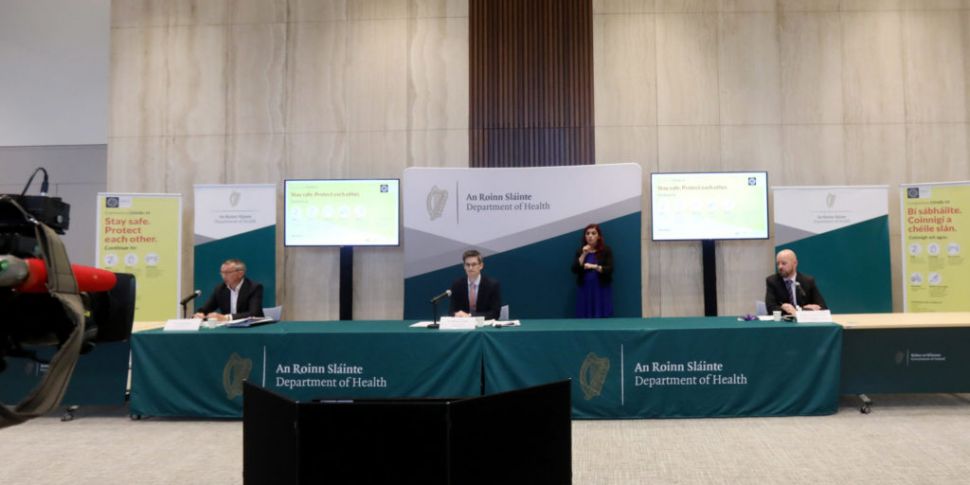
At the start, what characterised the response, just like Britain, was complacency.  On 4 March the Chief Medical Officer Tony Holohan of the HSE stated that “as things stand” there was no reason why the St Patricks day festival could not go ahead, and he did not believe that it was proportionate to prevent Italian rugby fans from visiting Dublin for a cancelled match.  The attendance of thousands of Irish racegoers at the Cheltenham festival also went ahead.  From the point of view of the generalised lockdown that was later to be implemented this was a catalogue of mistakes.

The State supposedly had a policy of test and trace, in which all cases could be identified and followed up to ensure isolation.  The system and its resources were quickly shown to be inadequate, with it only subsequently being admitted that test and trace did not identify where infections came from.  Prof. Philip Nolan from the National Public Health Emergency Team (NPHET) stated that “we would like to go back and find out where people are getting the virus, but we don’t have the time or resources to pursue this academic exercise”.  In any case, in October researchers from Beaumont reported that up to two out of every three infections could be missed through poor technique when people are being swabbed.

At this early stage the policy on testing was confused: so to be tested before March 12 a person had to be symptomatic or either in close contact with a confirmed case or have travelled from an affected area. Then having one symptom was required, then the list of symptoms changed, and if this threshold was passed the person needed to be in a priority category.

These early mis-steps have led many to see the issue as being one of weak or incomplete implementation of policy rather than the policy being misconceived in the first place.  The record suggests the latter.

The island of Ireland could not isolate itself from the rest of the world so could not avoid importing the infection.  Having imported it, it was always going to be impossible to identify all cases since most were asymptomatic.  Social distancing and isolation of suspected cases was considered to be the equivalent of the mass quarantine implemented elsewhere but was not.  The measures adopted simply slowed the spread of the infection, justified to protect the health service, but with the by-product that doing so gave it time to mutate, as it did.

Much bigger ‘mis-steps’ were made at this time, again flowing not from failure to adequately implement policy but as a result of its conception. On March 6 the representative organisation of private nursing homes, Nursing Homes Ireland, (NHI) banned all visitors to its homes.  Four days later Tony Holohan of the NPHET questioned the closures “before they are really necessary” while the Department of Health only eventually gave approval to the action ten days after NHI had introduced the restrictions.

In early March Holohan was claiming that ‘we had reacted very early and with significant action compared to other countries’, although the performance of these other countries seemed to be held up as some sort of exculpation rather than a pointer to a failing common approach. For the Chief Medical Officer their response “in the first instance had to focus on dealing with community transmission of this virus.  There was simply no way of protecting nursing homes or any other institutional setting if we don’t control the spread of this infection in the community.”

NPHET later claimed that it was not until late March that research pointed to the threat of asymptomatic transmission in care homes although by the end of May Paul Reid, chief executive of the Health Service Executive (HSE), was acknowledging that “there are obvious gaps in clarity and responsibility in the overall governance and oversight of private nursing homes.”

By mid-April Holohan was stating that vulnerable groups in care settings were a priority, but by that time there were 330 outbreaks in residential cares facilities, with concern expressed about under-reporting.  While boasting of the “unprecedented level of support” given to homes the HSE was unable to provide up-to-date figures for deaths.

Not much later Holohan was stating that it was “not realistic to think we could keep it out of homes”, while by the end of April it was reported that 735 people had died in residential community settings.  By early May the mortality rate in nursing homes was three times that among the rest of population, accounting for 61 per cent of deaths (including those in other residential facilities).

By the end of May the Department of Health had been warned by the health regulator of more than 200 “high risk” nursing homes, while receiving “just an acknowledgement” and “no response”.  NHI had quickly raised concerns around PPE and hospital discharges, but by late March 88 per cent of homes had bought either their own PPE or used home-made. Almost half of nursing homes said that they had to wait 10 days for test results to come back, and publication of cases in particular homes was not provided (unlike for hospitals).

By June it was apparent that nursing and other residential facilities were not the only health and social care facilities where infections were occurring.  At the start of the month, it was reported that more than 200 people had contracted coronavirus while in hospital in 102 outbreaks. By the end of August, it was also reported that about 90 per cent of all cases among over-65s were of nursing home residents (between March and end of June), amounting to almost 6,000 cases resulting in 968 deaths (56% of the total at that point).

By the beginning of the following month concern was again being expressed at the rise in cases among older people.  In early October a NPHET letter noted a ‘sustained increase’ in cases, with home residents accounting for more than half of the 1,810 virus-related deaths, but with Holohan again asserting that it was not possible to document all patterns of infection and that measures directed to the whole population were needed.

The Health Information and Quality Authority (HIQA) expressed concern that there was no “consistency of approach” on whether nursing home residents should be tested where staff had tested positive. The HSE chief clinical advisor claimed that older people could not be “siphoned off safely” but the chief inspector of HIQA stated later that “not all centres where staff have tested positive have undertaken a programme of resident testing.”

In November, NPHET priorities, according to Holohan, were protection of the most vulnerable, continued resumption of non-Covid health and social care services and education of children; but by mid-November it was reported that in the week up to Oct 31 there were 56 outbreaks of infection in nursing homes and 33 associated with hospitals.

Lockdown however appeared to be getting some results, even if this was little more than postponement rather than eradication. This was now success, as was the perceived protection of a health system unable to adequately do its own job of protection.

By the beginning of December the Irish state was hailed, especially by itself, as the best performing in Europe measured by the average number of new cases.  Unfortunately, even in success the most significant threat remained, with Holohan expressing concern at the level of infections in nursing homes despite the highest Level 5 lockdown.  Hospitals also remained a problem, and on 13 November it was reported that pre-admission tests for Covid that had been recommended for hospitals were not being practised by all.  Anne O’Connor, the chief operations officer of HSE, stated that guidance had been changed in the previous two weeks.

By December the problem with hospital acquired infection was continuing, with over 200 confirmed cases in the four weeks up to 13 December and more than 400 picking it up in hospital in two weeks in January.  By the new year the Irish State had gone from the being the best in Europe to being the worst in the world in terms of growth in cases.  The State went from 80,000 cases in nine months to doubling this total in three weeks.

Since there had been a partial opening before Christmas this was held up for blame but there remained no evidence that cafes, hairdressers or clothes’ shops were a problem; it was a question of a seasonal infection flourishing in its best environment with any human interaction facilitating spread.

Doing away with the latter altogether was the only logical extension of the existing policy and all the variations on the different social distancing rules were the proverbial number of angels dancing on the head of a pin.  Very few wanted to go there, and those who might would face the difficulty that closing down sites of infection might have to start with hospitals and nursing homes, with 100 outbreaks in the former from July to mid-December and 93 in the latter.  A study in mid-January reported that the rate of infection among hospital staff in Galway and Dublin was six times that of the local community.

Despite the months of restrictions and despite the worst-in-the-world figures there did not appear to be excess deaths.  The prevailing narrative appeared to tell a story that did not add up.  One aspect however appeared stubbornly consistent, the median age of those dying was reported in mid-January to be 82.  This outcome was consistent with the North despite its apparent different path, with people aged 75 and over accounted for 77.7 per cent of ‘coronavirus-related’ deaths and with 91.5 per cent having some pre-existing condition, Dementia and Alzheimer’s disease being the most common.

Back to part 2

A year of Covid-19 (2) – following doctor’s orders

The view that there is a single scientific approach to the Covid-19 pandemic has had a number of consequences.

Firstly, it became simply a scientific question; at most politicians had some discretion to accept or reject the extent of the measures proposed by the scientists and doctors, but no wider political questions were involved despite the dramatic effect on people’s everyday lives, their employment and their freedoms.  Any regard to these was argued to be putting ‘the economy’ before lives and particularly denounced by some on the Left.  The Government could pay for any of the economic consequences and let the science-led effort to control the virus take effect.  Anything else was letting politics interfere and was by definition unjustified.

Secondly, because there was a single science, whatever scientific approach was adopted was the right one, again with only a difference of degree acceptable, so that whoever was appointed the scientific leadership was by definition the single scientific authority.  Others could comment, but as we saw in the links in the last post, the scientists themselves were under pressure to accept that there was a single scientific approach, resulting in censorship and self-censorship of critical views.

One example of this was the criticism of the voluntary approach adopted by Sweden, pointing at certain times to its relatively high death toll, while failing to highlight that this had resulted from the failure to protect the elderly in care homes.  Yet exactly this same failure was held up to excuse the record of the Irish state, which pointed to the failure of other countries to protect its elderly population as some sort of exoneration.  In April the Health Service Executive national clinical advisor was pointing to the failure in Ireland not being unique and that many countries were struggling with outbreaks of infection in homes.

At this stage between 45 and 60 per cent of all Covid-related deaths in the UK, Belgium, France, Spain and Italy had been of residents of nursing homes.  Yet rather than this being a series of warnings, of wake-up calls that something was wrong with the prevailing approach, it was accepted.  The chief medical officer Tony Holohan later stating that it was “not realistic to think we could keep it out of homes”.

In 2017 the Irish State had adopted a management plan to deal with emergencies, which it then ignored when the pandemic threatened.  Instead, it made the top leadership of the Health Service Executive the scientific leadership, which almost immediately appeared to have so much authority devolved to it that it also appeared to have almost total control.

This in itself was pretty extraordinary since the HSE (and the Health Service in the North) was widely regarded as being something of a disaster, while the bureaucrats with medical qualifications that had presided over the failing health systems, along with the various governments, were for that reason considered responsible.

In the North, the extent of the failure was brought home when it was reported that Poles living there travelled home for treatment rather than wait years on a waiting list; and that one GP had disclosed that some of his patients who had fled the war in Syria were in ‘disbelief’ at the state of the North’s health system.  The same one sometimes held up as a model for the two-tier service in the South.

Such was the moral panic induced, the responsibility for the ability of the health services to do its job, to protect the health of the population, instead became the responsibility of the population to ‘protect the health service’.  In this, the situation in Ireland North and South was the same as in Britain, the architects and executive of the failing system made their failure the responsibility of the people they had failed.

Since the health services could not protect the people and had already failed, it was clear from the start that the people would fail to protect the health service. Simple and routine daily activity became the occasion for berating the public that they were letting the health service down, or as the Health Minister in the North put it, was equivalent of going into a hospital and ‘slapping a nurse.’

The blinkered approach that considered there was a single scientific approach, and the domination of this approach by a medical bureaucracy, meant that wider considerations were ignored.  It became a situation I have described before as one in which those with only a hammer perceive every problem as a nail. This was obvious when the strategy adopted became subject to the inadequate resources of the acute health systems North and South.

It is important to recognise the domination of health services by the acute sector, the hospitals, which always downgraded social and community services and public health; the price of which in the pandemic has been paid in lost lives.  It is not as if the problems with this have never been acknowledged.  In the North the necessity of greater emphasis on community services has been repeated in reports as often as it has been disregarded following their publication.  Public Health has always been the Cinderella service, although at least she got to go to the ball; in the health service she would have got to go to the laundry in the outhouse.

The National Public Health Emergency Team (NPHET) married the erroneous view that there was a single scientific approach with the acute services bias common to many health systems.  This common bias helps explain the similar failed approach adopted by so many countries that ironically justified each other’s failure by their own.  Yet the nature of the threat has been obvious from the start.

In the last week of December, it was reported that a majority of the 2,150 deaths in the Irish State were accounted for in nursing homes and that in this, and in infections among hospital staff, it was among the worst in the world.  In the North it was reported that 39.2 per cent of all Covid-19 related deaths in 2020 were of care home residents in hospital.  In effect, the gathering of the vulnerable in enclosed locations became not protection but helpless confinement, and the mechanism to provide treatment the instrument of infection.

The common approach of generalised lockdown was justified by the need to protect an inadequately resourced health service that precluded targeted protection of the vulnerable in homes and outside.  Yet it is admitted in NPHET minutes reported over a week ago that “the majority of the excess hospitalisations, intensive care admissions and deaths would be amongst those aged 60 – 79 Years”.  The policy of precisely targeted measures and resources to protect these people was rejected on the grounds that this would lead to unsupportable demands on the heath service.  Was it not taken into consideration that targeted protection would act to reduce potential demands on the health service?

Despite all this, the authority of the medical leadership has withstood the outcome of the failed approach adopted, in Ireland and in other countries.  Instead, the measure of success is not avoiding failure, but failing better.  That is, not being so bad that the country comes out looking worse than others.  The performance of the Boris Johnson government has therefore been a bit of a get out of jail free card, and the Irish is not the only political leadership on these islands that has relied on nationalism for political protection, not excepting the Johnson government itself.

Forward to part 3

Back to part 1

Ireland – the Apple Republic part 1

apple_tax_european_union_sept022016The decision of the European Commission to require the Irish State to collect €13 billion in unpaid taxes, plus a potential €6 billion in interest, from US technology company Apple made headlines across the world.  Special tax arrangements, which appear not to have applied the State’s already low 12.5% corporate tax rate, led to an effective tax rate on Apple of 0.05% in 2011 and 0.005% in 2014.  Two tax rulings in 1991 and 2007 allowed an Irish company to book Apple sales across Europe, the Middle East, Africa and India in Ireland and attribute profit on these sales to a “head office” which was stateless, had no offices, had no employees and existed only on paper.
The Irish State has decided to appeal the ruling, as has Apple itself.  Apparently preventing the State from abjectly prostrating itself in front of Apple is an assault by the European Commission on the sovereignty of a small nation.  It supposedly calls into question Irish tax policy while the Government frantically claims that the ruling affects the arrangements of no other multinational.

The appeal is to protect Ireland’s reputation although being dragged kicking and screaming to apply your own laws without discrimination, while defending cheating other countries of tax revenue, is apparently good for it.  The appeal is to prove that the Irish State is not a tax haven although a tax rate of 0.005% would appear to be a decent definition of one and defending it would appear to be open acknowledgement of it.  The Irish Government seeks to defend its prerogative to set an (in)famous corporate tax rate of 12.5% but does so by defending a 0.005% rate.

€13 billion is a big number and is the biggest judgement in the history of EU competition law – the cumulative total of all EU cases involving repayment of illegal state subsidies over the past 15 years is less than €11 billion – and it has been imposed on Apple, the world’s biggest company by market capitalisation.

One explanation given for all this is that the Irish state is dominated by imperialism and plays its natural role as an obsequious supplicant to multinational capital.  This is ok as far as it goes but it doesn’t go far enough, either in explaining or in providing the grounds for an alternative.  If we start with the latter – an anti-imperialist struggle in Ireland to make the natural resources of Ireland the property of the Irish people isn’t a solution.

For a start, the main natural resource of Ireland is its people.  In fact the growth of technology, and companies like Apple, demonstrates that it is the knowledge and skills of workers which is the key to the most dynamic sectors of the economy.  So it is harnessing the power of workers that is the key to economic development in Ireland as elsewhere, not minerals under the earth or the factory building which house the most modern production.  The machines that power this production are obsolete within years; simple ownership of them does not guarantee the future unless workers not only own them but have the knowledge and capacity to continue to revolutionise their development.

Secondly an utterly subordinate role for Irish capitalism does not explain how it allowed itself to become the vehicle for depriving other European countries of tax revenue, which the EU ruling now gives the latter an avenue to pursue.  The ruling signals that although other EU states may not have liked the Irish State’s low corporate taxation regime, it was not such a problem if it remained relatively marginal.  After all, they’re all engaged in tax competition in one form or another as one facet of inter-state and inter-company rivalry.

The problem for the Irish is that they prostrate themselves disproportionately to the US, who don’t so much mind the role of Ireland as a tax haven since it is US tax rules which permit Ireland’s role of in tax avoidance and also still allows the US to take a cut if and when the profits are eventually repatriated, perhaps as a result of some tax amnesty.

The Irish State has thus put itself in the middle of a bigger competition between EU and US capital and however much it might be “closer to Boston than Berlin” and wallow in its generations of emigrant’s ties to the old sod, the Irish State is part of the EU.  Its facilitation of US companies through an effective tax haven can only be permitted so much success before the bureaucracy of the EU proto-state decided that it had gone too far.  The Irish are therefore not just functioning as a subordinate client to imperialism but play a particular role in inter-imperialist rivalry.

And it would be wrong to characterise this role as something anomalous to the normal functioning of capitalism.  Apple had over $215 billion in cash and assets sitting outside the US as of June this year, sitting there avoiding US taxation.  It has been estimated that this is only part of $1.4 trillion sitting offshore of the US, all avoiding tax and perhaps waiting for an amnesty and a nice big deal.

It has been estimated that about half of all lending and deposits originate in Offshore Financial Centres(OFCs), about half of which are also tax havens.  The Irish State comes in 9th on the list in terms of size of tax haven, behind the Cayman Islands, which is the largest, and Switzerland and the Netherlands, which are 7th and 8th respectively.  These OFCs account for receipt of about 30% of the world’s foreign direct investment and themselves originate a similar amount.

While the tax rulings in 1991 and 2007 were based on Apple’s proposals to the Irish State, there is nothing anomalous about this either.  The British ‘Guardian’ newspaper reported last Thursday that  “the government has effectively privatised tax policymaking and enforcement . . . a working group consisting entirely of representatives from GlaxoSmithKline, Rolls-Royce, Eisai pharmaceuticals, Syngenta, Shell, Dyson, Arm, KPMG, Vectura and AND Technology Research drafted what eventually became known as the Patent Box legislation. They secured a special tax concession worth over £1bn a year for large corporations.”

The EC ruling on Apple has been described as “a watershed” and liberal Irish commentators have argued that it’s a wake-up call – that the Irish State’s success, based on attracting multinationals through tax breaks, is not a strategy that will stand the test of time.  The Irish State and its apologists claim that their tax policy is actually an industrial policy, which should be regarded as a purely national issue, but if this were so then we would expect the Cayman Islands, the Bahamas and Jersey to be thriving centres of industrial production.  Their brass plate companies and those in Ireland shown how ridiculous this rebranding exercise really is.

Some states benefit from tax competition and some suffer losses.  The EU bureaucracy attempts to set rules that do not allow discrimination against European companies as if the European Union was one capitalist state, which it isn’t (yet).  The state aid case against the Irish State is not therefore a bolt from the blue.  Since 2000 there have been 400 state aid cases and 225 cases involving tax advantages across the EU.  The Irish State, as a fully paid up member of the EU, has approved European Commission investigation of the tax arrangements of fellow EU states.

In October last year the EC concluded that Luxembourg and the Netherlands had granted tax advantages to Fiat and Starbucks respectively and in January concluded the same in relation to Belgium’s treatment of at least 35 multinationals, mainly from the EU, amounting to €700 million that should be collected.  The EC is currently investigating Luxembourg and its relations with Amazon and McDonald’s.

Capitalist states therefore both cheat and enforce laws against cheating.  They both protect big business and tax it in order to pay for itself.  Mostly however they tax small businesses and workers to provide the services and infrastructure that allow society to operate and function, one that functions and operates according to the laws of capitalist accumulation.

Forward to part 2

The Austerity Referendum and turkeys voting for Christmas

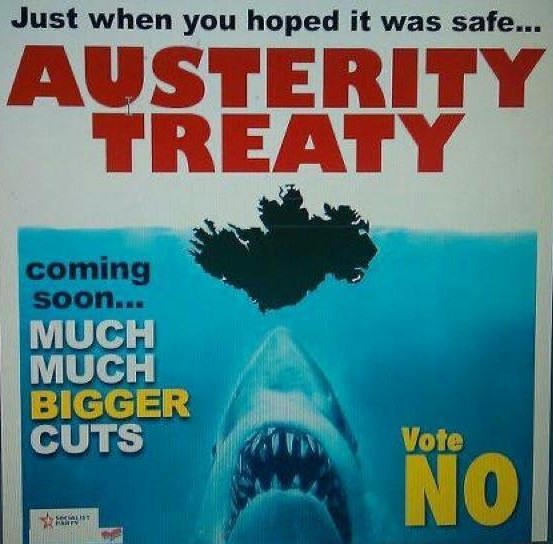
Socialist Party Poster predicts the future

The vote in favour of the Austerity Treaty is clear.  At 60 per cent Yes against 40 per cent No there is no room for doubt.  It is a decisive endorsement of government policy and a mandate for further cuts and tax increases.  The result should not have been unexpected given the political forces ranged in support of the Treaty, the support of big and small business, the failure of the trade union movement to oppose it and the inevitable support of the mass media.  In the general election last year the Irish people voted by a large majority for a new government in no important way different from the previous one and with no claim to pursue significantly different policies.

The result is nevertheless disappointing.    Austerity isn’t popular despite the vote and never will be.  Even the Yes campaign was under instructions not to celebrate its victory.  Austerity is a reality because of an economic crisis which most people still believe was the fault of bankers and property developers.  In October last year when the Austerity Treaty was originally being negotiated an opinion poll recorded 63 per cent opposed to it with only 37 per cent supporting.  Quite simply many changed their minds.  Why?

Many voting Yes did so reluctantly while many will have wanted to vote No but didn’t vote or even voted Yes.  The low turnout of 50 per cent reflected all this.  Yet the vote was decisive.

The No campaign was successful in challenging the failure of austerity and pointing out that such a policy across Europe would only lead to continued stagnation.  Ironically it was more successful than it deserved to be because from a Marxist point of view it is by no means clear that austerity always and everywhere will fail, if by this we mean failure to return a particular economy to growth.  Austerity, as the leaders of Germany understand it, is simply the state policy that enforces the normal disciplines of the market by cutting costs and devaluing capital so that the rate of profit is increased, accumulation of capital through investment and new business creation is encouraged and economic growth returns.

Socialists oppose austerity not because it might or might not return the economic system to this position but because renewed growth rests on increased exploitation of the working class and posits continuation of a capitalist system that will accumulate and grow until the next crisis. Unfortunately we are not yet in a situation where the debate can be framed in terms of a choice of alternative systems but one which only asks the best way to help the existing one.

The Keynesian alternative of increased government spending, summed up by the call for ‘growth’, has long captured the trade union movement and what passes for left politics.  On the other hand there is ignorance of the alternative Marxist perspective and difficulty in arguing for it because of our weakness. We are also not agnostic as to which side of this capitalist debate wins. This means that excavating and pushing for a genuine alternative is not easy.  The first lesson of the campaign however is that there has been a failure of the Keynesian alternative to convince, for it was predominantly under this banner that the No campaign was fought.

Ironically one reason it failed is that, being no real alternative, it was so easily appropriated by the Yes campaign who blithely announced they were working on their own growth agenda.  Being in government they are also the only ones in a position to do anything about it. Again the idea that the capitalist state should be called upon to solve a capitalist crisis is not one with which Marxists could agree.   This is particularly true of the Irish state.  Indeed the very idea that our notoriously venal and incompetent state, so implicated in facilitating the crisis, was itself the mechanism of salvation was obviously questionable.  Even the odd interviewer could not resist pointing this out.  Doubly ironic that this argument was employed by mainstream media figures in calling into question the claims of left wing No campaigners.

In terms of the campaign therefore the criticisms of austerity were blunted by the governing parties’ claims that they too were working for a growth agenda.  More importantly the need for austerity seemed inevitable because there is a huge debt, which is growing and it is going to have to be repaid.  In the meantime the Yes side told us we needed to borrow to pay for state services and we needed to borrow from those states which are telling us to impose the Treaty.  The latter would not take kindly to us saying no to their Treaty while asking for another loan.  While the No side rejected the argument that we would be unable to borrow if the Treaty was rejected the Yes side countered by saying – why take the chance?   If you heard once about needing a safety net you heard it a hundred times.

It is widely accepted that the threat that the Irish State would not be able to borrow, or only at much higher rates, introduced the fear factor that triumphed.  On this issue the weakness of the Irish state, faced with the EU and IMF, was exposed.  The Irish people have had a couple of years to get accustomed to their subordination to the major European powers and decades of acceptance of subordinating policy to the needs of US multinationals.  Any alternative based on the Irish State going in an alternative direction, one that questioned these arrangements, appeared implausible.

The second lesson is very like the first. An alternative based on the Irish state challenging the big European powers or the IMF proved unconvincing because it lacks credibility.  The campaign proved this.  Blaming workers for being afraid when this is the real situation is therefore missing the target.

The No campaign was always on the back foot.  By saying it was not necessary to approve the Treaty for the State to borrow, when this borrowing has to be repaid, it simply reminded voters of the argument that austerity was necessary.

Only two alternatives were weakly argued for in the No campaign.  The first is that the debt should be defaulted on, simply not paid back.  Secondly that the rich who caused the crisis or who have largely escaped its consequences should be taxed so that both these wrongs are righted. These arguments simply didn’t feature largely enough and I will look at just whether they are powerful and robust anyway in future posts.

In the last analysis we have had a referendum on the consequences of a systematic crisis of the capitalist economy and the referendum has told us that unfortunately the working class does not yet have an alternative.  This lesson is inescapable.  Since the socialist alternative is the actions of the working class itself, if this class is too fearful to challenge the system then by definition no alternative currently exists. The Keynesian alternative that marked the No campaign proved unpersuasive.  The capitalist alternative did not convince.  At least on this score Marxists can be at one with the majority of workers.  We can begin to exploit this agreement by putting our own criticism to counter the right and challenge the left that currently dominates what exists of a working class movement.

We can also take heart that many workers, despite no real alternative being presented and being unable to begin creating one for themselves, still decided to either vote No or abstain.  The No vote was overwhelmingly a working class one.  The 20 per cent who voted No are not however anywhere near either a majority of workers nor of the majority of society on which a socialist alternative must rest. Nor can it be claimed that the 30 per cent who voted yes are middle class and can be ignored.  What the media calls middle class is more often than not better paid workers who see themselves as having something to lose by challenging the status quo.

If fear triumphed it is not because workers are congenitally cowardly.  Fear is a rational response to relying on others for protection when these others – the governing parties, state bureaucracy and foreign institutions are all so wedded to austerity.

Confidence on the other hand means confidence in ourselves and the alternative only we can create.  It means to stop looking to others for answers, especially to parties that are committed to austerity, to a state that led us into the crisis and international bureaucracies that everywhere and at all times seek to impose austerity and protect the banks.

Many workers took what action they could and protested by voting No.  Protest is only the beginning of an alternative but it is a beginning.