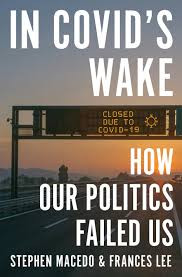
In Covid’s Wake (1 of 6): the past is another country

The Irish government report on how the state handled the Covid-19 pandemic is due to report at the end of the year, seven years after it reportedly arrived in Ireland.  The delay says a lot, as was the original announcement of the review by the government – that the review was to have a “no-blame” approach and would “not be a UK-style” inquiry.  It would not have statutory powers and would be an “evaluation” on the grounds that anything greater would drag on for years.  This was not an empty threat given the many previous tribunals of inquiry held by the state, but it rather loses conviction when it took so long to establish in the first place.

Scepticism over its role was heightened by it rejecting the stronger powers of the UK inquiry, but since this failed to question the basic approach to the pandemic adopted by the British government these in themselves would not have promised a full reckoning.   A spokesperson for a patient advocate group stated that ‘the Evaluation model protects policies and decision makers from any scrutiny at all’.  We shall see.

Two liberal (Democratic Party-type) US academics have published a new book that has much wider relevance than the US, including why it is important that we do not just forget about the whole thing. The book, not surprisingly, is controversial as the consensus it critiques has, also not surprisingly, not gone away.  The authors have responded to some criticism here.

It is said that the past is another country but since almost all other countries had the same experience this doesn’t displace it safely to the past, not least because its impact is still with us, never mind the possibility of any repetition.  

From the point of view of this blog the focus is on what the book implies for an evaluation of the approach taken by much of the left.  Those who have read the coverage during the pandemic will know that it was severely critical of the groupthink that overtook the left and was very much a minority, but not idiosyncratic, view.  The Left’s groupthink showed it incapable of challenging the politics of the state and mainstream bourgeois opinion across the world, putting forward a policy–‘Zero Covid’–that was actually much worse.

The suddenness and severity of actions taken by states meant that ‘just a few weeks after the lockdowns spread from China to Italy and elsewhere, 3.9 billion people–half the world’s population–were living under some form of quarantine.’ (In Covid’s Wake, p 3) What was also sudden was the adoption of the policy of lockdown that justified this approach.  Called “following the science”, it was adopted by overturning the science as it had previously been accepted and became the club to silence and stigmatise those who challenged or even questioned it.  The Left consensus simply adopted a more extreme version of this predominant approach.

Several non-pharmaceutical interventions (NPIs), including “contact tracing, quarantine of exposed individuals, entry and exit screening, [and] border closure” were “not recommended in any circumstances” in a World Health Organisation’s (WHO) assessment in November 2019 of NPI use in a respiratory pandemic.  Quarantine of individuals–never mind whole populations–was “not recommended because there is no obvious rationale for this measure in most Member States.” Contact tracing was considered some help in “isolated communities” in the “very early stages of a pandemic.” (In Covid’s Wake, p 29) Other assessments also questioned the use of NPIs, including after reviewing the experience of the 1918 Spanish flu pandemic.

This meant that when China introduced lockdown “public health experts in the United States and elsewhere responded with shock and disbelief”. (In Covid’s Wake, p 50). Dire predictions from Imperial College in London and China’s draconian embrace of lockdown were the occasion for a complete change of approach by the WHO so that now there was no alternative to unprecedented restrictions on freedom of movement backed by massive social surveillance.

Previously inconceivable restrictions became moral imperatives supported by governments, health bureaucracies, health academics and the mainstream media; plus the majority of the left for whom the unprecedented was not unprecedented enough and the draconian not sufficiently draconian.  That China’s apparent success kept on being implemented until its population started revolting was all in the future.  The WHO’s mission to China found that it provided “vital lessons for the global response” and its measures were the only “proven to interrupt or minimize transmission”, while early predictions were made that it would succeed within three months. (In Covid’s Wake, p 56 &58)

The book records how dubious this claim must have been, including the knowledge that pandemics proceed in waves; millions of people had escaped lockdown in Wuhan, and there could be no confidence in the effect lockdown would have against the progress of a novel virus. The WHO made matters worse by stating that “globally, about 3.4% of reported Covid-19 cases have died”, although it could not know how many people had been infected so could not say what percentage of them had died.  Without acting to implement stringent NPIs the modellers of Imperial College predicted “approximately 500,000 deaths” in the UK “and 2.2M million in the US”, along with the collapse of heath systems. “Suppression” of the virus was the only “viable strategy”, with China again held up as the exemplar. (In Covid’s Wake, p 63 &64)

If this didn’t scare you, or rather ‘convince’ you, this might be because you might have known of Imperial College modellers’ previous poor record.  In 2006 it had predicted “catastrophe”, ‘forecasting 150 million deaths around the world’ as a result of the outbreak of avian flu.  Nevertheless, the book’s authors note that Imperial College Covid projections ‘captured the headlines and grabbed the attention of Covid policymakers, including President Donald Trump.’ (In Covid’s Wake, p 51)

Given the forces ranged against any possible dissent it is not surprising that the ‘global suspension of basic liberties was undertaken with widespread public support.’   This was despite the book stating that ‘it is important not to ascribe to policymakers’ views more coherence than they possessed with respect to the goals of the policies they pursued.  To some extent, policymakers failed to reckon with the choices between flattening the curve, attempting to contain the disease and eliminate it entirely, or suppressing the total number of infections over the whole course pf the pandemic.’ (In Covid’s Wake, p 67)

In my own city of Belfast, the local hospital was converted into a ‘Nightingale Hospital’ for Covid-19 patients and apparently more or less closed for most of everything else. While claiming that Covid-19 would close it if it was not protected, it partially closed itself.   Cancer patients could die but no Covid-19 patient could be refused.  Yet even this stupidity did not give pause for thought that this whole policy was the latest example of the ‘madness of crowds.’  Moral panics demand that doubters are immoral and with so much mainstream opinion on-side it is easy to excuse the left who supported it, except it was a failure; they demanded even more of the same, and they ignored, when they weren’t denouncing, alternative voices.
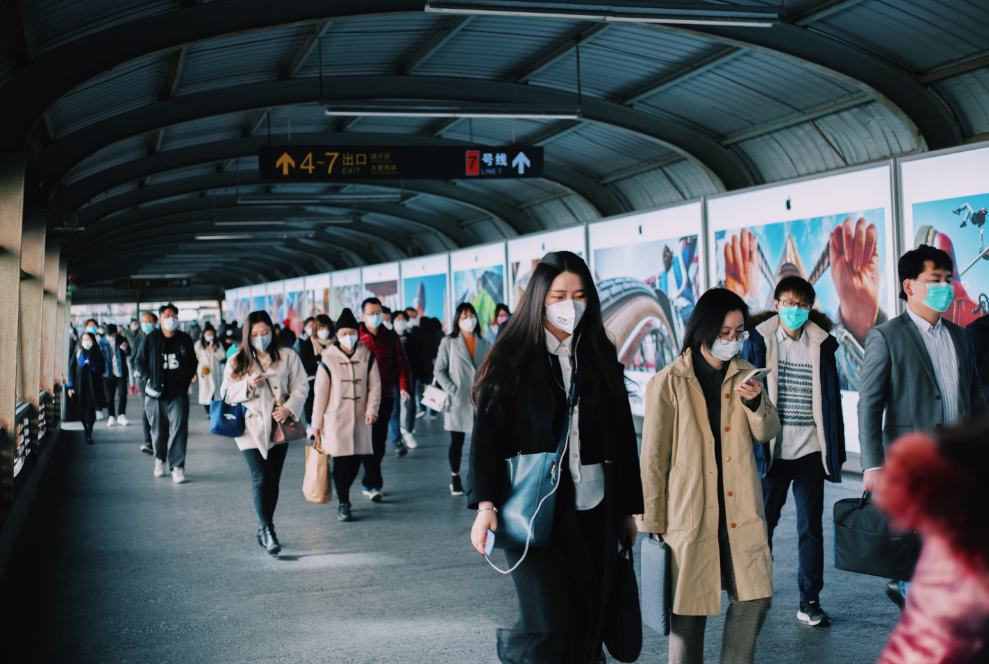
‘The Day the World went Mad’ – a review (3)

No death from coronavirus is acceptable’ said Nicola Sturgeon in Scotland, while the idiot Health Minister for the North of Ireland stated that the health service could not turn away any Covid-19 patient.  When asked whether this meant that a cancer patient may die, he replied “Yes, that’s as black-and-white as it is.”

Mark Woolhouse describes the first remark, if taken literally, as making it ‘impossible to tackle the novel coronavirus epidemic in a rational manner’.   He goes on: ‘unfortunately, it was taken literally, and not only in Scotland, and that’s a large part of the reason why we ended up in lockdown.’

His argument is therefore that the lockdown policy wasn’t rational because it was impossible to find a balance between costs and benefits.  The Health Minister in the north of Ireland took it a step further and in effect claimed to throw all clinical judgement out the window by making Covid-19 patients a priority no matter what.

What sort of priority? Why a political priority of course!  One so obvious he did a U-turn, but only after the absurdity was too embarrassing.

While statistics were regularly produced on test numbers, infections, the R number and other covid metrics, the health cost of lockdown was ignored by invoking a simplistic health versus ‘the economy’ argument.  The need to protect the NHS, especially exposure of its inadequacies – due in part to Tory policy – covered up both the failure of the Covid policy and the performance of the NHS.  Woolhouse notes that during the first lockdown bed occupancy was 65 per cent between April and June while television news homed in on the small number of hospitals close to 100 per cent capacity.

Woolhouse reviews the harms of lockdown under the headings of health care provision, mental health, education, the economy and societal well-being.  He could have added the political effect of the government and state taking on dictatorial powers, frightening large sections of the population, and determining very basic activities that would never have been thought before to require some right in order to exercise.  These costs are nowhere near being evaluated and quantified even now and were all but ignored during lockdown.

Even the argument of prioritising health over ‘the economy’ had to ignore the health effects of austerity, including that an ‘additional 335,000 deaths were observed across Scotland, England & Wales between 2012 and 2019’, according to research at the University of Glasgow.  Marxists are often accused of wrongly exaggerating the importance of ‘the economy’ to social life but in this case some went further than anyone in claiming its inconsequence.

As we noted in the previous post, the first models assumed a disease with very different incidence from Covid-19, yet a later risk estimation algorithm analysed from the data of over six million people found that ‘the 5% of people predicted to be of greatest risk accounted for a staggering three-quarters of all deaths attributed to Covid-19’. It should therefore have been possible to target protection of the population in the same way the disease discriminated, and Woolhouse makes some suggestions how this could have been done, saving lives and money.

But politicians disagreed, and Michael Gove declared that ‘we are all at risk’ – ‘the virus does not discriminate’, while Health secretary Matt Hancock claimed one localised outbreak was ‘disproportionately’ affecting children.   They followed the views of certain experts who claimed, according to the BBC’s Newsnight programme, that ‘ a substantial number of people still do not feel sufficiently personally threatened . . . the perceived level of personal threat needs to be increased . . .’

The media themselves played their part by ‘regularly reporting rare tragedies involving low-risk individuals as if they were the norm.’  Then, of course, we had some on the left for whom all this was far, far too relaxed, if not a calculated conspiracy to weed out the unproductive members of the working class.

Woolhouse recounts his experience of the second lockdown, in which the failures of the first were largely repeated – ‘the case for a second lockdown in England remains weak to this day.’  On the issue of lockdown at Christmas at the end of 2020 he argued that ‘we could focus not on reducing the number of contacts but on making those contacts safe’, but states that ‘this idea did not gain hold in what became an increasingly hysterical debate.’

He observes that ‘as the second wave raged across mainland Europe, the zero Covid campaign faded away when even its most ardent supporters were forced to admit that zero was not a realistic target.’  Woolhouse, however, is obviously not familiar with all its advocates, for whom the last politically correct stance by the Chinese state has now been surrendered.  One recent article has claimed that China embraces ‘forever Covid’ when what is really happening is that Covid is embracing China as it was always going to do, with the only appropriate response being to prepare for it in the correct way.

The arrival of vaccines is presented by Woolhouse as the cavalry, and the fact that China has failed on this while pouring its energy into repressive lockdowns should be yet another lesson.  Many, however, will let the whole Covid-19-episode retreat into the distance that is known as the past and become ‘history’.

Woolhouse reviews the experience of several other countries, including Taiwan, New Zealand, and Sweden, which was prominently disparaged but which he defends.  He also addresses the experience in Africa, where he has interesting things to say but is less definitive.  He looks at alternatives but is critical of The Great Barrington Declaration, despite its emphasis on protecting the vulnerable, although it is not clear to me that his criticism is not compatible with a version of its general approach.  Of the UK’s science advisory team, he accepts that the following could have played a part in its failures: ‘group-think, unconscious bias, tunnel vision, hubris, discouragement of dissent and lack of diversity . . .’

Though disliking the term ‘lockdown sceptic’, which he thinks makes him sound like a ‘climate change denier’ or ‘flat earther’, he still declares ‘why I’m a lockdown sceptic.’  He describes what happened as ‘following the crowd even while it is stampeding in the wrong direction’ because changing course would mean admitting being wrong in the first place, although he notes that the case to do so was so compelling the World Health Organisation did so.

He lists the thigs he did not expect to happen in the pandemic, including many ignoring elementary principles of epidemiology or scientists abandoning their objectivity, and finally that the world would go mad.

‘But it did.’

concluded

Back to part 2

‘The Year the World went Mad’: a review (2)

In his book Mark Woolhouse provides the story of the Covid-19 pandemic in Britain and his role as an advisor to the British and Scottish Governments.

His restrained story does not cover all aspects of the pandemic and the Governments’ response, but it is nevertheless pretty damning.  He notes that that Scottish Government didn’t set up its own expert advisory committee and have its first meeting until three days after the first lockdown, ‘by which time the course of the epidemic in Scotland and the UK . . . was pretty much set’. He criticises the World Health Organisation (WHO) for only declaring a pandemic until well into March, so undermining early action in the UK, and by which time he deems it also ‘pretty much irrelevant.’ 

In fact, WHO comes in for other scathing criticism, including for its approval of China’s strict lockdown policy – “China’s bold approach . . . has changed the course of a rapidly escalating and deadly epidemic’ it said at the end of February 2020, even as Covid-19 had already spread to forty-eight countries.  Nearly three years later China’s strict lockdown policy is falling apart and the call by the Director-General of WHO to follow its policy now looks foolish.

The UK had its own problems right from the start, including the assumption in its pre-existing planning that it was going to be fighting an influenza pandemic.  As Woolhouse puts it, the modelling group he sat on ‘had to contend with one challenge right away; it was set up to tackle the wrong disease.’

The difference this made can be seen in the models created to inform decisions on what action to take against the spread of the disease.  More appropriate for an influenza pandemic, the ‘new, bespoke coronavirus models’ included the impact of schools but not of care homes for the elderly.  Covid-19 was a disease massively disproportionately affecting the elderly, with the average age of death in the UK at 78 and 80 for deaths attributed to coronavirus, but having generally only mild effects on children.  The original influenza models also didn’t include lockdown.

Woolhouse says that ‘We’d done our homework, but we’d prepared for the wrong exam’.  He still claims that they ‘were useful tools’ but also that ‘I wouldn’t want decision-making to be over-reliant on models either’.  Unfortunately, he also says that ‘in March 2020 . . . you could easily get the impression that the UK government’s mantra of ‘following the science’ boiled down to following the models.  That’s how it looked and that’s how the media presented it.’

The models were used to produce an R number every week: the average number of cases generated by a single case. ‘The R monster turned out to be quite dangerous . . . The relentless focus on the R number detracted from the usual public health priorities of saving lives and preventing illness.’  This, for him, was part of a wider problem, accusing many scientists of ignoring elementary principles of epidemiology and abandoning objectivity and common sense.

One example, that was employed as an ignorant term of abuse also on the left, was the damning of ‘herd immunity’, and he criticises the editor of the leading medical journal ‘The Lancet’ for continuing ‘to rail against their straw man version of a herd immunity strategy.’

This criticism of the approach of many scientists is measured and unpolemical, and he presents it from an insider perspective in which models create scenarios and not predictions. He nevertheless finds a particular target in the Imperial College report number 9, which generated a worst-case scenario of half a million deaths in the UK by the end of July.  He admits to generating such a scenario himself.  ‘The problem was that these worst-case scenarios weren’t realistic and weren’t intended to be.’  This one however had the very real consequence of making lockdown ‘accepted as a necessity the first time it was proposed.’

The strategic objectives were presented as saving lives and protecting the NHS.  As Woolhouse notes, if this meant ‘trying to minimise deaths due to novel coronavirus while ignoring deaths from other causes, and if social distancing is the intervention of choice, then we don’t need a complex computer model to tell us what to do.’

Boris Johnson’s ‘flattening the curve’ to ‘protect the NHS’ had two problems according to him.  Firstly, flattening infections and hospitalisation reduced peak demand on NHS services but prolonged it, and the NHS couldn’t cope with either. The NHS therefore required more resources and, while it got new hospital facilities, these remained largely unused because it didn’t get the required staff.  Woolhouse claims the UK got what he predicted – ‘yo-yoing between intolerably severe restrictions and unsustainable pressure.’

In my own posts during the pandemic, I argued that protecting the NHS was attractive to politicians because it would also protect them from accountability for their prior policy of running the service down.  Ritual hand-clapping on the street became the substitute, while we are now invited to condemn NHS workers for striking to recover the fall in living standards incurred over the past number of years.  Perhaps these workers would be in a stronger position today if the failures of government had been exposed during the pandemic instead of demanding more of the same policy.

Woolhouse admits to supporting the introduction of the first lockdown despite concerns, because there was no other option on the table, he was unsure of the effect of earlier measures and he was not prepared to take the risk.  The central message of the book however is that lockdown was wrong and there was an alternative.  He argues that there were already marked shifts in people’s mobility before lockdown and that the latter ‘seems to have come late to the party and had surprisingly little effect.’  Imperial College published a counter-factual analysis ignoring this voluntary activity and exaggerating the effect of lockdown.  

Woolhouse notes some problems with its analysis.  Sweden never went into full lockdown but brought the epidemic under control. Imperial then claimed implausibly that its banning of mass gatherings had had the same effect. Other researchers came up with the quite different conclusion that the UK epidemic was already in decline before lockdown took effect.  He doubts that ‘anyone would claim now that the March 23rd lockdown saved anywhere near half a million lives.’

His alternative was to act earlier, but not to introduce the lockdown that was implemented, while lifting restrictions earlier.  ‘Lockdown was never going to solve the novel coronavirus problem, it just deferred it to another day, and it did so at a great cost.  Epidemiologists and modellers knew that it was going to be the case from the outset. It turned out policy-makers did not . . .’

‘Lockdown was conceived by the World Health Organisation and China as a means of eradicating novel coronavirus once and for all from the face of the earth. With hindsight, this plan was doomed from the outset . . . The world was given an intervention that only made sense in the context of eradication as the preferred means to control a disease that was clearly here to stay.’

Many on the left maintained this position – of zero-Covid – long after this was obvious, while the World Health Organisation eventually backed away from the policy.  In October 2020 it stated that ‘we really do appeal to all world leaders: stop using lockdown as your primary control method.’

As Woolhouse puts it – ‘tragically, this appeal came seven months too late and by that time a colossal amount of damage had already been done.’

Back to part 1

Forward to part 3

‘The Year the World went Mad’: a review (1)

‘The Year the World went Mad; a scientific memoir’, Mark Woolhouse, Sandstone Press, 2022

The working class in Ireland and Britain face dramatic cost of living crises caused by inflation, and in the UK by austerity justified by claims that the public sector deficit has dramatically increased.  The BBC reports that ‘the cost of living is currently rising at its fastest rate in almost 40 years’ and that ‘the UK faces its biggest drop in living standards on record.’  This is ‘largely due to the war in Ukraine and the fallout of the pandemic’ says the BBC.

In Britain the sudden collapse of the pound following the Liz Truss/Kwasi Kwarteng budget was the result of large unfunded tax cuts that the international finance markets would not accept.  One reason they did not accept them was the previous massive expenditure arising from the Covid-19 pandemic.  In Britain and the North of Ireland the cost has been estimated as £376 billion, or 15 per cent of total Government debt and enough to fund over eight and a half years of a deficit that supposedly justifies the current austerity.

The war in Ukraine has resulted in sanctions by the West on Russia, which has in response limited energy supplies to the West.  Sanctions have also disrupted trade and increased many commodity costs, exacerbating the inflationary effect of state expenditure during Covid and the money printed through quantitative easing.  There was always going to be a price to be paid for the money spent as a result of the lockdown policy and sanctions on Russia and it is hardly a surprise that it is being imposed on working people.  What should be a surprise is that the Left should have opposed incurring these costs in the first place but didn’t.

In so far as the war in Ukraine goes, much of the Left has been an echo of Western Governments, which so far have been willing to incur the pain as long as it can be transferred on to rivals and/or dumped on workers.  The voices of the pro-war Left tend to mute when it comes to accepting responsibility for supporting the sanctions policy and consequent assault on working class living standards.

As far as the policy of lockdown during Covid is concerned, the problem would be massively worse had much Left advice to extend and deepen lockdown been accepted.  This book by a member of the British and Scottish Governments’ Covid-19 advisory bodies is a Professor of Epidemiology and a critic of both of their pandemic policies.  He is critical of the lockdown policy of both, of its health, social and economic costs, and insists there was a better way.

If his credentials are supposed to inspire confidence it should of course be remembered that there were many other scientists and medical experts who would disagree with his analysis and conclusions.  Appeals to authority are not going to take you very far.  It is necessary, as always, to think for yourself. His book is worth reviewing because he was an insider in the Governments’ responses and therefore in an advantageous position to recount their decisions and why they were made.  He can also provide background to the pandemic and the response to it but essentially his analysis backs up what was very largely known during lockdown and which led this blog and others to reject the consensus that lockdown was the only correct response.

As to why so much of the Left supported lockdown, this in itself is no pointer to a correct policy; we long ago left the terrain of seeking comfort in majority opinion on this end of the political spectrum.  Stalinism, social democracy and ultra-left sectarians have been making up the majority of it for a long time and even the last grouping almost invariably seeks maximum action by the state as the answer to immediate political and social problems, washed down with a heavy dose of scatological political prognoses based on the supposed radicalisation of the working class through a seemingly permanent capitalist catastrophe.

If capitalism is in permanent crisis then it would seem obviously impossible that the greatest political, social and health disasters are anything other than the immanent outcomes of capitalist economics and the calculated strategies of the representatives of the capitalist class.  This resulted in some on the left demanding even greater lockdowns because the existing ones were either a sham or simply inadequate.  This involved highlighting the potentially worst possible outcomes, repeating the greatest scares and calling for the most drastic actions.

Their recommended policy ignored the level of repression required to enforce their preferred extreme version of lockdown, and ignored the real costs of existing lockdowns and the very impossibility of achieving more restrictive enforcement. It ignored the stupidity of closing down production of goods and services while calling on the state to fund the incomes of workers who produce them so that they could buy the goods and services that they were being paid not to produce.  Anything else was denounced as sacrificing lives for profit, as if under capitalism the goods and services required to produce and reproduce life could be created any other way.

From this perspective the advantage of this book is that it is not in the least concerned with much of the disputation on the left, but may be read as a critique of their proposed approach from which they might at least ask–did we get it wrong?

Forward to part 2

Goodbye Covid-19?

Common Cold Can Protect Against Infection by COVID-19 Virus

Professor Tim Colbourn of University College London was quoted in the ‘Financial Times’ (on 4 Jan) that it was “entirely reasonable to think that the burden of Covid can be reduced by 95 per cent in 2022, so that it’s no longer a top 10 health problem.  That would be a reasonable goal to end the pandemic.”

The article notes that ‘some experts view Omicron itself as a pointer to future evolution of the Sars-Cov-2 virus, as natural selection favours mutations that pass quickly and efficiently between people who already have some immune protection . . . These conclusions are supported by epidemiological evidence that the risk of severe disease is reduced by half or more with Omicron.’

The Director of the Wellcome Medical foundation, Jeremy Farrar, is quoted as saying that he was reassured at the prospect of Omicron taking over from Delta and that “I’d be more worried if you had different variants circulating at the same time.” 

The article states that ‘another variant of the virus is a certainty and that while individual changes in the genetic code are random the environmental pressures that allow some to thrive are not.  This favours variants that transmit quickly while evading immune response but mutations that make the virus more lethal are unlikely to make it fitter and may even be a handicap.’

Jennifer Rohn, a cell biologist and UCL professor, said that “although you can imagine a deadly new variant emerging that’s more harmful . . . I don’t know how feasible that would be for this virus.  Sars-Cov-2 depends on infecting cells and it may already be close to the limits of its repertoire.”

The article notes that the view that the virus will become milder is ‘a matter of debate among scientists’, but quotes another professor of medicine at the University of East Anglia, Paul Hunter, that he is convinced this is true of coronaviruses.  “Sars-Cov-2 will continue to throw up new variants forever but our cellular immunity will build up protection against severe disease every time we’re infected. In the end we’ll stop worrying about it.”

Jeremy Farrar notes that there is a small risk of an evolutionary jump – “something out of left field that does not come from existing lineages”, the article states that ‘most experts regard it as extremely unlikely. “I’m much more scared of another pandemic caused by a new virus that we don’t yet know about than by some variant of Sars-Cov-2” says Tim Colbourn.

Since much of the left has taken a doomsday view of Covid-19 this is perhaps not good news for their perspectives.  How they can continue to argue for a zero-Covid policy – the article quotes a forecast of 3bn infections world-wide over the next two months – is a terrain I don’t really want to explore.  With perspective not far from the fictitious character Private Frazer of ‘Dad’s Army’, perhaps they will cling to a dialectical understanding of the non-linear revolutionary genetic leap that will confirm their pessimism.

They will not, in addition, be enamoured with the views of the former chairman of the UK’s vaccine taskforce, Dr. Clive Dix, who has said ‘Covid should be treated as an endemic virus similar to flu, and ministers should end mass-vaccination after the booster campaign.’

He effectively repeats the views of Dr. Gerald Barry in Dublin quoted in the previous post in calling ‘for a major rethink of the UK’s Covid strategy, in effect reversing the approach of the past two years and returning to a “new normality”.

“We need to analyse whether we use the current booster campaign to ensure the vulnerable are protected, if this is seen to be necessary,” he said. “Mass population-based vaccination in the UK should now end.”

The Guardian’ article goes on to report him saying that ministers should urgently back research into Covid immunity beyond antibodies to include B-cells and T-cells (white blood cells). This could help create vaccines for vulnerable people specific to Covid variants . . .  adding: “We now need to manage disease, not virus spread. So stopping progression to severe disease in vulnerable groups is the future objective.”’

The article quotes Professor Eleanor Riley, professor of immunology and infectious disease at the University of Edinburgh, saying: “Everything depends on whether another variant comes up.  A fourth dose or second booster of the existing vaccine probably isn’t going to achieve very much. The evidence is that immunity against severe disease is much longer lasting. The only justification for doing a second booster for the majority of the population would be if we saw clear evidence of people, five or six months after their booster, ending up in hospital with severe Covid.”

Most people will welcome these views, if only because it’s what they want to hear, as they are tired of lockdown and fed up with the restrictions on their lives.  One danger of pretending everyone has been equally in danger from Covid-19 was always that the vulnerable would be overlooked.  A continuing blanket assertion that we are all still threatened, including children, is worse than useless.

The left’s zero-Covid strategy has nowhere to go, except to expose its exponents as wild catastrophists whose ultra-left politics is exposed once again; supporting longer restrictions for which more and more people can see little justification.  Believing that socialist revolution can only arise out of crisis, they wrongly assume that every crisis requires revolutionary methods.  They do so in pursuit of relevance and sign of their revolutionary purity.  That social crisis has not shown itself conducive to working class politics was the subject of some of the earliest posts on this blog.

A continued forlorn and regressive campaign for zero-Covid will ignore the real issues that are arising, and will have to argue that individual, very basic, freedoms and civil rights should continue to be suppressed by the state.

The issues arising include other costs of lockdown, which will affect working people, and the young especially, for decades.  A left that wants this lockdown extended and deepened has no credibility in responding to these problems.

These costs include financial, health and educational losses.  Calls by the left for the government to pay for workers not to work exhibit all the ignorance often called out by conservatives and reactionaries.  Those workers genuinely at risk or sick must be fully protected but this requires that the rest of the working class actually continues to work.  Real mass lockdown of society is impossible.  Pretending that only ‘essential’ workers should continue to work divides the working class perniciously and reveals levels of ignorance about a division of labour under capitalism that makes the vast majority ‘essential’.

As for asking the government to pay, this reveals incredible confusion at multiple levels – illusions in the capitalist state; illusions in the power of money without workers producing goods and services to buy with this money; the effects of inflation on workers’ living standards in simply handing out money, and the fact that governments don’t pay for anything – they tax or borrow and pay back the latter with the former, unless of course they print money, but then see previous comment.

If any of what this left claimed was true for any length of time, the ‘property question’ which Marx said was key would not be the ‘leading question’ in socialist politics.

More immediately, socialists should support workers being back in the workplace, in order to strengthen their feelings of shared identity, interests, solidarity and organisation.  Concern about health and safety should be dealt with collectively, which is much easier to do if you actually work closely together.

The Health Service has failed – see this earlier post – but to say so is almost to be damned as impugning the staff who work in it, some of whom have made real sacrifices during the pandemic.  Unfortunately, the politicians and bureaucrats who have been responsible for the incapacity of health services to carry out their role have cynically hid behind them, substituting rhetoric about heroes and rituals of hand-clapping for an effective service.

The British left is especially bought into illusions in the NHS, which is a health bureaucracy that was exposed from the start as incapable of protecting even its own staff.  The overwork of many staff is testament to its essential nature as a medical bureaucratic creature of the state, which for socialists is first and foremost a capitalist state with operations, functions and direction determined by the requirements of its class character.

Much of the Irish left wants an Irish NHS, because health care in the South is two tier, in complete ignorance of the fact that the failure of the NHS in the North means that health care there is more and more two tier as well.

Health provision in the pandemic has undergone a real crisis, with services closed down or restricted, waiting lists increased and diagnoses not carried out.  Just like an economic crisis, no crisis goes to waste as far as those in power are concerned.  Simply defending the existing service and believing that more money is the answer is an illusion.

So, to answer the question – Covid-19 will only go away if a zero-Covid policy was possible and was implemented.  It isn’t possible so it isn’t going to happen.  Instead Covid-19 and the mistaken reaction to it will leave in its wake multiple problems.  We need to understand the reason for this mistaken reaction and what the correct approach now is to the current and future evolution of the disease.

Back to part 2

‘Lockdowns . . . a failure of public health policy.’

Coronavirus: 133 patients in intensive care as pressure on hospitals builds

When University College Dublin virologist Dr Gerald Barry was interviewed by ‘The Irish Times’ and asked ­– why have we so many cases when we’re so highly boosted? – he said ‘Even asking the question points to the root of our problem in Ireland and in many parts of the world, we are using a tool that isn’t designed to stop infections and then wondering why it didn’t stop infections.’

‘I would strongly advocate for a complete reassessment of everything we have done to this point, identify everything else that could be done that would help, knock off everything that isn’t feasible or is unaffordable and do everything else.’

So we have failed? – ‘The problem with a “do more” strategy is that some countries that have demonstrably done less to curb the spread of infection, such as England, seem to be doing better overall.’

Just such a reassessment was recently reported in ‘The Guardian’ from Professor Mark Woolhouse, ‘one of the country’s leading epidemiologists’, who has written a forthcoming book, ‘The Year the World Went Mad: A Scientific Memoir’.  Lockdown, he says, ‘was a lazy solution to a novel coronavirus epidemic, as well as a hugely damaging one”.

The day Britain went mad is reported as when ‘the No 10 briefing in March 2020, cabinet minister Michael Gove warned the virus did not discriminate. “Everyone is at risk,” he announced.’  To which Woodhouse responds: “I am afraid Gove’s statement was simply not true. In fact, this is a very discriminatory virus. Some people are much more at risk from it than others. People over 75 are an astonishing 10,000 times more at risk than those who are under 15.”

 “We did serious harm to our children and young adults who were robbed of their education, jobs and normal existence, as well as suffering damage to their future prospects, while they were left to inherit a record-breaking mountain of public debt.  All this to protect the NHS from a disease that is a far, far greater threat to the elderly, frail and infirm than to the young and healthy.”

“We were mesmerised by the once-in-a-century scale of the emergency and succeeded only in making a crisis even worse. In short, we panicked. This was an epidemic crying out for a precision public health approach and it got the opposite.”

That Covid-19 is a disease that discriminates is a point made often on this blog and by others, which should have signaled that a blanket approach wasn’t warranted.  A recent paper analysing this has recently been published, which shows the disparity in effect by age, despite the difficulties in measurement. 

It records that in ‘Twenty-five seroprevalence surveys representing 14 countries were included . . . the median IFR [Infection Fatality Rate] in community-dwelling elderly and elderly overall was 2.9% (range 0.2%-6.9%) and 4.9% (range 0.2%-16.8%) . . . IFR was higher with larger proportions of people >85 years. Younger age strata had low IFR values (median 0.0013%, 0.0088%, 0.021%, 0.042%, 0.14%, and 0.65%, at 0-19, 20-29, 30-39, 40-49, 50-59, and 60-69 years . . .’

These IFRs have been calculated using data from 2020 and are therefore before widespread vaccination, at least in richer countries and before the less virulent Omicron variant.  We can therefore expect these numbers to have fallen not only due to vaccination but also better hospital treatment as lessons began to be learned about ventilation etc.  The paper notes that ‘absolute risk values still have substantial uncertainty’ and mentions the low number of elderly in the studies examined by the paper, but which might also reflect uncertainty about the total number of infections and number of deaths actually caused by Covid as opposed to deaths of people with Covid.

The link here to IFRs for various diseases shows that for the younger age groups Covid-19 is far down the list.  According to the European Centre for Disease Prevention and Control here Influenza (over all ages) appears more severe than Covid-19 for those aged below 30 although this also depends on the virus, host issues, and other factors.

The paper also notes that ‘besides age, comorbidities and lower functional status markedly affects COVID-19 death risk. Particularly elderly nursing home residents accounted for 30-70% of COVID-19 deaths in high-income countries in the first wave, despite comprising <1% of the population. IFR in nursing home residents has been estimated to be as high as 25%.’

Professor Woolhouse argues in ‘The Guardian‘ article that:

‘the country should have put far more effort into protecting the vulnerable. Well over 30,000 people died of Covid-19 in Britain’s care homes. On average, each home got an extra £250,000 from the government to protect against the virus . . .  “Much more should have been spent on providing protection for care homes,”

He ‘castigates the government for offering nothing more than a letter telling those shielding elderly parents and other vulnerable individuals in their own homes to take precautions,’ something this bloggers’ wife found particularly galling as medical personalities and politicians congratulated themselves and were congratulated by others for efforts on her and others’ behalf which consisted of nothing much more than a letter.

As ‘The Guardian’ goes on in reporting Woodhouse’s views ­– ‘The nation could have spent several thousand pounds per household on provision of routine testing and in helping to implement Covid-safe measures for those shielding others and that would still have amounted to a small fraction of the £300bn we eventually spent on our pandemic response, he argues. Indeed, Woolhouse is particularly disdainful of the neglect of “shielders”, such as care home workers and informal carers. “These people stood between the vulnerable and the virus but, for most of 2020, they got minimal recognition and received no help.”

The British Government, according to Woodhouse, thus “lacked a convincing plan for adequately protecting the more vulnerable members of society, the elderly and those who are immuno-compromised.”  

“Lockdowns aren’t a public health policy. They signify a failure of public health policy.”

Back to part 1

Forward to part 3

Hello Omicron

Omicron puts scientists on red alert

Back in December the Deputy First Minister warned that Omicron will hit Northern Ireland “like a ton of bricks”.  “Once again we find ourselves dealing with what potentially is going to be the worst time through the whole of the pandemic,” she added. ‘We are continuing to work around the clock with public health officials to understand the impact because there are things that we currently know, but there are also things that we do not know.’ 

The Chief Medical Officer for Northern Ireland said that he was ‘more concerned than at any previous point in the pandemic’. The Chief Scientific Advisor said that it was inevitable that cases would double every couple of days.

In Dublin the Health Minister said that ‘the reality is the situation is very stark.’  Asked about the comment of the English Chief Medical Officer, Chris Whitty, that hospitalisations will be as bad if not worse  than last winter, he said ‘we could well see that, yes.’  Leo Varadkar warned that the situation was ‘beyond our worst feras’

Mike Ryan of the World Health Organisation has said that Omicron will ‘fill the hospitals up, we will fill the ICUs up.’ Similar warnings were made by politicians and health authorities across the world.

A month later the tone has changed. The Ministry for Health in Northern Ireland has admitted Omicron has not been the threat anticipated, now acknowledged in the South as well.  Learning to live with Covid has been accorded greater weight alongside recognition that lockdowns cannot continue forever. There are now more prominent questions about exactly what the threat from Covid-19 is, and just how many in hospital have been admitted with Covid or for something else but just happen to also be infected.  

At the end of last week it was reported that 44 per cent of those in hospital In the Irish State were diagnosed with Covid only after being admitted, some of whom will not have been admitted due to its effects. While nearly 1,000 Covid related patients are in hospital with the infection almost 500 patients are awaiting discharge from hospital but have nowhere to go, filling beds and potentially posing a risk of further infection.

The need for adequate social services is a longer story than ‘War and Peace’ and as unfinished as most people’s efforts at ‘Ulysses’.  The health service bureaucracy complains that services are under threat from Covid but the real problem is its own failings, in capacity and organisation.  In the South there was much dismay at news that five times more senior managers were recruited in the second quarter of last year than medical staff.

These senior managers complain about staff absences due to Covid but many of these staff are not actually sick but following the isolation rules recommended by them.  And this is not the only part of their lockdown strategy which is worse than useless and is falling apart.  Useless, because testing results take so long when people are most infectious in the first few days.  Useless because many people have been unable to get tests when they want, Useless because to be effective tests would have to be carried out continuously in a way that cannot be performed.  At €200 per PCR test it is an expensive waste.  Falling apart because testing cannot meet demand so it is not even a reliable indicator of extent of infection. It has been estimated that between 300,000 and 500,000 infections went unrecorded last week, up to about 10 per cent of the population. In what possible way could testing act as any sort of measure of control? 

The argument between the National Public Health Emergency Team (NPHET) and Government about whether hospitality should close at 5pm or 8pm now looks laughably pointless, while widespread use of derogations calls into question the whole policy as does reduced periods required in isolation.  At the end of the first week in January there were fewer people in ICU than before Christmas. What is happening is that lots of people are now getting natural immunity.

Even in December it was still clear that infection was primarily an issue for elderly people and especially those unvaccinated.  In mid-December it was reported that 68 per cent of deaths related to Covid in the previous week were among those with an underlying condition and two-thirds were among those aged 65 or older.  This age group accounted for 50 per cent of hospitalisations while the unvaccinated accounted for 45 per cent of patients in ICU.  The unvaccinated were more likely to be in hospital and had a higher death rate. The majority in ICU over the last month have had the Delta and not Omicron variant.

When warnings were first made about the new Omicron variant it was stated by the CMO in England, Chris Whitty, that ‘there are several things we don’t know [about Omicron] but all things that we do know are bad’, which wasn’t true.  The administration in the North and Government in the South took their cue from these warnings.

When the Taoiseach Micheál Martin warned that the projections by NPHET were ‘sobering’, one journalist noted that ‘nobody pointed out that NPHET’s projections have frequently been almost drunkenly inaccurate.’  He admitted that this might not matter given the large numbers involved but this brings us back to Whitty’s remark about all the things known about Omicron were bad.

It was widely argued that the danger of hospitalisation, requirement for ICU, and death – let’s call each of these ‘ Z’ – were all a function of cases, let us call this ‘X’.  The severity of the Omicron variant was known from South Africa to be significantly milder but when the sheer number of cases was taken into account a milder variant with a lower severity – let’s call this level of severity ‘Y’, meant that a much bigger X multiplied by a lower Y still meant a very large Z, i.e. large number of hospitalisations etc.  All making perfect sense in algebraic terms but pretty meaningless in real terms.

If the severity of infection was lower there could be no assumption that a higher number of infections with a mild disease would be a calamity rather than a lot of people suffering a mild infection; but as we see, Whitty and those following simply assumed that a higher number of cases would almost inevitably bring a higher number of hospitalisations, requirement for ICU, and deaths.

Given the much increased transmissibility of Omicron and large numbers forecast it is hardly justified to believe that any general lockdown was going to work, an inadequate testing regime would be relevant, and that a strategy bases on protecting everyone could possibly work.  A policy of focused protection of those known to be most vulnerable is the only one to make sense but hostility to this, in the form of the ‘Great Barrington Declaration’, has been widespread for a long time and defaulting to it would have opened up those responsible for the existing approach to questions.

The reason not to do so, as at the start of the pandemic, was the claim that with so much uncertainty about the new virus the precautionary principle was required: assume the worst and prepare for it while perhaps hoping for the best.  Unfortunately, this explanation doesn’t convince.

If it must be assumed millions would be infected then it should have been obvious that generalised lockdown could not work, even more obvious now with Omicron.  The precautionary principle would require that an optimistic view of its efficacy could not be assumed.  The precautionary principle would also mandate a serious analysis of the prospective harm caused by generalised lockdown and I’ve yet to see any.

Relevant also is the fact that right from the start of the pandemic it was not a question of complete uncertainty – some things were known and should have been acted upon but were effectively ignored.  This was that the real threat to the population was highly correlated with age, with the more elderly suffering a risk multiple times greater than of younger people, which would point to a focused strategy of protection.

Instead of precaution, the real reason was the assumption that the health system could not cope with a sudden increase in cases but, since these were overwhelmingly those at risk, this too was no answer to those advancing the argument of an alternative approach.

Forward to part 2

Covid and the failure of the NHS

Thirty-six years ago I had an interview for a temporary clerical officer job in the local hospital.  One question was – ‘Who is the most important person in the health service?’

Thinking on my feet as I sat in the interview I answered – ‘the patient.’

Which is the right answer.

Although this doesn’t appear to be the case today.

While I was recruited to possibly the very lowest rank in the health service all those years ago, those today at the very top appear to have a different view.

Last week the Minister for Health at Stormont, Robin Swann, issued a public consultation on whether new staff recruited to the health service and social services should be compulsorily vaccinated.  The Minister both in the consultation and in interviews more or less ruled out vaccination of all staff, considering it relevant, or perhaps only possible, for new and agency staff.

It should be remembered that the Minister and Executive ensured that all health service staff, including office staff with no contact with patients, were offered vaccination last year before patients described as extremely clinically vulnerable – those with suppressed immune systems for example. 

When some of these patients were sent the draft of a letter proposing that they ensure all visitors to their homes take a Covid test, the project disappeared when it was returned with a question whether this would also include the visit of district nurses.

The public consultation launched last week mentions that “Trade unions, employees and employers will have a key role in this consultation, but the views of the general public will also be very important.” It also mentioned relatives, and failed to mention patients.

This week the Minister announced he wanted the introduction of a mandatory Covid-19 passport scheme and this has been agreed by all the parties except the DUP.  So, while the Minister wants anyone going into a restaurant or pub to demonstrate that they are vaccinated, or not otherwise a risk, he thinks it’s acceptable for nursing staff dealing with the care of vulnerable patients to be excused this requirement.

Part of the reason for the recent increase in Covid is obviously the partially seasonal nature of the virus. In the case of Northern Ireland however it is also due to the relatively lower numbers vaccinated than Scotland, England and Wales, despite having had a head start on them.  It currently has a higher number totally unvaccinated and a lower number fully vaccinated with a booster shot.

Not only has this probably led to increased severity of infection – requiring hospitalisation – but also increased the sickness level of health service staff (up to 20% among nurses).  Media reports following Freedom of Information requests indicate potentially lower vaccination rates among nursing and social services staff than among the rest of the population.

The trade union UNISON has opposed mandatory vaccination of nurses and called for a voluntary approach of persuasion.  The union might appear to be on more solid ground if it did not make the stupid point of asking why health service staff should be singled out.  Management might also strengthen its position if it were to at least mention the needs of patients, that their views should be canvassed, and that protocols were in place to ensure that the most vulnerable patients were not unnecessarily exposed to unvaccinated staff.  Both might have more of a point if they had followed through on their argument and were to point to a rigorous campaign to get staff to voluntarily vaccinate.

Unfortunately, as argued before, the needs of the NHS bureaucracy have been put before the needs of the people it is supposed to serve; summed up in the mantra that we must ‘protect the NHS.’  Politicians wave the possibility of the closure of Emergency departments; of the health service “about to topple over” if immediate action is not taken; and warnings by senior medical staff that “this phase of the pandemic is now the toughest”.

Just like the Tories in Britain, they point to the crisis they helped create in order to point away from their own culpability.  Instead, it becomes an alibi that implicates those subject to a collapsing service who are blamed for not following guidance and advice.

They congratulate the staff on their heroism in order to absolve themselves while making their heroism a continuing requirement of their work; wrap themselves around the NHS brand in order to avoid and deflect away from their role in its failure, and threaten future collapse as a move to pre-emptively protect . . . themselves.

This partially explains Swann’s particular penchant for lavishing praise on NHS staff with ‘proof’ of seriousness by repeated announcements of additional funding.  When advertising the gruelling pressure on doctors and nurses dealing with the pandemic, he presents himself as a vicarious fellow sufferer.  Identification of the NHS with himself reaches a pinnacle when he says that “I don’t have enough nurses, I don’t have enough doctors.”

Additional funding, as he acknowledges himself, cannot conjure up and deploy staff out of nowhere; its announcement is instead more usefully deployed as a response to internal requests for action by medical staff raising concern at where services are heading.  Additional funding cannot immediately increase capacity, especially if it is non-recurring and limited to a one-off injection, but unfortunately long-term planning has not been a strong feature of the NHS.

So, we are now enjoined to accept renewed restrictions involving Covid-19 passports in order that the NHS not be overwhelmed.  Unfortunately, it is abundantly clear that the NHS has already been overwhelmed.  While pointing to the crisis and away from themselves we are supposed to listen to the words of politicians and not recall their responsibility and years of inaction.

Years of unprecedented underfunding of the NHS are now presented as a historic problem that attaches to no one in particular today.  We are simply reminded that the task now, our task, is to ‘protect the NHS’ in an unprecedented pandemic.

Many socialists get very defensive about criticism of the NHS, as if it were some sort of socialist enterprise in the midst of capitalism.  The reasons for this are numerous, including that it is free at the point of delivery, is not run for a profit and is owned by the state.

Except that it is not free, and is funded by a regressive taxation system; many private companies make a lot of money out of it; it is owned and managed by a capitalist state, and having worked in it for 22 years I can confirm that there is nothing democratic about the way it is managed.  Like all state ownership, it is bureaucratic and unaccountable, as repeated scandals exposed within it testify.

It is not therefore simply a question of underfunding, and to uncritically defend it because the only alternative is conceived as privatisation is a mistake.  Socialism involves different ownership of the productive forces, including those that protect and improve our health, and this democratic workers’ ownership is not a question of a name on a title deed but of how productive forces are organised and developed.  

Workers are not ignorant or indifferent to the bureaucratic failings of the NHS because they are the ones who use it, while some better off workers, middle classes, and definitely the richest all use private health care to one degree or another.

It is argued that the pandemic is unprecedented but the longer restrictions continue the more circumstances can no longer bear the description of exceptional.  The lower rate of vaccination might go some way to explaining the greater effect of increased incidence of Covid than in other countries, while the later roll-out of booster vaccinations than in other countries might similarly explain renewed restrictions.  Nevertheless, it is the declared necessity of protecting the health system that is employed as justification for the new restrictions announced this week.

We have been informed repeatedly about the pressure which health service staff have been put under, and our reliance on them has been reason enough for most people to accept restrictions.  That this pressure has been harsh is real enough but this in itself does not permit the demands of the politicians and bureaucrats to go without challenge.

There have been enough first- and second-hand reports that not all NHS staff have been under similar pressure to ask why this organisation cannot more effectively and efficiently deal with Covid and the other demands placed upon it. Some of the reasons we have mentioned above ­– that the NHS is a bureaucracy in which individual talent and commitment can only have individual effects.

That the NHS is failing is shown by some of the latest statistics from the Northern Ireland health service which show that between the years 2019/20 and 2020/21 total admissions to hospitals fell by 30%; average occupied beds fell by 17.9% and total theatre cases fell from 110,605 to 59,762, a fall of 46%, and 50% on the previous year’s figure.

What these figures show is that it was not simply a question of capacity but the capability to use that capacity and the inability to use it efficiently.  A factor in this will no doubt be increased sickness of staff, but the higher rate of unvaccinated staff contributed to this. Other factors will be the inability to institute infection control without reducing capacity with the creation of much-hyped ‘Nightingale Hospitals’ illustrating the problem.

The results of this failure can be seen in increased waiting times; for example in the 112,915 patients waiting to go to hospital at 30 June 2021, up from 97,243 at 30 June 2020, and 88,203 at the same time in 2019; an increase of 28% over the two years. This is an example of only the most obvious and measurable outcome, which most damaging effect is in the impact on health.

The British government has successfully protected itself by using the NHS as a shield because its popularity has facilitated this, which in turn is partially because the only alternative to it is perceived as privatisation, which is widely unpopular.  Much of the Left, with its state-centred view of socialism and greater predilection for knowing what it is against rather than what it is for, has put itself in no position but to follow the government, with the add-on of demanding more money.

When the London Olympics opened nearly ten years ago, it was noted that the NHS was part of the show, a tribute to its place in the national psyche.  What it wasn’t was a tribute to socialism, no more than was the presence in the show of James Bond and the Queen.  

Covid-19 Delta – ‘the biggest hurricane that has ever hit Ireland’

Ireland on cusp of fourth wave of Covid due to deadly Delta variant, NPHET  warns - Irish Mirror Online

The Irish State has reached the milestone of 5,000 deaths associated with Covid-19 at the same time as it controversially announced that there will not be a reopening of indoor hospitality on 5 July as planned.

Two weeks ago a government source had said that “the narrative that our reopening will slow down is not true.’ However that was before the National Public Health Emergency Team (NPHET) presented advice to it that a pessimistic ‘scenario’ forecasted 2,000 deaths over three months, largely due to the new Delta variant of the disease, with advice that only vaccinated people and those who have had Covid should be allowed inside restaurants etc.

Such a measure was denounced as ‘absolutely bananas” by one opposition leader amid accusations that it was unworkable, discriminatory and potentially illegal, never mind the damage to the social bond that arises from everyone making sacrifices together.  Young people, it seemed, who predominantly serve in hospitality but are unvaccinated could serve, but not be served. Sinn Fein denounced the Government while more quietly accepting the decision; in this case talking more softly out of one corner of its mouth than the other. What would you do if faced with this dreaded forecast was the stock response from the governing parties.

While it was noted that NPHET had failed to factor into its assumptions newly allowed vaccination of younger people and there were calls for an independent audit of its modelling, plus claims that the Irish were an outlier in Europe in terms of indoor hospitality, by and large the figures were accepted without real challenge.  The Irish State has had one of the strictest and longest lockdowns in Europe but if many more people are no longer so scared as they were, there is no alternative critical view of State policy beyond making it harder.

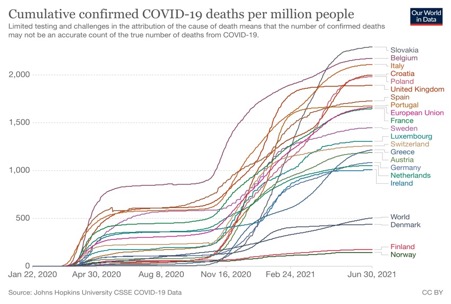
There are a number of reasons for this including that the Irish State has done relatively well in relation to deaths:

State support payments to the unemployed and businesses have continued, and political opposition, including from the left, has been in favour of even tighter restrictions.  Such opposition as has declared itself, has been restricted to the far-right, including anti-Vaxxers who are easily dismissed but serve to make any other criticism easier to ignore.

The Irish economy is also set to grow by over 8%, according to the Central Bank, with this growth having less to do with base effects (the previous fall caused by lockdown making future growth easier statistically as well as economically) because the Irish economy has been hit less by Covid-19 despite the lockdown. The disproportionate presence of US multinationals, which includes companies in the pharmaceuticals, medical devices and IT sectors, has seen demand for their products increase.

An opinion poll in June reported that ‘fewer than one third of voters (32 per cent) agree that life should return “to the way it was before Covid” even after most people are vaccinated. Almost two-thirds (65 per cent) say that some precautions should remain in place, such as wearing masks in shops. Older voters remain significantly more cautious on this issue, with 79 per cent favouring continued precautions.’(Irish Times). The greater threat to older people goes a long way to explaining their particular concerns, as does the failure of the state to protect these people in its care or in private homes for which the state still has a responsibility.

That this number of people are so anxious is not a healthy sign, either from a psychological view or politically. A scared population is not one that is likely to be critical of state policy or seek to map out its own alternative. From a socialist viewpoint it is not conducive to independent thought by workers and rather affirms their social subordination.  In this case the attendant denial of very basic civil liberties emphasises it.

Given the current very low level of cases, hospitalisation and deaths, plus the summer season, the dire warning by the Minister of Health, that “the biggest hurricane that has ever hit Ireland is coming’ simply reaffirms all these negative effects of state policy. Although one must assume his remark excludes An Gorta Mór.

The Government’s decision rests heavily on the most pessimistic of four scenarios presented by NPHET:

The presentation by NPHET shows a wide variation between a central scenario of 187,000 cases in three months and 545 deaths, and the pessimistic scenario of 682,000 cases and 2,170 deaths.  Given the prevalence of the Delta variant, plus greater transmissibility by Alpha, it is the increase in social mixing that appears as the cause of the difference, but this is placing a big burden on indoor hospitality to make this the cause of such an increase.  It is the possibility of the pessimistic scenario that is nevertheless given as the reason, although no probability is presented and the message appears to be that no possibility is acceptable.

The Chief Medical Officer has admitted that advice from his Scottish equivalent is that the Delta variant presents less risk of hospitalisation even if it is more transmissible.  It is already well known that the virus is predominantly a threat to life to those who have other underlying health conditions.

The most recent figures published for the period up to 12 December 2020 report that 93.4% of deaths were of those with an underlying condition.  The figures for those who had Covid-19 and also had an underlying condition was 16.9% for those aged 25 – 34, 52.58% for those aged between 65 and 74, and 59.4% of those 75+.

Clearly it is older people who are most at risk and it is mainly older people who are dying.  The proportion of total deaths accounted for by 25 – 34 year-olds at 11 May 2021 was 0.81% while it was 15.5% for those aged 65 – 74, 33.75% for those aged 75 – 84, and 42.39% of those aged 85+.  In other words, 91.64% of deaths were of those aged 65 and over, but being over this age is not sufficient to have a severe risk posed, you also need to have a relevant underlying condition.

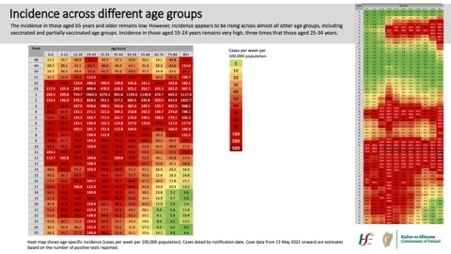
NPHET has reported that cases amongst the eldest has fallen and lower than younger age groups, as this heat map shows:

This is due in good part to the vaccination programme prioritising by age but also by considerations of those most vulnerable.  The programme has also prioritised health care staff although this was supposed to be targeted to front line workers.  In the North not so much pretence was made and back-office support workers with no interaction with patients were vaccinated before, for example, immunosuppressed cancer patients.  The mantra of ‘protect the NHS’ reached a logical conclusion when bureaucrats came before extremely vulnerable patients. While the Southern vaccination programme has been beset by some scandal in which relatives of senior executives and others favoured by them have been vaccinated out of priority, the existence of similar in the North has gone unreported.  

In both jurisdictions the unchallenged requirement for vaccination of health care staff arises because both health systems have been incapable of implementing effective infection control.  In part this is because of the large number of Covid patients hospitalised but this in turn has been mainly due to the failure to protect older people, including those in care and nursing homes.  The Irish Government Covid-19 hub reported, as an example, that on Tuesday 11 May over half of hospitalised cases were in the over 65 age group.

In any case, the vaccination programme has gone a long way to protecting those most vulnerable.  Among these the rates of full vaccination are very high – 94% of those aged 80 and over, and 91% of those aged 70 – 79.  Among the 60 – 69 age group 43% are fully vaccinated while 93% have had one dose. Around 68 per cent of all adults have had one dose of the vaccine, while 45 per cent have had full vaccination.  This compares with Scotland where the incidence of infection, and by the Delta variant, has dramatically increased but existing relaxation of restrictions, including on indoor hospitality, have remained.

However, the argument of the government and NPHET is that the vaccination programme has not progressed sufficiently to reduce the risk and that it is younger people who must be increasingly targeted by the vaccination programme.

However, it is openly acknowledged that the dire warnings and continued restrictions are based on uncertainty about the possible number of cases, the number that will be hospitalised and the number of deaths.  NPHET has forecast 2,170 in the next three months in its pessimistic scenario, but this would mean an over 40 per cent increase in the existing death toll in a very short period, one-fifth the time of the preceding pandemic.  This, when the most vulnerable have received some sort of vaccination, so protecting them to a significant extent against both hospitalisation and death, and against a dominant variant we are informed involves less risk of hospitalisation.

There is a final reason to be wary of attempts to frighten the population and potentially introduce discriminatory measures against those who face least risk.  Leo Varadkar has written ‘that Ireland is among a small number of countries that includes in our numbers suspected and probable deaths from Covid even when the patient did not test positive or was not tested at all.’ 

The Northern Ireland Statistics Research Agency has reported that: 

‘There were 1,626 deaths registered up to 31st December 2020 where Covid‐19 was identified as the underlying cause of death (88.8% of the 1,831 Covid‐19 related deaths). For 157 out of these 1,626 deaths (9.7%), there were no pre‐existing conditions.’

‘In Scotland, 6.8% of deaths involving Covid‐19 from March to December 2020 had no pre‐existing conditions. In the same period, the Office for National Statistics found 12.5% and 17.2% of Covid‐19 deaths had no pre‐existing conditions in England and Wales respectively.’ 

‘The Health Protection Surveillance Centre in the Republic of Ireland found that those who died with confirmed Covid‐19 up to 12th December 2020, 93.4% reported an underlying medical condition. The differences in these proportions between countries could be due to differences in the methodology and demographic make‐up of each country.’ 

The definition employed by NISRA is that the ‘underlying cause of death’ is a ‘disease or injury which initiated the train of morbid events leading directly to death’. On its own Covid-19 causes few deaths yet the virus has assumed unprecedented power to freeze social activity and civil liberties.

All the factors that might cause the Irish State to have a better outcome have received little attention, including it having by far the lowest proportion of its population in the EU in the over 65s.  As has been pointed out, 500,000 Irish people left for Britain in the 1950s and a further 300,000 in the 1960s. How many of these died in Britain who might have done so in Ireland?

There is no evidence that identifying those at risk and protecting them has been seriously considered or modelled.  As I have noted in previous posts, the state has in fact failed these people in the guise of protecting everyone.  That other states have also failed similarly has acted as some protection for them.  

The issue isn’t that indoor hospitality has been postponed to whenever, or the unemployment or business failures that will result, or even that it has involved justification through discrimination.  The issue is that it is yet one more example of an ‘abundance of caution’ ignoring the associated abundance of cost.  Where is the modelling of the health and social cost of lockdown?  Where is NPHET’s and the Irish State’s pessimistic ‘scenario’ for it?

Covid, Brexit, Protest, and the Left too

A couple of months ago in a Facebook discussion with a supporter of Zero Covid I argued that if he really did believe that Covid-19 represented the threat to humanity that he appeared to claim he should demand (albeit critically) more coercive restrictions on democratic rights from the State.  Nothing, after all, is more important than life.

He disagreed, insisting that socialists can never support restrictions on democratic rights by the capitalist state.

Unfortunately the proponents of Zero-Covid supported all the previous restrictions and if they are to be consistent then these new restrictions must also be an unfortunate necessity.  All the rest of the Zero-Covid demands have been made to the state and who else is going to implement them?  Again, it was they who have been hysterical in their claims that capitalism was engaged in what amounts to mass murder.

Of course, Covid-19 did not and does not represent the existential threat claimed and much of the left is wrong about this.  Their position becomes more and more untenable as people appreciate the personal threat to themselves, they tire of lockdown restrictions and more people, especially the vulnerable, get vaccinated.  Were it to become clear that Covid-19 is endemic and therefore requires regular vaccination, as with the flu, their policy would become obviously stupid.

So it should only be embarrassing that they now condemn the rough tactics adopted by the Metropolitan police when it broke up the protest of the murder of Sarah Everard.  To be consistent they should have defended the policy of the police while salving their conscience by condemning the roughness of its implementation.

Of course, the Tories have taken advantage of the widespread acceptance of restrictions of social interaction by proposing to introduce new laws that go a long way to criminalising protest altogether, as should have been feared from the start.  I recently posted another comment on Facebook pointing this out and suggesting that those who didn’t see this coming should avoid politics and find something else to do.

Meanwhile, the Labour Party is to engage in ‘parliamentary warfare’ over NHS pay while forgetting that austerity would be worse had the Tories implemented the greater lockdown restrictions demanded by Labour.  The cost would have been even greater had the Zero-Covid policy of some on the left been adopted; a policy that is the product of an opportunist attempt to attack the Tories but like all opportunism is incapable of taking a longer-term view.

It is no defence of this policy to declare that you also have a policy against austerity; one which makes heroic assumptions about the capacity of the working class to resist it.  Opportunism here is accompanied by ultra-left perspectives that envisages the capitalist class paying hundreds of millions of pounds for furlough payments, loans and grants to business and the shortage of tax receipts from workers etc.

Again, the Tories will claim the legitimacy of the bill to be paid and the left will again be exposed as it argued a policy that would have needlessly cost more. The policy of Zero-Covid simultaneously relies on the repressive apparatus of the state to work, while positing that this state can be defeated in the implementation of austerity that the policy requires.

We will leave aside any stupid notion that the combination of pandemic and austerity will somehow galvanise the working class to revolution; although these conceptions are precisely how much of the left envisages socialist revolution coming about – capitalist crisis producing a mass political consciousness that their political conceptions and interventions are incapable of envisaging coming about in any other way.

Despite their serial corruption and incompetence in most of their response to the pandemic the Tories are ahead in the polls.  Their bedrock support has relied, and continues to rely, upon their support for Brexit.  The pandemic has been used to hide the damage done by it and the Labour Party has been too afraid and too stupid to lead a political attack on it.

The Guardian columnist Polly Toynbee can write that “Labour will plug away, exposing myriad flaws in the dreadful trade deal” but this is meaningless if you don’t oppose it.  It looks hypocritical, since Labour supported the deal, and it looks like the dishonesty typical of politicians given Starmer’s avoidance of even mentioning the word, refusal to seek renegotiation of the deal, and previous policy of pushing the Tories to ‘get Brexit done‘.

But once again, while Labour fails, much of the left is actually worse, having supported Brexit from the start and campaigned for it in the referendum.  The damage to working class living standards and the austerity it will entail is on them.  They too, just like the Tories, are relying on Covid and the Tory press to hide Brexit’s damaging effects and just like Boris Johnson they will – child-like – deny any responsibility.

Two alternative narratives have developed – the fault is with Brexit or the fault is with the big bad EU.  The left that thought it could move on will be cut in two by these scissors but there is little chance that it will fess up and admit a mistake.  As a rule the left does not admit mistakes and certainly not ones as big as this, especially as they cannot consign it to history.

A few years ago a comrade on the left from the Official Republican tradition said to me, while we were watching the May Day parade in Belfast, that so much of the left was rotten that it basically had to die away before a new generation of socialists could make progress. He may even have included his own tradition in that, and in my view this should certainly be the case, but it isn’t as simple as that.  The corruption of Marxism perpetrated by the nationalist and statist left both in Ireland and Britain will not be easily cleansed.

In the meantime, you can hardly blame the British working class if it ignores much of the left, it is quite right to do so.