A beautiful wonderful victory in Syria?

Photo: OMAR HAJ KADOUR/AFP/Getty Images

The sudden and ignominious collapse of Bashar al-Assad revealed an utterly bankrupt regime so hollowed out that its army would not fight for it, its Russian and Iranian supporters could not save it, and it prepared for its own collapse by reportedly transferring $250mn to Moscow. Its passing is no cause for mourning, but it is no cause for rapturous celebration either.

The overthrow was achieved mainly by the reactionary Islamist Hayat Tahrir Al-Sham (HTS) and other militia groups, including the Turkish-sponsored Syrian National Army (SNA).  HTS is the previous al-Qaeda affiliate in the country and its leader, Abu Mohammed al-Jolani, is still subject to a bounty of $10mn by the US while the HTS is considered a terrorist organisation.

This hasn’t stopped western imperialist governments from swiftly moving to recognise the regime.  Why wouldn’t they, since they did so much to enable its victory?  Unlike some simpletons on the left who have welcomed the fall of the Assad regime, the imperialist powers recognise that this involves putting someone else in his place.

Now the Western media is questioning the designation of HTS as terrorist and Abu Mohammed al-Jolani as a wanted man.  The BBC has carried articles – ‘From Syrian jihadist leader to rebel politician: How Abu Mohammed al-Jolani reinvented himself.’  In reality, reinvention is only possible with the connivance of the Western media, such as the BBC itself.

The state broadcaster was only following its government, which has promptly raised the possibility of taking HTS off the terrorism list.  The US also moved quickly to claim that it had made “direct contact” with HTS, as if this was something new, as a start to securing the stability of imperialist interests. The EU announced it would meet the new government to ensure “it goes in the right direction” while threatening Georgia (which has actually had elections) with possible sanctions. It appears some elections are bad and some terrorists are good.

The reported role of Ukraine in assisting the Islamist victory is a pertinent reminder of its role as an ally of Western imperialism, previously in Iraq, Afghanistan, Sudan and Mali.  This may seem unsurprising, but it hardly corresponds to the pretence of the country as an innocent bystander, forced into a purely defensive war.  If Russia is successfully expelled from Syria, how will this advance the particular interests of Ukraine? Where might all the expelled Russian forces be deployed to?

The role of Ukraine is also a reminder how quickly and successfully western imperialism kisses the frog and makes a handsome prince.  In Ukraine the neo-Nazi Azov movement, subject to US sanctions, became freedom fighters when they received US weapons.  HTS is well on the road to such beatification.

Most importantly, the role of Ukraine illustrates the overthrow of Assad as an episode in a wider inter-imperialist conflict that is setting light to different hot wars that threaten to escalate into a single world-wide catastrophe.  On one side, Western imperialism illustrates its ‘progressive’ credentials through support for Islamist reactionaries while, on the other, ‘anti-imperialist’ certificates are endorsed by support for a vile dictatorship, the establishment of military bases on the Mediterranean, and facilitating the robbing of the country by the fleeing dictator.

The left supporters of a ‘multipolar’ world have the inevitable results of this project thrown in their faces – a world of competing and antagonistic imperialist rivalries in which war is inescapable.  Syria is dramatic demolition of the illusions contained in support for a multipolar world within which there are unipolar states.  The multipolar dismemberment of Syria is the multipolar world writ small.

Yet somehow, compared to others on the left, even these illusions seem half sane.  For these others, this world-wide inter-imperialist conflict is so circumscribed and defined by their support for Ukraine that it becomes no more than background noise.  Their effective capitulation to Western imperialism arrives via the road of bourgeois democracy, or the claims made for it, that they extol even as its content is evacuated in reality.  This now reaches grotesque levels in their support for the overthrow of Assad that in linear fashion tail ends Western imperialism.

Even the ideologues of imperialism offer a more accurate and honest view of the HTS than this left.  Foreign Policy notes that they are “cut from the same cloth as Assad” and that protesters against their regime in Idlib who described Jolani as a “tyrant . . . were directed to mass graves of those killed inside prisons—eerily resembling allegations against the Assad government.”

“In Syria it is kind of a monster-versus-monster conflict,” said Aron Lund, fellow with Century International. “Ordinary Syrians don’t have any choice in regard to who rules them. Groups come to their area with guns, and people just have to get along. Depending on who you are and where you are, either Assad or HTS may have pockets of support, but neither side allows any real free expression or elections.”

HTS success was achieved with the assistance of its many foreign Jihadi fighters and was at least partly the result of Turkish and US sponsorship.  It was accompanied by and enabled another invasion by the Zionist state with massive destruction of the weapons and military facilities of the Syrian state.  All this leaves no room for repeating false phrases about ‘self-determination’ as employed in support for Ukraine.  Neither can Islamic fundamentalism be held up as some sort of democratic movement of any kind.

An interview with a Swiss Syrian, Joseph Daher, posted by this left, notes that “We have to face the hard fact that there is a glaring absence of an independent democratic and progressive bloc that is able to organize and clearly oppose the Syrian regime and Islamic fundamentalist forces.”

He goes no to say that “Looking at HTS and SNA’s policies in the past, they have not encouraged a democratic space to develop, but quite the opposite. They have been authoritarian.”

Yet on Facebook, two of the pro-war and pro-Ukraine left said this about the events in Syria:

“Assad is gone! Victory beautiful wonderful victory to see a tyrant crushed like that. Damascus is under the control of the rebels.” 

And:

“The butcher Assad’s departure to Moscow is a great day for the Syrian people and it is hard to conceive of a new government which could be more brutal, reactionary and corrupt. The hope is that the urban movement which nearly brought down the dictatorship is able to take power.”

A “beautiful wonderful victory” for Islamic fundamentalism, one sponsored by Western imperialism and accompanied by another invasion by Israel! 

“A great day for the Syrian people” –how more wonderful could it be?  How greater a day could the Syrian people enjoy than to be subject to the rule of Islamic fundamentalists?

In the interview, Joseph Daher says that ‘Only the self- organization of popular classes fighting for democratic and progressive demands will create that space and open a path toward actual liberation” but that “the main obstacle has been, is, and will be the authoritarian actors, previously the regime, but now many of the opposition forces, especially the HTS and SNA; their rule and the military clashes between them have suffocated the space for democratic and progressive forces to democratically determine their future.”

So where does the “hope” come from that “the urban movement which nearly brought down the dictatorship is able to take power” as a result of this new “main obstacle”?

Daher goes on to say something that the left supporters of Ukraine, and now Islamist rebels, have set themselves against: “To choose one imperialism over another is to guarantee the stability of the capitalist system and the exploitation of popular classes.”

There are many ways of arriving at this, but celebrating the victory of HTS throws all the light you need in order to see the even greater betrayal involved in supporting Ukraine and its war to join NATO.

The Irish general election (2 of 2) – what lies beneath

When five political commentators were asked for the main moment of the election campaign, they all mentioned the TikTok Taoiseach’s snubbing of a disability care worker when he was on one of his many walkabouts.  It “cut through” to the public, as the saying goes, and probably did lower the Fine Gael vote a little.  However, in the grand scheme of things all it demonstrated was the irrelevance of the campaign, which has been described as a non-event.  Unlike recent general elections in many other countries, the incumbents were returned to office, providing evidence of political stability that does not exist elsewhere.  This stability rests on uncertain foundations.

The election was called following a large give-away budget of tax reductions and increased state spending, followed by a campaign where everyone promised even more tax cuts and increased spending.  This included the previous austerity-merchants in Fianna Fáil and Fine Gael. Halfway during the campaign, when Sinn Fein joined the club, Fine Gael launched hypocritical denunciations that it was about to break the “state piggy bank”.

On the surface, the only difference between the governing parties and the different varieties of opposition was how much they would spend. People before Profit claimed that their clothes were being stolen by everyone, at least for the election, while media commentators claimed that the widespread consensus on increased state intervention showed what an essentially leftwing country Ireland was.  Since PbP argues that such intervention is an expression of socialist politics these claims would be right – if PbP was also right, which it’s not.  The view of politics as a spectrum from left to right implies no fundamental difference between the government and opposition but only shades or degrees of difference.

If this didn’t provide the grounds for major change, and the existing alignment of party support made it unlikely, the most important reasons for continuity are the foundations of the state itself and the economic success that has satisfied a significant part of the population, if only on the grounds that it could be a lot worse and recently was.  The ‘left’ appeared as wanting to share the gains more equally.  Unfortunately, those seeking equality inside the Irish state have to reckon on the giant inequality outside on which it would have to be based and which determines it.

The largesse of recent budgets, and the promises of more during the election, rest on the existence of the Irish state as a tax haven where many US multinationals have decided to park their revenue for tax purposes alongside some of their real activities.  Over half of the burgeoning corporate tax receipts come from just ten companies, with the income taxes of their employees also significant.  Trump has threatened tariffs on the EU, which threatens the massive export by US pharmaceutical firms to the US, and has promised to reduce corporate taxes, which also reduces the attractiveness of the Irish state to multinational investment.  It is not so long since the shock of the Celtic Tiger crash, so very few will not be aware of the vulnerability of economic success and the finances of the state.

This vulnerability was ignored in recent budgets and election promises while the electorate is blamed for seeking short term gains that are all the political class can truthfully promise.  Failure to invest in infrastructure has weakened the state’s long term growth with the major shortfalls ranging wide, across housing, health, transport, childcare and other infrastructure such as energy and water.  This has led to calls for increased state expenditure as the existing policy of throwing money to incentivise private capital has fallen short even while the money thrown at it has mushroomed.  Bike sheds in Leinster House costing €336,000, and a new children’s hospital that had an estimated cost of €650m in 2015, but costed at €2.2 billion at the start of the year – apparently the most expensive in the world – are both examples of the results of a mixture of a booming capitalist economy and state incompetence.

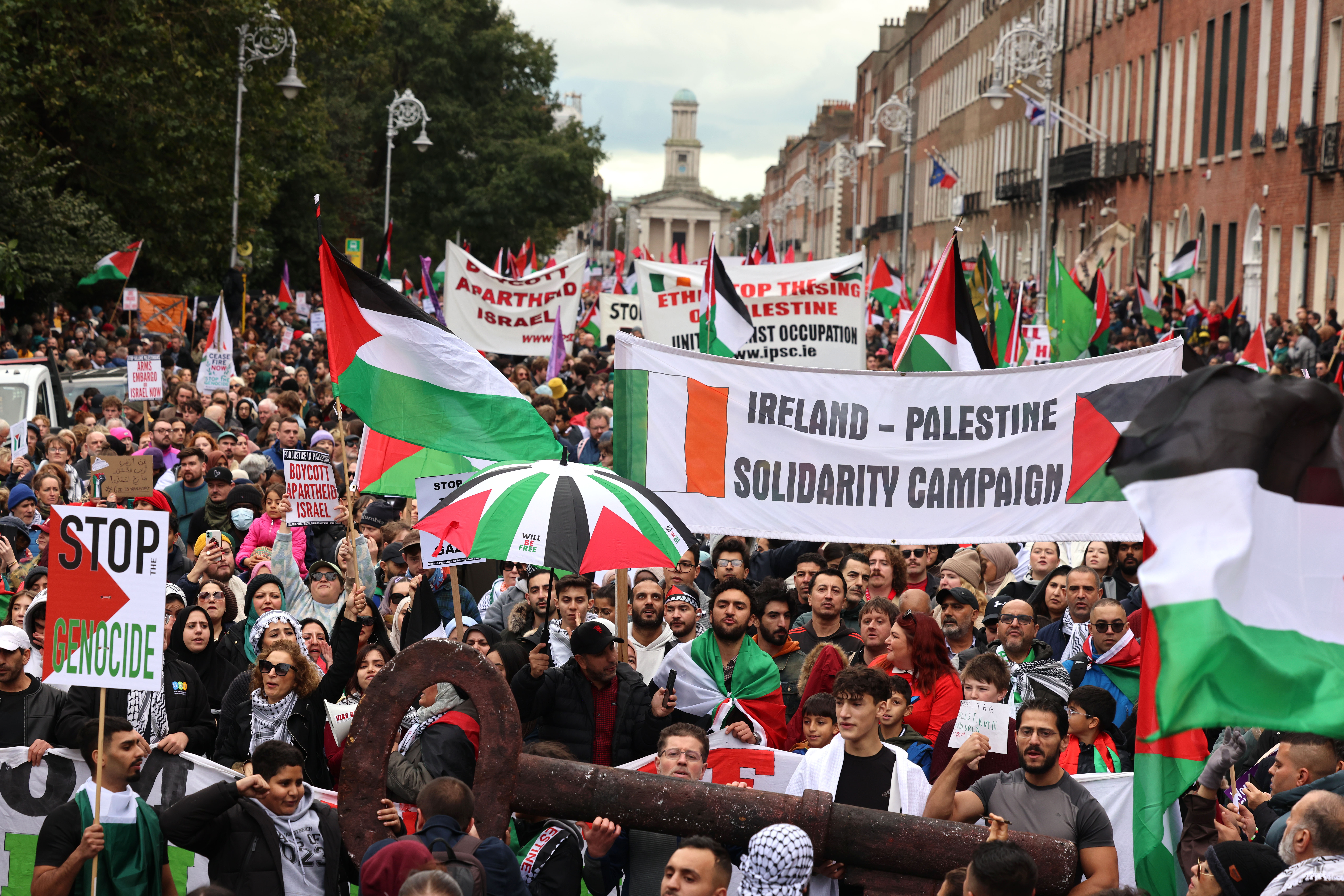
The consequences are an electorate that wants change but doesn’t want or can’t conceive of anything fundamental changing.  Government and opposition differ on degree but avoid the thought of challenging the constraints their lack of an alternative binds them to.  Trump is only one of them; Irish subservience to the US has already destroyed all the blarney about Irish support for the Palestinian people.  Gestures like recognition of a corrupt Palestinian state are nauseating hypocrisy beside the secret calls to the Zionist state promising lack of real action; selling Israeli war bonds to finance genocide by the Irish central bank, and the three wise monkeys of the three government parties ignoring the use of Irish airspace to facilitate the supply of weapons employed in the genocide.

The Irish state is not in control of its destiny and its population is aware of its vulnerability.  For a left that bases itself on the capacity of the state this is a problem; involving not just the incompetence, the bottleneck constraints on real resources, and the international subservience to Western imperialism.  The fundamental problem is in seeing the state as the answer.  Were the Irish state stronger, it would have joined NATO and more directly involved itself in the war in Ukraine; it would have intensified its support to US multinationals, and perhaps been a bit better at building bike sheds and a children’s hospital.  

Parts of the left seems to think the current Irish state can oppose NATO, oppose war and perhaps tax US multinationals a bit more.  It is, however, currently on the road to effective NATO membership; is more or less unopposed in its support for Ukraine in its proxy war; and already taxes multinationals on a vastly greater scale than almost any other country I can think of. 

The left doesn’t have an alternative ‘model’ because its alternative isn’t socialist, but simply development of the state’s existing role, presided over by some sort of inchoate left government, the major distinguishing characteristic of which is that it doesn’t include Fianna Fáil and Fine Gael.  This is so anaemic a strategy it avoids all the above reasons why it has minority support.

The terms in which this is popularly understood do not go in the direction of a socialist programme because of the generally low level of class consciousness, but a genuinely socialist path requires rejection of the current statist approach of ‘the left’.  That this too is currently very far away reflects not only the very low level of class consciousness but also how the forces that are responsible for this have also debased the left itself, especially the part that thinks itself really socialist.  Instead, we have the stupidities arising from the commonality of increased state intervention among all the parties repeatedly declared to be proof that Ireland is a left wing country.

These constraints explain the difficulty in creation of a left alternative to a Fianna Fáil and Fine Gael government; the fragmentation of the left and its Oliver Twist policies of simply asking for more.  There are numerous permutations possible before any purported left government would arise, with Sinn Fein, Independents, Social Democrats, Labour Party, and others all willing to go into office with either (or both) of them.  About the least likely is a ‘left’ government (in any meaningful sense) that excludes them and is composed of Sinn Fein – the austerity party in the North – and the Labour Party and Social Democrats whose whole rationale (as the good bourgeois parties that they are) is to get into office – they don’t see the purpose of being involved in politics if you don’t.

All the calls for a ‘left’ government free of the two uglies is based on the same bourgeois conceptions.  Even if only on the grounds of the Chinese proverb – to be careful what you wish for, the failure in the election to achieve such a government is not grounds for mourning, even if the result invites it.

Back to part 1

The Irish general election (1 of 2) – As you were

A continuation of the status quo is the result of the general election in the Irish state, with the two main capitalist parties, Fianna Fáil and Fine Gael, gaining 42.7% of the first preference vote.  Falling just short of the 88 seats needed for a majority there are enough independents, who are FF and FG in everything but name, to prop them up.  The only surprise is that Fianna Fáil topped the poll, the same party written off following it presiding over State bankruptcy and Troika vassalage after the crash in 2008.

Their main opposition, Sinn Fein, gained 19% and is more than willing to go into a coalition but ‘the left’ by which it might form an alternative one is too small and fragmented, and FF or FG will only consider it as a partner if they have to, and they don’t, so this route to government participation is also closed off to it.  It has pulled its familiar trick, practised to perfection in the North, of claiming victory, which is only possible if you accept the disastrous previous local and European results as the benchmark. At one point, in the summer of 2022, an opinion poll put it on 36% but in the election its vote fell by 5.5% on the previous general election.  Beyond the various figures, it will be staying in opposition, which is not at all where it wants to be.

The third leg of the existing government – the Green Party – collapsed from 12 to only 1 seat, that of its leader who now has no followers in the Dáil. Its previous participation in office led to its complete wipe out in 2011, following its collaboration in the bail-out of the banks and imposition of austerity.  Like its fellow Green parties across Europe, its ‘left’ alternative credentials are to be taken seriously only by the terminally naïve.

On what is called ‘the left’, two parties did reasonably well in terms of their expectations.  The vestal Social Democrats gained seats and 4.8% of the vote, while the shop-worn Labour Party staged its own return from near-death by gaining seats and a 4.7% share.  They too have no justifiable route into government since FF and FG don’t need them that much and they would have little leverage on policy. They know they would likely suffer the fate of the Greens for their inevitable disappointing of the hopes of their supporters, busting the illusion that they are in some way ‘an alternative’.   The unsullied Social Democrats are relative latecomers, which will be their major USP until they see their next career move as being junior ministers, while the problem with the Labour Party is that having nine lives as a junior partner in government has required suffering the same number of deaths. It could nevertheless still be a hard habit to break but this time probably just deferred.

The People before Profit – Solidarity alliance will continue to get state-funding with 2.8% of the vote, an increase of 0.2% but with a loss of two seats from 5 to 3.  The core objective of being part of a left-alternative government to Fianna Fáil and Fine Gael might be said to have been destroyed except that it never existed in the first place. Neither formally nor informally was it advanced and ‘failed’ not only because of the continuing success of the main capitalist parties, even if much reduced by historical standards, but also by the weakness and incoherence of what PbP-Sol thinks of as ‘the left’.  To its credit the Solidarity section of the alliance is less inclined to consider Sinn Fein as left but either way, the perspective of a left alternative government as a realistic alternative to the various permutations of the current bourgeois groupings has been exposed again.  State funding, speeches in the Dáil and political social-work by TDs and would-be TDs are not only not a socialist alternative but not even a credible means of achieving the PbP-Sol reformist project.

On the right, the Catholic Aontú party made an advance with two seats and 3.9% of the vote while the Independent Ireland grouping won 4 seats and 3.6%.  Beyond these more openly right-wing groups, a couple of independents made ground with anti-immigrant politics and the far-right also stood candidates in a coordinated attempt tom unite by not standing against each other.  None were elected but what was noteworthy was their presence.  They have not yet congealed into a movement with a leader and have been stymied by the absorption of the anti-immigrant message by the main bourgeois parties and independents to varying degrees.

The result then is a return to government in some form of the existing main capitalist parties and the continued exclusion of the fragmented opposition, which was always the most likely outcome and partly accounts for the reduced turnout –down from 62.9% in the 2020 election to 59.7%.  The lowest in the history of the state. Almost as many didn’t vote as will have supported the two parties dominating the government. Some commentators, and the opposition, have attempted to explain that there are bubbling undercurrents waiting to have their effect but it is better to start explaining the apparent stability before explaining that something very different is really going on.

Forward to part 2

Karl Marx’s alternative to capitalism part 56 – the conditions for emancipation

Containers sit on the tarmac at Felixstowe Port | Dan Kitwood/Getty Images

At the end of a lecture to workers in Brussels written in 1847, Karl Marx stated that:

‘Before we conclude, let us draw attention to the positive aspect of wage labour . .  . I do not need to explain to you in detail how without these production relations neither the means of production—the material means for the emancipation of the proletariat and the foundation of a new society—would have been created, nor would the proletariat itself have taken to the unification and development through which it is really capable of revolutionising the old society and itself.’

(Marx, “Wages”, Marx and Engels Collected Works, vol. 6, p 436.)

For him, capitalism had already so revolutionised society that it provided the conditions for the creation of a new one and the means to achieve the emancipation of the working class – ‘material conditions . . . that could be produced by the impending bourgeois epoch alone’ (Marx and Engels, Manifesto of the Communist Party. Collected Works, vol. 6, p 514)

Today, one very rarely reads a positive analysis of material conditions for working class emancipation created by capitalism, even though these have massively developed since Marx wrote these words, when they were really only becoming evident in one country and were too undeveloped even then.   They provide the most striking proof of the potential for the development of socialism out of present society.  In many respects however they are no longer recognised as such and rarely considered; in other respects they are rejected, but we will come to that later.

In Volume I of Capital Marx describes the creation of these conditions:

‘As soon as this process of transformation has sufficiently decomposed the old society from top to bottom, as soon as the labourers are turned into proletarians, their means of labour into capital, as soon as the capitalist mode of production stands on its own feet, then the further socialisation of labour and further transformation of the land and other means of production into socially exploited and, therefore, common means of production, as well as the further expropriation of private proprietors, takes a new form.’

‘That which is now to be expropriated is no longer the labourer working for himself, but the capitalist exploiting many labourers. This expropriation is accomplished by the action of the immanent laws of capitalistic production itself, by the centralisation of capital. One capitalist always kills many.’

‘Hand in hand with this centralisation, or this expropriation of many capitalists by few, develop, on an ever-extending scale, the co-operative form of the labour process, the conscious technical application of science, the methodical cultivation of the soil, the transformation of the instruments of labour into instruments of labour only usable in common, the economising of all means of production by their use as means of production of combined, socialised labour, the entanglement of all peoples in the net of the world market, and with this, the international character of the capitalistic regime.’ (Marx, Capital Volume I p929)

In earlier posts on Marx’s alternative to capitalism we outlined many of these and how the contradictions within this development, including that between the forces and relations of production, would lead to social revolution.  We outlined the increasing socialisation of production through the colossal expansion of capitalism across the world, turning more and more activities into commodities to be sold for profit, through a massive increase in the division of labour – within and between workplaces – that involves the the creation and enabling of new, previously undreamed of, technologies.

This massive ‘development of the forces of production is the historical task and justification of capital.  This is just the way in which it unconsciously creates the material requirement of a higher mode of production.’ (Capital Volume 3 p 181)

This is elaborated in the Grundrisse:

‘The great historic quality of capital is to create this surplus labour, superfluous labour from the standpoint of mere use value, mere subsistence; and its historic destiny is fulfilled as soon as, on one side, there has been such a development of needs that surplus labour above and beyond necessity has itself become a general need arising out of individual needs themselves – and, on the other side, when the severe discipline of capital, acting on succeeding generations, has developed general industriousness as the general property of the new species – and, finally, when the development of the productive powers of labour, which capital incessantly whips onward with its unlimited mania for wealth, and of the sole conditions in which this mania can be realized, have flourished to the stage where the possession and preservation of general wealth require a lesser labour time of society as a whole, and where the labouring society relates scientifically to the process of its progressive reproduction, its reproduction in a constantly greater abundance; hence where labour in which a human being does what a thing could do has ceased.’

‘Capital’s ceaseless striving towards the general form of wealth drives labour beyond the limits of its natural paltriness, and thus creates the material elements for the development of the rich individuality which is as all-sided in its production as in its consumption, and whose labour also therefore appears no longer as labour, but as the full development of activity itself, in which natural necessity in its direct form has disappeared; because a historically created need has taken the place of the natural one. This is why capital is productive; i.e. an essential relation for the development of the social productive forces. It ceases to exist as such only where the development of these productive forces themselves encounters its barrier in capital itself.’ (Marx, Grundrisse p 409-410)

The passages above, which might appear difficult – the first paragraph is comprised of only one sentence! – demonstrates capitalism’s contradictions, with its laying of the foundation for its supersession.  So, the drive for capitalism to ever greater exploitation of workers – by their giving up more and more of their time labouring for the capitalist that is not recompensed in wages – is indeed their intensified exploitation.  However, this very development of production, beyond what is required to simply maintain the working class at some minimum level of existence, expands productive powers in such a way that greater and higher needs can be satisfied – of course for the benefit of the capitalist class initially and to the utmost extent – but also increasingly for workers by increasing what they can consume; in their whole mode of living, and how they can further their personal interests and development.  Above all, this expansion can allow this development by potentially reducing the time necessary for work, permitting time to take part in the running of society while also pursuing other collective and individual interests.  The massive increase in the productivity of labour forced by capital in ruthless competition can be turned from a means of capitalist exploitation to working class emancipation.

Capitalist expansion of exploitation is ceaseless because it seeks the accumulation of wealth in the form of money, for which there is no limit, but at the same time must do this in the form of the creation of real objects and services which address genuine needs, even if capitalist society distorts and degrades their development and expression.  The potential freedom from want, insecurity, inequality and from the subordination of everyone subject to the imperatives of capitalist accumulation, is the foundation for the belief that the ending of the class system will herald the end of all social domination and oppression.

The capitalist has only a ‘transitory existence implied in the transitory necessity for the capitalist mode of production’ who ‘ruthlessly forces the human race to produce for production’s sake; he thus forces the development of the productive powers of society, and creates those material conditions, which alone can form the real basis of a higher form of society, a society in which the full and free development of every individual forms the ruling principle.’ (Marx Capital Volume 1 p 739)

Consequently, ‘from the moment that the bourgeois mode of production and the conditions of production and distribution which correspond to it are recognised as historical, the delusion of regarding them as natural laws of production vanishes and the prospect opens up of a new society, [a new] economic formation of society, to which the bourgeois mode of production is only the transition.’ (Marx, Theories of Surplus `value MECW Vo 33 p 346.) Capitalism is therefore just a transitional phase in the evolution of human society and its development of productive powers through which it shapes itself and its environment.

* * *

This post is the continuation of a series, the previous one of which is linked here, and the first of which can be found here.

Back to part 55

Forward to part 57

Who will follow the road to World War III?

It is reported that the US has approved the use of long range missiles against Russia and that the first missiles have been fired.  This requires that US personnel participate directly in identifying the targets and programming the attacks, authorised by a President who is mentally decrepit.

It’s something like a nightmare scenario that the United States is going to attack Russia with its missiles using willing proxies.  Who can possibly think that this is a good idea?

Over two years ago the left supporters of Ukraine vehemently denied that the war was an inter-imperialist one, on the basis that ‘to describe the ongoing conflict in Ukraine, in which the latter country has no ambition, let alone intention, of seizing Russian territory . . . to call this conflict inter-imperialist, rather than an imperialist war of invasion, is an extreme distortion of reality.’  Now we are apparently told that the US will provide its missiles, programme them, and employ its ISR (Intelligence, Surveillance and Reconnaissance) in support only of the Ukrainian invasion of Russia in Kursk.  Does this make the idea any better?

Two years ago the left supporters of NATO intervention were claiming that ‘we must also oppose the delivery of air fighters to Ukraine that Zelensky has been demanding. Fighters are not strictly defensive weaponry, and their supply to Ukraine would actually risk significantly aggravating Russian bombing.’  These fighters have been provided and are in operation.

A year later the same supporters were stating that ‘NATO is not waging an all-out proxy war against Russia proper’, citing as evidence of this ‘Washington’s refusal to green-light Ukraine’s bombing of Russia’s territory or even Crimea, and to provide Kyiv with adequate means for that purpose. Joe Biden’s refusal to deliver the F-16 fighter jets that the Ukrainian government is requesting is a case in point.’

This month the same pro-imperialist left is stating that ‘the supply of arms to Ukraine has been insufficient and slow’ and ‘Governments, including NATO countries, should provide the weapons necessary for Ukraine to win.’  Since it is widely accepted by imperialist experts and commentators that even the long-range missiles now approved will not allow Ukraine to win, this pro-imperialist left is not just trailing behind US imperialism but is now in advance of it – in supporting provision of whatever weapons that ‘are necessary for Ukraine to win.’

They have written a blank cheque for imperialist intervention, one year after their previous article was entitled ‘Supporting Ukraine—without writing a blank check’!   Have they even noticed the shift, or does the righteousness of the Ukrainian cause lead them to ignore or dismiss or otherwise justify the risk of World War III?

In this article it is admitted that the aim of retaking Crimea is ‘an escalation by NATO . . . [that] would be reckless and should be opposed.’  It states that ‘the recovery of those parts of Eastern Ukraine identified by the 2015 Minsk II agreement or of the Crimean Peninsula cannot for that matter be regarded as Ukrainian war goals that should be supported.’  It says that ‘the only acceptable solution of such quarrels is by letting the original populations of the disputed territories vote freely and democratically for their self-determination.’  Presumably the forced reintegration of these by Ukraine would therefore be unacceptable?  Why then are they supporting a war which has precisely this aim?

There are now no limits set to supporting Ukrainian and Western imperialist war aims.  The previous claims about their objectives have been exposed as nonsense, having previously stated that imperialism ‘has not even agreed to help Ukraine recover all the territory that it lost since 2014, which includes parts of Donetsk and Luhansk as well as the whole of Crimea. There is no serious indication until now that this has been or has become Washington’s goal, while there are plenty of indications to the contrary. . .’  The much heralded Ukrainian counter-offensive in 2023, prepared and planned with NATO, had precisely these objectives. Did the pro-war left not notice?

On the other hand, it is still claimed that the war is ‘a struggle for national liberation and self-determination’ and ‘for independence’, even though it is admitted that Ukraine was and is already an ‘independent country’ and that the self-determination on offer from the West is a cynical pretence.

Their latest statement says that ‘NATO countries, should provide the weapons necessary for Ukraine to win. It should not entail an increase in their military expenditure, the promotion of militarism or the expansion NATO and other military blocs – which should be disbanded . . .’

Yet its previous statement argued that ‘short of benefiting from NATO’s Article 5, Ukraine has become a NATO member in all other respects and for all intents and purposes . . . NATO will certainly further build up Ukraine’s military capabilities after the ongoing war, so that Ukraine’s future deterrence of potential Russian aggression will be considerably enhanced. The country will hence become a precious de facto auxiliary to NATO in confronting Russia.’  The statement further admits that Zelenskyy ‘is inviting private venture capitalists such as Blackrock to invest and buy up Ukraine’s assets. For his government, the message is clear: Ukraine is for sale.’

How subordination within NATO and selling its productive assets is ‘national liberation’, ‘self-determination’ and ‘independence’ is anyone’s guess.  The invasion of the ‘territorial and (neo)colonial domain of another country’ that this pro-war left first denounced is now evident not just in the invasion by Russia, but also through the actions of the Ukrainian capitalist state and its alliance with Western imperialism, primarily the US, on which Ukraine is now utterly dependent.

Again and again the actions that are claimed would confirm the war as an inter-imperialist one have come to pass, to the point that the United States is employing Ukraine to attack Russia with its missiles.  Yet still it is denied. The cognitive confusion and degeneration of the titular leader of Western imperialism has its analogue in the confusion and political degeneration of large swathes of the Western left that criticises him for not being aggressive and bellicose enough.

Is it possible that it will find a reverse gear and admit that it has got it all wrong?

That might be true if all we had was confusion, but this confusion is a result of political degeneration.  The confirmation that Russian nuclear doctrine now entails the possible use of nuclear weapons upon attack by a non-nuclear power that is supported by a nuclear one makes clear the stakes involved in the recent US escalation. That Trump is now the promise of an end to the war, while most of the left supports its continuation, even while saying that it believes that “Ukraine cannot win the war’, is a criminal betrayal of both the working class, including the Ukrainian working class, and of socialism.

This left stupidly compares its support for war to support for a workers’ strike that is judged unwinnable.  Besides the fact that socialists, in certain circumstances, may seek to draw to a close a strike that will result in a greater defeat if it continues, the comparison of a workers’ struggle with that of a rotten and corrupt capitalist state, in alliance with western imperialism, shows a complete inability to understand class politics.  The repeated conflation of the Ukrainian working class, its separate interests and the need to oppose the NATO imperialist alliance on the one hand, with ‘Ukraine’, the capitalist Ukrainian state and its imperialist war, on the other, demonstrates that it has no way out of its capitulation.

A left that cannot oppose the drift to world war, in fact supporting the dynamic towards it, while surrendering the claim to prevent it to the reactionary right, is one utterly lost.  The ‘lesser evil’ Democratic Party has just demonstrated the poverty of this sort of politics.  Only among the most rabid imperialist neocons is support for intensified and unlimited war popular; them and the pro-war left.  The struggle against the war is a struggle against both.

Politics of the Lesser Evil- Harris and Trump

In a two-horse race where you want both to lose, the crumb of comfort is that one of them will.  In this case the ‘lesser evil’ was an accomplice to genocide, which rather raises the question what the greater evil might possibly be?    Tested to destruction, the politics of the lesser evil failed spectacularly and all those US leftists who defend it have lost both the election and lost the argument.

Of course, this will be the beast that will not die and will raise its head again elsewhere, in, for example, the French Presidential elections.  We have already experienced it in Britain where Starmer’s Labour was the lesser evil alternative to the Tories; except that after a few months in office opinion polls show that its support has collapsed.

Trump now has the potential to control Congress as well as the Presidency, having packed the Supreme Court.  Only the permanent state apparatus lies between him and his implementation of policies most of the capitalist class opposes, and the US system already allows political appointments to the state bureaucracy.  The BBC quickly reported that he intends ‘an aggressive plan to restructure the federal bureaucracy, replacing senior career government employees with political appointments.’

An initial question arises – how did he win?  This is usually framed on the left as – how did she lose?  The answers overlap but are not the same.  The support base for Trump has been well enough analysed and includes the significant reservoir of racism that exists in the US, as well as the incorrigible reactionary petty bourgeoisie and other demoralised layers of the population.  It also includes many who are alienated from what they see as the rigged political system that the Democrats call democracy, and which they called upon voters to come out to defend by voting Kamala Harris.

This was a key part of their campaign after an initial tack to the left, as reported by the US publication Jacobin.  The magazine reported that, what they call ‘populist ‘ and ‘progressive’ policies, were more resonant and popular than calls to protect democracy from the threat of Donald Trump.  Yet Harris pulled back from them, confirming her as being as untrustworthy as the system she was defending.

The Democratic Party had already tried to foist a cognitively impaired candidate on the electorate before unceremoniously dumping him, but only after months of denying there was a problem.  The Party machine and big donors proved that they control the ‘democratic’ process, not the millions of members who voted for Biden in the primaries.  The origin of this problem goes back to their necessity to defeat Bernie Sanders, who might have raised expectations of some genuine progressive change had he been the candidate. 

Not all of this will have registered with voters, but the alternatives were a false and lying claim to be the champion of ordinary Americans against the elite with its corrupt and rigged system; and a defender of the system on the equally false claim that it is democratic.  Of course, Trump will advance an attack on democratic rights but the US has already fallen from a ‘full’ to a ‘flawed democracy’, according to that shrill defender of US capitalism ‘The Economist’, and this fall didn’t just happen under Trump.

Having tried to hide Biden from the population, the Democratic party tried to do it again with Harris.  A US commentator in ‘The Irish Times’ noted that ‘after a month in which Kamala Harris was shot to the top of the ticket by her party elites, and in which she did no substantive interviews, she was clearly leading. She then spent a month introducing herself to the public. This was her big mistake. Thereby she fell backwards into a dead heat as Americans concluded she’d be better off not speaking.’

He summed it up by saying that ‘What we can say is that the 2024 election is between a man whom Americans know far too well and a woman Americans would rather not get to know.”

The top-down manipulation of the Democratic party’s traditional base failed, encapsulated in the failure of the leadership of the Teamsters Union to endorse Harris.  She didn’t give them any reason to do so.    Even the issue of abortion rights was not nearly enough to propel her to victory, while the identity politics so beloved of the Democratic party, especially parts of the left, also failed it.  

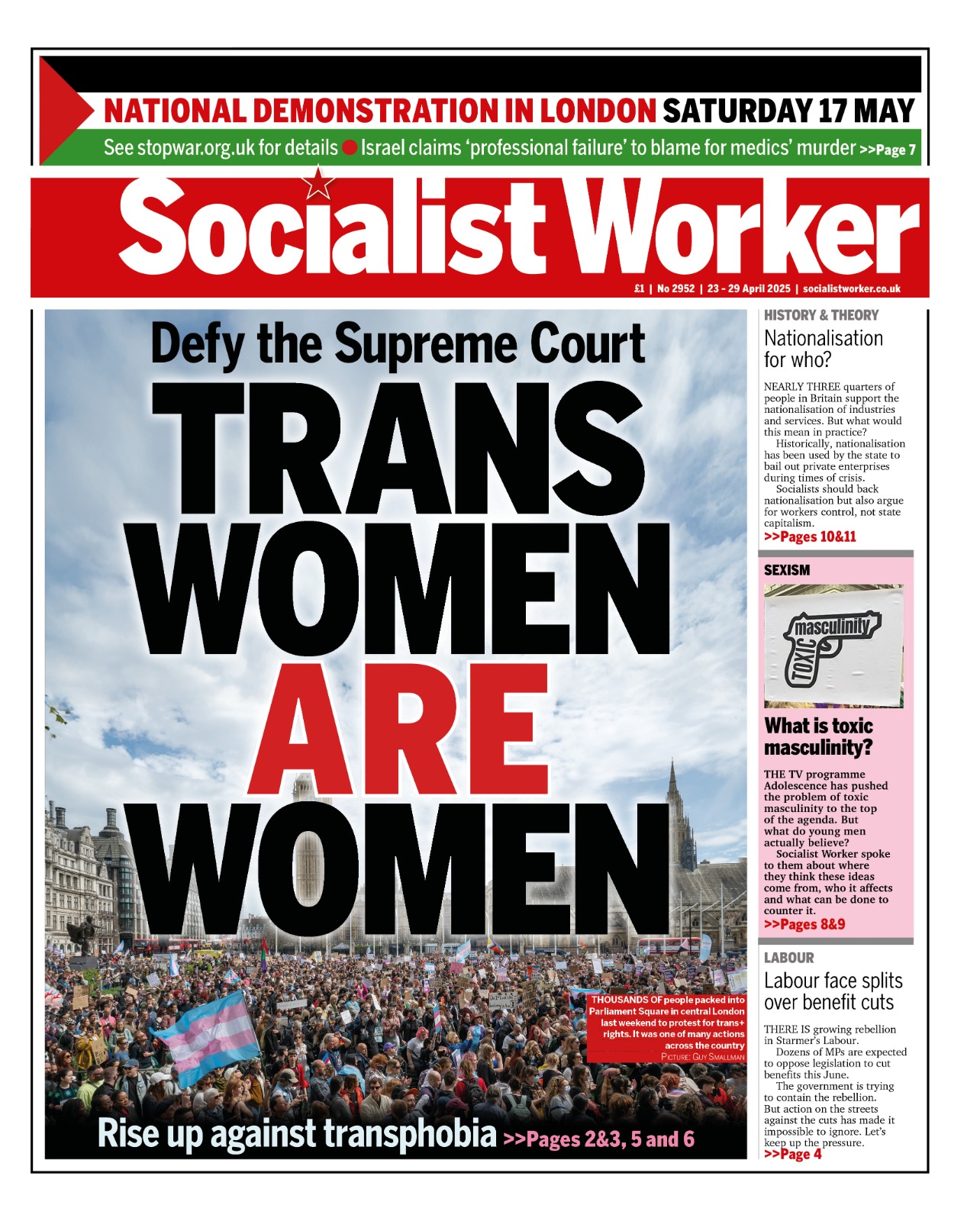
Trump targeted a lot of his media propaganda against the Democrats’ transgender agenda, which they then also retreated on.   Trans activists complained that ‘in a recent Gallup poll, transgender issues ranked dead last (out of 22 total areas) in importance to voters’, but don’t seem to realise that it is precisely its unimportance to many that meant that its previous prominence for the Democrat’s showed how out of touch they were.  This is only confirmed by the irrational and harmful demands previously championed; ranging from men in women’s sports to unproven or harmful medical interventions on vulnerable young people.

There is no reason to lament the defeat of Kamala Harris – the candidate of the war party and of genocide; of the biggest part of corporate United States; of a corrupt and rotten political system, and of fake progressive politics and truly reactionary identity politics. That a figure as repulsive as Donald Trump defeated her is testament to her and her party’s own abominable character.

The resistance to the Trump agenda will not advance through the politics or organisation he has just defeated, but through a critique of both, and working out how to break US workers from both Trump and the Democratic Party.  This involves bottom-up organisation and alternative politics to the fake claims of corporate-approved progressiveness.  The alternative is politics that puts forward what unites the working class, that opposes what divides it, and is clearly in their interest. This politics isn’t ‘populist’ or ‘progressive’. It’s socialist.

Should we support the Ukrainian Left’s route to victory? (2 of 2)

As I noted at the start of the previous post, various leftists in the West have said that we should listen to the voices of Ukrainian socialists and follow their lead, except, as we have seen, they are following the lead of the Zelenskyy regime.  His ‘victory plan’, the part that is not a secret to the Ukrainian people and known only in Western imperialist capitals, is that Ukrainian resources should be made available to the corporations of these imperialist states; that Ukraine should be able to join their military alliance NATO, and that it fulfil this role by its troops being stationed in other European countries. No doubt these Ukrainian troops would include its far right and fascist units, which would allow the concentration of existing NATO troops against other targets.

These Ukrainian socialists excuse this policy of integration into Western imperialism as the appearance of a “sober approach”, regretting that it feels “humiliating” for it to be “turned down almost immediately”.  They presumably deny that the moves towards NATO membership were crucial to precipitating the Russian invasion and entertain the idea that the cause of the war can be its solution.

This position stems partly from material weakness – “there is no left-wing political force in Ukraine that would voice the issues inherent to working people” – but this can only begin to be rectified by developing an independent political programme that stands upon the interests of working people.  Sotsialnyi Rukh (Social Movement) is a social movement because it is not a socialist one.  It floats in Ukrainian society and reflects, through its liberal conscience, the reactionary nationalism of Ukrainian society and its state. It cannot therefore articulate a position separate from the ruling regime.

It notes that the regime is “singling out new internal enemies: Russian speakers, “victims of colonial thinking”, followers of Moscow priests, collaborators, Kremlin agents”; with “manifestations of linguistic chauvinism, justification of hostility towards national minorities . . . and fostering ideological uniformity”; but it doesn’t decisively break from the ideological dominance of Ukrainian nationalism and makes the same ultimatist demands in relation to the pro-Russian East as the most rabid fascist – “recognition of the annexation of occupied territories is obviously out of the question”.  Yet where is the attempt to reconcile this demand with claimed opposition to the view that the people of these regions are “internal enemies”?  It can only dribble that this “will complicate the reintegration of occupied territories.”

Calls for “uniting as many people as possible around ideas of justice, freedom, and solidarity” are only so much sanctimonious sermons without a relevant political programme, and without outright opposition to those opposed to anything meaningful these words might entail, which includes the Ukrainian state and its imperialist sponsors, on whom it is now totally reliant.  Where on earth is Western imperialism a force for “justice, freedom, and solidarity”?  This Social Movement declares its “support for victims of far-right violence” but has nothing to say about this far-right being an integral and leading component of the Ukrainian armed forces that it supports.

Sotsialnyi Rukh states that “people should have a stake in the country’s future and respect for human dignity must be at the core of a society that asks its members to risk their lives for it” – a disregarded acknowledgement that this is precisely what does not exist, and which renders its whole approach inadmissible.  The correct response, enunciated by Marx in similar circumstances in which it was claimed that a reactionary state can be of assistance – and promoted now as resulting from “a sincere dialogue from the government” – is to state that “the working class is revolutionary, or it is nothing.”  What does this mean for Ukrainian workers today?

It starts by discarding illusions in the Ukrainian state and that the purpose of “a political movement” is that it “ensures the voice of the people is heard in the corridors of power.”  The corridors of power are staffed by reactionaries beholden to Western imperialism, seeking a new mobilisation of Ukrainian workers for the cause of membership of its imperialist alliance – a blood sacrifice on behalf of those whose plan to is enrich themselves on Ukraine after the war.

Opposition to the Russian invasion does not require support for NATO or membership of it, and the Sotsialnyi Rukh view that without “security guarantees” from the West Ukraine faces “an open invitation for renewed aggression” ignores that Ukraine thereby becomes hostage to Western imperialism’s aggression and any Russian response.  “Security guarantees” will require assurances of “predatory exploitation” by “foreign investors” with all the “inequality, alienation and disenfranchisement” that will result.  The enemy of my enemy is not my friend.

The unity of the workers of Ukraine and with their opposite number in Russia requires opposition to national chauvinism, with its hostility to national minorities, and only on this basis can a peaceful reconciliation of any kind be proposed as an earnest and sincere promise of unity without oppression.  Sotsialnyi Rukh cannot promise this by condemning such things as the Israeli oppression of Palestinians while seeking support and alliance with the same US imperialism that is the sponsor and accomplice of this oppression.  It is not possible to run with the fox and hunt with the hounds’ as the old saying goes.

Sotsialnyi Rukh demands “the restoration of electoral rights, the right to peaceful assembly and workers’ strikes, and the abolition of all restrictions on labor and social rights” but proposes that a “sincere dialogue” with the government that took them away is the way to achieve them.  Only by relying on the strength of the working class movement itself can the prerogatives of the working class be defended and advanced.  If it is too weak to assert them itself, it will never gain the strength to do so by relying on those who took them away.

Spontaneous resistance has arisen in opposition to the street kidnapping of workers so that they can be sent to their deaths at the front.  This resistance should be organised with the demand that summary arrest be ended; corruption in mobilisation exposed; that all conscripts receive proper training; that they have the right to organise trade unions and the right to protect themselves, including from suicidal orders from the rear. None of this is possible through “demand(ing) full state control over the protection of lives and the well-being of workers.”

The Ukrainian state has declared, even in the words of Sotsialnyi Rukh, that it “owes nothing to its citizens” and that its appeals are “hollow”.  By refusing to break from it, Sotsialnyi Rukh demonstrates the same for itself.

The Ukrainian state has no theory of victory that does not involve massive escalation of direct NATO intervention; to endorse it or give it a left gloss does not alter this in any way.  For workers in the West, it would mean following a road to escalation with all the risks of a world war that this involves.  To do so would see them dragged towards the same subordination to their own state and ruling class – where its left pro-war supporters have already gone – and politically unarmed to prevent world war.

The last thing workers in the West should do is take their lead from such a ‘social movement’.  For both, the slogan ‘the main enemy is at home’ remains the road to victory.

Back to part 1

Should we support the Ukrainian Left’s route to victory? (1 of 2)

At the start of the war in Ukraine various leftists in the West said that we should listen to the voices of Ukrainian socialists, which might have made some sense were these people socialist. Except they are not.  Two recent statements by them confirm their reactionary character and have value only to illuminate their political bankruptcy and, by extension, those in the West who follow them and have called for others to do so.

The statements address what is necessary for Ukrainian victory and the tasks of the left in achieving it.  It is supposed to be a left alternative to Zelenskyy’s much trumpeted ‘victory plan’– touted round the various capitals of western imperialism – but reveals itself to be a plea for succour to the regime that has sought it itself from imperialism and failed.

It is not an alternative to it but a pathetic reflection of it.  It is useless even for its own purposes and worse than worthless as a guide for a working class alternative course out of the war.  It can be summed up by one sentence within it that shows that it pretends to no alternative to the current state, and therefore no possibility of an alternative way out of the catastrophe inflicted on the country.  It states that “We will demand full state control over the protection of lives and the well-being of workers . . .”  The same state that colluded in precipitating the disaster – that has delivered its people into a needless war that has wrought such death and destruction – is to be the protector of the lives of its workers.  This is both absurd and treacherous.

The statements themselves can’t help but note the current misdeeds of this state, its “corruption, censorship, and other abuses by officials”, and the reaction of Ukrainian workers – “civilians no longer queue at draft stations but actively evade mobilisation. Reported cases of draft dodging have tripled since 2023, and polls consistently show that nearly half of respondents view this as reasonable.”  They note “nearly 30,000 cases of AWOL have been registered in the first six months of 2024” and “the brutality and impunity of draft officers, who press-gang men off the streets . . . In the meantime, reports from the battlefield describe how unmotivated, untrained, and even unfit recruits endanger the rest, making the result of increasing coercion questionable.”   Questionable?, is that all it is?  Medically unfit men kidnapped off the street and sent to the front  – poorly trained and armed – to die in a war against a much more powerful enemy?

The result is that “after 970 days of war, 10,000s dead, 100,000s wounded, and millions displaced, the toll is immense. Few families remain untouched by this devastation.”  Yet it refuses to denounce the ridiculous tally of dead and injured quoted in the Western media, fed to them by the Ukrainian state and the Zelenskyy regime. Its statement is unwilling to challenge these lies about the devastating consequences of the war, while saying that they have “taken our people for granted”, yet refusing to acknowledge the human cost that repeats this.

“Under the realities of oligarchic capitalism, restrictions on freedoms often serve the interests of the elites”, one statement declares, in admission of the rotten nature of the society and state that commits these crimes.  It notes the statement of the minister of social policy Oksana Zholnovich, that  “we need to break everything that is social today and simply reformat from scratch the new social contract about social policy in our state.”

It sums up the hypocrisy and real policy of the state by saying that “appeals to civic duty ring hollow when the state openly declares that it owes nothing to its citizens”, yet its proposals are that “the government should start a dialogue with the people about the achievable goals of the war.”  It simply wants “to cooperate with other forces to build a political movement that ensures the voice of the people is heard in the corridors of power.  “Sotsialnyi Rukh (Social Movement) demands a sincere dialogue from the government with society on how we arrived here and what we can realistically expect.” A “sincere dialogue” with a regime that promised peace and an end to corruption that has instead walked its people into war with new opportunities for massively increased graft through it.

It would be possible to feel a little sorry for this movement were it not for its own hypocrisy and war policy.  It accuses the Zelenskyy regime of presiding over “a caricature of a war economy” that “makes it possible to prolong the war at the cost of significant human losses and constant mobilization.”  Yet its own policy is simply an extension of this through a state “subordinated to the priorities of defense . . . mobilising all resources for defence”, while simultaneously promising that it “defends the rights of conscripts and servicemen to dignified treatment” when many of these workers do not want to be conscripts at all.

Zelenskyy’s plan is criticised for “its disproportionate reliance on the West’, while acknowledging that “to fight against Russian aggression . . ., we need support from the global community, including humanitarian and military assistance.” It laments this reliance but then states that “this might appear to be a sober approach”, with the further complaint that it feels “more humiliating” to be “turned down almost immediately”.

It canvasses what would be an acceptable peace but includes proposals that shows it has no idea “how we arrived here”, i.e. why the war began, never mind how realistically it might end: “The only deal with a chance of being supported, by a slight margin, includes de-occupation of Zaporizhzhia and Kherson regions, combined with NATO and EU memberships. . . . Therefore, the greatest mistake would be to pit diplomatic efforts against military support. Without meaningful solidarity, Ukraine and its people will fall — if not now, then later.”

It complains of “a quite remarkable shift from the earlier emotional appeals for solidarity to luring support with access to natural resources and promises of outsourcing Ukrainian troops for the European Union’s security”, but its own dependence on what it euphemistically calls “the global community”, and peace involving NATO membership, shows that its alternative to Zelenskyy is no alternative at all. It doesn’t even ask the question: why it is only now – after over two and a half years – that a purported plan for victory has been drafted? Or did all the others fail too?

Forward to part 2

Bourgeois democracy – reply to a critical reader

In the previous post a reader of the blog expressed disagreement with my approach in a comment.

He stated that “I find it hard to fathom how you can heavily criticise bourgeois democracy like you did in a recent post and at the same time advocate for something you call democratic rights.”

The comment doesn’t reference the particular post and makes only general references that are difficult to identify, including reference to the views of Marx as quoted by Paul Cockshott. I agree with the comment by Boffy in response that:

“I am always rather suspicious of people who cite what Marx and/or Engels are supposed to have said about something, without actually giving the quote, and source of it, because I have frequently found that either the claim is false, altogether, or else, the context, and text of what they said completely changes the meaning of what is being claimed. Given what they say in the Communist Manifesto about workers having no country, and the fact that they were themselves refugees from Germany, makes me doubt what is being claimed for them, here.”

I can only add that it is not altogether clear what the comment Boffy responded to is claiming.

In relation to bourgeois democracy – this post being one example – it is one political form of the dictatorship of capital – the exploitation of the working class, which is separated from the means of production and subject to wage slavery, as its labour power becomes a commodity.  I don’t see how you can be a Marxist and not take this view.

Does this mean we cannot demand and fight for democratic rights within capitalism?  Only the most formal of formal logics could lead to such a view and someone who regularly quotes philosophical thinkers should know this.

The fight for democratic rights was recognised by Marx as necessary in order for the working class to develop itself politically so that it could have the freedom to identify its separate interests, organise around them and struggle for the realisation of the dictatorship of the proletariat.  The word ‘dictatorship’ has rather changed its meaning since it was used by Marx and does not refer to lack of freedom but to the economic and social domination of the working class – uniting the working class with the means of production through cooperative and common ownership, the ending over time of the wage relationship and thus ending of exploitation.

The struggle for this freedom includes the struggle for democratic rights which are not “abstract principles . . .like as a magician pulling rabbits out of a hat” but are concrete measures to be imposed on, or accepted by, the state through working class struggle.  One of the points I have made continually is not to base the struggle for these rights on appeals to the state but to be won by the workers themselves, in opposition to the state if necessary.

He asks “Are your democratic rights legal claims that somehow endure without the presence of a State”?

Marxists do not invent a world subsisting without a state; we recognise the real world that exists in which there is one.  It is why Marxism has no need to invent such things as natural law.  Rights are not worth much if they cannot be validated and this very often is done by the state: so often the democratic rights demanded are demanded from the state, to be accepted by or imposed on it, but always with the view that it is the power and activity of the working class that will ultimately protect and defend them, to whatever extent this can be done within capitalism.

Marxists believe that society can only be understood as it really is – and thereby changed –  by recognising that it is structured by classes with their irreconcilable interests. It is the writer of the comment who is guilty of proposing ‘abstract’ ‘principles’ and ‘morals’, which is why he states that he doesn’t understand what I have written.  It is why he says such things as “I can honestly say I don’t know what these things are” and that “I might not agree with humanitarian morality but at least I could say I understood what was going on.”

When he says that he “would be happier if you and others who speak up for and march out for the asylum seekers did so on the basis of some common humanitarian morality” he simply says that he would be happier if I lapsed into the “abstract principles” he denounces as akin to “pulling rabbits out of a hat.”

He provides me with the option of justifying my position by saying that “I can see how you might get around the problem by imputing an interest and not a morality to the working class.”  And this is roughly what I have done, although I would not put it in those terms.  This, however, is an option that he obviously rejects, yet also rejecting a general “humanitarian morality” as an alternative. Where that leaves him is not my problem.

He then states: “let’s us assume that the bulk of the working class misrecognises the interest you impute to them or consciously rejects that interest. Well you are back with your principles again, an undisclosed humanitarian morality. It turns out therefore that lurking behind the objective interest of the working class is an undisclosed humanitarian morality.”

This is a big, big assumption, and the history of the working class demonstrates that significant numbers have identified that they have a separate interest.  This is demonstrated objectively in the alienation of the working class; its distrust of its rulers and opposition to many of its actions – including those rulers support for the current genocide in Palestine. It is demonstrated in its separate organisations, and in its long history across the world of class struggles big and small – from strikes to revolutions.

Naturally the bourgeois media, culture industry and education system ignores or distorts all this, which makes its undeniable existence all the more necessary to recognise and appreciate.  But let us presume that the assumption is correct for the sake of argument.

If it were true that “the working class misrecognises the interest you impute to them or consciously rejects that interest”; i.e. that it never develops class consciousness; then yes, there would be no material interests that could be realised, and any such interest would be abstract, therefore general and “undisclosed.” The point of the blog is to disclose this interest and advance understanding of what it is so that it can be realised in the real world, through informing working class struggles that are going on quite independent of it.

This is where morality ceases to be abstract, is attached to material interests, where ‘what is’ meets ‘what should be’.  To understand this, it is necessary in some way to be part of the struggle to understand and change the world.  The commentator is not part of this, so appears incapable of understanding Marxism. It is this purely contemplative perspective that, it seems, means that he never gets the point. 

Marxism and Gender Identity Ideology (7) – what the movement’s success explains about it

It might be asked how gender identity ideology, and the movement it represents, have been successful, despite its contradictions and impossible claims – claims by men to women’s rights while erasing the very meaning of woman; and claims to the ability to change one’s sex while denying the biological and binary nature of it and its basis in human reproduction.

There are various strands to the answer that have been touched upon in previous posts. Undue discrimination and prejudice evoke sympathy and support, and it is particularly popular among the young, who feel much less need to ask themselves how and why this issue has arisen and dominates certain milieus. Almost by definition they have less sensitivity to historical experience and awareness.  Their need for some historical validation – on the grounds that gender identity is innate – is shown by the attempts to read the modern idea of gender identity back into history, even if this results in yet more unsupported claims.

In the past week four ‘non-binary’ girls tried to disrupt a gay, lesbian and bi-sexual conference in London by releasing insects into the venue.  Their youth obviously permitted their oblivion to the irony of attacking the conference while claiming to be part of a wider LGBTQ+ movement – in doing so exposing their cannibalism of the original LGB and the incompatibility of their ideology with these original struggles.

It was also yet another demonstration that the T in the assortment of letters is interested solely in itself and is prepared to shaft its presumptive allies in pursuit of its own claims.  The young have had no experience of the struggle for gay and lesbian rights in many countries, or the experience of PRIDE marches not being huge parades that include numerous corporate sponsors; but rather, marginal demonstrations viewed by many with prejudicial revulsion and contempt.  But then, if men can aggressively and menacingly confront feminists while demanding that they be considered women, there would seem to be no set of circumstances for some in which gender ideology can be seen for what it is.

Defenders of women’s rights, and of reality itself, have thus found it necessary to explain how this modern and reactionary phenomenon has risen to such prominence.

As befits her occupation as a philosopher, Kathleen Stock in her book Material Girls, sets out ‘a brief history of Gender Identity’ in terms of the development of its ideas: from Simone de Beauvoir’s “one is not born, but rather becomes a woman”; through biological sex being “a continuum” and Judith Butler’s ‘gender as performance’; to the invention of the concept of TERF and the explosion of gender identities.

Helen Joyce, as a journalist, goes for ‘a brief history of transexuality’ in her book Trans, looking at the story of the medical and psychological treatment of what became transgender status.  Jane Clare Jones, in her essay on ‘the history of sex’ in the book Sex and Gender, looks at the ‘intellectual development and cogency of the sex-denialist ideas’ and identifies ‘the emergence of the contemporary trans movement to the early 1990s on both sides of the Atlantic through a blend of legal activism and academic theorisation.’

The periodisation of the movement to the 1990s helps understanding of the grounds upon which gender ideology has been able to drive its anti-woman and irrational claims into society.  Most obviously through the state and its various bureaucracies – especially health – and through NGOs, which are more and more reflections of the interests of the state despite their name. These often act as its conscience that the state can either ignore – if it is criticised – or hold up as justification for interventions if it is another rival state that is criticised

Legal changes supported by the gender identity movement have often been made surreptitiously, with little debate and without widespread public knowledge, as in Ireland, Denmark, Australia and Iceland.  No women’s organisations were included in the parliamentary enquiry by the UK Women and Equalities Committee in 2015 which led to consultation on changes to the UK Gender Recognition Act (2004), or for legislating for Gender self-identification in New Zealand.

The state has bought into and imposed gender identity ideology, from the local hospital and school, all the way up to the European Court of Human Rights and United Nations.  Sanctioning by such bodies has been seen as proof that the ideology and its claims are progressive by a left that has identified these bureaucracies as progressive, just as this left has more and more taken on the identity of an NGO rather than of a revolutionary working class organisation.  Law firms, prisons, sports organisations, religious and medical institutions, all normalise the abnormal so that we have ‘normal’ organisations claiming to believe in the preposterous.

It is rarely, if ever, noted by this left that the movement and ideology draws support from prominent capitalists, their corporate executives; bourgeois political parties, governments and state bureaucracies, and the NGOs they finance.  Some of these come together in the Gates, Soros and Ford foundations, which have committed $2.62bn to support self-identification.  (Women’s Rights, Gender Wrongs p187). And we haven’t even mentioned the fashionable philosophical and political ideologies pumped out of universities that give it the thinnest of veneers of intellectual legitimacy.

A small number of billionaires have played an outsized role in promoting the ideology and using their enormous wealth to fund the transgender movement through their own political organisations and corporations.  More important than the financing going directly to trans organisations is the money invested in health and pharmaceutical corporations in order to cater for the fact that many who undergo surgical and medical interventions can become lifetime patients.  The ideology has a growing material basis in the profitability of transgender medicine, especially in the US.

This is another difference between gay men and lesbians, who do not require medical or surgical intervention, and some who buy into gender identity and become lifelong patients, and especially in the US – lifelong paying customers.  For young people it can begin with puberty blockers, opposite-sex hormones, radical removal of healthy tissue, the addition of false secondary sex characteristics, and also the potential for repeated treatment to deal with the deleterious side-effects and consequences of these interventions.  In this respect, yet another difference between LGB and T.

Transgender health treatment has entailed creation of a medical-industrial complex with, for example, thousands of gender clinics around the world to deliver and support it, which also play a role in adding important ideological defences for it.  One writer gives the example of one billionaire sponsor of the ideology, Jennifer Pritzker:

‘Once a family man and a decorated member of the armed forces, Jennifer Pritzker now identifies as transgender. He has made transgenderism a high note in philanthropic funding through his Tawani Foundation. He is one of the largest contributors to transgender causes and, with his family, an enormous influence in the rapid institutionalization of transgenderism.’ 

‘Some of the organizations Jennifer owns and funds are especially noteworthy for examining the rapid induction of transgender ideology into medical, legal and educational institutions. Pritzker owns Squadron Capital, an acquisitions corporation, with a focus on medical technology, medical devices, and orthopedic implants, and the Tawani Foundation, a philanthropic organization with a grants focus on gender and human sexuality.’

‘Pritzker sits on the leadership council of the Program of Human Sexuality at the University of Minnesota, to which he also committed $6.5 million over the past decade. Among many other organizations and institutions Pritzker funds are Lurie Children’s Hospital, a medical center for gender non-conforming children, serving 400 children in Chicago; the Pritzker School of Medicine at the University of Chicago; a chair of transgender studies at the University of Victoria in Canada (the first of its kind); and the Mark S. Bonham Centre for Sexual Diversity Studies’ at the University of Toronto. He also funds the American Civil Liberties Union and his family funds Planned Parenthood, two significant organizations for institutionalizing female-erasing language and support for transgender causes. Planned Parenthood also recently decided to get into the transgender medical market.’

‘There doesn’t seem to be a sphere of influence that is untouched by Pritzker money, from early childhood education and universities to law, medical institutions, LGBT lobby and organizations, politics, and the military.’  (Bilek, Jennifer. Transsexual Transgender Transhuman: Dispatches from The 11th Hour (pp. 38-39, 43). Spinifex Press. Kindle Edition.. The money from these sources buys the spread of this influential ideological network across the world, including Ireland, which is hardly immune to economic, social, political and cultural influences from the US.

That such a tiny number of men, like Pritzker, have been able to impact in such a powerful fashion, and with such irrational effect from the point of view of our understanding and working of society, is a tribute to the irrational nature of capitalism and the power of the inequalities it generates.  The massive socialisation of production by capitalism that brings humanity together in innumerable connections exists beside the increasing monopolisation of production and the power of the tiny number of capitalists who benefit most from it: an illustration of the Marxist understanding of the contradiction between the forces and relations of production.

This impact should not be put down solely to the tiny number of billionaires who are themselves transgender, or are otherwise devoted to the idea of it as a way to advance some transhumanist agenda – in which technology increasingly renders biology (including sex) irrelevant – but to the wider influence and power that they can mobilise.  The author above also notes that:

‘Along with support by pharmaceutical giants such as Janssen Therapeutics, Johnson & Johnson, Viiv, Pfizer, Abbott Laboratories, Bristol-Myers Squibb, and Boehringer Ingelheim Pharmaceuticals, major technology corporations including Google, Microsoft, Amazon, Intel, Dell, and IBM are also funding the transgender project. In February 2017, Apple, Microsoft, Google, IBM, Yelp, PayPal, and 53 other mostly tech corporations signed onto an amicus brief pushing the US Supreme Court to prohibit schools from keeping private facilities for students designated according to sex. (Bilek, Jennifer. Transsexual Transgender Transhuman: Dispatches from The 11th Hour (pp. 43-44). Spinifex Press. Kindle Edition.)

With such powerful support from big business and the state it is not hard to explain the gender identity movement’s success.  The corporate sponsorship of Pride and their HR departments’ Diversity and Inclusion departments are all examples of the appropriation of the claims of oppressed groups by capitalism.  Annual Pride demonstrations are no longer an expression of rebellious campaigns but a rainbow of multinational corporations; state agencies; NGOs; the mainstream mass media and bourgeois politicians, in what is more a fancy dress party – themed by inane slogans such as ‘love your mind’ – than a progressive campaign.  The idea that this is a grass-roots movement is as true as the claim of men to be women.

One banner at this year’s Pride parade in Belfast that hit the nail on the head.

Back to part 6

Forward to part 8