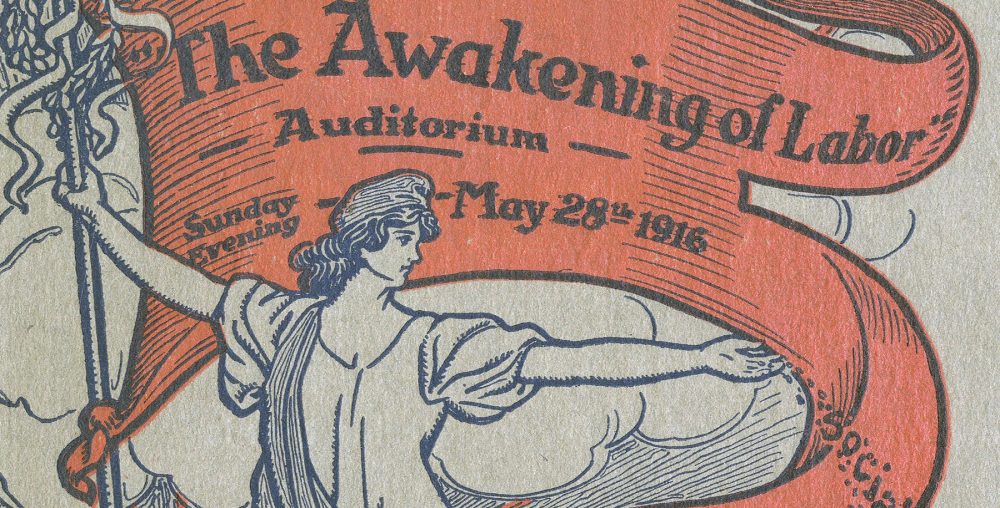
Should socialists support a border poll? 4 – working class unity

It has been noted in an academic study  of the flag dispute that “it has taken a unique political ideology to turn a clear ‘victory’ – a triple lock on the union,a change to the Republic’s constitutional claim, the signing up of Sinn Féin to ‘partitionist’ institutions – into abject insecurity.”

But insecurity in unionism is nothing new, thirty-five years ago a book on Protestant politics was entitled ‘Ulster’s Uncertain Defenders.” Uncertainty and political paranoia are inevitable when sectarian rights are based on proxies (such as bourgeois democracy) that either reject such politics implicitly or threaten to undermine it.  A demand for equality is especially pernicious since it appears reasonable but threatens loss when your claim to sectarian rights is necessarily based on inequality – every issue is zero sum game precisely because supremacy is what is being defended.

The Socialist Party defence of the rights of Protestants is a defence of their rights as Protestants and thus lapses into a defence of sectarian rights.

It leads to seeking justification for the claims of Protestants as a sectarian group, with its own anterior rights, and covering up for its sectarian and reactionary character. So, even when that Party has in the past defended civil rights (by their nature civil rights are not sectarian group rights) the Party claims that such rights were, and still are, not enough, because equality of poverty holds no attraction for Protestant workers.  What good is equality of misery it says?  What is required is a socialist programme.

But whatever justification there is for a socialist programme, which of course I support, and regardless of what this might look like, it cannot be advanced in order to obfuscate the opposition of many Protestant workers to equality per se.  It is not therefore the case that Protestant workers oppose a united Ireland because it may not be socialist. Their pro-imperialist, monarchist and reactionary politics makes the majority averse to socialism in any case.  The possibility that a united Ireland might in some way be socialist is against everything their political heritage defends, and is enough to guarantee the opposition of those who maintain allegiance to any specifically Protestant politics.

How can Protestant workers be won to socialism and the radical equality it promises if they do not accept the equality of Catholic workers in the first place?  Unless they accept the political emancipation of Catholic workers they will be unable to play any positive role in achieving the social liberation of the working class that includes themselves.  To believe that they can fight for the latter while opposing or even being passive to the former is to excuse their prejudice and undermine the possibility and meaning of socialism.  That this is also true of the perspective that Catholic workers must take is simply to state that sectarian division must be ended by mutual recognition by all workers of their equality regardless of religion or nationality.

It is still unfortunately the case that the majority of Protestant workers are attached to reactionary unionist politics, so that it is necessary for socialists to oppose both their unionism and their sectarianism.  There is an alternative political identity that must be fought for and is in their interests as workers, not as Protestant workers.

So, to employ episodes such as unionist opposition to the reduced flying of the union flag outside Belfast City Hall as justification for acceptance of limitations on one’s programme is to leave one defenceless against whatever reactionary veto unionist reaction decides to erect to any progressive change.

Loyalists now claim that it is Protestants that are discriminated against and it is they who are disadvantaged, and there is even some slight evidence of the latter.  The Northern Ireland Labour Force Survey recorded that over the period 1993 to 2017 the proportion of working age economically active Protestants with no qualifications has decreased from 30% to 12% while that of Catholics decreased from 32% to 11%, so Catholics were in a slightly better position.

It is a repeated complaint of loyalists that working-class Protestants, especially the young, are educationally disadvantaged.  In the same academic study referenced above the authors record interviews with loyalists and others that “the importance of education was stressed, but education with a very particular purpose, as a community project leader explained: We’ve got the programme there and it’s empowerment through education … once you teach them about their own identity then they understand what’s going on around them, cos I would say 100 per cent of our kids haven’t a clue about where they came from. “

“In the interviews we conducted the issue of Protestant/Catholic reconciliation did not arise unless raised by us [i.e. the academics]. It simply was not on any interviewee’s immediate agenda.”

“For those, within the PUL [Protestant/Unionist/Loyalist] community trying to re-build after the ruptures that opened up during the protest the key category is cohesion, not reconciliation. There was seen to be a strong imperative to build unionist unity, and to imbue young people with a deeper awareness of their unionist identity.”

The authors quote another academic study dealing with a small Derry town, which finds that loyalists “see no purpose in conflict transformation as their cultural identity is built on a glorification of sectarian conflict, and they reject democratic politics as ‘it did not stop the flag from being ripped down.’“

Yet another study based on North Belfast finds that even the Protestant church representatives did not talk about reaching out across the sectarian divide, but rather about: “The need to create a new confidence and a new identity around loyalism, one that was not demonised, and one that people could easily understand what it represented.”

As one flag protestor said: “They talk about a shared future. I don’t think the Protestant community is ready for a shared future.”

In other words, these loyalists want to see reinforcement of their sectarian identity. Why would socialists, as the Socialist Party does, erect such views as the limit to a democratic and socialist programme?  The Party ends up deferring to those most bitterly opposed to workers’ unity on the grounds of supporting it.

Of course, not all Protestant workers are sectarian and for such workers it is reactionary to seek to win them to socialism by offering to accommodate a sectarian identity they either don’t have or can be more easily broken from.  But many are sectarian, to varying degrees, and it is only blind political correctness that prevents acknowledging the obvious.  Socialists will get nowhere by pretending it doesn’t exist, or that it is marginal, or in some sense justified, or must be deferred to in some way.  They will get totally lost if they hand over a veto to the most sectarian voices just because they advance protests and politics with which many other Protestant workers have sympathy.

None of this means we do not advance a non-sectarian and anti-sectarian programme, and a socialist programme.  We must do so, obviously because we are socialists and socialism is our goal – a society governed by the workers themselves.  But we must be clear what it means.

Socialism is just the rule of the working class, as a whole, not a part of it.  To say that socialism is the answer to the division of the working class is just to say that working class unity is the answer to working class division.  To claim that a working class party is necessary to unite the working class is to say that the party created by the working class should unite the working class.

Escape into such truisms arises because real answers beyond such abstractions do not present themselves as obvious solutions, but as political programmes that offer particular courses of struggle.  James Connolly is famously noted for having denounced partition, but to end it means going beyond what he said –

“. . . the betrayal of the national democracy of Industrial Ulster, would mean a carnival of reaction both North and South, would set back the wheels of progress, would destroy the oncoming unity of the Irish labour movement and paralyse all advanced movements while it lasted.”

A role for those dedicated to the interests of the working class must mean that we are not paralysed.

Back to part 3

Forward to part 5


Should socialists support a border poll? 3 What sort of Protestant opposition?

I have stated that the purpose of a united Ireland for socialists is not to unite the nation or the territory but to unite the working class.  The Socialist Party opposes a border poll, which might be one way to move in this direction, because it says that the Protestant working class in the North will oppose it and may do so violently.  It has pointed to Protestant opposition expressed in the flags dispute beginning in 2012 as an example of such opposition, opposition which socialists should concede makes the initiative one that will increase sectarian division.

In this post I will look at this opposition and argue that it is not an example of an initiative that socialists should accede to, and certainly should not be presented as an example of the sort of response that should determine socialist views on the way forward, even if by necessity such actions must of course be taken into account.

In effect, what I am saying is that such opposition has no progressive content, should not be conceded to as legitimate barriers to fighting for progressive, democratic and socialist change, and are in fact wholly reactionary.  Rather than bow to them, it is the task of socialists to oppose such mobilisations – these do not constitute resistance reflecting legitimate interests of the working class but are defences of the most virulent division. Rather than being a reason to retreat or stand still, the forces behind the flag dispute are the most diehard defenders of sectarian division, which if it is to be defeated, will mean the defeat of the forces that defend it.  To do otherwise is to capitulate to sectarianism.

The flag dispute began at the beginning of December 2012 when Belfast City Council voted to restrict the flying of the union flag outside the City Hall to 18 designated days, instead of the existing arrangements of flying it every day of the year.  It led to a riot outside the building on the night of the vote by a loyalist crowd, which had been roused to anger by the distribution of 40,000 leaflets by the two main Unionist parties, who claimed that the unionist (with a small u) but self-identified non-sectarian Alliance Party was threatening unionist identity.

This led to a series of protests that involved almost 3,000 ‘occurrences’ according to police, which included demonstrations, riots and assaults on people and property, although no one was actually killed.  At its height it mobilised about 10,000 people at any one time, and in one night involved 84 different sites across the North.  It was therefore pretty widespread if not massively deep.

The mobilisations declined rather quickly, although continued into 2013, the following year, and a ritual demo takes place outside the City Hall every Saturday to this day.  In terms of previous decades of ‘the troubles’ it was small beer, except it was supposed to be after the success of the ‘peace process’ when we were all apparently to be living in a ‘post-conflict’ society.

However, in other respects it was typical of Northern Ireland politics, and therefore a reasonable controversy on which to hang the argument.  It suits the purpose of the Socialist Party position not only because it is relatively recent, no one was killed, and it obviously involved the question of Protestants’ identity as ‘British’, but also because, unlike other expressions of unionist politics in what they see as defence of their rights, which they could have used, such as the protests around the Drumcree Orange parade in the second half of the 1990s or Holy Cross Primary School in 2001, these would have too obviously demonstrated the naked bigotry of what often passes for Protestant defence of their rights.  No one outside the ranks of the bigots could ever be impressed by an assertion of Protestant rights that involves attacking primary school children and their parents going to school.

We don’t however need the worst examples in order to criticise Loyalist politics, and the example of the flag protest is neither ‘the best’ nor the worst.  It is the one that the Socialist Party writer decided to reference and the essential politics involved has wider application than the contingent factors involved in this particular episode.

The policy of flying the flag on designated days was a compromise from an original Sinn Fein proposal not to fly it at all, although Sinn Fein’s later support for the designated days policy could be guaranteed to anger loyalists, even though three councils with unionist majorities were already adhering to designated days before the Belfast council decision.

Policies on flying the flag had already been agreed for Government buildings and in workplaces (were they are prohibited) but not in local government, and the council already had legal advice pointing out the legal risk on grounds of equality legislation in the existing policy of flying the union flag every day.

The Unionist Parties were now in a minority on the council and the balance of power lay with the Alliance Party, which proposed the new designated days motion, and Catholics now constituted a majority in the city – 136,000 against 119,00 Protestants.  The equality and community relations industry was generally sympathetic to this sort of approach and two public meetings, entailed by official consultation on equality impact grounds, was attended at the first by two members of the public and by one at the second.  A petition of almost 15,000 supported existing policy but this was a result of many of the signatures being acquired at a loyalist celebration.

The Progressive Unionist Party, linked to the paramilitary Ulster Volunteer Force, actually supported the designated days policy in its submission to the consultation, although quickly changed its mind. For some loyalists it is fine if they can determine what does and does not happen, but what does and does not happen cannot be because Catholics have either asked for it or demanded it.  In other words, they have the rights that are allowed to them, which is to say, more strictly and accurately, no rights at all.

In a poll almost three quarters of Catholic Council employees stated that they would be pleased or very pleased if the union flag didn’t fly, while 88 per cent of Protestant staff said they would be displeased or offended.

The successful motion in the council to fly it on only designated days, including on birthdays of members of the royal family, stated that “this reflects the agreed sovereignty of Northern Ireland confirmed in the Good Friday Agreement and accepted by all its signatories . . . it also reflects the preferred determination of the Equality Commission.”

When the result of the vote was made known outside the meeting loyalists at the back of the City Hall rioted and attempted to enter the building.  Later, on their way home to East Belfast, they attacked houses in the small Catholic area of Short Strand, which was to become a regular occurrence.

Protests at the City Hall also became a regular occurrence each Saturday, with the first appearing chaotic and without clear leadership, although a number of individual loyalists became recognised spokesmen for the protests if not the actual leaders.  One was Jim Dowson, formerly a member of the British National Party.  At the march round the City Hall protestors sang sectarian songs such as The Sash, the Famine Song and the Glasgow Rangers football ‘Bouncy’ song (if you could call it a song).

Police appeared to facilitate rather than stop protestors in what were illegal protests.  This was later challenged by a resident of the Short Strand, which was initially successful but then lost on appeal, with the judiciary declaring that not preventing illegal parades was within the discretion of the police.  Catholics had earlier argued that the police had used their discretion to arrest Republican protestors in Ardoyne while taking a different approach to loyalists.

The other significant target for the protestors was the property and personnel of the Alliance Party which were attacked and which had been the original target of unionist politicians’ leaflet campaign.  Most of these politicians kept quiet during the period of violent loyalist protest, with a few issuing ritualistic and general condemnations of violence while a few others were openly standing with the protestors.  However, the leadership of unionism was sufficiently rattled by the out-of-control protests for them to call for unity around a Unionist Forum, which included themselves and paramilitary figures, although this outward show of unity did little to dispel the obvious disunity among them.

The protests petered out although continue in a ritualistic form today.  On the first anniversary of the protest 1,500 took part when 5,000 or 10,000 had been predicted, while a year later only 200 showed up.  By this stage loyalists had found a new assault on their identity with the rerouting of a return parade past the shops in the Catholic Ardoyne area.

This did not mean that the cause the loyalists were protesting was not popular among unionists, or even that the protests themselves were unpopular.  An opinion poll shortly after the protests started found that, while among all respondents 44 per cent thought designated days was the correct policy and 35 per cent supported flying the flag all the time, 73 per cent of unionists wanted it up 365 days a year and 64 per cent of nationalists 18 days. While there was majority support (51 per cent) for the right to protest, after nearly two months 76 per cent wanted them to stop, although 45 per cent of unionists wanted them to continue.

A separate poll, as part of the Northern Ireland Life and Times Survey, found that the designated days policy received the support of 53 per cent of all respondents while 24 per cent supported flying the union flag all the time.  In this poll 48 per cent of Protestants supported the designated days option while 44 per cent supported the 365 days option, although this may reflect the fact that most of this survey was carried out before the decision and protests had started.

A poll taken in August and September 2013, 9 to 10 months after the protests started and then died down – and been replaced to a great extent by those around Orange parades – found that 31 per cent of Protestants supported the all-year policy while only 8 per cent of Catholics did, while 19 per cent of ‘Other’ did, i.e. those who did not identify themselves as either Catholic or Protestant.

It is clear that attitudes changed and the strength of Protestant opposition to the erosion of their British identity, as it has been put, was stronger during the height of the protests than after, and involved a more extensive identification of just what this meant during the protests than before.

It is clear that some of the most extreme elements of Protestant politics were involved in the flag protest.  The often primitive and disordered protests were satirised on line, most prominently in the LAD Site (Loyalists Against Democracy).  The originator of the site described how it began:

“I sat down at the computer one night and created a page and gave it this title, Loyalists Against Democracy – I’m trying to be humorous – and I went to bed and when I got up in the morning 50 people had ‘liked’ the page. I mean, I was trying to be as ridiculous as I could be. I posted one page in particular – it wasn’t very funny – complaining about Aer Lingus flying over east Belfast and next morning there were hundreds of comments agreeing with this, each one more vile than the last.”

While this says something of the political character of the flag protest it also throws into relief the approach of the Socialist Party, which wishes to employ this episode as justification for emasculating a socialist approach and acceptance of limits imposed by the most primitive unionism. Essentially the Party argues that those most wedded to reactionary sectarian politics must be conciliated in pursuit of defeating this politics.

In the next post in this series I will look at some of the implications of this.

Back to Part 2

Should socialists support a border poll? 2 – is a majority enough?

For some people, getting a simple majority in the North of Ireland is not sufficient to justify a united Ireland, and Taoiseach Leo Varadkar is not the first leading southern politician to question whether it would be enough.  The unionist leader Peter Robinson has also said that any border poll on Northern Ireland’s future in the UK could not be conducted on the basis of a simple majority.  Varadkar has said that an Irish unity poll would be divisive and “a bad idea”, that the idea of a “majority of one” would lead to chaos, and questioned whether it would be a “good thing”.

The Irish establishment, the classes it is based on, and the politicians who represent it are quite happy with partition, and are more or less at one on this with unionists.  As former Taoiseach Jack Lynch put it some decades ago, “if we were given a gift of Northern Ireland tomorrow, we could not accept it.”

In the North a recent opinion poll recorded that more than half of unionists rejected the idea of a referendum completely, while 90 per cent of nationalists wanted one within five years.  A slight majority of all respondents supported the idea of ’50 per cent plus one’, while almost 20 per cent said a two-thirds majority should be required.  A majority of unionists advocated a 70 per cent threshold while nearly 90 per cent of nationalists favoured 50 per cent plus one.

Behind the numbers however is the question of what the purpose of unity is and what it would be for. The SDLP leader John Hume used to repeat, seemingly endlessly, that it wasn’t territory that needed to be united but people.  And for socialists this is indeed the case, with perhaps a further three vital considerations.

The first is that the unity to be achieved is not just unity between North and South but within the North as well; secondly that it is the unity of the working class that is decisive for real progressive change and thirdly, that unity of territory really means a united State, and states and their practices have been decisive in the past in dividing the working class.  So, it isn’t simply a question of uniting two pieces of land or of territory, but of the political arrangements upon which they sit.

It might thus seem that the Socialist Party is correct for example to emphasise workers unity, and in tune with unionism and the southern establishment, to state that a border poll would be ‘very divisive’; could be seen as “a dangerous development”, is not a “democratic” solution”, would amount to “coercion”, and would be similar in effect to such things as the Anglo-Irish Agreement and flag protests in 2012/2013, which “will inflame opinion in Protestant working class areas . . . and will cause harm to the cause of working class unity.”

It is not necessary to agree with the strong formulations of the Socialist Party in order to start from the question of working class unity, because that is indeed the objective. But in doing so it is necessary to appreciate that at the present time there is an absence of such unity, between Irish workers in the North and those in the South, and within the North.  Such things as common membership of a trade union does not constitute such unity.

For a Marxist workers unity means some sort of political unity, based on material circumstances that includes union membership, but which must also take into account political consciousness and the existing profound political division of the working class.  Opposing a border poll on the grounds of protecting the status quo because it contains some sort of working class unity is not therefore an option, except in so far as we do not want to make the disunity that exists worse.

Unfortunately, given the economism of the SP, which routinely identifies purely economic issues with class issues and struggles around employment and wages etc. as precursors of socialism, it means that the Party consistently overstates the extent to which workers unity already exists.  This tends to lead to the view that any change to the current arrangements must entail some sort of promise of ‘socialism’.

So while the leaders of the Party state that “we are clear that we do not in any way ignore the rights of Catholics. It has always been the case that we take into consideration the intense desire for change of working- class Catholics and we recognise the positive side of this intense desire for change”, such a claim always struggles to find expression in their programme.

So while they oppose a border poll for not being democratic because it will “inflame Protestant opinion”, cause “widespread anger in the Protestant community”, “mass protests” and “street violence”, they seem not to comprehend the message thereby sent to Catholic workers.

For these workers, the Northern Ireland State is a single gerrymandered sectarian constituency that has routinely discriminated against them and used repression in every decade of its existence to enforce their subordination.  In the 1960s some campaigned for civil rights to overturn the most flagrant gerrymandering within the state, but they are now being told to accept the gerrymandering of the state, even if they are in a majority!

Having fought for ”one man one vote”, many unionists (and analogously the SP) are now saying to Catholic workers that they should either not be able to vote in a poll, or they can vote, but they will have to gain a two-thirds or 70 per cent majority; in other words they will still not be able to have ‘one person, one vote’.  A Catholic vote will not be equal to a Protestant vote and they will still in effect be denied their civil rights.

And for what reason? Because of opposition within the Protestant population to the denial of their ‘identity’ as British?  In the name of opposing sectarian division the Socialist Party has thus found itself opposing civil rights on the grounds of sectarian identity.  And this from a Party that claims to oppose ‘identity’ politics and base itself on class politics.

The position of the Party actually makes its position one of the most reactionary of those opposed to a border poll.  Like its position on Brexit its economism, and the general limitations of its politics, finds it planted in the most reactionary camp.  How bad this is is clear from its employment of the flags protest as a case justifying its opposition to the minor political border arising from customs and regulatory checks in any East-West border that might arise from Brexit.

There is no attempt by it to define or defend some arbitrary majority that should be respected in a border poll, should it be 50%+1 or 2/3 or 70%, but simply that a poll cannot be entertained because it will inflame Protestant opinion.  In effect what we have is a sectarian veto and a defence of the continued existence of the Northern State as a sectarian one, justified only by its sectarian composition, by the opposition of some part of the Protestant working class through its identification with Britishness, an identification defined by loyalty to the monarchy, the Protestant religion, and British imperialist conquest. The logic of such sectarian privilege could easily be extended to all political practices within the state  because no limits are placed on the salience of this Protestant opinion.

In such circumstances no amount of explanation that this represents legitimate opposition by Protestant workers to Catholic sectarian claims would be the least convincing.  Nor would any claim that there was anything progressive about it, such as Protestant opposition to a ‘capitalist’ united Ireland as if – given their wholly reactionary politics – unionists would not express even more opposition to a socialist united Ireland.

Such a political position would not be defensible by claiming that a non-sectarian workers unity might be built within the North around economic issue.  If there was a majority for a united Ireland, any attempt to deny this majority could not possibly be defended from a socialist perspective, although this does not exhaust questions that arise about implementation.

Whether such a poll should be supported now is not quite the same question, although similar issues arise, and with the same consequences.  Outright denial of a border poll in principle is a denial of democratic rights and, if expressed on the grounds put forward by the Socialist Party, is a capitulation to sectarianism.

This does not mean that the question of increased sectarian division should not be taken into account but it does mean outright opposition to a border poll for the reasons given by the Socialist Party is not the answer.

The flags protest is a good example of Protestant workers’ opposition to changes which should definitely not be accommodated or accepted.  Even a cursory examination of it illustrates that to do otherwise is actually to capitulate to sectarian demands.  In the next part I will briefly review this episode.

Back to part 1

Forward to part 3

Should socialists support a border poll? 1

One consequence of Brexit has been louder demands for a border poll and the legitimacy of a test of support for a united Ireland, on the basis that Brexit breaches the Good Friday Agreement (GFA).
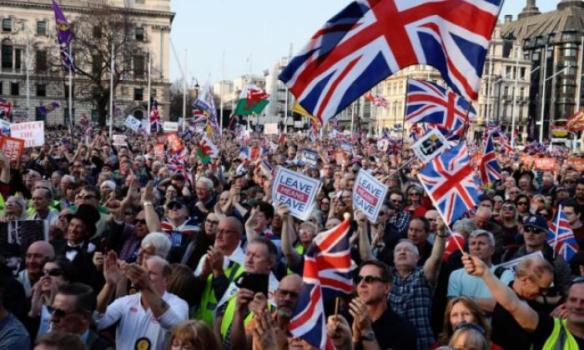

I have argued before that Brexit does not breach the GFA although it does exacerbate its failures and does involve increased tension between the British and Irish Governments, who are the custodians of the agreement.  It does catalyse increased instability and it does give rise to expectations that support for a united Ireland will have increased as a result. I have also argued that while this may be the case it is unlikely that a poll would result in a vote within the North for a united Ireland.

Nevertheless, the question arises whether socialists should support a poll, a question not only for us in the North of Ireland but for socialists in the South and for British socialists as well.  There is no such thing as a unilateral right to unification and this applies to those seeking unity with the South of the country and to those defending British rule.

Irish nationalists will argue that Ireland is one nation, although in many of their arguments, and in their practice, most of them appear to accept the argument that the Protestant Irish aren’t Irish at all.  Irrespective of this, the argument is not about whether there is one nation but whether there should be one Irish state.

The practical consequences of this are what matter, as has been demonstrated both by the Scottish referendum and the British Brexit referendum.  All the airy metaphysical nationalist claims can only get you so far, but as Brexit shows – even if you win – the hard reality of the real world will demand answers from your nationalist vision.

Recently the author and commentator Fintan O’Toole argued in his column in ‘The Irish Times’ that while the demand for Britishness remains in the North of Ireland (from unionists, mostly Protestants), the supply of it is in danger of disappearing (I paraphrase).

This is because opinion polls have shown that the most vehement supporters of Brexit in England, who most revel in the idea of some sort of continuing British imperial glory, would be prepared to lose both the North of Ireland and Scotland from their United Kingdom in pursuit of their beloved Brexit.

A few days later the unionist columnist Newton Emerson in the same paper argued, in a thinly veiled response, that actually it was remarkable that English Brexiteers had not shown more antagonism to their entanglement with the North of Ireland, given that it was the cause of the hated ‘backstop’ that appeared to be impeding a successful Brexit.  Of course, this assumed forbearance might have a number of causes and doesn’t refute the argument that O’Toole advanced.  In any case, it is very unlikely that the British State would seek to ditch the North of Ireland in order to save Brexit.

Newton Emerson also seemed happy to point out in his column in ‘The Irish News’ that while an RTE poll at the end of January showed 87 per cent of people would back a united Ireland over a hard border, this dropped to 54 per cent when the question was not framed by this stark choice.  He argued that ‘southerners are essentially soft-nationalist Alliance voters: they do not want a united Ireland without a united Northern Ireland’.  While there is some truth in the argument, it does not follow from the poll, and is not therefore ‘a fact’.

An RTE poll also showed that support for a united Ireland fell to 31 per cent if it meant paying more tax, which implies the desire for a united nation is to a great deal a sentiment that recognises practical constraints.  Whether these constraints are ‘fair’ or not is not the point.

So, both Irish and British socialists will be required to take a position on a border poll even if it is limited to within the six counties of Northern Ireland.  How should we respond?

In the last few weeks I have read two very different approaches.  The Socialist Workers Network in Ireland has presented this position:

“. . . all of the polls are consistent that support for a united Ireland is on the rise. That much we can be certain of.”

“This should be welcome news to socialists and progressives across Ireland. Partition is a thoroughly reactionary device, arising from a counter-revolutionary movement supported by British imperialism in order to set up a ‘carnival of reaction’, that has copper fastened two rotten states over the last century. And it is not just the physical divide between North and South that matters. Sectarianism exists, and is perpetually recreated, precisely because of the way that partition guarantees the maintenance of a sectarian state, that shapes every political question in a communal manner. We are opposed to sectarianism, then, but we also understand that sectarianism can only be overcome as part of a simultaneous challenge to the structures that enshrine it.”

“We should support a border poll as a basic democratic right, and oppose any notion that a majority is not enough to end partition. But we should creatively intervene into the discussion about what a border poll should look like. It is often presumed that a border poll would be a vote in the North to join the Southern state. We should argue, instead, that a border poll should be a vote to create a completely new state, not one where we simply subsume the six counties into the Southern state under the auspices of its conservative constitution.”

Leaders of the Socialist Party, in an internal members bulletin, present a very different position. For them, a border poll has “the potential to push the north back towards sectarian conflict.” They note that in March 2017, the Assembly election “marked a turning point in the history of Northern Ireland.  For the first time since the foundation of the state unionist political parties no longer have a majority at Stormont.”

They then go on to say that “This is the context in which we operate and in which the calls for a border poll have become louder and louder. This is a dangerous development. A border poll does not represent a “democratic” solution to the division of Ireland and will not provide a “solution” in any sense. Protestants have the right to say no to being coerced into a united Ireland. If this coercion takes the form of a majority vote in the North it is still coercion, even if dressed up (in) ‘democratic’ clothing. In stating this publicly we are clear that we do not in any way ignore the rights of Catholics. It has always been the case that we take into consideration the intense desire for change of working- class Catholics and we recognise the positive side of this intense desire for change.”

They then ask “how do we reconcile what appear to be irreconcilable aspirations, and at the same time drive forward the struggle for socialism.”  Even a leading member of the Party, who writes in opposition to these leaders’ understanding of the politics of Sinn Fein, writes that “It currently plays a sectarian role in the North, including trying to coerce the Protestant working class into the southern State via a border poll.”

The general approach of the Party has been covered in a number of recent articles, (beginning here) dealing with its support for Brexit.  Its position in relation to a border poll expresses its general political approach, which is well expressed in a recent article that notes Protestant opposition to a customs/regulatory border in the Irish sea, which would be required for a Brexit that avoided a ‘hard’ border within the island of Ireland:

“The draft agreement outlines a scenario in which there will be a developing East-West border. This will inflame opinion in Protestant working class areas. The opposite scenario, in which there is a hardening of the North-South border, will cause anger in Catholic areas. Either “solution” is no solution, and will cause harm to the cause of working class unity.”

This position is based on the following considerations:

“Any East-West border, no matter how minor, has come to represent a threat to the union between Northern Ireland and Britain. If an agreement is voted through at Westminster which allows for East-West checks after December 2020 against the opposition of the DUP, there will be widespread anger in the Protestant community. In 1985 the Anglo-Irish Agreement was agreed between the governments of Margaret Thatcher and Garrett Fitzgerald without the involvement of unionist political parties. As far as most Protestants were concerned cross-border institutions had been undemocratically imposed on them and mass protests and an upsurge in violence resulted. In December 2012 widespread disorder broke out when a mere emblem of the “Britishness” of Northern Ireland-the union flag over the City Hall in Belfast-was removed. If there is a perception in the coming months and years that the British identity of Northern Ireland is being diminished street protests and street violence cannot be ruled out.”

In the next few posts I will review these two positions and present my own views.

Brexit and the far right

I’ve read a number of articles saying that the major issue facing British workers is the rise of the far-right, appearing now in the shape either of Nigel Farage and his new Brexit Party or the racists and fascists around Tommy Robinson.  The answer to this is usually suggested to be a united campaign by socialists opposing racism and the fascists.

I don’t believe this to be the case – the major issue is, and has been, opposition to Brexit and the continuing effort to implement it.  It is Brexit that has rallied the reactionaries, given them a real success through the referendum and emboldened them to make more and more explicit threats as to what will happen if Brexit isn’t implemented.

In this respect these forces are no different from the increasingly bitter Tories and the unorganised bigots who have felt free to express their long-held racism through verbal and physical attacks.  The combined forces of these reactionaries mustered only a few thousand outside Parliament, while the anti-Brexit demonstration counted over a million.  It should therefore be clear that the major impact of a defeat for Brexit would not be the excitement of the reactionaries to greater fury but imposition of a crushing defeat.

Some of the supporters of the idea that the racists and fascists are the issue are those who have assisted these forces by supporting Brexit themselves, which can only disorient their supporters, give some legitimacy to the reactionaries’ cause and, not least, import their nationalism into the workers’ movement.  The latest example is the statement by George Galloway that he will vote for Farage’s Brexit Party.

Thus, an additional impact is the proposal of the mistaken orientation that the major task is to oppose the racists and fascists.  These forces have greater visibility and impact because their chauvinism is the most extreme form of the nationalism that lies behind the whole Brexit project.  It is therefore easy to sell it as the only real and authentic version.  They thus have a cause they can claim has been legitimised by popular vote.

The standard response of left organisations is to seek the widest unity, irrespective of what are claimed to be secondary issues, to confront the racists and fascists on the streets.  However, by consciously evading Brexit they even weaken their own misdirected strategy.

And they do this by ignoring the real issue.  They surrender legitimacy to the cause of which the reactionaries claim to be the true defenders.  They have purely negative arguments to the positive (however reactionary) cause that the reactionaries put forward, and they are defenceless against their claims to be the real democrats.  The key task is blurred, if not ditched, by thinking that unity with the Brexit supporting left will address the problems that Brexit has itself aggravated immensely.

Above all, it seriously underestimates the significance of the anti-working class attack that the Brexit project involves.  Its implementation would see rapid attacks on the rights and living standards of British workers and increased racist attacks by the State and street thugs.  Even if you thought increased xenophobia and racism by the far right was the major problem, the only way to prevent it getting worse, and actually reverse it, would be stop Brexit in its tracks.

But recognising Brexit as the issue leads to other conclusions.  At the moment the main effort to push some sort of Brexit that can be implemented includes the leadership of the Labour Party.  Despite hopes that this leadership would lead the Party to create a social movement that fully involves its members, the Labour leadership has shown that old-Labour politics of the left doesn’t have much more regard for democracy than the politics of the new-Labour right.

The task after Corbyn was elected was to democratise the Party and this remains the case.  To do so means fighting Brexit and implementing the overwhelming view of the Party’s members and supporters that it should be scrapped.  Such has been the decades of reaction that many seem not to want to carry out this task as vigorously as is required, perhaps because they have bought into Corbyn as much, if not more, that what he appeared to represent.  Unfortunately Brexit and his support for it shows the limits of old-style Labour politics, and the first casualty of Corbyn’s support for Brexit is his reputation for honesty and plain speaking.  The last casualty could be the success of the Party itself.

This reluctance to criticise or organise in spite of Corbyn, and against him if necessary, risks demoralising the mass membership on which the current future of socialism in Britain depends.  So, while Corbyn argues for a Brexit that is little different from Theresa May’s Withdrawal Deal, perhaps the Labour membership should also take their example from their Tory equivalents.

The rank and file of the Tory Party are as in favour of Brexit as their Labour opposites are against it, and are attempting to call an extraordinary general meeting of the Party to get rid of Theresa May to ensure Brexit goes through, deal or no deal. Like the Tory rank and file who are fed up waiting for Brexit, Labour members have been waiting for a general election or the Party to actually support a second referendum.  But both May and Corbyn seem to be doing everything to run down the clock, prevented only by the fact that Brexit would be a disaster quite quickly without significant amelioration of its effects. Accepting what these are and what their cost would be for the Brexit project has prevented an agreed deal.

Today, the real fight for British socialists is to stop Brexit and to mobilise the ranks of the Labour Party against it.  Corbyn matters only in so far as he facilitates working class organisation and the progressive measures that a social democratic Labour Government could introduce.  Brexit threatens both and so does Corbyn’s support for it.

Reasons for Remainers to vote Labour?

I usually read ‘The Guardian’ during my lunchbreak in work, so my attention was struck by an article headed ‘Remainers, you have nothing to fear from backing Labour in the EU elections’.

Mmm . . . this might be interesting I thought.

So, I read it.  The article informed its readers that, unlike the Conservatives “Labour will enter the EU elections from a completely different angle, with a programme that is actually about Europe.”  Yes indeed, and that’s the effing problem; because that programme is Brexit.

Its big message was that Labour’s policy is at one with the manifesto of the Party of European Socialists, although I’m fairly certain that this manifesto doesn’t actually support Brexit.

The manifesto “spells out, concretely and in the abstract, where the solutions lie”, and so “the party has an overriding imperative. It must, in solidarity with its European socialist allies, spread its hopeful vision for the bloc.” Except, of course, it wants to leave “the bloc” and, if it is the least bit logical, wishes that there was no bloc at all.  And, concretely, the policy of the Labour Party – of a ‘jobs Brexit’ – is nonsense and in the abstract is unviable, that is, unviable in the dictionary definition related to biology.

The European Socialist’s manifesto contains all sorts of admirable objectives such as “a carbon-neutral continent by 2050; strong welfare states, social safety nets and quality public services; standards driven up by collective transnational action; a ban on zero-hours contracts and fake self-employment.”  But there is a problem, I’ve yet to see a coherent argument for a national road to changing the climate, or unilateral national action that is collective transnational action.

We are told “We can fixate on the persistence of a pro-Brexit faction within Labour – unarguably, it exists – but it is tedious to continue to locate and analyse it when it cannot have a decisive voice on Labour’s position in the European elections.” But again, happy to be proved wrong, but unless the Party campaigns against Brexit, I think there’s a mistake hiding somewhere in this argument.

And I don’t think Remainers are finding Brexit tedious.  In fact, the one million plus march and 6 million plus petition shows that they are quite fired up. Rather it’s the Leavers who are tired – and why wouldn’t they be?  They were told, and many still believe, that leaving the EU would be easy, quick and painless.  The “let’s just get on with it” mood that Theresa May keeps on saying ‘the British people’ want is from all these leavers who still desperately want to be proved right, and equally desperately want some charlatan to confirm their prejudices.

We’re told of the Labour Party – “Never mind the pro-Brexit faction” – what a pity it happens to include the leadership.  And what can we say about such a leadership that, for example, presents us with the ridiculous spectacle of continuing negotiations with the Tories, that never should have started, that are based on the reactionary-ludicrous assumptions that some sort of progressive Brexit might exist, and might be agreed with the Tories.  And the longer they go on, the greater the effort, the more alienating the Labour leadership becomes to all those members and voters who long ago realised that Brexit is a dish better not served at all.

It gets harder, the more one reads it, to understand just what this Grauniad article is saying.  For example, when it states that the European manifesto “is the foundation for a much bolder question: how could these (EU) institutions be transformed so they served their original purpose?”  Doesn’t the Brexit leadership assume that this is impossible?  And do they not also assume that Brexit is still Brexit while adhering to a customs union and regulatory alignment, while having no say in setting the rules for either, while still in a position to ‘transform the institutions’.

You really could not make this up, which is why the leadership can’t explain how it can be made up, and the EU will tell it how it simply can’t be made up.

So, to sum up, supporters of the ‘successful ambiguity’ of Labour policy appear to be missing the rather unambiguous support the Corbyn leadership is giving Brexit – so unambiguous they proclaim their goal as one of unity with the Tories for their favourite Brexit option, which doesn’t look very different from May’s favourite Brexit option.  And this is called opposition?

Some people nevertheless comfort themselves with opinion polls showing Labour ahead, or rather Labour doing less badly, than the Tories, although this wasn’t the case in the Newport byelection.  What they fail to factor in is a Tory campaign for a hard Brexit– deal or no deal – should an election actually be called, which only they could deliver, and in the process hoovering up the Leave voters – who have no reason to vote Labour despite its policy. A Labour-supporting Brexit meanwhile, might present no reason whatsoever for Remainers to vote for it – which is why this otherwise ridiculous ‘Guardian’ column has seen the need to think up a reason to do so, which it abysmally fails to do.

So how ironic would it be if Theresa May should have called an election in 2017 on the basis of opinion polls, only to see the election campaign pan out differently and the arguments put during it actually have an impact, only for Corbyn to seek to do the same and go into an election telling everyone to ignore the elephant in the room?  What sort of argument for Brexit that almost all his members think is crazy or stupid, or something worse, could possibly win the election, unless relying on the opposition being useless?

But isn’t this what Theresa May did before?  Does this obviously failed leader, who isn’t even the leader of her own party anymore, really have to end up leading no one except the Labour Party, in its policy and strategy?

It is very, very hard to see the next election campaign repeating the same outcome as that in 2017, with a massive increase in the Labour vote – except perhaps in reverse.  About as hard as seeing what’s progressive in Brexit and how it could possibly benefit the Labour Party to support it.

Perhaps that article really should have been headed ‘Remainers, you have everything to fear from backing Labour in the EU elections’.  Of course if you still want to do so you perhaps you had better start doing something about the Party’s policy and its leadership. Non?

The Communist Party of Ireland and Brexit 2

In defence of Brexit the Communist Party of Ireland (CPI) repeats claims made by the Tory Party European Research Group (ERG), claims which have long been discredited. They revolve around the argument that nothing will really change unless we (the British State) want it to.

In dismissing claims that leaving the EU will lead to trade barriers such as tariffs, the CPI claims that “with so much trade between Britain and EU countries it is unlikely that the capitalist class will want to lose this market.”  We get the CPI version of the Tory argument that the Germans will want to sell us their cars so we’ll be alright.  And in another repeat of such nonsense we are told that “many countries would be very happy to begin trading with Britain that are not allowed now under EU regulations. They will now be free to trade wherever they want.”

So, when Britain leaves the EU it will strike up agreements with other countries, and presumably the capitalist rivalry that sets the framework for such deals will involve none of the detrimental effects that arise from those made by the  EU.  Imperialism, neoliberalism, undemocratic impositions etc. will all cease to be a problem when Britain seeks trade deals with the USA, China, Arab dictatorships, Asian tigers and Latin American governments such as that in Brazil.  Such an outcome is described in this way – “The British people have taken the first step towards economic independence by rejecting control by EU capital. The next step is for us to do the same with the native capitalist class.”

Since much of international trade is within a single multinational company, or involves materials or components for further assembly, it is difficult to understand how leaving the EU would lead to independence, never mind the question why you would want such independence in the first place.  It’s not at all clear how leaving the EU is analogous to the British ‘people’ leaving its capitalist class – or having ‘economic independence’ from it.

But it’s not just the faulty imagery of the Brexit project peddled by its Tory sponsors that infects the CPI’s support.  In an effort to bolster its case the Party repeats exactly the same arguments.

So, the ignorant fiction of Jacob Rees-Mogg is repeated in the claim that “under the World Trade Organization’s General Agreement on Tariffs and Trade (article XXIV:5, clause 3), Britain will be allowed to have free trade with the EU for ten years while it negotiates a new trade deal . . .”

Brexit, it seems, will mean freedom but it’s a good thing it won’t happen right away.  A modern version perhaps of St Augustine’s prayer – “O God make me pure, But not yet’

This is a claim repeatedly exposed as mistaken, so it is not therefore “all utter nonsense”, as the CPI claim it is, to say that trade barriers will arise when the UK leaves the EU.  The nonsense that exists is the claim of the ERG, repeated by the Communist Party, ironically in an article entitled ‘Brexit: Fact or Fiction?’.

The Party claims that “the open borders for trade within the EU are self-regulatory, in that all members comply with the regulations, and there are no tariffs. If Britain wants to deal with the EU after Brexit it will have to do the same; so there is no need for queues at borders, whether “hard” or “soft.  There will be random checks . . . If British companies are found to be outside the regulations they will be dealt with by the legal system.”

It seems as if the CPI supporters of Brexit feel the need to justify support for Brexit in a concrete way that others such as People before Profit and the Socialist Party do not, although this only exposes their case.

The borders within the EU are not “self-regulatory”, whatever that means, as the CPI itself surreptitiously admits when it states that regulations must be complied with – by members.  But after Brexit Britain will not be a member and compliance works because of thousands of pages of regulations and a legal system that imposes them; a system Brexit supporters are desperate to leave but think will allow Britain to continue to trade as other EU states do.  It is admitted that there will be ‘random’ checks’, but only as they exist now, despite Britain not being a member.  And of course, all this in the version of Brexit sought by the Tory ultras and the CPI, which is of the ‘plain and simple’ kind – i.e. involving no customs union!

So while Boris Johnson wants to have his cake and eat it, it appears the CPI wants the whole bakery while destroying it. The irony of wanting out of the EU because of such things as the customs union, Single Market and EU court system, while relying on these to save the project from disaster must be lost on members of the Party.

It’s not that the CPI is totally blind to the potential consequences of the Tory inspired Brexit but it seeks to disassociate itself from any responsibility for it by simultaneously claiming that while it will makes things worse it will not be very much different:

“If Brexit occurs according to their design and under Conservative Party governance, Britain will remain a largely low-wage country but with a diminishing social wage and a constantly receding welfare safety net—in other words, not greatly different from Britain within the EU”

The Party also recognises that in their fight against the EU they have been joined by viciously right wing parties across Europe and that “the beneficiaries of this growing disillusionment have been the political right,” but again there is no reflection on what this says about their support for the project.

The Party‘s support does however illustrate the alarming similarities between their left nationalism and the nationalism of the right. Both seek to destroy the EU, not in order to replace it with something progressive at an international level, and not in the sense that they seek to reform it in some way.  Their solution is to return to the nation state, and a strong state at that.  There are reports in Britain that such an alliance of convenience might already be sewing confusion.

The CPI has learned nothing from the collapse of the Stalinist states and the disrepute these brought to socialism in the eyes of millions of workers around the world.  It expresses regret at “the defeat and overthrow of socialism in Europe” and ignores the Stalinist regimes’ responsibility for incubating the xenophobic nationalism, racism and anti-Semitism that characterise many of the states in Eastern Europe that lived under this ‘socialism’.

Calling itself Marxist the Party ignores Marx and Engels repeated opposition to the identification of state ownership with working class rule and socialism.  The Party’s goals are not workers unity across nations, working class independence and opposition to their own capitalist states, but support for regression from the international capitalist development of the EU to more backward and therefore necessarily reactionary forms – “a departure from the EU could provide the opportunity to break both dependencies and establish an independent, sovereign national democracy, giving real power and influence to working people.”

The CPI supports Brexit that threatens a ‘hard’ border while it states that “the labour movement needs now to be actively supporting north-south co-operation, the all-Ireland economy, and the protection of the Belfast Agreement”.

It denies ‘retreating to the past’ but its policy is just that – “we need to push real, concrete demands for all-Ireland solutions to health, education and economic and social development, an all-Ireland investment and industrial strategy that favours working people, and targeted capital investment that meets the needs of our people, not the needs of speculators and profit-hungry corporations. This requires national control of capital, something that is totally illegal at present under EU rules.”

Again and again nationalism replaces class: so we have national control of capital not workers ownership; while we must defend the nation state which alone is presented as the road to real change and the depository of “democracy” and “accountability”. The demand is for “national sovereignty and national democracy.”  Not workers democracy and workers sovereignty. This sort of sovereignty is not only not the same but is incompatible with the sovereignty of the capitalist nation state and goes way beyond the democracy that this state will allow.

The Irish working class will be free and sovereign only as a part of the freedom and sovereignty of its sisters and brothers in the rest of Europe.  Not only is national sovereignty the wrong objective to fight for it is impossible, even for the biggest powers,  to claim unchallenged and unimpeded national sovereignty.  It is certainly ridiculous to consider such an idea for a small country like Ireland – the EU is currently teaching this to a much more powerful country.

Brexit is currently an object lesson that exposes the reactionary nature of seeking national solutions to the problems facing the working class.  The confusion and shambles of the current British exit from the EU is not what invalidates it, but is only symptomatic of the contradictions that an attempt to go backwards must expose.

To state, as does the CPI, that for a humane and socialist world “our contribution, as a small country, to this sought-after development must be to create a sovereign workers’ republic—a republic free from British, EU and US imperialism and supportive of progressive humanity wherever it struggles for the good of all” is to believe in the impossible. A sovereign Irish Workers Republic cannot exist while “British, EU and US imperialism” exist.  That’s one reason why the genuine solution is an international one.

The members of the CPI may not be able to conceive what such a solution would look like but that is because they haven’t looked.  Old formulations based on militant nationalism or republicanism laced with leftist phrases are familiar but have failed. The left nationalism of the CPI is reactionary and harks after a past that is dead.  Brexit is teaching this for those who are willing to learn.  If the past is another country, for Ireland’s workers that country is Britain. No wonder they don’t want to follow it.

Back to part 1

The Communist Party of Ireland and Brexit 1

In common with every left defence of Brexit, the Communist Party of Ireland (CPI) states that its starting point is “a class understanding . . . does it strengthen and advance the interests of labour (workers) or consolidate and advance the power and control of capital (bosses)?”

Unfortunately, the author then also states that “Brexit is at its heart a question of democracy and sovereignty”, and in relation to these there is no ‘class understanding’ involved.  The article quoted (see below) demonstrates that it does not consider that democracy has a class character, or that the the sovereignty invoked is the sovereignty of a state, and this too has a class character.

So the CPI doesn’t start from the sovereignty and democracy of the working class – the independence and self-determination of the working class – and so does not start from defence of its interests and explain what these might be.  What the CPI starts from is the independence of a nation, or rather two separate nations – Ireland and Britain – to presumably be followed by every other nation state within the EU.

Class becomes submerged under the requirements of individual nation states, i.e. capitalist states, and only within these is real change, in particular by working people, possible– “The strategy of the EU was and is to close down at the national level the capacity of people, in particular working people, to effect real change. It was to neutralise the capacity and the impact of national class struggle, to hollow out democracy . . .”  The idea that the working class must seek to organise itself at an international level to struggle internationally does not appear.

In the case of Ireland this means that it is not only the working class that is made subservient to a European imperialism but also that “The Irish ruling class is still subservient, still parasitic and dependent upon its relationship with imperialism. It is a comprador ruling elite.  The relationship between this state and the EU—as indeed with all the peripheral states—is a special form of neo-colonialism. We see this in the debt imposed on the peripheral states by the core states—all former colonial powers—and in the imposition of various “programmes” to facilitate the transfer of wealth from peripheral to core countries.”

The concrete reality that the Irish State and its rulers have benefited from membership of the EU is covered up while austerity programmes initiated and implemented by individual member states are ignored.  The transfer of wealth is considered primarily, as transfers between nations and not between classes.  For example the implementation of the EU’s Troika programme of austerity in the Irish Sate was preceded and followed by austerity imposed by and through the Irish State.  To proclaim that the answer to fighting the former is to fight for the ‘freedom’ and ‘sovereignty’ of the latter is a betrayal of the interests of the Irish working class and by extension of all those across Europe whose interest lies in their unity against both.

Because it does not start with “a class understanding” the CPI asks the wrong question – “Who needs to win back powers and establish national sovereignty and national democracy? We have to ask the question, Which class needs the tools of national democracy and sovereignty to advance their interests? And which class is subservient to and will collaborate with the EU and imperialism? . . . Are not national democracy and national sovereignty the essential tools needed for advancing the interests of the Irish working class?”

In this way the cause of nationalism is identified with the cause of the working class and the nation (capitalist) state is the instrument of its salvation through “a radical government anchored in a mobilised, politicised working class”

I have written a number of posts (beginning here) on the fallacy of this as a strategy for the Irish working class in relation to its adoption by those who consider themselves Trotskyist, including most recently the Socialist Party, although at least in the current case the CPI are being true to their political tradition.

The tools required by the working class are not the sovereignty of the capitalist state or the democracy that this state will allow to it, except in so far as the democratic norms that exist allow it to organise. The proper tools are the unity, independence and organisation of the working class against the capitalist state, at a national level as well as in opposition to their collaboration at the international level.

The members of the CPI should consider why so many of the Party’s claims and reasoning for Brexit require distortions of reality and arguments derived from Tory-ultras.  Even their most simple- minded vacuous rhetoric finds its CPI equivalent. Where Theresa May justified her most extreme version of Brexit as ‘Brexit means Brexit’, so does the CPI state that “It should not be assuming that Britain is going to remain in the customs union with an agreed backstop, thereby reneging on the result of the referendum, which was that Britain would leave the EU—not “kind of” leave it, partially leave it, or “sort of” leave it. It was a British exit from the EU. Plain and simple.”

So for the CPI Brexit means Brexit, “plain and simple”.  And no matter how complicated it has turned out to be the CPI, like the Tory Brexit ultras, make the same declarations, such as this one (in February of this year) even while the reality of exiting the EU shows it to be neither “plain” nor “simple.”

The CPI, also like the Tory ultras and the DUP, blames the EU for threatening a hard border inside Ireland.  Having opposed the EU-proposed backstop, again like the Tory Brexiteers, that is intended to prevent a hard border, it argues that it is the EU which will cause it to happen – “We must remember who’s doing the threatening. It is not Britain’s border, or Ireland’s border: it is the EU’s border. It is up to the EU to sort out this problem in the interest of its members, in other words Ireland, the only member affected by it.”

The idea that the border of the EU in Ireland affects only the Irish State and not the rest of the EU demonstrates such an ignorance of the issue at stake that it is hard to work out what it is this writer actually does understand.  In any case, once again we see left supporters of Brexit survey its potential wreckage and call on its great enemy to sort out the mess.  This approach is like that of the Socialist Party (SP). In an internal SP discussion their position is stated like this – “We say that whatever way the different capitalist vested interests resolve their business dispute, it must be done without any physical or repressive borders.”

In one contribution to the internal discussion a leading member of the SP correctly describes this position in this way:

“This far too passive and abstract position has been repeatedly echoed and emphasised in oral discussion along the lines of “You [the capitalists] deal with this yourselves. We’re not going to accept any division.” It accepts that the capitalist classes are in power and simply says they must implement Brexit without physical borders. What it doesn’t say is how this real problem would be addressed by a left government with a socialist programme.”

As I have pointed out in an earlier post, there is no immediate or short term prospect of a left Government, even if this was the correct strategic objective to go for, so the question becomes – how is the wreckage of Brexit to be addressed in a political programme?  The obvious answer of course is to prevent it.

The CPI states that “The vote to leave had nothing to do with xenophobia and everything to do with the damage the EU has done to British industry and jobs”, despite the evidence of opinion polls to the contrary.  We are expected to believe that the Leave vote had nothing to do with xenophobia despite it being supported by the vast majority of Tory voters, all of UKIP’s supporters and the far-right, including the fascists.

The loss of British industry and jobs is supposedly to be resisted through Brexit and making new free trade deals with the rest of the world, to where much of old British industry has relocated; while newer industries often dependent on membership of the EU – such as the car industry in Sunderland – are to be defended by leaving it!

It’s one of those occasions where you sigh that you couldn’t make it up, when referring to someone who just has. But then the CPI does it again!

It criticises the Irish Government for “siding with the EU against Britain, which also happens to be our largest trading partner, and against the decision made by its citizens to leave the EU”.  And it says this while supporting a British exit from the EU, which happens to be Britain’s largest trading partner!

So the CPI claims that “The EU is doing to Britain exactly what it did to Ireland during the financial crash”, “the EU and its anti-democratic nature has once again proved itself to be an enemy of independent, sovereign decision-making”, and “the EU has to be seen to punish Britain for leaving.”  We are reminded that “the Irish people today are caught in the triple lock of imperialist interests: British, European, and American.”  Britain appears as both oppressed and oppressor, as imperialist and subject to imperialism,although it’s never explained how, in the CPI’s terms, this is the case.

For the CPI, with Brexit, “at least the North will be shaking off the shackles of EU imperialism. One down, two to go: British and American next!”  Imperialism is not seen as a world-wide system, within which there is a unity characterised by capitalist competition and rivalry, but is understood as a series individual states, or groups of states, which oppress other nations.  The world is divided into nations and not classes, which only attain some sort of rhetorical primacy when they exist within individual, ‘independent’ states.  There is no conception of an international workers or socialist struggle, but at most a solidarity of struggles based not on some tangible and immediate interest but on moral grounds or more distant goals.

Note: In this and following posts the quotes from the statements of the CPI can be found here:

https://socialistvoice.ie/2017/10/brexit-who-decides/

https://socialistvoice.ie/2018/10/the-irish-left-and-the-european-union/

https://socialistvoice.ie/2018/11/brexit-and-backstops-difficulties-for-the-eu-continue-to-intensify/

https://socialistvoice.ie/2019/01/brexit-and-the-divisions-within-the-british-ruling-class/

https://socialistvoice.ie/2019/02/brexit-fact-or-fiction/

Forward to part 2

Brexit and the politics of ‘dead Russians’

I’ve written a number of posts criticising the support for Brexit by some left organisations but these haven’t addressed the original political inspiration for this support.
Brexit is a nationalist project, which is obvious when the likes of UKIP or the right wing of the Tory Party declare their support for it.  However, this is also true of its supporters on the left

‘Lexit’ is simply a left version of Brexit nationalism and left or right, it is nationalism which defines both types of support.  In effect, it doesn’t matter whether the intentions of these leftists are good, or they get one thing right – that the EU is a creation of international capitalism – the left supporters of Brexit have rallied behind a reactionary cause.

So, for example, it is not just the case that left supporters of Brexit were drowned out during the referendum by the more obviously reactionary campaigns; the argument of these people was invisible because it was fundamentally no different from that of the mainstream Leavers.   Both assumed the need to defend the predominant role of the nation state against the internationalisation of the economy and society, including its political form in the shape of the EU.

This can be seen in the many parallels between the arguments of the right-wing supporters of Brexit and its left echoes. Again and again the arguments presented by both, such as they are, are fundamentally the same, as we will see in a later post.  Both denounce the lack of accountability in the EU and compare it unfavourably with the democratic character of member states.  Then we’re told that it’s simply choice between the two.  A simple choice – with a straightforward outcome.

If anyone doubts the similarity, confirmation can be found in the fact that these left nationalists voted for the Tory-UKIP Brexit.  Whatever differences were inside their head never escaped it, even in order to abstain, never mind vote against.

Nothing has changed since the vote. These left nationalists have since failed to offer any alternative to the obvious shambles that has resulted from the decision they helped to make. Where are the left-wing pro-Brexit demonstrations? Where are all the meetings to welcome the great leap forward and discuss next steps?  Why is the left not marching in its own contingent from Sunderland to London as I write this blog?

If there’s a special place in hell for those who promoted Brexit without a plan, the supporters of Lexit have their own particular space already booked.  They are more invisible now than they were before the vote, in some cases attempting to hide behind the patently absurd pretence that what they voted for is not now really that important.

This, for example, is the argument of the most significant supporters of Brexit, which is wrapped around the leadership of the British Labour Party, whose alternative version of Brexit to Theresa May’s is not fundamentally different to her Withdrawal Agreement, including the ‘red lines’ she was forced to abandon.

These include inside the EU customs union while Britain can still negotiate its own trade deals, and participation in the Single Market but without acceptance of its most progressive feature – the free movement of people within the EU.  And the biggest lie of the lot – that you can have a ‘jobs Brexit’ and the left social democratic plans of a new Labour government can go ahead unaffected.

Unfortunately we do have the spectacle of a ‘left’ Labour leadership opposing the free movement of people.  If some supporters of Lexit were forced to sit at a typewriter and type ‘we must oppose the free movement of people’ endlessly, like a Jack Nicholson character in ‘The Shining,’ it would not be surprise if they still failed to register just how utterly reactionary this is.

Strip away the stock left phrases and the argument of the left supporters of Brexit is essentially the same as that of its right-wing custodians. Some cases are more obvious than others.  The example of the Communist Party of Ireland is one of the more obvious, which should not be a surprise, and this will be covered in the next two posts.

This is because it is Stalinism, the nationalist distortion of socialism and Marxism, that is the real political inspiration for left support for Brexit.  It turns out, as if it should really be any surprise, that the old debates by ‘dead Russians’ about the nature of socialism are neither obscure nor irrelevant.  And because they are not irrelevant, neither are the writings of Marx and Engels from whom those who defended the traditional internationalism of the socialist movement in these debates derived their ideas.

These writings include the ‘Communist Manifesto’ in which Marx enthusiastically acknowledges the development by capitalism of a world market, as the grounds upon which the working class created by this development could establish a new socialist society.  This development of capitalism created a new working class, which in turn created an industrial and political movement that was imbued with a confidence that they were on the side of history, a confidence that socialism was all but inevitable.

Do not fear the development of capitalism because it is creating its ‘grave diggers’.  Do not fear the dissolution of old barriers and restrictions, of old conventions and customs because these pave the way for a completely new set of human relationships.  Do not fear the socialisation of capital and the undermining of national divisions because on such processes an international class will be formed and an international movement of workers created.

Capitalism will again and again create a working class in its own image and the reflection that will stare back at it will be just as international in its politics and organisation. Giving birth to it will not be painless or easy, but then the creation of the new never is.  We should not however put ourselves in a position where the political right can point to us and ridicule us like Cameron did to Blair and say – ‘you used to be the future once’.

These views about the nature of socialism meant the movement looked forward not backwards and it is from these that it derived its confidence in its ultimate success, its hopes for the future and its positive programme of transformation. It is therefore not only from the defeats of the working class that the socialist movement lost this confidence, now long evaporated.  It will not come back for as long as the movement seeks only to retard capitalism, to limit it and tame it, or even to stymie it, strangle it or simply to smash it.

The left, as has been pointed out with glee by its opponents, has long been berated for being negative, for always knowing what it is against but not what it is for.  What it is for in a real sense, not empty phrases that are without content, without any practical or immediate application, or if they are real, are simply promises to return to a previous form of capitalism that failed to survive.

So the left is against austerity, against war, against inequality and discrimination.  But when it comes to positive answers the opposition to austerity turns out to involve expansion of the role of the capitalist state, its bureaucratic ownership of resources, and increased taxation of the rich, who unfortunately of course must stay rich in order to guarantee the revenues that feed this form of ‘socialism’.

Opposition to war involves pacifist illusions or support for those fighting imperialism no matter how reactionary they are, because they are ‘anti-imperialist’ – the ultimate end point of a programme defined by what you are against and not what you are for.

Opposition to inequality and discrimination meanwhile has for some now degenerated into identity politics where this negative identification of difference is primary and the grounds for any unity based on common interest is excluded by definition.

And within all this, support for Brexit fits in perfectly – opposition to the international development of capitalism but default support for increasingly outmoded and reactionary capitalist economic and political forms.  All the better for the attempt to recreate the old Keynesian accommodation with national capitalism.

The majority of workers sense what Brexit means, even if they do not have the political consciousness to understand it in the terms presented here.  They understand the backwardness of little England nationalism; they understand the growth or racism and xenophobia as true and authentic reflections of Brexit, and they understand that Brexit means turning their backs on the world in order to subordinate their hopes to narrow-minded nationalist myths.

EU flags fly in Remain demonstrations because the EU is the only political embodiment of a wider international vision they support and want to develop.  The international socialist movement on the other hand has long since submerged into nationalist islands that stand up for the interest of Irish workers, or British workers, or Scottish workers, or workers of the ‘global south’ – for the concerns of any group of workers except their true interest which can ultimately only be defined without national limitation or qualification.

Only in form can socialism be fought for within national terms, and even here this must be less and less the case in order for socialism to advance.  The existence of the EU is a reminder of such a requirement, which is why those who insist on national roads to socialism are unable to deal with it.

And because this purely negative opposition is without any positive content, the left supporters of Brexit are deaf, dumb and blind to the consequences of the no deal Brexit their position requires them to support – for they can hardly support a deal with the hated EU that the whole purpose of Brexit is to destroy.  Again and again the consequences of their decision is attributed to someone else – the Tories, the EU or just capitalism in general.

Key to this degeneration of the socialist movement was the defeat of the revolutionary wave that followed the First World War, itself a reflection of the continued vigour of capitalism, and especially the defeat of the Russian revolution.  From this defeat grew the ugly and deformed phenomenon of Stalinism and the nationalist distortion that was defined as socialism in one country and individual ‘national roads’ to socialism.

This is the history, and these are the conceptions, that lie behind left support for Brexit.  The appearance of a new generation of political consciousness, not necessarily only of young people, provides an opportunity to renew socialism on the internationalist grounds on which it once stood.  The last thing it needs is the dead hand of Stalinism suffocating it with defeated strategies and the promise of a future ‘socialism’, which oppressed millions of workers and which was decisively rejected by them when they got the chance.

This is therefore the importance of rejecting the left nationalism that stands behind support for Brexit and the Stalinism that has inspired it.

The Socialist Party and Brexit 3 – Brexit borders and workers’ unity

The Socialist Party has stated that “the unity of working class people is our over-riding priority and we oppose any moves which tend to weaken that unity.”  This post is about the extent to which this is evident in the party’s support for Brexit.

Unity of the working class is not a bad place to start, although in the context of the EU this should mean concern about the unity of workers across Europe.  However, it is in relation to the unity of Ireland’s workers that the Party shows most concern, and then mostly in relation to unity within the North.

The Party points to the potential for increased sectarian tension and division, particularly arising from the possibility of a harder border between North and South or a new one of sorts between Northern Ireland and Britain.

The requirement for a new border arises inevitably from the departure of the UK from the EU and from its Customs Union and Single Market.  The only way to avoid one would be to maintain membership of both and if this were the case it has been correctly argued that there would appear to be no reason to leave the EU in the first place.

Certainly, Socialist Party opposition to the Single Market means that there has to be a border somewhere. To claim otherwise is not only untrue but places the Party alongside the most extreme Tory Brexiteers and DUP, who currently make this absurd claim.  It is therefore not at all true that “any hardening of borders is unnecessary.”  In so far as the Party considers that its opposition to the EU is more fundamental than other supporters of Brexit, the necessity for a border is stronger.

The Party claims that “the Socialist Party will always oppose any deal which is agreed in the interests of capitalism.”  But since any conceivable deal will be in the interests of capitalism this amounts to opposition to any possible deal.  How could the Party expect the hated EU to negotiate any other sort of deal? Even a Corbyn led Government would not seek to negotiate a deal that went beyond the interests of capitalism.

The Party would then be compelled to oppose any Brexit deal, except of course where there was no deal to oppose.  But since no deal is the worst form of Brexit from the point of view of creating borders, not only has the Party’s support for Brexit created the border problem, its opposition to any conceivable deal also pushes it to oppose any deal that would reduce its scope and impact.

The Party is thus led to advocate the cause of the problem it seeks to oppose without any reasonable policy that would prevent or mitigate it.

The Socialist Party notes that “Northern Ireland voted against withdrawing from Europe in the 2016 referendum by 56% to 44%. There was a clear difference in attitudes between Catholics and Protestants: Catholics voted overwhelmingly to stay by a proportion of 85% to 15% while Protestants voted to leave by a proportion of 60% to 40%.”

The Party also notes that “many Catholics, in particular the young, voted for the EU because for them it represents their outward-looking and internationalist approach to the world. This is a positive impulse, shared by many of the young Protestants who voted remain.”

On the other hand, it notes that many Protestants oppose “any East-West border, no matter how minor, [which] has come to represent a threat to the union between Northern Ireland and Britain.”  This opposition is compared to unionist reaction to the Anglo-Irish Agreement in 1985 and to the “widespread disorder that broke out when a mere emblem of the “Britishness” of Northern Ireland – the union flag over the City Hall in Belfast – was removed.”  Since the latter was clearly a reactionary mobilisation in defence of a symbol of sectarian supremacy it is not explained why such opposition should be conciliated instead of resisted.

The Party believes that “if there is a perception in the coming months and years that the British identity of Northern Ireland is being diminished street protests and street violence cannot be ruled out”, and also seems to believe that this is a legitimate obstacle to be accommodated rather than opposed.  In relation to this, the Party is currently involved in a debate on identity politics, but this capitulation to a form of the most reactionary identity politics should form part of its debate.

The Party has noted that “many Catholics, in particular the young, voted for the EU because for them it represents their outward-looking and internationalist approach to the world. This is a positive impulse, shared by many of the young Protestants who voted remain.”

It would seem obvious then that one basis on which working class unity could be advanced would be to build upon this common view of Brexit, and the positive impulses that have arisen among young Protestants and Catholics.  This certainly looks an infinitely more promising route than trying to build on a Brexit-supporting opposition based on sectarian identity, which has found previous expression in sectarian flag-waving.

Of course, support for Brexit blinds the Socialist Party to this possibility, and even if it didn’t, the Party could not contribute to advancing this potential because it believes that these young people are wrong.  But how does it think it will unite workers on the basis of Brexit?  This is the key question the Party has to answer but it has not even asked.