Marx on pre-capitalist societies: review of ‘Marx at the Margins’ part IV

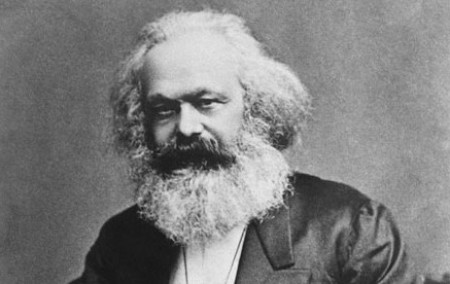
karl-marx-theoristBy Belfast Plebian

Marx published very little in the last ten years of his life and did not even manage to finish volumes two and three of Capital.  Some historians have said that he ran out of mental capacity. There were only two important documents published, small in size: the Critique of the Gotha Programme of 1875 is a schematic appraisal of the muddled socialism of Germany Social Democracy and the other a revised version of the Communist Manifesto for mainly Russian readers published just a month before Marx died in March 1883

It is the second document that offers a clue to what Marx was researching in his later years.  Marx and Engels state in the preface that they had neglected to say much concerning social developments in the United States of America and also in Russia in the original Manifesto. They then present a brief synopsis of the condition of the small independent farmers in the United States under the duress of expanding capital while turning to conditions in Russia they note the rise of a new revolutionary movement. They then attempt to take stock of the revolutionary potential contained within the primeval communal relations of the Russian society:

‘Can the Russian obshchina, a form , albeit heavily eroded, of the primeval communal ownership of land, pass directly into the higher form of communal ownership? Or must it first go through the same process of dissolution that marks the West’s historical development? Today there is only one possible answer: If the Russian revolution becomes the signal for a proletarian revolution in the Wes , so that the two complement each other , then Russia’s peasant communal land ownership may serve as the point of deparure for a communist development.’(T.Shanin p139)

In 1983 Teodor Shanin published a ground breaking book called ‘Late Marx and the Russian Road: Marx and the peripheries of capitalism’, a collection of Marx’s draft sketches and letters dealing with questions posed by the development of embryonic capitalism in Russia.

In a letter addressed to the Russian populist writer Nikolai Mikhailovsky Marx explained his research: ‘In order to reach an informed judgement on Russia’s economic development, I learned Russian and then for many years studied official and other publications relating to the question’.(Shanin p135)   Marx also says that ‘I have come to the conclusion that if Russia continues along the pathway she has followed since 1861, she will lose the finest chance ever offered by history to a people and undergo all the fateful vicissitudes of the capitalist regime.’ Marx stated his thesis tentatively referring to the now hectic undermining by both Russian and foreign capital of the customs of the usually isolated communal villages.

What Marx seemed most eager to banish in the mind of his Russian populist reader was the idea that he had arrived at a general philosophical account of modern historical developments.  Marx’s letter was a response to a sympathetic review by Mikhailovsky of Capital Volume One, an appraisal that had ascribed to Marx a unilinear account of necessary historical development.

The Russian populist had said in the review that Marx:  ‘In the sixth chapter of Capital, the section called  So called Primitive Accumulation, here, Marx has in view a historical sketch of the first steps of the capitalist process of production, but he gives us something much bigger, a whole philosophical-historical theory. This theory is of great interest in general and especially great interest for us Russians.’

In his reply Marx is determined to say that he has no such general theory of historical development ‘The chapter on primitive accumulation claims no more than to trace the path by which, in Western Europe, the capitalist economic order emerged from the womb of the feudal economic order….Thus events of striking similarity, taking place in different historical contexts, led to totally disparate results.  By studying each of these developments separately, one may easily discover the key to this phenomenon, but this will never be attained with the master key of a general historical-philosophical theory, whose supreme virtue consists in being suprahistorical.’(Shanin 136)

The above is important for it distances the late Marx from some of his own more rigid conceptions as articulated in the German Ideology and from the common ‘historic Marxism’ thesis that what Marx was about was revising the Hegelian philosophy of History in a materialist direction. The idea that Marxism is a failed Universal Theory of History is still the predominant one in social science.

The other equally important point was that Russia and other pre-capitalist societies ought not to be conflated with Western feudalism. Marx was in fact researching various pre-capitalist societies that were not feudal in the European sense.  When he spoke of an Asiatic mode of production he was not using the construction in a geographical sense, for it included most of South America and even parts of North Africa, especially Algeria.  Marx was not even trying to describe the pre-capitalists societies in any historical-anthropological way.  What he was really interested in was how capitalist expansion was penetrating and transforming pre -capitalist societies that had no feudal past, in short the disruption being wrought by the advancing capitalist-colonialism of his own lifetime. (We do not say imperialism for this terminology was not used by Marx.)

Marx conducted his research using his normal method of reading the leading bourgeois authors and compiling excerpts from them with his own added comments.  He made extensive excerpts and notes drawn from authors such as: the pioneering anthropologists  Henry Morgan’s ‘Ancient Society’ 1877; the evolutionist John Lubbock’s ‘The  Origin of Civilisation and the Primitive Conditions of Man’ 1870; Maxim Kovalevsky’s  study of India ‘Communal Landownership, the Causes, Course and Consequences of its Decline’ published in Russian in 1879; the political historian Henry Sumner Maine’s ‘Early History of Institutions’ (1885); notes of sixteen thousand words on John Phear’s ‘The Aryan Village of India and Ceylon’ 1 1880 and Robert Sewell’s ‘Analytical History of India’ 1870.

Much of this material had to do with the communal and clan structures of the still prevailing pre-capitalist societies. Marx appropriated, albeit critically, these works.  He portrays Maine as an ideologue defending capitalism and empire rather than a genuine historical scholar.  He agrees with Kovalevsky’s arguments covering changes to the communal property forms in India but criticises him for sometimes conflating India with European feudalism.

Marx declares one maxim of his method as ‘One has to be on guard when reading the histories of primitive communities written by bourgeois authors. They do not even shrink from falsehoods. Sir Henry Maine, for example, who was an enthusiastic collaborator of the English government in carrying out its violent destruction of the Indian communes, hypocritically assures us that all of the government’s noble efforts to maintain the communes succumbed to the spontaneous power of economic laws!’ (Shanin 107)

Anderson, basing himself on notes by Kovalevsky, argues that, Marx created a typology of communal forms across many societies and made differing assessments of their durability.  The second theme in the notes and drafts is a comparison between Russia and other ‘Asiatic communes’. To be sure he had not worked out a theory of revolution for Russia or for the others he had studied; moreover he was careful to take note of the political independence of Russia as an important difference.

In respect of the potential for social resistance Anderson argues that of the several communal forms that he had studied, Marx thought they were not as resistant to elimination as those that were rooted in Russia. This was due more to the fact that most of the others had already been conquered by colonial capitalism.  Marx’s guess on Russia is best stated in this from a letter quoted in the Shanin collection: ‘What threatens the life of the Russian commune is neither an historical inevitability nor a theory; it is oppression by the State and exploitation by capitalist intruders made powerful, at the expense of the peasants, by this same State.’   

Anderson concludes by saying that he hopes that his journey into Marx’s writings on nationalism, race, ethnicity and non-Western societies has revealed the multidimensional character of his overall intellectual projects, especially in his later years. Marx’s critique of capitalism was far broader than is usually supposed.

Anderson has done this, though he may have talked more about gender relation.  He mentions differences between Marx and Engels on how they each made use of the findings of Morgan’s study of the origins of patriarchy but he does not develop it much.

There are just a few other points I would like to make that Anderson in his restraint refrains from making.

One point about historical materialism that springs to mind after reading Anderson’s book is that it is not a finished theory and has no pretension to be a finished one.  It must be open to new evidence and new experiences.  If it is taken up as a closed system it would only become a sort of repository of past societies, like a great city museum stuffed full of abandoned knowledge and artefacts.

Another point concerns the assessment of the idea of progress that inheres within historical materialism. The bourgeois ideology of progress is rampant and without qualification: capitalism always improves the world through its free production of commodities, its new technologies, its science and its legal and political forms.

In so far as there is an opposition to this bourgeois credo of progress it can take on more than one mask.  In our time the most forceful originates from the mind of the German philosopher F. Nietzche, who declares in his ‘The Anti-Christ’ of 1888 that ‘Progress is merely a modern idea, that is to say a false one.’  Nietzche was much more impressed by the knowledge and art of the ancient world than he was with the modern one, as are his most intelligent followers.

This is not the kind of opposition, said Marx, that the workers and oppressed of the modern world need, the opposition of reactionary modernism.  Yet the socialist movement in the broad sense has been damaged by the full embrace of the capitalist ideology of progress.  In the first instance, with the progressive Germany ideology of Social Democracy and the Second International, revolution was no longer necessary as steady progress was already happening under capitalist conditions.  This steady progress must we remind ourselves included an acceptance of progressive colonialism.

Then there was the progress of actually existing socialism, supervised by the Stalinist bureaucracy and its ideology of State controlled economic progress.  Soviet society was reputed to be one without social contractions

Yet Marx assesses capitalism and its progress under the auspicious of dialectical contradiction; all progress within capitalism is torn by irony, even the breakthroughs of science are bundled with contradiction.  Medicines are withheld by patents and the Internet technologies are distorted by corporations, to cite just a few examples.

When we speak about the dialectic we are in fact using irony rather than a special kind of logic. The use of dialectic was spoken about by Plato in his dialogues.  Socrates was the master of subjective irony.  When Hegel revived the use of the dialectic he tell us that he learned it by studying the dialogue by Plato called the Meno.

Marx is the master of something more than subjective irony, he is the master of objective irony, he found it especially in the capitalism-colonialism of his own time and the quotes I have picked out from Anderson’s study are replete with this objective irony.

Finally something should be said about the controversy over Marx’s occasional referrals to the Asiatic and feudal modes of production.  Marx in fact wrote more words about Asiatic society than he did about Ancient or Feudal society, yet in the official Stalinist literature it went unmentioned.  The Communists spoke of the slave owning, feudal and then capitalist modes of production but not the Asiatic. Why was all talk of Asiatic society covered up by the Stalinist ideologues?

The best known book on this is a tendentious one by Karl Wittfogel called Oriental Despotism published in 1957.  The book is tendentious because Marx stopped speaking about pre-capitalism societies in terms of Oriental Despotism at an early stage, and because it is doubtful Marx had developed an account of such societies to the point that he was confident in naming them as belonging to a separate mode of production; the societies were too various for him to make that mistake.

Finally the Stalinists did not censure the terminology primarily because it sounded more like a description of the despotic Soviet Union under Stalin but because referring to the feudalism of China or India or Vietnam facilitated an international politics of anti-capitalist revolution that conceded revolutionary leadership to a class of supposed ‘progressive capitalists’ who were an integral part of common national and democratic revolution directed against the colonists and a class of reactionary feudal landowners.  It hardly mattered that Marx thought these Asiatic societies were not feudal in the European sense.      

Kevin Anderson has produced an admiral book.

concluded

Marx on Ireland and the American Civil War: review of ‘Marx at the Margins’ Part III

Jenny and Karl Marx

Jenny and Karl Marx

By Belfast Plebian

After the publication of Capital volume I in 1867 Marx’s perspective on Ireland underwent a transformation. During these years the Fenian movement was gaining support in Ireland, in the United States and in England with the more political minded Irish migrant workers. Anderson explains that ‘From its beginning, the International seems to have had some links to the Fenians, although, given the fact that the latter were part of a movement that was illegal in the British Empire, these were not always made public.’

In 1867 the Irish struggle really came to a boil and in March troops crushed a Fenian led uprising by poorly armed Irish peasants. On September 11 in Manchester, the police caught and charged two leading Fenians, Thomas Kelly and Timothy Deasy. Then, on Sept 18, some Fenians ambushed the prison van escorting the arrested men and an English police sergeant died of his wounds.

These events transpired during the same week that Marx was visiting Engels in Manchester to confer about publicising Capital volume I. Kelly and Deasy managed to escape to America but the police swooped down on the Irish community of Manchester arresting dozens and putting five men on trial for murder. Three of them were hanged on November 23 as a drunken mob celebrated outside. Queen Victoria articulated the ruling class opinion of the time ‘These Irish are really shocking, abominable people-not like any other civilised nation.’

In the days before the executions the International launched a solidarity campaign on behalf of the condemned prisoners. Marx wrote a letter to Engels saying ‘I have sought by every means at my disposal to incite the English workers to demonstrate in favour of Fenianism.’ Marx prepared a speech on Ireland for the November 26 meeting of the General Council but did not speak it aloud and an English worker presented it on his behalf.

The speech begins ‘Since our last meeting the object of our discussion, Fenianism, has entered a new phase. It has been baptised in blood by the English Government. The Political Executions at Manchester remind us of the fate of John Brown at Harpers Ferry. They open a new period in the struggle between Ireland and England.’ There began a hectic period of solidarity work on behalf of the Fenian prisoners, with the daughters of Marx heavily involved.

Marx’s daughter Jenny then twenty five years of age sought to break the silence about the plight of Fenian prisoners in the European press.  In February through April 1870 she published an eight-part series of articles on Ireland in ‘La Marseillaise’, a left of centre Paris newspaper. The articles of concern for, and plight of, the prisoners was then picked up and distributed by popular newspapers across Europe and the United States. The international embarrassment caused by the articles sparked a debate in the British Parliament, resulting in a formal inquiry. Finally in December 1870 Gladstone released the prisoners on condition that they leave the country.  In their letters Marx and Engels expressed a considerable pride in Jenny’s role in the affair and Engels and Elizabeth Burns sent her a twig of shamrock on Saint Patrick’s Day.

Marx’s own engagement with Ireland came to a rise in the International when a battle with the followers of Bakunin’s group became public in January 1870, after publication of the General Council’s Confidential Communication, written by Marx in French and responding to the accusation of authoritarian leadership. What usually goes unmentioned in this disputation with the anarchists is the fact that the attack on Karl Marx was two-pronged, the second targeting Marx’s support for revolution in Ireland.  A pro- Bakunin newspaper published a strong attack on the General Council Resolution on Ireland in December 11 1886, characterising it as a diversion from true revolutionary politics. Marx drafted a response to criticism and about a quarter of his 12 page document dealt with Ireland.

Marx states that ‘Ireland is the bulwark of English landlordism. If it fell in Ireland it would fall in England too. In Ireland this is a hundred times easier because the economic struggle is concentrated exclusively on landed property, because this struggle is at the same time national and because the people are more revolutionary and angry than in England…In the second place, the English bourgeoisie has divided the proletariat into two hostile camps…The common English worker hates the Irish worker as a competitor who lowers wages and the standard of life. He feels national and religious antipathies for him. He views him similarly to how the poor whites of the Southern states of America viewed black slaves…Thus the position of the International Association with regard to the Irish question is very clear. Its first concern is to advance the social revolution in England. To this end the great blow must be struck in Ireland.’    

This public statement had been prepared after a great deal of study of Irish history undertaken during October and November of 1869 and concentrating on the periods of the American and French revolutions up to the abolition of the Act of Union of 1801. Marx’s research notes comprise some 70 printed pages, following his usual method of taking excerpts from books he had been reading and then lacing them with his own comments.

Marx tracked the career and writings of John Curran, a radical Irish parliamentarian who became the defence attorney of the United Irishmen; he writes to Engels: ‘you must get hold of Currans’s speeches…I meant to give it to you when you were in London.  For the period of 1779-1800 it is of decisive importance, not only because of Curran’s speeches in court( I regard Curran as the sole great people’s advocate of the 18th century and the noblest personality, while Grattan was a parliamentary rogue) but because you find all the sources about the United Irishmen.  This period is of greatest interest, scientifically and dramatically. First the dirty infamies of the English in 1588-89 repeated perhaps even intensified in 1788-89. Second, class movement is easily shown in the Irish movement itself. Third the infamous policy of Pitt. Fourth which very much irks the English gentlemen, the proof that Ireland came to grief because in fact, from a revolutionary standpoint, the Irish were far too advanced for the English King and church mob, while English reaction in England as in Cromwell’s time has its roots in the subjugation of Ireland..’

Two letters, one to Engels and the other to  Kugelmann dated November 29, 1869 and December 10 spelled out his mature position on Ireland, which became the basis of a refutation of his critics in the International a year later: ‘For a long time I believed it would be possible to overthrow the Irish regime by English working class ascendancy. I always took this viewpoint in the New York Tribune. Deeper study has now convinced me of the opposite.  The English working class will never accomplish anything before it has got rid of Ireland.  The lever must be applied in Ireland.  This is why the Irish question is so important for the social movement in general.’

The life of the International coincided with the revolutionary war against slavery in America. It is a travesty of historical understanding that the great conflict between capitalist-slavery and free labour in America has featured so little in the making of ‘historic Marxism’, for the historical record shows that Marx regarded it as the most important political drama in his own time.

In several key places in Capital, Marx addressed the Civil War, the relationship between capital, labour and race; the first in the very preface where he refers implicitly to the impact the Civil War made on the very founding of the First International: ‘Just as the in the eighteenth century the American War of Independence sounded the tocsin for the European middle class, so in the nineteenth century the American Civil War did the same for the European working class.’

Marx takes up the story in a chapter called ‘The Working Day’. In comparing the finished book to the draft version, Dunayevskaya had argued that the Civil War and its impact on European labour was so great that the first edition was drafted to fit around it, rearranging his composition to remove the theoretical criticism of the economists and relegating that material to a fourth volume. She held that Marx’s activity in the International alongside the workers who had championed the Union cause was crucial to his decision to add the chapter on the working day: ‘He is breaking with the whole concept of theory as something intellectual, a dispute between theoreticians. Instead of keeping up a running argument with theorists, he goes directly into the labour process and thence to the Working Day…It wasn’t he; however who decided that the Civil War in the United States was A HOLY WAR OF LABOUR. It was the working class of England, the very ones who suffered the most, who decided that.’ (1958)

The above reference to the working class of England is to the fact that they sacrificed jobs and income and fought their own national ruling class to side with the Union Cause.  The context was explained by Marx ‘Direct slavery is as much the pivot upon which our present day industrialism turns as are machinery, credit.  Without slavery there would be no cotton, without cotton there would be no modern industry.  It is slavery which has given value to the colonies, it is the colonies which created world trade, and world trade is the necessary condition for large-scale machine industry…Slavery is therefore an economic category of paramount importance.’

Marx wrote many articles charting the unfolding of events in America and intervening in the common struggle in England, it might well be argued that his theoretical proposition that the working class is the only universal emancipating class was vindicated by this single struggle.  Anderson quotes the historian Padover:  ‘The beginning of the conflict found British opinion divided. On the pro-Confederacy side were the aristocracy, which sympathised with the southern plantation owners, and commercial interests which hoped for cheaper raw materials , particularly cotton, from an independent South. On the pro-Northern side were British liberal who saw in the civil war a struggle to preserve democracy and the working class which felt that the fate of free labour was at stake. Much of the London press spearheaded by the influential Times, which Marx read assiduously was pro-South. The British government led by Lord Palmerston as Prime Minister and Lord John Russell as Foreign Minister, leaned toward the Confederacy.’ Marx’s first Tribune article The American Question in England published on October 11 1861 dealt with this political battle on the home front.

I will not try to cover the entire story, there is way too much of it to summarise. In fact Anderson’s account of it is a vital part of his study. When the Civil War started, Lancashire was the workshop of the world; the cotton industry employed at least 440,000 workers in 2,400 factories. The main source of raw material came by way of the Confederate states, over a billion tons a year.  Disaster struck when the Union side imposed a naval blockade on the South, mills in Lancashire were closed or put on reduced working hours, half of the cotton workers went without wages, became unemployed and were evicted from their factory build homes.

The shipping and factory owners openly sided with the Confederacy; they called for the British navy to be used to break the Union blockade. The cotton workers response was to organise a campaign of public meetings to maintain the blockade and stand firm with the Union. The most remarkable testimony of the social setting has come down to us in the words of one Henry Hotze a Southern agitator for the Confederacy in England: ‘The Lancashire operatives are the only class which as a class continues actively inimical to us. With them the unreasoning aversion to our institutions is as firmly rooted as in any part of New England.’  In the year of 1863 English workers held at least 50 pro-union public meetings.

The Karl Marx archive gives us the drama of the story on both sides of the Atlantic, the differences of opinion over strategy, plus the role of the International.  Marx said that it was ‘the English working class that saved the West of Europe from plunging headlong into an infamous crusade for the perpetuation and propagation of slavery on the other side of the Atlantic.’

Anderson offers us a short political history of the assessment made by various threads of ‘historic Marxism’ and how Marx has been often criticised for not being critical enough of the Union cause and of Lincoln’s role in particular. Finally he shows how Marx analysed its overall impact and quotes a passage from the section of Capital on the working day:  ‘In the United States of America, every independent workers’ movement was paralysed as long as slavery disfigured a part of the republic. Labour in a white skin cannot emancipate itself where it is branded in a black skin. However a new life immediately arose from the death of slavery. The first fruit of the American Civil War was the eight hours agitation, which ran from the Atlantic to the Pacific, from New England to California with the seven-league boots of a locomotive. The General Congress of Labour held at Baltimore in August 1866 declared “ THE FIRST AND GREAT NECESSITY OF THE PRESENT, TO FREE THE LABOUR OF THIS COUNTRY FROM CAPITALIST SLAVERY, IS THE PASSING OF A LAW BY WHICH EIGHT HOURS SHALL BE THE NORMAL WORKING DAY IN ALL THE STATES OF THE AMERICAN UNION. WE ARE RESOLVED TO PUT FORTH ALL OUR STRENGTH UNTIL THIS GLORIOUS RESULT IS ATTAINEDTH.”

to be contined

So you think you know about Karl Marx? A review of ‘Marx at the Margins’, Kevin B Anderson.

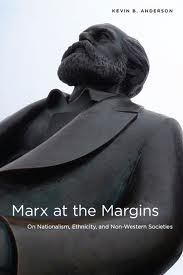
Kevin B AndersonBy Belfast Plebian

To date, no comprehensive intellectual biography has been published in any language. Kevin Anderson.

Every new class consciousness generation is forced by contemporary events to return to the philosophy of Karl Marx, not in a mood of revival but to learn something important that has become forgotten or carelessly overlooked by previous students.

In the past the known side of Karl Marx was represented by the Communist Manifesto, a handful of works by Engels and the first volume of an unfinished study of the capitalist-bourgeois model of the good society, Capital volume 1. The later volumes of Capital economic studies were inaccessible to most readers because they followed a difficult logic and even Engels, the life long friend and editor of at least three of the economic volumes, is frequently accused by contemporary devotees of seriously misunderstanding the logic of value as expounded across its many pages.  In fact the leading lights of the ‘intellectual academy’ seem to have reached a sort of consensus that Engels got the economic critique wrong in his introductions and prefaces of the numerous editions, though it has not yet reached a consensus as to the linking arguments of the exposition, the relationship – to give one central example – of the tendency for the average rate of profit to fall to the sudden outbreak of an economic crisis, which is still hotly disputed.

There is another part of the Karl Marx legacy that has yet to be appreciated.  I will call this, for want of a better expression, the esoteric part: that part of the intellectual legacy that got buried and then neglected by the custodians of the early workers’ parties. Many documents concerning what Karl Marx did and thought during his own lifetime were left unpublished until after the formation of an ‘historic Marxism.’

Marx had frequent disputes with other communists in his own lifetime and they were certainly able to understand him, maybe because the fundamentals of political existence then were stated in common speech in contrast to the specialised language of later social  science.  Marx in fact is famous less for his critique of classical economic science than for his preparation of the communist manifesto in 1848, one of the most accomplished of common language documents ever recorded and distributed. The manifesto was composed as a blend of just rhetoric and historical knowledge, and espoused in the name of a living revolutionary movement, the Communist League.

The act of rendering the dialectical thought of Karl Marx into fluent and accessible pamphlets and journalism is not without a certain risk of vulgar distortion.  Even sections of books approved by Karl Marx himself, like the ‘Anti Duhring’ of Engels, to this day provoke criticism from some ‘Marxists’.

One reason we may well surmise why Karl Marx kept his partnership with Engels strong for so long was that he felt a need for an intellectual accomplice who could speak to the workers about political economy in a less convoluted style than he thought he could do. Marx always maintained that an attack on bourgeois economics as first expressed by Engels was not only his first introduction to the subject matter but a life-long inspiration.  

Marx for sure could write in the style of a campaigning journalist but he certainly preferred to delegate the role of first publicist to his partner in revolution. When Engels committed intellectual blunders Marx usually refrained from excommunicating him.  Engels held frustrations of his own, especially over the esoteric intellectual habits of Marx, complaining in a letter: “as long as you still have an unread book that you think important, you do not get down to writing.”

With the benefit of historical hindsight Marx and Engels may have even ‘over-succeeded’ with their exoteric publications like the Communist Manifesto and the Ani-Duhring because these publications became by the turn of the century the core of what became known as ‘Second International Marxism’.  They published the first version of the great manifesto in February 1848 and then went on to publish several revised versions.

With the very first one they faced a pressure familiar to all those who write for a public purpose: their friends’ impatience (from their comrades in the Communist League of whom we have records from the time). A month before publication the secretary of the Communist League wrote saying ‘The central committee charges its leading circle in Brussels to communicate with Citizen Marx and to tell him if the manifesto of the C. Party, the writing of which he undertook to do at the recent congress, does not reach London by February 1st of the current year, further measures will have to be taken against him.’

The manifesto was the declaration of a hard fought battle of ideas within the Communist League, an early example of a revolutionary united front, so the ideas expressed in the first edition can’t be ascribed without some reservation to Karl Marx alone.

Marx and Engels wrote several prefaces to the later editions that seem to edge closer to something like a genuine historical Marxism.  In the 1872 German edition they say that in view of the gigantic strides taken by modern industry in the preceding twenty-five years, and in view of the political experience gained through workers participation in the Paris Commune of 1870/71, the communist programme of the first edition has in some respect become antiquated.

In point of fact friendly critics of the manifesto like Leon Trotsky and Ernest Mandel point out some serious flaws even in the revised versions from the perspective of a later Marxism. Trotsky says that in showing how capitalism draws along in its wake the backward and barbaric countries the manifesto does not say anything about the struggle of the colonial and semi- colonial peoples for their independence. He also says that the most obsolete part of the manifesto is Marx’s criticism of the socialist literature prevalent at that time.

Ernest Mandel says that the manifesto established the unfortunate myth of the driving down of workers wages to a subsistence level, the iron law of wages, as one of the main tenets of orthodox Marxist thought, something he in fact refuted in his scientific account.

What we learn from this worry over the communist manifesto is that we must be conscious of shifts and developments in the thought of Karl Marx.  We must not even assume that the later books, essays and pamphlets are always an improvement on the earlier ones.  After all we all decline with age.

Marx is unusual in that he has often suffered greater distortion in the hands of his supporters than from his intellectual enemies although these have often stood on common ground. To give just one example, both past friends and enemies typically selected out points 5, 6 and 7 of the Communist Manifesto as the only guide to what Marx argued for by way of an alternative to capitalist arrangements.  Point 5 states that communists are in favour of the centralisation of all credit in the hands of the State by means of a national bank with an exclusive monopoly. Point 6 states that communists are in favour of a monopoly of the means of communication and transport in the hands of the State and point 7 calls for an extension of factories and instruments of production owned by the State. Nowadays we would call this a programme for state organised capitalism.

It is to the credit of the author of this book about the thought of Karl Marx that he scrupulously tries to avoid a stereotyping of Marx by not resorting to the usual interpretative device of selecting just a handful of well known ‘key passages’ from the better known publications and then referring to this selection as definitive of Marxism . The chief virtue of the book is that it presents to the contemporary militant a serious reading of essays, documents and letters by Karl Marx that are not well known or are seldom thought to be worthy of comparison to the key passages approach.  The good thing is that we are offered a more ‘historical’ account than we are usually given.  We might legitimately call this a dialectical account of the development of the mind of Marx.

Anderson’s method is to split the collected works into a kind of core and a periphery and show how the works of the periphery if studied carefully offer us a more concrete understanding of the abstract core. The core for Anderson consists not so much of a privileged statement or single book but of the concepts of social capital and the exploitation of labour, the theory of alienation and fetishism and finally the notion of dialectics. These ideas are the core because they appear as a seam that is more or less present in all of the primary works.

Anderson does not make an assessment of Marx’s intellectual development on the basis of a definite epistemological break between a young, humanist Marx and a mature, scientific Marx like the French professor Louis Althusser tried to do. 

Anderson is one of those historians participating in the publication of  MEGA2 which began in Moscow and Berlin in 1975, came to a standstill in 1989 with the implosion of the Soviet regimes, and was taken up again mainly by Western funded institutes.  What we now have before us is a much expanded version of the works of Marx and Engels than was previously available.  It is hard to think of another modern thinker with so small a ratio of published writings during their own lifetime to those actually written.  Works now considered central to the canon such as the 1844 manuscripts, the German Ideology, the Grundrisse and the Theories of Surplus Value were largely unknown to the “orthodox Marxists” of 1905.  For the purpose of this review it is useful to be reminded of what new material is included in the complete works, for Anderson makes use of some of them in his study.

The updated complete works are divided into four sections:

Section One: early works, articles and drafts.

Of thirty two volumes now planned, seventeen have appeared.  Especially notable is the inclusion of a rougher but larger version of the influential 1844 manuscripts. Marx appears to be writing two versions at the same time.

Section Two: Capital and Preliminary Studies.

Consisting in 15 volumes, of which as of 2010, 13 have been published.  What has been included are all the editions of volume one of Capital.  Important here is a print of Engels’s 1890 German edition, but with an important addition from a French edition prepared by Marx himself in 1872-1875 with an extra 60 pages not included in the English translation of the standard German edition. This, it turns out, was the edition most favoured by Marx though not by Engels.   Anderson presents some extracts of letters concerning their difference of opinion over what version of Capital volume 1 should be prioritised.  Other volumes offer draft manuscripts for what became Volumes 2 and 3 of Capital, which can now be studied to see how Engels edited and arranged them.

Section Three: Correspondence.

Of 35 volumes planned, 12 volumes covering the years up to 1865 have been published.  In the previous complete works most letters from Marx to people other than Engels were usually omitted.

Section Four: Excerpt notebooks.

Of 32 volumes planned, eleven have so far been published.  Here we have many drafts and notes never published before in any language.  These include notebooks from 1844-1847 on political economists such as Jean -Baptiste Say, Jean-Charles Sismondi, Charles Babbage, Andrew Ure and Nassau Senior.  Excerpt notebooks from Marx slated for publication include (1) notes from 1853 and 1880 on Indonesia, (2) notes from 1852 on the history of women and gender relations, (3) notes on the history of agriculture in Russia plus some on prairie farming in the United States, (4) substantial notes on Ireland from the 1860s, (5) notes on agriculture in Roman times, and finally (6) a massive chronology of world history composed during the 1880s.

Kevin Anderson situates his presentation of the development of Marx close to a mode of interpretation associated with the books of Raya Dunayevskaya (his own book is dedicated to her) whose most notable books are Marxism and Freedom (1958,) Philosophy and Revolution: from Hegel to Sartre, and from Marx to Mao (1973) and Rosa Luxemburg, Women’s Liberation and Marx’s Philosophy of Revolution (1981).

In her own work Dunayevskaya turned to the unpublished ‘Ethnographic’ notebooks of Marx to argue against the thesis that the old Marx(the last ten years) was an unproductive thinker, pointing to some of the different conclusions Marx reached in contrast to Engels in the study of the role of women and class in early societies. This she believed was important owing to the undisputed spell Engel’s ‘Origin of the Family, Private Property and the State’ held over all later communists.  It was taken on trust that Marx had no thoughts of his own relevant to what was later to be called women’s liberation.

Some of the less well know documents that Anderson mines concern the political journalism, especially those relating to race and class in the United States, the national struggles in Ireland and Poland, and others covering the colonial expansion in India, China and Java.  He then relates some of this material to editions of Capital especially the generally ignored French edition, the one Marx himself preferred.

He also takes us on an excursion through Marx’s late studies of pre-capitalist societies with particular reference to Russia and India and asks what his reasoning was in spending so much time on them, all the while jeopardising the completion of Volumes 2 and 3 of Capital.

What we end up with is a much more energetic and interesting ‘late Marx.’ It should be noted that David Riazanov and his colleagues at the Moscow institute neglected to publish some of these later documents stating that Marx by 1880 ‘had lost his ability for intensive, independent, intellectual creation….. Sometimes, in reconsidering these notebooks, the question arises; why did he waste so much time on this….that is inexcusable pedantry.’

In the next post we will look at some of what Anderson reveals about these writings, including those on Ireland.

Trotsky and nationalisation

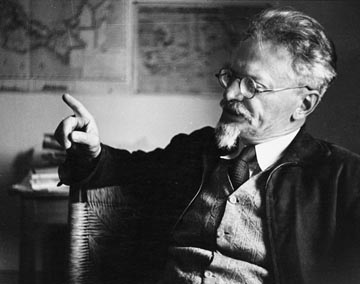
trotskyIn two previous posts I have looked at Leon Trotsky’s transitional programme and the general approach to a working class programme which it encapsulated at a particular point in time. In this final post on the question I want to look directly at what Trotsky’s views were on nationalisation. As I said at the start of these posts, many organisations claiming inspiration from his politics place calls for state ownership high up in their political programme. This conflicts directly with Marx’s views but we need to look at Trotsky to see if this is also true of him.

First we should note that in the transitional programme Trotsky explicitly counterposes ‘expropriation’ to “the muddleheaded reformist slogan of ‘nationalisation’”. He gives four reasons for doing so. The first is that he rejects ‘indemnification’, i.e. compensation to the capitalists. Secondly he does so as a warning against reformist socialists who, while also advancing this demand, nevertheless remain the agents of capitalism. Thirdly he says workers must rely on their own strength. As we have stressed, nationalisation relies on the state. Lastly he does so because he links the question of expropriation with the seizure of power by the workers. This latter point is crucial in his presentation while, because we live in less revolutionary conditions, I have laid greater emphasis on his third reason.

Thus in the very next section of the programme from that above, in which he argues the importance and the benefits of expropriation of the banks and statization of the credit system, he says that the latter will “produce these favourable results only if the state power itself passes completely from the hands of the exploiters into the hands of the toilers.”

When pushed, Trotsky accepts that ‘nationalisation’ may be accepted as a slogan but only in so far as it actually means expropriation and involves a workers’ government to achieve it. In other words reason four must apply.

It is possible to argue that the socialist programme must be taken as a whole and that therefore calls for nationalisation are perfectly valid when part of a comprehensive programme. There are several problems with such an argument but we will point out only two.

First – try finding the call for destroying the capitalist state or creation of a workers’ state in the programme of the left that might act as an alibi for demanding capitalist state ownership in the here and now.

Allied to this is the second reason. In every advanced capitalist country the working class is separated from conquest of state power by a huge gulf in social and political development and experience. The left might often be opportunistic but it is not immune to registering this fact, if only through avoidance of demanding overthrow of the state. In effect a link between nationalisation and a change in the character of the state is non-existent and the former becomes a simple call for the capitalist state to take ownership from private capitalists.

In other words the organ of the capitalist class as a collective, and its principal organ of defence of its system, is called upon to play a role in the destruction of this class and system.

For some on the left their understanding of Marxism and the working class political programme has degenerated so much that nationalisation of the economy is itself seen as the transformation of capitalism into socialism. In such circumstances however the relations of production remain unchanged; capitalism continues and the working class remains exploited, oppressed and separated from the means of production. It is precisely the establishment of this last condition that made for the creation of capitalism, and its ending that will signal capitalism’s overthrow, when the working class as the associated producers become owners of the means of production.

Trotsky was scathing about just such a belief in the socialist character of nationalisation. When talking about expropriating the banks he says that “of course this question must be indissolubly linked to the question of the conquest of power by the working class.” In the same article (Trotsky, Nationalised Industry and Workers Control, Writings , 1939) he writes that “It would, of course, be a disastrous error, an outright deception, to assert that the road to Socialism passes, not through the proletarian revolution, but through nationalisation by the bourgeois state of various branches of industry and their transfer, into the hands of the workers’ organisations.”

In many formulations of the call for nationalisation there is not even a call for nationalised property to be transferred to workers’ organisations, although the sometimes call for nationalisation under workers control is a nod in this direction.

We are thus left in the following position having reviewed Trotsky’s programme:
The socialist programme must be understood as a whole and it involves the destruction of the capitalist state and creation out of the working class itself of the new state.

In no country does the working class accept such a task or seek a way to achieve it. In no county is it subjectively revolutionary.

Trotsky seeks to adapt the working class and its political consciousness to its historical task but if it is not seeking revolution and has a very low level of political consciousness how do we proceed in a revolutionary way that does not address workers with politics that undermines the revolutionary goal?

Trotsky said that “comrades are absolutely right when they say we should tell the workers the truth, but that doesn’t signify that every moment, every place, we state the whole truth, starting with Euclid’s geometry and ending with socialist society. We do not have the right to lie to them, but we must present to them the truth in such form, at such time, in such place, that they can accept it.”

It would therefore be wrong to believe that because the complete programme of revolution cannot right now profitably be canvassed among the working class that the programme that must be fought for is less revolutionary. This is so only in degree but not in any qualitative sense. The revolutionary programme does not lose traction, does not cease to truly encapsulate the interests and immediate tasks of the workers because we cannot yet concretely and practically today propose the arming of the working class and destruction and replacement of the capitalist state.

What is also not involved is shying away from arguing outright for a socialist society, a society run by workers, and nor is it necessary or desirable to run away from this vision to the refuge of an improved capitalism. The vision of a systemic alternative to capitalism must capture the working class for it to put it into practice. It cannot be the result of stumbling blindly into it through some disembodied ‘logic’ of class struggle. Not speaking the whole truth every time and everywhere does not mean renouncing the goal of socialism at any time.

The revolutionary programme in non-revolutionary conditions means first rejecting illusions in capitalism and in its state – encapsulated in the demand for nationalisation.

It involves rejecting the substitution of the state for tasks that must be accomplished by workers themselves and it means identifying the steps forward that workers must take to develop their political consciousness, through increasing their economic, social and political weight in existing capitalist society.

There is no shortage of demands which can do so. It involves the demand for workers’ cooperatives – production without capitalists, not just as an answer to failing enterprises but as the model for new ones, through employment of workers’ pension funds and sponsorship by existing workers organisations such as trade unions. This is a question to which we shall return.

It involves workers reclaiming their organisations from the bureaucracies which currently control them through challenging and defeating these bureaucracies. In Ireland one form this takes is opposition to the policy and practice of social partnership. This in turn may involve creation of new trade unions; whether this is so is a practical and tactical question involving judgments that must ensure socialists and other militants do not become isolated.

It means creation of a workers political party that does not become the creature of electoralist stratagems and of TDs, as in the dying ULA. Similarly it does not mean the erroneous view that declarations of revolutionary virtue can in themselves guarantee anything in the wider working class, within which lies the only promise of revolution. The working class will of necessity learn from its own mistakes just as in will be its own liberator.

A programme which proclaims that the emancipation of the working class will be the achievement of the working class itself would go a long way to providing such a programme, were awareness of the dangers of reliance on the capitalist state for solutions as strong as it should be. It is arguing against such illusions, at what might seem excessive length, that many of the posts on this blog have been directed.

It is therefore time to turn to alternatives.

Does the demand for workers control represent such an alternative and does its joining together with a call for nationalisation represent a positive overcoming of the reactionary character of the latter – nationalisation under workers control? (Hint – the answer is no).

Does the call for workers cooperatives represent a real working class alternative to capitalism? Not, it would appear, to the organisations in Ireland’s left. But are they right?

The transitional programme and political consciousness Part II

2010-08-16Grafik8926075967511404471

In my first post on Trotsky’s transitional programme I argued that the political consciousness of the working class is critical to the success of the socialist project and crucial to take into account in the development of a political programme. I also noted that the transitional programme was one way of approaching this problem but did not in itself provide a simple solution. It did however provide ways of thinking about one by, for example, raising demands for workers’ control as an illustration of a programme based on workers self-emancipation.

The problem arises most clearly, as I said, when the political consciousness of workers is too low for them to effectively rise to the challenges posed by objective conditions. This could be the fight for an alternative to austerity in the south of Ireland or against sectarianism and the state that supports it in the north. How then should a programme be conceived and presented in such circumstances?

Trotsky presents guidance but it is not immediately apparent that the various elements of it are all consistent and provide clear answers. Trotsky argued that Marxists must tell workers the truth –

“To face reality squarely; not to seek the line of least resistance; to call things by their right names; to speak the truth to the masses, no matter how bitter it may be; not to fear obstacles; to be true in little things as in big ones; to base one’s program on the logic of the class struggle; to be bold when the hour for action arrives — these are the rules of the Fourth International.”

Socialists must avoid abstractions, which in words such as ‘peace’ or the ‘national interest’ are weapons of the capitalist class. Socialists on the other hand must be concrete in what they propose because a programme is a call to action not, as it often appears, purely propaganda for education purposes. Where it is the latter there is no reason not to speak Marxism clearly instead of debased social democracy.

Unfortunately too often the small groups of the left are known for their dishonesty, most obvious when they inflate their own numbers and achievements. This in itself is unimportant except that it is held up as evidence for particular perspectives that are often divorced from reality.

Trotsky understands that, in a programme predicated on what it is the working class itself does, the demands of the programme must be based on the truth, on reality and be practical or the working class will have no means to put them into action.

“Using these considerations as its point of departure, the Fourth International supports every, even if insufficient, demand, if it can draw the masses to a certain extent into active politics, awaken their criticism and strengthen their control over the machinations of the bourgeoisie.”

So we are to support limited demands if these are able to bring workers into active political activity while it is still necessary to state the truth that much more radical action may be required to achieve given objectives.

Trotsky however has been criticised because he didn’t actually understand the role of workers’ consciousness in framing a political programme. Trotsky is quoted:

“We know that the subjective conditions – the consciousness of the masses, the growth of the revolutionary party – are not a fundamental factor. It depends on the objective situation; in the last instance the subjective element itself depends on the objective conditions, but this dependence is not a simple process.”

And further:

“What are the tasks? The strategic tasks consist of helping the masses, of adapting their mentality politically and psychologically to the objective situation, of overcoming the prejudicial tradition of the American workers, and of adapting it (their mentality) to the objective situation of the social crisis of the whole system.”

“I say here what I said about the whole programme of transitional demands – the problem is not the mood of the masses but the objective situation, and our job is to confront the backward material of the masses with the tasks which are determined by objective facts and not by psychology.”

The question is then posed to Trotsky:

‘Question: Isn’t the ideology of the workers a part of the objective factors? Trotsky: For us as a small minority this whole thing is objective, including the mood of the workers. But we must analyse and classify those elements of the objective situation which can be changed by our paper and those which cannot be changed. That is why we say that the programme is adapted to the fundamental, stable elements of the objective situation, and the task is to adapt the mentality of the masses to those objective factors.’

We should remember that for Trotsky the transitional programme was itself said to incorporate the requirements of a transitional epoch – “During a transitional epoch, the workers’ movement does not have a systematic and well-balanced, but a feverish and explosive character. Slogans as well as organisational forms should be subordinated to this feature of the movement,”

The organisations on the left repeatedly argue that workers’ consciousness can change quickly, and so it can, but this is mostly simply a way of avoiding the reality of the distance that workers must travel, the time required to do so and the experiences that must be gone through. This also plays a role in the debasement of the socialist programme, prompting attempts to make it look more ‘realistic’ and even ‘common sense’ by constructing a socialism based on widespread illusions in the capitalist state. How much more realistic, upon such illusions, do calls for nationalisation appear than the call for workers’ cooperatives or other measures of control?

So if we can try to summarise Trotsky’s approach, it is one that starts from trying to change the consciousness of the working class, through its more militant elements, in order to change objective conditions which alone set the tasks of the working class.

In the ‘transitional epoch’ that Trotsky described “the workers’ movement does not have a systematic and well-balanced, but a feverish and explosive character” and might therefore have been expected to be more open to the changes in organisation, action and consciousness that were required.

As I said in the first post the workers movement today in European countries cannot be said to have this character. The organisation and consciousness of workers today must therefore be considered much more an objective factor than when the transitional programme was written. This reflects the long history of capitalist boom conditions after the Second World War and the defeats inflicted on the workers movement in the most advanced countries plus the general discrediting of socialism consequent on Stalinism and its collapse.

To a much greater extent therefore the tasks of the programme is to confront workers with the objective circumstances which include the limitations of their own consciousness. Since for Marxists consciousness must reflect reality, changing consciousness means changing the conditions of workers themselves, including their own organisations and their workplace experiences. This is the task of workers themselves.

The Marxist programme must therefore place to the fore the working class changing its own circumstances so that objectively it increases its political and social activity. That this does not immediately raise the question of revolution does not matter since this cannot be raised concretely and practically any other way and certainly not by programmatic demands issued by small groups.

It must be realised that a revolutionary programme is not defined by adherence or commitment to the call for revolution now or in the future (in the sense of smashing the capitalist state and creating a new workers’ state). In the first case this is revolutionary phraseology only and in the second is merely a promise, and promises are regularly broken. Revolutionary politics exist in today’s period of retreat as they also more clearly do in periods of offensive and they do so whether an actual revolutions is more or less probable.

Revolutionary politics means the self-activity and independence of the working class themselves and an acceptance that just as workers must achieve their own emancipation they must also learn their own lessons and do so through their own mistakes. Marxists can lessen and shorten this process but not abolish it. To counterpose real expressions of working class action that may be politically weak and to abstain from it in favour of hypothetically more advanced courses of development is a sectarian mistake. This is not such a common mistake on the left today since it usually makes the opposite one but it is sometimes reflected in demands for acceptance of programmatic positions that in themselves do not answer any real tasks more or less immediately posed.

The more common mistake is to substitute action by others for action by the working class and in a whole series of posts I have given examples of this being done. To return to the beginning of the first post – Trotsky’s transitional programme gives no support to those who believe state ownership is part of the working class programme. It is rather the predominant means by which the left supports actions by others for what can only be achieved by the working class.

In the next post I will look at what Trotsky had to say on this.

The transitional programme and political consciousness

Trotsky-1931In a series of posts I have shown that capitalist state ownership and its identification with socialism has no support in the writings of Marx, Engels and Lenin. It nevertheless recurs again and again and has done so for years in the political programmes of organisations claiming to derive their politics from these figures. Most of these organisations also claim to be inheritors of the ideas of Leon Trotsky and consider their political programme to embody the approach of the transitional programme formulated by Trotsky in 1938. It remains therefore to look at the transitional programme to see what support it gives to today’s organisations which consider themselves to be continuing the fight for this programme.

The transitional programme was itself said to incorporate the requirements of a transitional epoch – “During a transitional epoch, the workers’ movement does not have a systematic and well-balanced, but a feverish and explosive character. Slogans as well as organisational forms should be subordinated to this feature of the movement.” (Trotsky) It cannot be said today that the workers movements of Ireland, Europe or the historically advanced capitalist countries have a feverish or explosive character. The point is therefore not to quote Trotsky in order to impose a specific formula on today but to demonstrate a general approach to Marxist politics and in so doing dismiss what are mistakes in formulating a working class programme.

The purpose of the transitional programme is to bridge the gap between workers and socialism through approaching workers at whatever level of political consciousness they are at and through progressive struggle and education direct them towards the goal of socialist revolution. It starts with existing objective conditions and through step by step struggle projects forward to the conquest of political power by the working class. It is designed to overcome the division of political programme into support for socialism as the maximum objective and the fight for a minimum programme made up of immediate demands that involve only reform of the capitalist system.

For Marxists the truth is concrete, not a formula, a schema, theory or principle and the truth lies in the whole, not any individual part or series of parts. The Marxist programme is therefore one that is true to the interests of the working class when taken in its entirety and when it becomes a guide to action. The role and purpose of the transitional programme is not therefore without its own problems; it does not of itself provide solutions to the difficulties in fighting for the interests of the working class or achieving the working class conquest of political power and it does not guarantee falling into failure to really fight for revolutionary change, on the one hand, or declarations of revolutionary virtue with limited purchase on reality on the other.

It provides no ready-made answer when objective conditions clash with working class political consciousness, when the threat to the working class is either not understood by it or it does not have the means to respond. When the Irish working class faces years of austerity, but has no conception of an alternative and so votes or accepts this austerity, the transitional programme waves no magic wand. When relatively large numbers of working class people are prepared to support or engage in very militant forms of struggle but have no or very little conception of socialism, as many republican workers did in the north of Ireland during the late 1960s and 1970s for example, the method of the transitional programme offers no off-the-shelf remedy.

What it does do is demonstrate through very practical examples how these problems may be faced and the method used to conceive the way forward – practical political demands which socialists and militant workers can fight for that can achieve their objectives. The class struggle itself will decide whether success is achieved.

This can be illustrated by a criticism I have seen made of the Irish United Left Alliance programme. This Alliance has now fallen apart but there is no reason to believe that the errors of its political programme so criticised in this blog have been understood. The electoral platform of the ULA has been criticised for not using the word socialism but this would not be a problem if it was only the word that was missing and the content it is shorthand for, working class power, was maintained.

The method of the transitional programme is based solidly on the Marxist view that the emancipation of the working class must be the task of the working class itself. The demands of the programme are all ones that the working class must fight for, impose and achieve. To bring us back to the point: nationalisation is something the working class hands to the capitalist state, the defender of capitalism, to carry out.

In terms of the examples above; the fight against austerity must place the tasks of the workers themselves to the fore, fighting the mechanisms of austerity in cuts and tax rises and putting forward alternatives that are creations of the working class itself such as democratic trade unions and workers cooperatives etc. In the North the need for defence of sections of workers attacked because of their religion must be a political task first, not a military one, and must be carried out democratically by workers themselves, not by a secret military group. It must be done under a political banner committed to democratic and class identification not sectarian and communal affiliation. Of course, as we have said, to fight is not necessarily to win but to fight under the wrong political banner and demands is already to fail.

The principle that it is working class activity and action which is key through the mechanism of workers control is also revealed in the approach to demands which on the face of it are not specifically socialist and are limited to reforms or purely democratic changes within the existing capitalist framework. In these cases such demands must be fought for through working class methods of struggle in order that the workers themselves go through the experience of fighting and learn from the experience.

Inevitably when this occurs workers quickly teach the socialists but no lesson is learnt automatically or spontaneously. The struggle in the North of Ireland is proof that even the most militant struggle does not generate socialist consciousness and that this must be fought for just as much as the particular object of struggle itself and if they cannot be linked the struggle for socialism is not on the agenda anyway.

On the other hand the fixation with electoralism evidenced by the ULA is not a lapse but sits comfortably within a political programme which calls on the capitalist state to create equality and democratic ownership. Since the illusion exists that election to governmental office allows one to utilise the state to direct capitalist society, instead of the other way round, what makes more sense that seeking election? In this scenario working class action supports the actions of the elected instead of the elected acting merely as the megaphone of the working class movement.

When I first became involved in Marxist politics in Glasgow in the middle of the 1970s the organisation I joined, the International Marxist Group, was critical of what it saw as the syndicalism of the (British) Socialist Workers Party because the SWP refused to stand in elections. Electoral intervention led to revolutionary politics being diluted and betrayed in the pursuit of votes said the SWP. Less than five years later the same argument was being advanced by Peoples Democracy against Provisional republicans who claimed that standing in elections was to play the British game, legitimising its rule and distracting from the cutting edge of the armed struggle. For both the IMG and PD the Russian Marxists at the beginning of the century were proof that entering electoral contests did not necessitate abandoning revolutionary politics.

While this might be true in principle the subsequent course of both the SWP and republicans has conclusively demonstrated that the IMG and PD (and myself) were wrong in practice. Over on the Irish Left Review a statement is quoted from Ann Foley, the ULA candidate for Cork North West and the SWP’s People before Profit electoral organisation that starkly exhibits this: “I feel the ULA has very common sense policies. When people think of socialists, they think of communism, which is not the case. There is nothing dramatic or revolutionary about our policies.”

This is not the place to explain how this collapse of these organisations’ programmes came about but it is obvious that this has happened. As explained above, even the most militant struggle may not of itself generate socialist consciousness but electoralism has its own ways of causing political degeneration.

In any case the struggle for capitalist state ownership does not challenge capitalist ideology, does not challenge the natural order of capitalist society, does not challenge the widespread illusion that the state (at least potentially) is a neutral arbiter of interests or is the embodiment and representative of a common, national interest. When the actions of the state feature so heavily in even the programme of self-declared Marxists, and for decade upon decade, can there be any wonder there is so little evidence of socialist political consciousness among the Irish working class?

For Marxists this is key because if emancipation can only follow the actions of workers themselves then the ideas these workers act upon are obviously critical. In so far as socialists can affect this consciousness then the manifestos, budget statements, press statements, speeches on the floor of the Dail carried by TV and radio, door canvassing, interventions in workers’ meetings and leaflets at demonstrations are the means by which socialist education can be achieved. How many of these stray beyond Keynesian, that is capitalist, ideas? By comparison the theoretical articles in the left press are simply salves to a guilty conscience that is not even conscious of its guilt.

Consciousness is key because socialism is another name for working class rule and no ruling class rules without being aware of it, which explains the much higher level of class consciousness among capitalists than workers. Workers cannot rule unless they purposefully chose to do so because power will not simply be handed to them. They will have to fight for it which means they will have to want it. Perhaps this is obvious but it has consequences for how socialists must see socialism coming about.

The task of ruling society by the class that makes up the vast majority of society is an enormous and unprecedented undertaking. The scope and depth of political and social awareness to make such a prospect a real possibility does not at the moment exist anywhere. It must come through struggle involving greater and greater parts of the working class, through a process of political and social education that prepares the working class both ideologically and practically for accomplishing it. The transitional programme is meant to encapsulate how this momentous task is achieved.

Unfortunately the transitional programme is looked upon in relatively restricted terms, as a result of the particular historical period in which, and for which, it was written. It is most obviously relevant to a revolutionary situation where the capitalist system is in crisis and the rule of the capitalist class is similarly struck. By their nature such situations are temporary and often fleeting.

To believe today that such crises can move the working class from its current position of subservience, where it does not even control and mostly does not even participate in the organisations which are supposedly its own, such as trade unions, to being politically conscious and organised enough to take political and economic power, is to believe in revolutionary crisis as a sort of magic wand out of which the organisation and education of decades can be squeezed into a few years, at most, of crisis.

The creation of socialist political consciousness among the vast majority of the working class is not the task of a few months or years but of decades. This is also true of the maturation of the objective conditions upon which such consciousness can only be created. This involves a qualitative increase in the social and political participation of the working class as a class in political and economic life, through real participation in trade unions, political parties, community organisations, workers’ cooperatives and other aspects of economic life.

It sometimes appears as if supporters of the transitional programme believe that a series of smart demands allied to struggle can somehow lead workers from rather backward political consciousness, almost by the nose, to one day deciding they would like to rule society. Or worse, finding by sudden surprise that they must smash the capitalist state to get what they want or that having done so waking up one morning to find themselves in charge of society almost by default. It is almost as if the working class will take conscious control of society by a process of mostly unconscious action, at least until the last minute.

While it cannot be expected that even the greatest struggle must start with full consciousness of the socialist objective it cannot be expected that the beginnings of a revolutionary struggle will start without widespread allegiance by major sections of the working class to the ideas of socialism as an objective and deep and widespread experience of self-organisation as a result of commitment to such ideals. In other words there exists a more or less long struggle to win the working class to the ideas of socialism and the need for practical experiences of organisation that comes from militant workplace organisation and inroads into capitalist property.

For those who believe only a Marxist Party needs to be conscious of such tasks and long term objective there might not appear any problem.  But if socialism is working class rule then the vast majority of workers must believe in their capacity to rule society and seek it as the solution to the critical problems which capitalist society has presented to them in periods of revolutionary crisis.

In the next post I will look at claims that Trotsky did not understand this objective requirement.

Marxism and the State

In a previous post I said that I would be looking at the Marxist view of the State and in this post I will look at some aspects of Karl Marx and Frederick Engels’ original view.   For them the possibility of socialism was not that it best met some general principles of justice or equality but that it was based on the actual social and political development of the existing capitalist system.  If there were no developments within capitalism that might form a real foundation for achieving the former ideals then these ideals were practically worthless.  The question however is on what developments within capitalism is the potential for socialism based?

It is undoubtedly the case that the state plays a greater and greater role in capitalist society and that as this system has developed so has the role of the state.  That this has been so despite decades of rhetoric by the most ideologically rabid supporters of capitalism against the state ranks as only further proof of its central role.  The state also played a major role in the creation of the capitalist system although its importance may be subject to historical debate.

On this basis the majority of the socialist movement has come to identify socialism with this state either through state ownership, regulation, taxation or state expenditure on ‘public’ services.  In the form of Stalinism it has taken the shape of the most gargantuan forms of state power which has assumed prerogatives in social life that have associated the liberatory content of socialism with the totalitarian nightmares of Orwell’s 1984.

This has nothing to do with Marxism.  In fact the intellectual journey by which the young Marx came to ‘Marxism’ involved an utter and complete opposition to the state, as formulated by the German philosopher Hegel, which Marx carried out through his ‘Critique of Hegel’s Philosophy of Right’.  Marx’s view of socialism was not an ideal state which society must seek to achieve but the movement of a class to achieve political power as the means by which to ensure its own and humanity’s social liberation.  Socialism is therefore the movement of the working class to achieve power, not the actions of a state and especially not a capitalist one!

For Marx therefore the active germ of socialism is not expressed under capitalism by the growth of the state but by the growth in the social and political power of the working class, which itself is based on the objective development of the capitalist system.  The growth of the state does not in itself herald the new society because Stalinism has demonstrated that a society based on even the state of a superpower is not a historically viable social formation.

The Marxist view of the increasing role of the state was explained by Engels in relation to his native Germany under the Chancellor Bismarck:

“. . . only when the means of production and distribution have actually outgrown the form of management by joint-stock companies, and when, therefore, the taking them over by the State has become economically inevitable, only then — even if it is the State of today that effects this — is there an economic advance, the attainment of another step preliminary to the taking over of all productive forces by society itself. But of late, since Bismarck went in for State-ownership of industrial establishments, a kind of spurious Socialism has arisen, degenerating, now and again, into something of flunkyism, that without more ado declares all State-ownership, even of the Bismarkian sort, to be socialistic. Certainly, if the taking over by the State of the tobacco industry is socialistic, then Napoleon and Metternich must be numbered among the founders of Socialism.

If the Belgian State, for quite ordinary political and financial reasons, itself constructed its chief railway lines; if Bismarck, not under any economic compulsion, took over for the State the chief Prussian lines, simply to be the better able to have them in hand in case of war, to bring up the railway employees as voting cattle for the Government, and especially to create for himself a new source of income independent of parliamentary votes — this was, in no sense, a socialistic measure, directly or indirectly, consciously or unconsciously. Otherwise, the Royal Maritime Company, the Royal porcelain manufacture, and even the regimental tailor of the army would also be socialistic institutions, or even, as was seriously proposed by a sly dog in Frederick William III’s reign, the taking over by the State of the brothels.”

In the development of capitalism increased socialisation of production that anticipates and presages socialism is reflected in the increased role of the state and in this sense only is it progressive in that it signals the development of society towards socialism.  This does not mean that socialists should give any political support to this increased role of the state never mind put it forward as socialist in itself.  The development of capitalism has created and continues to create massive misery and exploitation through driving people from the countryside to cities and is progressive because it creates a working class which is the bearer of a new society but no one thereby claims that socialists should support this process politically.

This again is presented by Engels:

“But, the transformation — either into joint-stock companies and trusts, or into State-ownership — does not do away with the capitalistic nature of the productive forces. In the joint-stock companies and trusts, this is obvious. And the modern State, again, is only the organization that bourgeois society takes on in order to support the external conditions of the capitalist mode of production against the encroachments as well of the workers as of individual capitalists. The modern state, no matter what its form, is essentially a capitalist machine — the state of the capitalists, the ideal personification of the total national capital. The more it proceeds to the taking over of productive forces, the more does it actually become the national capitalist, the more citizens does it exploit. The workers remain wage-workers — proletarians. The capitalist relation is not done away with. It is, rather, brought to a head. But, brought to a head, it topples over. State-ownership of the productive forces is not the solution of the conflict, but concealed within it are the technical conditions that form the elements of that solution.”

Support for nationalisation as a socialist measure is a short-cut, a short-cut to nowhere:

“It is a purely self-serving falsification by the Manchesterite [laissez-faire] bourgeoisie to label every intervention into free competition as `socialism’: protective tariffs, guilds, tobacco monopoly, statification of branches of industry,…, royal porcelain factory. We should criticize this, not believe it. If we do the latter and base a theoretical argument on it, then it will collapse along with its premises” (Engels quoted in Draper, Karl Marx’s Theory of Revolution, 1990,p.96)

From the glorification of the power of the state comes the betrayal of socialism in the form of nationalism which is why it is so apt that this is often expressed in the demand for nation-alisation, as if the more of this demanded the more radical is the socialism.

This type of ‘socialism’ is often also associated with ethical considerations of justice and equality and the view that this can be achieved through state action.  This opens up the possibility of the latter becoming prettified beyond all recognition.  So vast bureaucracies become socialist institutions and means tested, inadequate benefits dispensed through pipettes become a whole new model of society.

If statisation is the advance of socialism then reforming this state is inherently the way forward and electoral success to reach the ‘pinnacle’ of this society becomes the most natural means to its attainment.  Calls for widespread nationalisation, defence of the welfare state without the least criticism of it, demands on the capitalist state to do things it simply will not and cannot do and rank electoralism are all consistent with each other and hallmarks of many of today’s ‘Marxists’.  As Marx was himself compelled to say of some of his ‘followers’, if this is Marxism I am no Marxist.

In his career Marx came across this approach to politics, which is all too familiar today, in the shape of the German Ferdinand Lassalle, who sought state aid for workers cooperatives as the germ of a future socialism, of which the workers were not yet ready to openly fight for.  Today some demands for nationalisation and state redistributive policies are designed to manoeuvre workers into a movement for socialism without even mentioning the word never mind traducing its real content.

Frederick Engels and Eduard Bernstein penned a critique of this sort of approach:

“If the masses could not yet be interested in the actual end of the movement, the movement itself was premature and then, even were the means attained, they would not lead to the desired end. In the hands of a body of working-men not yet able to understand their historical mission, universal suffrage might do more harm than good, and productive co-operative societies – with State-credit could only benefit the existing powers of the State, and provide it with a praetorian guard. But if the body of working-men was sufficiently developed to understand the end of the movement, then this should have been openly declared. It need not have even then been represented as an immediate aim, to be realised there and then. Not only the leaders, however, but every one of the followers that were led ought to have known what was the end these means were to attain, and that they were only means to that end.”

Today calls on the state to do good are presented as the means to win workers’ votes, which will ultimately lead to socialism, while the goal is considered too advanced to be put forward clearly, put to them as something that they must do and only they can achieve.  The avoidance of socialism and its real content today goes under the name of anti-capitalism or under the banner of broad left parties and alliances which hide what its sponsors claim they really stand for.

Let’s be clear about what the nature of Marx and Engels’ argument was.  It has been compared to their attitude to reforms.  Thus while they were in favour of many reforms to the capitalist system, the purpose of such reforms was to place the working class in a better position to carry out the revolutionary overthrow of capitalism.  It was not because such reforms of themselves were the means to bring socialism into effect.

So today socialists should not reject demands on the state or recoil from calls for nationalisation where these might be appropriate.  These proposals should not however be considered the basic mechanism for the transition to socialism; the all-encompassing framework for the programme that becomes its heart, body and soul and the all-embracing grounds on which the socialist argument takes place.  However as we have noted before this is exactly the role that the capitalist state plays today in the politics and programme of the left.  In a number of posts this has been explained; from the demands that the state tax the rich to investment to create jobs and nationalisation as if this were socialism itself.

The difference can quite easily be seen,on the one hand, in opposition to austerity, cuts in public services and opposition to privatisation, which should all be supported, and, on the other hand, putting forward as the socialist solution massive state investment  as the answer to unemployment, economic insecurity, inequality and low standards of living.  While such a policy by the capitalist state might be better for workers in that it provides some protection and better grounds for workers’ own organisation it is not itself the workers’ own alternative.  Nationalisation, state investment and taxation are not solutions and certainly not socialist ones.  All this has been explained in previous posts.

One other thing must also be explained.  Opposition to austerity must be supported, be part of the Marxist programme, because this is something to be carried out by workers themselves.  Keynesian programmes of state-led investment hand everything over to the state to achieve.  It remains in control, dictates how much and what is to be done, when, where and how.  It is precisely to remove all this from state control that is the task of the working class.

This is what Marx meant when he said that “every step of real movement is more important than a dozen programmes” which has been re-translated today so that state reformist electoral programmes are mistaken for real movement.  This denial of the primary role of workers’ own activity is reflected also in these organisations sectarian organisational practices and electoralism which are simply the everyday practical out-workings of a programme that signals dependence on the state for solutions that should come from the workers themselves.

Thus for Marx, support for workers cooperatives in ‘Capital’ is distinguished from Ferdinand Lassalle’s state aid for producers’ co-operatives  – “as far as the present co-operative societies are concerned, they are of value only insofar as they are the independent creations of the workers and not protégés either of the governments or of the bourgeois.”

For Marx and Engels “the emancipation of the working classes must be conquered by the working classes themselves.”  This is the starting point for today’s struggle for socialism, not faith in the benign actions of the capitalist state.

Thoughts on the class struggle in Greece (part 2) – Towards a Revolution?

As I remarked in the first post, the views of both sides in the debate over the way forward for socialists in Greece share the view that there exists in the country the potential for a workers’ revolution.  This is not one that I share and the Greek Marxists provide the evidence that this is so.

First, Andreas Kloke notes the temporary defeat of the movement resisting austerity.  The slogan “Elections Now” by the two biggest left parties Syriza and the KKE “represents a strategic failure.” No big change took place in these elections between the right and the left and the electoral majority for austerity “reflects the real balance of power between the main classes in Greek society.”  Austerity continues to intensify and the fascists of Golden Dawn have grown to represent a real force.  The Greek Marxists are keen to emphasise that no one voting for the fascists can be under any illusion any more about what they represent.  On the other hand the vote for the coalition of which these writers are a part collapsed.  In presenting the fascists and revolutionary socialists as being in a race, he says “the fascists clearly have a considerable head start.”

Syriza does not represent a growth in the collective strength of the working class movement but rather “a collective mood” of opposition to the two traditional parties.  The memorandum imposing austerity is opposed by two thirds of society but only about one third support the left.  There is thus plainly a crisis of a left alternative.  This is a simple reflection of the low level of class consciousness and weak organisation of the working class in no respect fundamentally different from that in many other countries including Ireland.

Manos Skoufoglou notes that the organisations of the Greek working class are not prepared for a radical alternative to the various options that the Greek capitalist class and the EU may choose from.  In the most significant observation he says that “the working class is not questioning directly its (capital’s) economic power.  Workers don’t yet see the left as the political branch of their own class struggle, but as a body on which they “invest” their hopes.”  The fundamental problem is therefore the consciousness of the working class but this also exposes the utter bankruptcy of those on the left who argue that the basic problem is one of working class “representation” and needing to build an electoral vehicle to solve this problem. In the later view the problem is creating a means to represent working class consciousness not in recognising the weakness of this consciousness in the first place.

The real problem is that we are not facing a possible Greek workers’ revolution because, as the Greek Marxists say, “the working class is not questioning directly capital’s economic power”.  Until it does this all talk of revolution is empty rhetoric, not to mention the basis for seriously wrong perspectives.  This is illustrated by a big majority not actually wanting new elections.  So while many wanted to vote for Syriza many didn’t want the only means to achieve this.   A class breaking its chains to achieve political power would never row in behind such anti-political conceptions.

Yet other commentators on the revolutionary left in the Fourth International make the mistake of believing that the basic problem is the need for the left to take the lead in the struggles of the working class with a political programme of breaking with capitalism, one that becomes credible in the eyes of the working class.  But as I pointed out in two earlier posts here and here, political struggles against austerity including general strikes have not led in the past to revolutions.  In fact the Greeks have a record of such strikes that dwarfs the experience of others.  In this post I reported on an academic study that looked at 16 countries including Ireland, which recorded 72 general strikes of which 33 occurred in Greece alone!  Clearly this is not enough to build the material foundations for a revolutionary working class.

And this is the problem.  It is not the weakness of the Marxist Left that is the issue, for this itself can only be explained by the political weakness of the working class but the commentators from the Fourth International have nothing to say about this.  The transformation of capitalism into a new society becomes a question of political struggle only and becomes narrowly focused on one event which acts as a magic wand.  This magic wand is called revolution.  The comrades have no real understanding of revolution as the culmination of a long struggle by the working class to build itself up as a countervailing force in society, in utter opposition to its current class rulers and their state, in which revolution is the final decisive act of rupture inexisting society and birth of the new.  Everything involved in this extended process becomes invested in a single event that is expected to achieve what only decades of struggle, organisation and advances in consciousness can achieve.

Thus for these organisations revolutionary politics becomes believing in the immediacy of revolution, even when it is not immediately on the cards.  Everything else is reformism, to be supported of course, but only in so far as it quickly can become exhausted.  Because socialist revolutions are only possible given a prior development of the working class, and the political situation more widely, their politics become sterile and redundant.  They either collapse into pitiful reformism while talking revolution to their new recruits or they become dogmatists insisting on the necessity of revolution, which isn’t untrue, but which in the form expressed only confirms that it must be 12 midnight before we can move into the new day.  Not much use the rest of the time.

This is the choice presented in this debate and as we saw in the first part it leads to the raising of political demands which are predicated on their being a revolutionary situation when there isn’t.  The demands raised, such as who shall form a government, are thereby either wrong ,by claiming certain political forces like Syriza are more politically advanced than they really are, or are too abstract because they reflect an unacknowledged recognition that the perspectives offered have little traction in reality.

Many on the Marxist left put forward demands such as general strikes as if these on their own will raise workers consciousness and lay the basis for revolution, but they fail in Greece to learn a very obvious lessons that these strikes teach us.   For example Marxists see general strikes as posing the question of who rules society, the workers or the capitalists.  Through stopping society by laying down their tools they challenge the power of the bosses and question their right to decide what happens. Since general strikes cannot stop everything from working they involve workers in deciding just what is allowed to continue to work and what doesn’t and on what terms things like hospitals, power, water, emergency and other services continue to operate.

Yet Greece has seen dozens of general strikes.  If these posed the question of power the question has been answered repeatedly in favour of the capitalists.  The strikes therefore on their own teach this lesson and become very large protests, and protests are not an alternative but merely an objection to what already exists.  The idea that a frontal assault on capitalism today in Greece could be successful seems to fly in the face of this experience but that does not mean revolutionary politics have no role to play.

The alternative perspective of building up the independent economic, social and political power of the working class while recognising that this power does not yet exists is today what revolutionary politics is about because it relies solely on the workers themselves and does not lapse into the short cuts demanded by the perspective of those who see revolution as the only immediate answer to everything.  This need for immediate global answers leads many who call themselves Marxists to demand that the capitalist state do what these Marxists know in their bones the workers are not yet ready to do.  So we have calls for nationalisation as if this were socialist instead of workers ownership and control because the former is seen as more practical and realistic.

This failure to build a real workers’ alternative bursts open when capitalist crises erupt and it is clear that the Marxist movement has no real material, as opposed to theoretical, alternative.  This is why we get incredible admissions of political and general programmatic nakedness such as the following from one of the Greek contributors to the debate.

“The transitional program we describe is a quite sufficient counterweight to reformist projects of the virtually and possibly actually “governing” parliamentary left. However, it is not yet concrete enough. In order to convince against “realistic” arguments, which SYRIZA seems already to succumb to, if not actively spreading itself – that a unilateral termination of the memorandum would lead to international isolation, that expropriation of banks would provoke partners in the government to withdraw their support – we have to prove that a revolutionary counterproposal could also be applicable in practice. We have to study further examples and historical experiences of revolutionary struggles of the oppressed and the exploited: revolutionary measures in Russia, Cuba or China, autogestion in Algeria and in Latin America etc, even progressive measures applied by Chavez.  If anything, so as to depict in our own conscience the real potential of utopia. How can international solidarity practically eliminate pressures inflicted by the international vindictiveness of bourgeois classes? How can we achieve expropriations with no compensation without the universe to collapse? What exactly is workers control and how does it work? Particularly this last question is a key in order to conceive which is the essential difference between a radical left government and a revolutionary workers’ government.”

If the Marxist left cannot prove that its revolutionary politics can be concrete and will work in practice then no wonder it does not have the confidence of the working class.  For the latter to exist the working class would have to prove it in practice to itself through successful example of workers ownership and workers control in the here and now, not promises of utopias tomorrow after the revolution.  Yet the idea of workers ownership and control prior to the revolution is routinely dismissed by many of the Marxist groups.

Manos Skoufoglou states that “The maturation of objective and, what’s more, subjective preconditions for a revolution is not accumulative.”  While the class struggle can rise and fall in favour of the working class which may have to retreat or advance as changing circumstances dictate this statement is surely wrong.  Marx believed that social systems are born, grow, mature and decline.  That this is accumulative proves that the germs of the alternative society must develop and mature within capitalism and appear more and more in its life.

The increasing socialisation of production within capitalism, the increasing specialisation of production forcing greater planning within and cooperation between enterprises, comes into contradiction with the private appropriation of this production.  This is an accumulative process pointing in the direction of the end of capitalism.  The increasing division of labour and the increasing need and actuality of its coordination is constantly upset and destroyed by the pursuit of private profit which leads to periodic economic crises.  The new society of planned production appears more and more in the life of the old capitalism.

But planning is not the essence of the new society but merely a description of the mechanism by which it must work.  The essence of the new society is its rule by the majority of that society and not by a minority ownership class.  In the new society the working class as the vast majority becomes the owners of the means of production and becomes the rulers of the new society.  Socialism is not a state of affairs defined by complete planning but is the movement of the vast majority of society in determining how the society works and achieves its collective goals.  For the new society to grow out of the old and not just be a utopian project this aspect of the new must be increasingly found in the old.  This is the importance of the growth of workers ownership and control in existing capitalism.

If this really were more and more the reality of capitalism then questions above, like how workers control would operate, whether Marxists had a real concrete alternative etc would not exist.  Instead revolution would be sought by the working class itself as the only means of securing and developing across the whole of society the advances in workers ownership and control already achieved.

It is clear therefore that the key to revolutionary politics today is building up this independent power of the workers and not in millennial pursuit of revolution for which the objective and subjective prerequisites are not present.  How this is done in Greece is primarily but not exclusively for Greek workers and Marxists to determine.

BBC ‘Masters of Money’ considers Karl Marx (Part 2)

The BBC programme was called ‘Masters of Money’ and was ostensibly all about money but there was nothing said about Marx’s theory of money, which is fundamental to explaining the current economic crisis.

For mainstream economics money is essentially just paper that can be used to exchange commodities.  Provided it is not issued in too high a quantity it will maintain its value and is useful for this purpose.  Already we can see a problem.  What is the intrinsic value of pieces of paper or metal coins?  If it had an intrinsic value its issue would hardly be a problem. It becomes a problem because paper money cannot fulfil all the functions of money precisely because it does not have an intrinsic value.

The massive expansion of credit makes credit too look like money in that it is used to exchange commodities.  However at a certain point people want paid with money and not yet more credit.  When this happens credit stops being given to some people and we have a ‘credit crunch’ such as developed in the latest financial crisis when banks refused to lend to each other and Governments had to step in.

For Marx money is itself a commodity with an intrinsic value because it too is the product of human labour.  Historically it has taken the form of gold.  This is why commodity exchange is an exchange of equals because when money is exchanged for a commodity the money is either gold directly or indirectly if it is convertible into gold.  The end of such convertibility does not abolish exchange being one of equivalents.  Just as credit cannot become real money and this is proved during a credit crunch so paper money is exposed when it is over-issued and creates inflation and when in a crisis capitalist investors look to put their money into something that will preserve the real value of their wealth.

In fact this occurs during booms when speculation on one type of asset after another leads to bubbles – in high-tech company stocks, houses, commodities and now certain government bonds. The price of oil is one barometer of this activity.

Thus just as the massive expansion of credit is not a solution to the problem of capitalist crisis and the contradiction between a limited market and profitable production so also is the printing of money through quantitative easing not a solution.  Yet according to mainstream economics there is no reason why printing money should not be a solution.  The proof of the pudding is that while quantitative easing  has prevented collapse it has not abolished the crisis.

Many companies are sitting on piles of cash including US multinationals holding money outside the US and so evading US taxes.  There is an ‘investment strike’ because of the recession which has created unemployment, falling incomes, debt crises for many countries and austerity which promises not a recovery but continued recession.  All this is worse in Ireland because it is not mainly the policy of austerity which is the problem but a massive overhang of debt, which must otherwise be repaid, and shrinkage in demand due to lower wages, unemployment and emigration.

We are back to ‘solutions’ that are based on more investment and higher wagers but which ignore that it is the system based on profit which is the cause of the problems.

Two other issues occupied the last part of the BBC programme.  The first was whether capitalism would last more or less forever or would be temporary and replaced by something else. The programme accepted that Marx’s analysis of capitalism had a lot of sense to it but it did not, to no one’s surprise I am sure, think that he had any alternative.  In fact the very scarcity of his views on this was held up a number of times while recognising that no one else had much of a clue either.

This was more than a little disingenuous.  The programme started off with shots of the Berlin Wall being demolished and of pictures of Red Square in Moscow and of Stalin.  The presenter recalled that she was at university at the time the Berlin Wall came down and one thing she was aware of was that ‘communism’ had definitively failed. The programme she said would therefore not look at what Marx had to say about communism.  To return at the end of the programme and say that Marx had no alternative while excluding what he did say about an alternative is, well, not exactly fair.

Also unreasonable was the nonsense that Marx, although he had been poor, had towards the latter years of his life become a bit bourgeois.  This seemed to consist of such things as worrying over the future of his children and taking walks in the park in quite nice areas of London.  What a traitor!  He hadn’t even been down a coal mine, unlike the presenter who went down one for the programme.

That leaves me a bit conflicted as I worry over my children, like nice walks in the park (sometimes) but have been down a coal mine (once).

More importantly the programme argued that Marx had no alternative and implied that this explains the otherwise puzzling phenomenon, gleefully expressed by ex-Tory Chancellor of the Exchequer Nigel Lawson, that many people were not flocking to the banner of Marxism.  The latter is a fact, so is it the result of the former?

In an earlier post on the defeat of the opposition to the austerity referendum I asserted that the Left and the working class generally did not have a real alternative, as opposed to some theoretical one, and that this was fundamentally why many workers had voted for something that was against their interests and which some knew to be the case.  The programme actually expressed very well what is meant by an alternative, if I recall more or less accurately, it said that this would be when ‘a compelling alternative would appear.’  What is this ‘compelling alternative’?  If we are talking about the replacement of the political economy of capitalism we are also talking about its replacement by the political economy of the working class.  What is this?

Marx described the alternative to capitalism this way:

“But there was in store a still greater victory of the political economy of labour over the political economy of property. We speak of the co-operative movement, especially the co-operative factories raised by the unassisted efforts of a few bold “hands”. The value of these great social experiments cannot be overrated. By deed instead of by argument, they have shown that production on a large scale, and in accord with the behests of modern science, may be carried on without the existence of a class of masters employing a class of hands; that to bear fruit, the means of labour need not be monopolized as a means of dominion over, and of extortion against, the labouring man himself; and that, like slave labour, like serf labour, hired labour is but a transitory and inferior form, destined to disappear before associated labour plying its toil with a willing hand, a ready mind, and a joyous heart. In England, the seeds of the co-operative system were sown by Robert Owen; the workingmen’s experiments tried on the Continent were, in fact, the practical upshot of the theories, not invented, but loudly proclaimed, in 1848.”

(http://www.Marxists.org/archive/Marx/works/1864/10/27.htm)

The beginning of an alternative to capitalism arises only when the working class takes action, however small, and is not limited to creation of worker owned and controlled production.  The creation of its own organisations to defend itself against capitalism also foreshadows its future control over the whole of society.  The creation of its own workers party is the pinnacle of it being conscious of its tasks.  Many of the political organisations claiming the banner of the working class and the mantle of Marx replace the centrality of the working class itself with calls upon the state, the capitalist state, to take the action only the working class can take and only which if it does take, can it be considered any step towards socialism.

So the BBC programme on the alternative of Karl Marx got his essential teachings wrong but unfortunately, through empirical impressions, got the current weakness of the socialist alternative right.  The programme itself however is an indication that this alternative is as necessary as it ever was.

BBC ‘Masters of Money’ considers Karl Marx (Part 1)

BBC Karl MarxAs part of its ‘Masters of Money’ series the BBC 2 programme, which looked at the ideas of John Maynard Keynes and Friedrich Hayek, finished by looking at the economic ideas of Karl Marx.  The overall verdict?  It could have been a lot worse.

There were of course huge simplifications that erased exactly what Marx was saying.  These could have been avoided, and the dismissal of communism and what Marx had to say about it was on a par with cold war contempt, but despite this there was a coherent argument through the programme.

It was very much the creature of a mainstream bourgeois economist albeit one who thought there were important insights to be found in Marx, particularly his perspective on the inequality of capitalism and its instability.  It avoided some cheap shots and pointed out that Marx appreciated the revolutionising of production achieved by capitalism and its dynamic development across the world.  The presenter Stephanie Flanders repeated the often made observation that Marx’s description of capitalism is more true now than when it was first made.  She also correctly observed that profit is the soul of capitalism and made some correct remarks about the compulsive nature of the drive for profit within the system.

There were some strange observations which tried to tie the relevance of Marx’s views to particular periods which excluded the post war boom and included the 19th century but excluded the great depression of the thirties.  The whole point of the programme however was to assert the relevance of his views today and if it did no more than this then it must be judged positively.

There were some problems that, had they been addressed, would have made for a much better exposition of Marx’s ideas.  The first is that the programme avoided what Marx thought was his greatest economic discovery – the nature of surplus value.  This is the discovery that the economic value created by capitalism is the result of human labour and can be measured by the labour time necessary for its production.  The source of capitalist profit is the result of the difference between what the capitalist pays for this capacity to labour and what this labour actually produces.  This explains how a surplus can be produced and a profit arise when the exchange of commodities, including labour power, is the exchange of equivalents. It is not a question of workers being cheated when they receive a wage in return for their labour power or of unequal exchange of commodities.

This is not a particularly difficult concept to explain but it does very clearly reveal the exploitation of the working class and exposes all the hypocritical justifications of the system.

The second problem is not what was left out but what was included, that Marx held that the absolute level of wages would be held down under capitalism.  This doesn’t sit well with the programme’s acknowledgment of Marx’s view that capitalism develops the forces of production.  Who did Marx believe would buy the goods created by the development of these productive forces?  This of course was the central tenet of the programme: that for Marx this was precisely the problem.

Marx’s argument was held to be that the tendency to lower wages reduced the ability of workers to buy the goods they produced.  Increasing wages would only reduce profits, the objective of the system, so this is not a solution.  As a temporary ‘fix’ the system expanded credit to make up the shortfall in wages and allow all the goods produced to be purchased.  The explosion of credit therefore explains the current economic crisis emanating within the financial services industry.  The programme was actually quite good when it cut to the right-wing talking heads who pooh-poohed the idea that low wages contributed in any way to the crisis.  They looked neither comfortable nor convincing, or maybe that was just me.

The programme argued that Marx’s criticism went much deeper than any other but actually the programme didn’t go deep enough.  Not altogether its fault since there is widespread debate among Marxists about the causes of the current crisis and even about the fundamental mechanisms of what might be called ‘classic’ capitalist crises.

What can be said however is that the description of the crisis given in the programme and the role of credit and wages is only how the crisis manifests itself, not how it is caused.  To explain the latter would require one to start with the idea ignored – surplus value.

If low wages restricting the market were merely the problem the question would not be so acute.  The capitalists who had diddled the workers could simply purchase what the workers did not.  Everything would then be sold.  The problem is worse because the workers create added value over and above what they are paid, over and above what is required to maintain production and also above the conspicuous consumption of the capitalists, and this additional value produced must find a market.  Why can’t this too be solved by the capitalists buying the difference?

The answer is that it can but the question then is what is the result of this?  Additional value appropriated by capitalists can expand their luxurious lifestyles but the driving force of the system is not this but profit.  To increase this means expanding production both to garner extra profit and destroy competitors.  This means the capitalist must employ the additional value produced by the workers to further invest in more workers and also machinery, raw materials etc to expand output.  The problem is intensified as production increases, new markets are sought for the things that are produced and the amount of surplus value (unpaid labour) created is expanded.

In the longer term the rate of profit comes under pressure as the capitalists replace workers with machines in order to produce more cheaply or even to produce some goods at all (some high-tech ones for example).  However because profit comes from workers the value of production comprised of workers labour declines and so does the proportion made up of surplus value, from which profit comes.  Fewer workers will create proportionately less surplus value while the cost of machines and raw materials etc increases relatively, so reducing the rate of profit.  The capitalists with the lowest productivity and lowest profitability can be forced into bankruptcy.  Of course to some extent this too can be offset by lower wages but the increasing sophistication of production means that paying peanuts will not allow the ‘monkeys’ to engage in the skilled labour required.  This is a long term tendency but one we can see in operation through the economic history of the west and in the rapid economic development of Asia.  It implies that profit plays a smaller and smaller relative role in production which calls into question a system in which this is the whole purpose of its existence.

The regular periodic crisis, including the current crisis, is the route by which this longer term tendency operates.  The compulsion to produce more and more surplus value also produces these more regular booms and busts.  The drive to expand the creation of surplus value means increased accumulation of workers, machines and materials and the expansion of markets to purchase the additional production.  In an economy dedicated to the needs of the population such increased production can be consciously planned and coordinated and its limits set by society as a whole.  Under capitalism no such limits are acceptable.

The limits on production of surplus value are therefore not set by the needs of society or by the limits of the purchasing capacity of workers and capitalists.  To break from these limits credit is expanded to bridge the limitations on consumption that are the result of the limits of production.  Through credit capitalism seeks to satisfy the capitalist desire to expand production through the accumulation of more and more surplus value.  Credit expands the market for increased surplus value production.

This can produce fantastic economic booms of the sort we have seen in the last decade or so in Ireland and across much of the globe, from China to Brazil.  The attempt to expand real production and to create an even larger market for it must at some point necessarily collapse for the same reason that credit is originally introduced.  Just as increased credit is an attempt to increase profit so the collapse of credit is the result of credit no longer being able to expand profitable production.

Workers must pay back debt at some level and beyond a certain point this becomes impossible because of the limits to their real incomes determined by real production.  The same is true of the capitalists.  Ever more convoluted attempts to expand credit beyond the capacity to pay it back – through creation of yet more credit – is doomed to collapse as the ever expanding amount of debt requires greater and greater repayments to keep it going.  The fantastic expansion of the financial services industry is testament to how big such an exercise can become. A glance at the size of the balance sheets of the Irish banks in comparison to the size of the whole economy reveals the scale of the overproduction and credit expansion that can arise.

In Ireland and the US the limits were reached when workers could no longer pay for inflated housing or capitalists pay for inflated office and other building construction.  A surplus of such properties is eventually created, overproduction appears, prices collapse, capitalists cannot sell except at a loss and those who built the houses and offices go bankrupt, workers in construction are made unemployed and the banks which financed it all go bust.  At such points it can appear that the problem is that workers wages are not big enough to buy all that has been produced and that this is the problem.  Solutions are proffered by Keynesians who say that what is need is yet more investment to take the place of that which has just collapsed.  But as we see, these solutions do not address the underlying problem and provide a ‘solution’ only by postponing the collapse and stoking up a bigger tsunami when the boom busts later.

In these circumstances blame is also placed on the institutions which created the massive credit explosion – the banks – especially since such booms inevitably involve hugely speculative, criminal and stupid behaviour during a time when everyone thinks they should be getting rich quick.   No one needs regulation during a boom when money is being made and afterwards the call is made that we have to have stricter regulation when again, but for opposite reasons, no one needs regulation.  Regulation becomes the alibi for the systematic failures of the system.  Left wing critiques which focus on the banks play into the hands of those who want to ignore or are simply ignorant of the system itself being responsible for the bust.  That the bust is so spectacular is simply a result of earlier failure to burst the bubble.  For a longer and bigger boom the price paid has been a longer and bigger bust but either way capitalismproduces booms and crashes.  Keynesian solutions to extend the boom can simply create bigger crashes.

Forward to Part 2