Arguments against workers’ cooperatives: the Myth of Mondragon Part 1

9780791430040Perhaps the most well-known workers’ cooperative is the Mondragon Group based in the Basque country, famous not only because of its success and longevity but because of its involvement in manufacturing.  Its approach has been recognised by many around the world as an alternative to the capitalist corporation, resulting in numerous visits and studies of its performance and operation from those keen to learn its lessons and apply them at home.  For Marxists it would seem practical demonstration of the claim that capitalists aren’t needed and workers can successfully organise production in a fairer and more equitable way and without abandoning efficiency or the making of goods that other workers would like to buy.  I therefore want to look at the arguments in a book that says that this view is wrong and is based on an understanding of the Mondragon story that is mistaken because that story is a myth.[i]

The myth arises, says the author, by de-contextualising the cooperative from its social and political environment and from its historical origins and development.  The workers of Mondragon are not more class conscious but less.  She quotes approvingly the view, expressed in a separate study of a particular group of workers’ class position, that political and ideological dimensions are often more significant for actual class position than are strict property relations.  When we adopt this perspective things look quite different.  The author presents general arguments around the question of workers’ cooperatives and a particular analysis of Mondragon.  She does so ‘from a working-class perspective.’

I am not knowledgeable enough to make judgements on the particular arguments about the Basque country but I will comment on the evidence for her claims that she presents and the general arguments presented on workers’ ownership within capitalism.

In my view her first mistake is to identify workers cooperatives as part of a spectrum of labour-management cooperation, ranging from quality circles, team organisation, works councils and employee share ownership programmes all the way to workers’ ownership.  All are designed not only to make workers obey management but to make them want to obey.  They involve various mechanisms of labour management cooperation and compare unfavourably with the conflict model that involves militant trade unions facing up to management and representing the workers.

Her mistake is to see workers’ ownership as a model of capital-labour cooperation.  Far from a mechanism for cooperation with management and capitalists it is a model for workers cooperating with each other and in which capitalists, at least within the firm, do not exist.  Its logic is to extend cooperation among the working class and in so doing create the grounds on which a new socialist society can be built and there are no capitalists anywhere.

Of course there is still a management within the cooperative and the model involves various mechanisms for shop-floor worker and management cooperation but it is the workers themselves who can appoint, and if so devised, replace management because it is the workers who are the owners.  Management is accountable to the owners who are the workers.  In a capitalist firm workers are accountable to management.

Of course Kasmir is aware of this but at places within her book she presents the management of Mondragon as virtually a separate class from workers on the shop floor.  As an anthropologist she is sensitive to the differences between the daily lives of workers and managers even where the income differences are relatively small compared to most capitalist enterprises. She sees these relatively small but significant differences in income reflected outside the workplace also reflected in knowledge, responsibility and power within the cooperative.  She notes that it is the cooperative’s managers who are most enthusiastic about the cooperative and that it is they who invariably welcome visitors and present the views of the cooperative’s members to outsiders.

It is undoubtedly true that workers are sensitive to even relatively small differences in income, especially in contexts in which equality is held as a primary virtue and objective.  It was just such dissonance between claims and reality that led to such cynicism among workers in the Stalinist regimes in Eastern Europe.  While workers were supposed to be in power and equality reigned, in the reality that everyone lived and saw the bureaucracy maintained exclusive power and defended all the material privileges that went with it.

It is not the case however that Mondragon is a little bit of Stalinism in the Basque country or economy of the Spanish State.  There is no attempt made to claim this in the book.  In fact the book records that repeated attempts by management to increase the allowed differential between management and shop floor pay have been repeatedly voted down by workers.  Workers have the power to limit the pay of management.  What capitalist firm allows that?  Read the financial press and it is full of complaints that even capitalist shareholders have difficulty doing this in big corporations.  How many votes did the Stalinist bureaucracies in Eastern Europe ever allow themselves to lose?  Unlike in these states the Mondragon cooperative does not outlaw political activity and the author records the actions of a small group of politicised workers who campaigned actively against the management proposal and succeeded.

The author however also reports that workers do not feel the strong identification with the cooperative that might be assumed.  She demonstrates this through a survey in which she is able to compare the attitudes of workers in a factory within the Mondragon Group to those in a similar privately owned one.  These results have been referred to on a number of occasions by people on the Left as justification for opposition to cooperatives, here for example.

Asked in the Clima cooperative whether ‘in your job, do you feel that you are working as if the firm is yours?’ 23 said yes (40 per cent) and 33 said no while in the privately owned Mayc 10 said yes (28 per cent) and 25 said no.  If technicians and managers are excluded the difference between the two almost disappears with 6 in Clima and 5 in Mayc agreeing.  In both therefore the majority denied feeling that they were working as if the firm was theirs.

Asked if they ‘feel that you are part of the firm?’ 34 agreed in Clima and 21 said no while 23 in Mayc said yes and 13 said no.  While a majority in both therefore agreed that they felt part of the firm a higher percentage agreed in the privately owned firm (64 per cent) than in the cooperative (59 per cent).  Again the feeling was stronger among managers within the cooperative.

Cooperative workers did however report that they felt solidarity with their co-workers, 97 per cent in Clima compared to 86 per cent in privately owned Mayc, while 53 per cent of Clima workers compared to 56 per cent of the private Mayc reported that they had participated in a solidarity strike.  The total for the Clima cooperative included 14 managers at all levels.  The author notes that age played a big part in the answer given the decline of such strikes.

To the question ‘is there any competition over salaries/job indexes?’ (indexes denote salary, responsibility and skill levels) 72 per cent in the cooperative said yes while 56 per cent in the private firm said yes.  When asked ‘is there competition for jobs?’ 79 per cent in the cooperative Clima said yes while 56 per cent in privately owned Mayc also said yes.

The author reports that in neither firms did the workers express strong confidence in the organs that represented them – the social council in the Clima cooperative and the workers’ council in Mayc.  Managers voiced stronger confidence in Clima.  Asked if trade union syndicates should play a role in the cooperative 13 manual workers said yes and 11 said no.  Asked if they needed them to support them and assist in getting expert advice to feed into alternative production and business plans 15 manual workers agreed.  Nevertheless though half of the sample agreed to trade union syndicates playing a role, and although individual membership was allowed while syndicate activity was not, only a handful of workers in 1990 were actually members.

Only six co-operators said they would prefer to work in a private firm.  Of those who did not want to change one said “but I would like it if things changed a lot in the cooperatives.”   Another, explaining his preference for a cooperative, said “because in theory we are worker-owners and the decisions are made by the manager as well as the guy who sweeps the floor.”

Finally asked ‘what social class are you?’ 25 per cent of manual workers in the private Mayc said they were middle class while 70 per cent in the Clima cooperative said they were middle class.  It is an argument of Kasmir that there is a tendency for cooperative workers to see themselves as middle class although she says that while this may be the case these workers see clear distinctions between themselves and their cooperative managers.

So what are we to make of these responses?  First we should note that the evidence is not clear cut and sometimes appears contradictory.  So more co-operators than private sector employees felt that they were working as if the firm was theirs, while a higher percentage of workers in the private firm agreed that they felt part of the firm.  More co-operators viewed themselves as middle class – 70 per cent -yet 97 per cent felt solidarity with their fellow workers.  Like all surveys we might not interpret the questions correctly never mind the answers.  Is there more competition for jobs in the cooperative and if there was was this a good thing rather than a bad thing – a sign of the openness to individual progress and a less rigid and restrictive job structure?

The most immediate problem however is that the survey was not representative.  In other words no robust conclusions can be drawn from it.  Only 58 cooperative workers answered the survey, which was only 19 per cent of the workforce.  Only 36 or 6 per cent of the private firm answered the survey.  The cooperative survey was also not representative because it contained a higher number of new recruits to the Clima cooperative, which might explain a lower identification with it.  Cooperative workers were also more likely to skip questions and write in their own answers and the author speculates that this might be evidence of the ‘culture of dialogue’ which exists in the cooperative.

The author is keen to point to the differences of response from manual workers and the technicians and managers, with the latter being more positive about the cooperative.  As we have seen, she endorses the view that ideological and political views might be more important than class position defined by the relations of production.  It is more than probable however, given the income differentials permitted in the cooperative, that these technicians and most managers were simply better paid workers and their views cannot be reduced on that account.  In the present context it would be rather circular to claim that particular ideological views are working class (less enthusiasm for cooperatives) than others (endorsement of workers’ ownership) without some argument as to why objectively cooperatives are not an expression of working class power inimical to capitalism.  To make such a case one would inevitably have to refer to relations of production but this is the approach the author appears to reject.

It would be a mistake however to simply reject and ignore the finding s of the survey because it is unrepresentative, although one could quite legitimately do this.  The author considers the survey important because its findings are consistent with the more informal and anecdotal evidence she has collected in her stays in Mondragon, including her conversations with some of the local people and review of the political debate among the left on the Mondragon experience.

But the same sort of criticism can be made of her evidence here as well.  So she refers to a demonstration in Mondragon over the annual province-wide labour contract for the metal sector.  This involved a ritualistic demonstration and a short strike as sometimes both the workers and business owners “simply go through the motions so that the structure of the contest does not break down.  Thus the strike is not always a genuine struggle between labour and owners but a ritual of class solidarity.”(page 169)

However this year, 1990, only 60 people turned up; many workers did not vote on whether to have a strike; many who did vote voted against one; the demonstration was short, was over in half an hour and “was disappointing for all who participated.”  It obviously graphically demonstrated the overall decline in workers’ struggle in the town and more widely in the Basque country and the Spanish State.  Given all this there is no big point to be made in noting that not one cooperative worker took part in the demonstration (and the metal contract only indirectly impacted on cooperative workers’ pay).  The author notes that co-operators always made some showing in the past.

The argument of the author however is that the cooperative model was a conscious stratagem to weaken the class combativity of the Mondragon working class – this argument, and that the cooperatives divide the working class, will be reviewed in the next post.  At this point however it is worthwhile accepting the possibility that the workers in Mondragon are not fully engaged in the management of the cooperative, might be apathetic and might not have the enthusiasm that we would wish for.

All this could be true and it would not at all invalidate the struggle for workers’ ownership as a crucial and central part of the struggle against capitalism and for a new socialist society.  Only if one believed that the weight of capitalist society could be lifted from workers’ shoulders by the still limited development of cooperatives could it be possible to be either surprised or deflated that the class consciousness of cooperatives workers has not risen to the requirements of socialist revolution.

It should be recalled that socialist revolution is not just the product of such consciousness but its creation and realisation.  Neither is such revolution reducible or possible as a one-off event but is the culmination of long and varied experience.  Since workers ownership and control of the whole of the productive powers of society is central to socialism it should not be a surprise that relatively early and limited steps towards this do not reflect in purity the future that socialists seek.

The Mondragon experience proves that cooperative workers and their political consciousness might not leap beyond that of their fellow workers.  The evidence of the book under review however is that the class consciousness and combativity of the Mondragon workers was not the cause of the downturn in class struggle in the Basque country and Spain but was simply a reflection of it.

Unlike workers in private firms however cooperative workers maintain ownership of their workplace even during such a downturn.  They therefore maintain an economic and social power which they can build upon in the future.  Their example lives on and they have at hand much greater resources to call upon when it is a more opportune time to advance.  All this compares very favourably with the more or less unrestricted powers of private owners and managers in firms stripped of trade unions or in which unions are weaker, thoroughly bureaucratised or in which they have become company poodles.  None of these rather common scenarios invalidates the correctness of continuing to fight for union organisation as part of the fight for socialism.

Perhaps the evidence of this book illustrates that greater trade union involvement might help raise the participation of workers in running the cooperative or that more open and structured involvement of political groups might achieve the same.  The point is that the possibility of this only arises where workers already own their workplace.

 Forward to part 2


[i] ‘The Myth of Mondragon. Cooperatives, Politics, and Working-Class Life in a Basque Town’, Sharryn Kasmir, State University of New York Press.

Employee ownership and socialism

coop-klBeyond the Corporation: Humanity Working, David Erdal, The Bodley Head, London, 2011.

The author of this book is clearly not a Marxist and he approves of arguments for workers’ cooperatives that encapsulate ‘good, basic, capitalist thinking.’  He puts forward the view that what he is proposing is, far from being woolly and utopian, not only immensely practical but has been implemented many, many times in many, many places.  It’s sheer practicality is one of its attractions and let’s be clear – the practicality of something is an attraction.  It is a clear advantage for any option that it can actually be implemented.

Much of the Left however recoils in horror at the ideas proposed in this book.  Nevertheless the impulse and development as well as the ideological case for workers’ ownership are forceful reflections of the analysis of Marx, which posits the growing contradiction between the socialisation of production and the private appropriation of this production by capital.

Ironically the author gives an illustration of this contradiction.  He compares the electronics industry in Silicon Valley favourably to that of Boston and accounts for the relative success of the former as a result of the fluidity of the movement of people involved in the industry, lack of proprietorial authority in many of the industries’ firms  and the inability of owners and managers to contain the flow of information within individual companies; all contributing to creative development of products and production.

It is notable, he says, that there is less of a top-down culture in Silicon Valley and that employee ownership has been a major driver in business development.  Companies could not attract good people simply by cash so instead used share options, a form of ownership, to get them to come, work for them and stay in the firm.  This together with the excitement of the work itself became the greatest motivating factors for employees.

The socialisation of production is evidenced by the increasing division of labour in which thousands, if not millions, of products are separately produced across the globe in order to come together as one combined product.  The necessity for this production to take place in a balanced and proportionate way, so that the final product can be efficiently produced, requires co-ordination and planning within and across hundreds and thousands of companies.

In April two years ago the BBC reported that a fire in a factory in the small town of Marl in western Germany had killed two people and affected the production of a resin called P-12, used in car braking and fuel  systems. This threatened car production across the world so that “Earlier this week, more than 200 executives from companies including General Motors, Volkswagen, Toyota and Ford met in Michigan. -. . . The group said that it was clear that “a significant portion of the global production capacity” had been compromised.  After the meeting, the big car companies were saying nothing on the record.  But some sources now say there is a real worry that the potential impact could be serious, including a slow-down in production.”

Such cooperation is planned but insufficiently so.  The inevitable disproportions in production lead not to conscious alterations in levels of production in order to seek balance in the myriad locations but to individual crises of cash-flow or profitability in individual firms and production units, leading to crises and disruption.  Economic and production efficiency is calculated at the individual firm level without regard to the overall system of production, the cooperative system of labour, which is in place.

We saw this through the recent dispute at the Grangemouth refinery and petro-chemical works, on which much of the British chemical industry was apparently dependent.  The economic calculation that was carried out rested solely on the relative profitability of the Grangemouth plant and not on an assessment of the industry as a whole.

Both examples illustrate the contradiction between private ownership of the means of production and the increasingly socialised system of production on which it is based.

An even more dramatic illustration of this contradiction is shown by the following two graphs.  They show the falls in world trade and industrial production following the credit crunch in 2008 compared to the impact of the great Depression of 1929:

World Trade

eo fig 2 eichengreen_2ndupdate_fig1

World Industrial Production

What these show is the dramatic falls in economic activity consequent on the decisions of individual banks and financial institutions not to lend because they did not trust each other to be in a position to pay the loans back.  The huge socialisation of resources that is carried out through the credit system became a prisoner of the private ownership of these credit institutions.  Each feared that the other might be fatally insolvent due to speculation in sub-prime mortgages or old-fashioned overproduction of houses and offices as in the case of Ireland.

What has this to do with the growth of workers cooperatives?  Well, if we  understand that capitalism is characterised by the separation of workers from the ownership of the means of production (including credit) and the ownership and control of these means in a separate class, the class of capitalists, we can see that such a system can exist only by workers gaining their livelihoods by selling their capacity to work on the labour market and using the money received to purchase the means of subsistence that they have just produced (but which are owned by the capitalists for whom they work).  The sale and purchase of these two types of commodities, labour power and means of subsistence, takes place in the market and the economics profession attempts to analyse how the economy works by focusing on how these markets work – without previously understanding or analysing why there is a need for these markets in the first place.

The explanation for this is that workers do not own the means of production and therefore cannot allocate these means or the output derived from them directly, through conscious planning, to satisfy the needs and wants that they have themselves previously identified.  They do not set the priorities for what has to be produced, how and where it is to be produced or consciously regulate the effects of what they produce so that any relative over-production does not lead to a closure of workplaces but to a planned decrease in capacity and switch to other desirable production.

The creation of workers cooperatives is a step in overcoming the separation of workers from the ownership of the means of production and therefore of overcoming capitalism.

Many on the left advance fears that workers will become their own capitalists and because the author of this book is not a socialist he quotes approvingly the view that while capitalism is good at creating capital it is not good at creating capitalists. The fear is that the competition involved in the Market will lead workers, even those owning their own businesses, to compete with each other in a way that simply replicates the exploitation involved in private capitalist ownership.  The drive to produce cheapest will lower wages and increase work effort.  In effect workers will exploit themselves.

What this view does in effect is give priority to the Market in analysing capitalism in just the same way as do the mainstream economists.  What they don’t see is the potential of workers cooperatives to overcome the separation of workers from ownership of the means of production and through ending this separation threaten the monopoly of the capitalist class, in doing so undermining the existence of the market as a regulator of economic life.

This can be done through the simple expedient of individual workers’ cooperatives cooperating!  The immediate objection to workers cooperatives is that they will have to compete with each other, or at least with private capital, and while the latter may be true the former is not.  Workers cooperatives can cooperate with each other.

Will workers cooperatives still exist within a society that is capitalist?  Yes, which is why books like the one reviewed see no contradiction between capitalism as a system and workers ownership.  Will this involve competition and will this not involve unwanted and unpleasant features and decisions? Yes, but Marx explained that the new society would not be born except on the basis of the old one and not on one that we could choose.

The sometimes contradictory arguments of this book reflect this contradiction existing in real life.  No more so than the argument about how the transition to workers cooperatives can come about.  Here it is argued, obviously on the basis that there is no contradiction between cooperative production and capitalism, that the capitalists themselves should simply transform their companies into cooperatives.  ‘The powerful need a change of heart’; senior managers will have to ‘make do with a smaller proportion of the wealth’; managers will ‘certainly have to learn how to exercise their power differently’ and ‘advisors will need a change of outlook’.  The book has explained why this should happen but not why it is in the interests of these people that it should happen.

The author calls on Government to prefer cooperatives and points out that this will increase prosperity, boost tax receipts, reduce social problems, increase citizen welfare and reduce social expenditure.  This makes sense only if you think the State is there for all citizens and not just for a few.

It calls on trade union leaders to realise the importance of workers gaining ownership rights and the potential it has for higher earnings, enhancing workers’ rights to information and their power to influence company decisions.  On this score it might appear that the author is on more secure ground since trade unions claim to represent workers and their interests.  Unfortunately it is just for this reason that many do not support worker ownership since such ownership would undermine claims that they exclusively represent workers in a particular workplace.  Normally union leaders prefer state ownership because the state will often guarantee union recognition, and therefore the dues income that pays the salaries of the union officials, while it allows these same officials the ability and right to claim exclusive representation rights.

The alternative perspective of some of the Left – of a once and for all take-over of all capitalist production by a workers’ state – has its own problems.  It leaves no role for the accumulation of prior social power and experience by the working class or of the potential radicalising effect of prior widespread workers ownership.  Such ownership would allow a ready reply to the accurate critique we now hear – where is your workers’ and socialist alternative?

Through many posts we have pointed out the fact that this has disarmed workers in fighting austerity, debt bondage and workplace closures.  Keynesianism – increases in state expenditure – is usually put forward as the only alternative to austerity but it is not an alternative that belongs to the working class.  The perspective of a workers’ economy can take root as a concrete alternative, at least in part to the degree that workers already own and control production.

Instead the ideal of a revolution, that in one blow achieves the requirements of decades of class struggle and experience, slides into the view that this comprehensive creation of socialised property becomes a single task of a country wide mechanism, usually the state.  So the State which is the protector of private ownership is wrongly held up as the means of overcoming it, through nationalisation etc.

Even those who see the creation of workers’ ownership as a task only for a workers’ state do not appreciate that this workers’ state itself must be based on workers ownership of production and of society.  How else do we prevent the bureaucratic degeneration experienced after the Russian revolution or expect the state to ‘wither away’ after revolution, which is the goal of Marxists and which was proclaimed by Lenin after the revolution?

The fight for workers cooperatives is a transitional one in that it contains the seeds of future society within the old.  It therefore contains elements of the old and those of the new but to condemn it for the former while ignoring the latter is a mistake.  In the next post I will look at criticisms of the idea of workers cooperatives as a means of achieving working class liberation and socialism.

Reforming the Northern Ireland Economy – A job for the State

No_Entry_to_Joy_Street_in_Belfast,_Northern_Ireland,_1974The following two articles originally appeared in the newspaper of the Irish Socialist Network.

CHANGING THE NORTH’S PUBLIC SECTOR

Northern Ireland got a new Finance Minister in August, Simon Hamilton from the DUP, and he made a bit of a splash in his first major speech.

He noted the well known facts that around one third of the workforce is in the public sector and two thirds of economic output is in the State’s hands.  However, instead of simply deploring these figures and blaming an inefficient and bloated public sector he said that the public sector can help the economy grow and not simply hold it back.  He said that what was needed was a reformed public sector that was more efficient.  And who could disagree with that?

Let’s skip for the moment what he means by reform and efficiency.  Surely socialists are in favour of reforms and efficiency? Aren’t we?

Well, the answer has to be yes.  Socialists are in favour of change.  In fact we want so much change that this requires not only reforms, not only radical change, but revolutionary change.  Of course we know the DUP aren’t advocating this but that doesn’t mean we don’t welcome change that involves genuine reform that, for example, improves efficiency.  And yes, we are in favour of increased efficiency.

In fact we are socialists because we believe a socialist society is a higher form of society than capitalism and is higher because, among many other things, it is more efficient.  Such efficiency could eliminate the need for unnecessary work, reduce the burden of work that does need to be done and create enough wealth so that poverty is eliminated and everyone has a standard of living that can satisfy our reasonable needs.

Simon Hamilton also said that he is in favour of alternative models of service delivery – like mutuals, cooperatives and social enterprises.  In other words public sector organisations or companies run or owned by the people who work in them.  What could be more socialist than firms or state bodies owned and controlled by workers?

Some might think this is a very naive approach to what Simon Hamilton is saying.  Surely he isn’t advocating the sort of reforms we would want?  Since when did the DUP become socialist and advocate workers’ ownership as a solution to economic underdevelopment?

Well there is a reason for the above approach and we can appreciate this reason when we compare it to the reaction of the trade unions to his speech.

I got a copy of the speech through a circular by my trade union NIPSA.  The letter from the General Secretary of NIPSA, Brian Campfield, noted the references to different models of public service delivery but said only that the view of NIPSA is that these would be detrimental to the interests of the union’s members and to the general community.

Of course Hamilton referred not only to cooperatives but also to ‘partnering with the private sector’, which is code for privatisation.  (You see! I’m not so naive!)  But this is only part of the story and not the most important part either.

Sticking only to the question of privatisation, which of course we should vigorously oppose, presents only a negative answer.  When our class enemies propose change our answer isn’t that things should stay as they are, but just be funded better.  We don’t defend the current state – or public sector as many call it – we want it changed just as much as we want the private sector changed.  We want the whole capitalist system changed, not just big private corporations but the bureaucratic state that supports and defends the corporations.

Socialists don’t look at the current state as a model for socialism. It’s bureaucratic and undemocratic.  I’ve worked in various bits of it for nearly 30 years and I haven’t had any meaningful say about how I do my work in all that time.  I have a boss, in fact I have loads of bosses, and I don’t have any say over who they are or what decisions they make.  How could this be any sort of socialism?

Socialists are socialists not only because are we against the present set-up but because we actually have an alternative – something positive to say.   So when the DUP says the present state is in need of change the first thing we should say is yes – and here is what it should look like.

It is much easier to be against things but much harder to say what you are for; even harder to explain what the alternative is and harder again to put it into practice.  That’s why when we see an opportunity to say we have an alternative and explain what it is we should grab it.

Part of the current weakness of socialism is that we, like the majority of people, are against how things currently are – with unemployment, inequality, crap jobs and the stress of everyday life – but we haven’t fought for the socialist answer that demonstrates the alternative.

Instead socialists have often been seen as defenders of the status quo – opposing privatisation but not offering any alternative to how the state delivers services, except to demand that it gets more money to do it.  Instead we are often seen as demanding solutions that don’t offer any radical change to the present system.  A better funded and bigger state is often how our alternative is presented, not just by our enemies but by ourselves!

The economy in the North of Ireland is well know as a bit of a basket case and the big size of the state sector is not the cause of it but is an expression of it.  This is also pretty well known by many.  It should be a big clue that a big state is not the answer.

Simon Hamilton thinks the public sector can be a vehicle for changing this situation and ironically the trade unions agree with him.  They just have slightly different ideas about how this can be done.

Socialist don’t agree with this and so don’t agree with Simon Hamilton or the standard trade union view.  In my next article I’ll explain this a bit more by looking at what else Hamilton said in his speech and what the standard left response has been.

STATE LED DEVELOPMENT?

When the new Finance Minister in the North said that the public sector could be a vehicle for developing the North’s economy, instead of being simply a drag, this was welcomed.  But with suspicion that this might mean privatisation.  There was also concern that he was continuing to boast of his party’s record of supporting low taxation.  In response the NEVIN economic think tank, sponsored by the trade unions, called for adequate levels of taxation; that is it was calling for increases in taxes.

What attitude should socialists take to this argument?

First of all we should recognise that states all over the world have involved themselves in promoting economic development, some more successfully than others.  Nationalists of all types are in favour of the nation state promoting its own economy in competition with other states.  For much of the last century this type of political programme was held up as ‘national liberation’. More and more state ownership was and still is presented as socialism.

It is very hard to see how the Northern state could ever be one of the successes.  State led economic development elsewhere has been successful to a point but the Northern State is dysfunctional.  Behind the rhetoric what is being proposed is not state led development but state enablement and facilitation of growth, but it is doubtful if the Northern State could even make progress with this.  Instead it will at best be reduced to attempting to lower taxes and entice a few footloose multinational companies to invest, based on a bucket of state hand-outs.

How desperate this has become was illustrated at the beginning of October when £3.3 million was given to a call centre company to promote nearly 1,000 jobs.  Half already existed, no capital investment was being made by the company and it had previously closed in Derry two years ago with the loss of 1,000 jobs.

The Northern Ireland Assembly hardly meets, it discusses things it can do nothing about and hasn’t a clue about what to do about things it can influence.  The Executive meets but has nothing to talk about since the DUP and Sinn Fein can agree nothing except to give hand-outs to multinationals.  But state led economic development requires much more than this.

It is doubtful if this is understood.  The DUP is a party of small businessmen who see the state and taxation purely as red tape and expense.  The need for the state to provide high class infrastructure and a well-educated and healthy workforce is all far removed from their immediate concerns with ‘how much tax do I have to pay?’

However a recent report by the Organisation for Economic Cooperation and Development records that in Northern Ireland (and England), 16 to 24-year-olds scored  266 on average in a literacy test, which put them third from bottom in a 24-nation league table.  In numeracy, 16 to 24-year-olds scored 257 – putting them fourth from the bottom.

Sinn Fein thinks the economy would be great if there were only one Irish economy rather than two but there is not even an inkling that a united economic state might result in benefits for the larger Southern bit to the detriment of the smaller Northern bit.  It’s called uneven development.

A policy of relying on the state in the north for economic development looks hopelessly improbable not least because the state hasn’t been able to modernise itself never mind anything else.  The new minister, Simon Hamilton, announced the creation of a new Public Sector Reform Division but there is no strategy.

It is recognised that innovation comes from people but in his speech all he can do is ask the question – “and how do we motivate our public servants and unlock their ability to innovate?”

Don’t expect an answer.  Workers won’t get paid any more and they won’t be trusted with ownership or control over their own workplace or job.  And if you’re not trusted to control your own job how could you be trusted to make truly transformative changes to society?

One ideological supporter of capitalism once wrote a book with the interesting title ‘Why most things Fail’.  It noted that most companies fail sooner or later.  While the capitalist state will accept that this or that capitalist enterprises can fail there is one capitalist undertaking that cannot be allowed to fail, ever, because it protects the rest.  That is the state itself. Only the most trustworthy can be entrusted with state power which is why the DUP and Sinn Fein don’t really have it.  What they have are the powers of a glorified council and they don’t even exercise the powers they have.

If workers were really to be given the power to develop a new economy there would still be many failures but the powers unleashed would ultimately lead to a new society.

This however isn’t the model of state economic development on offer or championed by any nationalist party.

The Northern state has failed but unfortunately for Sinn Fein so has the Southern State.  The nature of the capitalist state everywhere is that it cannot give workers the autonomy or freedom to take risks, innovate and try to change society, for example by promoting workers’ cooperatives.  Such economic power might sooner or later form the basis of a rival political power.

In other words state led economic development is nothing to do with socialism, which is the power of the working class.  And ‘national liberation’ tells us that the key problem is liberating a state in the oppressed nation instead of liberating the working class of the oppressed nation from the state – foreign and domestic.

This means workers have no interest in supporting many of the measures usually associated with such a programme, including tax increases, which will inevitably hit them hardest, or supporting local industry against foreign as if it was somehow ‘ours’.  Socialism is not the growth of the existing state or its accretion of more and more powers.

Simon Hamilton’s proposals on privatisation are widely recognised as bad news but the bureaucratic state is not the alternative.  If the Northern economy shows one thing it shows this.

Why have the Irish not revolted? Part IV

gustave_dore_fourth_circle_dante_infernoIn much of Europe the workers movement developed in the latter half of the 19th century and first half of the 20th through industrialisation, the growth of trade unions and socialist parties and the radicalisation caused by two world wars, in particular by the first.  The socialist movement often led the struggle for democratic rights and freedoms and gained support as a result.

The Irish experience has been different, leading to a working class with a lower level of class consciousness.  While Ireland started to industrialise early it was thrown back by the development of superior industrial development in Britain.  What industrialisation did occur was small and mainly concentrated in the north east of the country.  Defeat and brutal repression of Ireland’s bourgeois revolution in 1798 led to a bitterly divided working class with the most extreme reactionary ideology dominating the most advanced industrial area.

The land question was denuded of its radical potential by this counter revolution and by the effects of the catastrophic famine in the middle of the19th century when, in a population of over 8 million, around a million died and a million emigrated and the population began a decline that did not reverse until the 1970s.  The number of agricultural labourers fell by 700,000 from 1845 to the early twentieth century, the number of small farmers was halved and the cottier class almost wiped out.  All this could only but weaken the potential base for a radicalised land movement.

The result of all this was that when the national movement erupted in the first decades of the twentieth century in a battle for an independent state it was dominated by middle class revolutionaries who subordinated workers’ interests with the demand that ‘labour must wait’, which has been pretty much the policy of Irish republicanism since.

The new truncated statelet these most conservative of revolutionaries created was dominated by the same economic subordination as that which preceded nominal independence, resulting in economic growth after foundation of the new state at very much the same rate as before its creation; and a polity not much different than before except for the role of the new Irish bourgeoisie that often proclaimed its Catholicism more than its nationality.

The working class in its majority never broke from this political class and the socialist movement has been small and peripheral.  The Second World War passed the Irish State by and during the 1950s emigration was higher relatively than it had been almost 100 years earlier, sapping all social classes of vitality and energy.

The Irish State caught the tail end of the world-wide post war economic boom and the workforce in industry increased from 259,000 in 1961 to 363,000 in 1981.  Overall however there was little increase as the numbers employed as agriculture continued to decline.  This growth in the working class led to some limited revival in socialism reflected in the Labour Party claiming ‘the 70s will be socialist’ before that decade came and went  and republicanism being genuinely influenced by socialist ideas, although of a Stalinist-type that did not offer any real alternative.

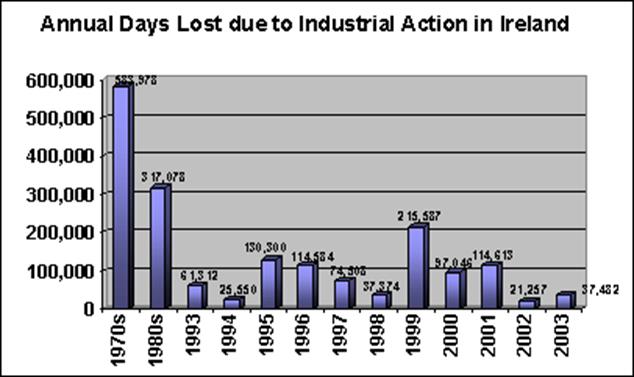
This period saw a large growth in the number of strikes so that at one point the Irish State had the highest number in Europe (see below).

strikestats

It also witnessed huge demonstrations against the high taxes imposed by the State on the working class, which amounted to 87 per cent of all income taxes in 1978. In 1979 over 150,000 workers demonstrated in Dublin with many thousands in thirty other towns including 40,000 in Cork.

At this point the Irish State’s model of economic development began to collapse. World-wide economic crisis, a weakening of foreign investment and bankruptcy of indigenous industry led to massive unemployment, renewed emigration and a ballooning State debt.  That the Irish working class and small socialist movement were unable to offer an alternative to the resulting capitalist restructuring and political offensive should not surprise.  There was no successful resistance and alternative created anywhere else.

The defeat of the tax struggles in the late seventies and early eighties and the inability to take advantage of ruling class political disarray, evidenced by repeated general elections in the first few years of the decade, plus the mass unemployment and emigration during the decade, weakened the working class both materially and politically.  The graph of strike activity above clearly shows a steep decline from the 1970s from which there has been no recovery.  It was in these circumstances that social partnership was imposed in the late 1980s.

Partnership signalled the move away from bargaining with the employers and State through militant action and acceptance that when the solvency of the State was in question this took priority.  Beginning in 1987 a series of deals were negotiated that meant accepting major cuts in pay and state services in order to reduce the massive State debt.  The parallels with today are obvious.

There was resistance to social partnership but it came in its most militant form from outside the trade unions and the trade union leaders were decisive in its relatively smooth introduction.  This defeat of militant workers action and acceptance of the prerogatives of capitalism was, as we have said, not at all unique to Ireland.

Across the world the ability and willingness of the working class to fight back in defence of its interests was set back.  Strike statistics are only the most graphic measure of this development.  Taking 42 countries and looking at the period between 1981-85 and 1996-2000 the number of countries in which strikes increased was 8 while there were 34 countries in which they declined.  In the group of countries in which strikes had risen the increase was only 5,183 while the reduction in strike numbers was 63,657 in the group of countries in which there was a decline.

In the Irish State the annual number of days lost in strikes fell from over 580,000 in the 1970s to 26,650 in 2005.  In the latter year there were only 15 strikes and only 10 in 2006, in which only 7,352 working days were lost, the lowest since records began in 1923.  In 2007, the last year of the boom, there were only 6.

As a percentage of the employed workforce trade union membership fell from 56.2% in 1987 to 42% in 1998.  Separate figures record a reduction from 46% in 1994 to 35% in 2004 while the Irish Congress of Trade Unions has admitted that density continued to fall, being lowest among young workers.  Where unions did exist member participation dropped and some of the features of bureaucratisation long normal at higher levels of trade unions infected union representatives further down the ranks.

All this occurred during an unprecedented boom in the economy, the period of the Celtic Tiger, when GDP growth ranged between 7.8% and 11.5% from 1995 to 2000 and between 4.4% and 6.5% from 2001 to 2007.  From 1990 to 2007 total employment grew from 1.160m to 2.112m, an increase of over 80%.  While incomes fell during the 1980s they grew rapidly during the Celtic Tiger.  The historical working class was recreated in many ways as a result of rapid economic growth both quantitatively as a result of falling unemployment, immigration and increased labour force participation rates and qualitatively as a result of the increased employment of women (whose number grew by over 125% from 1990 to 2007) and an influx of foreign workers.

The Irish working class was recreated as a result of a boom fuelled primarily by foreign investment, which excluded unions from its workplaces, increasing corporatism and bureaucratisation of the unions that did exist.  This within a world in which the historic goals of the working class movement – from progressive reform of the capitalist system to the view that it could be replaced – was increasingly discredited through the fall of Stalinism and defeat and retreat of workers struggles and the claims of social democracy.

The boom saw no political strengthening of the workers’ movement even as unemployment fell and the class objectively, at least in numbers, grew enormously.  As we said at the end of Part 3 capitalism is a revolutionary mode of production that recreates the working class.  In the Irish State it did so in a way and in circumstances that did nothing to overcome the historic political weaknesses of the class.  Indeed the trade unions became weaker as they bought into social partnership and the view that the interests of workers, State and bosses were best aligned.  Even the historic nationalist politics that has been hegemonic became encapsulated in the need to have a low corporation tax for US multinationals.

Lack of a strategic alternative, among other things, brought about defeat of the large struggles of the 1970s.  Unemployment, emigration and prolonged economic crisis brought an assault by the State on working class living standards and did so in such a way that it survived, even prospered, when the economy recovered and entered into a boom.  Social partnership sold the working class into sacrifices to bail out the State from bankruptcy and made the workers subordinate even when the boom gave them the conditions in which they could have recovered their strength and learnt to advance their own interests.  Instead, in so far as social partnership was later abandoned it was abandoned by the State.

The nationalist politics of the working class, the partnership with the state and the agreement of workers to sacrifice themselves on its alter came together in the reluctant acceptance of workers that they must bail out the banks and accept austerity when the economic crisis finally broke.  This dependence on the State can be seen in two other ways.

In Part 2 we noted that the left wing economist Michael Taft has claimed that the ‘squeezed middle’, the 4th to 8th deciles of income earners, suffered declines in direct income in the five years leading up to the crash, gaining only as a result of social transfers.  Social partnership involved a deal between the trade union leaders and the State/bosses in which workers refrained from industrial action and accepted lower than potential pay rises in favour of tax cuts.  This was not just the case in the final years of the boom but was the line pushed almost from the start – a policy that became more and more explicit as the partnership deals were negotiated.

Thus not only did the workers movement become denuded of any militant initiative but it became more and more dependent on the state, and this was true not only of public sector workers but of workers in the private sector as well.  Gross average industrial earnings grew by 25% in real terms in the 15 years between 1987 and 2000 but take home pay rose by 60% for a single person and 58% for married because taxation was cut.

Mainstream economists, in 2000, also reckoned that these tax cuts were regressive because they were largely achieved through reductions in tax rates, which favoured those on higher incomes.   It is well known that the State became excessively reliant on revenues from a credit boom but what this shows is that social partnership, and the whole strategy of the trade union leaders, was just as reliant.  But really, how could it be otherwise?

The second way this dependence increased can be seen in the simple growth of the state itself, true in all countries and not just of Ireland.  ‘The Economist’ reported that the average size of the state had grown from 12.7% of GDP in 1913 to 47.7% in 2009.  Even in the UK after decades of Thatcher and New Labour the size of the state remained around 44% from 1980 to 2005.  This translates into widespread and increasing dependence of the population on the state, which has become the supposed solution to every and all sorts of problems.

Such massive growth could not fail to have deep impacts on society at the ideological level and the ruling ideas that infect the working class.  Neoliberalism hasn’t done away with the State and neither has it weakened illusions in it.  The Irish State now presides over the world’s biggest property company (NAMA) after private capital made a mess of it.  The State is now the means by which the debts created by this private capital are made good by the working and middle class.

One business journalist has quantified some of the ways in which this dependency is transmitted:

“Irish Budget 2014: Half of Ireland’s population is on welfare and when recipients of child benefit, farmers dependent on public subsidies which are effectively welfare, accounting for 81% of average farm income in 2012; legal services costing the state about a half billion euros annually; public payments to doctors; a raft of corporate welfare schemes and the public service itself, at least while Karl Marx is likely to be disappointed that a few remnants of the failed communism experiment only remain, in Ireland there is a shining example of the halfway house known as socialism or to put it in non-ideological terms, dependency on the State.”

As we can see, he paints the growth of the capitalist state as somehow a practical example the ideas of Marx, and who can blame him?  It’s the view of most of the Left as well, who constantly call not on the working class to solve its own oppression but for the state to do it for them.

The journalist gives a host of facts that demonstrate the growth of dependency on the state -from the growth of social welfare expenditure from €9.5m in 2002 to €15.5m in 2007 when the crash came and to €20.7m in 2012.  The number of social welfare beneficiaries rose from 1.5m in 2002 to 1.6m in 2007 and 2.3m in 2012.  Of these 486,000 were on the Live Register.

He notes the increased number holding medical cards; the direct subsidies to private industry and agriculture – mostly to the biggest operators; the tax breaks for business and the direct procurement of goods and services from private capital.

However the bottom line with the austerity offensive is that the Irish State became bankrupt and could not afford to continue this, so introducing harsh cuts and tax increases.  The question we have sought to address is why Irish workers have not resisted, or resisted so little and to so little effect.

We have seen numerous reasons for this – from the historic weakness of the class; the recreation of such weakness in the defeats of the last few decades; international developments that have demonstrated the hardly unique character of the experience of Irish workers in this respect, and the particular role of trade union and political leaders, which again is far from unique to Ireland.  Only a few weeks ago I listened on the radio while a professor of economics in Madrid noted that commentators in Spain were wondering why Spanish workers were not reacting more angrily to austerity compared to their Portuguese neighbours.

The experience of Irish workers reflects the weakness of indigenous capitalism which the growth of foreign direct investment has not significantly altered.  The latter has only reinforced the weakness of Irish workers – they have hardly even attempted to unionise in the multinational sector and appear to have bought into the view that they must live through nine circles of hell before the proud Irish race will ever succumb to a headline corporation tax rate higher than 12.5 per cent.

Finally we have seen the very direct dependency of so many on the State that has just bankrupted itself bailing out the banks.  Unable to stop them doing so, in fact not even being asked if they agreed, and fed crap about the ‘cheapest bailout in history’, the working class was left with a choice – bail out the state it depended on for jobs and welfare or default when the only people in place who could carry out this policy was the same State that was demanding they pay up.  Without a mechanism to enforce default, even if that is what they wanted, and without an economic and political power base outside of dependency on the State, the choice was pretty clear, even if there could have been struggles that could have made it messy.

Put simply – how could workers tell the State to get stuffed when it relied on it so much?  The Left has peddled nonsense that the State can be made a means to redistribute wealth such that only the rich pay for capitalist crises but the workers haven’t bought this and some of the Left that calls itself Marxist is not actually supposed to believe it either.

The defeat inflicted on workers in the last five years should cause a rethink.  Renewed declarations of faith will not do.

Lessons from the Grangemouth dispute

GRANGEMOUTH_2700282bI received an email from Socialist Democracy inviting me to contribute to a discussion based on an article they have written on the lessons of the Grangemouth dispute in Scotland. This article sets out the devastating scale of the defeat – the freeze in pay, butchery of pension entitlement and castration of union organisation.  Many in the media called it an old fashioned battle of labour against capital, such was the unvarnished clarity of what was involved.

The questions to be answered are whether there could have been a different result and what lessons can be learnt?

The article does not say whether the result could have been different.  Given the circumstances I think not, but this means we must be clear what the circumstance were that lead to this conclusion.

As for the lessons the article posits two – that the entire strategy of the trade union leaders has been overthrown and that of union support for, and reliance on, the Labour Party is a mistake.  I believe that there is a third rather more basic one, which can be explained very much as the old fashioned relationship between labour and capital.  What is this relationship?

The relations of capitalist production are unequal as they involve capitalists as owners of the means of production, including oil refineries and petrochemical works, and workers separated from ownership of such means of production and dependent on employment by the capitalist for their livelihood.  In a struggle that does not threaten or weaken these foundations it is generally the case that the capitalists will be able to impose their wishes because these align with the power structures in society.

This does not mean each and every strike or struggle by workers is doomed to defeat but that in certain disputes this power of capital is fully deployed and the fundamental imbalance in power is cruelly demonstrated.  Were it otherwise capitalism might be able to find some stable compromise, some equilibrium between the two classes that would allow a ‘fairer’ distribution of resources.  No such stable equilibrium has been found.  Marxists have been confirmed in their view that the liberation of the majority of working people requires overturning the existing system and creation of one in which the monopoly of ownership of capital is destroyed. 

This is the basic case for socialism in opposition to all those who think a better world is possible while not overthrowing the fundamental structures of society.

It is not an all or nothing case.  It does not say that workers can do nothing to protect themselves short of socialism.  Struggles that do not threaten these fundamental relations can sometimes be victorious such as when the economy is booming, unemployment is low and workers can strike or otherwise bargain for higher wages without fear of being sacked and their place being taken by the unemployed.

Of course in an economic downturn the temporary leverage of workers and trade unions is undermined and the power of capitalists to do as they wish because of their ownership of capital is reasserted.

In the case of the Grangemouth dispute this means that no workers’ action no matter how brilliant, innovative or militant could prevent Jim Ratcliffe from using his ownership of capital to close the refinery and petrochemical works and throw thousands of workers onto the dole.

Of course if you were convinced he was lying about the profitability of the plant and convinced his threats to close were a bluff the solution is simple – call his bluff and tell him his demands will not be accepted.  Unfortunately his ownership means that only he and his management know the truth and his claims that the plant only had a future if he was able to put £300 million in investment into it were credible. The same system that decrees private ownership of a refinery also necessarily involves periodic overcapacity in production and this was held over the workers’ heads as the brute fact that required they surrender or face the sack.

Under such circumstances no one can be surprised the workers decided to accept the lesser evil.

The article is correct that simple strike action would not succeed.  It was the boss who went on strike – it’s called a lockout.  It is he who brought production to a halt and threatened to make this permanent.

Others called for widespread solidarity action perhaps secondary strikes.  Firstly these are illegal and related to this, workers have not yet the level of combativity to carry out such action, even those involved in the chemicals industry who would have lost their own jobs had Grangemouth closed.

If it is argued that this strategy is one we must argue for and attempt to build for the future then this is indeed an element of strategy.  In this situation however there is no reason to believe Ratcliffe gave a rat’s arse about the fate of the wider industry and of the other thousands of jobs that would have been lost.  If he was going to close Grangemouth then all these strikes would have made no difference to his plans.

A second possible answer was to call on the state to nationalise the refinery and works.  The problem with this is that neither the British State based in London nor that part that might go independent had no intention of doing so.  Both are ‘open for business’ only when it means private capitalism.  So who was going to nationalise the works?  If it is believed that strike action would compel such nationalisation then it would have had to be wider and deeper than that considered above and the first response of the State would have been to attempt to throttle it. Some people keep on forgetting the State is the protector of the enemy.

Some on the Scottish Left said the situation at Grangemouth showed the need for independence but this was not an immediate solution.  As we have just said, the Scottish National Party has no intention of nationalising private industry when private capitalists are prepared to invest if only the workers accept the necessary sacrifices.  Alex Salmond’s primary concern was with the exposure of his independence project, and the illustration of how weak the idea of a prosperous oil economy looks in light of this immediate threat to pull the plug.  Since the refinery provides fuel for northern England and Northern Ireland as well as Scotland the case for action to protect the service went beyond the border and thus implicitly provides the grounds for wide action to defend it.  It also undermines any case for a nationalist solution from the right or the left.

The article argues against the efficacy of such answers and proposes its own elements of a strategy.  Some of these are by no means very clear.

For example what does this mean? –

“The trade union and political fights have to be united around a movement that is willing to reject the claims of finance capital and to step in and expropriate capital where it is necessary to preserve the livelihood of workers.”

The only time a workers’ movement will be able on its own to expropriate capital is when there is a revolutionary situation. We’re not in one of those so it wasn’t and isn’t an answer.  (We’re also fighting industrial capital in this one.)

The article says –

“The Labour Party has promised a temporary freeze on prices, so a call could be made for a permanent cap . . .”

Just how are the laws of capitalism to be permanently abolished or even suspended when the system still exists?

They can’t.  The only way they can is if and when there is a revolution that creates the conditions for totally remodelling economic and social relations and even then prices will not be abolished for some considerable time.

The alternative proposed revolves around occupation and seeking an alternative to the Labour Party.

Once again however if the plant is really losing money and the threat of closure real then why would Ratcliffe not just let the workers occupy, sit in the refinery and – so far as he was concerned – rot away?  It would be just another way of closing the plant if he didn’t get the workers to accept his demands.

What the demand for occupation means is that workers take over ownership and run it themselves.  They cannot simply run it themselves without ownership.  No one would provide raw materials or other services without someone to contract with and you don’t form contracts with those in unlawful possession.  So the question is how would the workers take ownership?  How would they get the money to buy it and to invest perhaps the£300 million Ratcliffe says is needed?

Obviously this is much harder when pushed against a wall, with no preparation and no conception that this is the alternative.  Equally obviously if it is accepted that this is the road that workers in such situations should follow then it would be better to be prepared for such a challenge.  The challenge is precisely to the monopoly ownership of the means of production that we said at the start is the heart of the relationship between capital and labour and at the heart of capitalism.

The workers movement is big enough to fund research into the creation of worker owned businesses.  Workers might start to fight to gain control of their pension funds to invest in their own enterprises.  Money can be raised for investment from financial institutions or other funding means to be determined.    A network of employee owned cooperatives already exists.  What is involved is not utopian, in the sense it has never been done before, nor is it without rational calculation.

If workers could be ready for such an alternative the threats of closure would not be so conclusive.

In other words the alternative to capitalist ownership is workers’ ownership.  Not just in some indefinite future ‘after the revolution’ but now and not just for now but in order to build towards the future.

Finally the article criticises the unions’ support for the Labour Party.  It notes that organised workers continue to support their trade union and political leaders, although it only proposes that in order to fight both it is necessary to break from the Labour Party but not from the existing trade unions.  It calls for a ‘class struggle movement’ to be created across all the unions, which should call for a new working class party.

It obviously believes this fight can dismiss the Labour Party and need not go through it, although it does not explain how this can be achieved when it acknowledges workers continuing support for that Party.  Implicit is the view that a fight within that Party is not needed to convince workers to break from it.  This in my view is very doubtful.

It draws no lessons from its ridicule of the small socialist organisations which have attempted this road or what it correctly describes as the private character of their concerns; illustrated by their bizarre discussions and replication of policies that decades ago they excoriated the Labour Party for.  The articles’ own call for a revolutionary party is correct but of no help here since it is put forward, necessarily so, as an ideal future location.

Instead it states that – “there are many issues around which a fightback can be organised, but they cannot be organized by the current leadership of the working class . . . What it [Grangemouth] has shown up is the utter inability of the traditional leadership to defend workers and the demoralisation and lack of strategic vision on the part of the socialists.”

If what is being said is that a new leadership has to be created, and the existing one challenged, then this is correct.  If it is being said that this is a precondition for a fight-back then this is not correct. It is only in the course of struggle that existing leaderships can be defeated, as long as such objectives become part of the struggle by the mass of ordinary workers.

The workers at Grangemouth and, by extension, those beyond have suffered a cruel defeat.  One possible reaction is to be cowed by the power of capital to shatter livelihoods.  A second is to seek some magic bullet of a strategy that workers can employ to defeat such plans: a strike, secondary action or an occupation.

A third lesson is that very often workers are forcibly confronted with the reality that to secure a decent life they need to go beyond capitalism and that no amount of shifting it with militant action can change its fundamental nature.  This nature is one where capitalists own the means of production and they can open and close it when they want.  This is not a strong argument for capitalism but a powerful argument for changing society – for socialism.

As Marx said – “the working class ought not to exaggerate to themselves the ultimate working of these everyday struggles. They ought not to forget that they are fighting with effects, but not with the causes of those effects; that they are retarding the downward movement, but not changing its direction; that they are applying palliatives, not curing the malady. They ought, therefore, not to be exclusively absorbed in these unavoidable guerilla fights incessantly springing up from the never ceasing encroachments of capital or changes of the market. They ought to understand that, with all the miseries it imposes upon them, the present system simultaneously engenders the material conditions and the social forms necessary for an economical reconstruction of society. Instead of the conservative motto: “A fair day’s wage for a fair day’s work!” they ought to inscribe on their banner the revolutionary watchword: “Abolition of the wages system!

What way forward for the Dublin Bus workers?

482013-dublin-bus-strike-members-of-siptu-and-3-630x484In August drivers at Dublin Bus went on strike in opposition to yet another proposed cost cutting exercise in the company totaling €11m.  Subsequently a group comprising the Government, the Irish Congress of Trade Unions and the employers’ body IBEC, joined together to carry out an investigation into why Labour Court recommendations about cost cutting proposals had been consistently rejected.

From a workers’ point of view it is difficult to know where to start in responding to such an initiative.  ICTU joined with those seeking to cut terms and conditions in order to investigate why workers hadn’t done as they were told by management.  It might have been thought that unions were there to see how workers could defend conditions but the combination involved of bureaucrats, bosses and government have been engaged in a conspiracy against the decisions of the workers.

This is dressed up as concern for the drivers themselves –  the Minister for Transport Leo Varadkar and the Minister of State Alan Kelly have said that the investigators had worked independently “in an honest attempt to address the concerns of drivers”.  But addressing the concerns of drivers for these independent experts means that “We ask the drivers to agree to the final proposals.”  In other words the drivers are to do as they are told.

And if they don’t the workers are threatened – “We are clear, however, that the outlook for Dublin Bus and its employees is very stark if this final effort does not succeed.”

To appreciate what ICTU has done it is best to consider what it didn’t do.

ICTU didn’t commit itself to an investigation to ascertain if the claims by management about the financial position of Dublin Bus were correct.

ICTU didn’t investigate why the major concessions made by drivers in at least two previous productivity/cost-cutting agreements have failed to resolve the company’s financial crises despite management assurances to the contrary. Why are they threatened by yet another cost-cutting exercise?  Has management lied about the promised effects of previous cuts or has it just been incompetent in developing a robust plan for the company?

ICTU didn’t investigate whether the support of bus services by the State was comparable to that in other states, whether the Government had any coherent transport plan for the capital or had taken adequate account of the role that transport plays in providing the infrastructure necessary for an efficient and prosperous society.  Whether instead it had taken a narrow view of the company’s profitability without regard to wider benefits to society.

ICTU didn’t seek to collaborate with all the unions involved to determine a strategy that could assert and defend the bus drivers’ rights.

ICTU didn’t seek to rally together the bus unions, wider union movement and the users and potential users of the buses to initiate a campaign for an efficient, sustainable and decent bus service.

ICTU could have done lots of things and had plenty of alternatives but it decided to conspire with the bosses’ organisation and State to threaten the drivers. And it did it in plain sight.

When you think of it this way the actions of ICTU are shocking.  But they don’t shock and they don’t surprise and they don’t do these things because workers have long got used to the fact that this is the way ICTU behaves.  So registering anger and pointing out that ICTU are engaging in an act of betrayal is hardly enough.

Do socialists have an alternative?

The first and most important thing to understand is that socialists have no alternative unless workers decide to take matters into their own hands.  The first step is therefore that workers fight to win ownership and control of their own struggles through ownership and control of their own trade unions.

In so far as the steps that ICTU should have taken are political ones, workers need to create their own political party.  This of course is a longer term requirement only in the sense that it can realistically be achieved only over a number of years.  And while the building of a genuinely democratic and militant trade union movement is also not an immediate prospect it is one that is immediately posed.  In other words the fight to create it is always present, which means we must fight for it now.

These should be central tasks of Irish socialists and outside of them the debate about unity of the Left is pretty well irrelevant.  If the Left wants to unite to build itself, unless this is a task to be achieved through the organisation of the working class itself, it will be sectarian.  Left wing unity and political sectarianism are not mutually exclusive.

On the other hand genuine unity around such a task, achieved through democratic organisation, which alone can achieve it, would act as a beacon, however small, for workers in struggle.

In order to create it however we need to ask why we need such a movement.  Why is the current movement inadequate, even treacherous, and what would a new one do?  We need these answers in order to persuade workers to undertake the task of creating one.

So how do the ideas of socialism relate to the predicament facing Dublin’s bus workers?

First we should recognise that their repeated willingness to oppose management’s plans is the indispensable basis for any alternative.

Secondly we should inform workers that militant strike action by them will not be enough.  As Marx and Engels repeatedly stated, strikes are often provoked by bosses in order to facilitate their own plans.  Often they serve to save money, implement lock-outs and close workplaces.  In Dublin Bus they will undoubtedly be used to blame workers for the financial difficulties the company is in. Strike action is insufficient and is not the only action that can be taken.

Do workers have an alternative solution of their own that could be put forward?

The first step in creating such an alternative would be to establish the real financial position of the company, which is what ICTU should have done.  This would include an assessment of the support given to Dublin Bus by the state.

The second is to establish what sort of service should be provided and how it should be delivered.

The third is to determine whether the workers themselves can offer their own model of ownership to deliver this sort of service.  Privatisation and continued state ownership both offer the same prospect of cuts in workers’ conditions.  Reliance on state subsidy should be recognised as a weakness in the workers’ position.  Dependence on the state, the ally and protector of the bosses, is reliance on precisely those that are insistent that the cuts be implemented.  That these cuts must be made prior to privatisation is demonstration that both the bosses and state recognise that it is the latter which is best placed to reduce workers’ conditions.

The fourth is to publicise and win support among other workers and the travelling public.  Other forms of action could be considered to achieve this such as providing ‘free travel’ days.  Only a campaign structure going outside the confines of trade unionism could make such a campaign a reality.

It is no great feat of criticism to describe these steps as schematic or abstract.  Only a really existing movement could make them anything else.  Schemes, or plans, are there to be proposed and debated, discarded or modified as real, active workers determine.  They sometimes abstract from the concrete realities of the situation, which give abstractions content, and become simply propaganda, usually when those with ideas lack the power to implement them.  Propaganda however is almost everything when you have little else, which is where socialism in Ireland is at.  Ideas are critical when an idea of how to fight back is the element that is missing from struggle.

The point of the commentary above is to inform workers and socialists that a certain understanding, class consciousness, is required to see any way out of the struggle that the bus workers find themselves engaged in.

One thing is for sure; the answer to the bus workers needs has been proved not to reside with management, the state or with ICTU.  The second has yet to be proved – that it resides with the workers themselves and in the strength and solidarity that they can muster.

Why have the Irish not revolted? Part II

imagesausterityIn my first post I qualified the view that there was something particularly weak in the resistance of Irish workers to austerity but argued that nevertheless an explanation is needed.  To develop this further we need to ask what this austerity has involved.

Some commentators would have a ready explanation.  In terms of the share of taxation in Gross Domestic Product (GDP), in terms of the share of Government spending in GDP and overall deficit as a percentage of annual value added there has not been ‘savage austerity’ so there has been nothing to rebel against.

Here unfortunately we have no choice but to enter the world of economic statistics where only the naive can expect clear objectivity and accuracy.

A post on the Irish Economy blog records that (adjusting the statistics for the well-known effect of foreign multinationals in the Irish State significantly overstating economic performance) living standards measured in GDP per person (in Purchasing Power Parity values) declined by 14 per cent from 2007 to 2011.  This is a bigger decline in living standards than in Portugal where the fall was only 1.6 per cent, in Spain where it was 4.9 per cent and Greece where it was 8 per cent.  In terms of national income (another measure) the drop was bigger – 20 per cent – and it will have fallen further since then.  It would appear that the relative quiescence of Irish workers needs additional explaining.

But does it?

Any Irish statistic that uses GDP is immediately suspect for the reason above but not only because of this.  GDP is a measure of value added which means the 2007 figure will include property produced at vastly over-inflated values.  Houses and offices built and priced at one value will have been shown subsequently to have been worth 50, 60 or 70 per cent less, or sometimes to be completely worthless.  A moment’s thought reveals that this is not a characteristic simply of Irish statistics but of measures of capitalist production everywhere.

When we think of the effects of the banking industry on measures of economic growth we again see that this measure is seriously distorting, not only because of the difficulties of capturing accurately what is happening, but because of the nature of capitalist production.  This takes place through the production of commodities whose real value is only realised after production. The value of these commodities is elaborated through the workings of the market which reveals the socially necessary value of output in a cyclical fashion.

For economists wedded to capitalism recessions are always the result of exogenous shocks outside the system or of purely irrational behaviour within it, which amount to the same thing.  For Marxists the cycle of boom and bust is how the values of commodities are established and then re-established in a constant process.  By nature therefore there can be no precise measure of value produced at any one point in time or over any one period.

In figures for GDP the distinction between use value and exchange value is absent never mind any accounting for how really ‘socially useful’ the use values produced are – ghost estates and weapons compared to commodities actually consumed by workers. This is to be considered on top of the well-known criticisms of measuring living standards by GDP.

There are alternative measures we can review but before we leave behind this discussion we should appreciate that what we have been looking at is not simple mismeasurement of economic activity but one form of the appearance of real contradictions within the system.

From the point of view of our particular investigation we can make two points.  That a critical review of some of the figures means the boom was not as boomier (to quote Bertie Ahern) as some statistics might appear to show and the recession not as sudden and complete a reversal as might first appear.  The expectation of more or less immediate revolt might therefore be less justified?  Other evidence however might suggest that such a view should be considered a relatively minor factor.

Secondly, the constant reporting of such economic statistics plays an ideological role such that workers must accept real changes to their lives on the basis of these statistics.  Workers are subject to such pressures not just in the recession but also in the boom – encouraged to get into unsustainable debt for example.  To the extent that they do the latter they are then under ideological assault to accept that they, along with everyone else, ‘partied’ and went on a ‘mad borrowing’ frenzy, as Taoiseach Enda Kenny has put it.

Some commentators might argue that a recognition of ‘guilt’ has played a role in short-circuiting resistance but the existence of such undoubted views is as much a result of demoralisation as a cause of the lack of resistance.

There are other statistics we can look at to see if there are material reasons for the lack of opposition apart from this particular ideological one.

What appears a more relevant statistic is called Actual Individual Consumption which encompasses goods and services consumed by households including government services such as education and health provision.  This would appear to show that between 2008 and 2011 living standards in the Irish State fell more than in Spain and in Portugal but less than in Greece or Iceland.

Actual Individual Consumption

State

2008 index

2011 index

Percentage fall

Ireland

109

100

8.3

Spain

99

94

5.1

Greece

104

94

9.6

Portugal

84

82

2.4

UK

123

118

4.1

Iceland

122

107

12.3


This measure is made up of a component of GDP so is subject to some of the criticism above.  We have already seen that three different measurements of living standards result in reductions in living standards of 20 per cent, 14 per cent and over 8 per cent, depending on dates and the measurement adopted.

What we can say with certainty is that living standards fell abruptly and significantly due to the crisis and it is not obvious that the severity of the fall in any country determined the relative extent of opposition to austerity.  It is necessary before drawing any conclusions to look at what might be at least some of the components of the fall in living standards, not by any means only a result of the effects of Government austerity policies.

By one measure unemployment in the Irish State increased from 3.4 per cent in 2007 to 10.4 per cent in 2012, a tripling of the rate in only five years.  The economically inactive, which must contain many who have given up hope of getting a job, increased from 27.5 per cent of the population aged 15 to 64 to 30.8 per cent.

Using a different measurement unemployment in the Irish state was 13.5 per cent in January 2013 compared to 17.8 per cent in Portugal, 26.8 per cent in Spain and 27 per cent in Greece.  Clearly the crisis has hit the latter countries much harder than Ireland.  It is by no means clear that higher unemployment breeds resistance since its function under capitalism is to facilitate increased exploitation of the working class.  The mobilisation of the unemployed is not always for progressive reasons, which is one reason we have noted before that economic crises often breed reactionary movements.

Once unemployed some workers face the prospect of hardship and one measure of this defined as deprivation, or being without two or more basic items, has increased from 11.8 per cent of the population to 24.5 per cent in 2012.  The possibility of this is affected by the level of welfare an unemployed personmight rely upon and this is measured by the net replacement rate, or the payments due to the unemployed as a percentage of previous net income.  This obviously depends on whether the person has children or is married etc.

Net Replacement rates 2011


No children

2 children

Country Single person One earner

Married couple

Two-earner Married couple Lone Parent One-earner married couple Two-earner married couple
Republic of Ireland 50 81 75 64 75 81
Greece 49 54 75 58 63 80
Spain 79 76 90 77 75 89
Portugal 75 75 92 77 76 91


The table shows that Greece has significantly lower replacement rates than the other selected countries for most categories but that the Irish state’s is generally lower than Spain’s and Portugal’s.  It would not appear that the prospect of a more significant loss of income as a result of unemployment has spurred opposition in Ireland relative to that in Spain or Portugal.

The other obvious way workers cope with periods of unemployment is falling back on any savings that they have accumulated.  The following table shows the movement in net financial assets per person (€) in the various countries:

Country

2007

2011

Republic of Ireland

23,634

26,279

Spain

21,698

16,328

Portugal

19,950

19,750

Greece

19,681

10,105

Euro area (17 countries)

37,289

36,201


The table shows the Irish State to have the highest level of financial assets (though much below the Euro area average) and that this even increased between 2007 and 2011!  Since these figures say nothing about the unequal distribution of wealth and we know that many have suffered unemployment, cuts in wages or tax increases, it is clear that certain sections of Irish society are bearing up quite well.  In the other countries financial wealth fell and in Spain, but particularly in Greece, fell quite dramatically.

Such average figures hide as much as they reveal.  Average household disposable income in the Irish state fell from €49,043 in 2008 to €41,819 in 2011 but this was still significantly higher than in 2004 when it was €38,631.  Right wing commentators have often made the observation that incomes have often just gone back to such and such a date and we are all much better off than before the boom kicked off in the first half of the 1990s.  This is undoubtedly true for many but doesn’t provide an answer why as a class Irish workers have resisted austerity so weakly, unless the argument is that expectations have very quickly reduced.  Is this however another result of defeat or a contributing factor to it, or both?

Averages can obscure because it is precisely the unequal incidence of the effects of capitalist crisis that can have decisive political effects.

Unemployment has increased dramatically but its incidence is not uniform.  Employment in construction has collapsed, from 258,000 at the start of 2008 to 102,000 at the end of 2012, a fall of over 60 per cent.  Over the same period employment in the state sector fell from 417,000 to 381,000, a fall of 8.6 per cent.  The pitting of private sector workers against those in the public sector was a clear strategy of the Government, the employers and the media and it was quite successful.

But this has not been the only divisive effect of the crisis.  Rates of unemployment among young people in Ireland, just like other countries, have been much higher than the general rate.  In the Irish state the rate of unemployment among those less than 25 years old was 26.6 per cent in April this year while it was 42.5 per cent in Portugal, 56.4 per cent in Spain and 62.5 per cent in Greece.  These are truly staggering figures.  The rate of long term unemployment has increased from 29.2 per cent of total unemployment at the start of 2007 to 45.5 per cent at the end of 2012.  What this should remind us, is that unemployment is a divisive imposition of the effects of capitalist crisis that impacts not only on those without a job but also those in employment.  Emigration has returned and is continuing to increase, up from 87,100 in the year to April 2012 to 89,000 in the year to April 2013.

None of these figures illustrates the hardship caused by tax increases and public expenditure cuts that can affect the most vulnerable the most.  They do not include the effects on people’s experience of negative equity, the full effects of which have yet to hit home.  Here again it is younger people who are more likely to be in negative equity and to be in arrears in their mortgage payments.  And of course the figures do not tell us that the results of the crisis and austerity are to be here for a long time.

Over 32 people were unemployed for each job vacancy in 2012, while the figures for Spain and Portugal were 72.6 and 90.4 respectively.  The General Government Debt as a percentage of GDP was 117.6 per cent in 2012 while the 2012 EU Fiscal Compact stipulates that where this is above 60 per cent it must reduce by 1/20th per year.  In 2012 the in-year Government deficit was 7.5 per cent which means the debt was not getting smaller but getting bigger.  Normally optimistic forecasters are predicting that unemployment, as measured by the International Labour Organisation methodology, was only to reduce from 14.7 per cent in 2012 to 13.9 per cent in 2014.

So what are we to make of all these figures?

The fall in living standards has been significant even if not so sudden or large for some sectors of society as others and not on the same scale as some other countries such as Greece.  Certainly the disproportionate effects on young people and rise in emigration have blunted resistance but these factors exist on the same or greater scale in some other countries in Southern Europe where resistance has been greater.

It is not therefore the effects of the crisis themselves that explain the response even if these act to weaken certain social and political reactions.  The left wing economist Michael Taft has claimed that the ‘squeezed middle’, the 4th to 8th deciles of income earners, suffered declines in direct income in the five years leading up to the crash, gaining only as a result of social transfers.

During the boom the level of trade union organisation fell relatively as union density dropped from 46 per cent of the workforce in 1994 to less than a third in 2007, and only 16 per cent in the private sector.

Thus even during the most favourable circumstances, when workers are best placed to protect and advance their living standards, they were unable to do so with their own strength.  During recession such weakness is exposed.

Now they are subject to the vicious laws of the capitalist market and, as we said in the first post, short of overturning the system there is a limited amount workers can do about this without challenging the system itself.

During this post I have said that workers have not resisted austerity but in truth the great mass of unemployment, insecurity caused by mortgage arrears and negative equity, and the drop in personal consumption are not so much the result of the austerity policies of the Government, which of course have made things worse, but of the capitalist crisis.  This crisis can in certain circumstances be postponed or ameliorated by the State but it cannot be suppressed and certainly not by a State in bankruptcy.

When even during the boom large number of workers dependency on this state increased rather reduced and rather than their developing their own independent power, it can be little surprise that when the state turns round and kicks them in the teeth they are unprepared.

Some socialists argued again and again during the boom that social partnership, the vehicle by which the Irish trade unions hitched themselves to the State, was to be opposed not mainly because it prevented workers making gains in their living standards that they should but because it rotted away their independent organisation.  This has not just organisational consequences but political and ideological ones and it is to these that I need to look at next.

Why have the Irish not revolted?

Public-service-workers-st-006The defeat of the opposition to the property tax and the ability of the Government to impose a second Croke Park austerity deal might lead many to conclude that resistance to austerity has been defeated.  Even before this many have commented that while Greece has witnessed violent protests and numerous general strikes the absence of such events from Ireland is notable and remarkable.  General strikes have also taken place in Spain and Portugal but not in the Irish State.

The relative electoral success of the United Left Alliance appeared to blind some to this but the collapse of the ULA has simply confirmed what is more generally understood to be the case.  More and more it is acknowledged on the Left that we have to face the reality as opposed to perennial false claims that an upsurge is taking place or is just around the corner.

Realistic assessments of the state of workers’ action have often been drowned out by childish claims that this shows one is insufficiently revolutionary, underestimates the workers , their ability to change their ideas quickly or that such views will not encourage workers to take action.  Not in front of the children appears to be the motto.  Workers are always ‘angry’ and all it needs is the right campaign, so long as it is active enough, to stir them into action.

Reality is imposing itself and no sound bites along the lines of ‘the darkest hour is just before dawn’ can hide the fact that the economic crisis has resulted in the imposition of austerity on workers without effective resistance.  Why is this?

First we must qualify the judgement that Irish workers are peculiarly useless.  Commentators have remarked in similar terms about the countries in southern Europe.  We have noted before that more or less spontaneous social explosions have not resulted in great advances by the working class.  Greek workers have been by far the most combative in terms of general strike action but in hardly anywhere has living standards plummeted so much.  I have also noted in one of my first posts that economic crises spurs growth in extreme reactionary forces and we have seen this is in Greece with the rise of the Golden Dawn movement.  So Greece is no model to seek to copy.

Secondly Irish workers have fought back albeit within very strict limits.  I can still remember the very large demonstration in November 2009 in Dublin, which had many working class people from outside the ranks of the trade unions taking part.  The following year public sector trade unions organised a successful strike.  At a local level in certain places and at certain times strong campaigns have developed against tax increases or hospital closures.  All this and more was reflected in the vote for ULA.

There is however an over-estimation about what workers can achieve within the limits of the capitalist system – a general misconception that workers’ struggles can overturn the laws of capitalism.    For example, if a company goes bust and attempts to close down, making all its workers redundant, it is pretty obvious that strike action will not achieve very much.

At this point many on the left propose that the capitalist state protect workers even though these same people have a part of their brain that tells them that the state is a weapon of the capitalist class that cannot be reformed and must be smashed.  They also believe that the emancipation of the working class must be achieved by workers themselves but usually object to the idea that, instead of the state, the workers should take over and own and run these workplaces as workers cooperatives.

It is a similar situation at the level of society as a whole and at an international level.  The Irish state was and still is bankrupt.  It needed a massive injection of money to save the banks and put itself in a position to start reducing its mushrooming debt.  Austerity is a means of doing this.  Again the Left argues that the state can adopt policies of taxing the rich and spending money on investment that will restore the capitalist economy to economic growth, which will then deal with the problem of the debt.

This is not however the view of socialists.  The socialist view, confirmed once again by recent events, is that capitalism inescapably produces economic crises which are dealt with and resolved by the laws by which the system works, including through unemployment and destruction of unsuccessful capital whose markets and sometimes businesses are picked up on the cheap by those remaining.  It is not possible for the capitalist system to prevent such crises by adopting policies of more investment, as for example argued by left followers of Keynes.

It is not therefore possible for workers no matter how well organised to prevent the laws of capitalism from working.  This at least was the view of Marx and the evidence of history would again confirm this.  So workers resistance against austerity may be able to ameliorate austerity but, in so far as they are necessary to lay the foundations of a new upturn, it is not possible for workers to prevent unemployment or wage cuts or tax increases in their entirety or even to a significant degree.  In other words it is not possible within the system to prevent capitalism periodically disrupting workers’ lives.  That’s why we oppose the system and why we propose a different one called socialism.  If we thought capitalism could work better without its nasty effects we wouldn’t be socialists would we?

Yet the left presents austerity as simply one policy option of the Government which it could choose to reject and replace with their own proposals.  But even the Keynesian alternative requires ‘counter cyclical’ state action.  In other words the austerity measures are simply postponed.  All the left’s proposals involve actions by the capitalist state in one way or another – tax changes, public investment, nationalisation etc.

The point in terms of the current argument is not that the Left is misleading workers into accepting reformist solutions that won’t work and this is a reason why resistance to austerity has been such a failure in Ireland.  These ideas are more widespread in southern Europe than they are here.  No, the issue is that, absent a socialist alternative being created, as long as capitalism exists the laws of capitalism will continue to work and impose themselves.  Resistance to austerity will therefore fail and this failure is bound in turn to lead to weakening of the resistance.

We must be careful however not to qualify the problem out of existence when it contains more than a grain of truth.  When Greek workers chanted “we are not Irish” on their May Day demonstration in Athens in 2010 they weren’t imagining the relative weakness of resistance in Ireland.

Nor can the question be dismissed by saying Irish workers did fight back – they did, but nowhere near to the extent required for success.

Nor is it credible to blame the poor politics or organisation of the Irish Left.

It is also not adequate to simply say that capitalism wins unless we create socialism. This is obviously true, although its logical implications for reformist strategies and policies are often ignored.  But it doesn’t come near explaining why the reformist strategies for resistance have elicited such weak workers’ action.  It’s hardly that Irish workers can see through such strategies and are ready for something more radical.

Socialism is not an event or a situation but a movement. Workers will only become capable of building a socialist movement and carrying out revolutionary change if they are also capable of mounting strong resistance to the ravages of capitalism.  In Ireland this hasn’t happened and there has been a retrogression of the small socialist movement, although this in itself is not particularly new.

So in Ireland the state has been able to pursue austerity policies that increase unemployment and wage restraint in order to restore its solvency in very much the same way capitalist crises work to   restore profitability in the private sector.  It has been able to do so without much of the resistance shown in other countries in a very similar situation.  This remains to be explained.

To be continued.

Workers’ control of production Part 2

0425.1974_Portugal-newspapeIn my last post on workers’ control I noted that it inevitably arose as a result of crisis, and crises are by their nature temporary, occasioned by society-wide political upheavals or by threatened closure of a particular workplace that is perhaps producing unnecessary products, is working in an obsolete manner or is otherwise failing to compete successfully in the capitalist market.

In Britain in the 1970s there were more than 260 occupations of workplaces by their work forces including, perhaps most famously, at Upper Clyde Shipbuilders in Glasgow, usually sparked off by closures, layoffs, redundancies, dismissals or threats of closure.  Such occupations were spontaneous, often acts of desperation and with no real planning.  If successful, the numbers occupying would be offered jobs by a new employer although this number would usually be less than when the occupation would have begun.  When no new owners would appear the occupations might attempt to become workers’ cooperatives but the motivation was normally a pragmatic search for a solution rather than something drawn from political commitment and ideology.

The occupations were often built by shop stewards and sometimes at odds with the official trade union movement, a situation we see again and again and a result of factors far from accidental.

The theme of ‘industrial democracy’ was very much alive and in 1974 the Conservative Government called a general election on the issue of “who governs Britain”, in direct reference to the miners who had engaged in successful strike action.  The Tories lost and the new Labour Party Government included Tony Benn, who wanted greater involvement of workers in their workplaces.  He also came into conflict with trade union leaders who opposed his dealings with rank and file groups of workers.  “The whole machine is against you” Benn told one supporter of an occupation at Imperial Typewriters.

Workers’ cooperatives received the support of Benn, who was in a position to do something as Minister at the Department of Industry, but his financial help was relatively small and most industrial aid continued to go towards private industry.  That which did go to the cooperatives was mainly for compensation to previous owners who were paid for obsolete plant.  This left the new cooperatives under-capitalised and without the necessary resources to carry out research and development.  They generally lasted only a short space of time but still sometimes produced radical, innovative and still exemplary struggles.  One such was as at Lucas Aerospace, where workers pioneered conversion plans to socially useful production, again opposed by the union leadership.

By the end of the decade however these types of struggles had declined dramatically.  Few of the experiments in workers’ ownership survived and as history is usually written by the winner the victory of Thatcher, built on the attacks on workers commenced by Labour, left a legacy of disappointment and nostalgia in some old enough to remember.  This has affected the Left up to today in so far as it is suspicious, if not actually hostile, to workers’ cooperatives.  This is a profound mistake as the willingness of workers to fight for ownership and control of their own workplaces is an instinctive impulse to go beyond capitalism.

The history of American workers organisation in the 1930s is perhaps more celebrated than this experience but in some ways was more limited.  Workers and trade union power grew during the decade not just because of the struggle of workers to organise, most famously in Minneapolis, but because of the strong growth of US manufacturing industry.  Between 1936 and 1939 workers occupied 583plants in sit-down strikes in defence of their terms and conditions, protection of wages, achievement of union recognition, or prevention of sell-outs where recognition already existed. These were often successful.

Unfortunately there followed 70 years of union-management collaboration – no strike agreements during the second world war; the witch hunt and expulsion of socialist activists in the McCarthy period; mob penetration of the union movement and the turning of the union bureaucracy into a world-wide vehicle of the US state in its cold war with the Soviet Union.  The US union movement has now declined so much that in most of the private sector it is irrelevant, with unionisation accounting for only 7.5 per cent in the private sector in 2008.  In some workplaces where unions do ‘organise’ workers are not even aware there is a union!

The history of American workers’ militancy drives home a lesson to be  learnt from the British experience of the 1970s and 1980s – that politics are not only determined by workers militancy and their experiments with workers control but that politics can influence decisively the short and long-term success of these experiments.

In the end the question of politics is crucial, which is why Marxists believe that working class conquest of state power – revolution – is decisive.  It is important however not to telescope the path to this destination.  Revolution is decisive only if the material basis for working class rule is present.  This is not simply a question of the level of economic development but of the social and political development of the working class.  Without both of these the question of revolution is not posed practically i.e. in reality, no matter what more general ‘crisis of capitalism’ is evident.

The analysis of workers’ control in these posts is based on the belief that working class conquest of state power is necessary but that the immediate question is how to make that a widely shared goal given the low level of class consciousness and struggle than now pertains.

It is therefore important to attempt to draw lessons from the impact of political developments on workers attempts at independent organisation in the workplace.  In turn we can then look at the role of workers’ organisation in the workplace for its impact on wider political struggle.  This will reveal the limits as well as the strengths of a workplace-based strategy and what political demands should be raised as a result.  Such lessons informs the opposition to calls for nationalisation that have been argued in many earlier posts.

For example in the Spanish revolution in the 1930s it was the Republican state that strangled the workers’ and peasants’ collectives rather than the fascist counterrevolution.  Clearly in this case a call for this government to nationalise such collectives would not have made much sense.  Anarchists believed these collectives were a means of controlling the Republican authorities but clearly what was needed was an alternative Government and state – perhaps built on these bodies.

In Yugoslavia self-management was a means of mobilising the population against economic blockade and potential invasion, boosting production, minimising the power of the trade unions during a labour shortage and hoping that the workers would discipline themselves.  Unfortunately self-management as then practised led to accusations of workers’ neo-capitalism in which the enterprises were seen as the workers property, narrowly conceived, so that they competed with each other in a capitalist-like manner.  Self-management became not a means of workers self-realisation but a trade union-like bargaining system of clientelism and patronage.  Increased enterprise autonomy acted to dissolve wider working class solidarity leaving enterprise loyalty and territorial state loyalty as the alternative, one which ultimately descended into bitter and bloody nationalist war.  On the way to this dénouement it has been argued that enterprise autonomy became a mechanism to insert the Yugoslav economy directly into the capitalist world market.  Increased autonomy became the means of strengthening management power not workers’ autonomy.

Both Spain and Yugoslavia are testament to the fact that without real working class political and state power workers’ control can be subverted and/or crushed.  I have argued that it is the lack of workers’ economic power and experience before revolutionary crises that has weakened the struggle for their class rule thus making revolutionary success less likely in such crises.  But it is also true that such episodic economic power is doomed without a political project.  In Poland workers councils existed in 1945, 1956, 1970 and 1980-81 but revolution there became a restoration of capitalism.

In nationalist revolutions, such as in Indonesia, the most radical actions of workers are betrayed by a backward political consciousness; as when workers control is achieved and defended not as an extension of workers’ power as a class but as the property and achievement of the new independent (still capitalist) state.  This state can indulge in the wildest revolutionary rhetoric but as long as its power is not an extension of that of the workers it is just rhetoric, to be retracted when the new state feels itself more in control.  It succeeds in this as long as workers power is mistakenly seen by its holders as the gift of the newly independent state.  The examples of nationalism trumping the radical actions of workers are legion and proof again that revolutionary action does not automatically generate revolutionary socialist politics and consciousness.

What is clearly decisive is workers’ own consciousness and workers control, self-management or councils are not in themselves decisive in determining it.  This however is not the question and not the argument being put.  There is no ‘magic’ strategy guaranteeing a workers’ victory but there are more or less adequate roads and strategic conceptions.

The argument here is that workers’ control, and in the longer term, workers’ ownership can provide a more solid, permanent and robust material basis for the development of the necessary socialist consciousness than simple trade unionism, no matter how militant.  More realistic than reliance on spontaneous political revolutions to do all the work of consciousness raising in the necessarily short space of time in which they take place and certainly more than demands for nationalisation, which for example were obviously meaningless in both Yugoslavia and Poland.

What workers ownership should do is provide a basis and foundation for a political programme that seeks to extend and deepen this form of ownership and give it a political dimension, to make easier removal of the division between the political and the economic that characterises capitalism.  Workers’ collective control and ownership of the state can be more easily argued for on the basis of their wider ownership in the economy.

The argument is more easily advanced if there exists a successful worker owned and controlled sector of the economy that can be presented as an alternative to the capitalist owned sector or the illusion that a benevolent state can take ownership of the latter in order to benefit workers.  On this basis the socialist project can become a political one for which the ideal form to advance it is a mass workers’ party.  Such a project can begin to win the battle for hegemony within societies which are currently dominated by capitalist ideas despite the objective failures of that system.  A real material basis for an alternative is provided that can focus generalised discontent that now expresses itself in free-floating ethical concerns for justice and can find no more specific or concrete alternative than vague calls that ‘another world is possible.’  Instead through development of workers’ cooperatives and the wider labour movement another world is built in front of our eyes.

The absence of such hegemony of ideas, and its corollary – that no alternative to the capitalist system seems possible – results in the upheavals that returned societies to capitalism in Eastern Europe and the Soviet Union.  This wider and deeper lack of legitimacy of the socialist project weighs heavily on the spontaneous activity of workers even when they have engaged in the most radical activity.

In the Portuguese revolution in 1974 a movement within the army overthrew the dictatorship and between May and October of that year 4,000 workers’ commissions were established following mass meetings.  Not only factories but empty houses and apartments were occupied.

Within these commissions political competition developed between the Portuguese Communist Party and smaller revolutionary currents.  A failed right wing coup shifted events further to the Left.  Workers councils became not just organs of control in the workplace but organisations of struggle that could potentially threaten the power of the capitalist state.

In the end however they proved too weak and were unable to pose a political alternative to the quickly developing normal organisations of capitalist democracy – trade unions, political parties, parliament and the state.  In the end the Portuguese Socialist Party became the mechanism for a stabilisation of capitalist rule and bourgeois democracy.

Short-lived experiments in workers control and ownership were not in themselves capable of establishing hegemony for the project of workers’ state power.  A deeper and wider radicalisation was required.

The point is that this can take time and can only come about through the development of socialist consciousness in the working class over a more or less extended period and this must rest on a material base.  This can only be the development of the power of the workers in existing capitalist society, expressed in democratic trade unions, political parties, cultural organisations and workers cooperatives.

The opposite of this road is reliance on the state, expressed in the demand for nationalisation.  In Spain, Eastern Europe, Indonesia and Portugal it was the State which became the guarantor of capitalist ownership and power.

Today we are in circumstances where workers must not only defend themselves against the depredations of capitalism – battling against austerity – but socialists must also look to ways in which to advance a workers consciousness that seeks permanent expression of their needs and powers.  Not just defending immediate interests but looking and taking care of the future of the movement and workers’ position in society.

But it is not simply about the needs of the present as against the needs of the future because Marxism is the belief, confirmed by nearly two centuries of industrial capitalism, that it is not possible to satisfy the needs of workers today by only fighting today’s battles.  A socialist society is the future only because it is the answer to the challe-nges and problems of the present.  The demands for workers control and ownership express this view and are rejection of the clam that the existing capitalist state, by nationalisation etc, can provide the answer.

Revealing the truth about Anglo-Irish Bank – RTE censorship and ICTU complicity

David BeggThe release of the tapes recording the Executives of Anglo-Irish bank conspiring to rob billions from the Irish people has led to a clamour for an enquiry so that the full truth can be revealed.  In my last post I argued that this truth includes the plain and obvious fact that it has been the State that has made the reckless gambles of Anglo the burden of the people.  These Executives showed no great concern that the organs of the State would prove any barrier to their plans.  In this they were of course proved exactly right.

I argued that what is required is that workers should fight for their own inquiry to reveal this and other truths that remain obscured, not least by the media that presents itself as the vehicle for revealing the truth.  I suggested that workers should fight in their trade unions to launch such an inquiry.

I have just received an email that throws light not only on the role of the media but also that of the trade unions.  In particular it shows that the leadership of the trade union movement in the person of its General Secretary, David Begg, has questions to answer over his complicity in the complete and utter failure to regulate Anglo-Irish bank.

The text below recounts the intervention of a reader of the blog into RTE’s Liveline radio programme, which addressed the Anglo tapes.  She questioned the role of David Begg, which subsequently led to a complaint by him and the removal by RTE of the podcast of the programme.  The alacrity with which Begg moved to defend his reputation can be compared to his apparent inactivity in ensuring the Central Bank performed all the roles it was responsible for and which he presumably was on its Board to ensure were discharged.

Anne has written a draft letter of complaint to RTE and has asked for signatures to a petition, both of which are set out below.

This episode highlights the need for a workers’ campaign to highlight the full truth of the banking collapse and hold all those guilty to account.  Not least the system itself.

————————————————————————————————–

On Liveline 27th June I got the opportunity to speak about my reaction to the Anglo tapes. I mentioned the protests organised each Sunday by ‘Dublin says No’ and encouraged people to attend protests that are organized around the country by the ‘Say No’ campaigns. So listen in to a podcast for the item. It is the first on the play list. Overall it was a good programme and showed the anger people feel.

I mentioned a few issues. Firstly that in Feb 2009 a group of teachers picketed Anglo-Irish bank in protest against the bail out of the bankers/speculators and to show our anger at the massive cuts that were taking place in our schools and in public services. I said a group of us went into the bank briefly to ask workers to tell us the truth about the real state of the bank as we were supposed to own this bank yet we were not allowed to even know what was going on.

I mentioned that David Begg head of ICTU sat on the Audit Committee of the Central Bank during the most damaging years of the credit bubble. He had access to what was going on in the Central Bank and that Mr Begg knows the true story and should make a detailed statement of what went on. He was supposed to be representing our interests.  Either he was happy the way the Central Bank was fulfilling its obligation to oversee the banks or he was sleeping on the job and knew nothing. Either way he should RESIGN. Begg then should have acted like the whistleblower Edward Snowden today, and in that case we might not have the present devastation to our lives.

I also mentioned that at the time of the Anglo take-over public services were being massively cut; huge cuts in education, my area of work, in our pay and pensions and that at the time Waterford Crystal workers were occupying the company as it was closing but there was no rescue for them. Mr Begg did nothing to organize a national campaign to save a flagship company while the nest of thieves in Anglo was being bailed out by the organisation of which he was a leading figure.

I contrasted what had happened to 1913, when Dublin workers stood up against the employers. They were able to gain their dignity and build the trade union movement as a real force while today when we are being ground into the dust and the trade union leaders are committed to working within the injustice and tyranny of the Troika programme. I said it was time to stand up for our right for a civilized way of life for ourselves and our children and that people should come out and join the ‘Dublin says No’ to the Bailout protests. I commented on our small numbers and the thousands of Brazilians who were protesting on O’Connell St 2 weeks ago against corruption in Brazil. It was time for people to act for themselves.

I also said that the contracts of public sector workers were torn up and emergency legislation enacted to steal our pay while nothing is done to take the massive pensions off the politicians such as Bertie Ahern. He should be stripped of his pension and the assets of the perpetrators of the crimes against us seized.

Letter of Complaint to RTE

I wish to formally complain to RTE regarding the disclaimer statement carried at the beginning of the Liveline programme 28th June 2013. It stated that RTE accepted that comments on the Live Line programme of 27th June relating to ICTU General Secretary David Begg were wholly untrue and without foundation and we also accept that Mr Begg was never a member of the Banking Regulatory Authority. We want to make clear that there was no suggestion on Live Line part that David Begg  is or was responsible or aware of any of the wrongdoings of Anglo Irish Bank which he condemned in the strongest possible terms.

RTE in acting in the manner in which it has are neglecting their duty to deal with a perfectly legitimate call from me. They are curtailing an important discussion on the role of people who held senior positions on the Board of the Central Bank leading up to and during the nationalisation of Anglo. A major scandal has blown up regarding Anglo Irish Bank where we are learning day by day of the deeply scandalous behaviour of senior executives at the bank.

Mr Begg made his complaint on the narrow base that he was not a member of the Banking Regulatory authority but I made no reference in my comments on Live Line to this.   It is a matter of record that Mr Begg had a number of major responsibilities as a member of the Board of the Central Bank, of which he was a member between 1997 and 2011. These are outlined below and as such he should have been aware of what was going on in Anglo.

Report of the Central Bank and Financial Services Authority of Ireland for the year ended 31 December 2006

Board Procedures (Page 62)

The Board holds eleven regular meetings each year. A quorum of seven normally applies for all meetings. The Governor approves the agenda and papers, which are circulated to the Directors one week in advance of meetings. Additional Board meetings may be called by the Governor at short notice either on his own initiative or at the request of any two Directors.

The Secretary of the Bank keeps minutes of meetings.

The agenda for meetings typically includes:

_ Reports on monetary and financial developments;

_ Reports on various issues relating to the Irish economy, the European economy and the international economy;

_ Reports on regulatory developments to keep the Board informed on policy issues and where decisions by the Board are required;

_ Management of the investment assets of the Bank;

_ Substantial financial contracts to be placed by the Bank for the procurement of goods and services;

_ General management, planning and budgetary issues;

_ Quarterly and annual financial statements and results.

Board Sub-Committees

The Board established three sub-committees on 30 June 1994 as follows:

_ The Audit Committee; The Remuneration and Budget Committee; The Investments Committee.

Board regulations detail the terms of reference of each sub-committee and membership in each case is comprised of Directors — of whom one is appointed as Chairman — and a further member of the Regulatory Authority with observer status. The Secretary of the Bank, or a nominee, minutes all meetings of the subcommittees and, when approved, these minutes are circulated to the Board. The members of the sub-committees, as at 31 May 2007, were as follows:

The Audit Committee members; David Begg (Chair), Martin O’Donoghue, Deirdre Purcell*, Alan Ashe**

( *Members of both the Board and the Regulatory Authority. **Members of the Regulatory Authority who are not also members of the Board but who participate at meetings of the above CBFSAI Board committees with observer status.)

It is clear from the agendas of the meetings that the Board members had a responsibility in overseeing the state of the banks which would have included Anglo Irish Bank, the 3rd largest lender at that time.  It is inconceivable that Mr Begg was completely unaware of whether the Central Bank was fulfilling its obligation to oversee the banks considering the agenda of Board Meetings and also given that he was Chair of the Audit Committee.

As General Secretary of the ICTU he is expected to represent the interests of workers/ordinary tax payers and I called Liveline as a long time trade union member concerned at the devastating consequences of the bail out of Anglo and the shocking revelations in the tapes.

RTE as a public service broadcaster should be to the forefront in lifting the veil of secrecy that has surrounded the bail out of Anglo, instead it has in this instance censored an important discussion and is failing in its duty to investigate or allow discussion on how the members of the Board of the Central Bank have fulfilled their role the role.

The refusal to podcast the programme is a further example of failing in its duty

Furthermore the disclaimer statement is an attack on my integrity and the truthfulness of my contribution to the programme. As you can see from the above excerpt on the operation of the Central Bank, I did not stray from the facts surrounding Mr Begg’s role on the Board of the Central Bank.

I request a copy of the transcript of my comments on the Liveline programme as my good name has  been brought into question by the disclaimer.

I expect an apology for the aspersions cast on my character on national airwaves.


Statement condemning RTE censorship on the role of General Secretary of ICTU David Begg in his capacity as a Board member of the Central Bank

We the undersigned strongly condemn the censorship of discussion by RTE of comments and questions raised as to the role of the General Secretary of ICTU David Begg in his capacity as a board member of the Central Bank and chair of the audit committee of the Central Bank during the period covering the boom years and the subsequent collapse of the banking system.

This gross self censorship by RTE on these legitimate questions and the subsequent erasure of the podcast of the Liveline programme of 27th June 2013 is a shameful and disgraceful episode for RTE as national broadcaster.

The role of the ICTU in demanding a disclaimer on the narrow basis that David Begg was not on the regulatory authority, (a claim that was never made) is an issue of concern for trade union members and all those affected by the criminal activity within the banking sector.  The role of a senior member of the trade union movement in these catastrophic events should not be and cannot be censored.