How can you support a united Ireland and not support Scottish independence? Part 2

Roy-Keane-as-Braveheart-Paddy-Power-3When Irish unionists claim rights to self-determination history has shown that this is not a claim for equality but a claim on behalf of sectarian supremacy – a claim to the right to inequality.

But, the question can be put, if socialists regard self-determination as a means to facilitate the voluntary unity of nationalities surely a united Ireland will itself involve the forcible suppression of Protestants and of Protestant workers?  This would mean that while Irish unionism has no legitimacy the alternative of a united Ireland is also not one that socialists can support?

Some on the Left have stopped there, accepted this, and said that the only solution to the question of democratic national rights in Ireland is therefore socialism.  This tends to come from those for whom every thorny problem is solved by the invocation of socialism.

Workers’ opposition to mass immigration? A socialist society with full employment, great public services and housing would deal with objections.  Economic crises, with periodic mass unemployment and cuts in living standards? A socialist society!  Women’s oppression and racism? Socialism is the answer.  Workers’ passivity in the face of their right wing leaders’ betrayals?  A revolutionary party with a socialist alternative.  Sectarian division?  Workers unity around a socialist programme!

Such solutions are not so much an answer to a specific problem as an invocation that the problem would simply go away if it were made not to exist. It invokes an alternative reality and not an alternative set of policies to get there.  It says that the problems and challenges faced by workers are solved by socialism when in fact the reality is the reverse – socialism is created by workers.

This means working people being persuaded and organised to present answers to all these different questions, not invoking an idealist formula disembodied from those whose conscious actions alone can bring them about.  And the only people who can do this are working people themselves, with those who are socialists attempting to advance this process.

In the case of Ireland, the point of opposing self-determination for the Protestant Irish in the North is that such a claim is not compatible with workers’ interests.  It is not an invitation to violently impose a united Ireland.  Its purpose is to explain that the claiming of such rights is reactionary.  It is meant to identify unionist and loyalist ideas and movements as right wing by virtue of the demands they hold most dear.  In this sense the demand for a united Ireland is not one taken up despite the Protestant population but because of it, because it is they who are most saturated with reactionary sectarian and imperialistic ideology.

Treating it as a sanction to pursue an armed struggle against the wishes of the artificial majority in the Northern State is part of the Irish republican liberal understanding that there are rights which, if they exist, should be exercised regardless of any considerations of the reality in which they are supposed to be grounded.

This means for example that armed struggle by republicans is justified by the principle of the right of the oppressed to fight their oppressors by any means necessary, without stopping to ask ‘by any means necessary to achieve what?’  It means rights asserted as abstract principles without regard to efficacy or morality.

Socialism on the other hand is based on workers’ interests and needs grounded in the world they live in and not of abstractions that efface these needs and interests.

Opposition to Scottish independence by socialists can therefore only respond with bemusement to nationalist claims that every other country to achieve ‘independence’ has not wanted to go back, so that it can’t therefore be such a bad idea.

Well how many of these countries are really independent, of the requirements and pressures of capitalist globalisation for example?  How many of the workers in these countries have had their basic needs and interests resolved by the ‘independence’ of the countries they live in?  In what way does the principle of separation of itself address these problems; meaning have these nationalists really considered the alternatives; meaning also that if they have, this particular argument is not really one of principle at all.

The nationalists who claim that there are 200 or so nation states in the world – why has Scotland to be different – might want to ask how this world of nation states has fared in the twentieth century and whether it has been such a good way to order the world’s affairs.  Or have two world wars taught nothing?  Perhaps a look at the character of many of these states might make one think twice that this model is one to emulate.

When it comes to the demand for a united Ireland such a demand is both abstract and unrealistic outside of its insertion into a social and political struggle that understands it, not as the demand for a new Irish capitalist state, but as a means of reducing division; including by rejecting sectarian claims to state legitimacy and power by the Protestant population and rejecting the intervention of the British state to uphold such claims.

But it also means rejection of all the other ways in which division is imposed, including sectarian organisation of education and other state services both North and South, religious imposition of restrictions on women’s rights, sectarian employment practices, sectarian political arrangements such as Stormont and state sponsorship of armed sectarian paramilitary outfits.

It means building alternative centres of working class identification and power including a non-sectarian and anti-sectarian labour movement, trade unions and political parties, democratic campaigns, and workers cooperatives where workers livelihoods directly depend on their working together.

This socialist agenda is light years from nationalist answers. By understanding this workers might be able to see that the arguments of nationalists, their claims for rights that do nothing for workers, and their claims to address grievances which are either spurious or actually derive from class oppression are false.

concluded

Political propagandists and political murder in Belfast

Feeney 1imagesAs the political crisis generated by the killing of Gerard McGuigan by IRA members threatens to spiral out of control the politically weary population is invited to pick sides on what is to happen next, with seemingly everyone in favour of keeping Stormont while everyone knows it’s rotten.

This appears to put the onus on being able to blame someone else in order to defend a sectarian corner and the particular rights assumed inside the settlement.

The ‘right’ attitude to the killing has therefore to be asserted first, although it is of the least concern to the parties involved in yet another round of talks.

As a result a notable feature of reaction to the murder of Gerard McGuigan has been the propensity of nationalist commentators to ventilate on the synthetic character of unionist outrage at the murder.  In other words the outrage is fake – they don’t care about dead ex IRA men.

If that were the only point being made the response should be one of agreement.  Yes, unionists have ignored state and loyalist violence and have collaborated openly with paramilitary groups so their condemnation of republican violence is hollow.  They don’t care about dead IRA men and their actions since the latest killing is guided by purely party political calculations.

But that isn’t all there is to it.  The point being made by these nationalist commentators is that what has happened shouldn’t be allowed to upset the current political arrangements because the outrage is phoney.  Just as I pointed out in the previous post on this (that the new peace institutions are now the justification for ignoring the killing of others) so expressing outrage at the killing is also to be discounted because the main unionist complainants are insincere.

And the fact that this outrage is insincere means that this is a purely manufactured crisis that originates in unionist bad faith.  This bad faith is therefore the problem.  The perfidious British however have turned this around, as they usually do, in order to appease unionism.

So nationalists are invited by these commentators to believe that what must be discussed now is not what the danger is to those who fall foul of the Provisional IRA but how the institutions can be saved.  The British are happy to go along with this but add that this involves giving the unionists confidence.  But since this a purely subjective thing we are in the world of Humpty Dumpty – confidence means just what unionists choose it to mean, neither more nor less.

So yes, nationalists have a point about pandering to unionist hypocrisy but they have a problem when they allow this hypocrisy to become their moral compass by replying to unionist hypocrisy with their own.

They have a problem when they excoriate British pandering to unionist violence while turning a blind eye to Provisional murder.  So the outrage at the latter is fake – let’s ignore both it and the event that occasioned it.  Then we can have our equal and opposite hypocrisy.  Unionists complain about Provo violence but we will turn a blind eye to it and complain about loyalist violence.

In this way the sectarian perfect circle of hell attempts to trap everyone within it, everything and everyone is to be defined by sectarian division.

A prime example of this capture by sectarian division, involving capitulation to acceptance of reactionary political violence, can be seen in the regular political columnist in the largest nationalist paper in the North, Brian Feeney in yesterday’s ‘Irish News’.

So the police fingering of Provisional IRA members for the murder of Kevin McGuigan was “ill-considered”.  As I also pointed out before – I wonder would he therefore have considered well-judged the previous failure to finger the loyalist UVF for the attempted murder of a young woman in the same area.

Feeney had a previous column on the unionist invention of the 1960s civil rights campaign as an IRA plot, a fiction of course, but what had this to do with the real IRA plot to kill McGuigan, unless he wanted to claim it too was another unionist fiction?

Instead he goes along with the Sinn Fein line that what this is all about is unionist refusal to live in equality with nationalists: “This refusal to accept mere equality prevents them seeing themselves in the same light as nationalists and republicans.”

He appears totally oblivious to the fact that with this attitude of Nelsonian ignorance of IRA responsibility in murder he should really be writing that nationalists should now see themselves in the same light as unionists, united equally in the same light of sectarian blindness.

By such a descent into sectarianism are nationalist claims for equality to become nationalist equality in sectarianism, which is indeed the political project of Sinn Fein.

He then makes hay with silly and insensitive remarks about “the futile and fatuous attempt to abolish the IRA.”  How would anyone know “if someone has left the IRA? . . how would anyone prove they’d left?”

So does Feeney not want to see the end of the UDA and UVF?  Would Feeney be questioning as futile and fatuous calls for an end to loyalist paramilitaries if they had just killed someone?

Sure how would you know whether they or the Provisional IRA had gone away or not?

Well here’s a start.  You might have a chance of convincing someone they had disappeared if they didn’t kill those who fall foul of them.

Feeney complains that the leader of the DUP Peter Robinson needs to feel that he is “not bound by any constraints that apply to normal relationships.”  Leaving aside what counts for normal in the North of Ireland, does he not think such a remark might also be pointed in another direction?

It was bad enough when the British so openly overlooked and colluded in political murder by loyalists but their shameless excuses for the Provisional IRA and its supposed peaceful intentions complete the circle that working people in the North have to break from.  In this case nationalist workers should see through the muck apparently thrown at the British and unionists because it’s really being thrown in their eyes.  Who else is expected to listen to Feeney?


The politics of murder in Belfast

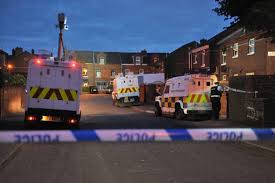
images (11)The murder of Kevin McGuigan on 12 August in East Belfast is widely seen as revenge for the former’s claimed involvement in the earlier murder of Provisional IRA leader Gerard ‘Jock’ Davison.

The Police Service of Northern Ireland (PSNI) have done their bit to protect the Provisional movement by claiming that although Provisional IRA members were involved there is no evidence that it was authorised by the leadership.  Since complete denial of Provo involvement would stretch credibility to breaking point and reflect on the PSNI as well as the Provos, this was as much as they could do.

Of course this makes no sense, although it was notable that some nationalist commentators were prepared to swallow it.  Much amazement was feigned by unionists that an IRA even existed, so ‘answers’ were demanded.  The British Government said that of course it knew the IRA existed but that what was important was what Sinn Fein said (i.e. not what the IRA actually did) and especially that it continued to express support for the ‘principles of democracy and consent”.

The Garda in the South had previously claimed that the IRA had no military structure but are going to look at it again and the PSNI claimed it was a lobby group for “peaceful, political republicanism”.  Sinn Fein spokesmen claimed that of course the IRA was not involved, that it had “gone away” and all allegations to the contrary were ‘palitics’.

So the Provos continue to support the police but not as far as allowing them to get in the way of taking revenge or protecting themselves and their enormous financial empire. Support for the police is therefore purely ‘palitical’.

In the hypocrisy and lying stakes each out-does the other.

So the British Government and PSNI are claiming that while a much slimmed-down ‘peaceful’ IRA exists there is no evidence that it sanctioned the murder of McGuigan; although investigations will continue, which means that if it suits the political purposes of the British Government such a judgement can be easily changed. And easily justified – a ‘peaceful’ IRA with guns, that murders its enemies, and which by its very reduced size and tightness makes inconceivable the idea that the murder was not approved from the top.

The meaning of this is obvious: the British state and its police force doesn’t care if the Provisional IRA kills people it doesn’t like.  It doesn’t care if loyalist paramilitaries kill people they don’t like. Round the corner from where McGuigan was killed a young woman was almost killed by the loyalist Ulster Volunteer Force but the PSNI refused to blame the UVF who were responsible.

Today it is reported that the murder of another Short Strand man Robert McCartney by the Provos was subject of a secret deal between the PSNI and Provos, with the cops offering not to go after those who cleared up the murder scene, in exchange for Provo information on the less important hands-on killers.  No one has gone to jail and the Provos kept their mouths shut.

The political import of the killing is the following:

The Provos can kill and the state will give them impunity but it will expect a price to be paid.  Anyone who thinks that the end of Sinn Fein’s meagre opposition to austerity through opposition to some welfare cuts will not form part of the price probably believes that everything that the British Government, police, unionists and Sinn Fein has said about the murder of Kevin McGuigan is 100% true.

A message has been sent to all enemies of the Provos, political or criminal, that they are willing and able to kill, no doubt under some new set of initials such as AAD (Action Against Drugs).

The slow crumbling of the architecture of the political peace settlement has speeded up and now threatens the current arrangements.  The Ulster Unionist Party has withdrawn from the all-party Executive, putting pressure on its supposed more rabid rivals in the DUP to follow its lead.

The DUP has now proposed that Sinn Fein be expelled from the Executive, although Sinn Fein can prevent it, and only the British Government can do this.  If the British do not support such a move the DUP would then be forced to either put its money where its mouth is and walk themselves, bringing down the Executive, or reveal themselves as joined at the hip to the Provos in the great gravy train on the hill.  It might then start losing support.

As the pro-settlement ‘Irish News’ editorial put it today, the Executive is so discredited most will not care if it remains or goes.  And as I have noted before, the current Stormont regime is so rotten it has little credibility left.

The peace process has been built on the lie that the rotten sectarian arrangement brought about the absence of widespread political violence.  In fact the defeat of the Provos and the ending of widespread violence preceded the creation of the rotten sectarian arrangements.  Again and again the sectarian political settlement has been defended by the claim its overthrow would bring us back to the troubles.

The recent killings demonstrate precisely the opposite.  The existence of the sectarian Assembly and Executive is now justifying collusion between the state, Provos and loyalist paramilitaries in violence, intimidation and large scale criminality.  The message from the British pro-consul has been explicit:  as long as Sinn Fein supports the sectarian settlement and police that is what counts.  What it actually does will be excused and glossed over if remotely possible.  The so-called peace settlement and its preservation is now the justification for allowing political and criminal violence.

Socialists must continue to oppose this rotten settlement.  They should continue to oppose the PSNI and expose its collusion with the Provisional IRA and loyalist paramilitaries.  They should oppose the austerity imposed by the British Government and the Stormont parties, especially Sinn Fein and its phoney anti-austerity posturing.

It should likewise refuse to offer political support to any opposition by Sinn Fein to its exclusion from Government should this occur.  The Provisional movement is an obstacle to working class people in the North and South of Ireland identifying their own interests and defending them.

The arrest of Gerry Adams

images (6)When Gerry Adams was arrested for the murder in 1972 of mother-of- ten Jean McConville Sinn Féin claimed it was “political policing. The arrest of a high profile political leader during an election could hardly be anything else.  That the intention to question him was notified by the Police Service of Northern Ireland (PSNI) to the highest levels of government in advance and that this government tells us it is keeping Washington informed is simply confirmation.

Yet when it comes to explaining what this political policing amounts to, Sinn Féin’s Martin McGuinness claims lamely that the arrest is due to a “small cabal” of police officers, “an embittered rump of the old RUC (Royal Ulster Constabulary)”.  McGuinness claims that other police sources have described these people as the “dark side”.

So it’s not really political policing but a “rump” that presumably can be dealt with.

Yet Sinn Féin hasn’t asked for this but just a vague wish that the episode is “resolved in a satisfactory way”.  Meanwhile the party will continue to “support the reformers who have made a massive contribution to policing” while saying that if it “does not work out the way that it should” the party will review the situation “in the context of continuing with a positive and constructive role in a vitally important peace process”.

However the press conference at which all this was said was really about a threat to reverse its previous political support for the PSNI, an event that would precipitate yet another crisis in the never-ending peace process.

But how can Sinn Féin complain of political policing when it supports this policing?  How can it issue vague hopes that everything turns out ok when it also claims that policing is accountable?  Why is it threatening to withdraw support (in a very vague and indirect way) when it can hold the police to account for its actions?  Why doesn’t it just do that?

Graffiti has gone up in West Belfast attacking “Boston College Touts” (informers), i.e. those who gave their accounts of their own and Adams’ involvement in the IRA and its abduction of Jean McConville to the American institution , the acquisition of which may be the basis of his arrest.

_74622246_img_1763

Yet how can these people be touts when Sinn Féin supports the PSNI and has called for everyone to give the police whatever information they have on the actions of republicans (i.e. the dissidents)?  The hypocrisy involved is as staggering as it is completely unselfconscious.

McGuinness claims that “Sinn Féin’s negotiations strategy succeeded in achieving new policing arrangements, but we always knew that there remained within the PSNI an embittered rump of the old RUC (Royal Ulster Constabulary).”  Yet it never made any qualification when it announced its original support for the PSNI.

Does this mean it only supports part of the PSNI or only partly support the PSNI?  Which part? How is everyone else supposed to know which part to support?  How would it and everyone else partly support the PSNI?

How can such a situation exist when Sinn Fein is in government?  How could the brilliant negotiators of Sinn Fein agree to a deal to support the police without getting a guarantee its leader would not be lifted for allegations made years ago?

Why is Sinn Féin making such an issue of Adams’ arrest when it never threatened to withdraw support from the PSNI when the PSNI spent months allowing loyalist crowds, led by the UVF, to disrupt everyone else trying to get home during the flags protests?

Why did it not threaten to withdraw support when these illegal parades were allowed by the PSNI, in fact the PSNI met with organisers to arrange them, and not do so when these parades attacked the small Catholic area of the Short Strand?  Only this week a judge found the PSNI (all of it, its leadership included and not just some “rump”) guilty of failing to enforce the law when it came to illegal loyalist parades.

Again these last few weeks drunken loyalist paramilitary mobs have taken down legal election posters and put up their own flags on main roads in Belfast,  right in front of police stations, while the PSNI has told local residents on no account to take them down.  Is it only Sinn Féin’s leaders who must be protected from the “dark side”?

And why indeed should Adams be protected?  He denies any responsibility for Jean McConville’s killing but then he also denies ever being in the IRA.  Other former IRA members, with unimpeachable republican credentials, have admitted their involvement and claimed Adams was in on it.

As the recently deceased IRA member Dolours Price put it “I wanted very much to put Gerry Adams where he belonged and where he had been. We had worked so closely with him, on many occasions and taken orders from him on many occasions and then to deny us, particularly after we had been through such a harrowing experience in prison … we were offended that he chose to deny us as much as he chose to deny his belonging to the IRA. To deny it is to offend those of us who partook in what we partook in.”

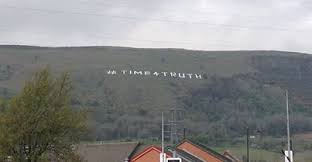
The message on the hill overlooking Belfast calls for the truth about the British Army murders of 11 people in Ballymurphy in August 1971, an enquiry into which has just been rejected by the British Government, but the same demand can apply to Adams.

But bad as these questions are for Sinn Féin none of them get anywhere near the biggest problem it has.   And this problem is that Adams would not have been arrested if the British Government had not given it the ok.  The political policing of which Sinn Féin speaks is not the actions of a “small rump” but the actions of a state.

That Sinn Féin should peddle the line of ‘sources’ within the PSNI that what is involved are the actions of “dark forces” against the reformers, “the many progressive and open-minded elements” of the PSNI that McGuinness hallucinates, is to swallow the old good-cop bad-cop tactic that old IRA men must have been warned about if caught or arrested.  That this is now the line of Sinn Féin shows how far it has travelled and so low it has sunk.

Swallowing and parroting this means buying into the designs of the British state just as much as swallowing the good cop line gives you the bad cop result.  What this means has been signalled by the British Government.

Recent speeches by Teresa Villiers, the NI Secretary of State, have glossed over the refusal of the Unionists to accept the deal offered by US diplomat Richard Haas, and supported by the British state itself,  and have conciliated their intransigent line, which itself is a play to extreme loyalism.  So the crimes of the state, never investigated with any seriousness it has been revealed, are even more to be airbrushed out of existence and instead it is the crimes of the “terrorists” which must be centre stage.  The role of state forces in sponsoring these terrorist gangs will of course also be occluded.

So the past will more and more become the one imagined by unionism.  Parades? Well the Parades Commission has given every evidence that its restrictions on loyal orders can be ignored with impunity.  Getting a form of words that ends with the same result might not be difficult given even a minimal willingness of loyalism to engage with Catholic residents whose neighbourhoods they parade in.  Flegs? Well we have noted the PSNI’s preference to let drunken loyalist mobs put up whatever symbols of intimidation they want.

That about completes the Haas agenda but even these do not signal the end game and this too is coming more into focus in a statement of Villiers.

In a speech widely reported, but the reporting of which missed its most significant element, Villiers anticipated the rewriting of the political deal on which Sinn Féin can claim success.  She foresees the “evolution” of the power-sharing institutions towards them having an opposition.

The whole point however of these institutions is that no one is in opposition, in particular nationalists are not put into opposition by unionists who have not demonstrated any capacity to act in other than a sectarian fashion.

It’s put in the usual honeyed words:

“The third way in which politics could be moved forward here is through the evolution of the devolved institutions.

Let me be clear, power sharing and inclusivity are enshrined in the Belfast Agreement and the government is not going to undermine any of those principles.

. . . Yet at the same time nobody can plausibly argue that the institutions must be set in stone for all time.

Political institutions the world over adapt and change.

As the founding father of modern Conservatism – the Irishman Edmund Burke – once put it:

‘A state without the means of change is without means of preservation.’

And there are inherent weaknesses in a system in which it is very difficult to remove one’s rulers by voting and to choose a viable alternative.

That’s why this government is clear that we would welcome moves that facilitate a more normal system at Stormont that allows for formal opposition, so long as a way can be found to do this which is consistent with power sharing and inclusivity.

But we also believe that if or how this happens really has to be primarily for parties in the Assembly to take forward, not least because it is so firmly within the Assembly’s competence to deal with those matters that might characterise an opposition, such as speaking rights, financial assistance and committee chairmanships.”

So at the moment the British Government would be quite happy for the Stormont regime to have parties outside Government if this was accepted by these parties, if it was voluntary.  No longer is this anathema, no longer is such a suggestion the antithesis of what the new arrangements are about.  Now this is both a viable and even preferred destination.

But of course it has to be voluntary.  Since having the nationalists in opposition is the primary objective of unionism such a policy stance is not so much a disinterested, absent-minded meandering on possible future directions as an incentive for unionism to get nationalists, or at least Sinn Féin, out of Government, “voluntarily”.

This is not actually the preferred British solution but it is testimony to how far it will go to keep unionism inside the existing deal that it floats ideas that while mollifying unionism actually increase instability.

That it only undermines the deal more and more by emboldening unionism and feeding its triumphalist agenda demonstrates only the continuing contradictions within the imperialist settlement – continuation of a sectarian state and sectarian political arrangements while hoping that this sectarianism can be made innocuous or at least reduced to an acceptable level, just as there used to be an “acceptable level of violence.”

So the incentive for unionism is to continue not to work the existing institutions while seeming to maintain a modicum of good faith, obstruct and provoke Sinn Féin as much as it can without damaging itself and hope that the sheer impossibility of Sinn Féin putting up with its obvious powerlessness gets the right reaction.

Unfortunately for them it is perfectly obvious that Sinn Féin will cling to the Stormont regime like grim death with no humiliation too embarrassing and no rebuke too severe for it to walk away. Sinn Féin will hold on to the appearance of power even when this appearance has gone.

But if clinging to the trappings of office becomes the main objective the point of actually having it – making changes – grows ever less important.  Being in office in the North is important for Sinn Féin getting into office in the South and it believes that it being in office in both Irish states on the centenary of 1916 will be a powerful symbol.

Indeed it will.  It will symbolise that the party has realised its strategy but that this strategy is ultimately a failure.  A Sinn Féin in government in both partitioned states will still leave both partitioned states in place.  Sinn Féin will simply sit over both.  Should it stay in office the sight of it doing so will prove no more remarkable than the sight of Sinn Féin toasting the Queen of Great Britain.

How quickly can illusions be shattered.  Fresh from congratulating themselves and being congratulated by the chattering classes for its wearing of white tails and standing for “God save the Queen” the acceptance of the privileges of the British monarchy is rammed home by her state exercising its powers as it sees fit.

Why toasting the symbol of oppression should lessen this oppression or limit its exercise can nowhere be explained by Sinn Féin.  When one swallows the toast there can be little complaint when one has to swallow a whole lot more.

Whatever the outcome of Adams’ arrest the whole exercise is a brutal demonstration of Sinn Féin failure and it will cost it in the long run.  The grounds for creation of an alternative are clearer but unfortunately there is no sign yet that any such alternative is arising or has some progressive working class content.
Sectarianism in Belfast. What’s new?

On July 12 this year a loyalist flute band marched past St. Patrick’s Catholic Church in Donegall Street near Belfast city centre.  They stopped at that particular point by “pure chance” and started walking round in circles playing a tune known as the Famine Song, which contains the line “the famine is over, why don’t you go home?”  This song is sung by supporters of Rangers Football club in Scotland and refers to the large Irish and predominantly Catholic immigration into Scotland from the 19th century onwards.  It has been found to be both sectarian and illegal by the Scottish courts.  According to the band and their political apologists they were merely playing a pop song.  Perhaps it was again mere chance it doubles as a sectarian anthem.  Perhaps also those allegations of an attack on a cameraman filming this Orange version of the X Factor are also mistaken.

On this basis the Parades Commission, a quango established by the British government to adjudicate on contentious parades, decided the band could not take part in the loyalist parade last Saturday, which was to pass the same church.  The other bands were also only allowed to march by a single drum beat past the church.

Unionist politicians were outraged and issued a statement, along with assorted flute bands, denouncing the Parades Commission, saying they were running out of adjectives to describe it , so they gave some nouns instead – “arrogance”, “incompetence” and “general ignorance”. This statement was signed by prominent members of the Stormont Government who claimed that they could no longer let the Parades Commission do untold damage to the peace process. “Violence” would potentially ensue, they said.

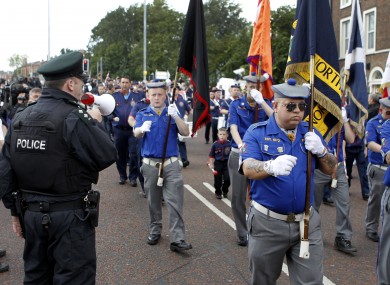
So on Saturday the loyalist flute band at the centre of events marched as normal and played the normal sectarian tunes that are the staple of these ‘kick the pope’ bands, as did many of the rest. The normal sectarian insults were hurled, which are surprising only to those terminally stupid or naive.   The police did nothing that anyone could notice to prevent this.  Well, not exactly nothing: there is a picture of one policeman using a loudhailer to tell the passing bands that they were really not allowed to do what they were doing.  This robust action will no doubt be followed by the police warning burglars by megaphone that they are breaking the law when they are seen to break into someone else’s house in broad daylight. Through the Police Federation the police later complained of being caught in the crossfire, presumably between those intent on breaking the law and those who were, well, how shall we say it, wanting it upheld?

There were minor scuffles and one apparent loyalist from Scotland was arrested for running through a nationalist protest, although this was blamed by one unionist politician on a republican.

So we have a loyalist coat-trailing exercise in bigotry, defended by the most senior unionist politicians who warn of violence, which stokes up the adrenaline of the street level bigot but allows the unionist politician to deny any responsibility when the lighted match touches the blue touch paper.  The police wring their hands and the nationalist politicians talk about getting it all sorted out through talking.  You have to be very, very young not be aware that this record has been played a thousand times before.  So what’s new then?

Well what is new is supposed to be – everything!  We have a new peace process, a new political settlement, a new Government and a new coalition between the “two sides”.  Belfast has a new skyline with lots of new visitor attractions welcoming tourists, which is still a relatively new concept to Belfast.  We have new cafes and restaurants and art galleries and a new generation too young to remember ‘the troubles’ and which just wants to live in peace and has no time for this sectarian stuff.

But we have been here before.  Belfast in the 1960s was also a ‘happening’ city with a burgeoning night-life whose young generation was hailed as no longer interested in the sectarianism of the past.  The sixties brought new life, hope and light even to Belfast and not just the streets of London or San Francisco.  New housing was being created that was demolishing the slums that had no inside toilet and entries that doubled as permanent rubbish tips.  Some of this new corporation housing promised mixed estates and a new Unity Flats was built at the bottom of the Shankill Road only a couple of hundred yards, if that, from St. Patrick’s church.  Unity Flats was so called because it was to contain both Protestant and Catholic tenants, sharing the one space in harmony.

We all know, or at least have some vague idea, what happened at the end of the sixties.  That swinging decade that even moved in Belfast was very new and modern but Belfast was incapable of accepting civil rights, including fair allocation of housing and jobs and equal voting rights.  Instead it burst into violence, with Orange parades which were hyped up by unionist politicians and a police force that could not subject violent bigots to the normal restrictions of the ordinary law.  Of course this violent explosion hasn’t happened yet and in my view isn’t going to happen, not yet at least.

The mutual exhaustion of the contending political forces has not yet ended and been reversed.  The unionist leaders are attempting to exert pressure that might eventually usher in their preferred model of unionist-only rule but they are not in a position to force a confrontation that would see the British Government accede to their demands. It is not impossible that a violent eruption might occur that goes beyond unionist plans but it needs a realistic objective and the aim of getting Sinn Fein out of government has not yet become the unifying campaign theme within unionism and loyalist organisations that is required.

Instead the provocative and vitriolic sectarianism endorsed by unionist politicians in the highest offices of the Stormont administration erodes the faith of nationalists in the new deal. The approach of Sinn Fein to the recent events has been relatively muted and resembles nothing so much as the old SDLP approach which so many nationalists rejected by supporting the old (republican) Sinn Fein.  Here too however there is no unified project beyond staying in office and doing nothing to jeopardise the electoral prospects of Sinn Fein in the South.

The real republicans can attempt to take advantage of the disillusionment with the Sinn Fein reaction to the sectarian provocation and can build up their support base but what is their political project?  In so far as it simply involves a renewed armed campaign it only strengthens the ideological hold of the peace process even while more and more people, subconsciously at first, begin to wonder when exactly this process, like every other, is going to end.  The traditional republican policy isn’t credible except as a form of protest but outside of an overarching strategy this republicanism isn’t in a position yet to mobilise a large political opposition.

A large scale sectarian provocation might accelerate these trends and the planned large loyalist parade on 29 September past the same church certainly has the potential to be such a provocation.  It might at the least drive home the lessons of last Saturday if it goes ahead as the parade did then.

The condemnation by two Protestant church leaders of the sectarian behaviour of the loyalist bands shows how vulnerable the loyalists are to criticism.  It is their solutions and that of the Catholic Church that is the problem.  They both want to set the rulings of the Parades Commission as inviolable.  The Catholic Church is worse because it calls for special measures to apply when the parades pass a place of worship conveniently setting themselves up as victim, potentially privileged  protection in future while turning a blind eye to the fact that a sectarian march is a sectarian march no matter where it passes. Its vitriolic bigotry is no more acceptable a hundred yards from a church than right in front of it.

What is needed is an anti-sectarian campaign that is unafraid to name sectarianism when it sees it and is not seduced by the siren calls for equality of traditions, including mutual respect for each other’s culture.  There can be no equality for a tradition based on sectarian supremacy or respect for a culture soaked in bigotry.  Such a campaign would target not just loyalist parades but the sectarian policy creeping into housing policy and the recent discriminatory employment practices of Sinn Fein.  It would challenge the trade unions to take a principled stand and, at least in principle, should be capable of uniting much of the small left. The ULA could take the lead on this in the South by making it an issue on the floor of the Dail as the clarion call for an all-island campaign.  To do otherwise is to turn one’s back on sectarianism while claiming this as the means of opposing it.

The main task would be to rip away the protection of the current sectarian arrangements that are more and more revealing their true colours by refusing to subordinate anti-sectarianism to the demands of the peace process, however this is defined.  What sort of peace is it that allows, even sanctions, the displays of sectarian bigotry on display in Donegall Street on Saturday?