Thoughts on the class struggle in Greece (part 2) – Towards a Revolution?

As I remarked in the first post, the views of both sides in the debate over the way forward for socialists in Greece share the view that there exists in the country the potential for a workers’ revolution.  This is not one that I share and the Greek Marxists provide the evidence that this is so.

First, Andreas Kloke notes the temporary defeat of the movement resisting austerity.  The slogan “Elections Now” by the two biggest left parties Syriza and the KKE “represents a strategic failure.” No big change took place in these elections between the right and the left and the electoral majority for austerity “reflects the real balance of power between the main classes in Greek society.”  Austerity continues to intensify and the fascists of Golden Dawn have grown to represent a real force.  The Greek Marxists are keen to emphasise that no one voting for the fascists can be under any illusion any more about what they represent.  On the other hand the vote for the coalition of which these writers are a part collapsed.  In presenting the fascists and revolutionary socialists as being in a race, he says “the fascists clearly have a considerable head start.”

Syriza does not represent a growth in the collective strength of the working class movement but rather “a collective mood” of opposition to the two traditional parties.  The memorandum imposing austerity is opposed by two thirds of society but only about one third support the left.  There is thus plainly a crisis of a left alternative.  This is a simple reflection of the low level of class consciousness and weak organisation of the working class in no respect fundamentally different from that in many other countries including Ireland.

Manos Skoufoglou notes that the organisations of the Greek working class are not prepared for a radical alternative to the various options that the Greek capitalist class and the EU may choose from.  In the most significant observation he says that “the working class is not questioning directly its (capital’s) economic power.  Workers don’t yet see the left as the political branch of their own class struggle, but as a body on which they “invest” their hopes.”  The fundamental problem is therefore the consciousness of the working class but this also exposes the utter bankruptcy of those on the left who argue that the basic problem is one of working class “representation” and needing to build an electoral vehicle to solve this problem. In the later view the problem is creating a means to represent working class consciousness not in recognising the weakness of this consciousness in the first place.

The real problem is that we are not facing a possible Greek workers’ revolution because, as the Greek Marxists say, “the working class is not questioning directly capital’s economic power”.  Until it does this all talk of revolution is empty rhetoric, not to mention the basis for seriously wrong perspectives.  This is illustrated by a big majority not actually wanting new elections.  So while many wanted to vote for Syriza many didn’t want the only means to achieve this.   A class breaking its chains to achieve political power would never row in behind such anti-political conceptions.

Yet other commentators on the revolutionary left in the Fourth International make the mistake of believing that the basic problem is the need for the left to take the lead in the struggles of the working class with a political programme of breaking with capitalism, one that becomes credible in the eyes of the working class.  But as I pointed out in two earlier posts here and here, political struggles against austerity including general strikes have not led in the past to revolutions.  In fact the Greeks have a record of such strikes that dwarfs the experience of others.  In this post I reported on an academic study that looked at 16 countries including Ireland, which recorded 72 general strikes of which 33 occurred in Greece alone!  Clearly this is not enough to build the material foundations for a revolutionary working class.

And this is the problem.  It is not the weakness of the Marxist Left that is the issue, for this itself can only be explained by the political weakness of the working class but the commentators from the Fourth International have nothing to say about this.  The transformation of capitalism into a new society becomes a question of political struggle only and becomes narrowly focused on one event which acts as a magic wand.  This magic wand is called revolution.  The comrades have no real understanding of revolution as the culmination of a long struggle by the working class to build itself up as a countervailing force in society, in utter opposition to its current class rulers and their state, in which revolution is the final decisive act of rupture inexisting society and birth of the new.  Everything involved in this extended process becomes invested in a single event that is expected to achieve what only decades of struggle, organisation and advances in consciousness can achieve.

Thus for these organisations revolutionary politics becomes believing in the immediacy of revolution, even when it is not immediately on the cards.  Everything else is reformism, to be supported of course, but only in so far as it quickly can become exhausted.  Because socialist revolutions are only possible given a prior development of the working class, and the political situation more widely, their politics become sterile and redundant.  They either collapse into pitiful reformism while talking revolution to their new recruits or they become dogmatists insisting on the necessity of revolution, which isn’t untrue, but which in the form expressed only confirms that it must be 12 midnight before we can move into the new day.  Not much use the rest of the time.

This is the choice presented in this debate and as we saw in the first part it leads to the raising of political demands which are predicated on their being a revolutionary situation when there isn’t.  The demands raised, such as who shall form a government, are thereby either wrong ,by claiming certain political forces like Syriza are more politically advanced than they really are, or are too abstract because they reflect an unacknowledged recognition that the perspectives offered have little traction in reality.

Many on the Marxist left put forward demands such as general strikes as if these on their own will raise workers consciousness and lay the basis for revolution, but they fail in Greece to learn a very obvious lessons that these strikes teach us.   For example Marxists see general strikes as posing the question of who rules society, the workers or the capitalists.  Through stopping society by laying down their tools they challenge the power of the bosses and question their right to decide what happens. Since general strikes cannot stop everything from working they involve workers in deciding just what is allowed to continue to work and what doesn’t and on what terms things like hospitals, power, water, emergency and other services continue to operate.

Yet Greece has seen dozens of general strikes.  If these posed the question of power the question has been answered repeatedly in favour of the capitalists.  The strikes therefore on their own teach this lesson and become very large protests, and protests are not an alternative but merely an objection to what already exists.  The idea that a frontal assault on capitalism today in Greece could be successful seems to fly in the face of this experience but that does not mean revolutionary politics have no role to play.

The alternative perspective of building up the independent economic, social and political power of the working class while recognising that this power does not yet exists is today what revolutionary politics is about because it relies solely on the workers themselves and does not lapse into the short cuts demanded by the perspective of those who see revolution as the only immediate answer to everything.  This need for immediate global answers leads many who call themselves Marxists to demand that the capitalist state do what these Marxists know in their bones the workers are not yet ready to do.  So we have calls for nationalisation as if this were socialist instead of workers ownership and control because the former is seen as more practical and realistic.

This failure to build a real workers’ alternative bursts open when capitalist crises erupt and it is clear that the Marxist movement has no real material, as opposed to theoretical, alternative.  This is why we get incredible admissions of political and general programmatic nakedness such as the following from one of the Greek contributors to the debate.

“The transitional program we describe is a quite sufficient counterweight to reformist projects of the virtually and possibly actually “governing” parliamentary left. However, it is not yet concrete enough. In order to convince against “realistic” arguments, which SYRIZA seems already to succumb to, if not actively spreading itself – that a unilateral termination of the memorandum would lead to international isolation, that expropriation of banks would provoke partners in the government to withdraw their support – we have to prove that a revolutionary counterproposal could also be applicable in practice. We have to study further examples and historical experiences of revolutionary struggles of the oppressed and the exploited: revolutionary measures in Russia, Cuba or China, autogestion in Algeria and in Latin America etc, even progressive measures applied by Chavez.  If anything, so as to depict in our own conscience the real potential of utopia. How can international solidarity practically eliminate pressures inflicted by the international vindictiveness of bourgeois classes? How can we achieve expropriations with no compensation without the universe to collapse? What exactly is workers control and how does it work? Particularly this last question is a key in order to conceive which is the essential difference between a radical left government and a revolutionary workers’ government.”

If the Marxist left cannot prove that its revolutionary politics can be concrete and will work in practice then no wonder it does not have the confidence of the working class.  For the latter to exist the working class would have to prove it in practice to itself through successful example of workers ownership and workers control in the here and now, not promises of utopias tomorrow after the revolution.  Yet the idea of workers ownership and control prior to the revolution is routinely dismissed by many of the Marxist groups.

Manos Skoufoglou states that “The maturation of objective and, what’s more, subjective preconditions for a revolution is not accumulative.”  While the class struggle can rise and fall in favour of the working class which may have to retreat or advance as changing circumstances dictate this statement is surely wrong.  Marx believed that social systems are born, grow, mature and decline.  That this is accumulative proves that the germs of the alternative society must develop and mature within capitalism and appear more and more in its life.

The increasing socialisation of production within capitalism, the increasing specialisation of production forcing greater planning within and cooperation between enterprises, comes into contradiction with the private appropriation of this production.  This is an accumulative process pointing in the direction of the end of capitalism.  The increasing division of labour and the increasing need and actuality of its coordination is constantly upset and destroyed by the pursuit of private profit which leads to periodic economic crises.  The new society of planned production appears more and more in the life of the old capitalism.

But planning is not the essence of the new society but merely a description of the mechanism by which it must work.  The essence of the new society is its rule by the majority of that society and not by a minority ownership class.  In the new society the working class as the vast majority becomes the owners of the means of production and becomes the rulers of the new society.  Socialism is not a state of affairs defined by complete planning but is the movement of the vast majority of society in determining how the society works and achieves its collective goals.  For the new society to grow out of the old and not just be a utopian project this aspect of the new must be increasingly found in the old.  This is the importance of the growth of workers ownership and control in existing capitalism.

If this really were more and more the reality of capitalism then questions above, like how workers control would operate, whether Marxists had a real concrete alternative etc would not exist.  Instead revolution would be sought by the working class itself as the only means of securing and developing across the whole of society the advances in workers ownership and control already achieved.

It is clear therefore that the key to revolutionary politics today is building up this independent power of the workers and not in millennial pursuit of revolution for which the objective and subjective prerequisites are not present.  How this is done in Greece is primarily but not exclusively for Greek workers and Marxists to determine.

BBC ‘Masters of Money’ considers Karl Marx (Part 2)

The BBC programme was called ‘Masters of Money’ and was ostensibly all about money but there was nothing said about Marx’s theory of money, which is fundamental to explaining the current economic crisis.

For mainstream economics money is essentially just paper that can be used to exchange commodities.  Provided it is not issued in too high a quantity it will maintain its value and is useful for this purpose.  Already we can see a problem.  What is the intrinsic value of pieces of paper or metal coins?  If it had an intrinsic value its issue would hardly be a problem. It becomes a problem because paper money cannot fulfil all the functions of money precisely because it does not have an intrinsic value.

The massive expansion of credit makes credit too look like money in that it is used to exchange commodities.  However at a certain point people want paid with money and not yet more credit.  When this happens credit stops being given to some people and we have a ‘credit crunch’ such as developed in the latest financial crisis when banks refused to lend to each other and Governments had to step in.

For Marx money is itself a commodity with an intrinsic value because it too is the product of human labour.  Historically it has taken the form of gold.  This is why commodity exchange is an exchange of equals because when money is exchanged for a commodity the money is either gold directly or indirectly if it is convertible into gold.  The end of such convertibility does not abolish exchange being one of equivalents.  Just as credit cannot become real money and this is proved during a credit crunch so paper money is exposed when it is over-issued and creates inflation and when in a crisis capitalist investors look to put their money into something that will preserve the real value of their wealth.

In fact this occurs during booms when speculation on one type of asset after another leads to bubbles – in high-tech company stocks, houses, commodities and now certain government bonds. The price of oil is one barometer of this activity.

Thus just as the massive expansion of credit is not a solution to the problem of capitalist crisis and the contradiction between a limited market and profitable production so also is the printing of money through quantitative easing not a solution.  Yet according to mainstream economics there is no reason why printing money should not be a solution.  The proof of the pudding is that while quantitative easing  has prevented collapse it has not abolished the crisis.

Many companies are sitting on piles of cash including US multinationals holding money outside the US and so evading US taxes.  There is an ‘investment strike’ because of the recession which has created unemployment, falling incomes, debt crises for many countries and austerity which promises not a recovery but continued recession.  All this is worse in Ireland because it is not mainly the policy of austerity which is the problem but a massive overhang of debt, which must otherwise be repaid, and shrinkage in demand due to lower wages, unemployment and emigration.

We are back to ‘solutions’ that are based on more investment and higher wagers but which ignore that it is the system based on profit which is the cause of the problems.

Two other issues occupied the last part of the BBC programme.  The first was whether capitalism would last more or less forever or would be temporary and replaced by something else. The programme accepted that Marx’s analysis of capitalism had a lot of sense to it but it did not, to no one’s surprise I am sure, think that he had any alternative.  In fact the very scarcity of his views on this was held up a number of times while recognising that no one else had much of a clue either.

This was more than a little disingenuous.  The programme started off with shots of the Berlin Wall being demolished and of pictures of Red Square in Moscow and of Stalin.  The presenter recalled that she was at university at the time the Berlin Wall came down and one thing she was aware of was that ‘communism’ had definitively failed. The programme she said would therefore not look at what Marx had to say about communism.  To return at the end of the programme and say that Marx had no alternative while excluding what he did say about an alternative is, well, not exactly fair.

Also unreasonable was the nonsense that Marx, although he had been poor, had towards the latter years of his life become a bit bourgeois.  This seemed to consist of such things as worrying over the future of his children and taking walks in the park in quite nice areas of London.  What a traitor!  He hadn’t even been down a coal mine, unlike the presenter who went down one for the programme.

That leaves me a bit conflicted as I worry over my children, like nice walks in the park (sometimes) but have been down a coal mine (once).

More importantly the programme argued that Marx had no alternative and implied that this explains the otherwise puzzling phenomenon, gleefully expressed by ex-Tory Chancellor of the Exchequer Nigel Lawson, that many people were not flocking to the banner of Marxism.  The latter is a fact, so is it the result of the former?

In an earlier post on the defeat of the opposition to the austerity referendum I asserted that the Left and the working class generally did not have a real alternative, as opposed to some theoretical one, and that this was fundamentally why many workers had voted for something that was against their interests and which some knew to be the case.  The programme actually expressed very well what is meant by an alternative, if I recall more or less accurately, it said that this would be when ‘a compelling alternative would appear.’  What is this ‘compelling alternative’?  If we are talking about the replacement of the political economy of capitalism we are also talking about its replacement by the political economy of the working class.  What is this?

Marx described the alternative to capitalism this way:

“But there was in store a still greater victory of the political economy of labour over the political economy of property. We speak of the co-operative movement, especially the co-operative factories raised by the unassisted efforts of a few bold “hands”. The value of these great social experiments cannot be overrated. By deed instead of by argument, they have shown that production on a large scale, and in accord with the behests of modern science, may be carried on without the existence of a class of masters employing a class of hands; that to bear fruit, the means of labour need not be monopolized as a means of dominion over, and of extortion against, the labouring man himself; and that, like slave labour, like serf labour, hired labour is but a transitory and inferior form, destined to disappear before associated labour plying its toil with a willing hand, a ready mind, and a joyous heart. In England, the seeds of the co-operative system were sown by Robert Owen; the workingmen’s experiments tried on the Continent were, in fact, the practical upshot of the theories, not invented, but loudly proclaimed, in 1848.”

(http://www.Marxists.org/archive/Marx/works/1864/10/27.htm)

The beginning of an alternative to capitalism arises only when the working class takes action, however small, and is not limited to creation of worker owned and controlled production.  The creation of its own organisations to defend itself against capitalism also foreshadows its future control over the whole of society.  The creation of its own workers party is the pinnacle of it being conscious of its tasks.  Many of the political organisations claiming the banner of the working class and the mantle of Marx replace the centrality of the working class itself with calls upon the state, the capitalist state, to take the action only the working class can take and only which if it does take, can it be considered any step towards socialism.

So the BBC programme on the alternative of Karl Marx got his essential teachings wrong but unfortunately, through empirical impressions, got the current weakness of the socialist alternative right.  The programme itself however is an indication that this alternative is as necessary as it ever was.

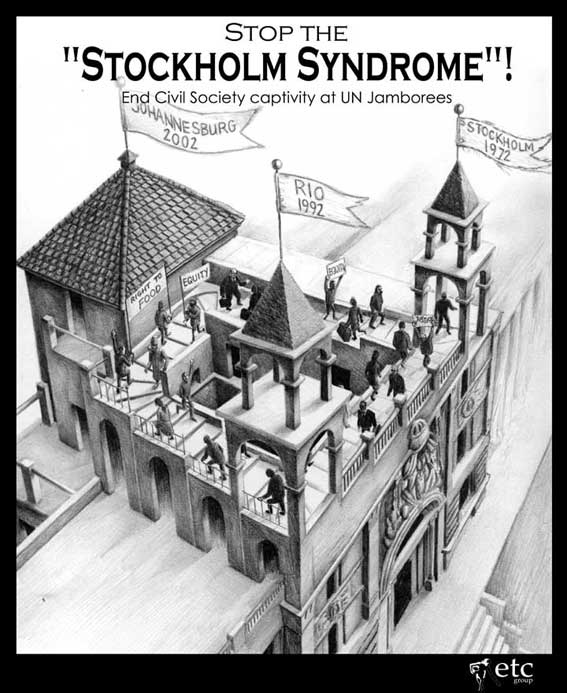
The State and Stockholm Syndrome – Part 2

Today the State is inflicting attack after attack on working people but just like sufferers of Stockholm syndrome many people keep coming back to ask it to protect them.

It is not that this is an idea with no rational content at all.  It does have a basis in reality but not one that justifies the political positions of some of the Left.

Last week on RTE news some disabled people were interviewed protesting outside the Dail at cuts to personal assistance, without which they might be forced into hospitalisation or else left to suffer appalling neglect.  Their protest was a powerful demonstration of the enormous dependence some of the most vulnerable have on the State and the capacity of that State to mistreat them appallingly.  While the media and others basked in the achievements of Irish athletes in the Paralympics in London the Irish State was preparing to shaft disabled citizens at home.  The protests succeeded in getting a U-turn on the proposed cuts and a rare but welcome victory.

This is but one example of the welfare state which is what the Left has in mind when it defends the state.  Where the right wing scream private good and public bad the left has often responded by defending public services and with declarations of the evils of the private sector.

Opposition to welfare cuts and to cuts in education and health services should not however imply any wider defence or support for the state or ‘public sector’.  The public sector is a large bureaucracy that has no democratic content, often providing poor and inefficient services.  The state training agency FAS is just one outstanding example of the corruption and wastefulness of the provision of services by the State. These are run by a capitalist state, in the interests of capitalism, by bureaucracies totally unaccountable to working people.  Why on earth should there be any inclination to defend what we are not responsible for? What we have no control over? That should rightly be criticised by us for its often bureaucratic waste of our money?

And this is the point. It is working people who pay for the welfare state, not the rich and not capital.  In a paper written some years ago the Marxist economist Anwar Shaikh sought to examine the argument that excessive welfare provision caused economic stagnation and unemployment.  In the course of this he demonstrated for six major countries (US, UK, Australia, Canada, Germany and Sweden) that this was not the case.  His central finding has relevance to our own argument, which was “that social benefit expenditures were financed out of the taxes paid by recipients of these very expenditures: in other words, by and large, social welfare expenditures were self-financed.”

The capitalist state taxes workers and then bribes them with their own money while liberals loudly declare that taxation is somehow progressive, even left-wing, and should be increased to improve welfare servicers and boost the economy.  Workers are expected to uncritically support this as if ‘the State’ is paying for something when it is actually they that are doing so.  The key question of ownership and control of the services provided by the state is ignored and the debate is framed in terms of the supposed ‘socialist’ position of ‘tax and spend’ and the right-wing position of cutting taxes and privatisation.

This framework has been used by the right to push privatisation, presenting it as the only alternative.  But it isn’t, and opposition to privatisation is not itself an alternative to the failures of health system or education systems that consistently betray those most in need of their help.  Too often the woeful character of state services has been defended in some misguided belief that defending state ownership is defending the workers delivering the services.  Such an error is rarely made when the unsatisfactory nature of services or products produced by workers in the private sector comes under similar attack.  It is against this background that the State seeks to divide private sector workers against public sector workers and portray the trade unions, often accurately enough, as primarily interested only in the latter because that is where their own bureaucratic power base resides.

While socialists must oppose privatisation as a solution to the inefficient provision of services we should never confuse this with support for or excuses for poor State delivery of services.  Too often the attacks on the working conditions of those employed to deliver these services are made prior to privatisation, or prepared prior to privatisation, by the state itself.  Nor is it true that state ownership guarantees better delivery of services.  The appalling neglect of older people in care for example has taken place under both private and state provision.

So what we have then is the provision of welfare state services which workers pay for but which are delivered often bureaucratically, with no democratic control and often in oppressive ways, such as the means-testing of welfare recipients.  Many workers delivering the services conscientiously do their best but this is despite rather than as a result of how they are organised and managed.  Simply demanding more welfare ignores all this and ignores that it is workers who pay for it.

Many are happy to pay because they care about the services provided and have in the past or will in the future benefit from them.  The provision of unemployment insurance etc. limits the devastation to living standards consequent on redundancy or sickness.  It puts a floor under the minimum wages capitalists can demand, which is why they always want it reduced; but fundamentally it is necessary because a pool of unemployed is necessary for capitalism and this pool must be of sufficient quality to take up employment when it is available.  Welfare capitalism is necessary for the capitalist system as a cost effective way of preserving the quality of labour power.  It is not fundamentally about delivering on the human needs of people.

The large growth of the capitalist state sector, from an average in the OECD (advanced capitalist countries)  of 27 per cent of gross Domestic Product in 1960 to 42 per cent in 1988 (statistics from Shaikh paper), has been the material and ideological power base of social democratic ideas that the capitalist system has been or can be reformed, if not into socialism, then at least something ‘different’ or along vague lines of ‘another world is possible’.   The limited standards of the services provided and endemic insecurity under which welfare recipients live are one testament to the limits and precariousness of this social democratic vision of reform.

Workers expected to row in behind demands to defend a large state should be aware that this sector has grown in recent years because of the state’s role in preventing a financial collapse pushing the whole capitalist system over a cliff. In Ireland, as in many other countries, workers are having to pay for it through tax increases and service cuts.  The last thing workers need is the idea that the State is something neutral that can be captured to represent its interests.  Yet this is the present perspective of much of the Left who have diagnosed the current situation as first of all a ‘crisis of working class representation’.  That is, a crisis of the social democratic illusions that once had hegemony over many workers, although to a much lesser degree in Ireland, who have suffered mainly from capitalist populism.

This dependence on the State as part of the fundamental programme of the Left is the ideological explanation for the electoralist strategy now so much a feature of the Left.  It is no accident that the need for a United Left Alliance was suddenly seen before the general election.  Having made the electoral intervention the need for unity was then considered by some as no longer so strong and the promised progress to a real party has evaporated.  We know when it will come back, if it’s not too late.

If this is at least one of the ideological origins of the chronic electoralism of the Left it must still be explained why this has happened given the parallel ideological notion that what the Left organisations want is a revolution in which the working class seizes state power.[i]

Whatever about the belief in revolution this has not been a practical proposition for many years: during the Celtic Tiger boom or the social and political defeat of workers during the previous couple of decades.  So, while often preaching revolution in the future, as a matter of pure practicality it has done what is actually possible.  Given its ideological confusion on the role of the state and having no conception of revolutionary politics outside of a contest for state power the Left has degenerated into electoralism.

The contest for state power by the working class in a long period where the working class has not been interested in such a project has become a reformist contest for state power which resolves into just getting elected to parliament.

The real Marxist attitude to the state, as opposed to dependence on the state for solutions, which I have looked at here, here and here for example, will be the subject of future posts.


[i] I realise that the Socialist Party has political roots which eschew this traditional Marxist view in favour of a perspective of a Left electoral victory, leading to majority in Parliament passing legislation nationalising big industry with the support of mass mobilisations, this allowing the introduction of what they believe to be socialism. But this has always been a relatively hidden revision of Marxism that is disguised by what is presented as a rather rigid orthodoxy.