Marxism and Gender Identity Ideology (5) – Believe as you’re told

It’s always been said that if you’re going to tell a lie, tell a big one.  The more outrageous the better. It immediately requires a big denial that itself feels like it is making a big claim.  A big lie also has numerous and wide consequences, so denial equally requires a lot of follow-through.

For many people the social opprobrium of denial is enough to impose silence and there are lots of incentives to keep schtum, including entreaties to ‘be kind’, be ‘on the right side of history’, not to be a bigot – or what seems to work better – not have anyone call you one.  And so many people on ‘your side’ seem to go along with it, and so many not on ‘your side’ seem to be against.  Anyway, it all involves a small number of people so let’s not get exercised about it.

An additional factor is the temptation not to think too hard about it all, lest you end up having the debate in your head that you have been insistently told you can’t have outside it. The ‘no debate’ mantra of some trans activists thus functions at two levels.  It immediately fences off from acceptable discussion disagreement with the view that men can become women – and in doing so claim all their rights – and treats such disagreement as akin to racism or homophobia. The assertion itself is therefore free from questioning.

Since there is now a fashion for the introduction of hate crimes in certain countries, the subjective views of those carrying out alleged criminal acts are also taken into account; meaning that what you think can also be taken as an aggravating factor and in effect become an ancillary crime itself. We are not quite in ‘thought-crime’ territory but we are definitely in the land of ‘impure thoughts’, so you must not only do as you are told but believe it as well.

I have written before that this ‘no debate’ mantra is the cause of the ‘toxicity’ of the (non) debate, so is largely the result of the virulence of tans activism.  Of course, this is a product of the preposterous nature of the claim itself but the consequence of this combination – of the outlandish claim and command to agree – results in the anger of those critical of the claim, and their exasperation at those who just want to ignore it, or turn a Nelsonian eye to the whole thing.

Again and again, however, the ideology hits you in the face, with the claim to be a uniquely vulnerable and marginalised minority clashing with the obvious support accorded to it by the state and other institutions.  Often, when it does, it’s because the consequences of the claim once again conflict with reality.

Let’s take an example I came across in the past week.

My wife was asked to complete a survey originating from Kings College in Britain, the purpose of which was stated as follows:

‘We would like to invite you to participate in this online survey which will explore how anxiety, emotion and wellbeing are experienced in the body after primary breast cancer and in secondary breast cancer. Before you decide whether you want to take part, it is important for you to understand why the research is being done and what your participation will involve’

‘We know that many people struggle with their mental health after primary breast cancer and in secondary breast cancer. Breast cancer and our emotions are also both rooted in the body. However, research has not yet explored how people feel emotions in their body during and after breast cancer, and how this can impact people’s general wellbeing.’

The survey is designed to take about 30 minutes, so not a quick on-line poll: ‘The purpose of the study is to understand how interoceptive sensibility – how someone feels able to sense their internal bodily sensations – impacts people’s experiences of mental health and wellbeing after primary breast cancer and in secondary breast cancer.’

By way of context, Cancer Research UK records that there are around 56,800 new breast cancer cases in the UK every year and that it is the most common cancer in females with around 56,400 new cases every year (2017-2019) but not among the 20 most common cancers in males, with around 390 new cases every year (2017-2019).  This translates into an annual death toll among women of 11,415 and among men of 85 with a mortality rate of 33.9 and 0.3 respectively. This means that women account for over 99 per cent of deaths from breast cancer.

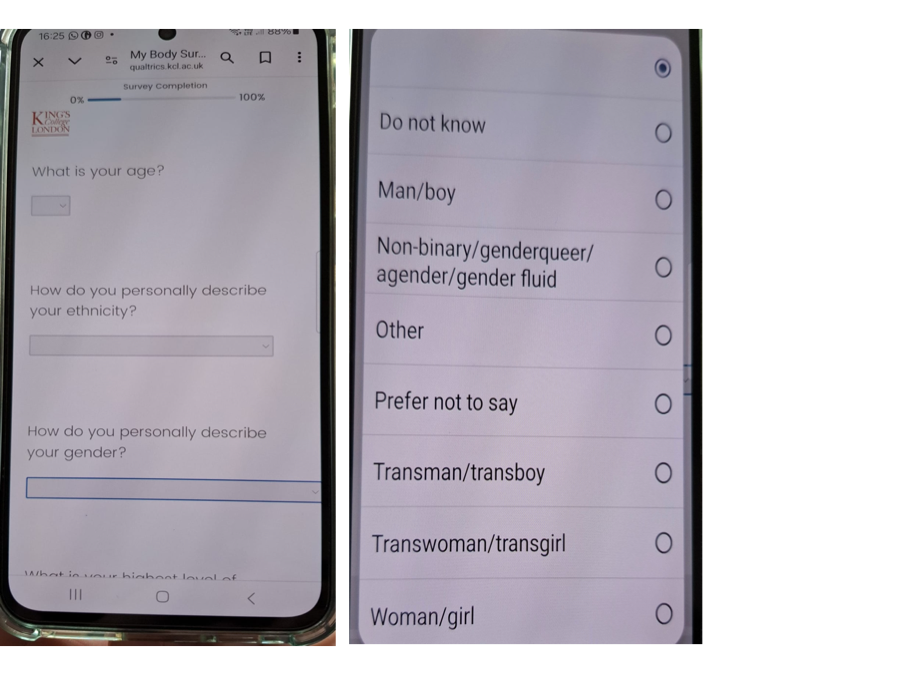
So, if men can also suffer from breast cancer and it is not a women-only disease, perhaps we can accept the use of the word ‘people’ in the survey from Kings College.  What is hard to accept is one of the questions at the start of the survey, which I captured on my phone and the range of potential answers expected and requested:

Question and permitted Answers:

If we were to be (very) charitable, we might say that the survey is about subjective responses to having had or still having breast cancer and that it is a valid objective to distinguish, and then compare, the subjective response of women, men and trans individuals. The permitted answers forswear the outer reaches of trans ideology by lumping together a number of ‘identities’ and excluding the myriad of others of uncertain number.

In doing this however, we would have to ignore the biological basis of cancer and that the overwhelming risk attaching to it is not ‘gender’, whatever that is, but sex.  We would also have to pass over the recognition by the survey’s authors that the study already recognises the primacy of biology by stating that ‘Breast cancer and our emotions are also both rooted in the body’ and that ‘The purpose of the study is to understand how interoceptive sensibility – how someone feels able to sense their internal bodily sensations. . .’

The problem is that the question is designed to find out not only what ‘gender’ someone thinks they are but what sex they are, and if someone were to reasonably state that non-binary/genderqueer/agender/gender fluid are not a sex then the question is at best ambiguous. At worst it is an invitation to accept gender identity ideology; that all the answers are equivalent and gender = sex and there are more than two.  If you don’t accept this equality then you would be entitled not to answer the question on the grounds that you do not have a gender identity.

In this case, from any scientific perspective, the survey is flawed. And in any case, anyone studying the responses who thinks ‘I don’t know’ is a valid answer to the question ‘how do you personally describe your gender’ has a big problem. Is the respondent stupid, confused or does she or he think that the question is stupid or the result of confusion?

Occam’s Razor would lead one to the conclusion that the survey is an example of gender identityideology positing the salience of self-ID to the feelings of women who have or are suffering from cancer. Does this matter?

This is often the question used to puncture opposition to expressions of gender identity ideology.  In this case the scientific soundness of the survey is called into question by mixing incommensurate concepts.  The introduction of the survey, on the stresses of having cancer, to be read by participants before they complete it, is keen to avoid causing further stress, advising ‘that you contact your GP in the first instance.’  One wonders how a question relating to a disease that by over 99 per cent affects women could put this category at the bottom of eight when attempting to identify its public.

Perhaps this will also be excused as a mistake, but that would be to deny the claims of gender identity ideology for which such a question is totally appropriate and absolutely necessary.  Don’t ask why, because that is to presume an explanation that itself presumes reasoning that itself must be open to interrogation, and that would require a debate.

Back to part 4

Forward to part 6

Karl Marx’s alternative to capitalism part 5: capitalism’s achievements

classroom-19th-century-1140x684One comment on an earlier post on the blog relating to the situation in Greece included the following: “So I think the task at hand is not to solve Greece’s economic crisis, this will certainly take years. Rather it is to add some political organisation and direction on to the instinct to fight. I believe that you are thinking too far ahead, overly concerned with what socialism should be in the future, and not really catching the fire of the present.”

Leaving aside whether this was true of this particular post on Greece or even of other posts; a point I have made is that the Marxist movement is too concerned with attempting to “catch the fire of the present”.  This has usually meant jumping on whatever bandwagon it thinks might propel it along in some opportunist direction.  This is informed by the view that socialism will arrive through a capitalist crisis that precipitates political revolution that will destroy the existing state and then introduce the new society.  All of which it will lead through “catching the fire” in some sort of eschatological conflagration.

Missing is the development of the alternative, evolving within capitalism in advance of any crisis, that creates and develops workers’ power in the present and most of all creates the conditions that means workers actually seek a socialist alternative long before any crisis.  Missing is the building of a working class movement that fights for an alternative society now, sees such a new society as its answer to its problems and does not limit itself to the necessarily defensive struggles against capitalist attacks.

This understanding of the working class movement, as embodying the future alternative within itself, is now more or less completely lost but would have been the foundation of workers’ socialist consciousness during most of the first century of the movement’s existence.  So, the building of mass workers’ parties, trade unions, friendly societies, educational organisations and cooperatives were all seen to be the visible rise of the more or less inevitable final victory of socialism.

No such confidence now pervades the socialist movement and part of this impoverished outlook is the perspective of fighting for and relying on the state to deliver the goods.  This and/or the view that some future, but always more or less near, political crisis will quickly precipitate a struggle and a consciousness adequate for a successful political revolution.   A view that forgets that socialist revolution is distinguished by it being primarily a social one and the Marxist view that social being determines consciousness: that is the development of consciousness is based on the development of capitalism, including what workers do over many decades to develop their own power and organisation within it. There is no exception in such a view for small groups propagandising for revolution, crisis or no crisis.

The patient building of workers organisations, such as cooperatives, is viewed by some as simply reform of capitalism when in fact no successful revolution will be possible without them.  Opposition to what has been termed the stages theory of revolution, that every workers struggle is inevitably limited to certain non-socialist goals, is confused with rejection of the truth that the working class will go through stages of development and that earlier stages that do not immediately threaten the system are also just as necessary because they are expressions of the workers own activity and power.

That this has been more or less forgotten is both a product and producer of the decline of the socialist movement.

That is why I started to write a series of posts on Marx’s alternative to capitalism, because without such an alternative there will be no, well to state the obvious – alternative!  It’s why this series is now continued.

*                                                     *                                                 *                                                              

In the last post on Marx’s alternative I said I would look at the evidence that the development of capitalism continues to provide the grounds for socialism as an alternative.  By this I mean the contradictory nature of capitalism is still creating on an increasing scale its gravediggers, the working class, and that even “with all the miseries it imposes upon them, the present system simultaneously engenders the material conditions and the social forms necessary for an economical reconstruction of society.” Marx.

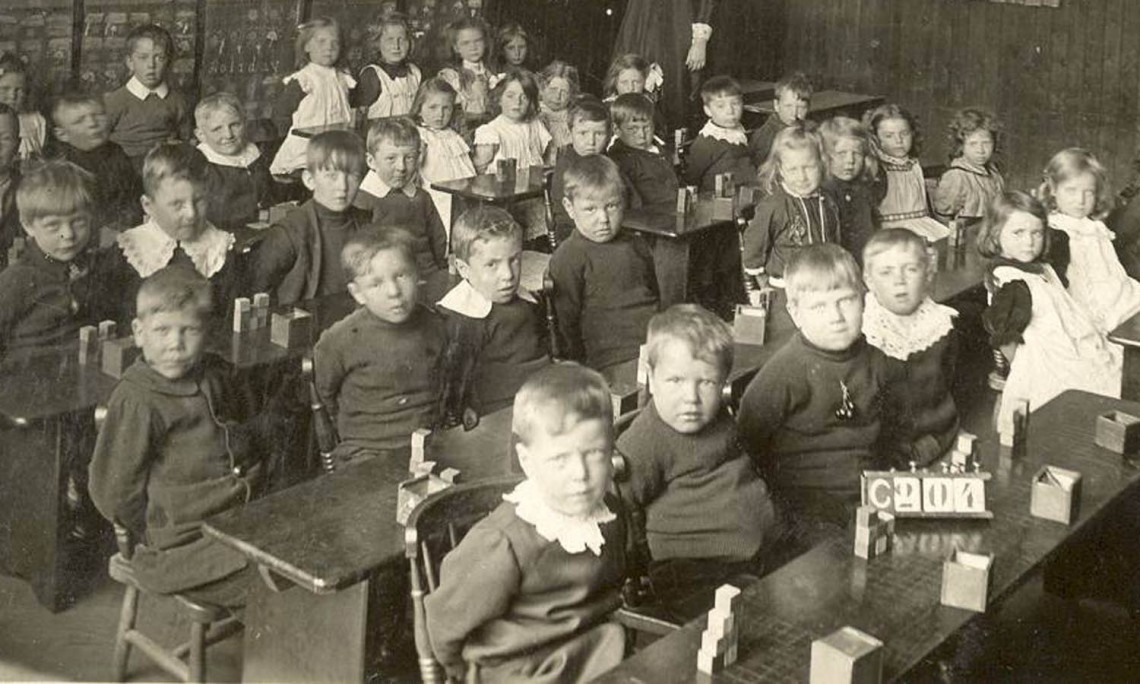
A look at the long term development of capitalism illustrates what Marx called its civilising mission, a product not just of the growing requirements of capitalist production for an educated and relatively healthy workforce but of the needs of the capitalist state itself that provides most of this education.  By 1985 mass education was compulsory in 80 per cent of the countries of the world and over 90 per cent of the world’s children spent some time enrolled in school.

Estimates for the year 1900 put participation rates in primary education at under 40 per cent in most parts of the world outside North America, northwest Europe and English speaking areas of the Pacific, where it was over 70 per cent.  By the beginning of the twenty-first century every part of the world had achieved the minimum of the most industrialised countries at the start of the 20th century and most had exceeded it.

The picture of course is far from universally rosy and a 2007 UNESCO report estimated that in 2004 781 million adults did not have minimum literacy skills and close to 77 million children of school age were not enrolled in school.  Nevertheless the twentieth century was the first in human history in which the majority of the world’s population learned to read and write.

The development of higher level education has been just as dramatic.  In 1900 roughly half a million were enrolled in higher education institutions across the world.  By 2000 the number had grown two-hundredfold to 100 million people.  Growth in higher education has not slowed but accelerated in the latter part of the twentieth century; particularly after about 1960, with enrolment rates climbing rapidly, especially of women.  This growth has created what amounts to a global higher education system with “the same subjects . . . taught with the same perspectives leading to very similar degrees . .” (The Worldwide Expansion of Higher Education in the Twentieth Century)

If we look at population and health we can see the capacity of the productive system to support a growing population and improved health.  “Since 1800, global population size has already increased by a factor of six and by 2010 will have risen by a factor of ten. . . . The length of life, which has already more than doubled, will have tripled . . In 1800, women spent about 70 percent of their adult years bearing and rearing young children, but that fraction has decreased in many parts of the world to only about 14 percent, due to lower fertility and longer life.” (The Demographic transition: Three centuries of Fundamental Change)

Global life expectancy (years at birth) in 1700 was 27, still 27 in 1800, 30 by 1900 47 by 1950 and 65 by 2000, while population was 0.68 billion, 0.98, 1.65, 2.52 and 6.07 billion in the same years.  This decline in mortality began about 1800 in northwest Europe, and in many lower income countries at the beginning of the twentieth century, accelerating after the Second World War.

“The first stage of mortality decline is due to reductions in contagious and infectious diseases that are spread by air or water. Starting with the development of the smallpox vaccine in the late eighteenth century, preventive medicine played a role in mortality decline in Europe. However, public health measures played an important role from the late nineteenth century, and some quarantine measures may have been effective in earlier centuries. Improved personal hygiene also helped as income rose and as the germ theory of disease became more widely known and accepted. Another major factor in the early phases of growing life expectancy is improvements in nutrition. Famine mortality was reduced by improvements in storage and transportation that permitted integration of regional and international food markets . . .”

“In recent decades, the continuing reduction in mortality is due to reductions in chronic and degenerative diseases, notably heart disease and cancer (Riley, 2001). In the later part of the century, publicly organized and funded biomedical research has played an increasingly important part, and the human genome project and stem cell research promise future gains.”

“Many low-income populations did not begin the mortality transition until some time in the twentieth century. However, they then made gains in life expectancy quite rapidly by historical standards. In India, life expectancy rose from around 24 years in 1920 to 62 years today, a gain of .48 years per calendar year over 80 years. In China, life expectancy rose from 41 in 1950–1955 to 70 in 1995–1999, a gain of .65 years per year over 45 years.” (The Demographic transition: Three centuries of Fundamental Change)

Again however the gains in life expectancy are not uniform and the productive advances of capitalism, some of which are reflected in public health and medical advances, are subordinated to the accumulation of profit.  This is most clearly seen in the two significant exceptions noted in the article quoted above – the stagnation in mortality gains and increased mortality from HIV/AIDS in sub-Saharan Africa and the decline in life expectancy in Eastern Europe and the former Soviet Union arising from their transition to capitalism.  The article quotes the UN in 2002 noting that male life expectancy in the Russian Federation was 60, similar to that of India.

Back to Part 4

Forward to Part 6